Patients › Rehabilitation
Reparo do tendão tríceps distal
Um plano de recuperação protegido após a reparação do tendão do tríceps distal no cotovelo: manter o braço em uma tipoia simples, num ângulo de 90 graus, liberando o movimento; em seguida, a extensão ativa; por fim, desenvolver a força em etapas cuidadosas.
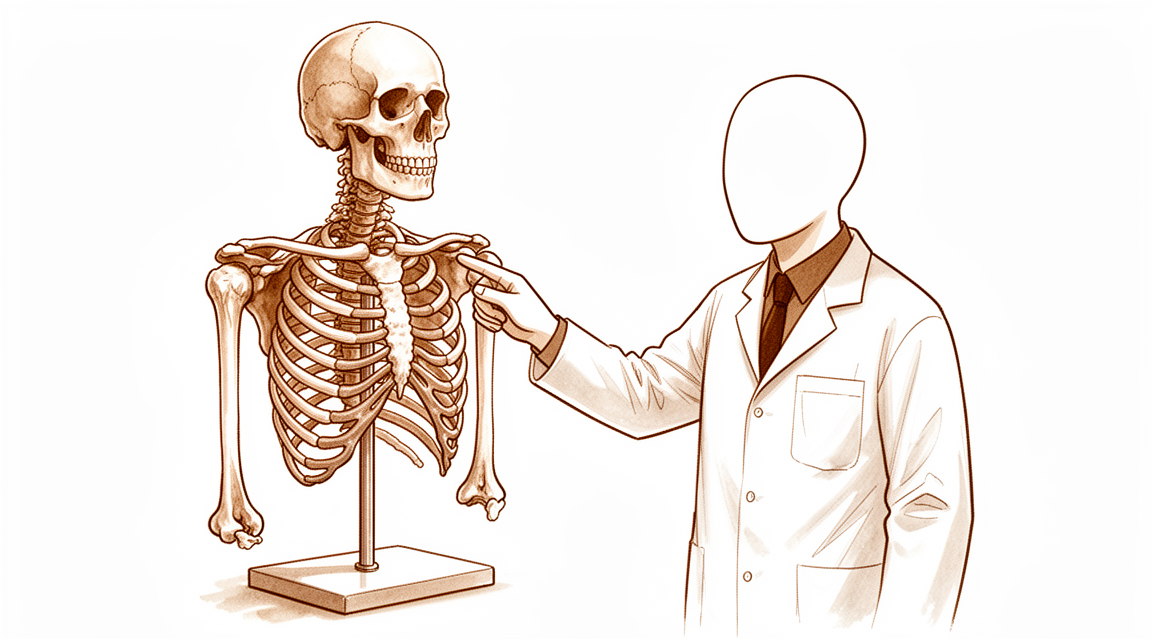
Este protocolo orienta sua recuperação após o reparo cirúrgico do tendão distal do tríceps (o tendão que conecta o músculo tríceps – responsável pela extensão do cotovelo – à extremidade do cotovelo), sob a orientação do Dr. Kieran Hirpara no Mater Private Hospital Rockhampton. Ele começa com um programa de exercícios para ser feito em casa, seguido pelo protocolo clínico estruturado elaborado para seu fisioterapeuta ou terapeuta da mão; leve esta página ou seu arquivo PDF à sua primeira sessão de terapia, para que a reabilitação seja devidamente coordenada. Seu terapeuta poderá ajustar o plano conforme a evolução da sua recuperação.
Caso tenha alguma dúvida ou preocupação quanto à ferida pós-cirúrgica, entre em contato com o consultório. Geralmente, é útil tirar uma foto da ferida e enviá-la por e-mail para análise.
O que esperar
A reparação do tríceps distal consiste em recolocar o tendão rompido sobre o osso, no nível do cotovelo (olécrano). Ao final da cirurgia, o Dr. Hirpara verifica se a reparação está segura e intacta com o cotovelo dobrado em um ângulo reto (90°). Por esse motivo, o seu cotovelo fica apoiado em uma tipoia simples, mantida a cerca de 90°, uma posição confortável e padrão. Não é utilizada nenhuma órtese com articulação, e o cotovelo não é mantido quase esticado. A tipoia é retirada durante os exercícios e para a higiene.
O tendão é submetido a tensão de duas maneiras distintas; o plano inicial visa protegê-lo contra ambas:
- Dobrar o cotovelo estica a área reparada. Assim, nas primeiras seis semanas, o grau de flexão é limitado a 90° (ângulo reto). Em contrapartida, esticar o cotovelo relaxa o tendão; portanto, esticá-lo completamente é permitido e incentivado, desde que confortável.
- Esticar ativamente o cotovelo ativa o tríceps, que puxa a área reparada. Por isso, nas primeiras seis semanas você não deve esticar o cotovelo ativamente por conta própria; esse movimento deve ser feito de forma suave e com auxílio, sem envolver o tríceps diretamente.
Posteriormente, os movimentos são ampliados gradativamente: a partir de seis semanas, permite-se maior amplitude de flexão; também a partir dessa fase, o esticamento ativo torna-se permitido. A partir de doze semanas, inicia-se o fortalecimento com resistência. A cicatrização da reparação prossegue por vários meses; por isso, o aumento da carga e o retorno às atividades esportivas são feitos de forma gradual, e não de uma só vez.
Precauções e limitações
- NÃO dobre o cotovelo além de um ângulo reto (90°) durante as primeiras seis semanas aproximadamente, pois isso estica e sobrecarrega a área reparada. É permitido e recomendado manter o cotovelo totalmente esticado.
- NÃO tente esticar o cotovelo ativamente usando a força muscular nas primeiras seis semanas; deixe que ele seja esticado suavemente com ajuda, sem forçar o tríceps.
- NÃO realize nenhum movimento de extensão resistida ou empuxo/pressão com o braço até cerca de doze semanas: nada de exercícios de tríceps, nenhum supino ou exercícios de pressão acima da cabeça, nem tentativas de se levantar de uma cadeira ou cama usando o braço operado.
- Use a tipoia mantendo o cotovelo a 90° conforme orientado (não se trata de uma órtese rígida, nem deve ser mantida totalmente reta); NÃO dirija enquanto estiver usando-a ou enquanto seu braço não conseguir controlar o volante com segurança.
- Comece desde já a movimentar a mão, o pulso e o ombro; utilize a mão para tarefas cotidianas leves, desde que não envolvam empuxo, levantamento de peso ou flexão forçada do cotovelo.
Para orientações sobre cuidados com a ferida, inchaço e cicatrização, consulte o guia de cuidados com a ferida do consultório.
Seus exercícios
Kieran Hirpara 4.0
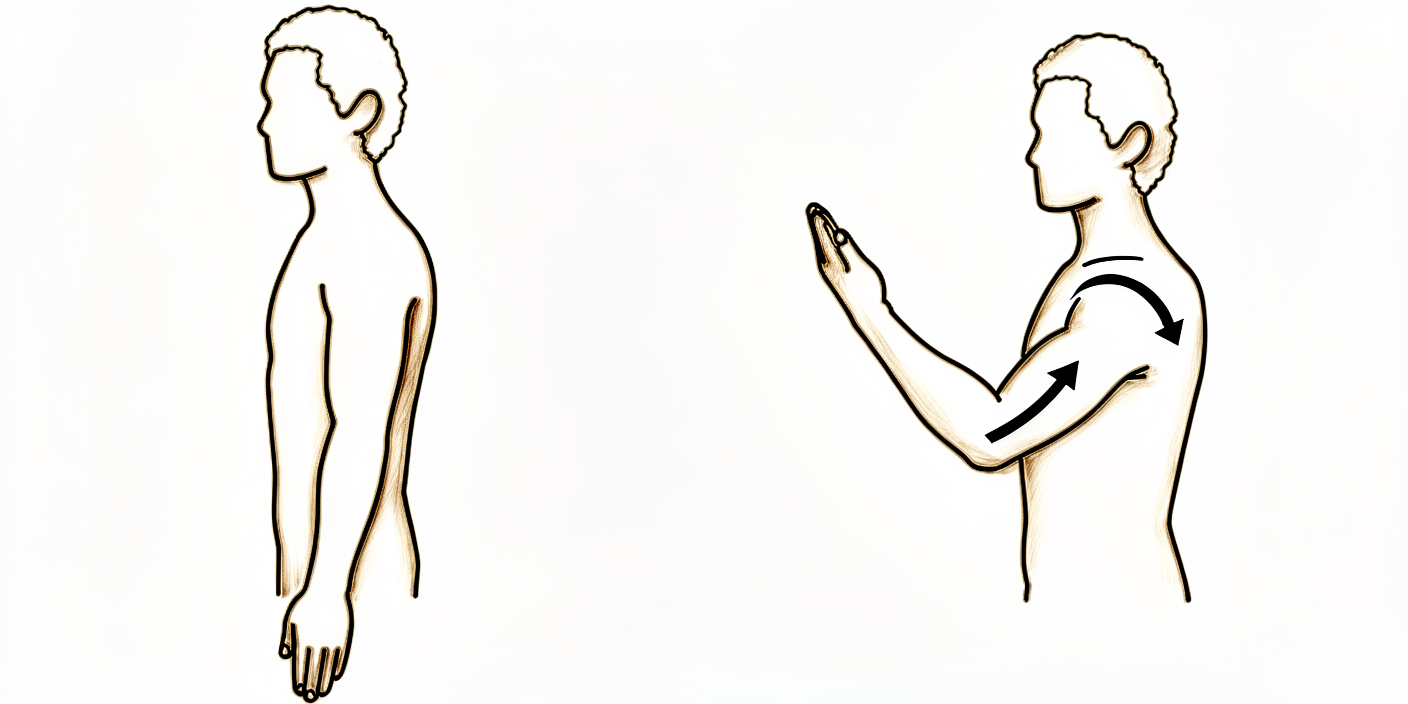
Movimentação protegida do cotovelo (arco de 0–90°)
Após retirar a tipóia, movimente o cotovelo suavemente dentro de sua faixa de movimento segura: você pode estendê-lo completamente (a extensão é livre, até onde for confortável), mas NÃO deve dobrá-lo além de um ângulo reto (90°) — aproximadamente o mesmo grau necessário para segurar um telefone junto ao ouvido. Faça os movimentos lentamente e mantenha-se dentro dessa amplitude. Dobrar o cotovelo além de 90° exerce tensão sobre o tendão em recuperação; por isso, esse movimento é restrito durante aproximadamente as primeiras seis semanas.
10 vezes, 2–3 vezes ao dia, dentro do arco de 0–90°
Kieran Hirpara 4.0
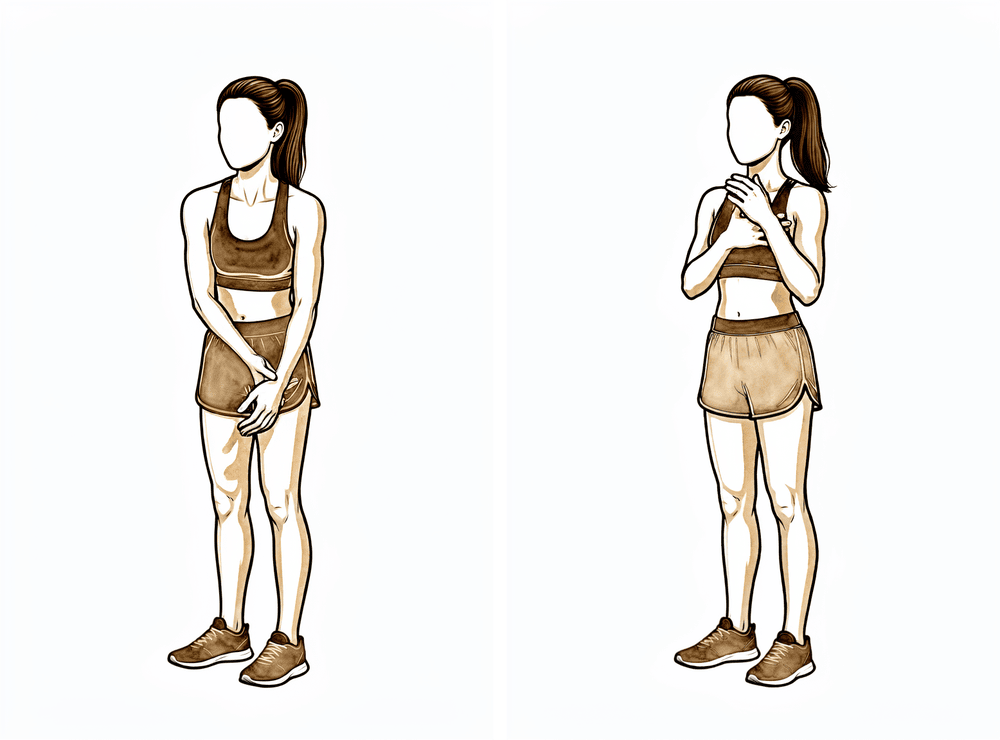
Flexão de cotovelo assistida (passiva)
Use a outra mão para dobrar suavemente o cotovelo operado em direção ao ombro, mantendo o tríceps totalmente relaxado — você não deve fazer força com o braço operado. Pare quando atingir o limite estabelecido (cerca de 90° no início). Isso mantém o cotovelo flexível sem sobrecarregar o tríceps.
10 vezes, 2–3 vezes ao dia, apenas até o limite estabelecido.
Kieran Hirpara 4.0
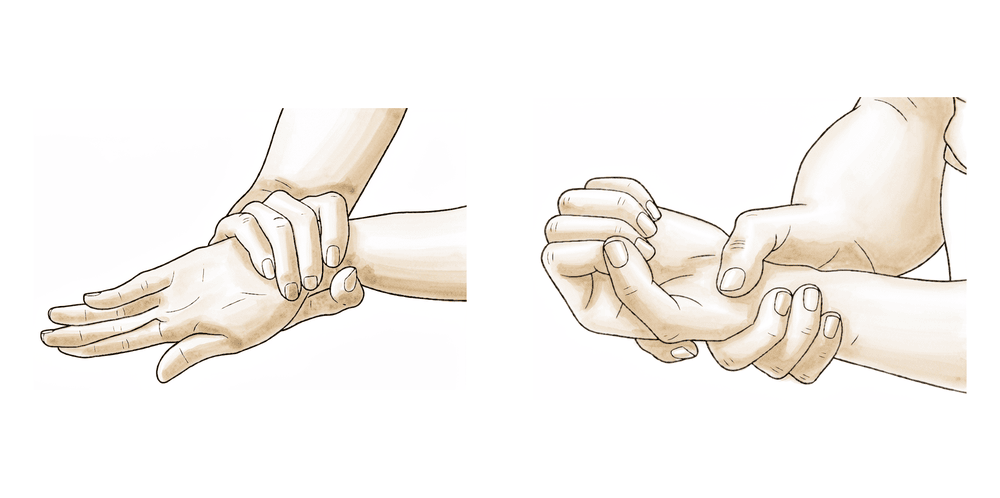
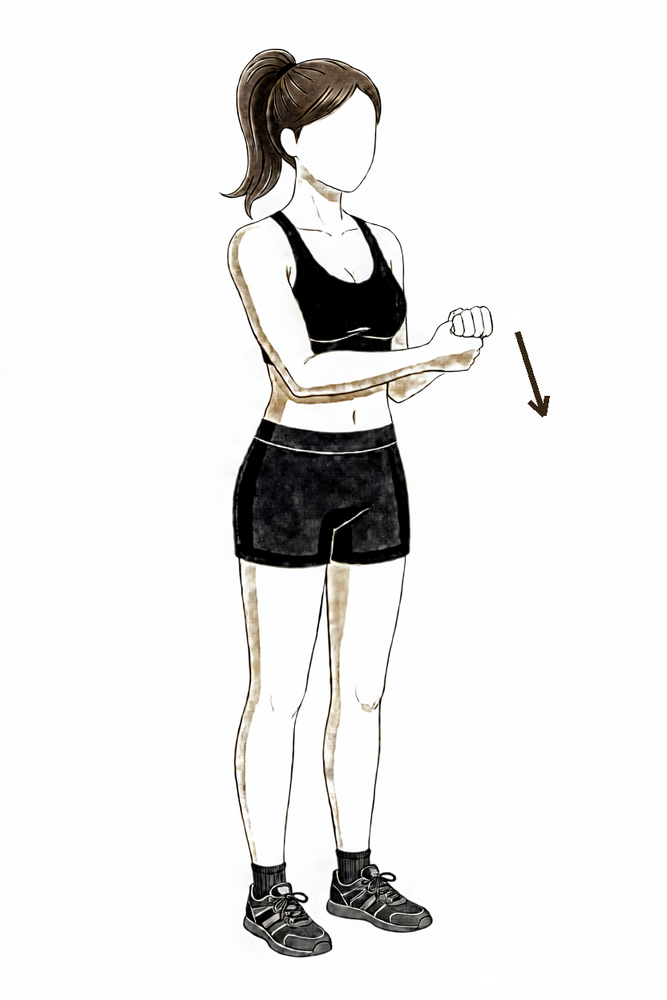
Rotação do antebraço (palma da mão para cima / palma da mão para baixo)
Com o cotovelo puxado para perto do corpo e dobrado de forma confortável, vire suavemente a palma da mão para cima, em direção ao teto, e depois para baixo, em direção ao chão. Faça isso de maneira lenta e tranquila. Isso mantém o antebraço flexível e não sobrecarrega a reparação do tríceps, permitindo que o exercício seja iniciado precocemente.
10 vezes em cada direção, 2–3 vezes ao dia.
Kieran Hirpara 4.0
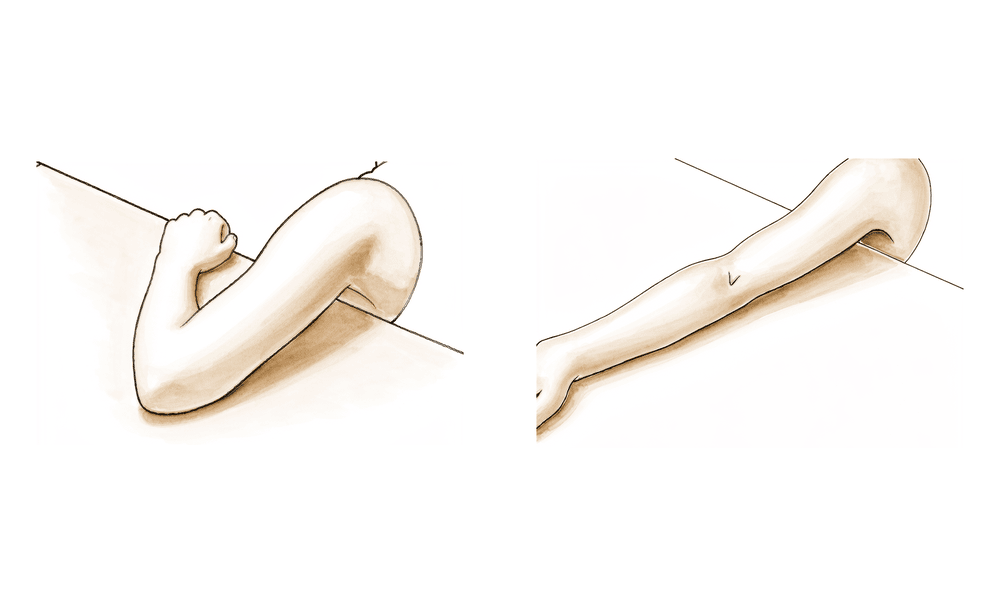
Contração isométrica do tríceps (suave, sem movimento)
Um exercício posterior — somente quando o fisioterapeuta o indicar (geralmente a partir da 8ª semana). Com o cotovelo apoiado, contraia suavemente o músculo na parte POSTERIOR do braço (o tríceps), como se quisesse esticar o cotovelo, MAS SEM permitir que ele se mova de fato — apenas uma leve pressão, mantida por um instante e depois relaxada. Não realize esse exercício nas primeiras seis semanas.
Mantenha por ~5 segundos, 5–10 vezes, conforme orientação (fase posterior).
Kieran Hirpara 4.0
Extensão ativa do cotovelo (sem resistência)
Um exercício posterior — deve ser iniciado por volta da 6ª semana, após autorização médica. Estique suavemente o cotovelo por conta própria, sem carregar peso na mão; em seguida, use a outra mão para ajudar a abaixá-lo novamente (assim, o tríceps ainda não precisa controlar a fase de descida). Mantenha-se sem dor. Não há nenhum movimento de extensão ativa nas primeiras seis semanas.
10 vezes, conforme orientação (a partir de aproximadamente 6 semanas, sem resistência)
Kieran Hirpara 4.0
Contração do tríceps contra leve resistência (extensão isométrica)
Um exercício posterior — a partir de aproximadamente 8 semanas, conforme orientação. Pressione o antebraço suavemente contra a outra mão ou contra uma superfície fixa, como se quisesse esticar o cotovelo; aumente a força apenas até um nível leve e confortável, mantendo essa posição sem mover o cotovelo. Esse exercício ativa o tríceps antes que se permita a realização de exercícios resistidos.
Mantenha por ~5 segundos, 5–10 vezes, conforme orientação (fase posterior).
Kieran Hirpara 4.0
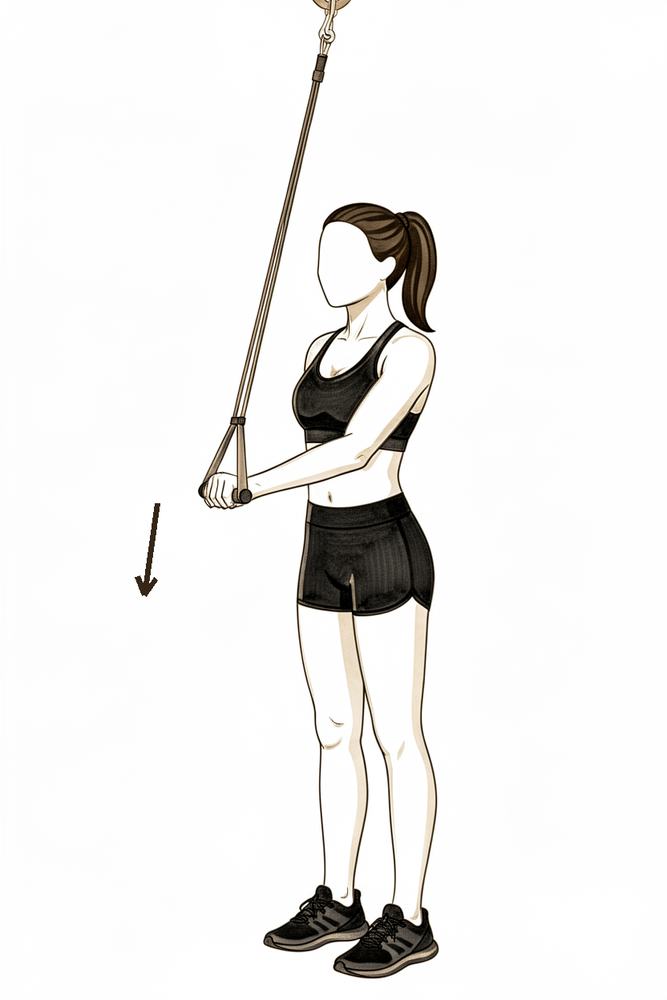
Extensão do cotovelo resistida com faixa elástica (fortalecimento tardio)
Um exercício de fase tardia — só deve ser iniciado após a liberação para atividades de resistência, geralmente a partir da 12ª semana. Estique o cotovelo contra uma faixa de resistência leve e, em seguida, controle o movimento de volta de forma lenta. Aumente gradualmente a resistência ao longo de várias semanas. Esse exercício carrega diretamente o tendão reparado; por isso, é o último a ser introduzido. Nunca apresse esse processo, e interrompa-o caso cause dor.
Conforme orientação do seu fisioterapeuta (apenas a partir da 12ª semana).
Estes são os exercícios contidos no seu folheto informativo. Comece a realizá-los somente sob orientação do Dr. Hirpara e do seu fisioterapeuta, respeitando os limites e a amplitude de movimento que lhe foram indicados. Os exercícios iniciais visam manter o cotovelo e o antebraço em movimento, sem sobrecarregar ou esticar a área reparada: movimentos suaves dentro da faixa protegida de 0–90°, flexão assistida e rotação do antebraço. Os exercícios para o músculo tríceps, a extensão ativa e os exercícios com elástico pertencem a fases posteriores e só devem ser iniciados após autorização expressa. Interrompa qualquer atividade que cause dor aguda na parte posterior do cotovelo.
Seu protocolo clínico
O restante desta página descreve o protocolo clínico em etapas para a reabilitação após reparo do tendão do tríceps distal. Esta seção deve ser entregue ao seu fisioterapeuta ou terapeuta da mão; cada fase começa com uma explicação simples, em linguagem acessível, sobre o que está ocorrendo. O reparo é submetido à carga por meio da flexão do cotovelo (que o estica) e da extensão ativa ou resistida (que contrai o tríceps sobre ele); portanto, o protocolo visa proteger ambos os movimentos enquanto restaura a amplitude articular, seguido pela extensão ativa e, por fim, pelo fortalecimento resistido.
Antes do início do tratamento, verifique o relatório cirúrgico do paciente e seu histórico médico; ainda, consulte o cirurgião responsável quanto ao método de fixação (túneis transósseos ou âncoras de sutura), qualidade do tecido e amplitude de movimento permitida. No caso do reparo realizado pelo Dr. Hirpara, a segurança foi comprovada intraoperativamente na posição de 90° de flexão; o paciente permanece em uma tipoia simples nessa mesma posição (sem uso de órtese articulada, sem manutenção da extensão). A amplitude de movimento protegida é de 0–90°; a extensão pode ser realizada conforme o conforto do paciente, enquanto a flexão é limitada a 90°.
Fase I — movimento protegido em uma tipoia a 90° (semanas 0 a 6)
Nas primeiras seis semanas, a tipoia protege a reparação cirúrgica e evita a rigidez do cotovelo. O braço permanece numa tipoia simples, mantido a 90°, sendo retirada apenas para exercícios e higiene. O cotovelo só pode mover-se dentro do arco de movimento protegido de 0–90°: pode estender-se totalmente para maior conforto, porém não deve dobrar-se além de um ângulo reto, e jamais sob ação ativa do tríceps.
Para o seu fisioterapeuta:
Instruções e precauções - Imobilizar o cotovelo numa tipoia simples a 90° (sem órtese articulada; não mantida próxima à posição de extensão); retirar para exercícios e higiene - Arco de movimento protegido apenas de 0–90°: extensão livre até o limite de conforto; flexão nunca além de 90° - Proibida qualquer extensão ativa ou resistida do cotovelo (a contração ativa do tríceps sobrecarrega a área reparada) - Proibido carregar peso ou empurrar com o braço operado; uso leve e sem carga da mão, dentro do limite do conforto - Realizar movimentos passivos suaves nos ombros no início (protege a cabeça longa do bíceps que atravessa a articulação)
Manejo clínico - Ferida: manter curativos cirúrgicos conforme orientação; monitorar sinais de infecção - Edema: manter o braço elevado, realizar movimentos de bombeamento suaves com a mão e aplicar gelo conforme necessário - Exercícios: movimentos ativos assistidos ou passivos do cotovelo dentro do limite de 0–90° (extensão até o limite de conforto; flexão limitada a 90°); movimentos ativos de punho, mão e preensão; movimentos passivos suaves dos ombros; rotação suave do antebraço; proibida qualquer extensão ativa
Critérios para avançar para a fase seguinte - Ferida completamente cicatrizada; capacidade de mover o cotovelo de forma confortável e controlada num arco de 0–90° por volta da sexta semana
Fase II — avançar na flexão e iniciar a extensão ativa (semanas 6 a 12)
A partir da sexta semana, o limite de flexão é liberado, permitindo que o movimento ultrapasse 90° até atingir a amplitude completa. A extensão ativa é introduzida sem resistência, e o tríceps é suavemente reativado por meio de exercícios isométricos. A extensão com resistência e a carga de peso ainda são proibidas.
Para o seu fisioterapeuta:
Avaliações - Amplitude de movimento ativa e passiva (flexão agora ultrapassando 90°, extensão); dor e inchaço; avaliação da ferida/ cicatriz
Instruções e precauções - Avance a flexão além de 90° até atingir a amplitude completa de forma gradual, a partir da sexta semana - Não realizar extensão com resistência nem colocar peso no braço até a 12ª semana
Tratamento - Exercícios: na semana 6–8, inicie a extensão concêntrica ativa SEM RESISTÊNCIA, dentro da faixa de movimento sem dor (auxilie a fase excêntrica com o outro braço); na semana 8, realize isometrias leves e submáximas do tríceps; mantenha a mobilidade em todo o arco de movimento e a rotação do antebraço; inicie o cuidado com a cicatriz após sua completa cicatrização
Critérios para avançar - Amplitude de movimento completa e indolor; extensão ativa plena com bom controle; dor ≤3/10
Fase III — fortalecimento e retorno (semanas 12 a 16 e além)
Após a restauração do movimento e com autorização para exercícios resistidos (por volta da 12ª semana), inicia-se o fortalecimento, de forma gradual: exercícios resistidos para o tríceps (primeiro concêntricos, depois excêntricos), seguidos por carga em cadeia fechada leve e, posteriormente, exercícios de pressão com amplitude limitada. O retorno ao esporte é baseado em critérios clínicos; o mais cedo possível, ocorre por volta dos cinco a seis meses.
Para o seu fisioterapeuta:
Avaliações - Força do tríceps em comparação ao lado contralateral; resposta de dor/inchaço à carga; testes funcionais e específicos para o esporte ou atividade laboral, conforme necessário
Instruções e precauções - Iniciar o fortalecimento resistido do tríceps (concêntrico → excêntrico) por volta da 12ª semana; aumentar a carga gradualmente - Carga em cadeia fechada a partir da 12ª semana (começar com carga leve e amplitude reduzida); exercícios de pressão leves (flexões, amplitude limitada) a partir da 14ª semana
Conduta terapêutica - Exercícios: extensão resistida do cotovelo de forma progressiva (primeiro com faixas elásticas, depois com pesos leves); carga em cadeia fechada gradual; exercícios de pressão com amplitude limitada; manter quaisquer exercícios de mobilidade ainda necessários - Considerar a alta quando a força atingir níveis quase simétricos e houver recuperação funcional adequada - Encaminhar novamente ao médico responsável caso a recuperação estagne ou os resultados sejam insatisfatórios
Critérios para retorno ao esporte - Força do tríceps de grau 5/5; capacidade de realizar movimentos de alta velocidade e específicos ao esporte sem dor
Voltando ao trabalho e às atividades
O uso leve e cotidiano da mão (comer, escrever e cuidados pessoais leves) é incentivado desde o início, desde que feito dentro do limite do conforto e sem exigir empurrar, levantar ou dobrar o cotovelo além de sua capacidade. Como não se deve dirigir enquanto o braço estiver imobilizado ou incapaz de controlar o volante com segurança, planeje contar com ajuda para o transporte nas primeiras semanas; a volta à direção só ocorre após a retirada da tipoia e quando o paciente conseguir controlar o carro, conforme confirmado na consulta de acompanhamento.
Atividades que exigem resistência ou carga sobre o braço (empurrar, pressionar, levantar e puxar) devem ser evitadas até cerca de doze semanas, quando então serão introduzidas gradualmente. O retorno aos esportes só é possível, no mínimo, após cinco a seis meses, desde que haja recuperação total do movimento sem dor e força adequada e simétrica do tríceps, avaliadas pelo Dr. Hirpara e pelo fisioterapeuta, e não apenas com base no tempo decorrido. O retorno a trabalhos manuais mais pesados segue o mesmo critério de progressão.
Após seguir este protocolo
Este protocolo complementa as orientações gerais de recuperação fornecidas pela clínica: consulte controle da dor pós-operatória, cuidados com a ferida e retorno às atividades esportivas. O plano em etapas descrito acima baseia-se nas diretrizes de reabilitação publicadas para casos de reparo do tendão do tríceps distal; sua recuperação continuará sendo acompanhada individualmente pelo Dr. Hirpara e pelo seu fisioterapeuta, conforme a evolução do seu cotovelo.
Evidence & references
This is the clinical evidence summary written for health professionals. It is technical, and it lists the research this page was built from. You do not need to read it to understand your treatment or to make a decision about it.
Distal Triceps Tendon Repair — Post-operative Rehabilitation (Evidence Brief)
Topic scope: post-operative rehabilitation after surgical reattachment of the avulsed distal triceps tendon to the olecranon (transosseous bone tunnels or suture-anchor footprint repair; best performed within ~3 weeks of injury). The extension mechanism is loaded by elbow flexion (passive stretch of the repair) and by active/resisted extension (triceps contraction), so the rehab cadence is built around protecting both, then restoring motion, then active extension, then resisted strength.
Defining principle: the repair is loaded in flexion and by triceps contraction, so early rehab limits flexion and blocks active/resisted extension while motion is restored, then releases active extension (~6 wk) and resisted extension (~12 wk) in steps, with return to sport at ~5–6 months. Dr Hirpara's stance: the repair is checked intra-operatively to be safe at 90° of flexion, so the elbow is rested in a simple sling at 90° (a standard, comfortable position — no hinged brace, and NOT held near extension) with a protected 0–90° arc (extension free to comfort, flexion capped at 90°) for ~6 weeks. This is deliberately less restrictive on early flexion than the published near-extension / 20°-flexion-lock guidelines, while keeping the key loading rules identical (no active extension to 6 wk, no resisted extension to 12 wk).
Evidence base and corpus note
No RCT and no large prospective cohort defines the rehab cadence for distal triceps repair. The phased timeline rests on a published institutional clinical-care guideline (Ohio State Sports Medicine, 2021), which itself cites the core review literature, corroborated by several surgeon and physiotherapy phased protocols. The local RAG corpus is thin on triceps-specific phased rehab (rotator-cuff and biceps content dominates), but it does contain the key biomechanical repair-strength papers, which inform how early and how aggressively one can mobilise. The week-by-week timeline is therefore carried by the published clinical-care guideline, with the corpus supplying the repair-strength evidence that justifies the cadence.
Key principles and controversies
- Early motion vs prolonged immobilisation. Classic teaching favours protective immobilisation (splint 2–6 wk, flexion-limited brace) because the triceps insertion is loaded in flexion. A counter-trend pushes accelerated early ROM where fixation is strong — a cadaveric study comparing dynamic-tape with standard suture fixation under an intense early-rehab protocol found the novel construct biomechanically superior, i.e. fixation strength is the rate-limiter for how early one can mobilise.
- Suture-anchor vs transosseous (bone-tunnel) repair strength. Carpenter et al. (JSES 2018) found no difference in tendon displacement between transosseous cruciate tunnels and suture-anchor repair when the number of sutures is equalised; the technique by Sarokhan & Leung (Arthrosc Tech 2019) cites Clark et al. (2014) finding anatomic (knotless) footprint repair superior to transosseous cruciate repair. Stronger anatomic footprint fixation is the lever that justifies earlier/more aggressive flexion and earlier resisted extension.
- Flexion-limit progression. No consensus on the exact ramp — the OSU guideline locks at 20° then advances ~15°/5 days; others use ~10°/week or an open 0–60° arc. All converge on full passive flexion by ~6 weeks, with active extension deferred to ~6 weeks and resisted extension to ~12 weeks. KH's variant keeps the elbow at 90° in a simple sling with a free 0–90° arc — less restrictive on early flexion, same loading deferrals.
- Strength athletes / high demand. Retrospective series in strength athletes report satisfactory return to sport but underline that resisted extension and pressing loads are the highest-risk re-rupture activities, supporting the firm 12-week resisted-extension / pressing block.
Phased timeline
| Phase | Window | Sling / ROM ceiling | Exercises | Criteria to progress |
|---|---|---|---|---|
| I — Protected motion | Weeks 0–6 | Simple sling at 90° (no hinged brace, not near extension), off for exercises. Protected arc 0–90°: extension free to comfort, flexion capped at 90°. No active extension. | AAROM/PROM elbow within 0–90°; wrist/hand/grip AROM; gentle shoulder ROM; forearm rotation | Wound healed; comfortable, controlled 0–90° arc at ~6 wk |
| II — Advance flexion + active extension | Weeks 6–12 | Release flexion cap; progress flexion past 90° toward full. No resisted extension / weight-bearing. | Wk 6–8 active concentric extension no resistance (assist eccentric with other arm); wk 8 light submaximal triceps isometrics | Full painless ROM; full active extension with good control; pain ≤3/10 |
| III — Strengthening & return | Weeks 12–16+ | Resisted triceps strengthening (concentric → eccentric) from ~12 wk; CKC weight-bearing from ~12 wk (light, small range); limited-range pressing ~wk 14 | Progressive resisted extension; graded loading; sport-/work-specific progression | 5/5 triceps strength; pain-free high-velocity / sport-specific control |
| Return to sport | ~5–6 months | Criterion-based, at the earliest | — | Full pain-free ROM + symmetrical triceps strength |
Evidence strength flags
- MODERATE (protocol cadence): the phased timeline (no active extension to ~6 wk, resisted extension to ~12 wk, return to sport ~5–6 mo) — anchored to the OSU Sports Medicine clinical-care guideline and corroborating surgeon/PT protocols. No defining rehab RCT.
- MODERATE (repair-strength biomechanics): suture-anchor vs transosseous equivalence with equalised sutures (Carpenter 2018); anatomic footprint superiority (Clark, via Sarokhan & Leung); insertional footprint anatomy (Whitaker 2022) — these justify the mobilisation cadence.
- LOW–MODERATE (KH's 90°-sling / flexion-capped-at-90° variant): biomechanically sound (flexion is the repair-tensioning motion; intra-op tensioning at 90° defines the safe arc) and less restrictive on early flexion than published near-extension guidance, while preserving the key extension-loading deferrals. Consensus / expert rather than trial-derived; corpus gap — no RCT or large cohort defines this exact variant.
CITATIONS
RAG corpus (180,000+ Orthopaedic articles)
- Keener JD, Sethi PM. Distal triceps tendon injuries. Hand Clin. 2015;31(4):641–650. DOI: 10.1016/j.hcl.2015.06.012
- Carpenter SR, Stroh DA, Melvani R, et al. Distal triceps transosseous cruciate versus suture anchor repair using equal constructs: a biomechanical comparison. J Shoulder Elbow Surg. 2018;27(11):2052–2056. DOI: 10.1016/j.jse.2018.07.005
- Sarokhan AK, Leung NL. Acute triceps tendon repair: a technique utilizing 3 curved tunnels and proximal knots. Arthrosc Tech. 2019;8(11):e1325–e1330. DOI: 10.1016/j.eats.2019.07.001
- Ng T, Rush LN, Savoie FH. Arthroscopic distal triceps repair. Arthrosc Tech. 2016;5(6):e1107–e1112. DOI: 10.1016/j.eats.2016.06.011
- Whitaker JJ, Hartke J, Hawayek BJ, et al. Histologic evaluation of the triceps brachii tendon insertion: implications for triceps-sparing surgery. J Hand Surg Am. 2022. DOI: 10.1016/j.jhsa.2022.03.020
Published rehabilitation protocols & literature (URLs)
- Ohio State University Sports Medicine. Distal Triceps Repair — Clinical Care Guideline (G. Hock PT DPT OCS; rev. M. Salsbery PT DPT SCS; Dec 2021). https://medicine.osu.edu/-/media/files/medicine/departments/sports-medicine/medical-professionals/shoulder-and-elbow/distaltricepsrepair.pdf (NB: its near-extension / 20°-flexion-lock immobilisation differs from Dr Hirpara's 90°-sling approach; the loading deferrals are shared.)
- Cadaveric study of dynamic-tape vs standard suture fixation in distal triceps repair under an intense early-rehab protocol. PMC. https://www.ncbi.nlm.nih.gov/pmc/articles/PMC12423150/
- Distal triceps tendon repair in strength athletes — satisfactory return to sport (22 cases). PMC. https://www.ncbi.nlm.nih.gov/pmc/articles/PMC11355401/
Note on corpus gap: the RAG corpus lacks a dedicated distal-triceps phased rehab article; the week-by-week timeline is carried by the OSU clinical-care guideline (and corroborating surgeon protocols), with the corpus papers supplying the repair-strength evidence that justifies the cadence. Flagged accordingly.