Patients › Rehabilitation
Procedimento de Latarjet
Rehabilitation protocol after the Latarjet coracoid bone-block transfer for anterior shoulder instability — union-gated loading and subscapularis/graft precautions.
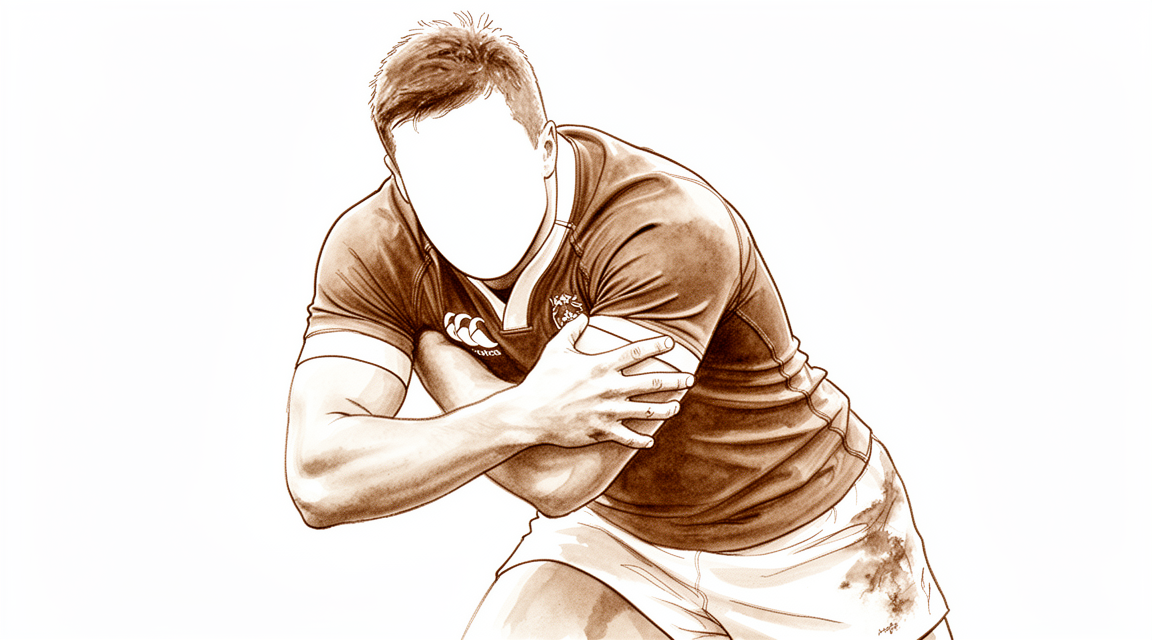
Este protocolo orienta sua recuperação após um procedimento de Latarjet realizado pelo Dr. Kieran Hirpara no Mater Private Hospital Rockhampton. Ele apresenta, em linguagem simples, a explicação de cada fase do processo, acompanhada de um programa estruturado que você poderá compartilhar com seu fisioterapeuta. Leve esta página ou o seu PDF na primeira consulta, para que a reabilitação seja devidamente coordenada. Seu fisioterapeuta poderá ajustar o plano conforme a evolução da sua recuperação.
Caso tenha alguma dúvida ou preocupação quanto à ferida cirúrgica, entre em contato com o consultório. Geralmente, é útil tirar uma foto da ferida e enviá-la por e-mail para análise.
O que esperar
A cirurgia de Latarjet é um procedimento que envolve o transplante de um bloco ósseo para tratar o ombro que se desloca repetidamente para a frente. Como utiliza um pedaço sólido de osso fixado com parafusos (em vez de apenas tecidos moles suturados), a reparação é imediatamente estável, e a recuperação costuma ser mais rápida do que na estabilização apenas com tecidos moles (reparação de Bankart). Em média, os pacientes retornam às atividades esportivas por volta da 20ª semana, em comparação com aproximadamente 32 semanas após uma reparação de Bankart.
Porém, “mais rápida” não significa “sem restrições”. O ritmo da sua recuperação depende, acima de tudo, de um único fator: a consolidação do osso transplantado no encaixe do ombro. Essa junção óssea (chamada união) geralmente leva de 6 a 8 semanas. Até que o cirurgião confirme que houve essa união, o uso do ombro deve ser limitado, independentemente de quão bem o braço pareça estar. A cirurgia de Latarjet também tem duas estruturas extras a proteger que a reparação de Bankart não tem; por isso, algumas das restrições iniciais abaixo são específicas para esse procedimento.
O procedimento
Na cirurgia de Latarjet, um pequeno pedaço de osso chamado coracoide (uma protuberância óssea na parte frontal da escápula) é deslocado e fixado com parafusos à borda anterior da cavidade glenoidal, onde houve perda óssea. Isso adiciona osso no local onde faltava e cria um efeito de “suspensão” na frente do ombro, ajudando a evitar sua luxação.
Para posicionar esse osso corretamente, o cirurgião precisa passá-lo através do subscapular (um músculo na frente do ombro), que é seccionado ou parcialmente descolado e depois suturado novamente. Portanto, duas estruturas precisam ser protegidas durante o processo de cicatrização:
- o bloco ósseo e seus parafusos, que devem se unir à cavidade glenoidal (união óssea, em aproximadamente 6–8 semanas); e
- o músculo subscapular na parte frontal, que é suturado ao redor do osso transferido.
Algumas pessoas acabam apresentando uma pequena perda permanente na amplitude de rotação externa do braço (girar a mão para fora), de cerca de 7–8 graus. Isso é esperado e não constitui uma complicação; para a maioria das pessoas, não gera nenhum impacto na vida cotidiana.
Como usar a tipoia
Você usará uma tipoia simples para o ombro, não uma almofada de abdução ou tipoia em forma de cunha. O Dr. Hirpara utiliza uma tipoia simples nas cirurgias de estabilização, pois a fixação óssea é resistente e a proteção vem principalmente do fato de manter o braço numa posição segura, e não da forma da própria tipoia.
- Use a tipoia por cerca de 3 semanas para apoio e conforto durante o dia (ela será retirada gradualmente a partir da 3ª semana). No caso da fixação óssea de Latarjet, o período de uso da tipoia é mais curto do que na reparação de tecidos moles.
- Não durma usando a tipoia. Durma sem ela; mantenha o braço numa posição segura enquanto dorme: não deixe que ele caia para o lado e fique virado para fora (a posição que a cirurgia visa evitar). Deitar com o braço apoiado num travesseiro à frente do corpo ou ao lado dele é confortável e seguro.
- Retire-a para tomar banho e para fazer os exercícios (após receber as instruções). Sempre que a tipoia estiver retirada, mantenha o braço relaxado ao lado do corpo.
- Use gelo se o ombro estiver inchado ou dolorido, especialmente após os exercícios.
Preste atenção à sua postura enquanto usa a tipoia: mantenha as orelhas, ombros e quadris alinhados, evitando curvar-se demais.
Precauções importantes — o que NÃO fazer
Estas medidas protegem o bloco ósseo, seus parafusos e o músculo frontal durante o processo de cicatrização.
- NÃO force o braço a realizar rotação externa (virar a mão para fora) precocemente. Nas primeiras 2 semanas, a rotação externa deve ser limitada a cerca de 25 graus, mantendo o braço em posição apoiada; somente depois disso ela será aumentada gradualmente, sempre dentro dos limites indicados pelo cirurgião.
- NÃO empurre o braço para trás do corpo (extensão do ombro), nem mantenha simultaneamente a posição de rotação externa e braço estendido para trás. Essa combinação exerce tensão excessiva sobre o tendão ligado ao osso transferido.
- NÃO realize exercícios de fortalecimento que exijam rotação interna resistida precocemente (pressionar a mão com força para dentro do corpo contra resistência). Isso sobrecarrega o músculo frontal em recuperação (subescapular), devendo ser evitado até autorização do cirurgião.
- NÃO coloque carga sobre o braço ou a mão, nem se apoie no braço para levantar-se de uma cadeira, nem levante, empurre ou puxe objetos pesados até que o cirurgião confirme que o osso já se uniu (aproximadamente 6–8 semanas). O processo de consolidação óssea, e não o tempo cronológico, determina quando cargas maiores podem ser aplicadas.
- NÃO realize exercícios pesados para o peito ou movimentos acima da cabeça nos primeiros estágios: nada de exercícios como “pec flys”, supino com pegada larga, desenvolvimento militar (acima da cabeça), puxadas atrás do pescoço ou mergulhos (dips) de tríceps até o final da recuperação.
- Evite qualquer movimento brusco, agarramento súbito ou queda sobre o braço.
Fase I — Proteção imediata (semanas 0–2)
Kieran Hirpara 4.0
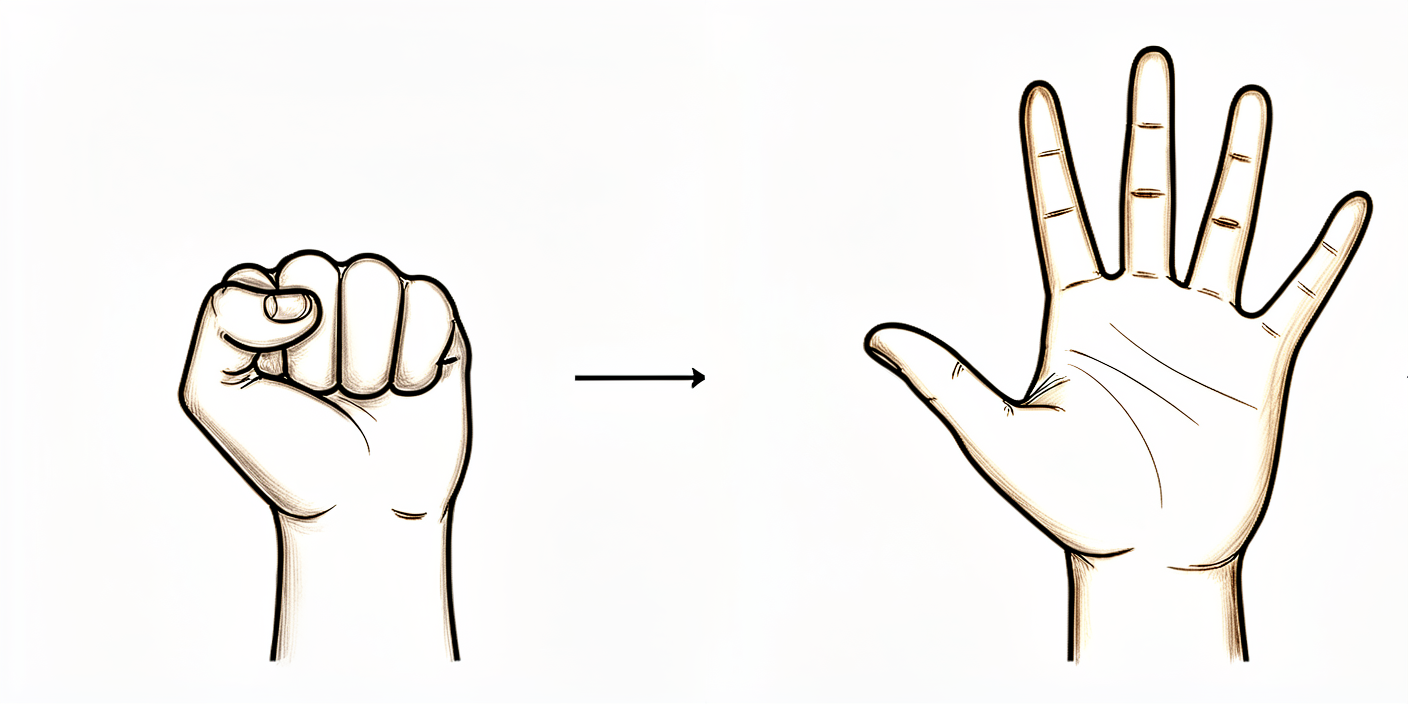
Abrir e fechar a mão
Feche bem a mão e, em seguida, abra-a completamente. Isso mantém a mão em movimento e ajuda a prevenir rigidez e inchaço.
10 vezes por hora
Kieran Hirpara 4.0
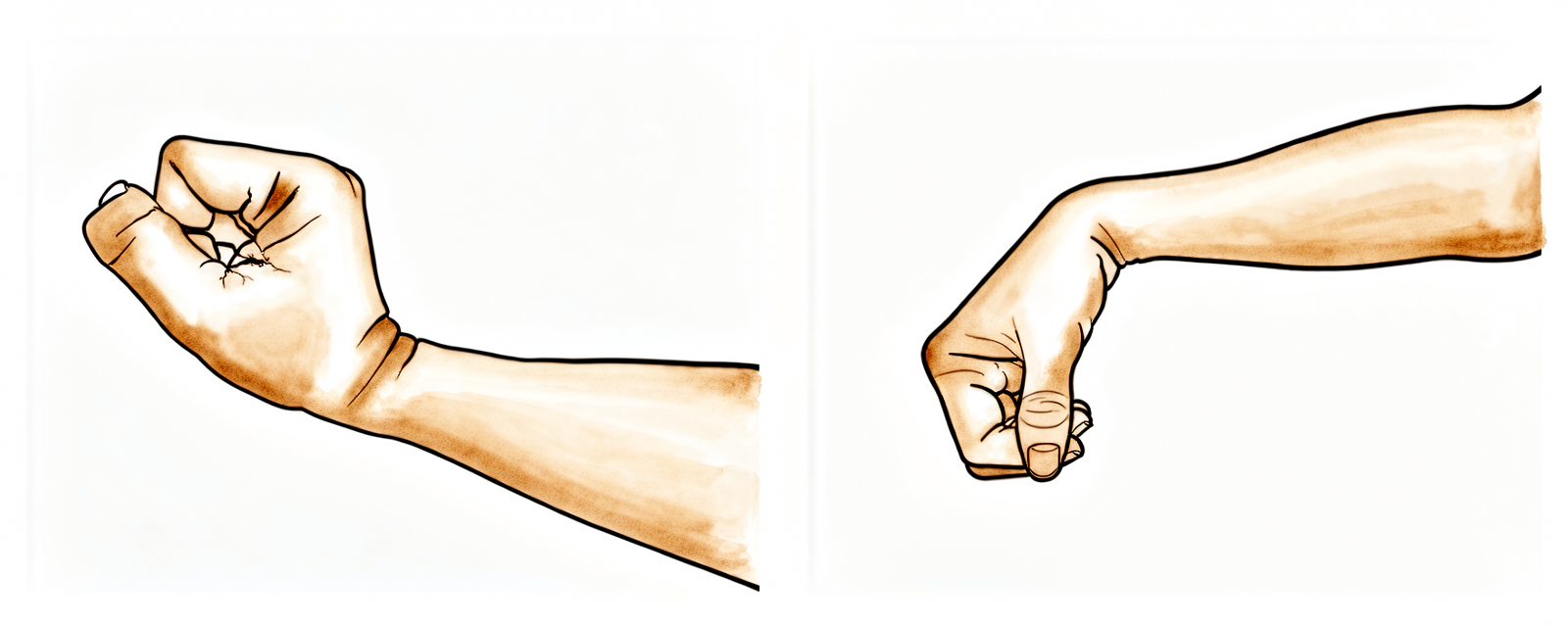
Flexões ativas do punho
Flexione suavemente o pulso para a frente e depois para trás, até o limite do confortável.
10–15 vezes por hora
Kieran Hirpara 4.0
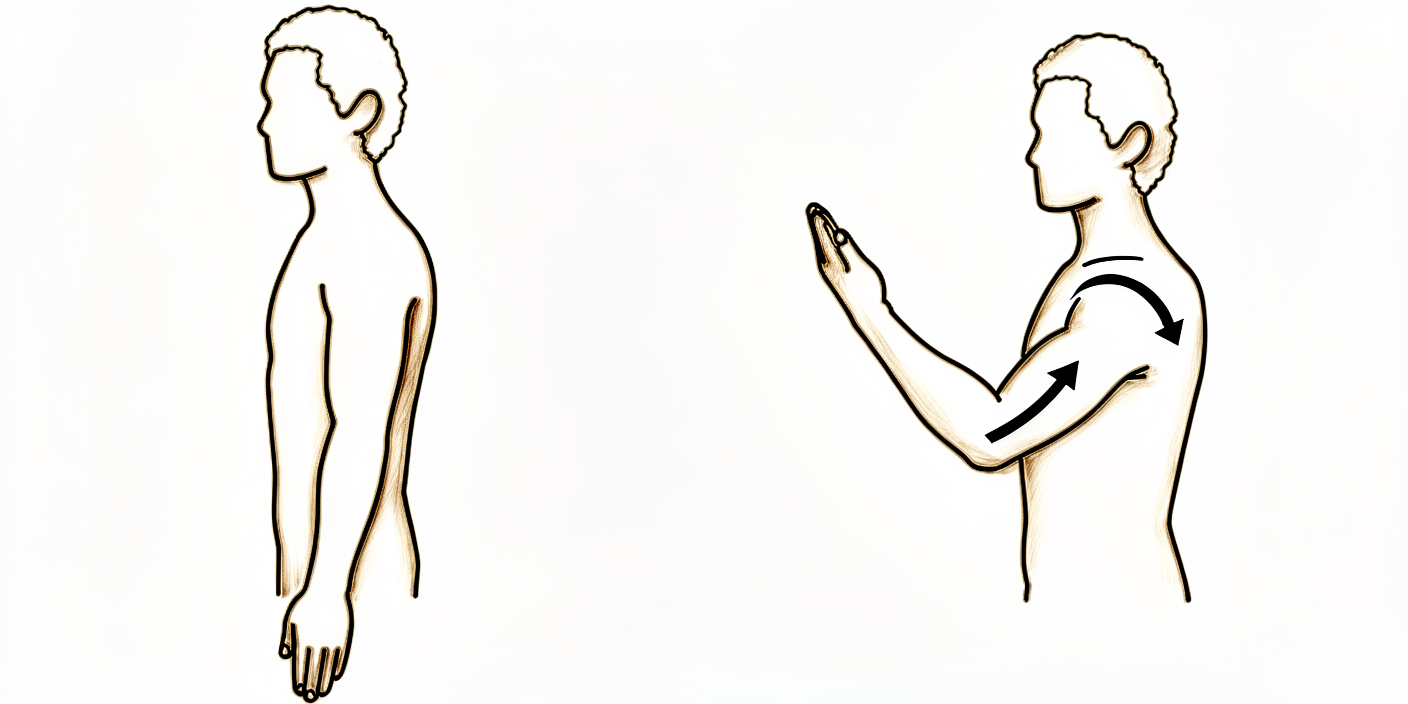
Flexões ativas do cotovelo
Com a palma da mão voltada para cima, dobre o cotovelo suavemente o máximo que puder e, em seguida, estique o braço novamente. Mantenha a parte superior do braço colada ao corpo. NÃO deixe o braço balançar para trás do corpo.
10–15 vezes, 2–3 vezes ao dia
Kieran Hirpara 4.0
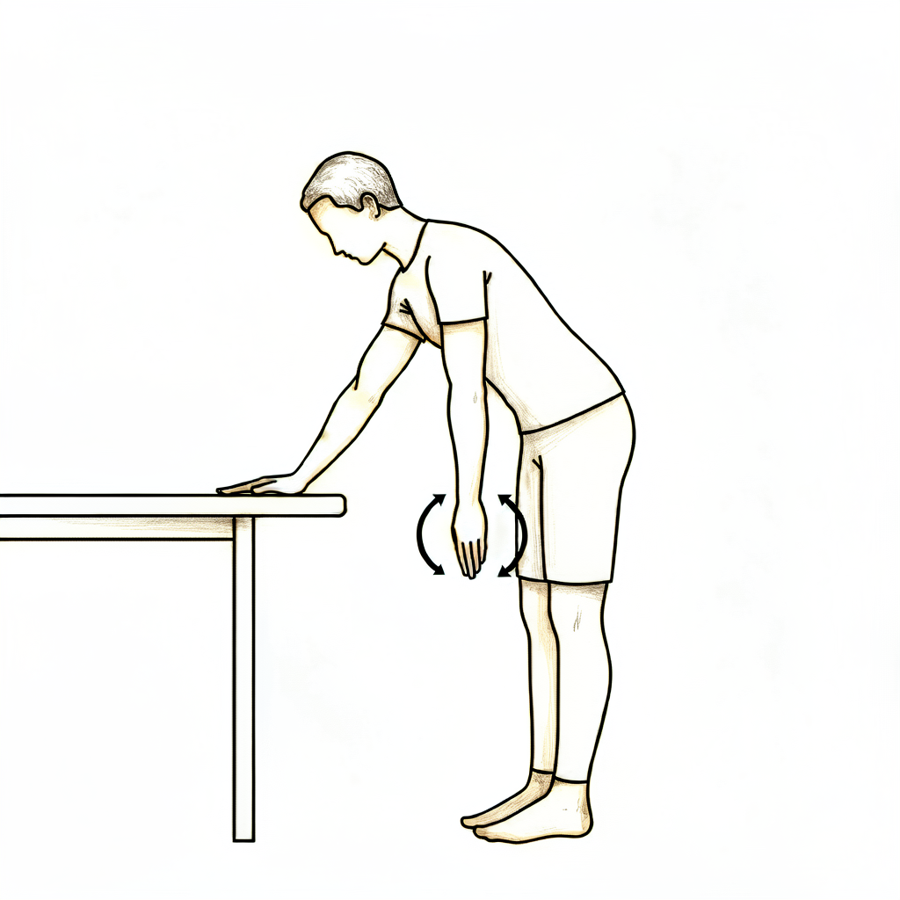
Exercício pendular
Incline-se para a frente e deixe o braço operado pendurado, completamente relaxado. Faça pequenos círculos — primeiro no sentido horário, depois no sentido anti-horário — balançando o corpo, NÃO usando os músculos do ombro. Mantenha os círculos pequenos (com menos de cerca de 20 cm). O braço operado deve permanecer relaxado o tempo todo; você não deve levantá-lo. NÃO deixe o braço se deslocar para trás do corpo.
10 em cada direção, 2–3 vezes ao dia
Kieran Hirpara 4.0
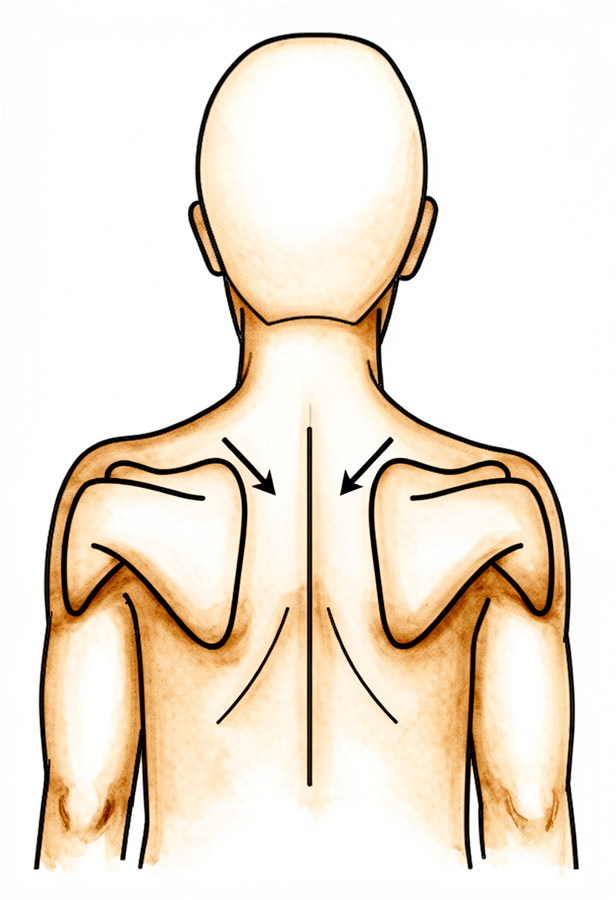
Posicionamento da escápula
Aperte suavemente as escápulas para baixo e uma em direção à outra, mantenha a posição e depois relaxe. Este é um exercício leve de ativação muscular — o seu braço não se move.
Mantenha por 5 segundos, 5 vezes, 2–3 vezes ao dia
Kieran Hirpara 4.0
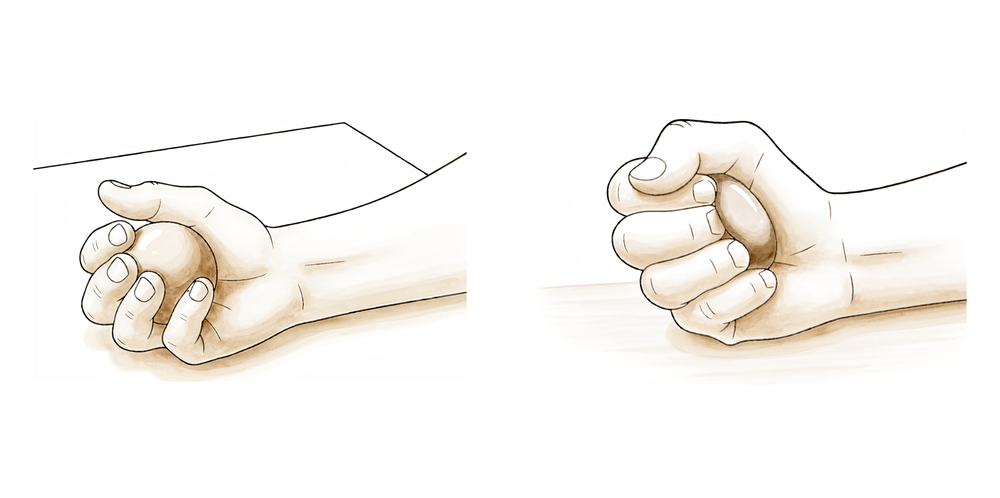
Apertar a bola
Segure uma bola macia ou uma meia enrolada na mão e aperte suavemente, depois relaxe. Isso mantém a mão e o antebraço ativos, enquanto o ombro descansa.
10 vezes, 2–3 vezes ao dia
As duas primeiras semanas têm como objetivo proteger o bloco ósseo recém-transferido e o músculo frontal reparado, enquanto o inchaço diminui. Durante o dia, você usa uma tipoia simples; dorme sem ela, mantendo o braço numa posição segura. Além disso, realiza exercícios suaves que mantêm a mão, o punho e o cotovelo em movimento, sem sobrecarregar o ombro. O próprio ombro é movimentado apenas de forma suave e passiva; ainda não é possível levantar o braço por força própria.
- Tipoia: tipoia simples para suporte e conforto durante o dia; retire-a para dormir, mantendo o braço numa posição segura; remova-a também para os exercícios e para a higiene.
- Movimentos permitidos: apenas movimentos assistidos e passivos suaves; não levante o braço usando a força do ombro. Elevação para a frente e afastamento do braço para o lado até o limite do conforto; a rotação externa deve ser mantida em cerca de 25 graus numa posição apoiada; não empurre o braço para trás, atrás do corpo.
- Exercícios: posicionamento da escápula; apertar uma bola; movimentos suaves da mão, do punho e do cotovelo; balanços pendulares (com o braço relaxado, sem deslocar-se para trás).
Está pronto para a próxima fase quando: a dor estiver diminuindo e controlada com analgésicos simples; a ferida estiver cicatrizada, sem sinais de complicações; você se sentir confortável sem a tipoia; e os movimentos suaves permanecerem dentro dos limites seguros estabelecidos pelo seu cirurgião.
Fase II — Restauração do movimento (semanas 3–9)
Kieran Hirpara 4.0
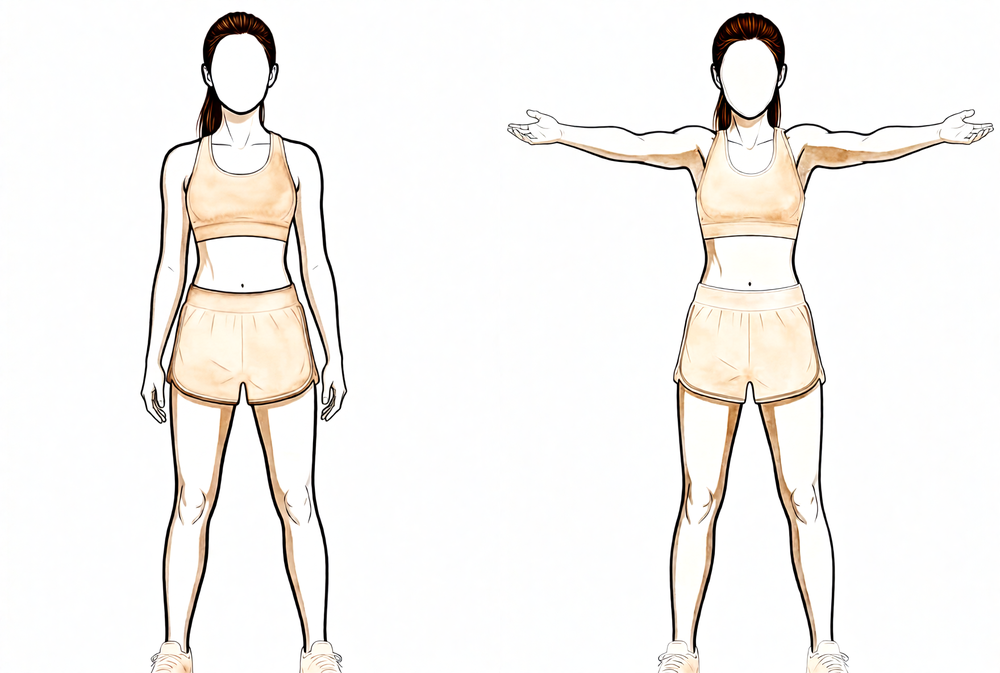
Elevação em “lata cheia” até a altura do ombro
A partir da 6ª semana, quando já conseguir mover o braço por conta própria, levante o braço para a frente e ligeiramente para o lado, mantendo o POLEGAR APONTADO PARA CIMA — a chamada posição de “lata cheia” — inicialmente até cerca da altura do ombro (90°), e depois abaixe-o de forma controlada. Não use peso algum ou use um peso muito leve (cerca de 1–1,5 kg), realizando muitas repetições.
Conforme orientado pelo seu fisioterapeuta
Kieran Hirpara 4.0
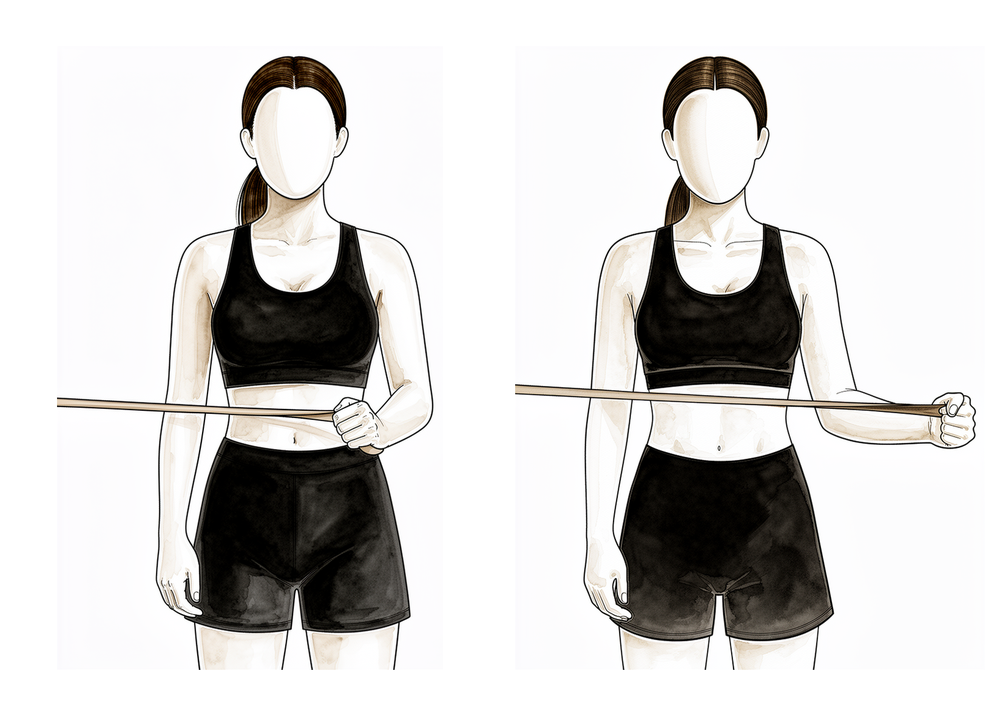
Rotação externa ao lado do corpo (faixa)
A partir da 6ª semana aproximadamente, dentro da faixa de rotação externa determinada pelo seu cirurgião. Mantenha o cotovelo junto ao corpo, colocando uma toalha enrolada entre o cotovelo e o corpo; o cotovelo deve ficar dobrado a 90°. Gire o antebraço suavemente para fora, contra a resistência de uma faixa leve, e depois volte à posição inicial com controle. Permaneça sempre dentro da faixa de movimento segura e nunca force o movimento. Utilize uma faixa leve e faça muitas repetições, evitando resistências muito fortes.
Conforme orientado pelo seu fisioterapeuta
Kieran Hirpara 4.0
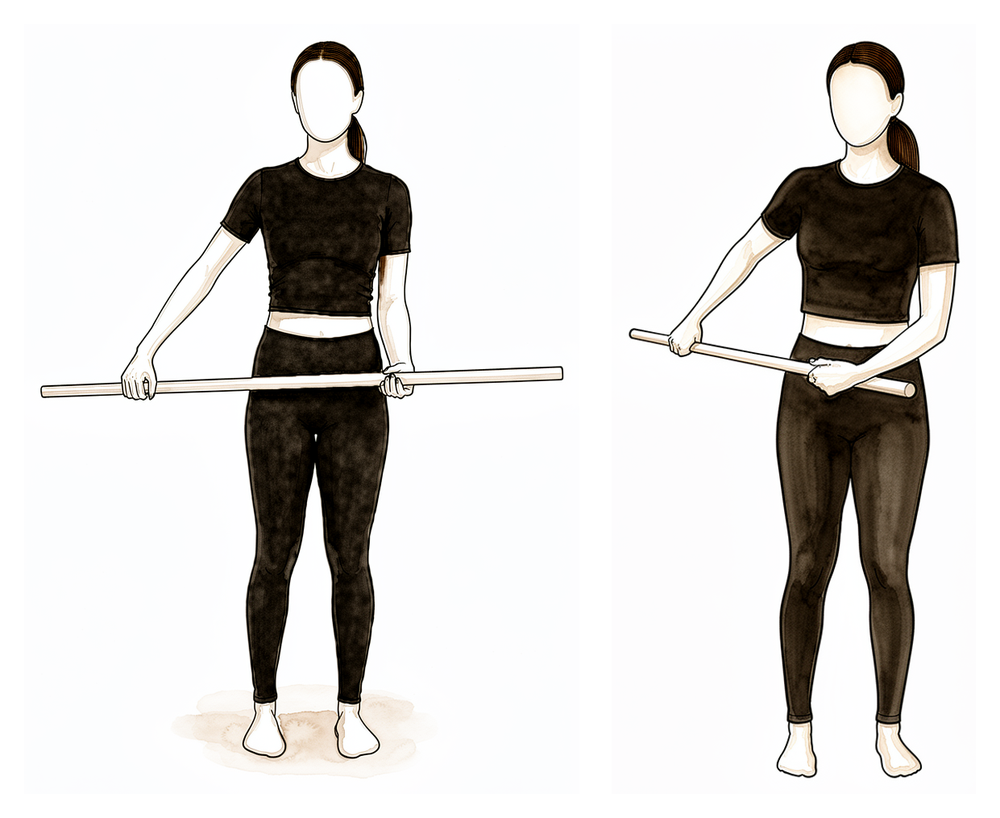
Rotação interna com bastão
A partir da 6ª semana, realize o movimento com delicadeza e apenas conforme orientado. Mantenha o cotovelo junto ao corpo e use um bastão na mão saudável para girar suavemente o antebraço operado para dentro, em direção ao abdômen, e depois volte à posição inicial. Trata-se de um movimento leve apenas — NÃO empurre com força nem adicione resistência no início, pois a parte frontal do ombro (o músculo subescapular) ainda está em processo de cicatrização.
Conforme orientado pelo seu fisioterapeuta
Kieran Hirpara 4.0
Remada baixa (posicionamento da escápula)
A partir da 6ª semana aproximadamente. Com a mão apoiada numa superfície fixa ao seu lado, pressione para baixo e para trás, de modo a puxar a escápula para baixo e para dentro, mantendo a posição por alguns instantes. Isso estabiliza a escápula.
Conforme orientado pelo seu fisioterapeuta
Kieran Hirpara 4.0
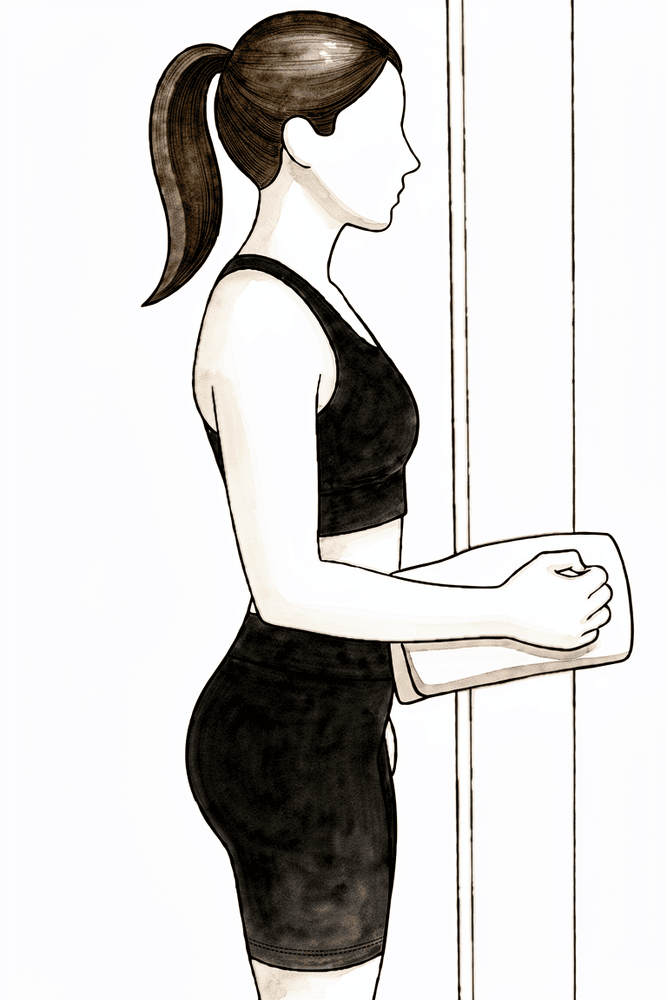
Rotação externa isométrica
A partir da 6ª semana aproximadamente, se o seu fisioterapeuta concordar e apenas dentro da faixa de movimento segura para você: fique em pé com o cotovelo encostado ao lado do corpo e dobrado a 90°, mantendo o dorso da mão próximo a uma parede ou à moldura de uma porta. Pressione suavemente o dorso da mão para fora contra a superfície, SEM mover o braço — um esforço suave, cerca de um quarto da sua força, sem causar dor. Mantenha a posição por alguns instantes e depois relaxe.
Mantenha por ~5 segundos, com suavidade (~25% de esforço), conforme orientação do seu fisioterapeuta
Kieran Hirpara 4.0
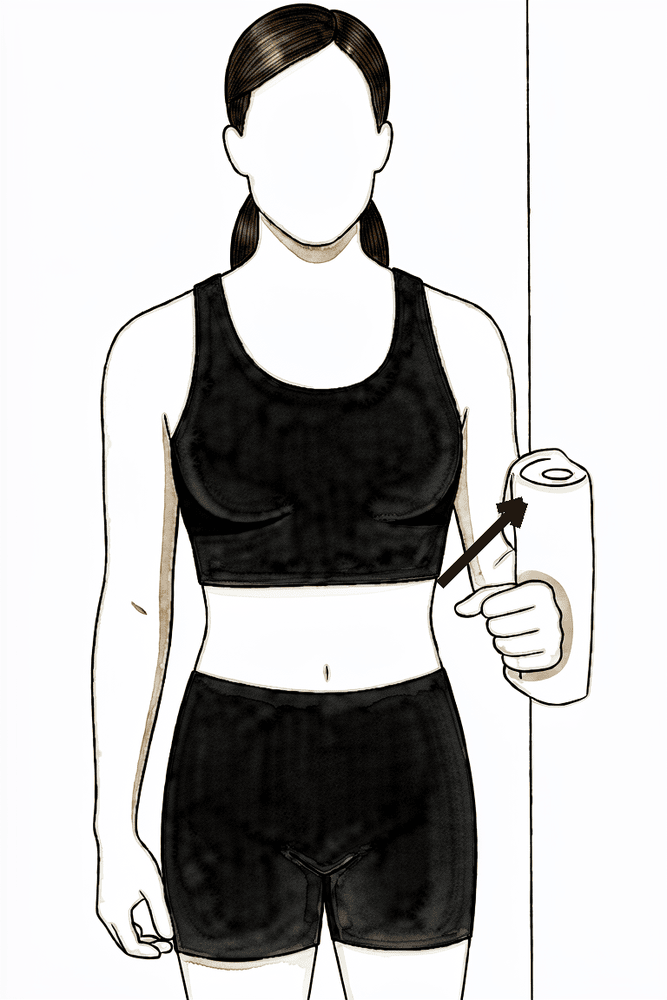
Rotação interna isométrica
Adiado para mais tarde (geralmente depois que o enxerto se uniu e o cirurgião concorda), pois pressionar para dentro trabalha o músculo anterior que está cicatrizando (subescapular). Quando liberado, fique em pé com o cotovelo junto ao corpo, a palma da mão encostada numa parede, e pressione suavemente a palma para dentro SEM deixar o braço se mover — cerca de um quarto do esforço, sem dor. Mantenha e depois relaxe.
Mantenha por ~5 segundos, com suavidade (~25% de esforço), conforme orientação do seu fisioterapeuta
Kieran Hirpara 4.0
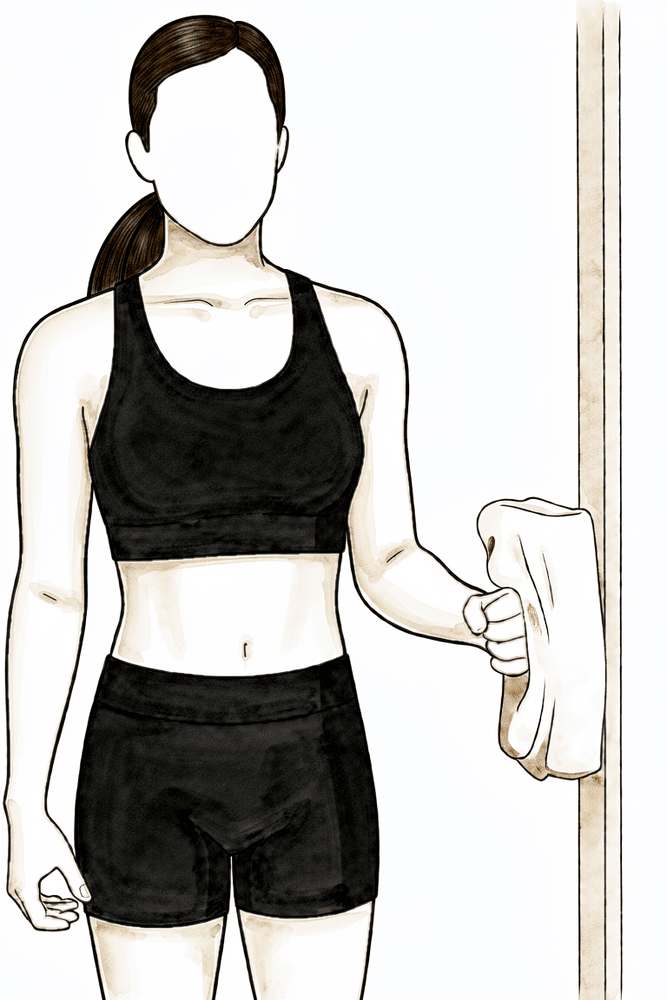
Abdução isométrica
A partir da 6ª semana, se o seu fisioterapeuta concordar. Fique de pé de lado, com a parte externa do braço próxima a uma parede e o cotovelo junto ao corpo. Pressione suavemente o braço para fora contra a parede, SEM permitir que ele se mova — cerca de um quarto do esforço, sem sentir dor. Mantenha a posição por alguns instantes e depois relaxe.
Mantenha por ~5 segundos, com suavidade (~25% de esforço), conforme orientação do seu fisioterapeuta
Agora, o foco é o movimento, não a força. O uso da tipoia é gradualmente reduzido a partir da semana 3. Você passa de movimentos assistidos para movimentos realizados por conta própria; a rotação externa também é ampliada progressivamente: inicialmente até cerca de 45 graus em posição apoiada, depois até o limite tolerado a partir da semana 6, sempre respeitando as orientações do seu cirurgião. São introduzidos exercícios isométricos leves de pressão e retenção, mantendo o esforço na rotação interna suave para proteger o músculo anterior. A carga ainda precisa esperar; nessa fase, o fragmento ósseo está apenas começando a unir-se.
- Tipoia: seu uso é reduzido a partir da semana 3.
- Movimentos permitidos: inicialmente movimentos assistidos, evoluindo para movimentos autônomos por volta da semana 6 (atingindo aproximadamente 90–110° de elevação). A rotação externa é ampliada gradualmente: inicialmente até 45 graus com apoio, depois até o limite tolerado, conforme definido pelo cirurgião. A rotação interna deve ser feita suavemente, até cerca de 45 graus.
- Exercícios: elevação em “lata cheia” até a altura do ombro; exercícios de rotação externa suave com faixa elástica sobre um rolo de toalha; rotação interna suave com um bastão (sem aplicar força); remada baixa; exercícios isométricos de pressão e retenção para rotação externa e abdução a partir da semana 6 (os isométricos de rotação interna são evitados até mais tarde). Seu fisioterapeuta também pode acrescentar exercícios de estabilização rítmica (movimentos de retenção em que ele empurra levemente seu braço e você oferece resistência) para retreinar o controle motor; trata-se de uma intervenção manual, sem necessidade de diagramas.
Está pronto para a próxima fase quando: o cirurgião confirmar (geralmente na avaliação por volta da semana 6–8) que o fragmento ósseo já se uniu; você conseguir mover o braço por conta própria com bom controle; seus movimentos assistidos e passivos forem completos ou quase completos e confortáveis; e os exercícios isométricos leves não provocarem dor posteriormente. O fortalecimento só começa após a confirmação da união óssea: esse processo depende da cicatrização óssea, atestada pelo cirurgião, não de um cronograma fixo.
Fase III — Fortalecimento (semanas 10–15)
Kieran Hirpara 4.0
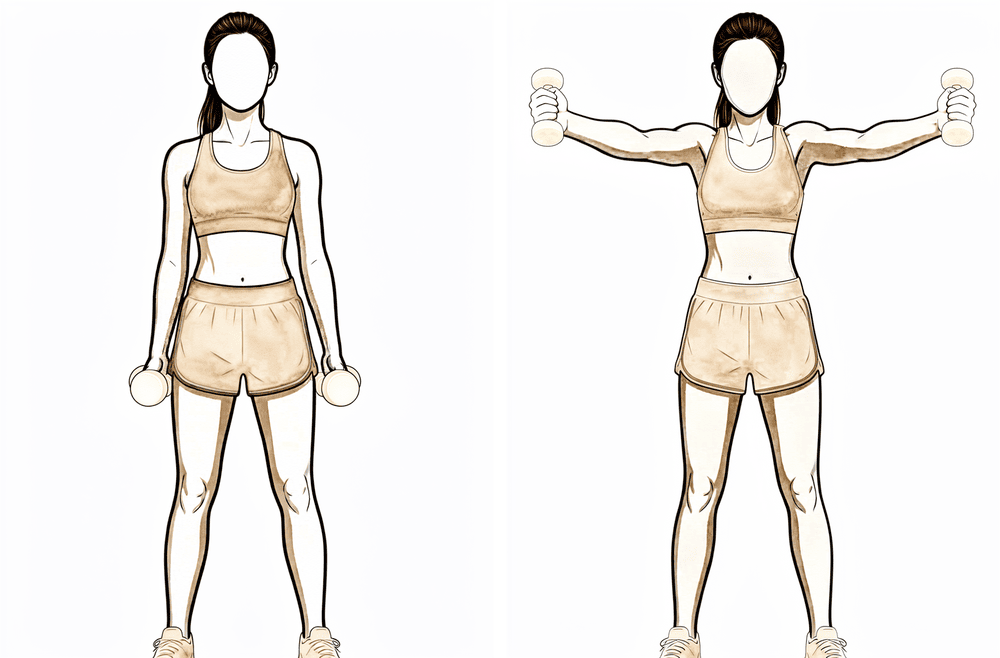
Elevação em “lata cheia” com peso leve
A partir da 10ª semana, após o cirurgião confirmar que o bloco ósseo já se uniu. Faça a elevação em “lata cheia” como antes; agora aumente gradualmente a altura e adicione um peso leve. Mantenha o POLEGAR PARA CIMA. Interrompa o exercício caso o ombro doa ou inche posteriormente.
Conforme orientado pelo seu fisioterapeuta
Kieran Hirpara 4.0
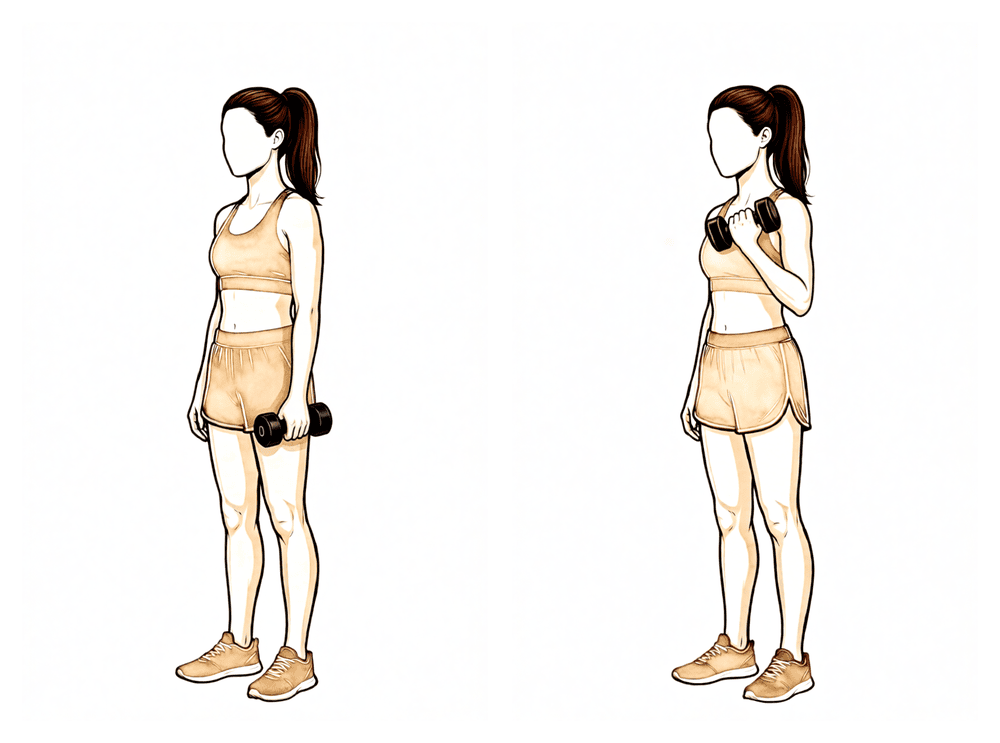
Flexão leve de bíceps (rosca)
A partir da 10ª semana, após a confirmação da consolidação óssea. Com o braço colado ao corpo, flexione o cotovelo para levantar um peso leve e, em seguida, abaixe-o de forma controlada. Aumente o peso gradualmente. O tendão do bíceps se insere próximo ao bloco ósseo; portanto, comece com um peso leve e progrida lentamente.
Conforme orientado pelo seu fisioterapeuta
Kieran Hirpara 4.0
Rotação interna pelas costas, com bastão (opção 1)
A partir da 12ª semana, quando o cirurgião e o fisioterapeuta considerarem que o músculo anterior (subescapular) já cicatrizou, segure um bastão atrás das costas e use a mão saudável para levantar suavemente a mão operada pelas costas, depois abaixe-a com controle. Faça o movimento de forma confortável e respeitando os limites indicados pelo fisioterapeuta.
Conforme orientado pelo seu fisioterapeuta
Kieran Hirpara 4.0
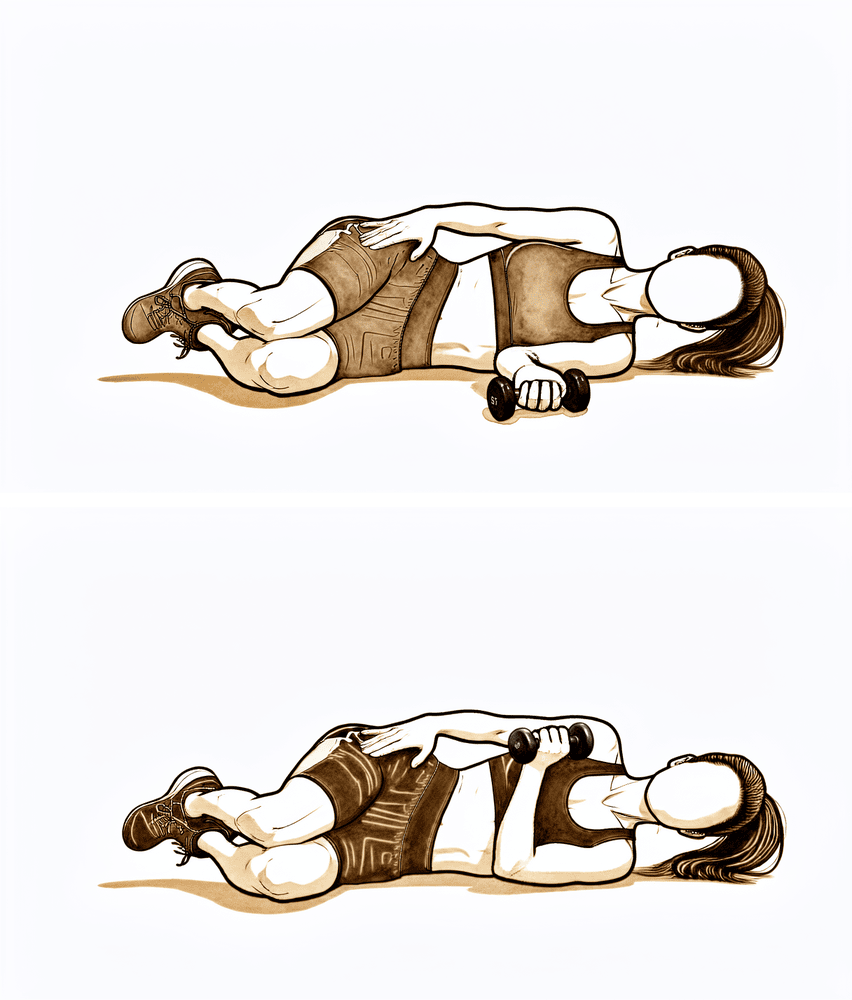
Rotação interna com um peso leve, deitado de lado (opção 2)
Uma alternativa à versão com bastão, com o mesmo cronograma de execução (a partir da 12ª semana, quando o músculo anterior já estiver cicatrizado). Deite-se do lado da cirurgia, com o cotovelo puxado para a cintura e dobrado a 90°; gire o antebraço de modo que a mão levante um peso leve em direção ao abdômen, e depois abaixe-o com controle. O fisioterapeuta escolherá a versão mais adequada para você — ambas desenvolvem a mesma força de rotação interna.
Conforme orientado pelo seu fisioterapeuta
Kieran Hirpara 4.0
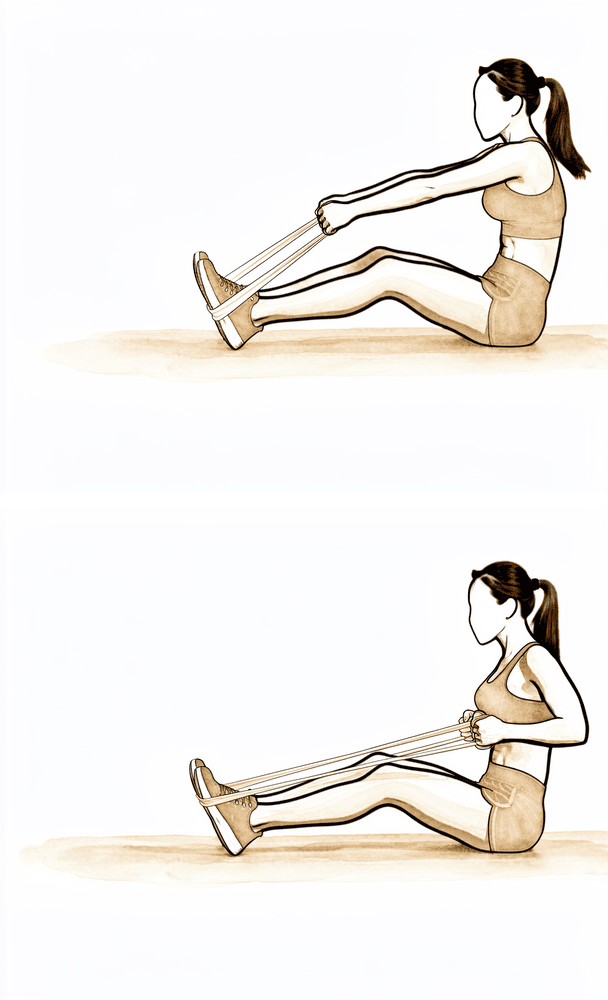
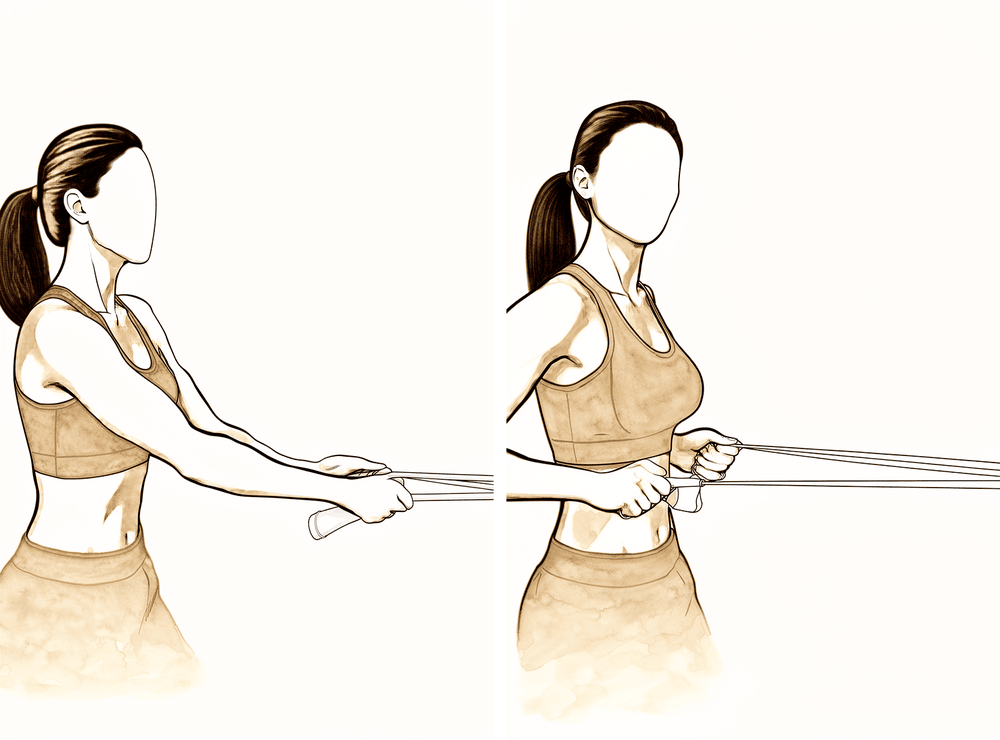
Remada com faixa de resistência
A partir da 10ª semana, após a confirmação da consolidação óssea. Com uma faixa elástica fixada à sua frente, puxe as alças em direção a si, trazendo os cotovelos para trás e aproximando as escápulas; em seguida, volte à posição inicial de forma controlada. Use uma faixa leve e faça muitas repetições; interrompa o exercício caso sinta dor no ombro.
Conforme orientado pelo seu fisioterapeuta
Kieran Hirpara 4.0
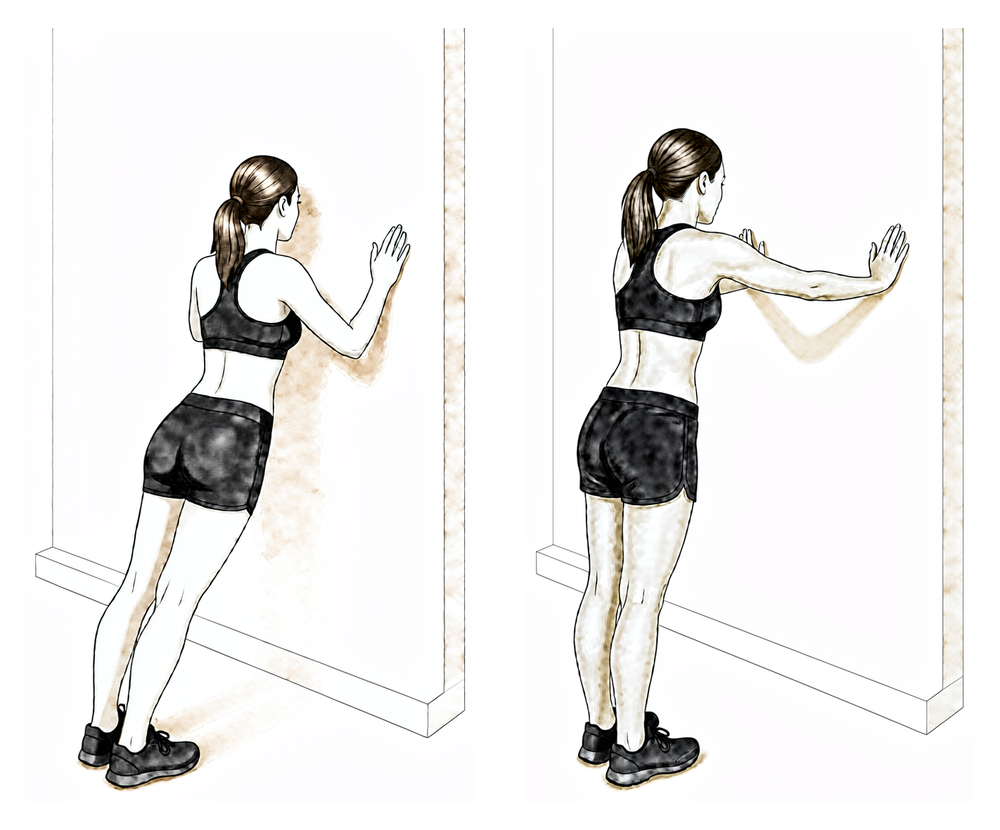
Flexão plus (na parede)
A partir da 10ª semana, após confirmação da consolidação óssea. Comece fazendo o exercício contra uma parede (não no chão). Faça uma flexão lenta; no ponto mais alto, empurre um pouco mais, de modo que as escápulas se afastem e a região dorsal superior se arredonde levemente. Evite que os cotovelos se movam para trás além da linha dos ombros. Esse exercício ativa o músculo anterior (subescapular); mantenha a intensidade leve e certifique-se de que não haja dor.
Conforme orientado pelo seu fisioterapeuta
Kieran Hirpara 4.0
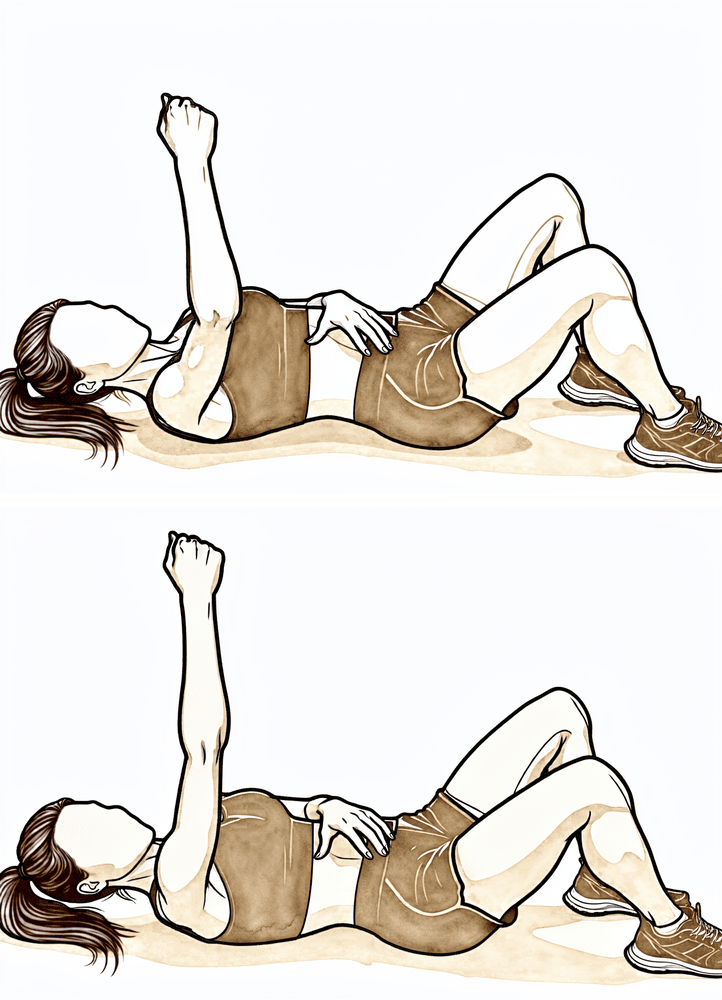
Soco para frente (deitado de costas)
A partir da 10ª semana, após a confirmação da consolidação óssea. Deite-se de costas, com o braço estendido para cima, segurando um peso leve ou nada. Estique a mão um pouco mais para cima, de modo que a escápula se levante da cama; em seguida, abaixe o braço com controle. Trata-se de um exercício suave para o músculo subscapular — mantenha o esforço leve.
Conforme orientado pelo seu fisioterapeuta
Kieran Hirpara 4.0
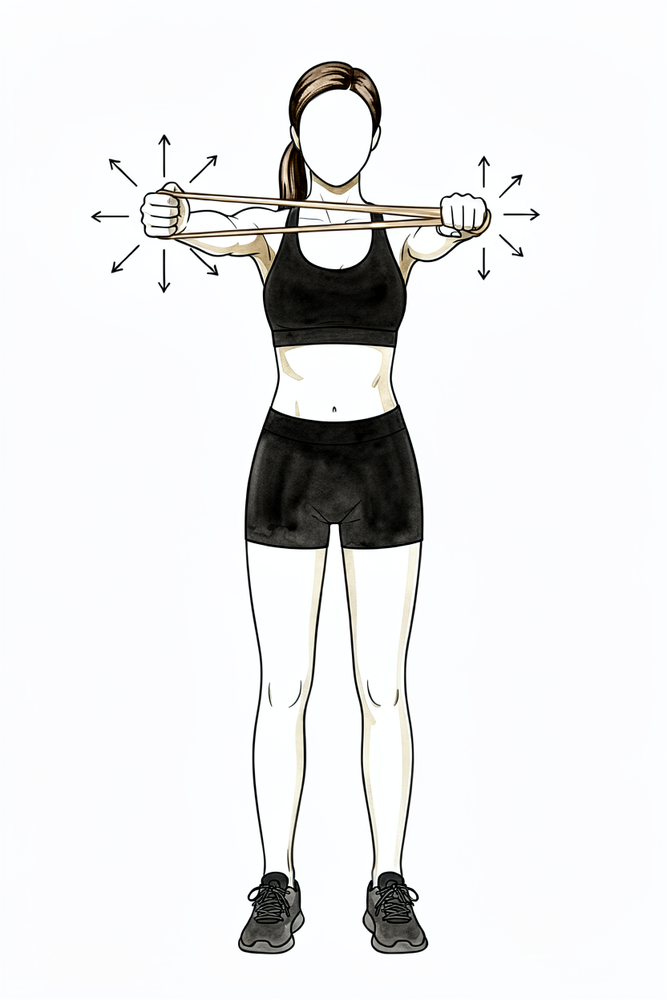
Estabilização rítmica
Com o braço apoiado à sua frente, na altura dos ombros, peça ao seu fisioterapeuta (ou à sua mão sã) que aplique pequenos empurrões suaves em diferentes direções, enquanto você mantém o braço imóvel e firme — não permita que ele se mova. Isso treina os músculos estabilizadores do ombro para reagirem. As pressões devem ser sempre suaves.
Conforme orientado pelo seu fisioterapeuta
Após o cirurgião confirmar que o osso já se uniu, você poderá começar a carregar peso no ombro. O fortalecimento inicia-se com faixas elásticas e pesos leves: muitas repetições e cargas baixas, aumentando gradualmente. A regra de ouro é uma direção por vez: só se fortalece numa determinada direção após alcançar movimento confortável e quase completo nela. O fortalecimento da rotação interna e dos músculos frontais (subescapular) deve ser introduzido com cautela e posteriormente, pois esse músculo foi reparado durante a cirurgia.
- Tipoia: não é necessária; espera-se movimento confortável e quase completo antes de carregar peso numa determinada direção.
- Exercícios: elevação em “lata cheia” com peso leve e crescente; flexões de bíceps com peso leve; remadas com faixa elástica; flexão plus na parede e soco para frente deitado de costas para o músculo frontal; rotação interna pelas costas com bastão (de forma suave, a partir da semana 12, quando o músculo frontal já estiver cicatrizado). Aumente as cargas aos poucos e interrompa o exercício se o ombro doer ou inchar.
Está pronto para a próxima fase quando: conseguir movimentar o ombro completamente, sem dor e com bom controle da escápula; não houver dor ou inchaço após os exercícios de fortalecimento; conseguir levantar peso com resistência abaixo da altura do ombro sem dificuldade; e a força de rotação externa estiver se aproximando da força do lado oposto.
Fase IV — Movimentos acima da cabeça e retorno ao esporte (semanas 16–20)
Kieran Hirpara 4.0
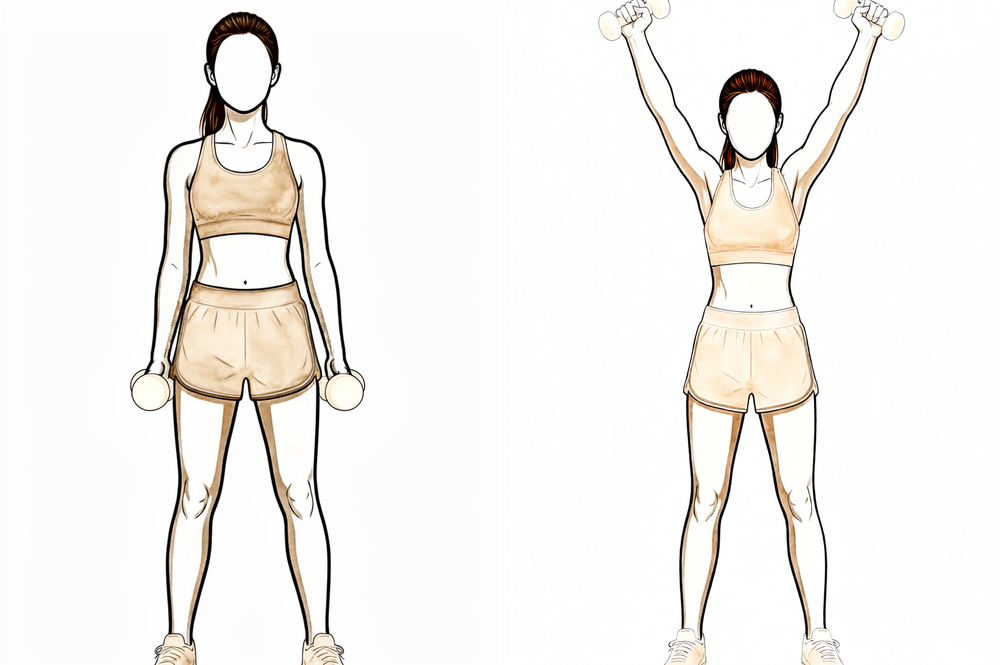
Elevação em “lata cheia” acima da cabeça
A partir da 16ª semana, quando a força muscular abaixo da altura do ombro já estiver boa, levante o braço para a frente e ligeiramente para o lado, mantendo o POLEGAR PARA CIMA. Em seguida, continue o movimento acima da altura do ombro, utilizando um peso leve que deve ser aumentado gradualmente. Interrompa o exercício caso sinta dor no ombro ou se ele inchar posteriormente.
Conforme orientado pelo seu fisioterapeuta
Kieran Hirpara 4.0
Remada progressiva com faixa de resistência
Continue a remada com faixa elástica, aumentando agora a resistência e o número de repetições como base para treinos mais intensos e para o condicionamento específico do esporte. Mantenha um bom controle das escápulas.
Conforme orientado pelo seu fisioterapeuta
Esta fase serve como ponte para que o ombro volte a funcionar plenamente, permitindo um retorno gradual ao esporte e a atividades mais pesadas. Você mantém a amplitude de movimento já adquirida e desenvolve força, potência e resistência para utilizá-la com confiança, inclusive em movimentos acima da cabeça. O retorno é feito de forma gradual, não repentina; no caso do esporte, um programa progressivo que aumenta o volume e a intensidade aos poucos é a abordagem mais segura.
- Tipoia: nenhuma.
- Exercícios: elevações em “lata cheia” acima da cabeça, com peso leve e crescente, quando a força abaixo da altura do ombro estiver boa; exercícios de remada com faixas elásticas de dificuldade progressiva; condicionamento específico para o esporte e para o trabalho; no final desta fase, exercícios de alta velocidade controlada (tipo pliométricos), conforme apropriado. Flexões também podem ser incluídas, desde que os cotovelos não se movam muito para trás.
Pronto para retornar quando: a força na rotação externa estiver dentro de aproximadamente 8–10% da força do lado oposto, e a força geral de rotação estiver se desenvolvendo de forma equilibrada; você tiver amplitude de movimento completa, sem dor e sem inchaço após cargas maiores; e passar nos testes específicos para sua atividade esportiva ou profissional. O retorno ao esporte geralmente ocorre por volta da semana 20, enquanto para esportes de contato ou com risco de colisão o retorno costuma ser um pouco mais tarde (por volta de 5–6 meses), dependendo do cumprimento desses critérios e da autorização do Dr. Hirpara e do seu fisioterapeuta, e não apenas do calendário.
Retorno ao esporte e ao trabalho
O seu retorno segue critérios específicos: estar sem dor, possuir amplitude de movimento, força e resistência adequadas, além de ter autorização tanto do Dr. Hirpara quanto do seu fisioterapeuta – não depende apenas do calendário. Como a técnica de Latarjet utiliza osso sólido, a recuperação costuma ser mais rápida do que em reparos de tecidos moles; porém, qualquer atividade mais intensa que movimentos leves deve ser adiada até que o bloco ósseo esteja unido (cerca de 6–8 semanas, conforme confirmado pelo seu cirurgião).
- Atividades leves, ao nível do peito, podem ser retomadas por volta da 10–15ª semana.
- Atividades que envolvam movimentos acima da cabeça ou arremessos podem ser retomadas por volta dos 4 meses.
- O retorno ao esporte ocorre, em média, após 20 semanas; para esportes de contato ou com colisões, geralmente é necessário aguardar cerca de 5–6 meses, sempre desde que os critérios de força e amplitude de movimento sejam atendidos.
Após seguir este protocolo
Este protocolo complementa as orientações gerais de recuperação fornecidas pela clínica; consulte como controlar a dor pós-operatória e cuidados com a ferida.
Evidence & references
This is the clinical evidence summary written for health professionals. It is technical, and it lists the research this page was built from. You do not need to read it to understand your treatment or to make a decision about it.
Latarjet (Coracoid Transfer) for Anterior Instability with Bone Loss: Rehabilitation Evidence
Topic: Open Latarjet / Bristow-Latarjet coracoid transfer for anterior glenohumeral instability with glenoid bone loss (>~20% glenoid, or off-track Hill-Sachs / failed soft-tissue repair). Compiled: 2026-06-16. Sources: local RAG Orthopaedic corpus + published fellowship/PT "standard of care" protocols.
How Latarjet rehab DIFFERS from arthroscopic Bankart
- It is a BONY procedure (coracoid autograft screw-fixed to the antero-inferior glenoid). Fixation is rigid -> the structural construct is stronger than soft-tissue suture anchors, so AROM and return to sport are generally FASTER than Bankart (Beletsky 2020: mean RTS ~19.6 wk Latarjet vs ~32.4 wk Bankart, p<0.001).
- BUT two distinct soft-tissue structures must be protected that Bankart does not involve: (1) the subscapularis (split, or taken down and repaired, to pass the graft); (2) the coracoid graft osseous union (~6-8 weeks to unite) plus the conjoint-tendon (biceps short head + coracobrachialis) "dynamic sling" still attached to the graft.
- Graft-protection precautions: avoid aggressive shoulder extension and combined extension + external rotation stretching early (tensions the conjoint origin on the graft). Progress biceps/coracobrachialis strengthening gradually. If subscapularis was taken down & repaired, slow ER progression and avoid aggressive IR strengthening until subscap healed - get an intra-operative "safe-zone" ER from the surgeon.
- Expect a permanent mild ER deficit (Hovelius: mean loss ~7.4 deg in adduction, ~8 deg in abduction) - this is accepted, not a complication.
Consensus phased timeline (BWH Latarjet standard of care)
| Phase | Week window | Sling/brace | ROM allowed & restrictions | AROM / strengthening | RTS |
|---|---|---|---|---|---|
| I - Immediate post-surgical | 0-2 wk | Sling at all times (remove only to shower, arm at side); towel under elbow to prevent hyperextension (graft protection); sleep in sling | No AROM. PROM only, no forcing: flexion/elevation & scaption to tolerance; IR to 45 deg at 30 deg abd; ER 0-25 deg in scapular plane at 30-40 deg abd (open-packed); respect anterior capsule; use intra-op ER measurements | Scapular isometrics, ball squeezes; cryotherapy | None |
| II - Intermediate / ROM | 3-9 wk | Wean from sling beginning wk 3 | Early (wk 3-4): ER to 0-45 deg at 30-40 deg abd, IR 45 deg at 30 deg abd. Late (wk 6): ER to tolerance, progress to multiple abd angles once >=35 deg; IR multi-angle. AAROM from wk 3 -> AROM by ~wk 6 (good mechanics, up to 90-110 deg elevation) | Begin balanced AROM/strengthening late phase II (~wk 6): high-rep/low-load (1-3 lb), full-can scaption to 90 deg, ER/IR tubing at 0 deg abd (towel roll), prone rows, rhythmic stabilisation. Subscap-specific work (upper+lower fibres) | None |
| III - Strengthening | 10-15 wk | None | Continue A/PROM; near-full ROM before loading a plane | Biceps curls light; progressive pec major/minor (avoid anterior-capsule-stress positions); subscap strengthening (push-up plus, cross-body diagonals, IR band 0/45/90, forward punch) | Chest-level functional activities |
| IV - Overhead / return to activity | 16-20 wk | None | Full pain-free ROM | Overhead strengthening once sub-90 strength good; progressive weightlifting (15-25 reps); plyometrics/interval program if cleared; push-ups allowed but elbows not past 90 deg | Throwing/overhead not before 4 months; pre-injury sport when cleared by MD |
Active ROM start: AAROM wk 3, AROM ~wk 6. Strengthening start: scapular isometrics immediately; isotonic/RC strengthening ~wk 6. RTS: chest-level ~10-15 wk; overhead/throwing >=4 months; full/contact sport typically ~5-6 months (RAG cohorts: open Latarjet RTS averages ~6 months; bone-block soft-tissue/graft healing requires the 3-month minimum). ER milestones to advance: PE >=155 deg, ER within 8-10 deg of contralateral at 20 deg abd and >=75 deg at 90 deg abd.
Graft-protection summary (the Latarjet-specific precautions): no aggressive extension or extension+ER stretch early; protect conjoint tendon/biceps origin; protect subscapularis (slower ER + delayed IR strengthening if taken down); no pec flys/wide-grip bench/military press/behind-neck lat pulls; tricep dips avoided; osseous union ~6-8 wk gates heavier loading.
Key controversies & evidence flags
-
Is a sling even necessary after open Latarjet? An RCT (Kourimpetis/PMC9969622, "Is sling immobilization necessary after open Latarjet surgery...") challenges routine immobilisation - because rigid bony fixation may not need the soft-tissue protection a Bankart does. This is the leading edge of "accelerated Latarjet." Evidence: STRONG (single RCT) - emerging, not yet standard.
-
Accelerated Latarjet rehab / faster RTS. Multiple comparative studies (Beletsky 2020; Delgado 2025 matched-pair; Rogowski 2025 JSES) confirm Latarjet RTS is earlier than Bankart and that bony union (~3 months) - not soft-tissue - is the rate limiter. Rogowski (JSES 2025) argues functional dominant/non-dominant testing at 4.5 months predicts successful RTS better than time alone, supporting criteria-based acceleration. Evidence: MODERATE (good cohorts, no large RCT on the rehab pace itself).
-
Contact/collision-sport return & procedure choice. Latarjet is often preferred in collision athletes (rugby) precisely because of bone block + dynamic sling. Tanaka 2022 / Hirose 2026 (Bristow vs Latarjet in rugby) and Gowd 2021 (JSES, RTS after Latarjet) inform RTS rates and timing; subluxation/pain after RTS more frequent in some Latarjet vs Bristow series. Contact RTS still generally ~5-6 months and criteria-based. Evidence: MODERATE cohort-level.
-
Subscapularis split vs takedown-and-repair changes ER progression: takedown demands slower ER and delayed IR strengthening. Protocol explicitly defers to an intra-operative surgeon-defined ER "safe zone." Evidence: consensus / biomechanical rationale.
CITATIONS
Published rehabilitation protocols (URLs)
- Brigham & Women's Hospital, Dept. of Rehabilitation Services - Anterior Stabilization of the Shoulder: Latarjet Protocol (orig. 2009, updated May 2016): https://www.brighamandwomens.org/assets/BWH/patients-and-families/rehabilitation-services/pdfs/shoulder-latarjet.pdf
- Rehabilitation Guidelines for Latarjet/Coracoid Process Transfer (Eichinger, MD): https://www.josefeichingermd.com/pdf/rehab-guideline-for-latarjet.pdf
- Rehabilitation Protocol - Latarjet (Coracoid Transfer/Eden-Hybinette), Lindsay Sports Med (2025): https://www.lindsaysportsmed.com/pdf/laterjet-and-edenhybinette-center-2025.pdf
- Rehabilitation Protocol: Latarjet Coracoid Process Transfer (Utz, MD): https://www.christopherutzmd.com/pdfs/latarjet-protocol.pdf
- Latarjet Procedure overview - Physiopedia: https://www.physio-pedia.com/Latarjet_Procedure
Local RAG corpus (article / journal / year)
- Beletsky A, Cancienne JM, Manderle BJ, et al. A Comparison of Physical Therapy Protocols Between Open Latarjet Coracoid Transfer and Arthroscopic Bankart Repair. Sports Health. 2020. [protocol comparison - Latarjet RTS ~19.6 wk vs Bankart ~32.4 wk, p<0.001; AAROM ~6-8 wk]
- Matache BA, Hurley ET, Wong I, et al. Anterior Shoulder Instability Part III - Revision Surgery, Rehabilitation and Return to Play - An International Consensus Statement. Arthroscopy. 2021;38(2). (Poses the open questions on immobilisation duration after coracoid transfer vs Bankart vs glenoid bone grafting.) [consensus]
- Gowd AK, Liu JN, Polce EM, et al. Return to sport following Latarjet glenoid reconstruction for anterior shoulder instability. Journal of Shoulder and Elbow Surgery. 2021;30(11):2549-2559. [systematic review - RTS]
- Rogowski I, Nove-Josserand L, Godeneche A, et al. Are the dominant-nondominant functional differences at 4.5 months after open Latarjet better predictors for successful RTS at 1 year than operated-nonoperated differences? Journal of Shoulder and Elbow Surgery. 2025;34(10):2338-2349. (3-month delay needed for graft healing; RTS ~6 months; criteria-based prediction.) [prospective cohort]
- Delgado C, Calvo E, Valencia M, et al. Arthroscopic Bankart Repair Versus Arthroscopic Latarjet for Anterior Shoulder Instability: A Matched-Pair Long-Term Follow-up Study. Orthopaedic Journal of Sports Medicine. 2025. [matched-pair comparative]
- Tanaka M, Hanai H, Kotani Y, et al. Open Bristow Versus Open Latarjet for Anterior Shoulder Instability in Rugby Players. Orthopaedic Journal of Sports Medicine. 2022. [comparative - contact athletes]
- Hirose T, Tanaka M, Nakai H, et al. Comparing Bristow and Latarjet procedures for anterior shoulder instability in competitive rugby players. Journal of Shoulder and Elbow Surgery. 2026;35(4). [within-subject comparative]
- Bonnevialle N, Girard M, Dalmas Y, et al. Short-Term Bone Fusion With Arthroscopic Double-Button Latarjet Versus Open-Screw Latarjet. The American Journal of Sports Medicine. 2021. [fixation/union]
- Salem HS, Vasconcellos AL, Sax OC, et al. Intra-articular Versus Extra-articular Coracoid Grafts: A Systematic Review of Capsular Repair Techniques During the Latarjet Procedure. Orthopaedic Journal of Sports Medicine. 2022. (Documents post-Latarjet ER loss ~4.5-6.3 deg.) [systematic review]
Additional online RCT/evidence
- "Is sling immobilization necessary after open Latarjet surgery for anterior shoulder instability? A randomized controlled trial." PMC9969622: https://www.ncbi.nlm.nih.gov/pmc/articles/PMC9969622/ [STRONG - RCT challenging routine immobilisation]
- "Latarjet procedure enables 73% to return to play within 8 months depending on preoperative SIRSI and Rowe scores." PMC8298242: https://www.ncbi.nlm.nih.gov/pmc/articles/PMC8298242/ [cohort - RTS rate/timing]
Overall evidence grade for the phased protocol itself: CONSENSUS / institutional standard-of-care (Level V). The "sling necessary?" question is the only RCT-level datapoint; accelerated/criteria-based RTS rests on good comparative cohorts (Level III).