Patients › General-Health
Injeções de cortisona e corticosteroides
What cortisone injections do, when they help, how long the effect lasts, and the risks of repeated injections for shoulder, elbow, wrist and hand conditions.
O que é
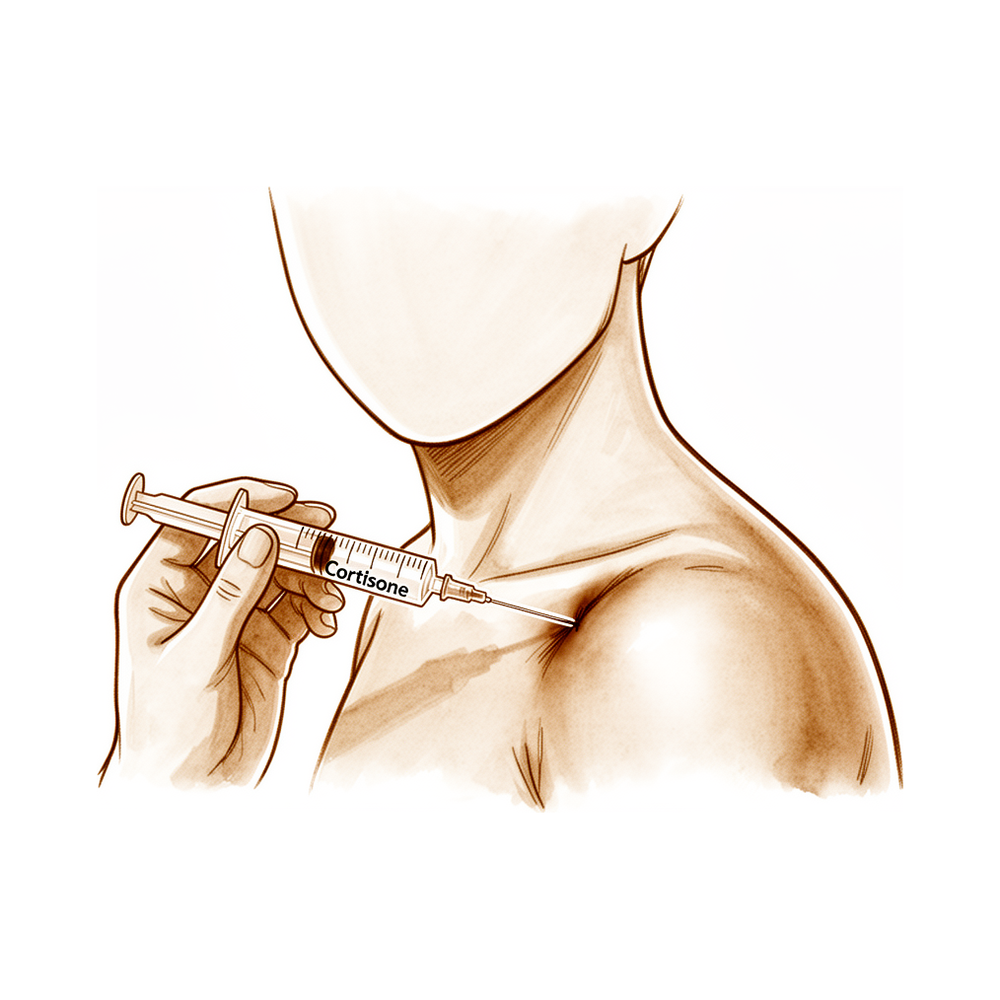
Uma injeção de cortisona é a aplicação de um medicamento anti-inflamatório forte, chamado corticosteroide, em uma articulação ou tendão dolorido. O medicamento reduz o inchaço e alivia a dor em um ponto específico. Não é um analgésico que se toma pela boca. Ele age onde é aplicado.
O seu médico pode oferecer esse tratamento para vários problemas da mão, do punho, do cotovelo e do ombro. Entre eles estão o dedo em gatilho (um dedo que prende ou trava), a síndrome do túnel do carpo (compressão de um nervo no punho), o cotovelo de tenista, a artrose da base do polegar, o ombro congelado e alguns cistos ganglionares. Também pode ser usado após algumas operações do ombro, embora geralmente não no primeiro mês após a cirurgia [1].
A injeção não resolve o problema de base. Ela proporciona alívio enquanto o seu corpo se recupera, ou enquanto você faz exercícios ou usa uma tala. Na síndrome do túnel do carpo, por exemplo, ela pode aliviar os sintomas por um tempo, mas a maioria das pessoas acaba precisando de cirurgia para um controle duradouro [2]. No cotovelo de tenista, o alívio de curto prazo pode desaparecer, e os problemas muitas vezes voltam mais tarde [3]. O seu médico vai conversar com você sobre se uma injeção é adequada para a sua situação ou se outra opção, como exercícios, tala ou cirurgia, faz mais sentido primeiro.
Funciona mesmo?
A resposta honesta é: depende da condição que está sendo tratada.
Para alguns problemas, as injeções funcionam bem. No ombro congelado, uma injeção de corticosteroide dentro da articulação alivia a dor, melhora o funcionamento do ombro e aumenta a amplitude de movimento [4]. Na doença de De Quervain (inchaço dos tendões na base do polegar), a dor e os resultados clínicos melhoraram significativamente após a injeção [5]. Na artrose da base do polegar, os corticosteroides são uma opção favorável porque são fáceis de aplicar e funcionam bem [6], embora o benefício possa ser de curto prazo [7].
Para outros problemas, o quadro é mais misto. No cotovelo de tenista, as injeções de corticosteroide podem trazer alívio de curto prazo, mas esse alívio muitas vezes se reverte após seis semanas, e o problema volta com frequência [3]. Pesquisas sugerem que os corticosteroides não devem ser usados na maioria das pessoas que têm sintomas de cotovelo de tenista há menos de 12 meses [8]. Na síndrome do túnel do carpo, as injeções proporcionam um alívio seguro e eficaz por um tempo, mas a maioria das pessoas acaba precisando de cirurgia para um controle duradouro [2].
Alguns resultados valem a pena conhecer antes de escolher esse tratamento. No dedo em gatilho, um tipo de corticosteroide (betametasona) deixou de fazer efeito mais cedo do que outro (triancinolona) [9]. No reparo do manguito rotador, não houve sinais claros de que uma injeção de corticosteroide aumente o risco de o reparo falhar novamente ou de infecção [10]. Uma única injeção antes da cirurgia do manguito rotador, aplicada até 1 ano antes da operação, não alterou as taxas de falha, os resultados relatados pelos pacientes, a amplitude de movimento nem a força [11].
As evidências não são perfeitas. Alguns desses resultados vêm de ensaios clínicos pequenos ou de revisões, e algumas condições têm poucas pesquisas disponíveis. O seu médico vai ponderar as evidências para a sua condição específica e conversar com você sobre se uma injeção provavelmente vai ajudar ou se outra opção faz mais sentido primeiro.
Quais são os riscos?
A maioria das pessoas nota apenas efeitos de curto prazo no local da injeção. A aplicação em si pode doer, e acrescentar um anestésico local (lidocaína) ao corticosteroide muda a intensidade da dor que você sente durante e logo após a injeção [12]. Essa diferença pode não importar muito a longo prazo, mas vale a pena perguntar sobre isso antes da sua injeção.
O corticosteroide também pode afetar o tecido onde é aplicado. No cotovelo de tenista, pesquisas associam as injeções de corticosteroide ao acúmulo de cálcio nos tecidos moles, e isso provavelmente é uma complicação da própria injeção [13]. Em algumas pessoas tratadas para cotovelo de tenista, uma única injeção de corticosteroide levou a resultados piores a longo prazo e a uma volta mais frequente do problema 1 ano depois [14].
O medicamento pode ir além do ponto onde foi injetado. Se você tem diabetes tipo 2 e não usa insulina, uma injeção de corticosteroide no ombro pode aumentar o seu nível de açúcar no sangue por um curto período [15]. Se você tem diabetes e está fazendo tratamento para a doença de De Quervain, uma única injeção tem menos chance de funcionar para você do que para pessoas sem diabetes, embora as injeções seguintes não pareçam perder o efeito [16].
Alguns riscos que poderiam preocupar você foram estudados e não foram encontrados. Após o reparo do manguito rotador, os estudos não encontraram evidências claras de que uma injeção de corticosteroide aumente o risco de o reparo romper novamente ou de infecção [10]. Uma injeção de corticosteroide antes da cirurgia de liberação do túnel do carpo não foi associada a uma taxa maior de infecção profunda depois [17]. As injeções repetidas para a síndrome do túnel do carpo mostraram-se seguras e não tornaram a cirurgia posterior mais arriscada [18].
A frequência com que uma injeção pode ser aplicada também importa. No dedo em gatilho, um estudo não encontrou complicações quando uma injeção de 4 mg de triancinolona foi aplicada com intervalos de pelo menos 1 mês [19]. Na doença de De Quervain, uma injeção direcionada a um compartimento do tendão pode reduzir a dose de corticosteroide usada, o que pode diminuir as complicações [20].
Este tratamento é adequado para você?
Uma injeção pode ser adequada para você se a sua dor vem de um ponto bem definido, como um dedo em gatilho, a artrose da base do polegar ou um ombro congelado. Na artrose da base do polegar (artrose por desgaste na base do polegar), as pesquisas favorecem as injeções de corticosteroide porque são fáceis de aplicar e funcionam bem [6]. Se você tem síndrome do túnel do carpo e outras injeções não tiveram efeito duradouro, as injeções repetidas mostraram-se seguras e não tornaram a cirurgia posterior mais arriscada [18].
Uma injeção pode não ser adequada para você se os seus sintomas de cotovelo de tenista existem há menos de 12 meses. Pesquisas sugerem que os corticosteroides não devem ser usados na maioria das pessoas nessa situação [8]. No cotovelo de tenista em geral, o plasma rico em plaquetas (um tratamento feito a partir do seu próprio sangue) foi melhor do que as injeções de corticosteroide aos 6 meses, enquanto os corticosteroides funcionaram melhor no primeiro mês [21].
A escolha é feita em conjunto com o seu médico. Ele vai avaliar a sua condição, os seus sintomas e o que você já experimentou. Pergunte qual é o objetivo da injeção, quanto tempo o alívio pode durar e se exercícios, uma tala ou a cirurgia seriam melhores para você. A seção sobre riscos acima explica os efeitos colaterais em detalhes, então leia-a antes de decidir.
Conclusão
Pode valer a pena considerar uma injeção de cortisona para um problema claro, em um único ponto, como o ombro congelado, a doença de De Quervain ou a artrose da base do polegar. Espere um alívio que pode ser real, mas muitas vezes de curto prazo, e saiba que, em algumas condições, como o cotovelo de tenista ou a síndrome do túnel do carpo, outros tratamentos ou a cirurgia podem ser melhores para você a longo prazo. A ressalva mais importante: uma injeção alivia os sintomas, mas não resolve o problema de base.
Referências
[1] Corticosteroid Injections After Rotator Cuff Repair Improve Function, Reduce Pain, and Are Safe: A Systematic Review. Arthroscopy, Sports Medicine, and Rehabilitation. 2021. DOI: 10.1016/j.asmr.2021.10.010
[2] Corticosteroid Injection for Carpal Tunnel Syndrome. The Journal of Hand Surgery. 2008. DOI: 10.1016/j.jhsa.2008.06.023
[3] Mobilisation with movement and exercise, corticosteroid injection, or wait and see for tennis elbow: randomised trial. BMJ. 2006. DOI: 10.1136/bmj.38961.584653.ae
[4] Intra-articular Steroid Injection for Frozen Shoulder: A Systematic Review and Meta-analysis of Randomized Controlled Trials With Trial Sequential Analysis. The American Journal of Sports Medicine. 2016. DOI: 10.1177/0363546516669944
[5] Prospective randomized comparison of ultrasonography-guided and blind corticosteroid injection for de Quervain's disease. Orthopaedics & Traumatology: Surgery & Research. 2020. DOI: 10.1016/j.otsr.2019.11.015
[6] Efficacy of Intra-Articular Corticosteroid Injection for Nonsurgical Management of Trapeziometacarpal Osteoarthritis: A Systematic Review and Meta-Analysis of Randomized Controlled Trials. The Journal of Hand Surgery. 2024. DOI: 10.1016/j.jhsa.2024.02.001
[7] Intra-Articular Corticosteroid Injections to Manage Trapeziometacarpal Osteoarthritis—a Systematic Review. HAND. 2015. DOI: 10.1007/s11552-015-9778-3
[8] Stop injecting corticosteroid into patients with tennis elbow, they are much more likely to get better by themselves!. Journal of Science and Medicine in Sport. 2010. DOI: 10.1016/j.jsams.2009.09.009
[9] The Effect of Corticosteroid Type on Failure Following Primary Trigger Finger Injection. The Journal of Hand Surgery. 2026. DOI: 10.1016/j.jhsa.2026.03.011
[10] Do Corticosteroid Injections Before or After Primary Rotator Cuff Repair Influence the Incidence of Adverse Events? A Subjective Synthesis. Arthroscopy. 2020. DOI: 10.1016/j.arthro.2020.01.039
[11] Timing of corticosteroid injection within 1 year prior to rotator cuff repair was not associated with increased risk of repair failure. JSES International. 2026. DOI: 10.1016/j.jseint.2026.101632
[12] Corticosteroid Injection With and Without Local Anesthetic for the Treatment of Trigger Finger: A Randomized Clinical Trial. The Journal of Hand Surgery. 2025. DOI: 10.1016/j.jhsa.2024.05.016
[13] Association of steroid injection with soft-tissue calcification in lateral epicondylitis. Journal of Shoulder and Elbow Surgery. 2019. DOI: 10.1016/j.jse.2018.10.009
[14] Effect of Corticosteroid Injection, Physiotherapy, or Both on Clinical Outcomes in Patients With Unilateral Lateral Epicondylalgia. JAMA. 2013. DOI: 10.1001/jama.2013.129
[15] The effect of steroid injection into the shoulder on glycemia in patients with type 2 diabetes. JSES International. 2022. DOI: 10.1016/j.jseint.2022.05.016
[16] Effectiveness of Corticosteroid Injections in Diabetic Patients With De Quervain Tenosynovitis. The Journal of Hand Surgery. 2022. DOI: 10.1016/j.jhsa.2022.02.018
[17] Ipsilateral Preoperative Corticosteroid Injection and Timing Not Associated With Postoperative Deep Infection After Carpal Tunnel Release. Journal of the American Academy of Orthopaedic Surgeons. 2025. DOI: 10.5435/jaaos-d-25-00317
[18] The safety and cost of repeated corticosteroid injections for carpal tunnel syndrome. Journal of Hand Surgery (European Volume). 2025. DOI: 10.1177/17531934251396629
[19] Safety and Efficacy of Low-Dose Triamcinolone Injection without Injection Frequency Limitation for Trigger Finger. Journal of Hand Surgery Global Online. 2025. DOI: 10.1016/j.jhsg.2025.01.005
[20] Is a Steroid Injection in Both Compartments More Effective than an Injection in the Extensor Pollicis Brevis Subcompartment Alone in Patients with de Quervain Disease? A Randomized, Controlled Trial. Clinical Orthopaedics & Related Research. 2021. DOI: 10.1097/corr.0000000000002018
[21] Corticosteroid injections for the treatment of lateral epicondylitis are superior to platelet-rich plasma at 1 month but platelet-rich plasma is more effective at 6 months: an updated systematic review and meta-analysis of level 1 and 2 studies. Journal of Shoulder and Elbow Surgery. 2023. DOI: 10.1016/j.jse.2023.04.018
Evidence & references
This is the clinical evidence summary written for health professionals. It is technical, and it lists the research this page was built from. You do not need to read it to understand your treatment or to make a decision about it.
Overview
Efficacy by Condition
- Corticosteroid injections are effective in 57% of patients with trigger finger [10].
- Corticosteroid injections provide benefit by relieving pain and improving functional outcome scores in rotator cuff repair patients [3].
- Corticosteroids are a favorable option for the management of trapeziometacarpal osteoarthritis given their affordability, ease of administration, and efficacy [11].
- When corticosteroid injection is used to treat adhesive capsulitis, both intra-articular and subacromial injection sites can be selected [15].
Steroid Type and Dosing
- Betamethasone injections resulted in a significantly shorter time to failure than triamcinolone injections for primary trigger finger [1].
- Triamcinolone is supported as a more viable corticosteroid option for shoulder injection compared to methylprednisolone [4].
- An injection targeting the extensor pollicis brevis subcompartment alone in de Quervain disease can reduce the dose of steroids used, potentially decreasing complications [8].
- No complications were observed for 4 mg triamcinolone injections for trigger finger when administered at intervals of at least 1 month [12].
Safety and Timing
- Corticosteroid injections should be administered only after the first postoperative month following rotator cuff repair to minimize the potential risk for adverse events [2].
- An interval of at least three months is recommended between corticosteroid injection and shoulder arthroplasty [19].
- There were no conclusive data to suggest an increased risk of retear or infection with corticosteroid injection use based on a subjective synthesis of ranges [5].
Contraindications
- Corticosteroid injections should not be used to treat most patients with tennis elbow with symptom duration of less than 12 months [6].
How It Works
Efficacy and Outcomes by Condition
- Local corticosteroid injection provides greater clinical improvement in symptoms 1 month after injection compared with placebo for carpal tunnel syndrome [13].
- Local corticosteroid injection provides significantly greater improvement than oral corticosteroid for up to 3 months for carpal tunnel syndrome [13].
- Local corticosteroid injection does not significantly improve outcomes compared with anti-inflammatory treatment, splinting, or laser treatment beyond 8 weeks for carpal tunnel syndrome [13].
- Corticosteroid injections provide benefit by relieving pain and improving functional outcome scores after rotator cuff repair [3].
- The significant short term benefits of corticosteroid injection for tennis elbow are reversed after six weeks, with high recurrence rates [9].
- Combining a corticosteroid injection with exercise is not superior to exercise or no exercise for plantar fasciopathy [7].
Steroid Type and Dosing
- An injection targeting the extensor pollicis brevis subcompartment alone can reduce the dose of steroids used in de Quervain disease [8].
Safety and Complications
- No complications were observed for 4 mg triamcinolone injections when administered at intervals of at least 1 month for trigger finger [12].
- Local corticosteroid injection to the shoulder can create a significant, short-term increase in systemic glucose levels in patients with type 2 diabetes not treated with insulin [20].
- Serial saline solution injections are a promising, cost-effective, and low-risk treatment option for subcutaneous lipoatrophy and skin depigmentation following cortisone injection in the elbow [17].
Timing and Surgical Context
- Corticosteroid injections should be administered only after the first postoperative month to minimize the potential risk for adverse events following rotator cuff repair [2].
- Preoperative corticosteroid injection at all studied timepoints was not associated with an increased risk of postoperative deep infection after carpal tunnel release [16].
Contraindications and Cautions
- Corticosteroid injection for tennis elbow should be used with caution due to high recurrence rates after six weeks [9].
What the Evidence Shows
Trigger Finger
- Betamethasone injections resulted in a significantly shorter time to failure than triamcinolone injections [1].
- There is a statistically significant difference in pain during and shortly after injection when using a steroid with lidocaine versus steroid alone, but that difference may not be clinically relevant [27].
Lateral Epicondylitis (Tennis Elbow)
- The significant short term benefits of corticosteroid injection are paradoxically reversed after six weeks, with high recurrence rates, implying that this treatment should be used with caution in the management of tennis elbow [9].
- A single, blinded injection of corticosteroid medication was associated with poorer long-term outcomes and higher recurrence rates 1 year after receiving an injection in patients with unilateral lateral epicondylalgia [22].
- Corticosteroid injections for the treatment of lateral epicondylitis are superior to platelet-rich plasma at 1 month [18].
- Platelet-rich plasma is more effective than corticosteroid injections at 6 months for the treatment of lateral epicondylitis [18].
- Platelet-rich plasma is superior to corticosteroid injections at 3 months for the treatment of lateral epicondylitis [18].
Rotator Cuff
- Corticosteroid injections provide benefit by relieving pain and improving functional outcome scores in rotator cuff disease [3].
- There were no conclusive data to suggest an increased risk of retear or infection with corticosteroid injection use based on a subjective synthesis of ranges regarding rotator cuff repair [5].
- Timing of a single preoperative corticosteroid injection within 1 year of rotator cuff repair did not significantly affect failure rates, patient-reported outcomes, range of motion, or strength [26].
- Corticosteroids have better efficacy in short term for rotator cuff disease treatment compared to platelet-rich plasma [23].
- Platelet-rich plasma is more beneficial for longterm recovery in rotator cuff disease treatment compared to corticosteroids [23].
Shoulder (General)
- Intra-articular steroid injection is effective and safe for frozen shoulder, relieving pain, improving functional performance, and increasing range of motion [25].
Carpal Tunnel Syndrome
- Local corticosteroid injection provides greater clinical improvement in symptoms 1 month after injection compared with placebo [13].
- Corticosteroid injection is safe and effective for the temporary relief of carpal tunnel syndrome symptoms [24].
- Most patients with carpal tunnel syndrome will eventually require surgery for long-term control of their symptoms despite corticosteroid injection [24].
Thumb Carpometacarpal Joint
- Corticosteroids are a favorable option when considering the choice of intra-articular injection for the management of trapeziometacarpal osteoarthritis given their affordability, ease of administration, and efficacy [11].
- There is lack of robust evidence to support use of image guidance to improve accuracy and clinical effectiveness of steroid injection for thumb carpometacarpal joint osteoarthritis [14].
Plantar Fasciopathy
- Combining a corticosteroid injection with exercise is not superior to exercise or no exercise for patients with plantar fasciopathy [7].
Practical Considerations
Steroid Selection and Dosing
- An injection targeting the extensor pollicis brevis subcompartment alone in de Quervain disease can reduce the dose of steroids used, potentially decreasing complications related to steroid injections [8].
Timing and Frequency
- Corticosteroid injections after rotator cuff repair should be administered only after the first postoperative month to minimize the potential risk for adverse events [2].
Efficacy and Outcomes
- Corticosteroid injections provide benefit by relieving pain and improving functional outcome scores following rotator cuff repair [3].
- Combining a corticosteroid injection with exercise for plantar fasciopathy is not superior to exercise or no exercise [7].
- Corticosteroids are a favorable option for intra-articular injection in the management of trapeziometacarpal osteoarthritis given their affordability, ease of administration, and efficacy [11].
- Platelet-rich plasma has no advantage over steroid injections within the first month of treatment for lateral epicondylitis, but it is superior to steroids at both 3 and 6 months [18].
Safety and Complications
- There were no conclusive data to suggest an increased risk of retear or infection with corticosteroid injection use before or after primary rotator cuff repair based on a subjective synthesis of ranges [5].
- Corticosteroid and hyaluronic acid injections remain a safe treatment option regarding the risk of severe adverse events requiring hospitalization [21].
Imaging Guidance
- There is a lack of robust evidence to support the use of image guidance to improve accuracy and clinical effectiveness of steroid injection for thumb carpometacarpal joint osteoarthritis [14].
Key Evidence
- [L3] Betamethasone injections resulted in a significantly shorter time to failure than triamcinolone injections. [1] (10.1016/j.jhsa.2026.03.011)
- [L1] Corticosteroid injections should be administered only after the first postoperative month to minimize the potential risk for adverse events. [2] (10.1016/j.asmr.2021.10.010)
- [L4] Corticosteroid injections provide benefit by relieving pain and improving functional outcome scores. [3] (10.1016/j.arthro.2020.04.044)
- [L2] This study supports TA as a more viable corticosteroid option for shoulder injection. [4] (10.1016/j.jse.2023.05.023)
- [L3] There were no conclusive data to suggest an increased risk of retear or infection with corticosteroid injection use based on a subjective synthesis of ranges. [5] (10.1016/j.arthro.2020.01.039)
- [Paper] Corticosteroid injections should not be used to treat most patients with tennis elbow with symptom duration of less than 12 months. [6] (10.1016/j.jsams.2009.09.009)
- [L1] The results indicate that combining a corticosteroid injection with exercise is not superior to exercise or no exercise. [7] (10.1136/bjsports-2023-106948)
- [L1] An injection targeting the EPB subcompartment alone can reduce the dose of steroids used, perhaps thereby decreasing complications related to steroid injections. [8] (10.1097/corr.0000000000002018)
- [L1] The significant short term benefits of corticosteroid injection are paradoxically reversed after six weeks, with high recurrence rates, implying that this treatment should be used with caution in the management of tennis elbow. [9] (10.1136/bmj.38961.584653.ae)
- [L1] Corticosteroid injections are effective in 57% of patients with trigger finger. [10] (10.5435/00124635-200703000-00006)
- [L1] Given the affordability, ease of administration, and efficacy associated with corticosteroids, they are a favorable option when considering the choice of intra-articular injection for the management of TMC OA. [11] (10.1016/j.jhsa.2024.02.001)
- [L4] No complications were observed for 4 mg triamcinolone injections when administered at intervals of at least 1 month. [12] (10.1016/j.jhsg.2025.01.005)
- [L1] Local corticosteroid injection provides greater clinical improvement in symptoms 1 month after injection compared with placebo and significantly greater improvement than oral corticosteroid for up to 3 months, but does not significantly improve outcomes compared with anti-inflammatory treatment, splinting, or laser treatment beyond 8 weeks. [13] (10.1177/1753193413490848)
- [L4] However, there is lack of robust evidence to support use of image guidance to improve accuracy and clinical effectiveness of steroid injection for thumb CMCJ and warrants further research. [14] (10.1177/17589983261430876)
- [L1] When corticosteroid injection is used to treat adhesive capsulitis, both injection sites can be selected. [15] (10.1155/2019/1274790)
- [L3] Preoperative corticosteroid injection at all studied timepoints was not associated with an increased risk of postoperative deep infection, a divergence from existing literature. [16] (10.5435/jaaos-d-25-00317)
- [L4] Serial saline solution injections are a promising, cost-effective, and low-risk treatment option for subcutaneous lipoatrophy and skin depigmentation following cortisone injection in the elbow. [17] (10.1016/j.jseint.2020.08.009)
- [L1] PRP has no advantage over steroid injections within the first month of treatment, but it is superior to steroids at both 3 and 6 months. [18] (10.1016/j.jse.2023.04.018)
- [L1] Thus, an interval of at least three months is recommended between injection and arthroplasty. [19] (10.1177/17585732241261659)
- [L2] Local corticosteroid injection to the shoulder can create a significant, short-term increase in systemic glucose levels in patients with type 2 diabetes not treated with insulin. [20] (10.1016/j.jseint.2022.05.016)
- [L2] Corticosteroid and hyaluronic acid injections remain a safe treatment option regarding the risk of severe adverse events requiring hospitalization. [21] (10.1186/s12891-026-09752-7)
- [L1] A single, blinded injection of corticosteroid medication was associated with poorer long-term outcomes and higher recurrence rates 1 year after receiving an injection in patients with unilateral lateral epicondylalgia. [22] (10.1001/jama.2013.129)
- [L1] Current analysis showed that corticosteroids have better efficacy in short term, whereas PRP is more beneficial for longterm recovery. [23] (10.1016/j.jse.2023.01.037)
- [L5] Corticosteroid injection is safe and effective for the temporary relief of carpal tunnel syndrome symptoms, but most patients will eventually require surgery for long-term control of their symptoms. [24] (10.1016/j.jhsa.2008.06.023)
- [L1] Intra-articular steroid injection is effective and safe for frozen shoulder, relieving pain, improving functional performance, and increasing range of motion. [25] (10.1177/0363546516669944)
- [L2] Timing of a single preoperative corticosteroid injection within 1 year of rotator cuff repair did not significantly affect failure rates, patient-reported outcomes, range of motion, or strength, suggesting that one injection before repair does not strongly influence outcomes. [26] (10.1016/j.jseint.2026.101632)
- [L2] There is a statistically significant difference in pain during and shortly after injection when using a steroid with lidocaine versus steroid alone, but that difference may not be clinically relevant. [27] (10.1016/j.jhsa.2024.05.016)
References
[1] The Effect of Corticosteroid Type on Failure Following Primary Trigger Finger Injection. The Journal of Hand Surgery. 2026. DOI: 10.1016/j.jhsa.2026.03.011
[2] Corticosteroid Injections After Rotator Cuff Repair Improve Function, Reduce Pain, and Are Safe: A Systematic Review. Arthroscopy, Sports Medicine, and Rehabilitation. 2021. DOI: 10.1016/j.asmr.2021.10.010
[3] Corticosteroid Injections May Increase Retear and Revision Rates of Rotator Cuff Repair: A Systematic Review. Arthroscopy. 2020. DOI: 10.1016/j.arthro.2020.04.044
[4] Comparison of triamcinolone and methylprednisolone efficacy and steroid flare reaction rates after shoulder corticosteroid injection: a prospective interrupted time series study. Journal of Shoulder and Elbow Surgery. 2023. DOI: 10.1016/j.jse.2023.05.023
[5] Do Corticosteroid Injections Before or After Primary Rotator Cuff Repair Influence the Incidence of Adverse Events? A Subjective Synthesis. Arthroscopy. 2020. DOI: 10.1016/j.arthro.2020.01.039
[6] Stop injecting corticosteroid into patients with tennis elbow, they are much more likely to get better by themselves!. Journal of Science and Medicine in Sport. 2010. DOI: 10.1016/j.jsams.2009.09.009
[7] Does a corticosteroid injection plus exercise or exercise alone add to the effect of patient advice and a heel cup for patients with plantar fasciopathy? A randomised clinical trial. British Journal of Sports Medicine. 2023. DOI: 10.1136/bjsports-2023-106948
[8] Is a Steroid Injection in Both Compartments More Effective than an Injection in the Extensor Pollicis Brevis Subcompartment Alone in Patients with de Quervain Disease? A Randomized, Controlled Trial. Clinical Orthopaedics & Related Research. 2021. DOI: 10.1097/corr.0000000000002018
[9] Mobilisation with movement and exercise, corticosteroid injection, or wait and see for tennis elbow: randomised trial. BMJ. 2006. DOI: 10.1136/bmj.38961.584653.ae
[10] Corticosteroid Injections in the Treatment of Trigger Finger: A Level I and II Systematic Review. Journal of the American Academy of Orthopaedic Surgeons. 2007. DOI: 10.5435/00124635-200703000-00006
[11] Efficacy of Intra-Articular Corticosteroid Injection for Nonsurgical Management of Trapeziometacarpal Osteoarthritis: A Systematic Review and Meta-Analysis of Randomized Controlled Trials. The Journal of Hand Surgery. 2024. DOI: 10.1016/j.jhsa.2024.02.001
[12] Safety and Efficacy of Low-Dose Triamcinolone Injection without Injection Frequency Limitation for Trigger Finger. Journal of Hand Surgery Global Online. 2025. DOI: 10.1016/j.jhsg.2025.01.005
[13] Cochrane corner: local corticosteroid injection for carpal tunnel syndrome. Journal of Hand Surgery (European Volume). 2013. DOI: 10.1177/1753193413490848
[14] Guided steroid injection for thumb carpometacarpal joint (CMCJ) osteoarthritis: A scoping review. Hand Therapy. 2026. DOI: 10.1177/17589983261430876
[15] Intra-Articular versus Subacromial Corticosteroid Injection for the Treatment of Adhesive Capsulitis: A Meta-Analysis and Systematic Review. BioMed Research International. 2019. DOI: 10.1155/2019/1274790
[16] Ipsilateral Preoperative Corticosteroid Injection and Timing Not Associated With Postoperative Deep Infection After Carpal Tunnel Release. Journal of the American Academy of Orthopaedic Surgeons. 2025. DOI: 10.5435/jaaos-d-25-00317
[17] Serial saline solution injections for the treatment of lipoatrophy and depigmentation after corticosteroid injection for medial epicondylitis. JSES International. 2020. DOI: 10.1016/j.jseint.2020.08.009
[18] Corticosteroid injections for the treatment of lateral epicondylitis are superior to platelet-rich plasma at 1 month but platelet-rich plasma is more effective at 6 months: an updated systematic review and meta-analysis of level 1 and 2 studies. Journal of Shoulder and Elbow Surgery. 2023. DOI: 10.1016/j.jse.2023.04.018
[19] The safety of corticosteroid injection prior to shoulder arthroplasty: A systematic review. Shoulder & Elbow. 2024. DOI: 10.1177/17585732241261659
[20] The effect of steroid injection into the shoulder on glycemia in patients with type 2 diabetes. JSES International. 2022. DOI: 10.1016/j.jseint.2022.05.016
[21] Safety of intra-articular corticosteroid and hyaluronic acid injections: a 14-year population-based cohort study of 404,797 patients. BMC Musculoskeletal Disorders. 2026. DOI: 10.1186/s12891-026-09752-7
[22] Effect of Corticosteroid Injection, Physiotherapy, or Both on Clinical Outcomes in Patients With Unilateral Lateral Epicondylalgia. JAMA. 2013. DOI: 10.1001/jama.2013.129
[23] Comparison of the effects of platelet-rich plasma and corticosteroid injection in rotator cuff disease treatment: a systematic review and meta-analysis. Journal of Shoulder and Elbow Surgery. 2023. DOI: 10.1016/j.jse.2023.01.037
[24] Corticosteroid Injection for Carpal Tunnel Syndrome. The Journal of Hand Surgery. 2008. DOI: 10.1016/j.jhsa.2008.06.023
[25] Intra-articular Steroid Injection for Frozen Shoulder: A Systematic Review and Meta-analysis of Randomized Controlled Trials With Trial Sequential Analysis. The American Journal of Sports Medicine. 2016. DOI: 10.1177/0363546516669944
[26] Timing of corticosteroid injection within 1 year prior to rotator cuff repair was not associated with increased risk of repair failure. JSES International. 2026. DOI: 10.1016/j.jseint.2026.101632
[27] Corticosteroid Injection With and Without Local Anesthetic for the Treatment of Trigger Finger: A Randomized Clinical Trial. The Journal of Hand Surgery. 2025. DOI: 10.1016/j.jhsa.2024.05.016