Skip to content

Patients › Wrist

Má união do rádio distal (e osteotomia corretiva)

When a wrist fracture heals in a poor position — the problems it causes and how a corrective osteotomy realigns the bone.
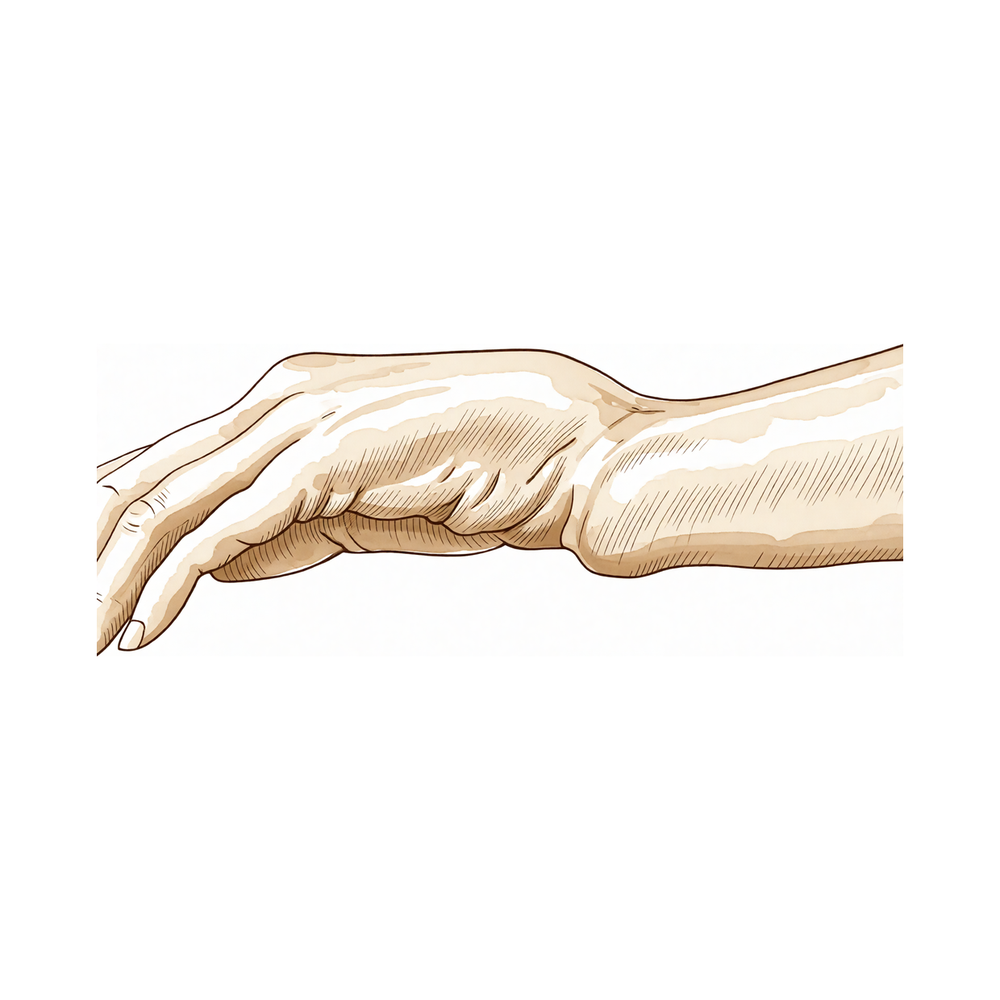
Vista lateral de um punho apresentando a clássica deformidade em “garfo de jantar”, após uma fratura ter cicatrizado de forma incorreta.
Má união do rádio distal: uma fratura do punho que cicatriza em posição inadequada pode resultar na deformidade em “garfo de jantar”, acarretando diminuição da força e da capacidade de rotação. Kieran Hirpara 4.0

Esta página foi traduzida automaticamente e ainda não foi verificada por um médico. A versão em inglês é a versão oficial.

O que você está sentindo

Você fraturou o pulso há algum tempo (talvez ao cair com a mão estendida) e ele cicatrizou. Porém, não voltou ao normal. O pulso pode parecer ligeiramente curvado, torto ou mais curto que o outro lado; às vezes há uma protuberância visível na parte de trás. Mais do que a aparência, o pulso muitas vezes não funciona como antes: a força de preensão fica fraca, o pulso fica rígido, e girar a palma da mão para cima e para baixo (como ao girar uma chave ou uma maçaneta) pode ser desconfortável ou doloroso.

Muitas pessoas percebem uma dor no lado do mindinho do pulso (o lado oposto ao polegar), que piora ao girar o braço, ao apoiar o peso na mão ou ao realizar tarefas mais pesadas. Algumas sentem um estalido ou sensação de instabilidade ao rotacionar o antebraço. Um número reduzido de pacientes desenvolve formigamento no polegar e nos dedos, caso a posição de cicatrização do osso comprima algum nervo no pulso. Todos esses são sinais de que o osso não se consolidou exatamente na forma correta.

O que está realmente acontecendo

O rádio distal é o maior dos dois ossos do antebraço, localizado do lado do polegar, bem na altura do punho. Quando ele se fratura e depois cicatriza em uma posição inadequada, chamamos isso de má união óssea: o osso está solidamente consolidado, porém com formato incorreto. O padrão mais comum é que a extremidade do rádio se incline para trás (em direção ao dorso da mão) e o osso fique mais curto, deixando de se alinhar corretamente com o ulna, o outro osso do antebraço.

Essa pequena alteração na forma do rádio gera efeitos colaterais. Um rádio mais curto e inclinado compromete a mecânica da preensão, reduzindo a força da mão. Além disso, desequilibra a articulação onde os dois ossos do antebraço se encontram próximo ao punho (a articulação rádio-ulnar distal), responsável pela rotação do antebraço; isso torna a rotação mais difícil ou dolorosa. Como o rádio ficou mais curto, o ulna acaba ficando “mais longo”, pressionando os pequenos ossos e a cartilagem do lado do dedo mindinho, provocando aquela dor no lado ulnar. Caso a fratura tenha atingido a própria superfície articular e cicatrizado com um desnível, a cartilagem se desgasta de forma irregular, podendo levar ao desenvolvimento de artrite com o tempo.

O que podemos fazer a respeito

No Mater Private Hospital Rockhampton, o Dr. Kieran Hirpara lidera nossa equipe especializada em cirurgia do membro superior no tratamento dessas lesões do punho. Geralmente iniciamos com tratamento não cirúrgico; porém, caso a dor ou a rigidez persistam, consideramos a cirurgia após uma avaliação minuciosa do seu histórico clínico e dos exames de imagem.

Nem todo punho com deformidade após a cicatrização necessita de cirurgia. Se a deformidade for leve e você estiver se adaptando bem, a fisioterapia, mudanças nas atividades diárias, o uso de uma tala de suporte e analgésicos simples são opções totalmente adequadas; muitas vezes começamos por aí.

Quando a deformidade é significativa e realmente lhe causa limitações (dor, dificuldade para segurar objetos, restrição de movimentos), o procedimento indicado para corrigir o problema é a osteotomia corretiva. Em termos simples, o cirurgião refaz o corte no osso no local da fratura antiga, realinha-o corretamente e o fixa com uma placa metálica e parafusos. Nos casos em que é necessário alongar o osso, o espaço resultante pode ser preenchido com enxerto ósseo (seu próprio osso, osso de doador ou material substituto); porém, com as placas modernas, muitas correções hoje cicatrizam de forma confiável sem a necessidade de enxerto. Caso o problema esteja principalmente no osso do lado do dedo mindinho, o cirurgião pode, alternativamente ou adicionalmente, encurtar a ulna para aliviar a pressão nesse lado.

Atualmente, a cirurgia costuma ser planejada previamente com base em um modelo 3D do seu próprio punho; o cirurgião pode ainda utilizar um guia personalizado para garantir que o corte e o realinhamento correspondam exatamente ao plano estabelecido. Isso é especialmente útil quando a fratura atingiu a superfície articular.

O que esperar

É útil saber desde já que esta é uma intervenção mais complexa do que a cirurgia original da fratura: o cirurgião está remodelando um osso já consolidado, em vez de simplesmente corrigir uma fratura recente; por isso, a recuperação é mais demorada e exigente. O osso precisa se consolidar na nova posição, o que geralmente leva alguns meses, e a placa é normalmente mantida no local.

A boa notícia é que, para os casos adequados, os benefícios são reais e duradouros: estudos demonstram consistentemente redução da dor, melhora na força de preensão e na rotação do antebraço; os pacientes, em geral, relatam satisfação anos após a cirurgia. Corrigir a deformidade precocemente, antes que a articulação e os ligamentos circundantes se adaptem à posição anormal, tende a gerar os melhores resultados. Isso não garante que o punho volte a ser perfeitamente normal; além disso, se a artrose já estiver instalada, os benefícios são mais limitados. Contudo, para casos de má união sintomática, esta cirurgia efetivamente melhora o funcionamento do punho em relação ao estado anterior.

Quando procurar um especialista

  • Um pulso que cicatrizou de forma torta e permanece dolorido, fraco ou rígido meses após uma fratura; vale a pena avaliar o alinhamento, pois a correção precoce geralmente traz melhores resultados.
  • Dor no lado do dedo mindinho do pulso que piora ao torcer ou apoiar o peso na mão, especialmente quando a rotação do antebraço fica limitada ou apresenta um “clique” anormal.
  • Piora na perda de força de preensão ou na capacidade de rotação, ou dificuldade em realizar tarefas cotidianas como girar chaves, despejar líquidos ou usar ferramentas.
  • Formigamento ou dormência no polegar e nos dedos após uma fratura do pulso; pode haver irritação de algum nervo, que deve ser avaliado.

Em maior profundidade

Advanced reading: the deeper science (optional)

Esta seção aborda tópicos além do necessário para a tomada de decisões terapêuticas por parte do paciente. A pseudartrose distal do rádio merece uma leitura mais aprofundada, pois a cirurgia corretiva possui um protocolo técnico bem definido que foi estabelecido apenas recentemente; além disso, a decisão de realizá-la depende da função da mão, e não da aparência do exame de raio-X.

A abordagem utilizada determina a taxa de reoperações

A correção de uma má união óssea exige o corte do osso já consolidado, o restabelecimento de seu alinhamento e a fixação com uma placa. Essa placa pode ser colocada na face anterior ou posterior do rádio; até agora, essa escolha era considerada uma questão de preferência do cirurgião.

A comparação entre 403 pacientes, porém, revela diferenças significativas. O uso de placa na face anterior esteve associado a menos reoperações – 9% contra 28% – e a menos remoções de material de fixação – 3% contra 18%, mantendo-se as taxas de complicações graves semelhantes: 5% e 6%, respectivamente. Os autores recomendam que os cirurgiões estejam plenamente cientes do risco acrescido associado à fixação com placa na face posterior após osteotomia corretiva [1].

O motivo dessa diferença é de natureza anatômica, não técnica. Na face posterior do punho, os tendões extensores passam diretamente sobre o osso, quase sem nada entre eles e a placa; por isso, o material de fixação fica proeminente, causa irritação e frequentemente precisa ser removido; em casos extremos, pode até causar desgaste do tendão. Na face anterior, uma camada muscular separa a placa dos tendões flexores.

Vale notar o que não apresentou diferença: as complicações graves foram as mesmas nos dois grupos. A vantagem da abordagem anterior reside, portanto, na prevenção de uma segunda cirurgia para remoção de material de fixação, e não na prevenção de complicações graves.

Por que o raio-X não é decisivo

Uma união inadequada do rádio distal, com má posição de consolidação, é visível em qualquer radiografia; a deformidade parece, de fato, exigir correção. No entanto, os valores mensurados — o grau de inclinação da superfície articular, o quanto o rádio encurtou — são o que um relatório de acompanhamento enfatiza.

Mas a deformidade em si não é o motivo da queixa. O que os pacientes relatam são perda da rotação do antebraço, perda de força de preensão, dor no lado ulnar do punho ou um aspecto estético que os incomoda. A relação entre os valores radiográficos e esses sintomas é tênue, sobretudo em pacientes mais velhos, nos quais deformidades consideráveis são frequentemente bem toleradas.

Por isso, a osteotomia corretiva é avaliada com base nos sintomas e na função, e não na aparência da imagem radiográfica. Um punho que funciona de maneira aceitável, para alguém cujas exigências ele atende, não precisa ser corrigido apenas porque os ângulos estão “errados”.

O que a cirurgia realmente corrige

Duas consequências são responsáveis pela maioria dos casos de má união sintomática.

A primeira é a perda da rotação do antebraço. Quando o rádio cicatriza mais curto ou inclinado, ele deixa de girar corretamente em torno da ulna; assim, a capacidade de virar a palma da mão para cima fica limitada – movimento necessário para segurar uma bandeja, pegar troco ou girar uma chave.

A segunda é a dor no lado da ulna, decorrente do seu alongamento relativo. O rádio encurta à medida que colapsa, fazendo com que a ulna se torne comparativamente mais longa e pressione os ossos do carpo, gerando um problema de impacto como consequência secundária da fratura. Esse problema pode ser tratado tanto restaurando o comprimento do rádio quanto encurtando a ulna; a escolha adequada depende de qual osso apresenta maior grau de deformidade.

Compreender esses dois mecanismos explica por que a correção cirúrgica costuma ser válida até mesmo anos após a lesão original: trata-se de resolver um problema mecânico contínuo, e não apenas reparar uma fratura antiga.

Referências

[1] Essa A, Paul R, Khan S, Avisar E, Chan A, Persitz J. Uma meta-análise comparando as complicações da osteotomia anterior versus dorsal e da fixação com placa no caso de má união do rádio distal. J Hand Surg Eur Vol. 2024;49(8):956-64. https://doi.org/10.1177/17531934241254962


Creative Commons BY-NC 4.0

CC Creative Commons licence
BY Attribution — you must credit the source
NC NonCommercial — not for commercial use

Attribution-NonCommercial 4.0 International


Creative Commons Corporation ("Creative Commons") is not a law firm and does not provide legal services or legal advice. Distribution of Creative Commons public licenses does not create a lawyer-client or other relationship. Creative Commons makes its licenses and related information available on an "as-is" basis. Creative Commons gives no warranties regarding its licenses, any material licensed under their terms and conditions, or any related information. Creative Commons disclaims all liability for damages resulting from their use to the fullest extent possible.

Using Creative Commons Public Licenses

Creative Commons public licenses provide a standard set of terms and conditions that creators and other rights holders may use to share original works of authorship and other material subject to copyright and certain other rights specified in the public license below. The following considerations are for informational purposes only, are not exhaustive, and do not form part of our licenses.

Considerations for licensors: Our public licenses are intended for use by those authorized to give the public permission to use material in ways otherwise restricted by copyright and certain other rights. Our licenses are irrevocable. Licensors should read and understand the terms and conditions of the license they choose before applying it. Licensors should also secure all rights necessary before applying our licenses so that the public can reuse the material as expected. Licensors should clearly mark any material not subject to the license. This includes other CC- licensed material, or material used under an exception or limitation to copyright. More considerations for licensors: wiki.creativecommons.org/Considerations_for_licensors

Considerations for the public: By using one of our public licenses, a licensor grants the public permission to use the licensed material under specified terms and conditions. If the licensor's permission is not necessary for any reason--for example, because of any applicable exception or limitation to copyright--then that use is not regulated by the license. Our licenses grant only permissions under copyright and certain other rights that a licensor has authority to grant. Use of the licensed material may still be restricted for other reasons, including because others have copyright or other rights in the material. A licensor may make special requests, such as asking that all changes be marked or described. Although not required by our licenses, you are encouraged to respect those requests where reasonable. More considerations for the public: wiki.creativecommons.org/Considerations_for_licensees


Creative Commons Attribution-NonCommercial 4.0 International Public License

By exercising the Licensed Rights (defined below), You accept and agree to be bound by the terms and conditions of this Creative Commons Attribution-NonCommercial 4.0 International Public License ("Public License"). To the extent this Public License may be interpreted as a contract, You are granted the Licensed Rights in consideration of Your acceptance of these terms and conditions, and the Licensor grants You such rights in consideration of benefits the Licensor receives from making the Licensed Material available under these terms and conditions.

Section 1 -- Definitions.

a. Adapted Material means material subject to Copyright and Similar Rights that is derived from or based upon the Licensed Material and in which the Licensed Material is translated, altered, arranged, transformed, or otherwise modified in a manner requiring permission under the Copyright and Similar Rights held by the Licensor. For purposes of this Public License, where the Licensed Material is a musical work, performance, or sound recording, Adapted Material is always produced where the Licensed Material is synched in timed relation with a moving image.

b. Adapter's License means the license You apply to Your Copyright and Similar Rights in Your contributions to Adapted Material in accordance with the terms and conditions of this Public License.

c. Copyright and Similar Rights means copyright and/or similar rights closely related to copyright including, without limitation, performance, broadcast, sound recording, and Sui Generis Database Rights, without regard to how the rights are labeled or categorized. For purposes of this Public License, the rights specified in Section 2(b)(1)-(2) are not Copyright and Similar Rights.

d. Effective Technological Measures means those measures that, in the absence of proper authority, may not be circumvented under laws fulfilling obligations under Article 11 of the WIPO Copyright Treaty adopted on December 20, 1996, and/or similar international agreements.

e. Exceptions and Limitations means fair use, fair dealing, and/or any other exception or limitation to Copyright and Similar Rights that applies to Your use of the Licensed Material.

f. Licensed Material means the artistic or literary work, database, or other material to which the Licensor applied this Public License.

g. Licensed Rights means the rights granted to You subject to the terms and conditions of this Public License, which are limited to all Copyright and Similar Rights that apply to Your use of the Licensed Material and that the Licensor has authority to license.

h. Licensor means the individual(s) or entity(ies) granting rights under this Public License.

i. NonCommercial means not primarily intended for or directed towards commercial advantage or monetary compensation. For purposes of this Public License, the exchange of the Licensed Material for other material subject to Copyright and Similar Rights by digital file-sharing or similar means is NonCommercial provided there is no payment of monetary compensation in connection with the exchange.

j. Share means to provide material to the public by any means or process that requires permission under the Licensed Rights, such as reproduction, public display, public performance, distribution, dissemination, communication, or importation, and to make material available to the public including in ways that members of the public may access the material from a place and at a time individually chosen by them.

k. Sui Generis Database Rights means rights other than copyright resulting from Directive 96/9/EC of the European Parliament and of the Council of 11 March 1996 on the legal protection of databases, as amended and/or succeeded, as well as other essentially equivalent rights anywhere in the world.

l. You means the individual or entity exercising the Licensed Rights under this Public License. Your has a corresponding meaning.

Section 2 -- Scope.

a. License grant.

1. Subject to the terms and conditions of this Public License, the Licensor hereby grants You a worldwide, royalty-free, non-sublicensable, non-exclusive, irrevocable license to exercise the Licensed Rights in the Licensed Material to:

a. reproduce and Share the Licensed Material, in whole or in part, for NonCommercial purposes only; and

b. produce, reproduce, and Share Adapted Material for NonCommercial purposes only.

2. Exceptions and Limitations. For the avoidance of doubt, where Exceptions and Limitations apply to Your use, this Public License does not apply, and You do not need to comply with its terms and conditions.

3. Term. The term of this Public License is specified in Section 6(a).

4. Media and formats; technical modifications allowed. The Licensor authorizes You to exercise the Licensed Rights in all media and formats whether now known or hereafter created, and to make technical modifications necessary to do so. The Licensor waives and/or agrees not to assert any right or authority to forbid You from making technical modifications necessary to exercise the Licensed Rights, including technical modifications necessary to circumvent Effective Technological Measures. For purposes of this Public License, simply making modifications authorized by this Section 2(a) (4) never produces Adapted Material.

5. Downstream recipients.

a. Offer from the Licensor -- Licensed Material. Every recipient of the Licensed Material automatically receives an offer from the Licensor to exercise the Licensed Rights under the terms and conditions of this Public License.

b. No downstream restrictions. You may not offer or impose any additional or different terms or conditions on, or apply any Effective Technological Measures to, the Licensed Material if doing so restricts exercise of the Licensed Rights by any recipient of the Licensed Material.

6. No endorsement. Nothing in this Public License constitutes or may be construed as permission to assert or imply that You are, or that Your use of the Licensed Material is, connected with, or sponsored, endorsed, or granted official status by, the Licensor or others designated to receive attribution as provided in Section 3(a)(1)(A)(i).

b. Other rights.

1. Moral rights, such as the right of integrity, are not licensed under this Public License, nor are publicity, privacy, and/or other similar personality rights; however, to the extent possible, the Licensor waives and/or agrees not to assert any such rights held by the Licensor to the limited extent necessary to allow You to exercise the Licensed Rights, but not otherwise.

2. Patent and trademark rights are not licensed under this Public License.

3. To the extent possible, the Licensor waives any right to collect royalties from You for the exercise of the Licensed Rights, whether directly or through a collecting society under any voluntary or waivable statutory or compulsory licensing scheme. In all other cases the Licensor expressly reserves any right to collect such royalties, including when the Licensed Material is used other than for NonCommercial purposes.

Section 3 -- License Conditions.

Your exercise of the Licensed Rights is expressly made subject to the following conditions.

a. Attribution.

1. If You Share the Licensed Material (including in modified form), You must:

a. retain the following if it is supplied by the Licensor with the Licensed Material:

i. identification of the creator(s) of the Licensed Material and any others designated to receive attribution, in any reasonable manner requested by the Licensor (including by pseudonym if designated);

ii. a copyright notice;

iii. a notice that refers to this Public License;

iv. a notice that refers to the disclaimer of warranties;

v. a URI or hyperlink to the Licensed Material to the extent reasonably practicable;

b. indicate if You modified the Licensed Material and retain an indication of any previous modifications; and

c. indicate the Licensed Material is licensed under this Public License, and include the text of, or the URI or hyperlink to, this Public License.

2. You may satisfy the conditions in Section 3(a)(1) in any reasonable manner based on the medium, means, and context in which You Share the Licensed Material. For example, it may be reasonable to satisfy the conditions by providing a URI or hyperlink to a resource that includes the required information.

3. If requested by the Licensor, You must remove any of the information required by Section 3(a)(1)(A) to the extent reasonably practicable.

4. If You Share Adapted Material You produce, the Adapter's License You apply must not prevent recipients of the Adapted Material from complying with this Public License.

Section 4 -- Sui Generis Database Rights.

Where the Licensed Rights include Sui Generis Database Rights that apply to Your use of the Licensed Material:

a. for the avoidance of doubt, Section 2(a)(1) grants You the right to extract, reuse, reproduce, and Share all or a substantial portion of the contents of the database for NonCommercial purposes only;

b. if You include all or a substantial portion of the database contents in a database in which You have Sui Generis Database Rights, then the database in which You have Sui Generis Database Rights (but not its individual contents) is Adapted Material; and

c. You must comply with the conditions in Section 3(a) if You Share all or a substantial portion of the contents of the database.

For the avoidance of doubt, this Section 4 supplements and does not replace Your obligations under this Public License where the Licensed Rights include other Copyright and Similar Rights.

Section 5 -- Disclaimer of Warranties and Limitation of Liability.

a. UNLESS OTHERWISE SEPARATELY UNDERTAKEN BY THE LICENSOR, TO THE EXTENT POSSIBLE, THE LICENSOR OFFERS THE LICENSED MATERIAL AS-IS AND AS-AVAILABLE, AND MAKES NO REPRESENTATIONS OR WARRANTIES OF ANY KIND CONCERNING THE LICENSED MATERIAL, WHETHER EXPRESS, IMPLIED, STATUTORY, OR OTHER. THIS INCLUDES, WITHOUT LIMITATION, WARRANTIES OF TITLE, MERCHANTABILITY, FITNESS FOR A PARTICULAR PURPOSE, NON-INFRINGEMENT, ABSENCE OF LATENT OR OTHER DEFECTS, ACCURACY, OR THE PRESENCE OR ABSENCE OF ERRORS, WHETHER OR NOT KNOWN OR DISCOVERABLE. WHERE DISCLAIMERS OF WARRANTIES ARE NOT ALLOWED IN FULL OR IN PART, THIS DISCLAIMER MAY NOT APPLY TO YOU.

b. TO THE EXTENT POSSIBLE, IN NO EVENT WILL THE LICENSOR BE LIABLE TO YOU ON ANY LEGAL THEORY (INCLUDING, WITHOUT LIMITATION, NEGLIGENCE) OR OTHERWISE FOR ANY DIRECT, SPECIAL, INDIRECT, INCIDENTAL, CONSEQUENTIAL, PUNITIVE, EXEMPLARY, OR OTHER LOSSES, COSTS, EXPENSES, OR DAMAGES ARISING OUT OF THIS PUBLIC LICENSE OR USE OF THE LICENSED MATERIAL, EVEN IF THE LICENSOR HAS BEEN ADVISED OF THE POSSIBILITY OF SUCH LOSSES, COSTS, EXPENSES, OR DAMAGES. WHERE A LIMITATION OF LIABILITY IS NOT ALLOWED IN FULL OR IN PART, THIS LIMITATION MAY NOT APPLY TO YOU.

c. The disclaimer of warranties and limitation of liability provided above shall be interpreted in a manner that, to the extent possible, most closely approximates an absolute disclaimer and waiver of all liability.

Section 6 -- Term and Termination.

a. This Public License applies for the term of the Copyright and Similar Rights licensed here. However, if You fail to comply with this Public License, then Your rights under this Public License terminate automatically.

b. Where Your right to use the Licensed Material has terminated under Section 6(a), it reinstates:

1. automatically as of the date the violation is cured, provided it is cured within 30 days of Your discovery of the violation; or

2. upon express reinstatement by the Licensor.

For the avoidance of doubt, this Section 6(b) does not affect any right the Licensor may have to seek remedies for Your violations of this Public License.

c. For the avoidance of doubt, the Licensor may also offer the Licensed Material under separate terms or conditions or stop distributing the Licensed Material at any time; however, doing so will not terminate this Public License.

d. Sections 1, 5, 6, 7, and 8 survive termination of this Public License.

Section 7 -- Other Terms and Conditions.

a. The Licensor shall not be bound by any additional or different terms or conditions communicated by You unless expressly agreed.

b. Any arrangements, understandings, or agreements regarding the Licensed Material not stated herein are separate from and independent of the terms and conditions of this Public License.

Section 8 -- Interpretation.

a. For the avoidance of doubt, this Public License does not, and shall not be interpreted to, reduce, limit, restrict, or impose conditions on any use of the Licensed Material that could lawfully be made without permission under this Public License.

b. To the extent possible, if any provision of this Public License is deemed unenforceable, it shall be automatically reformed to the minimum extent necessary to make it enforceable. If the provision cannot be reformed, it shall be severed from this Public License without affecting the enforceability of the remaining terms and conditions.

c. No term or condition of this Public License will be waived and no failure to comply consented to unless expressly agreed to by the Licensor.

d. Nothing in this Public License constitutes or may be interpreted as a limitation upon, or waiver of, any privileges and immunities that apply to the Licensor or You, including from the legal processes of any jurisdiction or authority.


Creative Commons is not a party to its public licenses. Notwithstanding, Creative Commons may elect to apply one of its public licenses to material it publishes and in those instances will be considered the “Licensor.” The text of the Creative Commons public licenses is dedicated to the public domain under the CC0 Public Domain Dedication. Except for the limited purpose of indicating that material is shared under a Creative Commons public license or as otherwise permitted by the Creative Commons policies published at creativecommons.org/policies, Creative Commons does not authorize the use of the trademark "Creative Commons" or any other trademark or logo of Creative Commons without its prior written consent including, without limitation, in connection with any unauthorized modifications to any of its public licenses or any other arrangements, understandings, or agreements concerning use of licensed material. For the avoidance of doubt, this paragraph does not form part of the public licenses.

Creative Commons may be contacted at creativecommons.org.