Patients › Rehabilitation
Epicondilite lateral (cotovelo de tenista)
Um programa de reabilitação baseado em carga para o cotovelo de tenista — que visa aliviar a dor e, em seguida, fortalecer progressivamente o tendão — abrangendo tanto o tratamento não cirúrgico quanto a recuperação após desbridamento do tendão ECRB.
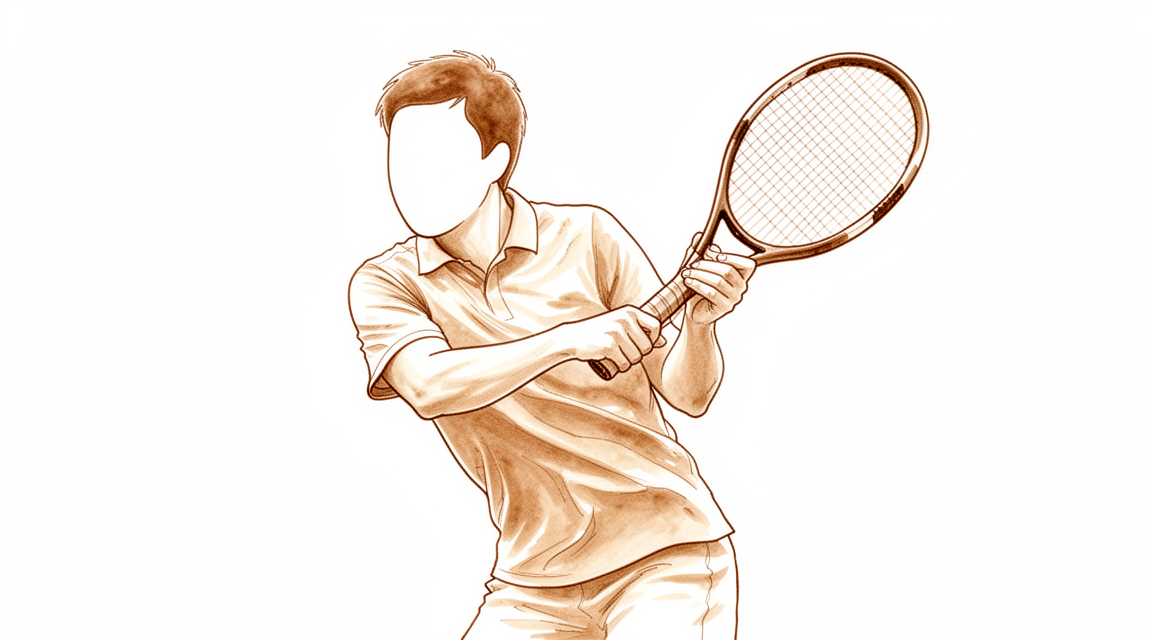
Esta página explica como tratar o cotovelo de tenista e como realizar a reabilitação, tanto no caso de tratamento sem cirurgia (que é o caso da grande maioria dos pacientes) quanto na recuperação após uma operação para limpar o tendão. O acompanhamento é feito pelo Dr. Kieran Hirpara, no Mater Private Hospital Rockhampton. A página começa com o seu programa de exercícios domiciliares, seguido do protocolo clínico estruturado destinado ao seu fisioterapeuta ou terapeuta da mão; leve esta página ou o seu arquivo PDF às sessões de terapia para garantir que a reabilitação seja coordenada. O terapeuta poderá ajustar o plano conforme a evolução da sua recuperação.
O que esperar
O cotovelo de tenista (epicondilite lateral) é um problema que afeta o tendão na parte externa do cotovelo, especificamente o tendão extensor comum e, em particular, um pequeno músculo chamado ECRB. Apesar do “-ite” no nome, não se trata de uma inflamação que possa ser resolvida apenas com repouso. Na verdade, é uma alteração degenerativa do tendão (tendinose), na qual as fibras tendinosas se tornam desorganizadas e não cicatrizam adequadamente.
Isso é importante porque muda completamente o tratamento. Você não melhora com repouso e proteção do cotovelo; na verdade, o repouso prolongado tende a enfraquecer o tendão e dificultar sua recuperação. A melhora acontece ao se aplicar carga gradualmente ao tendão, permitindo que ele se reestruture e recupere a capacidade de suportar esforços e movimentos de preensão. O processo é: primeiro controlar a dor, depois fortalecer progressivamente o tendão, começando por exercícios isométricos suaves e evoluindo para exercícios de fortalecimento controlados e lentos, como o “Tyler twist”.
A boa notícia é que, com um programa de carga adequado, o cotovelo de tenista geralmente melhora por conta própria. Cerca de 80–90% das pessoas apresentam melhora em até um ano; porém, em alguns casos pode levar até 12–18 meses para a resolução completa. A cirurgia só é considerada quando pelo menos seis meses de reabilitação consistente e de boa qualidade não deram resultado; apenas uma pequena parcela (aproximadamente 4–11%) chega a esse ponto.
Precauções e limitações
O que fazer:
- Continue utilizando o braço: aplique carga ao tendão, não o deixe em repouso.
- Use a dor como guia: uma leve dor durante e após o exercício é normal e esperada; dor aguda ou que piora indica que deve-se diminuir o esforço.
- Levante objetos com a palma da mão voltada para cima (como se estivesse segurando uma tigela de sopa) para aliviar a carga sobre o tendão dolorido.
- Use uma órtese de contraforça sobre o músculo do antebraço durante tarefas de preensão e levantamento.
O que não fazer:
- Não imobilize o cotovelo com gesso ou tipóia no caso de cotovelo de tenista que está sendo tratado sem cirurgia; esse não é o tratamento adequado para tendinose. (Após a cirurgia é diferente: a tipóia é usada para conforto na primeira semana, conforme descrito na via pós-operatória abaixo.)
- Não realize esforços de preensão intensos com o cotovelo esticado e o punho flexionado (por exemplo, levantar objetos pesados com a palma da mão voltada para baixo).
- Não se apresse em aplicar injeções de esteroides. A cortisona pode trazer alívio por algumas semanas, mas as evidências mostram que ela gera piores resultados e mais recorrências aos 6–12 meses em comparação à fisioterapia ou simplesmente à espera. Portanto, não é um tratamento de primeira linha.
Seus exercícios
Kieran Hirpara 4.0
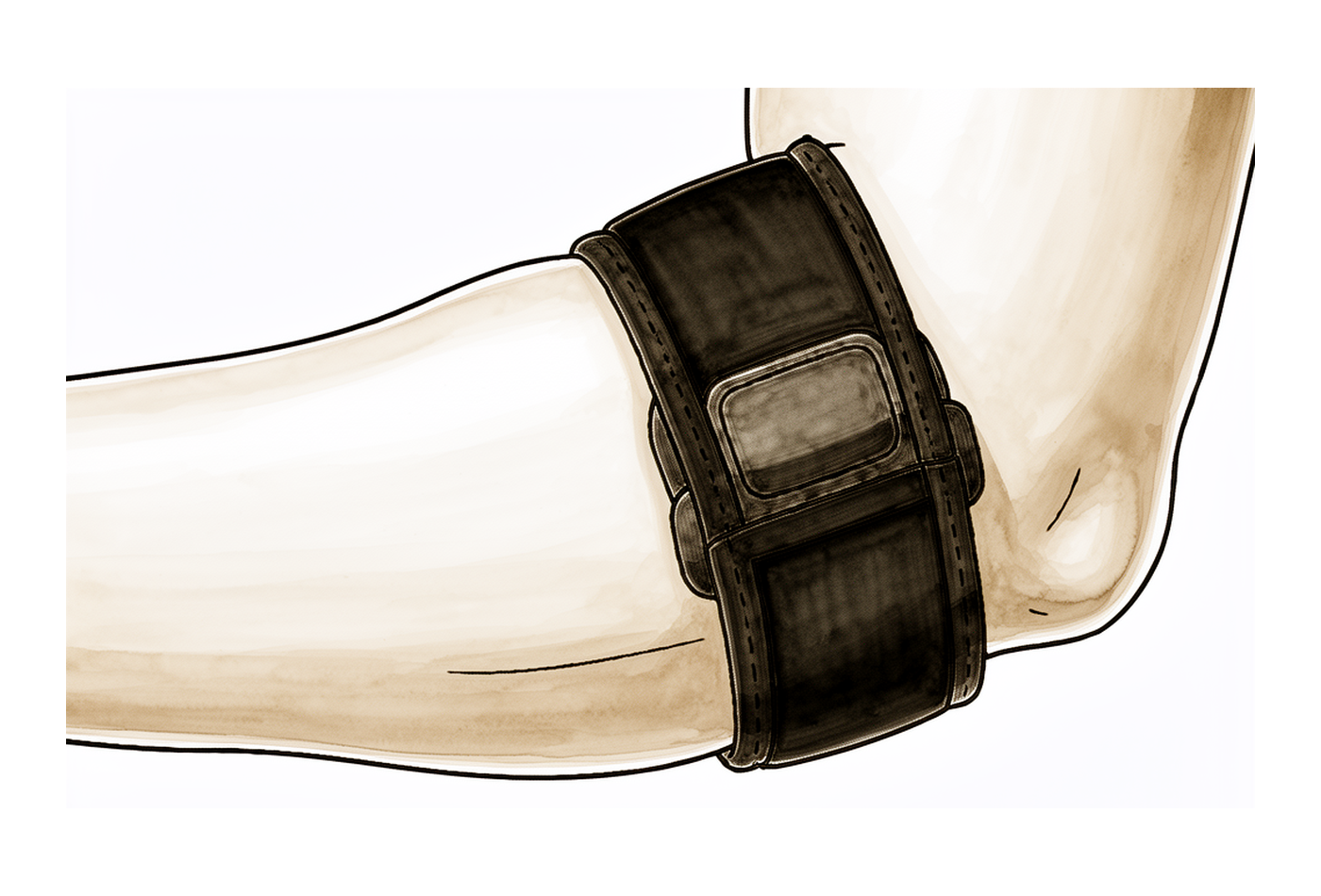
Órtese de contraforça
Coloque a faixa de contraforça ao redor do antebraço, algumas larguras de dedo abaixo do cotovelo, sobre a maior parte do músculo (não sobre o ponto ósseo em si). Ela deve ficar firme, mas não tão apertada a ponto de causar formigamento na mão. Use-a durante tarefas que exijam agarramento e levantamento de peso, para aliviar a carga sobre o tendão dolorido; não é necessário usá-la em repouso ou na cama.
Durante atividades que causam desconforto; afrouxe caso sinta formigamento na mão.
Kieran Hirpara 4.0
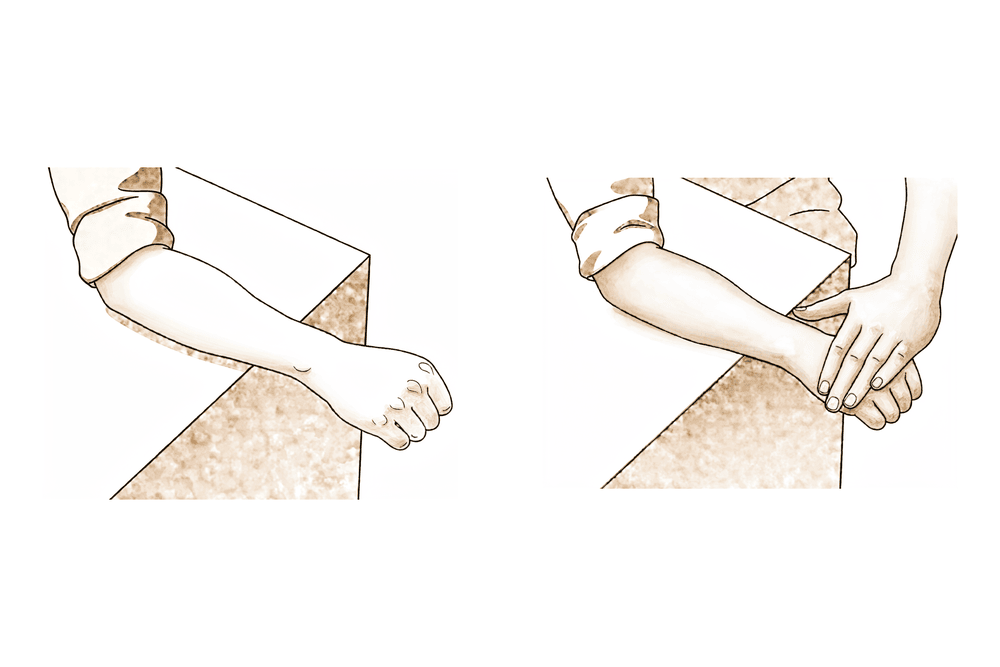
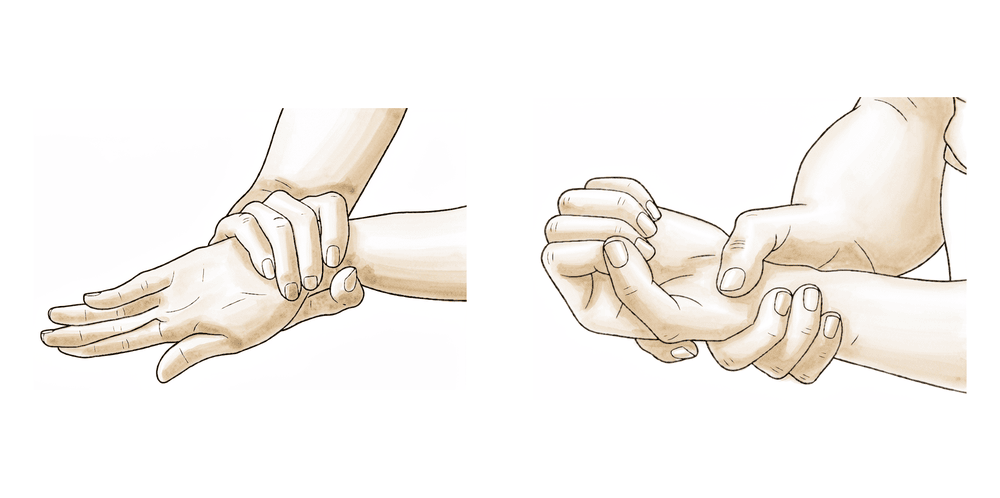
Extensão isométrica do punho
Apoie o antebraço numa mesa, com a palma da mão virada para baixo e a mão sobre a borda da mesa. Coloque a outra mão na parte de trás da mão dolorida. Tente levantar a parte de trás da mão em direção ao teto, enquanto a outra mão a mantém imóvel — nada deve se mover de fato; trata-se de um exercício de contração muscular contra resistência. Você deve sentir um esforço considerável, mas não uma dor aguda. Mantenha a força e depois relaxe.
Mantenha por 30–45 segundos, 5 vezes, 1–2 vezes ao dia.
Kieran Hirpara 4.0
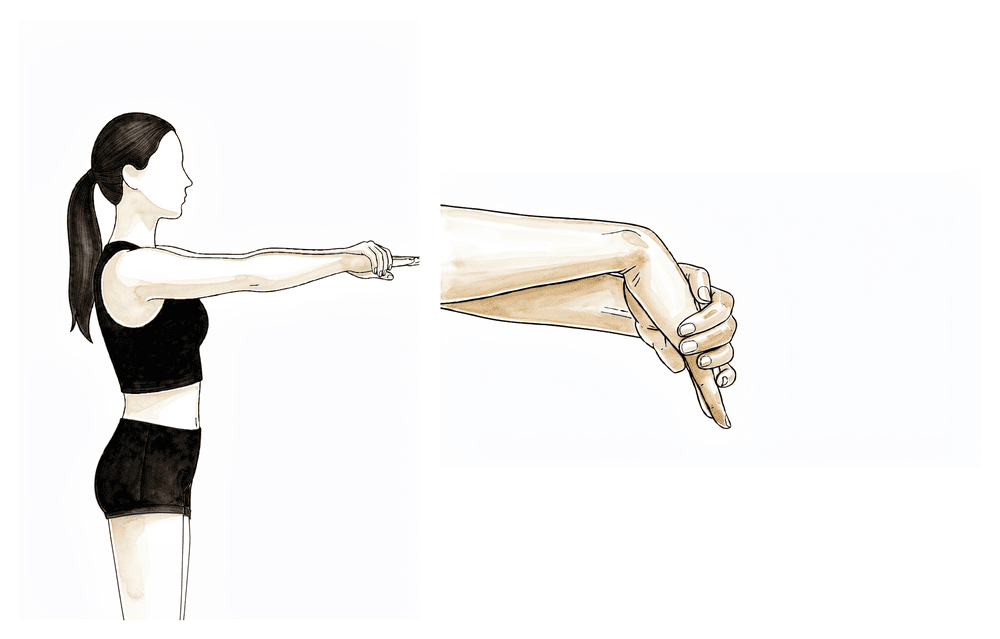
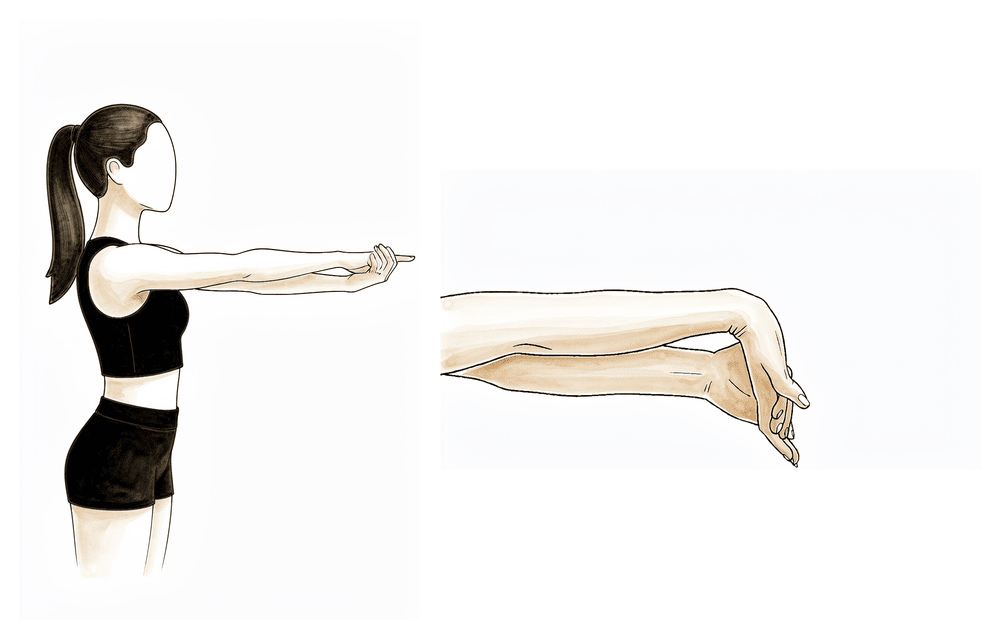
Alongamento dos extensores do punho
Estenda o braço dolorido à sua frente, mantendo o cotovelo reto e a palma da mão voltada para baixo. Com a outra mão, dobre suavemente o pulso para baixo, de modo que os dedos apontem para o chão, até sentir uma tensão confortável na parte superior do antebraço. Mantenha o cotovelo reto. Se esticar o cotovelo completamente causar desconforto, comece com ele ligeiramente dobrado e, à medida que a dor diminuir, vá esticando-o totalmente.
Mantenha por 30 segundos, 3 vezes, 2–3 vezes ao dia.
Kieran Hirpara 4.0
Alongamento dos flexores do punho
Estenda o braço à sua frente, mantendo o cotovelo reto e a palma da mão voltada para cima. Com a outra mão, puxe suavemente os dedos e o pulso para trás e para baixo, até sentir uma tensão confortável na parte inferior do antebraço. Mantenha o cotovelo reto durante todo o movimento.
Mantenha por 30 segundos, 3 vezes, 2–3 vezes ao dia.
Kieran Hirpara 4.0
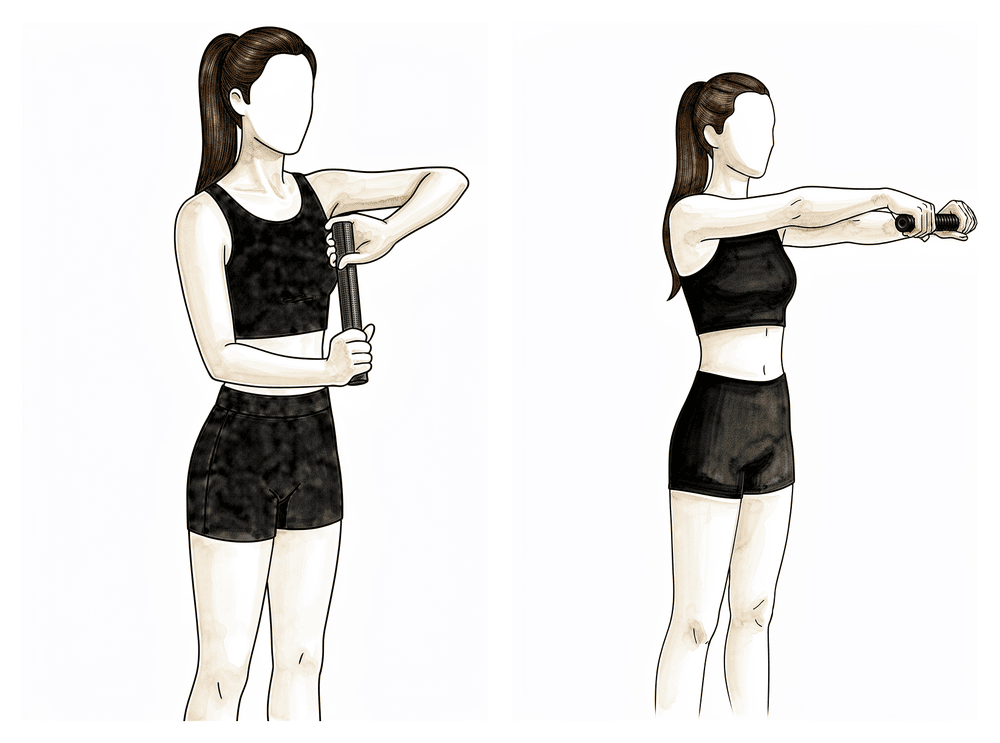
Torção de Tyler (extensão excêntrica do punho)
Segure uma barra de borracha flexível (FlexBar) verticalmente na mão dolorida, com o pulso inclinado para trás. Segure a parte superior da barra com a outra mão e gire-a. Em seguida, leve a barra para a frente do corpo, mantendo a rotação, e deixe lentamente o pulso dolorido desenrolar-se de forma controlada ao longo de 3–4 segundos — essa descida lenta e controlada é o que fortalece o tendão. Esse movimento de desenrolamento deve ser um pouco desgastante, mas sem causar dor aguda. É normal sentir uma leve dor durante e logo após o exercício; isso é perfeitamente aceitável.
3 séries de 15 repetições, uma vez ao dia (o exercício principal de fortalecimento).
Kieran Hirpara 4.0
Rotação do antebraço
Aproxime o cotovelo do corpo e dobre-o formando um ângulo reto. Gire lentamente o antebraço de modo que a palma da mão fique voltada para cima; em seguida, gire-o novamente para que a palma fique voltada para baixo, mantendo o cotovelo próximo ao corpo. À medida que a atividade se tornar mais fácil, segure um peso leve, como um martelo ou uma lata, para aumentar a carga.
10 repetições em cada direção, 2–3 vezes por dia; adicione um peso leve conforme possível.
Kieran Hirpara 4.0
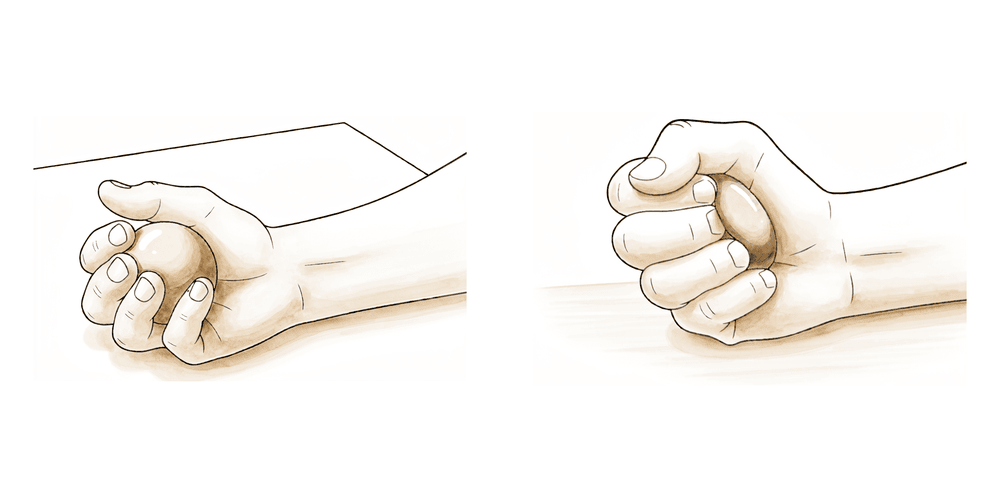
Fortalecimento da preensão
Aperte uma bola macia ou massa terapêutica na mão, mantenha a pressão por alguns instantes e depois relaxe. Aumente gradualmente a força do aperto à medida que o tendão for suportando mais carga. Se o ato de segurar algo ainda causar muita dor, comece mais tarde e com menos intensidade — os exercícios de preensão devem ser feitos na fase de fortalecimento, depois que a irritação inicial já tiver diminuído.
10–15 apertos, 2–3 vezes ao dia; aumente a firmeza conforme tolerado.
Estes são os exercícios contidos no seu folheto informativo. Eles seguem a sequência da recuperação: a órtese de contraforça e as contrações isométricas ajudam a aliviar a dor no início; os alongamentos mantêm o antebraço flexível; e o “Tyler twist”, a rotação do antebraço e os exercícios de preensão fortalecem novamente os tendões. Comece a realizá-los conforme orientação do Dr. Hirpara e do seu fisioterapeuta; não se sinta obrigado a fazer todos eles desde o primeiro dia. O seu fisioterapeuta indicará quais iniciar e quando acrescentar os exercícios de fortalecimento.
Seu protocolo clínico
O restante desta página constitui o protocolo de reabilitação clínica para epicondilite lateral (cotovelo de tenista). Esta seção deve ser entregue ao seu fisioterapeuta ou terapeuta da mão; cada fase começa com uma explicação simples, em linguagem acessível, sobre o que está ocorrendo.
O protocolo possui duas vias: uma via não cirúrgica (tratamento de primeira linha para praticamente todos os pacientes) e uma via pós-operatória, destinada ao pequeno número de pacientes que se submetem ao desbridamento do ECRB após não obterem melhora após seis ou mais meses de tratamento conservador adequado.
Abordagem não cirúrgica
O princípio fundamental é a carga progressiva sobre o tendão, guiada pela dor. O objetivo é encurtar a duração dos sintomas e restaurar a tolerância à carga, e não manter o tendão em repouso.
Fase I — Aguda / controle da dor (0–2 semanas)
O objetivo aqui é controlar a dor e restabelecer o movimento sem carga. Não há imobilização; trata-se de repouso relativo, não de gesso.
Para o seu fisioterapeuta:
- Objetivos: controlar a dor; restabelecer a amplitude de movimento ativa (AROM) completa sem carga.
- Manejo: modificação das atividades, proteção articular e orientações ergonômicas. É opcional o uso de órtese de contraforça sobre a massa extensora comum para desonerar a origem do ECRB durante a preensão; uma tala de punho (em extensão) pode ser utilizada em casos de dor aguda durante atividades de extensão. Para alívio da dor: gelo, mobilização dos tecidos moles com ou sem instrumentos (IASTM), AROM suave e indolor, aplicação opcional de agulhamento a seco e deslizamentos nervosos.
- Critérios para avançar: amplitude de movimento ativa completa sem carga e sem dor; capacidade de realizar o programa domiciliar de forma independente.
Fase II — Subaguda/carga precoce (2–4 semanas)
A carga sobre os tendões é iniciada de forma suave, e a cadeia proximal (omoplata e manguito rotador) também é trabalhada, pois a fraqueza na parte superior do braço gera sobrecarga no cotovelo.
Para o seu fisioterapeuta:
- Objetivos: iniciar a carga nos tendões; trabalhar a cadeia cinética proximal.
- Exercícios: carga isométrica nos extensores e flexores do punho (carga leve; os exercícios isométricos são bem tolerados e apresentam efeito analgésico na tendinopatia reativa); alongamento progressivo dos flexores e extensores do punho com o cotovelo a 90°; exercícios proximais: serrátil anterior, trapézio médio/inferior, manguito rotador e estabilizadores da omoplata.
- Critérios para progressão: manutenção da amplitude de movimento completa; tolerância ao alongamento com o cotovelo flexionado a 90°; aproximadamente 70% da preensão/força do lado contralateral.
Fase III — Fortalecimento/retorno às atividades (4–6+ semanas, geralmente até 12 semanas)
Nesta fase, o tendão é reconstruído e a tolerância à carga para o trabalho e a prática esportiva é restaurada. O carregamento excêntrico-concêntrico é o principal método terapêutico.
Para o seu fisioterapeuta:
- Objetivos: restaurar a tolerância à carga e a capacidade para atividades esportivas/profissionais.
- Exercícios: carregamento excêntrico-concêntrico na extensão do punho e na pronação/supinação do antebraço; o Tyler Twist (FlexBar) é o principal instrumento excêntrico para uso domiciliar. Prossiga com o alongamento até a posição de cotovelo estendido; utilize a mobilização com movimento (Mulligan). Realize fortalecimento da preensão e carregamento específico para tarefas/esportes; para atletas, inclua exercícios pliométricos. Reduza gradualmente o uso da órtese de contraforça à medida que o paciente ficar assintomático. Adapte os equipamentos para atletas (tamanho da empunhadura, tensão das cordas, técnica).
- Critérios para avançar (retorno ao esporte): força aproximadamente 90% da força do lado contralateral, função sem dor e capacidade de autogestão.
Tratamento pós-operatório (desbridamento do ECRB ± liberação)
A cirurgia é indicada apenas para os cerca de 4–11% dos pacientes que não obtiveram melhora após ≥6 meses de tratamento conservador adequado. O desbridamento aberto do tipo Nirschl e o desbridamento artroscópico do ECRB apresentam resultados comparáveis. O cronograma abaixo segue o Padrão de Atendimento do Brigham & Women’s para o desbridamento do epicôndilo lateral.
Fase 1 — Proteção (Dias 1–7)
A tipóia é utilizada apenas para conforto na primeira semana.
Para o seu fisioterapeuta:
- Tipóia para conforto; aplicar gelo por 20 minutos, 2–3 vezes ao dia; usar uma almofada no cotovelo sobre a incisão.
- AROM suave e sem dor de mão, punho e cotovelo; amplitude de movimento ativa do ombro; exercícios para a região periescapular.
- Minimizar atividades da vida diária que sobrecarreguem o mecanismo extensor (levantar objetos, extensão total do cotovelo combinada com flexão do punho); levantar objetos com a palma da mão voltada para cima para desonerar os extensores; uso opcional de talas para o punho em casos de dor intensa.
Fase 2 — Mobilização precoce (Semanas 2–4)
Para o seu fisioterapeuta:
- Interrompa o uso da tipóia. Comece a mobilização passiva (PROM) e ativa assistida dentro dos limites da tolerância à dor.
- Fortalecimento suave: movimentos ativos e exercícios isométricos submáximos. Inicie também o cuidado com a cicatriz.
Fase 3 — Fortalecimento (Semanas 5–7)
Para o seu fisioterapeuta:
- Avançar no fortalecimento resistivo (pesos / Theraband), dando ênfase à resistência dos extensores do punho (carga leve, maior número de repetições). Restaurar a amplitude de movimento ativa e passiva completa.
- Introduzir a órtese de contraforça no tendão extensor comum (com orientação para evitar compressão nervosa); realizar massagem transversal suave; iniciar a preparação funcional.
Fase 4 — Funcional / retorno às atividades (Semanas 8–12)
Para o seu fisioterapeuta:
- Treinamento funcional específico para tarefas; retorno a atividades laborais mais exigentes e atividades recreativas.
- Continue utilizando a órtese de contraforça conforme necessário, para realizar as atividades da vida diária sem dor e para o fortalecimento muscular.
Voltando ao trabalho e às atividades
Caso esteja tratando do cotovelo de tenista sem cirurgia, não existe um período fixo de “afastamento do trabalho”; você pode continuar utilizando o braço, adaptando as tarefas que exigem maior força de preensão e levantamento, além de usar uma órtese de contraforça para realizá-las. A expectativa realista é que o cotovelo se estabilize ao longo de 6–12 meses; a maioria das pessoas (80–90%) apresenta melhora em até um ano. Trata-se de um problema tendíneo de evolução lenta; portanto, a melhoria é avaliada ao longo de semanas e meses, não dias. Manter o programa de carga é o que leva ao sucesso; surtos de dor pontuais são normais e não representam um retrocesso, desde que a leve dor desapareça no dia seguinte.
Caso tenha sido submetido à cirurgia, a tipóia serve apenas para conforto na primeira semana e é retirada conforme o cotovelo se recupera. O fortalecimento muscular progride ao longo das semanas 5–7; na maioria dos casos, os pacientes retornam às atividades laborais e de lazer por volta da semana 8–12. As exigências físicas mais pesadas e específicas de cada esporte são reintroduzidas gradualmente nesse período, conforme a tolerância do tendão à carga.
O retorno ao esporte (em ambos os casos) deve ser baseado no alcance de cerca de 90% da força do outro braço, na ausência de dor e na confiança para lidar com as atividades sozinho, e não apenas na passagem do tempo.
Após seguir este protocolo
Este protocolo complementa as orientações gerais de recuperação fornecidas pela clínica; consulte como controlar a dor pós-operatória e, caso tenha sido submetido a cirurgia, cuidados com a ferida e noções básicas sobre a fisioterapia da mão. O plano em fases descrito acima reflete as melhores evidências atuais para o tratamento do cotovelo de tenista (carga progressiva nos tendões em vez de repouso); sua recuperação continuará sendo orientada individualmente pelo seu fisioterapeuta ou terapeuta da mão, conforme a evolução do seu cotovelo.
Evidence & references
This is the clinical evidence summary written for health professionals. It is technical, and it lists the research this page was built from. You do not need to read it to understand your treatment or to make a decision about it.
Lateral Epicondylitis (Tennis Elbow) — Non-operative & Post-operative Rehabilitation
Topic scope: (A) the natural history and stepped non-operative management of lateral epicondylitis (relative rest → progressive tendon loading: isometric → eccentric–concentric; counterforce bracing; controversies around corticosteroid and PRP injection), and (B) post-operative rehabilitation after open or arthroscopic ECRB debridement ± release, reserved for the minority who fail ≥6 months of quality conservative care.
Defining principle: despite the "-itis" suffix, lateral epicondylitis is a degenerative tendinopathy (tendinosis) of the extensor carpi radialis brevis (ECRB) origin, not an inflammatory condition. This reframes treatment away from rest and anti-inflammatory measures and toward progressive tendon loading — settle pain with isometrics, then rebuild load tolerance with eccentric–concentric loading (the Tyler twist / FlexBar). KH's stance: load the tendon, do not immobilise it; corticosteroid injection is avoided as first line because it is better short-term but worse at 6–12 months; surgery is a last resort after ≥6 months of genuine conservative care.
A. NATURAL HISTORY & NON-OPERATIVE MANAGEMENT
Natural history (self-limiting in most)
Lateral epicondylitis is self-limiting in the majority: roughly 80–90% resolve within about one year regardless of treatment, with the conservative literature ranging out to 12–18 months [Coonrad & Hooper 1973; Nirschl 1999]. This high spontaneous-resolution rate is the central methodological challenge of the field — any intervention must beat natural history, a high bar most fail to clear. The goal of therapy is therefore to shorten the symptomatic course and restore load tolerance, not to "cure" a condition that largely settles on its own.
Phased non-operative rehabilitation
First-line for essentially all comers. The therapeutic core is progressive tendon loading guided by pain.
Phase I — Acute / pain control (~0–2 weeks). Relative rest, NOT immobilisation — avoid full wrist/elbow casting (Nirschl). Activity modification, joint protection, ergonomics. Optional counterforce brace over the common extensor mass (offloads the ECRB origin during grip) ± a wrist cock-up splint if acutely painful. Adjuncts: ice, soft-tissue/IASTM, pain-free AROM, optional dry needling, nerve glides. Criterion to progress: full unloaded AROM without pain; independent with home program. Consensus / institutional protocol.
Phase II — Sub-acute / early loading (~2–4 weeks). Begin isometric wrist flexor/extensor loading (minimal load; isometrics are well tolerated and analgesic in reactive tendinopathy). Progressive stretching of wrist flexors/extensors with the elbow at 90°. Add proximal kinetic-chain work (serratus anterior, mid/lower trapezius, rotator cuff, scapular stabilisers — proximal deficits drive distal overload). Criteria to progress: full ROM maintained; tolerates stretch at 90° elbow flexion; ~70% contralateral grip/strength. Moderate (strengthening trials) / Consensus (timeline).
Phase III — Late / strengthening & return (~4–6+ weeks, often to 12 weeks). Eccentric–concentric loading of wrist extension and forearm pronation/supination is the core driver; the Tyler twist (FlexBar eccentric wrist-extension) is the prototypical home tool. Progress stretching to the elbow-extended position; add mobilisation-with-movement (Mulligan). Grip strengthening and task-/sport-specific loading; plyometrics for athletes. Gradually wean the counterforce brace as the patient becomes asymptomatic. Return-to-sport criteria: ~90% contralateral strength, pain-free function, self-management competence. Moderate–High (RCT/SR for exercise & loading) / Consensus (phase timings).
B. POST-OPERATIVE REHABILITATION (open or arthroscopic ECRB debridement ± release/repair)
Surgery is reserved for the ~4–11% who fail ≥6 months (commonly 6–12 months) of quality conservative care. Open Nirschl-type debridement and arthroscopic ECRB debridement give comparable complication and reoperation rates (national database, Arthroscopy 2022); arthroscopy additionally allows intra-articular inspection. The phased timeline below is the Brigham & Women's Standard of Care for lateral epicondyle debridement, cross-checked against community ECRB-release protocols.
| Phase | Window | Sling / support | Motion & strengthening | Notes |
|---|---|---|---|---|
| 1 — Protect | Days 1–7 | Sling for comfort; optional wrist splint if painful | Pain-free hand/wrist/elbow AROM; active shoulder ROM; periscapular work | Ice 20 min 2–3×/day; elbow pad over incision; lift palm-up to offload extensors |
| 2 — Early motion | Weeks 2–4 | Discontinue sling | PROM + active-assisted motion within pain tolerance; sub-maximal isometrics | Begin scar management |
| 3 — Strengthening | Weeks 5–7 | Introduce counterforce brace | Advance resistive strengthening (weights/Theraband); wrist-extensor endurance (light load, high rep); restore full A/PROM | Education to avoid nerve compression; cross-fibre massage |
| 4 — Functional / return | Weeks 8–12 | Counterforce brace as needed | Task-specific functional training; return to work/recreation | Functional return wk 8–12 |
Alternative published timelines (community ECRB-release protocols): wrist splint full-time 0–2 wk with no strengthening; full ROM goal by 4–6 wk; strengthening + transition to counterforce brace
6 wk; full activity ~8–10+ wk. Note: one comparative series found post-op bracing/immobilisation delayed symptom resolution versus PRP (mean time to full ROM 96 days surgery vs 42 days PRP) — reinforcing that early controlled motion, not protection, is the goal.
C. KEY CONTROVERSIES / EVIDENCE QUALITY
- Corticosteroid injection: better short-term, WORSE long-term. The Bisset/Smidt body of work (and the BMJ 2006 mobilisation-with-movement RCT) shows steroid gives early relief but higher recurrence and worse 6–12-month outcomes than physiotherapy or wait-and-see. Some authors now call it "always inadvisable" for lateral elbow (Orthop Trauma Surg Res 2019). Prior injection is associated with eventual surgery (a proxy for severity). Strong (Level-1 RCT).
- PRP / autologous blood: contested. Some Level-1 RCTs (Peerbooms 2010; Gosens 2-yr) show PRP superior to corticosteroid with ongoing 2-year benefit; others (Krogh 2013) found PRP ≈ glucocorticoid ≈ saline (no benefit over placebo). Meta-analyses are heterogeneous. Net: a reasonable second-line for refractory cases, but evidence is inconsistent. Conflicting (Level-1).
- Eccentric vs concentric vs isometric. Pure eccentric (Alfredson-style) is effective but not clearly superior; current view favours eccentric–concentric combined loading, with isometrics for early analgesia. Grip/isometric demands of the elbow differ from the Achilles, so blanket extrapolation of eccentric-only protocols is questioned. Moderate.
- Surgical indication/timing & technique. Reserve for failure of ≥6 months conservative care. Open vs arthroscopic debridement: no significant difference in complication or reoperation rates (national database, Arthroscopy 2022); choice is surgeon-/training-dependent. Repair after debridement vs debridement alone remains unsettled. Surgical incidence is declining, attributed to eccentric-exercise protocols and injections. Moderate.
- Self-limiting nature complicates all evidence: ~80–90% resolve within a year regardless of treatment, so any intervention must beat natural history. Strong (natural-history signal).
D. EVIDENCE STRENGTH FLAGS (summary)
- MODERATE–HIGH (RCT / SR): progressive loading (eccentric / eccentric–concentric) and exercise therapy for non-operative lateral epicondylitis; mobilisation-with-movement (BMJ 2006); the natural-history signal (~80–90% resolve within ~1 year).
- MODERATE (cohorts / database): post-operative ECRB debridement outcomes; equivalence of open vs arthroscopic debridement (no difference in complication/reoperation rates).
- CONSENSUS / institutional (Level-5): the phase timelines themselves derive from Standard-of-Care protocols (Brigham & Women's, Mass General Brigham, Campbell's/Nirschl) — broadly concordant across sources but not trial-derived.
- STRONG (against, Level-1): corticosteroid injection as first-line — better short-term, worse at 6–12 months.
CITATIONS
RAG corpus (180,000+ Orthopaedic articles)
- Bisset L et al. Mobilisation with movement and exercise, corticosteroid injection, or wait and see for tennis elbow: randomised trial. BMJ. 2006. DOI: 10.1136/bmj.38961.584653.AE
- Krogh TP et al. Treatment of lateral epicondylitis with platelet-rich plasma, glucocorticoid, or saline: a randomized, double-blind, placebo-controlled trial. Am J Sports Med. 2013. DOI: 10.1177/0363546512472975
- Peerbooms JC et al. Positive effect of an autologous platelet concentrate in lateral epicondylitis in a double-blind randomized controlled trial. Am J Sports Med. 2010. DOI: 10.1177/0363546509355445
- Gosens T et al. Ongoing positive effect of platelet-rich plasma versus corticosteroid injection in lateral epicondylitis: a double-blind randomized controlled trial with 2-year follow-up. Am J Sports Med. 2011. DOI: 10.1177/0363546510397173
- Ortega-Castillo M, Medina-Porqueres I. Effectiveness of the eccentric exercise therapy in physically active adults with symptomatic shoulder impingement or lateral epicondylar tendinopathy: a systematic review. J Sci Med Sport. 2016. DOI: 10.1016/j.jsams.2015.05.010
- Nirschl RP, Ashman ES. Elbow tendinopathy: tennis elbow. Clin Sports Med. 2003. (Current Concepts — Tendinosis of the Elbow, J Bone Joint Surg Am. 1999. DOI: 10.2106/00004623-199902000-00016)
- Coonrad RW, Hooper WR. Tennis elbow: its course, natural history, conservative and surgical management. J Bone Joint Surg Am. 1973. DOI: 10.2106/00004623-197355060-00002
- Lattermann C et al. Arthroscopic debridement of the extensor carpi radialis brevis for recalcitrant lateral epicondylitis. J Shoulder Elbow Surg. 2010. DOI: 10.1016/j.jse.2010.02.008
Lateral epicondylitis literature (URLs)
- Comparative efficacy and safety of nonsurgical treatment options for enthesopathy of the ECRB: a systematic review and meta-analysis of randomized trials. Am J Sports Med. 2018. https://pubmed.ncbi.nlm.nih.gov/29268037/
- Eccentric, eccentric–concentric, and eccentric–concentric + isometric training in lateral elbow tendinopathy. J Hand Ther. 2017. https://pubmed.ncbi.nlm.nih.gov/28732560/
- Role of strengthening during nonoperative treatment of lateral epicondyle tendinopathy. J Hand Ther. 2021. https://pubmed.ncbi.nlm.nih.gov/33041157/
- Chronic lateral elbow tendinopathy managed with a supervised graded exercise protocol. J Hand Ther. 2023. https://pubmed.ncbi.nlm.nih.gov/36127241/
- Management of lateral epicondylitis. Orthop Traumatol Surg Res. 2019. https://pubmed.ncbi.nlm.nih.gov/30414784/
- No difference in complication or reoperation rates between arthroscopic and open debridement for lateral epicondylitis: a national database study. Arthroscopy. 2022. https://pubmed.ncbi.nlm.nih.gov/34838651/
- Wang D et al. Trends in surgical practices for lateral epicondylitis among newly trained orthopaedic surgeons. Orthop J Sports Med. 2017. https://pubmed.ncbi.nlm.nih.gov/28840148/
- Factors associated with failure of nonoperative treatment in lateral epicondylitis. Am J Sports Med. 2015. https://pubmed.ncbi.nlm.nih.gov/26015443/
Published rehab protocols (patient-guidance — basis for the phase structure)
- Brigham & Women's Hospital — Post-Op Protocol for Lateral Epicondyle Debridement. https://www.brighamandwomens.org/assets/bwh/patients-and-families/rehabilitation-services/pdfs/elbow-lateral-epicondyle-debridement-postoperative-bwh.pdf
- Mass General Brigham Sports Medicine — Rehabilitation Protocol for Medial/Lateral Epicondylitis (non-operative), rev. April 2021. https://www.massgeneral.org/assets/MGH/pdf/orthopaedics/sports-medicine/physical-therapy/rehabilitation-protocol-for-medial-lateral-epicondylitis.pdf
- Beacon Orthopaedics — Lateral Epicondylitis ECRB Surgical Release Protocol. https://www.beaconortho.com/wp-content/uploads/Lateral-Epicondylitis-Release.pdf