Patients › General-Health
Como os nervos funcionam e se recuperam
How nerves carry signals, sense the world, and heal after injury — in plain English, with an in-depth section.

Os nervos são como os fios elétricos do corpo. Eles transmitem pequenos sinais elétricos entre o cérebro e o restante do corpo, ordenando aos músculos que se movam e trazendo de volta as sensações que sentimos: toque, temperatura, posição e dor. Quando um nervo fica irritado, comprimido ou cortado, esses sinais são interrompidos, e isso se manifesta como formigamento, dormência, fraqueza ou dor. A boa notícia é que os nervos conseguem se recuperar. Eles cicatrizam lentamente e de maneira bastante previsível; compreender esse processo torna a espera muito menos preocupante. Esta página explica, em linguagem simples, qual a função dos nervos e como eles se recuperam; para quem quiser saber mais, a última seção aprofunda um pouco a biologia por trás disso.
O que é um nervo e qual a sua função
Imagine um nervo como um feixe de cabos isolados. Cada “cabo” corresponde a uma única fibra nervosa; um nervo inteiro (como o nervo mediano no seu pulso) contém milhares dessas fibras agrupadas e envoltas em bainhas protetoras, semelhantes às camadas que envolvem um feixe de cabos.
Os sinais nervosos circulam em duas direções, razão pela qual os nervos desempenham três funções principais:
- Motor: os sinais saem do cérebro e da medula espinhal em direção aos músculos, indicando-lhes quando e com que intensidade devem contrair-se. É assim que conseguimos segurar objetos, fazer pinças e mover os membros.
- Sensorial: os sinais retornam da pele, das articulações e dos tendões, transmitindo informações sobre o tato, a vibração, a temperatura, a dor e a localização do membro no espaço.
- Autônomo: são sinais automáticos e involuntários, dos quais nem nos apercebemos, que controlam funções como a sudorese e o diâmetro dos pequenos vasos sanguíneos (por isso, uma área da pele lesionada pode ficar seca ou apresentar alteração de temperatura).
Cada fibra possui um núcleo vivo (o axônio) que conduz o sinal; muitas fibras são ainda envolvidas por uma camada gordurosa de isolamento chamada mielina. Tal como o revestimento plástico de um fio elétrico, essa camada impede que o sinal se disperse, permitindo que ele se propague muito mais rapidamente.
O que acontece quando um nervo é lesionado
Os nervos podem ser afetados de duas maneiras principais, e os sintomas indicam qual delas ocorreu.
Nervo comprimido ou esmagado. Quando um nervo é pressionado (por exemplo, o nervo mediano na síndrome do túnel carpal ou o nervo ulnar no cotovelo), primeiro são afetados o revestimento isolante e o suprimento sanguíneo daquela região. Os sinais nervosos ficam mais lentos ou são bloqueados ao passar pelo ponto comprimido. Isso se manifesta como formigamento, dormência e dificuldade de coordenação motora; os sintomas costumam piorar à noite ou em determinadas posições. Com o tempo, os músculos inervados por esse nervo podem enfraquecer. Como o próprio nervo geralmente permanece intacto, aliviar a pressão costuma permitir uma boa recuperação.
Nervo cortado ou rompido. Uma laceração, um corte profundo ou um estiramento severo podem dividir as fibras nervosas. Nesse caso, a conexão fica fisicamente interrompida: a porção do nervo situada além da lesão fica desconectada do cérebro e da medula espinhal, resultando na perda de sensibilidade e movimento nas áreas inervadas por esse nervo. Um nervo seccionado de forma limpa geralmente precisa de reparo cirúrgico, com sutura das extremidades para que as fibras tenham um caminho ao longo do qual possam crescer novamente.
O motivo pelo qual os sintomas surgem é simples: um sinal que não consegue passar é um sinal que não chega ao destino. O bloqueio das fibras motoras leva ao enfraquecimento muscular; o bloqueio das fibras sensoriais causa dormência ou formigamento na pele; a irritação das fibras gera dor.
Como os nervos se recuperam
A recuperação dos nervos é realmente lenta; saber disso de antemão ajuda a evitar a sensação de fracasso diante do ritmo lento.
Quando as fibras nervosas são danificadas, elas se regeneram a partir do ponto da lesão em direção à pele e aos músculos, a uma velocidade de aproximadamente um milímetro por dia, ou cerca de 2,5 centímetros por mês. Esse valor aproximado explica muitas coisas:
- Quanto mais distante o alvo, mais tempo leva para a recuperação. Um nervo lesado mais acima (por exemplo, próximo ao cotovelo) precisa regenerar-se por uma distância bem maior para alcançar as pontas dos dedos, o que pode levar muitos meses. Já um pequeno corte próximo à ponta do dedo cicatriza muito mais rapidamente.
- A sensibilidade geralmente retorna antes da força fina. Quando as fibras atingem a pele, você pode notar primeiro uma percepção vaga; depois, formigamento (muitas vezes uma sensação de zumbido ou choque elétrico ao tocar a área, um bom sinal de que as fibras estão se regenerando). Em seguida, vem a percepção do toque bruto e, por fim, a discriminação sensorial mais fina. A força e a coordenação motora fina tendem a ser os últimos aspectos a se recuperarem.
- O reparo precoce e preciso é fundamental. Um nervo rompido se recupera melhor quando reparado rapidamente e com precisão, pois as células de suporte do corpo que orientam a regeneração atuam melhor nos meses imediatamente após a lesão; com o tempo, sua eficácia diminui.
Fatores que favorecem a recuperação: manter as articulações flexíveis e os músculos saudáveis por meio dos exercícios de terapia da mão indicados, proteger a pele insensível de queimaduras e cortes (pois ela não avisa sobre danos), evitar o tabagismo e ter paciência. Reeducar o cérebro para interpretar os sinais que retornam, por meio de exercícios sensoriais guiados, também é essencial para um bom resultado. Caso um nervo que deveria estar melhorando dentro do prazo previsto não apresente progresso, isso merece ser avaliado, pois algumas lesões exigem cirurgia para maximizar as chances de recuperação.
Em maior profundidade
Advanced reading: the deeper science (optional)
Esta seção oferece uma explicação mais detalhada, voltada para estudantes, sobre a biologia por trás de tudo o que foi abordado anteriormente. Ela não é necessária para a compreensão da sua condição; porém, se você tem curiosidade sobre como esse mecanismo funciona na prática, continue lendo.
A célula nervosa e sua membrana
Assim como o restante do corpo, o nervo é formado por células, especificamente neurônios. Um neurônio possui um corpo celular (que abriga o núcleo, o centro de controle da célula), ramificações curtas de recepção chamadas dendritos, e um único axônio longo que transporta o sinal, podendo chegar a medir quase um metro.
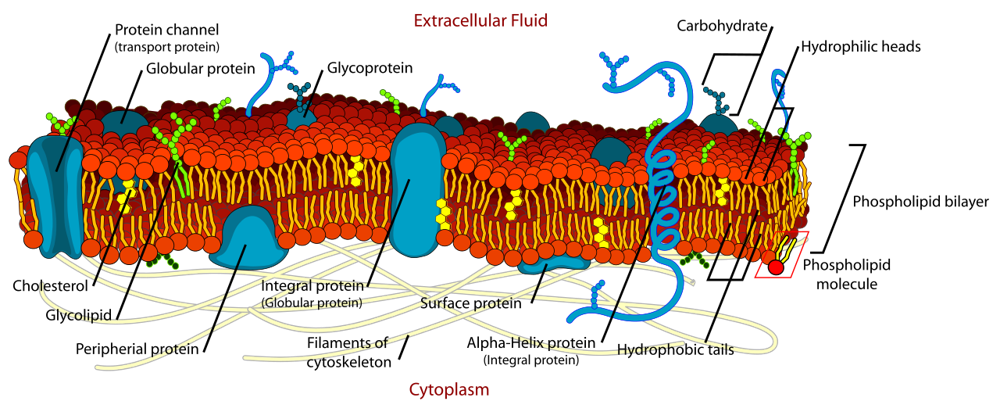
Toda célula, incluindo o neurônio, é envolvida por uma membrana celular, cuja composição é fundamental para o que se segue. A membrana é uma bicamada fosfolipídica, ou seja, duas camadas de moléculas gordurosas. Cada fosfolipídeo possui uma “cabeça” hidrofílica e duas “caudas” gordurosas hidrofóbicas; elas se alinham cauda contra cauda, formando duas camadas, com as cabeças voltadas para o fluido aquoso dentro e fora da célula, e as caudas gordurosas situadas no meio. Essa fina película gordurosa funciona como barreira entre o interior e o exterior da célula, podendo manter uma carga elétrica através de si mesma. Os “canais” e “bombas” descritos na próxima seção são, na verdade, portas proteicas inseridas nessa membrana gordurosa.
A estrutura da transmissão nervosa: axônios, mielina e nós de Ranvier
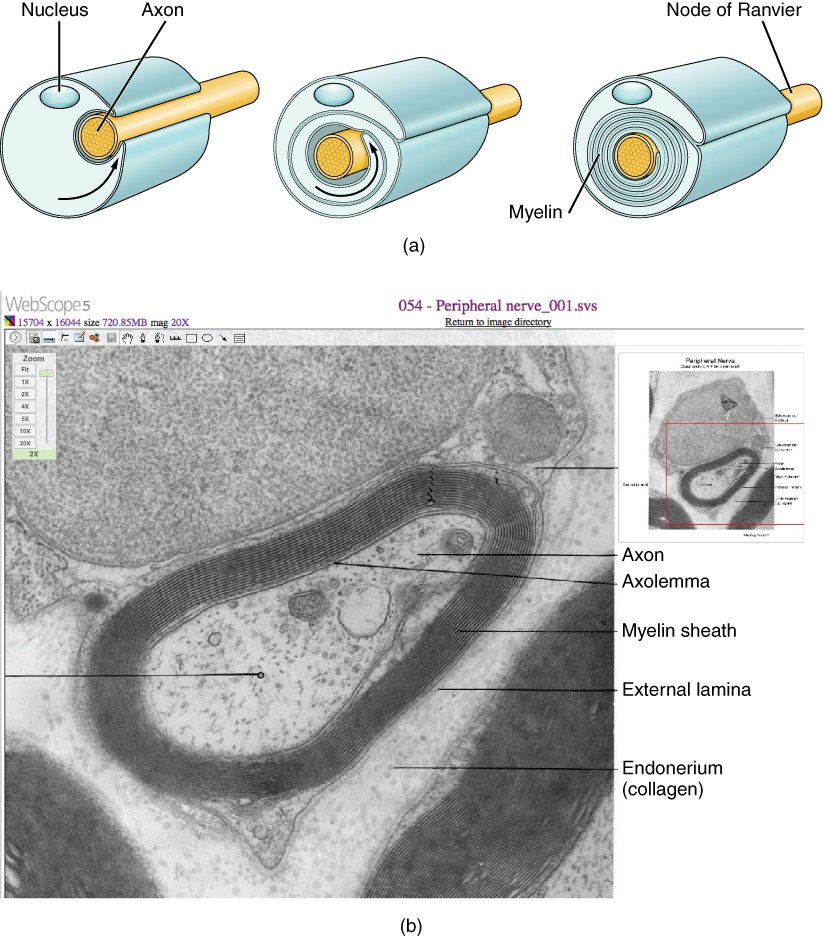
Uma única fibra nervosa é formada em torno de um axônio, uma extensão longa e filamentosa da célula nervosa que transporta o sinal elétrico. Muitos axônios são envoltos por mielina, uma bainha isolante gordurosa; vale a pena entender o que a mielina realmente é. Uma célula de suporte (a célula de Schwann nos nervos periféricos do braço) envolve sua própria membrana celular ao redor do axônio, repetidamente, como se enrolássemos um plástico aderente ao redor de um lápis dezenas de vezes. Como essa membrana é uma bicamada de fosfolipídios (basicamente gordura), cada volta adiciona mais uma camada gordurosa; essas camadas empilhadas formam uma espessa bainha gordurosa. Essa bainha de membrana enrolada é o isolante: a mielina é majoritariamente gordura, exatamente porque é composta por múltiplas camadas de membrana celular. Quanto mais voltas a célula de Schwann der, melhor o isolamento e mais rápida a transmissão do sinal pela fibra.
Contudo, a bainha de mielina não é contínua; ela se forma em segmentos, com pequenos intervalos descobertos entre eles chamados nós de Ranvier. O sinal elétrico não pode vazar através das regiões isoladas, então ele efetivamente salta de um nó para o outro. Isso é conhecido como condução saltatória (do latim saltare, “pular”), e é o motivo pelo qual as fibras mielinizadas são tão rápidas: ao pular de nó em nó, o sinal pode ser transmitido a velocidades superiores a 100 metros por segundo, em comparação com menos de 10 metros por segundo em fibras desprovidas de mielina. É também por isso que doenças ou lesões que destroem a mielina reduzem drasticamente a velocidade de condução nervosa.
Como o sinal se propaga
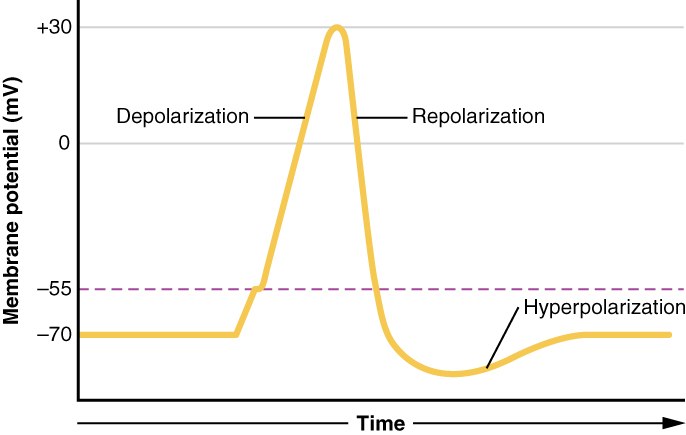
Em repouso, o interior de um axônio tem carga ligeiramente negativa em relação ao exterior: o chamado potencial de membrana de repouso, em torno de −70 milivolts. Essa carga é mantida graças ao fato de os íons de sódio permanecerem majoritariamente fora da célula e os íons de potássio, majoritariamente dentro dela.
Quando o nervo é ativado, ocorre uma sequência precisa de eventos:
- Despolarização. Os canais de sódio dependentes de voltagem se abrem repentinamente, permitindo a entrada rápida de íons de sódio. O interior do axônio torna-se positivo, atingindo um pico de cerca de +30 milivolts. Esse é o potencial de ação.
- Repolarização. Os canais de sódio fecham-se e os canais de potássio dependentes de voltagem abrem-se, permitindo a saída de íons de potássio. O interior do axônio volta a apresentar carga negativa, próxima ao valor de repouso.
- Período refratário (latente). Por um breve instante após isso, aquela região da membrana não consegue ser ativada novamente, independentemente da intensidade do estímulo, enquanto os canais se reajustam.
Esse período refratário tem uma função importante: como a porção da membrana logo atrás do sinal em propagação fica temporariamente incapaz de disparar novamente, o potencial de ação só pode avançar para a frente. É por isso que os sinais nervosos se propagam em uma única direção ao longo da fibra, em vez de ir e voltar.
Preenchendo a lacuna: sinapses e a placa motora
Uma fibra nervosa não entra em contato físico com o músculo que controla. Onde um nervo motor se encontra com um músculo, existe uma junção especializada, a junção neuromuscular, na qual há uma pequena lacuna (a fenda sináptica) entre a terminação nervosa e uma região espessa e dobrada da membrana muscular chamada placa motora.
O sinal elétrico não consegue atravessar essa lacuna diretamente; por isso, ele é convertido em sinal químico. Quando o potencial de ação atinge a terminação nervosa, ocorre a liberação de um neurotransmissor chamado acetilcolina na fenda sináptica. A acetilcolina se difunde até os receptores presentes na placa motora, abrindo canais que permitem a despolarização da membrana muscular. Se essa despolarização atingir o limiar necessário, gera-se um potencial de ação no músculo, fazendo com que a fibra se contraia. Em seguida, uma enzima (acetilcolinesterase) degrada rapidamente a acetilcolina, garantindo que cada impulso nervoso resulte em uma contração breve e precisa, e não em uma contração prolongada. Esse mecanismo de transmissão química é alvo de certos fármacos anestésicos e de doenças como a miastenia gravis.
Percebendo o mundo: receptores sensoriais
O sistema sensorial funciona de forma inversa: terminações especializadas convertem um estímulo físico em sinais nervosos. Existem receptores diferentes, cada um sensível a estímulos específicos:
- Corpúsculos de Pacini localizam-se nas camadas profundas da pele e respondem à pressão profunda e à vibração de alta frequência. Adaptam-se rapidamente, disparando apenas no momento em que ocorre uma mudança, e não continuamente.
- Corpúsculos de Meissner encontram-se logo abaixo da superfície da pele das pontas dos dedos e das palmas das mãos; detectam o toque leve e vibrações de baixa frequência, sendo fundamentais para a capacidade de perceber texturas e manusear objetos pequenos.
- Terminações nervosas livres são terminações desencapsuladas que detectam dor, temperatura e toque leve; são as terminações mais numerosas na pele.
- Fusos musculares situam-se dentro dos próprios músculos e detectam o alongamento e o comprimento muscular, enviando informações sobre a posição e o movimento (propriocepção); é assim que o cérebro sabe onde está a mão sem que seja preciso olhar.
As diversas sensações que podemos perceber (uma picada de agulha, o calor, o zumbido de um telefone, a posição do pulso) dependem, em grande parte, de quais desses receptores estão ativados e com que velocidade.
Graus de lesão nervosa
Os cirurgiões classificam a lesão nervosa conforme a profundidade dos danos, pois isso determina como e se a lesão irá se recuperar. São utilizadas duas classificações em conjunto.
O sistema mais antigo e simples, chamado Seddon, possui três categorias:
- Neurapraxia: o grau mais leve. As fibras são contusas ou o revestimento isolante é danificado localmente, mas os axônios permanecem intactos. A condução nervosa fica bloqueada naquele ponto, como uma mangueira torcida, porém a estrutura permanece íntegra. A recuperação costuma ser total e relativamente rápida após a eliminação da causa.
- Axonotmesis: os próprios axônios são rompidos, mas os tubos de tecido conjuntivo que os envolvem permanecem intactos. As fibras localizadas além do local da lesão morrem e precisam se regenerar; portanto, a recuperação é lenta. Contudo, os tubos preservados oferecem um caminho para o crescimento das novas fibras, e o prognóstico costuma ser bom.
- Neurotmesis: o grau mais grave. O nervo, incluindo toda a sua estrutura de suporte, fica completamente seccionado. Não há recuperação espontânea; é necessária reparação cirúrgica, e mesmo assim a recuperação costuma ser incompleta.
O sistema mais detalhado, chamado Sunderland, divide a lesão em cinco graus, que se correspondem aos graus de Seddon da seguinte forma:
- Grau 1 = neurapraxia (apenas bloqueio da condução nervosa).
- Grau 2 = axonotmesis, com o tubo mais interno (endoneuro) intacto; este é o grau com melhores perspectivas de regeneração.
- Grau 3 = o tubo interno também é danificado, o que pode fazer com que as fibras em regeneração sigam caminhos errados; a recuperação é parcial.
- Grau 4 = apenas o revestimento externo (epineuro) permanece intacto; geralmente, um bloqueio cicatricial impede uma recuperação útil sem cirurgia.
- Grau 5 = seção completa de todo o nervo, equivalente à neurotmesis de Seddon; requer reparação cirúrgica.
Em resumo: quanto mais camadas do nervo forem danificadas, mais lenta e incompleta será a recuperação espontânea, e maior a probabilidade de ser necessária uma intervenção cirúrgica.
Degeneração walleriana e regeneração
Quando um axônio é cortado ou rompido, a porção que fica além do local da lesão fica desconectada da célula que o mantém vivo. Nos dias seguintes, essa porção se desintegra em um processo ordenado e programado chamado degeneração walleriana: o axônio isolado e sua bainha de mielina são desmontados e removidos pelas células de Schwann e pelos macrófagos, células imunes recrutadas para a região.
Isso não é apenas uma destruição; é, na verdade, uma preparação. As células de Schwann que revestiam a fibra nervosa original sobrevivem, se multiplicam e se alinham em colunas ocas denominadas bandas de Büngner, seguindo o trajeto original do nervo. Essas colunas funcionam como tubos de suporte vivos: elas liberam fatores de crescimento e orientam fisicamente as fibras em regeneração de volta aos seus alvos.
A partir do local da lesão, a extremidade remanescente de cada axônio emite um cone de crescimento que avança pelo “tubo” formado pelas células de Schwann a uma velocidade de aproximadamente um milímetro por dia, até alcançar a pele ou o músculo e se reconectar (reinervação). É por isso que um reparo preciso e realizado precocemente é tão importante: os tubos cortados precisam ser alinhados corretamente para que as fibras entrem novamente aos canais adequados. Além disso, as células de Schwann oferecem maior suporte nos meses imediatamente posteriores à lesão; elas têm, de certa forma, uma “data de validade”. Se as extremidades forem alinhadas adequadamente e o tratamento for feito a tempo, muito mais fibras conseguirão retornar aos seus destinos.
Ver também
- Testes nervosos e estudos de condução — como medimos se um nervo está conduzindo sinais normalmente
- Síndrome do túnel carpal e compressão nervosa — um problema comum de compressão nervosa no punho
- Reparo de tendões e nervos — o que envolve o reparo cirúrgico de um nervo ou tendão lesado