Skip to content

Patients › General-Health

Gota na mão, no pulso e no cotovelo

Gout in the upper limb — what causes the attacks and lumps (tophi), how flares and high urate are treated, and when surgery is needed.
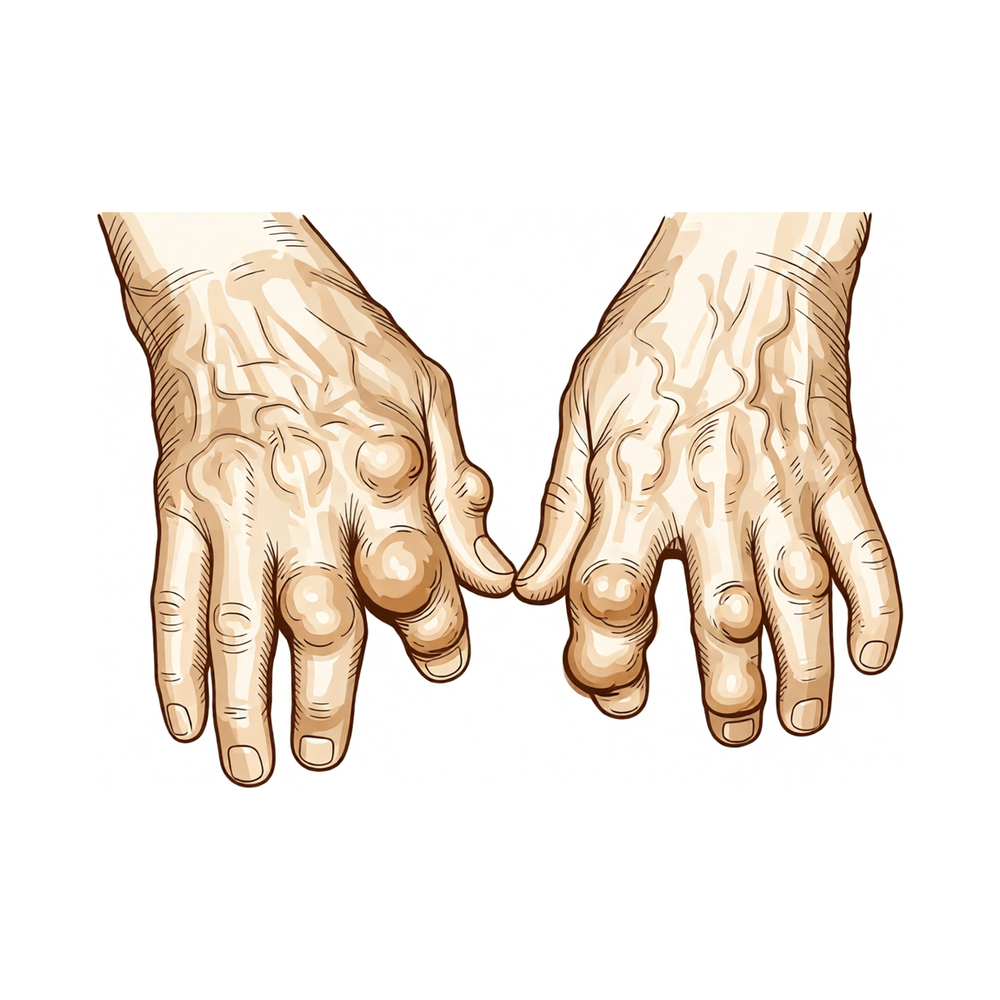
Ilustração de duas mãos apresentando nódulos firmes (tofos) decorrentes de gota tofácea crônica em diversas articulações dos dedos.
A gota crônica pode causar o surgimento de nódulos duros, chamados tofos, ao redor das articulações dos dedos, o que pode limitar o movimento e a função da mão. Arthritis Research UK Primary Care Centre / Wikimedia Commons, CC BY 2.0

Esta página foi traduzida automaticamente e ainda não foi verificada por um médico. A versão em inglês é a versão oficial.

O que você está sentindo

A gota geralmente se manifesta durante a noite. Uma articulação (às vezes a base do polegar, um nó dos dedos, o pulso ou a ponta do cotovelo) torna-se extremamente dolorida em apenas algumas horas. Ela fica quente, vermelha e inchada; é tão sensível que até o peso de um lençol parece insuportável. Isso é um surto, e o primeiro surto costuma ocorrer no pé, mas a mão e o pulso também são locais comuns.

Entre os surtos, a articulação pode parecer completamente normal, motivo pelo qual muitas pessoas ignoram o primeiro ataque. Contudo, ao longo de meses e anos, a gota pode gerar nódulos duros sob a pele, ao redor das articulações dos dedos, dos nós dos dedos ou sobre o cotovelo. Eles são chamados de tofos. Podem ser esbranquiçados ou ter cor de giz sob a pele; à medida que crescem, podem deixar a mão rígida, enfraquecer a força de preensão e dificultar tarefas delicadas, como abotoar uma camisa. Algumas pessoas também percebem dormência ou formigamento nos dedos quando um nódulo comprime um nervo no pulso.

O que realmente está acontecendo

A gota é um problema que afeta todo o corpo, manifestando-se nas articulações. O corpo produz um subproduto de resíduo chamado ácido úrico (urato). Quando sua concentração no sangue fica muito alta, ele pode formar pequenos cristais pontiagudos que se depositam nas articulações e nos tecidos moles ao redor, inclusive na mão e no pulso.

O sistema imunológico considera esses cristais invasores e os ataca; essa reação é a inflamação súbita e intensa que percebemos como um surto. Se os níveis elevados de urato permanecerem sem controle por anos, os cristais se acumulam formando depósitos sólidos (tofos). Com o tempo, esses depósitos podem desgastar o osso, danificar os tendões e, ocasionalmente, comprimir algum nervo. O ponto importante é que os surtos e os nódulos são duas manifestações da mesma condição: excesso de urato no corpo. Controle o nível de urato e você controlará a doença.

O que podemos fazer a respeito

O tratamento possui duas vertentes distintas, e ambas são importantes.

Controlar a crise. Uma crise aguda é controlada com medicamentos anti-inflamatórios, geralmente comprimidos anti-inflamatórios (AINEs), colchicina ou um curto ciclo de esteroides. Esses medicamentos têm maior eficácia quando administrados precocemente; por isso, vale a pena combinar um plano de ação com seu médico antes da próxima crise.

Reduzir os níveis de urato de forma duradoura. É isso que, com o tempo, cura a gota. Um comprimido diário, na maioria das vezes alopurinol, reduz gradualmente o nível de urato no sangue até atingir um valor-alvo. Mantido nesse nível por tempo suficiente, os cristais se dissolvem, as crises cessam e os tofos diminuem. Dieta e estilo de vida também ajudam (menos cerveja e destilados, reduzir o consumo de bebidas açucaradas, manter um peso saudável e beber bastante água); porém, para a maioria das pessoas, é o comprimido diário que faz a maior parte do trabalho.

A cirurgia é necessária apenas em casos excepcionais, como quando há um tofo grande que rompe a pele, interfere em um tendão ou comprime um nervo (por exemplo, causando sintomas de síndrome do túnel carpal). Mesmo nesses casos, o tratamento medicamentoso para reduzir o urato deve ser mantido após a cirurgia.

O que esperar

A gota é uma das poucas formas de artrite que realmente conseguimos controlar. Se o nível de urato permanecer abaixo do valor alvo por um longo período, as crises tornam-se raras e depois cessam, e os nódulos existentes desaparecem gradualmente. É um processo lento: leva meses ou anos. O comprimido para reduzir o urato geralmente deve ser tomado para sempre, pois interromper o tratamento permite que os cristais se formem novamente.

O preço a pagar por essa paciência é real: quanto mais tofos se acumulam na mão, mais ela fica limitada em suas funções. Por isso, manter o urato em níveis baixos desde cedo protege a força de preensão e a funcionalidade da mão. As pessoas que mantêm o tratamento obtêm excelentes resultados.

Quando procurar um médico

  • Uma primeira ocorrência de articulação quente, inchada e dolorida: procure um médico imediatamente. Uma infecção articular pode ter aparência idêntica à gota e é uma emergência; por isso, é necessário diferenciar uma da outra.
  • Ataques recorrentes ou que estejam se tornando mais frequentes: esse é o sinal para iniciar o tratamento para reduzir os níveis de urato.
  • Aparição de nódulos ao redor das articulações, ou um nódulo que rompa a pele ou libere material semelhante a giz.
  • Dormência, formigamento ou fraqueza na mão: pode haver um depósito pressionando algum nervo, e isso merece avaliação.

Em maior profundidade

Advanced reading: the deeper science (optional)

Esta seção vai além do que você precisa saber para tomar decisões sobre o próprio tratamento. A gota merece essa leitura adicional, pois é uma das poucas doenças reumatológicas com uma cura real — e também uma das mais mal tratadas, já que o efeito dessa cura ocorre numa escala de tempo que parece inadequada quando se está sentindo dor.

O que realmente é a gota: cristais de urato

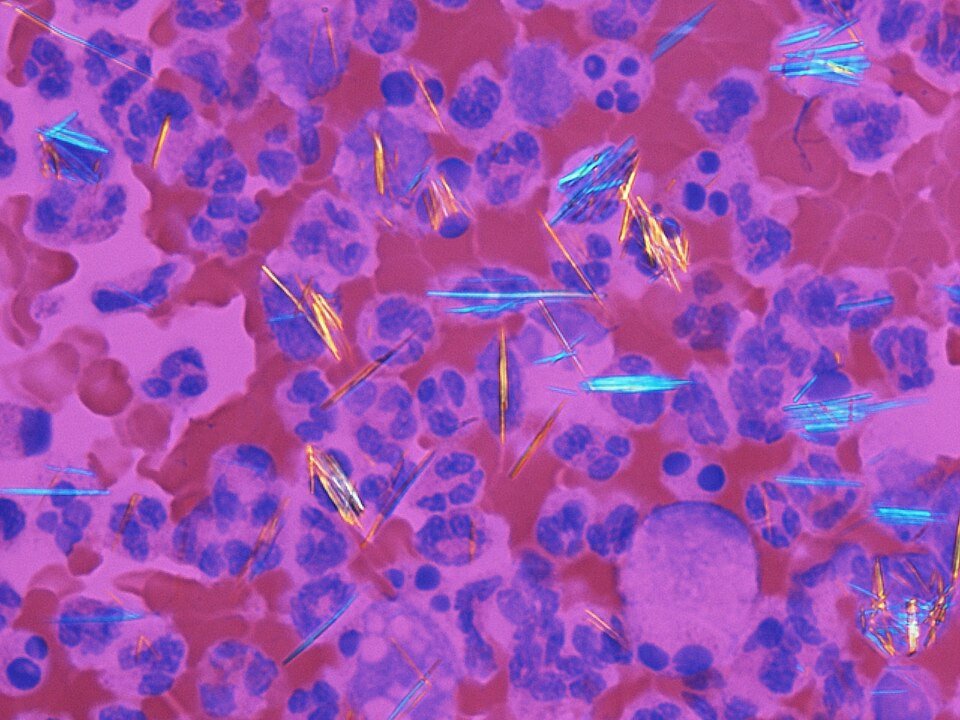
Microscopia com luz polarizada do líquido articular mostrando cristais de urato monossódico em forma de agulha, dispersos entre células imunes.
Cristais de urato monossódico sob luz polarizada — os cristais em forma de agulha que são fagocitados pelas células imunológicas, desencadeando um ataque de gota. Bobjgalindo, Wikimedia Commons, CC BY-SA 3.0

O ácido úrico é um produto residual normal gerado quando o corpo decompõe substâncias chamadas purinas (provenientes das células e de alguns alimentos). Quando os níveis de urato no sangue permanecem elevados, ele sai da solução e forma pequenos cristais em forma de agulha, chamados cristais de urato monossódico (MSU), dentro e ao redor das articulações. Esses cristais se formam mais facilmente em locais mais frios; por isso, o dedão do pé — a articulação mais fria e periférica do corpo — é o primeiro alvo clássico.

Naquela articulação, a gota é uma condição verdadeiramente destrutiva, e não apenas dolorosa. Em um grupo de 5.478 pacientes, a artrite aguda da primeira articulação metatarsofalângica é muito comum na gota e tem impacto significativo na dor e na incapacidade; além disso, causa efeitos comprovados na estrutura e na função da própria articulação [1].

O inflamassoma: por que um ataque é tão súbito e intenso

O ataque se inicia quando células fagocitárias do sistema imunológico (macrófagos) engolem os cristais de MSU. Esses cristais ativam um complexo de alarme interno chamado inflamassoma NLRP3, que ativa uma enzima (caspase-1) responsável pela liberação de um potente mensageiro inflamatório, a interleucina-1β (IL-1β). A IL-1β provoca intensa inflamação na articulação, resultando em vermelhidão, calor, inchaço e dor aguda em poucas horas. Com o passar dos dias, a resposta inflamatória se esgota, e os ataques cessam por si só.

Esse mecanismo explica algo de grande importância clínica: o ataque é, na verdade, a reação imunológica aos cristais, e não os próprios cristais. Controlar o ataque e remover os cristais são problemas distintos que exigem medicamentos diferentes, em escalas de tempo diferentes.

O número que decide tudo

O tratamento a longo prazo tem um único objetivo mensurável: baixar o nível sérico de urato para abaixo da concentração na qual os cristais podem se formar, e mantê-lo ali. As diretrizes internacionais recomendam manter o nível sérico de urato abaixo de 0,36 mmol/L (6 mg/dL); quando há tofos, o alvo é abaixo de 0,30 mmol/L (5 mg/dL), pois nesses níveis os cristais já existentes se dissolvem, em vez de simplesmente deixarem de se acumular.

As evidências científicas apoiam o tratamento baseado nesses alvos, e não a simples prescrição de uma dose fixa na esperança de bons resultados. Em um ensaio clínico randomizado com 183 participantes, o aumento mensal da dose de alopurinol até atingir o alvo resultou em redução significativa tanto na proporção de pacientes com crises quanto no tamanho médio dos tofos ao longo de 24 meses; além disso, o tratamento foi bem tolerado [2].

O mesmo princípio se aplica ao nível de prestação de serviços: um ensaio randomizado no Reino Unido que avaliou cuidados conduzidos por enfermeiros, com foco na educação do paciente e na estratégia de tratamento baseada em alvos de urato, demonstrou controle muito melhor do nível sérico de urato em comparação com os cuidados habituais; houve também menos crises e maior resolução dos tofos após dois anos [3].

Conclui-se, então, duas coisas: uma dose de alopurinol nunca ajustada conforme os resultados de exames de sangue não constitui, na verdade, um tratamento eficaz; e a afirmação “minha gota está sob controle” refere-se a um valor numérico específico, e não à simples ausência de crises neste mês.

Por que o tratamento é abandonado nos primeiros meses

O início do tratamento hipouricemiante pode desencadear crises. À medida que os cristais se dissolvem, liberam material ao qual o inflamassoma reage; por isso, os primeiros meses de tratamento podem ser piores do que a doença parecia ser. Esse é o motivo mais comum pelo qual as pessoas interrompem o tratamento e concluem que ele não funciona, quando, na verdade, a crise é sinal de que o tratamento está surtindo efeito. É por isso que o tratamento é iniciado com doses baixas, aumentadas gradualmente, e geralmente acompanhado de profilaxia anti-inflamatória nos primeiros meses.

Duas coisas que um cirurgião de membro superior deve observar

A gota não se limita ao pé; no braço, ela pode mimetizar patologias cirúrgicas. Existem casos relatados de tenossinovite gotosa na inserção distal do bíceps, que causa ruptura parcial do tendão, apresentando-se como uma simples ruptura do bíceps — sendo a gota a explicação para o quadro [4]. Embora seja rara, esse é o tipo de diagnóstico que só é feito por quem pensa nele.

De forma mais tranquilizadora, uma preocupação comum não se confirma: após analisar 684.964 pessoas, constatou-se que a gota não está associada a maior risco de fraturas. Além disso, o uso precoce de medicamentos para reduzir os níveis de urato não apresentou efeitos adversos nem benefícios no risco de fraturas [5].

Referências

[1] Stewart S, Dalbeth N, Vandal AC, Rome K. A primeira articulação metatarsofalângica na gota: uma revisão sistemática e meta-análise. BMC Musculoskelet Disord. 2016;17(1). https://doi.org/10.1186/s12891-016-0919-9

[2] Stamp LK, Chapman PT, Barclay ML, Horne A, Frampton C, Tan P, et al. Um ensaio clínico randomizado sobre a eficácia e segurança da escalada da dose de alopurinol para atingir o nível alvo de urato sérico em pacientes com gota. Ann Rheum Dis. 2017;76(9):1522-8. https://doi.org/10.1136/annrheumdis-2016-210872

[3] Doherty M, Jenkins W, Richardson H, Sarmanova A, Abhishek A, Ashton D, et al. Eficácia e custo-efetividade do cuidado conduzido por enfermeiros, envolvendo educação e engajamento dos pacientes, aliado a uma estratégia de tratamento visando o nível alvo de urato, em comparação com o cuidado habitual na gota: um ensaio clínico randomizado. Lancet. 2018;392(10156):1403-12. https://doi.org/10.1016/S0140-6736(18)32158-5

[4] Fairhurst RJ, Schwartz AM, Rozmaryn LM. Tenossinovite gotosa na inserção do tendão bicipital distal, complicada por ruptura parcial do tendão. Hand (N Y). 2016;12(1):NP1-NP5. https://doi.org/10.1177/1558944715627639

[5] Liu F, Dong J, Zhou D, Kang Q, Xiong F. A gota não está associada ao risco de fratura: uma meta-análise. J Orthop Surg Res. 2019;14(1). https://doi.org/10.1186/s13018-019-1317-4


Creative Commons BY-NC 4.0

CC Creative Commons licence
BY Attribution — you must credit the source
NC NonCommercial — not for commercial use

Attribution-NonCommercial 4.0 International


Creative Commons Corporation ("Creative Commons") is not a law firm and does not provide legal services or legal advice. Distribution of Creative Commons public licenses does not create a lawyer-client or other relationship. Creative Commons makes its licenses and related information available on an "as-is" basis. Creative Commons gives no warranties regarding its licenses, any material licensed under their terms and conditions, or any related information. Creative Commons disclaims all liability for damages resulting from their use to the fullest extent possible.

Using Creative Commons Public Licenses

Creative Commons public licenses provide a standard set of terms and conditions that creators and other rights holders may use to share original works of authorship and other material subject to copyright and certain other rights specified in the public license below. The following considerations are for informational purposes only, are not exhaustive, and do not form part of our licenses.

Considerations for licensors: Our public licenses are intended for use by those authorized to give the public permission to use material in ways otherwise restricted by copyright and certain other rights. Our licenses are irrevocable. Licensors should read and understand the terms and conditions of the license they choose before applying it. Licensors should also secure all rights necessary before applying our licenses so that the public can reuse the material as expected. Licensors should clearly mark any material not subject to the license. This includes other CC- licensed material, or material used under an exception or limitation to copyright. More considerations for licensors: wiki.creativecommons.org/Considerations_for_licensors

Considerations for the public: By using one of our public licenses, a licensor grants the public permission to use the licensed material under specified terms and conditions. If the licensor's permission is not necessary for any reason--for example, because of any applicable exception or limitation to copyright--then that use is not regulated by the license. Our licenses grant only permissions under copyright and certain other rights that a licensor has authority to grant. Use of the licensed material may still be restricted for other reasons, including because others have copyright or other rights in the material. A licensor may make special requests, such as asking that all changes be marked or described. Although not required by our licenses, you are encouraged to respect those requests where reasonable. More considerations for the public: wiki.creativecommons.org/Considerations_for_licensees


Creative Commons Attribution-NonCommercial 4.0 International Public License

By exercising the Licensed Rights (defined below), You accept and agree to be bound by the terms and conditions of this Creative Commons Attribution-NonCommercial 4.0 International Public License ("Public License"). To the extent this Public License may be interpreted as a contract, You are granted the Licensed Rights in consideration of Your acceptance of these terms and conditions, and the Licensor grants You such rights in consideration of benefits the Licensor receives from making the Licensed Material available under these terms and conditions.

Section 1 -- Definitions.

a. Adapted Material means material subject to Copyright and Similar Rights that is derived from or based upon the Licensed Material and in which the Licensed Material is translated, altered, arranged, transformed, or otherwise modified in a manner requiring permission under the Copyright and Similar Rights held by the Licensor. For purposes of this Public License, where the Licensed Material is a musical work, performance, or sound recording, Adapted Material is always produced where the Licensed Material is synched in timed relation with a moving image.

b. Adapter's License means the license You apply to Your Copyright and Similar Rights in Your contributions to Adapted Material in accordance with the terms and conditions of this Public License.

c. Copyright and Similar Rights means copyright and/or similar rights closely related to copyright including, without limitation, performance, broadcast, sound recording, and Sui Generis Database Rights, without regard to how the rights are labeled or categorized. For purposes of this Public License, the rights specified in Section 2(b)(1)-(2) are not Copyright and Similar Rights.

d. Effective Technological Measures means those measures that, in the absence of proper authority, may not be circumvented under laws fulfilling obligations under Article 11 of the WIPO Copyright Treaty adopted on December 20, 1996, and/or similar international agreements.

e. Exceptions and Limitations means fair use, fair dealing, and/or any other exception or limitation to Copyright and Similar Rights that applies to Your use of the Licensed Material.

f. Licensed Material means the artistic or literary work, database, or other material to which the Licensor applied this Public License.

g. Licensed Rights means the rights granted to You subject to the terms and conditions of this Public License, which are limited to all Copyright and Similar Rights that apply to Your use of the Licensed Material and that the Licensor has authority to license.

h. Licensor means the individual(s) or entity(ies) granting rights under this Public License.

i. NonCommercial means not primarily intended for or directed towards commercial advantage or monetary compensation. For purposes of this Public License, the exchange of the Licensed Material for other material subject to Copyright and Similar Rights by digital file-sharing or similar means is NonCommercial provided there is no payment of monetary compensation in connection with the exchange.

j. Share means to provide material to the public by any means or process that requires permission under the Licensed Rights, such as reproduction, public display, public performance, distribution, dissemination, communication, or importation, and to make material available to the public including in ways that members of the public may access the material from a place and at a time individually chosen by them.

k. Sui Generis Database Rights means rights other than copyright resulting from Directive 96/9/EC of the European Parliament and of the Council of 11 March 1996 on the legal protection of databases, as amended and/or succeeded, as well as other essentially equivalent rights anywhere in the world.

l. You means the individual or entity exercising the Licensed Rights under this Public License. Your has a corresponding meaning.

Section 2 -- Scope.

a. License grant.

1. Subject to the terms and conditions of this Public License, the Licensor hereby grants You a worldwide, royalty-free, non-sublicensable, non-exclusive, irrevocable license to exercise the Licensed Rights in the Licensed Material to:

a. reproduce and Share the Licensed Material, in whole or in part, for NonCommercial purposes only; and

b. produce, reproduce, and Share Adapted Material for NonCommercial purposes only.

2. Exceptions and Limitations. For the avoidance of doubt, where Exceptions and Limitations apply to Your use, this Public License does not apply, and You do not need to comply with its terms and conditions.

3. Term. The term of this Public License is specified in Section 6(a).

4. Media and formats; technical modifications allowed. The Licensor authorizes You to exercise the Licensed Rights in all media and formats whether now known or hereafter created, and to make technical modifications necessary to do so. The Licensor waives and/or agrees not to assert any right or authority to forbid You from making technical modifications necessary to exercise the Licensed Rights, including technical modifications necessary to circumvent Effective Technological Measures. For purposes of this Public License, simply making modifications authorized by this Section 2(a) (4) never produces Adapted Material.

5. Downstream recipients.

a. Offer from the Licensor -- Licensed Material. Every recipient of the Licensed Material automatically receives an offer from the Licensor to exercise the Licensed Rights under the terms and conditions of this Public License.

b. No downstream restrictions. You may not offer or impose any additional or different terms or conditions on, or apply any Effective Technological Measures to, the Licensed Material if doing so restricts exercise of the Licensed Rights by any recipient of the Licensed Material.

6. No endorsement. Nothing in this Public License constitutes or may be construed as permission to assert or imply that You are, or that Your use of the Licensed Material is, connected with, or sponsored, endorsed, or granted official status by, the Licensor or others designated to receive attribution as provided in Section 3(a)(1)(A)(i).

b. Other rights.

1. Moral rights, such as the right of integrity, are not licensed under this Public License, nor are publicity, privacy, and/or other similar personality rights; however, to the extent possible, the Licensor waives and/or agrees not to assert any such rights held by the Licensor to the limited extent necessary to allow You to exercise the Licensed Rights, but not otherwise.

2. Patent and trademark rights are not licensed under this Public License.

3. To the extent possible, the Licensor waives any right to collect royalties from You for the exercise of the Licensed Rights, whether directly or through a collecting society under any voluntary or waivable statutory or compulsory licensing scheme. In all other cases the Licensor expressly reserves any right to collect such royalties, including when the Licensed Material is used other than for NonCommercial purposes.

Section 3 -- License Conditions.

Your exercise of the Licensed Rights is expressly made subject to the following conditions.

a. Attribution.

1. If You Share the Licensed Material (including in modified form), You must:

a. retain the following if it is supplied by the Licensor with the Licensed Material:

i. identification of the creator(s) of the Licensed Material and any others designated to receive attribution, in any reasonable manner requested by the Licensor (including by pseudonym if designated);

ii. a copyright notice;

iii. a notice that refers to this Public License;

iv. a notice that refers to the disclaimer of warranties;

v. a URI or hyperlink to the Licensed Material to the extent reasonably practicable;

b. indicate if You modified the Licensed Material and retain an indication of any previous modifications; and

c. indicate the Licensed Material is licensed under this Public License, and include the text of, or the URI or hyperlink to, this Public License.

2. You may satisfy the conditions in Section 3(a)(1) in any reasonable manner based on the medium, means, and context in which You Share the Licensed Material. For example, it may be reasonable to satisfy the conditions by providing a URI or hyperlink to a resource that includes the required information.

3. If requested by the Licensor, You must remove any of the information required by Section 3(a)(1)(A) to the extent reasonably practicable.

4. If You Share Adapted Material You produce, the Adapter's License You apply must not prevent recipients of the Adapted Material from complying with this Public License.

Section 4 -- Sui Generis Database Rights.

Where the Licensed Rights include Sui Generis Database Rights that apply to Your use of the Licensed Material:

a. for the avoidance of doubt, Section 2(a)(1) grants You the right to extract, reuse, reproduce, and Share all or a substantial portion of the contents of the database for NonCommercial purposes only;

b. if You include all or a substantial portion of the database contents in a database in which You have Sui Generis Database Rights, then the database in which You have Sui Generis Database Rights (but not its individual contents) is Adapted Material; and

c. You must comply with the conditions in Section 3(a) if You Share all or a substantial portion of the contents of the database.

For the avoidance of doubt, this Section 4 supplements and does not replace Your obligations under this Public License where the Licensed Rights include other Copyright and Similar Rights.

Section 5 -- Disclaimer of Warranties and Limitation of Liability.

a. UNLESS OTHERWISE SEPARATELY UNDERTAKEN BY THE LICENSOR, TO THE EXTENT POSSIBLE, THE LICENSOR OFFERS THE LICENSED MATERIAL AS-IS AND AS-AVAILABLE, AND MAKES NO REPRESENTATIONS OR WARRANTIES OF ANY KIND CONCERNING THE LICENSED MATERIAL, WHETHER EXPRESS, IMPLIED, STATUTORY, OR OTHER. THIS INCLUDES, WITHOUT LIMITATION, WARRANTIES OF TITLE, MERCHANTABILITY, FITNESS FOR A PARTICULAR PURPOSE, NON-INFRINGEMENT, ABSENCE OF LATENT OR OTHER DEFECTS, ACCURACY, OR THE PRESENCE OR ABSENCE OF ERRORS, WHETHER OR NOT KNOWN OR DISCOVERABLE. WHERE DISCLAIMERS OF WARRANTIES ARE NOT ALLOWED IN FULL OR IN PART, THIS DISCLAIMER MAY NOT APPLY TO YOU.

b. TO THE EXTENT POSSIBLE, IN NO EVENT WILL THE LICENSOR BE LIABLE TO YOU ON ANY LEGAL THEORY (INCLUDING, WITHOUT LIMITATION, NEGLIGENCE) OR OTHERWISE FOR ANY DIRECT, SPECIAL, INDIRECT, INCIDENTAL, CONSEQUENTIAL, PUNITIVE, EXEMPLARY, OR OTHER LOSSES, COSTS, EXPENSES, OR DAMAGES ARISING OUT OF THIS PUBLIC LICENSE OR USE OF THE LICENSED MATERIAL, EVEN IF THE LICENSOR HAS BEEN ADVISED OF THE POSSIBILITY OF SUCH LOSSES, COSTS, EXPENSES, OR DAMAGES. WHERE A LIMITATION OF LIABILITY IS NOT ALLOWED IN FULL OR IN PART, THIS LIMITATION MAY NOT APPLY TO YOU.

c. The disclaimer of warranties and limitation of liability provided above shall be interpreted in a manner that, to the extent possible, most closely approximates an absolute disclaimer and waiver of all liability.

Section 6 -- Term and Termination.

a. This Public License applies for the term of the Copyright and Similar Rights licensed here. However, if You fail to comply with this Public License, then Your rights under this Public License terminate automatically.

b. Where Your right to use the Licensed Material has terminated under Section 6(a), it reinstates:

1. automatically as of the date the violation is cured, provided it is cured within 30 days of Your discovery of the violation; or

2. upon express reinstatement by the Licensor.

For the avoidance of doubt, this Section 6(b) does not affect any right the Licensor may have to seek remedies for Your violations of this Public License.

c. For the avoidance of doubt, the Licensor may also offer the Licensed Material under separate terms or conditions or stop distributing the Licensed Material at any time; however, doing so will not terminate this Public License.

d. Sections 1, 5, 6, 7, and 8 survive termination of this Public License.

Section 7 -- Other Terms and Conditions.

a. The Licensor shall not be bound by any additional or different terms or conditions communicated by You unless expressly agreed.

b. Any arrangements, understandings, or agreements regarding the Licensed Material not stated herein are separate from and independent of the terms and conditions of this Public License.

Section 8 -- Interpretation.

a. For the avoidance of doubt, this Public License does not, and shall not be interpreted to, reduce, limit, restrict, or impose conditions on any use of the Licensed Material that could lawfully be made without permission under this Public License.

b. To the extent possible, if any provision of this Public License is deemed unenforceable, it shall be automatically reformed to the minimum extent necessary to make it enforceable. If the provision cannot be reformed, it shall be severed from this Public License without affecting the enforceability of the remaining terms and conditions.

c. No term or condition of this Public License will be waived and no failure to comply consented to unless expressly agreed to by the Licensor.

d. Nothing in this Public License constitutes or may be interpreted as a limitation upon, or waiver of, any privileges and immunities that apply to the Licensor or You, including from the legal processes of any jurisdiction or authority.


Creative Commons is not a party to its public licenses. Notwithstanding, Creative Commons may elect to apply one of its public licenses to material it publishes and in those instances will be considered the “Licensor.” The text of the Creative Commons public licenses is dedicated to the public domain under the CC0 Public Domain Dedication. Except for the limited purpose of indicating that material is shared under a Creative Commons public license or as otherwise permitted by the Creative Commons policies published at creativecommons.org/policies, Creative Commons does not authorize the use of the trademark "Creative Commons" or any other trademark or logo of Creative Commons without its prior written consent including, without limitation, in connection with any unauthorized modifications to any of its public licenses or any other arrangements, understandings, or agreements concerning use of licensed material. For the avoidance of doubt, this paragraph does not form part of the public licenses.

Creative Commons may be contacted at creativecommons.org.