Patients › Rehabilitation
Artroplastia total do cotovelo
Recuperação após artroplastia total do cotovelo: movimentação suave assistida com o uso de uma tipoia simples nos estágios iniciais; o objetivo é alcançar um arco de movimento funcional; além disso, deve-se manter um limite permanente, ao longo da vida, para o levantamento de pesos, a fim de proteger o implante.
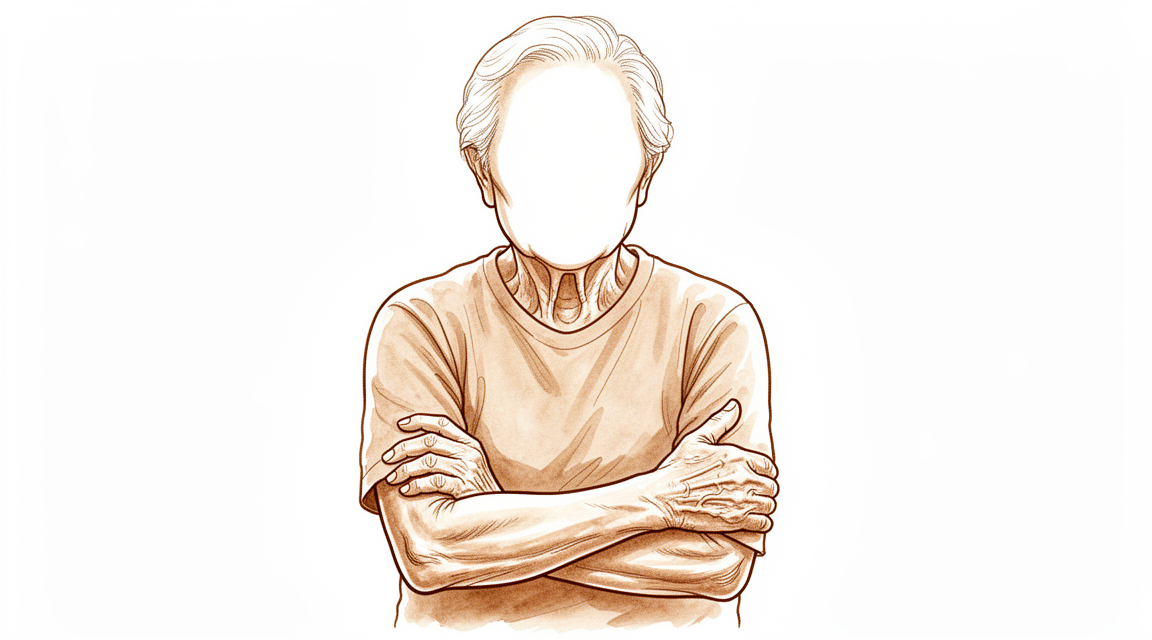
Este protocolo orienta sua recuperação após uma artroplastia total do cotovelo realizada pelo Dr. Kieran Hirpara no Mater Private Hospital Rockhampton. Ele começa com um programa de exercícios para ser feito em casa, seguido pelo protocolo clínico estruturado destinado ao seu fisioterapeuta ou terapeuta da mão: leve esta página ou seu arquivo PDF à sua primeira sessão de terapia, para que a reabilitação seja devidamente coordenada. Seu terapeuta poderá ajustar o plano conforme a evolução da sua recuperação.
Caso tenha alguma dúvida ou preocupação quanto à ferida cirúrgica, entre em contato com o consultório. Geralmente é útil tirar uma foto da ferida e enviá-la por e-mail para análise.
O que esperar
A artroplastia total do cotovelo consiste na remoção das superfícies articulares desgastadas ou danificadas e na sua substituição por um implante de metal e plástico. As duas partes do implante (uma fixada ao osso do braço, o úmero, e outra ao osso do antebraço, a ulna) são geralmente unidas por uma pequena dobradiça; por isso, esse procedimento é chamado de artroplastia semirrestrita ou “artroplastia acoplada”. É indicado, sobretudo, nos casos de artrite reumatoide grave, osteoartrite em estágio avançado ou determinadas fraturas do cotovelo em pacientes idosos cujos ossos não podem ser reparados.
O objetivo da recuperação é estabilizar o cotovelo, proteger os tecidos em processo de cicatrização e restaurar um arco funcional de movimento confortável e sem dor (suficiente para dobrar e estender o braço nas atividades cotidianas, como comer, lavar-se e vestir-se), e não tornar o cotovelo o mais forte possível. Para orientações sobre cuidados com a ferida, controle do inchaço e cicatrização, consulte o guia de cuidados com a ferida do consultório.
O ponto mais importante a compreender é o seguinte: o implante foi projetado para uma vida diária confortável, não para trabalhos pesados. Seus principais inimigos a longo prazo são o desgaste da superfície plástica de apoio e o afrouxamento gradual do implante no osso; ambos são intensificados pela aplicação de cargas pesadas. Por esse motivo, um programa rigoroso de fortalecimento muscular não é indicado após a artroplastia total do cotovelo, e o limite de carga a ser respeitado permanece para toda a vida, não apenas durante o período de recuperação. Manter esse limite é a medida mais importante para garantir a durabilidade do novo cotovelo.
Após a cirurgia, você usará uma tipoia simples para maior conforto, e não uma tala ou órtese rígida. Movimentos assistidos e suaves começam na primeira semana, e o plano de reabilitação evolui de forma lenta e cuidadosa a partir daí.
Precauções e limitações
O que fazer:
- Use a tipoia simples para maior conforto, conforme orientado.
- Comece os movimentos suaves assistidos abaixo na primeira semana, conforme orientação do Dr. Hirpara e do seu fisioterapeuta.
- Mantenha a mão, o pulso e o ombro em movimento para evitar rigidez.
- Após a recuperação, respeite o limite de peso a ser levantado para toda a vida (descrito abaixo).
O que não fazer:
- Nas primeiras 6 semanas, não levante nada mais pesado do que aproximadamente uma xícara de chá (1 libra / 0,45 kg) com o braço operado.
- Não force o cotovelo a dobrar-se, nem o estenda bruscamente ou com força.
- Não se levante de uma cadeira usando o braço operado, nem o use para carregar, empurrar ou suportar peso; também não permita que ninguém puxe ou torça o braço.
- Caso o músculo tríceps tenha sido manipulado durante a cirurgia, não tente estender o cotovelo contra resistência até que o cirurgião autorize (geralmente após 6–12 semanas).
- Limitações permanentes, para toda a vida: não levante repetidamente nada acima de aproximadamente 2 kg, e não levante mais do que 4.5–5 kg em uma única tentativa. Esses limites são definitivos e válidos para toda a vida. Nunca pratique tênis, arremessos ou esportes de impacto.
Seus exercícios
Kieran Hirpara 4.0
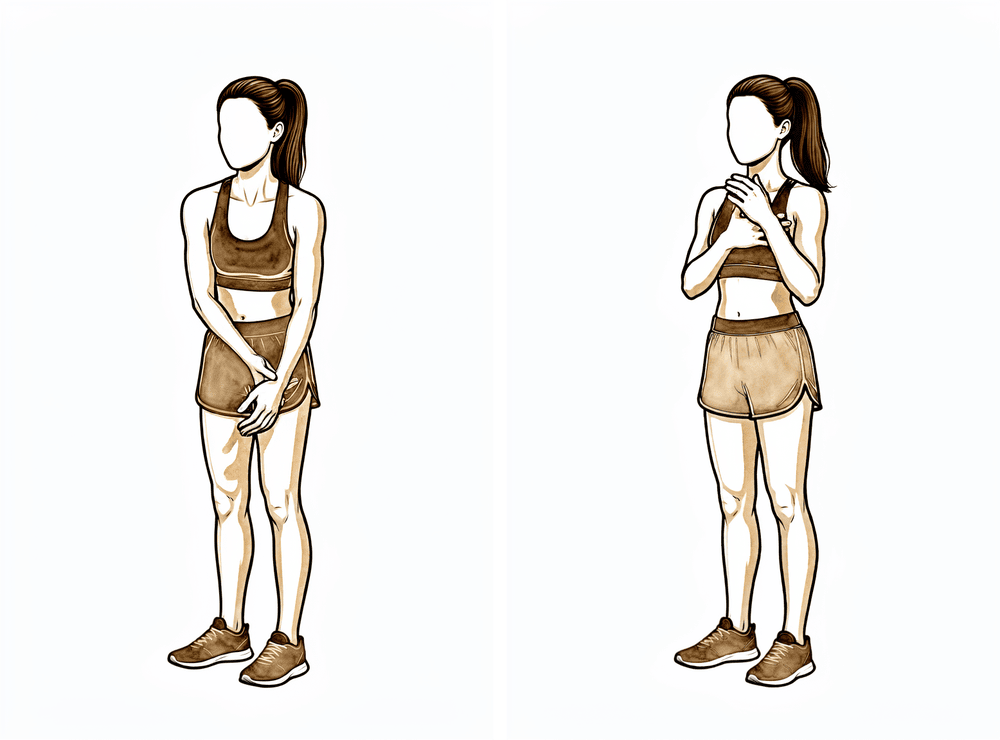
Flexão assistida do cotovelo (flexão passiva)
Com o braço colado ao corpo, use a outra mão para ajudar suavemente a dobrar o cotovelo operado em direção ao ombro, apenas até onde for confortável. Não force o movimento. Abaixe-o lentamente de volta. O seu fisioterapeuta lhe indicará até que ponto pode ir.
5–10 vezes, várias vezes ao dia, dentro dos limites do conforto.
Kieran Hirpara 4.0
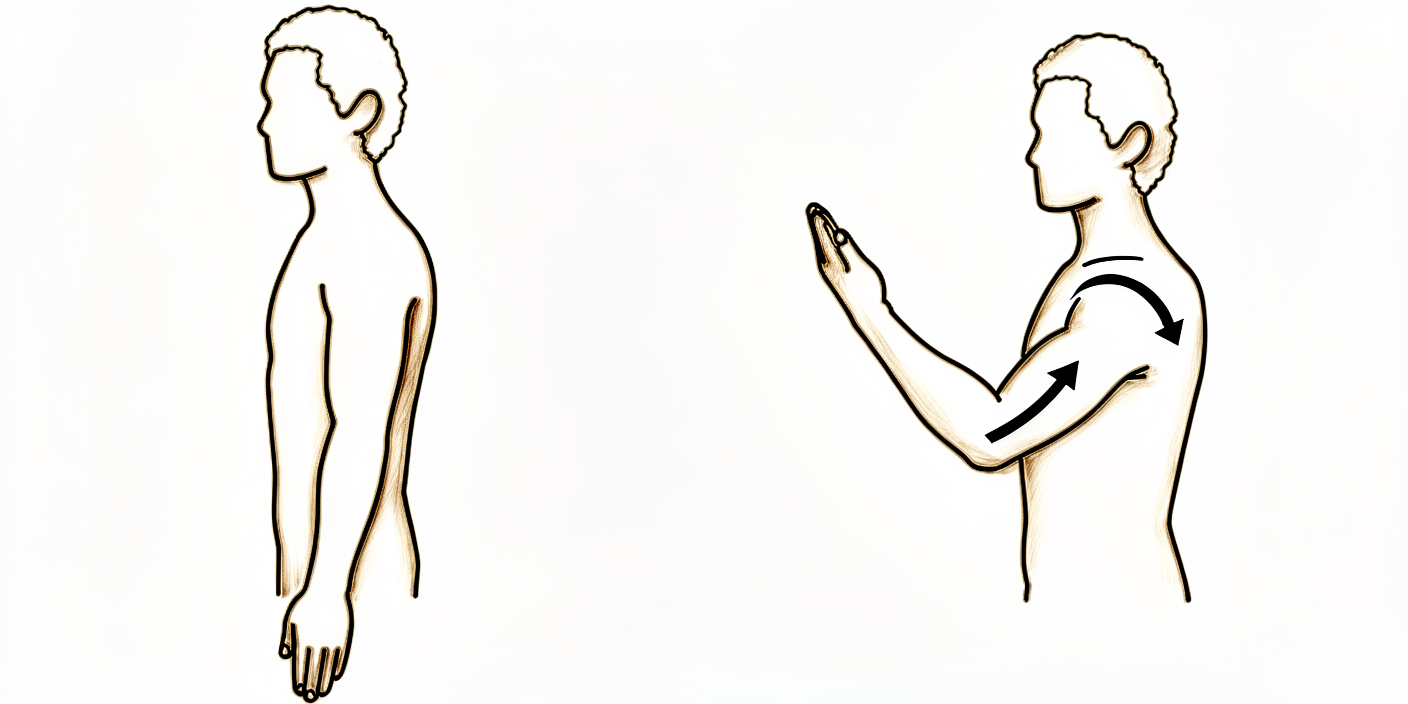
Flexões e extensões suaves do cotovelo
Com a palma da mão voltada para cima e o braço encostado ao corpo, dobre o cotovelo suavemente até onde for confortável; em seguida, deixe-o estender-se novamente graças à gravidade. Mantenha o movimento lento e sem esforço — deixe o braço realizar o trabalho; não force o movimento até os limites da amplitude articular.
5–10 vezes, várias vezes ao dia
Kieran Hirpara 4.0
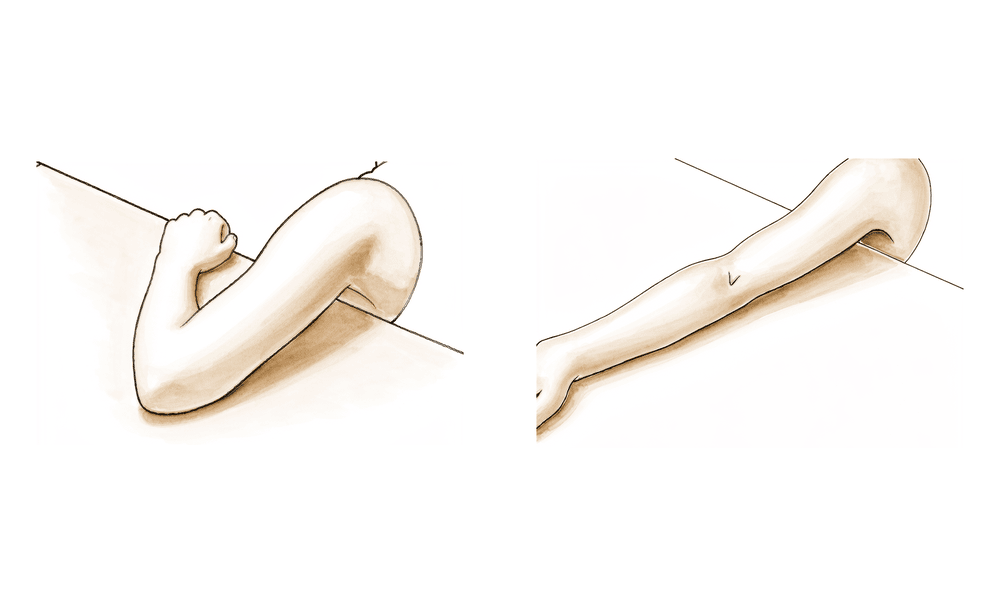
Endireitamento do cotovelo assistido pela gravidade (extensão ativa)
Descanse o braço apoiado (por exemplo, numa almofada ou no braço de uma cadeira) e deixe o antebraço descer, de modo que o cotovelo se estenda suavemente com a ajuda da gravidade. Não force nem faça movimentos bruscos para estender o cotovelo. Caso o seu cirurgião tenha informado que o músculo tríceps foi descolado (levantado) durante a cirurgia, mantenha esse movimento suave e evite tentar estender o cotovelo ativamente até receber autorização.
5–10 vezes, várias vezes ao dia, dentro dos limites do conforto.
Kieran Hirpara 4.0
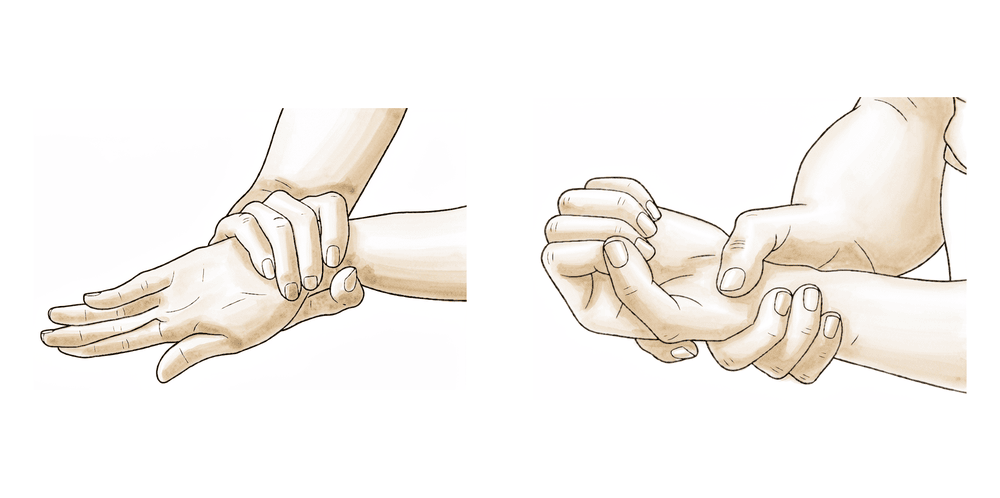
Rotação do antebraço (palma da mão para cima/para baixo)
Com o cotovelo dobrado e junto ao corpo, gire suavemente a palma da mão para cima, em direção ao teto; mantenha essa posição por um instante e, em seguida, gire a mão para baixo, em direção ao chão. Mantenha o braço imóvel, de modo que o movimento seja feito apenas pelo antebraço.
10 vezes em cada direção, algumas vezes ao dia.
Kieran Hirpara 4.0
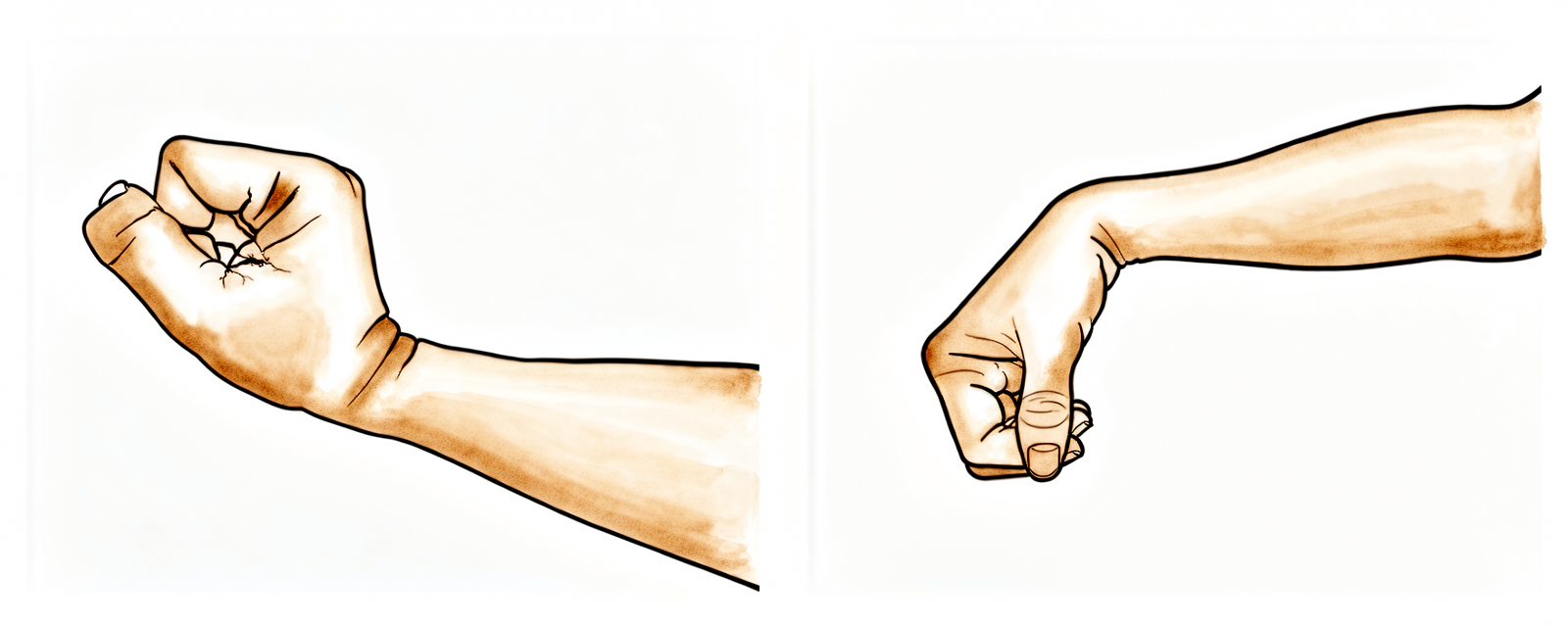
Movimento do punho
Flexione suavemente o pulso para a frente e depois para trás, até onde lhe for confortável. Isso mantém o pulso e a mão em movimento, ajudando a prevenir rigidez e inchaço enquanto o cotovelo cicatriza.
10–15 vezes, várias vezes ao dia
Kieran Hirpara 4.0
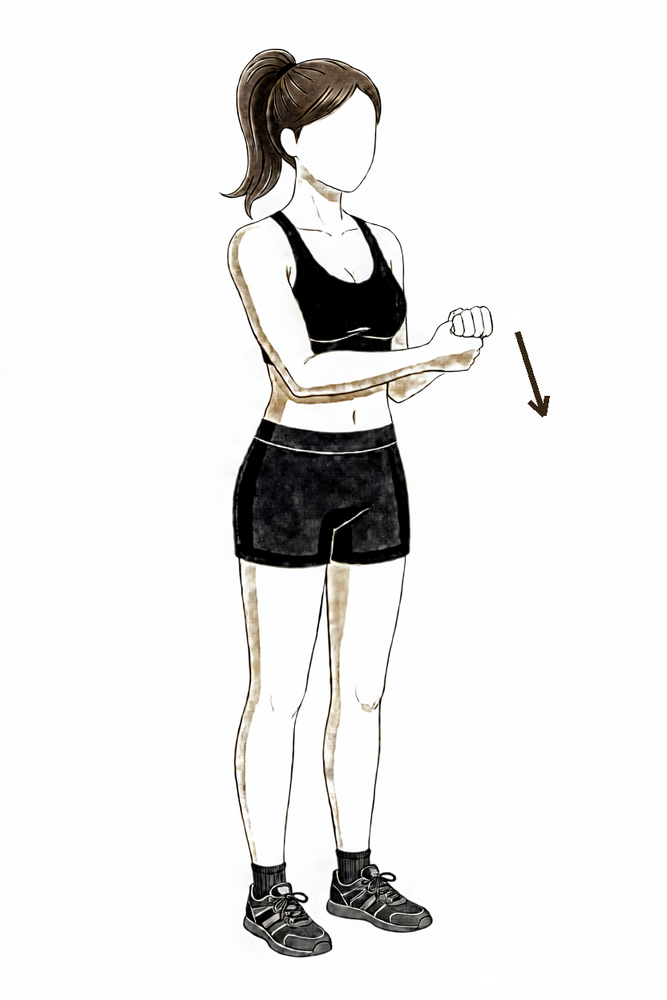
Contração do músculo tríceps (isométrica)
Este é um exercício avançado — comece a fazê-lo somente quando o seu cirurgião ou fisioterapeuta confirmar que o seu tríceps está pronto, geralmente após 6 semanas ou mais. Com o cotovelo mantido numa posição de flexão confortável, contraia suavemente o músculo na parte de trás do braço, como se fosse esticar o cotovelo, mas sem realmente movê-lo. Mantenha a contração por alguns instantes e depois relaxe.
Mantenha por 5 segundos, 10 vezes, após a liberação.
Estes são os exercícios contidos no seu folheto informativo, destinados a recuperar suavemente o movimento do cotovelo, antebraço, punho e mão. Comece a realizá-los conforme orientação do Dr. Hirpara e do seu fisioterapeuta. Mantenha todos os movimentos suaves e sem forçar; no início, o objetivo é uma movimentação fácil e assistida, não esforço ou alongamento.
Seu protocolo clínico
O restante desta página constitui o protocolo clínico para a reabilitação após uma artroplastia total do cotovelo de tipo semi-restrita (abordagem posterior, presumindo-se que o tríceps foi preservado). Esta seção deve ser entregue ao seu fisioterapeuta ou terapeuta da mão; cada fase abaixo começa com uma explicação em linguagem simples sobre o que está ocorrendo.
Antes do início do tratamento, verifique o relatório cirúrgico do paciente e seu histórico médico, e consulte o cirurgião responsável quanto à abordagem cirúrgica, especialmente se o tríceps foi preservado, refletido ou reaplicado (técnica de Bryan–Morrey), pois isso determina as restrições iniciais de extensão e a posição de repouso.
Fase I — Pós-operatório imediato, semanas 0–6
Nas primeiras seis semanas, o foco é proteger os tecidos moles em cicatrização e o tríceps, controlar a ferida e o inchaço, além de iniciar movimentos assistidos suaves para evitar a rigidez do cotovelo. O Dr. Hirpara utiliza uma tipoia simples para conforto, e não uma tala ou órtese posterior. A flexão e extensão do cotovelo assistidas (ativo-assistidas) começam entre os dias 1 e 7, com o cotovelo mantido junto ao corpo e o antebraço em posição neutra a pronada; a gravidade auxilia na extensão. É proibido levantar qualquer objeto com peso superior a 1 libra (0,45 kg) com o braço operado, bem como realizar cargas ou empurrões com ele.
Para o seu fisioterapeuta:
Imobilização e precauções
- Tipoia simples para conforto (na prática do Dr. Hirpara: não se usa tala ou órtese posterior). Caso o cirurgião tenha indicado uma órtese ou tala devido a preocupações com os tecidos moles, siga essa orientação; caso contrário, a tipoia simples deve ser usada por cerca de seis semanas, sendo retirada apenas para exercícios e higiene.
- Casos de tríceps refletido/reaplicado (ex.: técnica de Bryan–Morrey): a imobilização deve ser feita em posição próxima à extensão, evitando-se a extensão ativa e resistida do cotovelo nos primeiros dias para proteger a reparação (conforme lógica aplicada na reparação distal do tríceps).
- Não realizar flexão forçada (isso sobrecarrega a reparação do tríceps) nem extensão brusca ou forçada.
- Proibido qualquer tipo de carga no membro superior, empurrões contra resistência, ou estresse em varo/valgo.
- Não levantar objetos com peso superior a 1 libra (0,45 kg) com o braço operado.
Exercícios
- Movimentos ativo-assistidos suaves de amplitude de movimento (AAROM) de flexão/extensão do cotovelo a partir do dia 1–7; o cotovelo permanece junto ao corpo e o antebraço em posição neutra a pronada; a gravidade auxilia na extensão.
- Movimentos ativos de amplitude de movimento para a mão, punho e ombro, a fim de evitar rigidez.
Critérios para avançar para a Fase II: cicatrização da ferida, controle da dor e estabilização dos movimentos ativo-assistidos suaves. Não inicie exercícios de fortalecimento antes de 6 semanas.
Fase II — Atividade funcional, a partir das 6 semanas (nunca antes)
Nesta fase, inicia-se uma ativação muscular suave e, posteriormente, um fortalecimento muito leve; porém, jamais se deve adotar um programa de exercícios vigoroso. Os movimentos são progressivamente ampliados até atingir um arco funcional, e a resistência é introduzida com cautela e mantida em nível leve. A restrição ao levantamento de pesos permanece durante toda essa fase.
Para o seu fisioterapeuta:
Cronograma na Fase II
- 6 semanas: iniciar exercícios isométricos submáximos, sem dor, na amplitude média, em todos os planos. Caso o tríceps tenha sido reposicionado/reaplicado, confirme que está liberado antes de acrescentar exercícios isométricos de extensão.
- 8 semanas: avançar para exercícios isométricos submáximos em múltiplos ângulos, evitando a amplitude extrema.
- 10–12 semanas: introduzir fortalecimento isotônico leve (sem pesos ou resistência superior a 5 lb/2,3 kg), inicialmente em um único plano e, depois, em múltiplos planos.
Objetivo de amplitude de movimento
- Arco funcional: 30–120/130° de flexão, com 60° de pronação e 60° de supinação.
- Se a flexão for inferior a 120° até a 10–12ª semana, considere o uso de uma órtese progressiva, seja dinâmica ou estática.
Precauções
- Continue evitando cargas pesadas, movimentos de empuxo e impactos.
- Filosofia de fortalecimento (texto exato): “Após artroplastia total do cotovelo, não é indicado um programa de fortalecimento vigoroso.”
Critérios para avançar: deve-se alcançar e manter um arco funcional sem dor.
Fase tardia da fase II e por toda a vida, a partir das 12 semanas
A partir de aproximadamente 12 semanas, o cotovelo passa a seguir um programa domiciliar de manutenção, com o objetivo de manter o arco funcional sem dor. Nunca haverá fortalecimento intenso ou formal. As restrições de atividade e de levantamento de pesos, válidas para toda a vida, passam a ser aplicadas permanentemente a partir desse momento.
Para o seu fisioterapeuta:
- Programa domiciliar para manter o arco funcional sem dor.
- Reforçar com o paciente as restrições de atividade permanentes.
- Considerar a alta do tratamento quando se alcançar um arco funcional estável e confortável, bem como uma recuperação adequada das atividades diárias.
Voltando ao trabalho e às atividades diárias
O seu novo cotovelo foi projetado para proporcionar conforto no dia a dia; os limites abaixo são permanentes e são eles que garantem a durabilidade do implante.
- Levantamento de pesos (para toda a vida): nunca levante repetidamente mais do que cerca de 2 kg (equivalente a duas canecas cheias), nem mais do que 4.5–5 kg em um único esforço (cerca de um bule cheio) com o braço operado. Nas primeiras 6 semanas, o limite é ainda mais restrito: nada mais pesado do que 1 libra (0,45 kg).
- Esportes e impactos: nunca pratique tênis, arremessos ou atividades que envolvam impactos, por toda a vida. Atividades suaves e de baixa carga são permitidas após autorização médica, mas o cotovelo jamais deve ser submetido a cargas pesadas ou choques bruscos.
- Dirigir: só volte a dirigir quando se sentir confortável, quando não precisar mais do braçadeira para dirigir e quando conseguir controlar o volante com segurança. Confirme o momento adequado com o Dr. Hirpara na sua consulta de acompanhamento.
- Trabalho: tarefas leves de escritório e cuidados pessoais podem ser retomadas assim que houver conforto. Qualquer atividade que envolva levantamento, transporte, empuxão ou carga repetitiva no braço deve ser discutida individualmente com o Dr. Hirpara, pois os limites vitalícios também se aplicam ao ambiente de trabalho.
Seguir rigorosamente esses limites é a melhor medida que você pode tomar para proteger o seu implante e evitar afrouxamento ou desgaste ao longo dos anos.
Após seguir este protocolo
Este protocolo complementa as orientações gerais de recuperação fornecidas pela clínica; consulte controle da dor pós-operatória e cuidados com a ferida. Sua recuperação contínua será orientada individualmente pelo seu fisioterapeuta ou terapeuta da mão, conforme a evolução do seu cotovelo; além disso, os limites de atividade para toda a vida devem ser levados em conta em cada avaliação.
Evidence & references
This is the clinical evidence summary written for health professionals. It is technical, and it lists the research this page was built from. You do not need to read it to understand your treatment or to make a decision about it.
Total Elbow Arthroplasty (TEA) — Rehabilitation Evidence
Topic scope: post-operative rehabilitation after semi-constrained (linked/hinged) total elbow replacement — most commonly for rheumatoid arthritis, end-stage osteoarthritis, or a non-reconstructable distal humerus fracture in an elderly patient. This brief covers the phased rehabilitation timeline, the early triceps-protection rationale, the functional-arc goal, and — critically — the lifelong lifting restriction that exists to protect the implant against polyethylene wear and aseptic loosening.
Defining principle: unlike most joint replacements, the goal of TEA rehabilitation is a pain-free functional arc (~30–130° flexion, 60°/60° rotation), not maximal strength. The implant's long-term enemies are polyethylene wear and aseptic loosening, both driven by load, so heavy loading is restricted permanently, not just during healing — "the need for a vigorous strengthening program is not appropriate following total elbow arthroplasty." Dr Hirpara's practice: a simple sling for comfort (not a posterior splint or brace), gentle active-assisted motion from day 1–7, isometrics from ~6 weeks, light isotonic (≤ 5 lb) from 10–12 weeks, triceps protection where the triceps was reflected or detached, and a lifelong lifting limit (no repetitive lift > ~2.3 kg; no single lift > ~4.5–5 kg; no tennis/throwing/impact ever).
Consensus phased timeline (week windows)
Anchored to the Brigham & Women's Hospital (BWH) Total Elbow Arthroplasty Protocol (Thornhill; semi-constrained, hinged/linked prosthesis; posterior triceps-sparing approach assumed) and cross-checked against the primary literature. Dr Hirpara's practice substitutes a simple sling for comfort in place of BWH's 60° posterior resting splint; the ROM and strengthening cadence and the lifelong limits are retained.
| Phase | Window | Sling / immobilisation | ROM and use | Strengthening | Lifting |
|---|---|---|---|---|---|
| I — Immediate post-surgical | Weeks 0–6 | Simple sling for comfort (KH — no posterior splint/brace); triceps-reflected cases immobilised nearer extension | Gentle AAROM flexion/extension from day 1–7, elbow adducted, forearm neutral-to-pronated, gravity-assisted extension; hand/wrist/shoulder AROM | None | No lifting > 1 lb (0.45 kg); no weight-bearing/pushing |
| II — Functional activity | From 6 weeks (not before) | Sling weaned | 6 wk: submaximal mid-range isometrics, all planes · 8 wk: multi-angle submaximal isometrics (avoid end-range) · target functional arc 30–120/130°, 60°/60° | 10–12 wk: light isotonic, no resistance > 5 lb (2.3 kg), single-plane → composite | Restriction continues |
| Late II / lifelong | 12 weeks onward | — | Maintain pain-free functional arc | No vigorous strengthening — ever | Lifelong limits apply (see below) |
Triceps-protection note. Where the triceps is reflected (Bryan–Morrey) rather than spared, early rehabilitation is stricter — immobilisation nearer extension and delayed/limited active and resisted extension to protect the reattachment (cf. distal-triceps-repair logic). Wiesel keeps the elbow in full extension ~24–36 h then begins active-assisted ROM, and adds no pushing/overhead for 3 months to protect the triceps; Wolfe & Ranawat's osteo-anconeus flap is immobilised ~16 days. Triceps insufficiency is a recognised TEA complication.
CRITICAL — lifelong lifting restriction numbers + sources
| Source | Repetitive limit | Single-event limit | Lifelong? |
|---|---|---|---|
| BWH Standard of Care (Thornhill) | no repetitive lifts > 5 lb | no single lift > 15 lb | yes — "no heavier than 15 lb for life"; "no tennis or throwing for life" |
| Wiesel, Operative Techniques in Orthopaedic Surgery (2011) | > 5 lb (~2.3 kg) | > 10 lb (~4.5 kg) | yes (also no pushing/overhead × 3 months to protect triceps) |
| Toulemonde et al., Int Orthop 2015 (100 semi-constrained TEA) | > 1 kg | 5 kg | yes; all weight-lifting avoided entirely for the first 3 months |
| Kumar & Mahanta, Indian J Orthop 2013 | — | 5 kg | permanent restriction of strenuous activity |
Bottom line / patient-facing range: the canonical teaching is a lifelong restriction of roughly ~5 lb (2.3 kg) repetitive and ~10–15 lb (4.5–5 kg) single event. The exact ceiling varies by source: BWH allows up to 15 lb once; Wiesel caps single lift at 10 lb; the European series (Toulemonde) is most conservative at 1 kg repetitive / 5 kg single. Dr Hirpara quotes the conservative patient-facing range: do not repetitively lift more than ~2 kg, or lift more than ~5 kg in a single event, for life; no tennis/throwing/impact ever.
Key controversies / evidence quality
- Lifting-limit variation. Numbers range from 1 kg / 5 kg (Toulemonde 2015) to 5 lb / 15 lb (BWH). The restriction exists to protect against polyethylene wear and aseptic loosening, the dominant long-term failure mode — hence its permanence.
- Triceps-sparing vs reflected approach. Surgical handling of the triceps dictates early rehab: triceps-sparing (BWH default) permits earlier gentle AAROM; reflected approaches require protecting the reattachment with immobilisation nearer extension and delayed active/resisted extension. Triceps insufficiency/weakness is a recognised complication.
- Longevity and compliance. TEA was historically reserved for elderly low-demand patients owing to implant-longevity concerns (survivorship ~85–96% at 5 y, ~70–92% at 10 y in RA). As indications expand to younger, more active and post-traumatic patients, non-compliance with activity limits drives higher complication and failure rates — which is precisely why the lifelong limit is emphasised to every patient.
Evidence strength flags
- MODERATE–STRONG (published protocol + restriction numbers): the BWH institutional Standard of Care provides an explicit phased timeline with verbatim lifting limits, independently corroborated by multiple peer-reviewed primary sources (JBJS, JHS, JSES, Int Orthop, JAAOS) for the lifelong restriction and the triceps-protection rationale.
- MODERATE (ROM / strengthening cadence): phase timings and the isometric → light-isotonic progression are consensus/expert-driven; no high-level RCT dictates the rehab cadence. The exact lifting ceiling varies by source.
- CONSENSUS: the simple-sling (vs posterior-splint) choice and the precise functional-arc targets reflect surgeon practice and institutional protocols rather than trial data.
CITATIONS
RAG corpus (180,000+ Orthopaedic articles)
- Toulemonde J, Ancelin D, Azoulay V, et al. Complications and revisions after semi-constrained total elbow arthroplasty: a mono-centre analysis of 100 cases. Int Orthop. 2015. (1 kg repetitive / 5 kg single; no weight-lifting first 3 months)
- Kumar S, Mahanta S. Primary total elbow arthroplasty. Indian J Orthop. 2013. (5-kg weight-lifting restriction)
- Schoch B, Wong J, Abboud J, et al. Results of total elbow arthroplasty in patients less than 50 years old. J Hand Surg Am. 2017. (longevity/survivorship driving the restriction)
- Seitz WH, Evans PJ, Bismar H, Peers S. Complications of total elbow arthroplasty in nonrheumatoid patients. J Hand Surg Am. 2014. (active patients, poor compliance → complications)
- Baghdadi YM, Veillette CJ, Malone AA, et al. Total elbow arthroplasty in obese patients. J Bone Joint Surg Am. 2014;96(9). (higher failure with high BMI)
- Barlow JD, Morrey BF, O'Driscoll SW, et al. Activities after total elbow arthroplasty. J Shoulder Elbow Surg. 2013;22(6):787–791.
- You D, King G, Dehghan N, et al. Optimizing outcomes in total elbow arthroplasty. J Am Acad Orthop Surg (JAAOS). 2025. (modern failure-reduction review)
- Burnier M, Nguyen NTV, Morrey ME, et al. Revision elbow arthroplasty using a proximal ulnar allograft with allograft triceps for combined ulnar bone loss and triceps insufficiency. J Bone Joint Surg Am. 2020;102(22). (triceps insufficiency complication)
- Na K, Song S, Lee Y, et al. Modified triceps fascial tongue approach for primary total elbow arthroplasty. J Shoulder Elbow Surg. 2018;27(5):887–893. (triceps weakness after TEA; approach effect)
- Wolfe SW, Ranawat CS. The osteo-anconeus flap: an approach for total elbow arthroplasty. J Bone Joint Surg Am. 1990;72(5). (triceps-continuity-preserving approach; ~16-day immobilisation)
- Ring D. Instability after total elbow arthroplasty. Hand Clin. 2008. (triceps/LCL reattachment and stability)
- Wiesel SW. Operative Techniques in Orthopaedic Surgery. 2011. (5 lb repetitive / 10 lb single; full-extension splint 24–36 h; no pushing/overhead × 3 months to protect triceps)
Published protocol (web)
- Brigham & Women's Hospital, Department of Rehabilitation Services. Total Elbow Arthroplasty Protocol (J. Sayles OTR/L, R.B. Wilcox III PT; reviewer T.S. Thornhill MD; 2010). https://www.brighamandwomens.org/assets/bwh/patients-and-families/rehabilitation-services/pdfs/elbow-total-elbow-arthroplasty-bwh.pdf
- Brigham & Women's Hospital — Physical Therapy Standards of Care index. https://www.brighamandwomens.org/patients-and-families/rehabilitation-services/physical-therapy-protocols