Patients › Rehabilitation
Epicondilite medial (cotovelo do golfista)
A reabilitação baseada em carga para o cotovelo do golfista (tendinose dos flexores e pronadores), incluindo avaliação do nervo ulnar, exercícios excêntricos do tipo “twist reverso de Tyler”, além de um protocolo pós-operatório específico para a minoria de pacientes que necessitam de cirurgia.
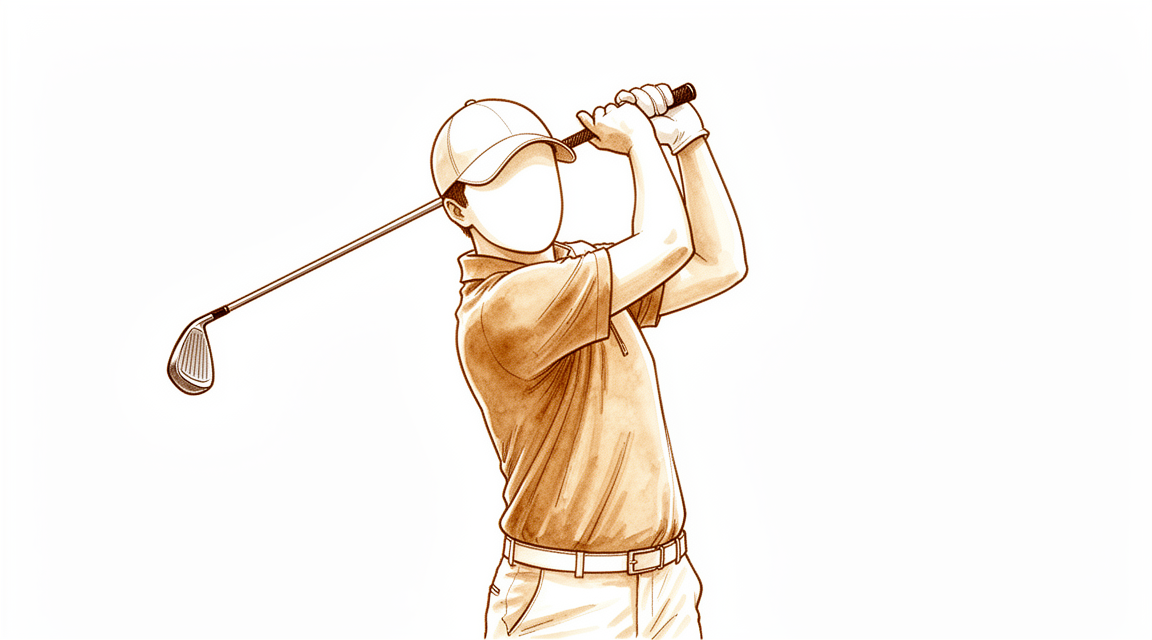
Esta página orienta sua recuperação da epicondilite medial (comumente chamada de cotovelo do golfista) sob os cuidados do Dr. Kieran Hirpara no Mater Private Hospital Rockhampton. A maioria das pessoas se recupera completamente sem cirurgia; o pilar do tratamento é um programa de exercícios progressivo e baseado na aplicação de carga, e não o repouso. O processo começa com seu programa de exercícios domiciliares, seguido pelo protocolo clínico estruturado elaborado para seu fisioterapeuta ou terapeuta da mão; leve esta página ou seu PDF à sua primeira sessão de terapia para garantir que a reabilitação seja coordenada. Seu terapeuta poderá ajustar o plano conforme sua evolução na recuperação.
Caso sinta formigamento, dormência ou fraqueza nos dedos mindinho e anular, informe o consultório ou seu terapeuta; o nervo ulnar passa bem atrás do cotovelo interno e, às vezes, requer atenção específica.
O que esperar
O cotovelo de golfista é um problema degenerativo dos tendões localizados na face interna do cotovelo: os tendões flexor-pronador, responsáveis por dobrar o pulso e virar a palma da mão para baixo, onde se inserem na protuberância óssea chamada epicôndilo medial. Apesar do antigo nome “epicondilite”, na verdade não se trata de uma inflamação; o tendão enfraqueceu e se desorganizou devido à sobrecarga. Por isso, o tratamento moderno não consiste em repouso e anti-inflamatórios, mas sim em um programa gradual que carregue suavemente o tendão até que recupere toda a sua força.
A recuperação exige paciência. O cotovelo de golfista geralmente é autolimitado, mas pode levar de 6 a 18 meses para se resolver completamente. A boa notícia é que a grande maioria das pessoas melhora com um bom programa conservador e nunca precisa de cirurgia. A cirurgia só é considerada após, no mínimo, seis meses de tratamento adequado sem resultados.
Uma característica que diferencia o cotovelo interno do externo (cotovelo de tenista) é o nervo ulnar (o nervo que dá “choque” quando se bate o cotovelo), que percorre um sulco imediatamente atrás do epicôndilo medial. Cerca de metade das pessoas com cotovelo de golfista também apresentam alguma irritação desse nervo; por isso, seu fisioterapeuta irá avaliá-lo em cada sessão e poderá acrescentar exercícios específicos de deslizamento nervoso.
Precauções e limitações
O que fazer:
- Continue utilizando o braço para as tarefas diárias habituais, dentro de limites confortáveis.
- Modifique, em vez de interromper completamente, as atividades que provocam piora dos sintomas.
- Use uma órtese de contraforça sobre o músculo do antebraço durante atividades que agravam a condição, caso isso ajude.
- Faça os alongamentos e exercícios de carga regularmente; a consistência é mais importante do que a intensidade.
O que não fazer:
- Não mantenha o cotovelo completamente em repouso nem coloque-o em gesso; o tendão precisa de uma carga suave para cicatrizar.
- Evite, no início, atividades que exigem grande carga em valgo: golfe, arremessos (especialmente nas fases de preparação e aceleração), natação e esportes com raquete, até que sua força seja recuperada.
- Não realize nenhum exercício até sentir dor aguda, nem realize exercícios de deslizamento nervoso até sentir formigamento ou dormência.
- Se os sintomas do nervo ulnar (formigamento ou dormência nos dedos mindinho e anular) piorarem, reduza a carga e consulte o médico antes de prosseguir com os exercícios.
Seus exercícios
Kieran Hirpara 4.0
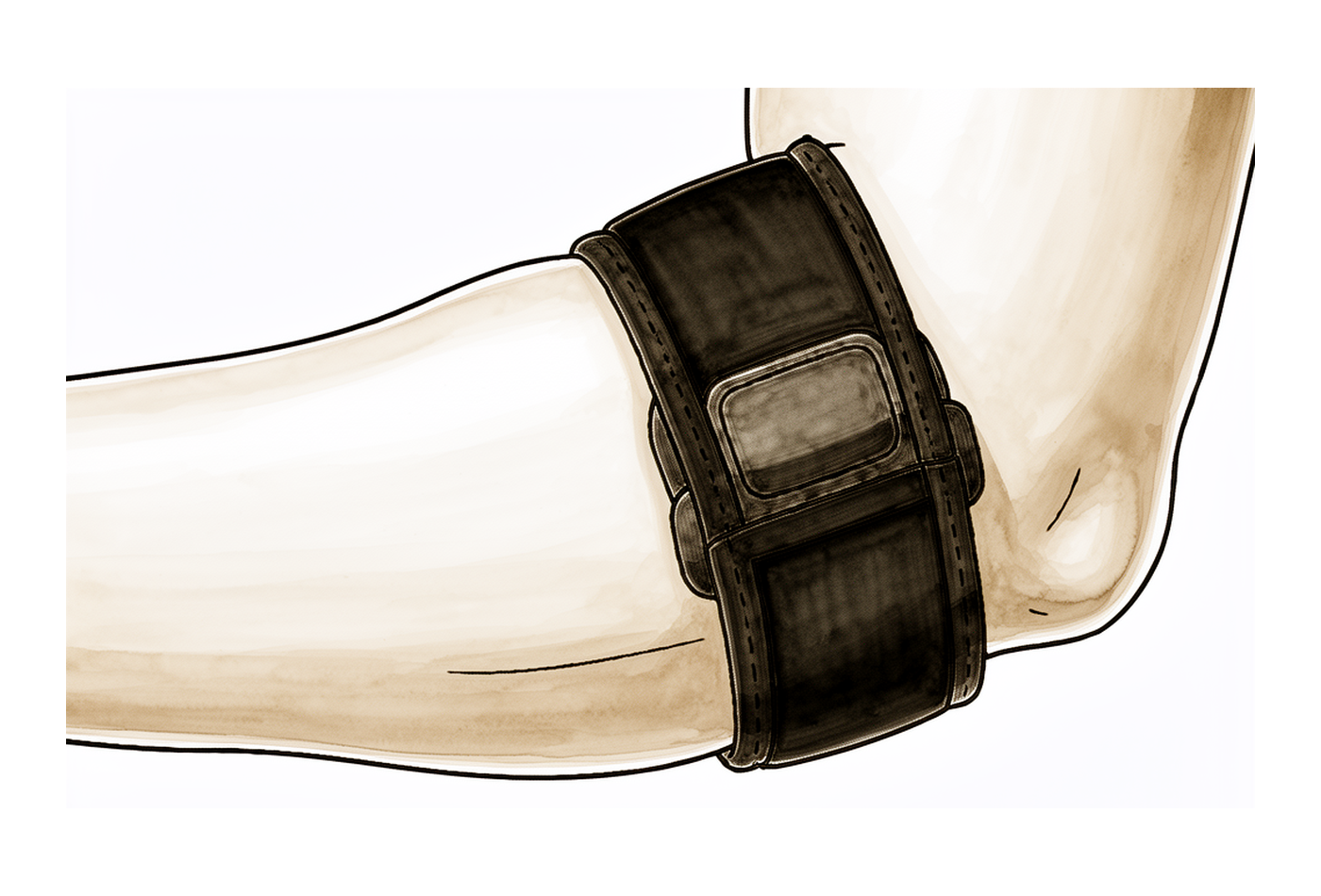
Órtese de contraforça
Use a órtese ao redor do antebraço, alguns centímetros abaixo do cotovelo interno, sobre a massa muscular — nunca sobre a protuberância óssea. Ela deve ficar firme, mas não tão apertada a ponto de causar formigamento ou dormência na mão. Utilize-a durante as atividades que pioram os sintomas (apertar objetos, levantar pesos, praticar esportes) nas primeiras semanas, e vá diminuindo seu uso à medida que os sintomas melhorarem.
Durante atividades que agravam os sintomas; reduza gradualmente conforme a melhora dos mesmos.
Kieran Hirpara 4.0
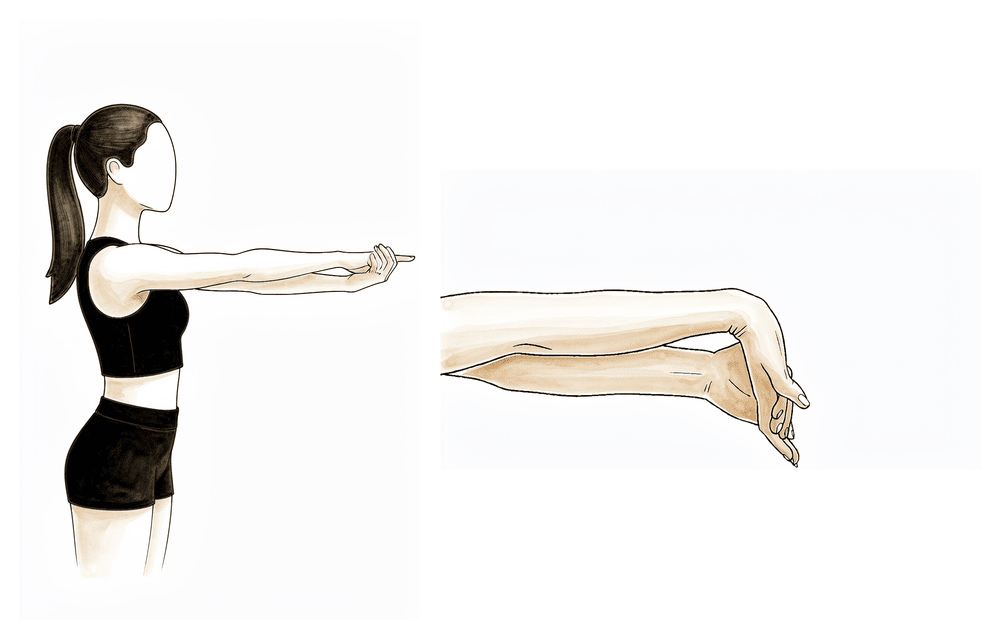
Alongamento dos flexores do punho
Estique o braço afetado à sua frente, com a palma da mão voltada para cima. Com a outra mão, puxe suavemente os dedos e o pulso em direção ao chão, até sentir um alongamento confortável ao longo da face interna do antebraço. No início, mantenha o cotovelo dobrado em aproximadamente 90°; à medida que sua condição melhorar, realize o alongamento com o cotovelo esticado. Mantenha a posição sem fazer movimentos bruscos.
Mantenha por 20–30 segundos, 3–5 vezes, 2–3 vezes ao dia.
Kieran Hirpara 4.0
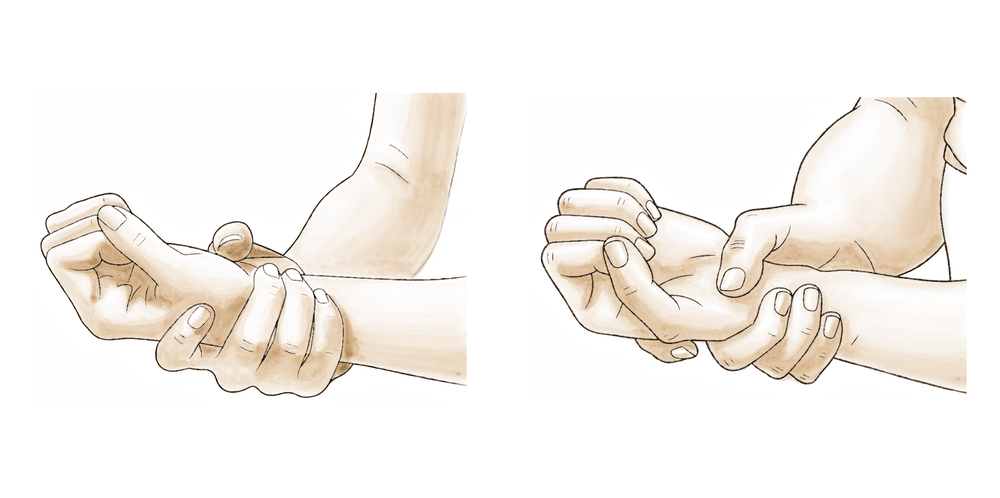
Alongamento do pronador
Com o cotovelo junto ao corpo, vire a palma da mão para baixo. Use a outra mão para girar suavemente o antebraço um pouco mais, até a posição em que a palma fica voltada para baixo, até sentir um leve alongamento na parte interna do antebraço. Faça isso com suavidade e sem causar dor.
Mantenha por 20–30 segundos, 3–5 vezes, 2–3 vezes ao dia.
Kieran Hirpara 4.0
Carga isométrica (flexora) no punho
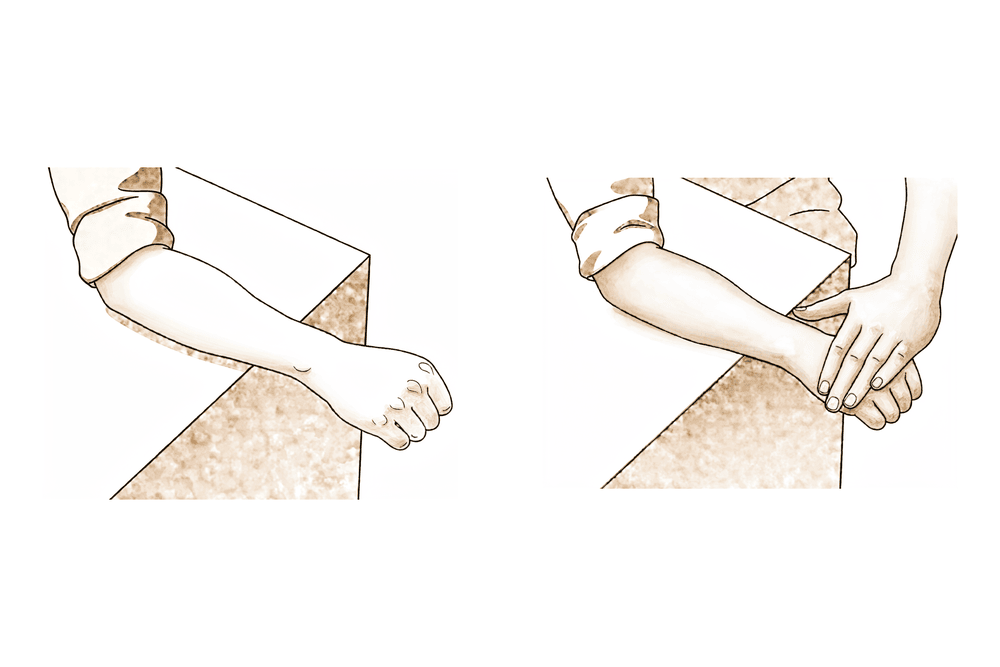
Apoie o antebraço numa mesa, com a palma da mão virada para cima. Pressione a palma da outra mão contra os dedos e tente dobrar o pulso para cima, mas mantenha-o imóvel, de modo que o pulso não se mova de fato — mantenha uma pressão constante contra a resistência. Este é um exercício inicial para carregar suavemente o tendão e aliviar a dor.
Mantenha por 30–45 segundos, 5 vezes por sessão, 1–2 vezes ao dia.
Kieran Hirpara 4.0
Torção reversa de Tyler (carga excêntrica dos flexores)
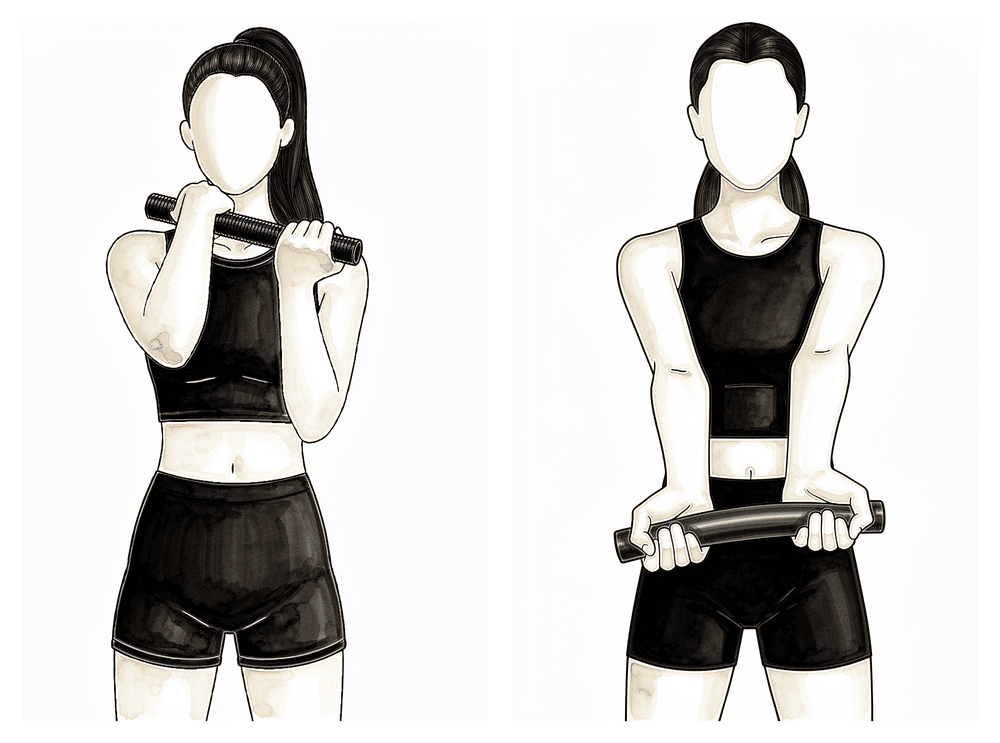
Segure uma barra de exercícios de borracha (FlexBar) com a mão afetada, mantendo o pulso dobrado para cima (palma da mão voltada para você), e gire a barra com a mão saudável. Estenda a barra à sua frente e, em seguida, deixe o pulso afetado se desdobrar lentamente e de forma controlada ao longo de 3–4 segundos — a mão saudável realiza a rotação, enquanto o pulso afetado faz a liberação lenta e controlada (a fase “excêntrica” do movimento). Este é o exercício fundamental para o fortalecimento muscular no caso do cotovelo do golfista; ele deve ser iniciado somente após a diminuição inicial da dor (por volta da 4ª semana).
3 séries de 15 repetições, uma vez ao dia.
Kieran Hirpara 4.0
Rotação do antebraço
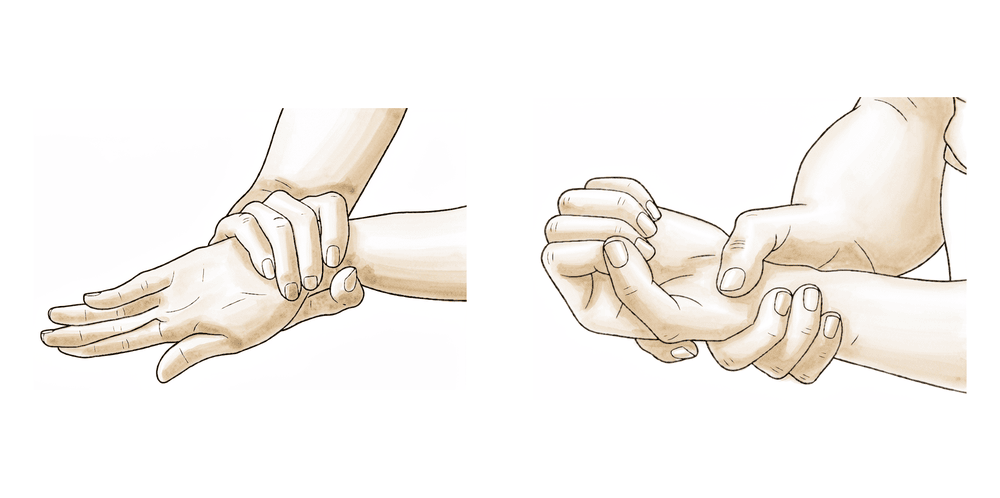
Com o cotovelo junto ao corpo, gire lentamente a palma da mão para cima, em direção ao teto, e depois para baixo, em direção ao chão, mantendo o cotovelo imóvel. Isso mantém os músculos rotadores do antebraço ativos e carrega suavemente os pronadores à medida que você avança no exercício.
10 vezes em cada direção, 2–3 vezes por dia.
Kieran Hirpara 4.0
Fortalecimento da preensão
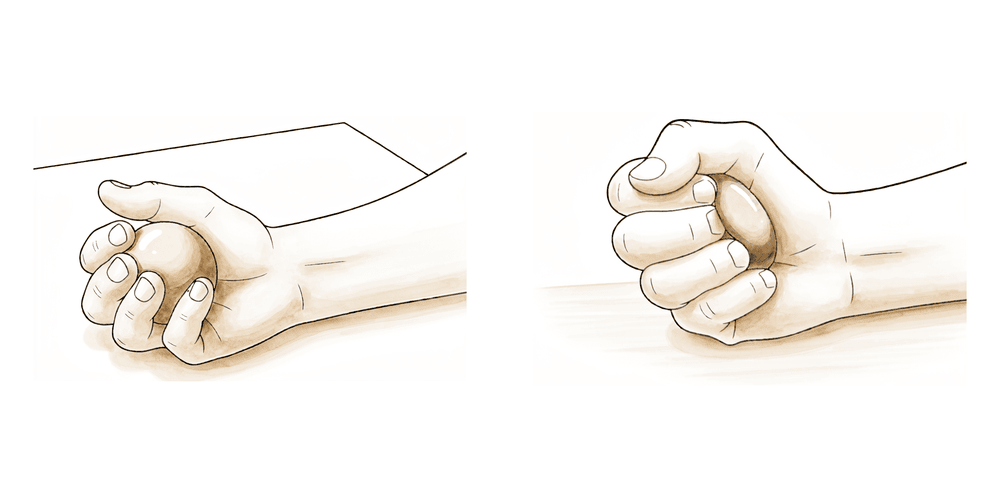
Aperte uma bola macia ou massa terapêutica, mantenha a pressão por alguns instantes e depois relaxe. Comece a fazer isso somente quando os exercícios de alongamento e de carga excêntrica já lhe forem confortáveis — isso desenvolve a força de preensão e do antebraço necessárias para as atividades diárias e esportivas. Evite chegar a um nível de dor aguda.
10–15 compressões, 2–3 vezes por dia
Kieran Hirpara 4.0
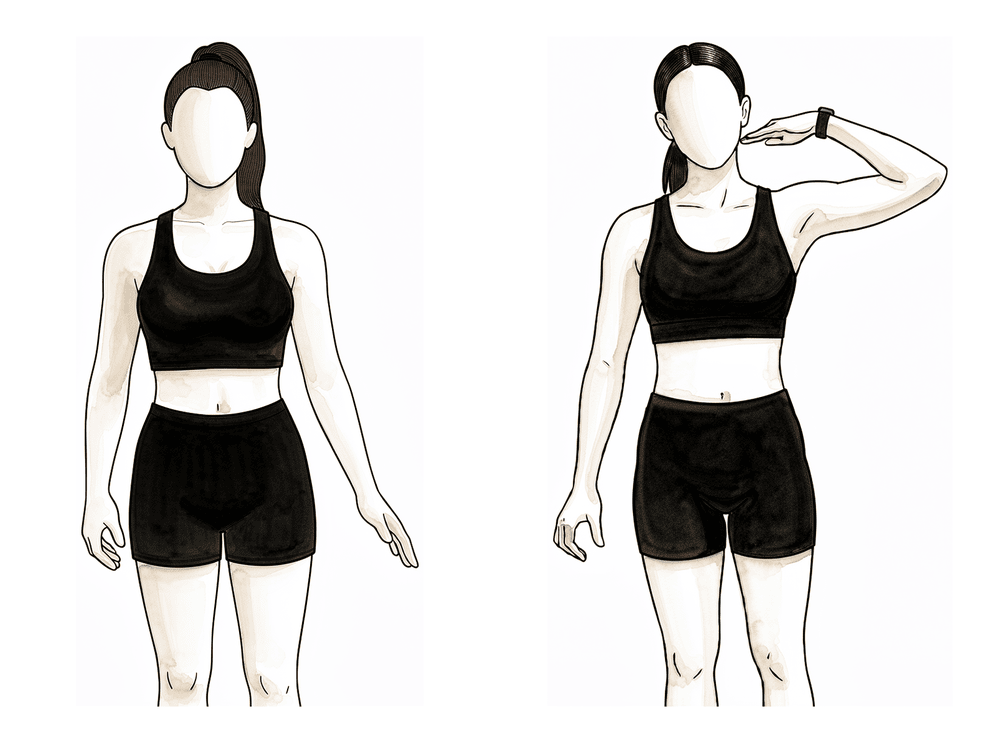
Deslizamento do nervo ulnar
O nervo ulnar percorre um sulco logo atrás da protuberância óssea no lado interno do cotovelo, sendo frequentemente irritável no chamado “cotovelo de golfista”. Para garantir que ele deslize livremente: forme um anel em formato de “OK” com o polegar e o indicador, depois levante a mão em direção ao rosto de modo que esse anel envolva o olho, mantendo o cotovelo dobrado e a palma da mão voltada para você. Mova-se suavemente para dentro e para fora dessa posição. NÃO force até sentir formigamento ou dormência; recue se os dedos mindinho e anular começarem a formigar, e informe seu terapeuta ou a equipe caso os sintomas neurológicos piorem.
5–10 deslizamentos suaves, 2–3 vezes ao dia
Estes são os exercícios contidos no seu folheto informativo. Comece a realizá-los conforme orientado pelo Dr. Hirpara e pelo seu fisioterapeuta. Nas primeiras semanas, o foco é controlar a dor, realizar movimentos suaves e manter contrações isométricas; os exercícios de torção reversa de Tyler excêntrica e de fortalecimento da preensão serão adicionados à medida que você melhorar. O deslizamento do nervo ulnar também está incluído, pois esse nervo costuma ser afetado na região interna do cotovelo; faça esse exercício com suavidade.
Seu protocolo clínico
O restante desta página constitui o protocolo de reabilitação clínica. Esta seção deve ser entregue ao seu fisioterapeuta ou terapeuta da mão. Trata-se de um protocolo condicionado a critérios clínicos, e não meramente ao tempo: a evolução entre as fases depende do cumprimento das metas estabelecidas, e não apenas da passagem do tempo. O nervo ulnar é avaliado em todas as consultas (sinal de Tinel, subluxação), uma vez que aproximadamente 50–60% dos casos de lesão medial apresentam sintomas associados no nervo ulnar; esses sintomas são a principal razão pela qual o tratamento conservador não surte efeito.
Abaixo, encontram-se dois caminhos a seguir: o programa não cirúrgico (primeira linha de tratamento, indicado para a grande maioria dos pacientes) e o programa pós-operatório (destinado à minoria que segue para a cirurgia após o insucesso do tratamento conservador).
Abordagem não cirúrgica
Fase I: Aguda / controle da dor (0–2 semanas)
Objetivos: controlar a dor; restaurar a amplitude de movimento completa sem carga.
- Repouso relativo e modificação das atividades: use a dor como limite; evite a imobilização. Modifique práticas como golfe, arremessos, natação, esportes com raquetes, levantamento de pesos e atividades que exijam preensão repetitiva.
- Uso opcional de órtese de contraforça sobre a massa dos flexores comuns; uma tala de punho pode ser utilizada em casos de dor aguda.
- Medidas auxiliares para controle da dor: aplicação de gelo, terapia manual/IASTM, exercícios suaves de amplitude de movimento ativa sem dor (AROM) e deslizamentos nervosos.
- Avaliação do nervo ulnar (teste de Tinel, verificação de subluxação).
- Critérios para avançar: amplitude de movimento completa sem carga e sem dor; capacidade de seguir sozinho o programa de exercícios em casa.
Fase II: Subaguda / início da carga (2–4 semanas)
Objetivos: iniciar a carga nos músculos flexores e pronadores; tratar a cadeia cinética proximal.
- Carga isométrica leve nos flexores do punho e músculos pronadores.
- Alongamento progressivo dos flexores do punho com o cotovelo flexionado a 90°.
- Cadeia cinética proximal: estabilizadores da escápula (serrátil anterior, trapézio médio/inferior) e manguito rotador; essenciais em atletas que arremessam, onde a sobrecarga medial do cotovelo decorre de movimentos em valgo.
- Critérios para avançar: manutenção da amplitude de movimento completa; tolerância ao alongamento a 90°; força muscular em torno de 70% da contralateral.
Fase III: Fortalecimento / retorno às atividades (4–6+ semanas)
Objetivos: restaurar a tolerância à carga e retornar às funções diárias e esportivas.
- Carga excêntrica-concêntrica nos flexores do punho e músculos pronadores; o equivalente medial do “Tyler Twist” é o “reverse Tyler Twist” (flexão excêntrica do punho utilizando um FlexBar). A carga excêntrica-concêntrica é preferível; a isometria ainda é útil para alívio da dor inicial.
- Mobilização associada ao movimento; avançar o alongamento até a posição de cotovelo estendido.
- Fortalecimento da preensão, seguido de cargas específicas para o esporte; para arremessadores, aplicar um programa de arremessos intervalados; os exercícios pliométricos vêm por último.
- Retirar gradualmente a órtese de contraforça à medida que o cotovelo deixar de doer; avaliar equipamentos e técnica empregada.
- Critérios para retorno ao esporte: força muscular em torno de 90% da contralateral, funcionalidade sem dor e capacidade de autogestão dos sintomas.
Trilha pós-operatória (desbridamento do grupo flexor-pronador ± reparo ± procedimento no nervo ulnar)
A cirurgia é indicada apenas para a minoria de pacientes que não respondem a ≥6 meses de tratamento conservador. A operação aberta do tipo Nirschl realiza o desbridamento da origem patológica do grupo flexor-pronador e, geralmente, seu reparo/reaplicação; o nervo ulnar é avaliado e protegido, sendo realizada descompressão ou transposição anterior simultaneamente em parte dos casos.
Fase 1: Proteção (0–2 semanas)
- Tala posterior de braço inteiro (cotovelo + punho) por 10–14 dias; uso de tipoia para atividades diárias.
- Elevação do membro e controle do edema; exercícios de AROM para dedos/tendões; AROM ativo do ombro; AROM suave da coluna cervical.
- Precauções: Proibido levantar, empurrar, puxar ou realizar preensão forte; é necessário proteger o local do reparo.
Fase 2: Restauração da amplitude de movimento (2–6 semanas)
- Na consulta por volta da 2ª semana: retirada dos pontos; transição para uma ortótese de punho neutra em uso contínuo (retirada apenas para higiene); uso de Tubigrip no cotovelo para controlar o inchaço.
- Iniciar AROM de flexão/extensão do cotovelo por volta da 2–4ª semana, depois AROM de quatro direções do punho + rotação do antebraço e AROM dos dedos/polegar por volta da 4–6ª semana.
- Exercícios de deslizamento do nervo ulnar são introduzidos na 4–6ª semana (um acréscimo específico para o lado medial).
- Estabilização da escápula (contra a gravidade). Nenhum exercício de fortalecimento com resistência antes das 6 semanas.
Fase 3: Fortalecimento (6–12 semanas)
- Retirar gradualmente a ortotese conforme tolerado (pode-se continuar usando à noite inicialmente).
- Fortalecimento progressivo com resistência do punho e antebraço. Inicialmente, não realizar movimentos de supinação/pronação com resistência; começar a levantar pesos em supinação/posição neutra, introduzindo levantamentos leves em pronação por volta da 9ª semana.
Fase 4: Retorno às atividades/esportes (12–16+ semanas)
- Aumentar gradualmente os pesos levantados em todas as posições do antebraço conforme tolerado; retorno total às atividades por volta da 12–16ª semana; para atletas, iniciar programa de treinamento esportivo e arremessos intervalados. A recuperação completa costuma ocorrer em 3–6 meses.
Precauções relativas ao nervo ulnar: caso tenha sido realizada transposição anterior, limitar inicialmente a flexão extrema do cotovelo e aumentar gradualmente a mobilidade do nervo. Sintomas ulnares persistentes ou que piorem exigem avaliação pelo cirurgião antes de aumentar a carga.
Voltando ao trabalho e às atividades
A rapidez com que você retorna às atividades depende do tratamento adotado, bem como das exigências do seu trabalho e dos esportes que pratica.
Tratamento não cirúrgico. Geralmente é possível continuar trabalhando e mantendo-se ativo, bastando adaptar as tarefas que causam desconforto no cotovelo, em vez de interrompê-las completamente. O golfe, esportes que envolvem arremessos, natação e esportes com raquetes podem ser retomados durante a fase de fortalecimento, quando a força do braço atingir cerca de 90% da força do lado oposto e não houver mais dor. Como a epicondilite medial é uma condição autolimitada, a resolução completa pode levar de 6 a 18 meses, embora a funcionalidade diária melhore muito antes disso.
Após cirurgia. O uso leve e restrito do braço começa logo após a cirurgia, porém levantamentos pesados e esforços de preensão são evitados para proteger a reparação realizada. A maioria dos pacientes retorna às atividades plenas em aproximadamente 12 a 16 semanas; a recuperação total costuma ocorrer entre 3 e 6 meses. Atletas que praticam arremessos seguem um programa progressivo de arremessos antes de retornarem às competições.
Dirigir: evite dirigir enquanto estiver usando tala ou tipoia, ou quando o cotovelo estiver muito dolorido para controlar o veículo com segurança. Retome a atividade assim que retirar a tala e conseguir mover o braço confortavelmente, conforme confirmado na sua consulta de acompanhamento.
Após seguir este protocolo
Este protocolo complementa as orientações gerais de recuperação fornecidas pelo consultório; consulte controle da dor pós-operatória, cuidados com a ferida e noções básicas sobre a terapia da mão. O cotovelo do golfista segue a mesma abordagem baseada na carga que o cotovelo lateral, conhecido como cotovelo do tenista; pergunte ao seu terapeuta se deseja receber orientações equivalentes para a epicondilite lateral. Sua recuperação contínua será orientada individualmente pelo seu fisioterapeuta ou terapeuta da mão, conforme a evolução do seu cotovelo.
Evidence & references
This is the clinical evidence summary written for health professionals. It is technical, and it lists the research this page was built from. You do not need to read it to understand your treatment or to make a decision about it.
Medial Epicondylitis (Golfer's Elbow) — Flexor-Pronator Tendinosis: Conservative Loading & Post-operative Rehabilitation
Topic scope: (A) the loading-based non-operative rehabilitation of medial epicondylitis — a degenerative tendinopathy of the flexor-pronator origin (chiefly flexor carpi radialis and pronator teres) at the medial epicondyle — with mandatory ulnar-nerve screening; and (B) post-operative rehabilitation after open flexor-pronator debridement (± repair, ± concurrent ulnar nerve decompression/transposition), reserved for the minority failing ≥6 months of quality conservative care.
Defining principle: medial epicondylitis is not an inflammatory condition but a degenerative tendinosis, so the treatment is graded tendon loading, not rest. The protocol mirrors lateral elbow tendinopathy but with two practice-defining differences Dr Hirpara emphasises: (1) the loaded group is the wrist flexors/pronators (hence the eccentric "reverse Tyler twist" rather than the lateral Tyler twist), and (2) the ulnar nerve lies immediately behind the medial epicondyle, so concomitant ulnar neuritis (~50–60% of cases) is screened at every visit and is the leading reason conservative care fails. Surgery is a last resort after ≥6 months.
Medial epicondylitis is far less studied than its lateral counterpart — it is ~5–10× less common (prevalence ~0.4% vs 1.3%; ~10–20% of all epicondylitis). Most evidence is extrapolated from lateral elbow tendinopathy and from older operative case series; dedicated medial RCTs are sparse. Phase timelines below come from institutional Standard-of-Care protocols (Mass General Brigham combined medial/lateral; UVA medial debridement; Campbell's / Nirschl) plus operative series.
A. NON-OPERATIVE REHABILITATION (phased)
First-line; the majority resolve without surgery. Largely the SAME phased structure as the lateral elbow (Mass General Brigham publishes ONE combined medial/lateral protocol), with the loading target shifted to the flexor-pronator mass. Expected resolution 6–18 months (self-limited).
Phase I — Acute / pain control (~0–2 weeks). Relative rest + activity modification using pain as the limiter (avoid immobilisation). Aggravators to modify: golf, throwing (esp. late-cocking / acceleration valgus load), swimming, bowling, racquet sports, weightlifting, repetitive gripping. Optional counterforce brace over the common flexor mass; wrist splint if acutely painful. Pain-control adjuncts: ice, soft-tissue / IASTM, gentle pain-free AROM, dry needling, nerve glides. Screen the ulnar nerve (Tinel, subluxation). Criterion to progress: full unloaded AROM without pain; independent home program.
Phase II — Sub-acute / early loading (~2–4 weeks). Isometric wrist-flexor and pronator loading (minimal load). Progressive stretching of the wrist flexors at 90° elbow flexion. Proximal kinetic chain: scapular stabilisers and rotator cuff — critical in throwers, where medial elbow overload is valgus-driven. Criteria to progress: full ROM maintained; tolerates the 90° stretch; ~70% contralateral strength.
Phase III — Late / strengthening & return (~4–6+ weeks). Eccentric and concentric loading of wrist flexion and forearm pronation — the medial analogue of the Tyler twist is a "reverse Tyler twist" (eccentric wrist flexion on the FlexBar). Combined eccentric-concentric loading is favoured; isometrics for early analgesia. Mobilisation-with-movement; progress stretching to the elbow-extended position. Grip strengthening, then sport-specific loading; for throwers, an interval throwing program; plyometrics last. Wean counterforce brace as asymptomatic; equipment/technique modification. Return-to-sport criteria: ~90% contralateral strength, pain-free function, self-management.
B. POST-OPERATIVE REHABILITATION (flexor-pronator debridement ± repair, ± ulnar nerve procedure)
Surgery is for the minority failing ≥6 months of conservative care. The open Nirschl-type operation debrides the pathologic flexor-pronator origin (incision posterior to the medial epicondyle to spare the medial antebrachial cutaneous nerve), with repair/reattachment commonly by suture anchor. The ulnar nerve must be assessed and protected: ulnar neuritis is addressed concurrently (decompression or anterior transposition) in roughly 20–50% of operative series. The phase timeline blends the UVA "Golfer's Elbow Debridement (with tendon repair)" protocol and the Verma / Midwest-Orthopaedics-at-Rush medial/lateral debridement protocol.
Phase 1 — Protect / immobilise (Weeks 0–2). Posterior long-arm splint (elbow + wrist) for 10–14 days; sling for community use. Elevation; oedema control; finger/tendon-glide AROM; unaffected-joint motion; active shoulder ROM; gentle cervical AROM. Precautions: NO lifting / pushing / pulling / forceful gripping; protect the repair.
Phase 2 — ROM restoration (Weeks 2–6). At the 2-wk visit: suture removal; transition to a wrist orthosis in neutral full-time (off for hygiene); Tubigrip at the elbow for swelling. Begin AROM elbow flexion/extension (2–4 wk), then 4-way wrist AROM + forearm rotation, finger/thumb AROM (4–6 wk). Ulnar nerve glides introduced ~weeks 4–6 (the explicit medial-specific addition). Scapular stabilisation (gravity-resisted). No resistance strengthening until after 6 weeks.
Phase 3 — Strengthening (Weeks 6–12). Wean the orthosis as tolerated (consider night use early). Progressive resistive strengthening of wrist and forearm; per Verma, no resisted supination/pronation early, lifting begun in supination/neutral, with light pronated lifting from ~week 9.
Phase 4 — Return to activity / sport (Weeks 12–16+). Progress lifting in all forearm positions as tolerated; full return to activity by ~12–16 weeks; sport-specific / interval throwing program for athletes. Full recovery commonly 3–6 months.
Ulnar nerve precautions: if an anterior transposition was performed, limit end-range elbow flexion early and progress nerve excursion gradually; persistent or worsening ulnar symptoms warrant surgeon review before advancing loading.
C. PHASED TIMELINE SUMMARY
| Pathway | Phase | Window | Immobilisation | Loading / key actions | Criteria / milestone |
|---|---|---|---|---|---|
| Non-op | I — Pain control | 0–2 wk | None (avoid casting); optional counterforce brace | Activity modification; pain-free AROM; nerve glides; ulnar screen | Full unloaded AROM, pain-free |
| Non-op | II — Early loading | 2–4 wk | None | Isometric flexor/pronator load; 90° wrist-flexor stretch; scapular/cuff | ~70% contralateral strength |
| Non-op | III — Strengthen / return | 4–6+ wk | Wean brace | Reverse Tyler twist (eccentric); grip; sport-specific; throwers' interval program | ~90% strength, pain-free → RTS |
| Post-op | 1 — Protect | 0–2 wk | Posterior long-arm splint 10–14 d + sling | Finger glides, shoulder ROM; oedema control | No resistance; repair protected |
| Post-op | 2 — ROM restore | 2–6 wk | Neutral wrist orthosis | Elbow AROM → 4-way wrist + forearm rotation; ulnar glides wk 4–6 | No resistance until >6 wk |
| Post-op | 3 — Strengthen | 6–12 wk | Wean orthosis | Progressive resistance; supinated/neutral lifting → light pronated ~wk 9 | Restored strength in safe positions |
| Post-op | 4 — Return | 12–16+ wk | None | Lifting all forearm positions; interval throwing | Full return ~12–16 wk; recovery 3–6 mo |
D. KEY CONTROVERSIES / EVIDENCE QUALITY
- Sparse high-level evidence. Almost no medial-specific RCTs; recommendations are extrapolated from lateral elbow and from retrospective operative series (Kurvers & Verhaar 1995 remains a cornerstone). Strength of evidence is materially weaker than for lateral epicondylitis.
- Ulnar nerve is the dominant modifier. Concomitant ulnar neuropathy (reported 23–60%) worsens prognosis and is the leading reason conservative care fails; whether and how to address it surgically (decompression vs transposition vs medial epicondylectomy) is debated. Outcomes are reliably worse when ulnar symptoms coexist and are untreated.
- PRP may rival surgery for type-1 disease. Bohlen et al (OJSM 2020) found 2 leukocyte-rich PRP injections matched surgery for recalcitrant type-1 medial epicondylitis (29/33 success each) with faster recovery (pain-free ~56 vs ~108 days; full ROM ~42 vs ~96 days) — the surgical delay partly attributed to post-op bracing. Small evidence base.
- Corticosteroid: short-term only. As with the lateral elbow, steroid gives transient relief without durable benefit and risks recurrence; repeated injections show diminishing returns.
- Eccentric vs concentric. Same unsettled debate as the lateral elbow; combined eccentric-concentric flexor-pronator loading is the pragmatic standard, but direct medial trial data are minimal.
- Surgical technique. Open Nirschl debridement with repair is reliable in case series; arthroscopic medial debridement is emerging (claimed ulnar-nerve protection) but is technically demanding and under-evidenced. Debridement alone vs with repair remains unsettled.
E. EVIDENCE STRENGTH FLAGS (summary)
- MODERATE (non-operative rehab): the phased loading program — extrapolated largely from lateral elbow tendinopathy and combined medial/lateral institutional protocols; combined eccentric-concentric flexor-pronator loading is the pragmatic standard.
- LOW–MODERATE (post-operative rehab): phase timelines from institutional debridement protocols (UVA; Verma/Rush) and operative case series; no defining post-op rehab RCT.
- MODERATE (PRP for type-1 disease): single comparative study (Bohlen OJSM 2020) matching surgery with faster recovery; small sample.
- CONSENSUS / EXPERT: ulnar-nerve screening at every visit, ulnar-glide timing (wk 4–6 post-op), and the forearm-position lifting progression — drawn from surgeon-guidance protocols and operative practice rather than trial data.
CITATIONS
RAG corpus (180,000+ Orthopaedic articles)
- Kurvers H, Verhaar J. The results of operative treatment of medial epicondylitis. J Bone Joint Surg Am. 1995. (ulnar neuritis coexistence 23–50%)
- Bohlen HL, et al. Platelet-rich plasma is an equal alternative to surgery in the treatment of type 1 medial epicondylitis. Orthop J Sports Med. 2020. DOI: 10.1177/2325967120908952
- Platelet-rich plasma versus Tenex in the treatment of medial and lateral epicondylitis. J Shoulder Elbow Surg. 2019.
- Ellenbecker TS, Nirschl R, Renstrom P. Current concepts in examination and treatment of elbow tendon injury. Sports Health. 2012.
- Rehabilitation of the thrower's elbow. Clin Sports Med. 2004.
- Nirschl surgical technique for concomitant lateral and medial elbow tendinosis. Am J Sports Med. 2011.
- Imaging of the elbow in the overhead throwing athlete. Am J Sports Med. 2003. (ulnar neuritis in ~60% of throwers with medial epicondylitis)
- Outcome of partial medial epicondylectomy for cubital tunnel syndrome. Clin Orthop Relat Res. 2006.
- Coonrad RW, Hooper WR. Tennis elbow: its course, natural history, conservative and surgical management (includes medial). J Bone Joint Surg Am. 1973.
- Green's Operative Hand Surgery. 2021. (medial vs lateral prevalence; combined treatment chapter; Nirschl technique)
- Campbell's Operative Orthopaedics. 2020. (Box 46.3 Rehabilitation Protocol for Epicondylitis [Wilk/Arrigo/Andrews]; Nirschl medial technique, posterior incision sparing the MABC nerve)
Published protocols (URLs)
- University of Virginia Orthopaedics — Medial Epicondyle (Golfer's Elbow) Debridement (with tendon repair), Rehabilitation Guidelines. https://med.virginia.edu/orthopaedic-surgery/wp-content/uploads/sites/242/2024/09/Medial-Epicondyle-Golfers-Elbow-Debridement-with-tendon-repair.pdf
- Midwest Orthopaedics at Rush (Nikhil Verma, MD) — Post-Operative Rehabilitation Guidelines for Medial/Lateral Epicondyle Debridement. https://www.sportssurgerychicago.com/patient-resources/rehab-manuals/mediallateral-epicondyle-debridement/
- Mass General Brigham Sports Medicine — Rehabilitation Protocol for Medial/Lateral Epicondylalgia (non-operative), rev. April 2021. https://www.massgeneral.org/assets/MGH/pdf/orthopaedics/sports-medicine/physical-therapy/rehabilitation-protocol-for-medial-lateral-epicondylitis.pdf