Patients › Wrist
Fusão total do punho
Wrist fusion permanently joins wrist bones to relieve pain from arthritis or injury.
Por que esta cirurgia foi recomendada
O Dr. Kieran Hirpara, cirurgião de membros superiores no Mater Private Hospital Rockhampton, começa com as opções menos invasivas adequadas ao seu caso. Em geral, os pacientes são encaminhados à nossa clínica pelo médico de família; caso um fisioterapeuta tenha sugerido que você nos procurasse, ainda assim será necessário um encaminhamento do seu médico de família para que você tenha direito ao reembolso do Medicare. Uma avaliação clínica, que inclui o histórico médico, exame físico e exames de imagem quando necessário, permite o diagnóstico.
A artrite do punho causa dor, fraqueza na força de preensão e, às vezes, instabilidade no punho. Para muitas pessoas, o tratamento não cirúrgico vem primeiro: modificação das atividades, terapia ocupacional, uso de talas ou injeções. Recomendamos a artrodese total do punho quando essas medidas não proporcionarem melhoria suficiente. A cirurgia une os ossos do punho para que eles se consolidem como uma única peça sólida, impedindo o atrito doloroso entre as superfícies articulares desgastadas. Geralmente, esse procedimento é indicado para casos graves de artrose decorrente de lesões ou para punhos danificados pela artrite reumatoide, que se tornaram instáveis ou deformados. Também pode ser considerado quando uma prótese de punho anterior falhou. O objetivo é obter um punho estável, forte e com muito menos dor, permitindo que você use a mão com confiança.
Antes da operação
O seu cirurgião planeará a operação utilizando exames de imagem do seu pulso, como radiografias ou ressonância magnética. A ressonância magnética utiliza um ímã potente para obter imagens detalhadas, podendo revelar problemas que as radiografias comuns não conseguem detectar. Receberá instruções claras sobre os medicamentos a tomar antes da cirurgia. Alguns medicamentos talvez precisem ser interrompidos temporariamente; o seu cirurgião informará quais e por quanto tempo. Deve deixar de comer e beber sete horas antes do horário da operação. Pedimos que seja sete horas em vez de seis para que seja possível antecipar o seu procedimento caso a lista de cirurgias avance mais cedo. Providencie alguém para o levar para casa após a operação. Traga consigo uma lista dos medicamentos que está a tomar atualmente. Use roupas largas e confortáveis. Se tiver outras condições médicas, poderá ser necessário realizar análises de sangue ou uma consulta com o anestesista.
No dia da cirurgia
Você chega à unidade de admissão cirúrgica do hospital, onde é registrado e preparado para a sala de operações. Lá, encontrará o anestesista. Esta cirurgia é realizada sob anestesia geral; você ficará completamente inconsciente durante o procedimento. Alguns pacientes também recebem um bloqueio nervoso regional para alívio da dor pós-operatória; a decisão é tomada pelo anestesista no próprio dia, conforme as suas condições individuais. Em seguida, você é levado à sala de operações, onde a cirurgia é realizada.
Você acorda na sala de recuperação, onde as enfermeiras monitoram seu estado enquanto a anestesia vai passando. Assim que sua condição se estabiliza, você é encaminhado para o quarto ou pode ir para casa, dependendo do tipo de cirurgia e da sua recuperação.
Como é realizada a operação
O cirurgião faz um único corte na parte de trás do seu pulso. Por meio dessa abertura, ele alcança as superfícies articulares desgastadas entre os pequenos ossos do pulso e a extremidade do osso do antebraço. Em seguida, remove o cartilagem liso remanescente dessas superfícies, bem como qualquer osso endurecido, de modo que osso fresco e sangrando fique exposto em ambos os lados de cada articulação a ser unida. Esse contato direto entre os ossos é o que permite que eles se curem e se fundam em uma única peça sólida.
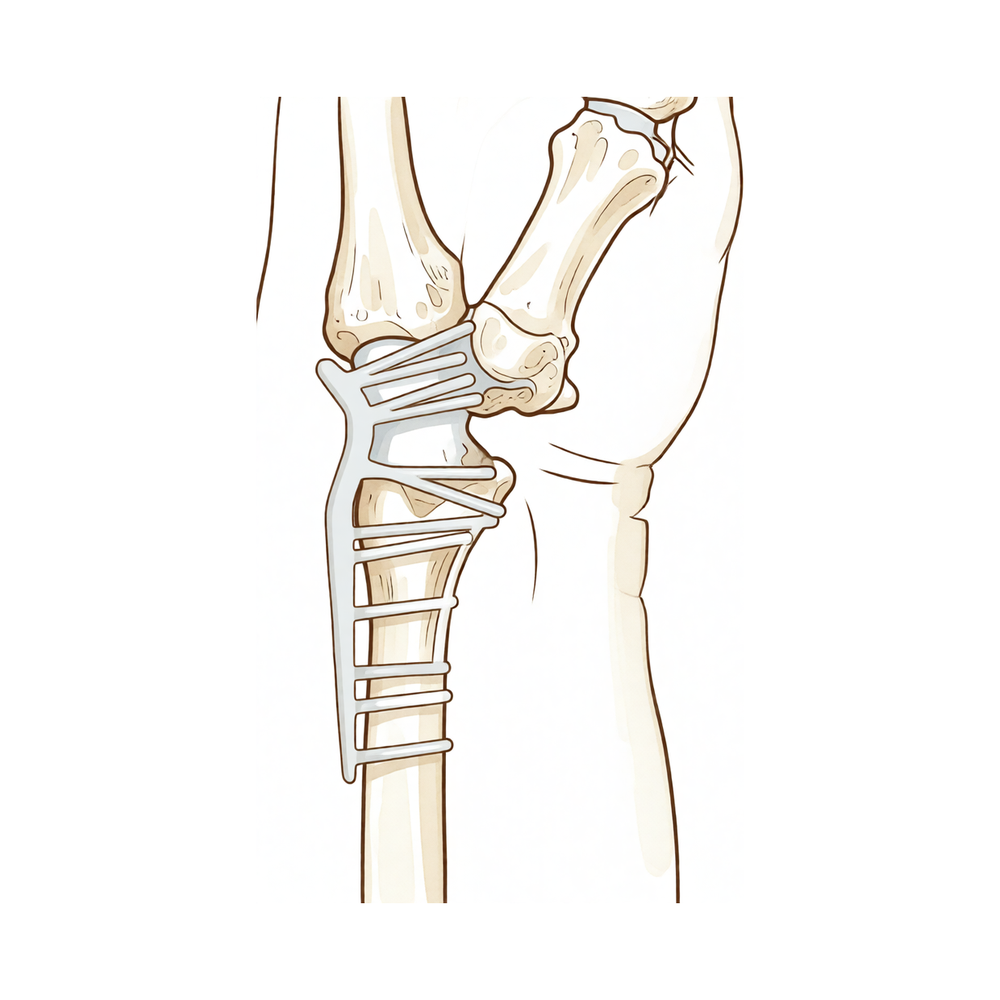
Em seguida, o cirurgião alinha os ossos numa posição funcional e os mantém imóveis durante a cicatrização. Uma placa metálica moldada é colocada na parte de trás do pulso e fixada aos ossos com parafusos. A placa mantém tudo no lugar, impedindo que os ossos se desloquem enquanto se unem. Em alguns casos, o cirurgião pode acrescentar uma pequena quantidade de enxerto ósseo para auxiliar na cicatrização.
Quando os ossos já estão bem fixos, o cirurgião fecha o corte com pontos de sutura e aplica um curativo.
Após a operação
Você acordará na sala de recuperação, sob a vigilância das enfermeiras, enquanto o efeito da anestesia passa. O seu pulso ficará imobilizado em uma tala ou gesso, com um curativo sobre o ferimento. Deixamos o curativo por cerca de 10 dias; por favor, não o retire antes disso, a menos que lhe seja indicado. Trocamos ou retiramos o curativo quando o examinamos. O alívio da dor será providenciado antes da sua alta hospitalar, e as enfermeiras podem ajustá-lo caso você sinta desconforto. No dia da cirurgia, você poderá levantar-se e caminhar, usando a outra mão para se apoiar. A maioria dos pacientes permanece uma noite no hospital após essa operação; porém, alguns conseguem ir para casa no mesmo dia. Por favor, providencie alguém para ficar com você nas primeiras 24 horas após voltar para casa.
Recuperação
Nos primeiros dias, seu pulso ficará dolorido e inchado. Isso melhora gradualmente. Manter a mão elevada sobre travesseiros, inclusive à noite, ajuda a reduzir o inchaço e o desconforto. Tome os analgésicos prescritos, em vez de esperar que a dor piore.
Seu pulso ficará imobilizado em uma tala ou gesso enquanto os ossos se unem. Você usará a outra mão para tarefas cotidianas, como se vestir, comer e tomar banho. Pode circular pela casa e fazer atividades leves, mas não deve dirigir enquanto o pulso permanecer imobilizado. Após a retirada do gesso ou da tala e com autorização do cirurgião, será possível voltar a dirigir; nossa página sobre dirigir após cirurgia no membro superior explica isso com mais detalhes.
A fisioterapia da mão começa pouco após a cirurgia e ajuda a prevenir rigidez nos dedos, pulso e antebraço. Sua fisioterapeuta, Ruby Doolan, da Extend Rehabilitation, orientará os exercícios e confeccionará qualquer tipo de tala necessária. Iniciar movimentos suaves precocemente ajuda a recuperar a mobilidade mais rapidamente e, muitas vezes, reduz o número total de sessões de terapia.
Como os ossos do pulso ficam unidos, essa região do pulso não dobrará mais. A maioria das pessoas se adapta bem e consegue realizar suas atividades diárias com alguns novos hábitos. O antebraço ainda pode girar, portanto muitas tarefas permanecem confortáveis. Assim que os ossos cicatrizarem e sua força de preensão estiver restaurada, você poderá retomar o trabalho e outras atividades.
Cada pessoa tem seu próprio ritmo de recuperação; portanto, seu cronograma pode ser diferente. Seu cirurgião e sua fisioterapeuta o guiarão em cada etapa.
O que pode dar errado
A maioria dos pacientes se recupera bem, mas, ocasionalmente, podem surgir problemas. O seu cirurgião e a equipe o monitoram de perto para detectar qualquer problema precocemente.
A placa metálica e os parafusos mantêm os ossos imóveis enquanto cicatrizam. Às vezes, esse material pode causar desconforto ou se deslocar ligeiramente. Você pode sentir uma borda afiada sob a pele ou uma dor persistente sobre a placa que os analgésicos comuns não aliviam. Se isso o incomodar, mencione-o na próxima consulta. O material pode ser removido após a consolidação óssea.
Ocasionalmente, os ossos do punho não se unem conforme o planejado. Isso é chamado de não união óssea. Muitas pessoas com esse problema não sentem nada e não apresentam sintomas. Contudo, se o espaço entre os ossos causar dor persistente, o cirurgião discutirá as opções disponíveis com você na consulta.
O nervo que atravessa o meio do punho pode ficar comprimido devido ao inchaço pós-cirurgia. Isso é conhecido como síndrome do túnel carpal. Você notará formigamento, sensação de “alfinetadas” ou dormência no polegar, indicador e dedo médio, geralmente pior à noite. Informe o cirurgião caso isso ocorra. Geralmente, o problema pode ser tratado com uma pequena cirurgia para aliviar a pressão sobre o nervo.
Também podem ocorrer problemas na cicatrização da ferida. Fique atento à pele ao redor do curativo: verifique se há vermelhidão que se espalha, aumento da temperatura, secreção ou odor desagradável. Uma ferida que não cicatriza pode exigir tratamento. Caso observe esses sinais, entre em contato com a clínica imediatamente, em vez de aguardar a próxima consulta.
Os tendões, que conectam os músculos aos ossos, podem, ocasionalmente, ficar irritados ou se romper próximo ao punho. Você pode notar fraqueza súbita – por exemplo, um dedo que não consegue se esticar corretamente – além de inchaço ou sensibilidade na parte de trás da mão. Comunique isso ao cirurgião o quanto antes.
Se você já realizou uma artroplastia de punho que não teve sucesso, a artrodese posterior ainda pode resolver o problema, embora a recuperação possa ser um pouco mais lenta do que após uma artrodese realizada pela primeira vez.
A tabela de complicações nesta página lista as taxas típicas, caso você queira informações mais detalhadas.
Quando nos contatar
A maioria dos problemas aparece nas primeiras semanas. Contate-nos se tiver febre, ou se a pele ao redor da ferida ficar mais vermelha, quente ou com secreção. Contate-nos se a dor piorar repentinamente, ou se notar formigamento ou dormência que antes não existia. Procure atendimento de emergência se a panturrilha estiver inchada e dolorida, ou se sentir falta de ar. Procure atendimento de emergência se não conseguir sentir ou mover a mão ou os dedos.
Onde ler mais sobre a condição
Esta página trata especificamente da operação. A condição que ela visa tratar, incluindo as evidências sobre quando a cirurgia é benéfica e quando não é, é abordada com mais detalhes na página Osteoartrite do Punho.
Evidence & references
This is the clinical evidence summary written for health professionals. It is technical, and it lists the research this page was built from. You do not need to read it to understand your treatment or to make a decision about it.
Anatomy & Pathophysiology
Bony Anatomy
- The wrist is the anatomic region between the forearm and the hand, including the distal radioulnar, radiocarpal, and ulnocarpal joints and the eight carpal bones [2].
- The proximal row of carpal bones consists of the scaphoid, lunate, triquetrum, and pisiform [2].
- The distal row of carpal bones consists of the trapezium, trapezoid, capitate, and hamate [2].
- The pisiform and trapezoid are the smallest carpal bones, while the capitate is the largest [2].
- The capitate articulates with seven other carpal bones, whereas the pisiform articulates with only one (the triquetrum) [2].
- The radiocarpal joint is formed by the articulation of the distal radius with the scaphoid and lunate, and the triquetrum on the triangular fibrocartilage [2].
- The distal concave articular surfaces of the proximal carpal row form the midcarpal articulations with the distal row [2].
- The distal ulnar convexity articulates at the lesser sigmoid notch of the distal radius [2].
- The sigmoid notch articular surface accommodates the ulnar head through two thirds of its arc [2].
- There is approximately a 20-degree inclination of the distal ulna at its articulation with the radius [2].
- The ulnar styloid lies dorsal to the ulnar head and extends distally [2].
- The distal radius has three articular components: the scaphoid fossa, the lunate fossa, and the sigmoid notch [6].
- A ridge between the scaphoid and lunate fossae corresponds with the scapholunate interval [6].
- The radial styloid allows attachment of the brachioradialis tendon and is the origin of the radial scapholunate and radial lunocapitate ligaments [6].
- The concave elliptical distal radius is oriented in the sagittal plane with an average of 11 degrees of volar tilt [6].
- In the frontal plane, the average radial inclination of the distal radius is 23 degrees [6].
- Radial length, measured from the tip of the radial styloid to the ulnar articular surface, averages 13 mm [6].
- The interosseous membrane connects the shafts of the radius and ulna, with a thickened central portion important for force transmission [6].
Ligamentous Anatomy
- The triangular fibrocartilage complex (TFCC) attaches to the ulnar margin of the lunate fossa of the radius [2].
- The TFCC includes the ulnar collateral ligament, dorsal and volar radioulnar ligaments, articular disc, meniscal homologue, extensor carpi ulnaris sheath, and ulnolunate and ulnotriquetral ligaments [2].
- Extrinsic carpal ligaments connect the radius or the ulna to the carpus [7].
- Volar extrinsic ligaments are generally stronger than dorsal ligaments [7].
- The radioscaphocapitate ligament connects to the waist of the scaphoid and limits ulnar translation of the carpus [7].
- The long radiolunate ligament helps limit ulnar translocation of the carpus [7].
- The short radiolunate ligament helps control lunate position [7].
- The radioscapholunate ligament is a vascular conduit (ligament of Testut) rather than a true ligament [7].
- The ulnolunate ligament attaches to the palmar radioulnar ligament and the lunate [7].
- The ulnocapitate ligament attaches to the ulnar head and is the most superficial or palmar ulnocarpal ligament [7].
- The ulnotriquetral ligament attaches to the palmar radioulnar ligament and the triquetrum [7].
- The dorsal radiocarpal ligament has a trapezoidal shape, passing from the dorsal rim of the distal radius to the lunate and triquetrum [7].
- The dorsal radiocarpal ligament is associated with dorsal and volar intercalated segmental stabilities [7].
- Intrinsic carpal ligaments originate and insert within the carpus [7].
- The scapholunate interosseous ligament (SLIL) is a major stabilizer of the wrist and the most commonly injured wrist ligament [7].
- The SLIL is C-shaped, consisting of dorsal, palmar, and interosseous portions, with the dorsal portion being the strongest and thickest [7].
- The SLIL provides a flexion force on the lunate due to its attachment to the scaphoid [7].
- The lunotriquetral interosseous ligament (LTIL) is C-shaped, with the volar portion being the thickest and strongest [7].
- The LTIL provides an extension moment on the lunate due to its attachment to the triquetrum [7].
- The capitohamate ligament is a thick ligament measuring 5 × 5 mm in cross section, with extensions to the third or fourth metacarpals [7].
- The dorsal intercarpal ligament passes from the dorsal tubercle of the triquetrum to the distal pole of the scaphoid [7].
- The dorsal intercarpal ligament reinforces the elastic dorsal wrist capsule and stabilizes the scapholunate articulation [7].
- The space of Poirier is an area adjacent to the proximal capitate without ligamentous attachment, situated ulnar to the radioscaphocapitate ligament and radial to the long radiolunate ligament [7].
- The space of Poirier is a weak area vulnerable to instability, through which the distal carpal row separates from the lunate during a perilunate dislocation [7].
- The dorsal wrist ganglion is typically located directly over the scapholunate ligament [16].
Biomechanics and Kinematics
- The wrist joint’s motion planes include flexion, extension, radial deviation, ulnar deviation, and circumduction [7].
- There is minimal carpal motion with pronosupination [7].
- Approximately 62° of wrist extension occurs through the radiocarpal joint [7].
- 62% of wrist flexion occurs through the midcarpal joint [7].
- The midcarpal joint is mostly responsible for 20° of radial deviation and 40° of ulnar deviation [7].
- The midcarpal joint is responsible for the “dart thrower’s motion,” which involves moving from radial extension into ulnar flexion positioning of the wrist [7].
- The radius bears 80% of the axial load transmitted through the radiocarpal joint in neutral ulnar variance [7].
- The ulna bears 20% of the axial load transmitted through the radiocarpal joint in neutral ulnar variance [7].
- The proximal row of carpal bones forms an intercalated segment between the distal carpal row and the distal radius, bound into a functional unit by the SLIL and LTIL [7].
- The distal row of carpal bones is rigid with little motion between its bones due to stout intercarpal ligaments, acting as a functional unit with the scaphoid bridging both rows [7].
- During wrist flexion from neutral, the distal row flexes and ulnarly deviates slightly while the scaphoid pronates [7].
- During wrist flexion from neutral, the proximal row flexes differentially, with more rotation through the scaphoid, followed by the triquetrum and the lunate [7].
- During wrist flexion from neutral, the proximal row translates dorsally [7].
- During wrist extension from neutral, the distal row extends and radially deviates slightly while the scaphoid supinates [7].
- During wrist extension from neutral, the proximal row extends differentially, with more motion in the scaphoid, followed by the triquetrum and then the lunate [7].
- During wrist extension from neutral, the proximal row translates palmarly [7].
- The eight carpal bones represent the most complex articular system in the human body [3].
- Injuries to the wrist mechanism can lead to instability, resulting in a painful lack of motion, strength, and function [3].
Investigations
Magnetic Resonance Imaging
- MRI was first reported for hand and wrist imaging in 1986 [8].
- The primary advantages of MRI compared with CT and radiography are improved tissue characterization, especially of soft tissues such as ligamentous structures in the wrist and synovium in the hand, and the lack of ionizing radiation [8].
- MRI is the modality of choice for imaging radiographically occult fractures of the hand and wrist [8].
- Early MRI was limited by low magnetic field strength (0.15 T) and limited image options and processing [8].
- Modern MRI is generally at 1.5T or 3T with a wide variety of imaging options and powerful image processing [8].
- 3T is much preferred for hand and wrist imaging, especially for imaging small fields of view [8].
- Dedicated extremity magnets have been marketed, but image quality is poor compared with conventional MR imaging [8].
- 7T MRI has recently become approved for clinical use [8].
- 7T MRI has more than double the magnetic field strength of 3T MRI and has the potential to become a powerful tool for hand and wrist imaging as applications are developed [8].
- MRI with contrast enhancement is most commonly used to determine whether soft-tissue lesions are solid or cystic [8].
- In rheumatologic imaging, MRI with contrast enhancement is used to better visualize erosions and synovial burden [8].
- Dynamic contrast enhancement has been used with inconsistent results to assess for the presence of avascular necrosis in the lunate or scaphoid after injury [8].
- MR angiography of the hand and wrist can be helpful in situations such as diagnosis of the hypothenar hammer syndrome [8].
- MR arthrography can be performed for evaluation of the triangular fibrocartilage and intercarpal ligament tears, but this is generally unnecessary with the increasing availability of high field MRI [8].
Computed Tomography and Other Modalities
- Hybrid SPECT/CT has been used for the diagnosis of radiographic occult fractures of the wrist [4].
- Cone-beam CT has been used in the diagnosis of scaphoid fractures [4].
- CT and MRI have a diagnostic impact on wrist injuries in young adults [4].
- Cine MRI is a new approach to the diagnosis of scapholunate dissociation [4].
- Cone-beam computed tomography arthrography is an innovative modality for the evaluation of wrist ligament and cartilage injuries [4].
- 3D analysis of the wrist has been described [4].
- Normal and variant anatomy of the wrist and hand can be evaluated on MR imaging [4].
- Low-field MRI has been used for scaphoid fracture evaluation [5].
- Occult wrist fractures can be detected by magnetic resonance imaging [5].
- MR imaging has been used to evaluate the triangular fibrocartilage complex [5].
- MR imaging and computed tomography arthrography have been used for preoperative evaluation of the ulnar collateral ligament [5].
- Histologic and magnetic resonance imaging correlations have been established in Kienbock’s disease [5].
- MRI diagnosis of occult dorsal wrist ganglion has been evaluated [5].
Radiography and Stress Views
- Distal radioulnar joint stress radiography has been used for detecting radioulnar ligament injury [4].
- Radiographic stress views have been compared for scapholunate dynamic instability in a cadaver model [4].
- Simple plain radiographic signs and measures have been evaluated for the accuracy of diagnosing acute scapholunate ligament injuries of the wrist [9].
- Radiographic clues have been described for determining carpal instability and treatment protocol for scaphoid fractures [9].
References
[2] Campbell S Operative Orthopaedics 4 Volume Set. NERVE INJURIES AT THE LEVEL OF THE HAND AND WRIST > ANATOMY.
[3] Green S Operative Hand Surgery. INTRODUCTION.
[4] Campbell S Operative Orthopaedics 4 Volume Set. ANATOMIC RECONSTRUCTION OF THE DISTAL RADIOULNAR LIGAMENTS > RADIOGRAPHIC TECHNIQUES.
[5] Campbell S Operative Orthopaedics 4 Volume Set. ELBOW, WRIST, AND HAND.
[6] A Lange Medical Book Current Diagnosis Treatment In Orthopedics Fifth Edition. 2Musculoskeletal Trauma Surgery > FRACTURES AND DISLOCATIONS OF THE DISTAL AND MID-FOREARM.
[7] Aaos Comprehensive Orthopaedic Review 3. Carpal Instability* > II. Anatomy and Biomechanics (See Chapter 92).
[8] Orthopaedic Knowledge Update 13 Ebook Without Multimedia. Anatomy, Evaluation, Clinical Examination, and Imaging > Imaging: Advances in Imaging of the Hand and Upper Extremity > Magnetic Resonance Imaging.
[9] Campbell S Operative Orthopaedics 4 Volume Set. ANATOMIC RECONSTRUCTION OF THE DISTAL RADIOULNAR LIGAMENTS > DIAGNOSIS AND EVALUATION.
[16] Green S Operative Hand Surgery. BOX 59.1 Ganglions of the Hand and Wrist > Operative Treatment > Dorsal Wrist Ganglion.