Patients › Rehabilitation
Tendinite Calcificada
Recovery after arthroscopic excision of a calcific deposit, from early movement to full activity.
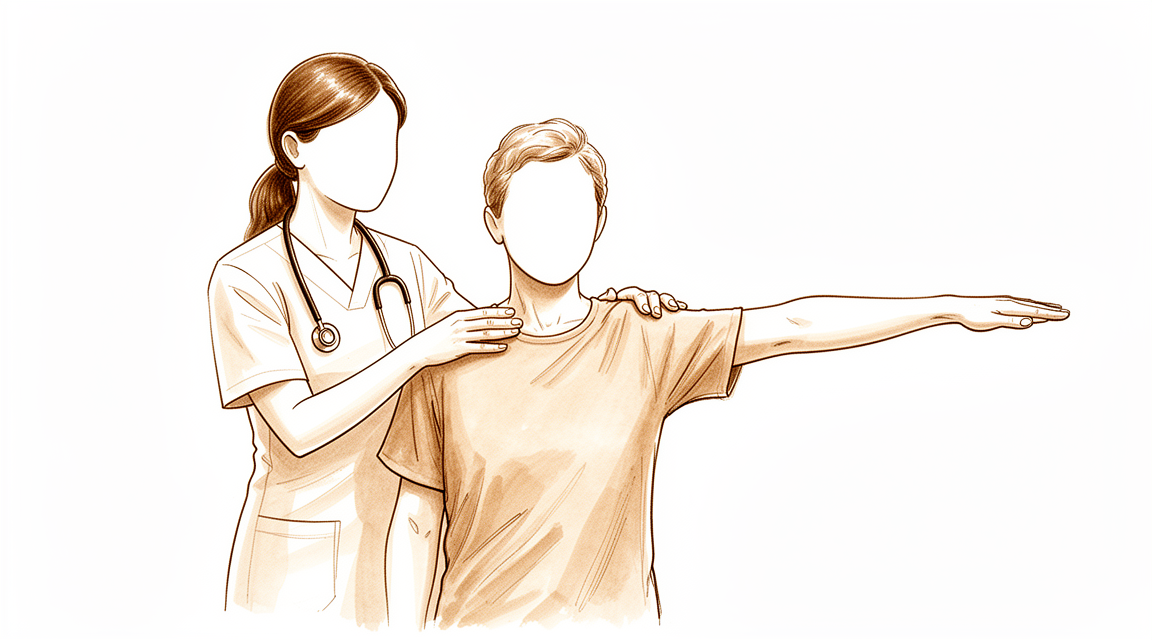
Este protocolo descreve a reabilitação após a excisão artroscópica de um depósito calcificado, realizada pelo Dr. Kieran Hirpara no Mater Private Hospital Rockhampton: trata-se de uma cirurgia minimamente invasiva para remover o depósito de cálcio do tendão do manguito rotador, às vezes associada a uma descompressão subacromial para criar mais espaço para o tendão. Leve esta página ou o seu PDF na sua primeira sessão de fisioterapia, para que a reabilitação seja devidamente coordenada. O seu fisioterapeuta orientará a evolução da reabilitação em cada uma das fases abaixo, conforme a recuperação do seu ombro.
Caso tenha alguma dúvida ou preocupação quanto à ferida cirúrgica, entre em contato com o consultório. Geralmente, é útil tirar uma foto da ferida e enviá-la por e-mail para análise.
Caso a fissura no tendão tenha sido suturada (a remoção do depósito frequentemente deixa uma fissura longitudinal no tendão, que costuma ser fechada com alguns pontos), a sua recuperação será um pouco mais lenta do que após a remoção isolada do depósito, mas mais rápida do que após um reparo do manguito rotador convencional: a tipóia é usada por três a quatro semanas, os movimentos começam com exercícios assistidos e passam a ser totalmente ativos a partir de cerca de quatro semanas, o fortalecimento começa por volta de dez a doze semanas, e o retorno à academia, aos esportes e aos trabalhos pesados costuma ocorrer entre quatro e seis meses. O Dr. Hirpara informará, após a cirurgia, se este é o seu caso.
O que esperar
Ambos os procedimentos permitem movimentar o ombro precocemente. Mesmo quando a fissura no tendão é suturada, trata-se de um reparo leve, que não exige meses de proteção; o objetivo do tratamento é eliminar a fonte da dor, e o objetivo da reabilitação é controlar a inflamação pós-tratamento, manter o ombro em movimento para evitar rigidez e, em seguida, recuperar a força.
- Após a excisão artroscópica, é fornecida uma tipóia apenas para conforto. Ela é usada por pouco tempo, geralmente alguns dias e raramente por mais de duas semanas; deve ser retirada sempre que possível. Não é necessário dormir com ela. A recuperação para atividades completas e sem restrições costuma levar cerca de três meses.
- Caso a fissura no tendão tenha sido suturada, a tipóia é usada por três a quatro semanas. Primeiro vêm os movimentos assistidos, depois os movimentos totalmente ativos a partir de cerca de quatro semanas, e o fortalecimento a partir de cerca de dez a doze semanas. A recuperação para atividades completas costuma levar cerca de quatro a seis meses.
Não dirija por pelo menos seis semanas após qualquer cirurgia no ombro, mesmo após a retirada da tipóia; seu cirurgião autorizará a volta à direção, normalmente na consulta de acompanhamento aos seis semanas.
Em ambos os tratamentos, o ombro pode levar algum tempo para se estabilizar completamente. O desconforto geralmente melhora gradualmente, e após a cirurgia pode levar vários meses (às vezes até nove) para que os sintomas prévios desapareçam por completo. O esperado é uma melhora gradual, e não um alívio imediato.
Trata-se de uma cirurgia ambulatorial minimamente invasiva, realizada por meio de pequenas incisões. O depósito calcificado está localizado no tendão do manguito rotador e é removido; frequentemente, realiza-se também uma descompressão subacromial para dar mais espaço ao tendão. Os curativos são à prova d’água — você pode tomar banho com eles a partir do primeiro dia — e permanecem até que as feridas sejam avaliadas na primeira consulta pós-operatória, cerca de uma semana a dez dias após a cirurgia.
Fase I — Movimentação precoce (semanas 0–2)
Kieran Hirpara 4.0
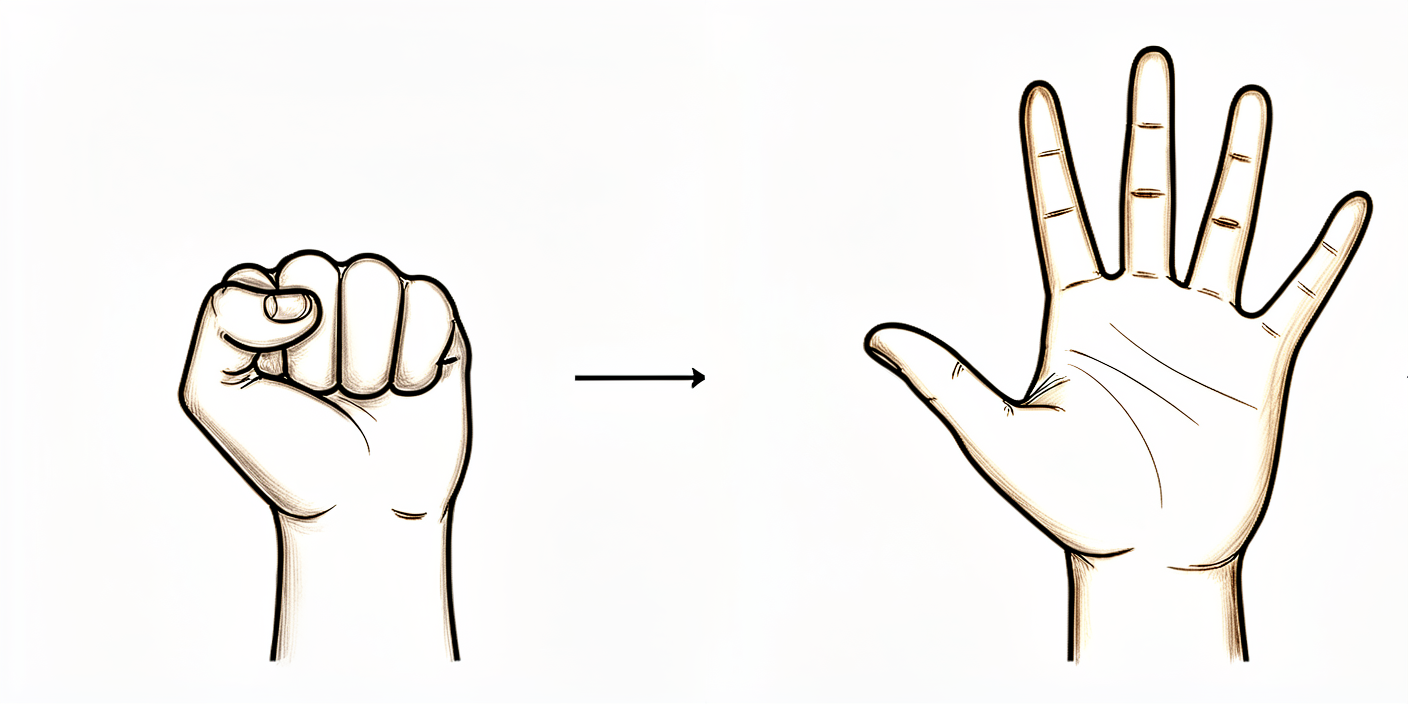
Abrir e fechar a mão
Mantenha a mão e os dedos em movimento, abrindo e fechando-os ou apertando uma bola macia. Comece a fazer isso imediatamente para manter a mão e o braço ativos enquanto o ombro se recupera.
10 vezes, três vezes ao dia.
Kieran Hirpara 4.0
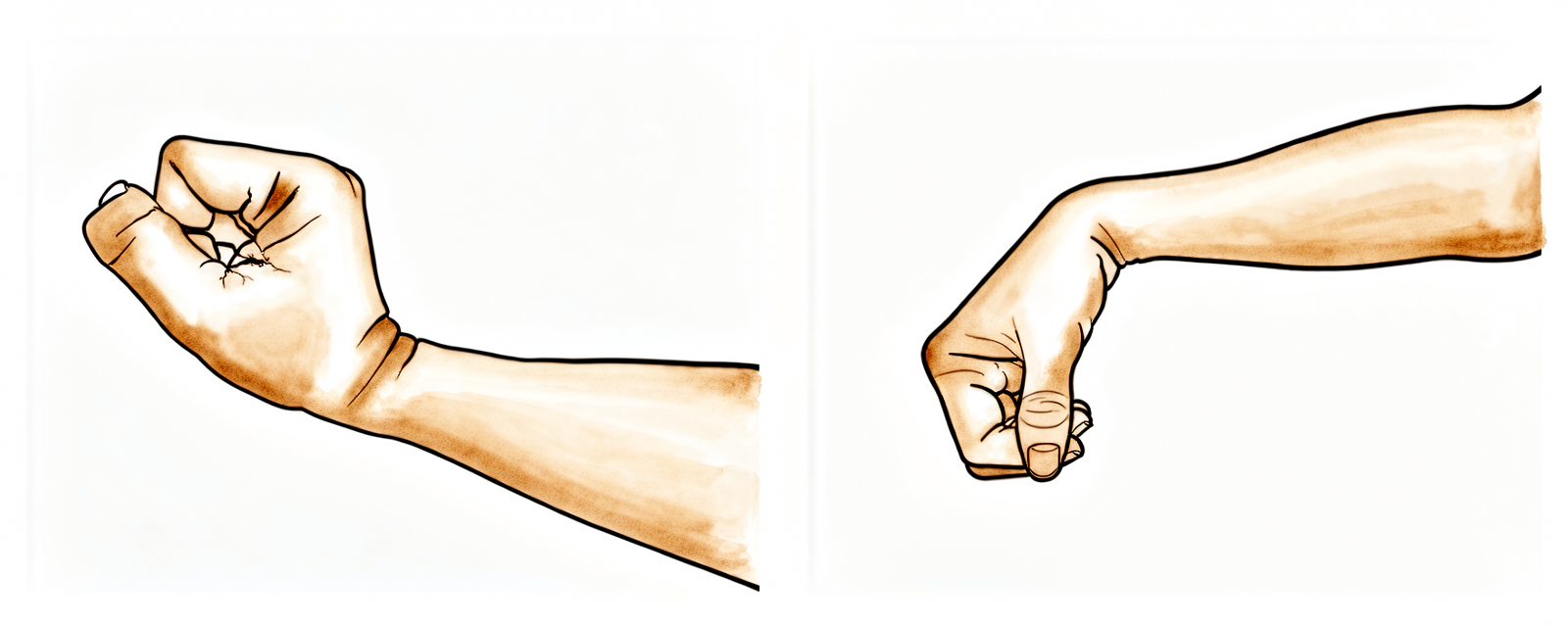
Movimento do punho
Mantenha o seu pulso em movimento, dobrando-o para a frente, para trás e para os lados. Faça isso com o braço fora da tipóia.
10 vezes, três vezes ao dia.
Kieran Hirpara 4.0
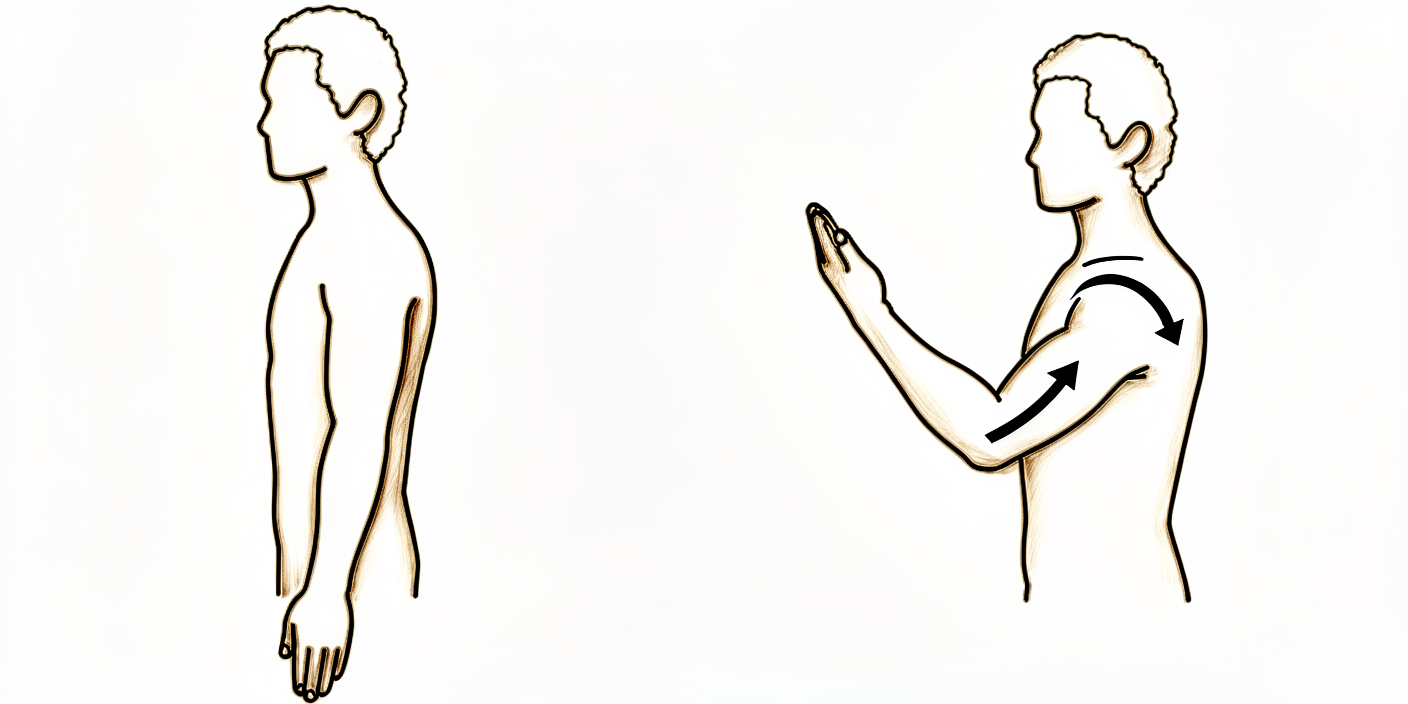
Flexão do cotovelo
Com o braço ao lado do corpo, dobre o cotovelo o máximo que puder confortavelmente, depois estenda-o completamente. Apenas o cotovelo deve se mover — mantenha o ombro relaxado.
10 vezes, três vezes ao dia.
Kieran Hirpara 4.0
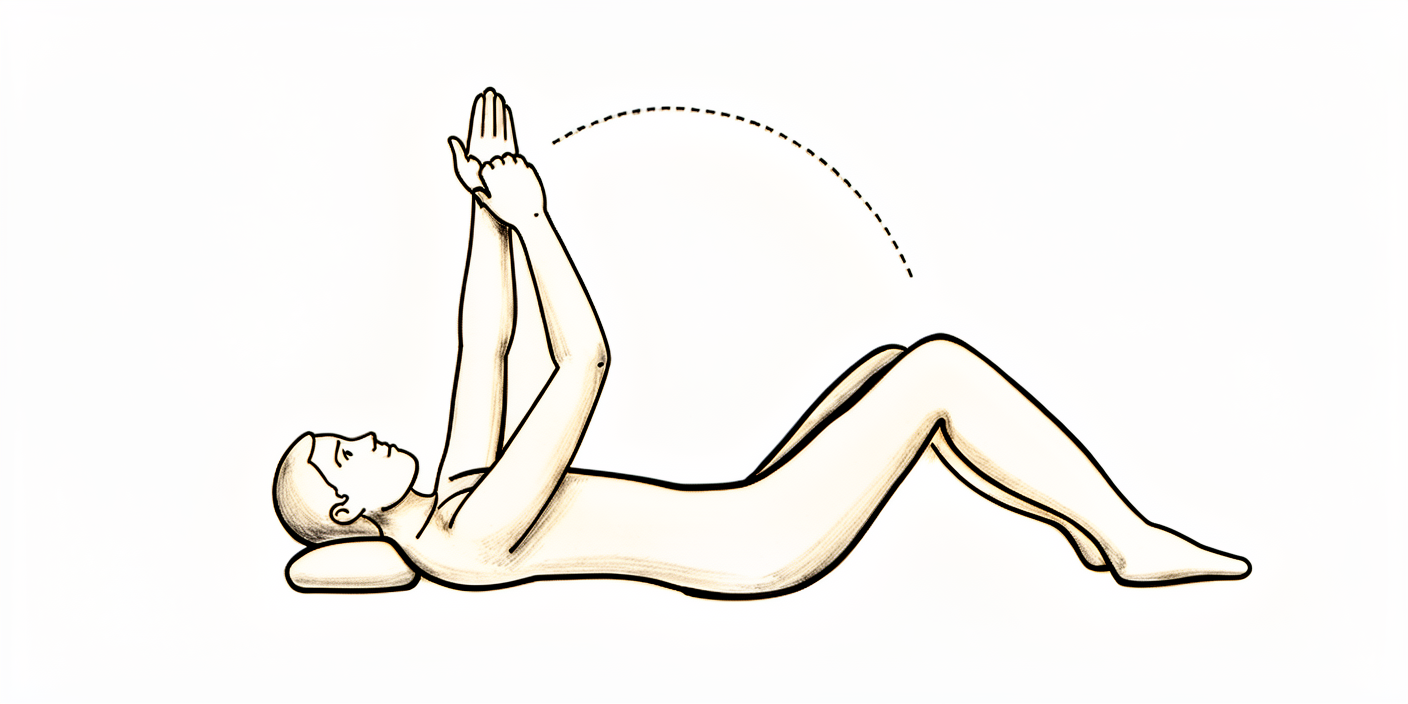
Alongamento assistido acima da cabeça (deitado)
Deite-se de costas e use o braço saudável para ajudar a levantar o braço operado acima da altura do ombro, num movimento de alongamento suave; em seguida, abaixe-o novamente, mantendo a ajuda do braço saudável. No início, será desconfortável — isso é normal — e este é o exercício fundamental para evitar a rigidez do ombro.
10 repetições, três vezes ao dia.
Ao acordar da cirurgia, seu braço estará preso em uma tipóia, mas ela serve apenas para conforto: tente ficar sem ela o máximo possível; na maioria dos casos, ela é retirada em poucos dias. Desde o início, você pode usar o braço sem restrições abaixo da altura dos ombros. Levantar o braço acima da altura dos ombros também é permitido e seguro, embora inicialmente cause desconforto; várias vezes ao dia, use o braço saudável para ajudar a elevar o braço operado acima dos ombros, como um alongamento suave, para evitar rigidez no ombro. Nas primeiras semanas, evite carregar qualquer coisa mais pesada que cerca de dois quilogramas com o braço operado, pois isso será doloroso. Comece os exercícios o quanto antes, visando realizar dez repetições de cada um, três vezes ao dia. Tome analgésicos antes dos exercícios e use gelo para aliviar o desconforto. Não dirija: a volta à direção só será permitida após autorização do cirurgião, geralmente na consulta de seis semanas.
Para o seu fisioterapeuta:
Objetivos
- Controlar a dor e o inchaço pós-operatórios
- Restaurar precocemente a amplitude de movimento: a prioridade é prevenir a rigidez, à qual pacientes com tendinite calcificada são propensos
- Permitir o uso normal do braço abaixo da altura dos ombros
Condutas
- Tipóia apenas para conforto; retire-a assim que possível, geralmente em poucos dias
- Uso ativo e irrestrito do braço abaixo da altura dos ombros a partir do primeiro dia
- Elevação ativa do braço acima dos ombros conforme tolerância
- Elevação passiva e assistida acima dos ombros várias vezes ao dia (utilizando o outro braço) para evitar rigidez
- Programa de exercícios domiciliares: dez repetições de cada exercício, três vezes ao dia
- Administração de analgésicos antes dos exercícios; aplicação de crioterapia para alívio da dor, conforme necessário
Precauções
- Proibido carregar ou levantar mais que aproximadamente dois quilogramas com o braço operado
- Proibido dirigir por seis semanas (isso aplica-se a qualquer cirurgia no ombro)
Critérios para avançar para a fase seguinte
- Avaliação da ferida satisfatória na primeira consulta pós-operatória
- Ausência da tipóia e uso confortável do braço abaixo da altura dos ombros
Fase II — Recuperação da amplitude de movimento (semanas 2–8)
Kieran Hirpara 4.0
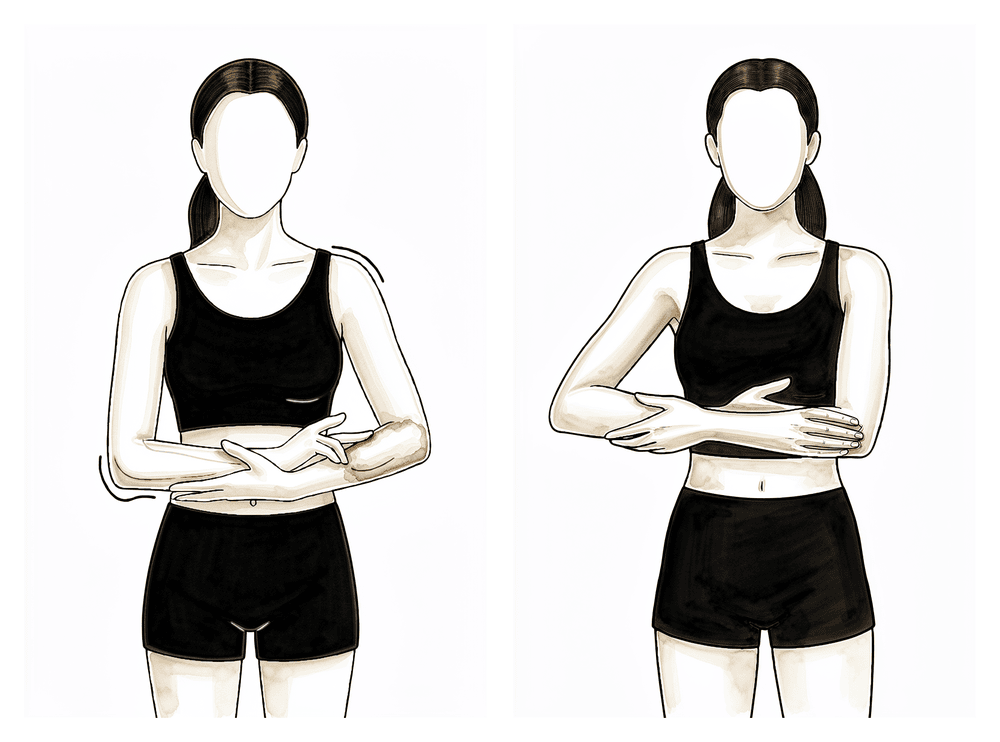
Abdução assistida
Segure o antebraço operado com o outro braço e levante ambos para o lado, deixando que o braço saudável faça a maior parte do trabalho; em seguida, abaixe-os com controle. Aumente gradualmente a amplitude de movimento conforme se sentir confortável: é aceitável esticar até sentir um desconforto moderado; porém, não se deve forçar o movimento a ponto de causar dor intensa.
Conforme orientado pelo seu fisioterapeuta
Kieran Hirpara 4.0
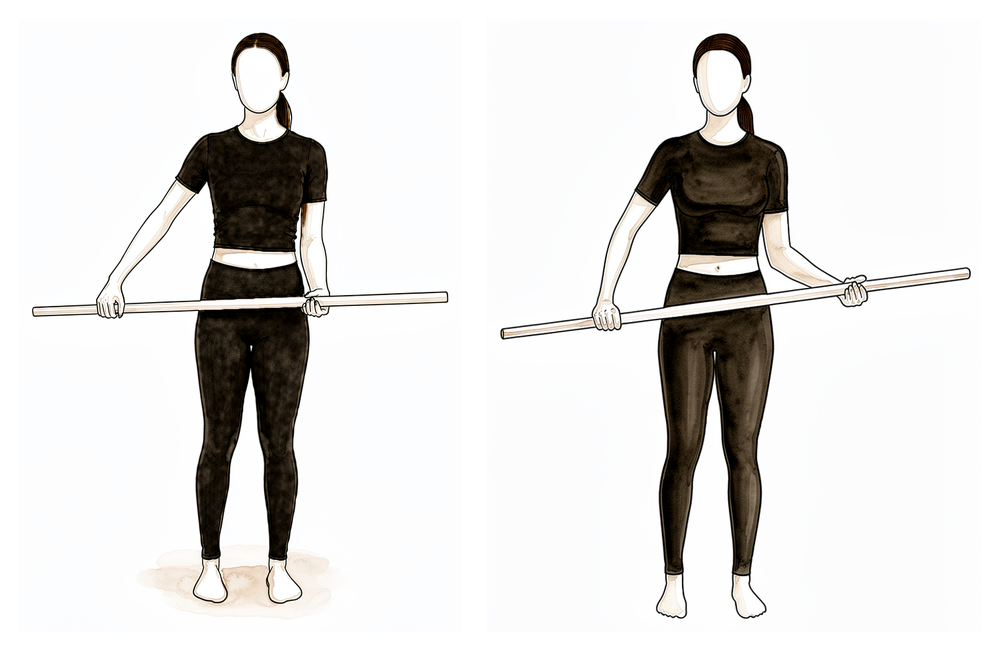
Rotação externa assistida com uma vara
Deite-se de costas, com o cotovelo junto ao corpo e dobrado em um ângulo reto. Segure uma vara com ambas as mãos e use o braço saudável para girar a mão operada para fora, fazendo a rotação do ombro. Restaurar essa rotação externa é um dos objetivos desta fase; portanto, continue exercitando-a suavemente, aumentando um pouco mais a amplitude a cada semana.
10 vezes, três vezes ao dia.
Kieran Hirpara 4.0
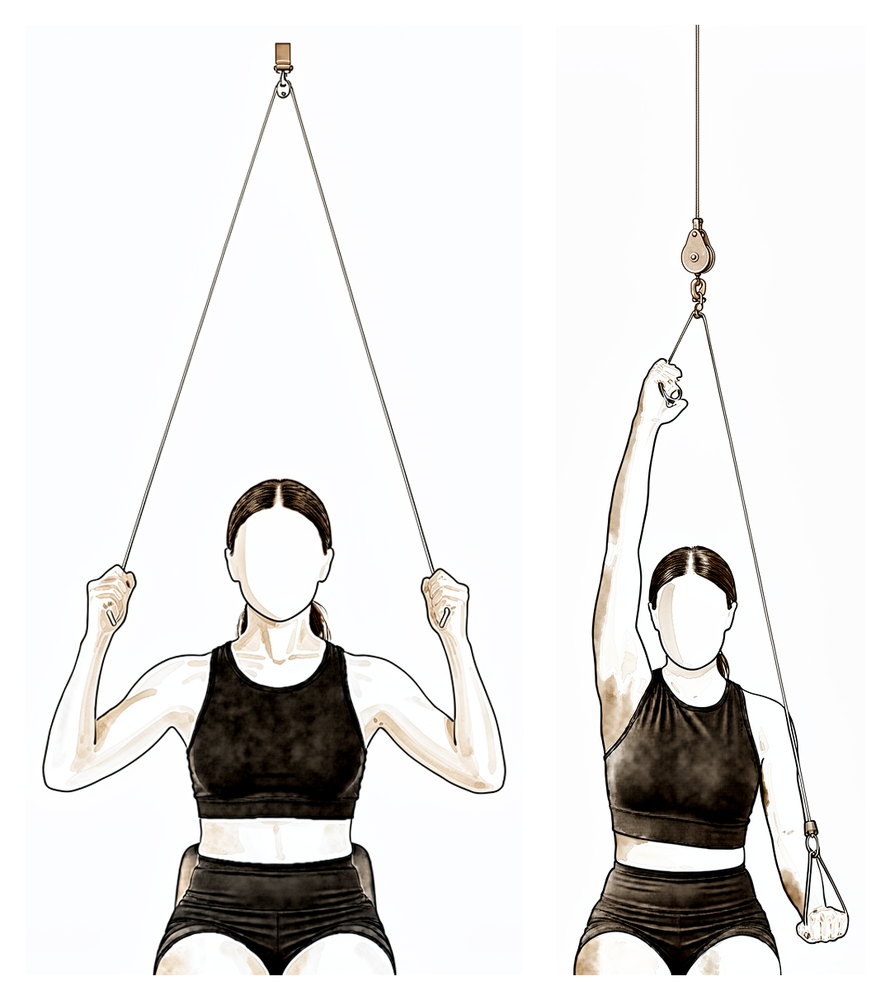
Polia de porta
Sente-se debaixo de uma polia de porta, segurando uma alça em cada mão. Puxe para baixo com o braço saudável, de modo a elevar o braço operado acima da cabeça até onde for confortável; em seguida, abaixe-o lentamente. O objetivo é obter um alongamento suave, sem causar dor intensa.
10 vezes, três a quatro vezes ao dia.
Kieran Hirpara 4.0
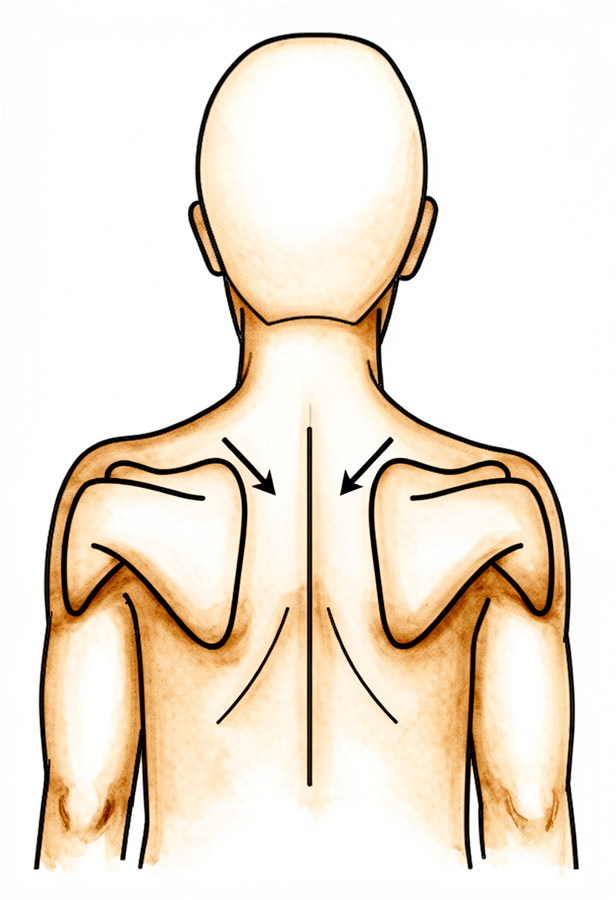
Posicionamento da escápula
Sentado ou em pé, puxe suavemente as escápulas para trás e para baixo, afastando-as das orelhas. Mantenha a posição por alguns segundos e depois relaxe. Repita esse movimento junto com os seus alongamentos, para manter a mobilidade das escápulas à medida que a amplitude de movimento se restabelece.
Conforme orientado pelo seu fisioterapeuta
Por volta da segunda ou terceira semana, será feita uma avaliação nas consultas, na qual serão verificadas a ferida cirúrgica e a amplitude de movimento passiva. O objetivo desta fase é, justamente, recuperar a amplitude de movimento: deve-se praticar alongamentos para elevação do braço para a frente e acrescentar movimentos para os lados, sempre sob orientação do fisioterapeuta. Os objetivos típicos são alcançar a elevação ativa do braço até a posição horizontal em seis semanas, além de retornar à normalidade a amplitude de movimento assistida (para frente, para os lados e em rotação) no mesmo prazo. A condução de veículos pode ser retomada a partir da sexta semana, após autorização do cirurgião e comprovação de capacidade para realizar uma frenagem de emergência com segurança.
Para o seu fisioterapeuta:
Objetivos
- Flexão anterior ativa e abdução até a posição horizontal em seis semanas
- Flexão, abdução e rotação externa passivas voltando ao normal em seis semanas
- Autonomia nas atividades diárias
Conduta terapêutica
- Progressão gradual da flexão anterior passiva e assistida; introdução e evolução da abdução
- Avançar para amplitude de movimento ativa em todos os planos, conforme a tolerância do paciente
- Manutenção dos exercícios de estabilização da escápula e correção postural
- Continuação do uso de analgésicos antes das sessões, além da aplicação de calor ou gelo durante os alongamentos, conforme preferência
Precauções
- Manter os esforços leves enquanto a amplitude de movimento é recuperada; a progressão deve ser guiada pelos sintomas
- É aceitável realizar alongamentos até o limite do desconforto; porém, alongamentos forçados e extremamente dolorosos devem ser evitados
Critérios para avançar para a próxima fase
- Amplitude de movimento passiva já próxima ou igual à normal
- Elevação ativa do braço até a posição horizontal ou melhor, com diminuição da dor
Fase III — Fortalecimento e retorno às atividades plenas (semanas 8–16)
Kieran Hirpara 4.0
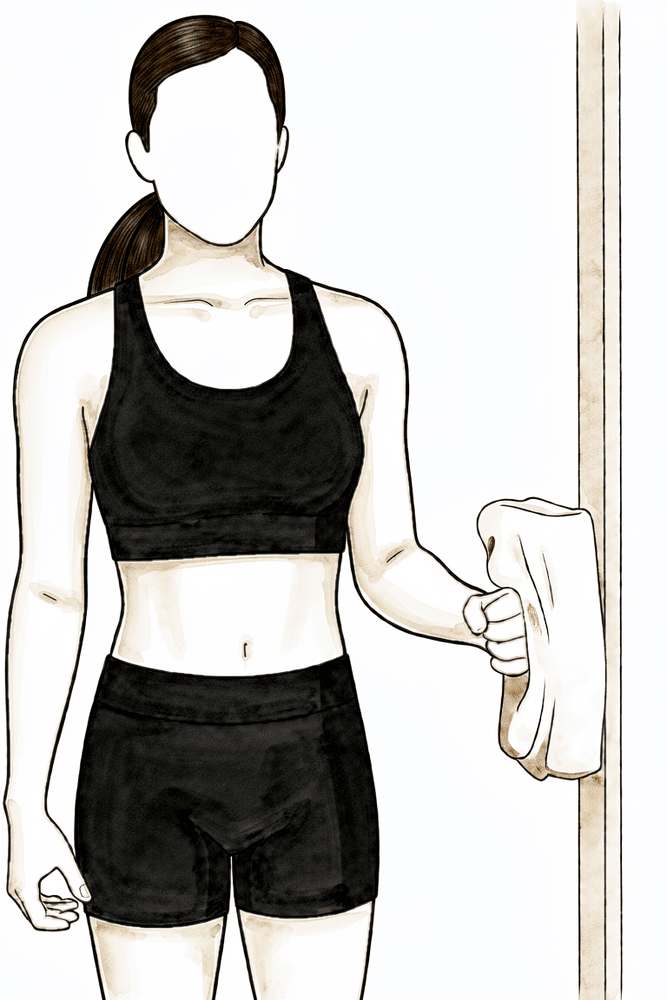
Rotação externa isométrica
Fique em pé com o cotovelo junto ao corpo e dobrado em um ângulo reto, com o dorso da mão encostado numa parede ou na moldura de uma porta. Pressione suavemente para fora contra a superfície, sem deixar o braço se mover; mantenha por alguns segundos e depois relaxe. Isso fortalece o manguito rotador sem movimento — é o ponto de partida do fortalecimento, a partir de cerca de oito semanas (dez a doze semanas, se a fissura no tendão tiver sido suturada).
Mantenha a posição por alguns segundos, várias vezes; conforme orientação do seu fisioterapeuta.
Kieran Hirpara 4.0
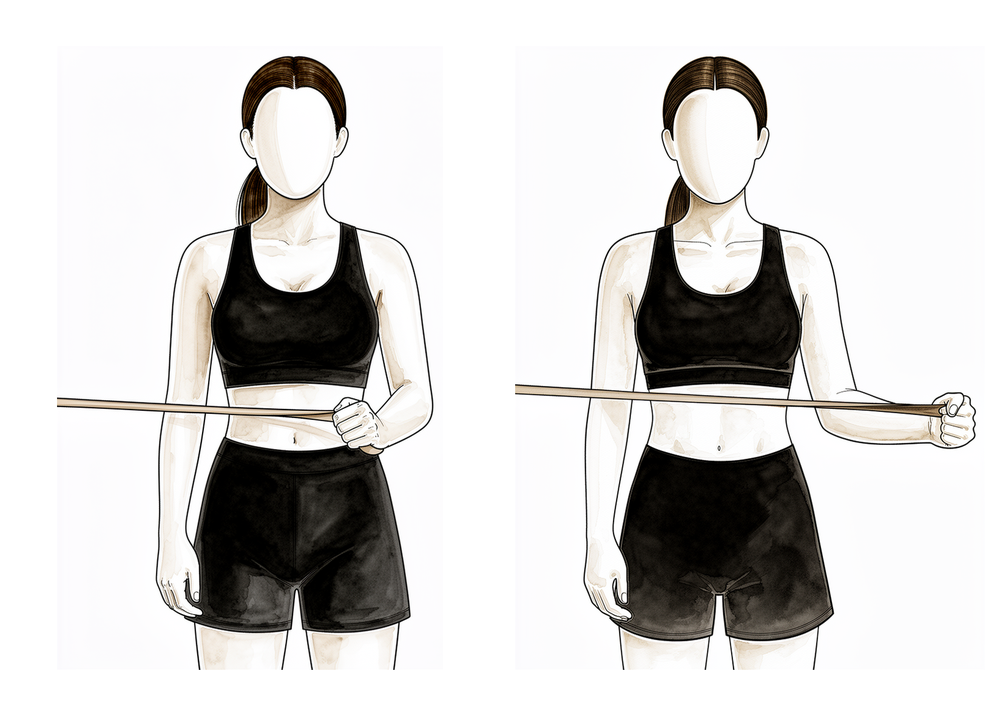
Rotação externa com faixa elástica
Fique de pé com o cotovelo pressionado contra o corpo e dobrado em um ângulo reto, segurando uma faixa elástica fixada na altura da cintura. Mantendo o cotovelo junto ao corpo, gire o antebraço para fora contra a resistência da faixa e depois volte lentamente à posição inicial. Este exercício complementa os exercícios isométricos à medida que sua força aumenta.
2 a 3 séries de 10 a 15 repetições, com baixa resistência
Kieran Hirpara 4.0
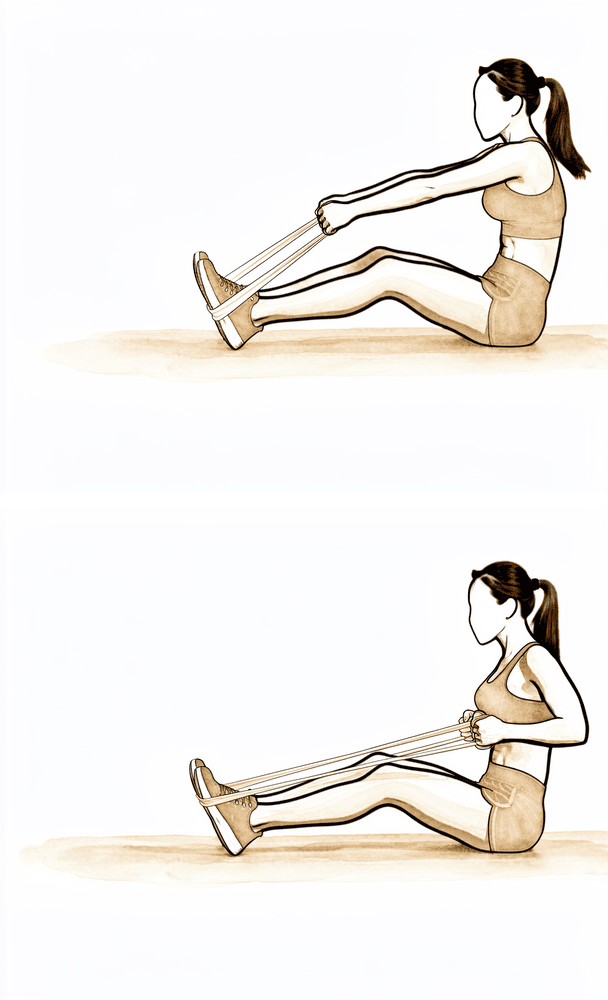
Remada baixa
Segure uma faixa à sua frente, na altura da cintura. Mantendo o braço razoavelmente esticado, puxe-o para trás e para baixo em direção ao quadril, contraindo a escápula para baixo e para trás; em seguida, volte lentamente à posição inicial. Este exercício fortalece os músculos da escápula que dão suporte ao manguito rotador.
2 a 3 séries de 10 a 15
Kieran Hirpara 4.0
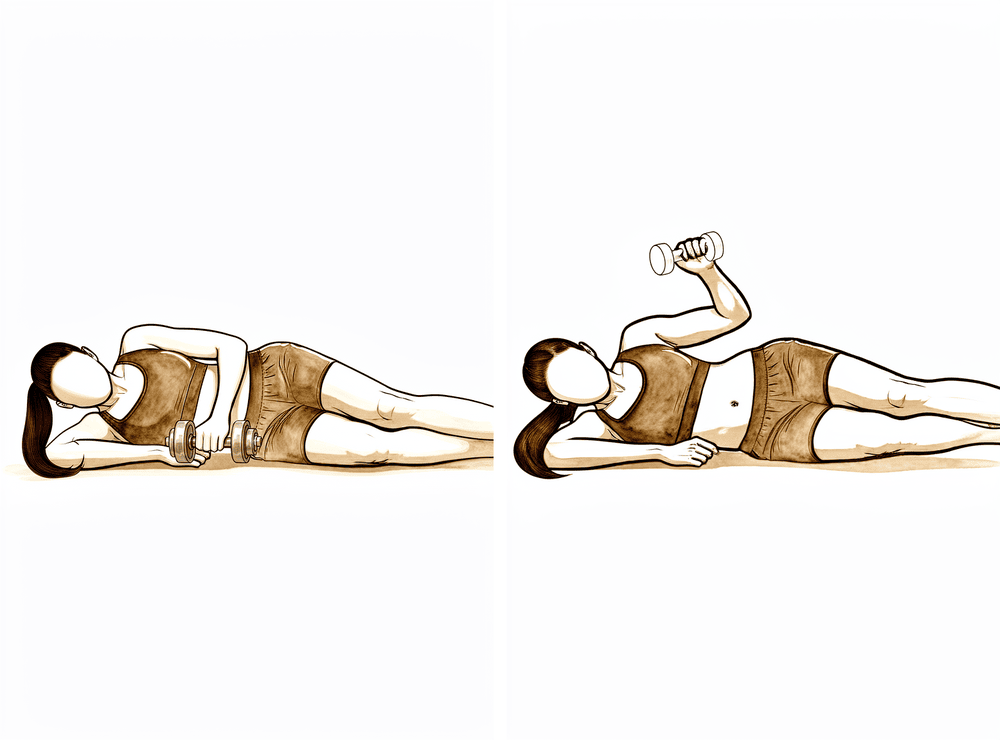
Rotação externa em decúbito lateral com carga
Deite-se sobre o lado não operado, com o cotovelo de cima dobrado em ângulo reto e junto ao corpo. Segurando um peso leve, gire o antebraço para cima, em direção ao teto, e depois abaixe-o lentamente. Faz parte do fortalecimento do manguito rotador a partir de cerca de oito semanas (dez a doze, se a fissura no tendão tiver sido suturada) — mantenha os exercícios de mobilidade em paralelo.
Carga baixa, número maior de repetições
Geralmente, você será reavaliado por volta da oitava semana. Com a amplitude de movimento já restaurada, a reabilitação passa a focar no fortalecimento do manguito rotador, geralmente sob supervisão do fisioterapeuta, além do uso livre do braço acima da altura do ombro. O objetivo é alcançar elevação e abdução ativas completas por volta da décima segunda semana. A recuperação após a remoção do depósito, isoladamente, costuma levar cerca de três meses, período após o qual não há mais restrições; caso tenha sido necessária uma reparação do manguito rotador, o tempo de recuperação é maior (em torno de cinco meses), seguindo o protocolo específico para essa cirurgia. Não se preocupe se alguma dor persistir após esse período: após essa operação, pode levar até nove meses para que os sintomas pré-operatórios desapareçam completamente, embora a tendência seja sempre para melhora.
Para o seu fisioterapeuta:
Objetivos
- Elevação e abdução ativas completas por volta da décima segunda semana
- Restauração gradual da força e resistência do manguito rotador e da escápula
- Retorno a todas as atividades sem restrições por volta dos três meses
Conduta
- Fortalecimento progressivo do manguito rotador a partir da oitava semana (a partir de dez a doze semanas, se a fissura no tendão tiver sido suturada): exercícios isométricos evoluindo para uso de faixas elásticas e pesos leves, com carga baixa e maior número de repetições
- Incremento progressivo do uso ativo do braço acima da altura do ombro
- Introdução gradual de cargas específicas para academia, trabalho e esportes, conforme tolerância, entre a décima segunda e a décima sexta semana
Precauções
- O fortalecimento não deve comprometer a amplitude de movimento; mantenha os exercícios de mobilidade ao longo de todo o período
- Aumente gradualmente as cargas pesadas e os movimentos acima da cabeça; se houver piora da dor, reduza temporariamente a intensidade
Critérios para progressão
- Amplitude de movimento ativa completa, força em recuperação e sintomas em constante melhora
- Liberação do acompanhamento rotineiro quando a evolução for satisfatória, geralmente entre a oitava e a décima sexta semana
Após seguir o seu protocolo
As fases descritas acima foram adaptadas a partir de orientações para pacientes e protocolos de reabilitação publicados para este procedimento: o protocolo de reabilitação para excisão de depósitos calcificados da London Shoulder Partnership, as orientações do ShoulderDoc (Reino Unido) sobre cirurgia para tendinite calcificada, e o guia do Dr. Kevin Ko para excisão artroscópica. Os intervalos de semanas indicados são apenas exemplos, não sendo fixos; a sua reabilitação contínua será orientada individualmente pelo seu fisioterapeuta, em colaboração com o consultório, conforme a recuperação do seu ombro. Esta página complementa as orientações gerais de recuperação fornecidas pelo consultório: consulte controle da dor pós-operatória e cuidados com o ferimento. Para saber mais sobre a própria condição e o funcionamento desses tratamentos, veja tendinite calcificada. As evidências científicas que sustentam este protocolo (evolução natural da doença, barbotagem e literatura sobre excisão cirúrgica) estão resumidas na seção de evidências, disponível em formato PDF no topo desta página.
Evidence & references
This is the clinical evidence summary written for health professionals. It is technical, and it lists the research this page was built from. You do not need to read it to understand your treatment or to make a decision about it.
Calcific Tendinitis of the Rotator Cuff — Staged Management & Post-operative Rehabilitation (Arthroscopic Excision)
Topic scope: (A) the natural history and stepped non-operative management of rotator-cuff calcific tendinitis (rest/analgesia → barbotage ± subacromial steroid → ESWT), and (B) post-operative rehabilitation after arthroscopic excision of the calcific deposit (± subacromial decompression; the cuff-repair pathway defers to the rotator-cuff-repair protocol).
Defining principle of the surgical rehab here: arthroscopic excision removes the source of pain and does not, by itself, create a construct that needs months of protection — provided the rotator cuff is left intact. So (like a debridement/decompression, and unlike a cuff repair) the rehab is an early-movement pathway: short sling for comfort only, unrestricted use below shoulder height from day one, assisted elevation to prevent stiffness, strengthening from ~8 weeks. The single branch point is whether removing the deposit left a tendon defect that needed repair — if so, the recovery converts to the slower, protected rotator-cuff-repair pathway.
A. NATURAL HISTORY & NON-OPERATIVE MANAGEMENT
Natural history (self-limiting in most)
Rotator-cuff calcific tendinitis is self-limiting in the majority: after a variable quiescent period the deposit enters a resorptive phase (peripheral vascularisation + phagocytosis), and spontaneous resorption occurs in roughly two-thirds of cases within 1–2 years [Uhthoff & Loehr; Chianca 2018 review]. This underpins a non-operative-first approach and explains why post-operative residual calcium that "dissolves spontaneously" does not harm the outcome.
Stepped non-operative interventions
- Analgesia / activity modification / physiotherapy — first line; many settle as the deposit resorbs. Consensus.
- Ultrasound-guided barbotage (needling + lavage), usually + subacromial corticosteroid — the best-supported interventional option. A systematic review of 908 patients and subsequent meta-analyses favour barbotage for medium-term pain/function; barbotage + subacromial steroid improves Constant–Murley score and reduces deposit size vs steroid alone. Notably, clinical improvement is NOT dependent on how much calcium is aspirated — perforating the deposit to trigger resorption is the active mechanism. Moderate–strong (SR/RCT).
- Extracorporeal shock-wave therapy (ESWT) — reduces deposit size and pain; broadly comparable to barbotage in several comparisons. Moderate (RCT).
B. POST-OPERATIVE REHABILITATION (arthroscopic excision ± subacromial decompression)
Surgery is reserved for deposits recalcitrant to adequate non-operative care. The operation locates and removes the deposit from within the cuff tendon, often with a subacromial decompression for room. Key surgical-outcome facts that shape the rehab:
- Preserving cuff integrity while removing as much deposit as possible gives good-to-excellent results in ~90% and avoids iatrogenic tendon defects [arthroscopic excision series].
- Complete vs near-complete removal gives equivalent outcomes — residual calcium resorbs spontaneously afterwards; the surgeon need not chase every fleck at the cost of the tendon.
- Arthroscopic decompression WITHOUT cuff repair is a validated strategy with good outcomes where the residual defect is not repaired [Bone & Joint 2023].
- Symptom settling is gradual — significant pain relief and ROM gains are the norm, but the pre-operative symptoms can take up to ~9 months to fade fully; recovery to unrestricted activity after excision alone is ~3 months.
Phased post-op timeline (no cuff repair)
| Phase | Window | Sling | ROM / use | Strengthening | Notes |
|---|---|---|---|---|---|
| I — Early movement | Week 0–2 | Comfort only, days (rarely > 2 wk), off ASAP | Unrestricted use below shoulder height from day 1; assisted elevation above shoulder height several × daily to prevent stiffness | — | Settle post-op flare; calcific patients are stiffness-prone → motion is the priority. ≤ ~2 kg, no driving while in sling |
| II — Regaining range | Week 2–8 | Off | Progress active elevation; restore full passive + active ROM | Begin gentle as pain allows | Most regain comfortable range through this window |
| III — Strengthening / return | Week 8–16 | Off | Full active elevation goal by ~12 wk | Cuff + scapular strengthening from ~8 wk, isometric → band/light weight; advance work/sport loading wk 12–16 | Full unrestricted activity ~3 months; discharge ~8–16 wk |
Branch point — if a rotator cuff repair was required: recovery converts to the protected rotator-cuff-repair pathway (sling ~6 wk, ROM restrictions, strengthening deferred), typically ~5 months total. The surgeon confirms post-operatively which pathway applies.
C. KEY CONTROVERSIES / EVIDENCE QUALITY
- Surgery is a last resort — given high spontaneous-resorption rates and effective barbotage/ESWT, excision is reserved for genuinely recalcitrant cases. Strong rationale.
- How much to remove / whether to repair the defect. Equivalent outcomes for complete vs partial removal, and viable decompression-without-repair, mean the surgeon balances deposit clearance against tendon integrity intra-operatively — which in turn decides the rehab pathway. Moderate.
- The post-op rehab protocol itself is consensus/expert, drawn from surgeon patient-guidance protocols rather than a rehab RCT — phase timings are typical, not trial-derived.
D. EVIDENCE STRENGTH FLAGS (summary)
- MODERATE–STRONG (SR / RCT): barbotage ± steroid for non-operative calcific tendinitis (908-patient SR; barbotage + steroid > steroid alone); ESWT efficacy.
- MODERATE (cohorts): arthroscopic excision outcomes (~90% good-excellent; equivalence of complete vs partial removal; decompression without repair, Bone & Joint 2023); spontaneous resorption ~2/3 within 1–2 years.
- WEAK / CONSENSUS: the post-operative rehabilitation protocol (surgeon patient-guidance documents; no defining rehab RCT).
CITATIONS
RAG corpus (180,000+ Orthopaedic articles) — adjacent rotator-cuff evidence
- Predictors of failure of non-operative treatment of chronic symptomatic rotator-cuff disease (2013 Neer Award). J Shoulder Elbow Surg. 2016. DOI: 10.1016/j.jse.2016.04.030
- Arthroscopic rotator cuff repair: scientific rationale, surgical technique, early clinical results. J Shoulder Elbow Surg. 2010. DOI: 10.1016/j.jse.2009.12.012
- Early versus delayed rehabilitation after arthroscopic rotator cuff repair. Knee Surg Sports Traumatol Arthrosc. 2024. DOI: 10.1002/ksa.12129
- Speed of recovery after arthroscopic rotator cuff repair. J Shoulder Elbow Surg. 2017. DOI: 10.1016/j.jse.2016.11.002
- (The corpus is thin on calcific-tendinitis-specific rehab; the evidence base below is the calcific literature + published surgeon protocols.)
Calcific tendinitis literature (URLs)
- Ultrasound-guided barbotage for calcific tendonitis of the shoulder: a systematic review including 908 patients (DARE). https://www.ncbi.nlm.nih.gov/books/NBK241935/
- Determining the efficacy of barbotage for pain relief in calcific tendinitis. JSES Int / ScienceDirect. 2024. https://pmc.ncbi.nlm.nih.gov/articles/PMC11401591/
- Needling and lavage in rotator-cuff calcific tendinitis: ultrasound-guided technique. PMC. 2024. https://pmc.ncbi.nlm.nih.gov/articles/PMC10805427/
- Calcific tendinitis of the rotator cuff: a review (natural history, phases, resorption). PMC. https://pmc.ncbi.nlm.nih.gov/articles/PMC3749672/
- Recovery pattern after arthroscopic treatment for calcific tendinitis of the shoulder. Orthop Traumatol Surg Res. 2020. https://www.sciencedirect.com/science/article/pii/S1877056820301043
- Arthroscopic decompression of calcific tendinitis without cuff repair. Bone Joint J. 2023. https://boneandjoint.org.uk/Article/10.1302/0301-620X.105B6.BJJ-2022-1137.R1
- Arthroscopic treatment of calcific tendonitis (preserve cuff, ~90% good-excellent; residuals resorb). PMC. https://pmc.ncbi.nlm.nih.gov/articles/PMC4044535/
Published rehab protocols (patient-guidance — basis for the phase structure)
- The London Shoulder Partnership — Calcific Deposit Excision Rehabilitation. http://thelondonshoulderpartnership.co.uk/shoulder/shoulder-rehabilitation/calcific-deposit-excision-rehabilitation/
- Ko K. Arthroscopic Excision of Calcific Tendonitis — What Can I Expect? (OPA Orthopedics). https://www.kevinkomd.com/pdf/calcific-tendonitis.pdf
- Funk L. Surgery for Calcific Tendinitis. ShoulderDoc. https://shoulderdoc.co.uk/pages/surgery-for-calcific-tendinitis