Patients › Rehabilitation
Substituição da cabeça do rádio
Um plano de recuperação protegido após a substituição da cabeça do rádio no cotovelo por um implante metálico, baseado na realização precoce de movimentos protegidos do cotovelo e do antebraço para evitar a rigidez. O antebraço é posicionado de modo a proteger quaisquer ligamentos reparados, e o cotovelo é mantido em uma tipoia simples para maior conforto.
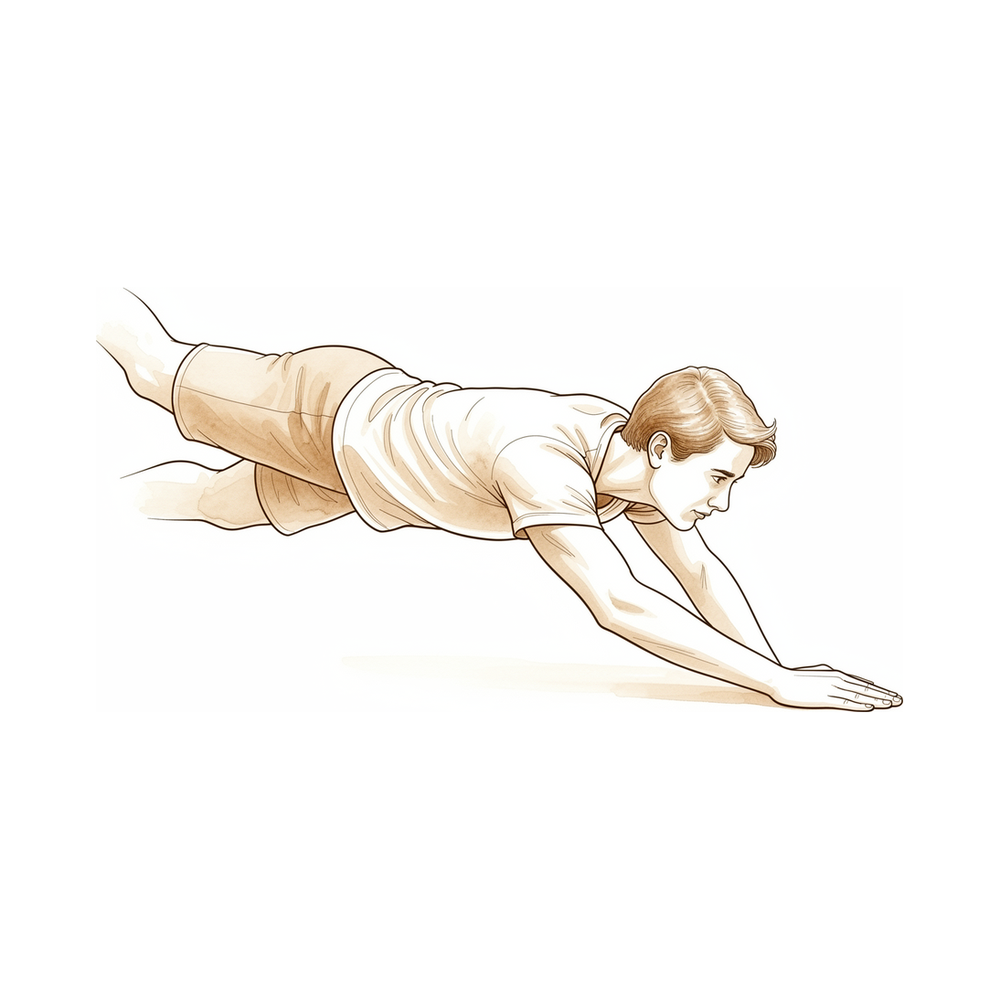
Este protocolo orienta sua recuperação após a substituição da cabeça do rádio no cotovelo (procedimento em que a cabeça do rádio fraturada é substituída por um pequeno implante metálico), realizada pelo Dr. Kieran Hirpara no Mater Private Hospital Rockhampton. Ele começa com um programa de exercícios para ser feito em casa, seguido pelo protocolo clínico estruturado destinado ao seu fisioterapeuta; leve esta página ou seu arquivo PDF à sua primeira sessão de terapia, para que a reabilitação seja coordenada de forma adequada. Seu terapeuta poderá ajustar o plano conforme a evolução da sua recuperação e conforme os detalhes da cirurgia realizada.
Caso tenha alguma dúvida ou preocupação quanto à ferida cirúrgica, entre em contato com o consultório. Geralmente, é útil tirar uma foto da ferida e enviá-la por e-mail para análise.
O que esperar
A cabeça do rádio é a parte redonda de um dos dois ossos do antebraço, onde se conecta ao cotovelo. Quando ela se quebra em muitos fragmentos, impossibilitando a reparação, é substituída por um pequeno implante metálico que restaura a estabilidade do cotovelo e um eixo de rotação suave do antebraço. Isso geralmente é feito como parte do tratamento de uma lesão mais complexa: uma fratura com luxação, às vezes chamada de “tríade terrível”, na qual a cabeça do rádio, um fragmento da coronóide e os ligamentos laterais do cotovelo são lesados simultaneamente.
Como o implante restaura a estabilidade, a prioridade da reabilitação é iniciar movimentos protegidos o quanto antes, para evitar rigidez. Os cotovelos são muito propensos a ficarem rígidos após esse tipo de lesão, e a melhor forma de prevenir isso é movimentá-los precocemente. Entre os exercícios, o cotovelo fica apoiado em uma tipoia simples para conforto (não é uma órtese articulada); a tipoia é retirada durante os exercícios e para a higiene.
Dois fatores determinam o momento e o grau dos movimentos permitidos:
- Os ligamentos reparados precisam ser protegidos. Se o ligamento colateral lateral do cotovelo foi reparado, o antebraço deve ser mantido e exercitado inicialmente na posição de palma da mão voltada para baixo (pronação); se o ligamento colateral medial foi reparado, deve ser mantido na posição de palma da mão voltada para cima (supinação); se ambos foram reparados, na posição neutra intermediária. O fisioterapeuta informará qual dessas condições se aplica a você.
- O cotovelo deve ser protegido de forças laterais (varo) e, no início, de movimentos de extensão total, caso tenha sido instável. Por isso, os movimentos são liberados gradualmente, em etapas, e não de uma só vez.
Os movimentos são progressivamente ampliados; o fortalecimento geralmente começa por volta da sexta semana, e a volta às atividades normais ocorre em cerca de três meses. O implante e a cicatrização continuam se ajustando ao longo de vários meses; por isso, a carga física é reintroduzida de forma gradual.
Precauções e limitações
- Use a tipoia simples para maior conforto, conforme orientado; ela não é uma órtese articulada e deve ser retirada para exercícios e higiene.
- Mantenha o antebraço na posição indicada pelo seu fisioterapeuta durante os exercícios iniciais (palma da mão para baixo, se o ligamento lateral externo foi reparado; palma da mão para cima, se foi o ligamento medial; posição neutra, se ambos foram reparados), o que protege a sutura.
- NÃO aplique força lateral (em varo) ao cotovelo; evite apoiar-se no cotovelo ou deixar o braço pendurado sem apoio no início do pós-operatório.
- NÃO force a extensão total do cotovelo se lhe foi informado que ele estava instável; estenda-o apenas dentro da amplitude permitida.
- NÃO levante, empurre, puxe ou coloque carga sobre o braço operado até receber autorização médica (geralmente após cerca de seis semanas); nos primeiros dias, use a mão com cuidado e leveza.
- Mantenha o ombro, o punho e os dedos em movimento desde o início; NÃO dirija enquanto o braço estiver na tipoia ou não puder controlar o volante com segurança.
Para orientações sobre cuidados com a ferida, inchaço e cicatrização, consulte o guia de cuidados com a ferida do consultório.
Seus exercícios
Kieran Hirpara 4.0
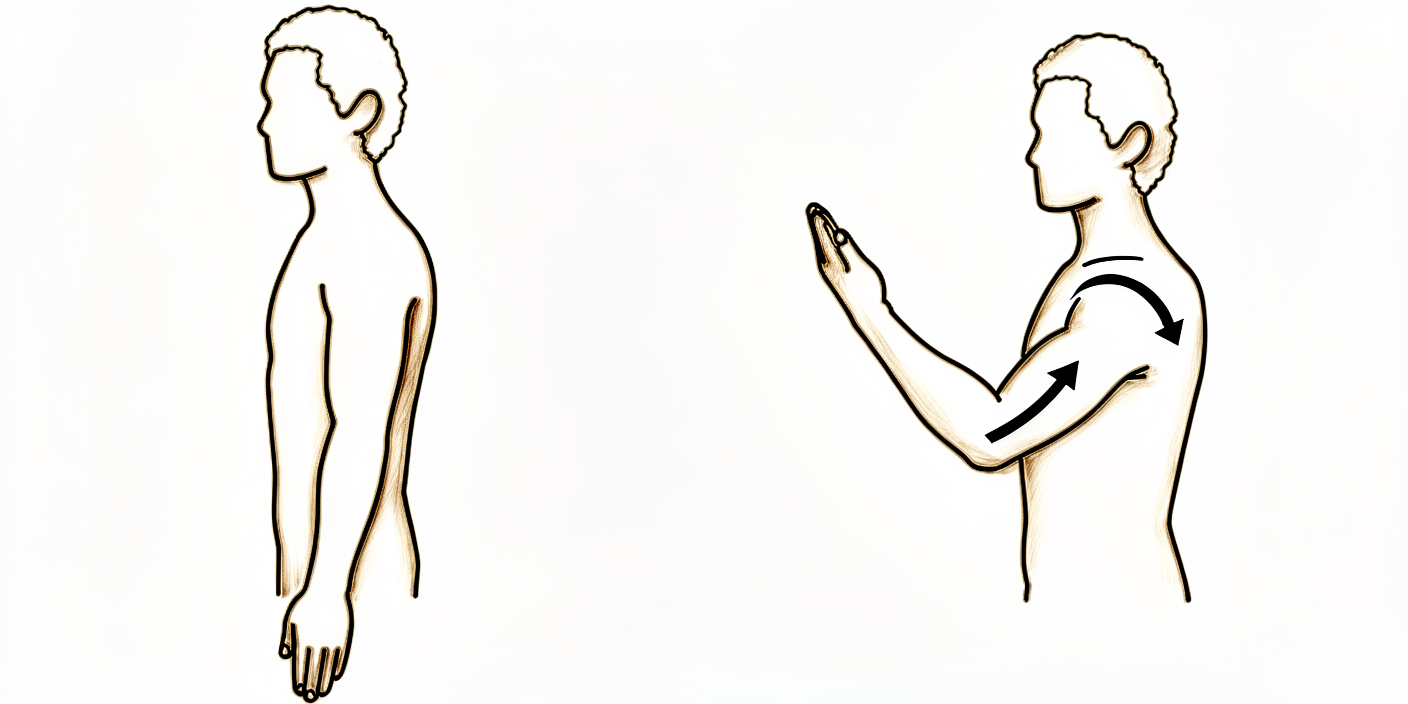
Flexão e extensão do cotovelo (ativa assistida)
Após retirar a tipóia, dobre e estenda suavemente o cotovelo operado dentro da amplitude de movimento indicada, utilizando a outra mão para guiar o movimento, de modo que o braço não precise fazer esforço. A mobilização precoce é o mais importante nesse caso: o implante metálico restaurou a estabilidade do cotovelo, tornando o movimento seguro; além disso, movimentar-se cedo evita que o cotovelo fique rígido. Respeite qualquer limite estabelecido quanto à extensão total do cotovelo, caso tenha sido indicado.
10 vezes, 3–4 vezes ao dia, dentro do intervalo permitido.
Kieran Hirpara 4.0
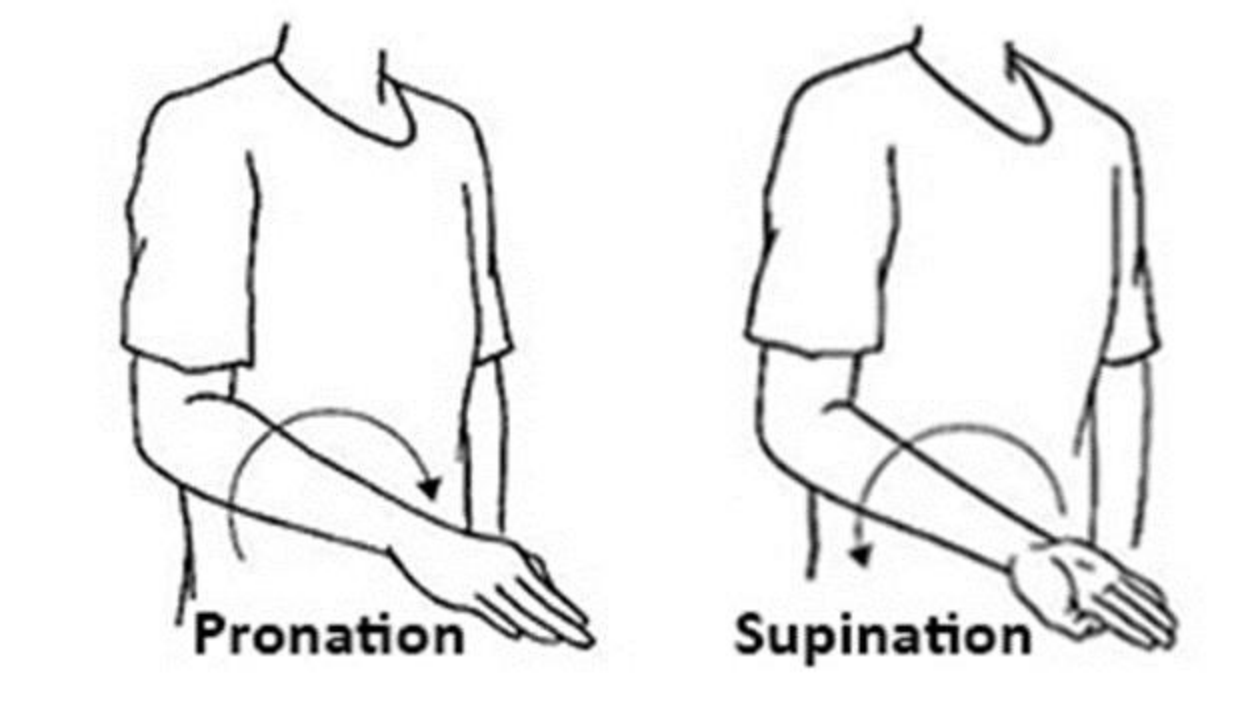
Rotação do antebraço (palma da mão para cima/para baixo)
Com o cotovelo pressionado contra o corpo e dobrado em um ângulo reto, gire suavemente a palma da mão para cima, em direção ao teto, e depois para baixo, em direção ao chão. Mantenha o cotovelo imóvel, permitindo que apenas o antebraço gire. No início, talvez lhe seja pedido para privilegiar uma única direção (palma para baixo ou palma para cima) a fim de proteger um ligamento reparado — siga as orientações do seu fisioterapeuta. Isso mantém o antebraço flexível, sendo esse um dos primeiros movimentos a ficar rígidos após essa lesão.
10 vezes em cada direção permitida, 3–4 vezes por dia.
Kieran Hirpara 4.0
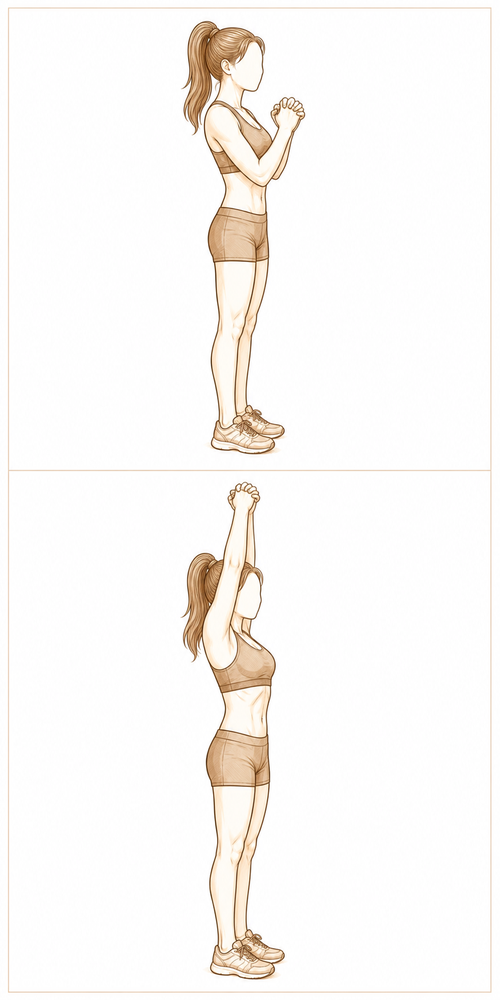
Movimentação do ombro e da mão
Mantenha o ombro, o pulso e os dedos em movimento desde o primeiro dia, para evitar rigidez enquanto o cotovelo se recupera. Faça um punho fechado completamente, estique os dedos, gire o pulso e movimente o ombro suavemente. Utilize a mão para tarefas cotidianas leves, dentro do limite do conforto. Nenhuma dessas atividades sobrecarrega a região do cotovelo em recuperação.
10 vezes cada um, várias vezes ao dia.
Kieran Hirpara 4.0
Cuidados com as cicatrizes
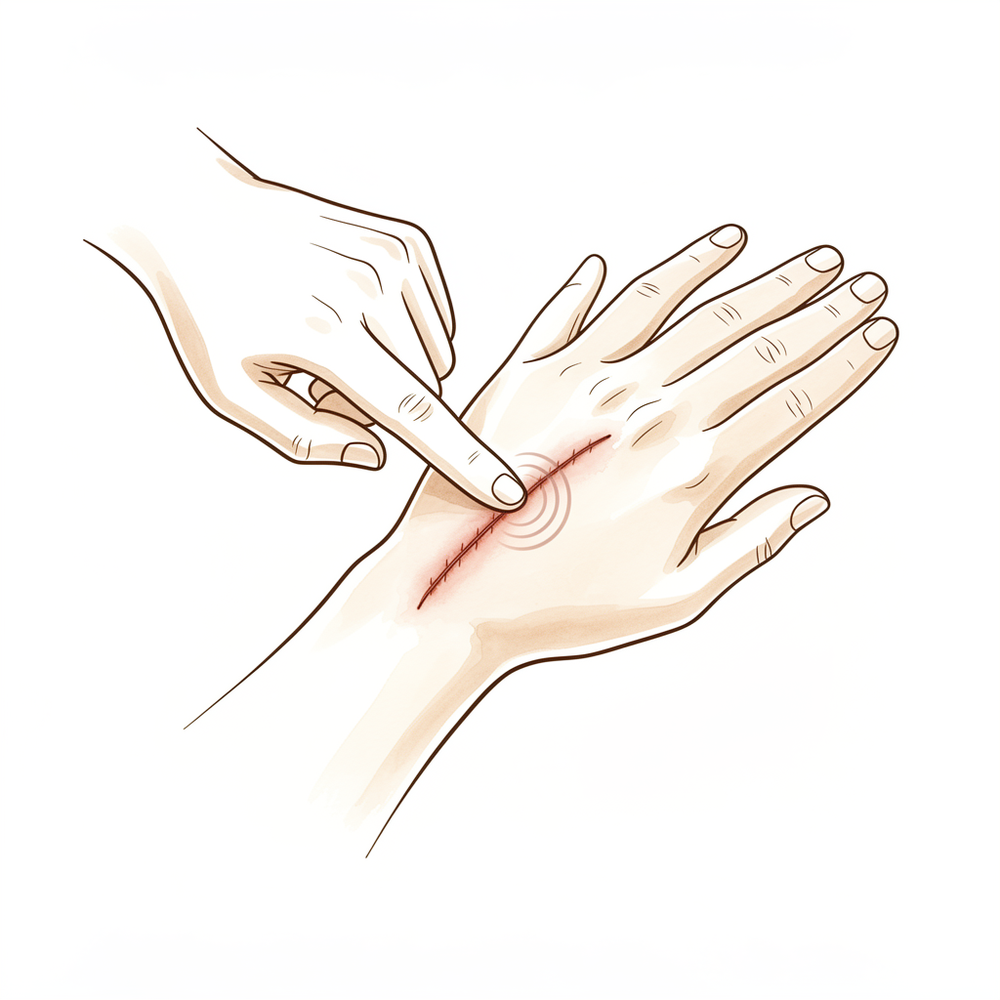
Assim que a ferida estiver totalmente cicatrizada e o cirurgião ou terapeuta autorizar, aplique um pouco de hidratante na cicatriz e faça massagens em pequenos círculos por alguns minutos. Isso mantém a cicatriz flexível e menos sensível. Não inicie esse procedimento antes de a ferida estar completamente fechada.
Alguns minutos, 2–3 vezes ao dia, após a cicatrização.
Kieran Hirpara 4.0
Fortalecimento a partir da 6ª semana
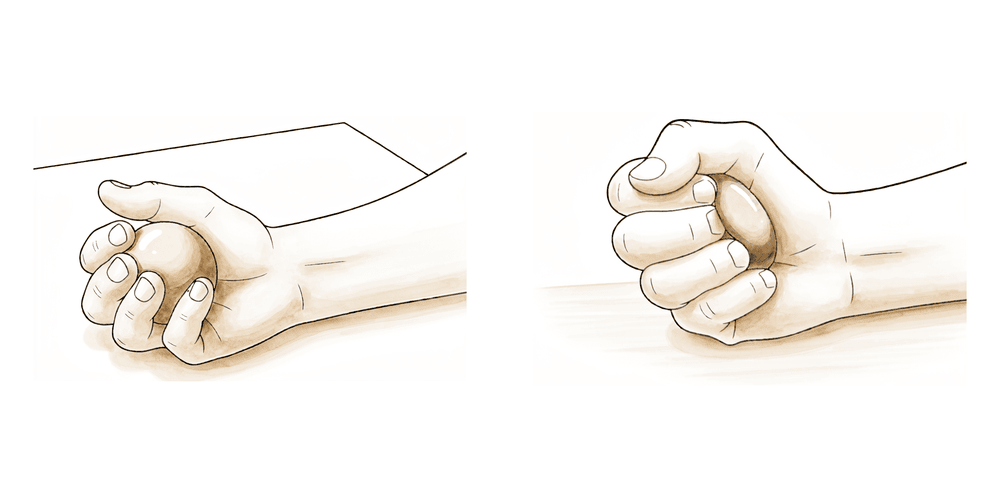
Um exercício posterior — só deve ser iniciado após autorização médica, geralmente por volta da sexta semana. Comece com um fortalecimento suave do cotovelo, do antebraço e da força de preensão — por exemplo, apertar uma bola macia, depois realizar flexões e extensões levemente resistidas — e aumente gradualmente a intensidade ao longo das semanas seguintes. Não apresse o aumento da carga; o cotovelo ainda está em processo de maturação por vários meses.
Conforme orientação do seu terapeuta de mão (apenas a partir de aproximadamente 6 semanas).
Estes são os exercícios descritos no seu folheto informativo. Comece a realizá-los somente sob orientação do Dr. Hirpara e do seu fisioterapeuta, respeitando sempre os limites de amplitude de movimento e a posição do antebraço que lhe foram indicados. Os exercícios iniciais visam manter o cotovelo e o antebraço em movimento para evitar rigidez, sem sobrecarregar as áreas em recuperação: flexão e extensão ativa-assistida do cotovelo, rotação suave do antebraço no sentido permitido, além de manter o ombro e a mão livres de tensão. O fortalecimento muscular e os cuidados com a cicatriz são etapas posteriores e só devem ser iniciados após autorização expressa. Interrompa qualquer exercício que cause dor intensa ou sensação de instabilidade no cotovelo.
Seu protocolo clínico
O restante desta página descreve o protocolo clínico em etapas para a reabilitação após a artroplastia da cabeça do rádio, procedimento geralmente realizado em casos de fratura cominutiva da cabeça do rádio que não pode ser reconstruída, muitas vezes como parte da chamada “tríade terrível” de fratura e luxação. Esta seção deve ser entregue ao fisioterapeuta especializado em mão; cada fase começa com uma explicação simples, em linguagem acessível, sobre o que está ocorrendo. O implante restaura uma articulação radiocapilar estável e congruente; portanto, o princípio orientador é a realização precoce de movimentos controlados, a fim de evitar a rigidez comum nesses cotovelos. O arco de movimento e a rotação do antebraço são limitados conforme a integridade dos reparos dos ligamentos colaterais e do processo coronoideu.
Antes de iniciar o tratamento, verifique o relatório cirúrgico do paciente e a avaliação de estabilidade realizada sob anestesia; consulte também o cirurgião responsável para saber quais ligamentos colaterais e/ou o processo coronoideu foram reparados, qual arco de movimento se mostrou estável durante a cirurgia e quais restrições de rotação do antebraço devem ser respeitadas. O Dr. Hirpara recomenda manter o cotovelo em uma tipoia simples para conforto (sem órtese articulada) e favorece uma abordagem acelerada de movimentos precoces, desde que a estabilidade seja garantida. Regra para a posição do antebraço: reparo do LCL → exercícios/repouso em pronação; reparo do MCL → supinação; ambos reparados → posição neutra intermediária; evite estresse em varo e, nos casos em que o cotovelo era instável, não realize extensão total precocemente.
Fase I — movimentação protegida inicial (semanas 0 a 2)
Nas duas primeiras semanas, inicia-se uma movimentação protegida suave assim que a ferida estiver estável (geralmente na primeira semana), a fim de prevenir a rigidez. O braço permanece numa tipoia simples para conforto, sendo retirada durante os exercícios e para higiene. O cotovelo move-se dentro do arco seguro, mantendo o antebraço na posição de rotação protetora correspondente ao ligamento reparado.
Para o seu fisioterapeuta de mão:
Instruções e precauções - Imobilizar o braço numa tipoia simples para conforto (sem órtese articulada); retirar para exercícios e lavagem - Iniciar flexão/extensão ativa assistida ou ativa do cotovelo dentro do arco estável demonstrado durante a cirurgia; evitar a extensão total se o cotovelo for instável - Rotação do antebraço na posição protetora: pronação se o LCL foi reparado; supinação se o MCL foi reparado; posição neutra intermediária se ambos os ligamentos foram reparados - Nenhum estresse em varo em nenhum momento; realizar exercícios acima da cabeça deitado, quando o cotovelo for instável, para neutralizar o estresse em varo e utilizar a gravidade para manter a articulação alinhada - Proibido carregar peso ou empurrar com o braço operado
Manejo - Ferida: curativos cirúrgicos conforme orientação; confirmar estabilidade da ferida antes de iniciar os movimentos - Edema: elevação do membro, uso suave de bomba manual para a mão, aplicação de gelo conforme necessário - Exercícios: AAROM (movimentação ativa assistida) e flexão/extensão ativa do cotovelo dentro do arco estável; rotação do antebraço na direção protegida com o cotovelo a 90°; amplitude completa de movimento ativo do ombro, punho, mão e preensão
Critérios para avançar - Ferida estabilizada; movimentação controlada e confortável dentro do arco protegido
Fase II — ampliação da amplitude de movimento e rotação do antebraço (semanas 2 a 6)
Entre a segunda e a sexta semana, a amplitude de movimento protegida é gradualmente ampliada até alcançar a extensão total, e a rotação do antebraço é estimulada em ambas as direções, com o objetivo de se obter pronação/supinação completas por volta da oitava semana. O fortalecimento e a aplicação de carga ainda são evitados.
Para o seu terapeuta da mão:
Avaliações - Flexão/extensão ativa e passiva do cotovelo e rotação do antebraço; presença de dor e inchaço; avaliação da ferida/ cicatriz; sintomas de instabilidade
Instruções e precauções - Avançar em direção à extensão total conforme a estabilidade permitir (remover gradualmente qualquer impedimento precoce à extensão) - Promover a rotação do antebraço em ambas as direções até atingir a amplitude completa, sempre considerando o estado do ligamento reparado nesta fase inicial - Continuar a evitar estresse varo e qualquer carga aplicada ao braço
Tratamento - Exercícios: ampliar a amplitude de flexão/extensão do cotovelo até o limite máximo; progredir na pronação/supinação até alcançar a amplitude completa (objetivo: ~8 semanas); iniciar o manejo da cicatriz após a cicatrização da ferida; manter a amplitude de movimento do ombro, punho e mão - Um programa de exercícios na posição supina continua útil quando houver preocupação com instabilidade residual
Critérios para avançar - Proximidade da amplitude de movimento completa e indolor; ausência de sintomas de instabilidade; dor ≤3/10
Fase III — fortalecimento e retorno às atividades (semanas 6 a 12 e além)
Após a recuperação da mobilidade e quando as reparações cirúrgicas são consideradas estáveis (geralmente por volta da sexta semana), inicia-se o fortalecimento, de forma gradual (primeiro a força de preensão, depois exercícios resistidos para o cotovelo e antebraço), progredindo ao longo das semanas seguintes. O retorno a atividades mais pesadas é baseado em critérios clínicos, geralmente por volta dos três meses.
Para o seu fisioterapeuta especializado em mão:
Avaliações - Força do cotovelo e antebraço em comparação ao lado contralateral; resposta à carga em termos de dor e inchaço; testes funcionais e específicos para atividades laborais/esportivas, conforme necessário
Instruções e precauções - Inicie exercícios resistidos suaves (preensão → flexão/extensão do cotovelo e rotações do antebraço) por volta da sexta semana; aumente a carga gradualmente - Prossiga para exercícios funcionais e específicos para o trabalho conforme tolerado; evite cargas pesadas ou impactantes nos estágios iniciais
Tratamento - Exercícios: fortalecimento progressivo do cotovelo e antebraço com resistência (faixas elásticas → pesos leves); fortalecimento da preensão; cargas funcionais graduais; manter os exercícios de mobilidade, se ainda necessários - Fique atento a dor persistente ou que piore, sintomas mecânicos ou perda de amplitude de movimento (possível excesso de tensão no implante, afrouxamento ou desgaste da cabeça do úmero); encaminhe o paciente ao médico responsável caso a recuperação estagne ou o resultado seja insatisfatório - Considere encerrar o tratamento quando a amplitude de movimento for funcional e a força estiver quase simétrica em relação ao lado contralateral
Critérios para retorno às atividades plenas - Amplitude de movimento funcional e sem dor; força quase simétrica entre os lados; cotovelo estável e seguro sob carga
Voltando ao trabalho e às atividades
O uso leve e cotidiano da mão (comer, escrever, cuidados pessoais básicos) é incentivado desde o início, desde que feito dentro do limite do conforto e sem exigir empuxão, levantamento de peso ou carga sobre o cotovelo. Como não se deve dirigir enquanto o braço estiver imobilizado ou incapaz de controlar o volante com segurança, planeje contar com ajuda para o transporte nas primeiras semanas; a volta à direção só ocorre após a retirada da tipóia e quando houver controle seguro do veículo, conforme confirmado na consulta de acompanhamento.
O fortalecimento muscular geralmente começa por volta da sexta semana e é progressivamente intensificado. O retorno a trabalhos mais pesados, levantamento de peso e prática esportiva costuma acontecer por volta dos três meses, dependendo da recuperação total de movimentos sem dor, da força simétrica e adequada do membro, bem como da estabilidade do cotovelo — critérios avaliados pelo Dr. Hirpara e pelo fisioterapeuta especializado em mão, e não apenas com base no tempo decorrido. Trabalhos manuais mais pesados e esportes de contato seguem a mesma progressão baseada em critérios clínicos.
Após seguir este protocolo
Este protocolo complementa as orientações gerais de recuperação fornecidas pela clínica; consulte controle da dor pós-operatória, cuidados com a ferida e tratamento das cicatrizes. O plano em fases descrito acima segue as diretrizes de reabilitação publicadas para casos de artroplastia da cabeça do rádio e reconstrução do “terrible triad”; sua recuperação será acompanhada individualmente pelo Dr. Hirpara e pelo seu terapeuta de mão, conforme a evolução do cotovelo e os procedimentos cirúrgicos realizados.
Evidence & references
This is the clinical evidence summary written for health professionals. It is technical, and it lists the research this page was built from. You do not need to read it to understand your treatment or to make a decision about it.
Radial Head Replacement — Procedure Outcomes & Post-operative Rehabilitation (Radial Head Arthroplasty for Unreconstructable Fracture / Terrible Triad)
Topic scope: post-operative rehabilitation after radial head arthroplasty (RHA) — replacement of an unreconstructable comminuted radial head with a metallic implant — performed either in isolation or, more commonly, as one component of reconstructing a fracture-dislocation (the "terrible triad": radial head + coronoid + lateral collateral ligament ± medial collateral ligament). The radial head is a key secondary stabiliser of the elbow against valgus and axial (posterolateral rotatory) load, so the implant exists to restore a stable, congruent radiocapitellar articulation and forearm axis — not merely to fill a defect.
Defining principle of the rehab here: the implant restores stability, so the dominant clinical enemy is stiffness, to which these elbows are strongly predisposed. The rehab is therefore an early protected-motion pathway — start moving within days to a week — explicitly gated by the integrity of the collateral-ligament and coronoid repairs done at the same operation. The two deliberate restraints are (1) the forearm rotation position that offloads the repaired ligament (pronation protects a repaired LCL; supination protects a repaired MCL; neutral mid-range when both), and (2) avoidance of varus stress and, where the elbow was unstable, early terminal extension. A simple sling is worn for comfort — not a hinged brace. The single biggest branch point is how much residual instability was demonstrated on examination under anaesthesia, which determines how fast the arc and forearm rotation are released.
A. PROCEDURE OUTCOMES (radial head arthroplasty; repair-vs-replace context)
Metallic RHA is a reliable reconstruction for the unreconstructable radial head, and — critically for rehab — it restores enough stability to permit early motion even in the setting of associated dislocation, provided the ligaments and coronoid are addressed.
- RHA restores elbow stability and kinematics when the native head is unreconstructable, but ligament repair is required to fully restore stability. Cadaveric work shows radial head excision alters kinematics and stability, arthroplasty restores them in the ligament-intact elbow, and in the ligament-disrupted elbow arthroplasty plus LCL repair is needed to correct varus–valgus laxity [Beingessner et al., J Bone Joint Surg Am 2004, DOI 10.2106/00004623-200408000-00018]. Strong (mechanistic/biomechanical).
- RHA gives functional, durable ROM in unstable elbow injuries equivalent to stable injuries. A 15-year single-surgeon series (68 patients) found patients with unstable radial head fractures plus dislocation achieved flexion and rotational arcs similar to stable injuries, with no difference in complication rate or implant survivorship — though supination loss was ~10° greater in the unstable group [Lott et al., J Shoulder Elbow Surg 2018, DOI 10.1016/j.jse.2017.10.011]. Moderate (Level II cohort).
- Long-term monopolar implant survival is good, with stiffness/sizing the main failure modes. A 15-year follow-up of the Acumed anatomical (press-fit, monopolar) implant for Mason III–IV fractures confirms durable function and survival, with the principal complications being joint stiffness, malpositioning and improper sizing [Tarallo et al., J Shoulder Elbow Surg 2026, DOI 10.1016/j.jse.2025.05.038]. Moderate (long-term cohort).
- Implant failure/revision risk is real, especially with associated instability. In a young active (military) cohort, RHA carried higher implant-failure rates than ORIF (20% vs 2.9%), and dislocation, coronoid fracture and concomitant ligament repair each predicted complications — underscoring that the injury complex, not just the implant, drives outcome [Kusnezov et al., HAND 2017, DOI 10.1177/1558944717715136]. Moderate.
- Terrible-triad reconstruction aims explicitly to restore stability sufficient for early motion. Comprehensive reviews frame the entire surgical sequence (LCL repair, radial head fix/replace, ± coronoid, ± MCL/fixator) as a means to permit early ROM and pre-empt stiffness, posttraumatic arthrosis and instability [Fahs et al., J Am Acad Orthop Surg 2024, DOI 10.5435/jaaos-d-24-00310]. Moderate–strong (narrative review).
B. REHABILITATION / THERAPY EVIDENCE
The rehab evidence base is built on biomechanics + surgical-series protocols rather than RCTs: there is strong agreement on early protected motion and on forearm-position-based ligament protection, but the exact arc and timing are individualised to intra-operative stability.
- Early motion is the consensus priority to prevent stiffness. Across operative series and textbook protocols, formal active and active-assisted ROM is begun within the first week once wound stability is confirmed, with splinting between sessions usually discontinued by 2–3 weeks and strengthening from ~6 weeks [Monica & Mudgal, Hand Clin 2010, DOI 10.1016/j.hcl.2010.04.008; Duckworth et al., Clin Orthop Relat Res 2014, DOI 10.1007/s11999-014-3516-y]. Moderate (consensus/series).
- Motion is gated by stability, with varus stress avoided at all times. Where instability is a concern, an overhead (supine) rehabilitation protocol begun ~10–14 days post-op achieves early motion while gravity coapts the joint and neutralises varus; "a stiff stable elbow is preferred over a loose incongruous one" [Rockwood and Green's Fractures in Adults, 2019]. Moderate (textbook consensus).
- Forearm rotation is positioned to protect the repaired ligament. Published RHA protocols position and exercise the forearm in pronation when the LCL was repaired, supination when the MCL was repaired, and neutral mid-range when both were repaired, progressing to full rotation as the repair consolidates [single-centre RHA protocol & narrative review, ResearchGate 2018; UVA / Christ Hospital RHA PT protocols — see URLs]. Weak–moderate (protocol consensus).
- A coronoid fracture treated without fixation does not preclude early motion in selected triads. Where the LCL and radial head are addressed and intra-operative fluoroscopic stability is confirmed, type I–II coronoid fractures can be left unfixed and still rehabilitated with early motion to good ROM and DASH scores [Papatheodorou et al., Clin Orthop Relat Res 2014, DOI 10.1007/s11999-014-3471-7]. Moderate (Level IV series).
- Restoring radiocapitellar contact (by replacement) is what permits the early-motion pathway in the unstable elbow; conservative or excision pathways are reserved for stable patterns and depend on the same early-mobilisation principle [Charalambous et al., J Shoulder Elbow Surg 2011, DOI 10.1016/j.jse.2011.02.013]. Moderate.
Recovery trajectory (expected, evidence-anchored)
| Phase | Window | Restraint | Therapy focus | Strength / load | Notes |
|---|---|---|---|---|---|
| I — Early protected motion | Week 0–2 (often start <1 wk) | Simple sling for comfort (no hinged brace); stable-arc only; forearm in ligament-protective rotation; no varus stress | Active/active-assisted elbow flexion–extension within the intra-operative stable arc; forearm pro/sup in the protected direction; full shoulder/wrist/hand ROM; supine overhead programme if unstable | None | Wound stability confirmed before motion; "stiff-stable > loose-incongruous" |
| II — Arc & rotation progression | Week 2–6 | Release extension block / forearm rotation gradually as stability allows | Progress elbow arc to full extension; open forearm rotation both directions; scar management once healed | None | Aim full pronation/supination by ~8 weeks; supination is the slowest to recover (~10° residual loss common) |
| III — Strengthening & return | Week 6–12+ | Restrictions lifted as repairs consolidate | Grip → resisted elbow/forearm strengthening; graded functional and work-specific loading | Begin ~6 wk, build gradually | Return to heavier work/sport criterion-based ~3 months; watch for overstuffing/loosening/capitellar wear |
(Phase windows mirror the precautions in the patient protocol; they are typical, stability-gated guides, not trial-derived deadlines.)
C. KEY CONTROVERSIES / EVIDENCE QUALITY
- Repair (ORIF) vs replace (RHA) the radial head. For reconstructable heads, ORIF is generally preferred and no prosthesis equals the native head biomechanically; for unreconstructable comminution (Mason III–IV) or in the unstable/dislocated elbow, RHA is the more reliable option because fixation constructs fail under the higher stresses [Kusnezov et al. 2017; Charalambous et al. 2011; Leigh & Ball, J Shoulder Elbow Surg 2012, DOI 10.1016/j.jse.2012.03.005]. Moderate; selection-dependent.
- Terrible-triad early motion vs protected immobilisation. Modern practice favours restoring enough stability (LCL ± radial head ± coronoid ± MCL/fixator) to permit early motion and avoid stiffness; the supine/overhead protocol exists precisely to reconcile early motion with residual instability. The trade-off ("stiff-stable preferred over loose-incongruous") is consensus, not RCT-settled [Rockwood and Green 2019; Fahs et al. 2024]. Moderate (consensus).
- Monopolar vs bipolar implants. Both are used; bipolar designs were intended to self-align and tolerate sizing imperfection, while monopolar anatomical implants show good long-term survival. No clear superiority is established, and overstuffing/sizing error harms either design more than the bearing type does [Tarallo et al. 2026; Doornberg et al., J Bone Joint Surg 2007, DOI 10.2106/jbjs.e.01340]. Weak (no head-to-head superiority).
- Implant-related complications. Overstuffing the radiocapitellar joint, malsizing and stem loosening cause capitellar erosion/osteopenia, pain and stiffness; capitellar erosion is reported from metal-on-cartilage articulation, and accurate head height/diameter is the key technical guard [Van Riet et al., J Bone Joint Surg 2004, DOI 10.2106/00004623-200405000-00028; Monica & Mudgal 2010]. Rehab cannot fix a malsized implant — persistent loading pain/stiffness warrants surgical review. Moderate.
- Supination is the laggard. Across series, forearm supination is the motion most likely to remain mildly deficient (≈10° loss), partly from scarring and partly from MCL-protective early positioning; patients should be counselled accordingly [Lott et al. 2018]. Moderate natural-history.
D. EVIDENCE STRENGTH FLAGS (summary)
- STRONG (biomechanical / mechanistic): RHA restores elbow stability and kinematics only in concert with collateral-ligament repair (varus–valgus laxity corrected by RHA + LCL repair, not RHA alone).
- MODERATE: functional ROM after RHA in unstable injuries equivalent to stable injuries with good implant survivorship (Level II–IV cohorts); long-term monopolar implant survival with stiffness/sizing as main failure modes; early-motion-to-prevent-stiffness as the governing rehab principle; supine/overhead protocol for the unstable elbow; supination as the slowest-recovering arc.
- WEAK / CONSENSUS: the specific forearm-position-by-repaired-ligament rehab rule (pronation for LCL, supination for MCL, neutral for both) and the exact phase timings (protocol-derived, stability-gated, not RCT-validated); monopolar-vs-bipolar bearing choice (no proven superiority).
CITATIONS
RAG corpus (180,000+ Orthopaedic articles)
- The Effect of Radial Head Excision and Arthroplasty on Elbow Kinematics and Stability. J Bone Joint Surg Am. 2004. DOI: 10.2106/00004623-200408000-00018
- Radial Head Arthroplasty. Hand Clin. 2010. DOI: 10.1016/j.hcl.2010.04.008
- Results after radial head arthroplasty in unstable fractures. J Shoulder Elbow Surg. 2018. DOI: 10.1016/j.jse.2017.10.011
- Long-term survival of Acumed anatomical radial head implant for Mason type III-IV fractures: a 15-year follow-up. J Shoulder Elbow Surg. 2026. DOI: 10.1016/j.jse.2025.05.038
- Operative Management of Unstable Radial Head Fractures in a Young Active Population. HAND. 2017. DOI: 10.1177/1558944717715136
- Management of Elbow Terrible Triad Injuries: A Comprehensive Review and Update. J Am Acad Orthop Surg. 2024. DOI: 10.5435/jaaos-d-24-00310
- Terrible Triad Injuries of the Elbow: Does the Coronoid Always Need to Be Fixed? Clin Orthop Relat Res. 2014. DOI: 10.1007/s11999-014-3471-7
- Radial Head Replacement for Acute Complex Fractures: What Are the Rate and Risk Factors for Revision or Removal? Clin Orthop Relat Res. 2014. DOI: 10.1007/s11999-014-3516-y
- Radial head reconstruction versus replacement in the treatment of terrible triad injuries of the elbow. J Shoulder Elbow Surg. 2012. DOI: 10.1016/j.jse.2012.03.005
- Comminuted radial head fractures: aspects of current management. J Shoulder Elbow Surg. 2011. DOI: 10.1016/j.jse.2011.02.013
- Radial Head Arthroplasty with a Modular Metal Spacer to Treat Acute Traumatic Elbow Instability. J Bone Joint Surg Am. 2007. DOI: 10.2106/jbjs.e.01340
- Capitellar Erosion Caused by a Metal Radial Head Prosthesis. J Bone Joint Surg Am. 2004. DOI: 10.2106/00004623-200405000-00028
- Comparative study of radial head resection and prosthetic replacement in surgical release of stiff elbows. Int Orthop. 2014. DOI: 10.1007/s00264-014-2594-5
- Rockwood and Green's Fractures in Adults (terrible-triad surgical pitfalls; overhead/early-motion protocol; "stiff-stable preferred"). Wolters Kluwer, 2019.
Radial head replacement rehabilitation literature (URLs)
- Rehabilitation protocol after radial head arthroplasty — a single-centre experience and narrative review of the literature. ResearchGate (2018). https://www.researchgate.net/publication/326168570
- University of Virginia, Department of Orthopaedic Surgery — Radial Head Replacement Rehabilitation Guidelines (forearm-position-by-ligament; arc progression). https://med.virginia.edu/orthopaedic-surgery/wp-content/uploads/sites/242/2024/09/Radial-head-replacement.pdf
- The Christ Hospital — Radial Head Replacement Physical Therapy Protocol (Rao). https://www.thechristhospital.com/landingpages/Documents/Rao%20PT%20Protocols/Operative/Elbow/Rao%20Radial%20Head%20Replacement%20r1.pdf
- Cheshire Arm Clinic — Physiotherapy Protocol for Radial Head Replacement. https://cheshirearmclinic.co.uk/wp-content/uploads/2021/09/Radial-Head-Replacement.pdf
- Denver Shoulder — Rehabilitation Protocol: Radial Head Replacement. https://www.denvershouldersurgeon.com/pdf/radial-head-replacement-protocol.pdf