Patients › Rehabilitation
Liberação de De Quervain
Um plano de recuperação com mobilização precoce após a liberação cirúrgica do primeiro compartimento dorsal no tratamento da tenossinovite de De Quervain, incluindo suporte para o conforto do paciente, movimentos suaves do polegar e do punho desde o início para evitar rigidez, cuidados com a cicatriz, e um retorno gradual à força de preensão e pinça por volta da quarta a sexta semana.
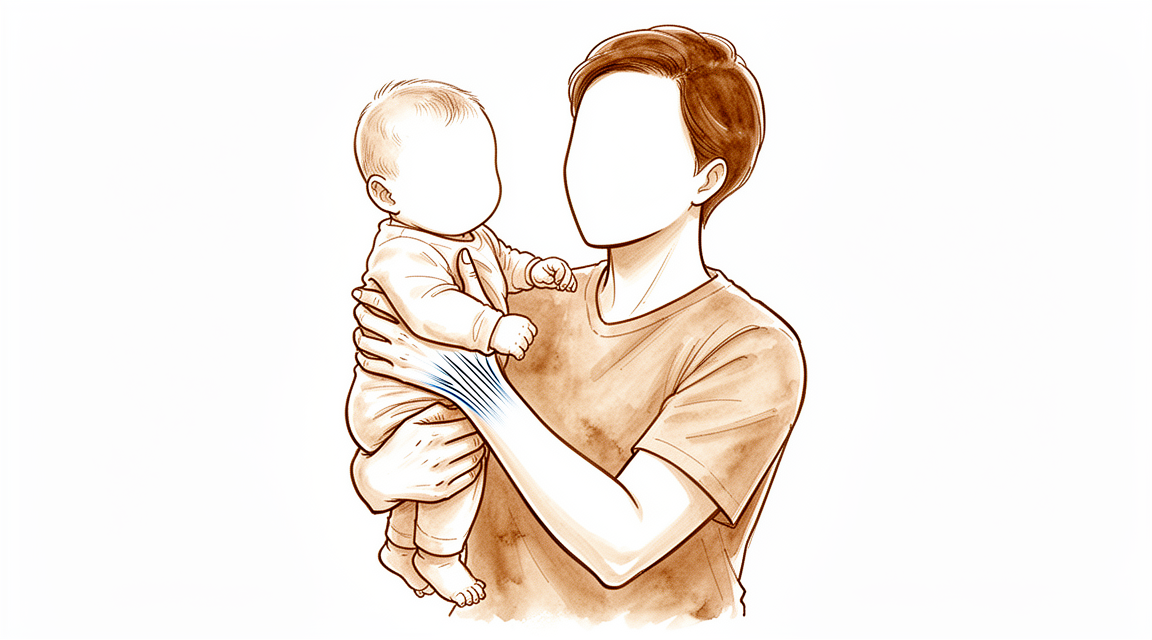
Este protocolo orienta sua recuperação após uma liberação de De Quervain, uma pequena cirurgia que abre o túnel apertado sobre os tendões do lado do polegar no seu pulso, realizada pelo Dr. Kieran Hirpara no Mater Private Hospital Rockhampton. Ele começa com um programa de exercícios para fazer em casa, seguido pelo protocolo clínico estruturado elaborado para o seu terapeuta de mão; leve esta página ou o seu PDF na sua primeira sessão de terapia, para que a reabilitação seja devidamente coordenada. O terapeuta pode ajustar o plano conforme a evolução da sua recuperação.
Caso tenha alguma dúvida ou preocupação quanto à ferida pós-cirúrgica, entre em contato com o consultório. Geralmente é útil tirar uma foto da ferida e enviá-la por e-mail para análise.
O que esperar
A tenossinovite de De Quervain consiste na irritação dos dois tendões que vão até o polegar (o abdutor longo do polegar e o extensor curto do polegar), no trecho em que eles passam por um túnel estreito (o primeiro compartimento dorsal) na face dorsal do punho. A liberação tendínea é uma pequena cirurgia que abre esse túnel para que os tendões possam deslizar livremente, aliviando a dor e o travamento.
Como nada é suturado ou apertado novamente (o túnel é simplesmente aberto e deve permanecer aberto), a recuperação permite movimentos precoces, sem necessidade de longo período de proteção. Não há estrutura que precise de meses para cicatrizar. O objetivo da reabilitação é manter os tendões em movimento no leito cirúrgico em processo de cicatrização, evitando que aderissem, enquanto a pequena incisão e os nervos cutâneos da região se estabilizam.
O plano de recuperação é simples: um curativo macio (às vezes uma tala leve para o polegar, apenas para conforto) nos primeiros dias, até cerca de uma ou duas semanas; início precoce de movimentos suaves do polegar e do punho; cuidados com a cicatriz após a cura da ferida; e aumento gradual da força de preensão e pinça. A maioria dos pacientes retorna às atividades normais sem dificuldades em aproximadamente quatro a seis semanas.
Após essa cirurgia, dois aspectos são monitorados. O primeiro é um pequeno nervo cutâneo, o nervo sensitivo radial, cujos ramos percorrem a região frontal da incisão; por algum tempo, essa área pode permanecer formigando ou sensível, e os exercícios iniciais visam sua recuperação. O segundo é a posição dos tendões: se o túnel for aberto em excesso na direção da palma da mão, pode ocorrer, ocasionalmente, deslocamento anterior de um dos tendões (subluxação) ao mover o polegar. Ambas as situações são raras, e seu terapeuta de mão ficará atento a elas.
Precauções e limitações
- Mantenha o polegar e o punho em movimento desde o início: o movimento suave é o tratamento indicado, não o repouso. O objetivo principal é evitar a rigidez decorrente da inatividade.
- Use qualquer tipo de tala confortável apenas conforme orientação e apenas nos primeiros dias a uma ou duas semanas: ela serve para conforto, não para proteção, e deve ser retirada para a realização dos exercícios.
- Mantenha o ferimento limpo e seco até que cicatrize; não inicie a massagem da cicatriz antes de retirar os curativos e quando a pele já estiver fechada.
- Evite apertar com força, beliscar com intensidade, levantar pesos e torcer (como torcer um pano, abrir potes difíceis de abrir ou manusear ferramentas pesadas) por cerca de três a quatro semanas; depois disso, retome essas atividades gradualmente.
- Informe seu fisioterapeuta ou a equipe da clínica caso perceba formigamento, dormência ou uma sensação aguda e latejante na parte dorsal do polegar e do punho, ou se houver algum tendão que “estale” ou “deslize” ao mover o polegar.
Para orientações sobre cuidados com o ferimento, inchaço e cicatrização, consulte o guia de cuidados com ferimentos da clínica.
Seus exercícios
Kieran Hirpara 4.0
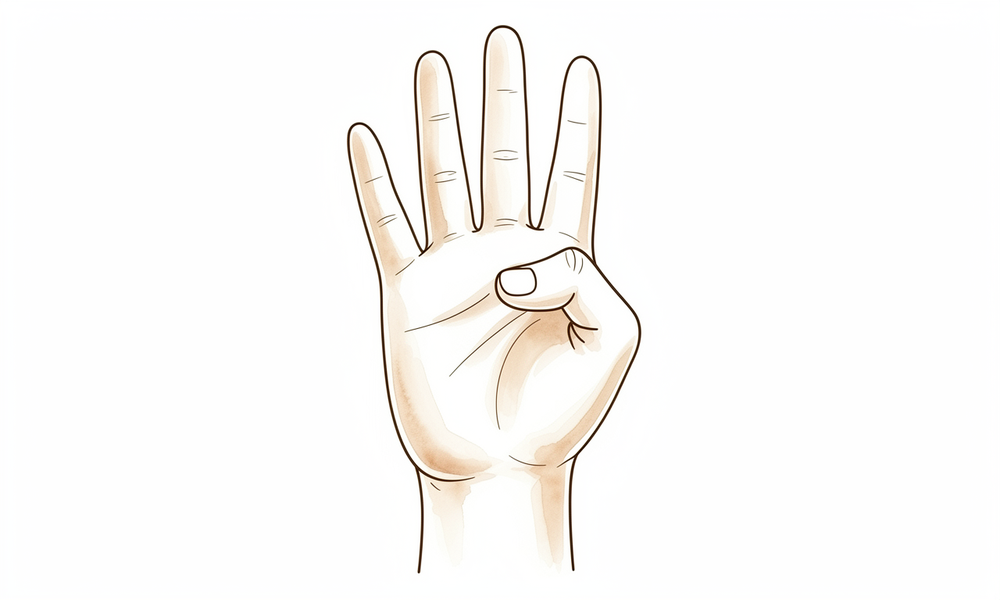
Movimentos do polegar (flexão, extensão e alcance)
Mova o polegar suavemente através de toda a sua amplitude de movimento: dobre a ponta em direção à palma da mão, estique-o novamente, depois mova todo o polegar para tocar a base do dedo mínimo e volte para a posição inicial. Faça isso de maneira lenta e confortável. Movimentar o polegar desde cedo ajuda a manter os tendões liberados em movimento, evitando que eles fiquem aderidos à cicatriz em processo de cura.
10 de cada, 3–4 vezes ao dia, dentro dos limites do conforto.
Kieran Hirpara 4.0
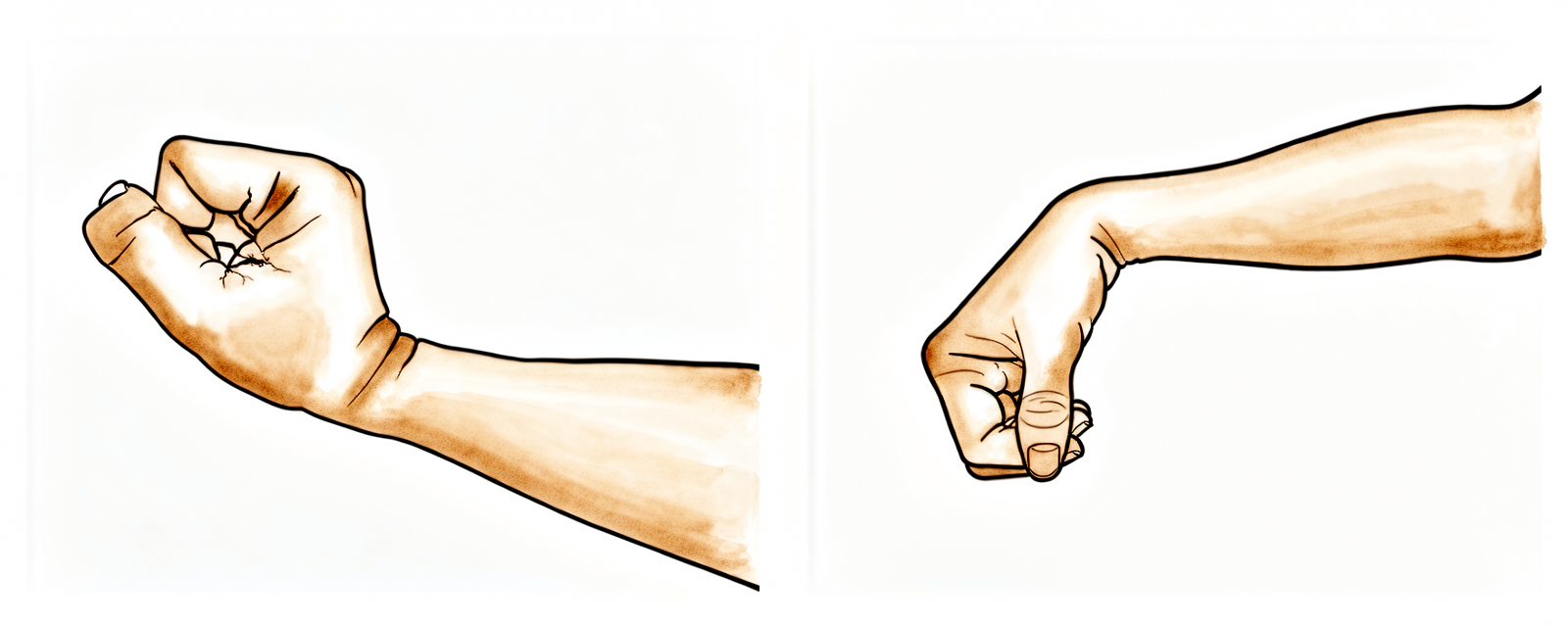
Movimento do punho (para cima, para baixo e para os lados)
Com o antebraço apoiado na mesa, dobre suavemente o pulso para cima e para baixo, depois incline-o para os lados (primeiro em direção ao polegar, depois em direção ao dedo mindinho). Mova-o apenas até onde se sentir confortável. Isso mantém o pulso flexível enquanto a ferida cicatriza.
10 em cada direção, 3–4 vezes ao dia
Kieran Hirpara 4.0
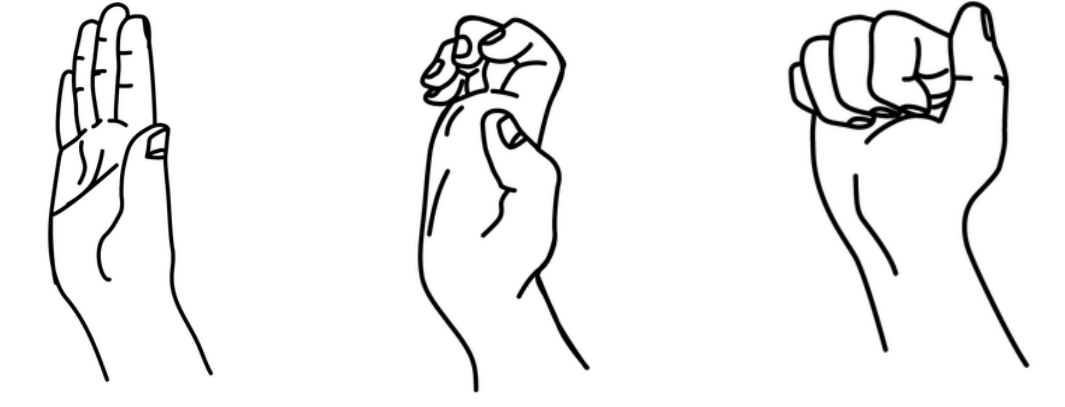
Deslizamentos tendinosos (deslizamento do polegar e dos dedos)
Abra a mão completamente; em seguida, deslize o polegar para tocar cada ponta dos dedos, um por um. Depois, faça um punho frouxo e abra a mão novamente. O objetivo é um movimento suave, sem aplicar força. Manter os tendões em movimento dentro do túnel liberado é a coisa mais importante nas primeiras semanas, para evitar rigidez e aderências.
5–10 ciclos lentos, 3–4 vezes ao dia
Kieran Hirpara 4.0
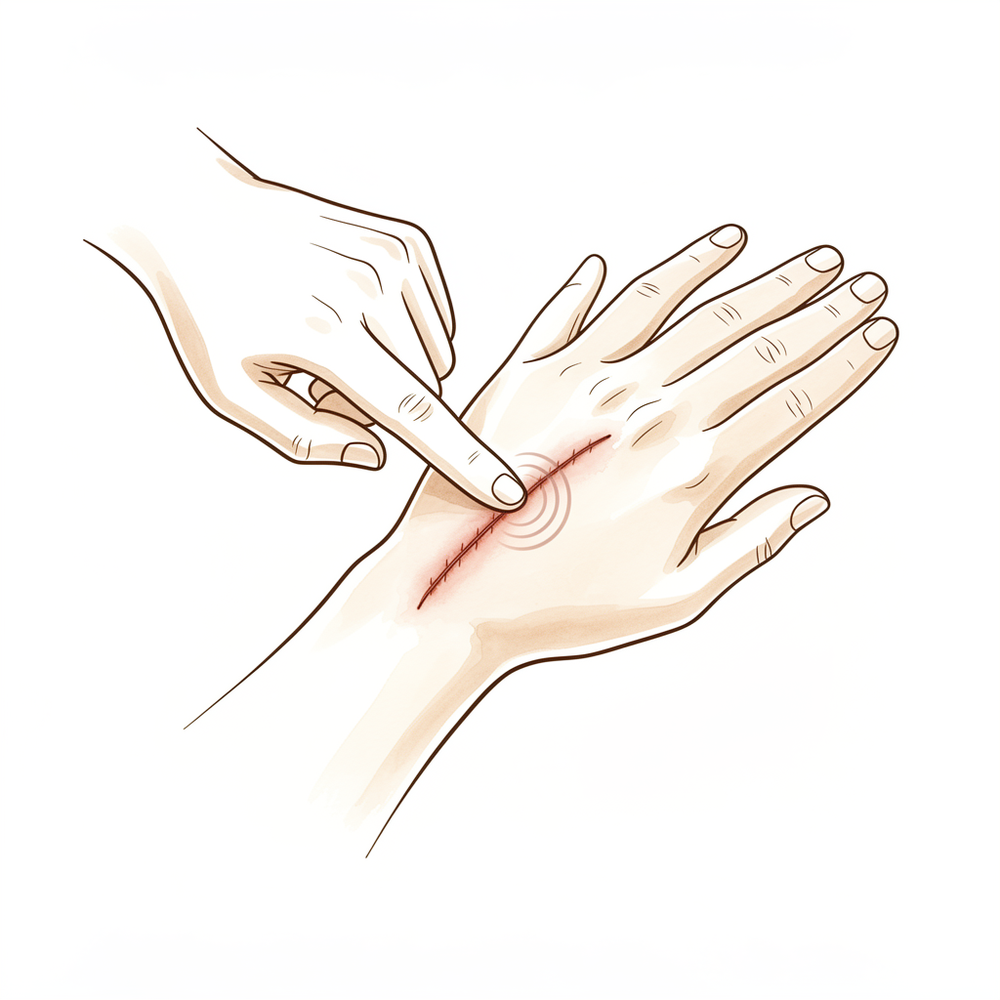
Massagem nas cicatrizes
Assim que a ferida estiver totalmente cicatrizada e os curativos removidos (geralmente após cerca de duas semanas), aplique um pouco de hidratante simples na cicatriz, fazendo pequenos círculos firmes por um ou dois minutos. Isso amacia a cicatriz e ajuda a pele e os delicados ramos nervosos sob ela a se estabilizarem. Interrompa o procedimento caso a área ainda esteja aberta ou exsudando.
1–2 minutos, 2–3 vezes ao dia, após a cicatrização
Kieran Hirpara 4.0
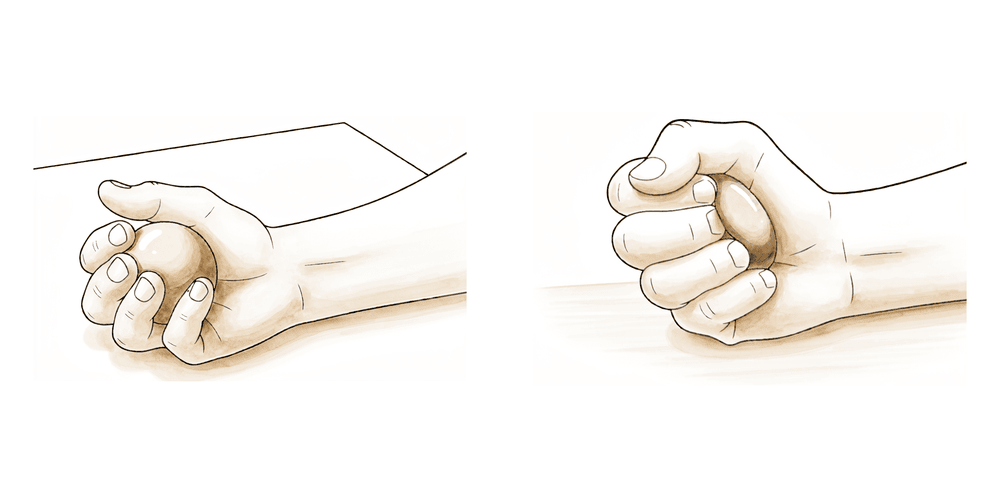
Fortalecimento da preensão e da pinça
Um exercício posterior — geralmente realizado entre três e quatro semanas após a cirurgia, quando a ferida já cicatrizou e os movimentos são confortáveis. Aperte uma bola macia ou massa terapêutica para fortalecer a força de preensão; também pressione um pequeno pedaço dessa massa entre o polegar e as pontas dos dedos para exercitar a pinça. Aumente a intensidade dos esforços gradualmente. Isso ajuda a recuperar a força muscular, que sempre diminui após a cirurgia.
10–15 apertos/pinças, 2–3 vezes ao dia (a partir de ~3–4 semanas)
Kieran Hirpara 4.0
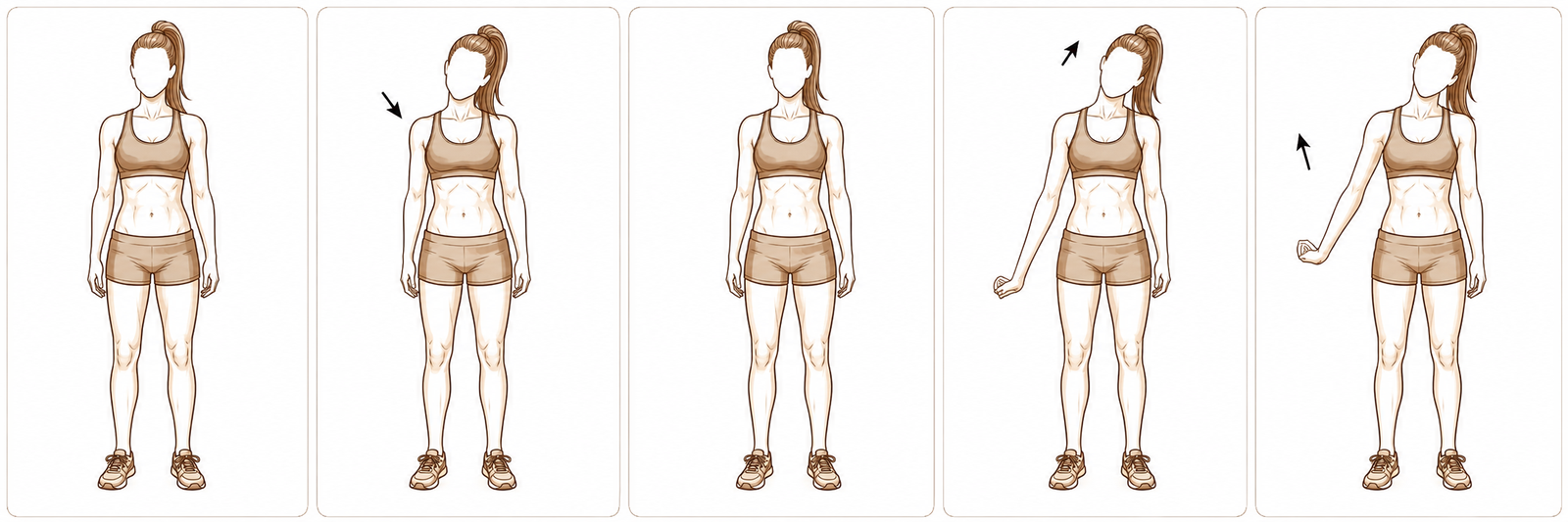
Deslizamento do nervo radial (se houver formigamento ou sensibilidade na parte dorsal do punho)
Apenas se o seu terapeuta ocupacional orientar — para casos de formigamento, sensibilidade ou dor na parte dorsal do polegar e do punho. Com o braço estendido para a frente, abaixe suavemente o punho e o polegar num alongamento leve até sentir uma ligeira tensão; mantenha essa posição por um instante e depois relaxe. O exercício nunca deve causar dor nem piorar o formigamento. Ele ajuda a acalmar o pequeno nervo cutâneo que passa exatamente sobre o local da cirurgia.
5–10 deslizamentos lentos, 1–2 vezes ao dia, somente conforme orientação.
Estes são os exercícios descritos no seu folheto informativo. Comece a realizá-los conforme orientação do Dr. Hirpara e do seu fisioterapeuta. Os exercícios iniciais (movimentação do polegar, movimentação do punho e deslizamentos tendíneos) mantêm tudo em movimento, evitando que os tendões recém-libertos aderissem; eles devem ser iniciados nos primeiros dias, dentro do limite do conforto. A massagem da cicatriz só deve ser feita após a cicatrização da ferida. O fortalecimento da preensão e do aperto com os dedos vem depois, geralmente a partir da terceira ou quarta semana. O deslizamento nervoso só é incluído se a pele sobre o punho apresentar formigamento ou sensibilidade aumentada. Interrompa qualquer exercício que cause dor aguda ou latejante no lado do polegar do punho.
Seu protocolo clínico
O restante desta página descreve o protocolo clínico em etapas para a reabilitação após a liberação do compartimento dorsal primeiro (de Quervain). Esta seção deve ser entregue ao seu terapeuta da mão; cada fase começa com uma explicação simples, em linguagem acessível, sobre o que está ocorrendo. Trata-se de uma descompressão, não de uma reparação: o compartimento dorsal primeiro é dividido e deve permanecer dividido; portanto, não há estrutura a ser protegida. O programa de reabilitação é, assim, um método baseado em movimento precoce e deslizamento dos tendões: manter os tendões APL/EPB deslizando na área cirúrgica evita aderências, controla o edema, auxilia na cicatrização e na recuperação do nervo sensitivo radial, além de restaurar a força de preensão e pinça.
Antes de iniciar o tratamento, verifique o relatório cirúrgico do paciente e consulte o cirurgião responsável sobre os detalhes da liberação (incisão longitudinal/dorsal, presença ou não de uma bainha/septo separado do tendão EPB e se foi liberado), a posição dorsal da incisão para prevenir subluxação dos tendões volares, bem como o manejo do nervo sensitivo radial. O Dr. Hirpara realiza a liberação por via dorsal/longitudinal, protegendo os ramos do nervo sensitivo radial e mantendo a incisão na região dorsal para evitar subluxação volar; a imobilização é feita apenas para conforto do paciente (curativo macio ± imobilização curta do polegar por alguns dias a ~1–2 semanas), sendo o movimento precoce do polegar e do punho a conduta padrão.
Fase I — movimentação precoce, controle do edema e cuidados com a ferida (semana 0 a ~2)
Nos primeiros dias, deve-se proteger a ferida e controlar o inchaço, enquanto a movimentação é iniciada imediatamente. Não há arco de movimento restrito a ser respeitado: o objetivo é fazer com que os tendões liberados comecem a deslizar desde o início. Qualquer tipo de tala serve apenas para conforto e deve ser retirada durante os exercícios.
Para o seu fisioterapeuta de mão:
Instruções e precauções - Trata-se de uma descompressão: não há estrutura a ser protegida; a movimentação ativa precoce é o procedimento padrão esperado. - Suporte para conforto apenas: curativo macio, acrescido ou não de uma tala curta tipo “spica” para o polegar nos primeiros dias, até aproximadamente 1–2 semanas; deve ser retirada para exercícios e higiene. - Mantenha a ferida limpa e seca até cicatrizar; adie qualquer tratamento das cicatrizes até que a pele esteja totalmente fechada. - Nesse período, evite apertar com força, pinçar, levantar pesos ou torcer o punho. - Verifique a área de inervação do nervo sensitivo radial (dorso do polegar e punho) quanto a parestesias, hipersensibilidade ou sinal de Tinel; avalie também a possibilidade de subluxação dos tendões APL/EPB durante movimentos ativos ou resistidos de extensão e abdução do polegar.
Tratamento - Ferida: utilize os curativos cirúrgicos conforme orientação; fique atento a sinais de infecção. - Edema: mantenha a mão elevada, faça massagem retrógrada suave e use gelo conforme necessário. - Exercícios: movimentação ativa do polegar (flexão/extensão, abdução palmar e radial, oposição), movimentação ativa do punho, deslizamentos dos tendões APL/EPB, movimentação ativa completa dos dedos; utilize a mão para atividades funcionais leves, dentro do limite do conforto.
Critérios para avançar para a fase seguinte - Ferida cicatrizada ou em processo de cicatrização; edema controlado; movimentação ativa do polegar e do punho sem desconforto.
Fase II — restauração do movimento e manejo das cicatrizes (semanas ~2 a 4)
Após a cicatrização da ferida, a tala de conforto é retirada e o foco passa a ser o movimento completo e confortável, além do manejo ativo das cicatrizes e da dessensibilização dos nervos. O fortalecimento leve começa no final deste período.
Para o seu fisioterapeuta de mão:
Avaliações - Amplitude de movimento ativa/passiva do polegar e do punho; qualidade da cicatriz; sintomas do nervo sensorial radial; avaliação de subluxação
Instruções e precauções - Suspender o uso da tala de conforto; incentivar o uso leve e normal da mão - Continuar evitando o aperto ou pinçamento forte até aproximadamente 3–4 semanas
Manejo - Cicatrizes: massagem e aplicação de silicone/hidratante após a cicatrização; dessensibilização em casos de hipersensibilidade - Nervos: exercícios de deslizamento e dessensibilização para o nervo sensorial radial, caso esteja irritado; estabilizar a condição antes de iniciar cargas - Exercícios: avançar para a amplitude completa de movimento do polegar e do punho; manter os exercícios de deslizamento tendíneo; iniciar o aperto/pinçamento leve (massa de modelar, bola macia) a partir de aproximadamente 3–4 semanas
Critérios para avançar para a fase seguinte - Amplitude de movimento completa e indolor do polegar e do punho; cicatriz curada e flexível; sintomas nervosos controlados
Fase III — fortalecimento e retorno às atividades (semanas ~4 a 6 e além)
Com o movimento restaurado e a ferida cicatrizada, a força de preensão e pinça é gradualmente aumentada, e o paciente retorna a todas as suas atividades habituais. A maioria atinge um uso normal e confortável por volta da quarta a sexta semana; atividades manuais mais exigentes demandam um pouco mais de tempo e seguem critérios específicos.
Para o seu terapeuta da mão:
Avaliações - Força de preensão e pinça em comparação ao lado contralateral; presença de dor durante a carga; testes funcionais/relacionados ao trabalho, conforme apropriado
Instruções e precauções - Retorno gradual à preensão, pinça, levantamento e torção; retorno total às atividades conforme o conforto e a força permitirem - Dor ou formigamento persistentes na região dorsorradial, ou sensação de “estalo” no tendão → encaminhar novamente ao cirurgião responsável (considerar possibilidade de neuroma, liberação incompleta ou subluxação volar)
Tratamento - Exercícios: fortalecimento progressivo da preensão e pinça; cargas específicas para tarefas e atividades laborais; continuação de exercícios para cicatrizes ou problemas nervosos remanescentes - Considerar a alta terapêutica quando a força estiver quase simétrica e a função restaurada - Encaminhar novamente ao médico responsável caso a recuperação estagne ou o resultado seja insatisfatório
Critérios para alta / retorno às atividades plenas - Força de preensão e pinça quase simétrica; uso funcional e laboral sem dor
Retorno às atividades e ao trabalho
O uso leve e cotidiano da mão (comer, escrever, vestir-se, realizar tarefas leves) é incentivado desde o início, desde que dentro dos limites do conforto. Como a cirurgia foi realizada no punho, é necessário que a mão se mova livremente e realize preensões com segurança. A condução de veículos pode ser retomada assim que a ferida estiver confortável, quando o uso de qualquer tipo de tala for desnecessário e quando você conseguir segurar e girar o volante com confiança; para a maioria das pessoas, isso ocorre na primeira ou segunda semana, conforme avaliado na consulta de acompanhamento.
A preensão forte, a pinça, o levantamento de pesos e a torção devem ser evitados até cerca de três a quatro semanas, sendo então introduzidos gradualmente. Trabalhos de escritório e atividades leves costumam ser retomados em poucos dias a uma ou duas semanas; já os trabalhos manuais mais pesados, que exigem força e movimentos repetitivos do polegar e do punho, geralmente podem ser retomados por volta da quarta a sexta semana. Essa avaliação é feita pelo Dr. Hirpara e pelo seu fisioterapeuta, levando em conta a recuperação da força e do conforto, e não apenas o tempo decorrido.
Após seguir este protocolo
Este protocolo complementa as orientações gerais de recuperação fornecidas pela clínica: consulte controle da dor pós-operatória, cuidados com a ferida e tratamento das cicatrizes. O plano em fases descrito acima baseia-se nas diretrizes de reabilitação publicadas para casos de liberação do túnel de De Quervain; sua recuperação contínua será acompanhada individualmente pelo Dr. Hirpara e pelo seu terapeuta de mão, conforme a evolução da sua mão.
Evidence & references
This is the clinical evidence summary written for health professionals. It is technical, and it lists the research this page was built from. You do not need to read it to understand your treatment or to make a decision about it.
de Quervain's Release — Procedure Outcomes & Post-operative Rehabilitation (First Dorsal Compartment Release)
Topic scope: post-operative rehabilitation after surgical release of the first dorsal compartment of the wrist (abductor pollicis longus, APL, and extensor pollicis brevis, EPB) for refractory de Quervain's tenosynovitis. This is a decompression, not a reconstruction: the fibro-osseous tunnel is opened and is meant to stay open, so the rehabilitation is an early-motion pathway built around tendon gliding, oedema and scar control, and protection of the overlying radial sensory nerve — rather than months of protected healing.
Defining principle of the rehab here: de Quervain's release relieves a tendon entrapment and does not create a construct that needs protection. The divided extensor retinaculum is meant to stay divided. So (unlike a tendon or ligament repair) immediate, gentle active thumb and wrist motion is the default, and the only deliberate restraints are brief comfort support and a short window of heavy-grip/pinch/twist avoidance while the wound heals. The therapy programme exists to keep the APL/EPB tendons gliding through the healing surgical bed so they do not adhere, to settle the radial sensory nerve branches that cross the incision, and to rebuild grip and pinch — not to immobilise. The single branch points are (1) whether a separate EPB sub-sheath/septum was present and released (its retention is a classic cause of failed release) and (2) keeping the release dorsal so the tendons do not subluxate volarly.
A. PROCEDURE OUTCOMES (open release; endoscopic and retinaculum-sparing variants)
Surgical release of the first dorsal compartment is a reliable operation for de Quervain's that has failed non-operative care: the great majority of patients obtain durable symptom relief, and the principal debates are over technique details (incision orientation, completeness of EPB sub-sheath release, whether to preserve/lengthen the retinaculum) rather than whether to decompress.
- Open release gives durable, high-quality long-term outcomes. A series of 80 cases with a mean 9.5-year follow-up reported sustained relief with a low complication profile, establishing the long-term reliability of open release [Garçon et al., Orthop Traumatol Surg Res 2018]. Moderate (long-term cohort).
- Functional recovery is good and objectively measurable. A series using DASH scores to evaluate first-extensor-compartment release for refractory disease documented good functional outcomes, and emphasised identifying and releasing a separate EPB sub-compartment (septum) when present [Lee et al., Clin Orthop Surg 2014]. DASH is a validated, widely used outcome instrument across hand and wrist conditions [Baltzer, Novak & McCabe, J Hand Surg Am 2014 — scoping review]. Moderate (cohort) + instrument SR.
- Endoscopic and open release are broadly comparable. A comparative study of endoscopic versus open release found favourable results for the endoscopic approach with attention to the radial sensory nerve, while open release remains the standard reference technique [Kang et al., Bone Joint J 2013]. Moderate (comparative).
- The retinaculum can be partly resected, simply divided, or reconstructed. Partial resection of the extensor retinaculum gives good short-term results [Altay et al., Orthop Traumatol Surg Res 2011]; simple release and Z-plasty (retinaculum-lengthening) reconstruction give comparable outcomes, with Z-plasty proposed to reduce subluxation risk at the cost of complexity [Kim, Baek & Lee, J Hand Surg Eur 2019]. A longitudinal-incision technique series likewise reports good functional outcomes [Mangukiya et al., Musculoskelet Surg 2019]. Moderate (comparative/cohort).
- Dissatisfaction does occur and is worth counselling for. A focused study of dissatisfaction after first dorsal compartment release found that a minority of patients remain dissatisfied, often linked to residual pain, nerve symptoms or incomplete relief — a reminder that outcomes are good but not universal [Rogozinski & Lourie, J Hand Surg Am 2016]. Moderate (cohort).
B. REHABILITATION / THERAPY EVIDENCE
The central rehab questions are (1) whether to immobilise the thumb/wrist afterwards and for how long, and (2) whether formal hand therapy changes the outcome. The published base specific to post-de-Quervain-release rehabilitation is thin and consensus-driven: there are no high-quality trials comparing immobilisation regimens or therapy protocols. Practice converges on brief comfort support and early motion, with hand therapy used selectively.
- Early motion is the rationalised default; prolonged immobilisation is not supported. Because the release is a decompression with no construct to protect, early active thumb and wrist motion is used to keep the APL/EPB tendons gliding and prevent adhesion. Immobilisation, where used, is a soft dressing or short thumb spica for comfort only for days to ~1–2 weeks. The supporting evidence is mechanistic/consensus, mirroring the well-established early-motion rationale after other upper-limb decompressions. Weak–moderate (mechanism strong, outcome data sparse).
- De Quervain's is not always an isolated problem — therapy assessment matters. A hand-therapy review highlights that de Quervain's syndrome may coexist with other dorsoradial/wrist pathology, so post-operative therapy should reassess rather than assume a single diagnosis — relevant when symptoms persist after release [Redvers-Chubb, Hand Therapy 2015]. Consensus (narrative/therapy review).
- Hand therapy focus is glide, scar and nerve, then strength. The programme priorities are tendon gliding (adhesion prevention), oedema control, scar management and radial sensory nerve desensitisation, and graded grip/pinch strengthening. The benefit of formal supervised therapy over a home programme is not established by trial data; selective therapy is defensible. Weak / consensus.
Recovery trajectory (expected, evidence-anchored)
| Phase | Window | Restraint | Hand use / therapy focus | Strength / load | Notes |
|---|---|---|---|---|---|
| I — Early motion, oedema & wound care | Week 0–~2 | Comfort support only (soft dressing ± short thumb spica) | Immediate active thumb + wrist motion; APL/EPB tendon glides; elevation/oedema control; screen radial sensory nerve + subluxation | Light functional use only | No construct to protect; motion is the treatment. Keep wound clean/dry |
| II — Restore motion & scar/nerve care | Week ~2–4 | Splint discarded once healed | Full thumb + wrist ROM; scar massage once wound healed; radial sensory nerve glides/desensitisation if irritable | Begin light grip/pinch (putty, ball) from ~3–4 wk | Avoid forceful grip/pinch/twist until ~3–4 wk |
| III — Strengthening & return | Week ~4–6+ | Restrictions lifted, graded | Progressive grip/pinch and task-specific loading | Return to near-symmetrical grip/pinch; full activity as strength allows | Light/desk work days–1–2 wk; manual work ~4–6 wk, criterion-based |
(Phase windows are typical clinical guides, not trial-derived deadlines. Driving resumes once the wound is comfortable, any comfort splint is off, and the patient can grip and steer confidently — commonly within 1–2 weeks.)
C. KEY CONTROVERSIES / EVIDENCE QUALITY
- The EPB sub-sheath (septum) must be sought and released. A separate EPB sub-compartment is common and, if missed, is a classic cause of persistent symptoms / failed release. Series that emphasise identifying and releasing it report good outcomes [Lee 2014]. Moderate — strong mechanistic consensus.
- Volar tendon subluxation if released too volar. Dividing the retinaculum too far towards the palmar side can let the APL/EPB tendons subluxate volarly with thumb motion. Keeping the release dorsal, and retinaculum-lengthening (Z-plasty) reconstructions, are described specifically to mitigate this [Kim 2019; Altay 2011]. Moderate (technique-comparative).
- Radial sensory nerve injury is the signature complication. The superficial radial nerve branches cross the operative field; injury or scar entrapment produces dorsoradial numbness, hypersensitivity or painful neuroma and is a leading driver of dissatisfaction [Ilyas et al., J Am Acad Orthop Surg 2007; Rogozinski 2016]. Careful exposure with nerve protection is emphasised across open and endoscopic techniques [Kang 2013]. Moderate.
- Immobilise or move early? No trial settles the optimal post-operative regimen; consensus favours brief comfort support and early motion (decompression logic) over prolonged splinting. Weak — consensus, not trial-derived.
- Outcomes are good but not universal. A measurable minority remain dissatisfied, usually from residual pain, nerve symptoms or incomplete release — worth explicit pre-operative counselling [Rogozinski 2016]. Moderate.
D. EVIDENCE STRENGTH FLAGS (summary)
- MODERATE (cohort / comparative): durable long-term relief from open release (9.5-yr cohort); good DASH-measured functional outcomes; comparability of endoscopic vs open and of simple release vs Z-plasty / partial retinaculum resection; radial sensory nerve injury as the signature complication; a real, defined dissatisfaction rate.
- WEAK / CONSENSUS: the early-motion, glide-based rehabilitation programme itself (mechanistically rationalised; no trial comparing immobilisation regimens or therapy protocols after de Quervain's release); the role of formal supervised therapy vs a home programme; exact phase timings and return-to-activity windows (typical guides, not trial-derived). Outcomes and the two signature complications (radial sensory nerve injury; volar subluxation) are better studied than the rehabilitation protocol.
CITATIONS
RAG corpus (180,000+ Orthopaedic articles)
- Garçon JJ, Charruau B, Marteau E, et al. Results of surgical treatment of De Quervain's tenosynovitis: 80 cases with a mean follow-up of 9.5 years. Orthop Traumatol Surg Res. 2018. DOI: 10.1016/j.otsr.2018.04.022 (PMID 29909297)
- Lee HJ, Kim PT, Aminata IW, et al. Surgical Release of the First Extensor Compartment for Refractory de Quervain's Tenosynovitis: Surgical Findings and Functional Evaluation Using DASH Scores. Clin Orthop Surg. 2014. DOI: 10.4055/cios.2014.6.4.405
- Ilyas AM, Ast M, Schaffer AA, et al. de Quervain Tenosynovitis of the Wrist. J Am Acad Orthop Surg. 2007. DOI: 10.5435/00124635-200712000-00009 (PMID 18063716)
- Kang HJ, Koh IH, Jang JW, et al. Endoscopic versus open release in patients with de Quervain's tenosynovitis. Bone Joint J. 2013. DOI: 10.1302/0301-620X.95B7.31486 (PMID 23814248)
- Altay M, Ertürk C, Işıkan UE. De Quervain's disease treatment using partial resection of the extensor retinaculum: A short-term results survey. Orthop Traumatol Surg Res. 2011. DOI: 10.1016/j.otsr.2011.03.015
- Kim J, Baek J, Lee J. Comparison between simple release and Z-plasty of retinaculum for de Quervain's disease: a retrospective study. J Hand Surg Eur Vol. 2019. DOI: 10.1177/1753193418818341 (PMID 30669923)
- Mangukiya HJ, Kale A, Mahajan NP, et al. Functional outcome of De Quervain's tenosynovitis with longitudinal incision in surgically treated patients. Musculoskelet Surg. 2019. DOI: 10.1007/s12306-018-0585-1
- Rogozinski B, Lourie GM. Dissatisfaction After First Dorsal Compartment Release for de Quervain Tendinopathy. J Hand Surg Am. 2016;41(1). DOI: 10.1016/j.jhsa.2015.09.020 (PMID 26481556)
- Baltzer H, Novak CB, McCabe SJ. A Scoping Review of Disabilities of the Arm, Shoulder, and Hand Scores for Hand and Wrist Conditions. J Hand Surg Am. 2014. DOI: 10.1016/j.jhsa.2014.07.050 (PMID 25227601)
- Redvers-Chubb K. De Quervain's syndrome: It may not be an isolated pathology. Hand Therapy. 2015. DOI: 10.1177/1758998315599796
de Quervain's release literature (URLs)
- Lee HJ, et al. Surgical Release of the First Extensor Compartment for Refractory de Quervain's Tenosynovitis (DASH outcomes; EPB septum). Clin Orthop Surg 2014 (open access). https://doi.org/10.4055/cios.2014.6.4.405
- Garçon JJ, et al. Results of surgical treatment of De Quervain's tenosynovitis: 80 cases, mean 9.5-year follow-up. Orthop Traumatol Surg Res 2018. https://doi.org/10.1016/j.otsr.2018.04.022
- Ilyas AM, et al. de Quervain Tenosynovitis of the Wrist (review — radial sensory nerve, surgical technique, complications). J Am Acad Orthop Surg 2007. https://doi.org/10.5435/00124635-200712000-00009
- Rogozinski B, Lourie GM. Dissatisfaction After First Dorsal Compartment Release for de Quervain Tendinopathy. J Hand Surg Am 2016. https://doi.org/10.1016/j.jhsa.2015.09.020