Patients › Rehabilitation
Liberação de dedo em gatilho
Post-operative exercises and precautions after trigger finger release, including tendon glides and joint blocking exercises.
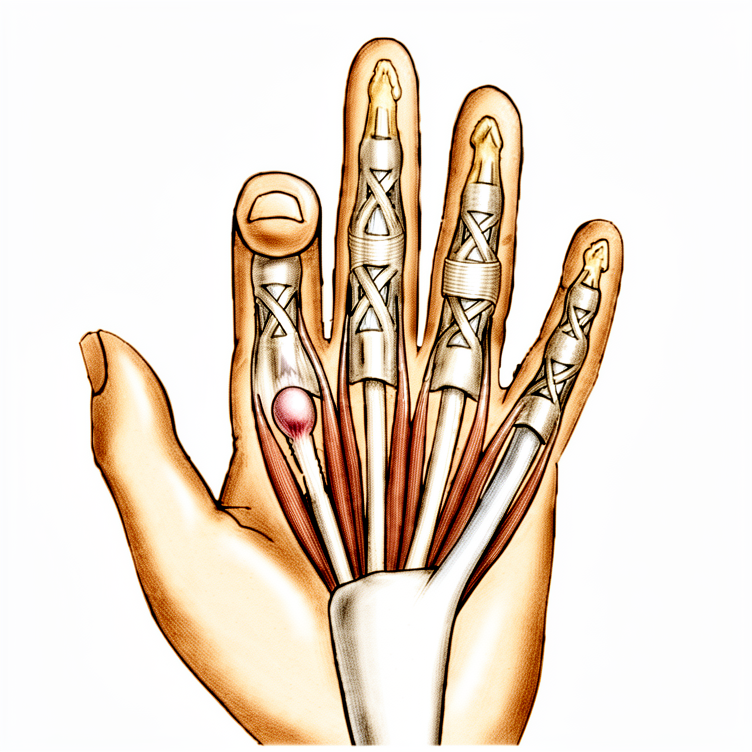
Este protocolo orienta sua recuperação após a liberação de dedo em gatilho realizada pelo Dr. Kieran Hirpara no Mater Private Hospital Rockhampton. Ele explica o que esperar, as precauções a serem tomadas e o programa de exercícios pós-operatórios: leve esta página ou seu arquivo PDF ao seu fisioterapeuta ou terapeuta da mão para que a reabilitação seja devidamente coordenada.
Caso tenha alguma dúvida ou preocupação quanto à ferida cirúrgica, entre em contato com nosso consultório. Geralmente, é útil tirar uma foto da ferida e enviá-la por e-mail para análise.
O que esperar
O cuidado com a ferida é explicado separadamente: consulte a página de cuidados com a ferida cujo link se encontra no final deste protocolo.
Os exercícios abaixo são muito importantes para evitar que os tendões aderam durante a cicatrização da ferida. Às vezes, as articulações dos dedos podem ficar rígidas após este procedimento. É fundamental prevenir essa rigidez desde cedo; por isso, recomenda-se que você realize alongamentos firmes e prolongados nos dedos (usando a outra mão), especialmente para esticá-los. Esse tipo de alongamento passivo é seguro e não afeta a cirurgia: a polia já foi liberada, portanto não há nada no interior que possa ser afetado pelo alongamento.
Após a cicatrização da ferida, aplique calor na mão por 20 minutos antes de realizar esses exercícios. Depois de concluí-los, a aplicação de gelo pode ajudar a prevenir a inflamação.
Às vezes, a mão ou a ferida podem ficar sensíveis. Isso é normal e pode ser evitado ou minimizado iniciando-se, diariamente, a dessensibilização: toque ou esfregue suavemente a ferida (com o curativo ainda no lugar), começando imediatamente após a cirurgia. Esse tipo de “retroalimentação sensorial” ajuda a pele a normalizar sua resposta ao toque e à textura.
Nas primeiras 48 horas, procure controlar o inchaço: mantenha a mão elevada, use gelo, aplique compressão caso seu terapeuta tenha fornecido um curativo compressivo, e faça movimentos suaves de abertura e fechamento dos dedos para ajudar a drenar o inchaço.
Comece a usar a mão para tarefas leves (vestir-se, comer, etc.) assim que a dor permitir, aumentando gradualmente a atividade. Não exagere: se a dor ou o inchaço aumentarem após alguma atividade, reduza o esforço até que a mão se estabilize, e então retome os exercícios aos poucos.
Uma vez que a ferida esteja totalmente cicatrizada, inicie a massagem da cicatriz: faça movimentos circulares firmes sobre a incisão. A página de cuidados com a ferida contém mais informações sobre o manejo das cicatrizes.
O que as evidências científicas dizem sobre a recuperação
A liberação aberta da polia A1 é uma cirurgia bem estabelecida, com sólidos resultados descritos na literatura médica. O fenômeno de travamento e bloqueio do tendão é corrigido pela própria cirurgia: uma vez que a polia é seccionada, o tendão volta a deslizar livremente, e o travamento geralmente não reaparece. Em uma série de quase 1.600 casos de liberação aberta, menos de 1% dos pacientes precisaram de uma segunda cirurgia devido à persistência ou recorrência do travamento; não foram registrados ferimentos nervosos nem infecções profundas [4]. Um estudo comparativo com acompanhamento de mais de três anos também não constatou recorrências após a liberação aberta [5].
A dor na palma da mão diminui significativamente nas primeiras uma ou duas semanas. Em um estudo comparativo, o tempo médio para redução significativa da dor após a liberação aberta foi de cerca de uma semana [5]. Contudo, certa sensibilidade na palma ao realizar apertos firmes, leve inchaço ou rigidez nos dedos podem persistir por várias semanas após esse período. Isso é normal e reflete a maturação da cicatriz, processo que leva cerca de três meses [3]; o programa de dessensibilização, massagem da cicatriz e exercícios descrito neste protocolo visa justamente controlar esses sintomas. Na grande série de casos mencionada, cerca de 1 em cada 20 dedos apresentou algum problema pós-cirurgia; na maioria dos casos, tratou-se de rigidez temporária ou sensibilidade na cicatriz, que melhoraram com tratamento. A recuperação da mobilidade tende a ser mais lenta em pacientes diabéticos; por isso, o programa de exercícios é ainda mais importante nesse grupo [4].
Os protocolos de terapia ocupacional publicados recomendam iniciar exercícios ativos e passivos de movimentação dos dedos e deslizamento do tendão nos primeiros dias após a cirurgia; posteriormente, após a cicatrização da ferida, introduzem-se cuidados com a cicatriz e a dessensibilização, seguidos de fortalecimento progressivo da força de preensão [2][3] – exatamente a mesma abordagem em etapas adotada neste programa. O início precoce dos exercícios garante que o tendão continue a deslizar e as articulações permaneçam flexíveis enquanto a ferida cicatriza.
O retorno ao trabalho depende das exigências da atividade laboral. Em um estudo comparativo, metade dos pacientes retornou ao trabalho cerca de duas semanas após a liberação aberta [5]; quem exerce funções leves ou de escritório costuma voltar ainda mais cedo, enquanto trabalhos manuais pesados exigem que as restrições de levantamento e preensão sejam removidas.
Um ensaio clínico randomizado comparou três meses de terapia supervisionada após a liberação aberta com um programa de exercícios domiciliares autoguiado: aos seis meses, a função geral, a mobilidade e a dor foram semelhantes entre os grupos; porém, a força de preensão melhorou mais com a terapia supervisionada. Os pacientes que se beneficiaram claramente da terapia formal foram aqueles cujo travamento do tendão persistia há mais de doze meses antes da cirurgia, bem como quem realizava tarefas domésticas ou trabalhos leves [1]. Na prática, um programa domiciliar bem executado (os exercícios desta página) é suficiente para a maioria dos pacientes; a terapia ocupacional especializada se mostra útil quando o dedo estava rígido há muito tempo ou quando a recuperação é lenta.
Precauções e limitações
É recomendado o uso funcional leve da mão para tarefas cotidianas, como cuidados pessoais, alimentação, vestuário, escrita e digitação. As restrições importantes são as seguintes:
- Evite levantar objetos, fazer preensão ou suportar peso por até 4 semanas após a cirurgia.
- Dirigir é restrito na primeira semana; retome essa atividade quando a dor permitir, quando conseguir fechar a mão completamente e quando puder controlar o veículo com segurança.
Para o seu fisioterapeuta:
Manejo
- Programa de exercícios domiciliares conforme os cartões abaixo: alongamento de flexão/extensão do punho; bloqueio das articulações DIP (interfalângica distal) e PIP (interfalângica proximal); deslizamentos tendíneos (Série A e Série B).
- Alongamentos passivos firmes e prolongados dos dedos, especialmente na direção da extensão, para prevenir precocemente a rigidez articular.
- Aplicação de calor na mão por 20 minutos antes dos exercícios, após a cicatrização da ferida; aplicação de gelo após os exercícios para evitar inflamação.
- Desensibilização diária (batidas suaves ou fricção sobre a ferida, com o curativo ainda no local), iniciando imediatamente após a cirurgia.
- Controle do inchaço nas primeiras 48 horas: elevação da mão, gelo, compressão conforme indicado e movimentos suaves de bombeamento dos dedos.
- Retorno gradual ao uso funcional leve conforme a tolerância à dor, monitorando a ocorrência de dor ou aumento do inchaço após as atividades.
- Massagem da cicatriz (círculos firmes sobre a incisão) após a cicatrização completa da ferida.
Precauções
- Use a mão apenas para tarefas cotidianas leves (cuidados pessoais, alimentação, vestuário, escrita, digitação).
- Não levante objetos, faça preensão ou suporte de peso por até 4 semanas após a cirurgia.
- Dirigir é restrito na primeira semana; retome essa atividade quando a dor permitir, quando conseguir fechar a mão completamente e quando puder controlar o veículo com segurança.
Marcos esperados (baseados em critérios e protocolos publicados [1][2][3])
- A dor deve reduzir-se a níveis confortáveis com analgésicos simples em até 1–2 semanas [5].
- A ferida deve cicatrizar, com início da massagem da cicatriz e da desensibilização, em até 2–3 semanas [2][3].
- A flexão e extensão ativas completas dos dedos (fechamento total da mão e extensão total) devem ser alcançadas por volta da 3ª semana, mantidas graças ao programa de bloqueio e deslizamentos tendíneos [2].
- O fortalecimento progressivo da preensão e pinça (ex.: com massa de modelar) deve ser iniciado após o término do período de 4 semanas de restrição a levantar/preender objetos, evoluindo para uso funcional pleno.
- Considere encaminhar o paciente para terapia ocupacional supervisionada caso houvesse desencadeamento de sintomas há mais de 12 meses antes da cirurgia, quando o paciente desempenha atividades manuais leves/finas de forma contínua, ou quando a recuperação da amplitude de movimento ou da força de preensão for lenta [1].
Estes são os exercícios contidos no seu folheto informativo, a serem iniciados após a cirurgia e continuados em casa conforme orientação do seu fisioterapeuta ou terapeuta ocupacional.
Seus exercícios
Kieran Hirpara 4.0
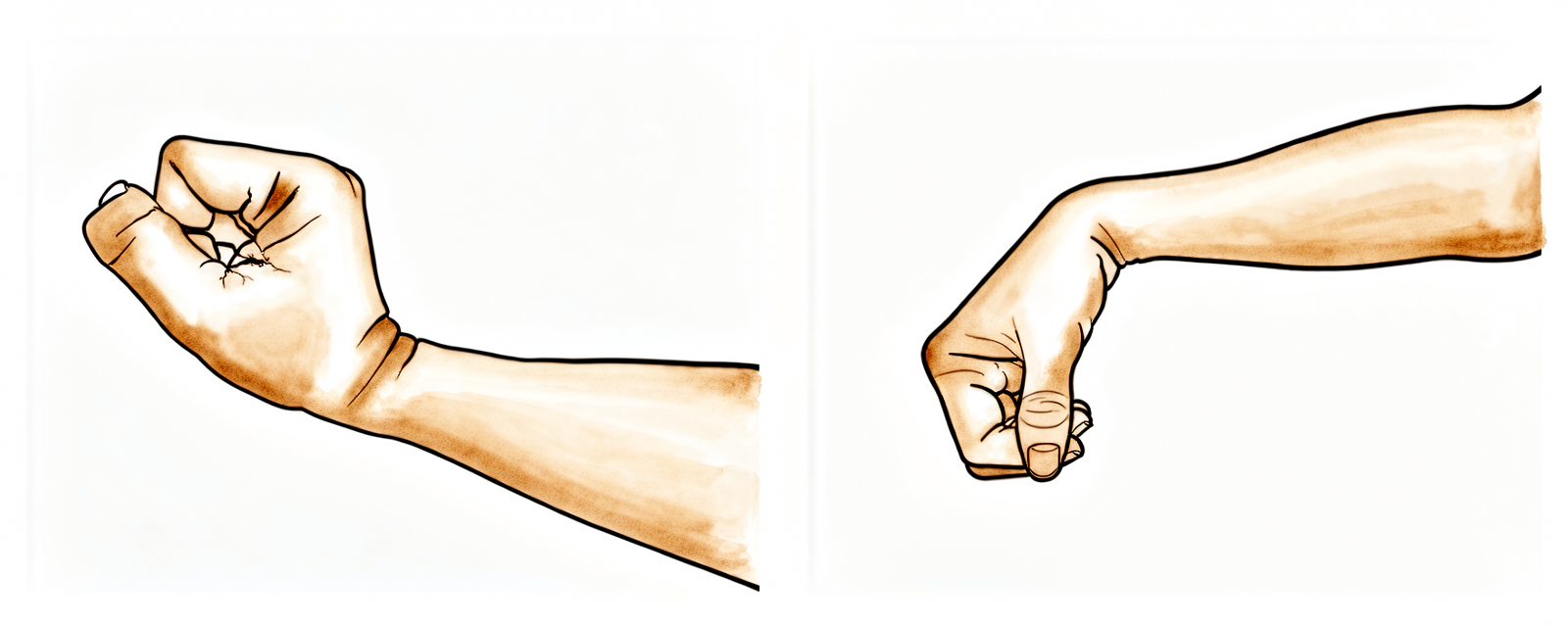
Alongamento para flexão/extensão do punho
Apoie o cotovelo numa mesa (ou o antebraço na borda de uma mesa ou poltrona) e balance suavemente o punho para frente e para trás. Quando se sentir mais à vontade, segure a palma da mão com a outra mão e empurre o punho para trás (com os dedos soltos, apontando para o teto) — mantenha por 15 segundos; depois faça o movimento inverso (com os dedos soltos, apontando para o chão) — mantenha por 15 segundos. Repita 5 vezes em cada direção.
10 repetições, 4–5 vezes por dia
Kieran Hirpara 4.0
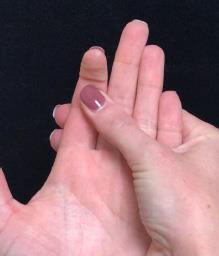
Bloqueio da articulação interfalângica distal
A articulação DIP (articulação interfalângica distal) é a articulação localizada na ponta do dedo. Comece com a palma da mão voltada para cima; use a outra mão para sustentar a mão afetada, posicionando-a logo abaixo da articulação distal. Flexione e estenda essa articulação, mantendo cada posição por 3–5 segundos. Apoie a articulação média apenas o suficiente para impedir que ela se flexione. Não há problema se os outros dedos se moverem durante o exercício.
10 repetições, 4 vezes ao dia, diariamente.
Kieran Hirpara 4.0
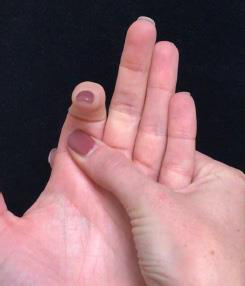
Bloqueio da articulação PIP
A articulação PIP (articulação interfalângica proximal) é a articulação do meio do dedo. Comece com a palma da mão voltada para cima; use a outra mão para sustentar a mão afetada, posicionando-a logo abaixo da segunda articulação. Flexione e estenda o dedo na articulação do meio, mantendo cada posição por 3–5 segundos. Não há problema se os outros dedos também se moverem.
10 repetições, 4 vezes ao dia, diariamente.
Kieran Hirpara 4.0
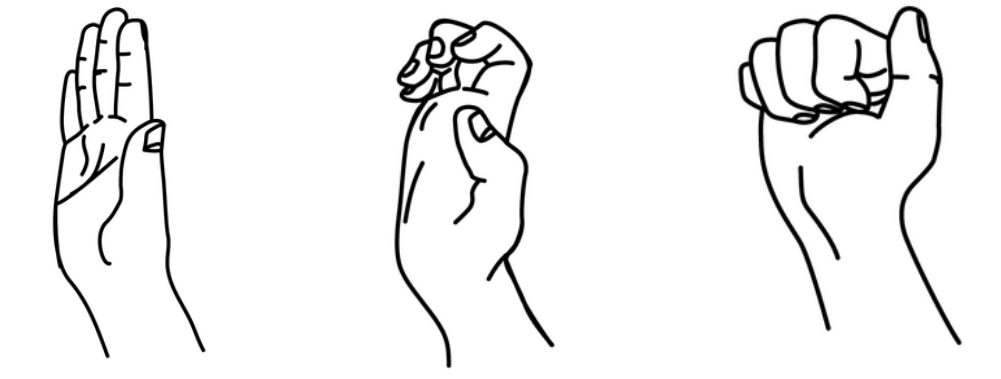
Deslizamentos tendinosos — Série A
Com a mão à sua frente e o pulso reto, estique completamente todos os dedos — você pode usar a outra mão para garantir que os dedos alcancem a extensão total (posição 1). Em seguida, dobre as pontas dos dedos para formar a posição de “gancho”, com os nós dos dedos voltados para cima (posição 2). Por fim, faça um punho fechado, colocando o polegar por cima dos dedos (posição 3).
5–10 repetições, 2–3 vezes ao dia, diariamente.
Kieran Hirpara 4.0
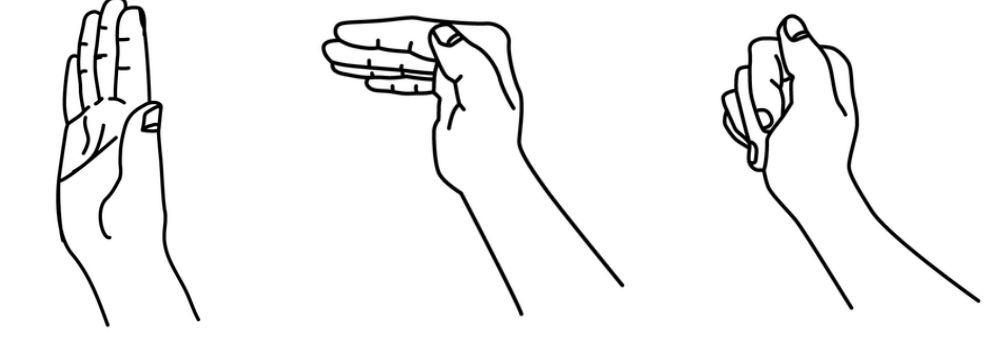
Deslizamentos tendinosos — Série B
Com a mão à sua frente e o pulso reto, estique completamente todos os dedos — você pode usar a outra mão para garantir que os dedos alcancem a extensão total (posição 1). Em seguida, forme uma “mesa” com os dedos, dobrando-os na articulação da base (os nós dos dedos) e mantendo-os retos — certifique-se de que o pulso não se inclina para a frente (posição 2). Por fim, dobre os dedos na articulação média, tocando-os na palma da mão (posição 3).
5–10 repetições, 2–3 vezes ao dia, diariamente.
Kieran Hirpara 4.0
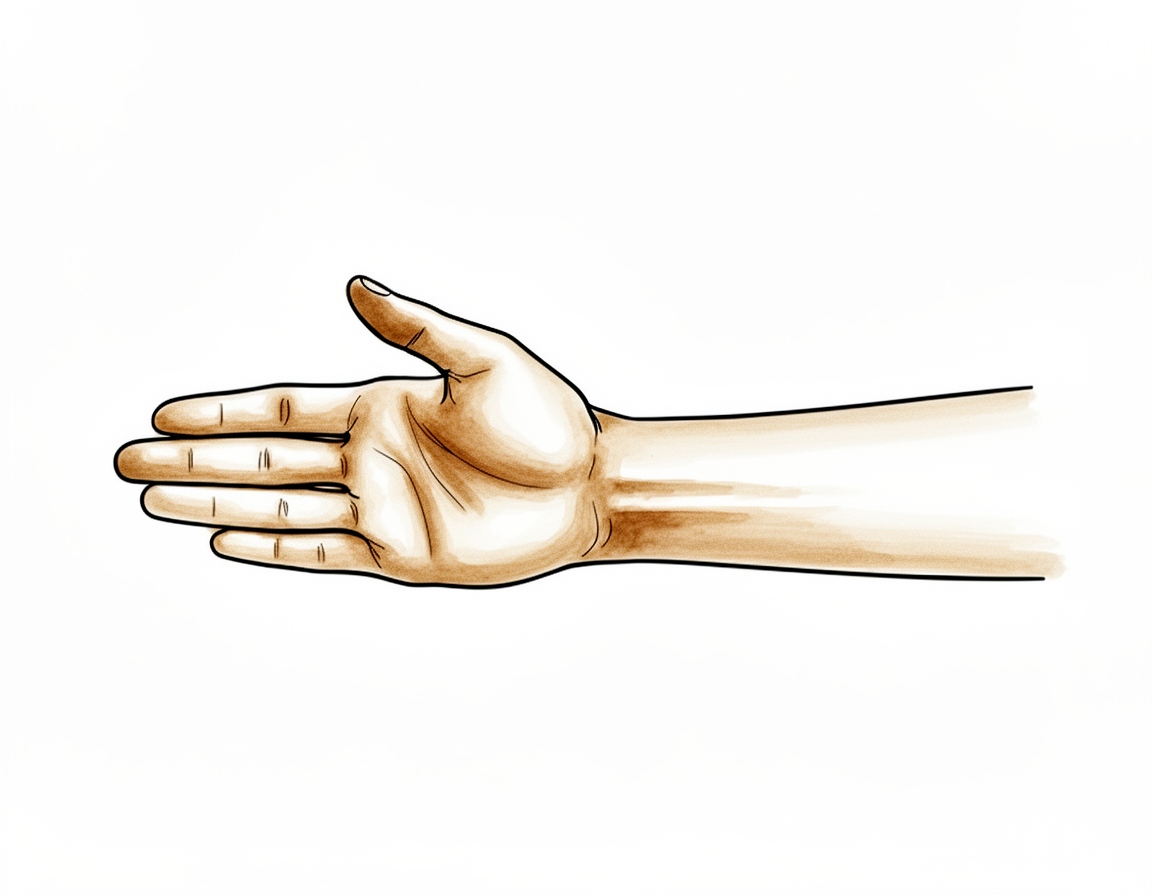
Extensão composta ativa
Apoie o cotovelo na mesa, estique os dedos o máximo possível e, em seguida, empurre um pouco mais com a outra mão. Conte até 5 e relaxe.
10 repetições, 3–4 vezes por dia
Kieran Hirpara 4.0
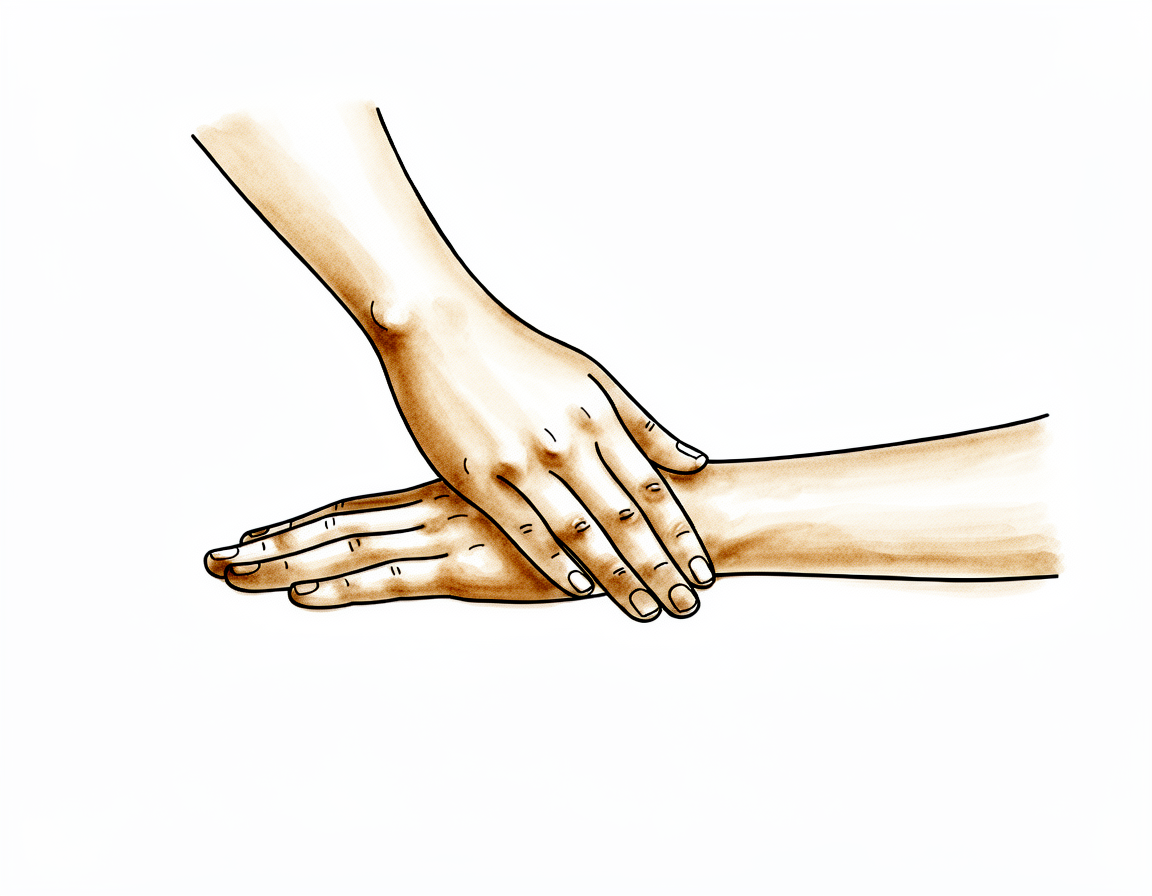
Extensão composta passiva
Coloque a mão plana sobre a mesa, com a palma virada para baixo. Com a outra mão, pressione o dorso da mão e faça uma “massagem” em direção ao corpo. Conte até 5 e depois relaxe.
10 repetições, 3–4 vezes por dia
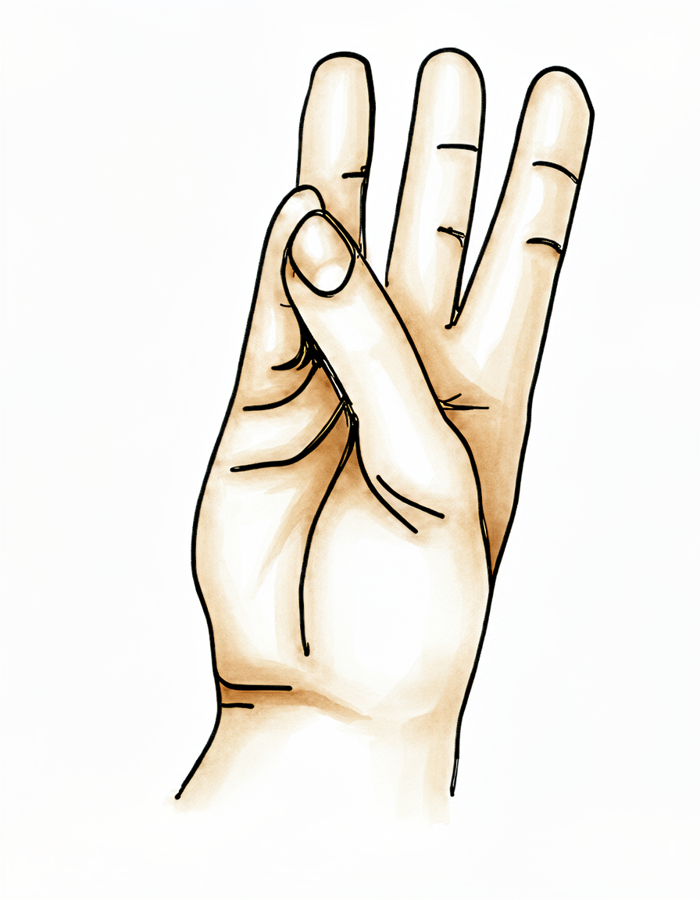
Kieran Hirpara 4.0
Oposição do polegar
Comece com os dedos esticados e relaxados. Toque a ponta do polegar na ponta do dedo indicador. Mantenha por 5 segundos e, em seguida, volte à posição inicial.
10 repetições, 3–4 vezes por dia
Comece a realizar os exercícios abaixo somente sob orientação do Dr. Hirpara e do seu fisioterapeuta, respeitando os limites e a amplitude de movimento que lhe foram indicados. A série de deslizamentos tendíneos e os exercícios de bloqueio mantêm o tendão recém-libertado movendo-se livremente dentro da bainha, evitando que ele aderisse à cicatriz em processo de cura — isso impede que a rigidez volte a se manifestar como tensão excessiva. Os exercícios de extensão ativa e passiva garantem que o dedo se estenda completamente; os movimentos de oposição do polegar restauram a capacidade de pinçar; já os alongamentos do punho impedem que ele fique rígido, mesmo quando o foco dos exercícios são os dedos. É normal sentir sensibilidade diretamente sobre a cicatriz na palma da mão durante algumas semanas. Interrompa qualquer exercício que cause dor aguda.
Após a aplicação do protocolo
Este protocolo foi elaborado em colaboração com Sarah Farrell, BOccThy (Bacharel em Terapia Ocupacional), Terapeuta de Mão Credenciada, e incorpora as orientações atualizadas sobre o manejo pós-cirúrgico (abril de 2025) de Ruby Doolan, Terapeuta de Mão Credenciada da Extend Rehabilitation. Ele complementa as orientações gerais de recuperação fornecidas pelo consultório: consulte controle da dor pós-operatória, cuidados com a ferida e noções básicas de terapia de mão. Para informações sobre a cirurgia em si, veja liberação do dedo em gatilho.
O quadro conceitual e as etapas da recuperação também se baseiam em protocolos publicados sobre reabilitação após liberação do dedo em gatilho, incluindo os do University of Virginia Hand Center e da Twin Cities Orthopedics, bem como em estudos publicados sobre os resultados da liberação aberta do dedo em gatilho, como um ensaio clínico randomizado sobre reabilitação pós-operatória (Saito et al., Journal of Clinical Medicine, 2023) e uma ampla série de eventos adversos observados (Bruijnzeel et al., Journal of Hand Surgery, 2012).
Referências
[1] Saito T, Nakamichi R, Nakahara R, Nishida K, Ozaki T. A eficácia da reabilitação após liberação cirúrgica aberta para dedo em gatilho: um estudo prospectivo, randomizado e controlado. J Clin Med. 2023;12(22):7187. https://pmc.ncbi.nlm.nih.gov/articles/PMC10671987/ [2] University of Virginia Hand Center. Diretrizes para liberação do dedo em gatilho (protocolo de terapia pós-operatória). https://med.virginia.edu/orthopaedic-surgery/wp-content/uploads/sites/242/2015/11/Triggerfingerreleaseprotocol.pdf [3] Meletiou SD, Twin Cities Orthopedics. Manejo pós-operatório da liberação do dedo em gatilho (liberação da polia A1). https://tcomn.com/wp-content/uploads/2017/10/Trigger-Release-A1.pdf [4] Bruijnzeel H, Neuhaus V, Fostvedt S, Jupiter JB, Mudgal CS, Ring DC. Eventos adversos da liberação aberta da polia A1 no dedo em gatilho idiopático. J Hand Surg Am. 2012;37(8):1650–1656. https://pubmed.ncbi.nlm.nih.gov/22763058/ [5] Chanthanapodi P, Aodsup S. Resultados comparativos da cirurgia percutânea e aberta para dedos em gatilho: uma análise por escore de propensão. Front Surg. 2025;12:1509292. https://pmc.ncbi.nlm.nih.gov/articles/PMC11922895/
Evidence & references
This is the clinical evidence summary written for health professionals. It is technical, and it lists the research this page was built from. You do not need to read it to understand your treatment or to make a decision about it.
Trigger Finger Release (A1 Pulley Release) — Surgical Outcomes & Post-operative Rehabilitation
Topic scope: (A) the place of surgery in stenosing tenosynovitis (trigger finger/thumb) after failed conservative care (splinting, corticosteroid injection), and (B) post-operative rehabilitation after surgical division of the A1 pulley — open or percutaneous. This is an early-motion pathway: nothing is reconstructed, the catching is mechanically abolished the moment the pulley is divided, and the rehab exists to keep the now-free tendon gliding and the finger joints supple while the wound heals.
Defining principle of the rehab here: A1 pulley release removes the obstruction; it does not create a construct that needs protecting. Once the pulley is divided the flexor tendon glides freely and triggering does not usually recur. So — unlike a tendon repair, and like a carpal-tunnel decompression — the pathway is immediate active motion: full active finger flexion/extension and tendon glides from the first days, oedema and scar care, early light functional use, and a quick return. Most patients need no formal hand therapy at all; supervised therapy is reserved for the minority with pre-existing joint stiffness, long-standing triggering, or slow recovery. The single branch point is whether the finger was already stiff before surgery (long-standing fixed flexion / PIP contracture) — those patients need active therapy to recover motion the release alone cannot restore.
A. WHERE SURGERY SITS IN THE PATHWAY
Trigger finger is usually managed non-operatively first: activity modification, splinting, and corticosteroid injection, which resolves a substantial proportion of digits without surgery. Surgery (A1 pulley release) is reserved for digits that fail injection, recur, or present with a fixed deformity. The corpus contains the comparative evidence underpinning this stepped approach (percutaneous release vs steroid injection; one- vs two-injection regimens; corticosteroid solution choice) — Moderate (RCT). The rehab protocol on the patient page begins after that decision has been made, so this brief concentrates on the surgical and post-surgical evidence.
B. SURGICAL OUTCOMES & RESOLUTION RATES
Open release of the A1 pulley is one of the most reliable operations in hand surgery. The mechanical problem — a thickened tendon catching under a tight pulley — is solved by dividing the pulley, and the result is durable:
- In a series of 1,598 open releases, fewer than 1% required a second operation for persistent or recurrent triggering, with no nerve injuries and no deep infections [Bruijnzeel 2012]. About one digit in twenty had a documented post-operative problem, almost all minor and self-limiting (transient stiffness, scar tenderness). Strong (large cohort).
- Recovery of motion is slower in patients with diabetes, reinforcing the value of the exercise program in that group [Bruijnzeel 2012]. Moderate.
- A propensity-matched comparison with >3 years follow-up found no recurrences after open release, with median time to significant pain reduction of about one week and roughly half of patients back at work within ~2 weeks [Chanthanapodi 2025]. Moderate.
Take-home for rehab: because the operation itself abolishes the triggering, the rehabilitation is not "earning back" a surgical result — it is preventing the two things that can go wrong during healing: tendon adhesion and joint stiffness. Early glide and early extension are the levers.
C. OPEN vs PERCUTANEOUS RELEASE
Both techniques divide the same structure and converge to the same place.
- A Level I meta-analysis of 8 RCTs (548 patients) found no significant difference between open and percutaneous release in revision, complication, or pain rates — both are appropriate options [Casey 2024, J Hand Surg Am]. Strong (meta-analysis of RCTs).
- Larger RCT syntheses show percutaneous release confers faster early functional recovery — better short/mid-term Q-DASH, ~12 days earlier return to work, and shorter analgesic use — while long-term function, grip, motion and complication/revision rates are equivalent. Strong.
- Percutaneous (including ultrasound-guided/sonographically-controlled) technique is supported by multiple corpus series for efficacy and safety, with the main theoretical risks being incomplete release and digital nerve proximity, mitigated by surface landmarks and imaging [corpus percutaneous series]. Moderate.
Rehab implication: the post-operative program is essentially the same for both approaches — early active motion, glides, oedema and scar care. The patient page applies regardless of whether the release was open or percutaneous; percutaneous patients simply tend to be comfortable and back to activity a little sooner.
D. THE ROLE — AND LIMITS — OF POST-OPERATIVE HAND THERAPY
This is the central evidence point for the protocol, and it is one where "more therapy" is not automatically better.
- A prospective RCT compared 3 months of supervised rehabilitation after open
release against a self-directed home exercise program: at six months,
overall function, motion and pain were similar between groups. Supervised
therapy added further grip-strength recovery, and the patients who clearly
benefited from formal therapy were those whose **triggering had been present
12 months pre-operatively and those in housework/lighter-work roles [Saito 2023, J Clin Med]. Moderate (single RCT).
- Published surgeon and hand-therapy protocols (e.g. University of Virginia Hand Center; Twin Cities Orthopedics) start active and passive finger motion and tendon glides within the first days, add scar massage and desensitisation once the wound is healed, and reintroduce graded grip strengthening later — precisely the staged structure of the patient page. Consensus.
Bottom line: a well-performed home program carries most patients through. Formal hand therapy is reserved, not routine — escalate it for long-standing pre-operative triggering, pre-existing joint stiffness/contracture, manual or fine-use occupational demands, or slow motion/grip recovery.
E. COMPLICATIONS
Serious complications are uncommon (roughly <1–4% across series) and most "complications" are minor, self-limiting healing phenomena:
- Digital nerve injury — the most feared complication, particularly relevant to percutaneous technique (blind division near the radial digital nerve of the thumb and index) and to scar/retraction in open release. Rare in experienced hands; transient paraesthesia is more common than true division [corpus complication series]. Moderate.
- Incomplete release / persistent triggering — failure to fully divide the A1 pulley (or an A2/FDS slip contribution); a recognised cause of revision, more often discussed with percutaneous technique. Moderate.
- Recurrent triggering — uncommon after adequate open release (<1% reoperation in the 1,598-digit series) [Bruijnzeel 2012]. Strong.
- Infection — usually superficial; deep infection rare (none in the large open series) [Bruijnzeel 2012]. Strong.
- Bowstringing — a rare complication from excessive proximal pulley loss (A1 plus encroachment on A2); largely avoided by limiting division to A1 [bowstringing case literature]. Weak (case-level).
- Stiffness / flexion contracture / "flare" — the commonest self-limiting problem; transient PIP stiffness, scar tenderness and a post-operative inflammatory flare that settle with the motion, desensitisation and scar program. Recovery is slower in diabetes. Moderate. This is the category the rehabilitation program actively targets.
F. PHASED POST-OP TIMELINE (matches the patient protocol)
| Phase | Window | Protection | Motion / use | Therapy add-ons | Notes |
|---|---|---|---|---|---|
| I — Immediate active motion & oedema control | Day 0–2 | None beyond dressing | Active finger flexion/extension and finger "pumps" from day 1; tendon glides commenced | Elevation, ice, compression if provided; desensitisation (tap/rub over dressed wound) from day 1 | Nothing reconstructed -> motion is the priority; manage swelling actively |
| II — Glide & joint motion | Week 0–2 | None | Tendon glides (Series A/B), DIP & PIP blocking, composite extension; firm passive stretch into extension | Continue desensitisation | Goal: keep tendon gliding, prevent adhesion & stiffness; pain settles substantially (~1 wk) [Chanthanapodi 2025] |
| III — Scar maturation & function | Week 2–4 | Light functional use only | Full active fist + full composite extension by ~3 wk; build light daily-living use | Scar massage (firm circles) once wound healed; heat before / ice after exercises | No lifting/gripping/weight-bearing to ~4 wk; driving limited ~first week (full fist + safe control) |
| IV — Strengthening & return | Week 4+ | None | Graded grip/pinch (e.g. putty) once 4-wk precaution lifts -> full function | Supervised therapy if indicated (long-standing trigger, stiffness, slow recovery, occupational demand) [Saito 2023] | Manual workers return later than desk/light roles |
Timings are criteria-based and drawn from published surgeon/hand-therapy protocols; they are typical, not trial-mandated.
G. KEY CONTROVERSIES / EVIDENCE QUALITY
- Is routine post-op hand therapy necessary? The best available evidence (Saito 2023 RCT) says no for most — home exercise matches supervised therapy on function/pain/motion at six months, with supervised therapy adding grip strength and benefiting a defined subgroup (long-standing trigger, lighter-work roles). The protocol's "therapy reserved, not routine" stance is evidence-aligned. Moderate.
- Open vs percutaneous. Equivalent long-term outcomes and safety (Casey 2024 meta-analysis); percutaneous offers faster early recovery. The rehab is the same either way. The live debate is technique-side (nerve safety, completeness of release), not rehab-side. Strong on equivalence.
- The rehab protocol structure itself is consensus/expert, built from surgeon patient-guidance documents plus one rehabilitation RCT — there is no large trial dictating exact phase timings.
- Diabetes modifies recovery — slower motion recovery and a lower threshold to involve a hand therapist; not a different protocol, a different pace. Moderate.
H. EVIDENCE STRENGTH FLAGS (summary)
- STRONG (meta-analysis / RCTs / large cohort): open vs percutaneous equivalence in revision/complication/pain (Casey 2024, 8 RCTs); percutaneous faster early functional recovery (RCT syntheses); durability of open release (<1% reoperation, no nerve injury/deep infection in 1,598 digits, Bruijnzeel 2012).
- MODERATE (single RCT / cohorts): home exercise ~ supervised therapy at 6 months with grip-strength edge for supervised therapy (Saito 2023); percutaneous efficacy/safety series; slower recovery in diabetes; injection-vs- surgery comparative data.
- WEAK / CONSENSUS: the post-operative rehabilitation protocol structure and exact phase timings (surgeon/hand-therapy patient-guidance documents); bowstringing risk (case-level).
CITATIONS
RAG corpus (180,000+ Orthopaedic articles)
- Open Versus Percutaneous Fixation of Trigger Finger: Meta-Analysis of Clinical Outcomes. J Hand Surg Am. 2024. DOI: 10.1016/j.jhsa.2024.03.010
- Complications of Open Trigger Finger Release. J Hand Surg Am. 2010. DOI: 10.1016/j.jhsa.2009.12.040
- Differential Pulley Release in Trigger Finger: A Prospective, Randomized Clinical Trial. Hand (N Y). 2021. DOI: 10.1177/1558944721994231
- Percutaneous A1 pulley release vs steroid injection for trigger digit. J Hand Surg Eur. 2010. DOI: 10.1177/1753193410381824
- Comparative Study of A1 Pulley Release and Ulnar Superficialis Slip Resection in Trigger Finger. J Hand Surg Am. 2022. DOI: 10.1016/j.jhsa.2022.04.021
- Risk Factors for Requiring Ulnar Superficialis Slip Resection During Trigger Finger Release. J Hand Surg Am. 2024. DOI: 10.1016/j.jhsa.2024.08.013
- Impact of Flexor Tendon Traction Tenolysis on Clinical Outcomes in Open A1 Pulley Release. J Hand Surg Glob Online. 2024. DOI: 10.1016/j.jhsg.2024.09.010
- Ultrasound-Assisted Percutaneous Trigger Finger Release: Is It Safe? Hand (N Y). 2008. DOI: 10.1007/s11552-008-9137-8
- Evaluation of Percutaneous First Annular Pulley Release: Efficacy and Complications. J Hand Surg Am. 2016. DOI: 10.1016/j.jhsa.2016.04.009
- Sonographically controlled minimally-invasive A1 pulley release using a new guide. BMC Musculoskelet Disord. 2023. DOI: 10.1186/s12891-023-06982-x
- Percutaneous A1 pulley with corticosteroid injection for trigger finger release. J Orthop Surg Res. 2025. DOI: 10.1186/s13018-025-05776-2
- A Cost and Efficiency Analysis of the WALANT Technique for the Management of Trigger Finger. Plast Reconstr Surg Glob Open. 2019. DOI: 10.1097/gox.0000000000002509
- Management of Pediatric Trigger Thumb and Trigger Finger. J Am Acad Orthop Surg. 2012. DOI: 10.5435/jaaos-20-04-206
- What's New in Hand Surgery. J Bone Joint Surg Am. 2024. DOI: 10.2106/jbjs.23.01343
Trigger finger surgical & rehabilitation literature (URLs)
- Saito T, et al. The Effectiveness of Rehabilitation after Open Surgical Release for Trigger Finger: A Prospective, Randomized, Controlled Study. J Clin Med. 2023;12(22):7187. https://pmc.ncbi.nlm.nih.gov/articles/PMC10671987/
- Bruijnzeel H, et al. Adverse Events of Open A1 Pulley Release for Idiopathic Trigger Finger. J Hand Surg Am. 2012;37(8):1650-1656. https://pubmed.ncbi.nlm.nih.gov/22763058/
- Casey JC, et al. Open Versus Percutaneous Fixation of Trigger Finger: Meta-Analysis of Clinical Outcomes. J Hand Surg Am. 2024;49(6):570-575. https://pubmed.ncbi.nlm.nih.gov/38727666/
- Chanthanapodi P, Aodsup S. Comparative results of percutaneous and open surgery for trigger fingers: a propensity score analysis. Front Surg. 2025;12:1509292. https://pmc.ncbi.nlm.nih.gov/articles/PMC11922895/
- Complications of Percutaneous Release of the Trigger Finger. PMC. https://pmc.ncbi.nlm.nih.gov/articles/PMC6485534/
- Trigger Finger. StatPearls, NCBI Bookshelf. https://www.ncbi.nlm.nih.gov/books/NBK459310/
- Bowstringing as a complication of trigger finger release. J Hand Surg Am. 1988. https://www.jhandsurg.org/article/S0363-5023(88)80097-2/abstract
- Trigger Finger (patient information). British Society for Surgery of the Hand (BSSH). https://www.bssh.ac.uk/patients/conditions/15/trigger_finger
Published rehab protocols (patient-guidance — basis for the phase structure)
- University of Virginia Hand Center. Trigger Finger Release Guidelines (post-operative therapy protocol). https://med.virginia.edu/orthopaedic-surgery/wp-content/uploads/sites/242/2015/11/Triggerfingerreleaseprotocol.pdf
- Meletiou SD, Twin Cities Orthopedics. Post-operative Management of Trigger Release (A1 pulley release). https://tcomn.com/wp-content/uploads/2017/10/Trigger-Release-A1.pdf
- EmergeOrtho. Trigger Finger Release - Post-operative Instructions. https://emergeortho.com/wp-content/uploads/2022/06/Trigger-Finger-Release.pdf