Patients › Elbow
Bursite do olécrano
Olecranon bursitis — causes, symptoms, and when to seek urgent medical attention for infection.
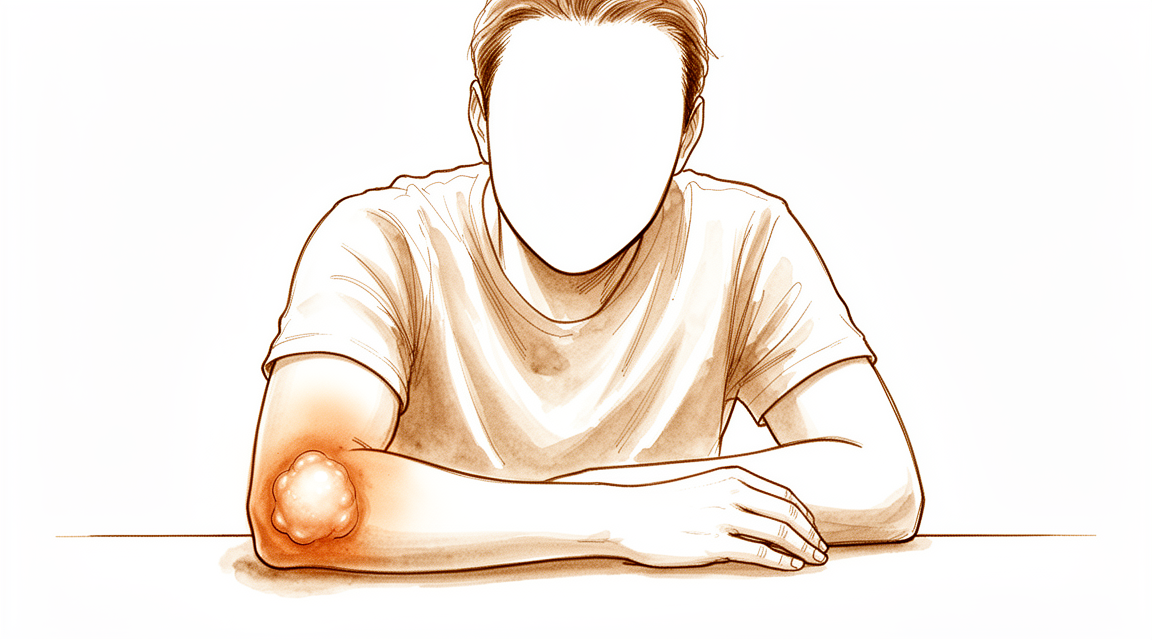
O que você está sentindo
A bursite do olécrano significa que o pequeno saco de amortecimento localizado na ponta do cotovelo ficou inchado. Esse saco, chamado de bolsa sinovial, normalmente permite que a pele deslize suavemente sobre o osso. Quando inflama, surge um nódulo macio, às vezes doloroso, exatamente na ponta do cotovelo.
O inchaço costuma ser o primeiro sinal percebido. Ele pode surgir rapidamente em um ou dois dias, ou de forma lenta ao longo de semanas. Apoiar o peso no cotovelo piora a situação; por isso, trabalhar em frente a uma mesa, apoiar o braço no braço da cadeira ou dormir com o cotovelo dobrado podem agravar o problema. Muitas pessoas sentem dor à noite, especialmente se dormem do lado afetado. Esticar o braço e aliviar a pressão sobre a ponta do cotovelo costuma ajudar a melhorar os sintomas.
Atividades cotidianas que exigem dobrar o cotovelo contra resistência ou pressionar a ponta do cotovelo tornam-se desconfortáveis. Levantar-se de uma cadeira baixa, carregar sacolas de compras apoiando o antebraço, colocar a louça na máquina de lavar ou apoiar o cotovelo na mesa enquanto lê podem causar desconforto. Esticar o braço acima da cabeça também pode puxar a área inchada.
O inchaço nem sempre se deve apenas ao desgaste normal. Às vezes, ele resulta de uma infecção na bolsa sinovial, o que geralmente deixa a pele do cotovelo vermelha, quente e mais dolorida. Outras vezes, é causado por cristais na articulação, condição conhecida como gota; isso é mais provável se você já teve crises semelhantes ou se o outro cotovelo também está afetado. O inchaço também pode estar ligado a doenças articulares inflamatórias, como a artrite reumatoide, que geralmente afeta várias articulações em ambos os lados do corpo.
Como essas causas podem apresentar sintomas parecidos, nem sempre é fácil distingui-las apenas pelo aspecto externo. Se o cotovelo estiver quente, vermelho ou muito dolorido, ou se o inchaço persistir por semanas sem melhorar, vale a pena procurar um médico para avaliação adequada e iniciar o tratamento correto.
O que está realmente acontecendo
Na ponta do cotovelo, existe um pequeno saco de líquido chamado bursa. Imagine-o como uma almofadinha fina, um tipo de bolsa acolchoada entre a pele e o osso. Sua função é permitir que a pele deslize suavemente sobre o osso toda vez que você dobra ou estica o braço.
Na bursite olecraniana, essa “almofadinha” fica inflamada e incha devido ao acúmulo de líquido extra. Isso geralmente ocorre após pequenos impactos ou pressão repetida na região do cotovelo, como acontece ao se apoiar em superfícies duras dia após dia. Com o tempo, o saco também pode simplesmente aumentar de tamanho devido ao atrito constante. O nódulo que se pode ver e sentir é, na verdade, o próprio saco inchado; a sensibilidade ao toque se deve ao tecido inflamado ao redor dele.
Às vezes, o inchaço não é apenas resultado de irritação. O saco pode ficar infectado; por isso, uma bursa infectada costuma estar quente, vermelha e mais dolorida do que uma simplesmente inflamada. Cristais provenientes da gota também podem se acumular no saco, e doenças inflamatórias como a artrite reumatoide podem provocar inchaço e pequenos nódulos duros na mesma região. Como essas causas apresentam aspectos externos muito semelhantes, é necessário um exame adequado para diferenciá-las.
O osso na ponta do cotovelo, chamado olecrano, fica logo abaixo da pele, com muito pouca proteção ao redor. É justamente por essa posição exposta que ele sofre tantos impactos e a bursa acima dele acaba absorvendo grande parte desse desgaste. Esse mesmo osso serve de ponto de fixação para o tendão do músculo localizado na parte posterior do braço, responsável por esticar o cotovelo; portanto, problemas nessa região podem afetar tanto a sensação quanto o movimento do cotovelo como um todo.
O que podemos fazer a respeito
O Dr. Kieran Hirpara, cirurgião de membro superior no Mater Private Hospital Rockhampton, começa com as opções menos invasivas adequadas ao seu caso. Em geral, os pacientes são encaminhados à nossa clínica pelo seu médico de família; caso um fisioterapeuta tenha sugerido que você nos procure, ainda assim será necessário um encaminhamento do seu médico de família para ter direito ao reembolso do Medicare. Na sua primeira consulta, colhemos o histórico clínico, examinamos o cotovelo e solicitamos exames de imagem, como ultrassonografia ou ressonância magnética, se isso for útil. A ressonância magnética utiliza ímãs para gerar imagens detalhadas dos tecidos moles; ela é eficaz para mostrar o grau de inchaço do saco bursal e a quantidade de líquido nele contida. Os exames de imagem também podem revelar outros problemas ocultos por trás do inchaço, o que é importante, pois diferentes causas exigem tratamentos distintos.
Na maioria dos casos crônicos, iniciamos com cuidados de suporte simples: aplicação de gelo, compressão com bandagem ou manga elástica, uso de proteção acolchoada sobre a região do cotovelo e modificação das atividades que contribuem para o agravamento do quadro. Aliviar a pressão sobre a ponta do cotovelo costuma ser a mudança mais eficaz que o paciente pode fazer. A fisioterapia visa reduzir a irritação e restaurar movimentos confortáveis, sem provocar novo inchaço. Testamos essa abordagem por um tempo razoável antes de considerar outras opções, pois o tratamento não cirúrgico funciona bem para a maioria das pessoas e evita os riscos associados a injeções ou cirurgias.
Se o saco bursal estiver infectado, tratamos diretamente essa infecção. Em casos sem complicações, a infecção costuma ser controlada apenas com medicamentos, sem necessidade de remoção do saco. Também acompanhamos de perto pacientes com artrite reumatoide, pois a própria articulação do cotovelo pode ser afetada simultaneamente à bursa, o que altera o tratamento a ser adotado.
A cirurgia não é nossa primeira opção para esse problema. A maioria dos cirurgiões evita operar precocemente, pois uma incisão sobre esse osso proeminente pode demorar a cicatrizar e, às vezes, deixar um “sinus”, um pequeno canal que continua drenando líquido. Quando o tratamento não cirúrgico não traz melhoria suficiente e o inchaço persiste, consideramos a remoção do saco inflamado, procedimento conhecido como bursectomia. Quando adequado, podemos realizá-lo por meio de pequenas incisões e de uma câmera miniatura, técnica chamada cirurgia endoscópica; isso evita uma cicatriz longa exatamente sobre a região sensível do cotovelo. Decidir se a cirurgia é a melhor opção para você é uma decisão conjunta, na qual ponderamos o que você deseja recuperar em comparação com os riscos e benefícios de cada alternativa.
O que esperar
Na maioria das pessoas, esse inchaço diminui com cuidados simples. Aliviar a pressão sobre o cotovelo, protegê-lo com almofadas e reduzir atividades que o agravam dão à bolsa sinovial a oportunidade de se acalmar. O tratamento não cirúrgico costuma ser mais eficaz e seguro do que a cirurgia para essa condição; a maioria das pessoas nunca precisa de operação. Se a bolsa estiver infectada, mas a infecção for leve, o tratamento com medicamentos geralmente basta, e o inchaço pode ser controlado sem necessidade de drenagem ou remoção da bolsa.
Na ausência desses cuidados, ou se as mesmas pressões continuarem, o inchaço tende a persistir ou reaparecer. Algumas pessoas percebem que ele permanece por semanas sem melhorar. Se o cotovelo ficar inchado por muito tempo, vale a pena reavaliá-lo, pois um inchaço persistente pode indicar uma causa menos comum que requer tratamento específico.
Quando os cuidados não cirúrgicos são aplicados e o inchaço continua a reaparecer, a cirurgia para remover a bolsa inflamada torna-se uma opção. Essa decisão não é tomada de forma leviana; geralmente só é considerada após a falha de medidas mais simples. Quando a cirurgia é realizada para esse tipo de inchaço persistente, os pacientes costumam notar melhora real na sensação e na função do cotovelo. A remoção da bolsa por meio de pequenos cortes e uso de uma câmera minúscula está associada a pouca dor pós-operatória e recuperação rápida; nos casos relatados, não houve recorrência nem complicações na cicatrização que exigissem nova intervenção cirúrgica. Mesmo assim, a cirurgia não é infalível: cerca de 11,5% das pessoas que têm a bolsa removida precisam de outra operação posterior. Há também uma pequena chance de o inchaço reaparecer mesmo após a cirurgia.
A recuperação após a cirurgia costuma ser tranquila; porém, a cicatrização de uma ferida nessa região óssea pode ser lenta, motivo pelo qual os cirurgiões preferem evitar a operação precocemente. A maioria das pessoas volta a usar o cotovelo normalmente em poucas semanas, não meses. Se a cirurgia vier a ser necessária, seu cirurgião explicará como será a recuperação para você.
Quando procurar ajuda médica
A maior parte do inchaço na região do cotovelo melhora com repouso e cuidados simples. Consulte seu médico de família se o nódulo continuar crescendo ou se não diminuir após algumas semanas de repouso do cotovelo.
Algumas causas exigem tratamento imediato. Dirija-se ao pronto-socorro se a pele sobre o cotovelo estiver quente, vermelha e muito dolorida, pois isso pode indicar infecção no saco sinovial, que requer avaliação no mesmo dia. Solicite avaliação por um especialista se já teve ataques de gota, se o outro cotovelo também estiver inchado ou se várias articulações em ambos os lados do corpo estiverem afetadas; isso sugere gota ou uma condição inflamatória como artrite reumatoide, e não apenas irritação simples. É difícil distinguir uma infecção da gota apenas pelo aspecto externo; portanto, não tente fazer esse diagnóstico por conta própria.
Em maior profundidade
Advanced reading: the deeper science (optional)
Esta seção aborda temas além do necessário para a tomada de decisões terapêuticas por parte do paciente. A bursite do olécrano merece uma leitura mais aprofundada, pois existem evidências contrárias a duas das medidas mais comumente adotadas: a drenagem do acúmulo de líquido por meio de agulha e a injeção de esteroides no local.
A drenagem pode ser justamente o que causa o problema
A intuição sugere o seguinte: há fluido, então devemos retirá-lo. Contudo, os dados de estudos indicam o oposto.
Numa comparação entre estratégias de tratamento para bursite séptica do olécrano sem complicações, o tratamento empírico sem aspiração se mostrou eficaz; nenhum paciente precisou de bursectomia. Já no grupo que recebeu aspiração tradicional, 8 de 11 pacientes acabaram necessitando da remoção cirúrgica da bursa [1].
Trata-se de uma diferença marcante, observada num estudo de pequena escala; portanto, deve ser interpretada com cautela. Mas o mecanismo por trás disso não é misterioso: a bursa fica logo abaixo de uma pele fina, sobre um ponto ósseo que sofre todo tipo de impacto e pressão, como ao se apoiar numa mesa. A inserção de uma agulha através dessa pele cria um canal; e um canal situado num ponto de pressão demora a fechar, podendo continuar a drenar fluido.
As revisões gerais sobre o tema concordam nesse ponto. Baseando-se principalmente em evidências de nível IV, o tratamento não cirúrgico é significativamente mais eficaz e seguro do que o tratamento cirúrgico [2].
A injeção de esteroides apresenta riscos sem melhorar o resultado
Isso é afirmado de maneira bastante clara na literatura médica. No caso da bursite asséptica, a injeção de corticosteroides está associada a riscos significativos, sem melhorar o resultado [2].
Esses riscos são específicos para o local: atrofia cutânea e despigmentação sobre proeminências ósseas subcutâneas, além do risco de infecção em um espaço difícil de limpar. Em outras regiões do membro superior, a injeção de esteroides é uma medida razoável quando métodos mais simples não surtem efeito. Porém, neste caso, as evidências não a sustentam; essa diferença merece ser conhecida caso essa opção seja oferecida.
A cirurgia é realmente um último recurso, apresentando uma taxa de falha mensurável
Mesmo quando a bursectomia é realizada, ela não garante necessariamente um desfecho favorável. A taxa de revisão após a bursectomia foi de 11,5%, sendo essa revisão mais frequente em pacientes com artrite reumatoide, diabetes, histórico de bursite em qualquer um dos cotovelos e em mulheres [3].
Esses fatores de risco indicam as situações em que a bursa tem maior probabilidade de se reformar: um fator inflamatório ou metabólico que a cirurgia não elimina, ou uma tendência comprovada do tecido daquele indivíduo a gerar esse problema. Nos casos recorrentes, a escleroterapia com doxiciclina intrabursal — que visa cicatrizar o espaço em vez de excisá-lo — tem sido descrita como alternativa em uma série de 45 cotovelos [4].
O que realmente faz com que a condição melhore
A resposta pouco glamourosa é proteção e tempo. Como a bursa é irritada mecanicamente pela pressão no ponto do cotovelo, o tratamento que ataca a causa consiste em eliminar essa pressão: usar almofadas e mudar o hábito de apoiar o peso no cotovelo, mantendo essas medidas por mais tempo do que parece necessário. A maioria dos casos melhora [5]; as intervenções mencionadas acima são, em grande parte, tentativas de encurtar um processo que, de qualquer forma, acaba se resolvendo sozinho. É exatamente por isso que qualquer intervenção que traga riscos próprios precisa atender a critérios bastante rigorosos neste contexto.
Referências
[1] Deal JB, Vaslow AS, Bickley RJ, Verwiebe EG, Ryan PM. Tratamento empírico da bursite séptica do olécrano não complicada, sem aspiração. J Hand Surg Am. 2020;45(1):20-5. https://doi.org/10.1016/j.jhsa.2019.06.012
[2] Sayegh ET, Strauch RJ. Tratamento da bursite do olécrano: uma revisão sistemática. Arch Orthop Trauma Surg. 2014;134(11):1517-36. https://doi.org/10.1007/s00402-014-2088-3
[3] Germawi L, Westenberg RF, Wang F, Schep NW, Chen NC, Eberlin KR. Fatores associados à cirurgia de revisão para bursite do olécrano após bursectomia. J Shoulder Elbow Surg. 2021;30(5):1135-41. https://doi.org/10.1016/j.jse.2020.09.033
[4] McDermott D, Wakefield D, Kowalsky M, Sethi P, Vitale MA, Morrey BF. Escleroterapia com doxiciclina intrabursal para bursite recorrente do olécrano. J Hand Surg Glob Online. 2024;6(4):504-9. https://doi.org/10.1016/j.jhsg.2024.03.006
[5] Nchinda NN, Wolf JM. Manejo clínico da bursite do olécrano: uma revisão. J Hand Surg Am. 2021;46(6):501-6. https://doi.org/10.1016/j.jhsa.2021.02.006
Evidence & references
This is the clinical evidence summary written for health professionals. It is technical, and it lists the research this page was built from. You do not need to read it to understand your treatment or to make a decision about it.
Overview
- Surgical resection of a chronic olecranon bursitis should not be considered lightly [1].
- The revision rate after bursectomy for olecranon bursitis was 11.5% [2].
- The operation appears to give satisfactory results for chronic olecranon bursitis [3].
- Based primarily on level IV evidence, nonsurgical management of olecranon bursitis is significantly more effective and safer than surgical management [4].
- Nontuberculous mycobacterial olecranon bursitis should be considered in any patient with a swollen bursa and protracted course, regardless of immune status [5].
- Patients who underwent endoscopic olecranon bursectomy experienced no recurrences or wound-healing complications necessitating return to the operating room [6].
- Empirical management of uncomplicated septic olecranon bursitis was found to be effective with no patients requiring bursectomy [7].
- In the traditional aspiration group for uncomplicated septic olecranon bursitis, 8 of 11 patients required bursectomy [7].
- Intrabursal doxycycline sclerotherapy may be an effective alternative to surgical bursectomy for patients with recurrent olecranon bursitis refractory to conservative management [8].
- Patients with refractory olecranon bursitis, particularly if aseptic, tend to gain significant physical health benefits from open bursectomy [9].
- Endoscopic bursectomies are a useful treatment option for patients with recalcitrant olecranon bursitis [10].
- Bursal suture repair is a viable alternative to bursectomy in selected patients with chronic traumatic olecranon bursitis [11].
- Bursal suture repair combines functional and cosmetic benefits in selected patients with chronic traumatic olecranon bursitis [11].
- Deferring aspiration in uncomplicated septic olecranon bursitis is a reasonable treatment option [16].
Anatomy & Pathophysiology
Bony Anatomy
- The olecranon and the coronoid process form the greater sigmoid notch, which articulates with the trochlea of the distal humerus [19].
- The intrinsic anatomy of the greater sigmoid notch allows flexion/extension movement of the elbow joint and provides stability for the elbow [19].
- The olecranon serves as the insertion for the triceps tendon, which blends with the periosteum of the proximal ulna [19].
- The exposed position of the olecranon renders it vulnerable to direct trauma and violent muscular contractions from the triceps [19].
- In children, the olecranon is predominantly cartilage, particularly in younger children, which reduces the chance of fracture occurring with a direct blow [20].
- The thick periosteum and relatively thin metaphyseal cortex of the olecranon in children predispose it to minimally displaced greenstick fractures [20].
Pathophysiology
- Olecranon bursitis is a condition where the bursal cavity, superficial to the olecranon, becomes inflamed [13].
- Olecranon bursitis can occur with or without infection [13].
- Olecranon bursitis is often predisposed by repeated minor trauma from external pressure [13].
- The olecranon bursa sometimes becomes enlarged as a result of pressure or friction [27].
- When the olecranon bursa is painful, the cause is more likely to be infection, gout, or rheumatoid arthritis [27].
- Gout is suspected in olecranon bursitis if there is a history of previous attacks, if the condition is bilateral, if there are tophi, or if X-ray shows calcification in the bursa [27].
- Rheumatoid arthritis causes both swelling and nodularity over the olecranon [27].
- In almost all cases of rheumatoid arthritis affecting the olecranon, it is associated with a typical symmetrical polyarthritis [27].
- In the late stages of rheumatoid arthritis, erosion of the elbow joint may cause marked instability [27].
Classification
- Olecranon bursitis has been given pseudonyms relating to the repeated minor trauma from external pressure that often predisposes [13].
- Traumatic lesions of the olecranon bursa are common injuries associated with a high risk of complications [14].
Clinical Presentation
- Olecranon bursitis is a common condition where the bursal cavity, superficial to the olecranon, becomes inflamed [13].
- Olecranon bursitis can occur either with or without infection [13].
- Due to multiple aetiologies, olecranon bursitis can present to any medical specialty with reasonable frequency [13].
- When the olecranon bursa is also painful, the cause is more likely to be infection, gout, or rheumatoid arthritis [27].
- Gout is suspected if there is a history of previous attacks, if the condition is bilateral, if there are tophi, or if X-ray shows calcification in the bursa [27].
- In almost all cases of rheumatoid arthritis-associated olecranon bursitis, the condition is associated with a typical symmetrical polyarthritis [27].
- Pyoderma gangrenosum must be considered in the differential diagnosis whenever a patient presents with ulcerative cutaneous lesions that resemble an infectious process such as olecranon bursitis [38].
Investigations
- MR imaging is probably the method of choice for determining both the development of the bursae and their fluid content [44].
Treatment
Non-Operative Management
- The first treatment line for olecranon bursitis is conservative, including ice, rest, anti-inflammatory and analgesic drugs and, occasionally, bursal fluid aspiration [25].
- More recent literature demonstrates adverse effects of intrabursal injections and surgery compared with noninvasive management for initial treatment of nonseptic olecranon bursitis [18].
- Hydrothermal ablation at temperatures between 50C and 52C is a safe treatment option for recurrent or chronic olecranon bursitis [34].
- Hydrothermal ablation for recurrent or chronic olecranon bursitis has fewer complications than open bursectomy and comparable efficacy [34].
Operative Management
- Open bursectomy appears to give satisfactory results for chronic olecranon bursitis [3].
- Endoscopic olecranon bursectomy provides a satisfactory view with less morbidity than the open method while avoiding a wound over the sensitive point of the olecranon [15].
- Bursal suture repair is a viable alternative to bursectomy in selected patients with chronic traumatic olecranon bursitis, combining functional and cosmetic benefits [11].
- Excision has been curative for all lesions of the olecranon bursa, whereas multiple medications have been tried for cutaneous and systemic infections without clear-cut success [17].
Surgical Complications and Outcomes
- More recent literature demonstrates adverse effects of surgery compared with noninvasive management for initial treatment of nonseptic olecranon bursitis [18].
- Surgeons are reluctant to perform surgical excision as first-line treatment for chronic olecranon bursitis due to the fear of causing a chronic draining sinus or infection [45].
Infection and Atypical Etiologies
Recovery
- Nonsurgical management of olecranon bursitis is significantly more effective and safer than surgical management [4].
- 8 of 11 patients in the traditional aspiration group required bursectomy [7].
- Bursal suture repair combines functional and cosmetic benefits [11].
- The extrabursal endoscopic approach provides a satisfactory view with less morbidity than the open method [15].
- The extrabursal endoscopic approach avoids a wound over the sensitive point of the olecranon [15].
- Excision has been curative for all lesions of the olecranon bursa [17].
- Multiple medications have been tried for cutaneous and systemic infections without clear-cut success [17].
Key Evidence
- [L3] The revision rate after bursectomy for olecranon bursitis was 11.5%. [2] (10.1016/j.jse.2020.09.033)
- [L4] The operation appears to give satisfactory results for chronic olecranon bursitis. [3] (10.1016/s0020-1383(77)80050-8)
- [L4] Based primarily on level IV evidence, nonsurgical management of olecranon bursitis is significantly more effective and safer than surgical management. [4] (10.1007/s00402-014-2088-3)
- [L4] Nontuberculous mycobacterial olecranon bursitis should be considered in any patient with a swollen bursa and protracted course, regardless of immune status. [5] (10.1016/j.jse.2008.07.009)
- [L4] In this population, patients who underwent endoscopic olecranon bursectomy experienced no recurrences or wound-healing complications necessitating return to the operating room. [6] (10.1016/j.asmr.2023.100832)
- [L4] Empirical management of uncomplicated septic olecranon bursitis was found to be effective with no patients requiring bursectomy, whereas 8 of 11 patients in the traditional aspiration group required bursectomy. [7] (10.1016/j.jhsa.2019.06.012)
- [L4] This may be an effective alternative to surgical bursectomy for patients with recurrent olecranon bursitis refractory to conservative management. [8] (10.1016/j.jhsg.2024.03.006)
- [L4] Patients with refractory olecranon bursitis, particularly if aseptic, tend to gain significant physical health benefits from open bursectomy. [9] (10.7759/cureus.43696)
- [L5] Endoscopic bursectomies are a useful treatment option for patients with recalcitrant olecranon bursitis. [10] (10.1016/j.eats.2023.09.004)
- [L5] Bursal suture repair is a viable alternative to bursectomy in selected patients with chronic traumatic olecranon bursitis, combining functional and cosmetic benefits. [11] (10.1016/j.xrrt.2025.100597)
- [L4] [13] (10.1177/1758573214532787)
- [Paper] Traumatic lesions of the olecranon bursa or prepatellar bursa are common injuries associated with a high risk of complications. [14] (10.1007/s00402-017-2690-2)
- [L4] This approach provides a satisfactory view with less morbidity than the open method while avoiding a wound over the sensitive point of the olecranon. [15] (10.1097/bth.0b013e31829c0535)
- [L4] Deferring aspiration in uncomplicated septic olecranon bursitis is a reasonable treatment option. [16] (10.1016/j.jhsa.2018.06.059)
- [Case_report] Excision has been curative for all lesions of the olecranon bursa, whereas multiple medications have been tried for cutaneous and systemic infections without clear-cut success. [17] (10.2106/00004623-198062050-00024)
- [L5] Older studies showed resolution with injections and surgery, but more recent literature demonstrates adverse effects of intrabursal injections and surgery compared with noninvasive management for initial treatment of nonseptic olecranon bursitis. [18] (10.1016/j.jhsa.2021.02.006)
- [L4] The first treatment line for olecranon bursitis is conservative, including ice, rest, anti-inflammatory and analgesic drugs and, occasionally, bursal fluid aspiration. [25] (10.1016/j.surge.2012.02.002)
- [L4] Hydrothermal ablation at temperatures between 50C and 52C is a safe treatment option for recurrent or chronic olecranon bursitis with fewer complications than open bursectomy and a comparable efficacy. [34] (10.1016/j.jse.2024.03.021)
- [Case_report] PG must be considered in the differential diagnosis whenever a patient presents with ulcerative cutaneous lesions that resemble an infectious process such as olecranon bursitis. [38] (10.1016/j.jse.2014.06.032)
- [L4] MR imaging is probably the method of choice for determining both the development of the bursae and their fluid content. [44] (10.1007/s002560050117)
- [L3] [45] (10.1016/j.jhsa.2010.12.030)
References
[1] Complications following resection of the olecranon bursa. Acta Orthopaedica Belgica. 2006.
[2] Factors associated with revision surgery for olecranon bursitis after bursectomy. Journal of Shoulder and Elbow Surgery. 2021. DOI: 10.1016/j.jse.2020.09.033
[3] A useful procedure in the treatment of chronic olecranon bursitis. Injury. 1977. DOI: 10.1016/s0020-1383(77)80050-8
[4] Treatment of olecranon bursitis: a systematic review. Archives of Orthopaedic and Trauma Surgery. 2014. DOI: 10.1007/s00402-014-2088-3
[5] Nontuberculous mycobacterial olecranon bursitis: Case reports and literature review. Journal of Shoulder and Elbow Surgery. 2009. DOI: 10.1016/j.jse.2008.07.009
[6] No Wound Healing Complications or Recurrences Were Seen and a High Level of Satisfaction Was Reported in Patients Who Underwent Endoscopic Olecranon Bursectomy for Recalcitrant Olecranon Bursitis. Arthroscopy, Sports Medicine, and Rehabilitation. 2024. DOI: 10.1016/j.asmr.2023.100832
[7] Empirical Treatment of Uncomplicated Septic Olecranon Bursitis Without Aspiration. The Journal of Hand Surgery. 2020. DOI: 10.1016/j.jhsa.2019.06.012
[8] Intrabursal Doxycycline Sclerotherapy for Recurrent Olecranon Bursitis of the Elbow: A Case Control Study. Journal of Hand Surgery Global Online. 2024. DOI: 10.1016/j.jhsg.2024.03.006
[9] Clinical Outcomes Following Open Olecranon Bursa Excision for Septic and Aseptic Olecranon Bursitis: An Observational Study. Cureus. 2023. DOI: 10.7759/cureus.43696
[10] Endoscopic Olecranon Bursectomy in the Treatment of Recalcitrant Olecranon Bursitis: Patient Selection and Operative Technique. Arthroscopy Techniques. 2023. DOI: 10.1016/j.eats.2023.09.004
[11] Olecranon bursal repair for chronic traumatic bursitis: a surgical technique. JSES Reviews, Reports, and Techniques. 2026. DOI: 10.1016/j.xrrt.2025.100597
[13] Olecranon bursitis: a systematic overview. Shoulder & Elbow. 2014. DOI: 10.1177/1758573214532787
[14] Treatment and outcome with traumatic lesions of the olecranon and prepatellar bursa: a literature review apropos a retrospective analysis including 552 cases. Archives of Orthopaedic and Trauma Surgery. 2017. DOI: 10.1007/s00402-017-2690-2
[15] Olecranon Extrabursal Endoscopic Bursectomy. Techniques in Hand & Upper Extremity Surgery. 2013. DOI: 10.1097/bth.0b013e31829c0535
[16] Empiric Treatment of Uncomplicated Septic Olecranon Bursitis Without Aspiration. The Journal of Hand Surgery. 2018. DOI: 10.1016/j.jhsa.2018.06.059
[17] Protothecal olecranon bursitis. A case report and review of the literature.. The Journal of Bone & Joint Surgery. 1980. DOI: 10.2106/00004623-198062050-00024
[18] Clinical Management of Olecranon Bursitis: A Review. The Journal of Hand Surgery. 2021. DOI: 10.1016/j.jhsa.2021.02.006
[19] Aaos Comprehensive Orthopaedic Review 3. Fractures of the Elbow > II. Olecranon Fractures.
[20] Tachdjian S Pediatric Orthopaedics From The Texas Scottish Rite Hospital For Children E Book. Pigmented Villonodular Synovitis and Giant Cell Tumor of the Tendon Sheath > Olecranon Fractures.
[25] Diagnosis and management of olecranon bursitis. The Surgeon. 2012. DOI: 10.1016/j.surge.2012.02.002
[27] Apley And Solomon S Concise System Of Orthopaedics And Trauma. OLECRANON BURSITIS.
[34] Hydrothermal ablation in recurrent or chronic olecranon bursitis: a prospective study. Journal of Shoulder and Elbow Surgery. 2024. DOI: 10.1016/j.jse.2024.03.021
[38] Case report: misdiagnosed olecranon bursitis: pyoderma gangrenosum. Journal of Shoulder and Elbow Surgery. 2014. DOI: 10.1016/j.jse.2014.06.032
[44] The US,CT and MR findings of cubital bursitis: a report of five cases. Skeletal Radiology. 1996. DOI: 10.1007/s002560050117
[45] Chronic Olecranon Bursitis. The Journal of Hand Surgery. 2011. DOI: 10.1016/j.jhsa.2010.12.030