Skip to content

Patients › Elbow

Osteocondrite dissecante do capitelo

A lateral elbow joint-surface problem in young throwers and gymnasts — how it is found, when it heals with rest, and when surgery is needed.
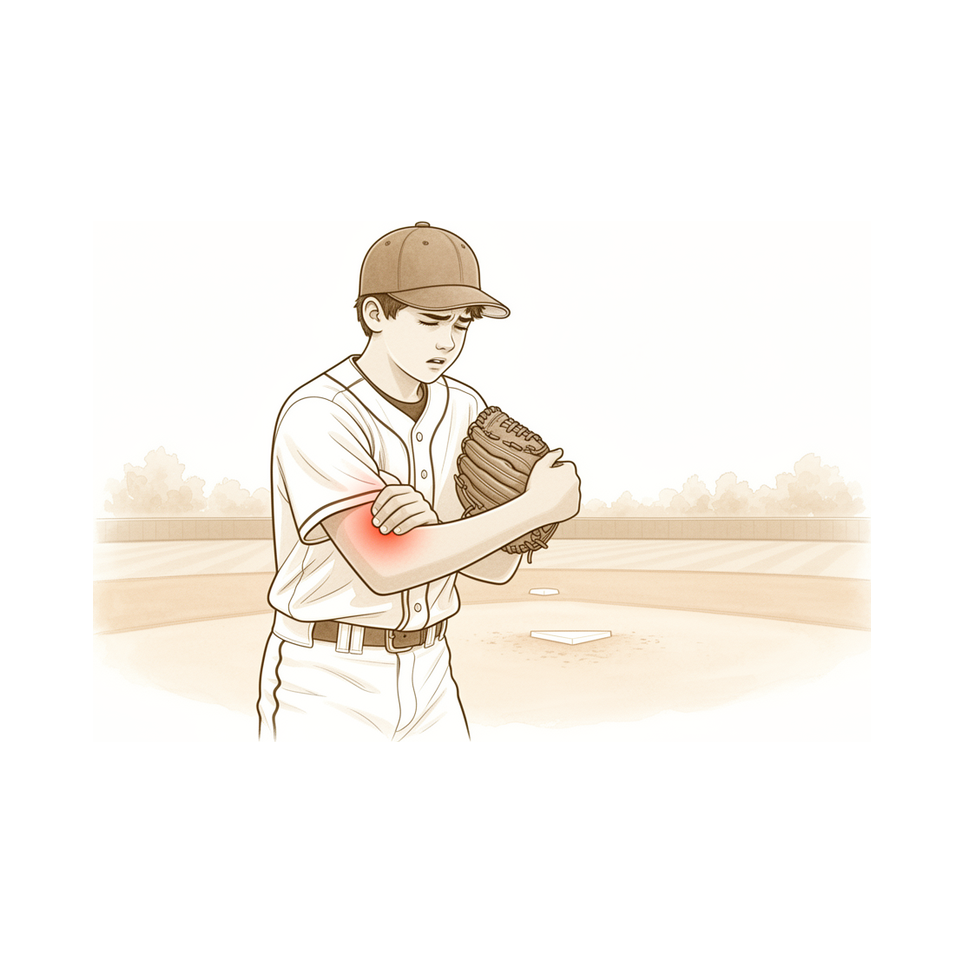
Um jovem arremessador de beisebol segurando o lado externo do cotovelo, sentindo dor.
A osteocondrite dissecante do capitelo afeta a parte externa do cotovelo em jovens arremessadores e ginastas, devido à carga repetitiva sobre a superfície articular. Kieran Hirpara 4.0

Esta página foi traduzida automaticamente e ainda não foi verificada por um médico. A versão em inglês é a versão oficial.

O que você está sentindo

Geralmente, isso se manifesta como uma dor surda e latejante na parte externa do cotovelo, sendo difícil apontar exatamente onde está a dor. Ela tende a piorar com a atividade física, especialmente ao arremessar, praticar ginástica ou qualquer movimento que sobrecarregue o braço, e melhora com o repouso. Muitos atletas jovens percebem que não conseguem mais estender completamente o cotovelo; essa perda dos últimos graus de extensão é comum e muitas vezes aparece antes de a dor se tornar um problema real.

Se um pedaço da superfície articular começar a se soltar, o cotovelo pode começar a travar, “clicar” ou apresentar sensação de bloqueio, além de inchar após a atividade física. Um verdadeiro episódio de travamento (quando o cotovelo fica imóvel por alguns instantes) geralmente indica que um pequeno fragmento de cartilagem e osso se desprendeu e está flutuando dentro da articulação. Essa condição afeta principalmente adolescentes que praticam arremessos (beisebol, críquete) ou ginástica, nos quais o lado externo do cotovelo sofre impactos repetidos.

O que está realmente acontecendo

A metade externa do cotovelo é uma protuberância óssea arredondada chamada capitelo, coberta por cartilagem lisa. Com cargas pesadas e repetidas sobre um cotovelo em crescimento, um pequeno trecho ósseo logo abaixo dessa cartilagem pode perder seu suprimento sanguíneo e começar a amolecer. Isso é osteocondrite dissecante, ou OCD. A cartilagem sobreposta pode permanecer intacta e cicatrizar, ou então esse trecho pode rachar, levantar e, por fim, se separar, formando um corpo solto.

Tenha cuidado para não confundir isso com uma condição infantil mais leve e autocorretiva chamada doença de Panner, que afeta crianças menores (geralmente com menos de 10 anos), melhora espontaneamente com repouso e não deixa danos permanentes. A verdadeira OCD ocorre em crianças mais velhas e adolescentes, podendo causar danos articulares permanentes caso um fragmento se solte.

O estado da cartilagem é extremamente importante. Uma lesão estável (cartilagem ainda firmemente aderida, placas de crescimento ainda abertas) tem boas chances de cicatrizar apenas com repouso. Já uma lesão instável (rachada, levantada ou já solta) geralmente não cicatriza sozinha e costuma necessitar de cirurgia.

O que podemos fazer a respeito

O Dr. Kieran Hirpara lidera nosso serviço de cirurgia de membro superior no Mater Private Hospital Rockhampton, onde orientamos os pacientes desde o encaminhamento inicial pelo médico clínico geral até uma avaliação detalhada do histórico clínico, exame físico e exames de imagem. Nos casos de problemas crônicos no cotovelo, geralmente iniciamos com tratamento não cirúrgico e só recorremos à cirurgia caso o repouso e a reabilitação não proporcionem alívio suficiente.

O primeiro e mais importante passo para lesões estáveis é simplesmente parar com as atividades que as agravam (nada de arremessos, nem de carregar peso com o braço) por vários meses; somente após a cicatrização óssea ser comprovada por exames é que se pode retomar as atividades gradualmente. Em atletas mais jovens, cujas placas de crescimento ainda estão abertas, muitas dessas lesões curam completamente dessa forma. O repouso não significa “não fazer nada”; ele é, na verdade, o tratamento.

Quando a lesão é instável, já gerou um corpo solto ou não melhora com o repouso, a cirurgia costuma ser indicada. Na maioria dos casos, ela é realizada por meio de cirurgia artroscópica. A técnica escolhida depende das características da lesão:

  • Ajuste e estimulação da cicatrização: remoção do fragmento danificado e realização de pequenos orifícios no osso exposto (microfratura), de modo a favorecer a formação de tecido novo. Essa abordagem é bastante eficaz para lesões menores.
  • Fixação do fragmento no lugar: se o fragmento solto for grande e de boa qualidade, às vezes é possível fixá-lo novamente com pinos ou parafusos.
  • Revestimento do defeito: em lesões maiores, especialmente aquelas na borda da articulação, podem ser transplantados enxertos de cartilagem e osso saudáveis para reconstruir a superfície articular.

O cirurgião decide qual dessas opções adotar com base no tamanho e localização da lesão, além da possibilidade de preservação da cartilagem; geralmente, essa decisão é orientada por um exame de ressonância magnética.

O que esperar

O prognóstico é geralmente bom, especialmente quando o problema é detectado precocemente e a lesão ainda está estável. Muitos pacientes jovens com lesões estáveis curam-se com repouso e retornam às suas atividades esportivas. Após a cirurgia para lesões instáveis, a maioria dos pacientes obtém bom alívio da dor e uma recuperação significativa da mobilidade; a maior parte dos atletas consegue voltar ao esporte, embora isso possa levar vários meses e exigir um programa de reabilitação estruturado.

Algumas ressalvas importantes: lesões maiores, aquelas que atingem a borda externa da articulação, e cotovelos em que as placas de crescimento já se fecharam tendem a ter um prognóstico pior e são mais propensas a necessitar de cirurgia. Pode haver alguma perda da extensão total do cotovelo; a longo prazo, uma lesão significativa pode aumentar ligeiramente o risco de desenvolver artrite no cotovelo mais tarde na vida. É exatamente por isso que o reconhecimento precoce e a proteção da articulação são tão importantes.

Quando procurar um especialista

  • Dor persistente na parte externa do cotovelo em jovens atletas que lançam ou praticam ginástica, que não melhora após uma ou duas semanas de repouso; procure avaliação antes de continuar com as atividades.
  • Perda da extensão total do cotovelo: a incapacidade de esticar completamente o cotovelo é um sinal de alerta precoce que merece ser investigado.
  • Sensação de travamento, estalos ou o cotovelo “travar”: isso indica que um fragmento ósseo pode ter se soltado, sendo necessária uma avaliação por imagem.
  • Inchaço após a atividade que reaparece repetidamente.
  • Qualquer um desses sintomas em atletas ainda em fase de crescimento requer atenção imediata, pois lesões detectadas enquanto as placas de crescimento ainda estão abertas têm maiores chances de cicatrizar sem necessidade de cirurgia.

Em maior profundidade

Advanced reading: the deeper science (optional)

Esta seção aborda temas que vão além do necessário para suas próprias decisões de tratamento. A osteocondrite dissecante do capítulo merece uma leitura mais aprofundada, pois trata-se, em grande parte, de uma doença silenciosa do cotovelo em desenvolvimento: quando finalmente causa dor suficiente para levar um jovem atleta à consulta médica, a lesão já costuma ter avançado além do ponto em que o tratamento mais simples é eficaz.

É mais comum do que os sintomas sugerem

Os resultados dos exames de rastreamento contam uma história diferente daquela observada nas consultas clínicas. Entre 2.433 adolescentes que praticam beisebol, a prevalência de osteocondrite dissecante do côndilo humeral — incluindo casos latentes — foi de 3,4%. Os atletas afetados começaram a praticar o esporte em idades mais precoces, treinaram por mais tempo e relataram maior incidência de dor no cotovelo [1].

A expressão “incluindo casos latentes” é fundamental aqui. Uma parcela significativa dessas lesões foi detectada apenas por meio do exame físico, e não porque os atletas as relataram; isso indica que a dor é um sinal tardio e pouco confiável nesse grupo de atletas, que, de qualquer forma, têm pouca tendência a mencionar esse tipo de desconforto.

O atraso altera as possibilidades de tratamento

As consequências disso ficam evidentes nas opções terapêuticas. Em 258 adolescentes, lesões avançadas foram observadas em pacientes com maior duração dos sintomas; porém, uma vez que uma lesão exigia cirurgia, eram as especificidades do tratamento, e não a duração dos sintomas, que melhor se correlacionavam com o retorno ao esporte [2].

Dois achados radiográficos indicam que o tratamento não cirúrgico provavelmente falhará: aumento do tamanho da cabeça do rádio e idade esquelética avançada no lado de arremesso em comparação com o lado não arremessador; ambos estão associados a doença em estágio avançado em 245 pacientes [3]. Ambos descrevem um cotovelo que já sofreu remodelação sob a carga mecânica, o que é uma constatação estrutural, e não apenas sintomática.

Esse é o argumento para se realizar exames de imagem em jovens atletas que apresentam dor persistente no cotovelo, em vez de tratar o problema como mera lesão de tecidos moles; também justifica a importância de levar a sério qualquer diferença entre os lados do corpo.

Para lesões estáveis, a cirurgia menos invasiva é suficiente

Quando o fragmento está estável e o defeito é pequeno, a questão em debate é se basta apenas limpar o defeito ou se também é necessário perfurar o osso abaixo dele para estimular a formação de fibrocartilagem. Em 327 pacientes, tanto o desbridamento quanto a microfratura resultaram em melhorias significativas na dor, na amplitude de movimento, nos índices de resultado e no retorno às atividades esportivas. Como resultados a médio prazo comparáveis foram obtidos apenas com o desbridamento, este constitui uma abordagem razoável para defeitos relativamente pequenos [4].

Em casos maiores ou instáveis, a equação clínica muda

Quando o fragmento se desprendeu ou o defeito é grande, é necessário substituir a superfície lesionada em vez de apenas consertá-la, geralmente por meio da transferência de um enxerto de cartilagem e osso. Esse procedimento é eficaz, mas com uma ressalva importante.

Em um estudo com 492 pacientes, a taxa geral de retorno ao esporte após o tratamento cirúrgico foi alta; além disso, os pacientes apresentaram maior probabilidade de voltar ao nível de desempenho pré-operatório após a transferência de enxerto osteocondral autólogo do que após desbridamento ou fixação [5]. Contudo, uma revisão de 470 pacientes realizada em 2024, embora confirmando altas taxas de retorno ao esporte, constatou que os atletas devem ser orientados a retornar com um nível de desempenho inferior ou a mudar de posição no time, e que a localização lateral da lesão pode prejudicar os resultados [6].

Ambas as afirmações são verdadeiras simultaneamente; essa distinção é crucial para um atleta jovem: o retorno ao esporte é provável, mas o retorno à mesma função dentro do time não é garantido. O tamanho e a localização da lesão, e não a escolha entre os procedimentos cirúrgicos disponíveis, são os principais fatores que determinam o prognóstico.

Referências

[1] Kida Y, Morihara T, Kotoura Y, Hojo T, Tachiiri H, Sukenari T, et al. Prevalência e características clínicas da osteocondrite dissecante do capitelo humeral em adolescentes praticantes de beisebol. Am J Sports Med. 2014;42(8):1963-71. https://doi.org/10.1177/0363546514536843

[2] Cheng C, Milewski MD, Nepple JJ, Reuman HS, Nissen CW. Papel preditivo da duração dos sintomas antes da apresentação clínica inicial em adolescentes com osteocondrite dissecante do capitelo na avaliação pré-operatória e pós-operatória: uma revisão sistemática. Orthop J Sports Med. 2019;7(2). https://doi.org/10.1177/2325967118825059

[3] Funakoshi T, Furushima K, Miyamoto A, Kusano H, Horiuchi Y, Itoh Y. Preditores do insucesso do tratamento não cirúrgico da osteocondrite dissecante do capitelo. Am J Sports Med. 2019;47(11):2691-8. https://doi.org/10.1177/0363546519863349

[4] McLaughlin RJ, Leland DP, Bernard CD, Sanchez-Sotelo J, Morrey ME, O'Driscoll SW, et al. Tanto o desbridamento quanto a microfratura produzem resultados excelentes no tratamento de lesões por osteocondrite dissecante do capitelo: uma revisão sistemática. Arthrosc Sports Med Rehabil. 2021;3(2):e593-e603. https://doi.org/10.1016/j.asmr.2020.10.002

[5] Westermann RW, Hancock KJ, Buckwalter JA, Kopp B, Glass N, Wolf BR. Retorno ao esporte após tratamento cirúrgico da osteocondrite dissecante do capitelo: uma revisão sistemática e meta-análise. Orthop J Sports Med. 2016;4(6). https://doi.org/10.1177/2325967116654651

[6] Lane G, Smith MV, Goldfarb CA, Coronado RA, Bowman EN. Resultados e retorno ao esporte após transplante autólogo osteocondral no tratamento da osteocondrite dissecante do capitelo: uma revisão sistemática. JSES Rev Rep Tech. 2024;4(3):563-70. https://doi.org/10.1016/j.xrrt.2024.02.011


Creative Commons BY-NC 4.0

CC Creative Commons licence
BY Attribution — you must credit the source
NC NonCommercial — not for commercial use

Attribution-NonCommercial 4.0 International


Creative Commons Corporation ("Creative Commons") is not a law firm and does not provide legal services or legal advice. Distribution of Creative Commons public licenses does not create a lawyer-client or other relationship. Creative Commons makes its licenses and related information available on an "as-is" basis. Creative Commons gives no warranties regarding its licenses, any material licensed under their terms and conditions, or any related information. Creative Commons disclaims all liability for damages resulting from their use to the fullest extent possible.

Using Creative Commons Public Licenses

Creative Commons public licenses provide a standard set of terms and conditions that creators and other rights holders may use to share original works of authorship and other material subject to copyright and certain other rights specified in the public license below. The following considerations are for informational purposes only, are not exhaustive, and do not form part of our licenses.

Considerations for licensors: Our public licenses are intended for use by those authorized to give the public permission to use material in ways otherwise restricted by copyright and certain other rights. Our licenses are irrevocable. Licensors should read and understand the terms and conditions of the license they choose before applying it. Licensors should also secure all rights necessary before applying our licenses so that the public can reuse the material as expected. Licensors should clearly mark any material not subject to the license. This includes other CC- licensed material, or material used under an exception or limitation to copyright. More considerations for licensors: wiki.creativecommons.org/Considerations_for_licensors

Considerations for the public: By using one of our public licenses, a licensor grants the public permission to use the licensed material under specified terms and conditions. If the licensor's permission is not necessary for any reason--for example, because of any applicable exception or limitation to copyright--then that use is not regulated by the license. Our licenses grant only permissions under copyright and certain other rights that a licensor has authority to grant. Use of the licensed material may still be restricted for other reasons, including because others have copyright or other rights in the material. A licensor may make special requests, such as asking that all changes be marked or described. Although not required by our licenses, you are encouraged to respect those requests where reasonable. More considerations for the public: wiki.creativecommons.org/Considerations_for_licensees


Creative Commons Attribution-NonCommercial 4.0 International Public License

By exercising the Licensed Rights (defined below), You accept and agree to be bound by the terms and conditions of this Creative Commons Attribution-NonCommercial 4.0 International Public License ("Public License"). To the extent this Public License may be interpreted as a contract, You are granted the Licensed Rights in consideration of Your acceptance of these terms and conditions, and the Licensor grants You such rights in consideration of benefits the Licensor receives from making the Licensed Material available under these terms and conditions.

Section 1 -- Definitions.

a. Adapted Material means material subject to Copyright and Similar Rights that is derived from or based upon the Licensed Material and in which the Licensed Material is translated, altered, arranged, transformed, or otherwise modified in a manner requiring permission under the Copyright and Similar Rights held by the Licensor. For purposes of this Public License, where the Licensed Material is a musical work, performance, or sound recording, Adapted Material is always produced where the Licensed Material is synched in timed relation with a moving image.

b. Adapter's License means the license You apply to Your Copyright and Similar Rights in Your contributions to Adapted Material in accordance with the terms and conditions of this Public License.

c. Copyright and Similar Rights means copyright and/or similar rights closely related to copyright including, without limitation, performance, broadcast, sound recording, and Sui Generis Database Rights, without regard to how the rights are labeled or categorized. For purposes of this Public License, the rights specified in Section 2(b)(1)-(2) are not Copyright and Similar Rights.

d. Effective Technological Measures means those measures that, in the absence of proper authority, may not be circumvented under laws fulfilling obligations under Article 11 of the WIPO Copyright Treaty adopted on December 20, 1996, and/or similar international agreements.

e. Exceptions and Limitations means fair use, fair dealing, and/or any other exception or limitation to Copyright and Similar Rights that applies to Your use of the Licensed Material.

f. Licensed Material means the artistic or literary work, database, or other material to which the Licensor applied this Public License.

g. Licensed Rights means the rights granted to You subject to the terms and conditions of this Public License, which are limited to all Copyright and Similar Rights that apply to Your use of the Licensed Material and that the Licensor has authority to license.

h. Licensor means the individual(s) or entity(ies) granting rights under this Public License.

i. NonCommercial means not primarily intended for or directed towards commercial advantage or monetary compensation. For purposes of this Public License, the exchange of the Licensed Material for other material subject to Copyright and Similar Rights by digital file-sharing or similar means is NonCommercial provided there is no payment of monetary compensation in connection with the exchange.

j. Share means to provide material to the public by any means or process that requires permission under the Licensed Rights, such as reproduction, public display, public performance, distribution, dissemination, communication, or importation, and to make material available to the public including in ways that members of the public may access the material from a place and at a time individually chosen by them.

k. Sui Generis Database Rights means rights other than copyright resulting from Directive 96/9/EC of the European Parliament and of the Council of 11 March 1996 on the legal protection of databases, as amended and/or succeeded, as well as other essentially equivalent rights anywhere in the world.

l. You means the individual or entity exercising the Licensed Rights under this Public License. Your has a corresponding meaning.

Section 2 -- Scope.

a. License grant.

1. Subject to the terms and conditions of this Public License, the Licensor hereby grants You a worldwide, royalty-free, non-sublicensable, non-exclusive, irrevocable license to exercise the Licensed Rights in the Licensed Material to:

a. reproduce and Share the Licensed Material, in whole or in part, for NonCommercial purposes only; and

b. produce, reproduce, and Share Adapted Material for NonCommercial purposes only.

2. Exceptions and Limitations. For the avoidance of doubt, where Exceptions and Limitations apply to Your use, this Public License does not apply, and You do not need to comply with its terms and conditions.

3. Term. The term of this Public License is specified in Section 6(a).

4. Media and formats; technical modifications allowed. The Licensor authorizes You to exercise the Licensed Rights in all media and formats whether now known or hereafter created, and to make technical modifications necessary to do so. The Licensor waives and/or agrees not to assert any right or authority to forbid You from making technical modifications necessary to exercise the Licensed Rights, including technical modifications necessary to circumvent Effective Technological Measures. For purposes of this Public License, simply making modifications authorized by this Section 2(a) (4) never produces Adapted Material.

5. Downstream recipients.

a. Offer from the Licensor -- Licensed Material. Every recipient of the Licensed Material automatically receives an offer from the Licensor to exercise the Licensed Rights under the terms and conditions of this Public License.

b. No downstream restrictions. You may not offer or impose any additional or different terms or conditions on, or apply any Effective Technological Measures to, the Licensed Material if doing so restricts exercise of the Licensed Rights by any recipient of the Licensed Material.

6. No endorsement. Nothing in this Public License constitutes or may be construed as permission to assert or imply that You are, or that Your use of the Licensed Material is, connected with, or sponsored, endorsed, or granted official status by, the Licensor or others designated to receive attribution as provided in Section 3(a)(1)(A)(i).

b. Other rights.

1. Moral rights, such as the right of integrity, are not licensed under this Public License, nor are publicity, privacy, and/or other similar personality rights; however, to the extent possible, the Licensor waives and/or agrees not to assert any such rights held by the Licensor to the limited extent necessary to allow You to exercise the Licensed Rights, but not otherwise.

2. Patent and trademark rights are not licensed under this Public License.

3. To the extent possible, the Licensor waives any right to collect royalties from You for the exercise of the Licensed Rights, whether directly or through a collecting society under any voluntary or waivable statutory or compulsory licensing scheme. In all other cases the Licensor expressly reserves any right to collect such royalties, including when the Licensed Material is used other than for NonCommercial purposes.

Section 3 -- License Conditions.

Your exercise of the Licensed Rights is expressly made subject to the following conditions.

a. Attribution.

1. If You Share the Licensed Material (including in modified form), You must:

a. retain the following if it is supplied by the Licensor with the Licensed Material:

i. identification of the creator(s) of the Licensed Material and any others designated to receive attribution, in any reasonable manner requested by the Licensor (including by pseudonym if designated);

ii. a copyright notice;

iii. a notice that refers to this Public License;

iv. a notice that refers to the disclaimer of warranties;

v. a URI or hyperlink to the Licensed Material to the extent reasonably practicable;

b. indicate if You modified the Licensed Material and retain an indication of any previous modifications; and

c. indicate the Licensed Material is licensed under this Public License, and include the text of, or the URI or hyperlink to, this Public License.

2. You may satisfy the conditions in Section 3(a)(1) in any reasonable manner based on the medium, means, and context in which You Share the Licensed Material. For example, it may be reasonable to satisfy the conditions by providing a URI or hyperlink to a resource that includes the required information.

3. If requested by the Licensor, You must remove any of the information required by Section 3(a)(1)(A) to the extent reasonably practicable.

4. If You Share Adapted Material You produce, the Adapter's License You apply must not prevent recipients of the Adapted Material from complying with this Public License.

Section 4 -- Sui Generis Database Rights.

Where the Licensed Rights include Sui Generis Database Rights that apply to Your use of the Licensed Material:

a. for the avoidance of doubt, Section 2(a)(1) grants You the right to extract, reuse, reproduce, and Share all or a substantial portion of the contents of the database for NonCommercial purposes only;

b. if You include all or a substantial portion of the database contents in a database in which You have Sui Generis Database Rights, then the database in which You have Sui Generis Database Rights (but not its individual contents) is Adapted Material; and

c. You must comply with the conditions in Section 3(a) if You Share all or a substantial portion of the contents of the database.

For the avoidance of doubt, this Section 4 supplements and does not replace Your obligations under this Public License where the Licensed Rights include other Copyright and Similar Rights.

Section 5 -- Disclaimer of Warranties and Limitation of Liability.

a. UNLESS OTHERWISE SEPARATELY UNDERTAKEN BY THE LICENSOR, TO THE EXTENT POSSIBLE, THE LICENSOR OFFERS THE LICENSED MATERIAL AS-IS AND AS-AVAILABLE, AND MAKES NO REPRESENTATIONS OR WARRANTIES OF ANY KIND CONCERNING THE LICENSED MATERIAL, WHETHER EXPRESS, IMPLIED, STATUTORY, OR OTHER. THIS INCLUDES, WITHOUT LIMITATION, WARRANTIES OF TITLE, MERCHANTABILITY, FITNESS FOR A PARTICULAR PURPOSE, NON-INFRINGEMENT, ABSENCE OF LATENT OR OTHER DEFECTS, ACCURACY, OR THE PRESENCE OR ABSENCE OF ERRORS, WHETHER OR NOT KNOWN OR DISCOVERABLE. WHERE DISCLAIMERS OF WARRANTIES ARE NOT ALLOWED IN FULL OR IN PART, THIS DISCLAIMER MAY NOT APPLY TO YOU.

b. TO THE EXTENT POSSIBLE, IN NO EVENT WILL THE LICENSOR BE LIABLE TO YOU ON ANY LEGAL THEORY (INCLUDING, WITHOUT LIMITATION, NEGLIGENCE) OR OTHERWISE FOR ANY DIRECT, SPECIAL, INDIRECT, INCIDENTAL, CONSEQUENTIAL, PUNITIVE, EXEMPLARY, OR OTHER LOSSES, COSTS, EXPENSES, OR DAMAGES ARISING OUT OF THIS PUBLIC LICENSE OR USE OF THE LICENSED MATERIAL, EVEN IF THE LICENSOR HAS BEEN ADVISED OF THE POSSIBILITY OF SUCH LOSSES, COSTS, EXPENSES, OR DAMAGES. WHERE A LIMITATION OF LIABILITY IS NOT ALLOWED IN FULL OR IN PART, THIS LIMITATION MAY NOT APPLY TO YOU.

c. The disclaimer of warranties and limitation of liability provided above shall be interpreted in a manner that, to the extent possible, most closely approximates an absolute disclaimer and waiver of all liability.

Section 6 -- Term and Termination.

a. This Public License applies for the term of the Copyright and Similar Rights licensed here. However, if You fail to comply with this Public License, then Your rights under this Public License terminate automatically.

b. Where Your right to use the Licensed Material has terminated under Section 6(a), it reinstates:

1. automatically as of the date the violation is cured, provided it is cured within 30 days of Your discovery of the violation; or

2. upon express reinstatement by the Licensor.

For the avoidance of doubt, this Section 6(b) does not affect any right the Licensor may have to seek remedies for Your violations of this Public License.

c. For the avoidance of doubt, the Licensor may also offer the Licensed Material under separate terms or conditions or stop distributing the Licensed Material at any time; however, doing so will not terminate this Public License.

d. Sections 1, 5, 6, 7, and 8 survive termination of this Public License.

Section 7 -- Other Terms and Conditions.

a. The Licensor shall not be bound by any additional or different terms or conditions communicated by You unless expressly agreed.

b. Any arrangements, understandings, or agreements regarding the Licensed Material not stated herein are separate from and independent of the terms and conditions of this Public License.

Section 8 -- Interpretation.

a. For the avoidance of doubt, this Public License does not, and shall not be interpreted to, reduce, limit, restrict, or impose conditions on any use of the Licensed Material that could lawfully be made without permission under this Public License.

b. To the extent possible, if any provision of this Public License is deemed unenforceable, it shall be automatically reformed to the minimum extent necessary to make it enforceable. If the provision cannot be reformed, it shall be severed from this Public License without affecting the enforceability of the remaining terms and conditions.

c. No term or condition of this Public License will be waived and no failure to comply consented to unless expressly agreed to by the Licensor.

d. Nothing in this Public License constitutes or may be interpreted as a limitation upon, or waiver of, any privileges and immunities that apply to the Licensor or You, including from the legal processes of any jurisdiction or authority.


Creative Commons is not a party to its public licenses. Notwithstanding, Creative Commons may elect to apply one of its public licenses to material it publishes and in those instances will be considered the “Licensor.” The text of the Creative Commons public licenses is dedicated to the public domain under the CC0 Public Domain Dedication. Except for the limited purpose of indicating that material is shared under a Creative Commons public license or as otherwise permitted by the Creative Commons policies published at creativecommons.org/policies, Creative Commons does not authorize the use of the trademark "Creative Commons" or any other trademark or logo of Creative Commons without its prior written consent including, without limitation, in connection with any unauthorized modifications to any of its public licenses or any other arrangements, understandings, or agreements concerning use of licensed material. For the avoidance of doubt, this paragraph does not form part of the public licenses.

Creative Commons may be contacted at creativecommons.org.