Patients › Rehabilitation
Fusão parcial do punho
Um plano de recuperação protegido após uma fusão parcial do punho (fusão capitolunata, geralmente com remoção do escafoide) em casos de punho desgastado; o membro é imobilizado até que os ossos se unam, em aproximadamente seis a oito semanas. Em seguida, restaura-se progressivamente um arco de movimento do punho e uma força de preensão úteis, porém deliberadamente limitados.
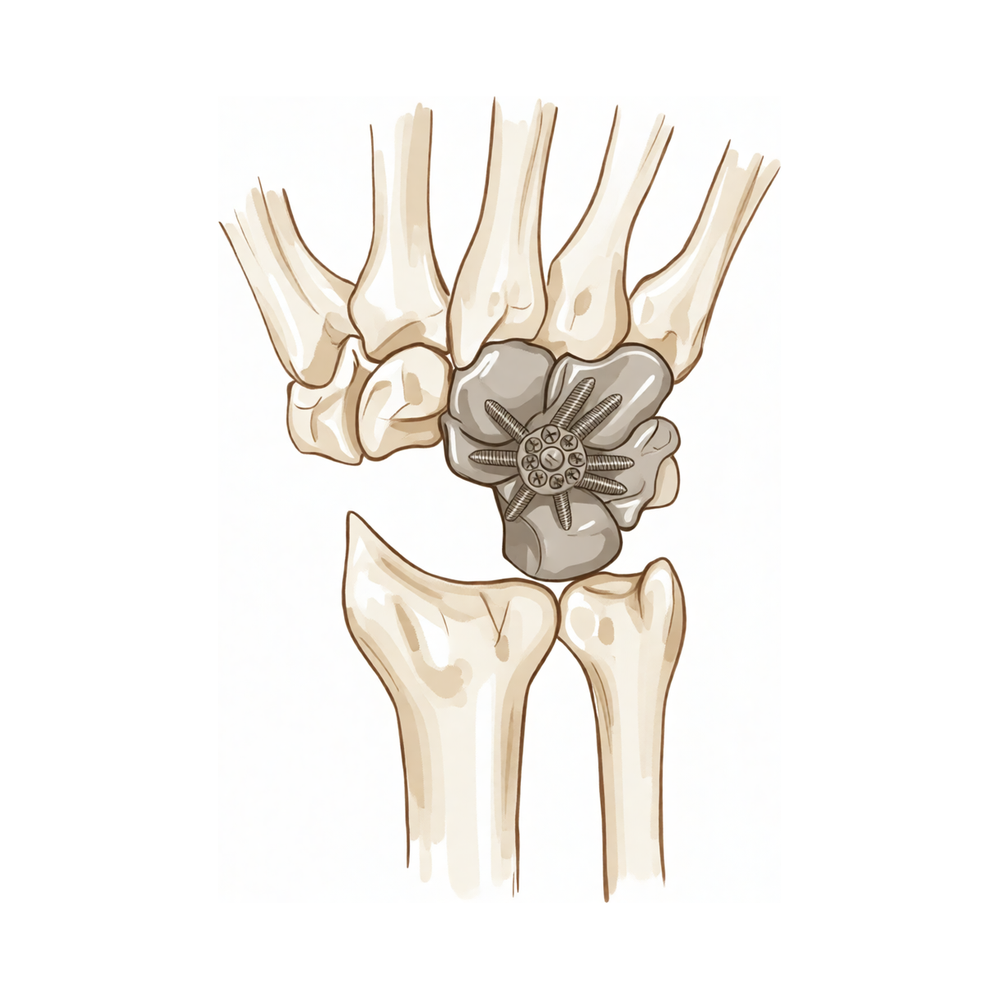
Este protocolo orienta sua recuperação após uma fusão parcial do punho (procedimento no qual se remove o osso escafoide desgastado e se une os pequenos ossos do meio do punho; na maioria dos casos, ocorre a fusão do capitato com o lunato, conhecida como fusão capitolunar) realizada pelo Dr. Kieran Hirpara no Mater Private Hospital Rockhampton. Ele começa com um programa de exercícios para ser feito em casa, seguido do protocolo clínico estruturado elaborado para seu terapeuta de mão: leve esta página ou seu arquivo PDF à primeira sessão de terapia, para que sua reabilitação seja devidamente coordenada. Seu terapeuta poderá ajustar o plano conforme a evolução da sua recuperação.
Caso tenha alguma dúvida ou preocupação quanto à ferida cirúrgica, entre em contato com o consultório. Geralmente, é útil tirar uma foto da ferida e enviá-la por e-mail para análise.
O que esperar
A fusão parcial do punho é indicada para punhos desgastados (artrite) que apresentam histórico de problemas no osso escafoide: seja por lesão do ligamento escafo-lunar (punho “SLAC”) ou por uma fratura do escafoide que nunca cicatrizou (punho “SNAC”). O escafoide danificado é removido, e os ossos do meio do punho são fundidos para que deixem de se atritar. O Dr. Hirpara geralmente realiza a fusão do capitato ao lunar (fusão capitolunar), às vezes incluindo os ossos vizinhos; quando o lunar, capitato, triquetra e hamato são todos fundidos, isso é chamado de fusão dos quatro cantos, e segue os mesmos princípios de recuperação.
A ideia central desta cirurgia é que apenas parte do punho é fundida, não todo ele. A articulação entre o lunar e o osso do antebraço (o rádio) é deliberadamente preservada. Essa articulação preservada é o que permite que o punho continue se movendo:
- A fusão das superfícies desgastadas elimina a dor: esse é o objetivo principal, e ele é alcançado de forma confiável.
- A manutenção da articulação rádio-lunar garante movimentos úteis. O preço a pagar é uma redução nos movimentos: a maioria dos pacientes acaba com cerca de metade a dois terços da amplitude de flexão anterior, e a força de preensão fica em torno de três quartos da do lado oposto. Esse é um resultado normal e esperado (não uma complicação); para um punho dolorido e desgastado, geralmente é uma troca muito vantajosa.
Os ossos fundidos precisam de tempo para se unirem firmemente, assim como em uma fratura. Durante as primeiras seis semanas, o punho permanece imóvel em uma tala para que isso aconteça. Nesse período, os dedos, o polegar e o antebraço podem se mover livremente, mas o punho deve permanecer em repouso. Assim que o cirurgião confirma, por meio de radiografia, que os ossos já se unificaram, os movimentos do punho e, posteriormente, o fortalecimento são retomados em etapas cuidadosas. Ter expectativas realistas desde o início — um punho confortável e funcional, mas não totalmente móvel — é parte essencial da recuperação.
Precauções e limitações
- Mantenha o pulso imóvel dentro da tala até que o cirurgião confirme que a fusão óssea ocorreu (geralmente após cerca de seis semanas): os ossos precisam unir-se antes que o pulso possa ser movimentado.
- Movimente os dedos, o polegar e o antebraço desde o primeiro dia, mas NÃO mova o pulso em si até receber autorização.
- NÃO aperte objetos com força, levante pesos, empurre, puxe ou exerça carga sobre o pulso até que a fusão óssea seja confirmada: isso protege o osso em cicatrização, bem como quaisquer placas, parafusos ou grampos utilizados.
- É normal que o alcance final de movimento seja reduzido: esse é o resultado esperado ao fundir parte do pulso, não um sinal de que algo deu errado.
- Mantenha a tala e o curativo limpos e secos; NÃO dirija enquanto estiver usando a tala ou caso não consiga controlar o volante com segurança.
Para orientações sobre cuidados com a ferida, inchaço e cicatrização, consulte o guia de cuidados com feridas do consultório.
Seus exercícios
Kieran Hirpara 4.0
Movimento dos dedos e do polegar
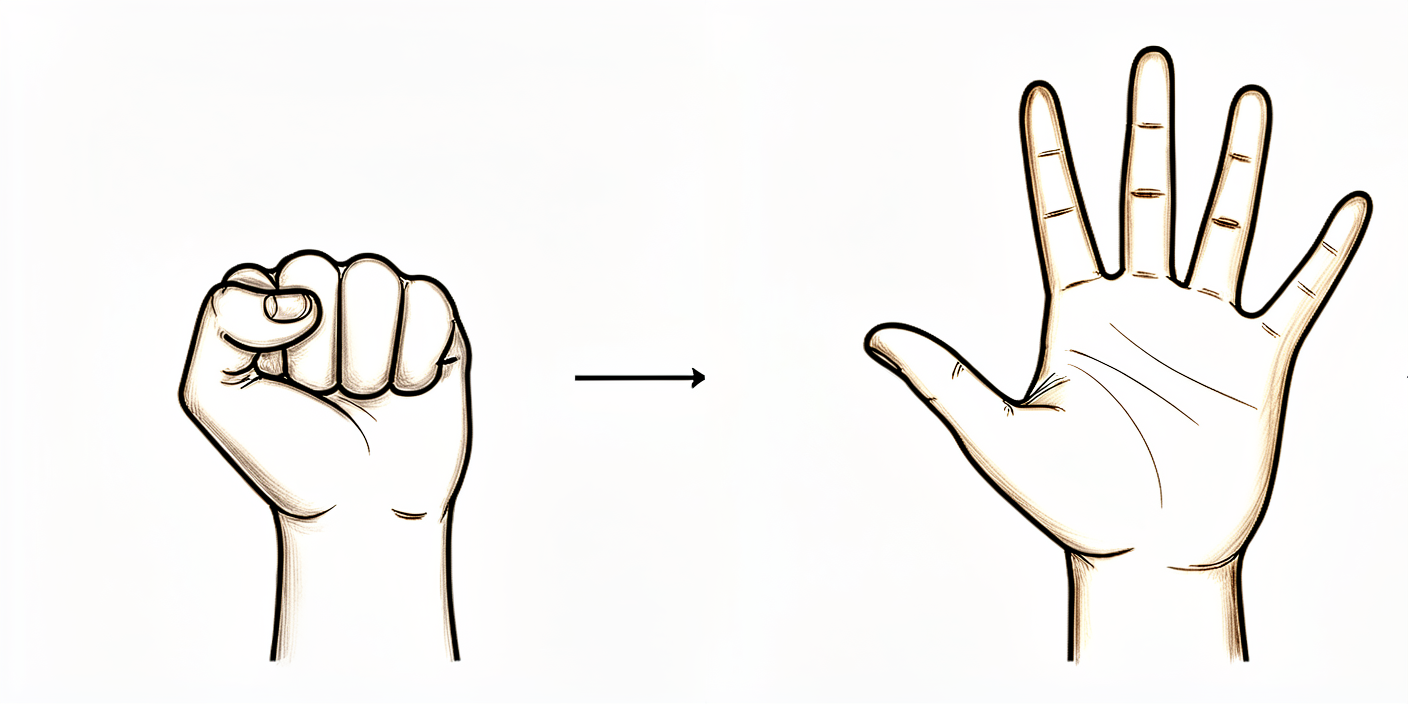
A partir do dia da cirurgia, mantenha os dedos e o polegar em movimento, enquanto o próprio punho permanece imóvel dentro do gesso ou da tala. Estique completamente todos os dedos, depois faça um punho fechado, e em seguida toque com o polegar na ponta de cada dedo, um por um. Isso evita que a mão fique rígida e permite que os tendões continuem a deslizar enquanto os ossos do punho se consolidam. Não mova o punho.
10 vezes cada um, várias vezes ao dia, todos os dias desde o início.
Kieran Hirpara 4.0
Rotação do antebraço (palma da mão para cima/para baixo)
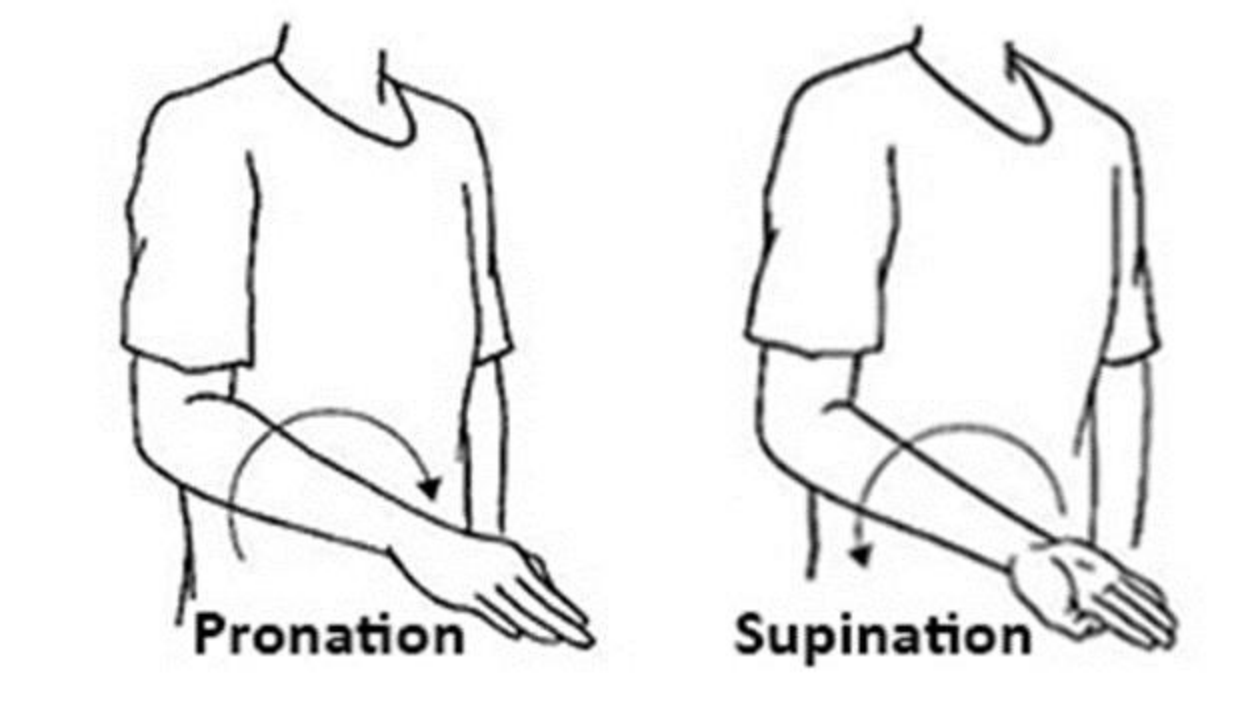
Com o cotovelo pressionado contra o corpo e dobrado em um ângulo reto, vire suavemente a palma da mão para cima, em direção ao teto, e depois para baixo, em direção ao chão. Certifique-se de que o movimento seja feito pelo antebraço, e não pelo pulso. Isso mantém o antebraço flexível e não interfere na consolidação da fusão, por isso este exercício pode ser iniciado imediatamente.
10 vezes em cada direção, 2–3 vezes ao dia.
Kieran Hirpara 4.0
Movimento do punho (após consolidação)
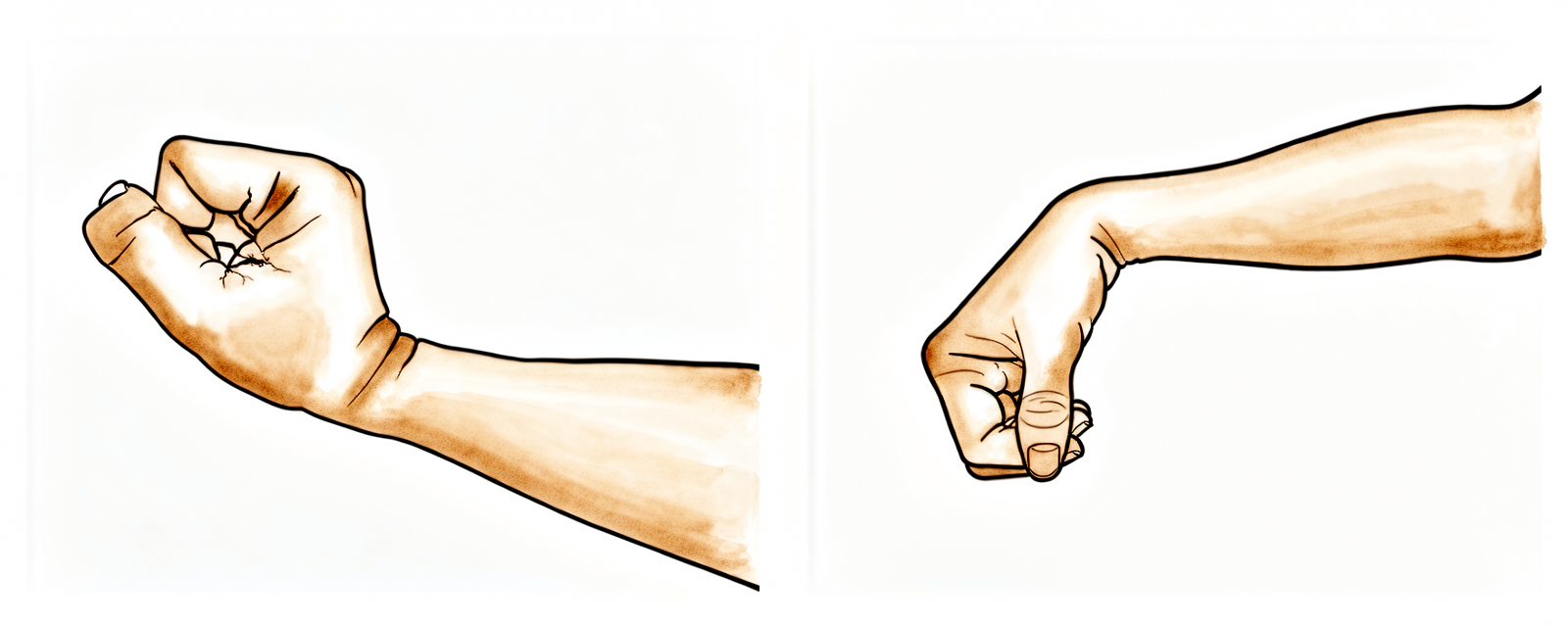
Um exercício posterior — somente após a consolidação da fusão e quando o cirurgião e o terapeuta da mão autorizarem os movimentos do punho (geralmente após seis a oito semanas). Flexione suavemente o punho para cima (para trás) e para baixo (para a frente); em seguida, incline-o em direção ao polegar e ao dedo mindinho, movendo-o apenas até onde for confortável. Lembre-se de que a parte do punho que foi fusionada não se moverá — você está restabelecendo o movimento proveniente da articulação que permaneceu intacta; portanto, a amplitude final de movimento será menor do que antes, e isso é normal.
10 vezes em cada direção, 2–3 vezes ao dia, dentro dos limites do conforto (após a consolidação)
Kieran Hirpara 4.0
Cuidados com as cicatrizes
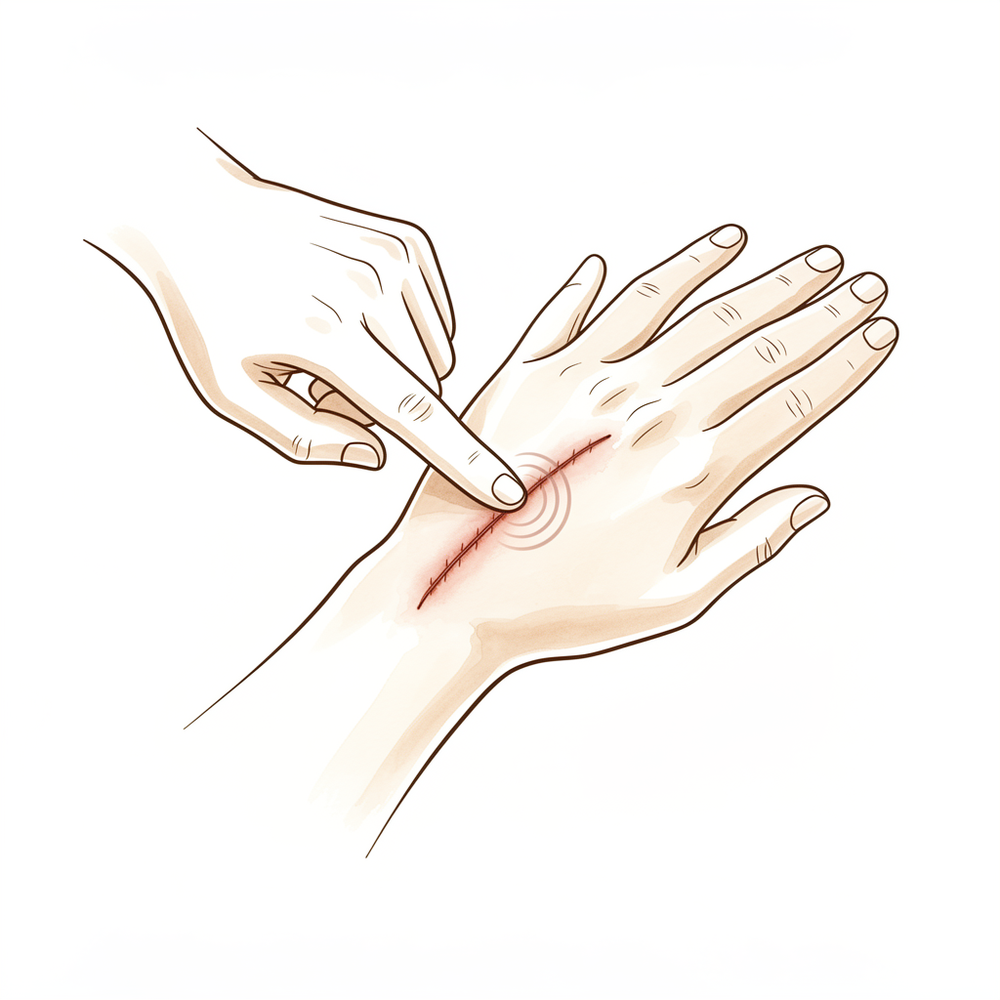
Após a ferida estar totalmente cicatrizada e seca, massageie a cicatriz com um pouco de hidratante sem perfume, fazendo pequenos círculos firmes com o polegar da mão oposta, durante alguns minutos. Isso amacia a cicatriz e reduz a sensibilidade. Não inicie essa massagem antes de a ferida estar completamente fechada e de o seu terapeuta autorizar.
2–3 minutos, duas vezes ao dia, após a cicatrização da ferida.
Kieran Hirpara 4.0
Fortalecimento da preensão
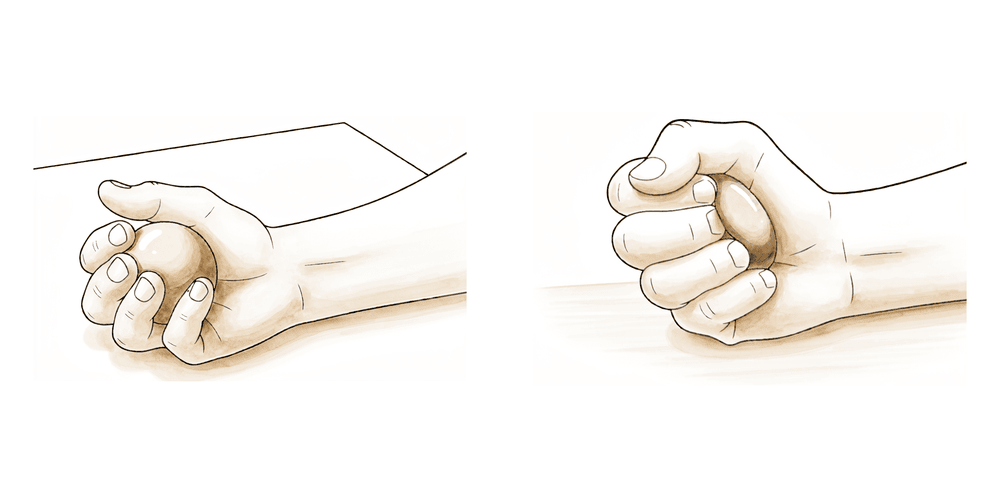
Um exercício posterior — iniciado somente depois que a fusão estiver sólida e o fortalecimento tiver sido autorizado (geralmente a partir de cerca de doze semanas). Aperte uma bola macia ou massa terapêutica na palma da mão, segure brevemente e depois solte. Aumente o esforço gradualmente ao longo de várias semanas. Apertar com força, levantar peso e apoiar o peso do corpo sobre o punho ficam adiados até que o seu cirurgião confirme que os ossos estão completamente consolidados.
10–15 compressões, 2–3 vezes ao dia, aumentando gradualmente (fase posterior)
Estes são os exercícios contidos no seu folheto informativo. Comece a realizá-los somente sob orientação do Dr. Hirpara e do seu terapeuta ocupacional, respeitando sempre os limites e a amplitude de movimento que lhe foram indicados. Os exercícios iniciais visam manter os dedos, o polegar e o antebraço em movimento, sem afetar a consolidação óssea; o próprio punho permanece imóvel dentro do gesso ou da tala. O movimento do punho e o fortalecimento da preensão pertencem a fases posteriores e só devem ser iniciados após o cirurgião confirmar que os ossos já se uniram. Interrompa qualquer exercício que cause dor intensa no punho.
Seu protocolo clínico
O restante desta página descreve o protocolo clínico em etapas para a reabilitação após uma fusão parcial do punho (excissão do capitolunato ± escafoide; os mesmos princípios se aplicam à fusão dos quatro ossos do punho). Esta seção deve ser entregue ao seu terapeuta de mão; cada fase começa com uma explicação simples, em linguagem acessível, sobre o que está ocorrendo. Diferentemente de uma reparação tendínea, aqui o “construto” é ósseo, e a progressão depende da união óssea comprovada por radiografia, não de um cronograma fixo. Até que o cirurgião confirme essa união, o punho permanece imobilizado; apenas os dedos, o polegar e o antebraço podem ser movimentados. Após isso, a amplitude de movimento do punho e, posteriormente, a carga aplicada são restauradas, com um limite real de aproximadamente 50–65% graus de flexão–extensão em relação ao lado contralateral e cerca de 70–80% de força de preensão.
Antes de iniciar o tratamento, verifique o relatório cirúrgico do paciente e confirme qual método de fixação foi utilizado (placa circular/dorsal, parafusos de compressão sem cabeça, grampos ou fios de Kirschner), bem como se o escafoide foi excisado. NÃO inicie os movimentos do punho até que o cirurgião confirme a união óssea por radiografia (geralmente após 6–8 semanas; em alguns casos, com fixação por parafusos ou grampos, esse período pode ser maior). Desde a primeira consulta, explique ao paciente que o objetivo é obter um punho funcional e sem dor, com uma amplitude de movimento deliberadamente reduzida, e não a mobilidade total.
Fase I — imobilização protegida até a consolidação óssea (semanas 0 a ~6–8)
A fusão óssea está cicatrizando como uma fratura; portanto, o punho é mantido imóvel enquanto os ossos se unem. A mão e o antebraço permanecem totalmente móveis para evitar rigidez e aderências tendinosas, mas o punho não deve ser movimentado.
Para o seu fisioterapeuta:
Instruções e precauções - O punho deve permanecer imobilizado em gesso ou talas até que o cirurgião confirme a consolidação radiográfica (geralmente após 6–8 semanas) - Nenhum movimento ativo ou passivo do punho deve ser realizado nesta fase - Proibido realizar qualquer tipo de preensão, levantamento, empuxão, tração ou suporte de carga com o punho operado - É importante informar desde o início: a amplitude de movimento final será reduzida (a articulação radiolunar é preservada; a articulação mediocarpal é fusionada)
Cuidados gerais - Ferida: trocar os curativos cirúrgicos conforme orientação; usar curativo volumoso ou talas por aproximadamente 10–14 dias, depois gesso de braço curto ou talas termoplásticas; monitorar sinais de infecção - Edema: manter o membro elevado acima do nível do coração, realizar movimentos suaves de bombeamento com a mão e aplicar gelo conforme necessário - Exercícios: movimentação ativa completa dos dedos, polegar e articulações MCP/IP; pronação/supinação do antebraço; movimentação suave dos ombros e cotovelos; nenhum movimento do punho
Critérios para avançar para a fase seguinte - Confirmação radiográfica da consolidação pelo cirurgião (não avançar apenas com base no tempo decorrido); ferida cicatrizada; edema sob controle
Fase II — restauração do movimento do punho (após a consolidação, de ~6–8 semanas a 12 semanas)
Assim que o cirurgião confirma que a fusão óssea está consolidada, o gesso é removido e inicia-se o movimento suave do punho. O progresso é gradual; o paciente deve ser informado de que a região fusionada não se moverá e que a amplitude de movimento alcançável será menor do que antes.
Para o seu terapeuta da mão:
Avaliações - Amplitude de movimento ativa e passiva do punho (flexão/extensão, desvio radial/ulnar), rotação do antebraço, força de preensão basal, dor e inchaço, avaliação da ferida/ Cicatriz
Educação e precauções - Iniciar movimentos ativos e assistidos do punho dentro dos limites do conforto; passar para uma tala removível para maior conforto e proteção entre as sessões - Continuar evitando preensões fortes, levantamento de cargas e suporte de peso pelo punho até autorização para iniciar exercícios de fortalecimento - Reforçar a expectativa de amplitude de movimento reduzida (alvo de aproximadamente 50–65% da amplitude de flexão–extensão do lado contralateral)
Manejo - Exercícios: flexão, extensão, desvio radial e ulnar do punho de forma ativa/assistida; iniciar massagem da cicatriz e dessensibilização após cicatrização completa da ferida; manter amplitude de movimento dos dedos, polegar e rotação do antebraço; controlar o edema conforme necessário
Critérios para avançar - Amplitude de movimento do punho controlada e confortável dentro dos limites reduzidos esperados; dor em regressão; autorização do cirurgião para iniciar fortalecimento
Fase III — fortalecimento e retorno à funcionalidade (a partir de ~12 semanas)
Com a fusão óssea consolidada e o movimento restaurado até seu limite útil, inicia-se o fortalecimento e a aplicação progressiva de cargas, que são intensificados ao longo das semanas. O retorno ao trabalho manual e às atividades esportivas depende do cumprimento de critérios específicos.
Para o seu fisioterapeuta da mão:
Avaliações - Força de preensão e pinça em comparação com o lado contralateral; resposta de dor/inchaço à aplicação de cargas; testes funcionais específicos para tarefas e atividades laborais
Instruções e precauções - Iniciar o fortalecimento progressivo da preensão e do punho (usando massa de modelar, bola e, posteriormente, resistência graduada) após autorização médica - Introduzir tarefas com carga e de suporte de peso de forma gradual; aumentar a carga ao longo de várias semanas, em vez de de uma só vez - Resultado esperado: força de preensão se aproximando de ~70–80% em relação ao lado contralateral, com amplitude de movimento útil, sem dor e reduzida
Tratamento - Exercícios: fortalecimento progressivo da preensão e dos músculos do antebraço/punho; simulação funcional e laboral de forma gradual; manutenção da amplitude de movimento e cuidados com a cicatriz - Ficar atento e encaminhar o paciente ao cirurgião caso persista dor dorsal no punho durante a extensão (possível impingimento dorsal), haja suspeita de não união óssea ou estagnação na recuperação - Considerar a alta terapêutica quando a força e a funcionalidade forem adequadas para as necessidades diárias e profissionais do paciente
Critérios para retorno à carga/trabalho - Fusão óssea consolidada, ausência de dor na amplitude de movimento restaurada e força de preensão suficiente para as tarefas; atividades manuais pesadas devem ser adiadas até cerca de 4–6 mês e introduzidas de forma gradual
Retorno às atividades e ao trabalho
O uso leve das mãos no dia a dia (comer, escrever, cuidados pessoais básicos) é incentivado desde o início, desde que feito com conforto e sem sobrecarregar ou torcer o punho. Como não é permitido dirigir enquanto o punho estiver imobilizado ou incapaz de controlar o volante com segurança, planeje contar com ajuda para o transporte nas primeiras semanas; a volta à direção só ocorre após a retirada do gesso e quando você demonstrar confiança no controle do veículo, conforme confirmado na consulta de acompanhamento.
Apreender objetos, levantar pesos e fazer esforços de carga através do punho só devem ser feitos após se confirmar que a fusão óssea está consolidada (geralmente após seis a oito semanas), sendo introduzidos gradualmente a partir daí. Pessoas que trabalham em escritórios ou com atividades leves costumam retornar ao trabalho por volta dos três meses; já os trabalhos manuais mais pesados geralmente exigem de quatro a seis meses, sendo retomados em etapas. Lembre-se sempre de que o objetivo final é obter um punho confortável e funcional, ainda que com amplitude de movimento reduzida; essa avaliação é feita com base na sensação e no desempenho do punho, sob a orientação do Dr. Hirpara e do seu fisioterapeuta especializado em mão, não apenas com base no calendário.
Após seguir este protocolo
Este protocolo complementa as orientações gerais de recuperação fornecidas pelo consultório: consulte controle da dor pós-operatória, cuidados com a ferida e tratamento das cicatrizes. O plano em fases descrito acima segue as diretrizes de reabilitação publicadas para casos de fusão parcial do punho; sua recuperação contínua será orientada individualmente pelo Dr. Hirpara e pelo seu fisioterapeuta, conforme a evolução da cicatrização do seu punho.
Evidence & references
This is the clinical evidence summary written for health professionals. It is technical, and it lists the research this page was built from. You do not need to read it to understand your treatment or to make a decision about it.
Partial Wrist Fusion — Procedure Outcomes & Post-operative Rehabilitation (Capitolunate / Four-Corner Arthrodesis with Scaphoid Excision)
Topic scope: post-operative rehabilitation after midcarpal partial wrist arthrodesis for scapholunate advanced collapse (SLAC) or scaphoid nonunion advanced collapse (SNAC). The index procedure here is a capitolunate fusion (the capitate fused to the lunate, usually with excision of the worn scaphoid); the closely related four-corner fusion (lunate–capitate– triquetrum–hamate) follows the same rehabilitation principles. This is a bony arthrodesis, so the rehabilitation is a union-gated pathway: the mid-wrist is immobilised until the fusion consolidates, after which a deliberately reduced wrist arc and grip are restored.
Defining principle of the rehab here: a partial wrist fusion is a motion-preserving salvage. The arthritic midcarpal surfaces are fused to abolish pain, while the radiolunate joint is intentionally preserved to retain movement. The construct that needs protecting is healing bone (plate, headless screws, staples or K-wires across the fusion), not a soft-tissue repair — so progression is gated by radiographic union, not a calendar. Counselling the patient that the planned end-point is a pain-free, functional wrist with a reduced arc (~50–65% of normal flexion–extension, ~70–80% grip) is itself part of the treatment: the reduced motion is the intended trade-off, not a failure. The two principal branch points are the fixation method (which sets the immobilisation window and union risk) and whether scaphoid excision was performed (standard in the SLAC/SNAC setting).
A. PROCEDURE OUTCOMES (capitolunate / four-corner fusion for SLAC–SNAC)
Partial wrist fusion is a well-established, durable salvage for the SLAC/SNAC wrist. The dominant debate is which motion-preserving salvage (four-corner / capitolunate fusion vs proximal row carpectomy), not whether to operate; both reliably relieve pain at the cost of some motion.
- Reliable pain relief with a useful but reduced arc. Across series, midcarpal fusion abolishes the painful midcarpal arthritis while preserving radiolunate motion. Typical results are roughly 50–65% of contralateral flexion–extension and ~70–80% of contralateral grip strength, with high rates of pain relief and return to work — the expected, planned trade-off of a partial fusion [Enna Hand Clin 2005; Strauch J Hand Surg Am 2011; Merrell J Hand Surg Am 2008; long-term series J Wrist Surg 2015]. Moderate (cohort/consensus).
- Capitolunate fusion (± scaphoid excision) performs comparably to full four-corner fusion while fusing fewer joints, simplifying the construct. A systematic review of capitolunate arthrodesis and comparative work report comparable motion, grip and union to four-corner fusion, supporting it as a sound index choice [Dunn J Hand Surg Am 2020 (systematic review); lunocapitate series J Hand Surg Eur 2009; J Chin Med Assoc 2017]. Moderate.
- A meta-analysis of two-, three- and four-corner constructs finds the number of fused columns does not materially change motion, grip, union or complications — biomechanically consistent with the radiolunate joint being the motion-determining segment [Hundepool J Hand Surg Am 2025 (SR/meta-analysis); Hernandez-Soria J Hand Surg Am 2016 (capitate-position biomechanics)]. Moderate (SR) + mechanistic.
- Modern fixation is forgiving but union is not guaranteed. Circular dorsal plates, headless compression screws and nitinol staples all achieve consolidation in the great majority, with nonunion and dorsal impingement the characteristic failures to watch for [Merrell J Hand Surg Am 2008 (circular plate); Ahmady J Hand Surg Glob Online 2025 (nitinol staples)]. Moderate.
B. REHABILITATION / THERAPY EVIDENCE
The rehab questions are (1) how long to immobilise, (2) what gates the start of wrist motion, and (3) how to set the patient's expectation of reduced motion. The evidence and published surgeon protocols converge on a union-gated sequence: immobilise the wrist (mobilise the hand and forearm) for ~6–8 weeks, then restore a reduced arc, then strengthen.
- Immobilise until radiographic union, not by the calendar. Because the construct is bony, wrist motion is withheld until the surgeon confirms consolidation — typically 6–8 weeks, longer with some screw/staple fixations. Published institutional protocols use a bulky dressing/splint for ~10–14 days, a short-arm cast to ~4–6 weeks, then a removable splint as motion begins. Moderate (consensus protocols).
- Keep the hand and forearm fully mobile from day one. Immediate active finger, thumb and forearm rotation prevents stiffness and tendon adhesion without disturbing the fusion — the same glide-preserving logic used across hand rehab. Consensus.
- Restore motion gradually after union, against a realistic ceiling. Once united, active and active-assisted wrist ROM is introduced; patients should be counselled that the fused midcarpal segment will not move and the achievable arc is smaller than pre-operatively (the radiolunate joint alone supplies wrist motion). Consensus + mechanistic (capitate-position biomechanics, Hernandez-Soria 2016).
- Strengthen and load only once the fusion is solid. Grip and loaded/weight-bearing work begins after union and is built up gradually; heavy manual demands are deferred to ~4–6 months. Consensus.
Recovery trajectory (expected, evidence-anchored)
| Phase | Window | Restraint | Hand use / therapy focus | Strength / load | Notes |
|---|---|---|---|---|---|
| I — Immobilisation (union) | Week 0 to ~6–8 | Wrist immobilised (cast/splint) | Full active finger, thumb & forearm motion; oedema control, elevation; no wrist motion | None through the wrist | Fusion knits like a fracture; progress is gated by radiographic union, not the calendar |
| II — Restoring wrist motion | From union (~wk 6–8) to 12 | Heavy-load avoidance; removable splint | Begin active/active-assisted wrist flexion/extension & deviation; scar massage once healed | No loaded grip yet | Counsel the reduced-arc expectation (~50–65% of normal flexion–extension) |
| III — Strengthening & return | From ~12 weeks (post-union) | Restrictions lifted progressively | Progressive grip/wrist strengthening; graded job simulation | Grip recovers toward ~70–80% of the other side | Desk work ~3 months; heavy manual ~4–6 months. Watch for dorsal impingement / nonunion |
(Phase windows mirror the precautions in the patient protocol and published surgeon protocols; they are typical guides anchored to union, not trial-derived deadlines.)
C. KEY CONTROVERSIES / EVIDENCE QUALITY
- Capitolunate vs four-corner vs proximal row carpectomy (PRC). All three are accepted motion-preserving salvages for SLAC/SNAC. PRC tends to give a slightly larger arc and avoids fusion-specific complications (nonunion, dorsal impingement, hardware), while fusion may give marginally better grip and is preferred where capitate-head or proximal-capitate cartilage is compromised. Systematic reviews and a meta-analysis find no consistent superiority of one over the other; choice is individualised [Mulford J Hand Surg Eur 2009; J Hand Surg Am 2024 meta-analysis; Strauch J Hand Surg Am 2011]. Moderate (SR/meta-analysis of mostly observational data).
- Capitolunate vs full four-corner construct. Fusing fewer columns (capitolunate) simplifies the construct without clearly compromising motion, grip or union versus four-corner — consistent with the radiolunate joint being the motion-determining segment [Dunn 2020 SR; Hundepool 2025 meta-analysis; Hernandez-Soria 2016]. Moderate.
- When can wrist motion safely start? Union timing varies with fixation, and protocols differ on exact cast duration. The defensible position is surgeon-confirmed radiographic union gates wrist ROM rather than a fixed week number. Weak–moderate (consensus; protocol variation).
- Reduced motion is the plan, not a complication. The preserved radiolunate joint supplies a smaller arc by design; mislabelling the expected ~50–65% range as a poor result drives unnecessary dissatisfaction. Strong mechanistically; cohort-supported.
- Characteristic failures: nonunion and dorsal impingement. Both are recognised, fixation-related complications; persistent dorsal wrist pain on extension or a non-progressing fusion warrants surgical review rather than more therapy [Merrell 2008; Ahmady 2025; long-term series 2015]. Moderate.
D. EVIDENCE STRENGTH FLAGS (summary)
- STRONG (mechanistic / well-supported): the reduced final arc is the planned consequence of preserving the radiolunate joint while fusing the midcarpal segment (capitate-position biomechanics); reliable pain relief from the fusion.
- MODERATE: typical outcome envelope (~50–65% flexion–extension, ~70–80% grip); equivalence of capitolunate and four-corner constructs; no consistent superiority of fusion vs PRC (SR/meta-analysis of largely observational data); modern fixation achieves high union with defined nonunion / dorsal impingement risk.
- WEAK / CONSENSUS: the specific union-gated immobilise → restore-motion → strengthen therapy sequence and exact phase timings (institutional/surgeon protocols, anchored to radiographic union rather than trial-derived).
CITATIONS
RAG corpus (180,000+ Orthopaedic articles)
- Enna M, Hoepfner P, Weiss AC. Scaphoid excision with four-corner fusion. Hand Clin. 2005. DOI: 10.1016/j.hcl.2005.08.012
- Dunn JC, Polmear MM, Scanaliato JP, et al. Capitolunate arthrodesis: a systematic review. J Hand Surg Am. 2020. DOI: 10.1016/j.jhsa.2019.10.007
- Hundepool CA, Duraku LS, Quanjel TJ, et al. Two-, three-, or four-corner arthrodesis for midcarpal osteoarthritis: a systematic review and meta-analysis. J Hand Surg Am. 2025. DOI: 10.1016/j.jhsa.2023.04.018
- Strauch RJ. Scapholunate advanced collapse and scaphoid nonunion advanced collapse arthritis — update on evaluation and treatment. J Hand Surg Am. 2011. DOI: 10.1016/j.jhsa.2011.01.018
- Merrell GA, McDermott EM, Weiss AC. Four-corner arthrodesis using a circular plate and distal radius bone grafting: a consecutive case series. J Hand Surg Am. 2008. DOI: 10.1016/j.jhsa.2008.02.001
- Hernandez-Soria A, Das De S, Model Z, et al. The effect of capitate position on coronal plane wrist motion after simulated 4-corner arthrodesis. J Hand Surg Am. 2016. DOI: 10.1016/j.jhsa.2016.07.101
- Ahmady AA, Zalzaleh M, Riedel BB. Midterm outcomes of four-corner fusion surgery using nitinol staples. J Hand Surg Glob Online. 2025. DOI: 10.1016/j.jhsg.2025.100805
- Mulford JS, Ceulemans LJ, Nam D, Axelrod TS. Proximal row carpectomy vs four corner fusion for scapholunate (SLAC) or scaphoid nonunion advanced collapse (SNAC) wrists: a systematic review of outcomes. J Hand Surg Eur Vol. 2009. DOI: 10.1177/1753193408100954
- Four-corner fusion versus proximal row carpectomy for scapholunate advanced collapse and scaphoid nonunion advanced collapse wrist: a systematic review and meta-analysis. J Hand Surg Am. 2024. DOI: 10.1016/j.jhsa.2024.01.011
- Long-term results of lunocapitate arthrodesis with scaphoid excision for SLAC and SNAC wrists. J Hand Surg Eur Vol. 2009. DOI: 10.1177/1753193409105683
- Lunocapitate fusion with scaphoid excision for the treatment of scaphoid nonunion advanced collapse or scapholunate advanced collapse wrist. J Chin Med Assoc. 2017. DOI: 10.1016/j.jcma.2016.10.001
- The long-term outcome of four-corner fusion. J Wrist Surg. 2015. DOI: 10.1055/s-0035-1549277
Partial wrist fusion rehabilitation literature (protocols & guidance — basis for the union-gated phase structure)
- University of Virginia Department of Orthopaedic Surgery. Wrist Partial Fusion (4-Corner) Rehabilitation Guidelines. https://med.virginia.edu/orthopaedic-surgery/wp-content/uploads/sites/242/2024/09/Wrist-Partial-Fusion-4-corner.pdf
- Oregon Health & Science University (OHSU). Four-Corner Partial Wrist Fusion — Surgery Guide. https://www.ohsu.edu/sites/default/files/2020-12/Four-Corner%20Partial%20Wrist%20Fusion.pdf
- Alaska Orthopedic Specialists. Four-Corner Fusion with Scaphoid Excision — Post-operative Protocol. https://www.akortho.com/wp-content/uploads/Four-Corner-Fusion-with-Scaphoid-Excision-1.pdf
- Twin Cities Orthopedics (Olson). Scaphoid Excision 4-Corner Fusion Post-operative Protocol. https://www.toportho.com/wp-content/uploads/2024/10/olson-_4-Corner-Fusion-Protocol.pdf
- The long-term outcome of four-corner fusion (open-access full text). PMC. https://pmc.ncbi.nlm.nih.gov/articles/PMC4408128/