Patients › Rehabilitation
Artrodese da articulação PIP
Um plano de recuperação protegido após a fusão (artrodese) da articulação média do dedo: mantém a articulação fusionada imóvel por meio de uma tala, enquanto todas as demais articulações são movimentadas desde o primeiro dia; posteriormente, o aperto e a pinça são restaurados assim que o osso se une.
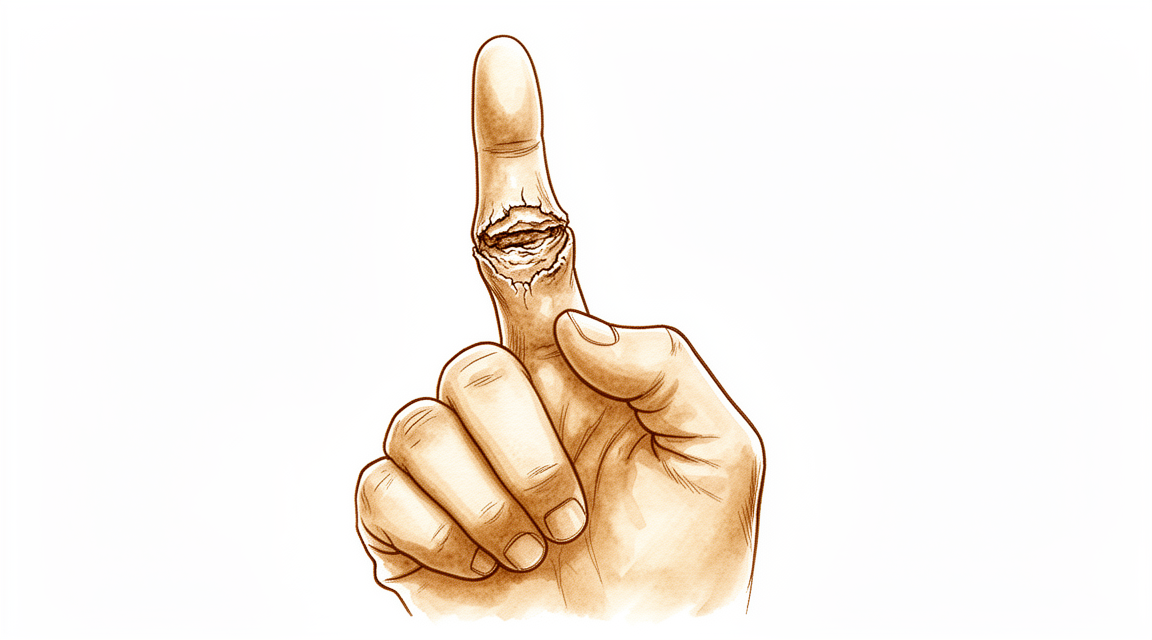
Este protocolo orienta sua recuperação após a fusão (artrodese) da articulação PIP (a articulação do meio do dedo) realizada pelo Dr. Kieran Hirpara no Mater Private Hospital Rockhampton. Ele começa com seu programa de exercícios domiciliares, seguido pelo protocolo clínico estruturado elaborado para seu terapeuta de mão: leve esta página ou seu arquivo PDF à sua primeira sessão de terapia, para que a reabilitação seja devidamente coordenada. Seu terapeuta de mão poderá ajustar o plano conforme a evolução da sua recuperação.
Caso tenha alguma dúvida ou preocupação quanto à ferida pós-cirúrgica, entre em contato com o consultório. Geralmente é útil tirar uma foto da ferida e enviá-la por e-mail para análise.
O que esperar
A fusão da articulação PIP consiste em unir firmemente uma articulação do dedo média que esteja desgastada ou instável, de modo que ela deixe de se mover. A articulação é posicionada numa posição funcional, ligeiramente flexionada, e não completamente reta: essa flexão é suave nos dedos indicador e médio (cerca de 15–20°) e aumenta em direção ao dedo mindinho (cerca de 25–40° nos dedos anular e mindinho), seguindo a curvatura natural dos dedos ao se fecharem. A articulação fundida é mantida nessa posição por meio de um pequeno implante (um fio de tensão, um parafuso sem cabeça, pinos K ou uma placa pequena), que preserva esse ângulo até que o osso se una na região da fusão.
Essa cirurgia é frequentemente indicada para os dedos indicador e médio, nos quais uma articulação estável para a realização de pinçamento é mais importante do que a mobilidade na articulação média. Após a operação, a articulação PIP deve permanecer rígida: esse é o objetivo do procedimento. Portanto, ao contrário de reparos de tendões ou ligamentos, a recuperação não visa recuperar a mobilidade dessa articulação; visa proteger a fusão até que o osso se una, enquanto todas as demais articulações da mão permanecem livres para se mover.
O plano de recuperação baseia-se em quatro princípios:
- Proteger a fusão até a união óssea. A união óssea geralmente ocorre em cerca de seis semanas; às vezes, pode levar até nove ou doze semanas. Até esse momento, a articulação fundida é sustentada por uma tala.
- Manter a mobilidade de todas as demais articulações desde o primeiro dia: a articulação da ponta do dedo, a articulação metacarpofalângica, os dedos vizinhos, o polegar e o punho, evitando que os tendões aderissem e que o restante da mão ficasse rígido.
- Controlar o inchaço e a cicatriz nas primeiras semanas.
- Restaurar a força de preensão e o pinçamento após a união óssea. Não fume: o tabagismo é conhecido por retardar a cicatrização óssea e atrasar a fusão.
Precauções e limitações
- NÃO carregue peso, segure ou aperte com força o dedo operado até que a fusão óssea esteja completa (geralmente após cerca de seis semanas, às vezes mais): carregar peso antes da união óssea pode impedir que a fusão ocorra.
- Mantenha a articulação fusionada completamente imóvel dentro da tala, conforme orientado; não tente “testar” ou dobrá-la.
- Mantenha todas as outras articulações em movimento desde os primeiros dias: articulação da ponta do dedo, articulações interfalângicas, outros dedos, polegar e punho.
- Mantenha a tala limpa e seca, use-a conforme indicado, e cuide da ferida e dos locais onde os pinos foram inseridos.
- NÃO dirija enquanto não conseguir controlar o volante com segurança; geralmente só após retirar a tala, por volta de quatro a seis semanas.
- Não fume: isso atrasa a união óssea.
Para orientações sobre cuidados com a ferida, inchaço e cicatrização, consulte o guia de cuidados com a ferida do consultório.
Seus exercícios
Kieran Hirpara 4.0
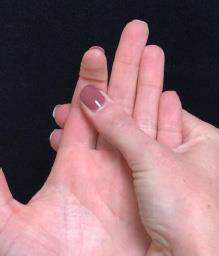
Movimentação da articulação DIP do dedo operado
Com a autorização do seu terapeuta ocupacional, dobre e estique suavemente a última articulação (da ponta do dedo) do dedo operado. Segure a parte central do dedo com a outra mão, de modo que apenas a ponta do dedo se mova. A articulação fusionada deve permanecer totalmente imóvel — somente a ponta do dedo deve se dobrar. Manter essa articulação em movimento evita que os tendões aderam durante o processo de fusão.
10 vezes, 3 vezes ao dia, apenas na articulação da ponta do dedo.
Kieran Hirpara 4.0
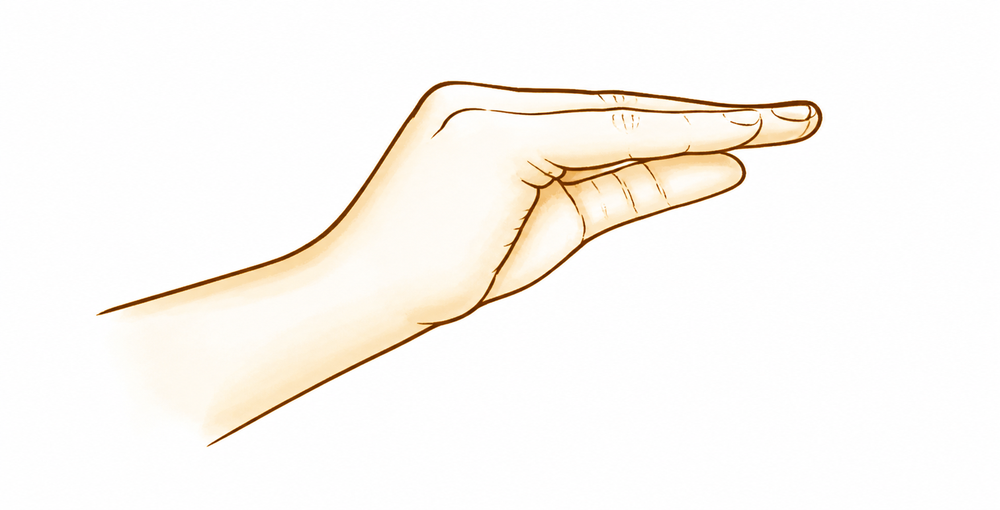
Movimento do nó do dedo (articulação MCP) do dedo operado
Dobre e estique suavemente a articulação metacarpofalângica (onde o dedo se conecta à mão) do dedo operado. A articulação média, que foi fusionada, permanece imóvel durante todo o processo — apenas essa articulação se move. Isso mantém a articulação flexível e evita que o dedo fique rígido enquanto a fusão se consolida.
10 vezes, 3 vezes ao dia, apenas na articulação do nó do dedo.
Kieran Hirpara 4.0
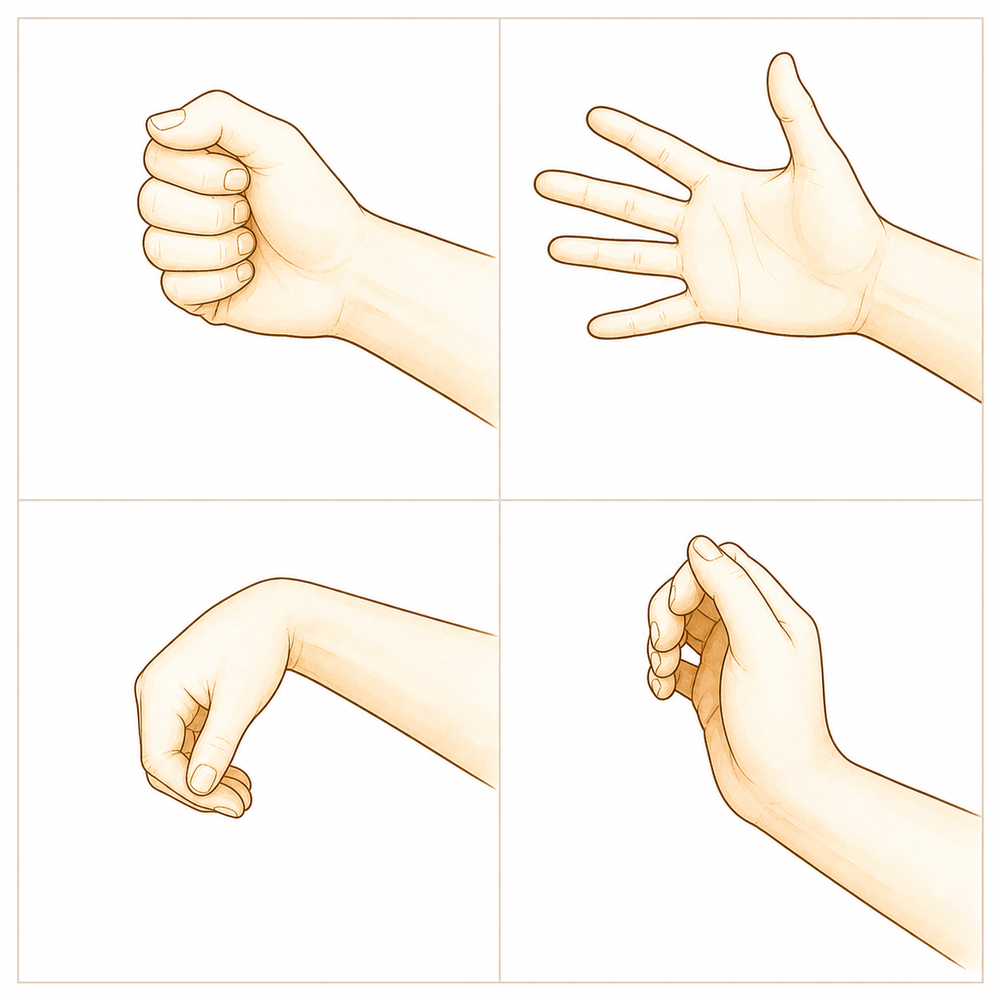
Mova todos os outros dedos, o polegar e o punho.
Desde os primeiros dias, movimente livremente todas as articulações que NÃO foram operadas: faça um punho fechado e abra-o novamente com os demais dedos, mova o polegar em todas as direções, e dobre, estenda e gire o pulso. Esta é a coisa mais importante que você pode fazer para manter a flexibilidade da mão e prevenir rigidez, enquanto a articulação que foi fusionada permanece protegida.
10 vezes cada um, várias vezes ao dia.
Kieran Hirpara 4.0
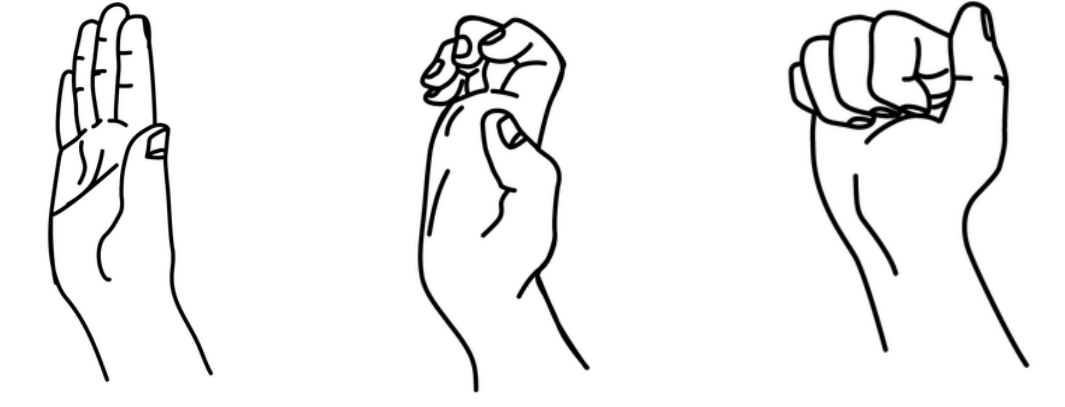
Deslizamentos tendinosos (gancho, punho fechado, reto)
Mova a mão lentamente, formando três posições para manter os tendões em movimento: um gancho (dobre a ponta e as articulações do meio, mantendo os nós dos dedos retos), um punho fechado completo e, por fim, a mão esticada e plana. Faça isso com todos os dedos não operados; o dedo operado deve mover-se apenas até onde as articulações livres (não fundidas) permitirem. Isso garante que os tendões se movam sem problemas e evita que fiquem aderidos próximo à área da cirurgia.
5 de cada formato, 3 vezes ao dia.
Kieran Hirpara 4.0
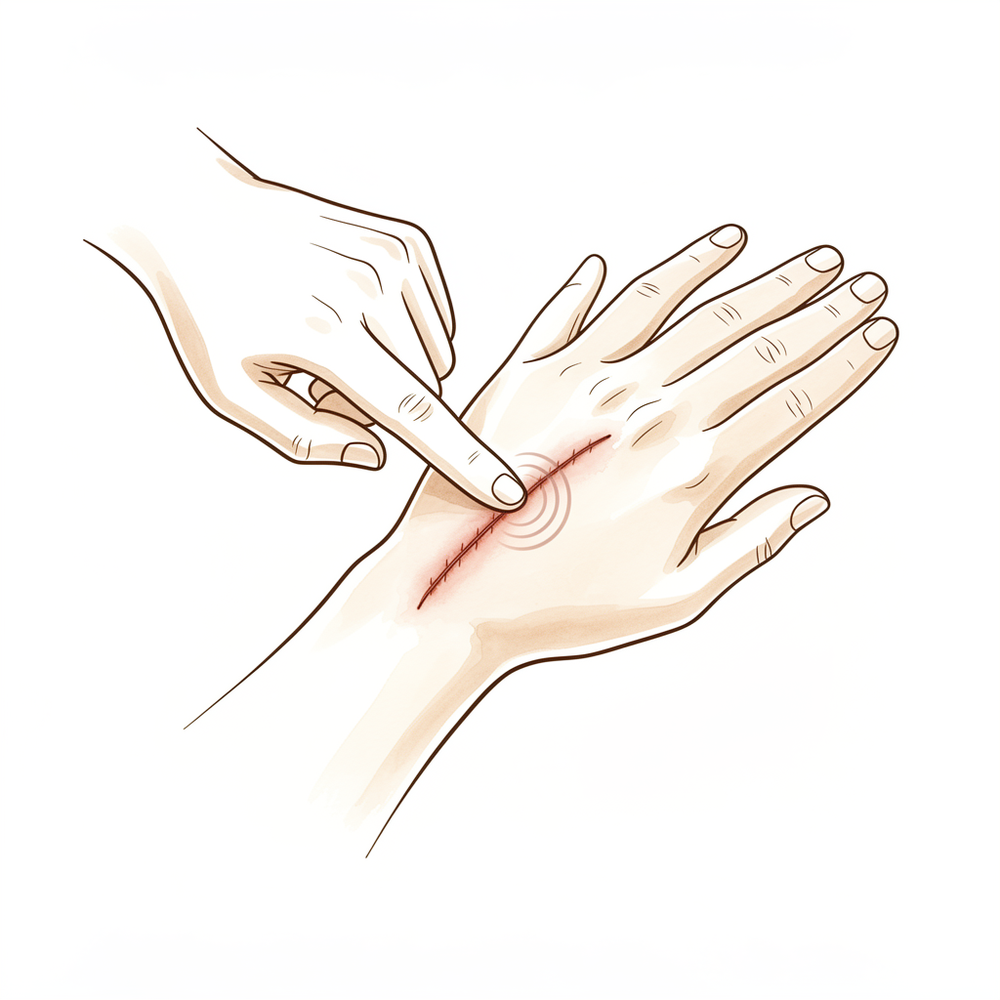
Massagem nas cicatrizes
Assim que a ferida estiver totalmente cicatrizada e o fisioterapeuta da mão a tiver avaliado, aplique um pouco de hidratante na cicatriz, fazendo pequenos círculos firmes por alguns minutos. Isso amacia a cicatriz, reduz a sensibilidade e evita que ela fique aderida aos tecidos subjacentes. Não inicie esse procedimento antes de a pele estar completamente fechada.
2–3 minutos, 2–3 vezes ao dia (após a cicatrização da ferida)
Kieran Hirpara 4.0
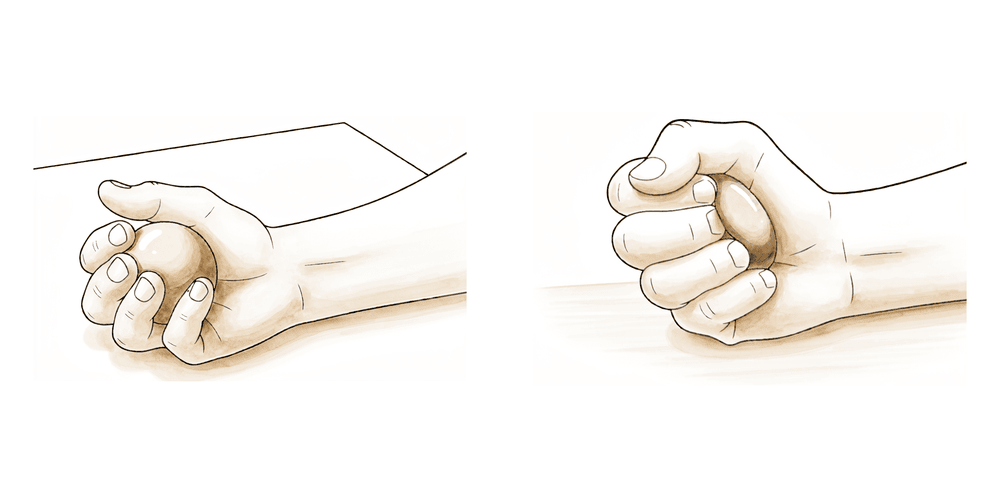
Fortalecimento da pinça e da preensão (após consolidação óssea)
Um exercício posterior — somente após a fusão óssea estar consolidada e o fisioterapeuta da mão iniciar o fortalecimento (geralmente após cerca de seis semanas). Aperte uma bola macia ou massa de modelar para exercitar a força de preensão; também belisque um objeto pequeno entre o polegar e o dedo operado, a fim de desenvolver a pinça lateral cuja estabilidade foi o objetivo da fusão. Aumente a intensidade dos esforços gradualmente. NÃO realize nenhuma preensão ou beliscão com resistência antes de receber autorização — isso sobrecarrega a fusão antes que o osso tenha se unido.
10 vezes, 2–3 vezes ao dia, conforme orientação (apenas após a consolidação óssea)
Estes são os exercícios descritos no seu folheto informativo. Comece a realizá-los somente sob orientação do Dr. Hirpara e do seu terapeuta ocupacional, respeitando todos os limites que lhe foram indicados. Os exercícios iniciais visam manter em movimento a articulação da ponta do dedo, a articulação metacarpofalângica, todos os demais dedos, o polegar e o punho, sem mover ou sobrecarregar a própria articulação fusionada, que deve permanecer imóvel dentro da tala. A massagem na cicatriz deve ser iniciada somente após a cicatrização da ferida. O fortalecimento da pinça e da preensão pertence a uma fase posterior; não deve ser iniciado até que a fusão óssea esteja consolidada e você receba autorização específica. Interrompa qualquer exercício que cause dor aguda na articulação fusionada.
Seu protocolo clínico
O restante desta página descreve o protocolo clínico em etapas para a reabilitação após artrodese da articulação PIP. Esta seção deve ser entregue ao seu terapeuta de mão; cada fase começa com uma explicação simples, em linguagem acessível, sobre o que está ocorrendo. A articulação artrodesada deve ser protegida de qualquer carga até a união óssea (geralmente cerca de 6 semanas, podendo chegar a 9–12 semanas). O princípio orientador é “proteger a articulação artrodesada e mobilizar todo o restante”: as articulações DIP, MCP, os dedos adjacentes, o polegar e o punho devem ser movimentados desde o primeiro dia para evitar aderências tendinosas e rigidez; o edema e a cicatriz devem ser controlados precocemente, e a capacidade de agarrar e fazer pinça só deve ser restaurada após a união óssea.
Antes de iniciar o tratamento, verifique o relatório cirúrgico do paciente e seu histórico médico; ainda, consulte o cirurgião responsável quanto ao método de fixação utilizado (fio de tensão, parafuso intramedular sem cabeça, pinos K ou placa), o ângulo de fusão estabelecido e se os pinos K foram enterrados ou precisam ser removidos. O Dr. Hirpara realiza a artrodese da PIP numa posição de flexão funcional que aumenta a desvio ulnar na mão (índice/dedo médio ≈ 15–20°, anular/mínimo ≈ 25–40°); isso é feito sobretudo nos dedos índice e médio, onde a estabilidade na pinça lateral é mais importante do que a mobilidade da articulação PIP. A articulação artrodesada permanece imobilizada em tala até a constatação da união por radiografia. A base de evidências científicas é limitada (séries de casos de nível 4 e consenso de especialistas); portanto, os prazos são individualizados, não havendo limites padronizados.
Fase I — proteção e controle do inchaço (semanas 0 a 2)
Nas duas primeiras semanas, visa-se proteger a fusão óssea e controlar o inchaço e a cicatrização da ferida, enquanto todas as demais articulações da mão começam a ser movimentadas imediatamente.
Para o seu fisioterapeuta:
Imobilização - Tala ou gesso volar para dedos cobrindo as articulações MCP e PIP, porém deixando a articulação DIP livre - Manter a articulação PIP fundida imóvel; elevar a mão para reduzir o edema
Instruções e precauções - Proibido fazer preensão, pinça ou aplicar carga no dedo operado - Manter a tala limpa e seca; proteger a ferida e quaisquer locais de inserção de pinos
Manejo - Ferida: usar curativos cirúrgicos conforme orientação; monitorar sinais de infecção e os locais de pinos, caso tenham sido utilizados fios de Kirschner - Edema: elevar a mão, realizar movimentos suaves de bombeamento nas articulações livres e aplicar gelo conforme necessário - Exercícios: a partir do primeiro dia, realizar movimentos ativos de todas as articulações não fundidas: dedos adjacentes (movimentos de fechar/abrir o punho), polegar e punho; iniciar movimentos ativos da articulação DIP do dedo operado dentro de alguns dias; realizar deslizamentos tendíneos nos dedos vizinhos; não realizar nenhum movimento nem aplicar carga na articulação PIP fundida
Critérios para avançar para a fase seguinte - Cicatrização da ferida em andamento; inchaço controlado; pronto para confecção de uma tala personalizada por volta da semana 2
Fase II — tala termoplástica personalizada e movimentação ativa das articulações livres (semanas 2 a 6)
A partir da segunda semana, uma tala termoplástica personalizada sustenta a articulação fusionada, permitindo ao mesmo tempo a movimentação ativa das articulações adjacentes. As articulações DIP e MCP do dedo operado são exercitadas fora da tala; a articulação PIP fusionada permanece protegida. Por enquanto, não se deve realizar nenhum tipo de preensão, pinça ou carga resistida.
Para o seu fisioterapeuta:
Avaliações - Amplitude de movimento das articulações adjacentes, avaliação de edema, ferida e cicatriz; confirmação da estabilidade da fixação com base na avaliação clínica e conforme orientação do cirurgião
Imobilização - Transição para uma tala termoplástica personalizada que sustente a articulação PIP fusionada, deixando as articulações adjacentes livres; imobilização protetora contínua por aproximadamente 6 semanas
Instruções e precauções - Proibido realizar preensão, pinça ou carga resistida no dedo operado até a consolidação óssea - Os exercícios devem ser feitos apenas fora da tala
Tratamento - Exercícios: movimentação ativa das articulações DIP e MCP do dedo operado fora da tala (o movimento DIP deve ser iniciado em poucos dias; o MCP é acrescentado nesta fase); deslizamentos tendíneos dos dedos adjacentes; manutenção da movimentação do polegar, punho e dedos vizinhos; iniciar tratamento para cicatrizes e edema após a cicatrização da ferida - Proibido realizar preensão, pinça ou carga resistida
Critérios para progressão - Consolidação óssea comprovada por radiografia (geralmente por volta da 6ª semana, podendo levar até 9–12); a articulação fusionada deve estar clinicamente e radiologicamente estável antes de qualquer carga ser aplicada
Fase III — retirada gradual da tala e introdução de uso leve (a partir de ~6 semanas, após a consolidação)
Após a consolidação da fusão (geralmente por volta da sexta semana), a tala é retirada gradualmente; introduz-se então o uso funcional leve, e os movimentos de pinça, oposição e preensão são reconstituídos passo a passo. Os fios K, caso tenham sido utilizados, são normalmente removidos por volta da sexta semana.
Para o seu fisioterapeuta:
Avaliações - Confirmar a consolidação radiográfica com o cirurgião; avaliar a força de preensão/pinça em comparação à outra mão; amplitude de movimento das articulações livres; condição da cicatriz
Instruções e precauções - Retirar e reduzir gradualmente o uso da tala após confirmação da consolidação; remover os fios K por volta da 6ª semana, se utilizados - Aumentar a carga progressivamente: iniciar com uso leve, depois introduzir exercícios de pinça e preensão de forma gradual
Tratamento - Exercícios: progredir do uso funcional leve para pinça, oposição e preensão; iniciar fortalecimento da preensão/pinça (com bola ou massa de modelar, pinça lateral) de forma gradual; manter os exercícios para a cicatriz - A tala é retirada após confirmação da consolidação radiográfica
Critérios para progressão - Consolidação da fusão, tolerância à carga leve sem dor; tala descontinuada; pronto para fortalecimento progressivo
Fase IV — fortalecimento progressivo e retorno às atividades (a partir de ~8–12 semanas)
Com a fusão óssea consolidada e o uso da mão restabelecido, inicia-se o fortalecimento e o aumento da carga, bem como o retorno gradual a atividades esportivas, pesadas ou manuais. O resultado final é alcançado por volta dos nove a doze meses.
Para o seu terapeuta da mão:
Avaliações - Força de preensão e de pinça em comparação ao lado contralateral; testes funcionais e específicos para o trabalho ou esporte, conforme necessário
Instruções e precauções - Aumente gradualmente a carga resistida; a articulação fusionada permanece permanentemente rígida por design; concentre o fortalecimento na preensão e na pinça lateral
Tratamento - Exercícios: fortalecimento e aumento progressivo da carga na preensão e na pinça; retorno gradual a atividades esportivas, pesadas e manuais - Considere a alta terapêutica quando a força alcançar níveis funcionais e quase simétricos; encaminhe novamente ao médico responsável caso a recuperação estagne
Critérios para retorno - Articulação fusionada estável, sem dor sob carga; força de preensão/pinça adequada para a atividade, avaliada clinicamente e não apenas pelo tempo decorrido; resultado final alcançado em 9–12 meses
Retorno ao trabalho e às atividades
É recomendado, desde o início, o uso leve da mão no dia a dia, dentro dos limites do conforto; a única restrição importante é não realizar apertos, pinçamentos ou carregar peso com o dedo operado até que a fusão óssea esteja consolidada. Como não se deve dirigir enquanto não houver controle seguro do volante, planeje contar com ajuda para o transporte nas primeiras semanas; geralmente a condução pode ser retomada entre quatro e seis semanas, após a retirada da tala e quando o controle do carro for seguro.
Após a consolidação da fusão (por volta da sexta semana), pode-se iniciar uso leve e apertos suaves. O fortalecimento de levantamento, aperto e pinçamento começa por volta da oitava semana, e todas as atividades ou esportes podem ser retomados a partir da décima segunda semana. A fusão continua se consolidando por vários meses; portanto, o resultado final e plenamente estabilizado ocorre entre nove e doze meses. Esses prazos são orientações baseadas no consenso de especialistas de uma única clínica (valores típicos e personalizados, não limites rígidos); o acompanhamento do seu progresso será feito pelo Dr. Hirpara e pelo seu terapeuta da mão, considerando a evolução da fusão, e não apenas o calendário.
Após seguir este protocolo
Este protocolo complementa as orientações gerais de recuperação fornecidas pelo consultório; consulte também controle da dor pós-operatória, cuidados com a ferida e tratamento das cicatrizes. O plano em fases descrito acima está alinhado com as diretrizes publicadas sobre a reabilitação após artrodese da articulação PIP; sua recuperação contínua será acompanhada individualmente pelo Dr. Hirpara e pelo seu fisioterapeuta, conforme o processo de cicatrização do seu dedo.
Evidence & references
This is the clinical evidence summary written for health professionals. It is technical, and it lists the research this page was built from. You do not need to read it to understand your treatment or to make a decision about it.
PIP Joint Fusion — Procedure Outcomes & Post-operative Rehabilitation (Proximal Interphalangeal Arthrodesis)
Topic scope: post-operative rehabilitation after arthrodesis (fusion) of the proximal interphalangeal (PIP) joint of a finger — a worn, painful or unstable PIP joint is fused solid in a functional flexed position. This is a fusion, not a reconstruction or a motion- preserving procedure: the PIP is deliberately made stiff to trade motion for a stable, pain-free, load-bearing digit. The rehab is therefore not about regaining PIP motion but about protecting the construct until bony union while keeping every other joint of the hand moving, then restoring grip and pinch.
Defining principle of the rehab here: PIP arthrodesis eliminates motion at one joint by design to gain stability for pinch and grip. The fused joint is set in a functional flexed position that increases ulnar-ward across the hand (index/middle ≈ 15–20°, ring/little ≈ 25–40°, following the digital cascade) and held by internal fixation (tension-band wire, headless intramedullary screw, K-wires, or plate) until union. Because nothing here needs to move to heal — it needs to unite — the single governing rule is "protect the fused joint, mobilise everything else." DIP, MCP, adjacent digits, thumb and wrist move from day one to prevent tendon adhesion and stiffness; oedema and scar are managed early; grip and pinch are restored only after radiographic union (~6 weeks, up to 9–12). The branch point is the indication — primary degenerative/post-traumatic fusion versus salvage of a failed PIP arthroplasty, where union is slower and the construct more demanding.
A. PROCEDURE OUTCOMES (PIP arthrodesis)
PIP arthrodesis is a reliable, well-established salvage and reconstructive operation, but its evidence base is uniformly low-level — predominantly retrospective level-4 case series and expert opinion, with no randomised controlled trials. Outcomes are reported as union, complication and reoperation rates rather than from comparative trials.
- The evidence base is low-level and consensus-driven. A systematic review of PIP arthrodesis found the literature is overwhelmingly level-4 (~94%) with no RCTs; conclusions on fixation choice and outcomes rest on case series and expert consensus [EFORT Open Rev 2021, DOI 10.1530/eor-21-0102]. Low (level-4 SR, no RCTs).
- Fixation holds the angle to union; nonunion and reoperation are the principal concerns. Series reporting nonunion and reoperation identify patient factors (including smoking and comorbidity) as drivers of failure, underscoring that the rehab job is to protect the construct until the bone joins [HAND 2020, DOI 10.1177/1558944720939196]. Low–moderate (case series).
- The fusion angle is chosen for function, especially pinch. A biomechanical/kinematic study of index PIP fusion (simulated 30–50°) shows the set angle is a functional trade-off: fusing the index/middle PIP stabilises lateral (key) pinch at the cost of PIP motion, which is why these digits are common fusion sites [J Hand Surg Am 2011, DOI 10.1016/j.jhsa.2011.09.010]. Mechanistic / cadaveric.
- Arthrodesis is a dependable salvage for failed PIP arthroplasty, but union is slow. A series of arthrodesis for failed PIP joint replacement reported a mean time to union of 5.8 months, illustrating that salvage fusions unite more slowly than primary fusions and need correspondingly extended protection [J Hand Surg Am 2011, DOI 10.1016/j.jhsa.2010.10.030]. Low (case series).
- The biomechanics of digital loss/fusion frame the functional cost. Reviews of the biomechanics of digital amputation and fusion describe how eliminating an IP joint redistributes grip and pinch mechanics — the rationale for accepting a stiff joint when it buys stability [Hand Clin 2016, DOI 10.1016/j.hcl.2016.07.003]. Mechanistic / narrative.
B. REHABILITATION / THERAPY EVIDENCE
There are no trials of rehab regimens after PIP arthrodesis; the programme is built on sound surgical principle and expert consensus. The two evidence-anchored levers are the union timeline (which sets when load may be applied) and the modifiable risk factor of smoking (which delays union).
- Protect-until-union, mobilise-everything-else is the consensus regimen. The fused PIP is splinted continuously until radiographic union (~6 weeks, up to 9–12); from day one the DIP, MCP, adjacent digits, thumb and wrist are actively moved to prevent tendon adhesion and global hand stiffness. This is stable across sources (surgeon protocols, hand-therapy guidance and patient-education material) even though it is not trial-tested [Melbourne Arm Clinic protocol; OrthOracle PIPJ arthrodesis; OrthoInfo finger IP fusion]. Consensus / expert.
- Smoking is an evidence-supported delayed-union risk. A study of hand and wrist arthrodesis found smoking delays union, making smoking cessation the one rehab-adjacent intervention with direct supporting evidence in this setting [J Hand Surg Am 2022, DOI 10.1016/j.jhsa.2022.05.016]. Moderate (cohort, modifiable risk factor).
- Union timing governs progression — and is slower in salvage fusions. Primary fusions are typically protected to ~6 weeks; salvage of failed arthroplasty unites far more slowly (mean 5.8 months), so loading must be union-led rather than calendar-led [J Hand Surg Am 2011, DOI 10.1016/j.jhsa.2010.10.030]. Low (case series).
- The set fusion angle is the functional anchor of the rehab goal. Because the index/middle PIP is fused at ~15–20° (and ring/little at ~25–40°) specifically to stabilise lateral pinch, the Phase III–IV strengthening rightly targets pinch and grip rather than any attempt at PIP motion [J Hand Surg Am 2011, DOI 10.1016/j.jhsa.2011.09.010]. Mechanistic.
Recovery trajectory (expected, evidence-anchored)
| Phase | Window | Restraint | Hand use / therapy focus | Strength / load | Notes |
|---|---|---|---|---|---|
| I — Protect & settle | Week 0–2 | Volar finger splint/cast spanning MCP + PIP, DIP left free | Elevation, wound/pin-site care, oedema control; active DIP within days + full motion of all non-fused joints (adjacent digits, thumb, wrist) | No grip / pinch / loading | Fused PIP kept still; everything else mobilised from day one |
| II — Custom splint & free-joint motion | Week 2–6 | Custom thermoplastic splint supporting the fused PIP, freeing adjacent joints; continuous splinting to ~6 wk | Active DIP + MCP of operated finger out of splint; tendon glides of adjacent digits; scar/oedema once healed | No resisted grip / pinch / loading | Union typically at ~6 wk (up to 9–12); load only after radiographic union |
| III — Wean splint & light use | From ~6 wk (united) | Splint weaned/cut down after union; K-wire out ~6 wk if used | Progress light use → pinch, opposition, gripping; begin grip/pinch strengthening | Graded grip/pinch, build gradually | Restraints lifted only once union confirmed |
| IV — Strengthen & return | ~8–12 wk+ | Restrictions lifted | Progressive strengthening/loading; return to sport/heavy/manual work | Build load progressively; target lateral pinch | Final settled result 9–12 months |
(Phase windows mirror the precautions in the patient protocol; they are expert-consensus, single-clinic guides — typical and individualised, not graded or trial-derived thresholds. Return milestones: driving ~6 wk, light use/gentle grip ~6 wk after union, lifting/gripping/pinch ~8 wk, full activity/sport ~12 wk, final result 9–12 months.)
C. KEY CONTROVERSIES / EVIDENCE QUALITY
- Whole topic is low-level evidence. PIP arthrodesis rests on level-4 case series and expert consensus with no RCTs (~94% level-4 in systematic review). All outcome and timing figures should be read as typical guides, not trial-validated thresholds [EFORT 2021]. Low.
- Fixation choice is unsettled. Tension-band wire, headless intramedullary screw, K-wires and plate all achieve union; comparative data are weak and selection is largely surgeon preference and bone/soft-tissue quality [EFORT 2021; HAND 2020]. Low.
- Fusion angle is a functional trade-off, not a fixed number. The ~15–20° (index/middle) to ~25–40° (ring/little) cascade is consensus-stable but individualised to the digit and the demands of pinch [J Hand Surg Am 2011 kinematics]. Mechanistic / consensus.
- Union timing is variable and indication-dependent. Primary fusions ~6 weeks; salvage of failed arthroplasty far slower (mean 5.8 months). Loading must be union-led [J Hand Surg Am 2011 salvage series]. Low.
- Smoking and patient factors drive nonunion/reoperation. Smoking is an evidence-supported delayed-union risk and a modifiable target [J Hand Surg Am 2022; HAND 2020]. Moderate (for the smoking association).
D. EVIDENCE STRENGTH FLAGS (summary)
- STRONG (RCT / SR): none — there are no RCTs in PIP arthrodesis; the best synthesis is a level-4 systematic review (~94% level-4 studies).
- MODERATE: smoking as a delayed-union risk after hand/wrist arthrodesis; patient factors driving nonunion/reoperation; cadaveric/kinematic basis for the functional fusion angle and pinch rationale.
- WEAK / CONSENSUS: the protect-until-union, mobilise-everything-else rehab regimen (mechanistically sound, not trial-tested); the specific fusion angles (consensus-stable); exact timelines (single-clinic, expert-consensus guides — typical, not graded thresholds); fixation choice (surgeon preference).
CITATIONS
RAG corpus (180,000+ Orthopaedic articles)
- Proximal interphalangeal joint arthrodesis: a systematic review (predominantly level-4 evidence; no RCTs). EFORT Open Rev. 2021. DOI: 10.1530/eor-21-0102
- Nonunion and reoperation after proximal interphalangeal joint arthrodesis: patient factors and outcomes. HAND. 2020. DOI: 10.1177/1558944720939196
- Index finger proximal interphalangeal joint arthrodesis and pinch kinematics (simulated 30–50° fusion). J Hand Surg Am. 2011. DOI: 10.1016/j.jhsa.2011.09.010
- Arthrodesis as salvage for failed proximal interphalangeal joint arthroplasty (mean time to union 5.8 months). J Hand Surg Am. 2011. DOI: 10.1016/j.jhsa.2010.10.030
- Smoking delays union after hand and wrist arthrodesis. J Hand Surg Am. 2022. DOI: 10.1016/j.jhsa.2022.05.016
- Biomechanics of digital loss and fusion. Hand Clin. 2016. DOI: 10.1016/j.hcl.2016.07.003
PIP arthrodesis rehabilitation & procedure literature (URLs)
- Melbourne Arm Clinic. PIP / DIP arthrodesis rehabilitation protocol. https://melbournearmclinic.com.au/orthopaedic-rehabilitation/shoulder-rehabilitation/pip-dip-arthrodesis-protocol/
- OrthOracle. Proximal interphalangeal joint (PIPJ) arthrodesis in the hand using the Apex system (Extremity Medical). https://www.orthoracle.com/library/proximal-interphalangeal-joint-pipj-arthrodesis-in-the-hand-using-the-apex-system-extremity-medical/
- EFORT Open Reviews. Proximal interphalangeal joint review (PMC). https://pmc.ncbi.nlm.nih.gov/articles/PMC6598614/
- American Academy of Orthopaedic Surgeons (OrthoInfo). Finger (interphalangeal) joint fusion. https://orthoinfo.aaos.org/en/treatment/finger-ip-joint-fusion/