Skip to content

Patients › Shoulder

Síndrome do Desfiladeiro Torácico

Compression of the nerves and vessels at the base of the neck — the types, why diagnosis is tricky, and physio-first treatment.
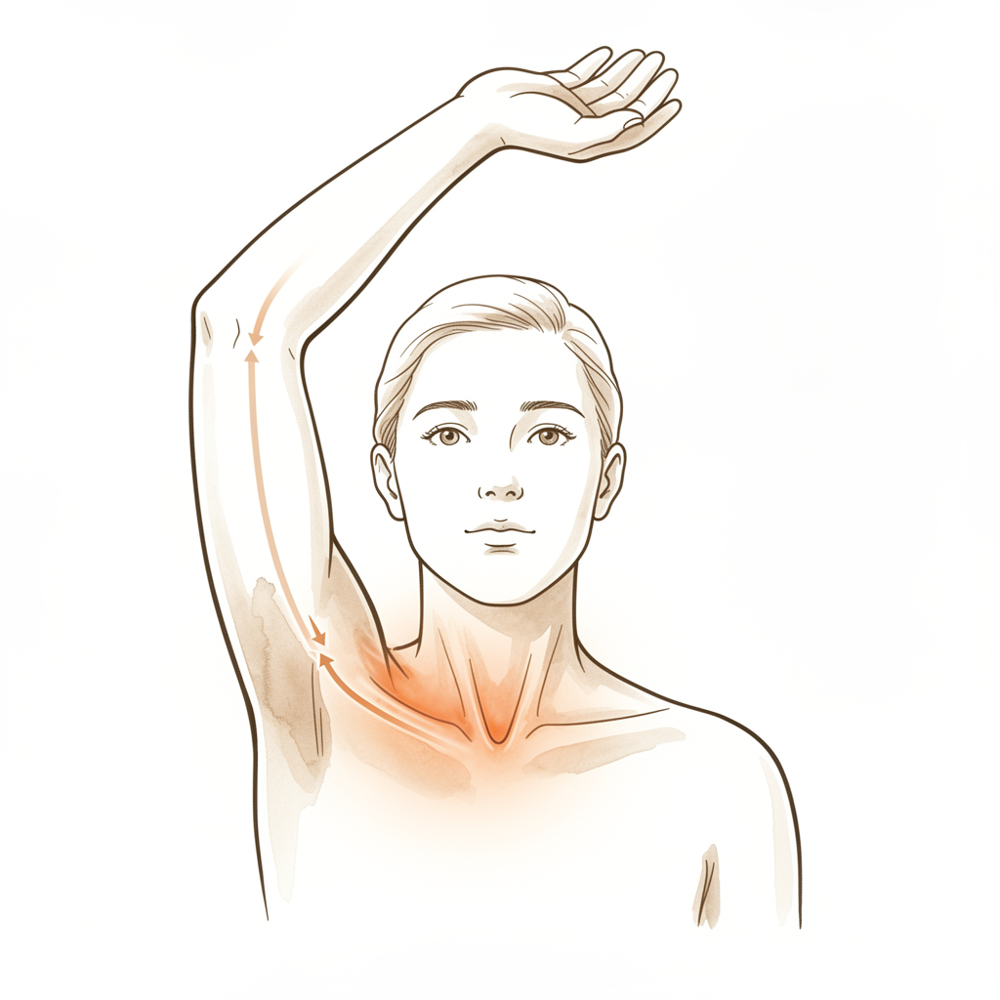
Braço levantado, com formigamento que irradia da base do pescoço e do ombro.
Na síndrome do desfiladeiro torácico, os nervos e vasos sanguíneos são comprimidos na base do pescoço — o que geralmente piora quando o braço é levantado acima da cabeça. Kieran Hirpara 4.0

Esta página foi traduzida automaticamente e ainda não foi verificada por um médico. A versão em inglês é a versão oficial.

O que você está sentindo

A síndrome do desfiladeiro torácico geralmente se manifesta como um braço que simplesmente não parece “normal”. Você pode notar uma dor no ombro, na lateral do pescoço e ao longo do braço, além de dormência, formigamento ou sensação de “agulhas e alfinetes”, frequentemente nos dedos anular e mindinho. O braço pode parecer pesado, fraco ou desajeitado, fazendo com que você deixe cair objetos ou sinta que a força de preensão se esgota rapidamente. Um indício muito típico é que os sintomas pioram quando o braço está levantado ou acima da cabeça (ao pendurar roupas para secar, alcançar uma prateleira alta, dirigir ou carregar uma bolsa no ombro) e melhoram ao descansar o braço. Algumas pessoas também apresentam dores de cabeça na região posterior da cabeça.

Com menos frequência, o problema está nos vasos sanguíneos, e não nos nervos. Se uma veia for comprimida, todo o braço pode inchar subitamente, ficar pesado e adquirir uma coloração azulada. Se uma artéria for comprimida (o que é raro), a mão pode ficar pálida, fria e dolorida. Esses quadros vasculares são importantes, pois exigem avaliação imediata (ver a última seção).

O que realmente está acontecendo

Para ir do pescoço até o braço, os nervos e vasos sanguíneos precisam passar por um espaço estreito na base do pescoço, entre a clavícula, a primeira costela e os músculos escalenos. Esse espaço é chamado de “saída torácica”. Quando ele fica muito apertado, essas estruturas são comprimidas, e essa pressão é o que gera os sintomas.

Existem três tipos, dependendo do que está sendo comprimido. A TOS neurogênica (compressão dos nervos, do plexo braquial) é de longe a mais comum, representando a grande maioria dos casos; ela se manifesta por dor, dormência, formigamento e fraqueza. A TOS venosa afeta a veia principal, causando inchaço, sensação de peso e coloração azulada no braço, às vezes acompanhada de coágulo. A TOS arterial é rara e afeta a artéria, resultando em mão pálida e fria.

Alguns fatores tornam esse espaço ainda mais estreito. Algumas pessoas nascem com uma costela extra no pescoço (costela cervical) ou com uma faixa fibrosa muito apertada. A postura também influencia: ombros arredondados e caídos reduzem o espaço, assim como músculos do pescoço e do tórax volumosos ou tensos; por isso, a condição é mais comum em pessoas que realizam movimentos repetitivos acima da cabeça ou praticam esportes. Um ferimento prévio no pescoço ou na clavícula também pode ser o gatilho.

O que podemos fazer a respeito

No Mater Private Hospital Rockhampton, o Dr. Kieran Hirpara lidera nosso tratamento para essa condição. Em geral, os pacientes são encaminhados à nossa clínica pelo médico de família; caso um fisioterapeuta tenha sugerido que você nos procure, ainda assim será necessário um encaminhamento do seu médico de família para ter direito ao reembolso do Medicare e para iniciarmos uma avaliação minuciosa a fim de confirmar o diagnóstico. Nos casos de sintomas crônicos, geralmente começamos com tratamento não cirúrgico e só consideramos a cirurgia caso esse tratamento não traga alívio suficiente.

A boa notícia é que, no tipo neurogênico mais comum, o tratamento de primeira linha é a fisioterapia, e não a cirurgia. Um programa específico para desobstruir a saída torácica é fundamental: ele corrige a postura, fortalece os músculos que mantêm a escápula para trás e para baixo, libera os músculos tensos do pescoço e do tórax, e ensina a evitar as posições do braço que causam compressão. Isso alivia os sintomas na maioria das pessoas; por isso, vale a pena se dedicar a esse tratamento por vários meses.

A cirurgia é indicada apenas em duas situações. A primeira é nos tipos vasculares (venoso ou arterial), nos quais a descompressão costuma ser necessária e constitui o principal tratamento. A segunda é no TOS neurogênico que não apresentou melhora mesmo após um tratamento fisioterapêutico adequado e que realmente interfere na vida diária do paciente. A operação visa descomprimir a saída torácica, geralmente removendo a primeira costela (e qualquer costela cervical extra) e soltando os músculos escalenos, para dar mais espaço aos nervos e vasos sanguíneos. Ela pode ser realizada pela axila, acima da clavícula ou com auxílio de cirurgia minimamente invasiva. Para pacientes selecionados, esse procedimento apresenta bons resultados.

O que esperar

O STC pode ser um diagnóstico complicado. Não existe nenhum exame isolado capaz de comprová-lo. O diagnóstico é, na maior parte, clínico: baseia-se na sua descrição dos sintomas e em testes que colocam o braço em posições capazes de provocá-los. As imagens por escaneamento e os estudos dos nervos são frequentemente usados tanto para excluir causas mais comuns (como o túnel do carpo no pulso, o túnel cubital no cotovelo ou problemas na coluna cervical/discais) quanto para confirmar o próprio STC. Portanto, parte do processo consiste em determinar, com paciência, qual é a verdadeira origem dos seus sintomas; nem sempre a resposta é evidente.

No caso do tipo neurogênico, a maioria das pessoas melhora com correção postural e fisioterapia, sem nunca precisar de cirurgia, embora isso possa levar meses e exija que você mantenha esses hábitos. Quando os tipos vasculares ou casos neurogênicos persistentes exigem intervenção cirúrgica, a descompressão alivia os sintomas na maioria dos pacientes criteriosamente selecionados, com recuperação ocorrendo ao longo de várias semanas. Como o STC ocorre no ponto mais proximal do trajeto do nervo (mais acima do túnel do carpo no pulso ou do túnel cubital no cotovelo), às vezes ele representa apenas uma parte do problema; por isso, o plano de tratamento é personalizado para cada paciente.

Quando procurar um especialista

  • Braço súbito, inchado, pesado ou azulado: isso pode indicar obstrução ou coágulo numa veia, exigindo avaliação urgente, ainda no mesmo dia.
  • Mão pálida, fria e dolorida, ou dedos que mudam de cor: pode ser um problema arterial, motivo para buscar atendimento urgente.
  • Dormência, formigamento, fraqueza ou descoordenação no braço ou na mão que persiste, piora ou interfere no trabalho, no sono ou nas atividades diárias.
  • Atrofia (perda de massa muscular) na mão, ou sintomas que reaparecem mesmo após um tratamento fisioterápico adequado: vale a pena consultar um especialista.
  • Se lhe foi diagnosticada costela cervical e você apresenta sintomas no braço, também é recomendável fazer uma avaliação.

Em maior profundidade

Advanced reading: the deeper science (optional)

Esta seção vai além do que você precisa saber para tomar decisões sobre seu próprio tratamento. A síndrome do desfiladeiro torácico merece essa leitura adicional, pois se divide em formas praticamente opostas: uma objetivamente comprovável e, às vezes, capaz de ameaçar o membro afetado; a outra diagnosticada basicamente com base no julgamento clínico. Quase toda a controvérsia gira em torno desta segunda forma.

Três condições que compartilham o mesmo nome

A saída torácica é o espaço estreito entre a clavícula e a primeira costela por onde passam os nervos do braço, bem como a artéria e a veia principais. A compressão nessa região gera três síndromes distintas.

A STT venosa e a arterial são problemas vasculares. São pouco comuns, podem ser objetivamente comprovadas por meio de exames de imagem, e podem ser situações de urgência: a trombose da veia subclávia gera um braço azulado e inchado; a compressão arterial provoca mão fria e, nos casos mais graves, embolias. Ninguém contesta a existência dessas condições nem a necessidade de tratamento.

A STT neurogênica representa a grande maioria dos casos. Nela, os nervos são comprimidos, causando dor no ombro e no braço, dormência geralmente na região do dedo mindinho, e os sintomas pioram quando os braços são mantidos acima da cabeça. O problema é que, na maioria dos casos, não existe nenhum exame capaz de confirmar o diagnóstico: os estudos de condução nervosa costumam ser normais, e os exames de imagem não revelam lesões.

As revisões atuais abordam essa questão distinguindo as formas vasculares e as formas objetivamente verificáveis da STT neurogênica do restante [1]; essa é uma maneira cuidadosa de reconhecer que os demais casos dependem exclusivamente do julgamento clínico.

Por que essa distinção é fundamental para tudo

Quando o diagnóstico pode ser comprovado objetivamente, as decisões terapêuticas seguem a lógica habitual. Quando isso não é possível, surgem dois tipos de falhas: pacientes com compressão real passam anos sem diagnóstico, pois seus exames são normais; já aqueles cuja dor no braço tem outra causa são submetidos a uma cirurgia complexa que não lhes traz benefícios.

Ambos os erros são amplamente reconhecidos; por isso o padrão de comprovação exigido antes de uma cirurgia é mais rigoroso nesses casos do que na maioria das compressões. Além disso, um período prolongado de fisioterapia, visando corrigir a postura, os músculos escalenos e a mecânica da cintura escapular, precede qualquer intervenção cirúrgica na forma neurogênica da doença.

O que é removido e as evidências que sustentam cada abordagem

A cirurgia visa descomprimir a região ao remover a primeira costela, dividir os músculos escalenos ou ambos.

Ao comparar diferentes abordagens em 2.010 pacientes, observou-se que os escores de Disabilities of the Arm, Shoulder and Hand e Derkash foram significativamente melhores após a escalenectomia sem remoção da costela; por outro lado, taxas de complicações mais elevadas foram registradas após a ressecção da primeira costela [2].

Por outro lado, estudos mais antigos defendem a realização da operação combinada. Em 532 pacientes, a ressecção transaxilar da primeira costela associada à escalenectomia transcervical foi descrita como a forma mais eficaz de descompressão, apresentando melhora maior dos sintomas e menor taxa de recorrência [3]. Ainda, a recorrência foi observada em 5% a 10% dos casos quando esse procedimento combinado foi utilizado como tratamento inicial [4].

Os dois pontos de vista não são totalmente conciliáveis com base nos dados publicados. A análise comparativa mais recente favorece a realização de um procedimento menos invasivo; já a experiência clínica de um único cirurgião, baseada em um grande número de casos, defende a abordagem mais radical, sob o argumento de que a descompressão incompleta é a principal causa da recorrência. O que ambos os grupos concordam é que a SOT recorrente constitui um problema muito mais difícil de tratar do que a apresentação inicial; portanto, a decisão inicial é mais importante do que a escolha da técnica cirúrgica.

A implicação prática

Considerando que o diagnóstico é frequentemente clínico, que a extensão ideal da cirurgia é objeto de controvérsia e que o problema da recorrência é difícil de resolver, trata-se de uma condição na qual uma segunda opinião antes da cirurgia é justificável, e não hostil. Isso vale especialmente para a forma neurogênica da doença, quando não há confirmação objetiva.

Referências

[1] Panther EJ, Reintgen CD, Cueto RJ, Hao KA, Chim H, King JJ. Síndrome do desfiladeiro torácico: uma revisão. J Shoulder Elbow Surg. 2022;31(11):e545-e561. https://doi.org/10.1016/j.jse.2022.06.026

[2] Blondin M, Garner GL, Hones KM, Nichols DS, Cox EA, Chim H. Considerações sobre o tratamento cirúrgico da síndrome do desfiladeiro torácico neurogênico: uma meta-análise dos resultados relatados pelos pacientes. J Hand Surg Am. 2023;48(6):585-94. https://doi.org/10.1016/j.jhsa.2023.03.005

[3] Atasoy E. Mais experiências de um cirurgião de mão com a síndrome de compressão do desfiladeiro torácico. J Hand Surg Am. 2010;35(9):1528-38. https://doi.org/10.1016/j.jhsa.2010.06.025

[4] Atasoy E. Síndrome do desfiladeiro torácico recorrente. Hand Clin. 2004;20(1):99-105. https://doi.org/10.1016/S0749-0712(03)00085-4


Creative Commons BY-NC 4.0

CC Creative Commons licence
BY Attribution — you must credit the source
NC NonCommercial — not for commercial use

Attribution-NonCommercial 4.0 International


Creative Commons Corporation ("Creative Commons") is not a law firm and does not provide legal services or legal advice. Distribution of Creative Commons public licenses does not create a lawyer-client or other relationship. Creative Commons makes its licenses and related information available on an "as-is" basis. Creative Commons gives no warranties regarding its licenses, any material licensed under their terms and conditions, or any related information. Creative Commons disclaims all liability for damages resulting from their use to the fullest extent possible.

Using Creative Commons Public Licenses

Creative Commons public licenses provide a standard set of terms and conditions that creators and other rights holders may use to share original works of authorship and other material subject to copyright and certain other rights specified in the public license below. The following considerations are for informational purposes only, are not exhaustive, and do not form part of our licenses.

Considerations for licensors: Our public licenses are intended for use by those authorized to give the public permission to use material in ways otherwise restricted by copyright and certain other rights. Our licenses are irrevocable. Licensors should read and understand the terms and conditions of the license they choose before applying it. Licensors should also secure all rights necessary before applying our licenses so that the public can reuse the material as expected. Licensors should clearly mark any material not subject to the license. This includes other CC- licensed material, or material used under an exception or limitation to copyright. More considerations for licensors: wiki.creativecommons.org/Considerations_for_licensors

Considerations for the public: By using one of our public licenses, a licensor grants the public permission to use the licensed material under specified terms and conditions. If the licensor's permission is not necessary for any reason--for example, because of any applicable exception or limitation to copyright--then that use is not regulated by the license. Our licenses grant only permissions under copyright and certain other rights that a licensor has authority to grant. Use of the licensed material may still be restricted for other reasons, including because others have copyright or other rights in the material. A licensor may make special requests, such as asking that all changes be marked or described. Although not required by our licenses, you are encouraged to respect those requests where reasonable. More considerations for the public: wiki.creativecommons.org/Considerations_for_licensees


Creative Commons Attribution-NonCommercial 4.0 International Public License

By exercising the Licensed Rights (defined below), You accept and agree to be bound by the terms and conditions of this Creative Commons Attribution-NonCommercial 4.0 International Public License ("Public License"). To the extent this Public License may be interpreted as a contract, You are granted the Licensed Rights in consideration of Your acceptance of these terms and conditions, and the Licensor grants You such rights in consideration of benefits the Licensor receives from making the Licensed Material available under these terms and conditions.

Section 1 -- Definitions.

a. Adapted Material means material subject to Copyright and Similar Rights that is derived from or based upon the Licensed Material and in which the Licensed Material is translated, altered, arranged, transformed, or otherwise modified in a manner requiring permission under the Copyright and Similar Rights held by the Licensor. For purposes of this Public License, where the Licensed Material is a musical work, performance, or sound recording, Adapted Material is always produced where the Licensed Material is synched in timed relation with a moving image.

b. Adapter's License means the license You apply to Your Copyright and Similar Rights in Your contributions to Adapted Material in accordance with the terms and conditions of this Public License.

c. Copyright and Similar Rights means copyright and/or similar rights closely related to copyright including, without limitation, performance, broadcast, sound recording, and Sui Generis Database Rights, without regard to how the rights are labeled or categorized. For purposes of this Public License, the rights specified in Section 2(b)(1)-(2) are not Copyright and Similar Rights.

d. Effective Technological Measures means those measures that, in the absence of proper authority, may not be circumvented under laws fulfilling obligations under Article 11 of the WIPO Copyright Treaty adopted on December 20, 1996, and/or similar international agreements.

e. Exceptions and Limitations means fair use, fair dealing, and/or any other exception or limitation to Copyright and Similar Rights that applies to Your use of the Licensed Material.

f. Licensed Material means the artistic or literary work, database, or other material to which the Licensor applied this Public License.

g. Licensed Rights means the rights granted to You subject to the terms and conditions of this Public License, which are limited to all Copyright and Similar Rights that apply to Your use of the Licensed Material and that the Licensor has authority to license.

h. Licensor means the individual(s) or entity(ies) granting rights under this Public License.

i. NonCommercial means not primarily intended for or directed towards commercial advantage or monetary compensation. For purposes of this Public License, the exchange of the Licensed Material for other material subject to Copyright and Similar Rights by digital file-sharing or similar means is NonCommercial provided there is no payment of monetary compensation in connection with the exchange.

j. Share means to provide material to the public by any means or process that requires permission under the Licensed Rights, such as reproduction, public display, public performance, distribution, dissemination, communication, or importation, and to make material available to the public including in ways that members of the public may access the material from a place and at a time individually chosen by them.

k. Sui Generis Database Rights means rights other than copyright resulting from Directive 96/9/EC of the European Parliament and of the Council of 11 March 1996 on the legal protection of databases, as amended and/or succeeded, as well as other essentially equivalent rights anywhere in the world.

l. You means the individual or entity exercising the Licensed Rights under this Public License. Your has a corresponding meaning.

Section 2 -- Scope.

a. License grant.

1. Subject to the terms and conditions of this Public License, the Licensor hereby grants You a worldwide, royalty-free, non-sublicensable, non-exclusive, irrevocable license to exercise the Licensed Rights in the Licensed Material to:

a. reproduce and Share the Licensed Material, in whole or in part, for NonCommercial purposes only; and

b. produce, reproduce, and Share Adapted Material for NonCommercial purposes only.

2. Exceptions and Limitations. For the avoidance of doubt, where Exceptions and Limitations apply to Your use, this Public License does not apply, and You do not need to comply with its terms and conditions.

3. Term. The term of this Public License is specified in Section 6(a).

4. Media and formats; technical modifications allowed. The Licensor authorizes You to exercise the Licensed Rights in all media and formats whether now known or hereafter created, and to make technical modifications necessary to do so. The Licensor waives and/or agrees not to assert any right or authority to forbid You from making technical modifications necessary to exercise the Licensed Rights, including technical modifications necessary to circumvent Effective Technological Measures. For purposes of this Public License, simply making modifications authorized by this Section 2(a) (4) never produces Adapted Material.

5. Downstream recipients.

a. Offer from the Licensor -- Licensed Material. Every recipient of the Licensed Material automatically receives an offer from the Licensor to exercise the Licensed Rights under the terms and conditions of this Public License.

b. No downstream restrictions. You may not offer or impose any additional or different terms or conditions on, or apply any Effective Technological Measures to, the Licensed Material if doing so restricts exercise of the Licensed Rights by any recipient of the Licensed Material.

6. No endorsement. Nothing in this Public License constitutes or may be construed as permission to assert or imply that You are, or that Your use of the Licensed Material is, connected with, or sponsored, endorsed, or granted official status by, the Licensor or others designated to receive attribution as provided in Section 3(a)(1)(A)(i).

b. Other rights.

1. Moral rights, such as the right of integrity, are not licensed under this Public License, nor are publicity, privacy, and/or other similar personality rights; however, to the extent possible, the Licensor waives and/or agrees not to assert any such rights held by the Licensor to the limited extent necessary to allow You to exercise the Licensed Rights, but not otherwise.

2. Patent and trademark rights are not licensed under this Public License.

3. To the extent possible, the Licensor waives any right to collect royalties from You for the exercise of the Licensed Rights, whether directly or through a collecting society under any voluntary or waivable statutory or compulsory licensing scheme. In all other cases the Licensor expressly reserves any right to collect such royalties, including when the Licensed Material is used other than for NonCommercial purposes.

Section 3 -- License Conditions.

Your exercise of the Licensed Rights is expressly made subject to the following conditions.

a. Attribution.

1. If You Share the Licensed Material (including in modified form), You must:

a. retain the following if it is supplied by the Licensor with the Licensed Material:

i. identification of the creator(s) of the Licensed Material and any others designated to receive attribution, in any reasonable manner requested by the Licensor (including by pseudonym if designated);

ii. a copyright notice;

iii. a notice that refers to this Public License;

iv. a notice that refers to the disclaimer of warranties;

v. a URI or hyperlink to the Licensed Material to the extent reasonably practicable;

b. indicate if You modified the Licensed Material and retain an indication of any previous modifications; and

c. indicate the Licensed Material is licensed under this Public License, and include the text of, or the URI or hyperlink to, this Public License.

2. You may satisfy the conditions in Section 3(a)(1) in any reasonable manner based on the medium, means, and context in which You Share the Licensed Material. For example, it may be reasonable to satisfy the conditions by providing a URI or hyperlink to a resource that includes the required information.

3. If requested by the Licensor, You must remove any of the information required by Section 3(a)(1)(A) to the extent reasonably practicable.

4. If You Share Adapted Material You produce, the Adapter's License You apply must not prevent recipients of the Adapted Material from complying with this Public License.

Section 4 -- Sui Generis Database Rights.

Where the Licensed Rights include Sui Generis Database Rights that apply to Your use of the Licensed Material:

a. for the avoidance of doubt, Section 2(a)(1) grants You the right to extract, reuse, reproduce, and Share all or a substantial portion of the contents of the database for NonCommercial purposes only;

b. if You include all or a substantial portion of the database contents in a database in which You have Sui Generis Database Rights, then the database in which You have Sui Generis Database Rights (but not its individual contents) is Adapted Material; and

c. You must comply with the conditions in Section 3(a) if You Share all or a substantial portion of the contents of the database.

For the avoidance of doubt, this Section 4 supplements and does not replace Your obligations under this Public License where the Licensed Rights include other Copyright and Similar Rights.

Section 5 -- Disclaimer of Warranties and Limitation of Liability.

a. UNLESS OTHERWISE SEPARATELY UNDERTAKEN BY THE LICENSOR, TO THE EXTENT POSSIBLE, THE LICENSOR OFFERS THE LICENSED MATERIAL AS-IS AND AS-AVAILABLE, AND MAKES NO REPRESENTATIONS OR WARRANTIES OF ANY KIND CONCERNING THE LICENSED MATERIAL, WHETHER EXPRESS, IMPLIED, STATUTORY, OR OTHER. THIS INCLUDES, WITHOUT LIMITATION, WARRANTIES OF TITLE, MERCHANTABILITY, FITNESS FOR A PARTICULAR PURPOSE, NON-INFRINGEMENT, ABSENCE OF LATENT OR OTHER DEFECTS, ACCURACY, OR THE PRESENCE OR ABSENCE OF ERRORS, WHETHER OR NOT KNOWN OR DISCOVERABLE. WHERE DISCLAIMERS OF WARRANTIES ARE NOT ALLOWED IN FULL OR IN PART, THIS DISCLAIMER MAY NOT APPLY TO YOU.

b. TO THE EXTENT POSSIBLE, IN NO EVENT WILL THE LICENSOR BE LIABLE TO YOU ON ANY LEGAL THEORY (INCLUDING, WITHOUT LIMITATION, NEGLIGENCE) OR OTHERWISE FOR ANY DIRECT, SPECIAL, INDIRECT, INCIDENTAL, CONSEQUENTIAL, PUNITIVE, EXEMPLARY, OR OTHER LOSSES, COSTS, EXPENSES, OR DAMAGES ARISING OUT OF THIS PUBLIC LICENSE OR USE OF THE LICENSED MATERIAL, EVEN IF THE LICENSOR HAS BEEN ADVISED OF THE POSSIBILITY OF SUCH LOSSES, COSTS, EXPENSES, OR DAMAGES. WHERE A LIMITATION OF LIABILITY IS NOT ALLOWED IN FULL OR IN PART, THIS LIMITATION MAY NOT APPLY TO YOU.

c. The disclaimer of warranties and limitation of liability provided above shall be interpreted in a manner that, to the extent possible, most closely approximates an absolute disclaimer and waiver of all liability.

Section 6 -- Term and Termination.

a. This Public License applies for the term of the Copyright and Similar Rights licensed here. However, if You fail to comply with this Public License, then Your rights under this Public License terminate automatically.

b. Where Your right to use the Licensed Material has terminated under Section 6(a), it reinstates:

1. automatically as of the date the violation is cured, provided it is cured within 30 days of Your discovery of the violation; or

2. upon express reinstatement by the Licensor.

For the avoidance of doubt, this Section 6(b) does not affect any right the Licensor may have to seek remedies for Your violations of this Public License.

c. For the avoidance of doubt, the Licensor may also offer the Licensed Material under separate terms or conditions or stop distributing the Licensed Material at any time; however, doing so will not terminate this Public License.

d. Sections 1, 5, 6, 7, and 8 survive termination of this Public License.

Section 7 -- Other Terms and Conditions.

a. The Licensor shall not be bound by any additional or different terms or conditions communicated by You unless expressly agreed.

b. Any arrangements, understandings, or agreements regarding the Licensed Material not stated herein are separate from and independent of the terms and conditions of this Public License.

Section 8 -- Interpretation.

a. For the avoidance of doubt, this Public License does not, and shall not be interpreted to, reduce, limit, restrict, or impose conditions on any use of the Licensed Material that could lawfully be made without permission under this Public License.

b. To the extent possible, if any provision of this Public License is deemed unenforceable, it shall be automatically reformed to the minimum extent necessary to make it enforceable. If the provision cannot be reformed, it shall be severed from this Public License without affecting the enforceability of the remaining terms and conditions.

c. No term or condition of this Public License will be waived and no failure to comply consented to unless expressly agreed to by the Licensor.

d. Nothing in this Public License constitutes or may be interpreted as a limitation upon, or waiver of, any privileges and immunities that apply to the Licensor or You, including from the legal processes of any jurisdiction or authority.


Creative Commons is not a party to its public licenses. Notwithstanding, Creative Commons may elect to apply one of its public licenses to material it publishes and in those instances will be considered the “Licensor.” The text of the Creative Commons public licenses is dedicated to the public domain under the CC0 Public Domain Dedication. Except for the limited purpose of indicating that material is shared under a Creative Commons public license or as otherwise permitted by the Creative Commons policies published at creativecommons.org/policies, Creative Commons does not authorize the use of the trademark "Creative Commons" or any other trademark or logo of Creative Commons without its prior written consent including, without limitation, in connection with any unauthorized modifications to any of its public licenses or any other arrangements, understandings, or agreements concerning use of licensed material. For the avoidance of doubt, this paragraph does not form part of the public licenses.

Creative Commons may be contacted at creativecommons.org.