Patients › Rehabilitation
Reparo do Bankart anterior
Rehabilitation protocol after arthroscopic anterior Bankart (labral) repair for anterior shoulder instability — apprehension-position precautions and staged return to sport.
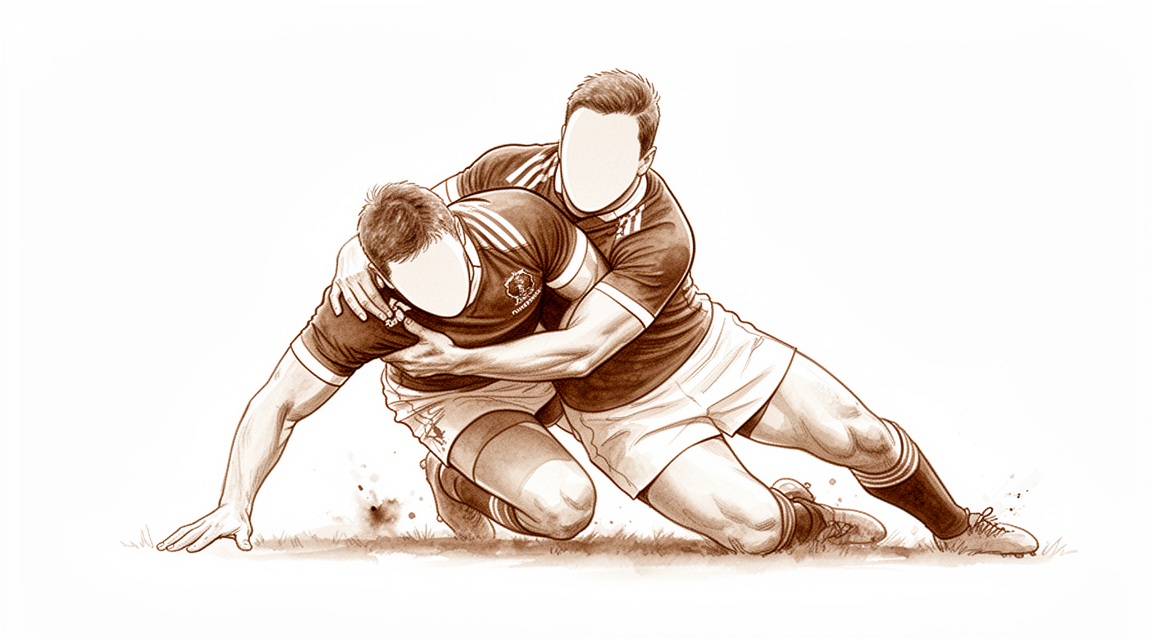
Este protocolo orienta sua recuperação após uma reparação artroscópica do ligamento Bankart anterior realizada pelo Dr. Kieran Hirpara no Mater Private Hospital Rockhampton. Ele apresenta, em linguagem simples, uma explicação de cada fase do processo, além de um programa estruturado que você pode compartilhar com seu fisioterapeuta. Leve esta página ou seu arquivo PDF à sua primeira consulta, para que a reabilitação seja devidamente coordenada. Seu fisioterapeuta poderá ajustar o plano conforme a evolução da sua recuperação.
Caso tenha alguma dúvida ou preocupação quanto à ferida cirúrgica, entre em contato com o consultório. Geralmente, é útil tirar uma foto da ferida e enviá-la por e-mail para análise.
O que esperar
A reparação de Bankart consiste em recolocar o bordo rasgado da cartilagem (o labrum) e a cápsula distendida na parte frontal da cavidade glenoidal, após uma luxação ou subluxação do ombro para a frente. Trata-se de uma reparação de tecidos moles; assim como um tendão em cicatrização, precisa de tempo para se fixar firmemente ao osso — aproximadamente doze semanas para atingir uma resistência confiável. Todo o programa de recuperação visa proteger esse processo de cicatrização.
A regra mais importante é proteger a parte frontal do ombro desde o início, limitando o grau de rotação externa do braço. A rotação externa do braço (especialmente com o braço levantado para o lado) exerce tração direta sobre a área reparada na frente do ombro. Por isso, inicialmente essa rotação é mantida em valores reduzidos, sendo ampliada apenas de forma gradual, até atingir a amplitude completa por volta da décima segunda semana.
A recuperação ocorre de forma progressiva, sem pressa. Primeiro retorna a mobilidade, depois a força muscular, e por fim as atividades esportivas e os trabalhos mais pesados. As reparações de labrum em tecidos moles cicatrizam mais lentamente do que a cirurgia óssea de Latarjet; por isso o cronograma é deliberadamente flexível: a maioria dos pacientes retorna a esportes de contato ou que exigem movimentos acima da cabeça entre quatro e seis meses, desde que atinjam os critérios estabelecidos, e não em uma data fixa.
O procedimento
A sua reparação de Bankart é realizada por artroscopia (técnica minimamente invasiva). Por meio de pequenas incisões, o labrum e a cápsula rompidos na parte anterior do ombro são reanexados à borda da cavidade glenoidal, utilizando pequenos âncoras e pontos de sutura, restaurando assim a função de “amortecedor” e a tensão necessárias para manter a cabeça do úmero centralizada na cavidade. O objetivo da reabilitação é proteger esse reanexo durante o processo de cicatrização, para então, gradualmente, restabelecer a amplitude de movimento, a força e a confiança do paciente no uso do ombro.
Como usar a tipóia
Você usará uma tipóia simples para o ombro, não uma órtese especial. O Dr. Hirpara utiliza uma tipóia simples que mantém o ombro em rotação neutra (com o antebraço apoiado sobre o abdômen); não é necessário usar travesseiros de abdução, cunhas ou órteses do tipo “gunslinger”. A proteção vem da própria tipóia e do fato de manter o braço fora da posição de risco, não da forma da órtese.
- Use a tipóia por 6 semanas como suporte durante o dia, especialmente quando estiver fora de casa ou na companhia de outras pessoas.
- Não durma com a tipóia. Ela serve apenas como suporte diurno; durma sem ela, mantendo o braço confortavelmente apoiado num travesseiro. Enquanto dorme, mantenha o braço à frente do corpo e encostado nele: não permita que ele caia para o lado ou gire para fora (a posição descrita abaixo).
- Retire-a para tomar banho e para fazer os exercícios (após receber as instruções). Sempre que a tipóia estiver retirada, mantenha o braço relaxado, à frente do corpo e ao lado do corpo.
- Use gelo caso o ombro esteja inchado ou dolorido, especialmente após os exercícios.
Preste atenção à sua postura enquanto usa a tipóia: mantenha as orelhas, ombros e quadris alinhados, evitando curvar-se demais.
Precauções importantes — NÃO FAÇA
- NÃO coloque o braço na posição de “mão para cima” ou de arremesso (braço levantado para o lado e rotacionado para fora, como se estivesse acenando ou prestes a lançar algo). É exatamente nessa posição que ocorre a luxação do ombro, e ela puxa diretamente a área reparada. Um guia simples que algumas pessoas usam é: “mantenha os cotovelos sempre à vista”: mantenha os braços à sua frente.
- NÃO rotacione ativamente o braço para fora, ultrapassando os limites indicados nas primeiras semanas. A rotação externa é liberada gradualmente: apenas uma pequena quantidade (cerca de 20°, bem abaixo da posição frontal direta) nas primeiras semanas, aumentando até atingir o limite total por volta da 12ª semana.
- NÃO movimente ativamente o ombro por conta própria até aproximadamente a 6ª semana: até lá, deixe que o braço saudável ou uma bengala realize os movimentos.
- NÃO tente alcançar as costas, abotoar um sutiã ou colocar a mão no bolso traseiro nos primeiros tempos.
- NÃO levante, empurre, puxe ou apoie peso no braço operado durante 6 semanas.
- NÃO faça flexões, supino, exercícios de adução ou abdução do peito, levantamento de peso acima da cabeça ou puxadas atrás do pescoço até o final do programa de reabilitação; todos esses movimentos sobrecarregam ou esticam a região anterior do ombro.
- NÃO force ou estique o ombro até uma posição em que ele pareça prestes a deslocar-se; dor ou sensação de desconforto são sinais para interromper o movimento.
- NÃO dirija enquanto o sling for necessário (6 semanas).
Fase I: Proteção (semanas 0–6)
Kieran Hirpara 4.0
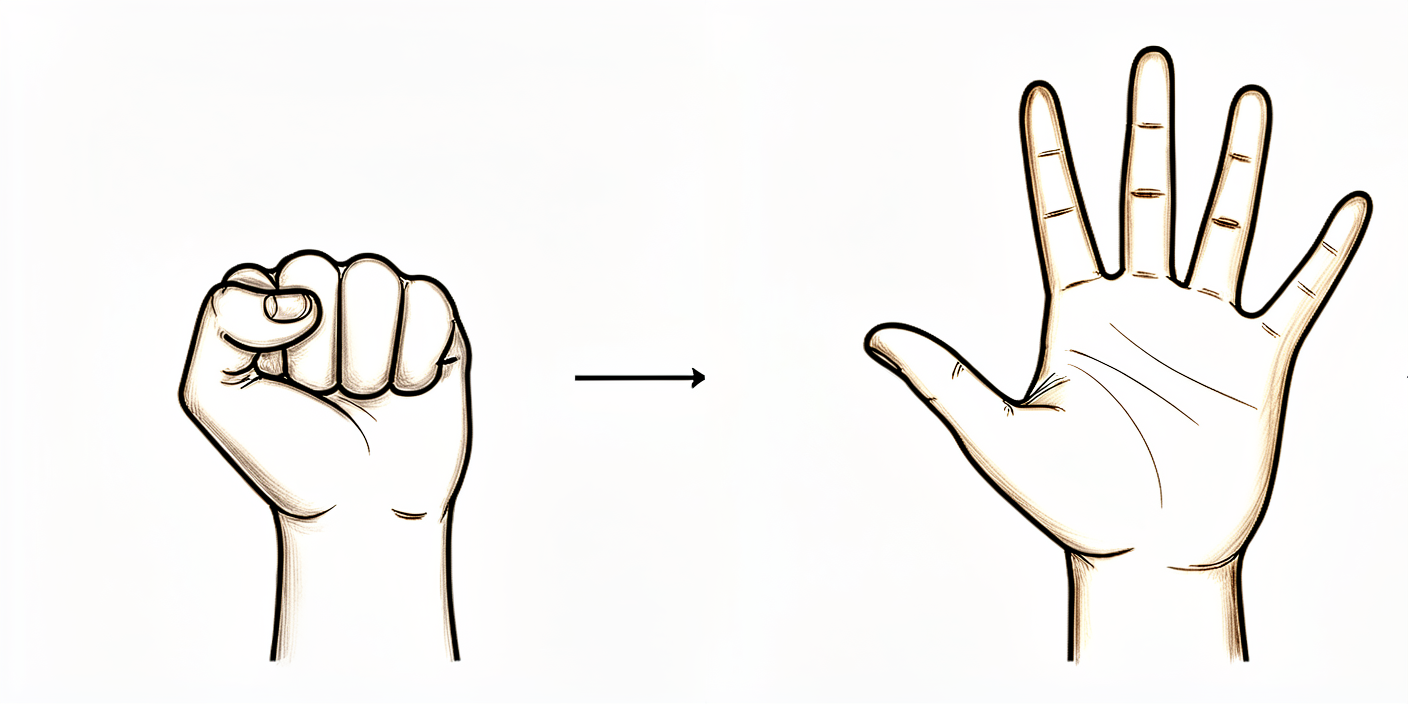
Abrir e fechar a mão
Faça um punho fechado com a mão e, em seguida, abra-a completamente. Isso mantém a mão em movimento e ajuda a prevenir rigidez e inchaço.
10 vezes por hora
Kieran Hirpara 4.0
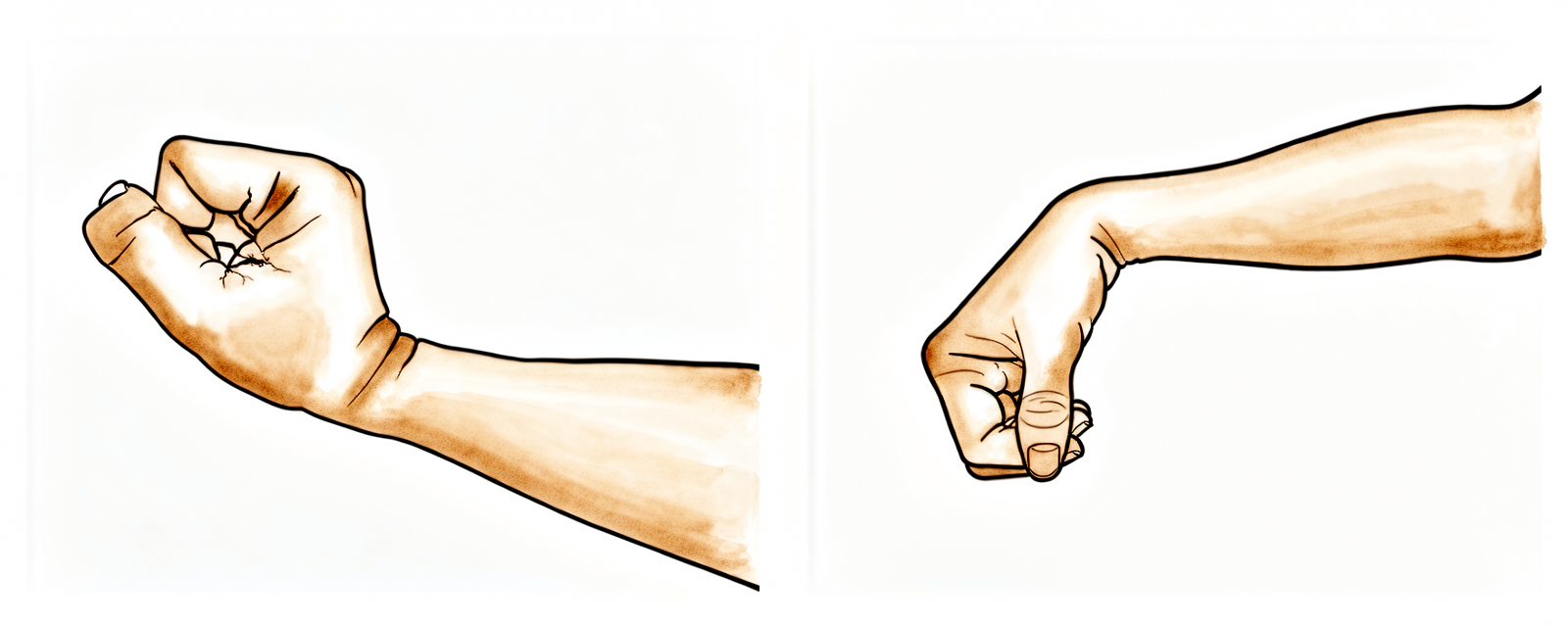
Flexão do punho
Flexione suavemente o pulso para a frente e depois para trás, até onde lhe for confortável.
10–15 vezes por hora
Kieran Hirpara 4.0
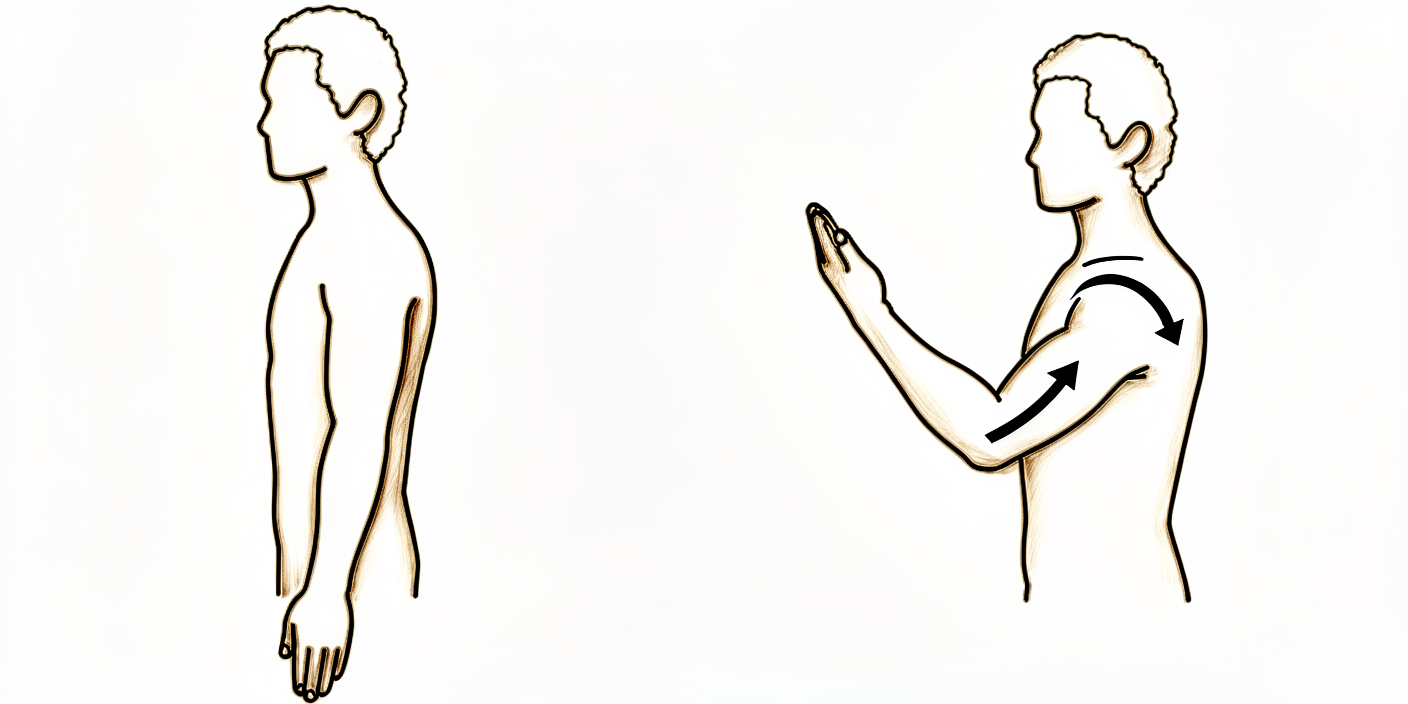
Flexão do cotovelo
Com a palma da mão voltada para cima, dobre o cotovelo suavemente o máximo que puder e, em seguida, estique o braço novamente. Mantenha o braço superior junto ao corpo. Não permita que o braço gire para fora durante esse movimento.
10–15 vezes, 2–3 vezes ao dia
Kieran Hirpara 4.0
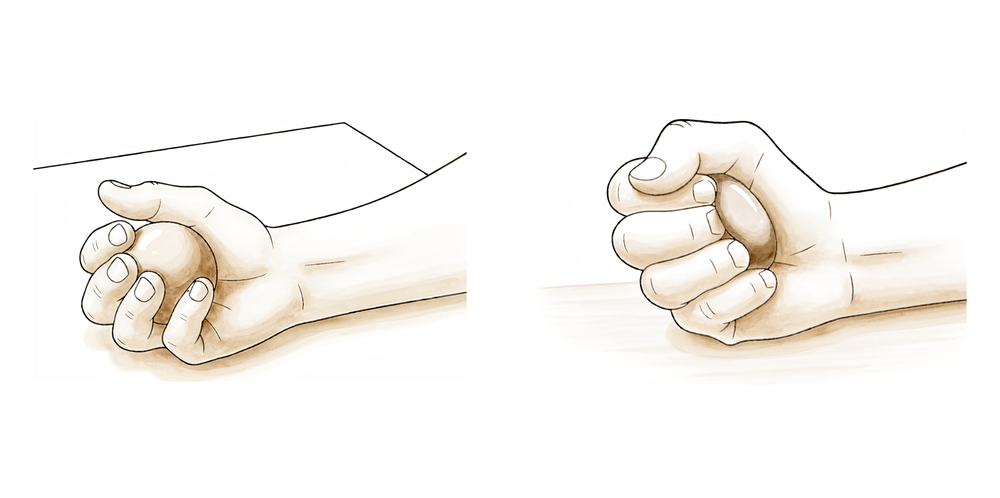
Apertar a bola
Aperte suavemente uma bola macia ou uma meia enrolada na mão, e depois solte. Isso mantém a mão e o antebraço ativos, enquanto o ombro descansa.
10–15 vezes, algumas vezes ao dia
Kieran Hirpara 4.0
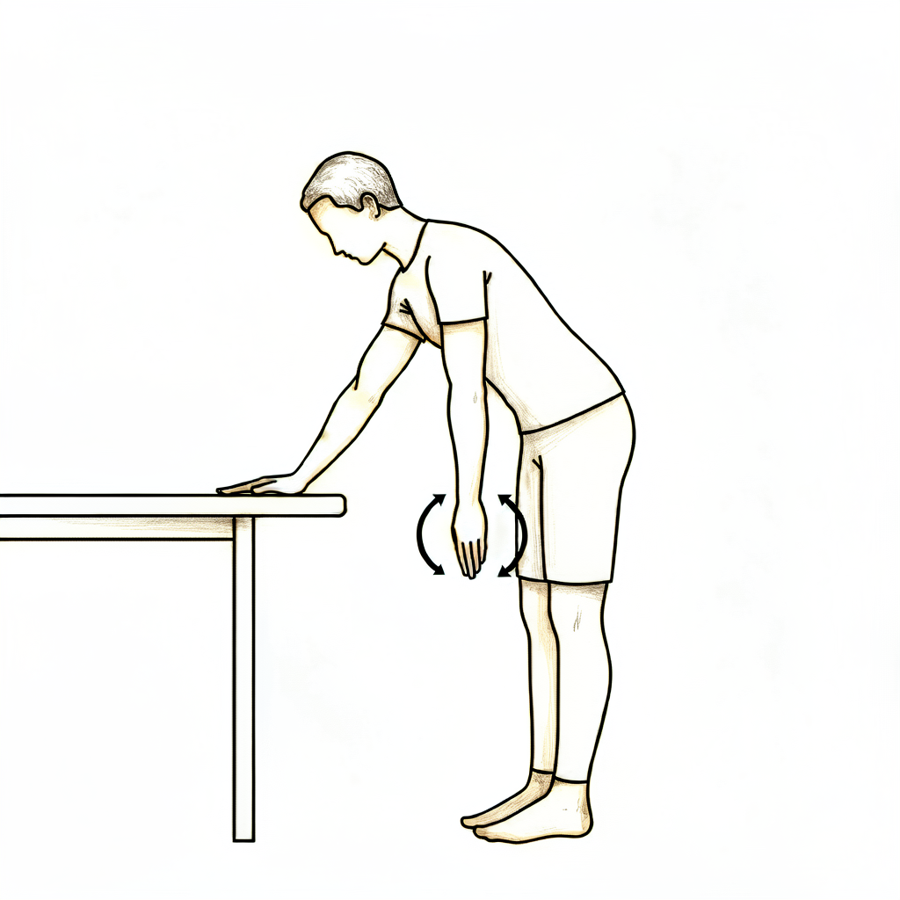
Oscilações do pêndulo
Incline-se para a frente e deixe o braço operado pendurado, completamente relaxado. Faça pequenos círculos — primeiro no sentido horário, depois no sentido anti-horário — balançando o corpo, NÃO usando os músculos do ombro. Mantenha os círculos pequenos (com menos de 20 cm de diâmetro) e o braço sempre pendurado na vertical — não permita que ele se balance para o lado ou gire para fora. O braço operado deve permanecer relaxado durante todo o exercício.
10 em cada direção, 2–3 vezes ao dia
Kieran Hirpara 4.0
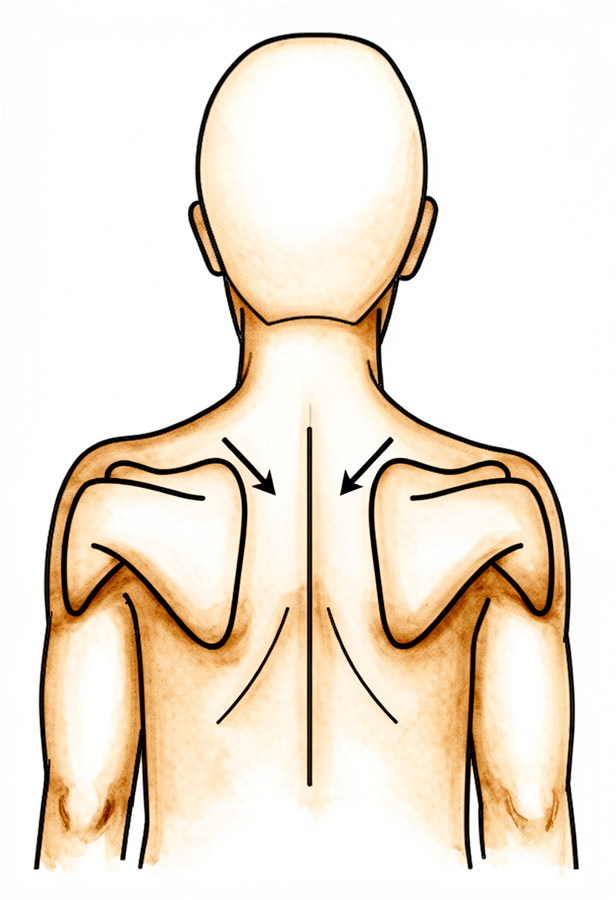
Posicionamento da escápula
Aperte suavemente as escápulas para baixo e para juntos, mantenha a posição e depois relaxe. Este é um exercício leve de ativação muscular: o braço não se move e o ombro permanece relaxado.
Mantenha por 5 segundos, 5 vezes, 2–3 vezes ao dia.
Kieran Hirpara 4.0
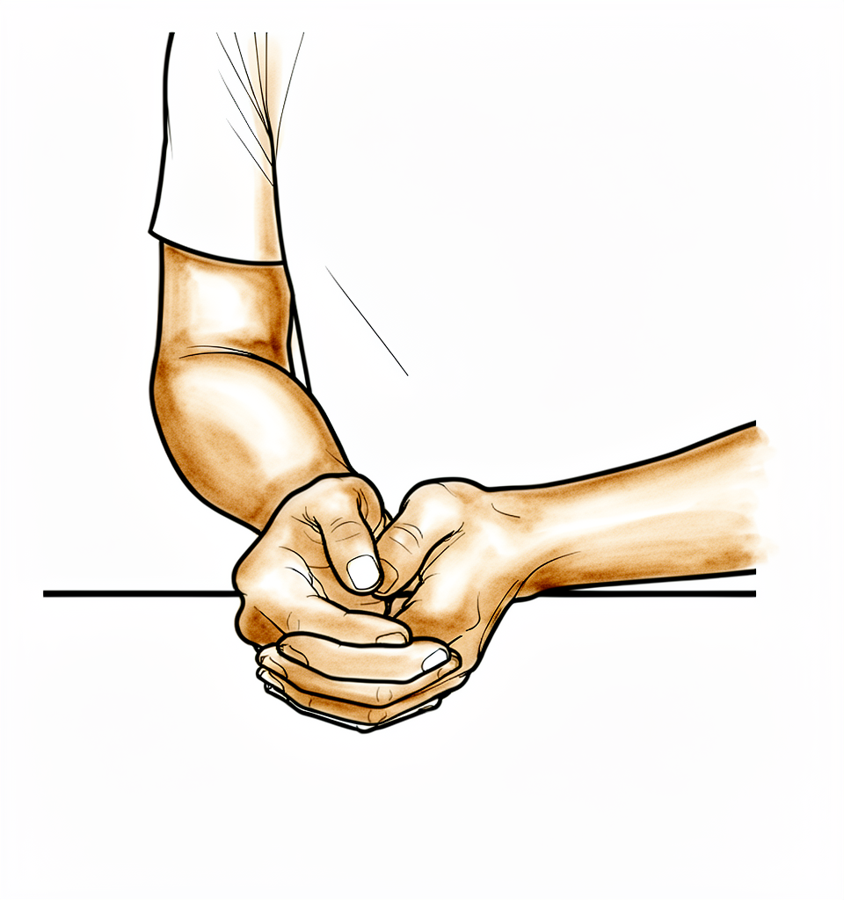
Rotação externa assistida até a posição neutra
A partir da semana 2 aproximadamente, apenas se o seu fisioterapeuta assim orientar. Com o cotovelo pressionado contra o corpo, dobrado a 90°, e a mão apoiada sobre o abdômen, use a mão saudável para guiar suavemente o antebraço para fora — mas apenas uma PEQUENA amplitude (cerca de um quarto de volta, aproximadamente 20°), nunca ultrapassando a posição reta para a frente (neutra) nestas primeiras semanas. Respeite rigorosamente o limite estabelecido pelo fisioterapeuta e nunca force o movimento. Esse é o movimento que sobrecarrega a área reparada; por isso, é mantido deliberadamente pequeno.
Conforme orientado pelo seu fisioterapeuta, dentro do limite estabelecido.
As primeiras seis semanas têm um único objetivo: proteger a reparação feita na frente do ombro enquanto ela começa a aderir ao osso. Durante o dia, você deve usar a tipoia simples para sustentar o braço; à noite, retire-a, mantendo o braço à frente do corpo, nunca estendido ou rotacionado para fora. Use gelo para controlar o inchaço e realize exercícios suaves que mantenham a mão, o pulso e o cotovelo em movimento, sem sobrecarregar ou esticar a área reparada. Por enquanto, não é possível mover o ombro por conta própria; o braço saudável ou uma bengala farão esse trabalho, e você deve permanecer completamente relaxado.
- Tipoia: use a tipoia simples, mantendo o braço em rotação neutra durante o dia; à noite, retire-a, mas mantenha o braço à frente do corpo e encolhido; retire-a também para fazer os exercícios e para higiene.
- Movimentos permitidos: apenas movimentos assistidos ou passivos (nada que exija força do próprio ombro). A partir da segunda semana, é permitido um levantamento suave do braço para a frente, até cerca de 90° (metade da altura total); a rotação externa assistida também é permitida, porém apenas numa pequena amplitude (cerca de 20°, sem chegar à posição frontal). O braço deve permanecer sempre à frente do corpo; nunca o estenda para o lado nem o gire para fora.
- Exercícios: balanços pendulares; movimentos suaves da mão, pulso e cotovelo; apertar uma bola; exercícios de estabilização das omoplatas. A partir da terceira semana, siga as orientações do fisioterapeuta para realizar contrações musculares suaves e indolores (pressione levemente o braço contra uma parede ou contra a outra mão, mantendo a posição, sem rotacionar o braço, nem para dentro nem para fora). A partir da segunda semana, se o fisioterapeuta indicar, também pode-se realizar rotação externa assistida numa amplitude limitada, respeitando os limites estabelecidos.
Está pronto para a próxima fase quando: a dor estiver controlada com analgésicos simples (cerca de 3/10 ou menos); você tiver completado as seis semanas de uso da tipoia; a ferida estiver cicatrizada, sem sinais de complicações; conseguir realizar os movimentos assistidos dentro dos limites sem sentir que o ombro possa deslocar-se; e não houver indícios de que a reparação tenha sido sobrecarregada.
Fase II: Restauração do movimento e da rotação (semanas 6–12)
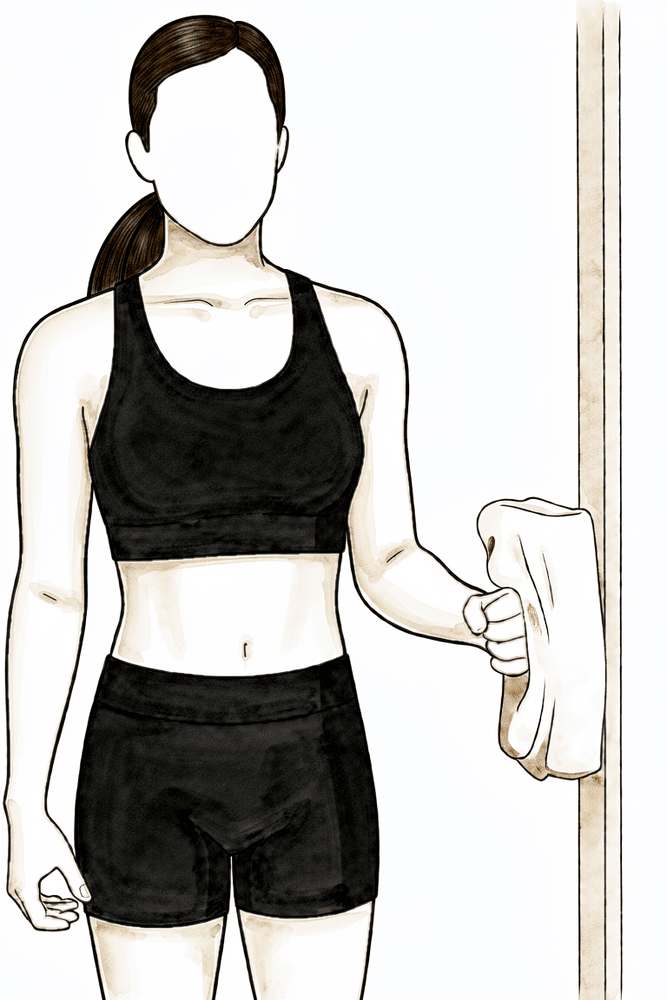
Kieran Hirpara 4.0
Rotação externa isométrica
A partir da semana 6–8, quando o fisioterapeuta autorizar. Fique em pé com o cotovelo pressionado contra o corpo e dobrado a 90°, mantendo o dorso da mão próximo a uma parede ou à moldura de uma porta. Pressione suavemente o dorso da mão para fora contra a superfície, SEM mover o braço — um esforço suave, cerca de um quarto da sua força, sem causar dor. Mantenha a posição e depois relaxe. Prossiga gradualmente, pois a rotação externa é a direção em que a área operada é mais sensível.
Mantenha por ~5 segundos, com suavidade (~25% da força máxima), conforme orientação do seu fisioterapeuta.
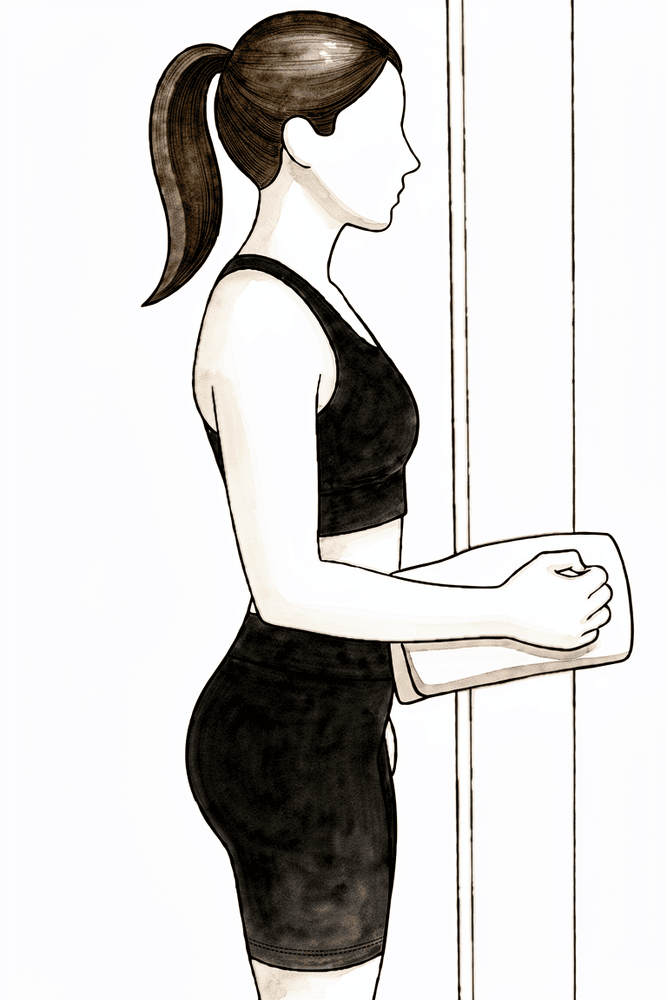
Kieran Hirpara 4.0
Rotação interna isométrica
A partir da semana 6–8, quando o fisioterapeuta autorizar. Fique em pé com o cotovelo junto ao corpo e a palma da mão encostada numa parede. Pressione suavemente a palma para dentro, SEM mover o braço — cerca de um quarto da sua força, sem sentir dor. Mantenha e depois relaxe.
Mantenha por ~5 segundos, com suavidade (~25% da força máxima), conforme orientação do seu fisioterapeuta.
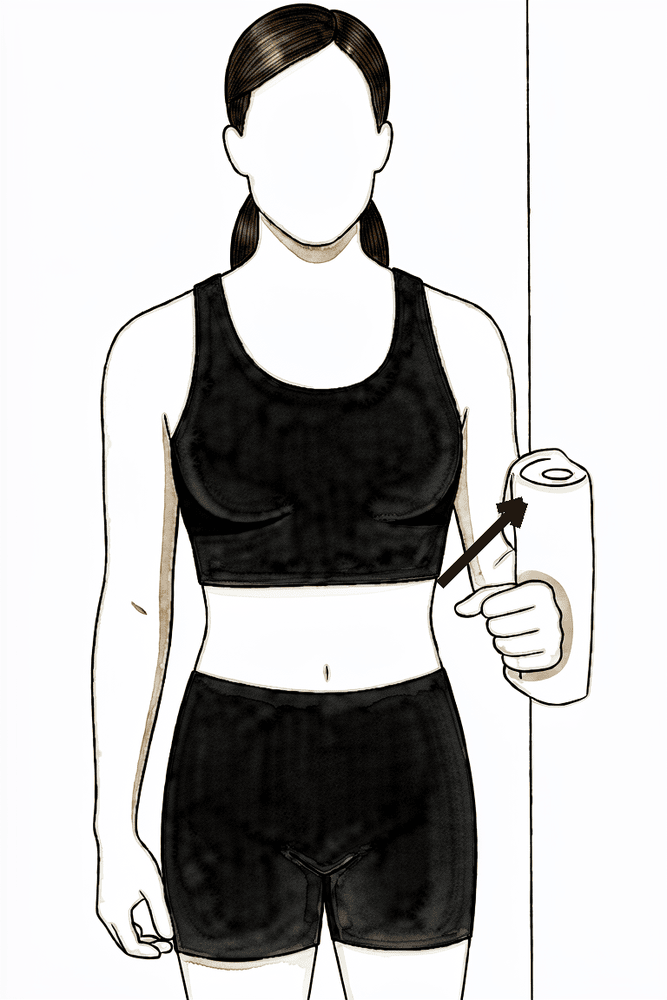
Kieran Hirpara 4.0
Isométrico: braço estendido para o lado
A partir da semana 6–8, quando o fisioterapeuta autorizar. Fique de pé de lado, com a parte externa do braço próxima a uma parede e o cotovelo junto ao corpo. Pressione suavemente o braço para fora contra a parede, SEM permitir que ele se mova — cerca de um quarto da sua força, sem dor. Mantenha e depois relaxe.
Mantenha por ~5 segundos, com suavidade (~25% da força), conforme orientado pelo seu fisioterapeuta.
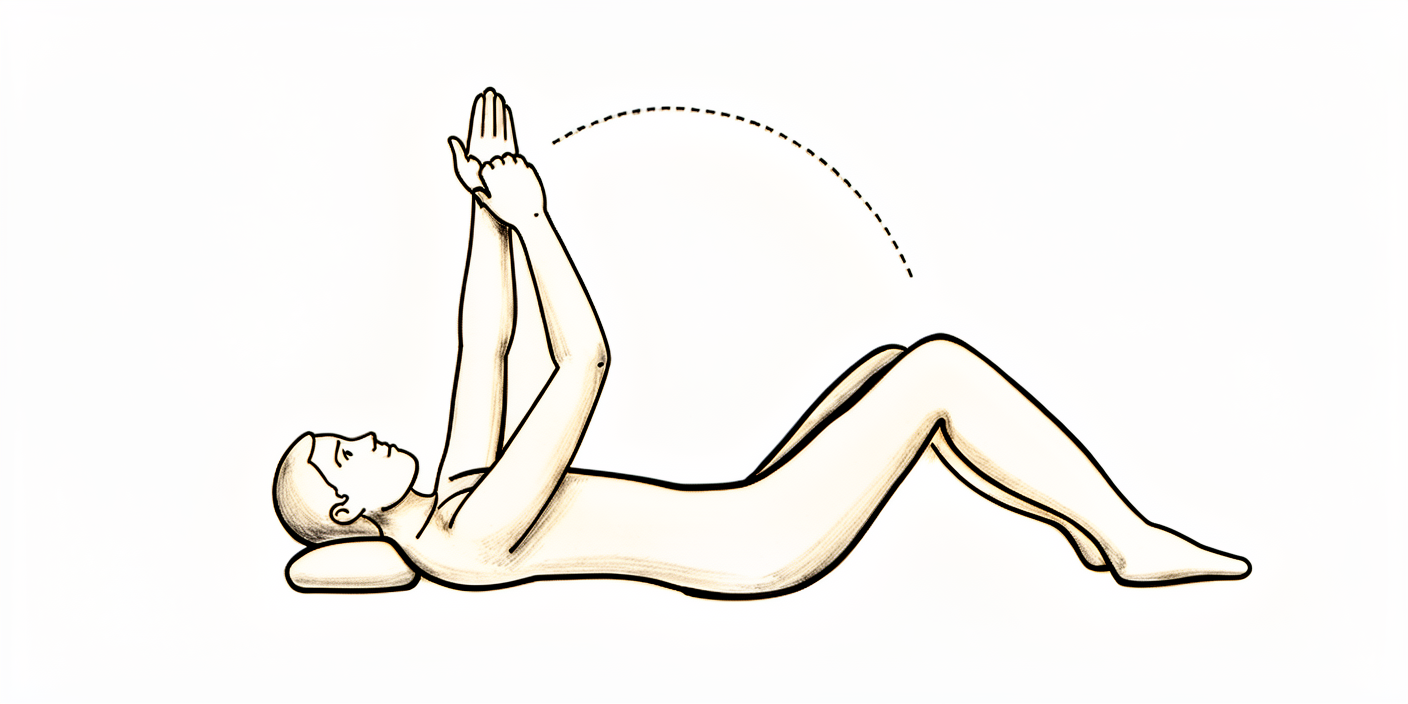
Kieran Hirpara 4.0
Elevação anterior assistida em decúbito
Deitado de costas, segure uma vara com as duas mãos e use o braço saudável para levantar o braço operado para a frente e para cima — o ombro operado deve permanecer relaxado. Faça o movimento de maneira suave, sem forçar, e abaixe o braço com controle. Aumente gradualmente a altura do movimento, respeitando os limites indicados pelo seu fisioterapeuta.
10 vezes, 2–3 vezes ao dia
Kieran Hirpara 4.0
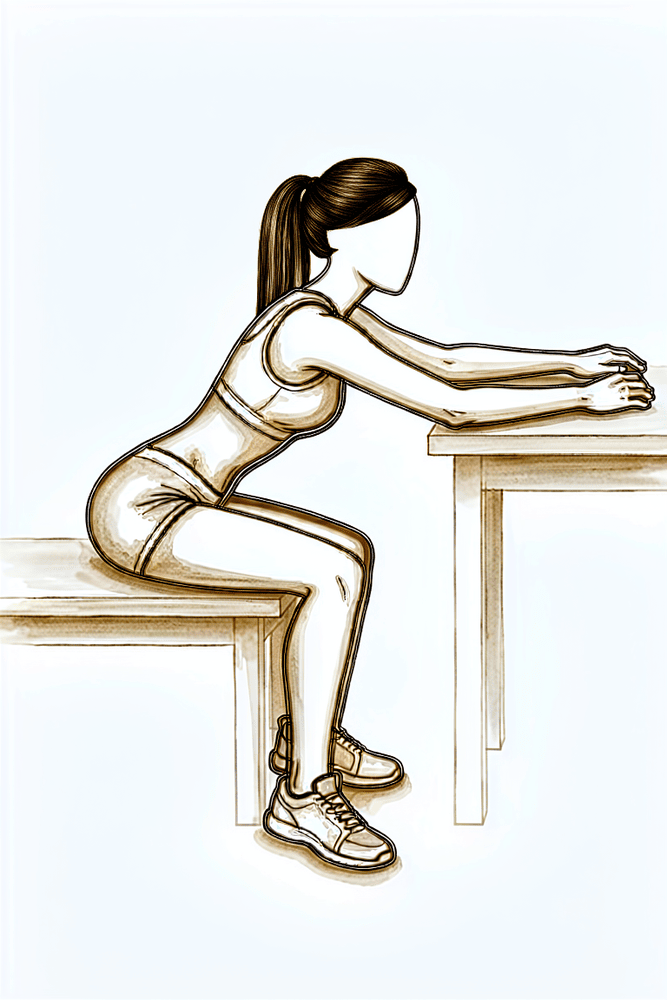
Deslizamento do braço sobre a mesa, sentado
Sente-se à mesa com a mão operada apoiada numa toalha. Deslize a mão para a frente ao longo da superfície, de modo que o braço se estenda para a frente e para cima, deixando que a mesa suporte o peso; em seguida, deslize a mão de volta. Mantenha o braço à sua frente — não o deslize para o lado nem permita que ele gire para fora.
10 vezes, 2–3 vezes ao dia
Kieran Hirpara 4.0
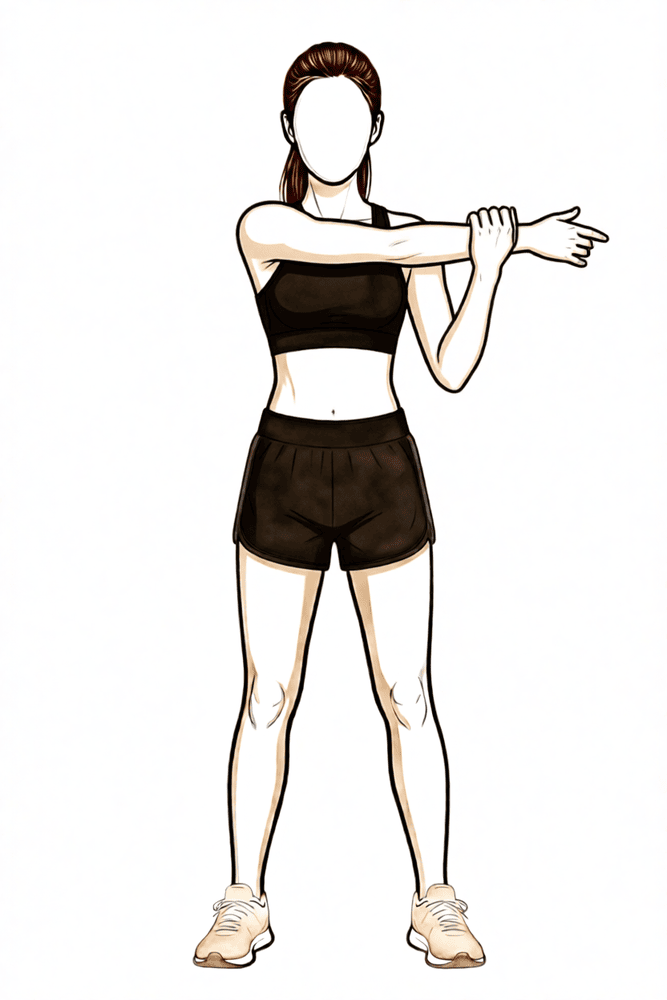
Alongamento cruzado do corpo
A partir da semana 6–8, se o fisioterapeuta assim orientar. Use a mão saudável para levar suavemente o braço operado cruzando à frente do peito, até sentir um alongamento confortável na parte posterior do ombro. Faça isso com delicadeza — não force. Esse movimento alonga a parte de trás do ombro sem sobrecarregar a área da reparação anterior.
Mantenha por 10–20 segundos, algumas vezes, conforme orientação do seu fisioterapeuta.
O cabresto já foi retirado, e agora o foco é restaurar o movimento, não a força muscular. Você passará do movimento assistido para o movimento realizado por seus próprios esforços; além disso, a rotação externa do braço será gradualmente recuperada: inicialmente em torno de 30–45° no início desta fase, atingindo a amplitude completa por volta da 12ª semana. Esse processo ocorre de forma progressiva, sem forçar os movimentos, pois a reparação dos tecidos frontais ainda está em fase de cicatrização. Conforme o movimento melhora, exercícios leves de ativação muscular (isométricos) também são incorporados.
- Cabresto: retirado.
- Movimentos permitidos: inicialmente movimentos assistidos, evoluindo para movimentos realizados por seus próprios esforços. O levantamento do braço para a frente avança até atingir a amplitude completa acima da cabeça. A rotação externa é recuperada gradualmente: cerca de 30–45° no início desta fase, atingindo a amplitude total por volta da 12ª semana. O movimento de alcançar atrás das costas é reintroduzido com cuidado e somente no final desta fase.
- Exercícios: levantamento do braço para a frente na posição deitada; deslizamento do braço sobre uma mesa sentado; exercícios isométricos suaves (pressão mantida) de rotação externa, rotação interna e movimento do braço para o lado; alongamento cruzado do ombro para a parte posterior do braço.
Pronto para a próxima fase quando: você conseguir levantar o braço para a frente por conta própria até quase a altura máxima, com bom controle (sem levantar os ombros ou movimentos bruscos); a rotação externa já tiver atingido a amplitude completa ou quase completa e for confortável; os exercícios isométricos leves forem tolerados sem provocar aumento da dor posteriormente; e você não sentir que o ombro possa “deslocar-se” durante os movimentos cotidianos.
Fase III: Fortalecimento (semanas 12–16)
Kieran Hirpara 4.0
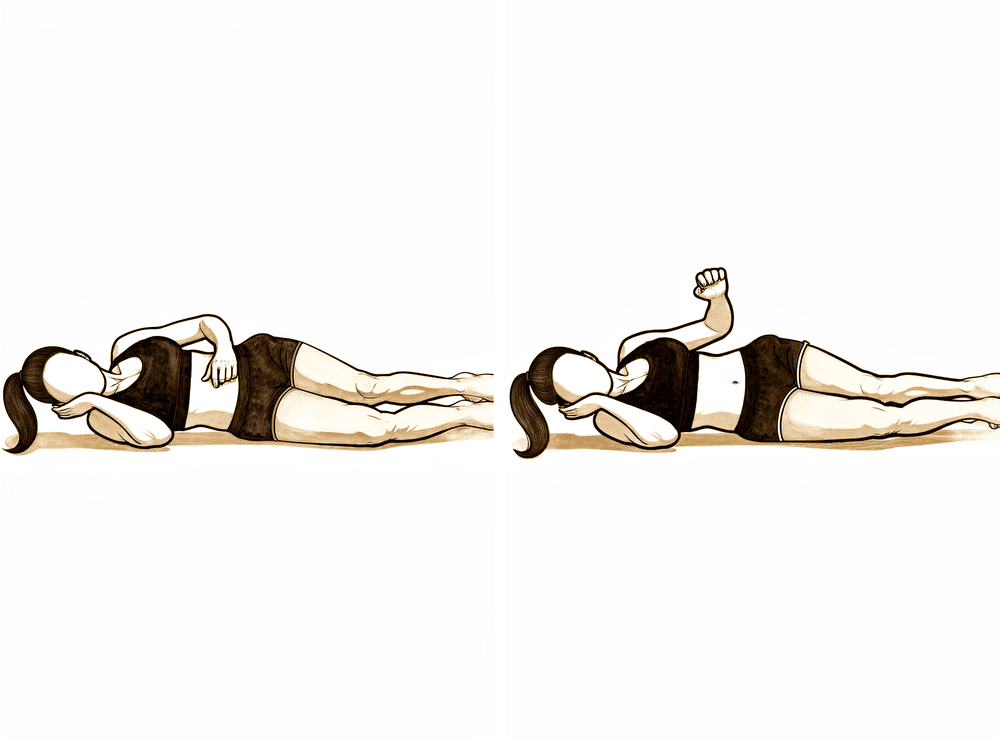
Rotação externa em decúbito lateral
A partir da 12ª semana aproximadamente. Deite-se de lado, com o cotovelo operado junto à cintura e dobrado a 90°. Gire o antebraço operado para cima, em direção ao teto, e depois abaixe-o de forma controlada. Comece sem nenhum peso, mantendo-se dentro da amplitude de movimento indicada pelo seu fisioterapeuta. Esse exercício fortalece a rotação externa por último, pois é o movimento que a reparação cirúrgica mais protege.
Conforme orientado pelo seu fisioterapeuta
Kieran Hirpara 4.0
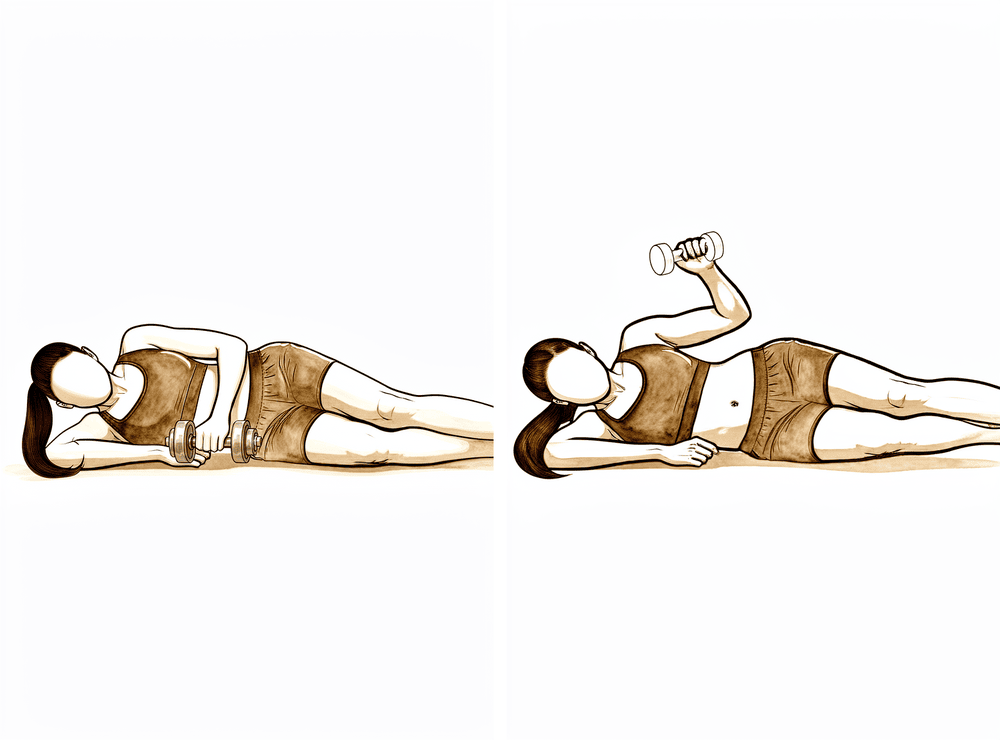
Rotação externa em decúbito lateral com um peso leve
A rotação externa em decúbito lateral, como antes, agora com um peso leve, aumentando a carga gradualmente. Mantenha o cotovelo junto à cintura. Interrompa o exercício caso sinta dor no ombro.
Conforme orientado pelo seu fisioterapeuta
Kieran Hirpara 4.0
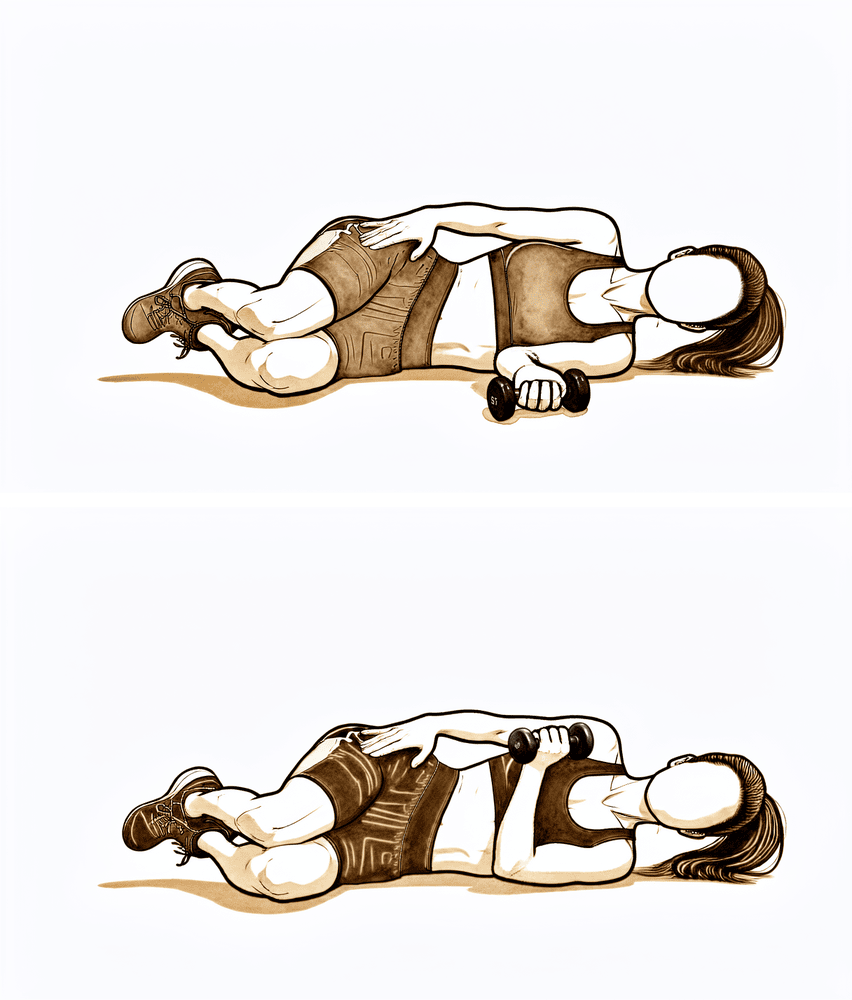
Rotação medial em decúbito lateral com um peso leve
A partir da 12ª semana aproximadamente. Deite-se sobre o lado operado, com o cotovelo junto à cintura e dobrado a 90°, segurando um peso leve. Levante o antebraço em direção ao abdômen e, em seguida, abaixe-o de forma controlada.
Conforme orientado pelo seu fisioterapeuta
Kieran Hirpara 4.0
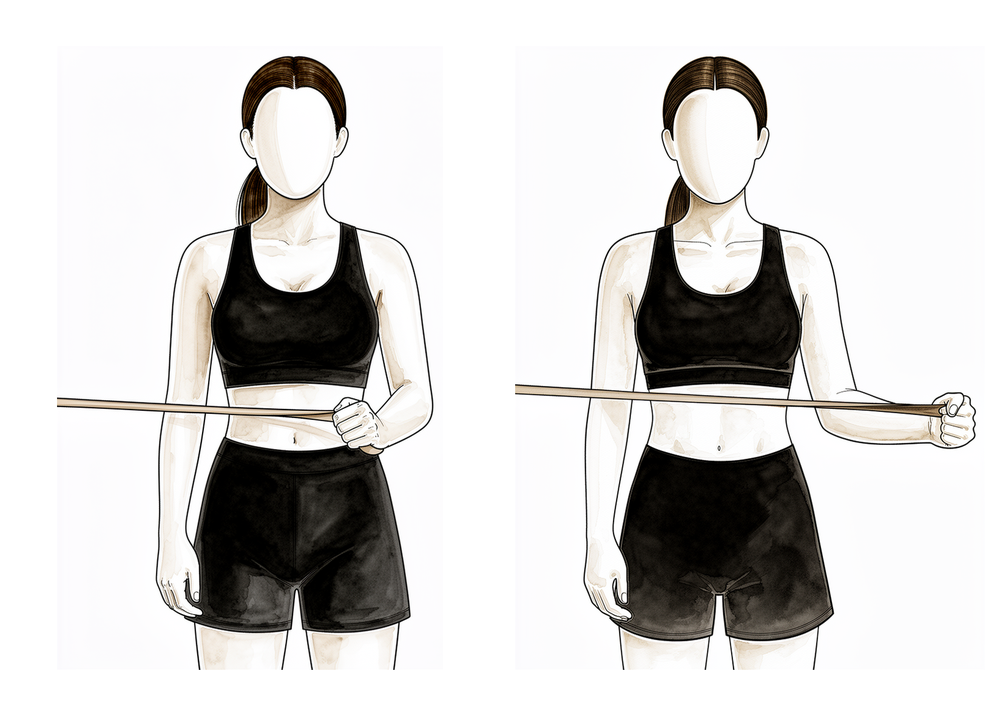
Rotação externa com faixa elástica
A partir da 12ª semana, quando a rotação completa já for confortável. Mantenha o cotovelo junto ao corpo e dobrado a 90°. Gire o antebraço para fora contra a resistência de uma faixa leve, depois volte à posição inicial de forma controlada. Use uma faixa leve e faça muitas repetições, evitando resistências muito fortes.
Conforme orientado pelo seu fisioterapeuta
Kieran Hirpara 4.0
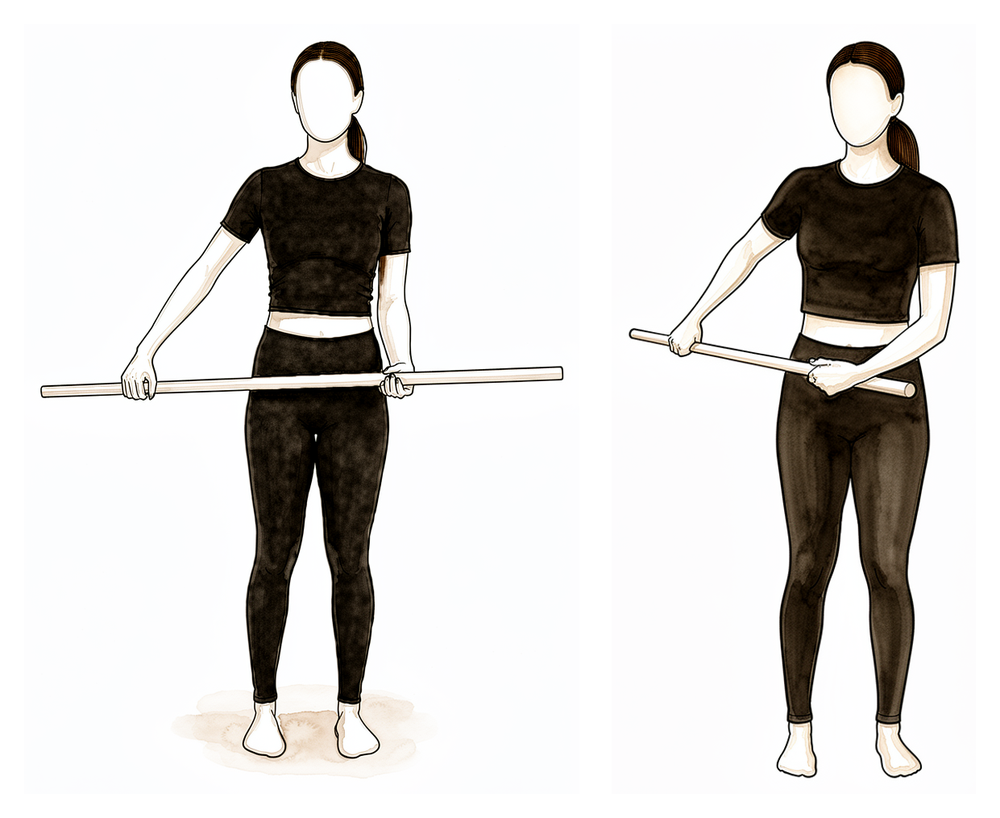
Rotação interna utilizando uma vara
A partir da 12ª semana aproximadamente. Segure uma vara atrás das costas e use a mão saudável para levantar suavemente a mão operada pelas costas, depois abaixe-a com controle. Faça o exercício de forma confortável e respeitando os limites indicados pelo seu fisioterapeuta.
Conforme orientado pelo seu fisioterapeuta
Kieran Hirpara 4.0
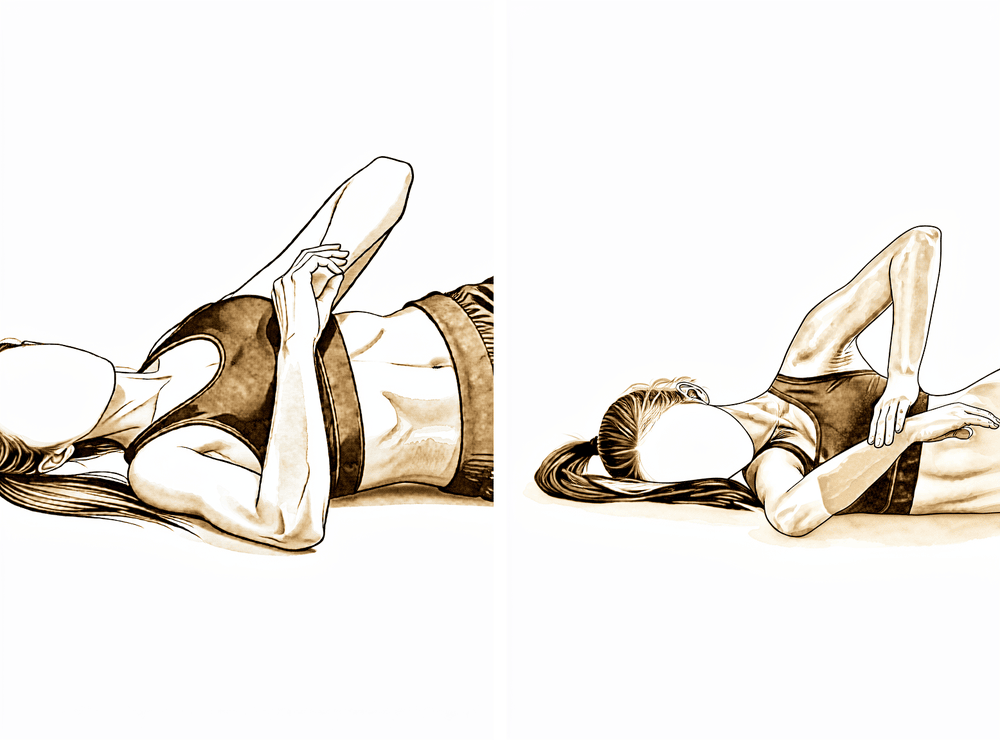
Alongamento do tipo “dorminhoco”
A partir da 12ª semana, se o seu fisioterapeuta assim orientar. Deite-se sobre o lado operado, com o braço estendido para a frente e o cotovelo dobrado. Use a mão superior para pressionar suavemente o antebraço em direção à cama, até sentir um alongamento confortável na parte posterior do ombro. Faça isso com suavidade — não force.
Mantenha por 10–20 segundos, algumas vezes, conforme orientação do seu fisioterapeuta.
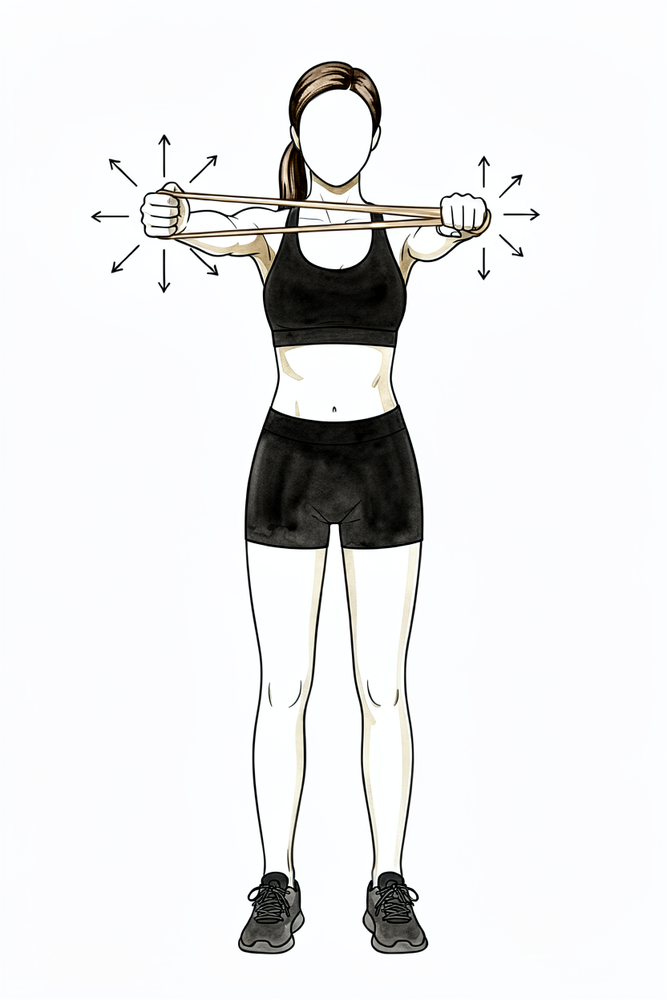
Kieran Hirpara 4.0
Estabilização rítmica
Com o braço apoiado à sua frente, na altura dos ombros, peça ao seu fisioterapeuta (ou à sua mão sã) que aplique pequenos empurrões suaves em diferentes direções, enquanto você mantém o braço imóvel e firme — não permita que ele se mova. Isso treina os músculos estabilizadores do ombro para reagirem. As pressões devem ser sempre suaves.
Conforme orientado pelo seu fisioterapeuta
Após doze semanas, a reparação já está suficientemente sólida para iniciar o fortalecimento propriamente dito; o foco passa, então, de recuperar o movimento para reconstruir a força, a resistência e o controle. Começa-se agora o trabalho de resistência com faixas leves e pesos leves: muitas repetições, cargas baixas. Os músculos do manguito rotador, responsáveis por estabilizar o ombro, são fortalecidos em todas as direções; a rotação externa é estimulada com cuidado, pois é a direção em que a reparação é mais sensível. Mantenha sempre os movimentos controlados e sem dor.
- Tipo de imobilização: nenhuma; espera-se movimento total.
- Exercícios: rotação externa deitado de lado (evoluindo para uso de peso leve); rotação interna deitado de lado com peso leve; rotação externa com faixa leve, cotovelo junto ao corpo; rotação interna usando uma vara; alongamento “sleeper” para a parte posterior do ombro. O fisioterapeuta também pode acrescentar a estabilização rítmica (exercícios suaves de manutenção da posição, nos quais ele empurra levemente o seu braço e você oferece resistência) para retreinar o controle do ombro. Trata-se de um trabalho manual, sem diagramas.
Está pronto para a fase seguinte quando: você consegue mover o ombro livremente e sem dor, inclusive controlando a escápula; não há dor nem inchaço após as sessões de fortalecimento; a força de rotação está aumentando de forma constante, aproximando-se do nível do lado oposto; e você não sente medo nem instabilidade ao realizar tarefas cotidianas que exigem esforço.
Fase IV: Retorno ao esporte e ao trabalho (4–6 meses)
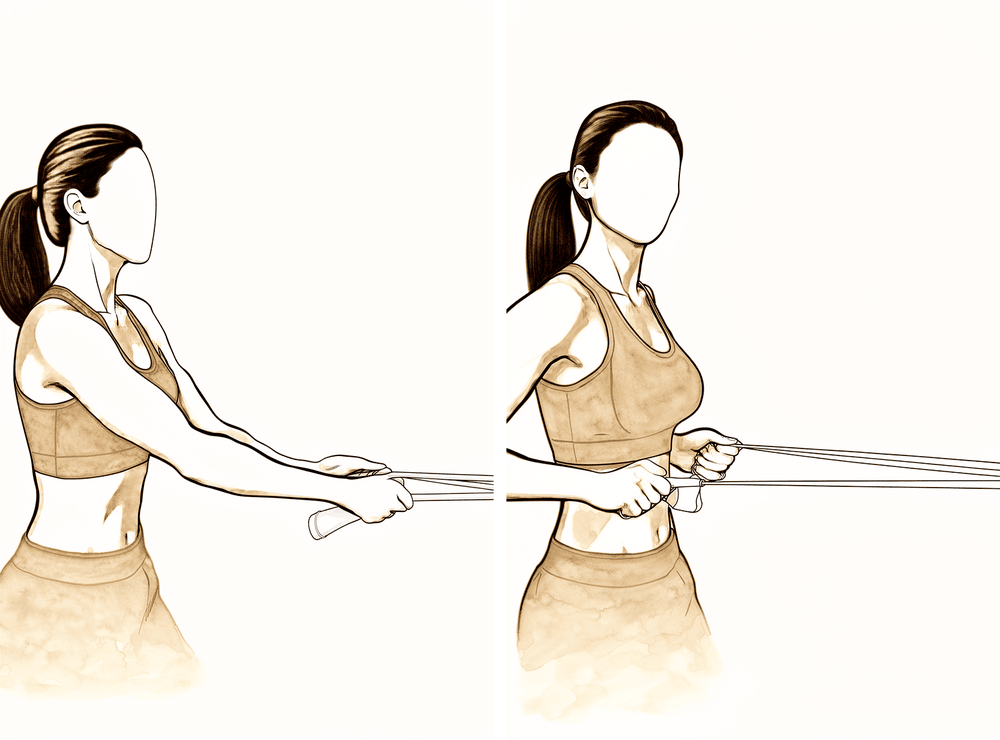
Kieran Hirpara 4.0
Remada com faixa de resistência
Com uma faixa elástica fixada à sua frente, puxe as alças em direção a si, trazendo os cotovelos para trás e juntando as escápulas; em seguida, volte à posição inicial de forma controlada. Mantenha os cotovelos próximos ao corpo e à frente de você — não os deixe deslizar para trás, para além da linha do corpo. Use uma faixa elástica leve e faça muitas repetições.
Conforme orientado pelo seu fisioterapeuta
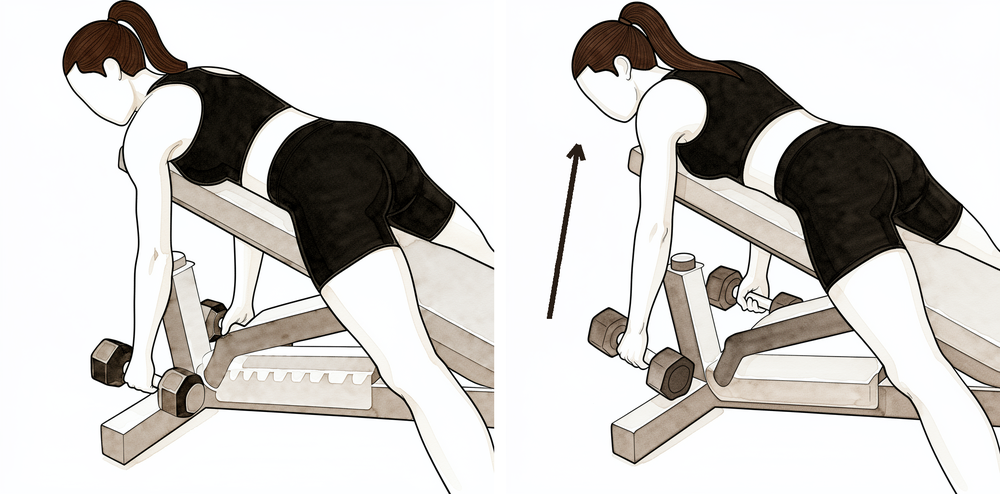
Kieran Hirpara 4.0
Tração da escápula com peso
Puxe as escápulas para trás e para baixo contra um peso leve ou faixa elástica, mantenha a posição por alguns instantes e depois solte com controle. Isso fortalece os músculos que estabilizam a escápula e dão suporte ao ombro reparado.
Conforme orientado pelo seu fisioterapeuta
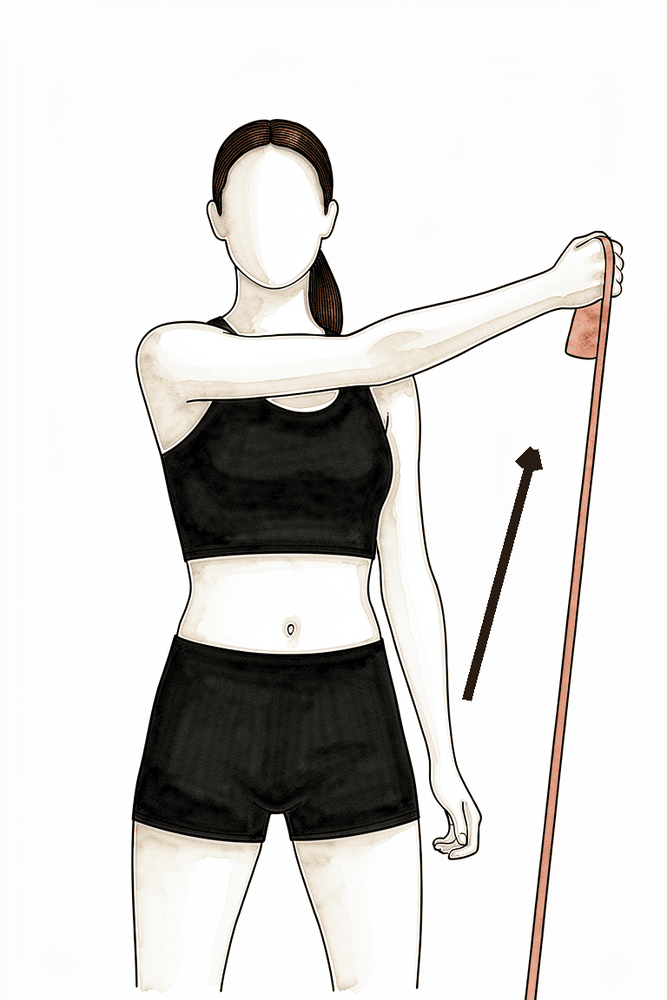
Kieran Hirpara 4.0
Padrão diagonal com faixa (alcançando para baixo e cruzando o corpo)
A partir da 12ª semana aproximadamente, quando já tiver movimento total e confortável. Com uma faixa leve, mova o braço numa linha diagonal suave — partindo de cima e para fora, para baixo e cruzando em direção ao quadril oposto, e depois de volta. Isso treina o ombro nos padrões diagonais naturais utilizados nas atividades diárias e nos esportes. Mantenha o movimento controlado e sem dor.
Conforme orientado pelo seu fisioterapeuta
Kieran Hirpara 4.0
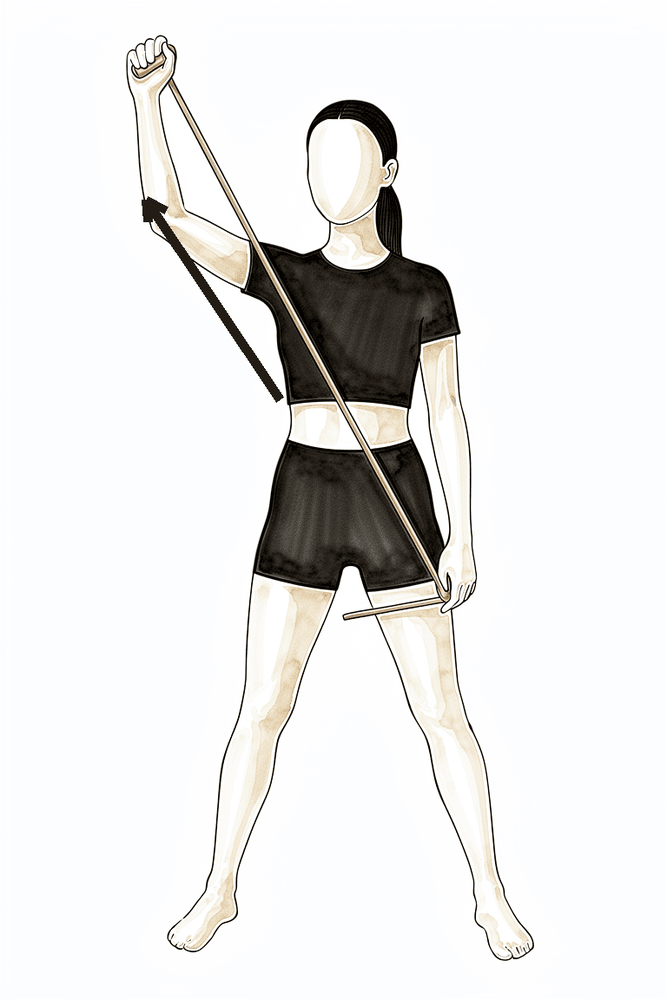
Padrão diagonal com faixa (alcançando para cima e cruzando o corpo)
A partir do final desta fase, quando a rotação externa já for completa e confortável. Com uma faixa leve, mova o braço numa linha diagonal suave — partindo de baixo e cruzado à frente do corpo, para cima e para fora acima da cabeça, e depois de volta. Como esse movimento leva o braço à posição elevada e com rotação externa, introduza-o somente quando o seu fisioterapeuta considerar que você está pronto. Mantenha o movimento controlado e sem dor.
Conforme orientado pelo seu fisioterapeuta
Esta fase serve como ponte para que o ombro, agora forte e controlado, volte a suportar as exigências do esporte e de atividades laborais mais pesadas. Você manterá a amplitude de movimento conquistada e desenvolverá força, potência e resistência para utilizá-la com confiança. O retorno é feito de forma gradual, não repentina; para esportes que envolvem movimentos acima da cabeça ou contato físico, um programa progressivo que aumente gradualmente o volume e a intensidade é a forma mais segura de retornar.
- Tipo de imobilização: nenhum.
- Exercícios: fortalecimento progressivo do manguito rotador e da escápula (remadas com faixa elástica, puxadas para trás da escápula); exercícios com faixa elástica em padrões diagonais que treinam o ombro nos movimentos naturais de alcance; o padrão de movimento acima da cabeça e com rotação só deve ser adicionado quando a rotação externa estiver completa e confortável. Em seguida, condicionamento específico para o esporte/trabalho e exercícios de alta velocidade, sempre de forma controlada.
Pronto para retornar quando: sua força atingir pelo menos 85% da força do lado contralateral e o equilíbrio entre a força de rotação externa e interna for adequado; você tiver amplitude de movimento completa, sem dor e sem sensação de instabilidade sob carga; e passar nos testes específicos para seu esporte ou atividade profissional. O retorno a esportes de contato ou com movimentos acima da cabeça geralmente ocorre por volta dos 4–6 meses, desde que esses critérios sejam atendidos e com autorização do Dr. Hirpara e do seu fisioterapeuta, e não apenas com base no calendário.
Retorno ao esporte e ao trabalho
O retorno ao esporte e ao trabalho é baseado em critérios: ausência de dor, amplitude de movimento completa, força muscular equilibrada, sensação de estabilidade do ombro, além da autorização tanto do Dr. Hirpara quanto do seu fisioterapeuta; não depende apenas do calendário.
- Trabalhos leves e sedentários: podem ser retomados em algumas semanas, com o braço devidamente protegido.
- Fortalecimento muscular: pode-se iniciar com cargas leves a partir da 12ª semana.
- Atividades que envolvem arremessos ou movimentos acima da cabeça: só são permitidas após 4 meses, e após um processo gradual de adaptação.
- Esportes de contato e colisão: geralmente após 4–6 meses, conforme os critérios clínicos.
O reparo de lesão dos tecidos moles do tipo Bankart cicatriza mais lentamente do que a cirurgia óssea de Latarjet; por isso, o retorno às atividades costuma ser um pouco mais tardio. A paciência nesse período ajuda a preservar o reparo e reduz o risco de nova luxação do ombro.
Após seguir este protocolo
Este protocolo complementa as orientações gerais de recuperação fornecidas pelo consultório; consulte controle da dor pós-operatória e cuidados com a ferida.
Evidence & references
This is the clinical evidence summary written for health professionals. It is technical, and it lists the research this page was built from. You do not need to read it to understand your treatment or to make a decision about it.
Anterior Stabilisation — Arthroscopic Bankart Repair: Rehabilitation Evidence
Topic: Arthroscopic capsulolabral (Bankart) repair for anterior glenohumeral instability. Compiled: 2026-06-16. Sources: local RAG Orthopaedic corpus (154k articles) + published fellowship/PT "standard of care" protocols. Core early precaution: protect the anterior repair -> limit external rotation (ER) (and combined abduction+ER) in the early weeks, because anterior-inferior capsulolabral healing is stressed by ER. This is the mirror image of the posterior protocol.
Consensus phased timeline
The two published academic protocols below are highly concordant. ER limits are given as degrees in the scapular plane / at the side and at 90 deg abduction.
| Phase | Week window | Sling/brace | ROM allowed & restrictions | AROM / strengthening | RTS |
|---|---|---|---|---|---|
| I - Immediate post-surgical / protection | 0-3 wk | Sling at ALL times (neutral rotation, ~30-45 deg abduction per MGH); remove only for shower + elbow/wrist ROM; sleep in sling 6 wk | No shoulder AROM. PROM begins wk 2: flexion <90 deg, ER in scapular plane <20 deg. Avoid abduction+ER (anterior capsule stress); no reaching behind back | Scapular setting, ball squeezes; submaximal isometrics start wk 3 (avoid ER/IR initially) | None |
| II - Protection / PROM | 4-5 wk | Continue sling | PROM progressed: flexion to ~140 deg, ER to 30-45 deg (at side / scapular plane / and at 90 deg abd per MGH), full IR, full abduction in scapular plane | AAROM; submaximal RC isometrics (ER, IR, flexion, abd, ext); periscapular strengthening | None |
| III - Intermediate / AROM | 6-8 wk | Wean / discontinue sling | ER to 50-65 deg scapular plane, ER to ~75 deg at 90 deg abd, flexion to ~160 deg. Begin AROM (gravity-minimised -> resisted). Begin posterior-capsule stretches (cross-arm, sleeper) | Begin isotonic RC + rhythmic stabilisation (closed->open chain). NO push-ups/pec flys (anterior stress) | None |
| IV - Strengthening / transitional | 8-12 (-16) wk | None | Progress ER (BWH: 65 deg at 20 deg abd, 75 deg at 90 deg abd wk 8-10; then all planes to tolerance). Full PROM/AROM by ~12 wk | Progressive RC + periscapular strengthening, PNF diagonals, light resistance until wk 12. Avoid contact sport | None |
| V - Return to activity / strengthening | 12-16 wk | None | Full ROM | Heavier strengthening, Thrower's 10, closed-chain push-up progression. Light golf/tennis (no serve until 4 mo) | Begin sport-specific / interval programs |
| VI - Unrestricted RTS | 4-6 months | None | Full | Throwing/overhead not before 4 months. Plyometrics, interval throwing | Full RTS on criteria + MD clearance |
Active ROM start: ~week 6. Strengthening start: isometrics wk 3; isotonic RC wk 6-8. RTS: sport-specific ~12-16 wk; throwing/overhead >=4 months; full/contact 4-6 months, criterion-based.
RTS criteria (criterion-based, both protocols)
Surgeon clearance; pain-free without instability/apprehension; adequate ROM for task; strength >=85% of uninvolved arm (handheld dynamometry / isokinetic); ER/IR ratio >64%; symmetric scapular mechanics; functional/endurance tests >85% (MGH battery).
Weight-lifting precautions (anterior-specific)
Avoid wide-grip bench press, military press, lat pulls behind the head; "always see your elbows" (avoid the abduction+ER position that re-stresses the anterior repair).
Key controversies & evidence flags
- Immobilisation position - ER vs IR (first-time DISLOCATION, mostly non-operative, but informs surgical positioning debate).
- Basic-science rationale (Itoi): a randomised cadaveric/MRI program showed the anterior labrum is better reduced (less separation/displacement) in external rotation, and that abduction further improves Bankart-lesion reduction (Abd-60ER > Add-ER/Add-IR). Itoi's RCT reported ER immobilisation x3 wk cut recurrence ~46%.
- Meta-analyses split: Hurley et al (JISAKOS 2021) meta-analysis - ER immobilisation reduced recurrence and improved RTP, with higher compliance. Whelan et al (AJSM 2015, meta-analysis of RCTs), Liu et al (Injury 2014) and Vavken et al (JSES 2014) - no significant benefit of ER over IR. Net: genuinely controversial; best-evidence (multiple RCT meta-analyses) does NOT consistently support ER bracing. Most post-Bankart-repair protocols (BWH/MGH above) use a standard neutral-rotation sling, not an ER brace.
-
Evidence strength: STRONG but conflicting (multiple RCTs + >=4 meta-analyses, opposite conclusions).
-
Accelerated vs conservative post-Bankart rehab. An RCT (NCT03347019, "Accelerated Rehabilitation After Arthroscopic Bankart Repair") exists; broader literature (Kim & Saper systematic review, Arthroscopy SM&R 2020; DeFroda et al, Sports Health 2018) finds wide protocol variability and a lack of high-level evidence to define the optimal pace, especially in adolescents/young adults. Evidence: WEAK / consensus-only.
-
Return-to-sport timing & criteria. International consensus (Hurley/Matache, Arthroscopy 2021/2022, Parts I & III) supports criteria-based rather than purely time-based RTS; Ryan (Arthroscopy 2025 editorial) and Kim et al (AJSM 2022 systematic review/meta-analysis) note RTS criteria reduce recurrence but remain hard to validate. Contact/collision athletes: Dickens et al (AJSM 2017, prospective multicentre) - surgical stabilisation gives ~90% successful RTS and far lower recurrence than non-op in contact athletes. Evidence: consensus + good prospective cohort; criteria-based RTS = moderate.
-
Bankart vs Latarjet for the same patient (context). Delgado et al (OJSM 2025, matched-pair long-term) and Beletsky et al (Sports Health 2020, protocol comparison) - Latarjet patients return to sport substantially faster (~19.6 wk vs ~32.4 wk for Bankart, p<0.001 in Beletsky) because bony fixation heals faster than soft-tissue labral repair (which needs ~12 wk). Relevant when choosing procedure in contact athletes / bone loss.
CITATIONS
Published rehabilitation protocols (URLs)
- Brigham & Women's Hospital, Dept. of Rehabilitation Services - Arthroscopic Anterior Stabilization (with or without a Bankart Repair) Protocol (rev. 2016): https://www.brighamandwomens.org/assets/bwh/patients-and-families/rehabilitation-services/pdfs/shoulder-arthroscopic-anterior-stabilization-protocol.pdf
- Massachusetts General Brigham Sports Medicine - Rehabilitation Protocol for Anterior Bankart Repair (rev. 10/2021): https://www.massgeneral.org/assets/MGH/pdf/orthopaedics/sports-medicine/physical-therapy/rehabilitation-protocol-for-anterior-bankart.pdf
- BWH - Open Anterior Stabilization (with or without a Bankart) Protocol: https://www.brighamandwomens.org/assets/bwh/patients-and-families/rehabilitation-services/pdfs/shoulder-open-shoulder-anterior-stabilization-protocol.pdf
Local RAG corpus (article / journal / year)
- Marcaccio SE, Kaarre J, Steuer F, et al. Anterior Glenohumeral Instability. Journal of Bone and Joint Surgery. 2024. (3-phase framework; RTS 4-6 mo; criteria-based testing.) [consensus/review]
- Hurley ET, Matache BA, Wong I, et al. Anterior Shoulder Instability Part I - Diagnosis, Nonoperative Management, and Bankart Repair - An International Consensus Statement. Arthroscopy. 2021;38(2). [consensus]
- Matache BA, Hurley ET, Wong I, et al. Anterior Shoulder Instability Part III - Revision Surgery, Rehabilitation and Return to Play, and Clinical Follow-up - An International Consensus Statement. Arthroscopy. 2021;38(2). [consensus]
- Whelan DB, Kletke SN, Schemitsch G, Chahal J. Immobilization in External Rotation Versus Internal Rotation After Primary Anterior Shoulder Dislocation: A Meta-analysis of Randomized Controlled Trials. The American Journal of Sports Medicine. 2015. [STRONG - meta-analysis of RCTs; no ER benefit]
- Hurley ET, Fried JW, Alaia MJ, et al. Immobilisation in external rotation after first-time traumatic anterior shoulder instability reduces recurrent instability: a meta-analysis. Journal of ISAKOS. 2021;6(1). [STRONG - meta-analysis; favours ER]
- Itoi E, Kitamura T, Hitachi S, et al. Arm Abduction Provides a Better Reduction of the Bankart Lesion During Immobilization in External Rotation After an Initial Shoulder Dislocation. The American Journal of Sports Medicine. 2015. [basic science / imaging]
- Liu A, Xue X, Chen Y, et al. The external rotation immobilisation does not reduce recurrence rates or improve quality of life after primary anterior shoulder dislocation: A systematic review and meta-analysis. Injury. 2014. [STRONG - meta-analysis; no ER benefit]
- Vavken P, Sadoghi P, Quidde J, et al. Immobilization in internal or external rotation does not change recurrence rates after traumatic anterior shoulder dislocation. Journal of Shoulder and Elbow Surgery. 2014;23(1). [STRONG - meta-analysis]
- Kim K, Saper MG. Postoperative Management Following Arthroscopic Bankart Repair in Adolescents and Young Adults: A Systematic Review. Arthroscopy, Sports Medicine, and Rehabilitation. 2020;2(6). [systematic review - notes protocol variability / weak evidence]
- Kim M, Haratian A, Fathi A, et al. Can We Identify Why Athletes Fail to Return to Sports After Arthroscopic Bankart Repair? A Systematic Review and Meta-analysis. The American Journal of Sports Medicine. 2022. [systematic review/meta-analysis]
- Ryan PM. Editorial Commentary: Criteria on the Basis of Return to Sport Evaluation After Arthroscopic Bankart Repair. Arthroscopy. 2025;41(8). [expert editorial]
- Dickens JF, Rue J, Cameron KL, et al. Successful Return to Sport After Arthroscopic Shoulder Stabilization Versus Nonoperative Management in Contact Athletes With Anterior Shoulder Instability: A Prospective Multicenter Study. The American Journal of Sports Medicine. 2017;45(11). [prospective cohort - contact athletes]
- Beletsky A, Cancienne JM, Manderle BJ, et al. A Comparison of Physical Therapy Protocols Between Open Latarjet Coracoid Transfer and Arthroscopic Bankart Repair. Sports Health. 2020. [protocol comparison - Bankart RTS ~32 wk vs Latarjet ~20 wk]
- Bartl C, Schumann K, Paul J, et al. Arthroscopic Capsulolabral Revision Repair for Recurrent Anterior Shoulder Instability. The American Journal of Sports Medicine. 2011;39(3). (ER restricted to 0 deg for 6 wk; flexion/abd limited to 90 deg for 6 wk - example surgical protocol.)
Overall evidence grade for the phased protocol itself: CONSENSUS / institutional standard-of-care (Level V) - no single RCT defines the canonical timeline; the immobilisation-position question is the only part addressed by RCT-level meta-analysis (and is unresolved).