Skip to content

Patients › Shoulder

Distúrbios da Articulação Esternoclavicular

Problems where the collarbone meets the breastbone — arthritis, instability and the rare but serious posterior dislocation — and how each is managed.
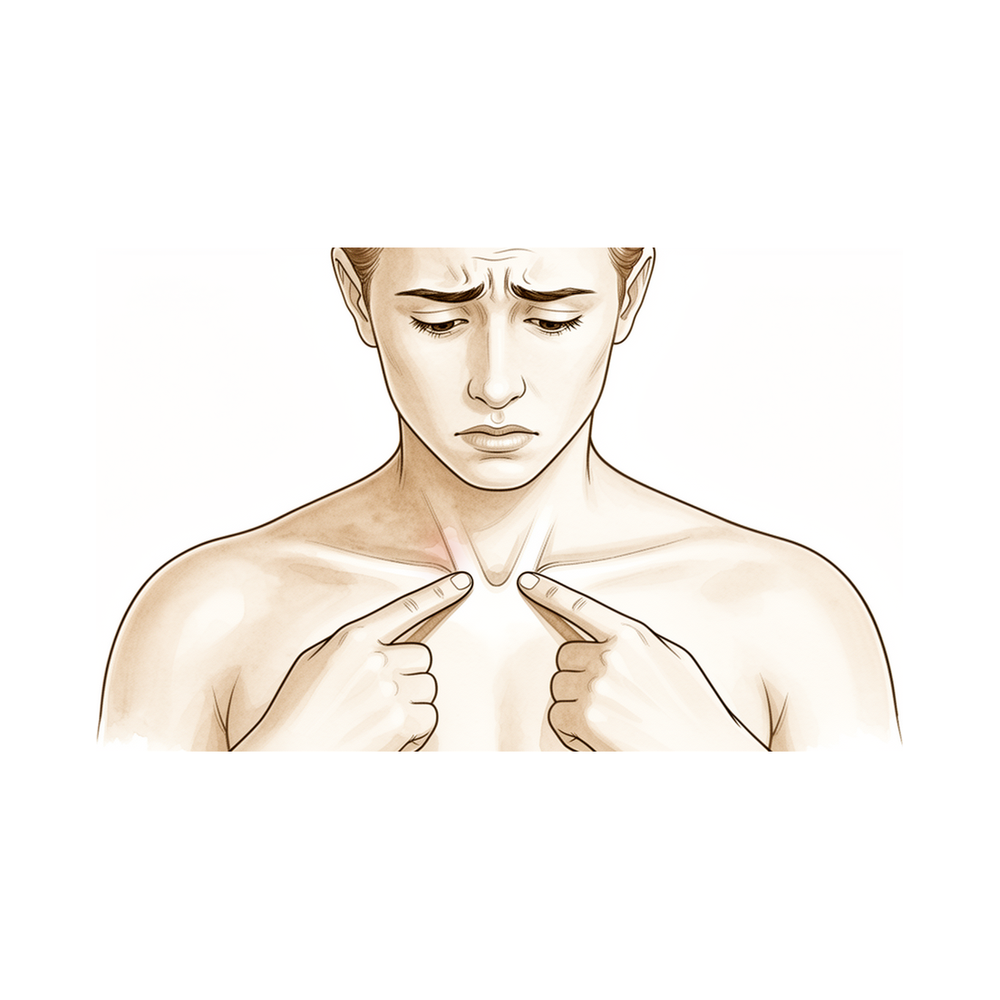
Ilustração que mostra a articulação onde a clavícula se une ao esterno, na base do pescoço.
A articulação esternoclavicular — local onde a clavícula se une ao esterno — pode ser afetada por artrite, instabilidade ou, raramente, por uma grave luxação posterior. Kieran Hirpara 4.0

Esta página foi traduzida automaticamente e ainda não foi verificada por um médico. A versão em inglês é a versão oficial.

O que você está sentindo

A articulação esternoclavicular é a pequena articulação na parte frontal do tórax, onde a extremidade interna da clavícula se encontra com o esterno. Você consegue senti-la como um pequeno “calombo” logo abaixo da base do pescoço, a alguns centímetros da linha média do corpo. É fácil não notá-la até que algo dê errado nela.

Os problemas nessa região geralmente se manifestam de algumas maneiras. Algumas pessoas percebem uma dor ou sensibilidade intensa exatamente sobre esse “calombo”, muitas vezes acompanhada de um pouco de inchaço; essa dor piora ao levantar os braços acima da cabeça, ao levantar pesos, empurrar objetos ou ao deitar-se sobre esse lado do corpo. Outras sentem a articulação “clicar”, deslizar ou se mover durante determinados movimentos; às vezes surge um “caroço” visível que aparece e desaparece. E, ocasionalmente, o problema começa com um trauma súbito (queda sobre o ombro, colisão ou acidente de carro), seguido de dor, inchaço e alteração na forma da articulação. A sensação que você tem depende muito de qual dessas situações está ocorrendo; abaixo explicamos isso detalhadamente.

O que está realmente acontecendo

A articulação esternoclavicular é a única articulação óssea verdadeira que conecta todo o braço e o ombro ao restante do esqueleto. Todos os movimentos do braço são ancorados ao tórax por meio dessa pequena articulação; por isso ela é muito resistente e envolta por ligamentos fortes. Vários fatores podem afetá-la.

A artrite (desgaste das superfícies articulares) é o problema mais comum. Com o tempo, a cartilagem lisa se torna mais fina; a articulação pode inchar e doer com o uso. Esse problema é mais frequente em mulheres de meia-idade, geralmente sem qualquer lesão prévia; por si só, não representa um perigo, apenas um incômodo.

A instabilidade atraumática ocorre quando a articulação desliza ou se desloca parcialmente sem que haja lesão real, geralmente devido à flacidez natural dos ligamentos. É mais comum em pessoas jovens e flexíveis (hipermóveis); a clavícula geralmente se desloca para a frente (deslocamento anterior), podendo gerar um “caroço” visível ao realizar certos movimentos.

O deslocamento traumático acontece quando uma força intensa empurra a clavícula para fora da articulação. Se o deslocamento for para a frente (anterior), é doloroso e deixa a região com aparência anormal, porém raramente é perigoso. O tipo mais grave é o deslocamento posterior, em que a clavícula é empurrada para trás, atrás do esterno, para dentro do espaço onde ficam a traqueia, o esôfago e os grandes vasos sanguíneos do tórax. É um caso raro, mas pode ser grave. Mais detalhes sobre isso na última seção.

O que podemos fazer a respeito

Nossa abordagem é orientada pelo Dr. Kieran Hirpara, cirurgião de membro superior no Mater Private Hospital Rockhampton. Em geral, os pacientes são encaminhados à nossa clínica pelo médico de família; caso um fisioterapeuta tenha sugerido que você nos procure, ainda assim será necessário um encaminhamento do seu médico de família para ter direito ao reembolso do Medicare. Em seguida, realizamos uma avaliação minuciosa para confirmar o diagnóstico. Nos casos de problemas crônicos, geralmente iniciamos com tratamento não cirúrgico e só consideramos a cirurgia se este não proporcionar alívio suficiente.

A boa notícia é que a maioria dos problemas esternoclaviculares se resolve sem cirurgia.

No caso de artrite e instabilidade anterior (para a frente), o tratamento de primeira linha é não cirúrgico e costuma ser eficaz: modificação das atividades que agravam o problema, uso de analgésicos e anti-inflamatórios simples, além de fisioterapia para estabilizar a articulação e fortalecer os músculos de suporte. Se uma articulação artrítica dolorosa persistir mesmo após esse tratamento, uma injeção de esteroides na articulação pode aliviar a dor e também ajudar a confirmar se ela é a fonte do desconforto.

A cirurgia é a exceção, não a regra. Ela é indicada apenas para pacientes cuja dor ou instabilidade não melhoram apesar do tratamento não cirúrgico adequado. Dependendo do problema, isso pode envolver estabilizar a articulação (reconstruindo os ligamentos para manter a clavícula no lugar) ou, nos casos de artrite resistente, remover a extremidade desgastada da clavícula para eliminar a superfície dolorosa. Essas opções são avaliadas com muito cuidado, pois a articulação fica bem próxima de estruturas importantes do tórax.

O deslocamento posterior é uma situação que não pode esperar. Geralmente requer uma redução urgente (recolocação da articulação no lugar) e, devido às estruturas que ficam atrás dela, esse procedimento costuma ser feito em sala de cirurgia com um cirurgião torácico ou vascular de plantão, para o caso de ser necessário.

O que esperar

No caso da artrite e da instabilidade anterior comum, o prognóstico é animador. Com mudanças nas atividades, fisioterapia e tempo, a grande maioria das pessoas consegue se adaptar à vida normal; muitas sequer precisam de algo além disso. As articulações flexíveis tendem a se estabilizar à medida que os músculos ao redor se fortalecem e a pessoa aprende quais movimentos deve evitar.

Quando a cirurgia é necessária, ela pode ser muito eficaz para o paciente certo; porém, a recuperação exige paciência: um período de proteção da articulação seguido de um retorno gradual às atividades ao longo de vários meses. O cirurgião explicará o plano específico para o seu caso.

Uma luxação posterior tratada prontamente costuma ter bom prognóstico, desde que a articulação seja recolocada no lugar com segurança. O fator decisivo é a rapidez: é preciso avaliar e reduzir a luxação o quanto antes.

Quando procurar ajuda médica

Consulte seu médico se apresentar:

  • Dor persistente, inchaço ou sensibilidade na articulação localizada na parte frontal do tórax que não melhora, ou um nódulo que aparece e desaparece repetidamente.
  • Articulação instável, que sai do lugar com certos movimentos e limita suas atividades.
  • Dor após algum trauma na região anterior do ombro ou do tórax, especialmente se a articulação parecer ou se sentir deformada.

Trate isso como uma emergência: ligue para a ambulância ou vá imediatamente ao pronto-socorro mais próximo caso, após um forte impacto ou lesão de alta energia no ombro ou no tórax, você apresente:

  • Dificuldade para respirar, sensação de pressão ou sufocamento, ou alteração na voz.
  • Dificuldade ou dor ao engolir.
  • Inchaço, mudança de cor, frio ou formigamento no braço, ou pulso fraco nesse lado do corpo.

Esses podem ser sinais de uma luxação posterior que está comprimindo a traqueia, o esôfago ou os grandes vasos sanguíneos atrás do esterno. É um caso pouco comum, mas requer avaliação hospitalar urgente. Não espere para ver se melhora por conta própria.

Em maior profundidade

Advanced reading: the deeper science (optional)

Esta seção aborda temas que vão além do necessário para suas próprias decisões de tratamento. Os problemas na articulação esternoclavicular merecem uma leitura mais detalhada, pois uma de suas variantes constitui uma verdadeira emergência médica — que pode parecer inofensiva externamente — e porque o período em que o tratamento mais simples ainda é eficaz é medido em horas.

A luxação posterior é a que realmente importa

A articulação esternoclavicular situa-se na base do pescoço, onde a clavícula se une ao esterno. Logo atrás dela encontram-se os grandes vasos sanguíneos, a traqueia e o esôfago.

Uma luxação anterior empurra a clavícula para a frente, gerando um nódulo visível. O quadro parece grave, mas geralmente é benigno. Já uma luxação posterior a empurra para trás, em direção a essas estruturas, resultando em poucos sinais externos; às vezes, apenas uma pequena depressão é perceptível. Os sinais clínicos são o oposto da gravidade real da lesão.

Os sintomas que sugerem uma luxação posterior incluem dificuldade para engolir, falta de ar, alteração na voz ou congestão das veias do braço ou do pescoço. Qualquer um desses sintomas após uma lesão na região anterior do ombro exige avaliação imediata. As radiografias simples são pouco confiáveis para essa articulação; geralmente, é necessário realizar uma tomografia computadorizada.

A janela de 48 horas

Quando se identifica uma luxação posterior, a clavícula geralmente pode ser recolocada no lugar sem a necessidade de abrir a articulação. Em 140 pacientes adolescentes, tanto os métodos fechados quanto os abertos demonstraram alta eficácia; além disso, a redução fechada é mais eficaz quando realizada em até 48 horas após a lesão inicial [1].

Esse é um número específico e prático para orientar a conduta clínica. Após cerca de dois dias, os tecidos moles começam a se organizar ao redor do osso deslocado, tornando a redução fechada cada vez menos provável de ser bem-sucedida; nesses casos, o procedimento se transforma numa cirurgia aberta próxima aos grandes vasos sanguíneos. Esse é o principal argumento a favor da realização precoce de exames de imagem, em vez de adotar uma conduta de observação, especialmente quando o mecanismo de lesão é compatível.

Devido a essa proximidade anatômica, a redução de uma luxação posterior costuma ser realizada com a presença de uma equipe cardiotorácica; não porque o procedimento costuma dar errado, mas porque, caso ocorra algum problema, as consequências são imediatas.

A reconstrução para instabilidade é eficaz, e a técnica utilizada não faz diferença

No caso de instabilidade recorrente ou crônica, a articulação é reconstruída mediante o uso de enxerto tendinoso. Em 164 pacientes, a reconstrução resultou em melhorias significativas nos desfechos relatados pelos pacientes e no retorno às atividades, com baixa taxa de complicações. Além disso, esses resultados foram observados independentemente da técnica empregada – seja perfuração unicortical ou bicortical, bem como uso de enxerto alogênico ou autólogo [2].

Quando diversas variantes técnicas produzem resultados semelhantes, a conclusão lógica é que o mais importante é obter uma estrutura estável, e não o método exato utilizado para isso.

A artrite nessa região é tratável, porém pouco reconhecida

As alterações degenerativas nessa articulação constituem uma causa real e frequentemente negligenciada de dor na base do pescoço, especialmente em mulheres de meia-idade; muitas vezes essa dor é atribuída ao próprio pescoço. O tratamento cirúrgico em 107 pacientes revelou-se um procedimento seguro, capaz de reduzir significativamente a dor e gerar alto índice de satisfação, embora a literatura médica não indique se a cirurgia aberta ou a artroscópica é a melhor opção [3].

O ponto prático a ser destacado é que uma sensibilidade persistente e bem localizada exatamente sobre essa articulação merece ser mencionada especificamente, pois se trata de um ponto pequeno e fácil de ser ignorado quando a queixa é descrita como dor no ombro ou no pescoço.

Referências

[1] Tepolt F, Carry PM, Heyn PC, Miller NH. Lesões da articulação esternoclavicular posterior na população adolescente: uma meta-análise. Am J Sports Med. 2014;42(10):2517-24. https://doi.org/10.1177/0363546514523386

[2] Kapoor U, Khoo KJ, Hsu JE, Matsen FA, Schiffman CJ. Resultados clínicos e complicações após reconstrução da articulação esternoclavicular: uma revisão sistemática. Am J Sports Med. 2026;54(7):1799-806. https://doi.org/10.1177/03635465251407324

[3] Rasmussen AH, Krogsgaard MR. Tratamento cirúrgico da osteoartrite da articulação esternoclavicular: uma revisão sistemática. J Shoulder Elbow Surg. 2025;34(10):2517-28. https://doi.org/10.1016/j.jse.2024.12.044


Creative Commons BY-NC 4.0

CC Creative Commons licence
BY Attribution — you must credit the source
NC NonCommercial — not for commercial use

Attribution-NonCommercial 4.0 International


Creative Commons Corporation ("Creative Commons") is not a law firm and does not provide legal services or legal advice. Distribution of Creative Commons public licenses does not create a lawyer-client or other relationship. Creative Commons makes its licenses and related information available on an "as-is" basis. Creative Commons gives no warranties regarding its licenses, any material licensed under their terms and conditions, or any related information. Creative Commons disclaims all liability for damages resulting from their use to the fullest extent possible.

Using Creative Commons Public Licenses

Creative Commons public licenses provide a standard set of terms and conditions that creators and other rights holders may use to share original works of authorship and other material subject to copyright and certain other rights specified in the public license below. The following considerations are for informational purposes only, are not exhaustive, and do not form part of our licenses.

Considerations for licensors: Our public licenses are intended for use by those authorized to give the public permission to use material in ways otherwise restricted by copyright and certain other rights. Our licenses are irrevocable. Licensors should read and understand the terms and conditions of the license they choose before applying it. Licensors should also secure all rights necessary before applying our licenses so that the public can reuse the material as expected. Licensors should clearly mark any material not subject to the license. This includes other CC- licensed material, or material used under an exception or limitation to copyright. More considerations for licensors: wiki.creativecommons.org/Considerations_for_licensors

Considerations for the public: By using one of our public licenses, a licensor grants the public permission to use the licensed material under specified terms and conditions. If the licensor's permission is not necessary for any reason--for example, because of any applicable exception or limitation to copyright--then that use is not regulated by the license. Our licenses grant only permissions under copyright and certain other rights that a licensor has authority to grant. Use of the licensed material may still be restricted for other reasons, including because others have copyright or other rights in the material. A licensor may make special requests, such as asking that all changes be marked or described. Although not required by our licenses, you are encouraged to respect those requests where reasonable. More considerations for the public: wiki.creativecommons.org/Considerations_for_licensees


Creative Commons Attribution-NonCommercial 4.0 International Public License

By exercising the Licensed Rights (defined below), You accept and agree to be bound by the terms and conditions of this Creative Commons Attribution-NonCommercial 4.0 International Public License ("Public License"). To the extent this Public License may be interpreted as a contract, You are granted the Licensed Rights in consideration of Your acceptance of these terms and conditions, and the Licensor grants You such rights in consideration of benefits the Licensor receives from making the Licensed Material available under these terms and conditions.

Section 1 -- Definitions.

a. Adapted Material means material subject to Copyright and Similar Rights that is derived from or based upon the Licensed Material and in which the Licensed Material is translated, altered, arranged, transformed, or otherwise modified in a manner requiring permission under the Copyright and Similar Rights held by the Licensor. For purposes of this Public License, where the Licensed Material is a musical work, performance, or sound recording, Adapted Material is always produced where the Licensed Material is synched in timed relation with a moving image.

b. Adapter's License means the license You apply to Your Copyright and Similar Rights in Your contributions to Adapted Material in accordance with the terms and conditions of this Public License.

c. Copyright and Similar Rights means copyright and/or similar rights closely related to copyright including, without limitation, performance, broadcast, sound recording, and Sui Generis Database Rights, without regard to how the rights are labeled or categorized. For purposes of this Public License, the rights specified in Section 2(b)(1)-(2) are not Copyright and Similar Rights.

d. Effective Technological Measures means those measures that, in the absence of proper authority, may not be circumvented under laws fulfilling obligations under Article 11 of the WIPO Copyright Treaty adopted on December 20, 1996, and/or similar international agreements.

e. Exceptions and Limitations means fair use, fair dealing, and/or any other exception or limitation to Copyright and Similar Rights that applies to Your use of the Licensed Material.

f. Licensed Material means the artistic or literary work, database, or other material to which the Licensor applied this Public License.

g. Licensed Rights means the rights granted to You subject to the terms and conditions of this Public License, which are limited to all Copyright and Similar Rights that apply to Your use of the Licensed Material and that the Licensor has authority to license.

h. Licensor means the individual(s) or entity(ies) granting rights under this Public License.

i. NonCommercial means not primarily intended for or directed towards commercial advantage or monetary compensation. For purposes of this Public License, the exchange of the Licensed Material for other material subject to Copyright and Similar Rights by digital file-sharing or similar means is NonCommercial provided there is no payment of monetary compensation in connection with the exchange.

j. Share means to provide material to the public by any means or process that requires permission under the Licensed Rights, such as reproduction, public display, public performance, distribution, dissemination, communication, or importation, and to make material available to the public including in ways that members of the public may access the material from a place and at a time individually chosen by them.

k. Sui Generis Database Rights means rights other than copyright resulting from Directive 96/9/EC of the European Parliament and of the Council of 11 March 1996 on the legal protection of databases, as amended and/or succeeded, as well as other essentially equivalent rights anywhere in the world.

l. You means the individual or entity exercising the Licensed Rights under this Public License. Your has a corresponding meaning.

Section 2 -- Scope.

a. License grant.

1. Subject to the terms and conditions of this Public License, the Licensor hereby grants You a worldwide, royalty-free, non-sublicensable, non-exclusive, irrevocable license to exercise the Licensed Rights in the Licensed Material to:

a. reproduce and Share the Licensed Material, in whole or in part, for NonCommercial purposes only; and

b. produce, reproduce, and Share Adapted Material for NonCommercial purposes only.

2. Exceptions and Limitations. For the avoidance of doubt, where Exceptions and Limitations apply to Your use, this Public License does not apply, and You do not need to comply with its terms and conditions.

3. Term. The term of this Public License is specified in Section 6(a).

4. Media and formats; technical modifications allowed. The Licensor authorizes You to exercise the Licensed Rights in all media and formats whether now known or hereafter created, and to make technical modifications necessary to do so. The Licensor waives and/or agrees not to assert any right or authority to forbid You from making technical modifications necessary to exercise the Licensed Rights, including technical modifications necessary to circumvent Effective Technological Measures. For purposes of this Public License, simply making modifications authorized by this Section 2(a) (4) never produces Adapted Material.

5. Downstream recipients.

a. Offer from the Licensor -- Licensed Material. Every recipient of the Licensed Material automatically receives an offer from the Licensor to exercise the Licensed Rights under the terms and conditions of this Public License.

b. No downstream restrictions. You may not offer or impose any additional or different terms or conditions on, or apply any Effective Technological Measures to, the Licensed Material if doing so restricts exercise of the Licensed Rights by any recipient of the Licensed Material.

6. No endorsement. Nothing in this Public License constitutes or may be construed as permission to assert or imply that You are, or that Your use of the Licensed Material is, connected with, or sponsored, endorsed, or granted official status by, the Licensor or others designated to receive attribution as provided in Section 3(a)(1)(A)(i).

b. Other rights.

1. Moral rights, such as the right of integrity, are not licensed under this Public License, nor are publicity, privacy, and/or other similar personality rights; however, to the extent possible, the Licensor waives and/or agrees not to assert any such rights held by the Licensor to the limited extent necessary to allow You to exercise the Licensed Rights, but not otherwise.

2. Patent and trademark rights are not licensed under this Public License.

3. To the extent possible, the Licensor waives any right to collect royalties from You for the exercise of the Licensed Rights, whether directly or through a collecting society under any voluntary or waivable statutory or compulsory licensing scheme. In all other cases the Licensor expressly reserves any right to collect such royalties, including when the Licensed Material is used other than for NonCommercial purposes.

Section 3 -- License Conditions.

Your exercise of the Licensed Rights is expressly made subject to the following conditions.

a. Attribution.

1. If You Share the Licensed Material (including in modified form), You must:

a. retain the following if it is supplied by the Licensor with the Licensed Material:

i. identification of the creator(s) of the Licensed Material and any others designated to receive attribution, in any reasonable manner requested by the Licensor (including by pseudonym if designated);

ii. a copyright notice;

iii. a notice that refers to this Public License;

iv. a notice that refers to the disclaimer of warranties;

v. a URI or hyperlink to the Licensed Material to the extent reasonably practicable;

b. indicate if You modified the Licensed Material and retain an indication of any previous modifications; and

c. indicate the Licensed Material is licensed under this Public License, and include the text of, or the URI or hyperlink to, this Public License.

2. You may satisfy the conditions in Section 3(a)(1) in any reasonable manner based on the medium, means, and context in which You Share the Licensed Material. For example, it may be reasonable to satisfy the conditions by providing a URI or hyperlink to a resource that includes the required information.

3. If requested by the Licensor, You must remove any of the information required by Section 3(a)(1)(A) to the extent reasonably practicable.

4. If You Share Adapted Material You produce, the Adapter's License You apply must not prevent recipients of the Adapted Material from complying with this Public License.

Section 4 -- Sui Generis Database Rights.

Where the Licensed Rights include Sui Generis Database Rights that apply to Your use of the Licensed Material:

a. for the avoidance of doubt, Section 2(a)(1) grants You the right to extract, reuse, reproduce, and Share all or a substantial portion of the contents of the database for NonCommercial purposes only;

b. if You include all or a substantial portion of the database contents in a database in which You have Sui Generis Database Rights, then the database in which You have Sui Generis Database Rights (but not its individual contents) is Adapted Material; and

c. You must comply with the conditions in Section 3(a) if You Share all or a substantial portion of the contents of the database.

For the avoidance of doubt, this Section 4 supplements and does not replace Your obligations under this Public License where the Licensed Rights include other Copyright and Similar Rights.

Section 5 -- Disclaimer of Warranties and Limitation of Liability.

a. UNLESS OTHERWISE SEPARATELY UNDERTAKEN BY THE LICENSOR, TO THE EXTENT POSSIBLE, THE LICENSOR OFFERS THE LICENSED MATERIAL AS-IS AND AS-AVAILABLE, AND MAKES NO REPRESENTATIONS OR WARRANTIES OF ANY KIND CONCERNING THE LICENSED MATERIAL, WHETHER EXPRESS, IMPLIED, STATUTORY, OR OTHER. THIS INCLUDES, WITHOUT LIMITATION, WARRANTIES OF TITLE, MERCHANTABILITY, FITNESS FOR A PARTICULAR PURPOSE, NON-INFRINGEMENT, ABSENCE OF LATENT OR OTHER DEFECTS, ACCURACY, OR THE PRESENCE OR ABSENCE OF ERRORS, WHETHER OR NOT KNOWN OR DISCOVERABLE. WHERE DISCLAIMERS OF WARRANTIES ARE NOT ALLOWED IN FULL OR IN PART, THIS DISCLAIMER MAY NOT APPLY TO YOU.

b. TO THE EXTENT POSSIBLE, IN NO EVENT WILL THE LICENSOR BE LIABLE TO YOU ON ANY LEGAL THEORY (INCLUDING, WITHOUT LIMITATION, NEGLIGENCE) OR OTHERWISE FOR ANY DIRECT, SPECIAL, INDIRECT, INCIDENTAL, CONSEQUENTIAL, PUNITIVE, EXEMPLARY, OR OTHER LOSSES, COSTS, EXPENSES, OR DAMAGES ARISING OUT OF THIS PUBLIC LICENSE OR USE OF THE LICENSED MATERIAL, EVEN IF THE LICENSOR HAS BEEN ADVISED OF THE POSSIBILITY OF SUCH LOSSES, COSTS, EXPENSES, OR DAMAGES. WHERE A LIMITATION OF LIABILITY IS NOT ALLOWED IN FULL OR IN PART, THIS LIMITATION MAY NOT APPLY TO YOU.

c. The disclaimer of warranties and limitation of liability provided above shall be interpreted in a manner that, to the extent possible, most closely approximates an absolute disclaimer and waiver of all liability.

Section 6 -- Term and Termination.

a. This Public License applies for the term of the Copyright and Similar Rights licensed here. However, if You fail to comply with this Public License, then Your rights under this Public License terminate automatically.

b. Where Your right to use the Licensed Material has terminated under Section 6(a), it reinstates:

1. automatically as of the date the violation is cured, provided it is cured within 30 days of Your discovery of the violation; or

2. upon express reinstatement by the Licensor.

For the avoidance of doubt, this Section 6(b) does not affect any right the Licensor may have to seek remedies for Your violations of this Public License.

c. For the avoidance of doubt, the Licensor may also offer the Licensed Material under separate terms or conditions or stop distributing the Licensed Material at any time; however, doing so will not terminate this Public License.

d. Sections 1, 5, 6, 7, and 8 survive termination of this Public License.

Section 7 -- Other Terms and Conditions.

a. The Licensor shall not be bound by any additional or different terms or conditions communicated by You unless expressly agreed.

b. Any arrangements, understandings, or agreements regarding the Licensed Material not stated herein are separate from and independent of the terms and conditions of this Public License.

Section 8 -- Interpretation.

a. For the avoidance of doubt, this Public License does not, and shall not be interpreted to, reduce, limit, restrict, or impose conditions on any use of the Licensed Material that could lawfully be made without permission under this Public License.

b. To the extent possible, if any provision of this Public License is deemed unenforceable, it shall be automatically reformed to the minimum extent necessary to make it enforceable. If the provision cannot be reformed, it shall be severed from this Public License without affecting the enforceability of the remaining terms and conditions.

c. No term or condition of this Public License will be waived and no failure to comply consented to unless expressly agreed to by the Licensor.

d. Nothing in this Public License constitutes or may be interpreted as a limitation upon, or waiver of, any privileges and immunities that apply to the Licensor or You, including from the legal processes of any jurisdiction or authority.


Creative Commons is not a party to its public licenses. Notwithstanding, Creative Commons may elect to apply one of its public licenses to material it publishes and in those instances will be considered the “Licensor.” The text of the Creative Commons public licenses is dedicated to the public domain under the CC0 Public Domain Dedication. Except for the limited purpose of indicating that material is shared under a Creative Commons public license or as otherwise permitted by the Creative Commons policies published at creativecommons.org/policies, Creative Commons does not authorize the use of the trademark "Creative Commons" or any other trademark or logo of Creative Commons without its prior written consent including, without limitation, in connection with any unauthorized modifications to any of its public licenses or any other arrangements, understandings, or agreements concerning use of licensed material. For the avoidance of doubt, this paragraph does not form part of the public licenses.

Creative Commons may be contacted at creativecommons.org.