Patients › Rehabilitation
Artroplastia total do ombro
Phase-by-phase rehabilitation protocol after total shoulder replacement, with criteria to progress and the early exercise program.
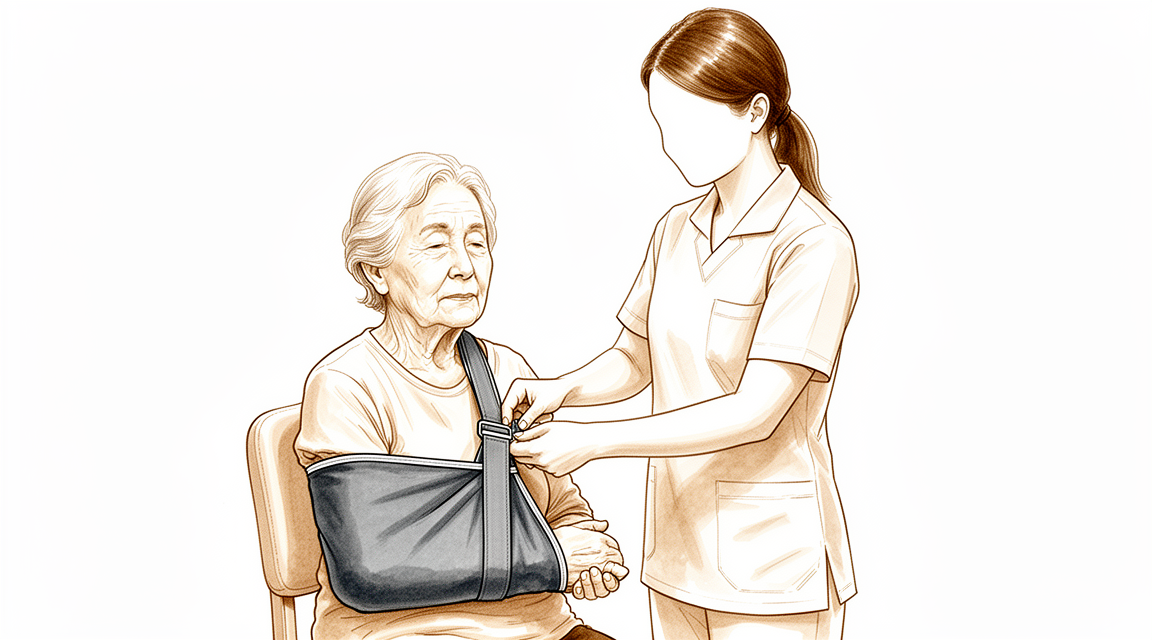
Este protocolo orienta sua recuperação após a artroplastia total do ombro (substituição total do ombro) realizada pelo Dr. Kieran Hirpara no Mater Private Hospital Rockhampton. Cada fase abaixo começa com uma explicação em linguagem simples sobre o que está acontecendo e o que é mais importante, seguida pelo protocolo estruturado destinado ao seu fisioterapeuta. Leve esta página ou o seu PDF na primeira sessão de fisioterapia, para que a reabilitação seja devidamente coordenada. O seu fisioterapeuta poderá ajustar o plano conforme a evolução da sua recuperação.
Caso tenha alguma dúvida ou preocupação quanto à ferida cirúrgica, entre em contato com o consultório. Geralmente, é útil tirar uma foto da ferida e enviá-la por e-mail para análise.
O que esperar
Ao acordar, você sentirá o braço dormente; essa sensação geralmente volta dentro de 6 a 12 horas. Em casos raros, alguma dormência ou fraqueza pode persistir por 2 a 3 dias.
Após a cirurgia, você ficará com uma tipoia e um grande curativo sobre o ombro. Esse curativo será removido antes da alta. Por baixo dele há um curativo impermeável que cobre uma fita adesiva cirúrgica; ela pode permanecer no local por 2 semanas. Os pontos utilizados são reabsorvíveis e não precisam ser retirados; porém, pode haver pequenos fios de pontos nas extremidades da incisão, que poderão ser cortados rente à pele após 2 semanas. Você terá um agendamento para uma consulta com nossa enfermeira a fim de verificar a ferida, 1–2 semanas após a cirurgia. Caso não possa comparecer a essa consulta, poderá remover o curativo por conta própria após 2 semanas.
Resumo do processo de recuperação:
- Proteção: 0–3 semanas
- Fase intermediária: 4–6 semanas
- Continuação da fase intermediária: 7–8 semanas
- Fase de transição: 9–11 semanas
- Fortalecimento avançado: 12–16 semanas
Prazos aproximados para retorno às atividades:
- Dirigir: 6 semanas
- Nadar: nado de peito após 8 semanas; nado livre após 12 semanas
- Golfe: 4–6 meses
- Levantar pesos: levantamento leve pode ser iniciado após 6 semanas; evite levantar objetos pesados por 6 meses
- Trabalho: para trabalhos sedentários, após 6 semanas; para trabalhos manuais, siga as orientações do seu cirurgião
Como usar a tipóia
A tipóia (imobilizador de ombro) sustenta o ombro durante o processo de cicatrização. As regras são simples:
- Use-a por 6 semanas, inclusive durante o sono.
- Retire-a apenas para tomar banho e para fazer os exercícios, após receber orientação; sempre que a tipóia estiver retirada, mantenha o braço ao lado do corpo.
- Em casa, quando estiver descansando, pode retirá-la, desde que tome cuidado: apoie o braço num travesseiro enquanto estiver sentado.
- Use gelo se o ombro estiver inchado ou dolorido, especialmente após os exercícios.
É importante ajustar a tipóia corretamente; uma tipóia frouxa não oferece o suporte adequado ao ombro:
- Posicione o cotovelo exatamente no canto da tipóia, garantindo bom apoio.
- A extremidade da tipóia deve ficar na altura da ponta do dedo mindinho. Se a mão ficar para além dessa marca, a tipóia não está oferecendo suporte adequado.
- A tipóia possui duas tiras de velcro: uma para o pescoço e outra para a cintura.
- Com o cotovelo e antebraço já posicionados, use o braço não operado para passar a tira superior ao redor do pescoço e prendê-la na alça superior.
- Da mesma forma, passe a tira inferior ao redor da cintura e prenda-a na alça inferior.
Enquanto usar a tipóia, preste atenção à postura: mantenha as orelhas, ombros e quadris alinhados, evitando que os ombros fiquem caídos. Uma boa postura protege as costas e evita a rigidez do ombro. Um rolo de toalha na região lombar, ao sentar, serve como bom lembrete.
Antes de ir para casa, o fisioterapeuta do hospital ajustará sua tipóia, ensinará como usá-la sozinho e iniciará os exercícios suaves abaixo. Três termos são frequentemente usados na reabilitação do ombro; é útil saber a diferença: amplitude de movimento ativa (AROM) significa mover o braço por conta própria, sem ajuda; amplitude de movimento ativa assistida (AAROM) implica usar o outro braço ou um objeto para auxiliar o movimento; já na amplitude de movimento passiva (PROM) o braço permanece completamente relaxado, sendo todo o movimento realizado pelo outro braço ou por uma força externa. Seu fisioterapeuta informará qual tipo de movimento cada exercício exige.
As regras iniciais de reabilitação, tanto no hospital quanto nas primeiras semanas em casa, são as seguintes:
- É necessário dormir usando a tipóia.
- Use gelo para aliviar a dor, se necessário.
- Enquanto usar a tipóia, relaxe o ombro e deixe que ela suporte o peso do braço.
- Tome analgésicos antes dos exercícios e antes das sessões de fisioterapia.
- Você pode retirar o braço da tipóia para fazer os exercícios e tomar banho.
- Use a tipóia por 6 semanas, especialmente quando estiver fora de casa.
- A menos que tenha optado por agendar sua própria fisioterapia, já foi marcada uma sessão para você; os detalhes constam no pacote de alta.
- Em caso de qualquer problema, entre em contato com o consultório ou informe seu fisioterapeuta.
A seguir, os primeiros exercícios, iniciados no hospital e continuados em casa conforme orientação do fisioterapeuta:
Seus primeiros dias no hospital
Kieran Hirpara 4.0
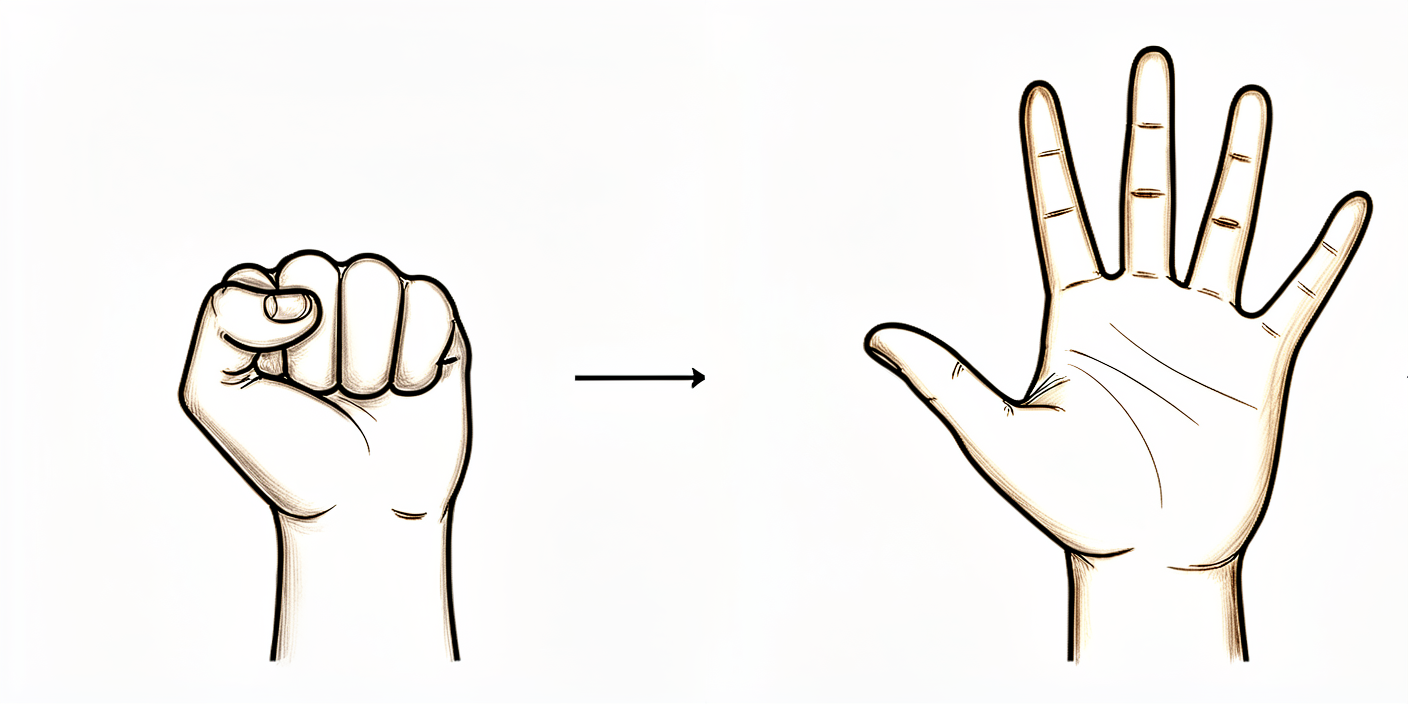
Abrir e fechar a mão
Mantenha a mão e os dedos em movimento, abrindo e fechando-os ou apertando uma bola macia.
10 vezes, 3 vezes por dia.
Kieran Hirpara 4.0
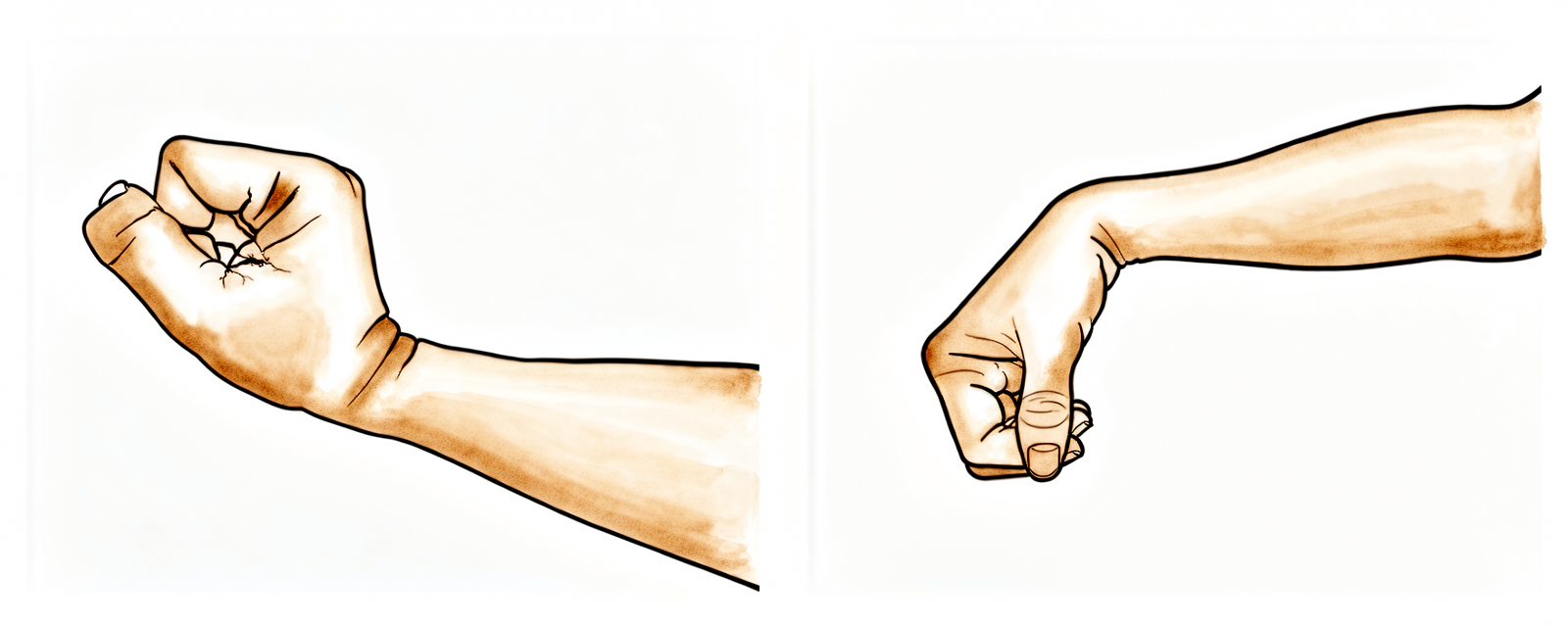
Movimento do punho
Mantenha o seu pulso em movimento, dobrando-o para a frente, para trás e para os lados.
10 vezes, 3 vezes por dia.
Kieran Hirpara 4.0
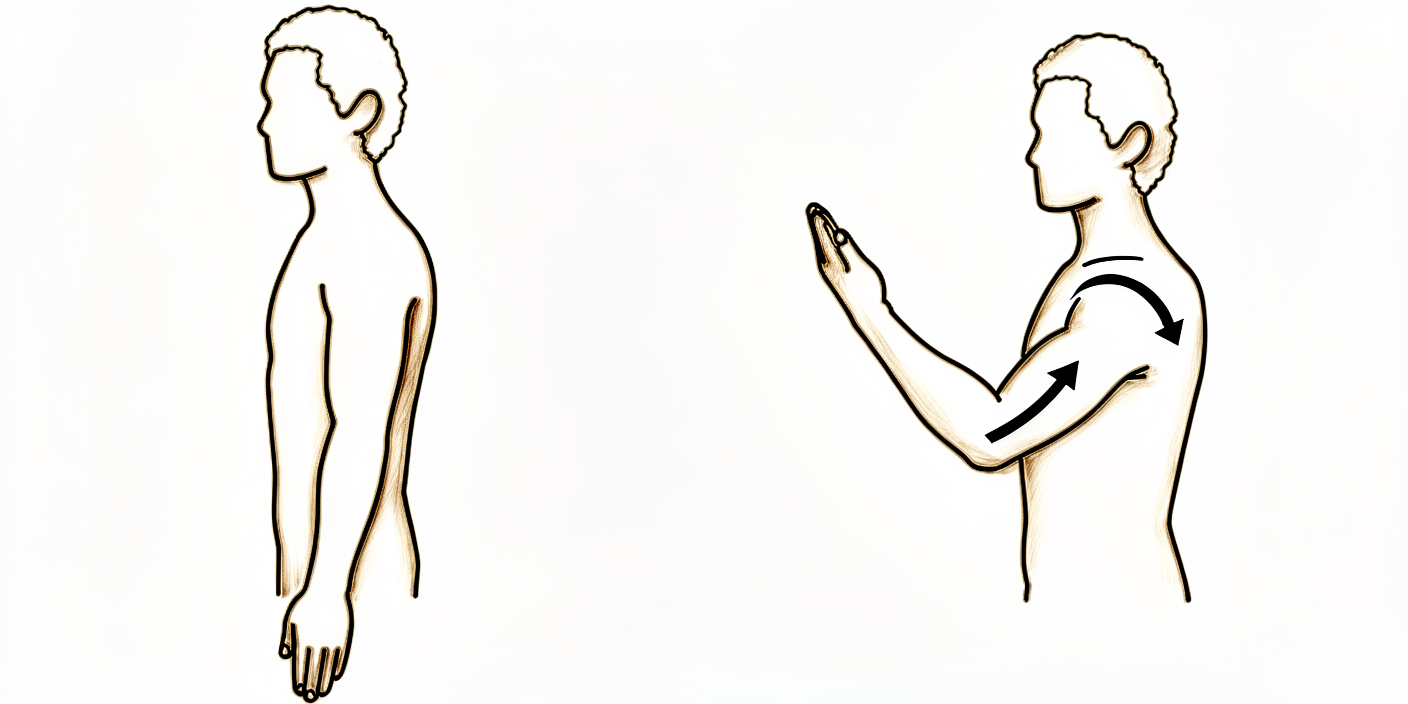
Cotovelo
Flexione e estenda o cotovelo.
10 vezes, 3 vezes por dia.
Kieran Hirpara 4.0
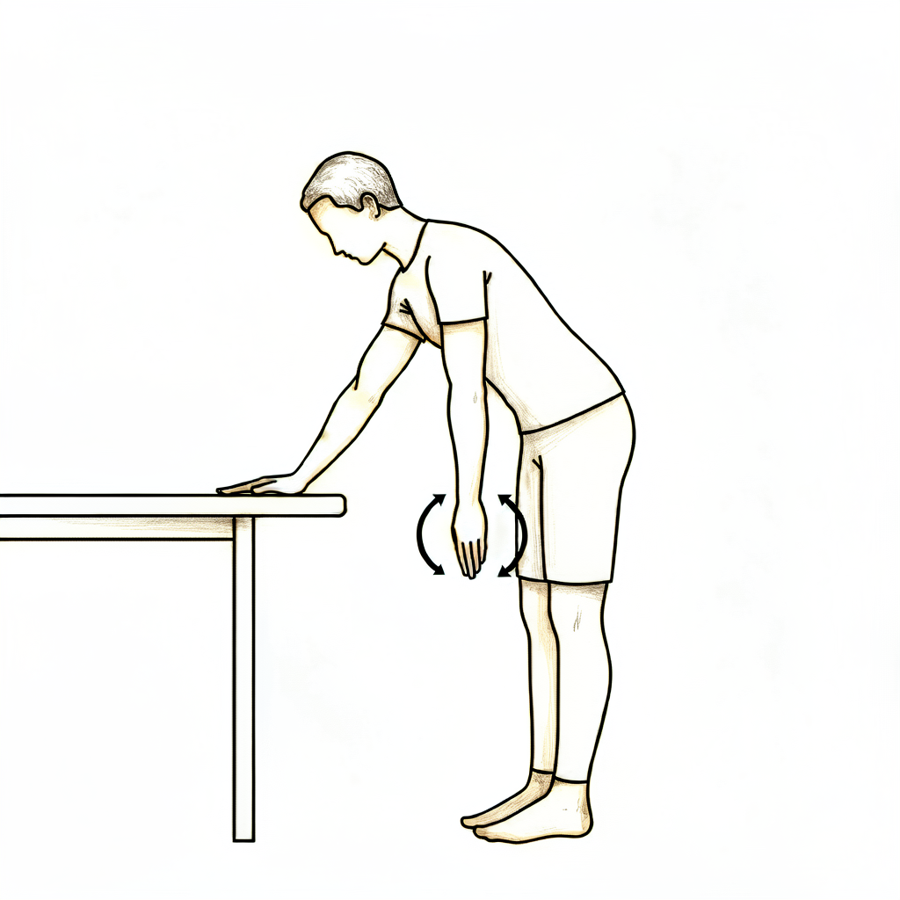
Pêndulos
Este é um exercício passivo. Incline-se para a frente e deixe o braço relaxar. Use o corpo para mover o braço suavemente, tanto no sentido horário quanto anti-horário, além de para a frente, para trás e para os lados.
Aproximadamente 30 segundos em cada direção, 3 vezes por dia.
Kieran Hirpara 4.0
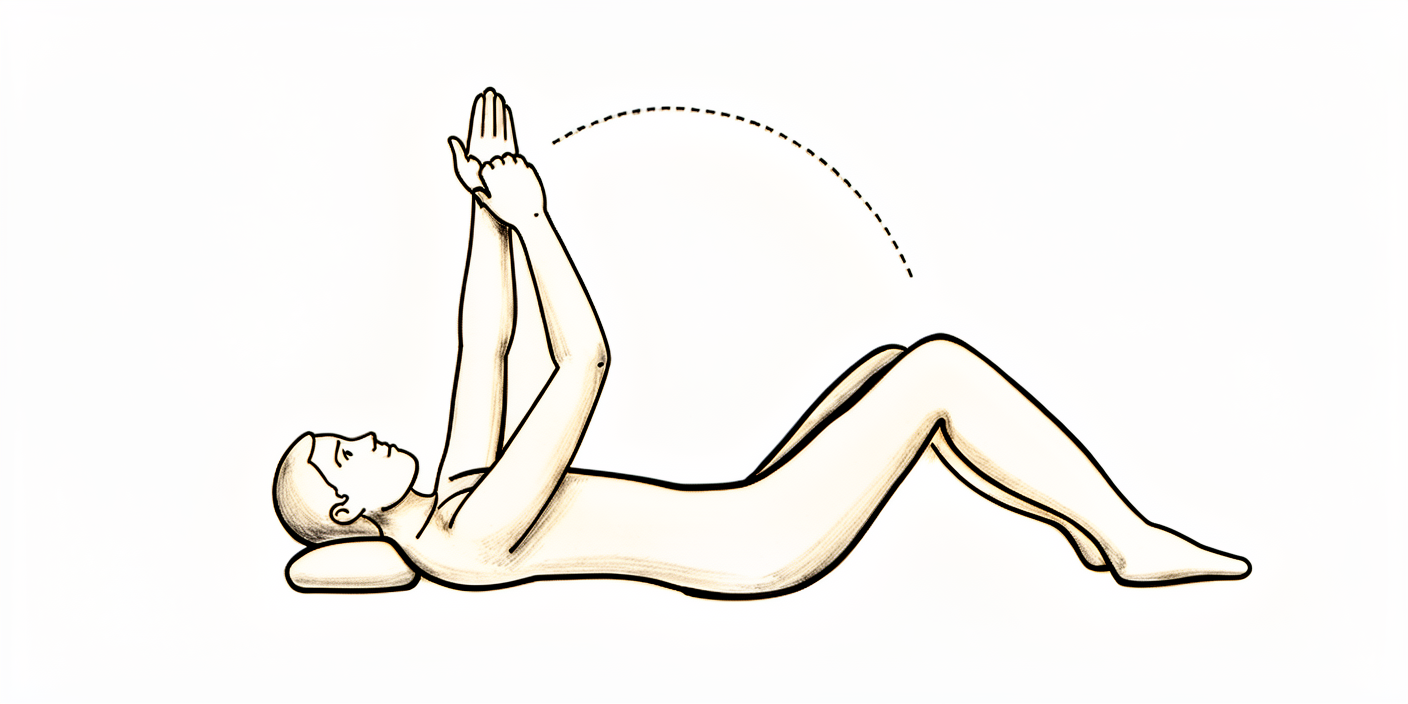
Flexão anterior (assistida)
Sentado numa cadeira e inclinado para a frente, segure o braço operado com o outro braço e mova-o suavemente para cima, à sua frente. Em seguida, abaixe-o novamente com a ajuda do braço não operado. Se preferir, você também pode deitar-se de costas na cama e auxiliar o braço a subir.
10 vezes, 3 vezes por dia.
Kieran Hirpara 4.0
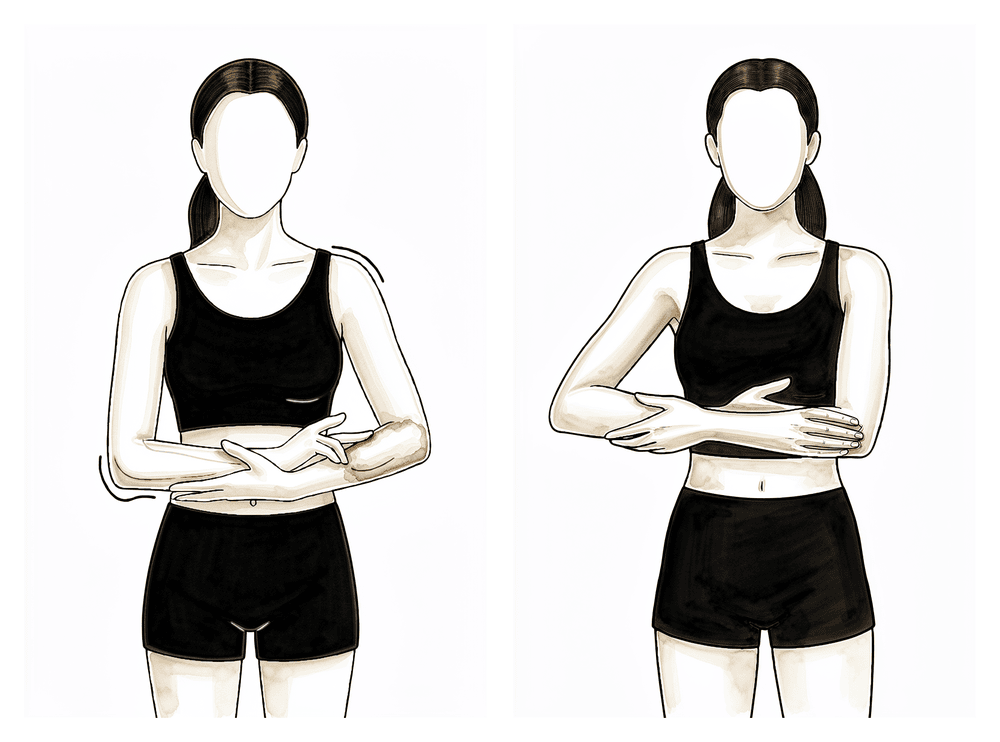
Abdução (assistida)
Sentado numa cadeira e inclinando-se para a frente, embale novamente o braço e ajude-o a mover para o lado (como se estivesse embalando um bebê).
10 vezes, 3 vezes por dia.
Kieran Hirpara 4.0
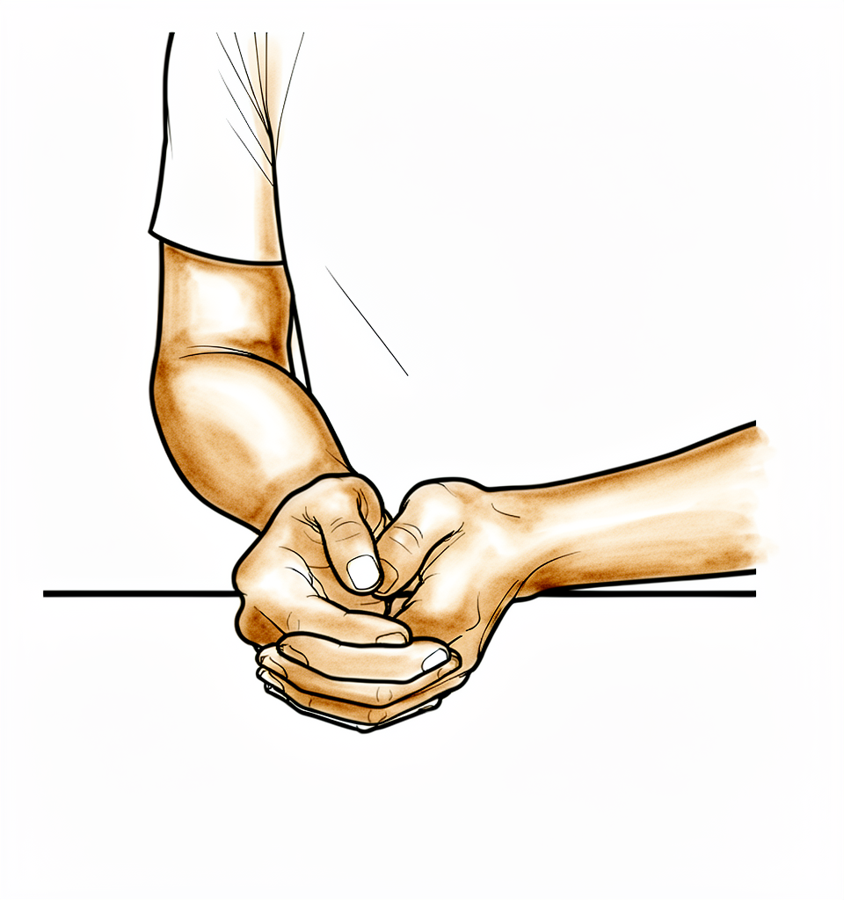
Rotação externa
Sentado numa cadeira, mova apenas o braço da posição em que estaria na tipóia até ficar apontado diretamente à sua frente. Não o mova para mais longe.
Suavemente, 10 vezes, 3 vezes ao dia.
Kieran Hirpara 4.0
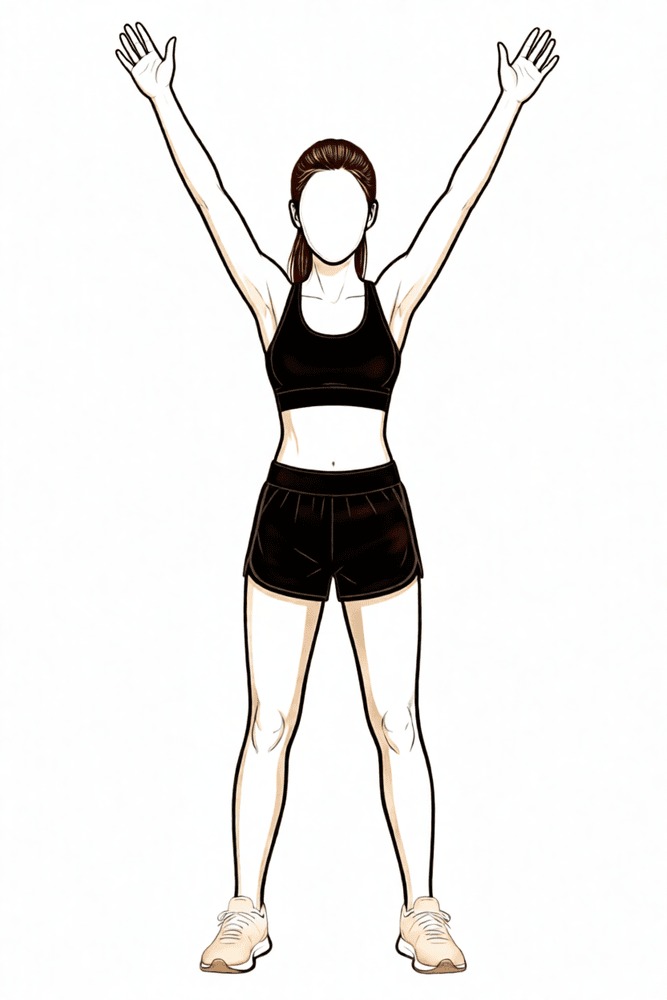
Ativação do trapézio inferior
Aperte as escápulas para baixo e para junto uma da outra.
Mantenha por 5 segundos, 5 vezes; repita 3 vezes ao dia.
Kieran Hirpara 4.0
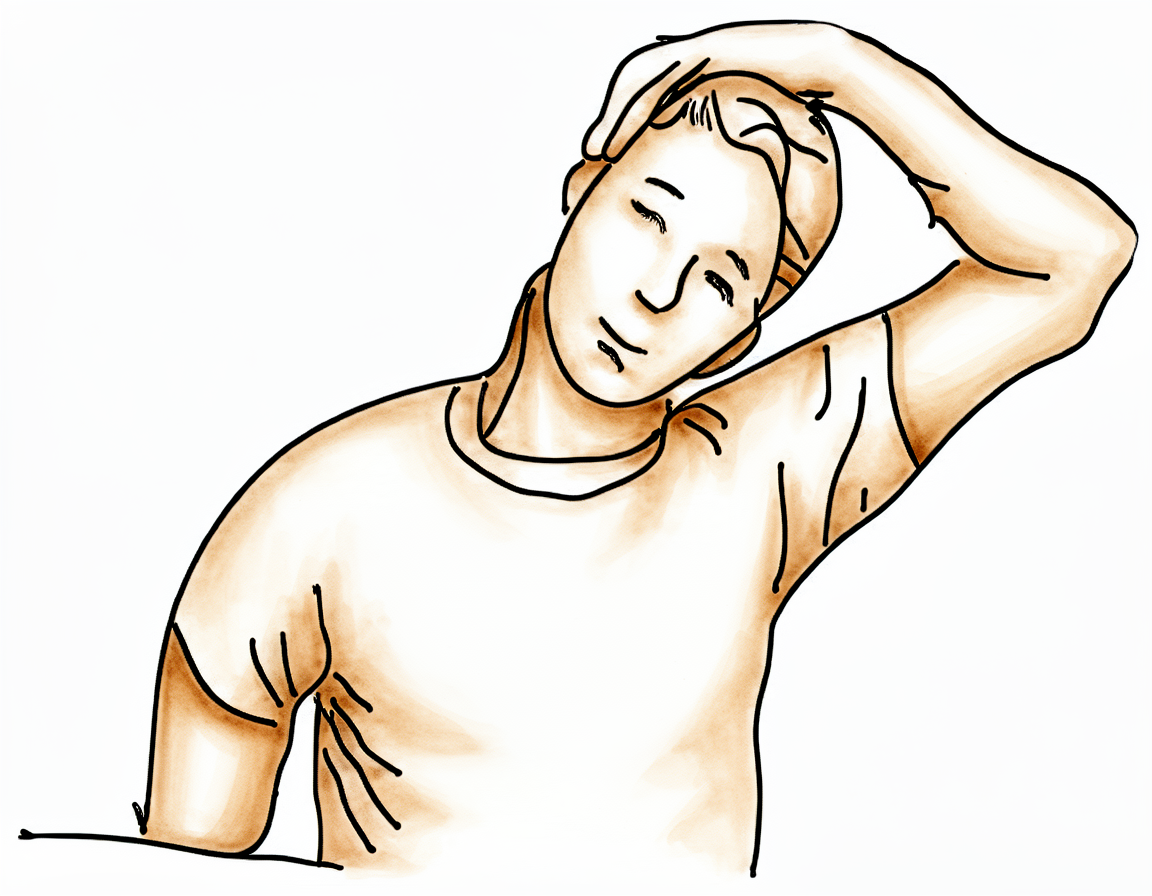
Alongamento do trapézio superior
Use o braço não operado para aproximar a orelha do ombro, afastando-a do lado operado.
Mantenha por 10 segundos, 3 vezes; repita 3 vezes por dia.
Kieran Hirpara 4.0
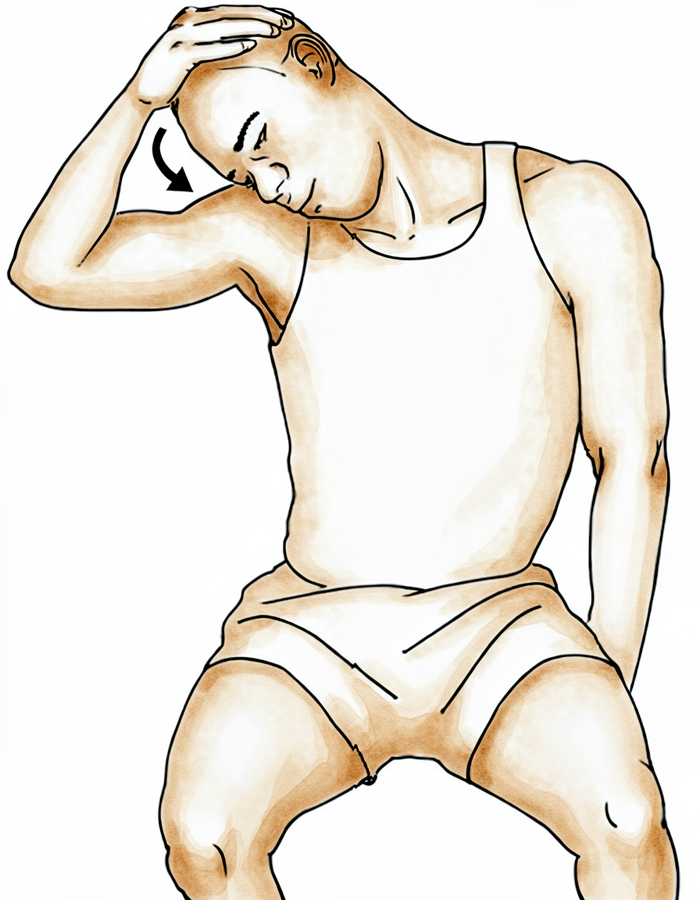
Alongamento do levantador da escápula
Use o braço que não foi operado para aproximar o nariz do mamilo ou da região da axila.
Mantenha por 10 segundos, 3 vezes; repita 3 vezes por dia.
Fase I — Proteção (Semanas 0–3)
Kieran Hirpara 4.0
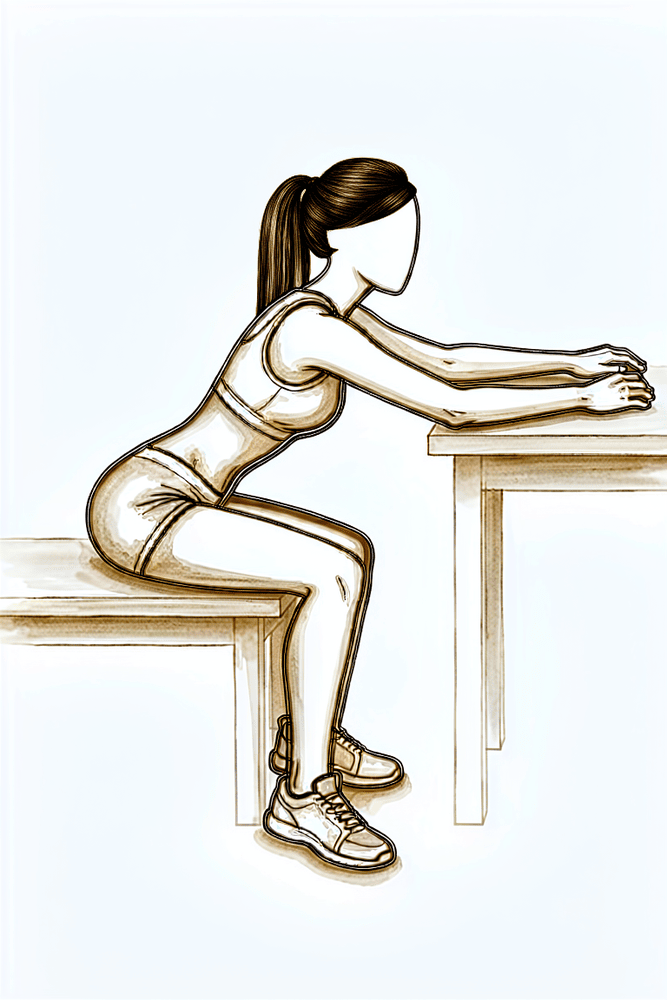
Deslizamento sobre a mesa em posição sentada
Sente-se à mesa com o antebraço apoiado na superfície. Deixe a mão deslizar para a frente ao longo da mesa enquanto se inclina suavemente, permitindo que o ombro se dobre para a frente sem o uso dos músculos do ombro; em seguida, deslize a mão de volta. Mantenha o movimento relaxado e confortável.
Conforme orientado pelo seu fisioterapeuta
As três primeiras semanas visam proteger o ombro recém-operado enquanto ele se estabiliza. Você usará uma tipóia para manter o ombro em posição neutra, especialmente à noite; aplicará gelo e compressão para reduzir o inchaço. O fisioterapeuta realizará movimentos suaves no ombro dentro de limites estabelecidos, enquanto você manterá a movimentação da mão, do pulso e do cotovelo por conta própria. A partir da 2ª semana, iniciam-se exercícios suaves para a escápula e compressões com bola. As regras mais importantes são: proibido qualquer movimento ativo do ombro, proibido estender o braço para trás das costas, proibido levantar objetos e proibido apoiar o peso do corpo nas mãos.
Para o seu fisioterapeuta:
Objetivos
- Proteger a reparação cirúrgica
- Reduzir o inchaço e minimizar a dor
- Manter a amplitude de movimento dos membros superiores (cotovelo, mão e pulso)
- Aumentar gradualmente a amplitude de movimento passivo do ombro (PROM)
- Minimizar a inibição muscular
- Educação do paciente
Manejo
- Tipóia: manter rotação neutra; usar à noite, durante o sono
- Controle do inchaço: gelo e compressão
- Amplitude de movimento/mobilidade:
- PROM: rotação externa ≤ 30 graus no plano escapular; rotação interna até a altura do cinto, também no plano escapular
- Flexão/abdução até o limite tolerado; abdução ≤ 90 graus; exercícios pendulares; deslizamento da mesa de flexão glenoumeral em posição sentada; deslizamento horizontal da mesa em posição sentada
- AAROM: flexão do ombro com assistência ativa
- AROM: cotovelo, mão e pulso
- Fortalecimento (a partir da 2ª semana):
- Músculos periescapulares: retração escapular, retração escapular em decúbito ventral, fixação escapular em pé, fixação escapular com suporte, deslizamento inferior da escápula, remada leve
- Compressão com bola
Precauções
- Proibida qualquer AROM do ombro
- Proibido estender o braço para trás das costas, especialmente em rotação interna
- Proibida rotação externa ou abdução excessiva do ombro
- Proibido levantar objetos
- Proibido apoiar o peso do corpo nas mãos
- Coloque um pequeno travesseiro ou rolo de toalha sob o cotovelo ao deitar de costas, para evitar hiperextensão do ombro
Critérios para avançar para a fase seguinte
- PROM de flexão e abdução do ombro ≥ 50% em relação ao lado contralateral
- PROM de abdução do ombro ≤ 90 graus
- PROM de rotação externa do ombro no plano escapular ≤ 30 graus
- PROM de rotação interna do ombro no plano escapular ≥ 70 graus
- Percepção tátil de contração muscular nos músculos da escápula
- Dor < 4/10
- Ausência de complicações na Fase I
Fase II — Intermediária (Semanas 4–6)
Kieran Hirpara 4.0
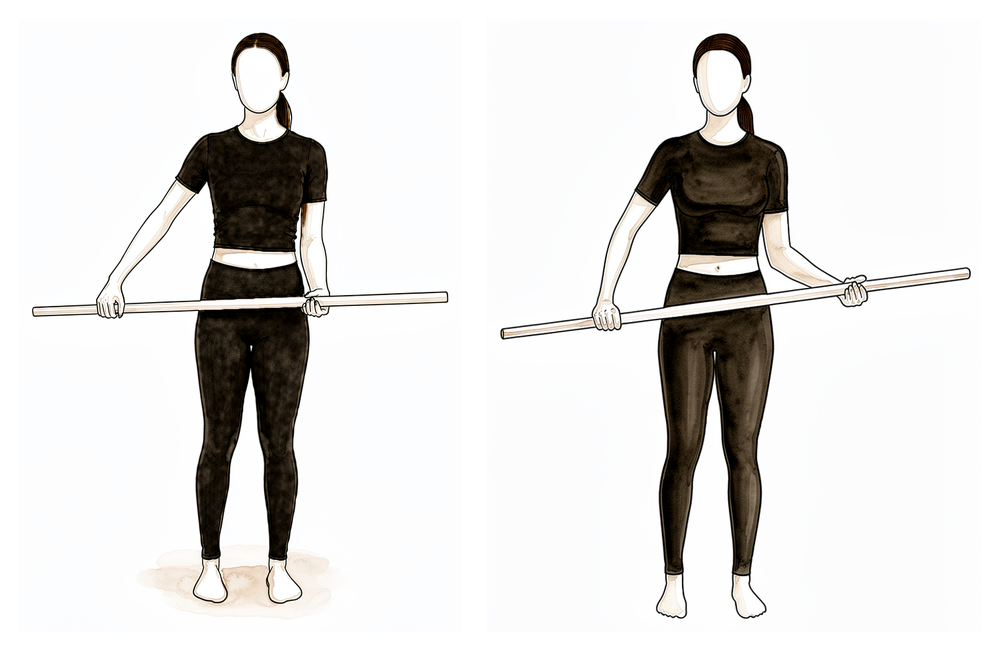
Alongamento em rotação externa com bastão
Deite-se de costas, com o cotovelo ao lado do corpo e dobrado a 90 graus. Segure uma bengala ou bastão com as duas mãos e use o braço não operado para empurrar suavemente a mão do braço operado para fora. Permaneça dentro dos limites estabelecidos pelo seu fisioterapeuta para esta fase, e nunca force o movimento.
Conforme orientado pelo seu fisioterapeuta
O ombro continua sob proteção, porém os movimentos agora são progressivamente intensificados. A tipóia deve ser usada à noite; durante o dia, será gradualmente retirada ao longo dessas duas semanas. O fisioterapeuta aumentará os movimentos passivos até alcançar a amplitude completa (dentro dos limites estabelecidos para rotação externa e abdução), introduzirá movimentos assistidos e, posteriormente, ativos; também iniciará exercícios suaves de ativação dos músculos da coifa dos rotadores e da escápula. Não levante nada mais pesado que uma xícara de café, e evite movimentos extremos de rotação ou de alcance.
Para o seu fisioterapeuta:
Objetivos
- Manter a proteção da reparação cirúrgica
- Reduzir o inchaço e minimizar a dor
- Aumentar gradualmente a amplitude passiva de movimento do ombro
- Minimizar padrões de substituição durante os movimentos ativos e assistidos
- Melhorar a ativação e a força dos músculos periescapulares
- Iniciar a ativação da coifa dos rotadores (músculos rotadores externos)
- Educação do paciente
Condutas
- Tipóia: usar à noite durante o sono; começar a retirá-la gradualmente durante o dia nas próximas duas semanas
- Manter as intervenções da Fase I
- Amplitude de movimento/mobilidade:
- Movimentos passivos: amplitude completa, exceto rotação externa ≤ 30 graus no plano escapular e abdução ≤ 90 graus
- Movimentos ativos assistidos: flexão do ombro com auxílio de bengala, alongamento de rotação externa com bengala, pressão com pano úmido, elevação do ombro sentado com auxílio de bengala
- Movimentos ativos: flexão deitado, movimentos de saudação, “socos” deitado
- Fortalecimento:
- Coifa dos rotadores: isometria de rotação externa
- Músculos periescapulares: remada em bola de fisioterapia, “socos” com serrátil anterior
- Cotovelo: flexão de bíceps, exercícios de flexão e extensão de tríceps com faixa elástica
- Controle motor:
- Rotação externa durante elevação e flexão do ombro 90–125 (estabilização rítmica)
- Alongamento:
- Adução horizontal deitado de lado
Precauções
- Evitar rotação externa ou abdução excessivas do ombro
- Não levantar objetos mais pesados que uma xícara de café
- Não apoiar o peso corporal nas mãos
- Colocar um pequeno travesseiro ou rolo de toalha sob o cotovelo ao deitar de costas para evitar hiperextensão do ombro
Critérios para avançar para a fase seguinte
- Amplitude passiva de flexão e elevação do ombro ≥ 75% em relação ao lado contralateral
- Amplitude passiva de rotação interna no plano escapular ≥ 75% em relação ao lado contralateral
- Amplitude passiva de rotação externa no plano escapular de 30 graus
- Amplitude passiva de abdução do ombro de 90 graus
- Padrões mínimos de substituição durante os movimentos ativos assistidos
- Elevação ativa do ombro até 100 graus com mínimos padrões de substituição
- Dor < 4/10
- Ausência de complicações durante a Fase II
Fase III — Intermediária, continuação (Semanas 7–8)
Kieran Hirpara 4.0
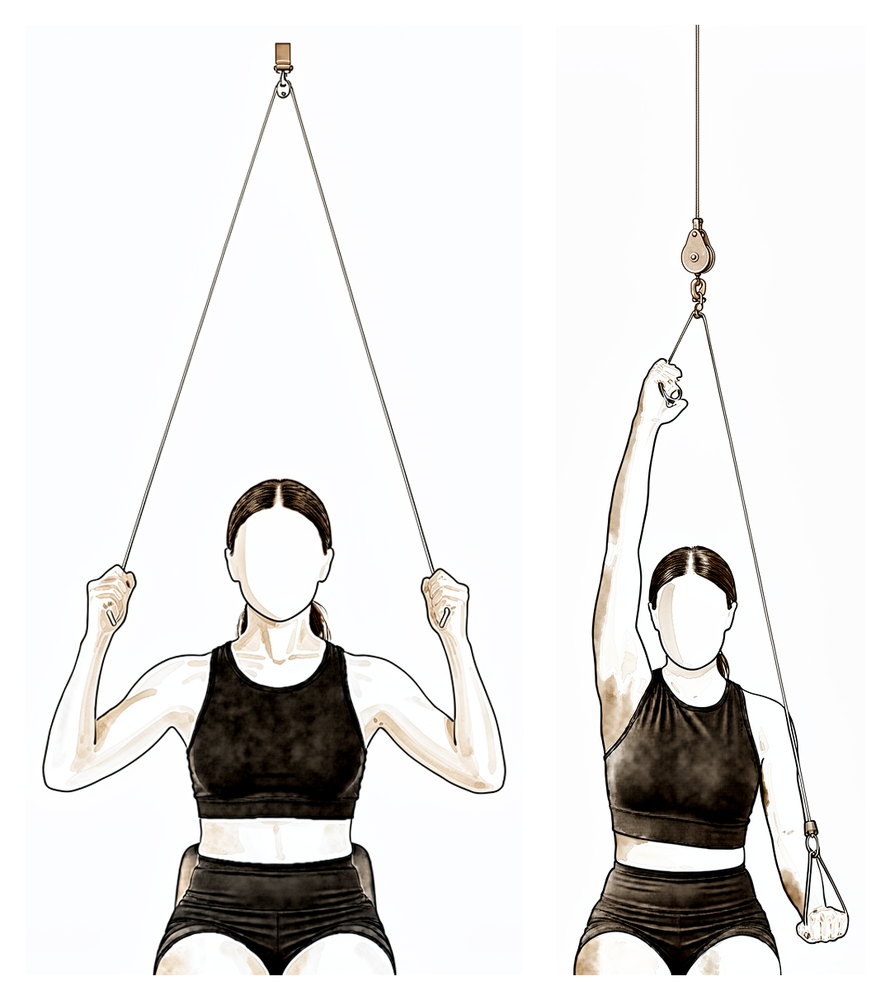
Polia de porta
Sente-se debaixo de uma polia de porta, segurando uma alça em cada mão. Puxe para baixo com o braço não operado para elevar o braço operado, mantendo este último relaxado; em seguida, abaixe-o de forma lenta e suave.
Conforme orientado pelo seu fisioterapeuta
Kieran Hirpara 4.0
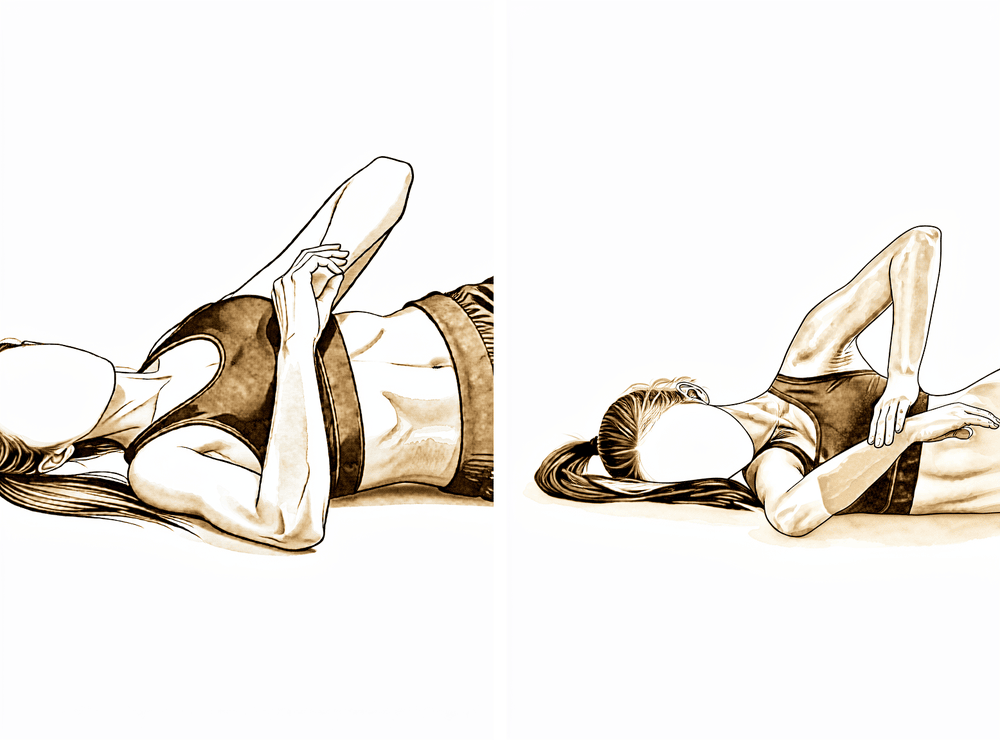
Alongamento do tipo “sleeper”
Deite-se sobre o lado operado, com o braço estendido à frente, na altura do ombro, e o cotovelo dobrado a 90 graus. Use a outra mão para pressionar suavemente o antebraço em direção à cama, até sentir um alongamento confortável na parte posterior do ombro. Não force o alongamento.
Conforme orientado pelo seu fisioterapeuta
Kieran Hirpara 4.0
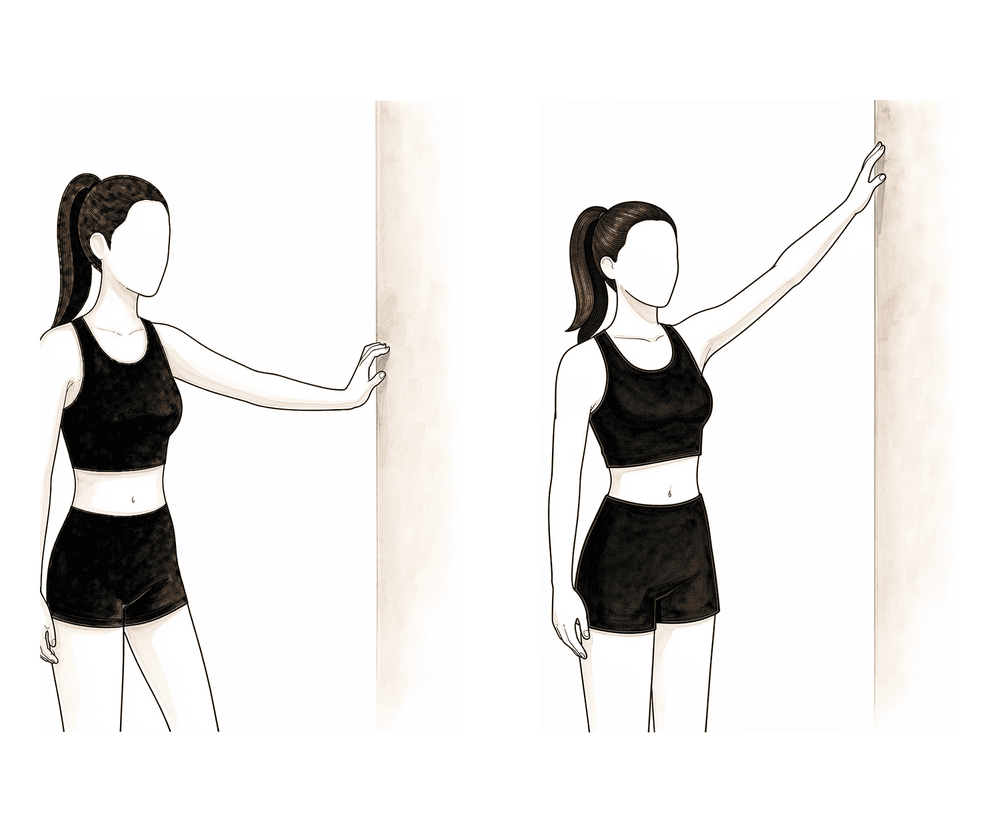
Subida dos dedos na parede, para o lado
Fique de lado em relação à parede, com as pontas dos dedos apoiadas nela. Deslize os dedos pela parede para o lado, levantando o braço o máximo que for confortável; em seguida, deslize-os de volta para baixo de forma controlada. A parede serve de apoio ao braço enquanto você recupera o movimento lateral.
Conforme orientado pelo seu fisioterapeuta
A tipóia já não é necessária; o objetivo agora é alcançar movimento total em todas as direções, com auxílio quando necessário e, progressivamente, por meio da própria força do paciente. O fortalecimento muscular intensifica-se, incluindo exercícios com faixas elásticas para o manguito rotador e os músculos da escápula; o paciente pode retomar todas as atividades cotidianas. Permanecem duas restrições: não levantar objetos pesados demais (acima de 5 kg) e evitar qualquer atividade que sobrecarregue o tecido em processo de cicatrização na parte anterior do ombro.
Para o seu fisioterapeuta:
Objetivos
- Não sobrecarregar o tecido em cicatrização (especialmente a cápsula anterior)
- Minimizar a dor
- Manter o PROM (movimento passivo)
- Melhorar o AROM (movimento ativo sem resistência)
- Aumentar a força dos músculos periescapulares e do manguito rotador
- Retorno às atividades funcionais plenas
- Educação do paciente
Conduta terapêutica
- Tipóia: retirar
- Continuar com as intervenções das Fases I e II
- Amplitude de movimento / mobilidade:
- Amplitude total de movimento em todos os planos
- AAROM: deslizamentos em mesa inclinada, rolagem de bola na parede, escaladas na parede, exercícios com polias
- AROM: elevação do braço sentado, flexão do braço sentado, elevação do braço em decúbito dorsal com resistência elástica até 90 graus
- Fortalecimento:
- Manguito rotador: isometria de rotação interna, rotação externa deitado de lado, rotação externa em pé com faixa elástica, rotação interna em pé com faixa elástica, rotação interna e externa
- Músculos periescapulares: extensão do ombro com faixa elástica, remadas sentado com faixa elástica, remadas, movimentos semelhantes ao cortar grama
- Controle motor:
- Rotação interna/externa e flexão 90–125 (estabilização rítmica)
- Exercícios isométricos alternados em posição de quadrupedia e estabilização com bola na parede
- Facilitação neuromuscular proprioceptiva (FNP): elevações diagonais D1, elevações diagonais D2
- Alongamento:
- Rotação interna atrás das costas com auxílio de toalha, adução horizontal deitado de lado, alongamento “sleeper”, alongamento do tríceps e do latíssimo do dorso
Precauções
- Proibido levantar objetos pesados (> 5 kg)
Critérios para avançar para a fase seguinte
- Ausência ou mínima ocorrência de padrões compensatórios durante o AROM do ombro
- Dor < 4/10
Fase IV — Transicional (Semanas 9–11)
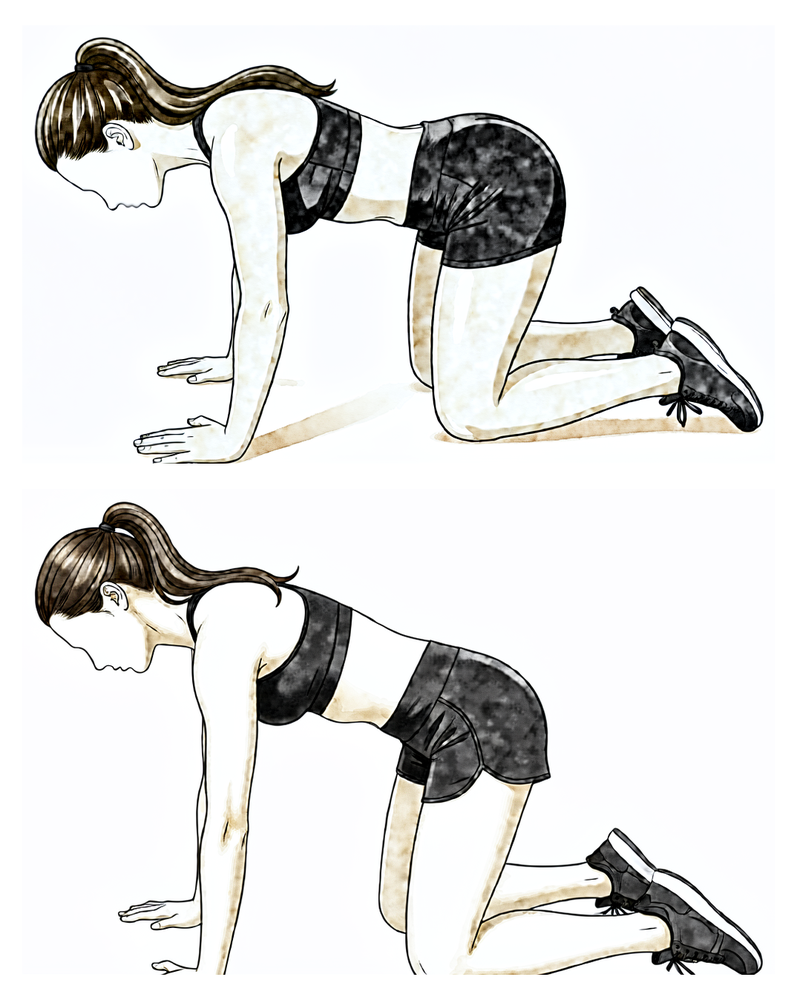
Kieran Hirpara 4.0
Flexão com protração (plus) apoiada nos joelhos
A partir da posição de flexão de joelhos, com as mãos sob os ombros, mantenha os cotovelos esticados e empurre as costas para cima, em direção ao teto, permitindo que as escápulas se afastem uma da outra; em seguida, abaixe o corpo de forma controlada.
Conforme orientado pelo seu fisioterapeuta
Neste momento, os movimentos já devem ser completos e confortáveis; esta fase visa tornar esses movimentos fortes e estáveis. A resistência nos exercícios para o manguito rotador aumenta, o programa de exercícios para a escápula se amplia, e os exercícios de controle desafiam o ombro em padrões funcionais diagonais. O limite de levantamento de 5 kg ainda se aplica, e devem ser evitadas posições que sobrecarreguem a parte anterior da articulação (como rotacionar o braço para fora quando ele estiver levantado acima de 80 graus para o lado).
Para o seu fisioterapeuta:
Objetivos
- Não sobrecarregar o tecido em processo de cicatrização (especialmente a cápsula anterior)
- Manter a amplitude de movimento passivo sem dor
- Continuar melhorando a amplitude de movimento ativo
- Aumentar a estabilidade dinâmica do ombro
- Restaurar gradualmente a força e a resistência do ombro
Manejo
- Continuar com as intervenções das Fases II e III
- Amplitude de movimento/mobilidade:
- Alcançar amplitude completa de movimento em todos os planos
- Fortalecimento:
- Manguito rotador: aumentar a resistência nos exercícios para o manguito rotador
- Músculos periescapulares: flexão com apoio nos joelhos, exercício em “W”, movimentos com faixa elástica em “W”, abraço dinâmico, abraço dinâmico com faixa elástica, extensão do ombro em decúbito ventral, soco para frente com faixa elástica, soco para frente, posição de tripé, movimento de dedo indicador
- Controle motor:
- Padrões PNF com faixa elástica; elevações diagonais D1 com resistência; deslizamentos na parede para cima e para baixo em diagonal, utilizando faixa elástica
Precauções
- Não levantar objetos pesados (> 5 kg)
- Evitar exercícios que sobrecarreguem a cápsula anterior do ombro (ou seja, rotação externa do ombro acima de 80 graus de abdução)
Critérios para avançar para a fase seguinte
- Flexão ativa em decúbito dorsal ≥ 140 graus
- Abdução ativa em decúbito dorsal ≥ 120 graus
- Rotação externa ativa em decúbito dorsal, no plano escapular, ≥ 60 graus
- Rotação interna ativa em decúbito dorsal, no plano escapular, ≥ 70 graus
- Elevação do ombro até 120 graus com mínima utilização de padrões compensatórios
- Execução correta de todos os exercícios, demonstrando mecânica escapular simétrica
- Dor < 2/10
Fase V — Fortalecimento avançado (Semanas 12–16)
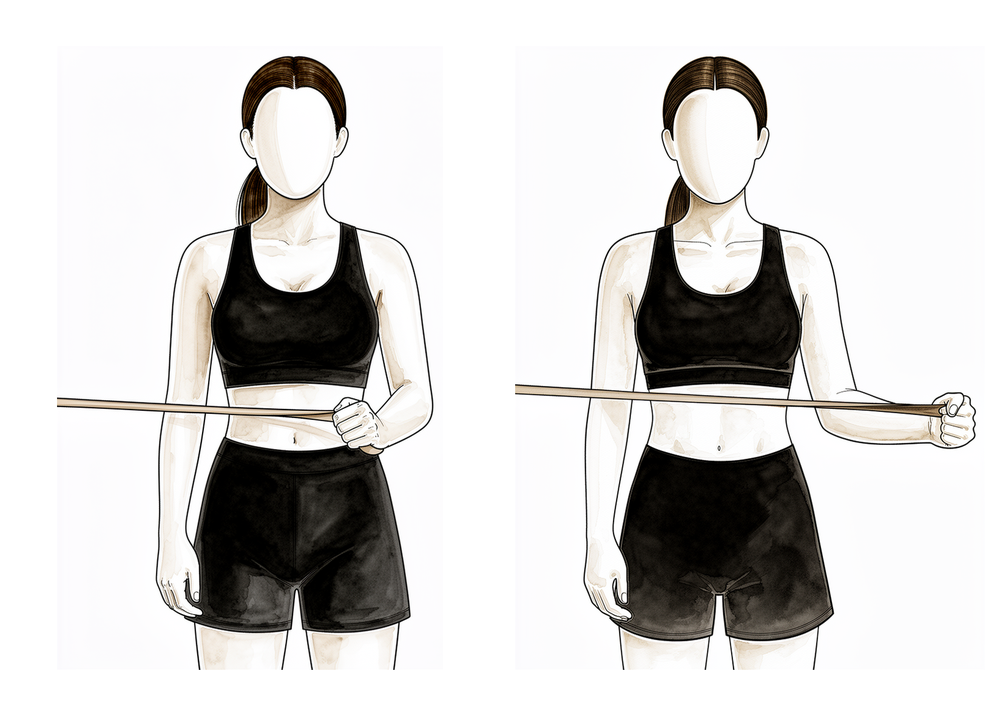
Kieran Hirpara 4.0
Rotação externa em pé a 90 graus (com faixa).
Em pé, levante o braço até a altura do ombro, para o lado, mantendo o cotovelo dobrado a 90 graus. Gire o antebraço para cima contra a resistência de uma faixa elástica leve e, em seguida, volte à posição inicial de forma controlada.
Conforme orientado pelo seu fisioterapeuta
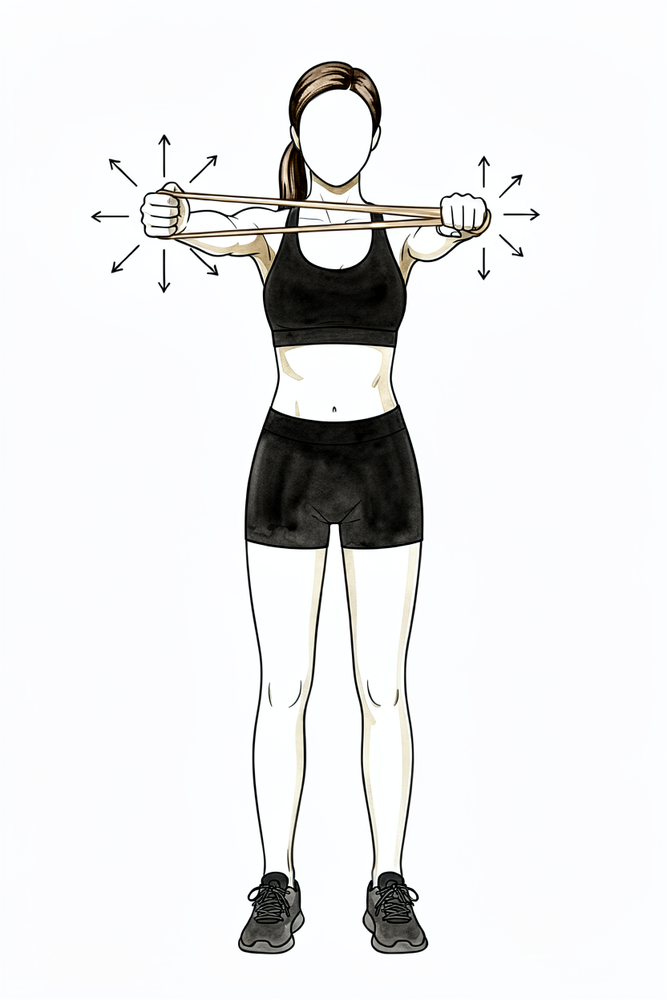
Kieran Hirpara 4.0
Estabilização rítmica
Com o braço apoiado à sua frente, na altura dos ombros, peça ao seu fisioterapeuta (ou à sua mão sã) que aplique pequenos empurrões suaves em diferentes direções, enquanto você mantém o braço imóvel e firme — não permita que ele se mova. Isso treina os músculos estabilizadores do ombro para reagirem. Certifique-se de que todos os movimentos sejam suaves.
Conforme orientado pelo seu fisioterapeuta
A fase final prepara o ombro para todas as atividades que se deseja realizar: aumentar a força e a resistência em posições mais elevadas, incluindo exercícios de rotação com o braço elevado a 90 graus, além de progredir nos exercícios de estabilização acima da cabeça. O avanço para além deste protocolo (inclusive qualquer retorno ao esporte) só ocorre com autorização do cirurgião, após o cumprimento de todas as metas estabelecidas; no caso de atletas, a decisão é individualizada, não baseada apenas no calendário.
Para o seu fisioterapeuta:
Objetivos
- Manter amplitude de movimento sem dor
- Melhorar a força e a resistência do ombro
- Otimizar o uso funcional do membro superior
Conduta terapêutica
- Continuar com as intervenções das Fases II–IV
- Fortalecimento:
- Músculos rotadores: rotação externa a 90 graus, rotação interna a 90 graus, rotação externa com faixa elástica em pé a 90 graus, rotação interna com faixa elástica em pé a 90 graus
- Músculos periescapulares: exercícios “T” e “Y”, flexão “plus” com joelhos estendidos, flexão contra a parede
- Controle motor:
- Avançar do exercício de estabilização da bola contra a parede para exercícios isométricos alternados acima da cabeça ou estabilização rítmica
Critérios para progressão
- Autorização médica e cumprimento de TODOS os critérios estabelecidos
- Manutenção de amplitude de movimento passiva e ativa sem dor
- Execução correta de todos os exercícios, demonstrando mecânica escapular simétrica
- Resultados satisfatórios nos questionários QuickDASH e ASES
Retorno ao esporte
- Para atletas amadores ou profissionais, a decisão de retorno ao esporte deve ser individualizada, considerando fatores como demanda sobre o membro superior, se o esporte é de contato ou não, frequência de participação, etc. Recomenda-se conversar detalhadamente com o cirurgião responsável antes de iniciar um programa de reabilitação voltado ao retorno ao esporte.
Após seguir este protocolo
Este protocolo complementa as orientações gerais de recuperação fornecidas pelo consultório; consulte controle da dor pós-operatória e cuidados com a ferida. Quanto à própria cirurgia, veja artroplastia total do ombro. As evidências científicas que sustentam este protocolo, bem como a razão pela qual a fase inicial é crucial para proteger a reparação do subscapularis, estão resumidas na seção de evidências, disponível em formato PDF no topo desta página.
Evidence & references
This is the clinical evidence summary written for health professionals. It is technical, and it lists the research this page was built from. You do not need to read it to understand your treatment or to make a decision about it.
Anatomic Total Shoulder Arthroplasty — Post-operative Rehabilitation
Topic scope: Post-operative rehabilitation after anatomic total shoulder arthroplasty (aTSA) for glenohumeral arthritis. (Reverse total shoulder arthroplasty has a different rehab logic — see the reverse-shoulder-arthroplasty protocol; the early in-hospital phase of either is covered by the inpatient-shoulder-replacement protocol.)
Defining principle of this rehab — PROTECT THE SUBSCAPULARIS: to reach the joint in an anatomic TSA the surgeon usually takes down and then repairs the subscapularis (by tenotomy, peel, or a lesser-tuberosity osteotomy). That repair is the structure rehabilitation must protect. So the early plan is the mirror image of a frozen-shoulder release: external rotation is limited, and active/resisted internal rotation is delayed, to avoid pulling the subscapularis repair apart — while early passive forward elevation is encouraged so the shoulder does not stiffen. This subscapularis-protection logic is the key difference from reverse arthroplasty (which usually has no subscapularis repair to guard) and the reason aTSA rehab is more measured.
A. THE PROCEDURE (what is being protected)
Anatomic TSA resurfaces the arthritic joint with a metal humeral head and a plastic glenoid, restoring the normal ball-and-socket mechanics — which depends on an intact, balanced rotator cuff (the indication that distinguishes it from reverse arthroplasty). The subscapularis management is the rehab-defining variable:
- Subscapularis tenotomy / peel with tendon-to-tendon or transosseous repair, or
- Lesser-tuberosity osteotomy (LTO) — repaired bone-to-bone.
Either way, the repair governs the early external-rotation limit and the delay before active and resisted internal rotation. The specific ER ceiling and the IR-loading timeline are surgeon-set (they depend on repair quality and tissue) — the patient protocol follows the surgeon's chosen limits, and the phase table below reflects them.
B. POST-OPERATIVE PHASED TIMELINE (subscapularis-protective)
Consistent with the protocol's phases (Protection → Intermediate → Transitional → Advanced). Sling supports the arm; passive elevation early; ER capped and active/resisted IR withheld until the subscapularis has healed.
| Phase | Window | Sling | ROM | Strengthening | Notes |
|---|---|---|---|---|---|
| I — Protection | Week 0–3 | Full-time (off for hygiene + exercises) | Passive elevation + gentle ER to the surgeon's limit only; pendulums; hand/elbow free | None | Protect subscapularis repair; no active shoulder motion; no behind-the-back / forced ER |
| II — Intermediate | Week 4–6 | Weaning | Progress passive → active-assisted elevation; ER advanced within limit | Scapular setting / isometrics as allowed | Subscapularis still protected — no resisted internal rotation |
| III — Intermediate continued | Week 7–8 | Off | Active ROM all planes progressing toward full | Begin gentle cuff (incl. graded IR) + scapular work | Subscapularis repair healing — IR loading introduced cautiously |
| IV — Transitional | Week 9–11 | Off | Full active ROM goal | Progressive resistance, low load → higher | — |
| V — Advanced strengthening | Week 12–16 | Off | Full, incl. rotation at 90° abduction | Advanced strength/endurance; overhead stability | Return to sport/heavy use on surgeon clearance, individualised |
C. KEY CONTROVERSIES / EVIDENCE QUALITY
- Subscapularis management — tenotomy vs peel vs lesser-tuberosity osteotomy. Healing and functional-IR recovery drive the ER-restriction and IR-loading timeline; biomechanical and clinical data inform but do not settle the choice. Moderate (biomechanical + cohort).
- Early vs delayed / immobilisation — a single-blind RCT comparing early rehabilitation versus immobilisation after shoulder arthroplasty found broadly comparable outcomes, supporting a measured but not ultra-conservative early plan; subscapularis protection remains the governing constraint. Moderate (RCT).
- The phase timeline itself is consensus/expert (institutional protocols — MGH, BWH — and surgeon practice), not a defining rehab RCT. Phase weeks are typical, surgeon-adjustable. Weak/consensus.
D. EVIDENCE STRENGTH FLAGS (summary)
- MODERATE (RCT / biomechanical / cohort): early-rehab-vs-immobilisation after shoulder arthroplasty (RCT); subscapularis repair-technique biomechanics; durability/outcome of aTSA.
- WEAK / CONSENSUS: the specific subscapularis-protective phase structure and ER/IR restriction timings (institutional protocols + surgeon preference; no defining rehab RCT).
- CONTEXT: the protocol's measured early phase is appropriately keyed to subscapularis healing rather than the calendar.
CITATIONS
RAG corpus (180,000+ Orthopaedic articles)
- A randomized single-blinded trial of early rehabilitation versus immobilization after shoulder arthroplasty. J Shoulder Elbow Surg. 2020. DOI: 10.1016/j.jse.2019.10.005
- A biomechanical evaluation of three surgical techniques for subscapularis repair. J Shoulder Elbow Surg. 2007. DOI: 10.1016/j.jse.2007.04.016
- Deltoid fatigue part 2: a longitudinal assessment of anatomic total shoulder arthroplasty. J Shoulder Elbow Surg. 2021. DOI: 10.1016/j.jse.2021.07.019
Published rehab protocols (basis for the phase structure)
- Massachusetts General Brigham Sports Medicine. Rehabilitation Protocol for Total Shoulder Arthroplasty and Hemiarthroplasty (rev. Dec 2018). https://www.massgeneral.org/assets/MGH/pdf/orthopaedics/sports-medicine/physical-therapy/rehabilitation-protocol-for-total-shoulder-arthroplasty-and-hemi.pdf
- Brigham and Women's Hospital. Total Shoulder Arthroplasty / Hemiarthroplasty Protocol. https://www.brighamandwomens.org/assets/bwh/patients-and-families/pdfs/shoulder---total-shoulder-arthroplasty-protocol.pdf
Note on the rehab evidence: there is no single defining RCT for the anatomic-TSA rehab protocol. The phase structure is the originating-institution / surgeon consensus, and the external-rotation ceiling and internal-rotation loading timeline are deliberately keyed to subscapularis repair healing — a surgeon-set, tissue-dependent decision. Treat phase weeks as typical, surgeon-adjustable defaults.