Patients › Hand
Hand Tendon and Nerve Injuries
Hand tendon and nerve injuries – understanding symptoms, diagnosis, and treatment options.
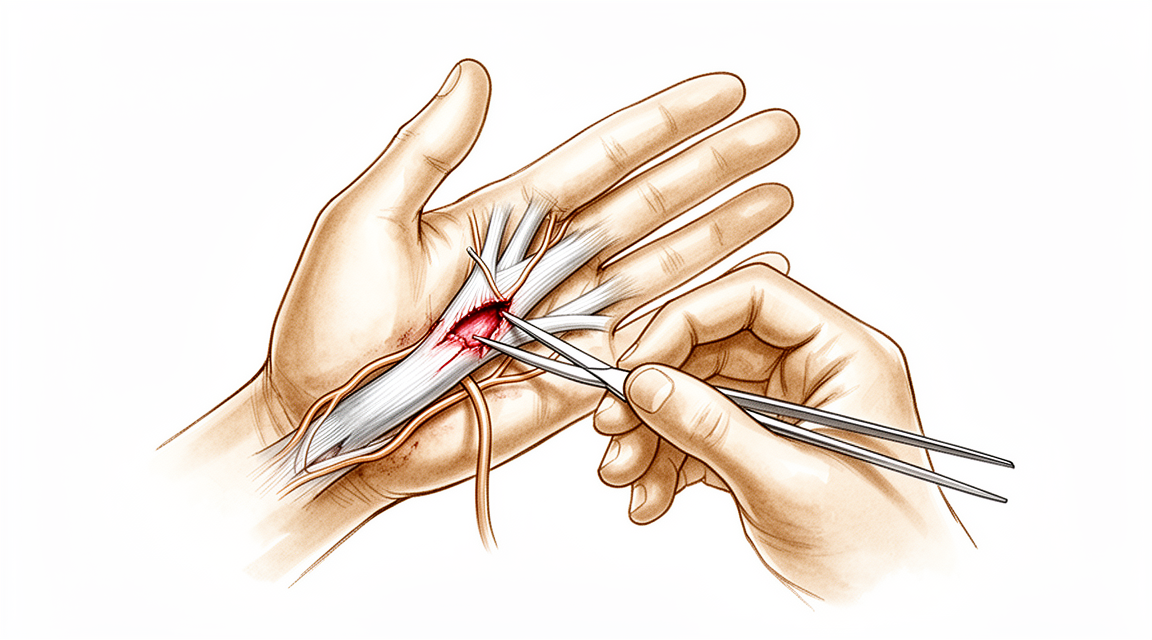
What you're feeling
A hand tendon or nerve injury usually follows a cut, a crush, or a sudden force that pulls a finger back. The pain sits where the injury happened, often along the palm side of a finger or thumb, or along the path of the nerve. It tends to flare when you grip, squeeze, or push through the hand, and it settles when the hand rests.
When a tendon is cut, you may find a finger will not bend on its own, even though someone else can straighten it for you. Bending to pick up a coin, hold a cup of tea, or turn a key becomes hard or impossible. When a nerve is cut, the feeling in part of the hand or finger changes. You may notice numbness, tingling, or pins and needles, and you may not feel heat, cold, or a sharp edge in that spot. Fine tasks like doing up small buttons, picking up a needle, or feeling for coins in your pocket get tricky because the finger cannot tell you what it is touching.
Some injuries ache more at night or first thing in the morning. A nerve that is irritated can send a sharp, electric shock-like feeling when you tap the sore spot, and that feeling can creep further along the finger over time. Some people develop a tender spot where the nerve healed, called a neuroma, which can be painful to touch or press.
These injuries often happen together with a broken bone in the hand or fingers, and that combination raises the chance of lasting stiffness or weakness. How well the hand recovers depends on several things: whether the cut was clean or a crush, whether bones were broken too, how many fingers or tendons were hurt, your age, and the type of hand therapy you do afterwards. Getting seen early by a hand specialist gives the repair the best chance, so it is worth getting checked promptly rather than waiting to see if it settles.
What's actually happening
Your hand is built like a small machine. It has 27 bones, and about as many tendons, which are the cords that join muscle to bone and pull your fingers when you want to move them. Nerves run alongside them, carrying feeling from your fingertips to your brain and carrying messages back down to make the muscles work.
A cut or a crush can snap a tendon or a nerve. A tendon is a rope of strong fibres, and when it is cut, the two ends pull apart. The finger loses its pulling power, which is why it will not bend on its own. A nerve works more like an electrical cable. When it is cut, the part beyond the injury breaks down, and the feeling in that area goes quiet.
Both structures try to heal themselves, but they do it in ways that cause trouble inside a tight space. A cut tendon grows new tissue over about 6 to 8 weeks, but that new tissue is never as strong or as smooth as the original. As it heals, it can stick to the thin sleeve that surrounds it, a bit like sticky tape gluing a drawstring in place. That stops the tendon from sliding, so the finger stiffens even after the repair has healed.
A healing nerve tries to sprout new endings that grow towards the fingertips. If those sprouts cannot find their way across the injury, they can grow into a tangled, tender knot instead. That knot is called a neuroma, and it is why some people have a sore spot that flares when touched. Nerves regrow slowly, and the feeling they restore is often not quite the same as before.
This is why early repair matters. Once the tendon ends have pulled apart or the nerve ends have scarred over, putting them back together becomes harder, and the hand may never glide or feel the way it did.
What we can do about it
Dr Kieran Hirpara, an upper-limb surgeon at Mater Private Hospital Rockhampton, matches the treatment to your specific injury. Patients are generally referred to our clinic by their GP; if a physiotherapist has suggested you see us, you will still need a referral from your GP in order to be eligible for the Medicare rebate. At the clinic visit we take a history, examine your hand, and arrange imaging where it helps. For some hand problems we usually start with non-operative care such as activity change, hand therapy or splinting, and consider surgery when that has not given enough improvement. For a fresh cut to a tendon or nerve, surgery may be recommended straight away, without a waiting period.
Hand therapy is a large part of treatment, whether or not you have an operation. A therapist fits splints that hold the hand in a safe position, guides the tendons and nerves through gentle movement so they glide rather than stick, guards against fingers drifting into a bent position, and retrains the feeling in a finger that has gone numb. The therapy programme you follow afterwards is one of the things that shapes how well the hand works later.
When a nerve has been cut and the two ends cannot simply be sewn together, there are ways to bridge the gap. For short gaps, a tube made of collagen, a material the body accepts, can guide the growing nerve across. For longer gaps, up to 5 cm, a processed donor nerve graft can be used. Another option is a nerve transfer, where a working nerve is rerouted to take over a job the injured nerve has lost. Which option suits you depends on the size of the gap and how much time has passed since the injury.
For tendons, a clean cut can often be repaired directly. If a tendon injury was missed at first, or an earlier repair has failed, a tendon graft can bridge the missing piece. If a nerve has no realistic chance of recovering, a tendon transfer can reroute a working tendon to do the job of the one that is out of action. This is sometimes chosen when getting back to work and daily life sooner matters more than waiting for a nerve to regrow.
Some people are left with a painful spot where a nerve healed into a neuroma. Surgery can release a nerve trapped in scar tissue, or move the nerve end so it is no longer caught under tender skin.
Before any operation we may use scans to plan. An MRI can show a torn tendon that is not visible from the outside, and ultrasound can track how a nerve is recovering.
What to expect
Recovery from a hand tendon or nerve injury is slow, and it rarely feels like a straight line. A repaired tendon grows new tissue over about 6 to 8 weeks, but that new tissue is never as strong or as smooth as the original. Nerves regrow far more slowly than tendons, and the feeling they restore is often not quite the same as before. Over weeks and months you can expect gradual change rather than a sudden return to normal.
For tendons, the outlook with treatment is generally steady. Most repairs hold, but a small number do not: about 4% of flexor tendon repairs rupture, and about 6% of people need another operation of some kind. Scar tissue can also glue the tendon in place, which happens in about 4% of repairs and leaves the finger stiff even though the repair itself has healed. If a repair is delayed, or a tendon at the wrist needs a graft, results are often far from perfect. Leaving a cut tendon alone means the finger will not bend on its own again, because the two ends have pulled apart.
For nerves, honesty matters more than optimism. When a single digital nerve, one of the feeling nerves in a finger, is repaired, only 24% regain feeling close to or equivalent to the level before the injury. That means most people are left with some numbness or altered feeling in that finger even after a well-done repair. Time matters too: waiting more than 6 months to repair a nerve substantially reduces the number of new nerve fibres that can grow, and the muscle endings they need to reach can waste away during those months. Sharp injuries to larger nerves often need a graft if repair is delayed by several days, though some digital nerves can still be repaired up to two weeks or greater after injury.
When a nerve cannot recover, a tendon transfer can restore movement instead, and this route often gets you back to work and daily life sooner than waiting for a nerve to regrow. Hand therapy shapes how well the hand works later, whatever treatment you have. Some aching around a healing repair is common and usually settles over several months.
When to see someone
Go to an emergency department if you have cut your hand and a finger will not bend on its own, or if part of your hand has gone numb after a cut or a crush. These injuries are time-critical: a nerve left unrepaired for more than 6 months loses much of its ability to regrow, and muscle endings it needs to reach can waste away in the meantime. Some digital nerve repairs can still be done up to two weeks or greater after injury, but the sooner you are seen, the more options remain open.
Ask for a specialist review if you notice a sharp, electric shock-like feeling when tapping a sore spot that creeps further along the finger over time, or a tender spot that flares when touched. These can signal a nerve problem that benefits from prompt assessment. If your hand was injured alongside a broken bone, mention this too, as that combination raises the chance of lasting stiffness or weakness.
See your GP if you have ongoing pain, numbness, or weakness that is not settling, or if a finger that was injured is stiffening or triggering. Your GP can refer you for a hand specialist review and arrange tests such as nerve studies, which are usually done around 3 to 4 months after injury to check how a nerve is recovering.
In more depth
Advanced reading: the deeper science (optional)
This section goes further than you need for your own treatment decisions. Tendon and nerve repair in the hand is worth the extra reading because the operation is only half the treatment, what happens in the following weeks determines the result as much as the repair itself, and the evidence there has become quite specific.
Moving early beats protecting
After a flexor tendon repair, two things compete. Move the finger and the repair may rupture; keep it still and the tendon scars to its sheath, so it heals intact but cannot glide, a stiff finger with a healed tendon inside it.
Across 569 patients, the early active motion group obtained greater total active motion than the early passive motion group. The qualification matters as much as the finding: a higher risk of rupture was noted in the active flexion-and-extension subgroup where the repair used only a 2-strand core suture [1].
That is the trade stated precisely. Early active movement produces better final motion, but it demands a repair strong enough to withstand it. This is why the number of strands crossing the repair is discussed at all, it is not technical detail for its own sake, but what determines whether the safer, better rehabilitation can be used.
The relative motion approach, and where its evidence actually applies
Relative motion orthoses hold the injured finger in slightly different alignment from its neighbours, unloading the repair while allowing the hand to be used. It is a considerable advance in tolerability over immobilising a hand for six weeks.
The evidence base is uneven, and worth knowing accurately. There is now good evidence that the relative motion approach is safe in zones V-VI extensor tendon repairs, but limited evidence for zones IV and VII extensor and for flexor tendon repairs [2].
So an approach well supported for extensor repairs on the back of the hand is not, on current evidence, equally established for flexor repairs in the finger. Where it is used there, it is reasonable extrapolation rather than demonstrated practice.
For nerves, the technique matters less than the gap
Digital nerve repair has attracted a range of techniques, direct suture, autograft taken from elsewhere, processed allograft, and synthetic conduits.
Across 625 repairs, all available techniques have reasonable outcomes, and where there is a gap, excluding direct repair, autograft and allograft performed comparably [3].
The decisive variable is therefore whether the nerve ends can be brought together without tension. If they can, direct repair is done. If they cannot, the gap must be bridged, and the current evidence does not compel taking a nerve from elsewhere in the patient to do it, which spares a donor site and the numb patch that comes with it.
Why recovery is measured in months
Both tissues heal on a biological timetable that no technique shortens. A repaired tendon is at its weakest around three weeks, when the initial fibrin has been resorbed and new collagen has not yet matured, which is precisely when the finger feels better and people are most tempted to use it.
Nerves regenerate by growing axons down the remaining sheath at roughly a millimetre a day. From a cut at the base of a finger, reaching the fingertip therefore takes several months, and sensation returns gradually and imperfectly, often as an unpleasant hypersensitivity before it becomes useful feeling. That sequence is expected recovery, not a complication.
References for the advanced reading
- Xu H, Huang X, Guo Z, Zhou H, Jin H, Huang X. Outcome of surgical repair and rehabilitation of flexor tendon injuries in zone II of the hand: systematic review and meta-analysis. J Hand Surg Am. 2023;48(4):407.e1-407.e11.
- Shaw AV, Verma Y, Tucker S, Jain A, Furniss D. Relative motion orthoses for early active motion after finger extensor and flexor tendon repairs: a systematic review. J Hand Ther. 2023;36(2):332-46.
- Herman ZJ, Ilyas AM. Sensory outcomes in digital nerve repair techniques: an updated meta-analysis and systematic review. Hand (N Y). 2019;15(2):157-64.
Evidence & references
This is the clinical evidence summary written for health professionals. It is technical, and it lists the research this page was built from. You do not need to read it to understand your treatment or to make a decision about it.
Overview
Preoperative Assessment and Classification
- Factors that interfere with the examination of nerves in the hand include other life-threatening or limb-threatening injuries, patient intoxication, anxiety, lack of cooperation, and extensive hand injury [9].
- If conditions are not satisfactory for a thorough examination during initial evaluation, the hand should be reexamined within a reasonable period to determine the extent of nerve and other injuries [9].
- A high index of suspicion is necessary in the evaluation of patients with hand injuries [9].
- Four areas of consideration are important when evaluating a patient with a nerve injury in the hand: type of injury, sensibility evaluation, motor function, and sudomotor function [9].
- The Seddon classification includes neurapraxia, axonotmesis, and neurotmesis [9].
- The Sunderland classification includes degrees I through VI, where degree VI is a combination of any of degrees I–V [9].
- Magnetic resonance neurography (MRA) is reported to provide details regarding nerve anatomic relationships, fascicular pattern, intraneural swelling, and evaluation of downstream muscle injury [9].
- Customary methods to evaluate damaged sensory nerves include using a sharp pin to assess pain, a cotton-tipped applicator or finger eraser to assess light touch, and the tips of a paper clip or commercially prepared tool to assess two-point discrimination [9].
- Normal two-point discrimination is usually 6 mm or less [9].
- Patients with closed injuries or partial injuries to nerves may show spotty appreciation of light touch and pain and have markedly widened two-point discrimination [9].
Surgical Anatomy and Incisions
- It is of paramount importance to respect and preserve the sensibility of the skin of the fingers and to avoid placing incisions in regions where pressure is commonly applied [40].
- The palmar cutaneous branch of the median nerve is the sensory nerve most susceptible to iatrogenic injury [40].
- The diameter of the palmar cutaneous branch of the median nerve is about 0.8 mm [40].
- The palmar cutaneous branch of the median nerve originates on the radial border of the median nerve 5 to 6 cm above the distal transverse flexion crease of the wrist [40].
- To avoid the palmar cutaneous branch of the median nerve and its branches, which constitute the most frequent source of palmar neuromas, the forearm incision must be ulnar to the palmaris longus tendon [40].
- The dorsal branch of the ulnar nerve arises from the medial aspect of the ulnar nerve at an average distance of 6.4 cm from the distal aspect of the head of the ulna [40].
- The dorsal branch of the ulnar nerve arises from the medial aspect of the ulnar nerve at an average distance of 8.3 cm from the proximal border of the pisiform [40].
- The terminal sensory branch of the radial nerve becomes superficial about 4 cm proximal to the radiocarpal joint line [40].
Nerve Reconstruction and Transfers
- Nerve transfers are an option for restoring hand and forearm function in patients with peripheral nerve injuries adversely affecting their ability to function [2].
- Nerve transfer is favored over nerve grafting in managing high ulnar nerve injuries because of better improvement of motor power and better restoration of grip functions of the hand [5].
- In lower-type injuries of the brachial plexus, transfer of median nerve branches that innervate the palm of the hand to the ulnar proper digital nerve of the little finger predictably restored protective sensation on the ulnar side of the hand [6].
- The biomechanical principles, indications, and limitations of tendon transfers, nerve transfers, and combined approaches are compared with particular attention to timing, patient selection, and functional goals [8].
- Experimental studies and positive reports from large clinical series suggest that new techniques using foreign nerves for reinnervation are worthy of integration into the management of upper brachial plexus injuries [16].
- Many questions regarding timing, donor morbidity, and comparative efficacy remain unanswered for new techniques using foreign nerves for reinnervation in upper brachial plexus injuries [16].
- Vascularized ulnar nerve graft technique should be recommended for reconstruction of the median or radial nerves in selected cases [18].
- Specific nerve transfers are preferred for motor and sensory restoration in high median nerve injury [21].
- Median nerve repair is mandatory for patients with high median nerve injury who have concomitant pain [21].
- End-to-side distal anterior interosseous nerve transfer provides significantly better results than a standard more proximal nerve repair in the treatment of proximal ulnar nerve injuries [26].
- Nerve transfer to the median nerve using parts of the ulnar and radial nerves may offer an alternative option for proximal nerve injuries or for free functioning muscle transplantations [39].
Preservation and Reconstruction
- The conservation of amputated finger-tips provides the hand surgeon with new possibilities for late reconstruction of an injured digit [3].
Anatomy & Pathophysiology
General Hand Architecture
- The hand is both an organ designed to obtain information and an organ of execution [20].
- The hand functions efficiently only if the proximal joints of the limb are stable and yet mobile [20].
- The hand moves within a large volume of space, with the shoulder being the apex [20].
- The shoulder is the most mobile joint in the body and allows orientation of the upper limb as required [20].
- The movements of the clavicle amplify those of the shoulder [20].
- The elbow, through flexion–extension movements, brings the hand closer to or moves it away from the body [20].
- Distal to the elbow, there is in effect only one physiological unit [20].
- The combined movements of the wrist and forearm place the hand in a position for grasping [20].
- For gripping, the wrist is usually in flexion when close to the trunk and in extension when placed at a distance [20].
- Forearm rotation (pronation–supination) plays an important role, particularly for bringing food to the mouth [20].
- The hand’s blood and nerve supplies are continuous with those of the rest of the limb [20].
- Some of the hand's muscles, the extrinsic muscles, arise in the arm and forearm [20].
- The open hand, with fingers extended and in contact, forms a balanced graceful oval in its longitudinal axis [20].
- The proximal “carpometacarpal” half of the hand is flattened, presenting two faces [20].
- The posterior or dorsal aspect of the hand is convex [20].
- The anterior, palmar or volar aspect of the hand is concave [20].
- The distal half of the hand is separated into five digits, which flex toward the palm [20].
- The digits converge in closing—that is, they flex and adduct—and diverge in opening—that is, they extend and abduct [20].
- The thumb has a more proximal and lateral position, allowing movement inward and outward from the palm [20].
- The four fingers are the distal extension of the carpometacarpal part of the hand [20].
- The hinges of finger movements are not at the bases of the digits, but at the thenar crease and at the transverse distal palmar crease [20].
- When the digits are fully extended and touching each other, the tips almost describe a regular curve, with the peripheral digits being the shortest [20].
- When the fingers are extended and separated, the tips of the fingers lie on the circumference of a circle whose center is the head of the third metacarpal [20].
- The hand consists of 19 bones, 17 articulations, and 19 muscles situated entirely within the hand [20].
- The hand contains about the same number of tendons activated by the forearm muscles as it has intrinsic muscles [20].
- The hand requires a stable wrist and at least two sensate digits that can oppose with some power for functional prehension [22].
Osseous Skeleton
- The skeleton of the hand and wrist consists of 27 bones, of which 19 are long bones [31].
- The skeleton is divided into five rays, each ray making up a polyarticulated chain comprising the metacarpals and phalanges [31].
- The base of each metacarpal articulates with the distal row of the carpus [31].
- The carpus articulates with the skeleton of the forearm through its proximal row [31].
- The radioulno-carpal articulation has two axes of movement to which is added a third—pronation and supination from the forearm [31].
- The wrist has three axes of movement, permitting the hand to be positioned in any spatial configuration [31].
- The radial ray or first ray is the shortest and is made up of only three bones—a metacarpal and two phalanges [31].
- The first ray continues the external column of the carpus formed by the scaphoid and trapezium [31].
- The trapezium is clearly angled out in front of the carpal plane so that the first metacarpal makes an angle of about 45 degrees with the second metacarpal in the sagittal plane [31].
- The thumb metacarpal is the shortest, and the index metacarpal is by far the longest [31].
- The proximal and middle phalanges of the long and ring fingers are longer than those of the index finger [31].
- The lengths of the metacarpals vary, with the thumb metacarpal being the shortest, the index finger the longest, and the others decreasing in length from the third to the fifth digits [31].
- The relative lengths of skeletal segments vary with the movements of opening and closing the fist [31].
- The digital extremes of each ray converge in flexion either toward the pulp of the thumb for thumb pinch or toward the base of the thenar eminence for power grip [31].
- The more ulnar the digit, the more obliquely it must deviate as it approaches the palm [31].
- The two ulnar metacarpals, especially the fifth, have slightly more mobility in flexion–rotation, compensating for their lack of length [31].
- The convergence of the palmar digits toward the scaphoid tubercle results from the orientation of their distal segments in flexion [31].
- The deviations of the digits are produced essentially at the level of the metacarpophalangeal and the proximal interphalangeal articulations [31].
- The skeleton of the hand presents a longitudinal and transverse concavity, giving it the shape of a cup with a palmar concavity when the thumb is placed next to the index finger [31].
- When the thumb spreads to grasp an object, the cup becomes a gutter whose major oblique axis follows the thumb crease [31].
- The transverse axis of the palm, which corresponds to the metacarpophalangeal articulations, is not perpendicular to the longitudinal axis [31].
- The transverse axis is oblique, more distal at the metacarpophalangeal joint of the index finger and more proximal at the fifth metacarpophalangeal joint [31].
- The transverse axis forms an acute angle of approximately 75 degrees with the longitudinal axis [31].
- The epiphyseal plates are located at the proximal ends of the phalanges and the first metacarpal [31].
- The epiphyseal plates are located at the distal ends of the other metacarpals [31].
- The fixed elements of the hand skeleton include the middle metacarpals [31].
- The index metacarpal is the most firmly fixed [46].
- The ring metacarpal is a transitional element to the fifth metacarpal and has about 10 degrees of mobility in flexion and extension [46].
- The fifth metacarpal is semi-independent; it articulates with the hamate and is restrained on its radial side by its articulation with the base of the fourth metacarpal [46].
- The fifth metacarpal has a range of flexion–extension of approximately 20 degrees [46].
- The second to fifth metacarpals are all bound together by various fibrous structures, the most distal of which is the deep transverse intermetacarpal ligament [46].
- The deep transverse intermetacarpal ligament is better named the interglenoid ligament, because it ties together the anterior “glenoid ligaments” of the metacarpophalangeal articulations, known as the “volar plates” [46].
- The longitudinal arches are composed of a fixed portion, the carpometacarpal, and a mobile portion, the digits [46].
- The keystones of the longitudinal arches are the metacarpophalangeal articulations [46].
- The thick anterior glenoid capsules, the volar plates, prevent hyperextension at the metacarpophalangeal joints [46].
- The volar plates are interconnected by the transverse interglenoid ligament [46].
- The stability of the metacarpophalangeal joints is essential to the support of the longitudinal arch as well as of the transverse metacarpal arch [46].
- The five rays of the hand differ in mobility and independence, with considerable mobility for the thumb, much less for the fifth ray, and even less for the others [46].
- The index ray has a certain degree of independence at the phalangeal level, owing to the arrangement of its flexor and extensor muscles [46].
- The metacarpal arch is endowed with a great deal of adaptability because of the mobility of the peripheral metacarpals [46].
- The peripheral metacarpals form the sides of the cup or the palmar gutter and can deepen the concavity as they approach each other [46].
- The thumb metacarpal is independent and articulates with the trapezium [46].
- The middle metacarpals are united to the carpus by the intrinsic interlocking encasement of the bones themselves [46].
Musculature and Tendon Anatomy
- Control of digital posture requires a complex balance of extrinsic and intrinsic muscle forces [30].
- Extrinsic muscles have their origin outside of the hand and their insertion on the hand or carpus [30].
- Intrinsic muscles have both origin and insertion within the hand [30].
- Extrinsic muscles are either flexors or extensors [30].
- Intrinsic muscles contribute to both digital flexion and extension [30].
- The extrinsic extensors run through six different fibroosseous retinacular compartments at the wrist level [30].
- The first (most radial) compartment contains the abductor pollicis longus and the extensor pollicis brevis [30].
- The abductor pollicis longus has multiple slips that insert at the base of the thumb metacarpal and radially abducts the thumb [30].
- The extensor pollicis brevis inserts on the dorsum of the proximal aspect of the proximal phalanx of the thumb and actively extends the metacarpophalangeal joint of the thumb [30].
- The second extensor compartment contains the extensor carpi radialis longus and the extensor carpi radialis brevis [30].
- The extensor carpi radialis longus inserts on the index metacarpal, dorsiflexes and radially deviates the wrist [30].
- The extensor carpi radialis brevis inserts into the base of the middle metacarpal and provides balanced wrist dorsiflexion [30].
- The third compartment contains the extensor pollicis longus [30].
- The extensor pollicis longus runs longitudinally down the forearm through the third compartment and turns abruptly radialward about Lister tubercle [30].
- The extensor pollicis longus provides forceful extension of the thumb interphalangeal joint [30].
- The oblique course of the extensor pollicis longus tendon provides a substantial adduction component to its pull [30].
- The fourth extensor compartment contains the extensor indicis proprius lying deep to the four tendons of the extensor digitorum communis [30].
- The fifth compartment contains the extensor digiti quinti [30].
- The extensor indicis proprius, extensor digitorum communis, and extensor digiti quinti each have a role in digital extension at the metacarpophalangeal, proximal interphalangeal, and distal interphalangeal joints of the fingers [30].
- The principal bony insertion of the extrinsic digital extensors is on the dorsal proximal aspect of the middle phalanx [30].
- Metacarpophalangeal joint extension is provided by extrinsic extensor force transmitted through the sagittal bands [30].
- Distal interphalangeal joint extension is achieved through the conjoined lateral bands that are composed of tendinous slips from the extrinsic and intrinsic tendons [30].
- The extensor indicis proprius inserts on the index finger ulnar to the extensor digitorum communis [30].
- The extensor digitorum communis inserts on the index, middle, ring, and, in some cases, little fingers [30].
- The extensor digiti quinti tendon inserts on the little finger ulnar to the extensor digitorum communis insertion [30].
- The extensor carpi ulnaris tendon runs through the sixth compartment and inserts at the base of the little finger metacarpal [30].
- The extensor carpi ulnaris provides wrist extension and ulnar deviation [30].
- The extensor digitorum communis tendons of the middle, ring, and little fingers are tethered together by juncturae tendinum over the dorsum of the hand proximal to the metacarpophalangeal joint [30].
- The extensor indicis proprius tendon may be recognized at the wrist level as possessing the most distal muscle belly of any of the digital extensor tendons [30].
- The digital extensor tendons are stabilized over the mid-line of the metacarpophalangeal joint by their attachment to sagittal band fibers [30].
- The sagittal band fibers insert onto the volar proximal phalanx and onto the lateral borders of the volar plate [30].
- The sagittal band fibers form a sling that allows proximal extrinsic extensor tension to be transmitted to the proximal phalanx, permitting metacarpophalangeal joint extension without a tendinous insertion onto the proximal phalanx [30].
- The sagittal bands normally keep the extrinsic extensor as far as possible away from the center of rotation of the metacarpophalangeal joint, thereby giving it the greatest mechanical efficiency [30].
- With rupture or attenuation of the sagittal band fibers, the extrinsic extensor tendon can sublux to the ulnar side of the metacarpal head causing ulnar deviation of the finger [30].
- The extrinsic finger flexors are the flexor digitorum profundus and the flexor digitorum superficialis [30].
- The flexor digitorum profundus inserts on the proximal volar aspect of the distal phalanx [30].
- The flexor digitorum profundus flexes the distal interphalangeal joint as well as the proximal interphalangeal and metacarpophalangeal joints [30].
- The flexor digitorum superficialis acts as a flexor of the proximal interphalangeal and metacarpophalangeal joints [30].
- The extrinsic flexors of the finger consist of the flexor digitorum profundus and the flexor digitorum superficialis [48].
- The flexor digitorum profundus originates from the proximal ulna and the interosseous membrane [48].
- In the forearm, the flexor digitorum profundus divides into two muscle groups: the most radial component supplying the index finger and the ulnar component supplying the middle, ring, and little fingers [48].
- The flexor digitorum profundus and the flexor pollicis longus muscles form the deep compartment of the volar forearm [48].
- As the flexor digitorum profundus and flexor pollicis longus tendons travel through the carpal tunnel, they occupy the floor of the carpal tunnel [48].
- The tenosynovial sheath of the flexor pollicis longus is continuous with the radial bursa [48].
- The tenosynovial sheath to the little finger is continuous with the ulnar digital bursa [48].
- In some patients, the radial and ulnar bursae communicate, allowing a so-called horseshoe abscess to spread between the thumb and little finger if infection occurs in the flexor tendon sheath of either one of these digits [48].
- The lumbricals originate from the radial side of the index, middle, ring, and little fingers in the palm [48].
- The profundus tendon passes through the bifurcation of the flexor digitorum superficialis before inserting into the proximal palmar base of the distal phalanx [48].
- The innervation of the flexor digitorum profundus of the index and middle fingers is through the anterior interosseous branch of the median nerve [48].
- The profundus of the ring and little fingers is innervated by the ulnar nerve [48].
- The flexor digitorum profundus provides digital flexion at both the proximal and distal interphalangeal joints [48].
- The flexor digitorum superficialis has two heads: The radial head originates from the proximal shaft of the radius, and the humeral ulnar head originates from the medial humeral epicondyle and coronoid process of the ulna [48].
- Each digit has a corresponding independent superficialis muscle [48].
- As the superficialis tendons pass through the carpal tunnel, the tendons of the middle and ring fingers are more superficial and central than those of the index and little fingers [48].
- In the proximal aspect of the finger, the flexor digitorum superficialis tendon bifurcates around the flexor digitorum profundus at the beginning of the A2 pulley [48].
- The flexor digitorum superficialis tendon slips then reunite distally at the Camper chiasm, with approximately half of the fibers staying on the ipsilateral side and
Classification
- Nerve injuries are classified based on the severity and extent of the damage [12].
- Recovery and outcome are dependent on the original classification of the nerve injury [12].
- The Sunderland classification includes degrees I through VI [9].
- Seddon Neurapraxia corresponds to Sunderland degree I [9].
- Seddon Axonotmesis corresponds to Sunderland degrees II, III, and IV [9].
- Seddon Neurotmesis corresponds to Sunderland degree V [9].
- Sunderland degree VI is a combination of any of Sunderland degrees I through V [9].
Clinical Presentation
History and Mechanism
- A careful history is essential to differentiate between neurapraxia and axonotmesis, which can be treated without surgery, and neurotmesis, which requires surgical intervention [10].
- The mechanism of ulnar nerve injury, excluding compression neuropathy, occurs in order of frequency as laceration, stretch, and contusion [10].
- Ballistic injuries to the hand are frequently associated with fractures and neurovascular and tendon injuries [4].
- Severe hand injuries resulting from Samurai sword assaults can cause devastating loss of function for victims [24].
- Persistent neurological deficits after distal radius fractures should prompt early investigation and consideration for structural nerve injury [14].
- A triad of multiple metacarpal fractures and/or dislocations of the fingers, severe hand swelling, and clinical evidence of acute median nerve dysfunction has been described [27].
- Double crush syndrome patients commonly present with peripheral sensorimotor neuropathy, which may include sensory loss, burning or tingling sensation, decreased limb dexterity, limb weakness, or lack of coordination [35].
- Additional central nervous system symptoms in double crush syndrome may include radiating nerve pain, paresthesia, loss of sensation, hand and upper extremity weakness, hyperreflexia, balance impairment, Lhermitte’s sign, and loss of fine motor control [35].
- Patients with ulnar artery thrombosis frequently complain of paresthesias in the distribution of the ulnar nerve because the nerve can suffer contusion at the time of injury or be compressed from an aneurysm [62].
- Patients with ulnar artery thrombosis present with ischemic symptoms in the ulnar digits, with the ring finger involved in nearly half of patients and the middle and little fingers involved in closer to one-third [62].
- The thumb is rarely ischemic in patients with ulnar artery thrombosis [62].
- Symptoms of ulnar artery thrombosis may resolve but also may be intermittent after the injury due to ongoing embolization of a clot to the distal digits [62].
- Patients with ulnar artery thrombosis usually complain of cold intolerance and intermittent color change in the fingers by the time they see a hand surgeon [62].
Physical Examination
- Factors that interfere with the examination of nerves in the hand include other life-threatening or limb-threatening injuries, patient intoxication, anxiety, lack of cooperation, and extensive injury to the hand [9].
- If a flexor tendon function deficit is present after a finger laceration, at least one digital nerve probably has been injured as well [9].
- At least four areas of consideration are important when evaluating a patient with a nerve injury in the hand: type of injury, sensibility evaluation, motor function, and sudomotor function (sweating) [9].
- Normal two-point discrimination usually is 6 mm or less [9].
- If the nerve is transected, a patient would not feel light touch, would not appreciate the pin as a sharp stimulus, and would be unable to discriminate between one and two points [9].
- Vascular condition can be assessed by noting the color of the fingers [57].
- Some hint of nerve function can be obtained by observing sudomotor function as revealed by sweatiness of the finger pulps [57].
- The extent and timing of injury are suggested by the degree of swelling and ecchymosis [57].
- The posture of the digits and the wrist may signal tendon or bone disruption [57].
- Normally, a cascade of increased digital flexion is noted when ulnar digits are observed next to radial digits [57].
- Circulation is assessed by capillary refill; when the skin is blanched in the paronychial region, circulation should return within 3 seconds [57].
- The integrity of the flexor digitorum profundus to each finger is tested by stabilizing the middle phalanx and asking the patient to flex the distal interphalangeal joint [57].
- The function of the flexor digitorum superficialis of each finger is tested by keeping all fingers except the one to be tested in full extension and asking the patient to flex the finger being evaluated at the proximal interphalangeal joint [57].
- The function of the flexor pollicis longus is tested by asking the patient to flex the interphalangeal joint of the thumb [57].
- The function of the extrinsic extensors is tested by asking the patient to extend the metacarpophalangeal joints of the fingers [57].
- An injury to one digital nerve did not affect the result of a tendon graft in a finger, but when both nerves were injured, the result was compromised [11].
- In the thumb, there was slight but definite impairment of function when either one or both digital nerves were injured [11].
Diagnostic Modalities
- Electrodiagnostic testing is critical in determining the level of nerve injury [10].
- Nerve conduction velocity studies and the results of electromyography (EMG) can be limited in cases of severe axonal loss or early after injury, when neurapraxia cannot be discerned from neurotmesis [10].
- EMG can also be limited by pain and an inability to identify anatomical variability [10].
- High-resolution ultrasound imaging can show individual nerve fascicules [10].
- A change in the hypoechoic signal within the nerve on ultrasound indicates injury [10].
- Visualization of the epineurium on ultrasound suggests the nerve may be in continuity [10].
- Magnetic resonance neurography (MRA) is reported to be able to provide details regarding nerve anatomic relationships, fascicular pattern, intraneural swelling, and evaluation of downstream muscle injury [9].
- A closed partial rupture of a common digital nerve in the palm requiring MRI and surgical exploration for diagnosis has been described [9].
- Such injuries are likely to be missed in casualty because of extensive soft tissue swelling, the apparent normal appearance of anteroposterior X-rays, and the technical difficulty in testing the motor branch of the ulnar nerve in the presence of pain [38].
- There is no clear consensus on what qualifies the diagnosis of double crush syndrome [35].
- There is currently no singular test to simultaneously determine central and peripheral nerve compression [35].
- Nerve conduction studies may potentially help to find multiple lesions on the same nerve, but there may still be overlap in determining lesion type which makes determining whether there are 2 distinct crush injuries challenging [35].
- Misdiagnosis of double crush syndrome is common given the extensive number of risk factors [35].
- The presence of an audible Doppler arterial signal in one of the wrist’s vessels is not an indication of adequate nutritional flow to the hand [51].
- A digital-brachial index value below 0.7 designates a significant occlusive problem somewhere in the forearm or hand [51].
- A prolonged rewarming response in cold stress testing is often seen in women and can be diagnostic of Raynaud’s [51].
- Smokers often have a delayed rewarming response in cold stress testing [51].
Classification and Prognosis
- Nerve injuries are classified based on the severity and extent of the damage, with recovery and outcome dependent on the original classification [12].
- Rapid intervention generally improves outcome; however, prolonged denervation of the nerve segments can lead to low recovery rates and to other disabilities [12].
- Traumatic neurapraxia in digital nerve injuries of the hand is not uncommon and has a favourable prognosis [36].
- At a mean final follow-up of 7 months, full recovery of median nerve function was seen in all patients with the triad of multiple metacarpal fractures/dislocations, severe hand swelling, and acute median nerve dysfunction [27].
- Rates of median nerve symptoms were high and resolved in most cases (92%) after reduction of perilunate dislocation [17].
Investigations
Diagnostic Modalities and Limitations
- Electrodiagnostic testing is critical in determining the level of ulnar nerve injury [10].
- Nerve conduction velocity studies and electromyography (EMG) results can be limited in cases of severe axonal loss or early after injury when neurapraxia cannot be discerned from neurotmesis [10].
- EMG can be limited by pain and an inability to identify anatomical variability [10].
- High-resolution ultrasound (US) imaging can show individual nerve fascicules [10].
- US imaging can identify a change in the hypoechoic signal within the nerve to indicate injury [10].
- US imaging can visualize the epineurium to suggest whether the nerve is in continuity [10].
- Evaluation based only on photographs taken in the emergency department is insufficient for the detection of neurovascular bundle injuries, tendon ruptures, and fractures [86].
Clinical Assessment and History
- A careful history is essential in cases of blunt trauma to differentiate between neurapraxia and axonotmesis (which can be treated without surgery) and neurotmesis (which requires surgical intervention) [10].
- The mechanism of ulnar nerve injury, excluding compression neuropathy, includes laceration, stretch, and contusion in order of frequency [10].
- Ulnar nerve injuries are likely to be missed in casualty due to extensive soft tissue swelling, the apparent normal appearance of anteroposterior X-rays, and the technical difficulty in testing the motor branch of the ulnar nerve in the presence of pain [38].
Functional Requirements
Treatment
Nerve Repair and Grafting
- Rapid intervention for peripheral nerve injuries generally improves outcomes, whereas prolonged denervation of nerve segments can lead to low recovery rates and other disabilities [12].
- Nerve transfer is favored over nerve grafting for high ulnar nerve injuries due to better improvement of motor power and better restoration of grip functions [5].
- Distal nerve transfers for high ulnar nerve injuries allow for a shorter reinnervation period and improved ulnar intrinsic recovery [25].
- End-to-side distal anterior interosseous nerve transfer for proximal ulnar nerve injuries provides significantly better results than a standard more proximal nerve repair [26].
- Supercharged end-to-side transfers exhibit a role in treating high ulnar nerve damage by supplying intrinsic muscles and allowing for proximal nerve regeneration [69].
- Vascularized ulnar nerve grafts are recommended for the reconstruction of median or radial nerves in selected cases involving large defects after severe trauma [18].
- Nerve grafts bridging the thenar branch of the median nerve to the ulnar nerve may support ulnar nerve regeneration and help prevent intrinsic muscles from irreversible atrophy, though the procedure is preliminary and requires validation by future clinical data [72].
- In high median nerve injuries, median nerve repair is mandatory for patients with concomitant pain [21].
- If a patient with a high median nerve injury requires a nerve graft, especially if done late or under unfavorable conditions such as a long graft or poor bed, useful extrinsic functional recovery is unlikely [34].
- Revision nerve reconstruction is typically considered only if a "red flag" has been identified or if definite clinical failure has been confirmed via EMG and sensory mapping before the development of irreversible denervation atrophy [23].
- Reexploration for revision nerve surgery is rarely performed before 3 to 4 months post-repair to allow enough axonal growth to be detectable using operative nerve-to-nerve conduction studies [23].
- Neurolysis and wrapping of the repair can be helpful when functional recovery is hindered by neuropathic pain, though this strategy is unpredictable and carries a potential for iatrogenic deterioration [23].
- Prolonged expectant observation and medical management is preferred in most situations for revision nerve surgery [23].
- Rates of median nerve symptoms were high in perilunate dislocations but resolved in most cases (92%) after reduction [17].
Nerve Transfers
- Transfer of the superficial radial or dorsal cutaneous branch of the ulnar nerve, or both, produced successful restoration of innervation of the thumb and index and long fingers in experimental sensory reinnervation studies [13].
- New techniques using foreign nerves for reinnervation are worthy of integration into the management of upper brachial plexus injuries, though many questions regarding timing, donor morbidity, and comparative efficacy remain unanswered [16].
- Nerve transfer through the pronator teres motor branch can be suggested in cases where the hand is partially involved to allow patients to regain or strengthen fingers flexion [28].
- In patients with complete pan-plexal injuries, intact extraplexal nerves (spinal accessory, intercostal, C3 and C4 nerves) can be transferred and coapted to the distal peripheral nerve of the brachial plexus as a method for reinnervation of critical sensory or motor nerves [53].
- For complete pan-plexus injuries, a single-stage gracilis free functioning muscle transfer (FFMT) is used for both elbow flexion and finger flexion when hand reinnervation is attempted [53].
- Sensation in the median nerve distribution of the hand in pan-plexus injuries can be provided by the transfer of sensory branches of the intercostal nerves to the lateral cord contribution of the median nerve [53].
- Secondary surgeries to provide stability to the hand and assist in rudimentary grasp for pan-plexus injuries are performed between 4 and 6 months after the index brachial plexus reconstruction [53].
Tendon Transfers and Reconstruction
- In high median nerve injuries where a nerve graft is required or recovery is unlikely, early extrinsic end-to-side transfers and/or a side-to-side transfer of the index and conjoined profundus tendons should be considered [34].
- All intrinsic and extrinsic transfers for high median nerve palsy can be performed at the same time [34].
- The author prefers EIP transfer if an opposition transfer is indicated for high median nerve palsy [34].
- The BR transfer is used for restoration of thumb flexion, especially for conditions in which there is relative sensory sparing, and an end-to-side attachment is used unless there is no prospect of later reinnervation [34].
- The author prefers to join the index and the common (middle, ring, and little) profundi tendons in a side-to-side fashion rather than performing an ECRL transfer to restore index finger flexion, as the hand condition is usually too poor to benefit from an ECRL transfer especially if there is a marked sensory deficit [34].
- Opponensplasty is typically not beneficial in high median nerve palsy because worthwhile sensory recovery is so unlikely in these cases for adults [34].
- The goal of any repair in high median nerve palsy is to create the best possible "helper" hand, with precision function assumed by the other hand [34].
- A reliable tendon prosthesis inserted as one stage in tendon reconstruction is the additional step needed to improve the results of flexor-tendon reconstructive surgery in hands with severe damage [32].
- In the setting of chronic flexor or extensor tendon injuries of the hand and wrist, one- or two-stage tendon reconstruction techniques should be used instead of tendon repair [50].
- Wide-awake analgesia allows for intraoperative assessment of flexor or extensor tendon repair/reconstruction and is a safe and cost-effective alternative to intravenous sedation or general anesthesia [50].
- The management and treatment of complex mutilated upper extremity injuries often can be challenging and at times seemingly formidable [83].
Non-Operative Management and Rehabilitation
- Early nonsurgical management for up to 6 months in adults and 9 months in children has expanded from closed humeral shaft fractures to include operative fractures that do not require nerve exposure, secondary palsies, and distal third humerus fractures for radial nerve injuries [41].
- Nonoperative management of the hand while waiting for radial nerve function recovery involves maintenance of full passive range of motion in all joints of the wrist and hand and prevention of contractures, including contracture of the thumb–index web [52].
- Patients with radial nerve palsy must be taught very soon after the original nerve injury how to perform an appropriate exercise program to keep the joints supple [52].
- An "off-the-shelf" inconspicuous $10 cock-up wrist splint stabilizes the wrist and restores adequate, and often remarkably good, function without interfering with clothing for patients with radial nerve palsy [52].
- If a wrist splint is worn only during the day for radial nerve palsy, a splint to hold the wrist and fingers in extension is recommended at night to prevent loss of fiber length of the flexor muscles [52].
- Clinical outcomes indicate that remote and in-person hand therapy provide similar results for patients with flexor tendon repairs in zones 1 and 2 [55].
- Patient understanding of nerve transfer procedures is important to ensure initial treatment strategies are correctly implemented, including providing realistic expectations regarding return of function and timing [58].
- In some cases, patients are instructed preoperatively in motor retraining exercises by utilizing the contralateral arm and normal movement patterns for nerve transfers [58].
- Early perioperative care for nerve transfers is directed toward protection of the nerve coaptation site, edema, proximal and distal joint range of motion, and pain control [58].
- Nerve transfers are performed without tension at the coaptation site [58].
- The nerve transfer coaptation is typically protected for 7–10 days, initially with a bulky dressing for 2–3 days following surgery [58].
- Tendinopathies of the flexor and extensor tendons of the hand and wrist are common conditions that may be managed conservatively with immobilization, NSAIDs, therapy, and corticosteroid injections [50].
- Surgical treatment for tendinopathies of the hand and wrist typically involves release of the associated tendon sheath [50].
Complications
Neuroma Formation
- Painful neuromas can form following digital nerve injury and may be more disabling than the impairment of sensation [42].
- In a series of 93 digital nerves repaired by direct epineural suture, 2% developed painful neuromas [42].
Sensory Deficits and Recovery Limitations
- Sensation does not recover to normal in adult patients following digital nerve repair [42].
- Mean two-point discrimination was 10.6 mm compared with 4.4 mm on the contralateral side in a long-term outcome study of 93 digital nerves repaired by direct epineural suture [42].
- Useful recovery of sensation (MRC grade S3 or S4) was achieved in 79.5% of nerves in a series of 254 completely divided digital nerves [42].
- Sensory recovery after a high median nerve repair in adults is always poor and is even worse if a nerve graft is required [34].
- Return of two-point discrimination is rare following median and ulnar nerve repair [42].
- The more severe the sensory deficit, the less likely the patient is to benefit from reconstructive surgery for low median nerve palsy [71].
Motor and Functional Complications
- When both digital nerves are injured in a finger, the result of a tendon graft is compromised [11].
- In the thumb, there is slight but definite impairment of function when either one or both digital nerves are injured [11].
- Overall control of muscle function is compromised by sensory impairment following median nerve repair [42].
- Nerve repair hardly ever restores lost opposition in high median nerve palsy [34].
- Prolonged denervation of nerve segments can lead to low recovery rates and other disabilities [12].
- An adduction contracture is a strong tendency in the presence of mangling or crushing injuries to the hand [68].
Diagnostic and Assessment Challenges
- Digital nerve injuries are frequently overlooked during the initial or preliminary examination of hand injuries [9].
- It is difficult to evaluate the extent of nerve injury in the hand due to factors such as life-threatening injuries, patient intoxication, anxiety, or lack of cooperation [9].
- Electrodiagnostic testing results can be limited in cases of severe axonal loss or early after injury when neurapraxia cannot be discerned from neurotmesis [10].
- The outcome of digital nerve repair is difficult to assess, particularly if only one nerve to a finger has been injured [42].
Revision and Secondary Surgery Complications
- Neurolysis and wrapping of the repair for neuropathic pain is unpredictable at best and carries a potential for iatrogenic deterioration [23].
- Unrealistic expectations and secondary gain are practically predictive of failure in revision nerve surgery [23].
Specific Injury Complications
- Persistent neurological deficits after distal radius fractures can result in ulnar neuroma-in-continuity [14].
- A flexor tendon function deficit after a finger laceration indicates that at least one digital nerve probably has been injured as well [9].
Recovery
Nerve Injury Outcomes and Prognosis
- In a series of 93 digital nerves repaired by direct epineural suture, mean two-point discrimination was 10.6 mm compared with 4.4 mm on the contralateral side [42].
- Only 2% of patients in a series of 93 digital nerve repairs developed painful neuromas [42].
- Useful recovery (MRC grade S3 or S4) was achieved in 79.5% of nerves in a long-term study of 254 completely divided digital nerves [42].
- 100% of patients under age 15 years regained useful sensation following digital nerve repair [42].
- 26% of patients over age 40 years regained useful sensation following digital nerve repair [42].
- Useful recovery was achieved in only 15% of nerves that required a graft over 50 mm in length [42].
- Outcomes for median and ulnar nerve repairs are better for primary compared to delayed repair [42].
- In a series of 584 median and ulnar nerve repairs, 33% gained a good result, 50% fair, 10% poor, and 7% bad [42].
- 71% of patients below age 10 years achieved good results in median and ulnar nerve repairs [42].
- 58% of patients aged 11 to 15 years achieved good results in median and ulnar nerve repairs [42].
- Recovery of thenar muscles is likely after median nerve repair, but overall control of muscle function is compromised by sensory impairment [42].
- Finger abduction and thumb adduction are more likely to show recovery than finger adduction following ulnar nerve repair [42].
- Rates of median nerve symptoms following perilunate dislocation were high and resolved in 92% of cases after reduction [17].
- Rapid intervention generally improves outcome in peripheral nerve injury, whereas prolonged denervation can lead to low recovery rates and other disabilities [12].
Sensory Restoration and Reinnervation
- Transfer of the superficial radial or dorsal cutaneous branch of the ulnar nerve, or both, produced successful restoration of innervation of the thumb and index and long fingers in experimental monkey models [13].
- Nerve transfer is favored over nerve grafting in managing high ulnar nerve injuries because of better improvement of motor power and better restoration of grip functions [5].
- New techniques using foreign nerves for reinnervation are worthy of integration into the management of upper brachial plexus injuries, though questions regarding timing, donor morbidity, and comparative efficacy remain unanswered [16].
- Sensibility in a neurovascular island graft is never normal after transfer [75].
- More than half of patients have persistently hyperesthetic skin following neurovascular island graft transfer [75].
- All patients lack precise sensory reorientation following neurovascular island graft transfer [75].
- Reorientation seems to improve with time and with use of the part following neurovascular island graft transfer [75].
Combined Tendon and Nerve Injury Outcomes
- An injury to one digital nerve did not affect the result of a tendon graft in a finger [11].
- When both digital nerves were injured, the result of a tendon graft in a finger was compromised [11].
- In the thumb, there was slight but definite impairment of function when either one or both nerves were injured during tendon grafting [11].
- Flexor tendon repair was followed by good function in a case of simultaneous dislocation of both interphalangeal joints and flexor tendon tear [73].
Functional Requirements and Reconstruction
- None of the procedures (Zancolli Lasso versus Modified Stiles-Bunnell) is superior to the other statistically in terms of improvement in grip strength, improvement in active ROM of MCPJs, claw correction, or improvement in overall patient hand functions [19].
Key Evidence
- [L4] Nerve transfers are an option for restoring hand and forearm function in patients with peripheral nerve injuries adversely affecting their ability to function. [2] (10.2106/jbjs.rvw.24.00150)
- [L4] The conservation of these finger-tips provides the hand surgeon with new possibilities for late reconstruction of an injured digit. [3] (10.1016/s0020-1383(73)80022-1)
- [L4] Ballistic injuries to the hand are frequently associated with fractures and neurovascular and tendon injuries. [4] (10.1177/15589447221092111)
- [L4] Nerve transfer is favored over nerve grafting in managing high ulnar nerve injuries because of better improvement of motor power and better restoration of grip functions of the hand. [5] (10.1016/j.jhsa.2017.01.027)
- [L4] In lower-type injuries of the brachial plexus, transfer of median nerve branches that innervate the palm of the hand to the ulnar proper digital nerve of the little finger predictably restored protective sensation on the ulnar side of the hand. [6] (10.1016/j.jhsa.2012.02.047)
- [L5] The biomechanical principles, indications and limitations of tendon transfers, nerve transfers and combined approaches are compared, with particular attention to timing, patient selection, and functional goals. [8] (10.1177/17531934261416300)
- [L5] [10] (10.1016/j.jhsa.2014.04.038)
- [L4] [12] (10.1177/17531934241240867)
- [L5] Transfer of the superficial radial or dorsal cutaneous branch of the ulnar nerve, or both, produced successful restoration of innervation of the thumb and index and long fingers. [13] (10.2106/00004623-197759030-00016)
- [L5] Persistent neurological deficits after distal radius fractures should prompt early investigation and consideration for structural nerve injury. [14] (10.1016/j.jhsg.2026.101074)
- [L5] Experimental studies and positive reports from large clinical series suggest that new techniques using foreign nerves for reinnervation are worthy of integration into the management of upper brachial plexus injuries, though many questions regarding timing, donor morbidity, and comparative efficacy remain unanswered. [16] (10.1054/jhsb.2000.0460)
- [L4] Rates of median nerve symptoms were high and resolved in most cases (92%) after reduction. [17] (10.1177/15589447251317236)
- [L4] This technique should be recommended for reconstruction of the median or radial nerves in selected cases. [18] (10.1016/j.jhsa.2005.03.017)
- [L2] None of the procedures is superior to the other statistically in terms of improvement in grip strength, improvement in active ROM of MCPJs, claw correction, or improvement in overall patient hand functions, in the intermediate follow-up duration. [19] (10.1177/15589447251364568)
- [L4] The authors prefer specific nerve transfers for motor and sensory restoration, noting that median nerve repair is mandatory for patients with concomitant pain. [21] (10.1016/j.hcl.2015.12.008)
- [L5] The hand requires a stable wrist and at least two sensate digits that can oppose with some power for functional prehension. [22] (10.1016/s0749-0712(02)00130-0)
- [L4] This case series demonstrates the extent and severity of hand injuries that can be caused by sword assaults with devastating loss of function for the victims. [24] (10.1177/1753193410381576)
- [L5] Distal nerve transfers for the treatment of high ulnar nerve injuries allow for a shorter reinnervation period and improved ulnar intrinsic recovery, which is critical to function of the hand. [25] (10.1016/j.hcl.2015.12.009)
- [L4] It provides significantly better results than a standard more proximal nerve repair. [26] (10.1016/s0363-5023(11)60008-7)
- [L4] At a mean final follow-up of 7 months, full recovery of median nerve function was seen in all patients, and all patients were able to return to work. [27] (10.1177/1753193408087105)
- [L5] This specific procedure can be suggested in cases where the hand is partially involved to allow patients to regain or strengthen fingers flexion. [28] (10.1016/j.jhsg.2025.100844)
- [L4] The authors conclude that a reliable tendon prosthesis inserted as one stage in tendon reconstruction is the additional step needed to improve the results of flexor-tendon reconstructive surgery in hands with severe damage. [32] (10.2106/00004623-197153050-00001)
- [Paper] [35] (10.1177/15589447251352122)
- [L4] Traumatic neurapraxia in digital nerve injuries of the hand is not uncommon and has a favourable prognosis. [36] (10.1007/s00402-007-0299-6)
- [L4] Such injuries are likely to be missed in casualty because of the extensive soft tissue swelling, the apparent normal appearance of anteroposterior X-rays and the technical difficulty in testing the motor branch of the ulnar nerve in the presence of pain. [38] (10.1016/s0020-1383(96)00207-0)
- [L5] Clinically, this technique may offer an alternative option for proximal nerve injuries or for free functioning muscle transplantations. [39] (10.1054/jhsb.2000.0389)
- [L5] Early nonsurgical management for up to 6 months in adults and 9 months in children has expanded from closed humeral shaft fractures to include operative fractures that do not require nerve exposure, secondary palsies, and distal third humerus fractures. [41] (10.5435/jaaos-d-17-00325)
- [L3] Clinical outcomes indicate that remote and in-person hand therapy provide similar results for patients with flexor tendon repairs in zones 1 and 2. [55] (10.1177/15589447251339498)
- [L5] [58] (10.1016/j.jht.2013.12.007)
- [L4] SETS exhibit a remarkable role in the treatment of high ulnar nerve damage by supplying intrinsic muscles and allowing for proximal nerve regeneration. [69] (10.1186/s12891-024-07650-4)
- [L4] The thenar branch of the median nerve may support ulnar nerve regeneration and help prevent intrinsic muscles from irreversible atrophy, but the report is preliminary and the procedure should be validated by future clinical data. [72] (10.1177/1753193416675069)
- [L5] Flexor tendon repair was followed by good function. [73] (10.1016/s0020-1383(97)00202-7)
- [L5] The management and treatment of complex mutilated upper extremity injuries often can be challenging and at times seemingly formidable. [83] (10.1016/s0749-0712(02)00143-9)
- [L4] Similarly, evaluation based only on the photograph was insufficient for the detection of neurovascular bundle injuries, tendon ruptures, and fractures. [86] (10.1016/j.jhsa.2024.07.009)
References
[2] Review of Outcomes After Peripheral Nerve Transfers for Motor Nerve Injury in the Upper Extremity. JBJS Reviews. 2024. DOI: 10.2106/jbjs.rvw.24.00150
[3] Preservation of amputated finger-tips. Injury. 1973. DOI: 10.1016/s0020-1383(73)80022-1
[4] Outcomes in Ballistic Injuries to the Hand: Fractures and Nerve/Tendon Damage as Predictors of Poor Outcomes. HAND. 2022. DOI: 10.1177/15589447221092111
[5] Nerve Transfer Versus Nerve Graft for Reconstruction of High Ulnar Nerve Injuries. The Journal of Hand Surgery. 2017. DOI: 10.1016/j.jhsa.2017.01.027
[6] Distal Sensory Nerve Transfers in Lower-Type Injuries of the Brachial Plexus. The Journal of Hand Surgery. 2012. DOI: 10.1016/j.jhsa.2012.02.047
[8] Tendon versus nerve transfers – balancing hand function in upper extremity high nerve injuries. Journal of Hand Surgery (European Volume). 2026. DOI: 10.1177/17531934261416300
[9] Campbell S Operative Orthopaedics 4 Volume Set. NERVE INJURIES AT THE LEVEL OF THE HAND AND WRIST > EVALUATION.
[10] Management of Ulnar Nerve Injuries. The Journal of Hand Surgery. 2015. DOI: 10.1016/j.jhsa.2014.04.038
[11] Flexor-Tendon Grafts in the Fingers and Thumb: A STUDY OF FACTORS INFLUENCING RESULTS IN 1000 CASES.. The Journal of Bone and Joint Surgery. American Volume. 1971.
[12] Timing of surgery in peripheral nerve injury of the upper extremity. Journal of Hand Surgery (European Volume). 2024. DOI: 10.1177/17531934241240867
[13] Experimental sensory reinnervation of the median nerve by nerve transfer in monkeys. The Journal of Bone & Joint Surgery. 1977. DOI: 10.2106/00004623-197759030-00016
[14] Ulnar Neuroma-in-Continuity Following Distal Radius Fracture: A Rare Complication Requiring Reconstruction with Nerve Allograft and Dynamic Tendon Transfer. Journal of Hand Surgery Global Online. 2026. DOI: 10.1016/j.jhsg.2026.101074
[16] Avulsion Injuries to the Brachial Plexus and the Value of Motor Reinnervation by Ipsilateral Nerve Transfer. Journal of Hand Surgery. 2000. DOI: 10.1054/jhsb.2000.0460
[17] Perilunate Dislocation Reduction Technique and Results. HAND. 2025. DOI: 10.1177/15589447251317236
[18] Vascularized Ulnar Nerve Graft for Reconstruction of a Large Defect of the Median or Radial Nerves After Severe Trauma of the Upper Extremity. The Journal of Hand Surgery. 2005. DOI: 10.1016/j.jhsa.2005.03.017
[19] Functional Outcomes of Zancolli Lasso Versus Modified Stiles-Bunnell Techniques for Post-Leprosy Ulnar Claw Hand Correction: A Prospective Randomized Comparative Study. HAND. 2025. DOI: 10.1177/15589447251364568
[20] Exam Of The Hand Wrist 2Ed. INTRODUCTION.
[21] High Median Nerve Injury. Hand Clinics. 2016. DOI: 10.1016/j.hcl.2015.12.008
[22] Biomechanics and hand trauma: what you need. Hand Clinics. 2003. DOI: 10.1016/s0749-0712(02)00130-0
[23] Green S Operative Hand Surgery. Technique: Target Muscle Reinnervation > AUTHOR'S PREFERRED METHOD OF TREATMENT: REVISION SURGERY.
[24] Severe hand injuries resulting from Samurai sword assaults: a Dublin case series. Journal of Hand Surgery (European Volume). 2010. DOI: 10.1177/1753193410381576
[25] High Ulnar Nerve Injuries. Hand Clinics. 2016. DOI: 10.1016/j.hcl.2015.12.009
[26] End-to-side Distal Anterior Interosseous Nerve Transfer in Treatment of Proximal Ulnar Nerve Injuries. The Journal of Hand Surgery. 2011. DOI: 10.1016/s0363-5023(11)60008-7
[27] The Triad of Multiple Metacarpal Fractures and/or Dislocations of the Fingers, Severe Hand Swelling and Clinical Evidence of Acute Median Nerve Dysfunction. Journal of Hand Surgery (European Volume). 2008. DOI: 10.1177/1753193408087105
[28] Nerve Transfer for Restoration of Ulnar Fingers Flexion Through Pronator Teres Motor Branch: A Cadaveric Feasibility Study. Journal of Hand Surgery Global Online. 2026. DOI: 10.1016/j.jhsg.2025.100844
[30] A Lange Medical Book Current Diagnosis Treatment In Orthopedics Fifth Edition. 9Hand Surgery > Image DISORDERS OF THE MUSCULATURE OF THE HAND.
[31] Exam Of The Hand Wrist 2Ed. 1.1 SKELETON OF THE HAND > The osseous skeleton.
[32] Flexor-Tendon Reconstruction in Severely Damaged Hands. The Journal of Bone & Joint Surgery. 1971. DOI: 10.2106/00004623-197153050-00001
[34] Green S Operative Hand Surgery. Tendon Transfers for Median, Radial, and Ulnar Nerve Palsy > ECRL-to-Index Profundus Transfer > High Median Nerve Palsy Summary.
[35] Double Crush Syndrome: A Review of the Literature. HAND. 2025. DOI: 10.1177/15589447251352122
[36] Clinical and user-friendly classification of traumatic digital nerve injuries of hand. Archives of Orthopaedic and Trauma Surgery. 2007. DOI: 10.1007/s00402-007-0299-6
[38] Carpometacarpal dislocation producing transient motor neurapraxia of the ulnar nerve. Injury. 1997. DOI: 10.1016/s0020-1383(96)00207-0
[39] Nerve Transfer to the Median Nerve Using Parts of the Ulnar and Radial Nerves in the Rabbit – Effects on Motor Recovery of the Median Nerve and Donor Nerve Morbidity. Journal of Hand Surgery. 2000. DOI: 10.1054/jhsb.2000.0389
[40] Exam Of The Hand Wrist 2Ed. Skin incisions > Sensation.
[41] Updates on and Controversies Related to Management of Radial Nerve Injuries. Journal of the American Academy of Orthopaedic Surgeons. 2019. DOI: 10.5435/jaaos-d-17-00325
[42] Rockwood And Green S Fractures In Adults. 19: Principles of Nerve Injuries and Their Management > Open Injuries to the Hand and Wrist.
[46] Exam Of The Hand Wrist 2Ed. The arches of the hand > The metacarpal arch.
[48] A Lange Medical Book Current Diagnosis Treatment In Orthopedics Fifth Edition. 9Hand Surgery > FLEXOR TENDON INJURY.
[50] Orthopaedic Knowledge Update 13 Ebook Without Multimedia. Tendon Injuries and Tendinopathies of the Hand and Wrist > Summary.
[51] Green S Operative Hand Surgery. EVALUATION.
[52] Green S Operative Hand Surgery. Tendon Transfers for Median, Radial, and Ulnar Nerve Palsy > Nonoperative Treatment.
[53] Green S Operative Hand Surgery. Intraoperative Decisions and Priorities of Repair > Pan-Plexal Injury.
[55] Telerehabilitation After Zone 1 and 2 Flexor Tendon Repairs: Comparison With In-Person Therapy. HAND. 2025. DOI: 10.1177/15589447251339498
[57] A Lange Medical Book Current Diagnosis Treatment In Orthopedics Fifth Edition. 9Hand Surgery > DIAGNOSIS OF DISORDERS OF THE HAND.
[58] Advances in nerve transfer surgery. Journal of Hand Therapy. 2014. DOI: 10.1016/j.jht.2013.12.007
[62] Green S Operative Hand Surgery. Complications > Closed Arterial Trauma.
[68] Green S Operative Hand Surgery. EVOLUTION IN THE TREATMENT OF MANGLING INJURIES > CASE STUDY 43.3 Partial Hand Amputation.
[69] Supercharged end-to-side anterior interosseous nerve transfer to restore intrinsic function in high ulnar nerve injury: a prospective cohort study. BMC Musculoskeletal Disorders. 2024. DOI: 10.1186/s12891-024-07650-4
[71] Green S Operative Hand Surgery. Tendon Transfers for Median, Radial, and Ulnar Nerve Palsy > Expectations and Patient Counseling for Low Median Nerve Palsy.
[72] Nerve grafts bridging the thenar branch of the median nerve to the ulnar nerve to enhance nerve recovery: a report of three cases. Journal of Hand Surgery (European Volume). 2016. DOI: 10.1177/1753193416675069
[73] Simultaneous dislocation of both interphalangeal joints and flexor tendon tear in a finger. Injury. 1998. DOI: 10.1016/s0020-1383(97)00202-7
[75] Campbell S Operative Orthopaedics 4 Volume Set. NERVE INJURIES AT THE LEVEL OF THE HAND AND WRIST > NEUROVASCULAR ISLAND GRAFTS.
[83] Use of “spare parts” in mutilated upper extremity injuries. Hand Clinics. 2003. DOI: 10.1016/s0749-0712(02)00143-9
[86] Evaluation of Injured Structures and Circulation of Fingers From Photos Taken in the Emergency Department After Hand Injury. The Journal of Hand Surgery. 2024. DOI: 10.1016/j.jhsa.2024.07.009