Patients › Hand
Trigger Finger Release
Trigger finger release — understanding the condition, conservative treatments, and surgical options for a stuck or clicking finger.
Why this operation has been suggested
Dr Kieran Hirpara, an upper-limb surgeon at Mater Private Hospital Rockhampton, starts with the least invasive options that suit your condition. Patients are generally referred to our clinic by their GP; if a physiotherapist has suggested you see us, you will still need a referral from your GP in order to be eligible for the Medicare rebate. At your appointment we take a history, examine your hand, and arrange imaging if it is needed. That tells us what is causing your finger or thumb to catch or lock.
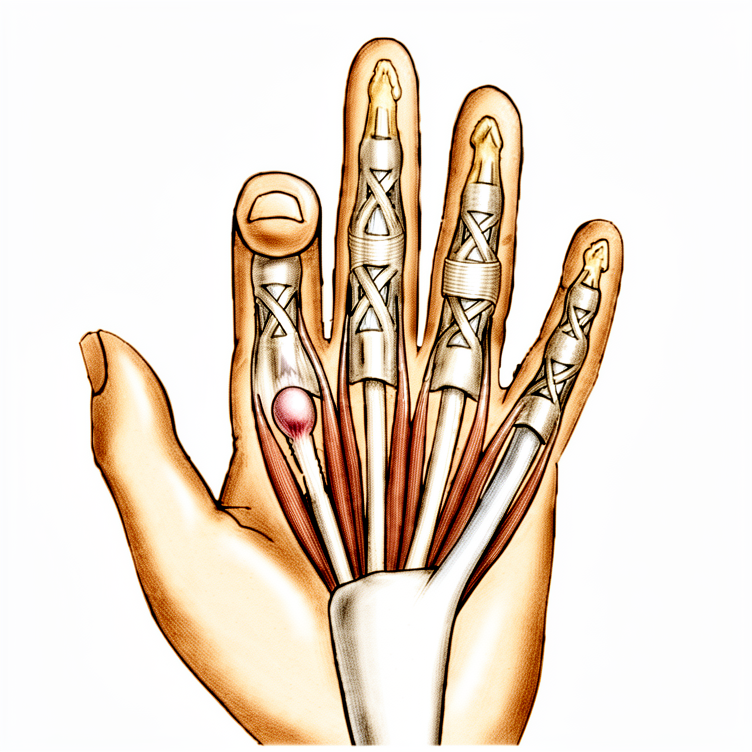
Trigger finger happens when a tendon in the finger or thumb catches as it glides through a tight tunnel in the palm. Non-operative care usually comes first. That can include a splint, hand therapy, or a steroid injection (a medicine placed near the tendon to settle inflammation). We consider surgery when these have not given enough improvement, or when the finger has become stuck in a bent position that can no longer be straightened.
The operation itself is a release: a single cut is made over the area being operated on, and the tight part of the tunnel is opened so the tendon can glide freely. About 97% of people have complete resolution of their triggering after surgery. The aim is a finger or thumb that moves smoothly, without catching, locking or pain.
Before the operation
Most people need little preparation. You will be told not to eat or drink for seven hours before surgery. We ask for seven hours rather than six so your time can be brought forward if the theatre list runs early. Your surgeon will tell you which medicines to stop and when, and you should bring a written list of everything you take. Arrange for someone to drive you home afterwards, and wear loose, comfortable clothing on the day. Imaging such as an X-ray, MRI or ultrasound is sometimes arranged beforehand to help plan the operation. If you have other medical conditions, you may need blood tests or a review with the anaesthetist (the doctor who gives the anaesthetic), but most people need neither.
On the day
You arrive at the hospital's surgical admissions unit, where you are checked in and prepared for theatre. You will meet the anaesthetist (the doctor who gives the anaesthetic). This operation can be done under local anaesthetic (an injection that numbs just the area of surgery, with you awake) or under general anaesthetic (fully asleep). Most people choose local: recovery is quicker and you can go home soon after. If you'd prefer to be asleep, that's also a reasonable choice; discuss it with your surgeon and anaesthetist.
You are then taken into the operating theatre, where the operation is performed. Afterwards you wake up in the recovery area, where nurses monitor you while the anaesthetic wears off. Once you are stable, you either go to the ward or go home, depending on the procedure and your recovery. Most people having this operation go home the same day. Bring the driver you arranged in the previous section, and follow any instructions the nurses give you about your hand before you leave.
What the operation involves
The operation is called a trigger finger release. Your surgeon makes a single cut over the area being operated on, usually about 2 cm long. Through this cut, your surgeon reaches the tight part of the tunnel in your palm that the tendon glides through. The tight band of tissue is carefully opened, about 1 cm at a time, until the tendon can move freely. Your surgeon will then check that the finger or thumb bends and straightens smoothly without catching.
For a trigger thumb, only one tight band needs releasing. For a finger, a second nearby band may also be opened. Your surgeon works carefully to protect the nearby nerves and to leave the deeper supporting bands of tissue in the finger untouched, because these keep the tendon working properly.
Once the release is complete, the wound is closed with stitches. A compression dressing (a firm bandage) is placed over the hand. You will keep this dressing on for about 10 days, and the stitches are removed at 10 to 14 days. Normal use of your finger or thumb is encouraged straight away.
If you have rheumatoid arthritis (a condition that causes joint inflammation), the plan may differ slightly. In that case, your surgeon may remove a small slip of tendon rather than release the band, because releasing it can allow the finger to drift sideways over time. Your surgeon will explain the exact plan for your hand before you consent.
After the operation
You will wake up in the recovery area, where nurses keep an eye on you while the anaesthetic wears off. This is a day case, so you will go home the same day. Your hand will have a compression dressing (a firm bandage) on it, and you can move your finger or thumb straight away. Some soreness is normal for the first day or two; simple pain relief from your pharmacist or GP is usually enough. Ask someone to stay with you for the first 24 hours. We leave the dressing on for about 10 days; please do not take it off before then unless we tell you to. We change or remove it when we see you. Most people are back to driving within one to two weeks, once the wound is comfortable and they can grip and turn the wheel without protecting the hand.
Recovery
Most people are surprised by how quickly the hand settles. The area around the cut will be sore and a little swollen for the first few days. Simple pain relief from your pharmacist or GP is usually enough to keep you comfortable, and keeping your hand raised on a pillow when you sit or rest helps the swelling go down. Some tenderness around the scar can last longer than the rest, and this eases as the wound matures.
You will move your finger or thumb straight away, and normal everyday use is encouraged from the start. There is no cast or brace to wear, just the dressing, which we leave on for about 10 days. When we see you, we will change or remove it and take out the stitches. Hand therapy after surgery is with Ruby Doolan at Extend Rehabilitation. Ruby will guide you through simple exercises that keep the finger bending and straightening smoothly, and she can make a splint if your hand needs one.
You can do most things at home as soon as you feel able: eating, dressing, typing and light tasks around the house. Avoid heavy gripping, lifting and dirty or wet environments until the wound has healed. Once you can grip and turn the steering wheel without protecting the hand, driving is usually close by; see our page on driving after upper-limb surgery.
Recovery varies from person to person, and your timeline may differ. Your surgeon and your therapist will guide you along the way.
What can go wrong
Most patients do well, but problems can occasionally happen. Your surgeon and the team monitor you closely to spot any issue early.
The most common problems are minor ones around the wound, or a finger that feels stiff for a while. You might notice some ongoing soreness, swelling, or that the finger does not bend as freely as you expected in the early weeks. If this is not settling, bring it up at your next review.
Infection is uncommon but worth knowing about. Watch the wound for redness that spreads out from the cut, increasing pain, warmth, or oozing. A deep infection can cause a deep, throbbing pain that does not ease with simple painkillers, and you may feel unwell. If you notice any of these signs, call the clinic straight away rather than waiting for your next appointment.
A nerve near the surgery can occasionally be irritated. This feels like numbness, tingling or pins and needles in part of the finger or thumb. Some numbness at the wound edge is expected at first, but if it persists or spreads, mention it at your review.
The triggering can come back in a small number of people. If the catching or locking returns after it had settled, let us know at your follow-up.
Some people develop stiffness in the finger, where it does not straighten or bend fully even though the triggering has gone. Hand therapy exercises help prevent this, so keep up the movements Ruby has shown you. If the finger seems to be stiffening rather than loosening, tell your therapist or surgeon early.
If your finger was triggering for a long time before surgery, the joint in the middle of the finger can stay achy even after the release. This tends to improve slowly rather than straight away.
Finally, surgery for trigger finger is linked with a small chance of developing Dupuytren disease, a condition where firm cords form in the palm and pull the fingers bent. If you notice thickening or lumps in your palm later on, have it checked.
The complications table on this page lists typical rates if you want the specifics.
When to call us
Call the clinic straight away if you have a fever, or if redness, warmth or oozing around the wound is getting worse. Call us if pain suddenly becomes severe, or if numbness or tingling spreads and does not settle. Go to emergency if you have calf swelling or pain, or shortness of breath, as these can be signs of a blood clot. Go to emergency if you cannot move the finger or thumb at all, or if the hand becomes cold or pale.
Where to read more about the condition
This page is about the operation itself. The condition it treats, including what the evidence shows about when surgery helps and when it does not, is covered in more detail on the Trigger Finger page.
Evidence & references
This is the clinical evidence summary written for health professionals. It is technical, and it lists the research this page was built from. You do not need to read it to understand your treatment or to make a decision about it.
Overview
Operative Technique
- Local anesthetic infiltration in the palm proximal to the incision site is preferred for trigger finger release [5].
- A pneumatic arm tourniquet may be helpful, although a high forearm Esmarch wrap usually is sufficient [5].
- For middle, ring, and small trigger finger releases, a transverse incision about 2 cm long is made several millimeters distal to the distal palmar crease [5].
- For index trigger finger releases, a transverse incision about 2 cm long is made several millimeters distal to the proximal palmar crease [5].
- Trigger thumb releases can be performed through incisions either distal or proximal to the metacarpophalangeal joint flexion crease [5].
- Alternative incisions for fingers can be made obliquely or longitudinally between the metacarpophalangeal and distal palmar creases [5].
- Alternative incisions for the thumb can be made obliquely across the thumb metacarpophalangeal flexion crease [5].
- The digital nerves on the thumb are more palmar and closer to the flexor sheath than might be anticipated [5].
- The thumb radial digital nerve is especially vulnerable during trigger thumb release [5].
- Subcutaneous tissues are spread away from the underlying annular pulley system to ensure digital nerves are safely protected [5].
- Trigger thumbs require release of only the A1 pulley [5].
- Trigger digits require division of the A1 and A0, or proximal palmar pulley [5].
- Pulley division is usually accomplished with an initial opening of the pulley with a No. 15 knife blade and a pair of tenotomy scissors [5].
- For trigger thumb release, cutting too far distally should be avoided to prevent disrupting the oblique pulley [5].
- The sheath is incised from proximal to distal, approximately 1 cm, and reassessed for triggering [5].
- Persistent triggering after initial release implies that either the A1 and palmar pulleys are incompletely released or an alternate site of triggering is present [5].
- When the distal A1 pulley edge is released, the divided pulley leaves are parallel rather than ending in a V-shaped pattern [5].
- The distinction between the A1 and A2 pulleys may not be apparent during surgery [5].
- Other fingers can be found to trigger at the same surgical setting and can be managed at the same time [5].
Postoperative Care
- The compression dressing is removed after 48 hours [5].
- Sutures are removed at 10 to 14 days [5].
- Normal use of the finger or thumb is encouraged postoperatively [5].
Anatomy & Pathophysiology
Demographics & Epidemiology
- Trigger finger occurs in 2% to 3% of the general population [9].
- Women are more commonly affected than men [9].
- Women older than 50 years of age are the primary demographic for trigger finger [1, 2].
- Middle and ring finger involvement is most common in adults [1, 2].
- The digits are affected in the following order of decreasing prevalence: thumb, ring, long, little, and index [9].
- Stenosing tenosynovitis is more common in diabetic patients than in nondiabetic patients [4].
- Trigger finger is more common in patients with diabetes mellitus, with a 10% to 20% lifetime incidence [9].
Comorbidities & Etiology
- Trigger finger is associated with diabetes and inflammatory arthropathy [1, 2].
- Trigger finger is seen in patients with hypothyroidism, sarcoidosis, rheumatoid arthritis, and septic tenosynovitis [9].
- The etiology of trigger finger is possibly associated with repetitive grasping activities [1, 2].
- Gout can present as trigger finger due to monosodium urate precipitation eliciting a fulminant inflammatory reaction in the tenosynovium [9].
- Calcific tendinitis can result in triggering due to calcium salt deposition in the tenosynovium [9].
- Pseudogout can cause triggering via calcium pyrophosphate dihydrate crystal deposition [9].
- Amyloidosis, characterized by beta-2-microglobulin deposition, can cause trigger finger in patients with renal failure undergoing dialysis [9].
- Trigger finger is considered an early indication of Dupuytren’s disease by some authors [12].
- The incidence of concurrent trigger finger and Dupuytren’s disease is higher in the middle and ring fingers than expected by statistical coincidence [11].
Histology & Pathology
- Histology of the affected pulley demonstrates fibrocartilaginous metaplasia of the pulley and/or FDS tendon [1, 2].
- Pathologic examination of affected pulleys demonstrates a proliferation of chondrocytes and increased type III collagen [9].
- The flexor digitorum profundus tendon often demonstrates a pathologic nodule, while the flexor digitorum superficialis is often unaffected [9].
- A nodule or fusiform swelling of the flexor tendon just distal to the first annular pulley may be palpable [7].
- The tendon nodule is usually located just proximal to the anulus at the metacarpophalangeal joint level [7].
- In rheumatoid patients, a nodule distal to the metacarpophalangeal joint level may cause triggering [7].
- A volar retinacular ganglion cyst between the A1 and A2 pulleys may be present [9].
- In congenital trigger digits, the pathologic anatomy includes narrowing and thickening of the sheath with occasional formation of a ganglion cyst [10].
- An intratendinous nodule proximal to the first annular pulley, often referred to as Notta’s nodule, may be present in congenital trigger digits [10].
Clinical Presentation
- Patients present with pain and tenderness in the palm at the proximal edge of the digital A1 pulley [4].
- Patients frequently note catching or triggering of the affected finger or thumb after forceful flexion [4].
- In more severe cases, the opposite hand must be used to force the finger or thumb passively into extension [4].
- In the most severe cases, the finger becomes locked in a flexed position [4].
- Triggering is often more pronounced in the morning than later in the day [4].
- A common complaint is referred pain at the dorsal MCP/PIP area [1, 2].
- Patients frequently state that the problem is in the proximal interphalangeal joint with trigger finger or trigger thumb [7].
- Concomitant trigger finger and carpal tunnel syndrome occurs in 40% to 60% of patients [1, 2].
- Local tenderness may be present but is not a prominent complaint [7].
- Pressure accentuates the apparent snapping or triggering of the more distal joints [7].
Anatomical Variations & Specific Structures
- Newer evidence has found a fourth pulley (variable annular pulley) in 75% of patients with thumb trigger finger, which may contribute to stenosis [1, 2].
- The radial digital nerve is at risk of iatrogenic injury during thumb trigger finger release due to its superficial location [1, 2].
- On the thumb, digital nerves are more palmar and closer to the flexor sheath than might be anticipated [5].
- The thumb radial digital nerve is especially vulnerable during surgical release [5].
- Trigger thumbs require release of only the A1 pulley, whereas trigger digits require division of the A1 and A0 (or proximal palmar) pulley [5].
- The distinction between the A1 and A2 pulleys may not be apparent during surgery; however, when the distal A1 pulley edge is released, the divided pulley leaves are parallel rather than ending in a V-shaped pattern [5].
- The fibers of the A2 pulley must be spared to preserve effective digital flexion [4].
- In patients with rheumatoid arthritis, the entire annular pulley system should be preserved to prevent further ulnar drift of the fingers [4].
Classification
- Green Classification Grade I is defined as pain and tenderness at the A1 pulley [1, 2, 9].
- Green Classification Grade II is defined as catching of the finger [1, 2] or mechanical catching of the digit without locking [9].
- Green Classification Grade III is defined as locking of the finger that is passively correctable [1, 2] or mechanical locking of the digit which is passively correctable [9].
- Green Classification Grade IV is defined as a fixed, locked finger [1, 2, 9].
Classification
- The Green classification of trigger finger consists of four grades [1].
- Grade I is defined as pain and tenderness at the A1 pulley [1].
- Grade II is defined as catching of the finger [1].
- Grade III is defined as locking of the finger that is passively correctable [1].
- Grade IV is defined as a fixed, locked finger [1].
Clinical Presentation
Demographics and Epidemiology
- Trigger finger is most common in women older than 50 years of age [1, 2].
- Trigger finger is more common in patients with systemic diseases such as diabetes mellitus, hypothyroidism, sarcoidosis, rheumatoid arthritis, and septic tenosynovitis [9].
- Diabetes mellitus has a 10% to 20% lifetime incidence of trigger finger [9].
- When multiple digits are involved, the possibility of diabetes should be considered [4].
Etiology and Pathology
- Trigger finger is possibly associated with repetitive grasping activities [1, 2].
- Histology of the affected pulleys demonstrates fibrocartilaginous metaplasia of the pulley and/or FDS tendon [1, 2].
- Pathologic examination of the affected pulleys demonstrates a proliferation of chondrocytes and increased type III collagen [9].
- The flexor digitorus profundus tendon often demonstrates a pathologic nodule, while the flexor digitorus superficialis is often unaffected [9].
- A fourth pulley (variable annular pulley) is found in 75% of patients with thumb trigger finger, which may contribute to stenosis [1, 2].
Symptoms and Signs
- Patients present with pain and tenderness in the distal palm [1, 2].
- Pain and tenderness are located at the proximal edge of the digital A1 pulley [4].
- Symptoms progress to mechanical catching or locking of the finger [1, 2].
- In severe cases, the opposite hand must be used to force the finger or thumb passively into extension [4].
- Patients may note a lump or knot in the palm [7].
- The lump may be a thickened area in the first annular pulley or a nodule/fusiform swelling of the flexor tendon just distal to it [7].
- The tendon nodule can be palpated by the examiner’s fingertip and moves with the tendon [7].
- The tendon nodule is usually just proximal to the anulus at the metacarpophalangeal joint level [7].
- In rheumatoid patients, a nodule distal to the MCP joint level may cause triggering [7].
- Patients frequently state that the problem is in the proximal interphalangeal joint [7].
- Concomitant trigger finger and carpal tunnel syndrome occur in 40% to 60% of patients [1, 2].
Physical Examination Findings
- Tenderness to palpation of the flexor tendon at the level of the A1 pulley is a physical examination finding [9].
- Palpable triggering or pain with flexion and extension of the finger is a physical examination finding [9].
- Nodularity of the flexor tendon just proximal to the A1 pulley is a physical examination finding [9].
- Presence of a volar retinacular ganglion cyst between the A1 and A2 pulleys is a physical examination finding [9].
- Presence of a fixed flexion deformity of the proximal interphalangeal (PIP) joint is a physical examination finding [9].
Classification
- Green classification Grade II is defined as catching of the finger [1, 2].
- Green classification Grade II is defined as mechanical catching of the digit without locking [9].
- Green classification Grade III is defined as locking of the finger that is passively correctable [1, 2].
- Green classification Grade III is defined as mechanical locking of the digit which is passively correctable [9].
Differential Diagnosis Considerations
- Intraarticular disorders such as loose bodies, degenerative joint disease, and fractures can cause symptoms similar to trigger finger [7].
- Common extensor tendon subluxation can cause symptoms similar to trigger finger [7].
- Gout can mimic infectious tenosynovitis with marked pain, erythema, swelling, and warmth [9].
- Calcific tendinitis can resemble an infection and result in triggering [9].
- Pseudogout can present with calcium pyrophosphate dihydrate crystal deposition localized to the triangular fibrocartilage or within the carpal tunnel [9].
- Amyloidosis can present with beta-2-microglobulin deposition along flexor tendons, most commonly in patients with renal failure undergoing dialysis [9].
Investigations
Clinical Presentation and History
- Trigger finger is characterized by pain and tenderness in the palm at the proximal edge of the digital A1 pulley [4].
- Pain and tenderness in the distal palm progress to mechanical catching or locking, and may become fixed [1].
- A common complaint is referred pain at the dorsal MCP or PIP area [1].
Physical Examination Findings
- Physical examination may reveal tenderness to palpation of the flexor tendon at the level of the A1 pulley [9].
- Nodularity of the flexor tendon just proximal to the A1 pulley may be present on examination [9].
- A volar retinacular ganglion cyst between the A1 and A2 pulleys may be present on examination [9].
- A fixed flexion deformity of the proximal interphalangeal (PIP) joint may be present on examination [9].
Classification
Associated Conditions and Demographics
- The lifetime incidence of trigger finger in patients with diabetes mellitus is 10% to 20% [9].
- Calcific tendinitis can result in triggering and is affected five times more frequently in males than females [9].
- Pseudogout involves calcium pyrophosphate dihydrate crystal deposition often localized to the triangular fibrocartilage or within the carpal tunnel [9].
- Amyloidosis is characterized by the deposition of beta-2-microglobulin in thick, plaque-like accumulations along the flexor tendons [9].
Imaging and Histology
- MR imaging findings of trigger thumb have been described [3].
Treatment
Nonoperative
- Corticosteroid injection into the flexor tendon sheath is curative in about 60% of patients initially [1].
- Diabetic patients are generally less responsive to corticosteroid injection [1].
- There is no difference between soluble and insoluble corticosteroid preparations for trigger finger injection [1].
- In a study of 292 corticosteroid injections, repeat injections provided symptomatic relief for a year or more in 50% of patients [7].
- Corticosteroid injections may elevate serum glucose levels for 5 days or more in patients with diabetes mellitus [7].
- Patients with unstable diabetes may be better treated without corticosteroid injection [7].
- Preoperative hypoglycemia increases infection risk after trigger finger injection and release [7].
- Immediate surgical release in the clinic was identified as the most cost-effective treatment strategy for trigger finger in diabetic patients [7].
- Nonoperative methods for trigger digits include stretching, night splinting, and combinations of heat and ice [7].
Operative
- Surgical release of the A1 pulley is curative in digits refractory to steroid injection [4].
- Surgical release reliably relieves the problem for most patients, with approximately 97% of patients having complete resolution after operative treatment [7].
- Persistence of triggering is more common than recurrence after surgical release [7].
- Trigger release should be performed with a local block so that the cessation of triggering can be evaluated intraoperatively [7].
- Adjacent finger triggering may become obvious only after a given finger is released and can be managed at the same surgical setting [7].
- In patients with rheumatoid arthritis, the preference is to excise a slip of the FDS tendon rather than to release the A1 pulley to prevent exacerbation of ulnar drift at the MCP joint [1].
- The fibers of the A2 pulley must be spared during surgical release to preserve effective digital flexion [4].
- Minor complications of surgical release include wound dehiscence, scar tenderness, and decreased range of motion [1].
- Incomplete pulley release and damage to the flexor tendons and digital nerves remain concerns, especially in the index finger and thumb with limited exposure techniques [7].
- Percutaneous release of the A1 pulley may be accomplished with a needle on the middle and ring fingers, especially if they actively lock [4].
- The safety and effectiveness of percutaneous trigger finger release using a needle or a push knife have literature support [7].
- For percutaneous release, an 18- or 19-gauge needle may suffice [8].
- During percutaneous release, the bevel of the needle should be oriented longitudinally parallel to the flexor tendons [8].
- Injection of corticosteroid is optional during percutaneous trigger finger release [8].
- Postoperative compression dressing for open trigger finger release is removed after 48 hours [5].
- Sutures for open trigger finger release are removed at 10 to 14 days [5].
- Normal use of the finger or thumb is encouraged after open trigger finger release [5].
- Active hand and finger use with stretching exercises is encouraged after percutaneous trigger finger release [8].
Complications
Operative
- Digital nerves on the thumb are more palmar and closer to the flexor sheath than might be anticipated, making the thumb radial digital nerve especially vulnerable [5].
- Minor complications of trigger finger release are relatively high and include wound dehiscence, scar tenderness, and decreased range of motion [1].
- Incomplete pulley release remains a concern with limited exposure techniques [7].
- Damage to flexor tendons remains a concern with limited exposure techniques, especially in the index finger and thumb [7].
- Damage to digital nerves remains a concern with limited exposure techniques, especially in the index finger and thumb [7].
- Patients may experience triggering after operative release because of catching of the tendon on the palmar aponeurosis transverse fibers [7].
- Triggering caused by catching on palmar aponeurosis transverse fibers usually resolves with time [7].
- A partially lacerated flexor tendon at the metacarpophalangeal joint level may heal with a nodule sufficiently large to cause triggering [7].
- Persistence of triggering is more common than recurrence after operative treatment [7].
- Preoperative hypoglycemia increases infection risk after trigger finger release [3].
- Preoperative hypoglycemia increases infection risk after trigger finger injection [3].
- In patients with rheumatoid arthritis, release of the A1 pulley carries a chance of exacerbating ulnar drift at the MCP joint [1].
Non-Operative
- Corticosteroid injections may elevate serum glucose levels for 5 days or more [7].
References
[1] Miller S Review Of Orthopaedics. SECTION 16 PATELLAR TRACKING IN TOTAL KNEE ARTHROPLASTY > 2. Flexor tendon injury > 3. Stenosing tenosynovitis (trigger finger).
[2] Miller S Review Of Orthopaedics. 2. Flexor tendon injury > 3. Stenosing tenosynovitis (trigger finger).
[3] Campbell S Operative Orthopaedics 4 Volume Set. EXCISION OF NECROTIC MUSCLES COMBINED WITH NEUROLYSIS OF MEDIAN AND ULNAR NERVES FOR SEVERE CONTRACTURE > REFERENCES > TRIGGER THUMB AND TRIGGER FINGER.
[4] A Lange Medical Book Current Diagnosis Treatment In Orthopedics Fifth Edition. 9Hand Surgery > 2. Flexor Tenosynovitis (Trigger Finger and Trigger Thumb).
[5] Campbell S Operative Orthopaedics 4 Volume Set. EXCISION OF NECROTIC MUSCLES COMBINED WITH NEUROLYSIS OF MEDIAN AND ULNAR NERVES FOR SEVERE CONTRACTURE > TRIGGER FINGER AND THUMB > SURGICAL RELEASE OF TRIGGER FINGER.
[7] Campbell S Operative Orthopaedics 4 Volume Set. EXCISION OF NECROTIC MUSCLES COMBINED WITH NEUROLYSIS OF MEDIAN AND ULNAR NERVES FOR SEVERE CONTRACTURE > TRIGGER FINGER AND THUMB.
[8] Campbell S Operative Orthopaedics 4 Volume Set. EXCISION OF NECROTIC MUSCLES COMBINED WITH NEUROLYSIS OF MEDIAN AND ULNAR NERVES FOR SEVERE CONTRACTURE > PERCUTANEOUS RELEASE OF TRIGGER FINGER.
[9] Aaos Comprehensive Orthopaedic Review 3. Tendinopathy of the Hand and Wrist* > II. Trigger Finger.
[10] Campbell S Operative Orthopaedics 4 Volume Set. MULTIPLE Z-PLASTY RELEASE OF A CONGENITAL RING > TRIGGER FINGERS.
[11] Dupuytren S Disease And Related Hyperproliferative Disorders. 31. The Influence of Dupuytren’s Disease on Trigger Fingers and Vice Versa > 31.5 Discussion.
[12] Dupuytren S Disease And Related Hyperproliferative Disorders. 31. The Influence of Dupuytren’s Disease on Trigger Fingers and Vice Versa > 31.5 Discussion > 31.5.1 Why Is DD Concurring with TF?.