Patients › Rehabilitation
舟骨固定
腕舟骨骨折经埋入式无头加压螺钉内固定术后的保护性康复计划:在螺钉保护下,于骨愈合缓慢期间早期逐步恢复腕关节活动,随后增强握力与肌力,直至影像学确认骨性愈合前,避免负重及接触性运动。
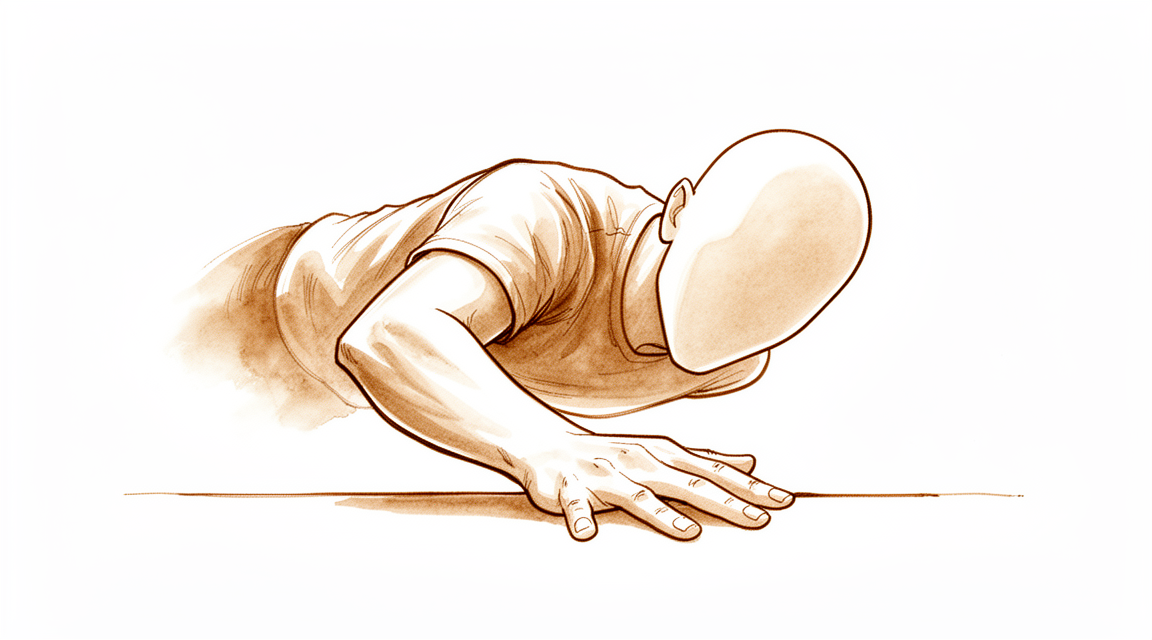
本方案指导您在 Mater Private Hospital Rockhampton 接受 Kieran Hirpara 医生进行舟骨骨折(手腕深处小型船形骨骼的断裂,通过埋入式无头加压螺钉固定)手术固定术后的康复。方案从您的居家锻炼计划开始,随后是为您手部治疗师撰写的结构化临床方案。请在首次治疗就诊时携带此页面或其 PDF 文件,以确保您的康复过程协调一致。您的手部治疗师可能会根据您的骨折情况、固定方式及康复进展调整计划。
如果您在手术后对伤口有任何疑虑,请联系诊室。通常,拍摄伤口照片并通过电子邮件发送以供审阅会很有帮助。
预期情况
舟骨是位于腕部掌侧(腕底)的一块小骨,连接着腕骨的两排。它具有独特且脆弱的血供,血液从一端流向另一端,呈逆向灌注,因此舟骨骨折愈合缓慢,若未得到处理,有时可能无法愈合(即骨不连)。舟骨固定术使用单枚无头加压螺钉将骨折的两块骨片牢固地固定在一起,螺钉完全埋入骨内;患者无需感知或取出螺钉。螺钉将骨折端挤压在一起,这既有助于愈合,又能使腕关节比单纯使用石膏固定的骨折更早开始活动。如果骨折陈旧或尚未愈合,可能会添加一小块骨移植物(通常取自邻近的前臂骨)以促进愈合;这可能会使早期的康复计划更加谨慎。
此康复方案的核心理念是:螺钉负责固定,而骨骼缓慢愈合。由于舟骨愈合缓慢,本方案中的各个阶段节点取决于骨骼愈合情况,而非仅由时间决定。 您的外科医生通常会在允许您进行较大负荷活动和运动之前,通过X光片,并经常通过CT扫描,确认骨折已愈合(“骨性愈合”)。您进展的速度取决于骨折的类型和位置(靠近愈合缓慢的远端,即“近极”的骨折,以及既往骨不连的情况需要更加谨慎)以及固定的稳定性。
活动范围按谨慎的阶段逐步开放:手指和拇指活动可立即进行;一旦您的手部治疗师允许,即可开始轻柔的腕关节活动;仅在骨骼愈合后才能进行抓握和力量训练;最后才恢复负重或对抗性运动。由于修复组织在数月内持续成熟,较大负荷和运动是逐步恢复的,而非一次性进行。
注意事项与限制
- 按照指示佩戴您的夹板或石膏,并保持其干燥。Hirpara 医生和您的手部治疗师会告知您何时可以取下进行锻炼,以及何时可以完全拆除。
- 在被告知骨折已愈合之前,请勿紧握、提举、搬运或通过手腕用力推物;在骨骼仍在愈合期间,挤压和负重会对舟骨及螺钉造成应力。
- 避免强行将手腕向后弯曲至完全伸展位,早期应避免极限活动;应循序渐进地增加活动范围,不要强行达到极限。
- 在外科医生确认骨骼已连接并允许您恢复之前,请勿参与对抗性、碰撞性或承重运动(或健身房/举重、俯卧撑、球拍类或棍棒类运动);这通常需要数月而非数周。
- 从一开始就保持手指、拇指、肘部和肩部的活动,以防僵硬,并在舒适范围内使用手部进行轻微的日常生活任务,只要不涉及紧握、提举或强行活动手腕。
- 如果您的固定手术因骨不连而使用了植骨,请预期更谨慎的时间表;请遵循外科医生和手部治疗师为您制定的具体计划。
关于伤口、肿胀和疤痕管理,请参阅本诊所的伤口护理指南。
您的锻炼
Kieran Hirpara 4.0
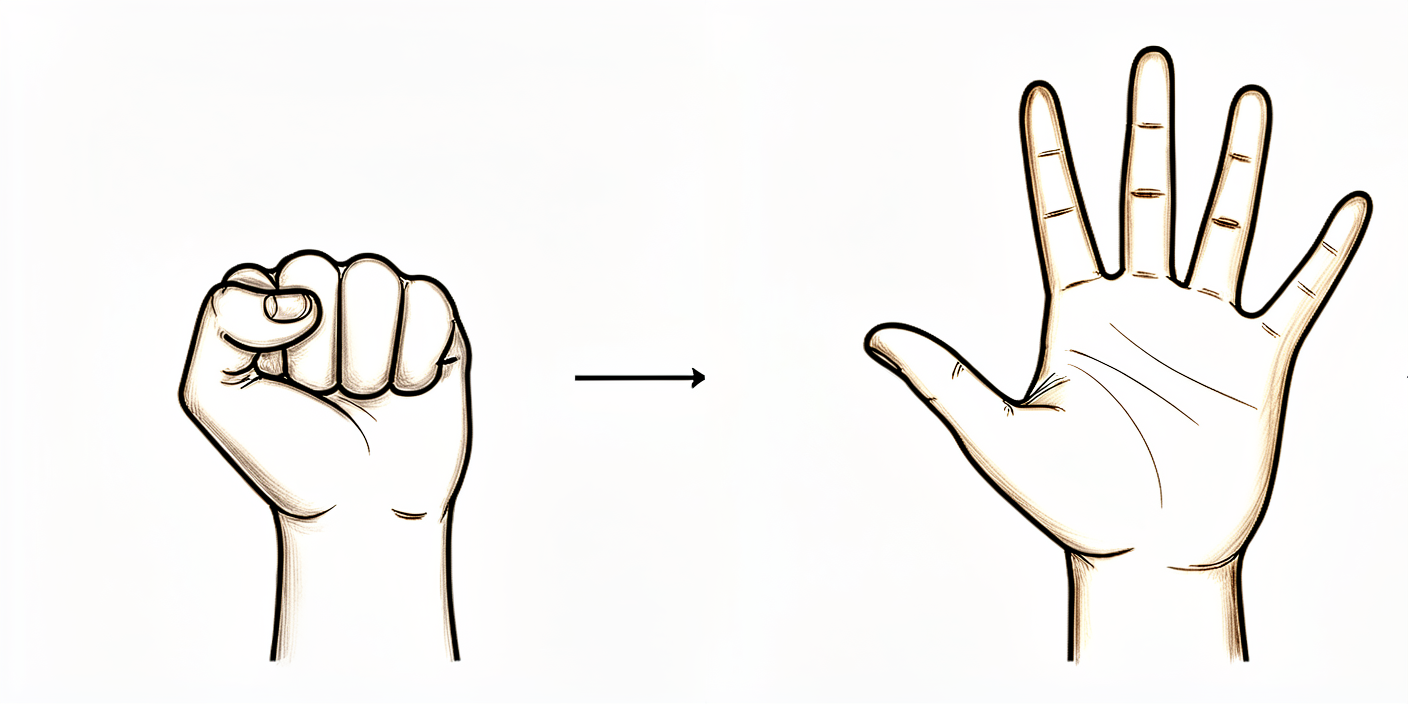
手指和拇指运动
从最初几天起,请保持手指和拇指的活动,以防僵硬。轻轻握紧拳头,然后将手指完全伸直,并依次用拇指触碰每个指尖。在此期间,手腕本身应保持在夹板或石膏内保持静止。这可以立即安全地进行——它能在不干扰舟骨愈合的情况下保持手部柔韧。
各10次,每天数次,从第一天起
Kieran Hirpara 4.0
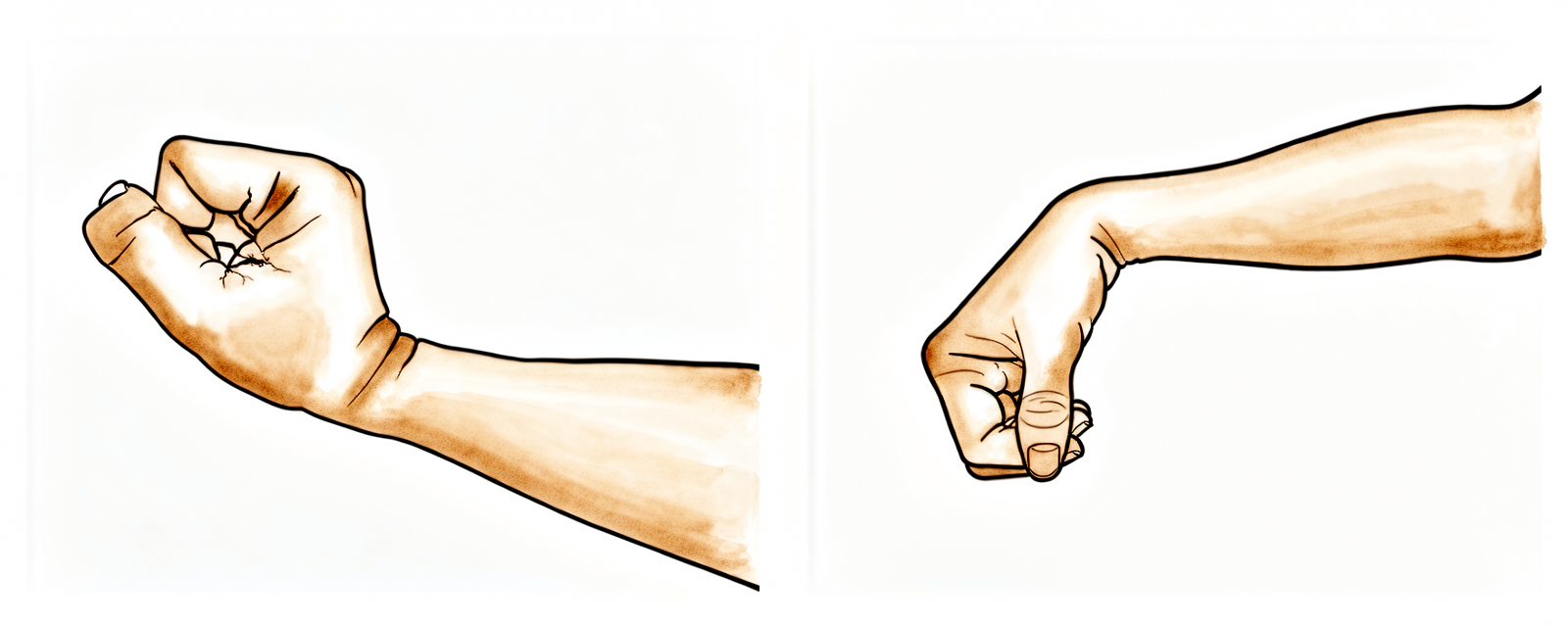
腕部活动(在允许的情况下)
一旦您的手部治疗师确认可以开始——通常在手术后仅数周,具体取决于您的骨折类型和固定方式——请开始轻柔地活动手腕:先上下弯曲,再左右倾斜,动作要缓慢,并保持在舒适且无痛的范围内。切勿强行达到动作的极限,也切勿过早地用力向后弯曲(背伸)。您的治疗师会告知您何时开始以及活动范围应达到多少。
每个方向10次,每天2-3次,仅在获准后进行
Kieran Hirpara 4.0
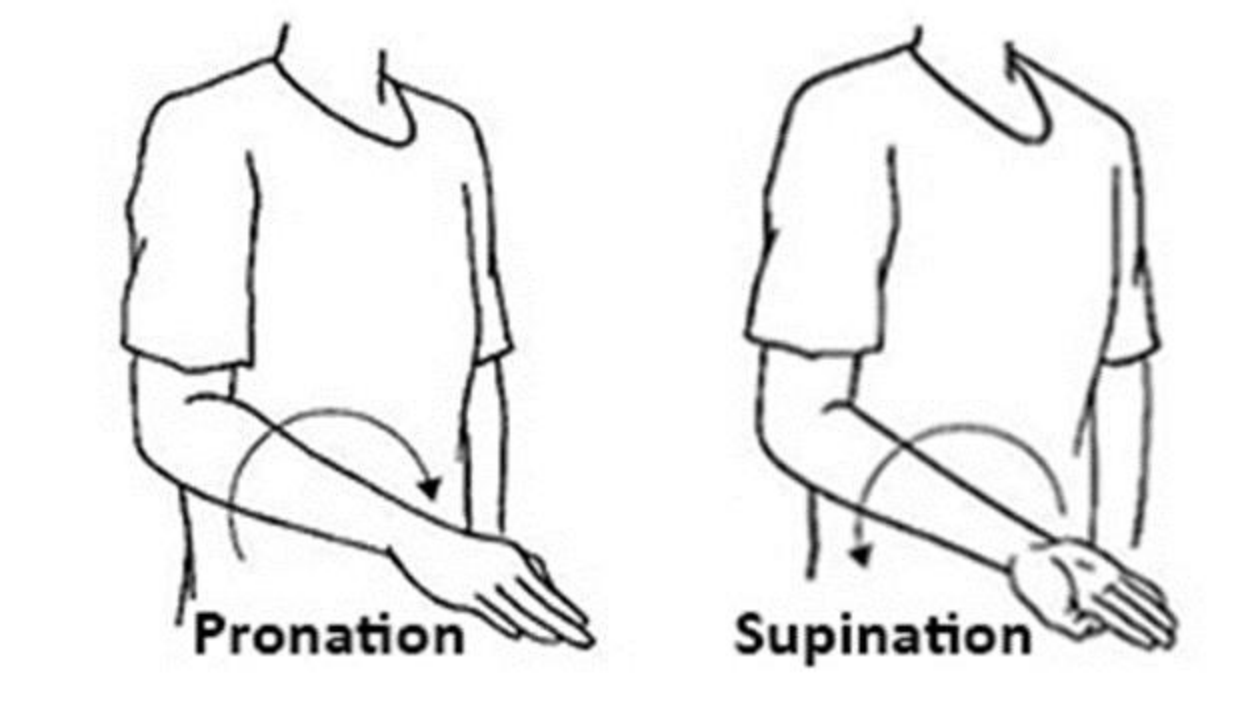
前臂旋转(掌心向上 / 掌心向下)
将肘部贴紧体侧并屈曲至直角,缓慢、轻柔地将手掌向上转向天花板,然后向下转向地面。动作保持缓慢、轻松。此动作可保持前臂的柔韧性,且不会对舟骨产生负荷,因此通常可早期开始——请遵循手部治疗师的指导。
每个方向10次,每天2-3次
Kieran Hirpara 4.0
瘢痕护理
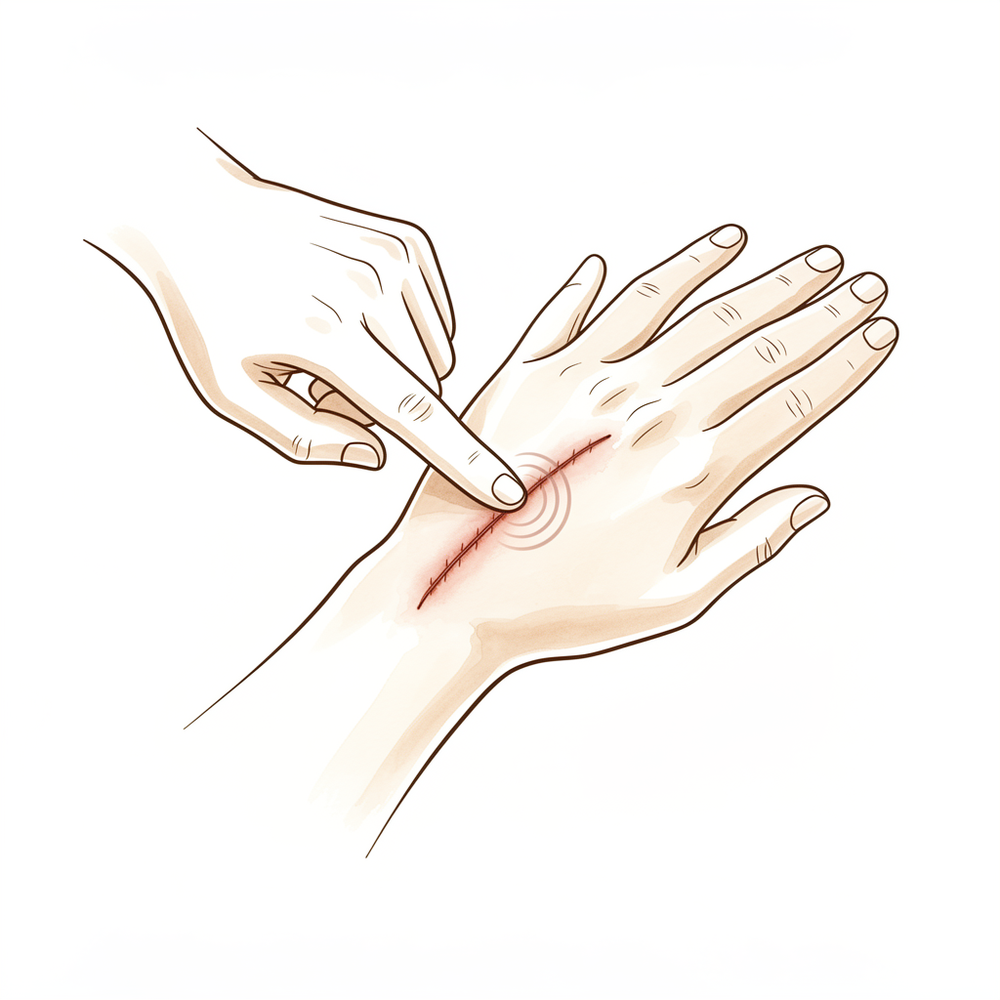
待伤口完全愈合且无痂皮后,取少量无香型润肤霜,以小而坚定的圆形动作按摩疤痕一至两分钟。这有助于保持疤痕柔软并降低敏感度。若您的螺钉是通过一个小钥匙孔切口置入的,疤痕虽小,但同样的护理仍有裨益。
1-2 分钟,每日两次,待伤口愈合后
Kieran Hirpara 4.0
握力强化(骨愈合后)
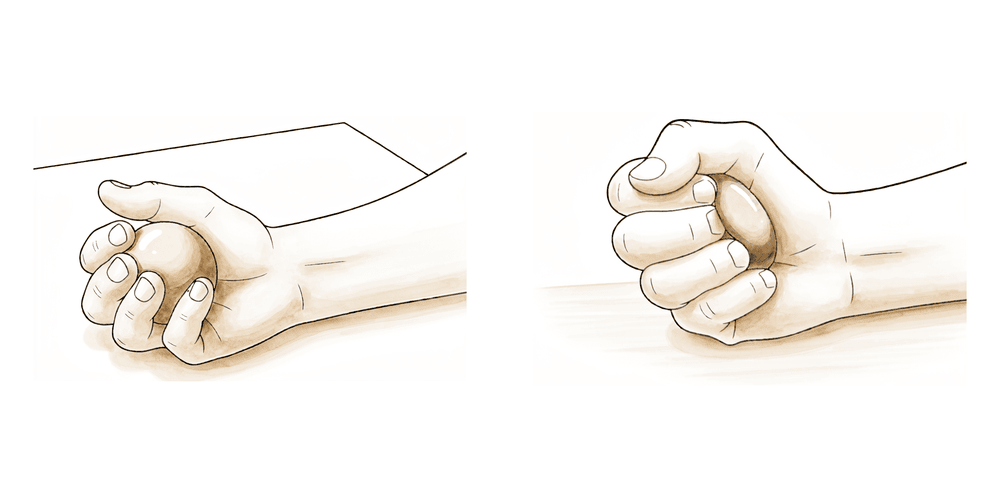
后期练习——仅在骨折愈合且手部治疗师开始进行肌力强化训练时进行(通常不早于8至12周,并经影像学检查确认)。挤压软球或治疗用橡皮泥,短暂保持后放松。循序渐进地增加强度。在骨骼坚固之前需限制握力,因为用力挤压会对舟骨和螺钉产生负荷,且舟骨愈合缓慢。
仅在确认骨愈合后,按照您的手部治疗师的指导进行
这些是您的手册中列出的锻炼动作。仅在Hirpara医生和您的手部治疗师的指导下开始,并严格保持在您被允许的活动范围和限制之内。早期的锻炼旨在保持手指、拇指和前臂的活动,同时不干扰正在愈合的舟骨;只有当您的治疗师允许时,才会加入温和的手腕活动。握力强化属于后期阶段,在被告知骨骼已愈合之前不应开始。如果任何动作导致手腕剧烈疼痛,请立即停止,并告知您的治疗师。
您的临床方案
本页其余部分为舟骨无头加压螺钉固定术后康复的分阶段临床方案。本节内容应提供给患者的手部治疗师,每个阶段均以通俗易懂的语言解释当前正在发生的情况。由于舟骨的血供薄弱且呈逆向供血,其愈合速度较慢,因此康复进程以骨性愈合为门槛,并取决于内固定及骨折情况:对于稳定的急性腰部骨折,采用刚性螺钉固定后可允许较早的保护性腕关节活动;而对于近极骨折、骨不连及植骨病例,则应采取更为保守的康复进程。
在治疗开始前,请查阅手术报告及既往病史,并与主刀医生就骨折类型(腰部与近极)、骨折为急性还是骨不连、是否使用了植骨、内固定的稳定性以及用于确认骨性愈合的计划影像学检查节点进行沟通。手部治疗师应针对具体的骨折和内固定情况遵循相应方案。以下时间为稳定的螺钉固定急性腰部骨折的典型参考指南;对于近极骨折、骨不连及植骨固定,应采用更为谨慎的康复进程。
第一阶段 - 保护性早期活动(第0至2周)
最初几周旨在保护伤口和内固定,同时保持手部活动能力。手腕置于支具或短石膏中;手指、拇指和前臂从第一天起即可自由活动。伤口复查通常安排在两周左右,此时开始正式康复治疗。
致您的手部治疗师:
健康教育与注意事项 - 按外科医生指示,使用腕部支具或短石膏进行固定;保持干燥;仅在获得许可后取下 - 立即进行完全主动的手指、拇指、肘部和肩部活动范围(ROM)训练,以防止僵硬 - 禁止通过腕部进行抓握、提举、负重或推压动作 - 避免强制或极限腕背伸
管理措施 - 伤口:按指示使用外科敷料;监测感染迹象;约2周时进行伤口复查 - 水肿:抬高患肢,轻柔手部泵动,必要时冰敷 - 练习:主动手指/拇指复合屈伸;拇指对掌;轻柔前臂旋前-旋后;肩部和肘部活动范围训练
晋级标准 - 伤口愈合/正在愈合;疼痛缓解;外科医生许可开始腕部活动
第二阶段 - 保护性腕关节活动(第2至8周,以骨愈合为门槛)
对于稳定的螺钉固定急性腰部骨折,约两周后,在螺钉的保护下,在舒适且无痛的范围内引入轻柔的主动腕关节活动。活动范围逐渐增加;仍避免末端伸展及任何负重。近极、骨不连及植骨固定需更长时间保持保护性制动,并在外科医生指导下较晚开始活动。
致您的手部治疗师:
评估 - 主动腕关节活动度(ROM)、疼痛、肿胀;伤口/瘢痕检查;就影像学及骨愈合状态与外科医生沟通
教育与注意事项 - 在无痛范围内开始轻柔的主动腕关节屈伸及桡偏-尺偏;逐渐增加活动范围 - 避免末端/强迫腕关节伸展,并避免负重 - 在确认骨愈合前,禁止握力强化、禁止负重、禁止抗阻作业 - 继续维持全手指及前臂活动度;愈合后开始瘢痕管理
管理 - 练习:在舒适范围内的主动及主动辅助腕关节活动度;继续手指/拇指/前臂活动度;水肿及瘢痕管理 - 若建议,在本阶段早期练习之间使用支具;制动解除由外科医生指导
进展标准 - 由外科医生确认影像学(常经CT证实)骨愈合;舒适、可控的腕关节活动度;疼痛轻微。开始任何强化训练前需满足所有标准。
第三阶段 - 强化与恢复(在确认骨愈合后)
一旦外科医生确认骨折已愈合(急性腰部骨折通常在8至12周左右,近端极骨折和骨不连则更晚),强化训练开始并逐步建立:首先进行握力和橡皮泥训练,然后是渐进性抗阻腕部和前臂强化,最后是负重及运动专项训练。恢复对抗、碰撞和负重运动是基于标准且以骨愈合为门槛的,通常不早于约三到四个月,对于高风险骨折往往更晚。
致您的手部治疗师:
评估 - 握力和捏力与对侧比较;腕部活动范围(ROM);负重时的疼痛/肿胀反应;适当的功能性及运动/工作特异性测试
教育与注意事项 - 仅在外科医生确认骨愈合后开始握力和橡皮泥强化;逐渐增加负荷 - 增加渐进性抗阻腕部和前臂强化;随后进行分级负重和闭链运动 - 恢复对抗/碰撞/负重运动以骨愈合为门槛且基于标准,通常不早于约3-4个月,近端极/骨不连者更晚;在外科医生指示下,运动员早期受监督恢复时可使用保护性夹板或石膏
管理 - 练习:分级握力/橡皮泥 → 抗阻腕部和前臂强化(弹力带 → 轻重量)→ 负重及运动专项训练;继续任何残留的活动度训练 - 一旦力量接近对称且达到适当的功能恢复,考虑出院 - 如果恢复停滞、疼痛持续或骨愈合存疑(考虑延迟愈合/骨不连或AVN),转回主治外科医生
恢复运动的标准 - 外科医生确认骨愈合;完全无痛的活动范围(ROM);接近对称的握力;无痛的运动特异性负重和控制
重返工作与活动
鼓励从初期开始进行轻度日常手部使用(如进食、书写、穿衣、轻度自我护理),以舒适为限,前提是这些活动不涉及抓握、提举或对手腕施加外力。办公室及其他轻度非体力工作通常可较早恢复,有时在第一或第二周即可在调整职责的情况下进行;而对腕部负荷较大的体力工作需等待骨折愈合后再逐步恢复。
由于您必须能够安全地控制车辆,在佩戴妨碍安全操控方向盘的石膏或夹板期间,或在腕部无法安全转向和抓握时,请不要驾驶。一旦您脱离限制性石膏,并能自信且安全地控制车辆(经复诊确认),即可恢复驾驶。请提前安排早期几周的交通协助。
通过腕部施加负荷(用力抓握、提举、推、压和拉)需等待您的外科医生确认骨骼已愈合,之后再逐步增加负荷。重返对抗性、碰撞性及承重运动以骨折愈合为门槛,通常不早于三至四个月,对于近端极骨折和骨不连病例往往更晚。这基于确认的愈合情况,以及恢复完全无痛活动及充分、对称的抓握力量,由Hirpara医生和您的手部治疗师评估,而非仅依据日历时间。
您的方案之后
本方案与本诊所的总体康复建议相辅相成:请参阅 术后疼痛管理、伤口护理 和 疤痕管理。上述分阶段计划反映了舟骨固定术后已发表的康复指南,您的持续康复将由 Hirpara 医生和您的手部治疗师根据您的骨折情况、固定方式以及腕部愈合情况,进行个体化指导。
Evidence & references
This is the clinical evidence summary written for health professionals. It is technical, and it lists the research this page was built from. You do not need to read it to understand your treatment or to make a decision about it.
Scaphoid Fixation — Fracture Fixation Outcomes & Post-operative Rehabilitation (Headless Compression Screw ± Bone Graft)
Topic scope: post-operative rehabilitation after internal fixation of a scaphoid fracture with a buried headless compression screw — percutaneous or open, for an acute fracture or for a nonunion (the latter usually with bone graft, e.g. distal-radius cancellous or vascularised graft). This is a fixation of a slow-healing bone, not a soft-tissue repair: rehabilitation is paced by bone union rather than by tendon/ligament healing windows, and the central tension is between the early-motion advantage that rigid screw fixation buys and the scaphoid's biological tendency to heal slowly and, when neglected, to fail to unite.
Defining principle of the rehab here: the scaphoid has a tenuous retrograde blood supply (it fills from distal to proximal), so it heals slowly and the proximal pole is at risk of delayed union, nonunion and avascular necrosis. A headless compression screw compresses and stabilises the fracture, which is what permits earlier protected wrist motion than a cast alone and earlier return to work/sport in suitable fractures. But the construct does not change the bone's biology: grip, loading and contact sport remain union-gated — held back until the surgeon confirms healing, commonly on CT. Progression is therefore fixation- and fracture-dependent: a stable, screw-fixed acute waist fracture mobilises early; a proximal-pole fracture, a nonunion, or a bone-grafted case is treated more cautiously. The hand therapist follows the plan for the specific fracture and fixation.
A. FIXATION OUTCOMES (acute fixation, and nonunion fixation with graft)
Headless compression screw fixation is a reliable operation with high union rates; the principal debates are who should be fixed acutely (vs cast) and how aggressively to mobilise, not whether the screw works.
- Headless compression screws give high union rates and earlier mobilisation. Internal fixation of scaphoid fractures with headless compression screws achieves high union in both non-displaced and displaced fractures, with the added benefits of earlier mobilisation and earlier return to work and sport compared with cast treatment [Fowler & Ilyas, Hand Clin 2010; Fowler & Hughes, Clin Sports Med 2015]. Moderate (narrative/technique reviews + cohort).
- Percutaneous screw fixation unites faster than cast for acute waist fractures. A randomised trial of 60 acute scaphoid-waist fractures found percutaneous Acutrak screw fixation reached union significantly faster than cast immobilisation (~9.2 vs ~13.9 weeks), with a trend to fewer nonunions [Bond et al., J Bone Joint Surg Br 2008]. Moderate–strong (RCT, single-centre).
- But surgery vs cast for minimally displaced waist fractures gives equivalent long-term function at the cost of more complications. The pragmatic multicentre SWIFFT RCT (bicortical, ≤2 mm displaced waist fractures) found no meaningful difference in wrist function between early surgical fixation and cast immobilisation (with fixation reserved for the cast fractures that failed to unite), while surgery carried more complications. Systematic reviews/meta-analyses concur: surgery favours union but raises complication risk, with ROM, grip and arthritis rates not significantly different [Dias et al., SWIFFT, Lancet 2020; Alshryda et al., The Surgeon 2012; Modi et al., Injury 2009; Rhemrev et al., Injury 2009]. Strong (RCT + SRs).
- Nonunion fixation with bone graft restores union in most cases but heals slower. Scaphoid nonunions treated with screw fixation and bone grafting (non-vascularised distal-radius, vascularised distal-radius, or two-screw constructs) achieve union in the large majority, with proximal-pole and avascular cases the hardest. Acute fixation unites ~100% vs chronic/nonunion ~87% in pooled experience [Garcia et al., J Hand Surg Am 2014; Ribak et al., Int Orthop 2009; Kim et al., Orthop Traumatol Surg Res 2018; Wu et al., Bone Joint J 2022; Simonian & Trumble, JAAOS 1994]. Moderate (cohort/SR).
- The elite/competitive athlete is a distinct decision. Early screw fixation is often favoured in athletes to compress the fracture, shorten immobilisation and enable earlier (often splinted) return to play, accepting the surgical risk for the time advantage [Belsky et al., Hand Clin 2012; Fowler & Hughes, Clin Sports Med 2015]. Moderate (expert/cohort).
B. REHABILITATION / THERAPY EVIDENCE
The rehab questions are (1) how soon to mobilise the wrist after rigid fixation, (2) when to permit loading/grip, and (3) when to confirm union and clear sport. The evidence supports early protected motion under the screw but keeps strengthening and sport union-gated, with proximal-pole/nonunion cases handled more conservatively.
- Rigid screw fixation permits earlier protected wrist motion than cast-alone. The mechanical rationale is that compression across the fracture confers stability, allowing the wrist to begin gentle motion while the bone unites; reported acute-fixation pathways start gentle mobilisation early with a ~2-week wound/therapy review and ~6-week radiographic check [Fowler & Ilyas, Hand Clin 2010; Fowler & Hughes, Clin Sports Med 2015]. Moderate (technique/expert).
- Union is the gate for loading — and it is slow and imaging-confirmed. Reported time to union ranges ~7–16 weeks depending on healing criteria, fracture site and population (athletes vs general), and CT is frequently used to confirm union before clearing loading and sport because plain films overestimate healing [Ecker, Hand Clin 2017 (scaphoid union); Fowler & Hughes, Clin Sports Med 2015]. Moderate.
- Proximal-pole fractures, nonunions and grafted cases progress more slowly. The proximal pole's poor vascularity means later union and a more cautious return; arthroscopic and open grafting series for nonunion report union but over longer timeframes [Wu et al., Bone Joint J 2022; Shih et al., J Orthop Surg Res 2023; Garcia et al., J Hand Surg Am 2014]. Moderate (cohort).
- Percutaneous/antegrade technique is a safe route that supports the early-motion pathway. The percutaneous antegrade approach minimises soft-tissue insult and supports the earlier-mobilisation rationale in suitable fractures [Weinberg et al., Injury 2009]. Moderate (cohort).
Recovery trajectory (expected, evidence-anchored)
| Phase | Window | Restraint | Hand use / therapy focus | Strength / load | Notes |
|---|---|---|---|---|---|
| I — Protected early motion | Week 0–2 | Wrist splint/short cast; no wrist loading | Immediate active finger/thumb/elbow/shoulder ROM; oedema control; wound review ~2 wk | None through the wrist | Hand kept supple; scaphoid undisturbed |
| II — Protected wrist mobilisation | Week 2–8 (union-gated) | No grip/loading; avoid end-range/forced extension | Gentle active wrist flexion-extension and deviation in pain-free range; gradual progression; forearm rotation; scar massage once healed | No resisted/grip work | For stable, screw-fixed acute waist fractures. Proximal-pole/nonunion/grafted: immobilise longer, mobilise later |
| III — Strengthening & return | After confirmed union (commonly ~8–12 wk acute waist; later for proximal pole/nonunion) | Restrictions lifted on union | Grip/putty → progressive resisted wrist/forearm → loaded & sport-specific | Graded to symmetrical grip | Contact/load sport union-gated, typically not before ~3–4 months, later for high-risk fractures; CT often confirms union |
(Phase windows are typical guides for a stable screw-fixed acute waist fracture, not trial-derived deadlines; proximal-pole, nonunion and bone-grafted fixations are paced more conservatively by the surgeon and hand therapist.)
C. KEY CONTROVERSIES / EVIDENCE QUALITY
- Screw fixation vs cast for the acute minimally displaced waist fracture. Fixation unites faster (Bond RCT: ~9 vs ~14 weeks) and returns athletes/workers sooner, but SWIFFT and meta-analyses show equivalent long-term wrist function with more complications from surgery for minimally displaced waist fractures. The defensible position is selective fixation (displacement, proximal pole, high-demand athlete/worker, patient preference) rather than routine surgery for every undisplaced waist fracture [Dias SWIFFT Lancet 2020; Bond JBJS Br 2008; Alshryda Surgeon 2012; Modi/Rhemrev Injury 2009]. Strong evidence of functional equivalence; moderate on the complication trade-off.
- Early motion vs continued immobilisation after fixation. Rigid compression is the rationale for earlier protected wrist motion than cast-alone, and reported pathways mobilise early — but there is no high-certainty trial defining the optimal mobilisation schedule, so timing is surgeon/ therapist protocol and fracture-dependent. Weak–moderate (mechanism strong, scheduling consensus).
- When is it united — and what confirms it. Time to union is wide (~7–16 weeks) and plain radiographs overestimate healing; CT is commonly used to confirm union before clearing loading and sport, which is the true gate for progression [Ecker Hand Clin 2017]. Moderate.
- Return-to-sport timing. Union-gated and fracture-dependent; competitive athletes may return earlier in a protective splint/cast at surgeon discretion, accepting risk, whereas proximal-pole and nonunion cases return later. Reported real-world return is typically months, not weeks [Belsky Hand Clin 2012; Fowler & Hughes Clin Sports Med 2015]. Moderate (expert/cohort).
- Nonunion and proximal-pole biology. The retrograde blood supply drives delayed union, nonunion and AVN risk; grafting (cancellous, corticocancellous, or vascularised) addresses biology but lengthens the timeline. Persistent pain or doubtful union warrants reassessment rather than more loading [Garcia JHS Am 2014; Ribak Int Orthop 2009; Kim OTSR 2018; Wu BJJ 2022; Simonian & Trumble JAAOS 1994]. Moderate.
D. EVIDENCE STRENGTH FLAGS (summary)
- STRONG (RCT / SR): equivalent long-term wrist function from surgery vs cast for minimally displaced acute waist fractures, with more complications from surgery (SWIFFT + meta-analyses); faster union with percutaneous screw fixation than cast (Bond RCT, ~9 vs ~14 weeks).
- MODERATE: high union rates and earlier mobilisation/return with headless compression screws; nonunion union rates with screw + bone graft (acute ~100% vs chronic ~87%); wide ~7–16-week union window and CT confirmation of union; athlete-specific early/splinted return.
- WEAK / CONSENSUS: the specific early protected-motion, union-gated phase schedule (mechanistically rationalised by rigid compression; exact timings are surgeon/hand-therapist protocol and fracture-dependent, not trial-derived); precise return-to-sport months.
CITATIONS
RAG corpus (180,000+ Orthopaedic articles)
- Fowler JR, Ilyas AM. Headless compression screw fixation of scaphoid fractures. Hand Clin. 2010. PMID: 20670800. DOI: 10.1016/j.hcl.2010.04.005
- Fowler JR, Hughes TB. Scaphoid fractures. Clin Sports Med. 2015. PMID: 25455395. DOI: 10.1016/j.csm.2014.09.011
- Belsky MR, Leibman MI, Ruchelsman DE. Scaphoid fracture in the elite athlete. Hand Clin. 2012. PMID: 22883862. DOI: 10.1016/j.hcl.2012.05.005
- Ecker J. Scaphoid union. Hand Clin. 2017. PMID: 28991580. DOI: 10.1016/j.hcl.2017.07.001
- Bond CD, Shin AY, McBride MT, Dao KD. Percutaneous screw fixation versus conservative treatment for fractures of the waist of the scaphoid: a prospective randomised study. J Bone Joint Surg Br. 2008. PMID: 18160502. DOI: 10.1302/0301-620X.90B1.19767
- Alshryda S, Shah A, Odak S, et al. Acute fractures of the scaphoid bone: systematic review and meta-analysis. The Surgeon. 2012. PMID: 22595773. DOI: 10.1016/j.surge.2012.03.004
- Modi CS, Nancoo T, Powers D, et al. Operative versus nonoperative treatment of acute undisplaced and minimally displaced scaphoid waist fractures — a systematic review. Injury. 2009. PMID: 19195652. DOI: 10.1016/j.injury.2008.07.030
- Rhemrev SJ, van Leerdam RH, Ootes D, et al. Non-operative treatment of non-displaced scaphoid fractures may be preferred. Injury. 2009. PMID: 19324359. DOI: 10.1016/j.injury.2008.10.028
- Weinberg AM, Pichler W, Grechenig S, et al. The percutaneous antegrade scaphoid fracture fixation — a safe method? Injury. 2009. PMID: 19380132. DOI: 10.1016/j.injury.2008.12.016
- Garcia RM, Leversedge FJ, Aldridge JM, et al. Scaphoid nonunions treated with 2 headless compression screws and bone grafting. J Hand Surg Am. 2014;39(7). PMID: 24793227. DOI: 10.1016/j.jhsa.2014.02.030
- Ribak S, Medina CEG, Mattar R, et al. Treatment of scaphoid nonunion with vascularised and nonvascularised dorsal bone grafting from the distal radius. Int Orthop. 2009. PMID: 19730861. DOI: 10.1007/s00264-009-0862-6
- Kim J, Yoon J, Baek H. Corticocancellous bone graft vs cancellous bone graft for the management of unstable scaphoid nonunion. Orthop Traumatol Surg Res. 2018. PMID: 29258960. DOI: 10.1016/j.otsr.2017.11.011
- Wu F, Zhang Y, Liu B. Arthroscopic bone graft and fixation for proximal scaphoid nonunions. Bone Joint J. 2022. PMID: 35909374. DOI: 10.1302/0301-620X.104B8.BJJ-2022-0198.R1
- Shih Y, Wu C, Shih J. Arthroscopic treatment of stable nonunion, unstable nonunion, or nonunion of the scaphoid with early degenerative radioscaphoid arthritis. J Orthop Surg Res. 2023. PMID: 36804865. DOI: 10.1186/s13018-023-03609-8
- Simonian PT, Trumble TE. Scaphoid nonunion. J Am Acad Orthop Surg. 1994. PMID: 10709008. DOI: 10.5435/00124635-199407000-00001
Scaphoid fixation / rehabilitation literature (URLs)
- Dias JJ, Brealey SD, Fairhurst C, et al. Surgery versus cast immobilisation for adults with a bicortical fracture of the scaphoid waist (SWIFFT): a pragmatic, multicentre, open-label, randomised superiority trial. Lancet. 2020. DOI: 10.1016/S0140-6736(20)30931-4. https://doi.org/10.1016/S0140-6736(20)30931-4
- SWIFFT protocol — Scaphoid Waist Internal Fixation for Fractures Trial. PMC. https://www.ncbi.nlm.nih.gov/pmc/articles/PMC4893284/
- Bond CD, Shin AY, McBride MT, Dao KD. Percutaneous screw fixation versus conservative treatment for fractures of the waist of the scaphoid. J Bone Joint Surg Br. 2008. PubMed. https://pubmed.ncbi.nlm.nih.gov/18160502/
- The headless compression screw — technical challenges in scaphoid fracture fixation. PMC. https://pmc.ncbi.nlm.nih.gov/articles/PMC4796528/
- Arthroscopic-assisted screw fixation of scaphoid waist fractures vs conservative treatment — randomised trial, minimum 4-year follow-up. PubMed. https://pubmed.ncbi.nlm.nih.gov/25913660/
- Non-operative treatment versus percutaneous fixation for minimally displaced scaphoid waist fractures in high-demand young manual workers. PMC. https://pmc.ncbi.nlm.nih.gov/articles/PMC4244556/