Patients › Rehabilitation
远端桡尺关节半切除成形术
远端桡尺关节半切除-间置成形术后的康复计划,该手术通过部分切除尺骨头磨损部位以恢复无痛的前臂旋转;在短暂保护期后,早期前臂旋转(手掌上下翻转)是首要目标,随后逐渐增加负重。
本方案指导您在远端桡尺关节(DRUJ)半切除间置成形术后的康复。该手术旨在重塑前臂磨损的末端,以恢复前臂舒适且无痛的旋转功能,由 Mater Private Hospital Rockhampton 的 Kieran Hirpara 医生主刀。方案首先介绍您的居家锻炼计划,随后是为您手部治疗师撰写的结构化临床方案;请在首次治疗就诊时携带此页面或其 PDF 文件,以确保您的康复过程协调一致。您的治疗师可能会根据康复进展调整计划。
如果您对术后伤口有任何疑虑,请联系诊室。通常,拍摄伤口照片并通过电子邮件发送以供审阅会很有帮助。
预期情况
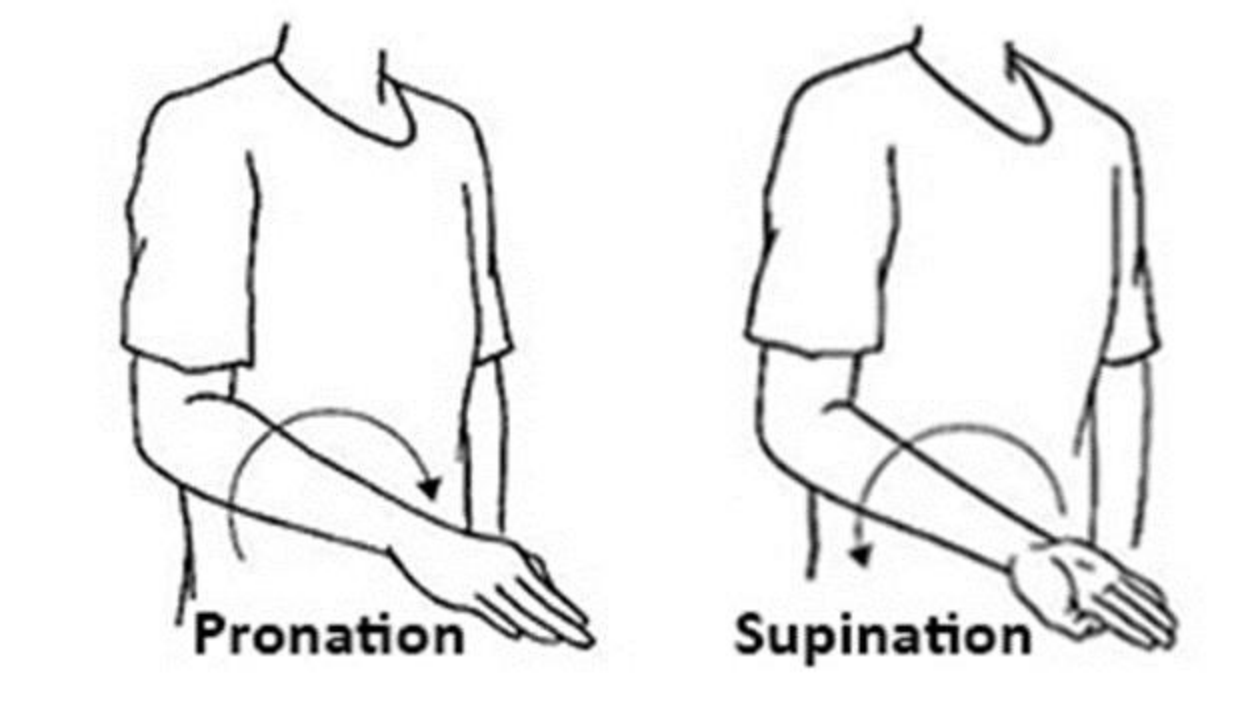
远端桡尺关节(DRUJ)是位于手腕小指侧、桡骨与尺骨(前臂的两根骨骼)交汇处的小关节。该关节使前臂能够进行旋前(掌心向下)和旋后(掌心向上)运动。当此关节磨损并发生关节炎时,前臂旋转会引发疼痛。
在半切除术成形术中,仅将尺骨头部磨损、发生关节炎的部分磨除(部分切除:“hemi”意为一半),并将一小块您自身的软组织垫入间隙,以防止关节面相互摩擦。该手术保留了关键的稳定结构,包括三角纤维软骨复合体(TFCC,即支撑该侧手腕的软骨和韧带“吊床”)、尺骨茎突以及软组织附着点,从而确保尺骨远端得到支撑。这正是其与尺骨头完全切除术(Darrach 手术)的区别所在。
由于关节面是重塑而非修复或重建,因此没有需要在保护下愈合数月的肌腱或韧带。该手术的目标是无痛的前臂旋转,康复过程中最关键的部分是尽早恢复旋转功能。在短时间的夹板保护期以让软组织稳定后,恢复前臂的旋转(掌心向上和向下)将成为康复的重点。之后,力量和较重的负荷将逐步增加。
注意事项与限制
- 在最初约两到三周内,请按照指示佩戴支具;它会在间置组织稳定期间温和地限制前臂旋转。请保持手指以及(在允许的情况下)腕部持续活动。
- 一旦获准拆除支具,请将前臂旋转作为首要任务,确保其无痛且无负重。早期旋转应在空手状态下进行,而非对抗重量。
- 早期切勿对前臂施加旋转负荷:在获准进行强化训练之前(通常为六至八周左右),不要拧开罐子、拧干布料、使用螺丝刀或在该侧携带重物。
- 当通过前臂推压或负重时,请警惕小指侧腕部出现的疼痛或不稳定感,因为这是手术操作的区域。请向您的手部治疗师提及此情况;不要强行通过该阻力。
- 从一开始就保持手指、拇指、肘部和肩部的自由活动,并在舒适范围内将手用于轻度日常任务,只要不涉及强制或负重扭转即可。
关于伤口、肿胀和疤痕管理,请参阅本诊所的伤口护理指南。
您的锻炼
Kieran Hirpara 4.0
前臂旋转(掌心向上 / 掌心向下)
这是核心练习——手术旨在恢复的正是这一动作。将肘部紧贴身体一侧并弯曲成直角(以防止肩部代偿运动),轻轻将手掌向上转向天花板,然后缓慢向下转向地面。仅在舒适范围内活动。当Hirpara医生和您的手部治疗师允许您拆除夹板进行锻炼时(通常在术后两到三周左右)开始此练习,并在此后将其作为主要重点。
每个方向10次,每天3-4次,无痛范围
Kieran Hirpara 4.0
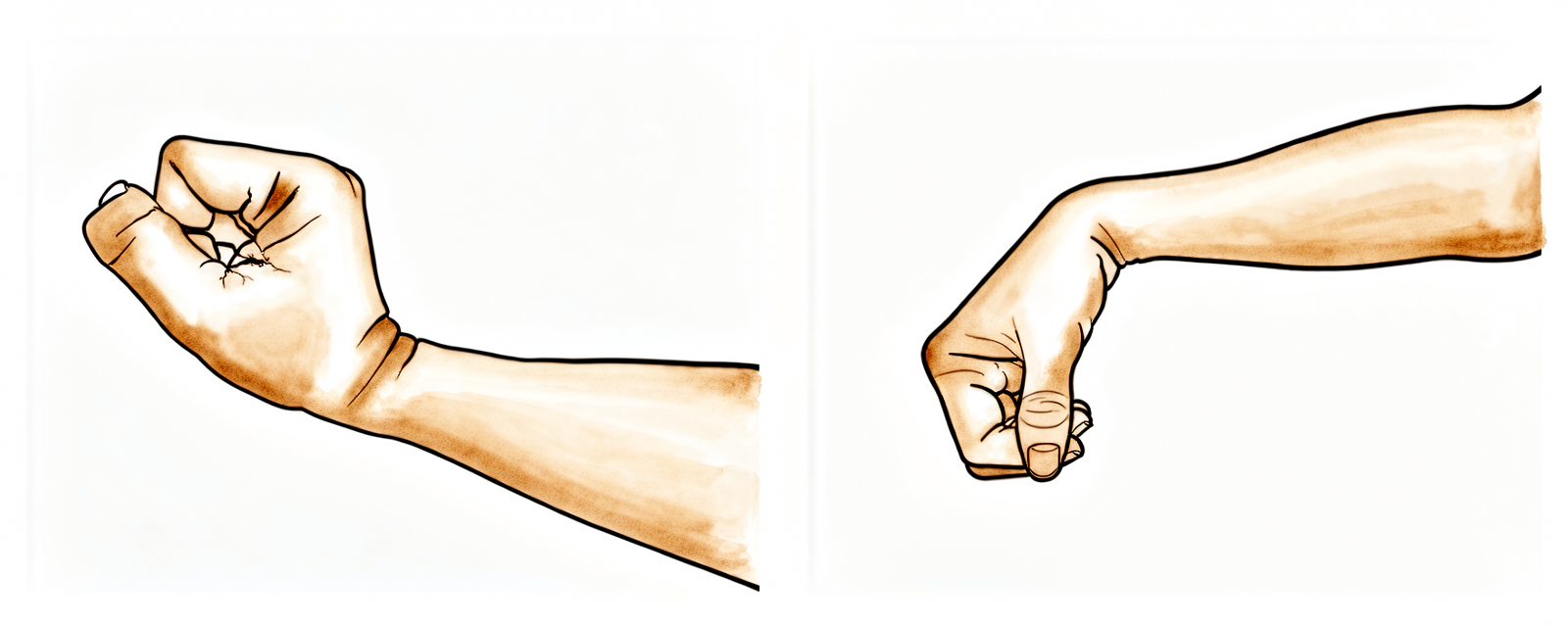
腕部活动(屈曲和伸展)
轻轻将手腕向前弯曲(掌心朝向前臂)和向后弯曲(手背朝向前臂),保持动作缓慢且在舒适范围内。这有助于在远端尺骨逐渐恢复稳定期间防止腕关节僵硬。早期应保持动作轻柔,不要强行达到活动范围的极限。
每个方向10次,每天2-3次
Kieran Hirpara 4.0
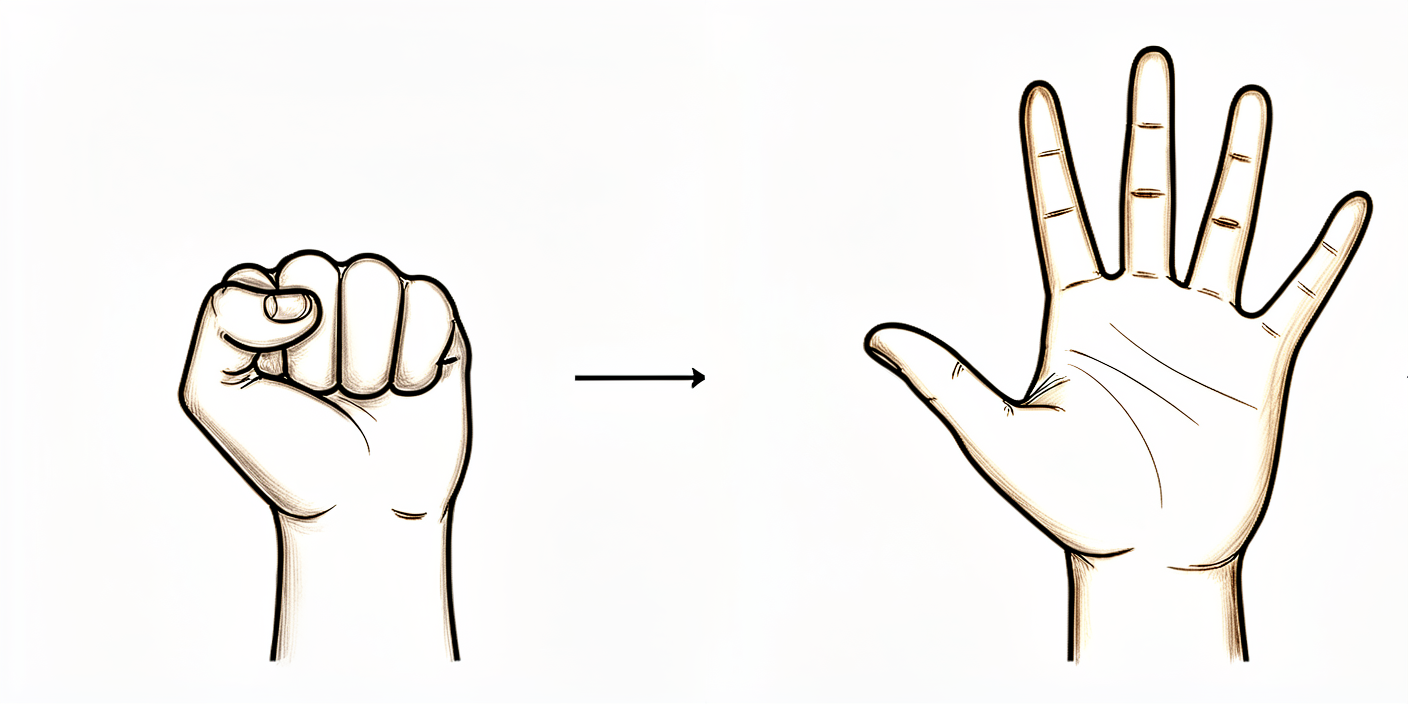
手指活动(完全握拳和伸展)
从第一天开始进行此练习。先握紧拳头,然后张开手掌,将手指伸直。早期保持手指活动可预防僵硬,并有助于肿胀消退。全天应频繁进行此练习,即使前臂仍佩戴支具时也应如此。
10次,清醒时每两小时左右一轮
Kieran Hirpara 4.0
瘢痕按摩
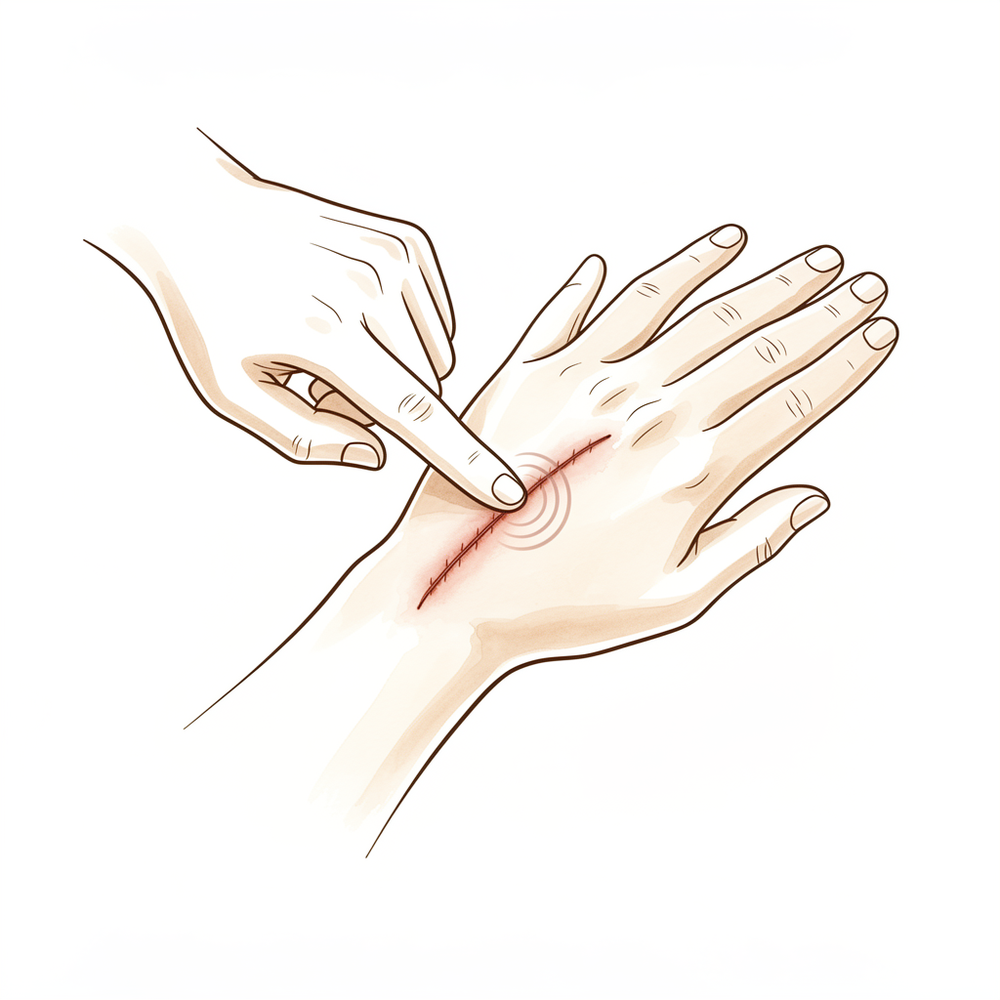
待伤口完全愈合且无痂皮(通常约三至四周后),取少量无添加保湿霜,以坚定的小圆圈动作在瘢痕上按摩数分钟。此举可软化瘢痕,并有助于远端尺骨上方的皮肤和肌腱自由活动。若伤口尚未完全闭合,请停止操作。
2-3 分钟,每日两次,待伤口愈合后
Kieran Hirpara 4.0
握力与旋转肌力强化(后期)
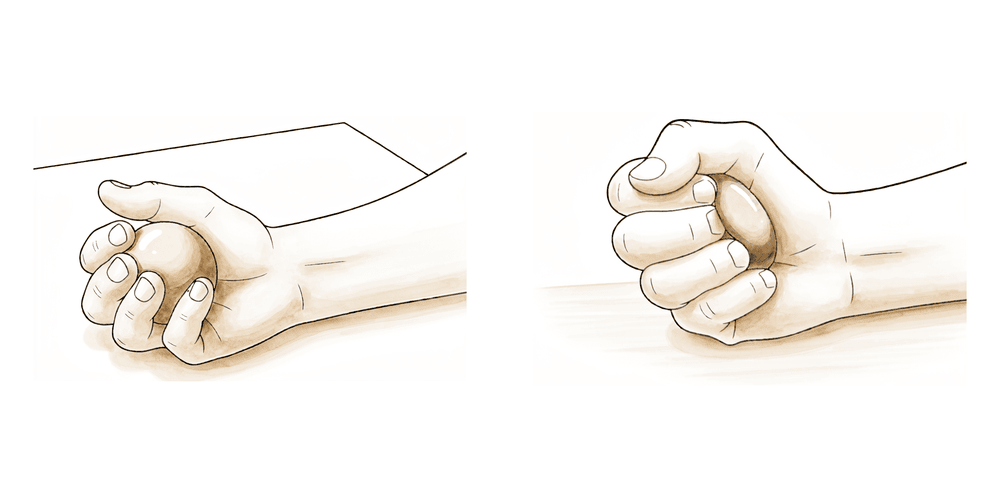
后期锻炼——仅在Hirpara医生和您的手部治疗师批准开始强化训练后进行,通常从术后六至八周左右开始。挤压软球或橡皮泥以重建抓握力,并在轻阻力下将前臂旋前(掌心向下)和旋后(掌心向上)(例如,像握锤子一样持握轻哑铃)。在数周内缓慢增加阻力。如果在负重下旋转前臂时,手腕尺侧(小指侧)出现疼痛,请停止锻炼。
仅在约6-8周后,在您的手部治疗师指导下
这些是您的手册中列出的锻炼项目。仅在Hirpara医生和您的手部治疗师的指导下开始进行,并严格保持在您被允许的范围内和限制内。手指活动应立即开始。前臂旋转(整个手术的核心所在)和腕部活动在拆除外固定支具后开始,通常在术后两到三周左右,此后旋转将成为您的主要关注点。瘢痕按摩在伤口完全愈合后开始。抓握和旋转力量训练属于后期阶段,在获得明确许可之前不应开始。停止任何导致腕部小指侧出现剧烈疼痛的动作。
您的临床方案
本页其余部分为远端桡尺关节半切除-间置成形术后康复的分阶段临床方案。本节内容应提供给您的手部治疗师,且每个阶段均以通俗易懂的语言解释当前正在发生的情况。这是一种关节重塑(成形术)手术,而非修复手术:不存在需要保护数月之久的受张力结构。有意识的限制期较短:短暂的夹板固定期,以使软组织间置和关节囊稳定,之后早期恢复前臂旋转是明确的优先事项,因为旋转正是该手术旨在恢复的功能。整个过程中需要尊重的主要负荷是远端尺骨的旋转负荷,因为正是这种负荷会引发疼痛性的尺骨残端不稳定和桡尺关节汇聚。
在治疗前,请查阅患者的手术报告及既往病史,并与主刀医生就任何联合手术(三角纤维软骨复合体修复、远端桡骨截骨术、骨间后神经切断术、伸肌腱重建)、术中评估的远端尺骨残端稳定性,以及规定的夹板和旋转上限进行沟通。联合进行的三角纤维软骨复合体修复或远端桡骨截骨术会延长保护期;而针对退行性或创伤后关节炎的孤立性半切除术则遵循以下较短的路径。Hirpara 医生保留了三角纤维软骨复合体、尺骨茎突及尺骨软组织附着点,因此远端尺骨仍得到支撑,康复因此可以优先进行早期旋转。
第一阶段 — 夹板保护性固定(第0周至 2-3 周)
最初两到三周旨在保护软组织间置物和关节囊,同时保持肢体其余部分的活动度。前臂置于夹板中(通常为限制前臂旋转的肘上/门斯特型夹板或石膏),仅在清洁护理以及该阶段末期进行首次轻柔旋转时取下。手指从第一天起即可活动。
致您的手部治疗师:
健康教育与注意事项 - 在规定的夹板(肘上/门斯特型,或遵医嘱)中固定,限制前臂旋转;仅在清洁护理和已获许可的练习时取下 - 禁止负重前臂旋转;禁止通过手术侧前臂进行承重或扭转 - 告知患者,早期握力减弱和尺侧肿胀属于预期现象
管理 - 伤口:按指示使用外科敷料;监测感染迹象 - 水肿:抬高患肢、轻柔手部泵运动、必要时冰敷 - 练习:从第一天起进行主动手指、拇指以及(若未被夹板阻挡)肩关节活动度训练;在夹板允许的范围内进行轻柔的肘关节活动度训练;若外科医生允许早期取下夹板,则在本阶段最后几天引入轻柔、无痛的主动前臂旋转
晋级标准 - 伤口稳定;夹板固定期(单纯半切除术约 2-3 周)结束;外科医生许可进行主动旋转
第二阶段——早期前臂旋转(优先事项)(第2-3周至第6周)
这是定义性阶段。脱离支具后,主动旋前和旋后成为康复的核心:轻柔、频繁、无痛且无负重。增加腕部活动。旋转是手术旨在恢复的功能,因此在仍避免负重期间,此处积极追求该功能。
致您的手部治疗师:
评估 - 主动和被动前臂旋前/旋后(目标恢复至结果系列中报告的每个方向约80°);腕部和手指活动范围(ROM);尺侧腕部疼痛;肿胀;伤口/瘢痕检查
教育与注意事项 - 前臂旋转是优先事项: 频繁、无痛、无负重的主动旋前/旋后,肘部贴紧身体侧面以孤立前臂 - 在约6-8周前,禁止抗阻或负重旋转、禁止强力抓握、禁止扭转任务 - 某些支具在石膏拆除后的几周内会进一步限制末端范围旋转;请遵守任何规定的上限
管理 - 练习:以主动和主动辅助的旋前/旋后为主要重点;主动腕屈曲/伸展和桡偏/尺偏;继续手指和抓握活动范围(尚无抗阻抓握);伤口完全愈合后开始瘢痕管理 - 根据需要采用物理因子治疗以减轻水肿和瘢痕
进展标准 - 舒适、可控、接近全范围的无痛主动前臂旋转;伤口愈合;疼痛≤3/10;轻柔旋转时无诱发性的尺侧疼痛
第三阶段——强化与回归(第 6-8 周及以后)
一旦旋转功能恢复且无痛,即开始强化训练并逐步递增:先进行握力训练,随后进行负重前臂旋转,特别留意负重下是否出现疼痛性的尺骨残端不稳定或桡尺骨汇聚。回归重体力劳动和体育运动需基于标准评估。
致您的手部治疗师:
评估 - 握力与对侧对比(结果系列报告提示恢复至对侧约 85-90% 的水平);前臂旋转力量,以及负重旋转时是否出现疼痛或不稳定;根据情况适当进行功能性及工作/运动特异性测试
宣教与注意事项 - 首先引入抗阻握力训练,随后在约六至八周时引入分级负重前臂旋转(例如使用轻重量进行锤式旋转);缓慢增加负荷 - 警惕轴向或旋转负荷下疼痛性的尺骨残端不稳定 / 桡尺骨汇聚:若诱发上述症状,应降低负荷并与外科医生沟通
处理 - 练习:渐进性握力/橡皮泥训练;分级抗阻旋前/旋后(轻 → 中);任务特异性负荷训练;继续任何残留的活动度(ROM)训练 - 一旦旋转和握力功能恢复且接近对称,并实现适当的功能回归,可考虑出院 - 若恢复停滞,或存在持续尺侧负荷疼痛提示残端不稳定或汇聚,可考虑转回主治医生处
回归负荷/运动标准 - 握力和旋转力量接近对称;负重旋转无痛;功能性测试中无不稳定
恢复工作与活动
鼓励从初期开始进行轻度日常手部活动(如进食、书写、轻度自我护理),以舒适为限,前提是避免前臂的强制或负重扭转。由于您的前臂早期需佩戴夹板,且您必须能够安全地控制方向盘(包括转动方向盘),请在最初几周内安排交通协助;待您拆除夹板,且经复诊确认能够舒适、安全地旋转前臂以操控方向盘后,方可恢复驾驶。
负重扭转任务(如拧开紧盖的罐子、拧干、使用螺丝刀、在该侧提重物)需待强化训练获准(通常在六至八周左右)后方可进行,并应循序渐进地增加强度。恢复较重的体力劳动和体育运动遵循相同的基于标准的进阶方案,具体取决于恢复无痛、接近对称的前臂旋转和抓握功能,该评估由Hirpara医生及您的手部治疗师共同判断,而非仅依据时间。
方案实施后
本方案与诊所的总体康复建议配合使用;请参阅术后疼痛管理、伤口护理和瘢痕管理。如果您的下尺桡关节问题继发于腕部骨折,远端桡骨骨折固定方案可作为有用的补充。上述分阶段计划反映了远端桡尺关节半切除术关节成形术后已发表的康复指南,您的持续康复将由Hirpara医生和您的手部治疗师根据您前臂的进展情况个体化指导。
Evidence & references
This is the clinical evidence summary written for health professionals. It is technical, and it lists the research this page was built from. You do not need to read it to understand your treatment or to make a decision about it.
DRUJ Hemiresection-Interposition Arthroplasty (Bowers) — Procedure Outcomes & Post-operative Rehabilitation
Topic scope: post-operative rehabilitation after hemiresection-interposition arthroplasty (HIT) of the distal radioulnar joint (DRUJ) — the Bowers procedure — for painful DRUJ arthritis (degenerative, post-traumatic, or inflammatory). The arthritic portion of the ulnar head is partially resected and a soft-tissue spacer is interposed, preserving the TFCC, ulnar styloid and ulnar soft-tissue attachments so the distal ulna remains supported. This is a joint-reshaping arthroplasty, not a repair or reconstruction: the rehab is therefore an early-rotation pathway built around a short protected settling phase, then prioritised restoration of forearm pronation/supination, then graded loading — not months of construct protection.
Defining principle of the rehab here: the operation exists to restore pain-free forearm rotation, and nothing is sutured under tension that must heal protected for months. The deliberate restraint is a brief splinted phase (commonly an above-elbow / Muenster-type splint limiting forearm rotation for ~2-3 weeks in the isolated case) to let the soft-tissue interposition and capsule settle. After that, early active pronation/supination is the explicit priority — rotation is the function the operation restores. The single load to respect throughout is rotational/axial loading of the distal ulna, which provokes the characteristic failure mode: painful ulnar-stump instability and radioulnar convergence. The main branch point that lengthens the protected phase is a concurrent procedure (TFCC repair, distal radius osteotomy, extensor reconstruction).
A. PROCEDURE OUTCOMES (hemiresection-interposition arthroplasty)
The Bowers HIT is a long-established, generally reliable salvage for the arthritic DRUJ. The evidence base is level IV (retrospective cohorts and case series, no randomised trials), but it is consistent across decades: most patients gain durable pain relief and improved, stable forearm rotation, with the principal residual concern being ulnar-stump instability / radioulnar convergence under load.
- The original Bowers series established the procedure and its rationale. Bowers' 1985 description (38 patients, mean ~2.5 yr) reported stable, painless rotation in the great majority — in rheumatoid patients ~85% achieved stable painless rotation (pronation ~84°, supination ~77°), and degenerative/post-traumatic patients achieved painless rotation averaging ~80° in each direction. The technique was explicitly designed to preserve the functional ulnocarpal ligament complex [Bowers, J Hand Surg Am 1985]. Level IV (foundational case series).
- Long-term outcomes are durable but with a defined complication rate. A long-term cohort (66 patients, mean follow-up 8.6 years) reported low residual pain (median NRS 1/10), an overall complication rate of ~14% and reoperation ~8%; reported complications included stylocarpal impingement, ulnar subluxation, exostoses and tendon rupture. Inflammatory-arthritis patients had lower pain than post-traumatic patients (median 0 vs 5). The same series found PIN neurectomy associated with improved pain scores [HIT long-term outcome study, Hand (N Y) 2019]. Level IV (cohort).
- Forearm rotation, grip and pain all improve measurably. A capsuloretinacular HIT series (21 wrists, mean ~2 yr 10 mo) reported significant gains: pronation 56.8°→83.0°, supination 60.0°→82.0°, grip 66.0%→87.4% of the contralateral side, VAS pain 62→23 mm, DASH 37.7→25.0, PRWE 48.1→24.4, with no post-operative DRUJ instability reported in that series [HIT capsuloretinacular series, J Wrist Surg 2023]. Level IV (cohort).
- HIT sits within a family of DRUJ salvage options (Darrach distal ulna resection, Sauvé-Kapandji arthrodesis-pseudarthrosis, matched/hemiresection variants, and ulnar-head implant arthroplasty), each with its own instability/convergence profile; HIT's selling point is preservation of the ulnar support structures to reduce stump instability versus a formal Darrach [Bowers 1985; Glowacki, Hand Clin 2005; Chidgey, JAAOS 1995; Rekant, Hand Clin 2012; Murray, Hand Clin 2011]. Mechanistic / narrative-review.
B. REHABILITATION / THERAPY EVIDENCE
There is no trial-level evidence for any specific rehabilitation regimen after DRUJ HIT. Protocols are surgeon- and technique-derived expert consensus, reported as the post-operative methods of the outcome series and operative-technique articles above. The consensus is consistent on its key features.
- A brief protected settling phase, not prolonged immobilisation. In the isolated hemiresection (no distal radius osteotomy, no TFCC repair), a long-arm plaster splint for ~10 days followed by a removable Muenster splint for a further 2-3 weeks is typical; cohort series report an upper-arm cast ~3 weeks then a forearm cast 1-2 weeks. Where a distal radius osteotomy or TFCC repair is added, immobilisation is longer (e.g. a long-arm cast in ~45° supination for ~4 weeks) [Pillukat & van Schoonhoven, Oper Orthop Traumatol 2009; HIT capsuloretinacular series, J Wrist Surg 2023]. Weak / expert consensus.
- Early forearm rotation is the explicit priority once protection ends. The whole point of the operation is rotation, so active pronation/supination is pursued early and frequently. Some protocols further limit end-range rotation by splint for ~4 more weeks after the cast comes off before unrestricted motion and load [Pillukat & van Schoonhoven 2009]. Weak / expert consensus.
- Loading is added last, watching for the characteristic failure mode. Range and load are returned to normal after the rotation-limited window; the specific thing to watch is painful ulnar-stump instability and radioulnar convergence under axial/rotational load, which is the biomechanically demonstrated weak point of distal-ulna procedures [Sauerbier et al., J Hand Surg Br 2002; Douglas et al., J Hand Surg Am 2014; Barret et al., Orthop Traumatol Surg Res 2020]. Mechanistic (biomechanical) + consensus.
- Finger, thumb, elbow and shoulder motion from day one is standard to prevent stiffness, as in any forearm/wrist immobilisation pathway. Consensus.
Recovery trajectory (expected, evidence-anchored)
| Phase | Window | Restraint | Hand use / therapy focus | Strength / load | Notes |
|---|---|---|---|---|---|
| I — Protected settling | Week 0 to 2-3 | Splint limiting forearm rotation (Muenster / above-elbow type) | Active finger/thumb/shoulder ROM from day 1; elbow ROM as splint allows; first gentle pain-free rotation toward end of phase | None through forearm | Longer if concurrent TFCC repair or distal radius osteotomy (cast in supination ~4 wk) |
| II — Early forearm rotation (priority) | Week 2-3 to 6 | Unloaded; some protocols cap end-range rotation a few more weeks | Active pronation/supination as the main focus, elbow tucked; add wrist ROM; finger/grip ROM; scar massage once healed | No resisted/loaded rotation, no heavy grip | Target restoration toward ~80° each direction; pain-free is the rule |
| III — Strengthening & return | Week 6-8+ | Restrictions lifted progressively | Resisted grip first, then graded loaded rotation (hammer turns); task-specific loading | Build load slowly; grip recovers toward ~85-90% contralateral | Watch for ulnar-stump instability / radioulnar convergence under load |
(Phase windows mirror the precautions and phase tables in the patient protocol; they are typical expert-consensus guides, not trial-derived deadlines, and lengthen with concurrent procedures.)
C. KEY CONTROVERSIES / EVIDENCE QUALITY
- HIT vs Darrach. The Darrach (complete distal ulna resection) is simpler but sacrifices the ulnar support structures and is more prone to painful proximal ulnar-stump instability and radioulnar convergence, especially in younger, higher-demand or post-traumatic patients. HIT preserves the TFCC/styloid/attachments to mitigate this — but biomechanical work shows HIT also converges under load, just to a different degree, so convergence is a spectrum, not a HIT-vs-Darrach binary [Sauerbier et al., J Hand Surg Br 2002; Douglas et al., J Hand Surg Am 2014]. Darrach remains reasonable in low-demand/elderly patients. *Moderate (biomechanical
- cohort).*
- HIT vs Sauvé-Kapandji. Sauvé-Kapandji fuses the DRUJ and creates a controlled proximal pseudarthrosis, preserving the ulnar head/buttress for the carpus; it is often favoured where ulnar translation of the carpus is a concern (e.g. rheumatoid), but it too can develop painful proximal-stump instability. Long-term Sauvé-Kapandji and modified-Sauvé-Kapandji series report durable function with that caveat [Reissner et al., J Hand Surg Eur 2021; Zimmermann et al., Arch Orthop Trauma Surg 2003]. Choice is patient- and pathology-specific, not evidence-mandated. Moderate.
- HIT vs ulnar-head (implant) replacement. Implant ulnar-head arthroplasty is an alternative — particularly for failed resection/instability salvage — restoring a load-bearing buttress, but it adds implant-specific complications. Long-term implant series report good outcomes; it is increasingly used to rescue a painful, unstable stump after resection-type procedures [Kakar et al., J Hand Surg Am 2010; Adams, Hand Clin 2010; Watts et al., Hand Clin 2010; Rekant, Hand Clin 2012]. Moderate.
- The rehab regimen itself is consensus, not trial-derived. No RCT compares immobilisation length, rotation timing or loading progression after HIT. The "brief protection → early rotation → graded load" structure is inferred from technique articles and the methods of level-IV outcome series. Exact phase timings are typical, not deadlines, and shift with concurrent procedures. Weak / expert consensus.
- Patient selection drives results. Inflammatory-arthritis patients report lower residual pain than post-traumatic patients in long-term follow-up; adjunct PIN neurectomy is associated with better pain scores. Both point to outcome being substantially a selection/technique matter, not a rehab one [HIT long-term cohort, Hand 2019]. Moderate (within level-IV data).
D. EVIDENCE STRENGTH FLAGS (summary)
- STRONG (RCT / SR): none. There are no randomised trials of DRUJ HIT or of its rehabilitation.
- MODERATE: the biomechanical basis of radioulnar convergence / ulnar-stump instability under load across distal-ulna procedures (cadaveric studies); the comparative trade-offs among HIT / Darrach / Sauvé-Kapandji / ulnar-head replacement (consistent cohort + mechanistic data).
- LEVEL IV (cohort / case series — the outcome evidence): pain relief, grip recovery (~85-90% contralateral), pronation/supination gains (toward ~80° each), ~14% complication and ~8% reoperation rates, durability to ~8-9 years. Consistent but uncontrolled and surgeon-reported.
- WEAK / EXPERT CONSENSUS (the rehab regimen): the specific brief-protection → early-rotation → graded-load programme, the Muenster/above-elbow splint choice, the ~2-3 week protected window, and all exact phase timings — derived from technique articles and the methods sections of level-IV series, lengthened by concurrent procedures. No comparative rehab evidence exists.
CITATIONS
RAG corpus (180,000+ Orthopaedic articles)
- Glowacki KA. Hemiresection arthroplasty of the distal radioulnar joint. Hand Clin. 2005. DOI: 10.1016/j.hcl.2005.08.002
- Sauerbier M, Fujita M, Hahn ME, et al. The dynamic radioulnar convergence of the Darrach procedure and the ulnar head hemiresection interposition arthroplasty: a biomechanical study. J Hand Surg Br. 2002. DOI: 10.1054/jhsb.2002.0763
- Douglas KC, Parks BG, Tsai MA, et al. The biomechanical stability of salvage procedures for distal radioulnar joint arthritis. J Hand Surg Am. 2014. DOI: 10.1016/j.jhsa.2014.03.028
- Barret H, Lazerges C, Chammas P, et al. Modification of matched distal ulnar resection for distal radio-ulnar joint arthropathy: analysis of distal instability and radio-ulnar convergence. Orthop Traumatol Surg Res. 2020. DOI: 10.1016/j.otsr.2020.07.008
- Chidgey LK. The distal radioulnar joint: problems and solutions. J Am Acad Orthop Surg. 1995. DOI: 10.5435/00124635-199503000-00005
- Murray PM. Current concepts in the treatment of rheumatoid arthritis of the distal radioulnar joint. Hand Clin. 2011. DOI: 10.1016/j.hcl.2010.10.002
- Lee SK, Hausman MR. Management of the distal radioulnar joint in rheumatoid arthritis. Hand Clin. 2005. DOI: 10.1016/j.hcl.2005.08.009
- Ozer K. Management of complications of distal radioulnar joint. Hand Clin. 2015. DOI: 10.1016/j.hcl.2014.12.003
- Zimmerman RM, Jupiter JB. Instability of the distal radioulnar joint. J Hand Surg Eur Vol. 2014. DOI: 10.1177/1753193414527052
- Rekant M. Distal ulna arthroplasties. Hand Clin. 2012. DOI: 10.1016/j.hcl.2012.08.016
- Watts AC, Hayton MJ, Stanley JK. Salvage of failed distal radioulnar joint reconstruction. Hand Clin. 2010. DOI: 10.1016/j.hcl.2010.05.004
- Kakar S, Swann R, Perry K, et al. Distal radioulnar joint implant arthroplasty: a long-term outcome analysis. J Hand Surg Am. 2010. DOI: 10.1016/j.jhsa.2010.05.010
- Adams BD. Complications of wrist arthroplasty. Hand Clin. 2010. DOI: 10.1016/j.hcl.2010.01.006
- Reissner L, Schweizer A, Unterfrauner I, et al. Long-term results of the Sauvé-Kapandji procedure. J Hand Surg Eur Vol. 2021. DOI: 10.1177/17531934211004459
- Zimmermann R, Gschwentner M, Arora R, et al. Treatment of distal radioulnar joint disorders with a modified Sauvé-Kapandji procedure: long-term outcome with special attention to the DASH questionnaire. Arch Orthop Trauma Surg. 2003. DOI: 10.1007/s00402-003-0529-5
- Nypaver C, Bozentka DJ. Distal radius fracture and the distal radioulnar joint. Hand Clin. 2021. DOI: 10.1016/j.hcl.2021.02.011
- Pillukat T, van Schoonhoven J. Die Hemiresektions-Interpositionsarthroplastik des distalen Radioulnargelenks nach Bowers [The hemiresection-interposition arthroplasty of the distal radioulnar joint]. Oper Orthop Traumatol. 2009. DOI: 10.1007/s00064-009-1913-2
DRUJ hemiresection literature (URLs)
- Bowers WH. Distal radioulnar joint arthroplasty: the hemiresection-interposition technique. J Hand Surg Am. 1985;10(2):169-178. https://www.jhandsurg.org/article/S0363-5023(85)80100-3/abstract (PMID: 3980927)
- Hemiresection interposition arthroplasty of the distal radioulnar joint: a long-term outcome study. Hand (N Y). 2019. DOI: 10.1177/1558944719873430. https://pmc.ncbi.nlm.nih.gov/articles/PMC8461192/
- Hemiresection capsuloretinacular interposition arthroplasty for distal radioulnar joint osteoarthritis. J Wrist Surg. 2023. DOI: 10.1055/s-0043-1771341. https://pmc.ncbi.nlm.nih.gov/articles/PMC11606672/
- Mid- to long-term functional results after Bowers' hemiresection interposition arthroplasty of the distal radio-ulnar joint. PubMed. https://pubmed.ncbi.nlm.nih.gov/35238965/
- Pillukat T, van Schoonhoven J. The hemiresection-interposition arthroplasty of the distal radioulnar joint (operative technique). Oper Orthop Traumatol. 2009. https://link.springer.com/article/10.1007/s00064-009-1913-2 (PMID: 20058126)
- Ulnar head hemiresection with interposition and extensor reconstruction — surgical technique. OrthOracle. https://www.orthoracle.com/library/ulnar-head-hemiresection-with-interposition-and-extensor-reconstruction/