Patients › Shoulder
翻修肩关节置换术
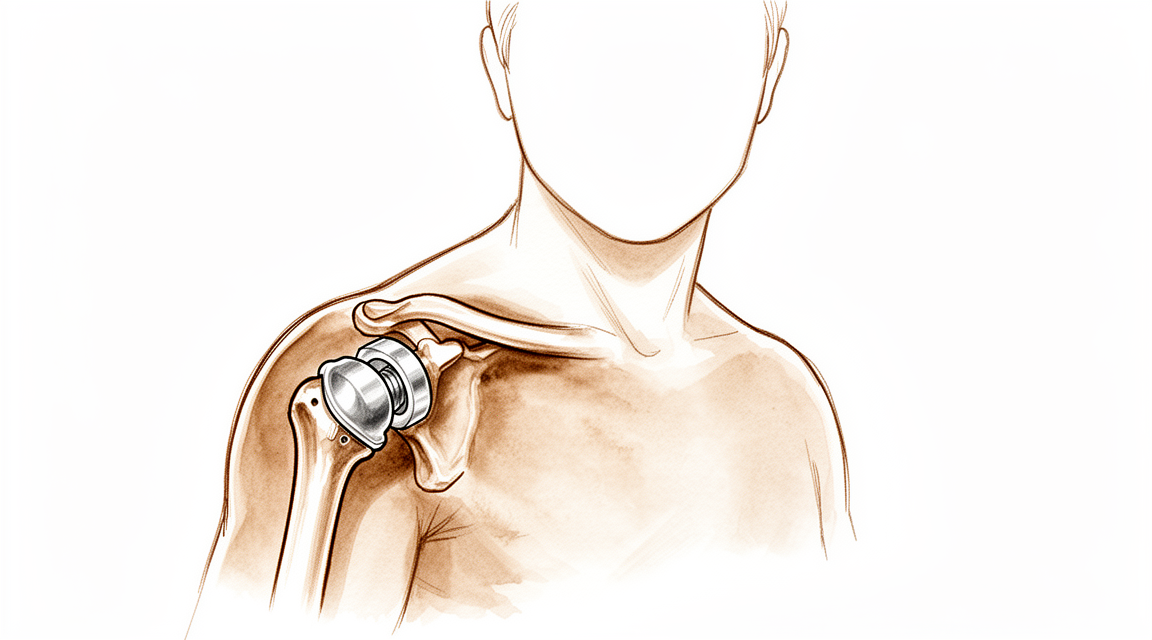
Revision shoulder replacement — addressing failure of prior shoulder replacements with a reverse design.
为何建议进行此手术
Mater Private Hospital Rockhampton 的上肢外科医生 Kieran Hirpara 医生会从适合您病情的最微创方案开始。患者通常由其全科医生(GP)转诊至我们的诊所;如果物理治疗师建议您就诊,您仍需获得全科医生的转诊,才有资格享受 Medicare 报销。在您的首次就诊时,我们会采集病史,检查您的肩部,并在必要时安排影像学检查。对于长期存在的问题,我们通常首先尝试非手术治疗,例如改变活动方式、物理治疗或支具固定,当这些方法未能带来足够改善时,我们才会考虑手术。
翻修肩关节置换术是一种二次手术,用于更换先前肩关节置换术的部分或全部部件。当初次置换效果不佳时,我们建议进行此手术,最常见的原因包括部件松动、关节不稳定或关节盂磨损。剧烈疼痛和僵硬是人们因该手术前来就诊的主要原因。手术目标是减轻疼痛、改善活动度并增强肩部的稳定性。翻修反式肩关节置换术的假体十年生存率为 85%。我们将与您详细讨论该手术能为您做什么以及不能做什么,并共同决定其是否适合您。
术前
您的肩部需要进行影像学检查,以便我们制定手术方案。通常,从几个角度拍摄的普通X光片就足够了。有时,会额外进行MRI(一种显示软组织的扫描)或超声检查。在手术日之前,您将从我们的团队那里获得明确的指示。您需要提前七小时停止进食和饮水。我们要求七小时而非通常的六小时,以便如果手术室手术列表提前完成,您可以被提前安排。请携带一份您目前所有药物的书面清单,因为某些药物可能需要暂停服用。请安排有人开车送您回家。穿着宽松、舒适的衣物。如果您有其他健康状况,可能需要进行血液检查或由麻醉师(负责实施麻醉的专家)进行评估。
手术当日
您将抵达医院的手术入院单元,在此办理入院手续并进行术前准备。随后,您将与麻醉师见面。该手术在全身麻醉联合区域神经阻滞下进行。麻醉师将在手术前与您见面,并向您详细讲解这两部分内容。
之后,您将被带入手术室进行手术。手术结束后,您将在复苏区苏醒。护士会在此监测您的状况,直至麻醉消退。一旦您的生命体征平稳,您将被转入病房。
手术内容
翻修肩关节置换术是一种开放手术,通过手术区域上方的单一切口进行。外科医生通过此单一切口到达关节。
具体步骤取决于初次置换失败的原因。外科医生可能会移除部分或全部磨损或松动的部件,并用新的金属和塑料表面进行替换。如果关节窝骨质已磨损,可植入一小块骨移植(用于重建缺失区域的骨块),以便安装新的关节窝部件。在可能的情况下,外科医生会尽量安装新的关节窝组件,而不是将其省略。如果关节不稳定,外科医生可能会将置换设计更改为反置式,即交换球头和关节窝的位置,以使关节更稳定。有时,肱骨侧部件周围的旧骨水泥会被保留,并在其内部填充新骨水泥,而不是移除所有残留物。
一旦新部件就位并检查完毕,即关闭伤口。首先,在闭合的伤口上覆盖一层细薄的自粘网状物,以固定皮肤边缘。然后,在网状物上涂抹液体皮肤粘合剂,待其凝固后密封整个区域。该装置通常保留一至两周,随后自行脱落剥离,无需取出。
术后
您将在恢复区苏醒,由护士监护。情况稳定后,您将被转入病房。大多数患者在此手术后住院一至两晚。镇痛方案将根据您的具体情况定制,手术室中实施的神经阻滞通常能初期保持肩部舒适。您的手臂将佩戴简易吊带以提供舒适感;进行锻炼和清洗时需取下吊带。敷料将保留约10天;除非我们告知您,否则请勿提前拆除。我们将在复诊时为您更换或拆除敷料。物理治疗师可能会上门指导开始轻柔的活动。请安排有人在您回家后的最初24小时内陪伴您。
恢复
最初几天以休息和舒适为主。您的肩部会出现疼痛和肿胀,手术室中实施的神经阻滞通常在初期能保持其相对平静。随着阻滞效果消退,您将感受到更多的酸痛。为您量身定制的镇痛方案、休息以及温和的活动均有助于缓解症状。肿胀会在早期数周内逐渐消退。
您的手臂将佩戴一个简单的吊带以提供舒适感。进行锻炼和清洗时需取下吊带。理疗师将在早期指导您进行温和的活动,随后根据您的肩部恢复情况逐步增强力量和活动范围。在家庭环境中,初期您需要他人协助完成较重的任务,但手臂的轻度使用会稳步恢复。在最初几天,保持直立睡眠或用枕头支撑通常更为舒适。
恢复是分阶段进行的,而非一蹴而就。一旦外科医生允许您驾驶,通常是在术后六周的复查时,您即可重新上路;请参阅我们关于上肢手术后驾驶的指南。随着活动能力的恢复,穿衣和烹饪等日常任务会变得更加容易。当您的肩部足够强壮时,大多数人可以重返工作岗位,许多人也能恢复他们喜爱的运动或活动。许多人在第一年内会注意到肩部持续改善。
您的恢复时间表可能与他人不同。您的外科医生和理疗师将在每次复查时为您提供指导,并根据您肩部的愈合情况调整计划。
可能出现的并发症
大多数患者恢复良好,但偶尔可能会出现一些问题。您的外科医生和医疗团队会密切监测您的状况,以便尽早发现任何问题。
有时,新的假体部件可能会松动,或者关节变得不稳定。您可能会感到术前疼痛复发,或者出现术后本不应有的新疼痛。有些人会注意到咔哒声、研磨感或撞击感,或者感觉肩部脱位。如果发生这种情况,请在下次复诊时提出,或者如果疼痛加剧,请提前联系诊所。
任何置换手术都存在感染的风险。请留意以下症状:不随普通止痛药缓解的深层搏动性疼痛、从伤口向外扩散的红肿、肩部局部发热或发烧。如果您注意到其中任何一项,请立即联系诊所。如果您感到不适并伴有发烧,或者红肿迅速扩散,请前往急诊科。
有时,新假体周围的骨骼可能会发生骨折,这通常在术后早期的X光片上被发现。您会感到突然的剧烈疼痛,比通常的术后疼痛更严重,有时伴有断裂声或错位感。如果发生这种情况,请告知您的外科医生或诊所。
某些健康状况和情况会增加出现问题的风险。这些包括帕金森病、术前营养不良、术前发生的脆性骨折(由轻微跌倒引起的骨折)、既往肩部手术史、炎症性关节炎(由免疫系统过度活跃引起的关节炎)、术后需要使用抗凝药物,以及双侧肩部在较短时间内相继接受手术。如果您符合上述任何情况,我们会将其纳入治疗计划,并对您进行更密切的监测。
本页上的并发症表格列出了典型的发生率,如果您想了解具体数据,可以参考该表格。
何时联系我们
如果您出现发热、伤口红肿加重或渗液,或疼痛持续加剧,请致电诊所。如果您突然感到呼吸困难、小腿肿胀或疼痛,或肩部疼痛突然变得剧烈,请前往急诊科。如果您手臂或手部失去感觉,或无法活动,请立即联系我们。如有任何疑虑,请致电我们。我们更希望尽早收到您的反馈。
关于该疾病的更多阅读
本页介绍手术本身。该手术所治疗的疾病,包括证据显示手术在何时有效、何时无效,在肩关节炎页面上有更详细的介绍。
Evidence & references
This is the clinical evidence summary written for health professionals. It is technical, and it lists the research this page was built from. You do not need to read it to understand your treatment or to make a decision about it.
Anatomy & Pathophysiology
Bony Anatomy
- The proximal humerus comprises four main parts: the humeral head, greater tuberosity, lesser tuberosity, and humeral shaft [3].
- The articular head of the proximal humerus is spherical with a diameter of 37 to 57 mm [3].
- The most superior portion of the articular surface of the humeral head averages 8 mm above the greater tuberosity [3].
- Humeral version averages 29.8 degrees, with a range of 10 to 55 degrees [3].
- The humeral head is inclined approximately 130 degrees with respect to the humeral shaft [3].
- The anatomic neck of the proximal humerus is located at the junction of the articular surface and the tuberosities [3].
- The surgical neck represents an indistinct region below the tuberosities but above the humeral shaft [3].
- The greater tuberosity serves as the attachment site for the supraspinatus, infraspinatus, and teres minor tendons [3].
- The lesser tuberosity serves as the attachment site for the subscapularis tendon [3].
- The glenoid is a convex structure of shallow depth shaped like an inverted pear [3].
- The glenoid cavity is a shallow socket, approximately one third the size of the humeral head [4].
- The neck-shaft angle measures an average of 135 degrees [4].
- The humeral head is retroverted an average of 30 degrees [4].
- The scapula is attached to the axial skeleton by the acromioclavicular and sternoclavicular joints [5].
- The glenoid is connected with the flat body of the scapula by the scapular neck [5].
- The coracoid process curves forwards from the superior surface of the scapular neck [5].
- The scapular spine ends in a flattened bony process, the acromion, which curves forwards [5].
- The highest concentration of bony mass in the scapula is located in the glenoid, the scapular neck, and the lateral border of the scapular body [5].
- Two bony pillars transmit compressive forces from the glenoid fossa: the lateral pillar and the spinal pillar [5].
- The lateral pillar connects the inferior border of the glenoid with the inferior angle [5].
- The spinal pillar arises from the central part of the glenoid and continues medially to become part of the base of the scapular spine [5].
- The weakest bone in the scapula is located primarily in the central part of the infraspinous fossa [5].
- The weakest area of the circumference of the biomechanical body of the scapula is the spinomedial angle [5].
- The subchondral bone of the glenoid is relatively flat, with articular concavity augmented by cartilage and a circumferential labrum [6].
- The glenoid averages 5° of retroversion in relation to the axis of the scapular body [6].
- The humeral head averages 19° of retroversion and 41° of inclination (neck-shaft angle) [6].
- The acromion has three ossification centers: the metacromion, mesoacromion, and preacromion [6].
- Failure of fusion of the acromial ossification centers results in os acromiale [6].
Vascular Anatomy
- The proximal humerus receives its blood supply from the anterior and posterior humeral circumflex branches from the third division of the axillary artery [3].
- The posterior humeral circumflex artery travels with the axillary nerve and enters the quadrilateral space posteriorly [3].
- The anterior humeral circumflex artery arises from the axillary artery at the inferior border of the subscapularis [3].
- The anterior humeral circumflex artery provides vascular inflow to the humeral head via its terminal anterolateral branch, known as the artery of Laing or arcuate artery [3].
- The ascending branch of the anterior humeral circumflex artery courses parallel to the lateral aspect of the long head biceps tendon [3].
- The ascending branch of the anterior humeral circumflex artery enters the humeral head at the interface of the bicipital groove and greater tuberosity [3].
- Injury to the arcuate artery may result in osteonecrosis of the humeral head [3].
- Additional extraosseous collateral branches can permit humeral head perfusion despite complete ligation of the arcuate artery [3].
- The major blood supply to the humeral head is through the ascending branch of the anterior humeral circumflex artery, which penetrates the head at the bicipital groove and becomes the arcuate artery [4].
- Fractures of the anatomic neck have a poor prognosis because of complete disruption of the blood supply to the head [4].
- The anterolateral ascending branch of the anterior humeral circumflex artery provides the primary blood supply to the humeral head [6].
- The terminal intraosseous portion of the anterior humeral circumflex artery enters at the proximal aspect of the intertubercular groove as the arcuate artery [6].
Soft Tissue & Ligamentous Anatomy
- The rotator cuff consists of four muscles: the subscapularis, supraspinatus, infraspinatus, and teres minor [4].
- The teres major is not a rotator cuff muscle [4].
- The rotator cuff muscles serve as depressors of the humeral head to allow the deltoid to efficiently abduct the humerus [4].
- The infraspinatus and teres minor are external rotators, while the subscapularis is an internal rotator of the humerus [4].
- The acromion, coracoacromial ligament, and coracoid process form the coracoacromial arch [3].
- The rotator cuff, subacromial bursa, and subdeltoid bursa pass underneath the coracoacromial arch [3].
- The subscapular bursa lies between the subscapularis tendon and the neck of the scapula [7].
- The subscapular bursa communicates with the joint cavity between the superior and middle glenohumeral ligaments [7].
- The subscapular bursa protects the tendon of the subscapularis at the point where it passes under the base of the coracoid process and over the neck of the scapula [7].
- The subscapular bursa often houses loose bodies in the shoulder [7].
- The subscapular bursa is a region in which synovitis of the shoulder may be most intense [7].
- The rotator interval is defined medially by the base of the coracoid, superiorly by the supraspinatus tendon, and inferiorly by the subscapularis tendon [6].
- The rotator interval contains the coracohumeral ligament, the superior glenohumeral ligament, and the intra-articular portion of the long head of the biceps tendon [6].
- Laxity of the rotator interval results in inferior laxity (the sulcus sign) [6].
- Contracture of the rotator interval is seen with adhesive capsulitis [6].
- The coracohumeral ligament restricts external rotation in adduction [6].
- The coracohumeral ligament is a static restraint to inferior and posterior translation in adduction and external rotation [6].
- The superior glenohumeral ligament is a primary static restraint against anterior translation with the arm at the side [6].
- With the coracohumeral ligament, the superior glenohumeral ligament forms a pulley that provides restraint against medial subluxation of the long head of the biceps tendon [6].
- The middle glenohumeral ligament is a primary static restraint against anterior translation with the arm in external rotation and 45° of abduction [6].
- The anterior band of the inferior glenohumeral ligament is a primary static restraint against anterior-inferior dislocation of the glenohumeral joint in 90° of abduction and external rotation [6].
- The posterior band of the inferior glenohumeral ligament is a primary static restraint against posterior-inferior translation in internal rotation and adduction [6].
- The glenoid labrum provides concavity and up to 50% of marginal glenoid socket depth [6].
- The superior transverse scapular ligament arises from the medial base of the coracoid overlying the suprascapular notch [6].
- The suprascapular artery runs superior to the superior transverse scapular ligament, while the nerve runs deep to it [6].
- Entrapment of the suprascapular nerve at the superior transverse scapular ligament causes denervation of both the supraspinatus and the infraspinatus [6].
- The spinoglenoid ligament overlies the suprascapular nerve at the spinoglenoid notch [6].
- Entrapment, traction, or compression of the suprascapular nerve at the spinoglenoid notch causes denervation of the infraspinatus [6].
Pathophysiology & Biomechanics
- Stability and function of the glenohumeral joint are provided by the interaction of structures that promote a near global range of motion and purposeful function [3].
- External loads transferred to the shoulder girdle are initially offset by joint surface anatomy, joint volume, atmospheric pressure, and joint fluid cohesion and adhesion [3].
- Moderate and large loads are counterbalanced by the deltoid and rotator cuff and by the capsulolabral and bone structures, respectively [3].
- Proximal humeral fractures alter complex interactions, resulting in pain, decreased range of motion and stiffness, and disability [3].
- Displacement of proximal humeral fracture fragments is based on the deforming forces created by the tendinous insertions of the pectoralis major, subscapularis, supraspinatus, and infraspinatus [3].
- The subscapularis inserts on the lesser tuberosity and causes medial displacement [3].
- The supraspinatus and infraspinatus insert on the greater tuberosity and cause superior and posterior displacement [3].
- The pectoralis major inserts on the humeral shaft and displaces it medially [3].
- A fracture involving the anatomic neck is prognostically worse than fractures involving other regions of the proximal humerus with respect to the potential disruption of the vascular supply to the humeral head and subsequent development of avascular necrosis [3].
- Displaced proximal humeral fractures can impede normal movement of structures passing under the coracoacromial arch, causing impingement and disruption of normal glenohumeral motion [3].
- In proximal humeral fractures, the subdeltoid and subacromial bursae can become thickened and fibrotic, forming adhesions that limit normal glenohumeral motion [3].
- The malcentering of the joint reaction force on the glenoid leads to posterior instability, posterior glenoid wear, and "rocking horse" loosening of prosthetic glenoid components [2].
- The point of contact of the humeral articular surface on the glenoid articular surface reflects the degree of centering of the net humeral joint reaction force on the glenoid [2].
- Arthritis usually involves the central aspect of the humeral head [2].
- Joint space narrowing is most evident on the axillary view taken with the arm in elevation compared to images made with the arm at the side [2].
- The axillary view taken with the arm in elevation demonstrates posterior subluxation or "functional decentering" that is not evident in images taken with the arm at the side [2].
- Dense scarring from previous operations commonly complicates the surgical approach in revision shoulder arthroplasty [15].
- Exposure in revision shoulder arthroplasty is typically quite difficult, making component implantation less predictable [15].
- Preexisting instability or subscapularis deficiency often is not correctable with an anatomic revision arthroplasty [15].
- The rotator cuff is often deficient in patients with massive (>4 cm) proximal humeral bone loss [15].
Investigations
Plain Radiography
- The purpose of shoulder imaging is to help establish the diagnosis, determine the severity of the pathoanatomy, assist in surgical planning, and enable the surgeon to illustrate the condition of the shoulder to the patient [2].
- Standardized plain films are almost always sufficient to garner the information needed for shoulder care [2].
- The first key radiographic view is the anteroposterior (AP) view taken in the plane of the scapula such that the x-ray beam passes through the glenohumeral joint [2].
- The AP view in the plane of the scapula shows the superoinferior position of the humeral head relative to the glenoid, the presence of osteophytes on the humeral head and glenoid, narrowing of the joint space, and the degree of medial displacement of the humerus in relation to the lateral acromial line [2].
- The AP view in the plane of the scapula also shows the quality of the humeral and glenoid bone, the presence of loose bodies, and whether there is humeral head collapse or deformity [2].
- The second key radiographic view is the axillary view taken with the arm in the functional position of elevation in the plane of the scapula [2].
- The axillary view is oriented so that both the spinoglenoid notch and the scapular neck are visible [2].
- The axillary view demonstrates a different perspective of humeral anatomy, the amount of glenoid bone, the shape of the glenoid, its version in relation to the plane of the scapula, and the relationship of the humeral head to the glenoid fossa [2].
- The axillary view is referred to as the “truth view” because it demonstrates glenohumeral relationships in the functional position of elevation [2].
- CT scans have the disadvantage of being taken with the arm in the adducted position, unlike the axillary truth view which is taken in elevation [2].
- Many axillary views sent for consultation are taken without standardization, making it impossible to determine important features of the glenohumeral joint [2].
- When taken properly, standardized anteroposterior and axillary views indicate the thickness of the cartilage space between the humerus and the glenoid, relative positions of the humeral head and glenoid, presence of osteophytes, degree of osteopenia, and extent of bony deformity and erosion [2].
- Joint space narrowing is most evident on the axillary truth view as opposed to images made with the arm at the side [2].
- The axillary truth view can show posterior subluxation or “functional decentering” that is not evident in images taken with the arm at the side [2].
- The degree of posterior subluxation can be measured as the position of the center of the humeral head in relation to the plane of the scapula [2].
- The degree of posterior subluxation can be measured as the position of the center of the humeral head in relation to the glenoid face [2].
- The degree of posterior subluxation can be measured as the point of contact of the humeral articular surface on the glenoid articular surface [2].
- Malcentering of the joint reaction force leads to posterior instability, posterior glenoid wear, and “rocking horse” loosening of prosthetic glenoid components [2].
- At least two X-ray views should be obtained: an anteroposterior in the plane of the glenoid and an axillary projection with the arm in abduction to show the relationship of the humeral head to the glenoid [11].
Computed Tomography
- CT scans may offer a few degrees of increased precision in the measurement of glenoid version [2].
- The authors are not convinced that the increased precision of CT scans in measuring glenoid version improves the quality of the surgery or the clinical outcome [2].
- There is information that can be gathered from properly taken plain films that cannot be obtained from CT scans [2].
- Three-dimensional reconstructions can reveal fine details of the shoulder anatomy, but this additional information rarely changes the planning or conduct of the arthroplasty [2].
- Computed tomography (CT) is helpful for planning fracture surgery and shoulder joint replacement [11].
Magnetic Resonance Imaging
- Magnetic resonance imaging (MRI) is useful to identify osteonecrosis of the humeral head, or a bone tumour [11].
- MRI can identify labral tears and rotator cuff tears [11].
- The accuracy of MRI for identifying labral tears and rotator cuff tears is enhanced by combining the scan with arthrography [11].
Ultrasonography
- Ultrasonography is a simple and accurate test for identifying rotator cuff tears and calcific tendinitis [11].
- Ultrasonography can be useful in guiding injections or barbotage (aspirating calcific deposits in the rotator cuff) [11].
- The most commonly performed joint examination using ultrasonography is the shoulder examination [9].
- The accuracy of rotator cuff ultrasonography depends on the skill of the scanner operator and an awareness of pitfalls that are encountered [9].
General Imaging Principles
- The diagnosis of a stiff shoulder depends on awareness of the problem, with history and physical examination being paramount and ancillary studies helpful in certain circumstances [1].
- Unless a specific research protocol is in place, the temptation to “overimage” should be resisted, obtaining only the scans or reconstructions that are necessary for the care of the patient [2].
- Proper radiographic technique is as important as proper surgical technique to achieve the desired outcome [2].
- The shoulder is a three-dimensional structure that cannot be represented by a single planar view [13].
- Critical relationships, such as the degree of centering of the humeral head, change with the position of the arm [13].
- Shoulder pathology may be found in a large number of different bones and soft tissues [13].
- Overlying and superimposed structures as well as metallic implants may complicate imaging the structures of interest [13].
- Surgeons need to develop a judicious approach to imaging that yields the information necessary to treat the patient while avoiding the tendency to "over-image" [13].
References
[1] Rockwood And Matsen S The Shoulder. Arthroscopic Management of Prearthritic and Arthritic Conditions of the Shoulder and the Postarthroplasty Shoulder > SUMMARY.
[2] Rockwood And Matsen S The Shoulder. Arthroscopic Management of Prearthritic and Arthritic Conditions of the Shoulder and the Postarthroplasty Shoulder > Radiographic Evaluation.
[3] Rockwood And Matsen S The Shoulder. Shoulder and Elbow Specialty Clinic Workers’ Survey > ANATOMY.
[4] A Lange Medical Book Current Diagnosis Treatment In Orthopedics Fifth Edition. 2Musculoskeletal Trauma Surgery > SHOULDER AND ARM INJURIES.
[5] Rockwood And Green S Fractures In Adults. 29: Principles of Nonunion and Bone Defect Treatment > Applied Anatomy Related to Scapular Fractures.
[6] Aaos Comprehensive Orthopaedic Review 3. Anatomy of the Shoulder, Arm, and Elbow > I. Shoulder.
[7] Rockwood And Matsen S The Shoulder. Developmental Anatomy of the Shoulder and Anatomy of the Glenohumeral Joint > Bursae.
[9] Orthopaedic Knowledge Update Sports Medicine 6. Diagnostic Ultrasonography and Ultrasonography-Guided Procedures > Annotated References.
[11] Apley And Solomon S Concise System Of Orthopaedics And Trauma. INVESTIGATION.
[13] Rockwood And Matsen S The Shoulder. Developmental Anatomy of the Shoulder and Anatomy of the Glenohumeral Joint > SENIOR EDITOR COMMENTARY.
[15] Campbell S Operative Orthopaedics 4 Volume Set. RECONSTRUCTIVE PROCEDURES OF THE SHOULDER AND ELBOW IN ADULTS > REVISION SHOULDER ARTHROPLASTY > INDICATIONS.