Patients › Hand
指尖损伤
Crush, laceration, nail-bed and amputation injuries of the fingertip and their management.
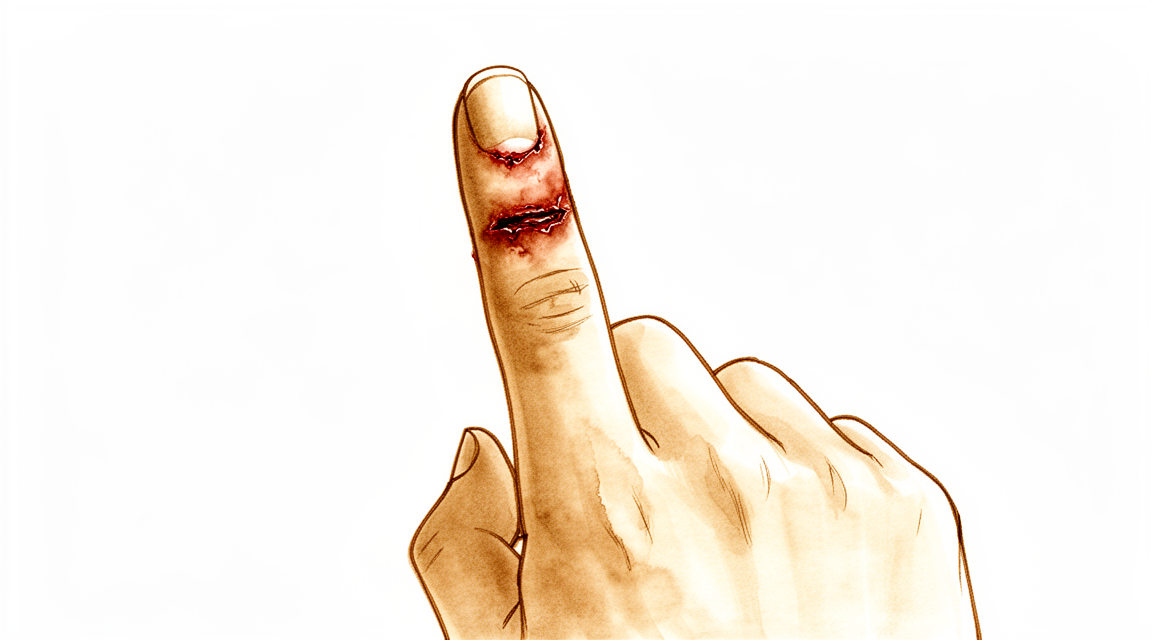
您的感受
指尖损伤的疼痛通常正好位于手指末端,此处皮肤、指甲和骨骼彼此靠近。疼痛往往呈尖锐状或搏动性,当手指受到撞击、抓握某物或指尖受压时,疼痛往往会加剧。打字、扣衣服纽扣、捡拾硬币和转动钥匙都可能变得笨拙,因为这些动作都要由指尖来承力。
手指可能感到麻木或无力,或两者兼有。您可能会注意到指尖变得不灵活,或者不能像以前那样感知物体的质地。指甲周围肿胀和压痛很常见,指甲本身也可能受损。在最初几天,疼痛常常会让人在夜间痛醒,而且在用手之后可能会加重。
有些人注意到,在伤口愈合很久之后,指尖仍然对寒冷有反应。冷空气、冷水或寒冷的天气都可能使指尖酸痛或感觉过于敏感。这种情况通常会随时间改善。
如果手指的一部分被切断,请立即前往急诊科,并把断离的部分随身带上。用湿纱布或干净的湿布包裹断离部分,放入密封的塑料袋中,再把这个袋子放在冰上或冰水中。切勿把断离部分直接放在冰上。
如果手指变得发热、发红、肿胀和疼痛,尤其是伴有发烧,请当日前往急诊科。如果骨折处或关节上方的皮肤破损、有骨骼外露,或手指明显变形,也同样如此。如果手指变得苍白、发冷、发白或发青,或者受伤后突然失去感觉或活动能力,也需要当日前往急诊就医。
如果症状没有缓解、在数周内逐渐加重、让您夜间痛醒,或使您无法工作或无法使用这只手,请去看您的全科医生(GP),或要求专科医生评估。
实际发生了什么
指尖损伤是指手指最末端受到的损伤,此处皮肤、指甲、骨骼和神经末梢紧密地聚集在一起。指尖是手上最忙碌的部位之一。几乎所有东西您都要用它来感知、抓握和拿取,因此即使那里有一个很小的损伤,也会引起您的注意。
每根手指的末端都有一小块骨头、指甲赖以生长的甲床,以及一个密集的神经网络,负责传递触觉和温度觉。当指尖被挤压、割伤或夹住时,这些结构中的任何一个都可能同时受损。这就是为什么您刚刚读到的那些症状往往会同时出现:在所有结构紧密相邻的地方出现疼痛,神经受伤导致麻木,以及指甲周围肿胀。
甲床的重要性远超其大小所暗示的程度。它是指甲板下方的一层薄组织,有点像植物生长的苗床。如果甲床被割伤后愈合得不平整,或者在已移位的骨块上愈合,之后长出的指甲可能会分裂、起脊或呈钩状。这就是为什么即使损伤看起来很轻微,只要累及甲床,仍需认真对待。
如果指尖被部分或完全切断,损伤就会累及皮肤、骨骼以及为其供血的细小血管。每种结构受累的程度决定了可以采取的处理方式,从让手指从自身边缘向内愈合的敷料,到把断离部分重新接回。在条件合适时,指尖本身也确实具有自我愈合的能力,这就是为什么治疗会在伤情允许的范围内尽量保持简单。
儿童指尖损伤很常见,大多发生在家中,被门或窗夹伤,而且大多数是可以预防的。
我们能做什么
Mater Private Hospital Rockhampton 的上肢外科医生 Kieran Hirpara 会根据您的具体伤情制定治疗方案。有些指尖损伤无需手术即可愈合,另一些则需要尽快手术,因此及时评估很重要。患者通常由全科医生(GP)转诊至我们的诊所;如果理疗师建议您就诊,您仍需获得全科医生的转诊才能符合 Medicare 报销资格。在诊所,我们会采集病史,检查手指,并在需要时安排影像学检查。
许多指尖损伤无需手术即可治疗。保持伤口湿润并受到保护的敷料能让指尖从自身边缘向内愈合,即使有一小块骨骼外露,这种方法也可能奏效。在条件合适时,指尖确实具有再生自身轮廓和感觉的能力。能让空气和水分透过的敷料在更换时往往更舒适,尤其是在早期,而且使用这种敷料时愈合时间似乎也更好。有些敷料可以免去住院或进手术室。这种方式的主要代价是时间,加上需要定期更换敷料,但这种负担只是暂时的。伤口闭合后,手部治疗会帮助您恢复活动度,让手指重新投入工作。
当损伤本身需要手术时,就会考虑手术,而不仅仅是在敷料治疗失败之后。如果手指的一部分被切断,我们可能会把它重新接回,这样可以同时恢复外观和功能。如果指尖需要新的皮肤覆盖,有几种转移组织的方法,具体根据损伤的位置以及外露的结构来选择。如果甲床被割伤,我们会仔细修复,因为从不平整的甲床上长出的指甲最终可能会分裂、起脊或呈钩状。该手术有其专门的页面,术后的预期情况将在下一节介绍。
预期情况
大多数指尖损伤在得到正确治疗后都能恢复良好。指尖确实具有自我愈合的能力,对皮肤、甲床和神经进行细致的处理,一般可以让您的指尖外观良好、功能良好。许多损伤无需手术即可愈合,这种方式的主要代价是时间和定期更换敷料,而不是任何永久性的问题。伤口闭合后,手部治疗会帮助您恢复活动度,让手指重新投入工作。
恢复是渐进的,而不是一蹴而就的。指尖的感觉往往恢复缓慢,而且可能与受伤前的感觉不完全一样。有些人注意到,在伤口愈合很久之后,指尖仍然对寒冷有反应,这种情况通常会随时间改善。麻木、压痛和指甲的变化也可能需要数周至数月才能缓解。如果手指的一部分被重新接回,这根手指的感觉或功能可能不完全和受伤前一样,但它仍然可以为您提供有用的功能、良好的外观,并让您重返工作和日常活动。
如果指尖损伤不予治疗,或者甲床没有得到细致的修复,问题往往会持续存在,而不是自行缓解。从不平整的甲床上长出的指甲可能会一直分裂、起脊或呈钩状。未经处理的神经损伤可能导致长期麻木或持续疼痛。有些人在伤口愈合后,指尖仍有长期疼痛;在手指部分被切除的人中,约三分之一报告有长期的神经性疼痛。此类损伤后的感染并不常见,发生率为 2.5%,但如果手指变得发热、发红、肿胀和疼痛,尤其是伴有发烧,请当日前往急诊科。
在恢复期间请留意警示信号。如果手指变得苍白、发冷、发白或发青,或者受伤后突然失去感觉或活动能力,请当日前往急诊科。如果症状没有缓解、在数周内逐渐加重、让您夜间痛醒,或使您无法工作或无法使用这只手,请去看您的全科医生,或要求专科医生评估。
何时就医
大多数指尖损伤可以等到看全科医生或常规预约时再处理,但有些不能等。如果手指的一部分被切断,请立即前往急诊科,并把断离的部分随身带上。如果手指变得发热、发红、肿胀和疼痛,尤其是伴有发烧,或者手指变得苍白、发冷、发白或发青,请当日前往急诊科。如果受伤后手指突然失去感觉或活动能力,或者骨折处或关节上方的皮肤破损、有骨骼外露,或手指明显变形,也同样如此。被戒指卡住或撕伤的手指可能造成严重损伤,需要专科治疗。如果症状没有缓解、在数周内逐渐加重、让您夜间痛醒,或使您无法工作或无法使用这只手,请去看您的全科医生,或要求专科医生评估。
深入探讨
Advanced reading: the deeper science (optional)
本节内容超出了您自身治疗决策所需的范围。指尖损伤值得额外阅读,因为预后组合最佳的治疗方案是无需任何手术,这一发现与闭合伤口的本能相悖。
开放愈合优于闭合处理
当指尖发生截指时,重建选项包括皮瓣、植皮,或敷料加时间——即允许伤口通过二期愈合(从边缘向中心)自行闭合。
回顾1,592例二期愈合病例,采用敷料和保护性夹板的保守伤口管理可使患者避免制动和供区并发症,达到接近正常的感觉和极少的寒冷不耐受,并实现早期重返工作 [1]。
这四项独立优势,每一项都针对手术替代方案的具体代价。皮瓣需要从其他部位取材,这会形成第二个伤口,且通常需要在愈合期间固定手指。皮瓣组织带有其自身的神经支配,而非指尖原有的神经支配,因此感觉在性质上有所不同。寒冷不耐受是指尖损伤后常被低估的长期主诉,而在二期愈合中报告为极轻微。
指尖具有显著的再生自身轮廓和感觉的能力,前提是提供相应的条件,特别是在骨骼未外露的情况下。保守治疗的主要代价是所需的时间和换敷料,这确实是一种负担,但只是暂时的。
使用植骨时,年龄可预测存活率
复合组织移植(即将截除部分作为移植组织进行移植,而不重新吻合血管)被描述为一种可行且有效的方法,可用于恢复具有美学和功能的手指。在 720 例患者中,大多数移植组织得以存活,且 年轻人群中表现出更为显著的存活模式 [2]。
在做出决定之前,了解这种年龄效应至关重要,因为如果复合组织移植失败,留下的伤口最终仍不得不通过保守途径愈合,而这期间已经浪费了时间。
再植:其能恢复与不能恢复的功能
当整个手指被截断时,再植手术旨在重新连接血管。基于619例患者的诚实总结是:手指再植不能恢复伤前的手部功能,但能实现足够的手部功能,这一预期应作为决策的一部分 [3]。
存活的影响因素也比通常认为的更为明确。在2,641例再植手术中,性别和缺血时间对存活率无显著影响,而年龄、受伤的手、损伤类型、区域以及用于保存截断部分的方法均具有显著影响 [4]。
鉴于此类损伤的紧迫性,缺血时间未达显著性水平这一结果令人意外。不应将其解读为时间无关紧要,这很可能反映了适当保存的手指比预期更能耐受较长的延迟,而这正是保存方法至关重要的原因。由此得出的实际操作指导:用湿纱布包裹截断部分,将其密封在袋中,并将该袋子置于冰上,切勿将截断部分直接接触冰块。
甲床是决定外观的部分
指尖损伤的长期外观在很大程度上取决于甲板下方的甲床。甲床裂伤若经精确修复,通常可形成正常指甲;若未予修复,或在移位骨碎片上愈合,则会导致指甲永久性分裂、起脊或钩状变形。因此,即使看似轻微但涉及甲床的损伤,其处理也需比其表观大小所提示的更为谨慎。
参考文献
[1] Krauss EM, Lalonde DH. 指尖截断的二期愈合:综述。Hand (N Y). 2014;9(3):282-8. https://doi.org/10.1007/s11552-014-9663-5
[2] Elameen AM, Dahy AA, Abu-Elsoud A, Gad AA. 预测指尖截断患者复合皮瓣存活率的因素:系统综述与荟萃分析。J Orthop Surg Res. 2024;19(1). https://doi.org/10.1186/s13018-024-05230-9
[3] Shaterian A, Sayadi LR, Tiourin E, Gardner DJ, Evans GRD, Leis A. 断指再植术后手部功能的预测因素:定量综述与荟萃分析。Hand (N Y). 2019;16(1):11-7. https://doi.org/10.1177/1558944719834658
[4] Ma Z, Guo F, Qi J, Xiang W, Zhang J. 非手术因素对断指再植存活率的影响:荟萃分析。J Hand Surg Eur Vol. 2015;41(2):157-63. https://doi.org/10.1177/1753193415594572
Evidence & references
This is the clinical evidence summary written for health professionals. It is technical, and it lists the research this page was built from. You do not need to read it to understand your treatment or to make a decision about it.
Overview
- Fingertip injuries in children are common and result in significant burden [1].
- Most fingertip injuries in children occur at home in a door or window [1].
- Fingertip injuries in children are mostly preventable [1].
- It is impossible to save fingers which were totally minced in severe mincer injuries [2].
- The Fingertip Injury Outcome Score (FIOS) is the most complete fingertip-specific outcome instrument [4].
- FIOS should be adopted as the primary standard for outcome reporting and long-term follow-up across fingertip injuries [4].
- A prospective study shows that the open method has a definite place in the treatment of certain fingertip injuries in adults [5].
- In a series of 74 patients with 96 injured fingers treated with a deepithelialized pedicle flap placed subcutaneously, the result was a well-contoured fingertip in all patients [6].
- When considering reconstructive options for fingertip injuries, the location of damage should be considered [7].
- The conservation of amputated finger-tips provides the hand surgeon with new possibilities for late reconstruction of an injured digit [8].
- The low incidence of infection (2.5%) and lack of a meaningful difference between groups call into question prophylactic antibiotic prescribing after distal fingertip injuries [9].
- The parallelogram flap is a better choice for reconstruction of fingertip injury with bone exposure compared to the homodigital island flap [10].
- Secondary procedures are often necessary following hand and digit replants [14].
- The purse-string suture technique is recommended to be applied to all fingertip injuries to preserve the nail [20].
- Donor finger morbidity in cross-finger flaps is a common occurrence and can produce a donor finger which is both stiff and cosmetically displeasing [32].
- Functional results of successfully replanted fingers were rated from fair to excellent, with better outcomes in younger patients [35].
- The superficialis finger operation has wider application than previously recognized [44].
- The best indication of the reversed digital artery island flap is the coverage of large defects of the dorsal aspects of the middle and third phalanx, not the treatment of fingertip injuries [45].
- The philosophy of digital replantation reflects the aim of ensuring not only the survival of a digit, but its functional use as well [50].
- Current data are inadequate to make comments regarding donor site morbidity for toe-to-thumb transfers [51].
- An evidence-based recommendation for the superiority of a specific type of toe-to-thumb transfer cannot be made due to inadequate data [51].
- There is insufficient evidence to determine the best treatment method for composite defects of the fingertips due to the lack of prospective randomized trials and disparate retrospective case series [56].
- Two new indications for the use of the first dorsal metacarpal artery (1st DMA) in reconstruction following severe hand injury are reported [68].
- Demographics play a significant role in the decision for finger replantation and its outcomes in addition to injury factors [118].
- Fingertip replantation represents a complex technical procedure for expert surgeons [119].
- In the absence of any means of identifying patients whose replants are likely to fail, economics dictate that replantation of amputations of the distal finger is not attempted or the cost of this small group of patients is borne [120].
Anatomy & Pathophysiology
Osseous and Skeletal Architecture
- The skeleton of the hand consists of 27 bones, of which 19 are long bones [43].
- The hand skeleton is divided into five rays, each forming a polyarticulated chain comprising metacarpals and phalanges [43].
- The thumb ray is the shortest, consisting of a metacarpal and two phalanges [43].
- The index metacarpal is the longest of the metacarpals [43].
- The proximal and middle phalanges of the middle and ring fingers are longer than those of the index finger [43].
- The epiphyseal plates are located at the proximal ends of the phalanges and the first metacarpal [43].
- The epiphyseal plates are located at the distal ends of the other metacarpals [43].
- The fingertip is defined as the portion of the finger distal to the insertion of the flexor and extensor tendons [33].
Musculotendinous Anatomy
- The extrinsic extensors run through six different fibroosseous retinacular compartments at the wrist level [42].
- The principal bony insertion of the extrinsic digital extensors is on the dorsal proximal aspect of the middle phalanx [42].
- Metacarpophalangeal joint extension is provided by extrinsic extensor force transmitted through the sagittal bands [42].
- Distal interphalangeal joint extension is achieved through conjoined lateral bands composed of tendinous slips from extrinsic and intrinsic tendons [42].
- The flexor digitorum profundus inserts on the proximal volar aspect of the distal phalanx [42].
- The flexor digitorum superficialis inserts via radial and ulnar slips into the proximal metaphysis of the middle phalanx [84].
- The fibroosseous tunnel of the digital flexor sheath extends distally to the proximal aspect of the distal phalanx [84].
- The A2 and A4 pulleys are the most essential in maintaining the mechanical advantage of the flexor tendons [84].
- The dorsal interossei are abductors, while the volar interossei are adductors [77].
- The middle finger has two dorsal interossei and no volar interossei because the central axis of the hand lies within it [77].
- The terminal tendon of the extensor mechanism inserts at the base of the distal phalanx to extend it [77].
Vascular and Neurovascular Anatomy
- The volar metacarpal vessels play an important part in the vascularity of the hand [60, 61].
- The "princeps pollicis" artery is the terminal branch of the radial artery that crosses the first intermetacarpal space [81].
- In the pulp segment of the thumb, the two arteries run through thick fatty subcutaneous padding and convert into the ends of the digital nerves at the median axis [81].
- The digital neurovascular structures are surrounded by a diffuse network of thin transverse oblique fibers [87].
- Fibers dorsal to the neurovascular bundle are collectively called Cleland ligament, and those palmar to the bundle are called Grayson ligament [87].
Cutaneous and Soft Tissue Anatomy
- The dorsal integument of the distal phalanx is characterized by the nail bed with its matrix [76].
- The dorsal skin possesses a normal pilosebaceous system, unlike the palm [86].
- The dorsal skin has loose connections with deeper planes, allowing free gliding and full flexion at the digital joints [86].
- Flexion of the fingers produces a significant lengthening of the dorsal skin, with an average increase of 3 cm in the middle finger from extension to full flexion [86].
- The palmar integument of the digits is subdivided into phalangeal units separated by digital flexion folds [76].
- When a digit is completely flexed, the integument of adjacent phalanges comes into contact in the zones of the flexion creases, forming diamond-shaped areas of cutaneous contact [76].
- The skin covering each finger is 7 cm by 10 cm on both the palmar and dorsal aspects [79].
Functional Pathophysiology and Injury Mechanisms
- The unique anatomy and specialized structure of the fingertip make it critical for functions such as sensation, fine handling, and gripping [33].
- Fingertip injuries in children are mostly preventable, with most injuries occurring at home in a door or window [1].
- In severe mincer injuries, it is impossible to save fingers which were totally minced [2].
- The nail plate protects the fingertip from injury, regulates circulation, provides counterforce for picking up small objects, and contributes to tactile sensation [172].
- Nail and fingertip injuries frequently occur together [25].
- Nail dystrophies are present in up to 60% of cases of nail and fingertip injuries, except for the most minor injuries involving less than one third of the distal nail bed [25].
- Extensor mechanism injuries in the digit are traumatized five times more frequently than flexor tendons [38].
- The proximity of the extensor mechanism to the underlying periosteum at a fracture site makes the likelihood of adhesion formation much greater than for flexor tendons [38].
- Healing times in isolated extensor injury are often up to 6-8 weeks following injury, which is lengthier than in flexor tendons [38].
- The measured force of the flexor tendons is almost three times greater than the extensor tendon [38].
- The dorsal extensor mechanism has much less excursion than the flexors, adding to the importance of preservation of tendon length [38].
- Fingertip injuries in athletes may arise from a myriad of causes on the field and may occur in virtually any sport [27].
- Two of the most common fingertip injuries in athletes are mallet and jersey fingers [27].
Classification
- Fingertip injuries in children are common, result in significant burden, and are mostly preventable, with most injuries occurring at home in a door or window [1].
- Fingertip injuries in children presenting with abuse are significantly more likely to occur during childhood compared with those without recorded abuse, suggesting these injuries may be ones of abuse or neglect [16].
- The Pulp Nail Bone (PNB) classification was evaluated for reliability in a study recruiting 100 patients with fingertip injuries between September 2003 and March 2005 [12].
- In the PNB classification study, the most frequently injured fingers were the index (33%) and the middle finger (32%), while the thumb (16%), ring finger (15%), and little finger (4%) were less frequently injured [12].
- The Fingertip Injury Outcome Score (FIOS) is the most complete fingertip-specific outcome instrument and should be adopted as the primary standard for outcome reporting and long-term follow-up across fingertip injuries [4].
- Nail and fingertip injuries frequently occur together, and nail injuries should be treated as a separate entity regardless of the treatment of associated lesions, as inadequate treatment may lead to severe disabling sequelae [25].
- Only half of the nail dystrophies associated with nail and fingertip injuries are disabling [25].
- The Urbaniak classification scheme for ring avulsion injuries defines Class III as the most severe type, including avulsion-amputation and complete degloving injuries [74].
- In Class III ring avulsion injuries, the complete degloving type usually leaves bone and tendon units intact but badly damages the skin envelope, with severe avulsion injury to the digital artery at its most distal portion usually precluding revascularization [74].
- The Urbaniak classification defines Class I ring avulsion injuries as having adequate circulation, where standard bone and soft tissue treatment is sufficient [156].
- The Urbaniak classification defines Class II ring avulsion injuries as having inadequate circulation, where vessel repair preserves viability and permits immediate or delayed repair of other tissues [156].
- The Urbaniak classification defines Class III ring avulsion injuries as complete degloving or amputation, where judgment is required since revascularization of a nonfunctional digit will result in a parasitic member [156].
- Class IIA ring avulsion injuries are defined as those in which only digital arteries are damaged but all other structures are intact and functional [156].
- Class IIA ring avulsion injuries are considered an absolute indication for microvascular repair because failure to operate results in digital loss [156].
- The Chaudakshetrin classification divides the fingertip from the distal interphalangeal (DIP) joint distally into Zone 1 (area from the joint line to the nail matrix), Zone 2 (germinal nail matrix distance), and Zone 3 (area distal to the nail matrix) [166].
- In the Chaudakshetrin classification, no arterial arches were recorded in Zone 1, while Zone 2 contained 47 arches (73.4%) and Zone 3 contained 17 arches (26.6%) [166].
- The precise management of a fingertip injury in adults depends on the degree of injury itself, and a number of operative and non-operative techniques may be successfully employed [11].
- Reconstructive options for hand injuries, when considering fingertip injuries, require consideration of the location of damage [7].
Clinical Presentation
Epidemiology and Demographics
- Fingertip injuries in children are common and result in significant burden, yet are mostly preventable, with most injuries occurring at home in a door or window [1].
- In a cohort of 100 patients with fingertip injuries, the average age was 38.3 years (range 18–79), with 85 men and 15 women [12].
- In the same cohort of 100 patients, the dominant hand was injured in 39 cases and the non-dominant hand in 61 cases [12].
- The most frequently injured fingers were the index (33%) and the middle finger (32%), while the thumb (16%), ring finger (15%), and little finger (4%) were less frequently injured [12].
- Hand injuries are common presentations in the emergency department [96].
- Injuries encountered in the US military range from subungual hematomas to finger amputations [106].
Mechanism and Etiology
- Fingertip injuries in athletes may arise secondary to a myriad of causes on the field and may occur in virtually any sport [27].
- Weakened rings allow avoiding complete finger avulsion but are the cause of severe and complex lesions that require specialized management [28].
- Patients presenting with abuse are significantly more likely to have fingertip injuries during childhood compared with those without recorded abuse, which suggests that these injuries may be ones of abuse or neglect [16].
Clinical Evaluation and History
- Assessment of patients with fingertip injuries should include a focused history including age, sex, handedness, mechanism of injury, occupation, smoking status, medical comorbidities, tetanus vaccination, and previous operations on the affected hand [19].
- The examiner should also elicit any subjective symptoms including numbness, weakness, or pain [19].
- Clinical evaluation of the injured or dysfunctional hand and wrist can be a daunting task because painless and full hand function requires seamless integration of joints, muscles, and nerves to complete even the most basic task [26].
- Patients often have difficulty accurately describing their symptoms and may incorrectly attribute pathology to a perceived deficit, whether real or imagined [26].
- The task of the astute clinician is to combine the patient history with a careful physical examination to pinpoint or at least narrow the scope of possible pathologic processes [26].
- Diagnostic tests such as imaging and serum laboratory studies are useful in this determination but can be expensive, time consuming, and often nonspecific [26].
- A careful physical examination is essential to direct care and future testing if indicated [26].
- With so many structures in such a small space, a systematic method to approaching the physical examination is essential [26].
- Some clinicians may prefer to organize their examination by anatomic location or region of the hand, while others may choose to proceed by organ system or pathology [26].
Associated Findings and Complications
- Although conservative treatment usually leads to good results for pulp injuries, nail dystrophies are always present (up to 60% of cases) except for the most minor injuries involving less than one third of the distal nail bed [25].
- Only half of nail dystrophies were disabling [25].
- Ectopic nail formation should be included within the differential diagnosis when evaluating distal finger masses, especially in cases of previous distal digital trauma [49].
- A correlation exists between experienced loss of function and an estimated diagnosis of major depression in patients with a fingertip injury [17].
Investigations
- FIOS is the most complete fingertip-specific outcome instrument and should be adopted as the primary standard for outcome reporting and long-term follow-up across fingertip injuries [4].
- A careful physical examination is essential to direct care and future testing if indicated, as diagnostic tests such as imaging and serum laboratory studies can be expensive, time-consuming, and often nonspecific [26].
Treatment
General Principles and Assessment
- The examiner should elicit any subjective symptoms including numbness, weakness, or pain during the assessment of fingertip injuries [19].
- The precise management of a fingertip injury in adults depends on the degree of injury itself [11].
- A number of operative and non-operative techniques may be successfully employed for the management of partial fingertip amputation in adults [11].
- The most significant guideline underlining the philosophy of digital replantation today reflects the aim of not only ensuring the survival of a digit, but its functional use as well [50].
- Age alone should not be an absolute contraindication to finger replantation [91].
- Radial-digit involvement and no prior tobacco use were associated with replantation success [39].
Non-Operative Management
- Conservative treatment with semiocclusive dressings has become more acceptable due to excellent results in restoring contour, sensibility, and aesthetics for fingertip and thumb tip injuries [148].
- A semipermeable dressing has been shown to cause less discomfort to patients on removal for changes of dressing in finger-tip injuries, particularly in the early stages of healing [126].
- Healing times appear enhanced by the use of a semipermeable dressing in fingertip injuries [126].
- The semiocclusive dressing is a suitable alternative in treating fingertip injuries [144].
- A protective distal finger splint allowed the patient to return to work successfully, without contraindications [97].
- Clinical outcomes indicate that remote and in-person hand therapy provide similar results for patients with flexor tendon repairs in zones 1 and 2 [102].
Operative Management: Replantation and Salvage
- The open method has a definite place in the treatment of certain fingertip injuries [5].
- Factors including mechanism of injury, preservation and condition of the amputated part, ischemia time, availability of a trained team at an institution, and adequacy of resources can substantially influence and even preclude the capability of performing a distal replantation [33].
- Of the 7 fingers treated with nonmicrosurgical replantation using a subcutaneous pocket, only one survived completely but became atrophic after 4 months, while three fingers developed total necrosis [15].
- All patients (regardless of age) treated with nonmicrosurgical replantation using a subcutaneous pocket developed flexion contractures, not only of the injured, but also of the uninjured, digits of the same hand [23].
- Other cases of finger replantation are more controversial because of the poor functional outcome, especially for the index finger, which is often functionally excluded [21].
- The damage to the hand from severe mincer injuries is severe and it is impossible to save fingers which were totally minced [2].
- Venous congestion after digital replantation or revascularization threatens digit survival in the immediate postoperative period [139].
- External bloodletting, including leech therapy, provides a central role in salvage of the congested finger following digital replantation or revascularization [139].
- Negative pressure wound therapy (NPWT) maintains wound homeostasis and reduces wound exudate and soft tissue edema [143].
- Use of NPWT on the amputation stump may shorten the delay from initial ectopic banking to a subsequent delayed replantation [143].
Operative Management: Flaps and Reconstruction
- Fingertip flap reconstruction becomes important when replantation of an amputated fingertip is not possible [33].
- The location of damage should be considered when selecting reconstructive options for fingertip injuries [7].
- A deepithelialized pedicle flap placed subcutaneously for fingertip reconstruction resulted in a well-contoured fingertip in all 74 patients with 96 injured fingers treated between 1976 and 1986 [6].
- The thenar flap provides good sensory function and appearance when fundamental technical principles (flap design, timing of division, and early mobilization) are respected [37].
- The free dorsal middle phalangeal finger flap provides excellent sensory and aesthetic recovery for severe fingertip injuries [36].
- The best indication of the reversed digital artery island flap is not the treatment of fingertip injuries, but rather the coverage of large defects of the dorsal aspects of the middle and third phalanx [45].
- A method for postoperative cooling after composite grafting of the fingertip splints the operated digit while leaving nonoperated fingers free to move without compromising cooling [160].
Nail Bed and Specific Injury Considerations
- Only half of nail dystrophies following injury were disabling [25].
- Nail injuries should be treated as a separate entity, whatever the treatment of associated lesions may be, as inadequate treatment may lead to severe disabling sequelae [25].
- Early treatment of nail injuries usually leads to good and excellent results [25].
- Recognition of injury to the nail bed and proper treatment will greatly reduce the number of reconstructions and secondary procedures that are necessary [133].
- Surgeons do not operate on nail deformities following injury for at least one year, since they will all improve over that time [133].
- The lump on the distal growing nail following trauma usually bothers patients, and it is consoling to them to be told that this is normal and will improve [133].
Complications
Infection and Antibiotic Prophylaxis
- The incidence of infection following distal fingertip amputation and crush injury is 2.5% [9].
- There is no meaningful difference in outcomes between groups regarding prophylactic antibiotic prescribing after distal fingertip injuries [9].
Replantation and Revascularization Complications
- Cold-induced vasospasm after digital replantation does not improve with time [147].
- The incidence of cold-induced vasospasm following replanted digital amputations has been reported to be as high as 100% [147].
- Patients with severe cold-induced vasospasm problems did not experience improvement over time [147].
- In a study of nonmicrosurgical replantation using a subcutaneous pocket, 3 of 7 treated fingers developed total necrosis [15].
- In a study of nonmicrosurgical replantation using a subcutaneous pocket, 1 of 7 treated fingers survived completely but became atrophic after 4 months [15].
- All patients in a study of nonmicrosurgical replantation using a subcutaneous pocket developed flexion contractures of the injured digits [23].
- All patients in a study of nonmicrosurgical replantation using a subcutaneous pocket developed flexion contractures of the uninjured digits of the same hand [23].
- In a study of fingertip replantation using a single volar arteriovenous anastomosis, partial necrosis occurred in 1 case [70].
- In a study of fingertip replantation using a single volar arteriovenous anastomosis, 3 cases resulted in complete survival of the replanted fingertip [70].
Donor Site Morbidity
- Donor finger morbidity is a common occurrence following cross-finger flaps [32].
- Donor finger morbidity from cross-finger flaps can result in a stiff and cosmetically displeasing donor finger [32].
Functional and Sensory Complications
- There is a correlation between experienced loss of function and an estimated diagnosis of major depression in patients with fingertip injuries [17].
- Phalangization for thumb reconstruction generally yielded poor results with repeated ulceration [72].
- Phalangization for thumb reconstruction did not increase span [72].
Reoperation and Secondary Procedures
- Patients with combined index finger injury treated with repair had a 44% rate of unplanned reoperation [161].
- Patients with combined index finger injury treated with immediate amputation had a 21% rate of unplanned reoperation [161].
- 6 patients (18%) underwent amputation after initial repair for combined index finger injury [161].
- Women were more likely to have an unplanned reoperation than men following combined index finger injury [161].
- Patients who had a reoperation for fingers other than the index finger were at risk for unplanned reoperation after repair of the index finger [161].
- Patients who had a ray amputation were at risk for unplanned reoperation after immediate amputation of the index finger [161].
Specific Injury Mechanisms and Outcomes
- Fingers that were totally minced in severe mincer injuries are impossible to save [2].
- Spontaneous amputation of the terminal phalanx of the index finger occurred in two patients with finger injuries from infant mittens [69].
- In a study of isolated finger injuries in children, damage to the fingers can be prevented or minimised by the use of safety measures [150].
Recovery
Assessment and Outcomes
- The examiner should elicit any subjective symptoms including numbness, weakness, or pain during the assessment of patients with fingertip injuries [19].
- Both functional outcomes and patient-reported outcomes together facilitate a comprehensive assessment of the benefits of replantation for amputation injuries in the hand [136].
- The functional outcome following complete ring finger avulsion depends on the condition of the proximal interphalangeal joint [140].
- A method for assessing hand function following loss of the long finger extensors in Zones 6 and 7 is described [24].
Replantation and Revascularization Outcomes
- In a series of 7 fingers treated with nonmicrosurgical replantation using a subcutaneous pocket, only one survived completely but became atrophic after 4 months, while three fingers developed total necrosis [15].
- All patients treated with nonmicrosurgical replantation using a subcutaneous pocket developed flexion contractures, not only of the injured, but also of the uninjured, digits of the same hand [23].
- In 3 cases of fingertip replantation using a single volar arteriovenous anastomosis and drainage with a transverse tip incision, the replanted fingertip survived completely; partial necrosis occurred in 1 case [70].
- In a series of cross-finger dermal pocketing to augment venous outflow for distal fingertip replantation, 3 digits survived and patients regained baseline active motion 6 weeks after the procedure [146].
- The results of delaying replantation of digits overnight give results comparable with those of immediate replantation in selected cases [152].
- Functional results of successfully replanted fingers following ring avulsion injuries were rated from fair to excellent, with better outcomes in younger patients [35].
- Amputations of the distal phalanx and the thumb, being male, and ischemia time of greater than 12 hours seem to have a somewhat worse prognosis for digit replantation [165].
- Long-term results of ring avulsion injuries managed with homodigital and heterodigital venous island conduit flaps reveal durable cover and satisfactory range of motion in the injured and donor digits [149].
Reconstruction and Salvage Outcomes
- From 1976 through 1986, 74 patients with 96 injured fingers treated with a deepithelialized pedicle flap placed subcutaneously for fingertip reconstruction resulted in a well-contoured fingertip in all patients [6].
- In all cases of V-Y advancement of the entire volar soft tissue of the thumb in distal reconstruction, a good functional, innervated thumb tip was achieved at a single operation without recourse to either vascular or nerve anastomosis and without any reduction in thumb length beyond that of the injury [41].
- The reconstructed finger following staged hand-foot flap reciprocity exhibited satisfactory sensation and functional scores during follow-up [59].
- Although recul unguéal reconstruction results in a shorter finger, good functioning and good immediate sensitivity are maintained [71].
- Phalangization for thumb reconstruction generally yielded poor results with repeated ulceration and no increase in span [72].
- The postoperative course for one-stage thumb reconstruction using a previously injured little finger from the contralateral hand was uneventful apart from some delayed healing of the right hand, and the patient was pleased with the early result [163].
- At 6 months following secondary flexor tendon surgery using a silicone perfusion tube in a resource-limited environment, very significant progress was observed with complete and total recovery of active flexion amplitudes of the proximal and distal interphalangeal joints of 4 long fingers [157].
Prosthetics and Long-term Function
- After 3 years, two-thirds of patients continued to use the artificial finger following digital prostheses and orthotics [174].
- The best results for shock absorbing finger caps were obtained when the cap was fitted within weeks rather than months of the finger-tip becoming painful, though a few long-standing cases were helped [31].
- Long-term follow-up in transient patient populations with pay phone receiver cord injuries to the hand was impossible, and anticipated hand function results are less than optimal [63].
Key Evidence
- [L4] Fingertip injuries in children are common and result in significant burden, yet are mostly preventable, with most injuries occurring at home in a door or window. [1] (10.1177/1558944716670139)
- [L4] The damage to the hand is severe and it is impossible to save fingers which were totally minced. [2] (10.1016/0266-7681(85)90045-2)
- [L3] FIOS is the most complete fingertip-specific outcome instrument and should be adopted as the primary standard for outcome reporting and long-term follow-up across fingertip injuries. [4] (10.2106/jbjs.rvw.25.00128)
- [L3] This prospective study shows that the open method has a definite place in the treatment of certain fingertip injuries. [5] (10.1016/s0363-5023(82)80042-7)
- [L4] From 1976 through 1986, 74 patients with 96 injured fingers were treated with this technique, and in all patients the result was a well-contoured fingertip. [6] (10.1016/0363-5023(92)90375-y)
- [L5] Reconstructive options for hand injuries, when considering fingertip injuries, the location of damage should be considered. [7] (10.1016/j.hcl.2020.09.002)
- [L4] The conservation of these finger-tips provides the hand surgeon with new possibilities for late reconstruction of an injured digit. [8] (10.1016/s0020-1383(73)80022-1)
- [L3] The low incidence of infection (2.5%) and lack of a meaningful difference between groups call into question prophylactic antibiotic prescribing after these distal fingertip injuries. [9] (10.1016/j.jhsg.2023.07.010)
- [L2] This method is a better choice for reconstruction of fingertip injury. [10] (10.1186/s13018-022-03214-1)
- [Paper] However, the precise management of a fingertip injury in adults depends on the degree of injury itself, and a number of operative and non-operative techniques may be successfully employed. [11] (10.1016/j.injury.2017.10.042)
- [L4] [12] (10.1016/j.jhsb.2006.11.015)
- [Paper] Secondary procedures are often necessary following hand and digit replants. [14] (10.1055/s-0039-1681981)
- [L4] Of the 7 fingers treated, only one survived completely but became atrophic after 4 months, while three fingers developed total necrosis. [15] (10.1016/j.jhsa.2004.10.013)
- [L3] Patients presenting with abuse are significantly more likely to have fingertip injuries during childhood compared with those without recorded abuse, which suggests that these injuries may be ones of abuse or neglect. [16] (10.1016/j.jhsg.2019.09.001)
- [L3] We have found a correlation between experienced loss of function and an estimated diagnosis of major depression in patients with a fingertip injury. [17] (10.1177/15589447211060456)
- [L5] [19] (10.5435/jaaos-d-24-00818)
- [L4] It is recommended that this technique be applied to all fingertip injuries to preserve the nail. [20] (10.1097/bth.0b013e3181f60dc0)
- [L5] Other cases are more controversial because of the poor functional outcome, especially for the index finger, which is often functionally excluded. [21] (10.1016/j.main.2013.04.012)
- [L4] All patients (regardless of age) developed flexion contractures, not only of the injured, but also of the uninjured, digits of the same hand. [23] (10.1016/j.jhsa.2005.09.005)
- [Paper] A method for assessing hand function following loss of the long finger extensors in Zones 6 and 7 is described. [24] (10.1016/0266-7681(88)90086-1)
- [Paper] [25] (10.1016/j.hansur.2016.07.005)
- [L5] [27] (10.1016/j.hcl.2020.09.012)
- [L4] Weakened rings allow avoiding complete finger avulsion but are the cause of severe and complex lesions that require specialized management. [28] (10.1016/j.main.2012.10.007)
- [L4] The best results were obtained when the cap was fitted within weeks rather than months of the finger-tip becoming painful, but there were exceptions to this in that a few long-standing cases were helped. [31] (10.1016/0266-7681(91)90122-5)
- [L4] We can confirm the anecdotal reports of donor finger morbidity and have shown that these are in fact a common occurrence, and at times produce a donor finger which is both stiff and cosmetically displeasing. [32] (10.1016/s0020-1383(99)00205-3)
- [L5] [33] (10.1016/j.jhsa.2015.02.010)
- [L4] Functional results of successfully replanted fingers were rated from fair to excellent, with better outcomes in younger patients. [35] (10.1016/j.main.2012.10.006)
- [L5] The free dorsal middle phalangeal finger flap provides excellent sensory and aesthetic recovery for severe fingertip injuries. [36] (10.1053/jhsu.2003.50064)
- [L4] It provides good sensory function and appearance when fundamental technical principles (flap design, timing of division, and early mobilization) are respected. [37] (10.1016/j.hansur.2021.04.003)
- [L5] [38] (10.1016/s0894-1130(89)80046-8)
- [L4] Radial-digit involvement and no prior tobacco use were associated with replantation success. [39] (10.2106/jbjs.l.01219)
- [L4] In all cases, a good functional, innervated thumb tip was achieved at a single operation without recourse to either vascular or nerve anastomosis and without any reduction in thumb length beyond that of the injury. [41] (10.1016/0266-7681(93)90073-o)
- [L4] The superficialis finger operation has wider application than previously recognized and guidelines are suggested for patient selection. [44] (10.1016/s0894-1130(89)80048-1)
- [L4] The best indication of the reversed digital artery island flap is not the treatment of fingertip injuries, but rather the coverage of large defects of the dorsal aspects of the middle and third phalanx. [45] (10.1016/0363-5023(94)90032-9)
- [L5] Ectopic nail formation should be included within the differential diagnosis when evaluating distal finger masses, especially in cases of previous distal digital trauma. [49] (10.1016/j.jhsa.2005.12.025)
- [L5] The most significant guideline underlining the philosophy of digital replantation today reflects the aim of not only ensuring the survival of a digit, but its functional use as well. [50] (10.1054/jhsb.2001.0595)
- [L2] The current data are inadequate to make any comments with regards to donor site morbidity, and an evidence-based recommendation for the superiority of a specific type of toe-to-thumb transfer cannot be made. [51] (10.1007/s11552-011-9340-x)
- [L5] There is insufficient evidence to determine the best treatment method for composite defects of the fingertips due to the lack of prospective randomized trials and disparate retrospective case series. [56] (10.1016/j.jhsa.2008.07.001)
- [L4] The reconstructed finger exhibited satisfactory sensation and functional scores during follow-up, while concurrently addressing the repair of the foot donor site. [59] (10.1016/j.injury.2025.112745)
- [L4] The volar metacarpal vessels play an important part in the vascularity of the hand. [60] (10.1016/0266-7681(88)90140-4)
- [L4] The volar metacarpal vessels play an important part in the vascularity of the hand. [61] (10.1016/0266-7681_88_90140-4)
- [L4] Long-term follow-up in this particular transient patient population was impossible, and anticipated hand function results are less than optimal. [63] (10.1016/s0363-5023(84)80078-7)
- [L5] Two new indications for the use of the first dorsal metacarpal artery (1st DMA) in reconstruction following severe hand injury are reported. [68] (10.1016/s0266-7681(05)80168-8)
- [L4] Spontaneous amputation of the terminal phalanx of the index finger occurred in two patients but in the other there was complete healing. [69] (10.1016/0020-1383(95)00216-2)
- [L4] In 3 cases the replanted fingertip survived completely; partial necrosis occurred in 1 case. [70] (10.1053/jhsu.2001.28939)
- [L4] Although this reconstruction method results in a shorter finger, good functioning and good immediate sensitivity are maintained. [71] (10.1016/s1297-3203(00)73494-9)
- [L4] The paper reviews 51 thumb reconstructions performed between 1972 and 1981, noting that phalangization generally yielded poor results with repeated ulceration and no increase in span. [72] (10.1016/0266-7681(84)90030-5)
- [L5] [74] (10.1016/0363-5023(92)90322-g)
- [L3] Age alone should not be an absolute contraindication to finger replantation. [91] (10.1016/j.jhsa.2011.01.031)
- [L4] [96] (10.1016/j.annemergmed.2004.10.012)
- [L5] This protective distal finger splint allowed the patient to return to work successfully, without contraindications. [97] (10.1016/s0894-1130(99)80032-5)
- [L3] Clinical outcomes indicate that remote and in-person hand therapy provide similar results for patients with flexor tendon repairs in zones 1 and 2. [102] (10.1177/15589447251339498)
- [Paper] Injuries encountered range from subungual hematomas to finger amputations. [106] (10.1016/j.hcl.2020.09.010)
- [L3] Our findings demonstrate that in addition to injury factors, demographics play a significant role in the decision for finger replantation and its outcomes. [118] (10.1177/1558944719873150)
- [L4] Fingertip replantation represents a complex technical procedure for expert surgeons. [119] (10.1016/j.main.2015.10.153)
- [L4] In the absence of any means of identification of patients whose replants are likely to fail, economics dictate that replantation of amputations of the distal finger is not attempted or the cost of this small group of patients is borne in order that those with successful replantations achieve the clinical benefits indicated by this and other studies. [120] (10.1016/s0266-7681(97)80282-3)
- [L1] A semipermeable dressing has been shown to cause less discomfort to patients on removal for changes of dressing in finger-tip injuries, particularly in the early stages of healing, and healing times appear enhanced by the use of such a dressing. [126] (10.1016/0266-7681(87)90077-5)
- [Paper] [133] (10.1016/s0894-1130(00)80018-6)
- [L4] Both functional outcomes and patient-reported outcomes together facilitate a comprehensive assessment of the benefits of replantation for amputation injuries in the hand. [136] (10.1016/j.hcl.2018.12.008)
- [L5] [139] (10.1016/j.jhsa.2020.03.026)
- [L4] The functional outcome depends on the condition of the proximal interphalangeal joint. [140] (10.1016/j.hansur.2018.03.003)
- [L4] [143] (10.1016/j.hcl.2019.01.002)
- [L4] The semiocclusive dressing is a suitable alternative in treating fingertip injuries. [144] (10.1177/1558944716660555da)
- [L4] In our series, 3 digits survived and patients regained baseline active motion 6 weeks after the procedure. [146] (10.1097/bth.0000000000000051)
- [L4] [147] (10.1016/s0266-7681(05)80059-2)
- [L5] The article provides an update on the most commonly used flaps and semiocclusive dressing treatments for fingertip and thumb tip injuries, noting that conservative treatment with semiocclusive dressings has become more acceptable due to excellent results in restoring contour, sensibility, and aesthetics. [148] (10.1016/j.jhsa.2017.01.022)
- [L4] Long-term results reveal durable cover and satisfactory range of motion in the injured and donor digits. [149] (10.1016/s0266-7681(98)80123-x)
- [L4] Both children and adults should be educated about the mechanism and causation, reiterating that damage to the fingers can be prevented or minimised by the use of safety measures. [150] (10.1016/s0020-1383(00)00052-8)
- [L4] The results of delaying replantation of digits overnight give results comparable with those of immediate replantation in selected cases. [152] (10.1016/j.jhsa.2018.03.047)
- [L4] [156] (10.1016/s0363-5023(84)80053-2)
- [L5] At 6 months, very significant progress was observed with complete and total recovery of active flexion amplitudes of the proximal and distal interphalangeal joints of 4 long fingers. [157] (10.1016/j.hansur.2018.10.074)
- [L5] The method splints the operated digit while leaving nonoperated fingers free to move without compromising cooling. [160] (10.1097/00130911-200606000-00012)
- [L4] [161] (10.1016/j.jhsa.2015.12.013)
- [L5] The postoperative course was uneventful apart from some delayed healing of the right hand, and the patient is pleased with the early result. [163] (10.1016/s0266-7681(85)80022-x)
- [L1] The amputations of the distal phalanx and the thumb, being male, and ischemia time of greater than 12 hours seem to have a somewhat worse prognosis. [165] (10.1097/01.bth.0000225005.64605.17)
- [L5] [166] (10.1016/s0363-5023(10)80114-5)
- [L5] [172] (10.1016/j.jhsa.2013.04.009)
- [L5] Both surveys reported that after 3 years two-thirds of the patients continued to use the artificial finger. [174] (10.1097/00130911-199712000-00006)
References
[1] Fingertip Injuries in Children: Epidemiology, Financial Burden, and Implications for Prevention. HAND. 2016. DOI: 10.1177/1558944716670139
[2] Severe mincer injuries. The Journal of Hand Surgery: Journal of the British Society for Surgery of the Hand. 1985. DOI: 10.1016/0266-7681(85)90045-2
[4] Outcome Scores for Fingertip Injuries. JBJS Reviews. 2025. DOI: 10.2106/jbjs.rvw.25.00128
[5] Open treatment of fingertip injuries in adults. The Journal of Hand Surgery. 1982. DOI: 10.1016/s0363-5023(82)80042-7
[6] Deepithelialized pedicle flap placed subcutaneously for fingertip reconstruction. The Journal of Hand Surgery. 1992. DOI: 10.1016/0363-5023(92)90375-y
[7] Microsurgical Free Tissue Options for Fingertip Reconstruction. Hand Clinics. 2021. DOI: 10.1016/j.hcl.2020.09.002
[8] Preservation of amputated finger-tips. Injury. 1973. DOI: 10.1016/s0020-1383(73)80022-1
[9] Antibiotic Prophylaxis in the Management of Distal Fingertip Amputation and Crush Injury. Journal of Hand Surgery Global Online. 2023. DOI: 10.1016/j.jhsg.2023.07.010
[10] Parallelogram flap versus homodigital island flap in the treatment of fingertip defects with bone exposure: a prospective controlled study. Journal of Orthopaedic Surgery and Research. 2022. DOI: 10.1186/s13018-022-03214-1
[11] Management of partial fingertip amputation in adults: Operative and non operative treatment. Injury. 2017. DOI: 10.1016/j.injury.2017.10.042
[12] Reliability of the Pulp Nail Bone (PNB) Classification for Fingertip Injuries. Journal of Hand Surgery (European Volume). 2007. DOI: 10.1016/j.jhsb.2006.11.015
[14] Characteristics of Secondary Procedures following Digit and Hand Replantation. Journal of Hand and Microsurgery. 2019. DOI: 10.1055/s-0039-1681981
[15] Nonmicrosurgical Replantation Using a Subcutaneous Pocket for Salvage of the Amputated Fingertip. The Journal of Hand Surgery. 2005. DOI: 10.1016/j.jhsa.2004.10.013
[16] Pediatric Fingertip Injuries: Association With Child Abuse. Journal of Hand Surgery Global Online. 2020. DOI: 10.1016/j.jhsg.2019.09.001
[17] A Threshold QuickDASH Score for Estimating a Diagnosis of Major Depression in Patients With Fingertip Injuries in the American and Dutch Population. HAND. 2021. DOI: 10.1177/15589447211060456
[19] Fingertip Injuries: A Review and Update on Management. Journal of the American Academy of Orthopaedic Surgeons. 2024. DOI: 10.5435/jaaos-d-24-00818
[20] Purse-string Suture as a Complementary Technique with Conventional Flaps in Repairing Fingertip Amputation. Techniques in Hand & Upper Extremity Surgery. 2011. DOI: 10.1097/bth.0b013e3181f60dc0
[21] Finger replantation: Surgical technique and indications. Chirurgie de la Main. 2013. DOI: 10.1016/j.main.2013.04.012
[23] Nonmicrosurgical Replantation Using a Subcutaneous Pocket for Salvage of the Amputated Fingertip. The Journal of Hand Surgery. 2006. DOI: 10.1016/j.jhsa.2005.09.005
[24] Functional deficit following loss of continuity of the long extensors of the fingers: A method of assessment. The Journal of Hand Surgery: Journal of the British Society for Surgery of the Hand. 1988. DOI: 10.1016/0266-7681(88)90086-1
[25] IFSSH scientific committee on skin coverage: 2015 report. Hand Surgery and Rehabilitation. 2016. DOI: 10.1016/j.hansur.2016.07.005
[26] Orthopaedic Knowledge Update 13 Ebook Without Multimedia. Anatomy, Evaluation, Clinical Examination, and Imaging > Evaluation and Clinical Examination: Current Concepts.
[27] Fingertip Injuries in Athletes, Musicians, and Other Special Cases. Hand Clinics. 2021. DOI: 10.1016/j.hcl.2020.09.012
[28] Doigts d’alliance partiels : description des lésions induites par des bagues fragilisées, à propos de huit cas cliniques. Chirurgie de la Main. 2012. DOI: 10.1016/j.main.2012.10.007
[31] Shock Absorbing Finger Cap. Journal of Hand Surgery. 1991. DOI: 10.1016/0266-7681(91)90122-5
[32] Donor finger morbidity in cross-finger flaps. Injury. 2000. DOI: 10.1016/s0020-1383(99)00205-3
[33] Reconstruction of Fingertip Injuries: Surgical Tips and Avoiding Complications. The Journal of Hand Surgery. 2015. DOI: 10.1016/j.jhsa.2015.02.010
[35] Avulsions digitales complètes par bague (Ring Finger stade 4), bilan d’un centre SOS mains sur 15 ans. Chirurgie de la Main. 2012. DOI: 10.1016/j.main.2012.10.006
[36] The pulp ring avulsion lesion as a new indication for the free dorsal middle phalangeal finger flap: A case report. The Journal of Hand Surgery. 2003. DOI: 10.1053/jhsu.2003.50064
[37] Fingertip injuries managed by a thenar flap: Follow-up and long-term outcomes of 32 cases. Hand Surgery and Rehabilitation. 2021. DOI: 10.1016/j.hansur.2021.04.003
[38] Early protective motion in digital revascularization and replantation. Journal of Hand Therapy. 1989. DOI: 10.1016/s0894-1130(89)80046-8
[39] Digit Replantation. The Journal of Bone & Joint Surgery. 2013. DOI: 10.2106/jbjs.l.01219
[41] V-Y Advancement of the Entire Volar Soft Tissue of the Thumb in Distal Reconstruction. Journal of Hand Surgery. 1993. DOI: 10.1016/0266-7681(93)90073-o
[42] A Lange Medical Book Current Diagnosis Treatment In Orthopedics Fifth Edition. 9Hand Surgery > Image DISORDERS OF THE MUSCULATURE OF THE HAND.
[43] Exam Of The Hand Wrist 2Ed. 1.1 SKELETON OF THE HAND > The osseous skeleton.
[44] Flexor tendon salvage and functional redemption using the hunter tendon implant and the superficialis finger operation. Journal of Hand Therapy. 1989. DOI: 10.1016/s0894-1130(89)80048-1
[45] A Reversed Digital Artery Island Flap for the Treatment of Fingertip Injuries. The Journal of Hand Surgery. 1994. DOI: 10.1016/0363-5023(94)90032-9
[49] Posttraumatic Ectopic Nail: Case Report. The Journal of Hand Surgery. 2006. DOI: 10.1016/j.jhsa.2005.12.025
[50] Indications and Selection for Digital Amputation and Replantation. Journal of Hand Surgery. 2001. DOI: 10.1054/jhsb.2001.0595
[51] A Systematic Review of Outcomes of Toe-to-Thumb Transfers for Isolated Traumatic Thumb Amputation. HAND. 2011. DOI: 10.1007/s11552-011-9340-x
[56] Fingertip Reconstruction. The Journal of Hand Surgery. 2008. DOI: 10.1016/j.jhsa.2008.07.001
[59] Staged hand-foot flap reciprocity: A microsurgical protocol utilizing great toenail flap for finger defect reconstruction. Injury. 2025. DOI: 10.1016/j.injury.2025.112745
[60] Transmetacarpal amputations and replantation: The importance of the normal vascular anatomy. The Journal of Hand Surgery: Journal of the British Society for Surgery of the Hand. 1988. DOI: 10.1016/0266-7681(88)90140-4
[61] Transmetacarpal Amputations and Replantation: The Importance of the Normal Vascular Anatomy. Journal of Hand Surgery. 1988. DOI: 10.1016/0266-7681_88_90140-4
[63] Pay phone receiver cord injuries to the hand. The Journal of Hand Surgery. 1984. DOI: 10.1016/s0363-5023(84)80078-7
[68] Two New Applications for the First Dorsal Metacarpal Artery Pedicle in the Treatment of Severe Hand Injuries. Journal of Hand Surgery. 1995. DOI: 10.1016/s0266-7681(05)80168-8
[69] Finger injuries from infant mittens; a continuing but preventable hazard. Injury. 1996. DOI: 10.1016/0020-1383(95)00216-2
[70] Fingertip replantation using a single volar arteriovenous anastomosis and drainage with a transverse tip incision. The Journal of Hand Surgery. 2001. DOI: 10.1053/jhsu.2001.28939
[71] Recul unguéal en urgence : nouvelle technique de prise en charge des amputations digitales distales. Chirurgie de la Main. 2000. DOI: 10.1016/s1297-3203(00)73494-9
[72] Experience with Thumb Reconstruction. Journal of Hand Surgery. 1984. DOI: 10.1016/0266-7681(84)90030-5
[74] Salvage in a case of ring avulsion injury with an immediate second-toe wrap-around flap. The Journal of Hand Surgery. 1992. DOI: 10.1016/0363-5023(92)90322-g
[76] Exam Of The Hand Wrist 2Ed. Functional cutaneous units.
[77] Green S Operative Hand Surgery. Interosseous and Hypothenar Muscles.
[79] Exam Of The Hand Wrist 2Ed. Planning skin cover of the hand and forearm.
[81] Exam Of The Hand Wrist 2Ed. Techniques of investigation of the arterial supply by J P Melki > Vascularization of the thumb > Palmar aspect.
[84] A Lange Medical Book Current Diagnosis Treatment In Orthopedics Fifth Edition. 9Hand Surgery > FLEXOR TENDON INJURY.
[86] Exam Of The Hand Wrist 2Ed. The dorsal skin.
[87] Green S Operative Hand Surgery. PERTINENT ANATOMY.
[91] Adverse Events Following Digital Replantation in the Elderly. The Journal of Hand Surgery. 2011. DOI: 10.1016/j.jhsa.2011.01.031
[96] Non–Work-Related Finger Amputations in the United States, 2001-2002. Annals of Emergency Medicine. 2005. DOI: 10.1016/j.annemergmed.2004.10.012
[97] Protective distal finger splint. Journal of Hand Therapy. 1999. DOI: 10.1016/s0894-1130(99)80032-5
[102] Telerehabilitation After Zone 1 and 2 Flexor Tendon Repairs: Comparison With In-Person Therapy. HAND. 2025. DOI: 10.1177/15589447251339498
[106] The Burden of Fingertip Trauma on the US Military. Hand Clinics. 2021. DOI: 10.1016/j.hcl.2020.09.010
[118] Pediatric Digit Replantation Following Traumatic Amputation: Nationwide Analysis of Patient Selection, Outcomes, and Cost. HAND. 2019. DOI: 10.1177/1558944719873150
[119] Fingertip replantation – obvious or debatable choice. Our experience. Chirurgie de la Main. 2015. DOI: 10.1016/j.main.2015.10.153
[120] A Comparison of Replantation and Terminalization after Distal Finger Amputation. Journal of Hand Surgery. 1997. DOI: 10.1016/s0266-7681(97)80282-3
[126] The use of semipermeable dressings in fingertip injuries. The Journal of Hand Surgery: Journal of the British Society for Surgery of the Hand. 1987. DOI: 10.1016/0266-7681(87)90077-5
[133] Understanding the perionychium. Journal of Hand Therapy. 2000. DOI: 10.1016/s0894-1130(00)80018-6
[136] Outcomes Following Replantation/Revascularization in the Hand. Hand Clinics. 2019. DOI: 10.1016/j.hcl.2018.12.008
[139] Leech Therapy Following Digital Replantation and Revascularization. The Journal of Hand Surgery. 2020. DOI: 10.1016/j.jhsa.2020.03.026
[140] Complete ring finger avulsion: Review of 16 years of cases at a Hand Emergency Unit. Hand Surgery and Rehabilitation. 2018. DOI: 10.1016/j.hansur.2018.03.003
[143] Revascularization and Replantation in the Hand. Hand Clinics. 2019. DOI: 10.1016/j.hcl.2019.01.002
[144] Therapy of Fingertip Injuries. HAND. 2016. DOI: 10.1177/1558944716660555da
[146] Cross-Finger Dermal Pocketing to Augment Venous Outflow for Distal Fingertip Replantation. Techniques in Hand & Upper Extremity Surgery. 2014. DOI: 10.1097/bth.0000000000000051
[147] Cold-Induced Vasospasm after Digital Replantation does not Improve with Time. Journal of Hand Surgery. 1995. DOI: 10.1016/s0266-7681(05)80059-2
[148] Fingertip and Thumb Tip Wounds: Changing Algorithms for Sensation, Aesthetics, and Function. The Journal of Hand Surgery. 2017. DOI: 10.1016/j.jhsa.2017.01.022
[149] Ring Avulsion Injuries Managed with Homodigital and Heterodigital Venous Island Conduit (VIC) Flaps. Journal of Hand Surgery. 1998. DOI: 10.1016/s0266-7681(98)80123-x
[150] Isolated finger injuries in children — incidence and aetiology. Injury. 2000. DOI: 10.1016/s0020-1383(00)00052-8
[152] Immediate Versus Overnight-Delayed Digital Replantation: Comparative Retrospective Cohort Study of Survival Outcomes. The Journal of Hand Surgery. 2018. DOI: 10.1016/j.jhsa.2018.03.047
[156] Class IIA ring avulsion injuries: An absolute indication for microvascular repair. The Journal of Hand Surgery. 1984. DOI: 10.1016/s0363-5023(84)80053-2
[157] Tubulure de perfusion siliconée en lieu et place de tiges de Hunter dans la chirurgie secondaire des tendons fléchisseurs en zone 2 dans un environnement chirurgical à ressources limitées. Hand Surgery and Rehabilitation. 2018. DOI: 10.1016/j.hansur.2018.10.074
[160] A Technique for Postoperative Cooling After Composite Grafting of the Fingertip. Techniques in Hand & Upper Extremity Surgery. 2006. DOI: 10.1097/00130911-200606000-00012
[161] Reoperation After Combined Injury of the Index Finger: Repair Versus Immediate Amputation. The Journal of Hand Surgery. 2016. DOI: 10.1016/j.jhsa.2015.12.013
[163] One Stage Thumb Reconstruction Using a Previously Injured Little Finger from the Contralateral Hand. Journal of Hand Surgery. 1985. DOI: 10.1016/s0266-7681(85)80022-x
[165] A Meta-analysis of Success Rates for Digit Replantation. Techniques in Hand & Upper Extremity Surgery. 2006. DOI: 10.1097/01.bth.0000225005.64605.17
[166] Artery anatomy and tortuosity in the distal finger. The Journal of Hand Surgery. 1991. DOI: 10.1016/s0363-5023(10)80114-5
[172] Controversies in the Treatment of Nail Bed Injuries. The Journal of Hand Surgery. 2013. DOI: 10.1016/j.jhsa.2013.04.009
[174] Digital Prostheses and Orthotics. Techniques in Hand & Upper Extremity Surgery. 1997. DOI: 10.1097/00130911-199712000-00006