Patients › Elbow
Olecranon Bursitis
Olecranon bursitis — causes, symptoms, and when to seek urgent medical attention for infection.
What you're feeling
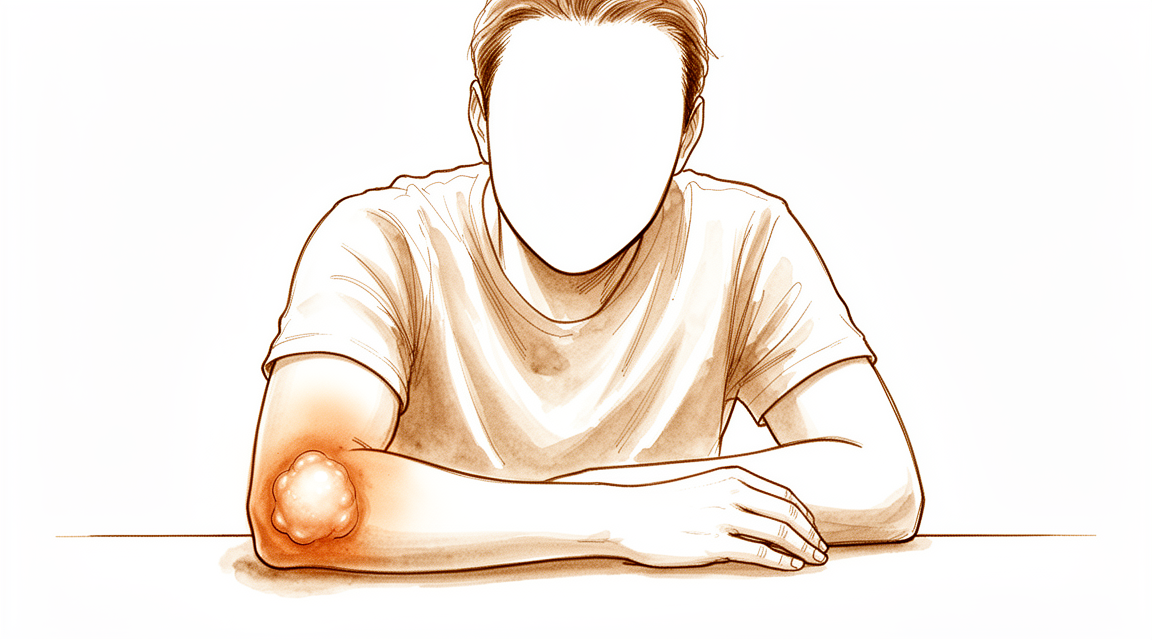
Olecranon bursitis means the small cushioning sac at the point of your elbow has become swollen. That sac, called the bursa, normally lets skin glide smoothly over the bone. When it flares up, you notice a soft, sometimes tender lump right over the tip of the elbow.
The swelling is usually the thing you see first. It can come up quickly over a day or two, or slowly over weeks. Leaning on that elbow makes it worse, so desk work, resting your arm on a chair arm, or sleeping with the elbow bent under you can all aggravate it. Many people find it aches at night, especially if they sleep on that side. Straightening the arm out and taking pressure off the point of the elbow tends to settle it.
Everyday tasks that bend the elbow against resistance or press on the tip become awkward. Pushing yourself up from a low chair, loading the dishwasher, carrying shopping bags against your forearm, or resting your elbow on a table while you read can all be uncomfortable. Reaching overhead may pull on the swollen area too.
The swelling itself is not always simple wear and tear. Sometimes it comes from an infection in the sac, which usually makes the skin over the elbow red, warm and more painful. Sometimes it comes from crystals in the joint, a condition called gout, especially if you have had similar attacks before or the other elbow is affected as well. Swelling here can also be linked with inflammatory joint conditions such as rheumatoid arthritis, which typically affects several joints on both sides of the body at once.
Because these causes can look alike, it is not always easy to tell them apart from the outside. If your elbow is hot, red or very painful, or the swelling has hung around for weeks without settling, it is worth having it looked at properly so the right treatment can be started.
What's actually happening
At the tip of your elbow sits a small sac of fluid called the bursa. Think of it as a thin cushion, like a padded pouch between the skin and the bone. Its job is to let the skin slide smoothly over the bone every time you bend or straighten your arm.
With olecranon bursitis, that cushion becomes inflamed and swells up with extra fluid. This usually happens after repeated small knocks or pressure on the point of the elbow, the kind that comes from leaning on hard surfaces day after day. The sac can also simply enlarge from friction over time. The lump you can see and feel is the swollen sac itself, and the tenderness comes from the inflamed tissue around it.
Sometimes the swelling is not just irritation. The sac can become infected, which is why an infected bursa tends to be hot, red and more painful than one that is merely inflamed. Crystals from gout can settle in the sac, and inflammatory conditions such as rheumatoid arthritis can cause swelling and small firm lumps over the same spot. Because these causes look so similar from the outside, telling them apart can take a proper examination.
The bone at the tip of the elbow, called the olecranon, sits just under the skin with very little padding around it. That exposed position is exactly why it picks up knocks so easily, and why the bursa above it takes so much of the wear. The same bone also anchors the tendon of the muscle at the back of your arm, the one that straightens your elbow, so problems around this small area can affect how the whole elbow feels and moves.
What we can do about it
Dr Kieran Hirpara, an upper-limb surgeon at Mater Private Hospital Rockhampton, starts with the least invasive options that suit your condition. Patients are generally referred to our clinic by their GP; if a physiotherapist has suggested you see us, you will still need a referral from your GP in order to be eligible for the Medicare rebate. At your first visit we take a history, examine your elbow and arrange imaging such as ultrasound or MRI scans if it will help. An MRI scan uses magnets to build detailed pictures of the soft tissues, and it is good at showing how swollen the sac is and how much fluid it holds. Imaging can also pick up other problems hiding behind the swelling, which matters because different causes need different treatment.
For most long-standing cases, we begin with simple supportive care. That means ice, compression with a bandage or sleeve, protective padding over the point of the elbow, and changing the activities that keep aggravating it. Taking pressure off the tip of the elbow is often the single most useful change you can make. Physiotherapy aims to settle the irritation and rebuild comfortable movement without provoking the swelling. We give this approach a fair trial before thinking about anything further, because non-operative care works well for most people and avoids the risks that come with needles or surgery.
If the sac is infected, we treat that infection directly. Uncomplicated infection in this sac can usually be settled with medication alone, without needing the sac removed. We also keep a close eye on people with rheumatoid arthritis, because the elbow joint itself can occasionally be involved at the same time as the bursa, and that changes the treatment.
Surgery is not our usual first move for this condition. Most surgeons hold off on operating early, because a wound over this prominent bone can be slow to heal and can sometimes leave a sinus, a small channel that keeps draining. When non-operative care has not given enough improvement and the swelling keeps coming back, we consider removing the inflamed sac, an operation called bursectomy. Where suitable, we can do this through a few small cuts using a tiny camera, an approach called endoscopic surgery. That avoids a long wound directly over the sensitive point of the elbow. Whether surgery is right for you is a decision we make together, weighing what you want to get back to against what each option involves.
What to expect
For most people, this swelling settles with simple care. Taking pressure off the point of your elbow, protecting it with padding and easing back on aggravating activities gives the sac a chance to calm down. Non-operative treatment is generally more effective and safer than surgery for this condition, and most people never need an operation. If the sac is infected but the infection is straightforward, treating it with medication alone usually works, and the swelling can often be managed without draining it or removing the sac.
Without that care, or if the same pressures keep up, the swelling tends to persist or keep coming back. Some people find it hangs around for weeks without settling. If your elbow stays swollen for a long time, it is worth having it reassessed, because a swelling that will not settle can occasionally point to a less common cause that needs its own treatment.
When non-operative care has had a fair go and the swelling still keeps returning, surgery to remove the inflamed sac becomes an option. It is a decision not taken lightly, and it is usually held back until simpler measures have failed. Where surgery is done for this stubborn type of swelling, people tend to see real improvement in how their elbow feels and functions. Removing the sac through a few small cuts with a tiny camera has been associated with minimal postoperative pain and rapid recovery, with no recurrences or wound-healing complications needing a return to theatre in the patients reported. Even so, surgery here is not foolproof: about 11.5% of people who have the sac removed need a further operation later on. There is also a small chance the swelling comes back even after surgery.
Recovery after surgery is usually straightforward, but a wound over this bony point can be slow to heal, which is one reason surgeons prefer to avoid operating early. Most people get back to comfortable, everyday use of the elbow within weeks rather than months. Your surgeon will talk you through what recovery would look like for you if surgery ever becomes part of the plan.
When to see someone
Most swelling over the point of the elbow settles with rest and simple care. See your GP if the lump keeps growing, or if it has not settled after a few weeks of taking pressure off the elbow.
Some causes need to be sorted out quickly. Go to an emergency department if the skin over the elbow is hot, red and very painful, because that can mean the sac is infected and infection here needs same-day assessment. Ask for a specialist review if you have had gout attacks before, if the other elbow is swollen as well, or if several joints on both sides of your body are affected, since these point towards gout or an inflammatory condition such as rheumatoid arthritis rather than simple irritation. Telling an infection from gout can be difficult from the outside, so do not try to work it out yourself.
In more depth
Advanced reading: the deeper science (optional)
This section goes further than you need for your own treatment decisions. Olecranon bursitis is worth the extra reading because two of the things most instinctively done about it, draining the swelling with a needle, and injecting steroid into it, have evidence against them.
Draining it can be the thing that causes the problem
The intuition is strong: there is fluid, so remove the fluid. The trial data point the other way. In a comparison of management strategies for uncomplicated septic olecranon bursitis, empirical treatment without aspiration was effective, with no patients requiring bursectomy, while in the traditional aspiration group, 8 of 11 patients went on to need surgical removal of the bursa [1].
That is a striking difference from a small series, and it should be read with that caution. But the mechanism is not mysterious. The bursa sits directly under thin skin over a bony point that takes every knock and every lean on a desk. Putting a needle through that skin creates a tract, and a tract over a pressure point is slow to seal and can keep discharging.
The general reviews agree on direction. Based primarily on level IV evidence, non-surgical management is significantly more effective and safer than surgical management [2].
Steroid injection carries risk without improving the outcome
This one is stated unusually plainly in the literature. For aseptic bursitis, corticosteroid injection is associated with significant risks without improving the outcome [2].
The risks are specific to the site: skin atrophy and depigmentation over a subcutaneous bony prominence, and infection introduced into a space that is difficult to clear. Elsewhere in the upper limb a steroid injection is a reasonable step when simpler measures fail. Here the evidence does not support it, and that difference is worth knowing if it is offered.
Surgery is a genuine last resort, with a measurable failure rate
Where bursectomy is performed, it does not reliably end the story. The revision rate after bursectomy was 11.5%, and revision was more frequent in patients with rheumatoid arthritis, diabetes, a history of bursitis on either elbow, and in women [3].
Those risk factors describe the situations in which the bursa is likely to reform: an inflammatory or metabolic driver that surgery does not remove, or a demonstrated tendency of that individual's tissue to produce the problem. For recurrent cases, intrabursal doxycycline sclerotherapy, deliberately scarring the space closed rather than excising it, has been described as an alternative in a series of 45 elbows [4].
What actually settles it
The unglamorous answer is protection and time. Because the bursa is irritated mechanically by pressure on the point of the elbow, the treatment that addresses the cause is removing that pressure: padding, and changing the habit of resting on the elbow, sustained for longer than feels necessary. Most cases settle [5], and the interventions above are largely attempts to shorten a course that resolves anyway, which is precisely why an intervention carrying its own risk needs to clear a high bar here.
References for the advanced reading
- Deal JB, Vaslow AS, Bickley RJ, Verwiebe EG, Ryan PM. Empirical treatment of uncomplicated septic olecranon bursitis without aspiration. J Hand Surg Am. 2020;45(1):20-5.
- Sayegh ET, Strauch RJ. Treatment of olecranon bursitis: a systematic review. Arch Orthop Trauma Surg. 2014;134(11):1517-36.
- Germawi L, Westenberg RF, Wang F, Schep NW, Chen NC, Eberlin KR. Factors associated with revision surgery for olecranon bursitis after bursectomy. J Shoulder Elbow Surg. 2021;30(5):1135-41.
- McDermott D, Wakefield D, Kowalsky M, Sethi P, Vitale MA, Morrey BF. Intrabursal doxycycline sclerotherapy for recurrent olecranon bursitis of the elbow. J Hand Surg Glob Online. 2024;6(4):504-9.
- Nchinda NN, Wolf JM. Clinical management of olecranon bursitis: a review. J Hand Surg Am. 2021;46(6):501-6.
Evidence & references
This is the clinical evidence summary written for health professionals. It is technical, and it lists the research this page was built from. You do not need to read it to understand your treatment or to make a decision about it.
Overview
- Surgical resection of a chronic olecranon bursitis should not be considered lightly [1].
- The revision rate after bursectomy for olecranon bursitis was 11.5% [2].
- The operation appears to give satisfactory results for chronic olecranon bursitis [3].
- Based primarily on level IV evidence, nonsurgical management of olecranon bursitis is significantly more effective and safer than surgical management [4].
- Nontuberculous mycobacterial olecranon bursitis should be considered in any patient with a swollen bursa and protracted course, regardless of immune status [5].
- Patients who underwent endoscopic olecranon bursectomy experienced no recurrences or wound-healing complications necessitating return to the operating room [6].
- Empirical management of uncomplicated septic olecranon bursitis was found to be effective with no patients requiring bursectomy [7].
- In the traditional aspiration group for uncomplicated septic olecranon bursitis, 8 of 11 patients required bursectomy [7].
- Intrabursal doxycycline sclerotherapy may be an effective alternative to surgical bursectomy for patients with recurrent olecranon bursitis refractory to conservative management [8].
- Patients with refractory olecranon bursitis, particularly if aseptic, tend to gain significant physical health benefits from open bursectomy [9].
- Endoscopic bursectomies are a useful treatment option for patients with recalcitrant olecranon bursitis [10].
- Bursal suture repair is a viable alternative to bursectomy in selected patients with chronic traumatic olecranon bursitis [11].
- Bursal suture repair combines functional and cosmetic benefits in selected patients with chronic traumatic olecranon bursitis [11].
- Deferring aspiration in uncomplicated septic olecranon bursitis is a reasonable treatment option [16].
Anatomy & Pathophysiology
Bony Anatomy
- The olecranon and the coronoid process form the greater sigmoid notch, which articulates with the trochlea of the distal humerus [19].
- The intrinsic anatomy of the greater sigmoid notch allows flexion/extension movement of the elbow joint and provides stability for the elbow [19].
- The olecranon serves as the insertion for the triceps tendon, which blends with the periosteum of the proximal ulna [19].
- The exposed position of the olecranon renders it vulnerable to direct trauma and violent muscular contractions from the triceps [19].
- In children, the olecranon is predominantly cartilage, particularly in younger children, which reduces the chance of fracture occurring with a direct blow [20].
- The thick periosteum and relatively thin metaphyseal cortex of the olecranon in children predispose it to minimally displaced greenstick fractures [20].
Pathophysiology
- Olecranon bursitis is a condition where the bursal cavity, superficial to the olecranon, becomes inflamed [13].
- Olecranon bursitis can occur with or without infection [13].
- Olecranon bursitis is often predisposed by repeated minor trauma from external pressure [13].
- The olecranon bursa sometimes becomes enlarged as a result of pressure or friction [27].
- When the olecranon bursa is painful, the cause is more likely to be infection, gout, or rheumatoid arthritis [27].
- Gout is suspected in olecranon bursitis if there is a history of previous attacks, if the condition is bilateral, if there are tophi, or if X-ray shows calcification in the bursa [27].
- Rheumatoid arthritis causes both swelling and nodularity over the olecranon [27].
- In almost all cases of rheumatoid arthritis affecting the olecranon, it is associated with a typical symmetrical polyarthritis [27].
- In the late stages of rheumatoid arthritis, erosion of the elbow joint may cause marked instability [27].
Classification
- Olecranon bursitis has been given pseudonyms relating to the repeated minor trauma from external pressure that often predisposes [13].
- Traumatic lesions of the olecranon bursa are common injuries associated with a high risk of complications [14].
Clinical Presentation
- Olecranon bursitis is a common condition where the bursal cavity, superficial to the olecranon, becomes inflamed [13].
- Olecranon bursitis can occur either with or without infection [13].
- Due to multiple aetiologies, olecranon bursitis can present to any medical specialty with reasonable frequency [13].
- When the olecranon bursa is also painful, the cause is more likely to be infection, gout, or rheumatoid arthritis [27].
- Gout is suspected if there is a history of previous attacks, if the condition is bilateral, if there are tophi, or if X-ray shows calcification in the bursa [27].
- In almost all cases of rheumatoid arthritis-associated olecranon bursitis, the condition is associated with a typical symmetrical polyarthritis [27].
- Pyoderma gangrenosum must be considered in the differential diagnosis whenever a patient presents with ulcerative cutaneous lesions that resemble an infectious process such as olecranon bursitis [38].
Investigations
- MR imaging is probably the method of choice for determining both the development of the bursae and their fluid content [44].
Treatment
Non-Operative Management
- The first treatment line for olecranon bursitis is conservative, including ice, rest, anti-inflammatory and analgesic drugs and, occasionally, bursal fluid aspiration [25].
- More recent literature demonstrates adverse effects of intrabursal injections and surgery compared with noninvasive management for initial treatment of nonseptic olecranon bursitis [18].
- Hydrothermal ablation at temperatures between 50C and 52C is a safe treatment option for recurrent or chronic olecranon bursitis [34].
- Hydrothermal ablation for recurrent or chronic olecranon bursitis has fewer complications than open bursectomy and comparable efficacy [34].
Operative Management
- Open bursectomy appears to give satisfactory results for chronic olecranon bursitis [3].
- Endoscopic olecranon bursectomy provides a satisfactory view with less morbidity than the open method while avoiding a wound over the sensitive point of the olecranon [15].
- Bursal suture repair is a viable alternative to bursectomy in selected patients with chronic traumatic olecranon bursitis, combining functional and cosmetic benefits [11].
- Excision has been curative for all lesions of the olecranon bursa, whereas multiple medications have been tried for cutaneous and systemic infections without clear-cut success [17].
Surgical Complications and Outcomes
- More recent literature demonstrates adverse effects of surgery compared with noninvasive management for initial treatment of nonseptic olecranon bursitis [18].
- Surgeons are reluctant to perform surgical excision as first-line treatment for chronic olecranon bursitis due to the fear of causing a chronic draining sinus or infection [45].
Infection and Atypical Etiologies
Recovery
- Nonsurgical management of olecranon bursitis is significantly more effective and safer than surgical management [4].
- 8 of 11 patients in the traditional aspiration group required bursectomy [7].
- Bursal suture repair combines functional and cosmetic benefits [11].
- The extrabursal endoscopic approach provides a satisfactory view with less morbidity than the open method [15].
- The extrabursal endoscopic approach avoids a wound over the sensitive point of the olecranon [15].
- Excision has been curative for all lesions of the olecranon bursa [17].
- Multiple medications have been tried for cutaneous and systemic infections without clear-cut success [17].
Key Evidence
- [L3] The revision rate after bursectomy for olecranon bursitis was 11.5%. [2] (10.1016/j.jse.2020.09.033)
- [L4] The operation appears to give satisfactory results for chronic olecranon bursitis. [3] (10.1016/s0020-1383(77)80050-8)
- [L4] Based primarily on level IV evidence, nonsurgical management of olecranon bursitis is significantly more effective and safer than surgical management. [4] (10.1007/s00402-014-2088-3)
- [L4] Nontuberculous mycobacterial olecranon bursitis should be considered in any patient with a swollen bursa and protracted course, regardless of immune status. [5] (10.1016/j.jse.2008.07.009)
- [L4] In this population, patients who underwent endoscopic olecranon bursectomy experienced no recurrences or wound-healing complications necessitating return to the operating room. [6] (10.1016/j.asmr.2023.100832)
- [L4] Empirical management of uncomplicated septic olecranon bursitis was found to be effective with no patients requiring bursectomy, whereas 8 of 11 patients in the traditional aspiration group required bursectomy. [7] (10.1016/j.jhsa.2019.06.012)
- [L4] This may be an effective alternative to surgical bursectomy for patients with recurrent olecranon bursitis refractory to conservative management. [8] (10.1016/j.jhsg.2024.03.006)
- [L4] Patients with refractory olecranon bursitis, particularly if aseptic, tend to gain significant physical health benefits from open bursectomy. [9] (10.7759/cureus.43696)
- [L5] Endoscopic bursectomies are a useful treatment option for patients with recalcitrant olecranon bursitis. [10] (10.1016/j.eats.2023.09.004)
- [L5] Bursal suture repair is a viable alternative to bursectomy in selected patients with chronic traumatic olecranon bursitis, combining functional and cosmetic benefits. [11] (10.1016/j.xrrt.2025.100597)
- [L4] [13] (10.1177/1758573214532787)
- [Paper] Traumatic lesions of the olecranon bursa or prepatellar bursa are common injuries associated with a high risk of complications. [14] (10.1007/s00402-017-2690-2)
- [L4] This approach provides a satisfactory view with less morbidity than the open method while avoiding a wound over the sensitive point of the olecranon. [15] (10.1097/bth.0b013e31829c0535)
- [L4] Deferring aspiration in uncomplicated septic olecranon bursitis is a reasonable treatment option. [16] (10.1016/j.jhsa.2018.06.059)
- [Case_report] Excision has been curative for all lesions of the olecranon bursa, whereas multiple medications have been tried for cutaneous and systemic infections without clear-cut success. [17] (10.2106/00004623-198062050-00024)
- [L5] Older studies showed resolution with injections and surgery, but more recent literature demonstrates adverse effects of intrabursal injections and surgery compared with noninvasive management for initial treatment of nonseptic olecranon bursitis. [18] (10.1016/j.jhsa.2021.02.006)
- [L4] The first treatment line for olecranon bursitis is conservative, including ice, rest, anti-inflammatory and analgesic drugs and, occasionally, bursal fluid aspiration. [25] (10.1016/j.surge.2012.02.002)
- [L4] Hydrothermal ablation at temperatures between 50C and 52C is a safe treatment option for recurrent or chronic olecranon bursitis with fewer complications than open bursectomy and a comparable efficacy. [34] (10.1016/j.jse.2024.03.021)
- [Case_report] PG must be considered in the differential diagnosis whenever a patient presents with ulcerative cutaneous lesions that resemble an infectious process such as olecranon bursitis. [38] (10.1016/j.jse.2014.06.032)
- [L4] MR imaging is probably the method of choice for determining both the development of the bursae and their fluid content. [44] (10.1007/s002560050117)
- [L3] [45] (10.1016/j.jhsa.2010.12.030)
References
[1] Complications following resection of the olecranon bursa. Acta Orthopaedica Belgica. 2006.
[2] Factors associated with revision surgery for olecranon bursitis after bursectomy. Journal of Shoulder and Elbow Surgery. 2021. DOI: 10.1016/j.jse.2020.09.033
[3] A useful procedure in the treatment of chronic olecranon bursitis. Injury. 1977. DOI: 10.1016/s0020-1383(77)80050-8
[4] Treatment of olecranon bursitis: a systematic review. Archives of Orthopaedic and Trauma Surgery. 2014. DOI: 10.1007/s00402-014-2088-3
[5] Nontuberculous mycobacterial olecranon bursitis: Case reports and literature review. Journal of Shoulder and Elbow Surgery. 2009. DOI: 10.1016/j.jse.2008.07.009
[6] No Wound Healing Complications or Recurrences Were Seen and a High Level of Satisfaction Was Reported in Patients Who Underwent Endoscopic Olecranon Bursectomy for Recalcitrant Olecranon Bursitis. Arthroscopy, Sports Medicine, and Rehabilitation. 2024. DOI: 10.1016/j.asmr.2023.100832
[7] Empirical Treatment of Uncomplicated Septic Olecranon Bursitis Without Aspiration. The Journal of Hand Surgery. 2020. DOI: 10.1016/j.jhsa.2019.06.012
[8] Intrabursal Doxycycline Sclerotherapy for Recurrent Olecranon Bursitis of the Elbow: A Case Control Study. Journal of Hand Surgery Global Online. 2024. DOI: 10.1016/j.jhsg.2024.03.006
[9] Clinical Outcomes Following Open Olecranon Bursa Excision for Septic and Aseptic Olecranon Bursitis: An Observational Study. Cureus. 2023. DOI: 10.7759/cureus.43696
[10] Endoscopic Olecranon Bursectomy in the Treatment of Recalcitrant Olecranon Bursitis: Patient Selection and Operative Technique. Arthroscopy Techniques. 2023. DOI: 10.1016/j.eats.2023.09.004
[11] Olecranon bursal repair for chronic traumatic bursitis: a surgical technique. JSES Reviews, Reports, and Techniques. 2026. DOI: 10.1016/j.xrrt.2025.100597
[13] Olecranon bursitis: a systematic overview. Shoulder & Elbow. 2014. DOI: 10.1177/1758573214532787
[14] Treatment and outcome with traumatic lesions of the olecranon and prepatellar bursa: a literature review apropos a retrospective analysis including 552 cases. Archives of Orthopaedic and Trauma Surgery. 2017. DOI: 10.1007/s00402-017-2690-2
[15] Olecranon Extrabursal Endoscopic Bursectomy. Techniques in Hand & Upper Extremity Surgery. 2013. DOI: 10.1097/bth.0b013e31829c0535
[16] Empiric Treatment of Uncomplicated Septic Olecranon Bursitis Without Aspiration. The Journal of Hand Surgery. 2018. DOI: 10.1016/j.jhsa.2018.06.059
[17] Protothecal olecranon bursitis. A case report and review of the literature.. The Journal of Bone & Joint Surgery. 1980. DOI: 10.2106/00004623-198062050-00024
[18] Clinical Management of Olecranon Bursitis: A Review. The Journal of Hand Surgery. 2021. DOI: 10.1016/j.jhsa.2021.02.006
[19] Aaos Comprehensive Orthopaedic Review 3. Fractures of the Elbow > II. Olecranon Fractures.
[20] Tachdjian S Pediatric Orthopaedics From The Texas Scottish Rite Hospital For Children E Book. Pigmented Villonodular Synovitis and Giant Cell Tumor of the Tendon Sheath > Olecranon Fractures.
[25] Diagnosis and management of olecranon bursitis. The Surgeon. 2012. DOI: 10.1016/j.surge.2012.02.002
[27] Apley And Solomon S Concise System Of Orthopaedics And Trauma. OLECRANON BURSITIS.
[34] Hydrothermal ablation in recurrent or chronic olecranon bursitis: a prospective study. Journal of Shoulder and Elbow Surgery. 2024. DOI: 10.1016/j.jse.2024.03.021
[38] Case report: misdiagnosed olecranon bursitis: pyoderma gangrenosum. Journal of Shoulder and Elbow Surgery. 2014. DOI: 10.1016/j.jse.2014.06.032
[44] The US,CT and MR findings of cubital bursitis: a report of five cases. Skeletal Radiology. 1996. DOI: 10.1007/s002560050117
[45] Chronic Olecranon Bursitis. The Journal of Hand Surgery. 2011. DOI: 10.1016/j.jhsa.2010.12.030