O que você está sentindo
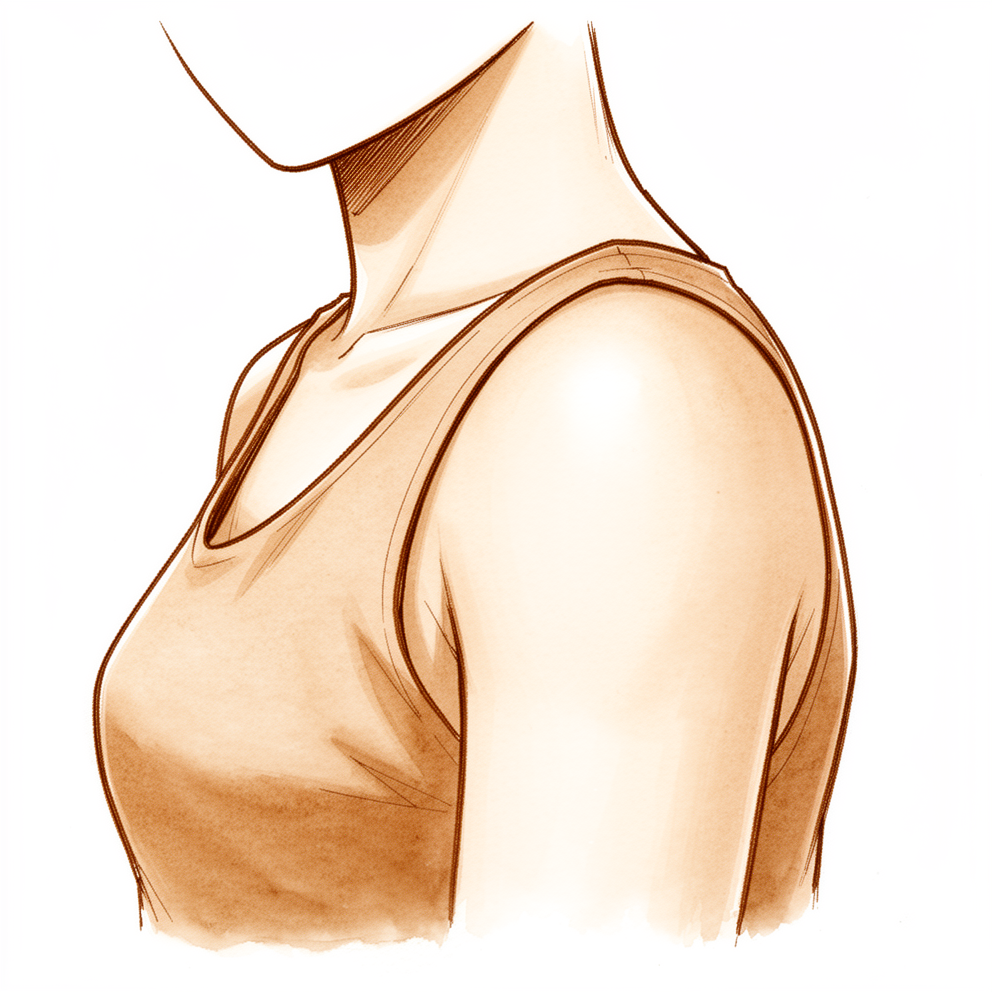
Discinesia escapular significa que a sua escápula (a omoplata) fica posicionada ou se move de forma diferente do normal quando você levanta e abaixa o braço. É um sinal de um problema no ombro, e não uma condição em si. Você pode notar a borda interna da escápula saltando para fora, principalmente quando levanta o braço. A escápula pode subir cedo demais, ou se elevar em direção à orelha, em vez de deslizar suavemente.
A dor geralmente fica ao redor da parte de cima do ombro e na própria escápula. Muitas pessoas também sentem uma dor na lateral do pescoço, onde fica o músculo trapézio. Levantar o braço acima da cabeça costuma piorar a dor. Alcançar uma prateleira alta, estender roupa no varal ou levantar algo até um suporte pode ser difícil. Dormir sobre esse lado muitas vezes dói, e a dor pode acordar você à noite. O ombro pode ficar mais rígido ao acordar e se soltar à medida que você se movimenta.
O problema da escápula muitas vezes aparece junto com outros problemas do ombro, como o impacto (pinçamento dos tendões na parte de cima do ombro), as rupturas do manguito rotador, a instabilidade ou uma fratura da clavícula. Muitas vezes não está claro se ele causa a dor ou se é a resposta do seu corpo a ela. Também é comum em pessoas sem nenhuma dor, incluindo atletas que fazem arremessos ou levantam peso acima da cabeça.
Se os seus sintomas não estiverem melhorando, estiverem piorando ao longo de semanas, acordarem você à noite ou impedirem você de trabalhar ou de usar o braço, procure o seu médico de família ou peça uma avaliação com um especialista. Se a dor se espalhar pelo braço com dormência, formigamento ou fraqueza, procure o seu médico para que o pescoço e os nervos sejam examinados.
O que está realmente acontecendo
A sua escápula não está presa às costelas por uma articulação. Ela desliza sobre a parte de trás da parede do tórax em uma fina camada de tecido escorregadio, um pouco como uma gaveta deslizando nos trilhos. Ela é mantida no lugar e movimentada inteiramente por músculos, incluindo o trapézio, na parte de trás do pescoço e do ombro, e o serrátil anterior, na lateral das costelas.
Quando você levanta o braço, a parte em forma de bola do ombro faz a maior parte do movimento, mas a escápula deve girar para cima e inclinar-se para trás ao mesmo tempo. Pense nela como uma plataforma estável que se desloca para o lado à medida que o braço sobe. Esse movimento levanta o teto ósseo sobre o ombro, para que os tendões que ficam embaixo tenham espaço para deslizar sem serem pinçados. Cerca de dois terços do movimento de levantar o braço vêm da própria articulação do ombro, e cerca de um terço vem da escápula.
Quando esse trabalho em equipe falha, a escápula pode ficar muito para a frente, não girar para cima ou se elevar em vez de deslizar. O teto sobre o ombro então não sobe o suficiente, e os tendões que ficam embaixo podem ser comprimidos quando você levanta o braço. Essa compressão é o que produz a dor que você sente na parte de cima do ombro e ao redor da escápula.
Vale a pena saber que isso é um sinal, e não uma doença em si. Muitas vezes aparece junto com outros problemas do ombro, como tendões pinçados, tendões rompidos, um ombro frouxo ou uma clavícula quebrada. Às vezes, o problema da escápula ajuda a causar esses problemas. Às vezes, é simplesmente a forma de o seu corpo proteger um ombro dolorido, assim como você manca para poupar um tornozelo dolorido. Muitas vezes não está claro o que veio primeiro. Também é comum em pessoas sem nenhuma dor, por isso uma escápula com aparência estranha, por si só, não significa que o seu ombro esteja lesionado.
O que podemos fazer a respeito
O Dr. Kieran Hirpara, cirurgião de membros superiores no Mater Private Hospital Rockhampton, começa pelas opções menos invasivas adequadas ao seu quadro clínico. Para a maioria das pessoas, isso significa fisioterapia, que é o principal tratamento para este problema. O seu fisioterapeuta define o programa. Ele trabalha o controle e a força dos músculos ao redor da escápula, alonga os músculos tensos da parte da frente do tórax e avalia a sua postura. O objetivo é restaurar uma posição e um movimento normais da escápula, para que ela fique estável enquanto você usa o braço acima da cabeça. O exercício ajuda na dor e na função. Como os problemas musculares de cada pessoa são diferentes, o seu fisioterapeuta adapta os objetivos e os exercícios ao que encontrar quando examinar você. Paralelamente, tratamos o problema do ombro que veio junto, como tendões pinçados ou um tendão rompido. Em geral, os pacientes são encaminhados à nossa clínica pelo médico de família; caso um fisioterapeuta tenha sugerido que você nos procure, ainda assim será necessário um encaminhamento do seu médico de família para que você tenha direito ao reembolso do Medicare.
A cirurgia é direcionada ao problema de base do ombro, e não à escápula em si. Se os seus sintomas persistirem apesar da fisioterapia, reavaliamos você. Dependendo dos seus sintomas e do exame, isso pode incluir uma ultrassonografia ou uma ressonância magnética para verificar um reparo, exames dos nervos ou uma avaliação do pescoço.
O que esperar
Não existe um prazo único para este problema, porque ele é um sinal de um problema no ombro, e não uma condição em si. Quanto tempo ele dura depende em grande parte do problema do ombro que veio junto. Algumas pessoas percebem que o movimento estranho da escápula melhora à medida que a dor no ombro melhora. Em outras, ele persiste, ou vai e volta, mesmo depois que a dor diminui.
Se você for bem acompanhado, o quadro habitual é de progresso constante ao longo de semanas a meses, e não uma solução repentina. A fisioterapia atua na dor e no funcionamento do ombro, e é isso que a maioria das pessoas percebe primeiro. O movimento da própria escápula tende a mudar mais lentamente do que a dor. Após uma cirurgia do ombro, incluindo o reparo do manguito rotador, a escápula muitas vezes se move de forma anormal antes e depois da operação. Ela geralmente melhora ao longo de meses, à medida que o ombro se recupera, mas pode não ter voltado totalmente ao normal em um ano. Seis meses de reabilitação após um reparo do manguito muitas vezes também não são suficientes para normalizá-la por completo. As pessoas cujo movimento da escápula continua anormal tendem a ter resultados um pouco piores do que aquelas cujo movimento se recupera.
É honesto dizer que as evidências aqui são mistas. O exercício ajuda de forma confiável na dor e na função, mas não está tão claro se ele muda a forma como a escápula em si se move. Alguns padrões de movimento anormal melhoram após a cirurgia do problema de base, e as pessoas cujo movimento se recupera tendem a ter uma função melhor. Em outras, o padrão persiste sem prejuízo evidente. Também é comum em pessoas sem nenhum sintoma, por isso uma escápula com aparência estranha, por si só, não significa que o seu ombro esteja piorando.
Não tratar geralmente não torna a situação perigosa, mas também não faz a dor desaparecer. Se os seus sintomas não estiverem melhorando, estiverem piorando ao longo de semanas, acordarem você à noite ou impedirem você de trabalhar ou de usar o braço, procure o seu médico de família ou peça uma avaliação com um especialista. Se a dor se espalhar pelo braço com dormência, formigamento ou fraqueza, procure o seu médico para que o pescoço e os nervos sejam examinados.
Quando procurar um especialista
A maioria dos problemas da escápula não é urgente. Mas alguns sinais indicam que é hora de buscar ajuda, em vez de continuar esperando.
Procure o seu médico de família se os seus sintomas não estiverem melhorando, estiverem piorando ao longo de semanas, acordarem você à noite ou impedirem você de trabalhar ou de usar o braço. Peça uma avaliação com um especialista se a borda interna da escápula continuar saltando para fora, ou se a elevação do ombro (como se você estivesse dando de ombros) ao levantar o braço não melhorar com repouso.
Uma dor que se espalha pelo braço com dormência, formigamento ou fraqueza indica um problema no pescoço ou em um nervo, e não na escápula. Procure o seu médico para que isso seja examinado.
Se uma escápula que se afasta do tórax surgir de repente, principalmente com dor ou fraqueza, peça ao seu médico de família uma avaliação logo, em vez de esperar semanas.
Em maior profundidade
Advanced reading: the deeper science (optional)
Esta seção vai além do que você precisa saber para tomar decisões sobre o seu próprio tratamento. A discinesia escapular merece essa leitura adicional porque é muito mal compreendida: é comum em pessoas sem sintomas, raramente explica um problema do ombro por si só e, após uma cirurgia do ombro, melhora mais lentamente do que o próprio ombro.
Um sinal, não um diagnóstico
O consenso internacional da "scapular summit" descreve a discinesia escapular como uma alteração na posição de repouso ou no movimento da escápula, presente em uma grande proporção das lesões do ombro. Ele também conclui que o seu papel exato em causar ou agravar problemas do ombro não está claramente definido e que ela é mais bem entendida como um possível comprometimento da função do ombro do que como um diagnóstico [1]. Uma revisão anterior a chamou de resposta inespecífica a um ombro dolorido, e não de característica de uma condição específica [2].
Ela também é comum sem sintomas. Em 12 estudos com 1.401 atletas, ela foi relatada em 61% dos atletas que fazem movimentos acima da cabeça e em 33% dos demais [3]. É duvidoso que ela preveja lesões: em uma meta-análise de 923 atletas acompanhados de forma prospectiva, ela estava presente em 46% e não aumentou significativamente o risco de uma lesão posterior no ombro (razão de risco 1,07, IC 95% 0,85 a 1,34) [4].
Como ela é avaliada, e os limites dos testes
O teste clínico habitual é observar a escápula por trás enquanto a pessoa levanta e abaixa os braços várias vezes, muitas vezes segurando pesos leves, e classificar o movimento como normal ou anormal [5]. A concordância entre examinadores é moderada a boa: em 40 pacientes com impacto, o kappa entre dois avaliadores foi de 0,59 (86% de concordância). No mesmo estudo, as pessoas com e sem discinesia não diferiram nas pontuações do ombro no início nem aos três meses [6]. É por isso que os cirurgiões tratam um teste positivo como uma parte do exame, e não como um diagnóstico.
A escápula alada causada por lesão de um nervo é um problema diferente. Em 96 pacientes com escápula alada por fraqueza do serrátil anterior comprovada em exames dos nervos, 88% tinham uma lesão do nervo torácico longo, na maioria das vezes por amiotrofia nevrálgica (47) ou trauma (33). Entre os que tinham amiotrofia nevrálgica, 22 se recuperaram sem tratamento em até três anos, mas nenhum se recuperou totalmente quando a escápula alada já durava mais de três anos [7].
Rupturas do manguito rotador: causa ou consequência?
Uma revisão sistemática de 16 estudos (335 rupturas) constatou que a escápula se move de forma anormal em todos os estudos de rupturas do manguito, mas sem um padrão consistente. As rupturas maiores mostraram mais alterações, e as rupturas dolorosas mais do que as indolores; as rupturas indolores não diferiram dos ombros saudáveis. A revisão não conseguiu dizer quais alterações são adaptativas e quais são prejudiciais [8]. Uma comparação encontrou menos rotação para cima da escápula, e mais trabalho do levantador da escápula, nas rupturas dolorosas do que nas indolores, com o trapézio superior mais ativo do que nos ombros saudáveis [9]. Em rupturas maciças que recuperaram o movimento com fisioterapia, exames de PET mostraram o levantador da escápula e os romboides trabalhando mais, o que é compatível com os músculos da escápula compensando o manguito [10].
O que acontece após o reparo do manguito rotador
Os estudos discordam, e essa discordância é a principal mensagem.
- Muitas vezes ela melhora. Em 35 pacientes avaliados com tomografia computadorizada antes e depois do reparo, 23 (66%) tinham discinesia antes. 12 dos 23 melhoraram após a cirurgia, principalmente o tipo com redução da inclinação para trás. A melhora acompanhou uma melhor elevação anterior e melhores pontuações de Constant, e nenhum reparo deixou de cicatrizar no grupo que melhorou [11].
- Ela pode se normalizar. Em 26 pacientes acompanhados com sensores eletromagnéticos por um ano, o movimento da escápula se aproximou do padrão do outro ombro, e a abdução melhorou 20° [12].
- Ela pode persistir. Em 21 pacientes medidos com sensores vestíveis aos 12 meses ou mais, o movimento e as pontuações de Constant melhoraram, mas o ritmo da escápula não mudou significativamente [13]. Em outro estudo pequeno, seis meses de reabilitação após o reparo não restauraram totalmente o movimento normal da escápula [14].
- Ela importa para o resultado. Em 48 pacientes acompanhados durante um ano de reabilitação após o reparo, a substituição pela escápula diminuiu, mas continuou maior do que no outro lado. Aqueles em quem o fisioterapeuta observou substituição tiveram pontuações piores, menos movimento e menos força em todos os momentos avaliados [15]. Em 110 pacientes de 6 a 18 meses após o reparo, a discinesia acompanhou uma função pior, e a resistência dos músculos da escápula previu o resultado [16].
Uma reabilitação direcionada pode mudar isso? Em 60 pacientes com discinesia após o reparo, acrescentar o fortalecimento dos músculos específicos da escápula que estavam fracos (identificados por eletromiografia) resultou em uma pontuação de Constant de 87,2 contra 83,9, e em uma elevação anterior de 137° contra 128°, às 16 semanas. Essa diferença é modesta, e o estudo não foi randomizado [17]. Uma meta-análise de 2026 constatou que a reabilitação direcionada à escápula reduziu a dor e melhorou a função ao longo de todo o tratamento do manguito rotador, mas as evidências pós-operatórias eram escassas demais para serem combinadas [18]. De modo mais amplo, o exercício ajuda de forma confiável na dor e na função no impacto [19], mas as evidências de que ele muda o movimento da própria escápula são conflitantes [20].
Um estudo em animais levantou a possibilidade de que uma escápula que se move de forma anormal possa prejudicar a cicatrização de um tendão reparado: em ratos, cortar os nervos que controlam a escápula antes de um reparo do supraespinal resultou em reparos mais fracos e menos organizados [21]. Isso não foi demonstrado em pessoas.
Após outras operações do ombro
- Latarjet. A discinesia foi observada em 5 de 20 pacientes após uma cirurgia de Latarjet e em nenhum de 20 após uma estabilização com enxerto ósseo que não mexe no coracoide. Aqueles com discinesia tiveram pontuações menores [22]. Uma série posterior a encontrou em 25% após a operação padrão e em nenhum de 20 pacientes após o peitoral menor ser reinserido no coracoide. 4 dos 5 casos melhoraram com seis meses de reabilitação específica [23].
- Prótese do ombro. Após a prótese reversa, a escápula faz mais do trabalho de levantar o braço do que em um ombro normal (uma meta-análise de 464 pacientes) [24]. Em 85 próteses anatômicas e reversas, uma maior contribuição da escápula após a cirurgia acompanhou mais dor e uma função pior [25].
- Clavícula e articulação acromioclavicular (AC). A discinesia foi encontrada em 9 de 24 pessoas após uma fratura desviada da clavícula, e elas tinham mais dor e pontuações piores. Ela foi observada em 1 de 12 tratados com cirurgia e em 8 de 12 tratados sem cirurgia [26]. Após a cirurgia para luxação aguda da articulação AC, ela foi observada em 4 de 34 [27].
Dor no trapézio e a elevação do ombro
Há muito pouca pesquisa sobre a dor no trapézio ou na lateral do pescoço após uma cirurgia do ombro. Nenhum estudo mediu com que frequência isso acontece. A evidência mais próxima é o "sinal do encolher de ombros", em que toda a cintura escapular se eleva quando o braço é levantado. Em 982 pacientes consecutivos examinados antes da cirurgia, ele estava presente em 51%, com mais frequência no ombro congelado (95%). Ele acompanhou rigidez, fraqueza e dor noturna, e não foi específico de uma ruptura do manguito [28]. Isso é compatível com uma explicação simples para a dor no trapézio enquanto o ombro se recupera: os músculos que elevam a escápula trabalham mais para levantar um braço rígido ou fraco, como foi demonstrado nas rupturas dolorosas do manguito [9]. A alça da tipoia pode contribuir para isso. Essas explicações são razoáveis, mas não foram testadas. Uma dor que se espalha pelo braço com dormência, formigamento ou fraqueza indica, em vez disso, um problema no pescoço ou em um nervo e deve ser examinada.
Referências
[1] Kibler WB, Ludewig PM, McClure PW, et al. Clinical implications of scapular dyskinesis in shoulder injury: the 2013 consensus statement from the 'scapular summit'. Br J Sports Med. 2013;47(14):877-85. https://doi.org/10.1136/bjsports-2013-092425
[2] Kibler WB, Sciascia A. Current concepts: scapular dyskinesis. Br J Sports Med. 2010;44(5):300-5. Epub 2009. https://doi.org/10.1136/bjsm.2009.058834
[3] Burn MB, McCulloch PC, Lintner DM, et al. Prevalence of Scapular Dyskinesis in Overhead and Nonoverhead Athletes. Orthop J Sports Med. 2016;4(2):2325967115627608. https://doi.org/10.1177/2325967115627608
[4] Hogan C, Corbett JA, Ashton S, et al. Scapular Dyskinesis Is Not an Isolated Risk Factor for Shoulder Injury in Athletes: A Systematic Review and Meta-analysis. Am J Sports Med. 2021;49(10):2843-53. Epub 2020. https://doi.org/10.1177/0363546520968508
[5] Tate AR, McClure P, Kareha S, et al. A Clinical Method for Identifying Scapular Dyskinesis, Part 2: Validity. J Athl Train. 2009;44(2):165-73. https://doi.org/10.4085/1062-6050-44.2.165
[6] Christiansen DH, Møller AD, Vestergaard JM, et al. The scapular dyskinesis test: Reliability, agreement, and predictive value in patients with subacromial impingement syndrome. J Hand Ther. 2017;30(2):208-13. https://doi.org/10.1016/j.jht.2017.04.002
[7] Ng CY, Wu F. Scapular winging secondary to serratus anterior dysfunction: analysis of clinical presentations and etiology in a consecutive series of 96 patients. J Shoulder Elbow Surg. 2021;30(10):2336-43. https://doi.org/10.1016/j.jse.2021.02.012
[8] Barcia AM, Makovicka JL, Spenciner DB, et al. Scapular motion in the presence of rotator cuff tears: a systematic review. J Shoulder Elbow Surg. 2021;30(7):1679-92. https://doi.org/10.1016/j.jse.2020.12.012
[9] Ishikawa H, Muraki T, Morise S, et al. Differences in scapular motion and parascapular muscle activities among patients with symptomatic and asymptomatic rotator cuff tears, and healthy individuals. JSES Int. 2021;5(2):238-46. https://doi.org/10.1016/j.jseint.2020.10.014
[10] Chuang HC, Chiu NT, Liu ZW, et al. Compensatory Activation of Periscapular Muscles Aids Active Abduction in Patients With Massive Rotator Cuff Tears. Clin Orthop Relat Res. 2025;483(12):2295-305. https://doi.org/10.1097/corr.0000000000003556
[11] Song HE, Oh K, Yoon JP, et al. Improvement in scapular dyskinesis after rotator cuff repair and subacromial decompression. Knee Surg Sports Traumatol Arthrosc. 2021;29(12):3961-70. https://doi.org/10.1007/s00167-021-06681-x
[12] Kolk A, de Witte PB, Henseler JF, et al. Three-dimensional shoulder kinematics normalize after rotator cuff repair. J Shoulder Elbow Surg. 2016;25(6):881-9. https://doi.org/10.1016/j.jse.2015.10.021
[13] Mercurio M, Cofano E, Mancuso C, et al. Persistent scapular dyskinesis after arthroscopic rotator cuff repair: a prospective study. JSES Int. 2026;10(2):101420. https://doi.org/10.1016/j.jseint.2025.101420
[14] Nyőgér Z, Molnár CA, Szakály N, et al. Scapula dyskinesis in medium‐sized full‐thickness rotator cuff tear after subacromial Lidocaine infiltration and rotator cuff reconstruction. J Exp Orthop. 2025;12(1):e70154. https://doi.org/10.1002/jeo2.70154
[15] Baumgarten KM, Osborn R, Schweinle WE, et al. Scapular substitution after rotator cuff repair correlates with postoperative patient outcome. Int J Sports Phys Ther. 2018;13(4):687-99. https://doi.org/10.26603/ijspt20180687
[16] Alzahrani WM, Baltow BA, Alanazi ZA, et al. Scapular endurance, dyskinesis, and functional outcomes after rotator cuff repair: A cross-sectional mediation analysis. PLoS One. 2026;21(9):e0357765. https://doi.org/10.1371/journal.pone.0357765
[17] Sun JN, Zheng QY, Wang RS, et al. An additional rehabilitation program to improve postoperative outcomes in patients with rotator cuff tear and scapular dyskinesis: a propensity score-matched study. BMC Musculoskelet Disord. 2025;26(1):338. https://doi.org/10.1186/s12891-025-08596-x
[18] Alshehri AF, Samarkandi WO, Alshahrani KA, et al. Clinical Value of Scapular-Targeted Rehabilitation Within the Rotator Cuff Care Continuum: A Systematic Review and Meta-analysis of Conservative and Postoperative Evidence. Orthop Rev (Pavia). 2026;18. https://doi.org/10.52965/001c.165083
[19] Zhong Z, Zang W, Tang Z, et al. Effect of scapular stabilization exercises on subacromial pain (impingement) syndrome: a systematic review and meta-analysis of randomized controlled trials. Front Neurol. 2024;15:1357763. https://doi.org/10.3389/fneur.2024.1357763
[20] Nodehi Moghadam A, Rahnama L, Noorizadeh Dehkordi S, Abdollahi S. Exercise therapy may affect scapular position and motion in individuals with scapular dyskinesis: a systematic review of clinical trials. J Shoulder Elbow Surg. 2020;29(1):e29-e36. https://doi.org/10.1016/j.jse.2019.05.037
[21] Reuther KE, Tucker JJ, Thomas SJ, et al. Effect of scapular dyskinesis on supraspinatus repair healing in a rat model. J Shoulder Elbow Surg. 2015;24(8):1235-42. https://doi.org/10.1016/j.jse.2014.12.029
[22] Carbone S, Moroder P, Runer A, et al. Scapular dyskinesis after Latarjet procedure. J Shoulder Elbow Surg. 2016;25(3):422-7. https://doi.org/10.1016/j.jse.2015.08.001
[23] Candela V, Scacchi M, De Meo D, et al. The Pectoralis Minor–Repairing Latarjet: A Modified Technique to Prevent Postoperative Scapular Dyskinesis After the Latarjet Procedure. Am J Sports Med. 2025;53(7):1716-20. https://doi.org/10.1177/03635465251332270
[24] Johnson MA, Cogsil T, White AE, et al. Impact of reverse total shoulder arthroplasty on scapulohumeral rhythm: a systematic review and meta-analysis. J Shoulder Elbow Surg. 2026;35(4):1117-28. https://doi.org/10.1016/j.jse.2025.08.010
[25] Khawaja SR, Hardrick JC, Und Aspang JS, et al. Total shoulder arthroplasty and scapulohumeral rhythm: the clinical impact of achieving native shoulder mechanics. J Shoulder Elbow Surg. 2026. https://doi.org/10.1016/j.jse.2026.07.013
[26] Shields E, Behrend C, Beiswenger T, et al. Scapular dyskinesis following displaced fractures of the middle clavicle. J Shoulder Elbow Surg. 2015;24(12):e331-e336. https://doi.org/10.1016/j.jse.2015.05.047
[27] Murena L, Canton G, Vulcano E, Cherubino P. Scapular dyskinesis and SICK scapula syndrome following surgical treatment of type III acute acromioclavicular dislocations. Knee Surg Sports Traumatol Arthrosc. 2013;21(5):1146-50. Epub 2012. https://doi.org/10.1007/s00167-012-1959-9
[28] Jia X, Ji JH, Petersen SA, et al. Clinical Evaluation of the Shoulder Shrug Sign. Clin Orthop Relat Res. 2008;466(11):2813-9. https://doi.org/10.1007/s11999-008-0331-3