What you're feeling
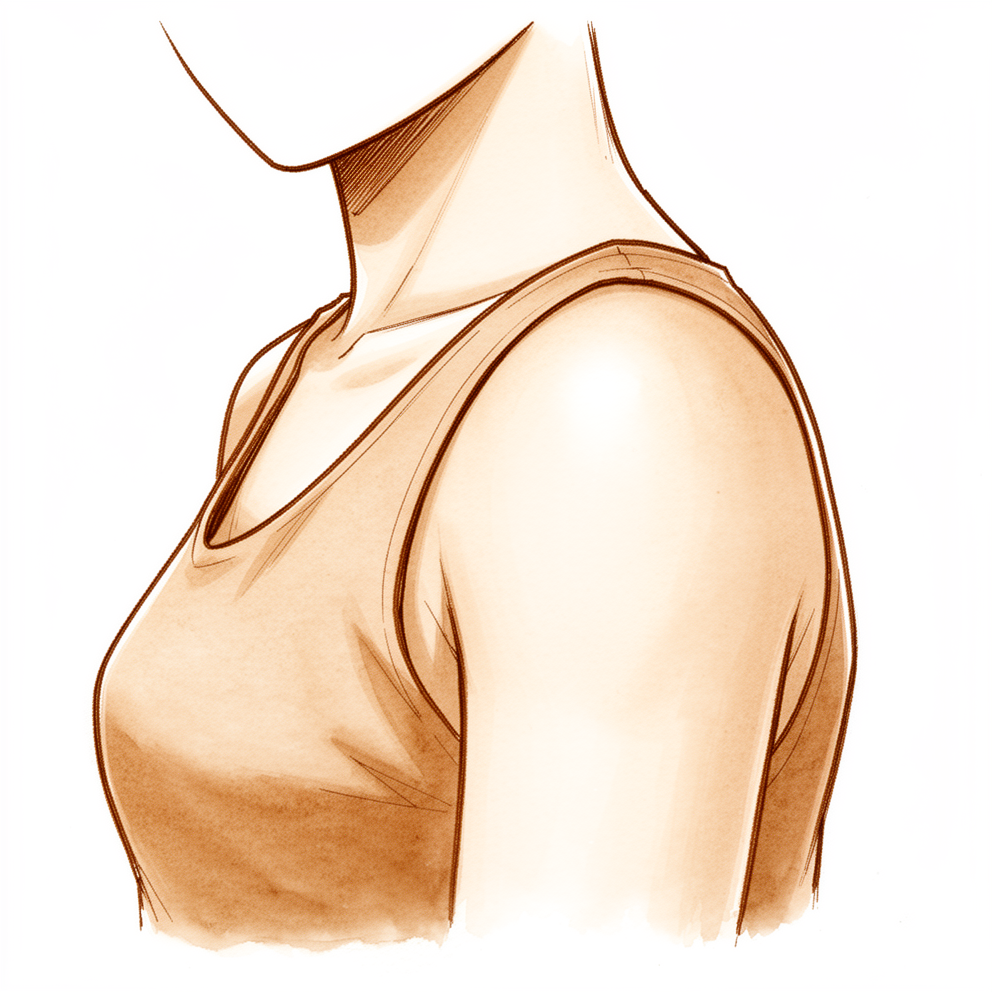
Scapular dyskinesis means your shoulder blade sits or moves differently from normal as you lift and lower your arm. It is a sign that something in the shoulder is not working smoothly, rather than a diagnosis in itself. You might notice the inner edge of your shoulder blade poking out, or your shoulder hitching or shrugging as you raise your arm. Some people have no symptoms at all, including athletes who use their arms overhead.
The pain usually sits around the top of the shoulder and the side of the neck, where the trapezius muscle sits. It often flares after activity, especially anything overhead such as reaching for a high shelf, hanging washing, or throwing. Lifting your arm away from your body can be uncomfortable, and the ache can linger afterwards or wake you at night if you roll onto that shoulder. Everyday tasks that need steady overhead reach, like washing your hair or getting a jumper over your head, can become awkward.
Scapular dyskinesis is often found alongside other shoulder problems, such as impingement (where the tendons at the top of the shoulder are pinched), rotator cuff tears, instability, AC joint injuries and collarbone fractures. Whether the shoulder blade problem causes the pain or is a response to it is often unclear. What you feel day to day is usually a mix of both: an achy shoulder that tires quickly, and a shoulder blade that seems to work overtime to make up for it.
If your symptoms are not settling, are getting worse over weeks, wake you at night, or stop you working or using your arm, see your GP or ask for a specialist review. If pain spreads down your arm with numbness, tingling or weakness, see your doctor as well, as that pattern points to the neck or a nerve rather than the shoulder blade itself.
What's actually happening
Your shoulder blade is not fixed to your ribs. It glides over the chest wall on thin, slippery tissue, a bit like a drawer sliding on smooth runners. It is held in place and moved entirely by muscles, with no bony strap holding it down. That design lets the blade slide and turn freely as your arm moves.
When you lift your arm, most of the movement happens at the ball-and-socket joint, but about a third comes from the shoulder blade turning and tilting on the chest. The blade has to rotate upward and tilt backward as you raise your arm. This clears space under a bony shelf at the top of the shoulder so the tendons can glide without being squeezed. If the blade does not move well, that shelf does not lift out of the way, and the tendons underneath can get compressed or pinched.
The muscles that steer the blade sit around it on all sides, in layers. When one part of the shoulder is injured or painful, those muscles often change how they work. The blade may sit lower, ride up, or fail to rotate as it should. Sometimes this changed movement is part of what is causing the trouble. Sometimes it is the shoulder's way of protecting an injury, the same way you limp to spare a sore ankle. Often it is hard to tell which came first.
This is why the changed movement is treated as a sign rather than a condition of its own. It usually settles as the underlying shoulder problem is treated, and as the muscles around the blade regain their strength and timing through physiotherapy.
What we can do about it
Dr Kieran Hirpara, an upper-limb surgeon at Mater Private Hospital Rockhampton, starts with the least invasive options that suit your condition. For most people that means physiotherapy, and the programme is set by your physiotherapist. The exercises focus on control and strength of the muscles around your shoulder blade, stretching the tight muscles at the front of your chest, and your posture. Exercise helps pain and function in shoulder problems like impingement. Because every shoulder is different, your physiotherapist examines you and sets goals and exercises for your specific needs.
Treatment is aimed at the shoulder problem found alongside the changed shoulder blade movement, not at the blade alone. As that problem settles and the muscles around the blade regain their strength and timing, the blade usually moves better too. If your symptoms persist despite physiotherapy, we reassess you. Depending on your symptoms and examination, that may include an ultrasound or MRI to check a repair, nerve tests, or looking at the neck. Surgery, when it is needed, is aimed at the underlying shoulder problem rather than the shoulder blade itself.
What to expect
For most people, the changed shoulder blade movement settles as the underlying shoulder problem is treated. It is a sign, not a condition of its own, so its outlook follows the outlook of the shoulder problem found alongside it. As your pain eases and the muscles around your shoulder blade regain their strength and timing through physiotherapy, the blade usually moves better too.
Recovery is often slower than you might expect. After shoulder surgery, including rotator cuff repair, the shoulder blade often moves abnormally before and after the operation. It usually improves over months as the shoulder recovers, but it may not be fully back to normal by a year. Six months of rehabilitation after a rotator cuff repair is not enough to fully eliminate the changed movement. People whose shoulder blade movement stays abnormal tend to do a little less well than those whose movement recovers, so your physiotherapist will keep working on it as part of your overall programme.
If it is left alone, the picture is less clear. The changed movement may increase the trouble in an already injured shoulder, and it often contributes to pain that will not settle. On the other hand, it is also common in people with no symptoms at all, and it may simply be the shoulder's way of protecting an injury. Whether it causes the problem or is a response to it is often unclear, so no one can promise you exactly how your shoulder will behave.
What recovery realistically feels like is gradual. Over weeks to months, you would expect the ache around the top of the shoulder and side of the neck to ease, overhead tasks to feel less awkward, and the hitching or shrugging as you lift your arm to smooth out. Some days will be better than others. If your symptoms persist despite physiotherapy, we reassess you and look again at the underlying shoulder problem.
When to see someone
See your GP or ask for a specialist review if your symptoms are not settling, are getting worse over weeks, wake you at night, or stop you working or using your arm. Ask sooner if the inner edge of your shoulder blade is poking out, or your shoulder hitches or shrugs every time you lift your arm. Pain that spreads down your arm with numbness, tingling or weakness points to the neck or a nerve rather than the shoulder blade, so see your doctor about that pattern too. If you have already had shoulder surgery and the changed movement or the ache across the top of the shoulder and side of the neck is not easing as your shoulder recovers, mention it to your physiotherapist and your surgeon.
In more depth
Advanced reading: the deeper science (optional)
This section goes further than you need for your own treatment decisions. Scapular dyskinesis is worth the extra reading because it is so often misunderstood: it is common in people with no symptoms, it rarely explains a shoulder problem on its own, and after shoulder surgery it improves more slowly than the shoulder itself.
A sign, not a diagnosis
The international "scapular summit" consensus describes scapular dyskinesis as an alteration in the resting position or movement of the shoulder blade, present in a high proportion of shoulder injuries. It also concludes that its exact role in causing or worsening shoulder problems is not clearly defined, and that it is best seen as a possible impairment of shoulder function rather than a diagnosis [1]. An earlier review called it a non-specific response to a painful shoulder rather than a feature of any one condition [2].
It is also common without symptoms. Across 12 studies of 1,401 athletes, it was reported in 61% of overhead athletes and 33% of others [3]. Whether it predicts injury is doubtful: in a meta-analysis of 923 athletes followed prospectively, it was present in 46%, and it did not significantly raise the risk of a later shoulder injury (risk ratio 1.07, 95% CI 0.85 to 1.34) [4].
How it is assessed, and the limits of the tests
The usual clinical test is to watch the shoulder blade from behind while the person lifts and lowers the arms several times, often holding light weights, and to grade the movement as normal or abnormal [5]. Agreement between examiners is moderate to good: in 40 patients with impingement, the kappa between two raters was 0.59 (86% agreement). In the same study, people with and without dyskinesis did not differ in their shoulder scores at baseline or at three months [6]. This is why surgeons treat a positive test as one piece of the examination, not a diagnosis.
Winging from a nerve injury is a separate problem. In 96 patients with winging from weakness of serratus anterior proven on nerve testing, 88% had a long thoracic nerve lesion, most often from neuralgic amyotrophy (47) or trauma (33). Of those with neuralgic amyotrophy, 22 recovered without treatment within three years, but none recovered fully once the winging had lasted longer than three years [7].
Rotator cuff tears: cause or consequence?
A systematic review of 16 studies (335 tears) found that the shoulder blade moves abnormally in every study of cuff tears, but with no consistent pattern. Larger tears showed more change, and painful tears more than painless ones; painless tears did not differ from healthy shoulders. The review could not say which changes are adaptive and which are harmful [8]. One comparison found less upward rotation of the shoulder blade, and more work from levator scapulae, in painful tears than in painless ones, with upper trapezius more active than in healthy shoulders [9]. In massive tears that regained movement with physiotherapy, PET scans showed the levator scapulae and rhomboids working harder, consistent with the shoulder blade muscles compensating for the cuff [10].
What happens after rotator cuff repair
The studies disagree, and that disagreement is the main message.
- It often improves. In 35 patients assessed with CT before and after repair, 23 (66%) had dyskinesis beforehand. 12 of the 23 improved after surgery, mostly the type with reduced backward tilt. Improvement went with better forward elevation and Constant scores, and no repair failed to heal in the improved group [11].
- It can normalise. In 26 patients tracked with electromagnetic sensors for a year, shoulder blade movement moved towards the pattern of the other shoulder, and abduction improved by 20° [12].
- It can persist. In 21 patients measured with wearable sensors at 12 months or more, movement and Constant scores improved, but shoulder blade rhythm did not change significantly [13]. In another small study, six months of rehabilitation after repair did not fully restore normal shoulder blade movement [14].
- It matters to the result. In 48 patients followed for a year of rehabilitation after repair, substitution by the shoulder blade decreased but stayed greater than on the other side. Those in whom the physiotherapist saw substitution had worse scores, less movement and less strength at every time point [15]. In 110 patients 6 to 18 months after repair, dyskinesis went with poorer function, and scapular muscle endurance predicted the result [16].
Can targeted rehabilitation change it? In 60 patients with dyskinesis after repair, adding strengthening of the specific weak shoulder blade muscles (identified on EMG) gave a Constant score of 87.2 against 83.9, and forward elevation of 137° against 128°, at 16 weeks. That gap is modest, and the study was not randomised [17]. A 2026 meta-analysis found that scapular-targeted rehabilitation reduced pain and improved function across rotator cuff care, but the post-operative evidence was too thin to pool [18]. More broadly, exercise reliably helps pain and function in impingement [19], but the evidence that it changes the movement of the shoulder blade itself is conflicting [20].
An animal study raised the possibility that an abnormally moving shoulder blade could impair how a repaired tendon heals: in rats, cutting the nerves that control the shoulder blade before a supraspinatus repair gave weaker and less organised repairs [21]. This has not been shown in people.
After other shoulder operations
- Latarjet. Dyskinesis was seen in 5 of 20 patients after a Latarjet and none of 20 after a bone-graft stabilisation that leaves the coracoid alone. Those with dyskinesis had lower scores [22]. A later series found it in 25% after the standard operation and in none of 20 patients after the pectoralis minor was repaired back to the coracoid. 4 of the 5 cases settled with six months of specific rehabilitation [23].
- Shoulder replacement. After reverse replacement, the shoulder blade does more of the work of lifting the arm than in a normal shoulder (a meta-analysis of 464 patients) [24]. In 85 anatomic and reverse replacements, more shoulder blade contribution after surgery went with more pain and worse function [25].
- Collarbone and AC joint. Dyskinesis was found in 9 of 24 people after a displaced collarbone fracture, and they had more pain and worse scores. It was seen in 1 of 12 treated with surgery and 8 of 12 treated without [26]. After surgery for acute AC joint dislocation it was seen in 4 of 34 [27].
Trapezius pain and the shrug
There is very little research on aching in the trapezius or the side of the neck after shoulder surgery. No study has measured how often it happens. The closest evidence is the "shrug sign", where the whole shoulder girdle lifts as the arm is raised. In 982 consecutive patients examined before surgery, it was present in 51%, most often in frozen shoulder (95%). It went with stiffness, weakness and night pain, and it was not specific for a cuff tear [28]. That fits a simple explanation for trapezius ache while a shoulder recovers: the shoulder blade elevators work harder to lift an arm that is stiff or weak, as shown in painful cuff tears [9]. The sling strap may add to it. These explanations are reasonable, but they have not been tested. Pain that spreads down the arm with numbness, tingling or weakness points to the neck or a nerve instead and should be checked.
References for the advanced reading
- Kibler WB, Ludewig PM, McClure PW, et al. Clinical implications of scapular dyskinesis in shoulder injury: the 2013 consensus statement from the 'scapular summit'. Br J Sports Med. 2013;47(14):877-85.
- Kibler WB, Sciascia A. Current concepts: scapular dyskinesis. Br J Sports Med. 2010;44(5):300-5. Epub 2009.
- Burn MB, McCulloch PC, Lintner DM, et al. Prevalence of Scapular Dyskinesis in Overhead and Nonoverhead Athletes. Orthop J Sports Med. 2016;4(2):2325967115627608.
- Hogan C, Corbett JA, Ashton S, et al. Scapular Dyskinesis Is Not an Isolated Risk Factor for Shoulder Injury in Athletes: A Systematic Review and Meta-analysis. Am J Sports Med. 2021;49(10):2843-53. Epub 2020.
- Tate AR, McClure P, Kareha S, et al. A Clinical Method for Identifying Scapular Dyskinesis, Part 2: Validity. J Athl Train. 2009;44(2):165-73.
- Christiansen DH, Møller AD, Vestergaard JM, et al. The scapular dyskinesis test: Reliability, agreement, and predictive value in patients with subacromial impingement syndrome. J Hand Ther. 2017;30(2):208-13.
- Ng CY, Wu F. Scapular winging secondary to serratus anterior dysfunction: analysis of clinical presentations and etiology in a consecutive series of 96 patients. J Shoulder Elbow Surg. 2021;30(10):2336-43.
- Barcia AM, Makovicka JL, Spenciner DB, et al. Scapular motion in the presence of rotator cuff tears: a systematic review. J Shoulder Elbow Surg. 2021;30(7):1679-92.
- Ishikawa H, Muraki T, Morise S, et al. Differences in scapular motion and parascapular muscle activities among patients with symptomatic and asymptomatic rotator cuff tears, and healthy individuals. JSES Int. 2021;5(2):238-46.
- Chuang HC, Chiu NT, Liu ZW, et al. Compensatory Activation of Periscapular Muscles Aids Active Abduction in Patients With Massive Rotator Cuff Tears. Clin Orthop Relat Res. 2025;483(12):2295-305.
- Song HE, Oh K, Yoon JP, et al. Improvement in scapular dyskinesis after rotator cuff repair and subacromial decompression. Knee Surg Sports Traumatol Arthrosc. 2021;29(12):3961-70.
- Kolk A, de Witte PB, Henseler JF, et al. Three-dimensional shoulder kinematics normalize after rotator cuff repair. J Shoulder Elbow Surg. 2016;25(6):881-9.
- Mercurio M, Cofano E, Mancuso C, et al. Persistent scapular dyskinesis after arthroscopic rotator cuff repair: a prospective study. JSES Int. 2026;10(2):101420.
- Nyőgér Z, Molnár CA, Szakály N, et al. Scapula dyskinesis in medium‐sized full‐thickness rotator cuff tear after subacromial Lidocaine infiltration and rotator cuff reconstruction. J Exp Orthop. 2025;12(1):e70154.
- Baumgarten KM, Osborn R, Schweinle WE, et al. Scapular substitution after rotator cuff repair correlates with postoperative patient outcome. Int J Sports Phys Ther. 2018;13(4):687-99.
- Alzahrani WM, Baltow BA, Alanazi ZA, et al. Scapular endurance, dyskinesis, and functional outcomes after rotator cuff repair: A cross-sectional mediation analysis. PLoS One. 2026;21(9):e0357765.
- Sun JN, Zheng QY, Wang RS, et al. An additional rehabilitation program to improve postoperative outcomes in patients with rotator cuff tear and scapular dyskinesis: a propensity score-matched study. BMC Musculoskelet Disord. 2025;26(1):338.
- Alshehri AF, Samarkandi WO, Alshahrani KA, et al. Clinical Value of Scapular-Targeted Rehabilitation Within the Rotator Cuff Care Continuum: A Systematic Review and Meta-analysis of Conservative and Postoperative Evidence. Orthop Rev (Pavia). 2026;18.
- Zhong Z, Zang W, Tang Z, et al. Effect of scapular stabilization exercises on subacromial pain (impingement) syndrome: a systematic review and meta-analysis of randomized controlled trials. Front Neurol. 2024;15:1357763.
- Nodehi Moghadam A, Rahnama L, Noorizadeh Dehkordi S, Abdollahi S. Exercise therapy may affect scapular position and motion in individuals with scapular dyskinesis: a systematic review of clinical trials. J Shoulder Elbow Surg. 2020;29(1):e29-e36.
- Reuther KE, Tucker JJ, Thomas SJ, et al. Effect of scapular dyskinesis on supraspinatus repair healing in a rat model. J Shoulder Elbow Surg. 2015;24(8):1235-42.
- Carbone S, Moroder P, Runer A, et al. Scapular dyskinesis after Latarjet procedure. J Shoulder Elbow Surg. 2016;25(3):422-7.
- Candela V, Scacchi M, De Meo D, et al. The Pectoralis Minor–Repairing Latarjet: A Modified Technique to Prevent Postoperative Scapular Dyskinesis After the Latarjet Procedure. Am J Sports Med. 2025;53(7):1716-20.
- Johnson MA, Cogsil T, White AE, et al. Impact of reverse total shoulder arthroplasty on scapulohumeral rhythm: a systematic review and meta-analysis. J Shoulder Elbow Surg. 2026;35(4):1117-28.
- Khawaja SR, Hardrick JC, Und Aspang JS, et al. Total shoulder arthroplasty and scapulohumeral rhythm: the clinical impact of achieving native shoulder mechanics. J Shoulder Elbow Surg. 2026.
- Shields E, Behrend C, Beiswenger T, et al. Scapular dyskinesis following displaced fractures of the middle clavicle. J Shoulder Elbow Surg. 2015;24(12):e331-e336.
- Murena L, Canton G, Vulcano E, Cherubino P. Scapular dyskinesis and SICK scapula syndrome following surgical treatment of type III acute acromioclavicular dislocations. Knee Surg Sports Traumatol Arthrosc. 2013;21(5):1146-50. Epub 2012.
- Jia X, Ji JH, Petersen SA, et al. Clinical Evaluation of the Shoulder Shrug Sign. Clin Orthop Relat Res. 2008;466(11):2813-9.