Skip to content

About

OrthoWiki

244 Clinical topics
0 Monthly digests
7 Anatomical regions

OrthoWiki is a curated orthopaedic surgery reference covering the shoulder, elbow, wrist and hand. It is written, edited and clinically reviewed by Dr Kieran Hirpara, Specialist Orthopaedic Surgeon, and published by CQ Hand + Upper Limb. Patient-facing articles explain conditions and procedures in plain language; the matching clinician pages summarise the peer-reviewed evidence behind them.

Topic synthesis is generated using large language models prompted against an indexed corpus of the orthopaedic literature, then edited and reviewed by Dr Hirpara. Every claim is referenced; the source DOI is listed in each topic's references list. Reviewed topics display the reviewing clinician and the date of review. This is a reference aid for clinicians familiar with the literature and an educational resource for patients — not a substitute for individual medical advice.

Text content is shared under the Creative Commons BY-NC 4.0 licence — free for non-commercial reuse with attribution. Figures and images may be separately licensed; check each caption or source link for the individual terms.

OrthoWiki is catalogued on Wikidata.


How OrthoWiki is built

Full transparency on the pipeline behind every page. OrthoWiki is produced by an automated, open-source toolchain that turns a library of peer-reviewed orthopaedic PDFs into referenced clinician summaries and plain-English patient guides — each one then reviewed by Dr Hirpara before publication. Nothing here is hidden; the tools are listed, with links, at the end.

From a PDF to indexed evidence

1. Source library. Primary sources — journal articles and textbook chapters — are collected as PDFs, organised by source. Each PDF is a primary reference.

2. PDF → text (a three-stage converter cascade). Every PDF is converted to Markdown by an automatic cascade that tries the cheapest accurate method first and falls through on failure:

  • docling (IBM's open-source document parser, using its TableFormer model for tables) extracts the text layer.
  • if that under-produces — e.g. a scanned page with no text layer — LiteParse (a fast, CPU-only spatial-text extractor) is tried.
  • for true scans, a vision-language model (Qwen3.6 VLM) performs OCR page by page.

3. Citations & metadata (CrossRef). The article's DOI is read from the PDF text and looked up against the CrossRef API, returning authors, journal, year and volume/issue/pages — formatted into a JBJS-Vancouver citation. Articles without a DOI fall back to a filename-based citation.

4. Region tagging (MeSH). Each article's PubMed MeSH descriptors and author keywords (fetched by DOI) are mapped to an anatomical region — shoulder, elbow, wrist, hand and beyond. A title-keyword fallback covers articles with no MeSH data.

5. Embedding & indexing. Article text is split into section-aware chunks (~400 tokens, tracking page numbers) and embedded with MedCPT — NCBI's medical bi-encoder, 768-dimensional. Vectors are stored in a Qdrant vector database; content-hash de-duplication stops the same PDF being indexed twice. Topics, articles, the article↔topic links, monthly digests and evidence levels live in a PostgreSQL database (with the pgvector extension).

6. The ingest pipeline. New PDFs flow through one ordered pipeline — seed → CrossRef → MeSH → classify → cite → index — with each article's progress tracked in a jobs table. Articles are classified to topics by their MeSH terms plus title keywords.

How an article is written

7. Retrieval (two-stage). For a topic, the relevant literature is gathered by a two-stage search: a fast MedCPT bi-encoder retrieval over the vector database, then a MedCPT cross-encoder re-ranks the candidates for precision. Region and source filters keep the evidence on-topic.

8. Synthesis (two passes). The gathered key articles become an evidence pack. The pipeline extracts a short digest of each article and scores each for relevance, then runs a two-pass synthesis: a first pass drafts the article from the evidence pack, and a second augment pass refines structure and readability. A Vancouver ## References list is built automatically, and a cross-reference pass adds inline DOI links and a See Also section. A token-budget guard keeps very large topics inside the model's context window.

9. Clinician-first, then patient. The clinician page is synthesised from the literature. The patient page is then derived from that same clinician evidence pack, re-voiced into plain English. For unusually broad ("danger-tier") topics, a deeper mode first digests every candidate article before synthesis.

10. Evidence levels. Where the source reports it, each article carries an Oxford level of evidence (1 = highest … 5), captured at the metadata step. The Evidence Explorer's pips aggregate these per topic (the highest available level plus the count of high-level sources) — a genuine signal, never a fabricated grade.

Operations, review & output

11. Recovery & complications sidecars. For each operation, a structured recovery-and-complications.json sidecar is generated from the evidence: a recovery timeline plus complications with their reported rates. This single file drives the recovery-at-a-glance strip, the complications table and the consent handout PDF. Non-operative (information) topics skip it cleanly.

12. Human review & hand-editing. Automated synthesis produces a draft. Dr Hirpara reviews and edits it. Pages that are hand-edited are flagged hand-authored and protected — the weekly automated pipeline skips them, so human edits are never overwritten. Reviewed topics show the reviewing clinician and the review date.

13. Cross-linking. A cross-reference pass links related topics (the See Also lists) and turns every citation into a clickable DOI link.

14. PDF handouts. At publish time, WeasyPrint renders each patient page into a printable handout.pdf; operations also get a consent-handout.pdf carrying the recovery strip and complications table. These PDFs feed the practice clinic and are served from this site.

Illustrations & figures

The anatomical illustrations, surgical diagrams and rehabilitation figures are produced separately, in a consistent hand-inked "house style", by OrthoWiki's image toolchain (cqhul-imagestyle). Two sources feed it:

  • Curated open-licence images — existing diagrams and photographs from Wikimedia Commons and similar repositories, used under their own Creative Commons terms; each figure's individual licence and source are credited in its caption.
  • De-novo illustration — where no suitable open image exists, a bespoke figure is generated locally and licensed CC BY-NC 4.0, like the text.

How the de-novo figures are made. Generation runs entirely on the practice's own GPU workstation through ComfyUI — there is no third-party image service, and all model weights are held locally. For the rehabilitation diagrams, a single recurring, faceless "house character" (kept consistent across a set of canonical front / back / profile / kneeling / lying reference views) keeps the figures visually uniform.
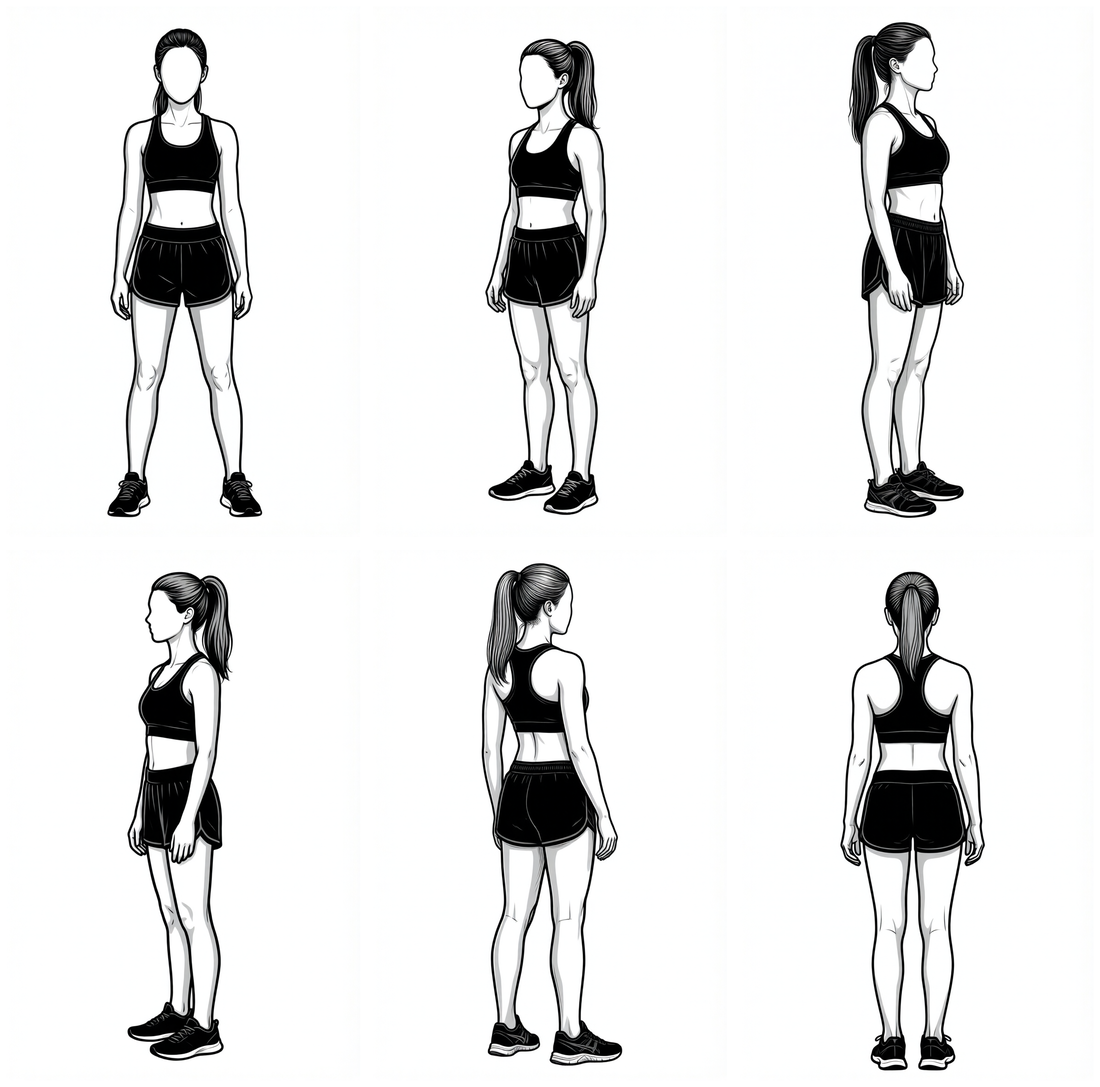
The OrthoWiki rehabilitation house character shown in six standing reference views — front, three-quarter, both profiles and back.
The rehabilitation "house character" — the same faceless, generic figure reused across every exercise diagram, here in its canonical reference views.

The pipeline chains several open diffusion models, each run quantised on the local GPU and driven through ComfyUI's API:

Stage Model(s) Role
Pose extraction DWPose (OpenPose) a reference figure → a pose skeleton only
Repose → clean line Qwen-Image-Edit + Qwen2.5-VL text encoder redraws the house character into the target pose as a clean black line drawing
House-style restyle FLUX.2 (Black Forest Labs) + Mistral text encoder restyles the clean line into the warm hand-inked sepia house style
Line / diagram route FLUX.1-dev + line-art LoRAs + ControlNet (OpenPose) alternative clean-line diagram generation
Exercise video (in development) Wan mocap-retargeted animated exercise demonstrations

Crucially, only the pose — a skeleton, which carries no likeness — is ever taken from a reference; the figure itself is generated fresh from a blank canvas, so no source photograph or person's likeness is reproduced. Every illustration is an original work.

Region line-art and a fallback library mean every topic shows a relevant illustration even before bespoke art is commissioned. Figures illustrate the referenced text; they are never themselves a clinical source.

Publication & architecture

15. Build & hosting. The finished knowledge base is built into a static site with MkDocs + Material for MkDocs and deployed to a Cloudflare Worker (this site). On-site search is Pagefind — a static, client-side index, so there is no search server and no query logging. The practice clinic's /education pages embed this same content and link to the PDFs hosted here.

16. Compute. The heavy lifting runs on local hardware: a GPU workstation runs the MedCPT embedding models and the language models used for synthesis; a server runs the vector and relational databases, the API, a second language-model endpoint and the publisher; network-attached storage holds the PDF library and the article store. Language models are served locally with llama.cpp behind an OpenAI-compatible API. (Specific network addresses and credentials are deliberately omitted.)

17. Models & frameworks.

Role Model Framework
Embeddings + reranking MedCPT (Query / Article / Cross-Encoder), 768-dim PyTorch / Transformers
Scanned-PDF OCR Qwen3.6 (35B, A3B mixture-of-experts), vision-language llama.cpp
Synthesis — draft pass Qwen3.5 (35B, A3B mixture-of-experts) llama.cpp
Synthesis — augment / cross-reference pass Gemma (26B, A4B mixture-of-experts) llama.cpp
Patient voice + deep mode Qwen3.6 (35B, A3B mixture-of-experts) llama.cpp
Document parsing docling + TableFormer; LiteParse Python / Node

The article store

The knowledge base is a simple tree — topics/<audience>/<region>/<slug>/ — where each topic folder holds the article (synthesis.md), the gathered evidence (evidence.md), its references and figures, and, for operations, the recovery sidecar. There are two audiences (clinician and patient), and roughly 600 topics across the upper-limb regions and beyond.

Open-source tooling

OrthoWiki stands on open-source work:

In short

Every page begins as an automated synthesis of the indexed literature, with each claim referenced to its DOI, and is then reviewed by a specialist before publication. It is an evidence aid and an educational resource — not a substitute for individual medical advice.

Creative Commons BY-NC 4.0

CC Creative Commons licence
BY Attribution — you must credit the source
NC NonCommercial — not for commercial use

Attribution-NonCommercial 4.0 International


Creative Commons Corporation ("Creative Commons") is not a law firm and does not provide legal services or legal advice. Distribution of Creative Commons public licenses does not create a lawyer-client or other relationship. Creative Commons makes its licenses and related information available on an "as-is" basis. Creative Commons gives no warranties regarding its licenses, any material licensed under their terms and conditions, or any related information. Creative Commons disclaims all liability for damages resulting from their use to the fullest extent possible.

Using Creative Commons Public Licenses

Creative Commons public licenses provide a standard set of terms and conditions that creators and other rights holders may use to share original works of authorship and other material subject to copyright and certain other rights specified in the public license below. The following considerations are for informational purposes only, are not exhaustive, and do not form part of our licenses.

Considerations for licensors: Our public licenses are intended for use by those authorized to give the public permission to use material in ways otherwise restricted by copyright and certain other rights. Our licenses are irrevocable. Licensors should read and understand the terms and conditions of the license they choose before applying it. Licensors should also secure all rights necessary before applying our licenses so that the public can reuse the material as expected. Licensors should clearly mark any material not subject to the license. This includes other CC- licensed material, or material used under an exception or limitation to copyright. More considerations for licensors: wiki.creativecommons.org/Considerations_for_licensors

Considerations for the public: By using one of our public licenses, a licensor grants the public permission to use the licensed material under specified terms and conditions. If the licensor's permission is not necessary for any reason--for example, because of any applicable exception or limitation to copyright--then that use is not regulated by the license. Our licenses grant only permissions under copyright and certain other rights that a licensor has authority to grant. Use of the licensed material may still be restricted for other reasons, including because others have copyright or other rights in the material. A licensor may make special requests, such as asking that all changes be marked or described. Although not required by our licenses, you are encouraged to respect those requests where reasonable. More considerations for the public: wiki.creativecommons.org/Considerations_for_licensees


Creative Commons Attribution-NonCommercial 4.0 International Public License

By exercising the Licensed Rights (defined below), You accept and agree to be bound by the terms and conditions of this Creative Commons Attribution-NonCommercial 4.0 International Public License ("Public License"). To the extent this Public License may be interpreted as a contract, You are granted the Licensed Rights in consideration of Your acceptance of these terms and conditions, and the Licensor grants You such rights in consideration of benefits the Licensor receives from making the Licensed Material available under these terms and conditions.

Section 1 -- Definitions.

a. Adapted Material means material subject to Copyright and Similar Rights that is derived from or based upon the Licensed Material and in which the Licensed Material is translated, altered, arranged, transformed, or otherwise modified in a manner requiring permission under the Copyright and Similar Rights held by the Licensor. For purposes of this Public License, where the Licensed Material is a musical work, performance, or sound recording, Adapted Material is always produced where the Licensed Material is synched in timed relation with a moving image.

b. Adapter's License means the license You apply to Your Copyright and Similar Rights in Your contributions to Adapted Material in accordance with the terms and conditions of this Public License.

c. Copyright and Similar Rights means copyright and/or similar rights closely related to copyright including, without limitation, performance, broadcast, sound recording, and Sui Generis Database Rights, without regard to how the rights are labeled or categorized. For purposes of this Public License, the rights specified in Section 2(b)(1)-(2) are not Copyright and Similar Rights.

d. Effective Technological Measures means those measures that, in the absence of proper authority, may not be circumvented under laws fulfilling obligations under Article 11 of the WIPO Copyright Treaty adopted on December 20, 1996, and/or similar international agreements.

e. Exceptions and Limitations means fair use, fair dealing, and/or any other exception or limitation to Copyright and Similar Rights that applies to Your use of the Licensed Material.

f. Licensed Material means the artistic or literary work, database, or other material to which the Licensor applied this Public License.

g. Licensed Rights means the rights granted to You subject to the terms and conditions of this Public License, which are limited to all Copyright and Similar Rights that apply to Your use of the Licensed Material and that the Licensor has authority to license.

h. Licensor means the individual(s) or entity(ies) granting rights under this Public License.

i. NonCommercial means not primarily intended for or directed towards commercial advantage or monetary compensation. For purposes of this Public License, the exchange of the Licensed Material for other material subject to Copyright and Similar Rights by digital file-sharing or similar means is NonCommercial provided there is no payment of monetary compensation in connection with the exchange.

j. Share means to provide material to the public by any means or process that requires permission under the Licensed Rights, such as reproduction, public display, public performance, distribution, dissemination, communication, or importation, and to make material available to the public including in ways that members of the public may access the material from a place and at a time individually chosen by them.

k. Sui Generis Database Rights means rights other than copyright resulting from Directive 96/9/EC of the European Parliament and of the Council of 11 March 1996 on the legal protection of databases, as amended and/or succeeded, as well as other essentially equivalent rights anywhere in the world.

l. You means the individual or entity exercising the Licensed Rights under this Public License. Your has a corresponding meaning.

Section 2 -- Scope.

a. License grant.

1. Subject to the terms and conditions of this Public License, the Licensor hereby grants You a worldwide, royalty-free, non-sublicensable, non-exclusive, irrevocable license to exercise the Licensed Rights in the Licensed Material to:

a. reproduce and Share the Licensed Material, in whole or in part, for NonCommercial purposes only; and

b. produce, reproduce, and Share Adapted Material for NonCommercial purposes only.

2. Exceptions and Limitations. For the avoidance of doubt, where Exceptions and Limitations apply to Your use, this Public License does not apply, and You do not need to comply with its terms and conditions.

3. Term. The term of this Public License is specified in Section 6(a).

4. Media and formats; technical modifications allowed. The Licensor authorizes You to exercise the Licensed Rights in all media and formats whether now known or hereafter created, and to make technical modifications necessary to do so. The Licensor waives and/or agrees not to assert any right or authority to forbid You from making technical modifications necessary to exercise the Licensed Rights, including technical modifications necessary to circumvent Effective Technological Measures. For purposes of this Public License, simply making modifications authorized by this Section 2(a) (4) never produces Adapted Material.

5. Downstream recipients.

a. Offer from the Licensor -- Licensed Material. Every recipient of the Licensed Material automatically receives an offer from the Licensor to exercise the Licensed Rights under the terms and conditions of this Public License.

b. No downstream restrictions. You may not offer or impose any additional or different terms or conditions on, or apply any Effective Technological Measures to, the Licensed Material if doing so restricts exercise of the Licensed Rights by any recipient of the Licensed Material.

6. No endorsement. Nothing in this Public License constitutes or may be construed as permission to assert or imply that You are, or that Your use of the Licensed Material is, connected with, or sponsored, endorsed, or granted official status by, the Licensor or others designated to receive attribution as provided in Section 3(a)(1)(A)(i).

b. Other rights.

1. Moral rights, such as the right of integrity, are not licensed under this Public License, nor are publicity, privacy, and/or other similar personality rights; however, to the extent possible, the Licensor waives and/or agrees not to assert any such rights held by the Licensor to the limited extent necessary to allow You to exercise the Licensed Rights, but not otherwise.

2. Patent and trademark rights are not licensed under this Public License.

3. To the extent possible, the Licensor waives any right to collect royalties from You for the exercise of the Licensed Rights, whether directly or through a collecting society under any voluntary or waivable statutory or compulsory licensing scheme. In all other cases the Licensor expressly reserves any right to collect such royalties, including when the Licensed Material is used other than for NonCommercial purposes.

Section 3 -- License Conditions.

Your exercise of the Licensed Rights is expressly made subject to the following conditions.

a. Attribution.

1. If You Share the Licensed Material (including in modified form), You must:

a. retain the following if it is supplied by the Licensor with the Licensed Material:

i. identification of the creator(s) of the Licensed Material and any others designated to receive attribution, in any reasonable manner requested by the Licensor (including by pseudonym if designated);

ii. a copyright notice;

iii. a notice that refers to this Public License;

iv. a notice that refers to the disclaimer of warranties;

v. a URI or hyperlink to the Licensed Material to the extent reasonably practicable;

b. indicate if You modified the Licensed Material and retain an indication of any previous modifications; and

c. indicate the Licensed Material is licensed under this Public License, and include the text of, or the URI or hyperlink to, this Public License.

2. You may satisfy the conditions in Section 3(a)(1) in any reasonable manner based on the medium, means, and context in which You Share the Licensed Material. For example, it may be reasonable to satisfy the conditions by providing a URI or hyperlink to a resource that includes the required information.

3. If requested by the Licensor, You must remove any of the information required by Section 3(a)(1)(A) to the extent reasonably practicable.

4. If You Share Adapted Material You produce, the Adapter's License You apply must not prevent recipients of the Adapted Material from complying with this Public License.

Section 4 -- Sui Generis Database Rights.

Where the Licensed Rights include Sui Generis Database Rights that apply to Your use of the Licensed Material:

a. for the avoidance of doubt, Section 2(a)(1) grants You the right to extract, reuse, reproduce, and Share all or a substantial portion of the contents of the database for NonCommercial purposes only;

b. if You include all or a substantial portion of the database contents in a database in which You have Sui Generis Database Rights, then the database in which You have Sui Generis Database Rights (but not its individual contents) is Adapted Material; and

c. You must comply with the conditions in Section 3(a) if You Share all or a substantial portion of the contents of the database.

For the avoidance of doubt, this Section 4 supplements and does not replace Your obligations under this Public License where the Licensed Rights include other Copyright and Similar Rights.

Section 5 -- Disclaimer of Warranties and Limitation of Liability.

a. UNLESS OTHERWISE SEPARATELY UNDERTAKEN BY THE LICENSOR, TO THE EXTENT POSSIBLE, THE LICENSOR OFFERS THE LICENSED MATERIAL AS-IS AND AS-AVAILABLE, AND MAKES NO REPRESENTATIONS OR WARRANTIES OF ANY KIND CONCERNING THE LICENSED MATERIAL, WHETHER EXPRESS, IMPLIED, STATUTORY, OR OTHER. THIS INCLUDES, WITHOUT LIMITATION, WARRANTIES OF TITLE, MERCHANTABILITY, FITNESS FOR A PARTICULAR PURPOSE, NON-INFRINGEMENT, ABSENCE OF LATENT OR OTHER DEFECTS, ACCURACY, OR THE PRESENCE OR ABSENCE OF ERRORS, WHETHER OR NOT KNOWN OR DISCOVERABLE. WHERE DISCLAIMERS OF WARRANTIES ARE NOT ALLOWED IN FULL OR IN PART, THIS DISCLAIMER MAY NOT APPLY TO YOU.

b. TO THE EXTENT POSSIBLE, IN NO EVENT WILL THE LICENSOR BE LIABLE TO YOU ON ANY LEGAL THEORY (INCLUDING, WITHOUT LIMITATION, NEGLIGENCE) OR OTHERWISE FOR ANY DIRECT, SPECIAL, INDIRECT, INCIDENTAL, CONSEQUENTIAL, PUNITIVE, EXEMPLARY, OR OTHER LOSSES, COSTS, EXPENSES, OR DAMAGES ARISING OUT OF THIS PUBLIC LICENSE OR USE OF THE LICENSED MATERIAL, EVEN IF THE LICENSOR HAS BEEN ADVISED OF THE POSSIBILITY OF SUCH LOSSES, COSTS, EXPENSES, OR DAMAGES. WHERE A LIMITATION OF LIABILITY IS NOT ALLOWED IN FULL OR IN PART, THIS LIMITATION MAY NOT APPLY TO YOU.

c. The disclaimer of warranties and limitation of liability provided above shall be interpreted in a manner that, to the extent possible, most closely approximates an absolute disclaimer and waiver of all liability.

Section 6 -- Term and Termination.

a. This Public License applies for the term of the Copyright and Similar Rights licensed here. However, if You fail to comply with this Public License, then Your rights under this Public License terminate automatically.

b. Where Your right to use the Licensed Material has terminated under Section 6(a), it reinstates:

1. automatically as of the date the violation is cured, provided it is cured within 30 days of Your discovery of the violation; or

2. upon express reinstatement by the Licensor.

For the avoidance of doubt, this Section 6(b) does not affect any right the Licensor may have to seek remedies for Your violations of this Public License.

c. For the avoidance of doubt, the Licensor may also offer the Licensed Material under separate terms or conditions or stop distributing the Licensed Material at any time; however, doing so will not terminate this Public License.

d. Sections 1, 5, 6, 7, and 8 survive termination of this Public License.

Section 7 -- Other Terms and Conditions.

a. The Licensor shall not be bound by any additional or different terms or conditions communicated by You unless expressly agreed.

b. Any arrangements, understandings, or agreements regarding the Licensed Material not stated herein are separate from and independent of the terms and conditions of this Public License.

Section 8 -- Interpretation.

a. For the avoidance of doubt, this Public License does not, and shall not be interpreted to, reduce, limit, restrict, or impose conditions on any use of the Licensed Material that could lawfully be made without permission under this Public License.

b. To the extent possible, if any provision of this Public License is deemed unenforceable, it shall be automatically reformed to the minimum extent necessary to make it enforceable. If the provision cannot be reformed, it shall be severed from this Public License without affecting the enforceability of the remaining terms and conditions.

c. No term or condition of this Public License will be waived and no failure to comply consented to unless expressly agreed to by the Licensor.

d. Nothing in this Public License constitutes or may be interpreted as a limitation upon, or waiver of, any privileges and immunities that apply to the Licensor or You, including from the legal processes of any jurisdiction or authority.


Creative Commons is not a party to its public licenses. Notwithstanding, Creative Commons may elect to apply one of its public licenses to material it publishes and in those instances will be considered the “Licensor.” The text of the Creative Commons public licenses is dedicated to the public domain under the CC0 Public Domain Dedication. Except for the limited purpose of indicating that material is shared under a Creative Commons public license or as otherwise permitted by the Creative Commons policies published at creativecommons.org/policies, Creative Commons does not authorize the use of the trademark "Creative Commons" or any other trademark or logo of Creative Commons without its prior written consent including, without limitation, in connection with any unauthorized modifications to any of its public licenses or any other arrangements, understandings, or agreements concerning use of licensed material. For the avoidance of doubt, this paragraph does not form part of the public licenses.

Creative Commons may be contacted at creativecommons.org.