Patients › Rehabilitation
Carpal Tunnel Release
Post-operative exercises and precautions after carpal tunnel release, including tendon and nerve glides.
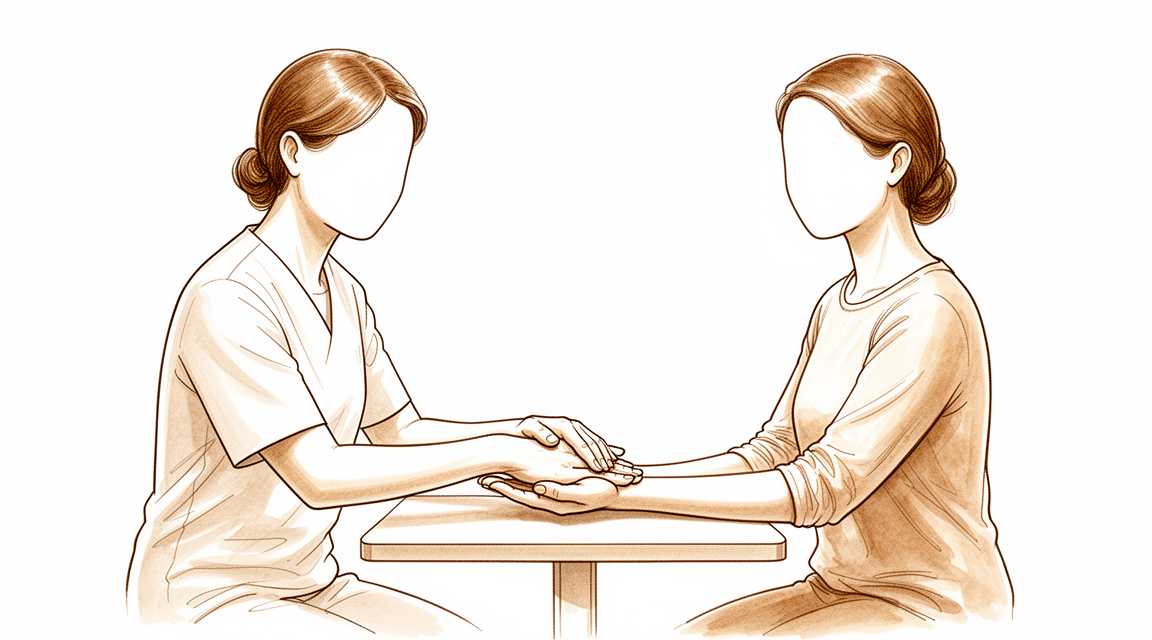
Ang protocol na ito ay nagsisilbing gabay sa iyong paggaling pagkatapos ng carpal tunnel release kasama si Dr Kieran Hirpara sa Mater Private Hospital Rockhampton. Ipinapaliwanag nito ang mga dapat asahan habang naghihilom ang iyong sugat, ang mga pag-iingat para sa mga unang linggo, at ang programa sa ehersisyo upang mapanatiling malayang nakaka-glide ang iyong nerve at tendons habang bumabalik sa normal ang lahat. Dalhin ang pahinang ito o ang PDF nito sa iyong physiotherapist o hand therapist upang manatiling coordinated ang iyong rehabilitasyon.
Kung mayroon kang anumang alalahanin tungkol sa iyong sugat pagkatapos ng operasyon, makipag-ugnayan sa mga rooms. Madalas na nakatutulong ang pagkuha ng larawan ng sugat at pag-email nito para masuri.
Ano ang dapat asahan
Ang pag-aalaga sa iyong sugat ay ipinaliwanag sa gabay ng klinika para sa wound care. Sa pulso, ang nerve at mga tendon ay magkakalapit, eksakto kung saan naghihilom ang operasyon, kaya mahalaga ang mga ehersisyo sa pahinang ito: ang pagpapanatili sa pag-glide ng nerve at mga tendon ay pumipigil sa mga ito na dumikit sa naghihilom na tissue habang kumakalma ang iyong sugat.
Ang mga naghihilom na gilid ng pinutol na ligament ay nananatiling maselan (tender) sa loob ng hindi bababa sa apat hanggang anim na linggo. Karaniwan din ang pagiging maselan sa bawat gilid ng palad (kung saan ang ligament ay nakakabit sa mga buto); ito ay tinatawag na "pillar pain" at unti-unting kumakalma. Ang ligament mismo ay hindi dapat muling magdugtong: ang scar tissue ay bumubuo ng isang "pseudo-ligament" na gumagawa ng parehong trabaho, kaya naman ang release ay nagpapalaya sa nerve nang hindi ginagawang unstable ang pulso.
Ang mga pag-aaral na sumubaybay sa mga pasyente pagkatapos ng carpal tunnel release ay nagpapakita kung gaano kapredictable ang pagkawala ng pagiging maselan na ito: humigit-kumulang apat sa sampung tao ang nakakapansin pa rin ng pillar-type discomfort isang buwan pagkatapos ng operasyon, mga isa sa apat sa loob ng tatlong buwan, at sa loob ng labindalawang buwan ay kumalma na ito sa halos lahat ng mga kamay (Povlsen & Tegnell, 1996). Kaya kung ang mga gilid ng iyong palad ay maselan pa rin pagkalipas ng ilang linggo pagkatapos ng operasyon, normal na bahagi ito ng paghihilom, at hindi senyales na may mali.
Ang lakas ng kamay ay sumusunod sa isang well-described recovery curve. Sa isang madalas sipiing pag-aaral, ang grip strength ay humigit-kumulang isang kapat ng pre-operative level nito tatlong linggo pagkatapos ng operasyon at humigit-kumulang tatlong-kapat sa loob ng anim na linggo, bumalik sa pre-operative level sa loob ng tatlong buwan, at lumampas pa rito sa loob ng anim na buwan; ang pinch strength ay mas mabilis na nakaka-recover, na naaabot ang malapit sa pre-operative level nito sa loob ng anim na linggo (Gellman et al., 1989). Samakatuwid, inaasahan ang pansamantalang pagbaba ng grip sa mga unang linggo; sumasalamin ito sa naghihilom na ligament at palad sa halip na problema sa operasyon, at nakaka-recover ito habang kumakalma ang pillar tenderness.
Ang maagang paggalaw ay sinasadya, at sinusuportahan ito ng ebidensya. Ang kasalukuyang clinical guidance ay ang pulso ay hindi dapat rutinang nakalagay sa splint pagkatapos ng carpal tunnel release (AAOS, 2024), at ang mga nailathalang hand-centre protocol ay nagsisimula agad ng active movement ng mga daliri, thumb at pulso upang mapanatili ang pag-glide ng mga tendon at median nerve habang naghihilom ang sugat. Ang isang Cochrane review ng rehabilitasyon pagkatapos ng carpal tunnel release ay nakita na ang recovery ay karaniwang straightforward at walang iisang add-on treatment na may malakas na ebidensya sa likod nito, kaya naman ang programang ito ay pinapanatiling simple, at kaya ini-aadjust ito ng iyong hand therapist base sa kung paano nagre-recover ang iyong sariling kamay (Peters et al., 2016).
Para sa unang linggo, panatilihing nakataas ang kamay sa itaas ng lebel ng puso hangga't maaari; ang mas kaunting pamamaga ay nangangahulugan ng mas kaunting sakit at mas malayang nerve. Maaari ring maglagay ang iyong therapist ng compressive dressings o taping (Coban, Tubigrip o kinesiotape) upang kontrolin ang pamamaga at suportahan ang arch ng palad.
Kapag hilom na ang iyong sugat, maglagay ng init sa iyong kamay sa loob ng 20 minuto bago gawin ang mga ehersisyong ito. Pagkatapos kumpletuhin ang mga ehersisyo, maaaring maglagay ng ice upang maiwasan ang inflammation.
Minsan ang kamay o sugat ay nagiging sensitive. Normal ito, at maaari itong maiwasan o maibsan sa pamamagitan ng araw-araw na desensitisation: dahan-dahang pagtapik at paghaplos sa ibabaw ng sugat (o dressing) at sa palad, simula agad pagkatapos ng iyong operasyon. Ang "sensory feedback" na ito ay muling nagsasanay sa nerve na basahin ang touch at texture nang normal. Pinakamabisa ang maiikli at madalas na session (halimbawa 2–3 minuto bawat oras), at ang iyong therapist ay maaaring magbigay ng silicone pad o glove upang makatulong sa pagpapakalma ng scar at ng sensitivity.
Kapag ganap nang hilom ang sugat, simulan ang scar massage: matitigas na pabilog na masahe sa ibabaw ng incision. Ang pahina ng wound care ay may karagdagang impormasyon tungkol sa scar management.
Pagbabalik sa trabaho at aktibidad
Karamihan sa mga tao ay bumabalik sa trabaho sa loob ng ilang linggo pagkatapos ng carpal tunnel release, at ang timing ay nakadepende pangunahin sa kung ano ang hinihingi ng iyong trabaho sa iyong kamay. Isang systematic review ng 56 na pag-aaral ang nakatagpo na ang mga tao sa desk-based o non-manual na mga tungkulin ay bumalik sa trabaho sa median na tatlong linggo pagkatapos ng operasyon (iniulat na range ay isa hanggang anim na linggo), habang ang mga nasa manual na tungkulin ay tumagal ng median na humigit-kumulang limang at kalahating linggo (iniulat na range ay humigit-kumulang tatlo hanggang labing-apat na linggo); marami ang bumalik nang mas maaga sa modified o mas magaan na mga tungkulin bago bumalik sa buong tungkulin (Newington et al., 2018). Ituring ang mga pigurang ito bilang gabay sa halip na deadline: ang tamang timing para sa iyo ay nakadepende sa iyong sugat, sa iyong komportable, at sa mga pag-iingat sa ibaba.
Bilang praktikal na gabay, karaniwan ka nang handang bumalik sa isang partikular na gawain kapag:
- ang iyong sugat ay gumaling na at nakakayanan ang pressure o contact na kasama sa gawain;
- magagamit mo ang kamay nang komportable para sa kung ano ang aktwal na kinakailangan ng gawain, sa loob ng mga pag-iingat sa ibaba; at
- anumang mas mabigat na paghawak (gripping), pagbuhat, o exposure sa vibration sa iyong tungkulin ay maghihintay hanggang sa maalis na ang mga pag-iingat.
Kung ang iyong trabaho ay mabigat, paulit-ulit, o kinapapalooban ng mga vibrating tools, banggitin ito sa iyong post-operative review upang ang petsa ng pagbabalik at anumang modified duties sa panahong ito ay maplano kasama ang iyong employer.
Mga pag-iingat at limitasyon
Hinihikayat ang magaan na functional na paggamit ng iyong kamay para sa mga gawaing pang-araw-araw tulad ng pag-aalaga sa sarili, pagkain, pagbibihis, pagsusulat, at pag-type. Higit pa rito, ang mga limitasyon para sa mga unang linggo ay:
- Bawal ang pagbuhat, pagkapit, pagdadala ng bigat, o paggamit ng mga makinang may vibration (halimbawa, power tools o lawn mower) hanggang 6 na linggo pagkatapos ng operasyon.
- Limitado ang pagmamaneho sa unang 1–2 linggo, o hanggang sa kaya mo nang itikom nang husto ang iyong kamao.
Para sa iyong physiotherapist:
Pamamahala
- Pag-aalaga sa sugat ayon sa gabay sa pag-aalaga ng sugat ng klinika
- Pag-angat (elevation) sa itaas ng antas ng puso hangga't maaari sa unang linggo; compressive dressings/taping (Coban, Tubigrip, kinesiotape) para sa kontrol ng pamamaga at suporta sa carpal-arch ayon sa indikasyon
- Programa sa tendon gliding at median nerve gliding ayon sa mga exercise card sa ibaba, upang maiwasan ang adhesion ng nerve at tendons habang naghihilom ang sugat
- Kapag magaling na ang sugat: paglalagay ng init sa kamay sa loob ng 20 minuto bago ang mga ehersisyo; paglalagay ng yelo pagkatapos ng mga ehersisyo upang maiwasan ang pamamaga
- Araw-araw na desensitisation agad pagkatapos ng operasyon: banayad na pagtapik / paghaplos sa ibabaw ng sugat (dressing) at palad, upang hayaang maging normal ang pagtugon ng nerve sa hipo at texture
- Scar massage (matitigas na pabilog na masahe sa ibabaw ng incision) kapag ganap nang magaling ang sugat
Mga Pag-iingat
- Hinihikayat ang magaan na functional na paggamit ng kamay para sa mga aktibidad sa pang-araw-araw na pamumuhay (pag-aalaga sa sarili, pagkain, pagbibihis, pagsusulat, pag-type)
- Bawal ang pagbuhat, pagkapit, pagdadala ng bigat, o paggamit ng mga makinang may vibration (hal. power tools, lawn mower) hanggang 6 na linggo pagkatapos ng operasyon
- Limitado ang pagmamaneho sa unang 1–2 linggo, o hanggang sa makamit ang ganap na pagtikom ng kamao
Mga tala sa ebidensya
- Immobilisation: may katamtamang ebidensya laban sa routine post-operative splinting pagkatapos ng carpal tunnel release (AAOS CPG, 2024); ang maagang active motion ayon sa mga exercise card ang itinakdang default
- Rehabilitation adjuncts: natagpuan ng Cochrane review ang limitado at low-certainty na ebidensya para sa mga indibidwal na post-CTR rehabilitation treatment (Peters et al., 2016); i-angkop ang programa sa pasyente sa halip na i-protocolise ang mga adjunct
- Pagbawi ng lakas: asahan ang grip ≈28% ng pre-operative level sa ika-3 linggo at ≈73% sa ika-6 na linggo, babalik sa pre-operative level sa loob ng 3 buwan at lalampas dito sa ika-6 na buwan; mas mabilis bumalik ang pinch (≈96% sa ika-6 na linggo) (Gellman et al., 1989)
- Pagbabalik sa trabaho: median na 21 araw para sa non-manual work (range 7–41) kumpara sa 39 araw para sa manual work (range 18–101); modified duties nang mas maaga (Newington et al., 2018)
- Pillar pain: naiulat sa ≈41% sa ika-1 buwan, ≈25% sa ika-3 buwan, at ≈6% sa ika-12 buwan pagkatapos ng open release (Povlsen & Tegnell, 1996)
Ito ang mga ehersisyo mula sa iyong handout, na isinasagawa ayon sa inilarawan sa bawat card. Ang programang ito ng ehersisyo ay isinulat sa pakikipagtulungan kay Sarah Farrell, BOccThy AHT (occupational therapist at accredited hand therapist), na may karagdagang post-operative guidance mula kay Ruby Doolan, Accredited Hand Therapist, Extend Rehabilitation.
Iyong mga ehersisyo
Kieran Hirpara 4.0
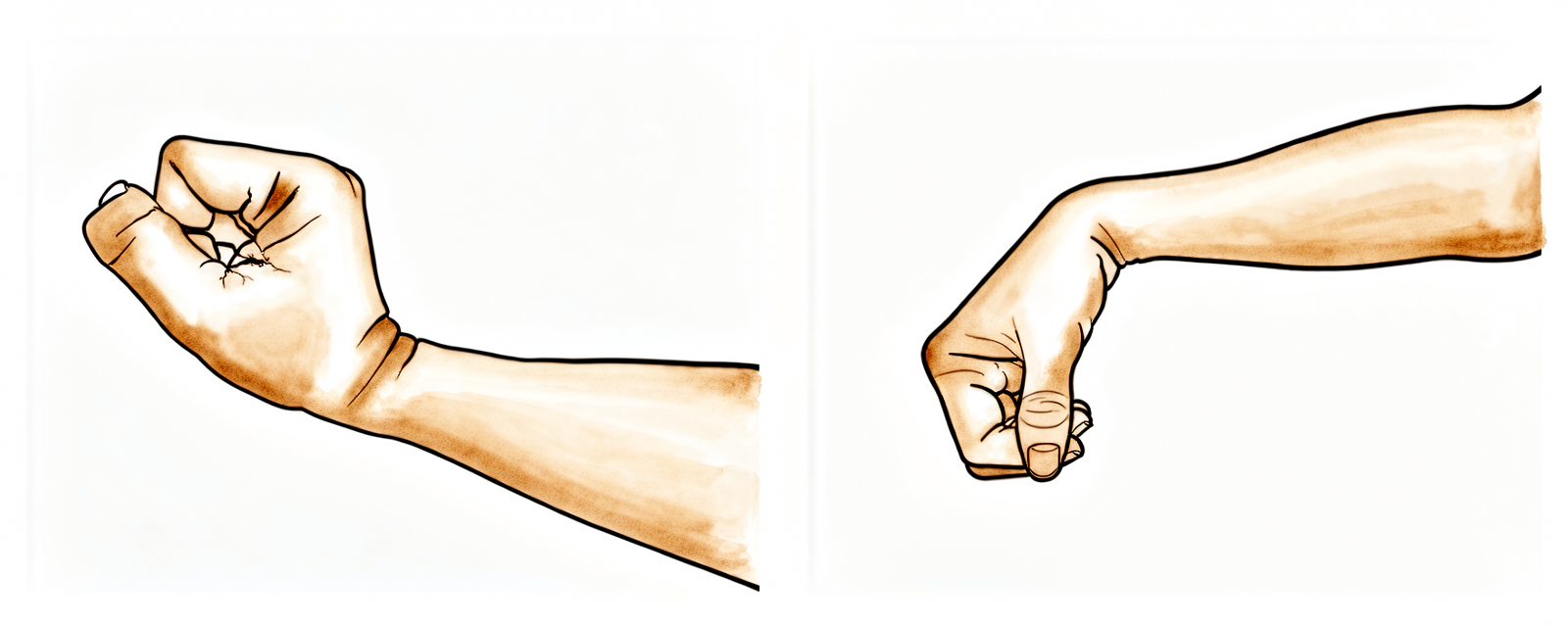
Stretch ng flexion / extension ng pulso
Ipatong ang iyong siko sa isang mesa (o ang iyong pulso sa gilid ng isang mesa o armchair) at dahan-dahang igalaw ang iyong pulso nang pabalik-balik. Kapag mas komportable na, hawakan ang iyong palad gamit ang kabilang kamay at itulak ang pulso pabalik (nakarelaks ang mga daliri, nakaturo sa kisame) — manatili sa posisyong ito nang 15 segundo; pagkatapos ay sa kabilang direksyon (nakarelaks ang mga daliri, nakaturo sa sahig) — manatili sa posisyong ito nang 15 segundo. Ulitin nang 5 beses sa bawat direksyon.
10 reps (5 sa bawat direksyon, hawakan nang 15 segundo), 4–5 beses araw-araw
Kieran Hirpara 4.0
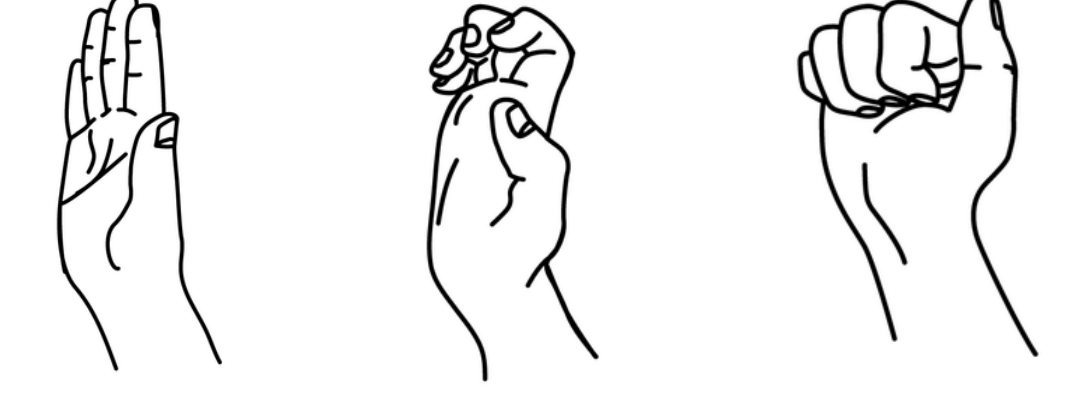
Tendon glides — Series A
Habang ang iyong kamay ay nasa harap mo at ang iyong pulso ay diretso, i-straight nang husto ang lahat ng iyong mga daliri (1). I-bend ang mga dulo ng iyong mga daliri sa posisyong “hook” habang ang iyong mga knuckles ay nakaturo pataas (2). Gumawa ng isang mahigpit na kamao na ang iyong hinlalaki ay nasa ibabaw ng iyong mga daliri (3).
5–10 repetitions, 2–3 beses sa isang araw
Kieran Hirpara 4.0
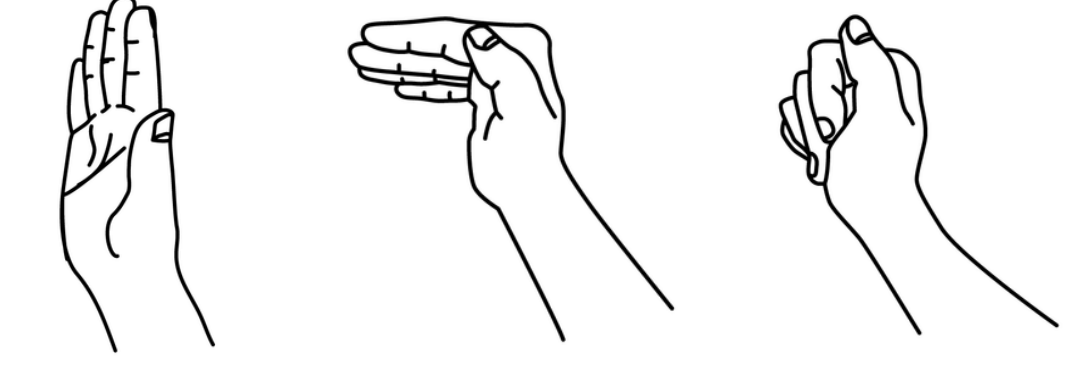
Tendon glides — Series B
Habang ang iyong kamay ay nasa harap mo at ang iyong pulso ay diretso, i-unat nang husto ang lahat ng iyong mga daliri (1). Gumawa ng “tabletop” gamit ang iyong mga daliri sa pamamagitan ng pagbaluktot sa iyong ibabang knuckle at panatilihing diretso ang mga daliri — tiyaking hindi bumabagsak ang iyong pulso pasulong (2). Ibaluktot ang iyong mga daliri sa gitnang joint, idikit ang iyong mga daliri sa iyong palad (3).
5–10 repetitions, 2–3 beses sa isang araw
Kieran Hirpara 4.0
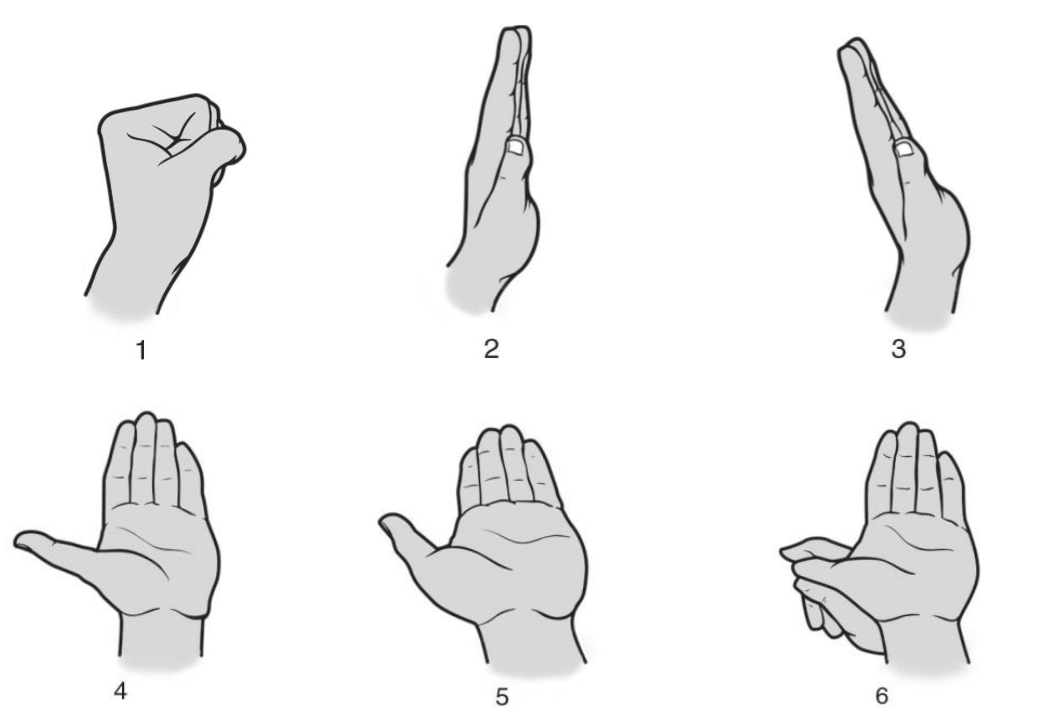
Mga median nerve glide
Igalaw ang iyong kamay sa anim na posisyong ipinapakita, at hawakan ang bawat posisyon nang 3–7 segundo. Huwag masyadong diinan ang iyong hinlalaki sa posisyon 6. Pagkatapos ay idagdag ang nerve stretch: ituwid ang iyong braso sa harap mo nang nakaharap pataas ang iyong palad, at ibaluktot pabalik ang iyong pulso upang nakaturo pababa ang iyong mga daliri. Gamitin ang iyong kabilang kamay upang dahan-dahang itulak pabalik ang iyong mga daliri hanggang maramdaman mo ang banayad na stretch sa bahagi ng palad ng iyong forearm. Hawakan nang 15 segundo, at ulitin nang 5 beses. Panatilihin itong banayad: bawasan ang stretch kung lumalala ang pangingilig.
10–15 repetitions bawat araw, panatilihin ang bawat posisyon nang 3–7 segundo
Kieran Hirpara 4.0
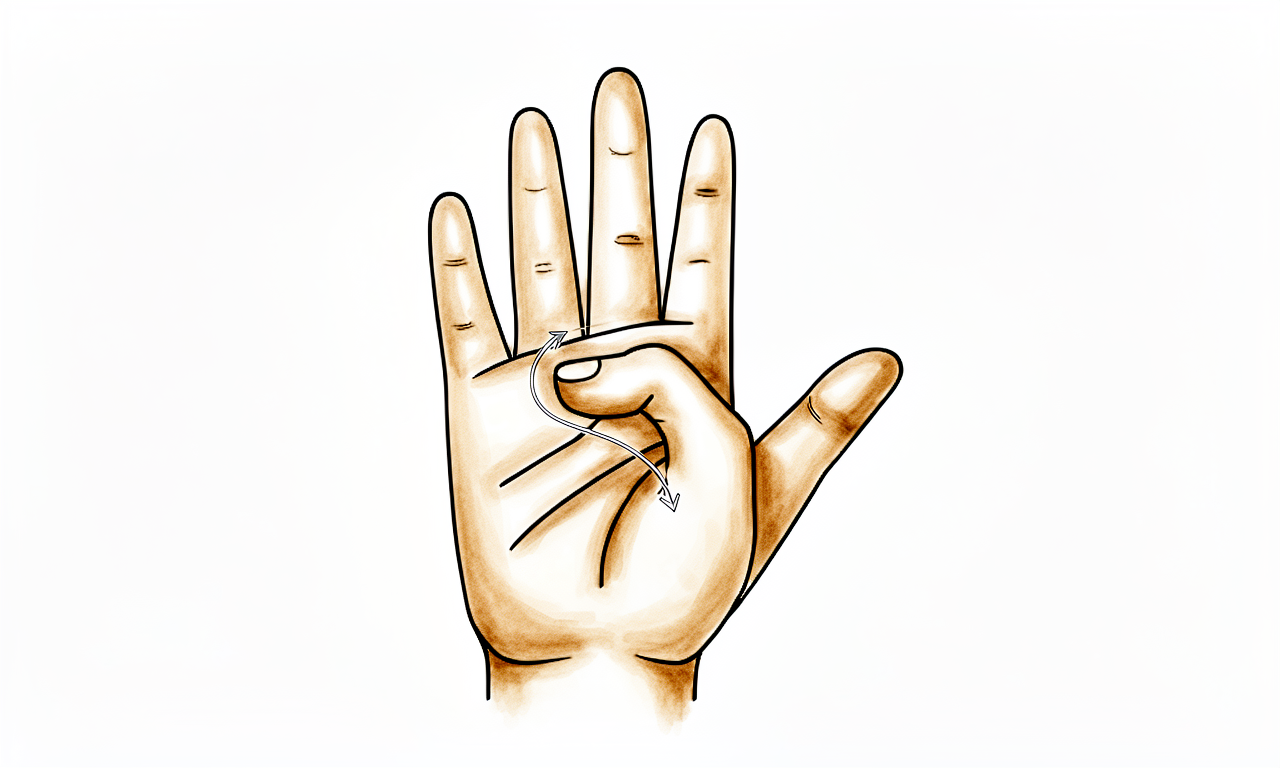
Opposisyon ng hinlalaki
Igalaw ang iyong hinlalaki patawid sa iyong palad patungo sa base ng iyong kalingkingan, pagkatapos ay ituwid itong muli.
5–10 reps, 2–3 beses sa isang araw, araw-araw
Simulan lamang ang mga ehersisyo sa ibaba ayon sa gabay ni Dr Hirpara at ng iyong hand therapist, at manatili sa anumang range at limitasyong ibinigay sa iyo. Ang wrist stretch at ang dalawang tendon-glide series ay pinapanatiling malayang gumagalaw ang mga tendon at ang nailabas na nerve upang hindi sila dumikit sa naghihilom na peklat; nagsisimula ang mga ito nang maaga, sa antas na komportable. Ang mga median nerve glide ay idinagdag upang panatilihing dumudulas ang nerve sa halip na mabigkis, at ang thumb opposition ay muling bumubuo sa pinch na madalas ay mahina bago ang operasyon. Inaasahan ang pananakit nang direkta sa ibabaw ng peklat sa palad sa loob ng ilang linggo. Itigil ang anumang nagdudulot ng matalas o parang kuryenteng sakit patungo sa mga daliri.
Pagkatapos ng iyong protocol
Ang protocol na ito ay kasabay ng pangkalahatang payo sa paggaling ng klinika: tingnan ang pamamahala ng sakit pagkatapos ng operasyon, pag-aalaga ng sugat at mga pangunahing kaalaman sa hand therapy. Para sa mismong operasyon, tingnan ang carpal tunnel release.
Mga Sanggunian
[1] Peters S, Page MJ, Coppieters MW, Ross M, Johnston V. Rehabilitation following carpal tunnel release. Cochrane Database of Systematic Reviews. 2016;2:CD004158. https://pubmed.ncbi.nlm.nih.gov/26884379/ [2] American Academy of Orthopaedic Surgeons. Management of Carpal Tunnel Syndrome — Evidence-Based Clinical Practice Guideline. 2024 update. https://www.aaos.org/quality/quality-programs/upper-extremity-programs/carpal-tunnel-syndrome/ [3] Newington L, Stevens M, Warwick D, Adams J, Walker-Bone K. Sickness absence after carpal tunnel release: a systematic review of the literature. Scand J Work Environ Health. 2018;44(6):557–567. https://pmc.ncbi.nlm.nih.gov/articles/PMC6215485/ [4] Gellman H, Kan D, Gee V, Kuschner SH, Botte MJ. Analysis of pinch and grip strength after carpal tunnel release. J Hand Surg Am. 1989;14(5):863–864. https://pubmed.ncbi.nlm.nih.gov/2794407/ [5] Brigham and Women's Hospital Department of Rehabilitation Services. Standard of Care: Carpal Tunnel Release. 2007 (pillar pain natural-history figures after Povlsen & Tegnell, 1996). https://www.brighamandwomens.org/assets/BWH/patients-and-families/rehabilitation-services/pdfs/wrist-carpal-tunnel-release-pt.pdf
Evidence & references
This is the clinical evidence summary written for health professionals. It is technical, and it lists the research this page was built from. You do not need to read it to understand your treatment or to make a decision about it.
Carpal Tunnel Release — Procedure Outcomes & Post-operative Rehabilitation (Open / Endoscopic Decompression)
Topic scope: post-operative rehabilitation after surgical decompression of the median nerve at the wrist by division of the transverse carpal ligament — open or endoscopic carpal tunnel release. This is a decompression, not a reconstruction: nothing is repaired or tightened, so the rehab is an early-motion pathway built around oedema control, scar/desensitisation work, and tendon + median-nerve gliding rather than months of protected healing.
Defining principle of the rehab here: carpal tunnel release relieves nerve compression and does not create a construct that needs protection. The divided ligament is meant to stay divided — a scar "pseudo-ligament" reconstitutes the carpal arch without re-tethering the nerve. So (unlike a tendon or ligament repair) immediate, unrestricted light use is the default, and the only deliberate restraint is a short window of heavy-load/grip/vibration avoidance while the palm and ligament edges heal. The therapy programme exists to keep the median nerve and flexor tendons gliding through the healing surgical bed so they do not adhere — not to immobilise. The single branch point is whether a concurrent procedure (e.g. flexor tenosynovectomy, revision with a fat-pad flap) was performed, which can extend the protected/oedema phase.
A. PROCEDURE OUTCOMES (open vs endoscopic)
Carpal tunnel release is one of the most reliable operations in upper-limb surgery: the great majority of patients obtain durable symptom relief, and the principal debate is over access (open vs endoscopic), not whether to decompress.
- Both open and endoscopic release give equivalent long-term outcomes. Randomised comparisons and meta-analyses find no meaningful difference in symptom relief, function or patient satisfaction at long-term follow-up between open and single- or dual-portal endoscopic release. Endoscopic release offers a modestly faster early recovery and earlier return to work at the cost of a small increase in transient nerve-related events; by 5 years the two converge [HAND meta-analysis 2022; J Hand Surg 5-year RCT 2009; J Bone Joint Surg RCT 1994]. Strong (RCTs/SR).
- Symptom relief is high and durable. Night symptoms and paraesthesiae typically resolve early; numbness and thenar weakness recover more slowly and may be incomplete where compression was long-standing. Five-year and elderly-cohort series confirm sustained benefit, including in patients over 65 [J Hand Surg 5-yr follow-up; elderly cohorts]. Moderate–strong.
- Division of the transverse carpal ligament alters carpal-tunnel biomechanics (canal volume increases; the flexor tendons shift volarly), which is the anatomical basis for pillar pain and the transient grip-strength dip — both expected, self-limiting consequences of the decompression rather than complications [Clinical Biomechanics 2003]. Mechanistic.
B. REHABILITATION / THERAPY EVIDENCE
The central rehab questions are (1) should the wrist be immobilised afterwards, and (2) does routine formal hand therapy change the outcome. The evidence answers no to routine splinting and no to mandatory protocolised therapy — while supporting a simple, early-motion, glide-based home programme.
- Routine post-operative splinting is NOT recommended. Moderate-quality evidence (AAOS 2024 CPG; supporting systematic reviews) finds wrist immobilisation by sling/orthosis after release does not improve pain, grip or function and may delay recovery. Early active motion is the intended default. Moderate (CPG + SR).
- No single rehab adjunct has strong supporting evidence. The Cochrane review of rehabilitation following carpal tunnel release found only limited, low-certainty evidence for any individual add-on — orthoses, dressings, exercise, cold/ice, multimodal hand therapy, laser, electrotherapy, scar desensitisation or arnica. Recovery is usually straightforward; the implication is to keep the programme simple and individualise it rather than protocolise adjuncts [Peters et al., Cochrane 2016]. Moderate (Cochrane SR — of low-certainty primary evidence).
- Tendon- and nerve-gliding exercises are biologically and clinically rationalised. The rationale is that wrist/digit motion produces longitudinal excursion of the median nerve through the surgical bed, preventing adhesion of nerve to flexor tendons; ultrasound studies confirm measurable nerve excursion during gliding exercises, and comparative-effectiveness work supports tendon/nerve gliding and neural mobilisation as low-risk adjuncts [Am J Phys Med Rehabil 2011; J Hand Therapy 2008 (excursion; neural mobilisation)]. The benefit is modest and the adhesion-prevention purpose is mechanistic/consensus rather than proven by hard outcome trials. Weak–moderate (mechanism strong, outcome modest).
- Supervised therapy is not required for most patients. Outcome series using a standard protocol with a single hand-therapy visit and a home programme report good patient-reported outcomes, supporting selective rather than universal formal therapy. Moderate (cohort).
Recovery trajectory (expected, evidence-anchored)
| Phase | Window | Restraint | Hand use / therapy focus | Strength / load | Notes |
|---|---|---|---|---|---|
| I — Early motion & oedema control | Week 0–1 | None routine (no splint) | Elevate above heart level; immediate active finger/thumb/wrist motion; tendon + median-nerve glides; desensitisation from day 1; compressive dressing/taping for swelling | Light functional use only | Less swelling → freer nerve. Grip is expected to be low |
| II — Wound & ligament healing | Week 1–6 | Heavy-load avoidance | Continue glides; add scar massage once wound healed; heat before / ice after exercises | No lifting, gripping, weight-bearing or vibrating-tool use up to 6 weeks; driving from ~1–2 weeks (once a full fist is achievable) | Pillar tenderness peaks then settles; grip ≈¼ pre-op at 3 wk, ≈¾ by 6 wk |
| III — Return to load & work | Week 6–12+ | Restrictions lifted | Progress gripping, lifting and task-specific loading | Grip back to pre-op by ~3 months, exceeding it by ~6 months; pinch recovers sooner (≈ pre-op by 6 wk) | Non-manual work median ~3 wk; manual work median ~5–6 wk, earlier on modified duties |
(Phase windows mirror the precautions and recovery-curve figures in the patient protocol; they are typical guides, not trial-derived deadlines.)
C. KEY CONTROVERSIES / EVIDENCE QUALITY
- Open vs endoscopic. Equivalent long-term outcomes; endoscopic buys a faster early recovery for a small transient-complication trade-off. Choice is largely surgeon/patient preference and cost. Strong evidence of equivalence.
- To splint or not. Older practice favoured post-operative wrist splinting; current moderate-quality evidence and the AAOS 2024 CPG advise against routine immobilisation. This page's no-splint, early-motion default reflects the current guideline. Moderate.
- Does formal therapy change outcomes? No rehab adjunct has high-certainty benefit (Cochrane). Gliding exercises rest on a sound mechanistic (adhesion-prevention, nerve-excursion) rationale but modest outcome data. The defensible position is a simple home programme + selective therapy, not universal supervised rehab. Weak–moderate.
- Pillar pain & grip dip are expected, not failure. Both follow predictably from dividing the transverse carpal ligament and resolve on a well-described curve; mislabelling them as complications drives unnecessary anxiety. Strong natural-history data.
- Recurrence/revision is uncommon but real; persistent symptoms warrant assessment for incomplete release, the wrong diagnosis, or a second compression site rather than more of the same therapy [JAAOS recalcitrant-CTS review; revision-rate series]. Moderate.
D. EVIDENCE STRENGTH FLAGS (summary)
- STRONG (RCT / SR): equivalence of open vs endoscopic release at long-term follow-up (faster early recovery with endoscopic); high, durable symptom relief from decompression.
- MODERATE: AAOS 2024 CPG against routine post-operative splinting; Cochrane review (limited, low-certainty evidence for any single rehab adjunct → keep it simple); biomechanical basis of pillar pain / grip dip; uncommon but defined revision rate.
- WEAK / CONSENSUS: the specific early-motion, glide-based therapy programme (mechanistically rationalised, outcome benefit modest; surgeon/hand-therapist protocols); exact phase timings (typical, not trial-derived).
CITATIONS
RAG corpus (180,000+ Orthopaedic articles)
- Open versus single- or dual-portal endoscopic carpal tunnel release: a meta-analysis of randomized controlled trials. HAND. 2022. DOI: 10.1177/15589447221075665
- Open compared with 2-portal endoscopic carpal tunnel release: a 5-year follow-up of a randomized controlled trial. J Hand Surg Am. 2009. DOI: 10.1016/j.jhsa.2008.10.026
- Carpal tunnel release: a randomized comparison of three surgical methods. J Hand Surg (Eur Vol). 2013. DOI: 10.1177/1753193412475247
- Carpal tunnel release. A prospective, randomised assessment of open and endoscopic methods. J Bone Joint Surg. 1994. DOI: 10.2106/00004623-199408000-00020
- Five-year follow-up of carpal tunnel release in patients over age 65. J Hand Surg Am. 2010. DOI: 10.1016/j.jhsa.2009.10.020
- Carpal tunnel syndrome (clinical review). BMJ. 2014. DOI: 10.1136/bmj.g6437
- Biomechanical and anatomical consequences of carpal tunnel release. Clin Biomech. 2003. DOI: 10.1016/s0268-0033(03)00052-4
- The comparative effectiveness of tendon and nerve gliding exercises in patients with carpal tunnel syndrome. Am J Phys Med Rehabil. 2011. DOI: 10.1097/phm.0b013e318214eaaf
- The effects of neural mobilization in addition to standard care in persons with carpal tunnel syndrome. J Hand Ther. 2008. DOI: 10.1197/j.jht.2007.12.001
- The excursion of the median nerve during nerve gliding exercise: an observation with high-resolution ultrasonography. J Hand Ther. 2008. DOI: 10.1197/j.jht.2007.11.001
- Effective self-stretching of carpal ligament for the treatment of carpal tunnel syndrome: a double-blinded randomized controlled study. J Hand Ther. 2020. DOI: 10.1016/j.jht.2019.12.002
- Use of conservative therapy before and after surgery for carpal tunnel syndrome. BMC Musculoskelet Disord. 2021. DOI: 10.1186/s12891-021-04378-3
- Power grip, pinch grip, manual muscle testing or thenar atrophy — which should be assessed as a motor outcome after carpal tunnel decompression? A systematic review. BMC Musculoskelet Disord. 2007. DOI: 10.1186/1471-2474-8-114
- Management of recalcitrant carpal tunnel syndrome. J Am Acad Orthop Surg. 2019. DOI: 10.5435/jaaos-d-18-00004
- The rate and timing of revision carpal tunnel release with long-term follow-up. J Hand Surg Am. 2026. DOI: 10.1016/j.jhsa.2026.02.006
- Does aging matter? The efficacy of carpal tunnel release in the elderly. Arch Plast Surg. 2015. DOI: 10.5999/aps.2015.42.3.278
Carpal tunnel rehabilitation literature (URLs)
- Peters S, et al. Rehabilitation following carpal tunnel release. Cochrane Database Syst Rev. 2016;2:CD004158. https://www.cochranelibrary.com/cdsr/doi/10.1002/14651858.CD004158.pub3/full
- O'Connor D, et al. Rehabilitation treatments following carpal tunnel surgery (original Cochrane review). 2003. https://www.cochranelibrary.com/cdsr/doi/10.1002/14651858.CD004158/full
- American Academy of Orthopaedic Surgeons. Management of Carpal Tunnel Syndrome — Evidence-Based Clinical Practice Guideline (2024 update; moderate evidence against routine post-operative immobilisation). https://www.aaos.org/quality/quality-programs/upper-extremity-programs/carpal-tunnel-syndrome/
- Wrist immobilization after surgical decompression of the median nerve in carpal tunnel syndrome: a systematic review. PMC. 2024. https://www.ncbi.nlm.nih.gov/pmc/articles/PMC11374399/
- Sensory nerve conduction velocity predicts improvement of hand function with nerve gliding exercise following carpal tunnel release surgery. PMC. https://www.ncbi.nlm.nih.gov/pmc/articles/PMC8470096/
- Patient-reported outcomes after open carpal tunnel release using a standard protocol with 1 hand therapy visit. J Hand Ther / ScienceDirect. https://www.sciencedirect.com/science/article/abs/pii/S089411301630031X
Published rehab protocols (patient-guidance — basis for the early-motion phase structure)
- Bakker — Carpal Tunnel Release Post-op Protocol (Twin Cities Orthopedics). https://tcomn.com/wp-content/uploads/2017/11/Carpal-tunnel-release-protocol.pdf
- University of Virginia — Carpal Tunnel Release Open Protocol and Home Exercise Program. https://med.virginia.edu/orthopaedic-surgery/wp-content/uploads/sites/242/2015/11/copy_of_CTROPENProtocolandHEP.pdf
- Brigham and Women's Hospital, Department of Rehabilitation Services. Standard of Care: Carpal Tunnel Release (pillar-pain natural history after Povlsen & Tegnell 1996; grip-recovery after Gellman 1989). https://www.brighamandwomens.org/assets/BWH/patients-and-families/rehabilitation-services/pdfs/wrist-carpal-tunnel-release-pt.pdf