Skip to content

Patients › General-Health

Paano Gumagana ang Pananakit

Illustration: Paano Gumagana ang Pananakit

Ang pahinang ito ay isinalin ng makina at hindi pa nasusuri ng isang doktor. Ang bersyong Ingles ang siyang opisyal.

Ang sakit ay ang alarm system ng katawan. Pinoprotektahan ka nito sa pamamagitan ng pagpapahinto, pagpapaurong, at pagpapahinga habang may naghihilom, at sa panandaliang panahon, ito ay isa sa mga pinakakapaki-pakinabang na ginagawa ng nervous system. Ngunit ang sakit ay mas kumplikado kaysa sa isang simpleng "damage meter." Ang tunay na pag-unawa rito ay nakatutulong, lalo na kapag ang sakit ay nananatili: ang alarm system mismo ay maaaring maging oversensitive, kaya ang sakit ay nagpapatuloy, o nararamdaman nang higit pa sa nakikita sa scan, kahit na naghilom na ang mga tissue. Isang sentral at evidence-based na mensahe ang dumadaloy sa pahinang ito: ang pagkasakit (hurt) ay hindi laging katumbas ng pinsala (harm). Ipinapaliwanag ng pahinang ito, sa simpleng pananalita, kung ano ang sakit at kung paano ito gumagana, at pagkatapos ay mas lalong magpapalalim para sa mga nagnanais malaman ang biology kung bakit maaaring magpatuloy ang sakit.

Ano ang sakit at para saan ito

Ang sakit ay hindi sinusukat ng isang sensor at ipinapadala nang walang pagbabago sa utak gaya ng pagbasa ng thermometer. Ito ay isang output na ginagawa ng utak matapos timbangin ang maraming input: mga signal mula sa katawan, oo, ngunit pati na rin ang konteksto, nakaraang karanasan, mood, at kung gaano kadelikado ang paghatol ng utak sa sitwasyon. Ang layunin nito ay proteksyon, upang makuha ang iyong atensyon at baguhin ang iyong gawi upang ang isang pinsala ay makagaling.

Ito ang dahilan kung bakit ang parehong pinsala ay maaaring magdulot ng magkaibang antas ng sakit sa magkaibang araw o sa magkaibang tao, at kung bakit ang sakit ay ganap na totoo kahit hindi ito tumutugma sa nakikita sa X-ray.

Acute versus chronic pain

  • Ang Acute pain ay ang normal na alarm: dumarating ito kasabay ng isang pinsala, ito ay halos proporsyonal sa pinsala, at humuhupa habang nagaganap ang paggaling. Ang sakit na ito ay ginagawa ang tungkulin nito.
  • Ang Chronic pain ay sakit na nananatili lampas sa inaasahang oras ng paggaling (karaniwang binibigyang-kahulugan bilang higit sa humigit-kumulang tatlong buwan). Dito, ang problema ay madalas na hindi ang patuloy na pinsala sa tissue kundi isang alarm system na naging over-sensitive at hindi na namamatay. Ang sakit ay totoo at maaaring malala, ngunit hindi na ito isang maaasahang signal na mayroong napipinsala.

Ang pagkakaibang iyon ay napakahalaga, dahil ang dalawa ay nangangailangan ng magkaibang mga approach: ang acute pain ay pinamamahalaan sa pamamagitan ng paggamot sa pinsala at pagbibigay ng short-term relief; ang chronic pain ay pinamamahalaan sa pamamagitan ng unti-unting pagpapakalma at muling pagsasanay sa nervous system, hindi sa pamamagitan ng paghahanap ng mas malalakas na painkillers.

Ano ang nakakatulong sa sakit

  • Pag-unawa rito. Ang pag-alam na ang "sakit ay hindi nangangahulugang pinsala" ay tunay na nagbabawas ng chronic pain at kapansanan; ang takot at catastrophising ay nagpapalala sa sakit.
  • Paggalaw at pacing. Ang banayad at graded na aktibidad ay nag-de-desensitise sa isang over-sensitive na sistema; ang matagal na pahinga at pag-iwas ay karaniwang nagpapalala sa chronic pain.
  • Tulog, mood at stress. Ang kulang na tulog, mababang mood at stress ay lahat nagpapataas sa tindi ng sakit; ang pagtugon sa mga ito ay nagpapababa rito.
  • Ang tamang gamot para sa tamang sakit. Ang maiikling kurso ng mga simpleng analgesic ay nakakatulong sa acute pain; ang chronic pain ay mas tumutugon sa mga gamot na targeted sa nerve, ehersisyo at mga psychological strategy kaysa sa mga opioid.

Mas malalim na pagtalakay

Advanced reading: the deeper science (optional)

Ang seksyong ito ay tumataas patungo sa isang mas detalyadong paliwanag sa antas ng estudyante. Hindi ito kailangan upang pamahalaan ang iyong sakit, ngunit kung curious ka kung paano nalilikha ang sakit at kung bakit ito maaaring magpatuloy, magpatuloy sa pagbabasa.

Paano naglalakbay ang signal ng sakit

Ang mga espesyalisadong dulo ng nerbiyos na tinatawag na nociceptors ay nakaka-detect ng mga stimuli na maaaring makapinsala: matinding presyon, init, o mga kemikal na inilalabas ng napinsalang tissue. Nagpapadala sila ng mga signal sa dalawang uri ng fibre. Ang mabilis at insulated na A-delta fibres ang nagdadala ng matalas at agarang "ouch" na nagiging sanhi ng mabilis na pagbawi mo ng iyong kamay; ang mas mabagal at hubad na C fibres naman ang nagdadala ng mapurol, kumikirot, at nananatiling sakit na sumusunod. Ang mga signal na ito ay nakakarating sa spinal cord, kung saan sila ay ipinapasa (at namodulate na) bago maglakbay pataas sa utak. Walang iisang "pain centre"; maraming rehiyon ng utak ang magkakasamang nagdedesisyon kung lilikha ng sakit, at kung gaano ito karami. Kaya ang sakit ay binuo (constructed), hindi lamang basta tinanggap.

Ang ideya ng gate control

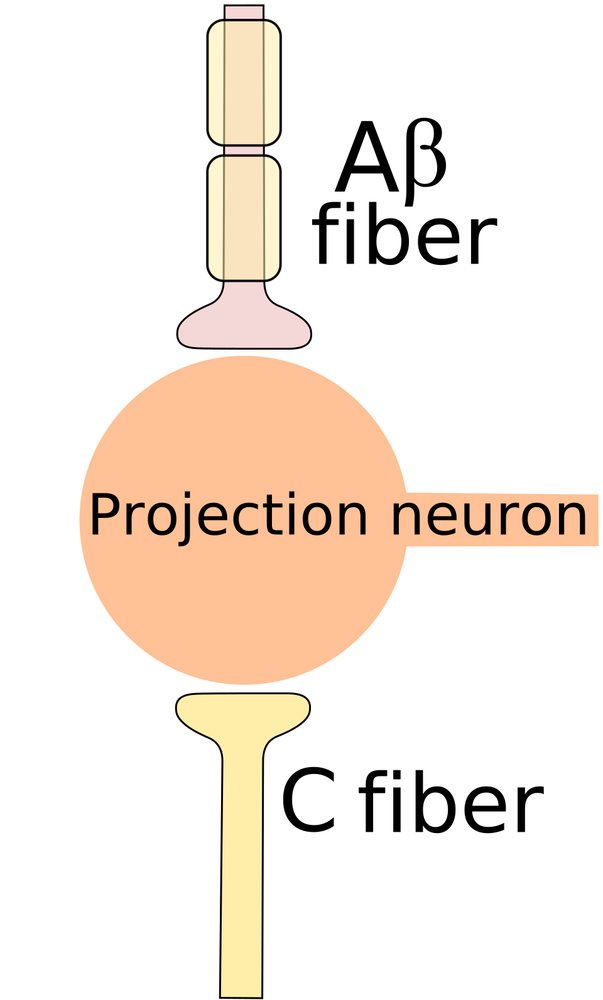
Pinasimpleng diagram ng gate-control: isang projection neuron na tumatanggap ng input mula sa isang mabilis na A-beta fibre at isang mabagal na C (pain) fibre.
Ang gate, sa simpleng paliwanag: ang non-painful Aβ input ay maaaring magsara ng gate sa mga C-fibre pain signal sa spinal projection neuron. Wikimedia Commons, CC BY-SA 3.0

Ang spinal cord ay nagsisilbing isang gate (pintuan) na maaaring magpalakas o magpahina ng mga pumapasok na signal ng sakit. Ang mga non-painful input ay maaaring "isara ang gate" sa sakit, kaya naman ang paghaplos sa isang bump, o ang paggamit ng TENS machine, ay nakakabawas nito. Ang utak ay nagpapadala rin ng mga signal pababa sa spinal cord na nag-aadjust ng tindi ng sakit depende sa atensyon, mood, at konteksto (descending modulation). Ito ang tunay na mekanismo sa likod ng mga pang-araw-araw na obserbasyon: isang sports injury na halos hindi nararamdaman sa gitna ng laro, sakit na lumalala kapag ikaw ay balisa o pagod, at ginhawa mula sa distraction o pagpapanatag. Ang gate ay hindi metapora; ito ay pisyolohiya.

Peripheral at central sensitisation

Pagkatapos ng isang pinsala, sadyang itinataas ng system ang sarili nitong gain upang maprotektahan ang apektadong bahagi:

  • Peripheral sensitisation: ang mga kemikal na inilalabas sa pinsala ay ginagawang mas excitable ang mga lokal na nociceptor, kaya mas sumasakit ang sugatang bahagi (ito ang dahilan kung bakit ang balat na sunburnt ay sobrang hapdi sa mainit na shower).
  • Central sensitisation: ang spinal cord at utak mismo ay nagiging mas excitable, na nagpapalakas sa bawat pumapasok na signal.

Ang mga pangunahing palatandaan nito ay hyperalgesia (ang mga bagay na masakit ay mas sumasakit kaysa sa dapat) at allodynia (ang mga bagay na hindi dapat masakit, gaya ng magaan na paghipo o damit, ay nagiging masakit). Sa acute injury, ito ay kapaki-pakinabang at bumabalik sa dati. Sa chronic pain, maaari itong magpatuloy at maging self-sustaining.

Kapag ang sakit ay tumatagal lampas sa pinsala: chronic at nociplastic pain

Sa ilang tao, nananatiling sensitibo ang nervous system matagal na matapos gumaling ang mga tissue; ang alarm ay nananatiling "on." Ang sakit na nagmumula sa binagong processing na ito, sa halip na mula sa patuloy na pinsala o nerve injury, ay tinatawag na nociplastic pain (central sensitisation ang pangunahing mekanismo nito). Ipinapaliwanag nito ang isang karaniwan at dating nakalilitong clinical picture: malala, tunay, at nakakapanghina na sakit ngunit kakaunti o walang makitang pinsala sa imaging. Ang pagkilala rito ay hindi pagbalewala sa sakit bilang "nasa isip mo lang"; ang mga pagbabago ay tunay at nasusukat na mga pagbabago sa nervous system. Binabago nito ang layunin: hindi ang maghanap ng higit pang structural damage na aayusin, kundi ang i-down-regulate ang isang over-sensitive na system. Ang mga kondisyon tulad ng fibromyalgia, at maraming persistent musculoskeletal pain, ay kabilang dito.

Bakit hindi sagot ang mas malakas na painkiller para sa chronic pain

Ang mga opioid ay kapaki-pakinabang para sa panandalian at malalang acute pain, ngunit hindi sila angkop para sa chronic pain. Sa patuloy na paggamit, nagkakaroon ang katawan ng tolerance (nangangailangan ng mas marami para sa parehong epekto) at, paradoxically, opioid-induced hyperalgesia: maaaring gawin ng mga gamot na ito na mas sensitibo sa sakit ang nervous system sa paglipas ng panahon. Dahil ang chronic pain ay pangunahing problema ng sensitisadong sistema, ang mga epektibong tool ay ang mga nagsasanay muli sa sistemang iyon: graded exercise, pagtulog, mga sikolohikal na estratehiya, at mga gamot na nakatuon sa nerve (sa halip na opioid).

Ano ang nakakatulong at nakakasama

  • Graded activity at pacing ang nag-de-desensitise sa system; ang pag-iwas dahil sa takot at matagal na pahinga ay lalong nag-se-sensitise rito.
  • Sleep, mood, at stress management ang nagpapababa ng gain; ang kulang na tulog at distress ay nagpapataas nito.
  • Edukasyon at pagbabawas ng catastrophising ay may nasusukat na pagbabawas sa sakit at kapansanan.
  • Tamang gamot para sa tamang sakit: short-term simple analgesia para sa acute pain; ehersisyo, psychological therapy at nerve-targeted drugs (hindi pagpapataas ng opioids) para sa chronic pain.

Tingnan din


Creative Commons BY-NC 4.0

CC Creative Commons licence
BY Attribution — you must credit the source
NC NonCommercial — not for commercial use

Attribution-NonCommercial 4.0 International


Creative Commons Corporation ("Creative Commons") is not a law firm and does not provide legal services or legal advice. Distribution of Creative Commons public licenses does not create a lawyer-client or other relationship. Creative Commons makes its licenses and related information available on an "as-is" basis. Creative Commons gives no warranties regarding its licenses, any material licensed under their terms and conditions, or any related information. Creative Commons disclaims all liability for damages resulting from their use to the fullest extent possible.

Using Creative Commons Public Licenses

Creative Commons public licenses provide a standard set of terms and conditions that creators and other rights holders may use to share original works of authorship and other material subject to copyright and certain other rights specified in the public license below. The following considerations are for informational purposes only, are not exhaustive, and do not form part of our licenses.

Considerations for licensors: Our public licenses are intended for use by those authorized to give the public permission to use material in ways otherwise restricted by copyright and certain other rights. Our licenses are irrevocable. Licensors should read and understand the terms and conditions of the license they choose before applying it. Licensors should also secure all rights necessary before applying our licenses so that the public can reuse the material as expected. Licensors should clearly mark any material not subject to the license. This includes other CC- licensed material, or material used under an exception or limitation to copyright. More considerations for licensors: wiki.creativecommons.org/Considerations_for_licensors

Considerations for the public: By using one of our public licenses, a licensor grants the public permission to use the licensed material under specified terms and conditions. If the licensor's permission is not necessary for any reason--for example, because of any applicable exception or limitation to copyright--then that use is not regulated by the license. Our licenses grant only permissions under copyright and certain other rights that a licensor has authority to grant. Use of the licensed material may still be restricted for other reasons, including because others have copyright or other rights in the material. A licensor may make special requests, such as asking that all changes be marked or described. Although not required by our licenses, you are encouraged to respect those requests where reasonable. More considerations for the public: wiki.creativecommons.org/Considerations_for_licensees


Creative Commons Attribution-NonCommercial 4.0 International Public License

By exercising the Licensed Rights (defined below), You accept and agree to be bound by the terms and conditions of this Creative Commons Attribution-NonCommercial 4.0 International Public License ("Public License"). To the extent this Public License may be interpreted as a contract, You are granted the Licensed Rights in consideration of Your acceptance of these terms and conditions, and the Licensor grants You such rights in consideration of benefits the Licensor receives from making the Licensed Material available under these terms and conditions.

Section 1 -- Definitions.

a. Adapted Material means material subject to Copyright and Similar Rights that is derived from or based upon the Licensed Material and in which the Licensed Material is translated, altered, arranged, transformed, or otherwise modified in a manner requiring permission under the Copyright and Similar Rights held by the Licensor. For purposes of this Public License, where the Licensed Material is a musical work, performance, or sound recording, Adapted Material is always produced where the Licensed Material is synched in timed relation with a moving image.

b. Adapter's License means the license You apply to Your Copyright and Similar Rights in Your contributions to Adapted Material in accordance with the terms and conditions of this Public License.

c. Copyright and Similar Rights means copyright and/or similar rights closely related to copyright including, without limitation, performance, broadcast, sound recording, and Sui Generis Database Rights, without regard to how the rights are labeled or categorized. For purposes of this Public License, the rights specified in Section 2(b)(1)-(2) are not Copyright and Similar Rights.

d. Effective Technological Measures means those measures that, in the absence of proper authority, may not be circumvented under laws fulfilling obligations under Article 11 of the WIPO Copyright Treaty adopted on December 20, 1996, and/or similar international agreements.

e. Exceptions and Limitations means fair use, fair dealing, and/or any other exception or limitation to Copyright and Similar Rights that applies to Your use of the Licensed Material.

f. Licensed Material means the artistic or literary work, database, or other material to which the Licensor applied this Public License.

g. Licensed Rights means the rights granted to You subject to the terms and conditions of this Public License, which are limited to all Copyright and Similar Rights that apply to Your use of the Licensed Material and that the Licensor has authority to license.

h. Licensor means the individual(s) or entity(ies) granting rights under this Public License.

i. NonCommercial means not primarily intended for or directed towards commercial advantage or monetary compensation. For purposes of this Public License, the exchange of the Licensed Material for other material subject to Copyright and Similar Rights by digital file-sharing or similar means is NonCommercial provided there is no payment of monetary compensation in connection with the exchange.

j. Share means to provide material to the public by any means or process that requires permission under the Licensed Rights, such as reproduction, public display, public performance, distribution, dissemination, communication, or importation, and to make material available to the public including in ways that members of the public may access the material from a place and at a time individually chosen by them.

k. Sui Generis Database Rights means rights other than copyright resulting from Directive 96/9/EC of the European Parliament and of the Council of 11 March 1996 on the legal protection of databases, as amended and/or succeeded, as well as other essentially equivalent rights anywhere in the world.

l. You means the individual or entity exercising the Licensed Rights under this Public License. Your has a corresponding meaning.

Section 2 -- Scope.

a. License grant.

1. Subject to the terms and conditions of this Public License, the Licensor hereby grants You a worldwide, royalty-free, non-sublicensable, non-exclusive, irrevocable license to exercise the Licensed Rights in the Licensed Material to:

a. reproduce and Share the Licensed Material, in whole or in part, for NonCommercial purposes only; and

b. produce, reproduce, and Share Adapted Material for NonCommercial purposes only.

2. Exceptions and Limitations. For the avoidance of doubt, where Exceptions and Limitations apply to Your use, this Public License does not apply, and You do not need to comply with its terms and conditions.

3. Term. The term of this Public License is specified in Section 6(a).

4. Media and formats; technical modifications allowed. The Licensor authorizes You to exercise the Licensed Rights in all media and formats whether now known or hereafter created, and to make technical modifications necessary to do so. The Licensor waives and/or agrees not to assert any right or authority to forbid You from making technical modifications necessary to exercise the Licensed Rights, including technical modifications necessary to circumvent Effective Technological Measures. For purposes of this Public License, simply making modifications authorized by this Section 2(a) (4) never produces Adapted Material.

5. Downstream recipients.

a. Offer from the Licensor -- Licensed Material. Every recipient of the Licensed Material automatically receives an offer from the Licensor to exercise the Licensed Rights under the terms and conditions of this Public License.

b. No downstream restrictions. You may not offer or impose any additional or different terms or conditions on, or apply any Effective Technological Measures to, the Licensed Material if doing so restricts exercise of the Licensed Rights by any recipient of the Licensed Material.

6. No endorsement. Nothing in this Public License constitutes or may be construed as permission to assert or imply that You are, or that Your use of the Licensed Material is, connected with, or sponsored, endorsed, or granted official status by, the Licensor or others designated to receive attribution as provided in Section 3(a)(1)(A)(i).

b. Other rights.

1. Moral rights, such as the right of integrity, are not licensed under this Public License, nor are publicity, privacy, and/or other similar personality rights; however, to the extent possible, the Licensor waives and/or agrees not to assert any such rights held by the Licensor to the limited extent necessary to allow You to exercise the Licensed Rights, but not otherwise.

2. Patent and trademark rights are not licensed under this Public License.

3. To the extent possible, the Licensor waives any right to collect royalties from You for the exercise of the Licensed Rights, whether directly or through a collecting society under any voluntary or waivable statutory or compulsory licensing scheme. In all other cases the Licensor expressly reserves any right to collect such royalties, including when the Licensed Material is used other than for NonCommercial purposes.

Section 3 -- License Conditions.

Your exercise of the Licensed Rights is expressly made subject to the following conditions.

a. Attribution.

1. If You Share the Licensed Material (including in modified form), You must:

a. retain the following if it is supplied by the Licensor with the Licensed Material:

i. identification of the creator(s) of the Licensed Material and any others designated to receive attribution, in any reasonable manner requested by the Licensor (including by pseudonym if designated);

ii. a copyright notice;

iii. a notice that refers to this Public License;

iv. a notice that refers to the disclaimer of warranties;

v. a URI or hyperlink to the Licensed Material to the extent reasonably practicable;

b. indicate if You modified the Licensed Material and retain an indication of any previous modifications; and

c. indicate the Licensed Material is licensed under this Public License, and include the text of, or the URI or hyperlink to, this Public License.

2. You may satisfy the conditions in Section 3(a)(1) in any reasonable manner based on the medium, means, and context in which You Share the Licensed Material. For example, it may be reasonable to satisfy the conditions by providing a URI or hyperlink to a resource that includes the required information.

3. If requested by the Licensor, You must remove any of the information required by Section 3(a)(1)(A) to the extent reasonably practicable.

4. If You Share Adapted Material You produce, the Adapter's License You apply must not prevent recipients of the Adapted Material from complying with this Public License.

Section 4 -- Sui Generis Database Rights.

Where the Licensed Rights include Sui Generis Database Rights that apply to Your use of the Licensed Material:

a. for the avoidance of doubt, Section 2(a)(1) grants You the right to extract, reuse, reproduce, and Share all or a substantial portion of the contents of the database for NonCommercial purposes only;

b. if You include all or a substantial portion of the database contents in a database in which You have Sui Generis Database Rights, then the database in which You have Sui Generis Database Rights (but not its individual contents) is Adapted Material; and

c. You must comply with the conditions in Section 3(a) if You Share all or a substantial portion of the contents of the database.

For the avoidance of doubt, this Section 4 supplements and does not replace Your obligations under this Public License where the Licensed Rights include other Copyright and Similar Rights.

Section 5 -- Disclaimer of Warranties and Limitation of Liability.

a. UNLESS OTHERWISE SEPARATELY UNDERTAKEN BY THE LICENSOR, TO THE EXTENT POSSIBLE, THE LICENSOR OFFERS THE LICENSED MATERIAL AS-IS AND AS-AVAILABLE, AND MAKES NO REPRESENTATIONS OR WARRANTIES OF ANY KIND CONCERNING THE LICENSED MATERIAL, WHETHER EXPRESS, IMPLIED, STATUTORY, OR OTHER. THIS INCLUDES, WITHOUT LIMITATION, WARRANTIES OF TITLE, MERCHANTABILITY, FITNESS FOR A PARTICULAR PURPOSE, NON-INFRINGEMENT, ABSENCE OF LATENT OR OTHER DEFECTS, ACCURACY, OR THE PRESENCE OR ABSENCE OF ERRORS, WHETHER OR NOT KNOWN OR DISCOVERABLE. WHERE DISCLAIMERS OF WARRANTIES ARE NOT ALLOWED IN FULL OR IN PART, THIS DISCLAIMER MAY NOT APPLY TO YOU.

b. TO THE EXTENT POSSIBLE, IN NO EVENT WILL THE LICENSOR BE LIABLE TO YOU ON ANY LEGAL THEORY (INCLUDING, WITHOUT LIMITATION, NEGLIGENCE) OR OTHERWISE FOR ANY DIRECT, SPECIAL, INDIRECT, INCIDENTAL, CONSEQUENTIAL, PUNITIVE, EXEMPLARY, OR OTHER LOSSES, COSTS, EXPENSES, OR DAMAGES ARISING OUT OF THIS PUBLIC LICENSE OR USE OF THE LICENSED MATERIAL, EVEN IF THE LICENSOR HAS BEEN ADVISED OF THE POSSIBILITY OF SUCH LOSSES, COSTS, EXPENSES, OR DAMAGES. WHERE A LIMITATION OF LIABILITY IS NOT ALLOWED IN FULL OR IN PART, THIS LIMITATION MAY NOT APPLY TO YOU.

c. The disclaimer of warranties and limitation of liability provided above shall be interpreted in a manner that, to the extent possible, most closely approximates an absolute disclaimer and waiver of all liability.

Section 6 -- Term and Termination.

a. This Public License applies for the term of the Copyright and Similar Rights licensed here. However, if You fail to comply with this Public License, then Your rights under this Public License terminate automatically.

b. Where Your right to use the Licensed Material has terminated under Section 6(a), it reinstates:

1. automatically as of the date the violation is cured, provided it is cured within 30 days of Your discovery of the violation; or

2. upon express reinstatement by the Licensor.

For the avoidance of doubt, this Section 6(b) does not affect any right the Licensor may have to seek remedies for Your violations of this Public License.

c. For the avoidance of doubt, the Licensor may also offer the Licensed Material under separate terms or conditions or stop distributing the Licensed Material at any time; however, doing so will not terminate this Public License.

d. Sections 1, 5, 6, 7, and 8 survive termination of this Public License.

Section 7 -- Other Terms and Conditions.

a. The Licensor shall not be bound by any additional or different terms or conditions communicated by You unless expressly agreed.

b. Any arrangements, understandings, or agreements regarding the Licensed Material not stated herein are separate from and independent of the terms and conditions of this Public License.

Section 8 -- Interpretation.

a. For the avoidance of doubt, this Public License does not, and shall not be interpreted to, reduce, limit, restrict, or impose conditions on any use of the Licensed Material that could lawfully be made without permission under this Public License.

b. To the extent possible, if any provision of this Public License is deemed unenforceable, it shall be automatically reformed to the minimum extent necessary to make it enforceable. If the provision cannot be reformed, it shall be severed from this Public License without affecting the enforceability of the remaining terms and conditions.

c. No term or condition of this Public License will be waived and no failure to comply consented to unless expressly agreed to by the Licensor.

d. Nothing in this Public License constitutes or may be interpreted as a limitation upon, or waiver of, any privileges and immunities that apply to the Licensor or You, including from the legal processes of any jurisdiction or authority.


Creative Commons is not a party to its public licenses. Notwithstanding, Creative Commons may elect to apply one of its public licenses to material it publishes and in those instances will be considered the “Licensor.” The text of the Creative Commons public licenses is dedicated to the public domain under the CC0 Public Domain Dedication. Except for the limited purpose of indicating that material is shared under a Creative Commons public license or as otherwise permitted by the Creative Commons policies published at creativecommons.org/policies, Creative Commons does not authorize the use of the trademark "Creative Commons" or any other trademark or logo of Creative Commons without its prior written consent including, without limitation, in connection with any unauthorized modifications to any of its public licenses or any other arrangements, understandings, or agreements concerning use of licensed material. For the avoidance of doubt, this paragraph does not form part of the public licenses.

Creative Commons may be contacted at creativecommons.org.