Patients › Wrist
Total Wrist Fusion
Wrist fusion permanently joins wrist bones to relieve pain from arthritis or injury.
Bakit iminungkahi ang operasyong ito
Si Dr Kieran Hirpara, isang upper-limb surgeon sa Mater Private Hospital Rockhampton, ay nagsisimula sa mga opsyon na hindi gaanong invasive na angkop sa iyong kondisyon. Ang mga pasyente ay karaniwang nirerefer sa aming klinika ng kanilang GP; kung iminungkahi ng isang physiotherapist na magpatingin sa amin, kakailanganin mo pa rin ng referral mula sa iyong GP upang maging eligible para sa Medicare rebate. Ang isang clinic assessment, kabilang ang iyong history, pagsusuri, at imaging kung kinakailangan, ang nagtatakda ng diagnosis.
Ang wrist arthritis ay nagdudulot ng sakit, panghihina ng grip, at kung minsan ay pulso na hindi nananatiling steady. Para sa maraming tao, nauuna ang non-operative care: pagbabago sa aktibidad, hand therapy, splinting, o mga injection. Iminumungkahi namin ang total wrist fusion kapag ang mga hakbang na iyon ay hindi nagbigay sa iyo ng sapat na pagbuti. Pinagsasama ng operasyon ang mga buto ng pulso upang gumaling ang mga ito bilang isang solidong piraso. Pinipigilan nito ang masakit na pagkiskisan sa pagitan ng mga gasgas na joint surfaces. Karaniwan itong inaalok para sa malalang wear-and-tear arthritis pagkatapos ng pinsala, o para sa pulsong napinsala ng rheumatoid arthritis na naging unstable o deformed. Maaari rin itong isaalang-alang kung nabigo ang isang naunang wrist replacement. Ang layunin ay isang stable at malakas na pulso na may mas kaunting sakit, upang magamit mo ang iyong kamay nang may kumpiyansa.
Bago ang operasyon
Plalanong ng iyong surgeon ang operasyon gamit ang imaging ng iyong pulso, gaya ng mga X-ray o MRI scan. Gumagamit ang MRI ng malakas na magnet upang kumuha ng detalyadong mga larawan at maaaring magpakita ng mga problemang hindi nakikita sa mga ordinaryong X-ray. Makakatanggap ka ng malinaw na mga instruksyon tungkol sa iyong mga gamot bago ang operasyon. Ang ilang mga gamot ay maaaring kailangang itigil muna sa loob ng maikling panahon, at sasabihin sa iyo ng iyong surgeon kung alin sa mga ito at kung gaano katagal. Itigil ang pagkain at pag-inom pitong oras bago ang oras ng iyong operasyon. Humihingi kami ng pitong oras sa halip na anim upang maaari kang mauna kung maagang matapos ang theatre list. Mag-ayos ng taong magmamaneho para ihatid ka pauwi pagkatapos. Magdala ng listahan ng iyong mga kasalukuyang gamot. Magsuot ng maluwag at komportableng damit. Kung mayroon kang iba pang kondisyong medikal, maaaring kailanganin mo ng mga blood test o pagsusuri kasama ang anaesthetist.
Sa araw ng operasyon
Darating ka sa surgical admissions unit ng ospital, kung saan ka ire-rehistro at ihahanda para sa theatre. Makikilala mo doon ang anaesthetist. Ang operasyong ito ay ginagawa sa ilalim ng general anaesthetic. Ikaw ay tulog nang tuluyan para sa operasyon. Ang ilang pasyente ay maaaring sumailalim din sa regional nerve block para sa pagpapaginhawa ng sakit pagkatapos ng operasyon; ang anaesthetist ang magpapasya sa araw na iyon base sa iyong indibidwal na kalagayan. Pagkatapos ay dadalhin ka sa operating theatre, kung saan isasagawa ang operasyon.
Magigising ka sa recovery area, kung saan babantayan ka ng mga nurse habang nawawala ang bisa ng anaesthetic. Kapag stable ka na, maaaring pumunta ka sa ward o uuwi na, depende sa procedure at sa iyong paggaling.
Ano ang kinapapalooban ng operasyon
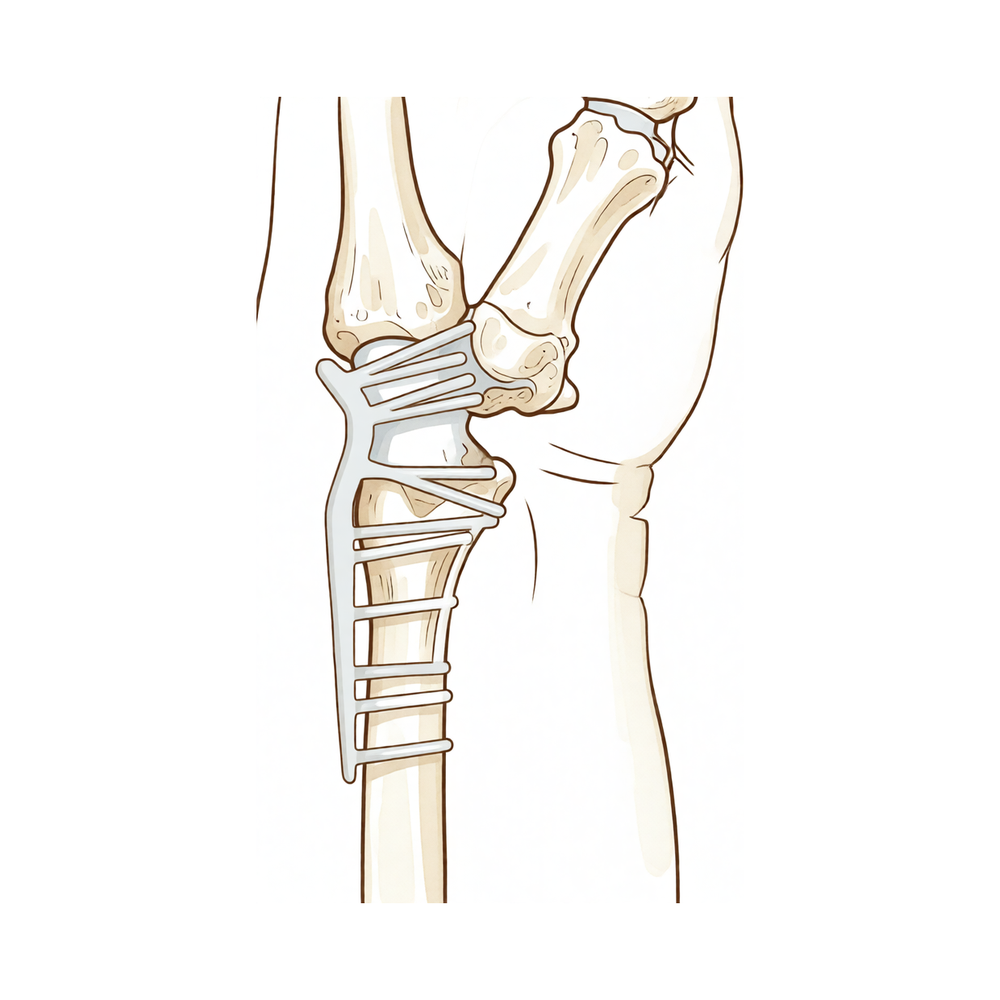
Ang iyong siruhano ay gagawa ng isang hiwa sa likod ng iyong pulso. Sa pamamagitan ng bukasan na ito, maaabot nila ang mga gasgas na surface ng joint sa pagitan ng maliliit na buto ng pulso at ng dulo ng buto ng forearm. Tatanggalin nila ang natitirang makinis na cartilage mula sa mga surface na ito, kasama ang anumang tumigas na buto, upang malantad ang sariwa at dumudugong buto sa magkabilang panig ng bawat joint na pagdurugtungin. Ang raw-on-raw contact na ito ang nagpapahintulot sa mga buto na gumaling nang magkasama bilang isang solidong piraso.
Pagkatapos ay itatapat ng iyong siruhano ang mga buto sa isang functional position at pananatilihin itong hindi gumagalaw habang gumagaling. Isang hugis-metal na plate ang ikakabit sa likod ng pulso at ififixed sa mga buto gamit ang mga screw. Pinapanatili ng plate ang lahat sa tamang posisyon upang hindi gumalaw ang mga buto habang naghihilom ang mga ito. Sa ilang mga kaso, maaaring magdagdag ang iyong siruhano ng kaunting extra bone graft upang makatulong sa paggaling.
Kapag secure na ang mga buto, itatahi ng iyong siruhano ang hiwa at lalagyan ng dressing.
Pagkatapos ng operasyon
Magigising ka sa recovery area habang binabantayan ka ng mga nurse habang nawawala ang bisa ng anaesthetic. Ang iyong pulso ay susuportahan ng isang splint o cast, na may dressing sa ibabaw ng sugat. Iniiwan namin ang dressing sa loob ng humigit-kumulang 10 araw; mangyaring huwag itong tanggalin bago ang panahong iyon maliban kung sinabi namin sa iyo. Papalitan o tatanggalin namin ito kapag nakita ka namin. May nakaplano nang pain relief para sa iyo bago ka umalis ng ospital, at maaaring i-adjust ito ng mga nurse kung ikaw ay hindi komportable. Makakabangon ka at makakalakad sa araw ng operasyon, gamit ang iyong kabilang kamay para sa suporta. Karamihan sa mga pasyente ay nananatili ng isang gabi sa ospital pagkatapos ng operasyong ito, bagaman ang ilan ay nakakauwi sa mismong araw. Mangyaring mag-ayos ng isang tao na sasamahan ka sa unang 24 oras pagkauwi mo sa bahay.
Paggaling
Sa unang ilang araw, ang iyong pulso ay magiging masakit at mamamaga. Unti-unti itong huhupa. Ang pagpapanatiling nakataas ng iyong kamay sa mga unan, kahit sa gabi, ay nakakatulong upang mabawasan ang pamamaga at discomfort. Inumin ang pain relief na nakaplano para sa iyo sa halip na hintayin pang tumindi ang sakit.
Ang iyong pulso ay lalagyan ng splint o cast habang naghihilom ang mga buto. Gagamitin mo ang iyong kabilang kamay para sa mga pang-araw-araw na gawain tulad ng pagbibihis, pagkain, at paghuhugas. Maaari kang gumalaw sa loob ng bahay at gumawa ng mga light activities, ngunit hindi ka dapat magmaneho habang naka-immobilise ang iyong pulso. Kapag naalis na ang cast o splint at binigyan ka na ng clearance ng iyong surgeon, maaari nang magsimulang magmaneho; ang aming pahina tungkol sa driving after upper-limb surgery ay nagpapaliwanag nito nang mas detalyado.
Ang hand therapy ay magsisimula agad pagkatapos ng operasyon at nakakatulong upang maiwasan ang paninigas ng iyong mga daliri, pulso, at forearm. Ang iyong hand therapist, si Ruby Doolan sa Extend Rehabilitation, ang gagabay sa iyong mga ehersisyo at gagawa ng anumang splint na iyong kakailanganin. Ang pagsisimula ng banayad na paggalaw nang maaga ay nakakatulong upang mabalik ang kapaki-pakinabang na motion nang mas mabilis at madalas na nangangahulugan ng mas kaunting therapy visits sa kabuuan.
Dahil ang mga buto sa pulso ay pinagsama, ang bahaging iyon ng iyong pulso ay hindi na mababaluktot. Karamihan sa mga tao ay mabilis na nakaka-adapt at nakakayanan ang kanilang mga pang-araw-araw na aktibidad sa pamamagitan ng ilang mga bagong gawi. Ang iyong forearm ay maaari pa ring pumihit, kaya maraming gawain ang nananatiling komportable. Kapag naghilom na ang mga buto at naramdaman mong malakas na ang iyong grip, maaari ka nang unti-unting bumalik sa trabaho at iba pang mga aktibidad.
Ang bawat tao ay naghihilom sa sarili nilang bilis, kaya maaaring mag-iba ang iyong timeline. Ang iyong surgeon at ang iyong hand therapist ang gagabay sa iyo sa bawat hakbang.
Ano ang maaaring maging problema
Karamihan sa mga pasyente ay gumagaling nang maayos, ngunit paminsan-minsan ay maaaring magkaroon ng mga problema. Binabantayan kayo nang maigi ng inyong surgeon at ng team upang maagapan ang anumang isyu.
Pinapanatiling hindi gumagalaw ng metal plate at mga screw ang mga buto habang ang mga ito ay naghihilom. Minsan, ang hardware na ito ay nagdudulot ng discomfort o bahagyang gumagalaw. Maaari kayong makaramdam ng matalim na gilid sa ilalim ng balat, o isang paulit-ulit na kirot sa ibabaw ng plate na hindi nawawala sa simpleng painkiller. Kung ito ay nakakaabala sa inyo, banggitin ito sa inyong susunod na review. Ang hardware ay maaaring tanggalin kapag naghilom na ang mga buto.
Paminsan-minsan, ang mga buto sa wrist ay hindi nagdidikit ayon sa plano. Tinatawag itong nonunion. Maraming tao na may problemang ito ang walang nararamdaman, at hindi ito nagdudulot ng anumang sintomas. Kung ang puwang ay nagdudulot ng sakit na hindi nawawala, tatalakayin ng inyong surgeon ang mga opsyon sa inyo sa oras ng review.
Ang nerve na dumadaan sa gitna ng wrist ay maaaring maipit dahil sa pamamaga pagkatapos ng operasyon. Tinatawag itong carpal tunnel syndrome. Mapapansin ninyo ang pangingilig, pakiramdam na parang tinutusok ng karayom (pins and needles), o pamamanhid sa inyong thumb, index, at middle fingers, na madalas ay lumalala sa gabi. Sabihan ang inyong surgeon kung mangyari ito. Karaniwan itong maaaring gamutin sa pamamagitan ng isang maliit na operasyon upang maalis ang pressure sa nerve.
Maaaring magkaroon ng mga problema sa paghilom ng sugat. Bantayan ang balat sa paligid ng inyong dressing para sa kumakalat na pamumula, tumitinding init, pagtagas ng likido, o hindi kanais-nais na amoy. Ang sugat na hindi gumagaling ay maaaring mangailangan ng gamutan. Kung mapansin ninyo ang mga senyales na ito, makipag-ugnayan agad sa clinic sa halip na maghintay para sa inyong susunod na appointment.
Ang mga tendon, ang mga cord na nag-uugnay ng muscle sa buto, ay maaaring mairita o mapunit paminsan-minsan malapit sa wrist. Maaari kayong makapansin ng biglaang panghihina, halimbawa, isang daliri na hindi maituwid nang maayos, kasama ang pamamaga o tenderness sa likod ng kamay. Ipaalam ito agad sa inyong surgeon.
Kung kayo ay nagkaroon na ng naunang wrist replacement na nabigo, ang fusion na ginawa pagkatapos nito ay maaari pa ring makatulong, bagaman ang recovery ay maaaring mas mabagal kaysa sa unang pagkakataon na fusion.
Ang complications table sa pahinang ito ay naglilista ng mga tipikal na rate kung nais ninyo ang mga detalye.
Kailan dapat tumawag sa amin
Karamihan sa mga problema ay lumalabas sa unang ilang linggo. Tumawag sa amin kung ikaw ay may lagnat, o kung ang balat sa paligid ng iyong sugat ay nagiging mas mapula, mainit, o may lumalabas na likido. Tumawag sa amin kung ang iyong sakit ay biglang lumala, o kung mapansin mo ang pangingilig o pamamanhid na wala naman noon. Pumunta sa emergency kung ang iyong binti (calf) ay namamagâ at masakit, o kung ikaw ay nahihirapang huminga. Pumunta sa emergency kung hindi mo na maramdaman o hindi mo na maigalaw ang iyong kamay o mga daliri.
Saan maaaring magbasa nang higit pa tungkol sa kondisyon
Ang pahinang ito ay tungkol sa operasyon mismo. Ang kondisyong ginagamot nito, kabilang ang kung ano ang ipinapakita ng ebidensya tungkol sa kung kailan nakatutulong ang operasyon at kung kailan hindi, ay tinalakay nang mas detalyado sa pahinang Wrist Osteoarthritis.
Evidence & references
This is the clinical evidence summary written for health professionals. It is technical, and it lists the research this page was built from. You do not need to read it to understand your treatment or to make a decision about it.
Anatomy & Pathophysiology
Bony Anatomy
- The wrist is the anatomic region between the forearm and the hand, including the distal radioulnar, radiocarpal, and ulnocarpal joints and the eight carpal bones [2].
- The proximal row of carpal bones consists of the scaphoid, lunate, triquetrum, and pisiform [2].
- The distal row of carpal bones consists of the trapezium, trapezoid, capitate, and hamate [2].
- The pisiform and trapezoid are the smallest carpal bones, while the capitate is the largest [2].
- The capitate articulates with seven other carpal bones, whereas the pisiform articulates with only one (the triquetrum) [2].
- The radiocarpal joint is formed by the articulation of the distal radius with the scaphoid and lunate, and the triquetrum on the triangular fibrocartilage [2].
- The distal concave articular surfaces of the proximal carpal row form the midcarpal articulations with the distal row [2].
- The distal ulnar convexity articulates at the lesser sigmoid notch of the distal radius [2].
- The sigmoid notch articular surface accommodates the ulnar head through two thirds of its arc [2].
- There is approximately a 20-degree inclination of the distal ulna at its articulation with the radius [2].
- The ulnar styloid lies dorsal to the ulnar head and extends distally [2].
- The distal radius has three articular components: the scaphoid fossa, the lunate fossa, and the sigmoid notch [6].
- A ridge between the scaphoid and lunate fossae corresponds with the scapholunate interval [6].
- The radial styloid allows attachment of the brachioradialis tendon and is the origin of the radial scapholunate and radial lunocapitate ligaments [6].
- The concave elliptical distal radius is oriented in the sagittal plane with an average of 11 degrees of volar tilt [6].
- In the frontal plane, the average radial inclination of the distal radius is 23 degrees [6].
- Radial length, measured from the tip of the radial styloid to the ulnar articular surface, averages 13 mm [6].
- The interosseous membrane connects the shafts of the radius and ulna, with a thickened central portion important for force transmission [6].
Ligamentous Anatomy
- The triangular fibrocartilage complex (TFCC) attaches to the ulnar margin of the lunate fossa of the radius [2].
- The TFCC includes the ulnar collateral ligament, dorsal and volar radioulnar ligaments, articular disc, meniscal homologue, extensor carpi ulnaris sheath, and ulnolunate and ulnotriquetral ligaments [2].
- Extrinsic carpal ligaments connect the radius or the ulna to the carpus [7].
- Volar extrinsic ligaments are generally stronger than dorsal ligaments [7].
- The radioscaphocapitate ligament connects to the waist of the scaphoid and limits ulnar translation of the carpus [7].
- The long radiolunate ligament helps limit ulnar translocation of the carpus [7].
- The short radiolunate ligament helps control lunate position [7].
- The radioscapholunate ligament is a vascular conduit (ligament of Testut) rather than a true ligament [7].
- The ulnolunate ligament attaches to the palmar radioulnar ligament and the lunate [7].
- The ulnocapitate ligament attaches to the ulnar head and is the most superficial or palmar ulnocarpal ligament [7].
- The ulnotriquetral ligament attaches to the palmar radioulnar ligament and the triquetrum [7].
- The dorsal radiocarpal ligament has a trapezoidal shape, passing from the dorsal rim of the distal radius to the lunate and triquetrum [7].
- The dorsal radiocarpal ligament is associated with dorsal and volar intercalated segmental stabilities [7].
- Intrinsic carpal ligaments originate and insert within the carpus [7].
- The scapholunate interosseous ligament (SLIL) is a major stabilizer of the wrist and the most commonly injured wrist ligament [7].
- The SLIL is C-shaped, consisting of dorsal, palmar, and interosseous portions, with the dorsal portion being the strongest and thickest [7].
- The SLIL provides a flexion force on the lunate due to its attachment to the scaphoid [7].
- The lunotriquetral interosseous ligament (LTIL) is C-shaped, with the volar portion being the thickest and strongest [7].
- The LTIL provides an extension moment on the lunate due to its attachment to the triquetrum [7].
- The capitohamate ligament is a thick ligament measuring 5 × 5 mm in cross section, with extensions to the third or fourth metacarpals [7].
- The dorsal intercarpal ligament passes from the dorsal tubercle of the triquetrum to the distal pole of the scaphoid [7].
- The dorsal intercarpal ligament reinforces the elastic dorsal wrist capsule and stabilizes the scapholunate articulation [7].
- The space of Poirier is an area adjacent to the proximal capitate without ligamentous attachment, situated ulnar to the radioscaphocapitate ligament and radial to the long radiolunate ligament [7].
- The space of Poirier is a weak area vulnerable to instability, through which the distal carpal row separates from the lunate during a perilunate dislocation [7].
- The dorsal wrist ganglion is typically located directly over the scapholunate ligament [16].
Biomechanics and Kinematics
- The wrist joint’s motion planes include flexion, extension, radial deviation, ulnar deviation, and circumduction [7].
- There is minimal carpal motion with pronosupination [7].
- Approximately 62° of wrist extension occurs through the radiocarpal joint [7].
- 62% of wrist flexion occurs through the midcarpal joint [7].
- The midcarpal joint is mostly responsible for 20° of radial deviation and 40° of ulnar deviation [7].
- The midcarpal joint is responsible for the “dart thrower’s motion,” which involves moving from radial extension into ulnar flexion positioning of the wrist [7].
- The radius bears 80% of the axial load transmitted through the radiocarpal joint in neutral ulnar variance [7].
- The ulna bears 20% of the axial load transmitted through the radiocarpal joint in neutral ulnar variance [7].
- The proximal row of carpal bones forms an intercalated segment between the distal carpal row and the distal radius, bound into a functional unit by the SLIL and LTIL [7].
- The distal row of carpal bones is rigid with little motion between its bones due to stout intercarpal ligaments, acting as a functional unit with the scaphoid bridging both rows [7].
- During wrist flexion from neutral, the distal row flexes and ulnarly deviates slightly while the scaphoid pronates [7].
- During wrist flexion from neutral, the proximal row flexes differentially, with more rotation through the scaphoid, followed by the triquetrum and the lunate [7].
- During wrist flexion from neutral, the proximal row translates dorsally [7].
- During wrist extension from neutral, the distal row extends and radially deviates slightly while the scaphoid supinates [7].
- During wrist extension from neutral, the proximal row extends differentially, with more motion in the scaphoid, followed by the triquetrum and then the lunate [7].
- During wrist extension from neutral, the proximal row translates palmarly [7].
- The eight carpal bones represent the most complex articular system in the human body [3].
- Injuries to the wrist mechanism can lead to instability, resulting in a painful lack of motion, strength, and function [3].
Investigations
Magnetic Resonance Imaging
- MRI was first reported for hand and wrist imaging in 1986 [8].
- The primary advantages of MRI compared with CT and radiography are improved tissue characterization, especially of soft tissues such as ligamentous structures in the wrist and synovium in the hand, and the lack of ionizing radiation [8].
- MRI is the modality of choice for imaging radiographically occult fractures of the hand and wrist [8].
- Early MRI was limited by low magnetic field strength (0.15 T) and limited image options and processing [8].
- Modern MRI is generally at 1.5T or 3T with a wide variety of imaging options and powerful image processing [8].
- 3T is much preferred for hand and wrist imaging, especially for imaging small fields of view [8].
- Dedicated extremity magnets have been marketed, but image quality is poor compared with conventional MR imaging [8].
- 7T MRI has recently become approved for clinical use [8].
- 7T MRI has more than double the magnetic field strength of 3T MRI and has the potential to become a powerful tool for hand and wrist imaging as applications are developed [8].
- MRI with contrast enhancement is most commonly used to determine whether soft-tissue lesions are solid or cystic [8].
- In rheumatologic imaging, MRI with contrast enhancement is used to better visualize erosions and synovial burden [8].
- Dynamic contrast enhancement has been used with inconsistent results to assess for the presence of avascular necrosis in the lunate or scaphoid after injury [8].
- MR angiography of the hand and wrist can be helpful in situations such as diagnosis of the hypothenar hammer syndrome [8].
- MR arthrography can be performed for evaluation of the triangular fibrocartilage and intercarpal ligament tears, but this is generally unnecessary with the increasing availability of high field MRI [8].
Computed Tomography and Other Modalities
- Hybrid SPECT/CT has been used for the diagnosis of radiographic occult fractures of the wrist [4].
- Cone-beam CT has been used in the diagnosis of scaphoid fractures [4].
- CT and MRI have a diagnostic impact on wrist injuries in young adults [4].
- Cine MRI is a new approach to the diagnosis of scapholunate dissociation [4].
- Cone-beam computed tomography arthrography is an innovative modality for the evaluation of wrist ligament and cartilage injuries [4].
- 3D analysis of the wrist has been described [4].
- Normal and variant anatomy of the wrist and hand can be evaluated on MR imaging [4].
- Low-field MRI has been used for scaphoid fracture evaluation [5].
- Occult wrist fractures can be detected by magnetic resonance imaging [5].
- MR imaging has been used to evaluate the triangular fibrocartilage complex [5].
- MR imaging and computed tomography arthrography have been used for preoperative evaluation of the ulnar collateral ligament [5].
- Histologic and magnetic resonance imaging correlations have been established in Kienbock’s disease [5].
- MRI diagnosis of occult dorsal wrist ganglion has been evaluated [5].
Radiography and Stress Views
- Distal radioulnar joint stress radiography has been used for detecting radioulnar ligament injury [4].
- Radiographic stress views have been compared for scapholunate dynamic instability in a cadaver model [4].
- Simple plain radiographic signs and measures have been evaluated for the accuracy of diagnosing acute scapholunate ligament injuries of the wrist [9].
- Radiographic clues have been described for determining carpal instability and treatment protocol for scaphoid fractures [9].
References
[2] Campbell S Operative Orthopaedics 4 Volume Set. NERVE INJURIES AT THE LEVEL OF THE HAND AND WRIST > ANATOMY.
[3] Green S Operative Hand Surgery. INTRODUCTION.
[4] Campbell S Operative Orthopaedics 4 Volume Set. ANATOMIC RECONSTRUCTION OF THE DISTAL RADIOULNAR LIGAMENTS > RADIOGRAPHIC TECHNIQUES.
[5] Campbell S Operative Orthopaedics 4 Volume Set. ELBOW, WRIST, AND HAND.
[6] A Lange Medical Book Current Diagnosis Treatment In Orthopedics Fifth Edition. 2Musculoskeletal Trauma Surgery > FRACTURES AND DISLOCATIONS OF THE DISTAL AND MID-FOREARM.
[7] Aaos Comprehensive Orthopaedic Review 3. Carpal Instability* > II. Anatomy and Biomechanics (See Chapter 92).
[8] Orthopaedic Knowledge Update 13 Ebook Without Multimedia. Anatomy, Evaluation, Clinical Examination, and Imaging > Imaging: Advances in Imaging of the Hand and Upper Extremity > Magnetic Resonance Imaging.
[9] Campbell S Operative Orthopaedics 4 Volume Set. ANATOMIC RECONSTRUCTION OF THE DISTAL RADIOULNAR LIGAMENTS > DIAGNOSIS AND EVALUATION.
[16] Green S Operative Hand Surgery. BOX 59.1 Ganglions of the Hand and Wrist > Operative Treatment > Dorsal Wrist Ganglion.