Patients › Rehabilitation
Eksisyon ng Ganglion sa Pulso
Isang plano para sa maagang paggalaw ng recovery pagkatapos ng excision ng isang dorsal o volar wrist ganglion, gamit ang minimal na immobilisation at pagkatapos ay mabilis na paggalaw ng wrist sa bawat direksyon upang maiwasan ang stiffness na siyang pinakakaraniwang problema pagkatapos ng operasyong ito.
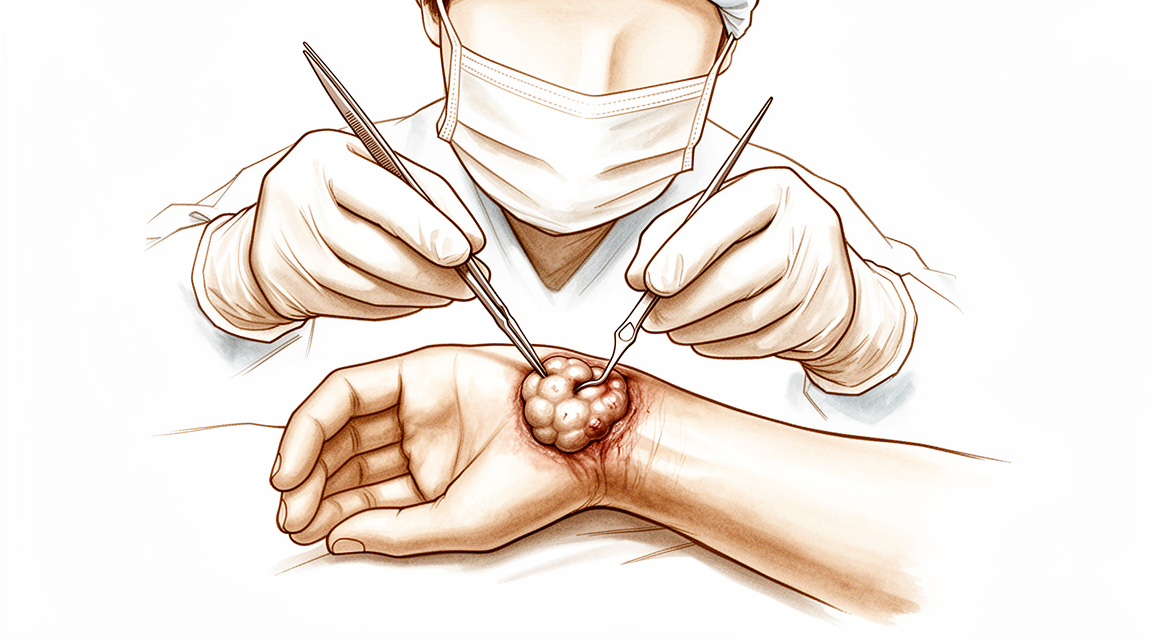
Ang protocol na ito ay nagsisilbing gabay sa iyong paggaling pagkatapos ng operasyon para sa pagtanggal (excision) ng wrist ganglion, isang cyst na puno ng likido na tumutubo mula sa kasukasuan ng pulso, kasama si Dr Kieran Hirpara sa Mater Private Hospital Rockhampton. Nagsisimula ito sa iyong home exercise program, na susundan ng structured clinical protocol na isinulat para sa iyong hand therapist; dalhin ang pahinang ito o ang PDF nito sa iyong unang therapy visit upang manatiling coordinated ang iyong rehabilitasyon. Maaaring i-adjust ng iyong therapist ang plano depende sa pag-unlad ng iyong paggaling.
Kung mayroon kang anumang alalahanin tungkol sa iyong sugat pagkatapos ng operasyon, makipag-ugnayan sa mga rooms. Madalas na nakatutulong ang pagkuha ng larawan ng sugat at pag-email nito para masuri.
Ano ang dapat asahan
Ang wrist ganglion ay isang parang lobo at puno ng likidong cyst na nakakabit sa pamamagitan ng isang makitid na stalk sa lining ng wrist joint. Karamihan ay lumilitaw sa likod ng pulso (isang dorsal ganglion); ang iba ay lumilitaw sa harap, sa bahagi ng hinlalaki (isang volar ganglion). Sa operasyon, tatanggalin ni Dr Hirpara ang cyst kasama ang stalk nito, hanggang sa wrist joint capsule, kukuha sa ugat pati na rin sa bukol, dahil ang pag-iwan sa stalk ang pangunahing dahilan kung bakit maaaring bumalik ang ganglion. Ang operasyon ay maaaring gawin nang open (sa pamamagitan ng maliit na hiwa) o gamit ang keyhole (arthroscopic) instruments.
Dahil walang inayos o muling binuo (isang cyst lamang ang tinanggal), walang tendon o ligament na naghihilom na kailangang protektahan sa loob ng maraming linggo. Ang recovery ay samakatuwid ay isang early-motion plan, at ang buong layunin nito ay mapagalaw agad ang pulso:
- Ang paninigas (stiffness) ang pinakakaraniwang problema pagkatapos ng operasyong ito, higit pa kaysa sa pagbalik ng cyst. Ang pulso na pinanatiling hindi gumagalaw nang masyadong matagal pagkatapos ng ganglion excision ay maaaring mawalan ng paggalaw.
- Kaya naman ang immobilisation ay pinapanatiling minimal: isang soft dressing, kung minsan ay may light wrist splint para lamang sa comfort, sa loob lamang ng ilang araw hanggang isang o dalawang linggo. Pagkatapos nito, igagalaw na ang pulso nang maaga, sa bawat direksyon.
Ang iyong mga daliri, na hindi inooperahan, ay dapat manatiling gumagalaw nang husto mula sa unang araw. Ang paggalaw ng pulso ay unti-unting bubuksan habang humihilom ang sugat, pagkatapos ay unti-unting ibabalik ang grip at load. Karamihan sa mga tao ay nakakabalik na sa ordinaryong aktibidad sa loob ng humigit-kumulang apat hanggang anim na linggo.
Mga pag-iingat at limitasyon
- Panatilihing gumagalaw nang husto ang iyong mga daliri, hinlalaki, at siko mula sa unang araw; ang pulso lamang ang nangangailangan ng dahan-dahang paggalaw.
- Isuot ang soft dressing o comfort splint hangga't itinagubilin lamang (karaniwang ilang araw hanggang isa hanggang dalawang linggo). Ito ay para sa ginhawa, hindi upang panatilihing hindi gumagalaw ang pulso sa loob ng mahabang panahon; maagang paggalaw ang layunin dito, hindi pahinga.
- HUWAG ibabad sa tubig ang sugat o basain ang dressing hanggang sa masabihan kang sarado na ang sugat; panatilihin itong malinis at tuyo.
- Iwasan muna ang mabibigat na paghawak (gripping), pagbuhat, at pagdadala ng mabigat na karga gamit ang pulso sa unang ilang linggo, at ibalik ang mga ito nang unti-unti sa halip na biglaan.
- Kung ikaw ay nagkaroon ng volar (harap-ng-pulso) ganglion, ang cyst ay maaaring malapit sa radial artery (isang pulso na mararamdaman sa harap ng pulso); ipaalam agad sa klinika kung mapansin ang hindi pangkaraniwang pamamaga, panlalamig, o pagbabago ng kulay sa kamay.
- HUWAG magmaneho hanggang sa kaya mo nang kontrolin ang manibela nang komportable at wala na sa anumang splint, gaya ng kumpirmasyon sa iyong review.
Para sa pamamahala ng sugat, pamamaga, at peklat, tingnan ang gabay ng klinika sa wound care.
Iyong mga ehersisyo
Kieran Hirpara 4.0
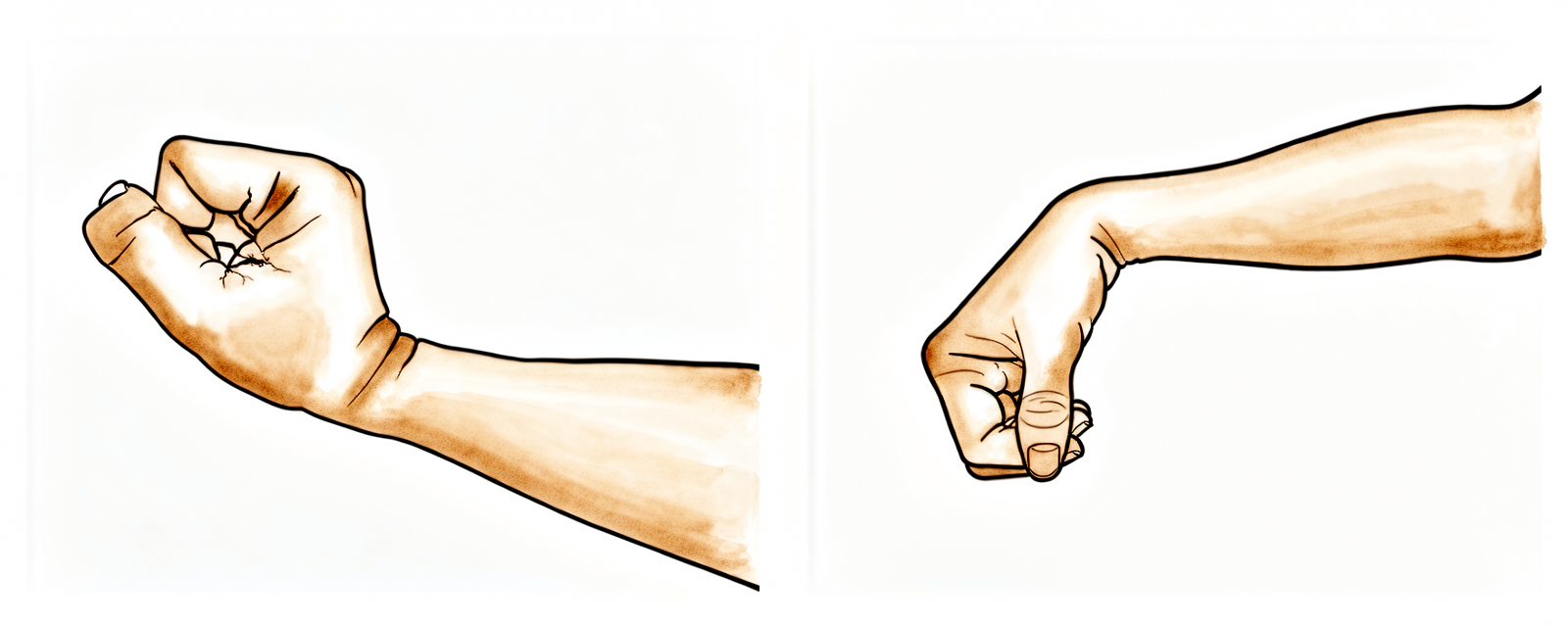
Paggalaw ng pulso (lahat ng direksyon)
Dahan-dahang igalaw ang iyong pulso sa bawat direksyon — itiklop ito pabalik (taas), itiklop ito pasulong (baba), at itagilid ito sa magkabilang panig — igalaw ito hangga't komportable sa bawat direksyon. Ito ang pinakamahalagang maagang ehersisyo, dahil may tendensiyang tumigas ang pulso pagkatapos ng operasyong ito, at ang maagang paggalaw nito ay nagpapanatili sa pagiging supple nito. Gawin ito nang mabagal at manatili sa loob ng komportableng limitasyon; hindi ito dapat magdulot ng matalas na sakit.
10 beses sa bawat direksyon, 4-5 beses sa isang araw, mula sa unang ilang araw
Kieran Hirpara 4.0
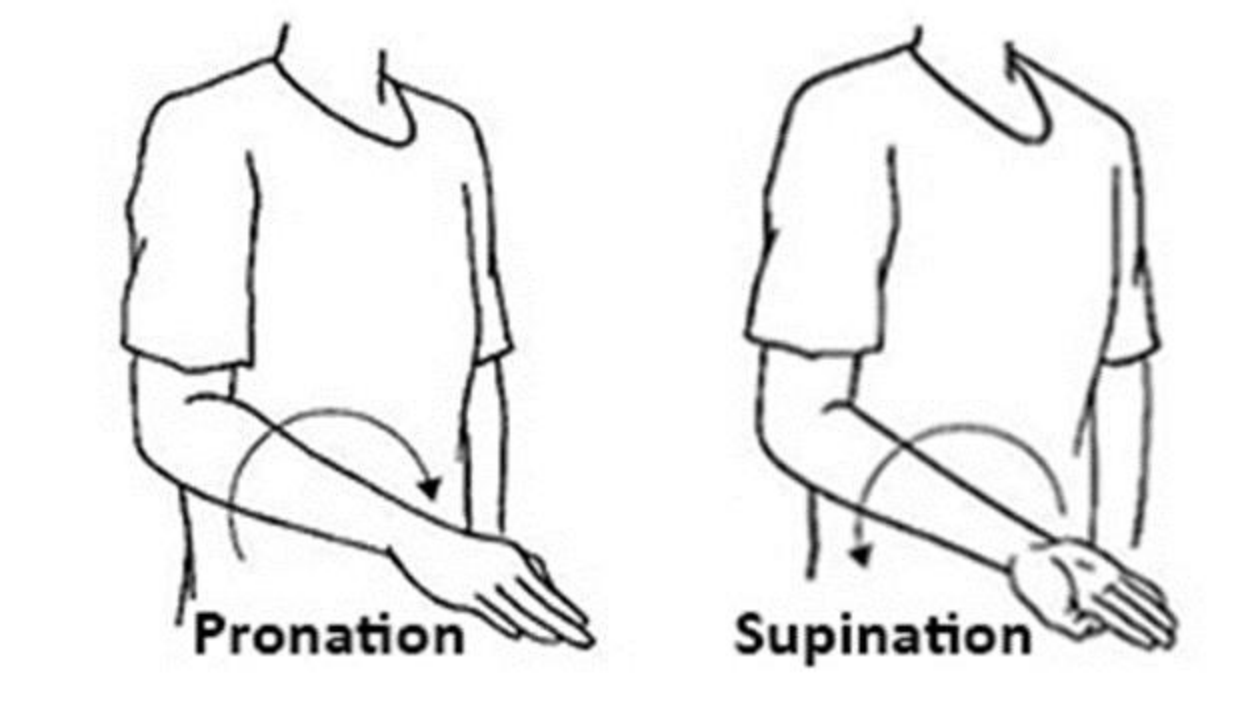
Rotasyon ng forearm (palad paitaas / palad paibaba)
I-tuck ang iyong siko sa iyong gilid at itiklop ito sa isang right angle. Dahan-dahang ituon ang iyong palad paitaas sa kisame, pagkatapos ay pababa sa sahig. Panatilihing hindi gumagalaw ang siko upang ang paggalaw ay manggaling sa forearm. Pinapanatili nito ang malayang pag-ikot ng forearm at pulso habang naghihilom ang sugat.
10 beses sa bawat direksyon, 3-4 beses sa isang araw
Kieran Hirpara 4.0
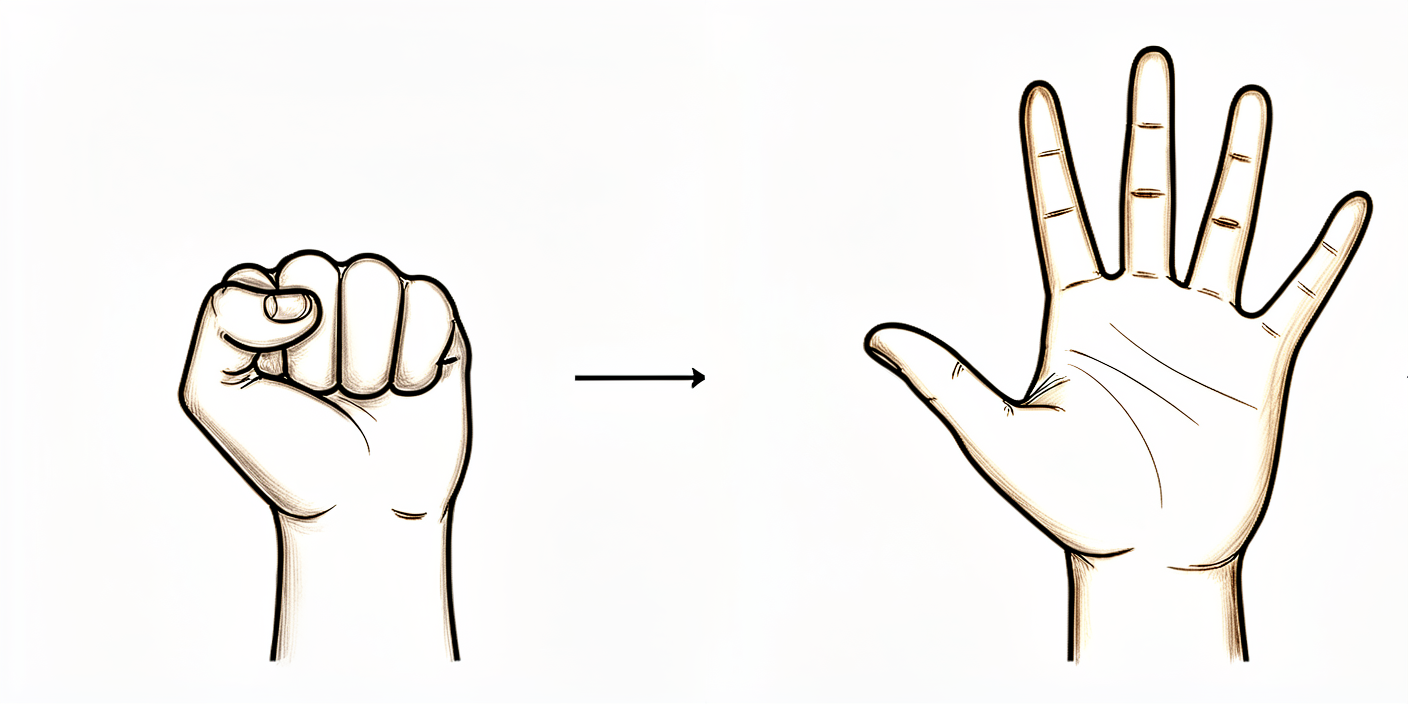
Paggalaw ng daliri
Gumawa ng isang buo at mabagal na kamao upang ang mga dulo ng daliri ay kumurba sa palad, pagkatapos ay buksan ang kamay at iunat nang lubos ang mga daliri. Hindi inooperahan ang mga daliri, kaya panatilihin ang ganap na paggalaw ng mga ito mula sa unang araw — pinipigilan nito ang paninigas ng kamay at tumutulong sa pag-alis ng pamamaga.
10 beses, ilang beses sa isang araw, mula unang araw
Kieran Hirpara 4.0
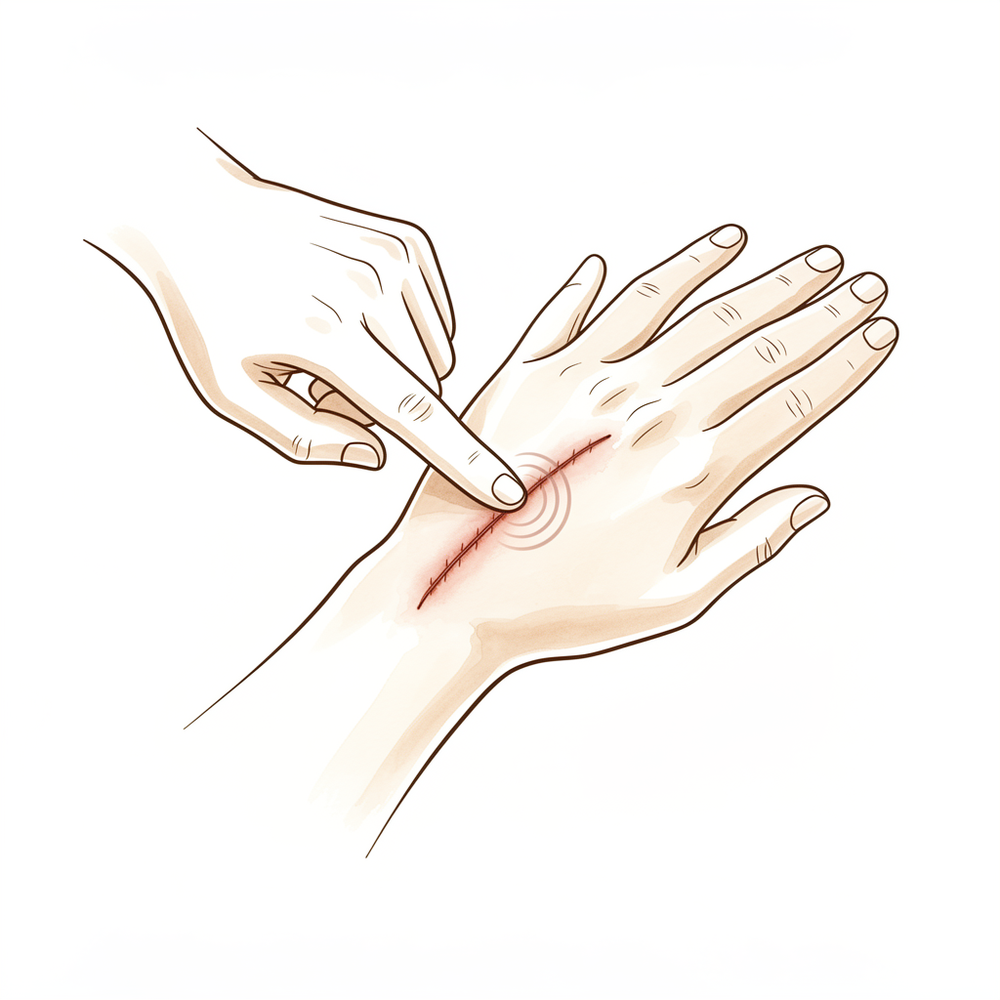
Masahe sa peklat
Kapag ganap nang magaling ang sugat at wala na ang mga dressing (karaniwan ay pagkalipas ng dalawang linggo), magpahid ng kaunting plain moisturizer sa peklat gamit ang dulo ng iyong daliri, sa pamamagitan ng pag-ikot nang maliit at madiin sa loob ng ilang minuto. Pinapanatili nitong malambot at mobile ang peklat at pinipigilan itong dumikit sa mga tissue sa ilalim, na kung hindi ay maaaring maglimita sa paggalaw ng pulso. Huwag simulan ito sa sugat na hindi pa magaling o may tumatagas pang likido.
Ilang minuto, dalawang beses sa isang araw, kapag ganap nang magaling ang sugat
Kieran Hirpara 4.0
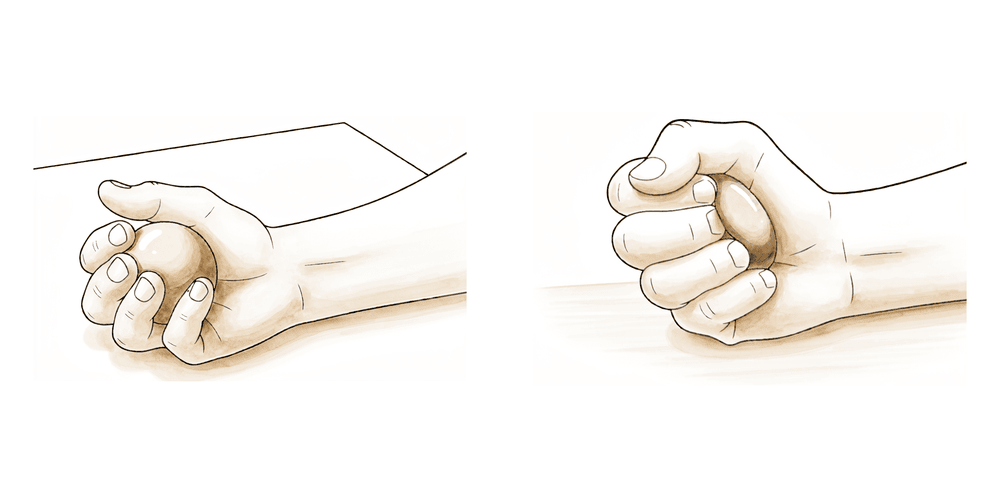
Pagpapalakas ng grip (kapit)
Isang exercise sa HULING bahagi, karaniwan ay mula tatlo hanggang apat na linggo kapag ang sugat ay magaling na at komportable na ang paggalaw. Pisilin ang isang malambot na bola o therapy putty sa iyong palad, hawakan nang ilang segundo, pagkatapos ay i-relax. Unti-unting dagdagan ang tindi nito. Ibinabalik nito ang grip strength na madalas bumababa sa loob ng ilang linggo pagkatapos ng operasyon.
10-15 piga, 2-3 beses sa isang araw, mula humigit-kumulang 3-4 linggo
Ito ang mga ehersisyo mula sa iyong handout. Simulan ang mga ito ayon sa gabay ni Dr Hirpara at ng iyong hand therapist. Ang mga maagang ehersisyo (paggalaw ng pulso sa lahat ng direksyon, pag-ikot ng forearm at paggalaw ng mga daliri) ang sentro ng paggaling na ito at nagsisimula sa loob ng unang ilang araw, dahil ang maagang paggalaw ng pulso ang pumipigil sa paninigas na karaniwang sumusunod pagkatapos ng operasyong ito. Ang scar massage ay nagsisimula kapag ganap nang magaling ang sugat, at ang grip strengthening ay idinaragdag nang mas huli depende sa iyong komportable. Wala sa mga ito ang dapat magdulot ng matalas na sakit; bawasan ang anumang ehersisyo na nagdudulot nito.
Ang iyong clinical protocol
Ang natitirang bahagi ng pahinang ito ay ang staged clinical protocol para sa rehabilitasyon pagkatapos ng wrist ganglion excision. Ang seksyong ito ay ibibigay sa iyong hand therapist, at ang bawat phase ay nagsisimula sa isang paliwanag sa simpleng Ingles tungkol sa kung ano ang nangyayari. Ito ay isang excision, hindi repair: walang construct na kailangang protektahan, kaya ang pangunahing prinsipyo ay minimal immobilisation na susundan ng maagang active wrist motion sa lahat ng planes upang maiwasan ang post-excision stiffness, na siyang pinakakaraniwang komplikasyon pagkatapos ng procedure na ito.
Bago ang paggamot, suriin ang operation report ng pasyente at ang past medical history, at makipag-ugnayan sa treating surgeon tungkol sa lokasyon (dorsal vs volar), ang surgical approach (open vs arthroscopic), ang integridad ng dorsal/volar capsule, at anumang concurrent finding. Ine-excise ni Dr Hirpara ang cyst kasama ang stalk nito hanggang sa joint capsule. Para sa mga volar ganglia, tandaan ang lapit ng radial artery. Walang protected arc at walang construct na kailangang i-off-load; ang tanging sadyang paghihigpit ay ang maikling window ng pag-iwas sa heavy-grip/load habang naghihilom ang soft tissues.
Phase I — minimal na immobilisation at maagang paggalaw (araw 0 hanggang ~14)
Pinoprotektahan ng unang phase ang sugat habang pinagagalaw nang maaga ang pulso. Sinasadyang maikli ang immobilisation (isang soft dressing, na may light wrist splint para sa comfort lamang kung kinakailangan), at ang pulso ay nagsisimula ng active motion sa lahat ng direksyon sa loob ng unang ilang araw. Ang ebidensya mula sa systematic-review ay ang limitadong immobilisation ng dalawang linggo o mas mababa pa, o wala talaga, ay hindi makabuluhang nagbabago sa outcome, habang ang matagal na pahinga ay may panganib ng paninigas (stiffness).
Para sa iyong hand therapist:
Edukasyon at mga pag-iingat - Soft dressing, na may optional na light wrist splint para sa comfort lamang; unti-unting alisin sa loob ng mga araw, hindi linggo - Walang matagal na rigid immobilisation: limitahan ang anumang splinting sa ≤2 linggo (karaniwan ay ilang araw lamang) - Panatilihing malinis at tuyo ang sugat hanggang sa magsara; full finger, thumb at elbow ROM mula unang araw - Volar cases: maging alerto sa radial artery; iulat agad ang mga vascular concerns
Pamamahala - Sugat: surgical dressings ayon sa itinuro; i-monitor para sa impeksyon - Oedema: elevation, gentle hand pump, ice kung kinakailangan - Mga ehersisyo: active wrist ROM sa lahat ng planes (flexion/extension, radial/ulnar deviation) sa loob ng comfort, sisimulan sa unang ilang araw; active/passive forearm pronation–supination; full active finger at thumb ROM; gentle shoulder ROM
Mga kraytirya para mag-progress - Paghilom ng sugat; paghupa ng oedema; bumubuti at comfortable na wrist arc; itigil ang splint (kung ginamit) sa loob ng ~2 linggo
Phase II — pagbabalik ng buong galaw at pamamahala ng peklat (mga linggo ~2 hanggang 4)
Mula sa humigit-kumulang dalawang linggo, tinatanggal na ang mga benda at hilom na ang sugat. Ang pokus ay ang pagbawi ng buo at simetrikong paggalaw ng pulso bago pa magkaroon ng paninigas, at pagsisimula ng pag-aalaga sa peklat upang manatiling mobile ito at hindi humila sa pulso.
Para sa iyong hand therapist:
Mga Assessment - Active at passive wrist ROM (ihambing sa kabilang panig); rotation ng forearm; oedema; pagsusuri ng sugat/peklat
Edukasyon at mga pag-iingat - Magpunta tungo sa buong wrist ROM sa lahat ng plane; tugunan agad ang anumang maagang pagkawala ng galaw sa pamamagitan ng active at gentle passive work - Simulan ang pamamahala ng peklat kapag ganap nang hilom ang sugat (masahe, silicone/moisturiser, desensitisation kung kinakailangan) - Hinihikayat ang magaan na functional na paggamit ng kamay; ipagpaliban ang mabibigat na paghawak (gripping) at pagbubuhat (loading)
Pamamahala - Mga ehersisyo: mag-progress tungo sa buong active at gentle passive wrist ROM; ipagpatuloy ang forearm rotation; simulan ang masahe sa peklat at desensitisation; magpakilala ng magaan na putty/grip work sa dulo ng phase na ito depende sa komportable ng pasyente
Mga kraytirya para mag-progress - Buo o halos buong pain-free wrist ROM; hilom at mobile na peklat; handa na para sa graded loading
Phase III — pagpapalakas at pagbabalik sa aktibidad (mga linggo ~4 hanggang 6 at higit pa)
Kapag naibalik na ang paggalaw, unti-unting ibinabalik ang grip at load. Para sa karamihan ng mga pasyente, ang ordinaryong aktibidad ay bumabalik sa loob ng humigit-kumulang apat hanggang anim na linggo; ang mas mabibigat na manual demands ay sumusunod sa isang criterion-based progression.
Para sa iyong hand therapist:
Mga Assessment - Grip at pinch strength kumpara sa kabilang panig; wrist ROM; tugon sa graded loading; functional/work-specific testing kung naaangkop
Edukasyon at mga pag-iingat - Isulong ang grip and wrist strengthening (putty, bola, graded resistance) ayon sa kakayahan ng pasyente - Unti-unting ibalik ang pagbubuhat at load-bearing sa pamamagitan ng wrist; ang ganap na pagbabalik ay ginagabayan ng mga sintomas, hindi ng kalendaryo
Pamamahala - Mga ehersisyo: progressive grip/pinch at wrist strengthening; graded loading at task-specific work; ipagpatuloy ang anumang residual mobility at scar work - Isaalang-alang ang discharge kapag ang ROM ay full na, ang lakas ay near-symmetrical, at ang function ay naibalik na - Isaalang-alang ang referral pabalik sa treating doctor kung ang wrist ay plateaued na matigas, o kung may lumitaw na recurrent swelling
Mga kraytirya para sa pagbabalik sa full activity - Full pain-free wrist ROM; near-symmetrical grip; komportable sa task- at work-specific loading
Pagbabalik sa trabaho at aktibidad
Hinihikayat ang magaan na pang-araw-araw na paggamit ng kamay (pagkain, pagsusulat, magaan na pag-aalaga sa sarili) mula sa simula hangga't komportable, at dapat ay gumagana nang lubos ang iyong mga daliri mula sa unang araw. Ang mga gawaing pang-opisina at magagaan na tungkulin ay madalas na posible sa loob ng ilang araw hanggang isang linggo o higit pa, lalo na kung malaya ang dominanteng kamay; ang mga trabahong kinapapalooban ng mabigat na paghawak, pagbuhat, o paulit-ulit na puwersadong paggalaw ng pulso ay mas matagal at unti-unting ibinabalik sa loob ng unang ilang linggo. Ang mga nailathalang serye ay nag-uulat ng maikling panahon lamang ng pagliban sa trabaho pagkatapos ng ganglion excision (humigit-kumulang dalawang linggo), bagaman nag-iiba ito depende sa panig na inoperahan at sa mga hinihingi ng iyong trabaho.
Dahil dapat kang makontrol ang manibela nang komportable at wala nang anumang splint, magplano para sa tulong sa transportasyon sa mga unang araw; ang pagmamaneho ay muling sisimulan kapag ikaw ay komportable at ligtas na, gaya ng kumpirmasyon sa iyong review. Karamihan sa mga tao ay nakakabalik sa ordinaryong aktibidad sa loob ng humigit-kumulang apat hanggang anim na linggo, kung saan ang mas mabigat na manwal na trabaho at isport ay unti-unting ibinabalik habang bumabalik ang paggalaw at paghawak, na hinuhusgahan base sa kalagayan ng pulso, at hindi sa kalendaryo lamang.
Pagkatapos ng iyong protocol
Ang protocol na ito ay kasabay ng pangkalahatang payo sa paggaling ng klinika: tingnan ang pamamahala ng sakit pagkatapos ng operasyon, pag-aalaga ng sugat at pamamahala ng peklat. Ang phased plan sa itaas ay sumasalamin sa nailathalang gabay pagkatapos ng wrist ganglion excision, kung saan ang prayoridad ay maagang paggalaw upang maiwasan ang paninigas; ang iyong patuloy na paggaling ay ginagabayan nang indibidwal ni Dr Hirpara at ng iyong hand therapist ayon sa pag-unlad ng iyong pulso.
Evidence & references
This is the clinical evidence summary written for health professionals. It is technical, and it lists the research this page was built from. You do not need to read it to understand your treatment or to make a decision about it.
Wrist Ganglion Excision — Procedure Outcomes & Post-operative Rehabilitation (Dorsal / Volar, Open or Arthroscopic)
Topic scope: post-operative rehabilitation after surgical excision of a wrist ganglion — removal of the cyst together with its capsular stalk down to the wrist joint, performed open or arthroscopically, for a dorsal (scapholunate-origin) or volar (radiocarpal/scaphotrapezial) ganglion. This is an excision, not a reconstruction: nothing is repaired or tightened, so the rehab is an early-motion pathway built around minimal immobilisation, prompt wrist movement in all planes, and scar care — not months of protected healing.
Defining principle of the rehab here: ganglion excision removes a cyst and its stalk; it does not create a construct that needs protecting. The most frequent adverse outcome is therefore not failure of any repair but wrist stiffness / loss of motion, which prolonged immobilisation makes worse. So the deliberate stance is minimal immobilisation (soft dressing ± brief comfort splint, ≤2 weeks) followed by early active wrist motion in every plane, with the only restraint a short window of heavy-grip/load avoidance while the soft tissues settle. The principal branch points are (1) dorsal vs volar (volar ganglia sit adjacent to the radial artery and carry a higher neurovascular-complication profile) and (2) open vs arthroscopic access (similar recurrence; arthroscopic may have a gentler early course). Importantly, the recurrence and outcome literature is far better developed than the rehabilitation literature, which is largely expert-consensus and low-level.
A. PROCEDURE OUTCOMES (open vs arthroscopic; dorsal vs volar)
Ganglion excision is a reliable, low-morbidity operation. The principal outcome debate is over recurrence and over access (open vs arthroscopic), not over whether excision works.
- Excision markedly out-performs aspiration for durable cure. Pooled across treatments, mean recurrence is roughly 6% arthroscopic, ~20–21% open, ~59% aspiration; surgical excision confers a large reduction in recurrence versus aspiration. Reported open-excision recurrence is wide (0–31%), the lowest classic series (Angelides & Wallace) reporting <1% with meticulous stalk excision [Zoller 2023 JAAOS review; Gant 2011 review]. Moderate (reviews of heterogeneous series).
- Removing the stalk down to the capsule is the key technical determinant of recurrence. Leaving the capsular stalk behind is the main reason a ganglion recurs; stalk resection is repeatedly advocated as the critical step [Gant 2011; Rizzo 2004]. Mechanistic / consensus.
- Open and arthroscopic excision give similar recurrence. A retrospective comparison and a systematic review found no significant difference once low-quality/high-bias studies are excluded (pooled ~8% arthroscopic vs ~10% open); a prospective randomised dorsal-ganglion trial (Kang) reported 11% vs 9%. Arthroscopic access may offer a cosmetic/early-recovery edge but is not proven superior for recurrence [Konigsberg 2023 HAND; Crawford 2018 SR; Gant 2011 citing Kang]. Moderate (SR + retrospective + one RCT).
- Wrist stiffness is the most common complication after carpal ganglion excision, ahead of recurrence; other risks are infection, scar problems, neurovascular injury and (rarely) injury to the scapholunate ligament [Gant 2011]. Moderate (review).
- Volar ganglia carry a distinct neurovascular risk. They are adherent to / immediately adjacent to the radial artery; radial-artery injury during volar excision is described as "quite common," and an MRI-based study identifies anatomical position as a risk factor for operation-related complications after arthroscopic volar ganglionectomy [Rocchi 2008; Oh 2025 BMC; operative-technique texts]. Moderate (cohort + anatomical).
B. REHABILITATION / THERAPY EVIDENCE
The central rehab questions are (1) should the wrist be immobilised afterwards, and (2) does a particular therapy regimen change the outcome. The best available evidence — a systematic review of post-excision immobilisation — answers that brief or no immobilisation is appropriate, with early motion the means of preventing the dominant complication (stiffness). There is no high-level trial evidence for any specific exercise protocol; rehab content is consensus.
- Limited or no immobilisation does not worsen outcome — and protects against stiffness. A systematic review and surgeon survey of dorsal ganglion excision found practice split roughly evenly between rigid splinting and soft dressings; immobilisation durations ranged from 48 hours to 2 weeks (open) and 5 days to 3 weeks (arthroscopic). The explicit conclusion: "limited immobilization of 2 weeks or less or no immobilization after surgery does not meaningfully affect patient outcome." Prolonged rigid immobilisation is the avoidable driver of stiffness (one 2-week bulky-dressing series reported 11.5% with ≥20° ROM loss, versus normal ROM in 100% of a short-immobilisation series) [Wong 2023 HAND SR]. Moderate (systematic review of low-level studies).
- Early active wrist motion in all planes is the core of the programme. Because there is no repair to protect and stiffness is the commonest problem, the consensus is to move the wrist early through flexion/extension and radial/ulnar deviation, with full finger and forearm motion from day one. The adhesion/stiffness-prevention rationale is mechanistic and consensus rather than trial-proven. Weak–moderate (mechanism strong, outcome data absent).
- Recovery is usually quick and time off work short. Series report on the order of ~2 weeks off work after open wrist ganglion excision (longer for volar than dorsal, and longer than aspiration), with most patients back to ordinary activity by ~4–6 weeks [Suen 2013 citing Dias 2007]. Moderate (cohort).
- Recurrent ganglia are re-excisable with good function, and physical therapy is routinely recommended in re-excision series — underlining that therapy here is supportive (motion + scar), not a construct-protecting protocol [re-excision outcome series]. Low (small series).
Recovery trajectory (expected, evidence-anchored)
| Phase | Window | Restraint | Hand use / therapy focus | Strength / load | Notes |
|---|---|---|---|---|---|
| I — Minimal immobilisation & early motion | Days 0–~14 | Soft dressing ± comfort splint only (≤2 wk) | Full finger/thumb/elbow ROM from day 1; active wrist ROM in all planes within the first few days; forearm rotation; elevation for oedema | Light functional use only | Brief or no immobilisation does not worsen outcome; prolonged rest → stiffness |
| II — Restore full motion & scar care | Week ~2–4 | None routine (splint weaned) | Drive to full wrist ROM; scar massage once wound healed; desensitisation | Light grip/putty toward end | Stiffness is the complication to pre-empt; address early ROM loss promptly |
| III — Strengthening & return | Week ~4–6+ | Restrictions lifted | Progress grip/pinch + wrist strengthening; task-specific loading | Graded grip and load to symmetry | Most back to ordinary activity ~4–6 wk; manual/volar cases a little longer |
(Phase windows mirror the precautions in the patient protocol; they are typical guides, not trial-derived deadlines.)
C. KEY CONTROVERSIES / EVIDENCE QUALITY
- To splint or not. Practice is genuinely split, but the systematic-review evidence is that limited (≤2 weeks) or no immobilisation does not change outcome — and that prolonged rigid immobilisation is the avoidable cause of stiffness. This page's brief-immobilisation, early-motion default reflects that finding. Moderate (SR of low-level data).
- Open vs arthroscopic. Similar recurrence once bias is accounted for; arthroscopic may give a cosmetic/early-recovery edge. Choice is largely surgeon/patient preference. Moderate.
- What drives recurrence. Incomplete stalk excision, not rehab, is the main recurrence determinant; no mobilisation regimen has been shown to affect recurrence. Consensus / mechanistic.
- Stiffness is the real enemy, not the cyst coming back. Wrist stiffness is the commonest complication; framing recovery around early motion (rather than protective rest) is the evidence-aligned stance. Moderate.
- Volar ganglia are different. Radial-artery proximity raises the neurovascular-complication profile of volar excision; this is an operative/anatomical caution rather than a rehab variable, but it shapes early monitoring. Moderate.
- Rehab evidence is thin. Recurrence and procedure outcomes are well studied; the specific exercise programme is expert-consensus with no controlled trials. The defensible position is a simple early-motion + scar home programme with selective hand therapy. Weak / consensus.
D. EVIDENCE STRENGTH FLAGS (summary)
- STRONG (RCT / SR): none specific to rehab. (Procedure-side: superiority of excision over aspiration for recurrence is robust across reviews.)
- MODERATE: systematic-review evidence that ≤2-week or no immobilisation does not worsen outcome (Wong 2023); similar recurrence open vs arthroscopic (Crawford SR, Konigsberg, Kang RCT); stiffness as the commonest complication; volar radial-artery risk; short time off work.
- WEAK / CONSENSUS: the specific early-motion, all-plane wrist ROM + scar therapy programme (mechanistically rationalised — stiffness prevention — with no controlled outcome trials); exact phase timings (typical, not trial-derived).
CITATIONS
RAG corpus (180,000+ Orthopaedic articles)
- Gant J, Ruff M, Janz BA. Wrist ganglions. J Hand Surg Am. 2011;36(3):510–512. DOI: 10.1016/j.jhsa.2010.11.048
- Zoller SD, Benner NR, Iannuzzi NP. Ganglions in the Hand and Wrist: Advances in 2 Decades. J Am Acad Orthop Surg. 2023;31(2). DOI: 10.5435/JAAOS-D-22-00105
- Rizzo M, Berger RA, Steinmann SP, et al. Arthroscopic resection in the management of dorsal wrist ganglions: results with a minimum 2-year follow-up period. J Hand Surg Am. 2004;29(1):59–62. DOI: 10.1016/j.jhsa.2003.10.018
- Konigsberg MW, Tedesco LJ, Mueller JD, et al. Recurrence Rates of Dorsal Wrist Ganglion Cysts After Arthroscopic Versus Open Surgical Excision: A Retrospective Comparison. Hand (N Y). 2023;18(1). DOI: 10.1177/15589447211003184
- Crawford C, Keswani A, Lovy AJ, et al. Arthroscopic versus open excision of dorsal ganglion cysts: a systematic review. J Hand Surg Eur Vol. 2018;43(6). DOI: 10.1177/1753193417734428
- Mathoulin C, Gras M. Arthroscopic Management of Dorsal and Volar Wrist Ganglion. Hand Clin. 2017;33(4). DOI: 10.1016/j.hcl.2017.07.012
- Oh W, Kim H, Kim D, et al. Anatomical location of volar wrist ganglion in preoperative MRI is a risk factor for operation-related complications after arthroscopic ganglionectomy. BMC Musculoskelet Disord. 2025;26(1). DOI: 10.1186/s12891-025-08766-x
- Gray J, Zuhlke T, Eizember S, et al. Dry Arthroscopic Excision of Dorsal Wrist Ganglion. Arthrosc Tech. 2017;6(2). DOI: 10.1016/j.eats.2016.09.018
Wrist ganglion excision & post-operative care literature (URLs)
- Wong CR, Karpinski M, Hatchell AC, et al. Immobilization of the Wrist After Dorsal Wrist Ganglion Excision: A Systematic Review and Survey of Current Practice. Hand (N Y). 2023;18(2):254–263. DOI: 10.1177/15589447211014631. https://pmc.ncbi.nlm.nih.gov/articles/PMC10035098/
- Suen M, Fung B, Lung CP. Treatment of Ganglion Cysts. ISRN Orthop. 2013;2013:940615. DOI: 10.1155/2013/940615. https://pmc.ncbi.nlm.nih.gov/articles/PMC4045351/
- Rocchi L, Canal A, Fanfani F, et al. Articular ganglia of the volar aspect of the wrist: arthroscopic resection compared with open excision — a prospective randomised study. Scand J Plast Reconstr Surg Hand Surg. 2008;42(5):253–259. DOI: 10.1080/02844310802210897. https://pubmed.ncbi.nlm.nih.gov/18791910/
- Ganglions — Treatment & Management (recurrence by treatment modality; surgical technique). Medscape Reference. https://emedicine.medscape.com/article/1243525-treatment