Patients › Rehabilitation
Pagpapalit ng Kasukasuan sa Base ng Hinlalaki (Touch)
Isang staged recovery plan pagkatapos ng dual-mobility total joint replacement ng arthritic thumb base (ang Touch implant), na pinoprotektahan ang bagong joint sa isang thumb splint sa simula, pagkatapos ay ibabalik ang opposition at paggalaw, at pagkatapos ay bubuuin ang pinch at grip strength.
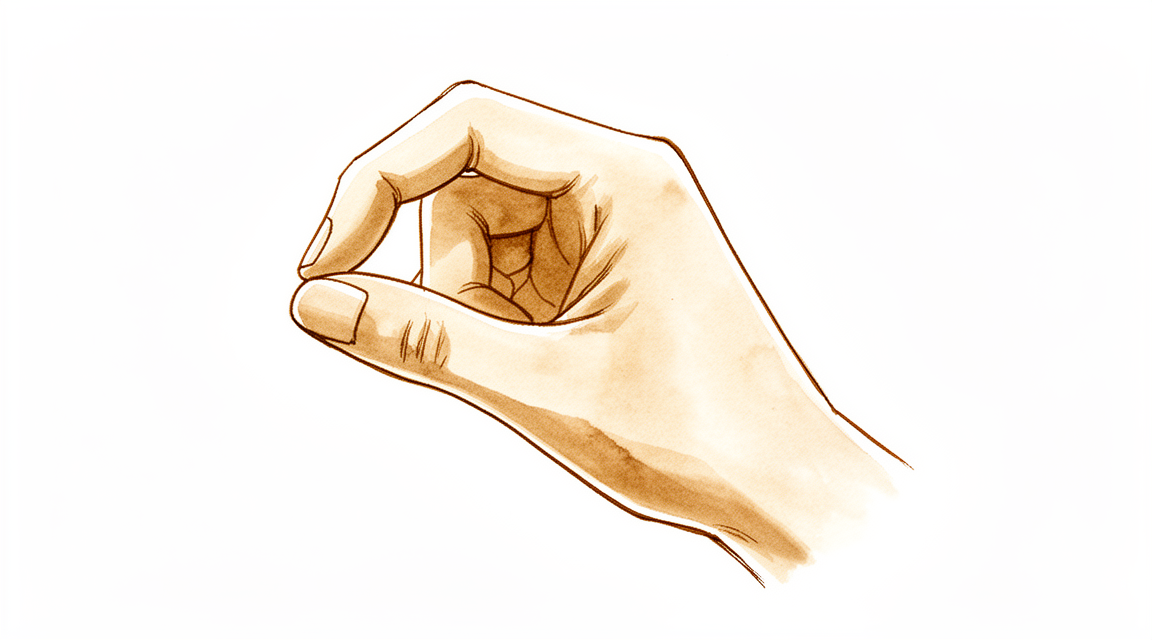
Ang protocol na ito ay nagsisilbing gabay sa iyong paggaling pagkatapos ng thumb base joint replacement (isang dual-mobility total joint replacement, ang Touch implant) para sa arthritis ng base ng hinlalaki, kasama si Dr Kieran Hirpara sa Mater Private Hospital Rockhampton. Nagsisimula ito sa iyong home exercise program, na sinusundan ng structured clinical protocol na isinulat para sa iyong hand therapist; dalhin ang pahinang ito o ang PDF nito sa iyong unang therapy visit upang manatiling coordinated ang iyong rehabilitasyon. Maaaring i-adjust ng iyong hand therapist ang plano depende sa pag-unlad ng iyong paggaling. Ang lahat ng iyong recovery ay ginagabayan sa pamamagitan ng formal hand therapy.
Kung mayroon kang anumang alalahanin tungkol sa iyong sugat pagkatapos ng operasyon, makipag-ugnayan sa mga rooms. Madalas na nakatutulong ang pagkuha ng larawan ng sugat at pag-email nito para masuri.
Ano ang dapat asahan
Ang kasukasuan sa base ng iyong hinlalaki (ang trapeziometacarpal, o CMC, joint) ay kung saan nagtatagpo ang hinlalaki at ang pulso, at ito ay isang napakakaraniwang lugar ng arthritis. Sa operasyong ito, ang mga gasgas na surface ng kasukasuan ay tinatanggal at pinapalitan ng isang maliit na artificial joint: isang dual-mobility implant, isang maliit na ball-and-socket na may extra moving surface na nagpapatatag at nagpapadulas dito. Pinapanatili ang trapezium bone at pinapanatili ang haba ng iyong hinlalaki, kaya ang recovery ay karaniwang mas mabilis kaysa sa trapeziectomy (ang lumang operasyon, na nagtatanggal ng buto at umaasa sa pagbuo ng scar tissue sa loob ng maraming buwan).
Ang isang implant na maayos ang pagkakalagay ay matatag at kayang humati ng load agad-agad, kaya naman ang hinlalaki ay kailangan lamang protektahan sa loob ng maikling panahon sa halip na i-immobilize ng ilang linggo. Ang plano ay hayaang kumalma ang mga soft tissue, pagkatapos ay mabilis na ibalik ang opposition ng iyong hinlalaki (paghipo sa mga daliri) at paggalaw nito, at pagkatapos ay palakasin ito.
Ang recovery ay nahahati sa tatlong yugto:
- Una, protektahan (mga unang 2–3 linggo). Isang malambot at makapal na dressing para sa unang linggo o higit pa, pagkatapos ay isang thumb splint upang ipahinga ang bagong kasukasuan habang kumakalma ang sugat at mga soft tissue. Panatilihing gumagalaw ang iyong mga daliri, pulso, at ang natitirang bahagi ng kamay.
- Pagkatapos, igalaw (mula mga 2–3 hanggang 6 na linggo). Pagkatapos tanggalin ang day splint, magsisimula ka ng banayad na active movement (opposition, pag-angat ng hinlalaki, pagbubukas ng web space at pag-ikot) at gamitin ang kamay para sa mga magagaan na pang-araw-araw na gawain.
- Pagkatapos, palakasin (mula 6 na linggo pataas). Kapag ang implant ay nakakabit na sa buto, magsisimula ang pinch and grip strengthening at unti-unting palalakasin. Ang lakas ay patuloy na mag-i-improve sa sumunod na 6 hanggang 12 buwan.
Ang isang bagay na dapat isaalang-alang sa simula ay maaaring ma-dislocate ang bagong kasukasuan kung mapipilit ito sa isang extreme position bago pa gumaling ang mga tissue sa paligid nito. Hindi ito karaniwan, at ang maagang plano ay binuo lamang upang hindi pilitin ang hinlalaki habang ito ay kumakalma.
Mga pag-iingat at limitasyon
- Isuot ang iyong thumb splint ayon sa itinuro (day splint para sa unang 2–3 linggo, pagkatapos ay night splint hanggang 6 na linggo) at panatilihing nakasuot ang splint para sa proteksyon hanggang sa payagan ka na ng iyong hand therapist.
- HUWAG piliting ilagay ang hinlalaki sa mga extreme position, at iwasan ang bigla o awkward na paghawak sa mga unang linggo; ang bagong joint ay maaaring ma-dislocate kung itutulak nang masyadong malayo bago ito maging stable. Gumalaw lamang sa abot ng iyong komportableng nararamdaman.
- HUWAG gumawa ng anumang malakas na pag-pinch, pagkapit, pagpihit (takip ng garapon, susi, gripo) o pagbuhat hanggang sa humigit-kumulang 6 na linggo; ang strengthening ay magsisimula lamang kapag sinimulan na ito ng iyong hand therapist.
- Panatilihing gumagalaw ang iyong mga daliri, pulso at ang natitirang bahagi ng kamay mula sa simula, at panatilihing naka-elevate ang iyong kamay sa umpisa upang mabawasan ang pamamaga.
- HUWAG magmaneho hanggang sa humigit-kumulang apat hanggang anim na linggo, kapag wala ka na sa iyong splint at kaya mo nang hawakan ang manibela nang komportable at walang sakit.
Para sa pamamahala ng sugat, pamamaga at peklat, tingnan ang gabay ng practice sa wound care.
Iyong mga ehersisyo
Kieran Hirpara 4.0
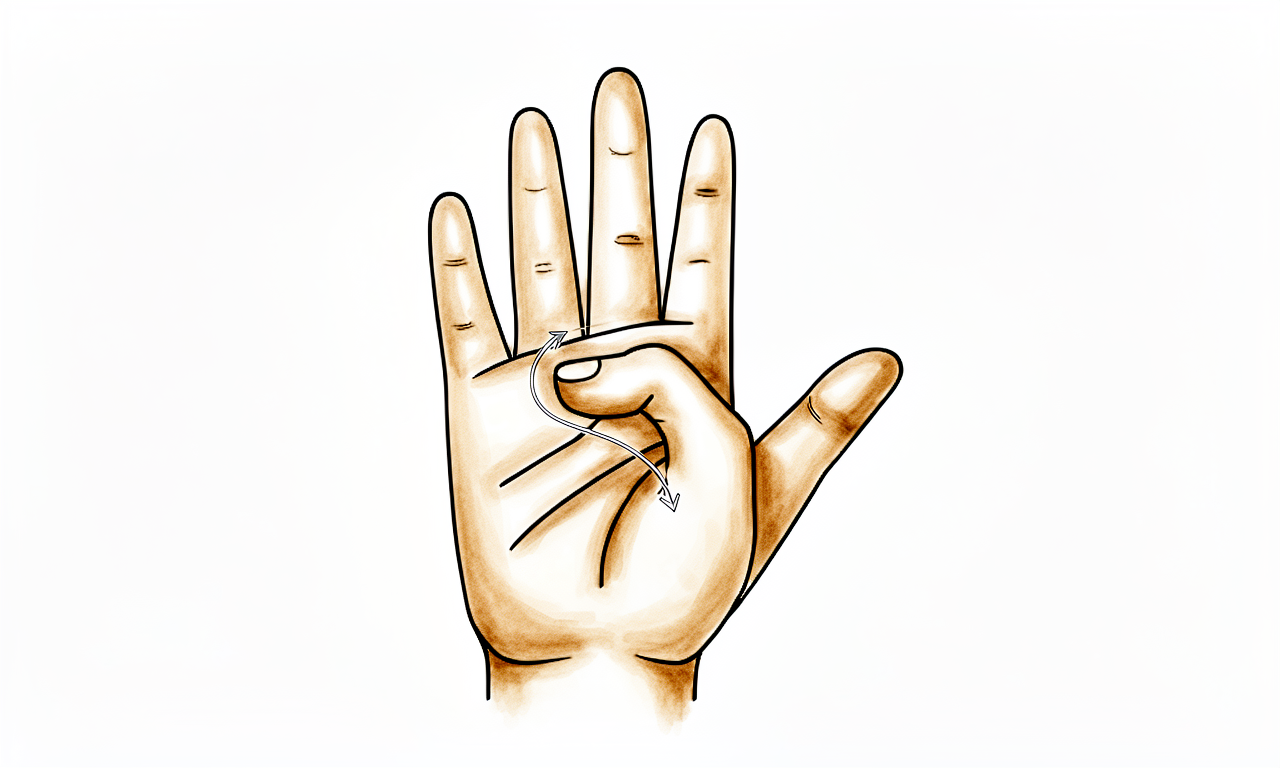
Thumb opposition (Kapandji ladder)
Dahan-dahang idikit ang dulo ng iyong hinlalaki sa gilid ng iyong hintuturo, pagkatapos ay sa dulo ng bawat daliri nang sunod-sunod, at pagkatapos ay i-slide ito pababa sa kalingkingan patungo sa base nito — ituloy ang pag-akyat sa 'hagdan' nang kaunti habang lumuluwag ang pakiramdam. Gumalaw lamang hanggang sa kung ano ang komportable. Ito ang pangunahing galaw upang maka-recover pagkatapos ng thumb base replacement, at sinisimulan ito nang dahan-dahan kapag wala ka na sa iyong day splint (humigit-kumulang dalawa hanggang tatlong linggo).
Gawin ang ladder 5–10 beses, 2–3 beses sa isang araw, hanggang sa kung ano ang komportable
Kieran Hirpara 4.0
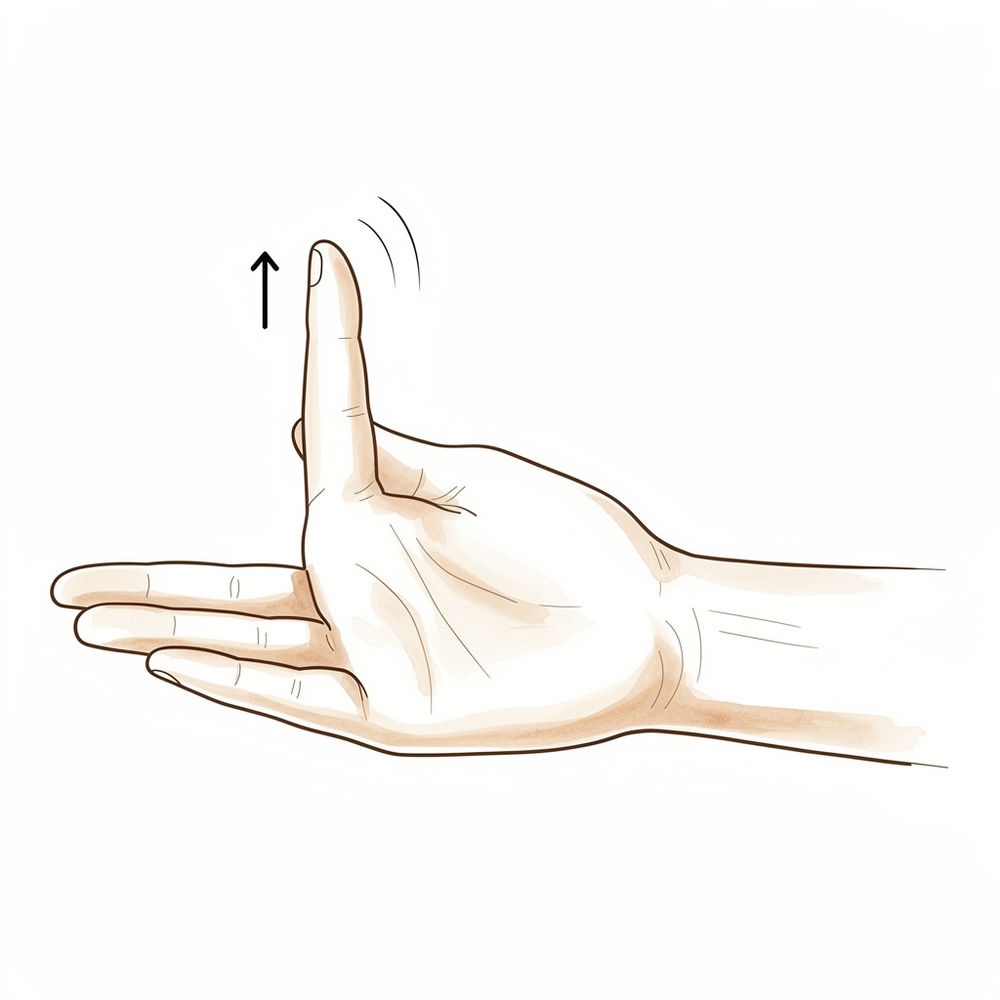
Palmar abduction (iangat ang hinlalaki mula sa palad)
Ipatong ang iyong kamay nang patag, nakaharap ang palad sa itaas. Habang pinapanatiling tuwid ang iyong hinlalaki, iangat ito palayo sa iyong palad patungo sa kisame, na tila binubuksan ang iyong kamay upang humawak ng lata — pagkatapos ay ibaba itong muli. Binubuksan nito ang web space at ibinabalik ang reach ng hinlalaki. Panatilihin itong banayad at hindi pinipilit; huwag itulak hanggang sa dulo ng paggalaw sa mga unang linggo.
10 beses, 2–3 beses sa isang araw, hanggang sa komportable
Kieran Hirpara 4.0
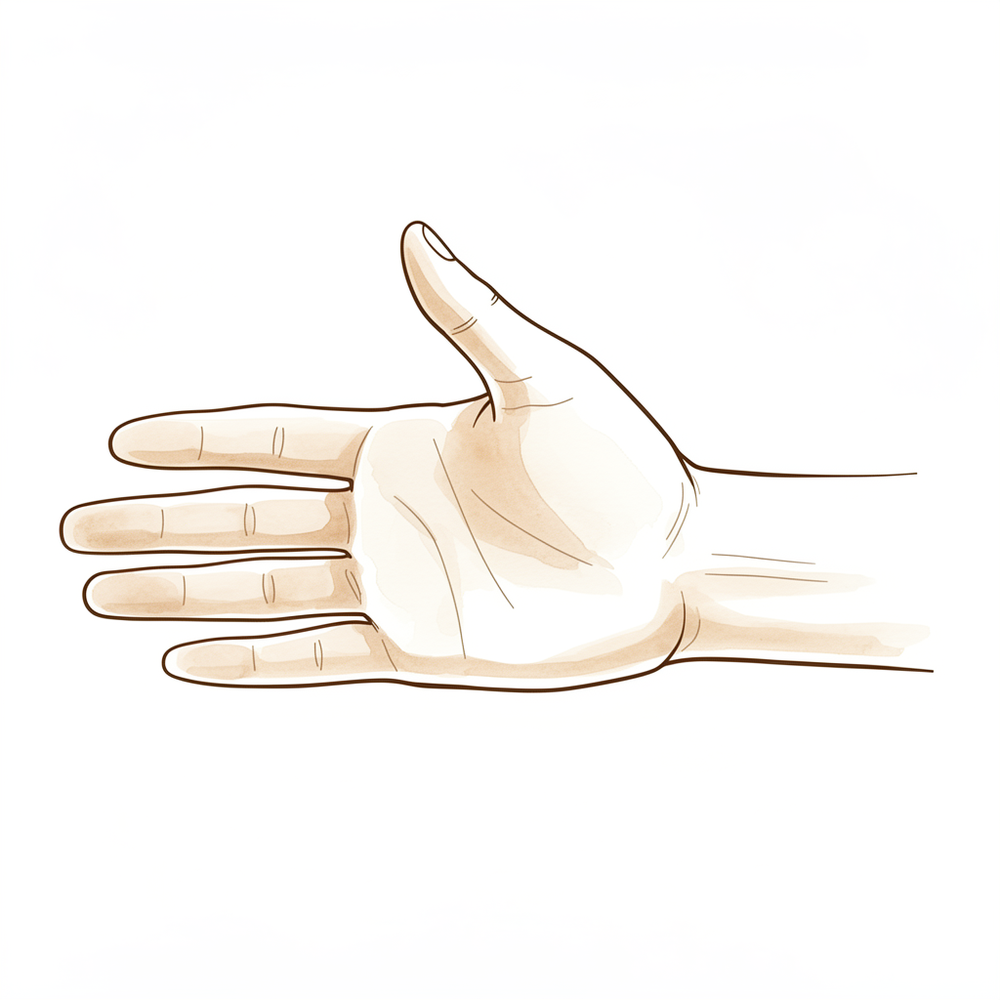
Radial abduction (paglayo ng hinlalaki sa gilid)
Ipatong ang iyong kamay nang patag na nakaharap sa ibaba ang palad. I-slide ang iyong hinlalaki nang patagilid, palayo sa iyong hintuturo, habang pinapanatili ito sa parehong patag na plane ng iyong palad — gaya ng pagbuo ng hugis 'L' — pagkatapos ay ibalik ito. Ibinabalik nito ang sideways reach ng hinlalaki. Gumalaw nang mabagal at huminto bago makaramdam ng anumang strain.
10 beses, 2–3 beses sa isang araw, hanggang sa komportable
Kieran Hirpara 4.0
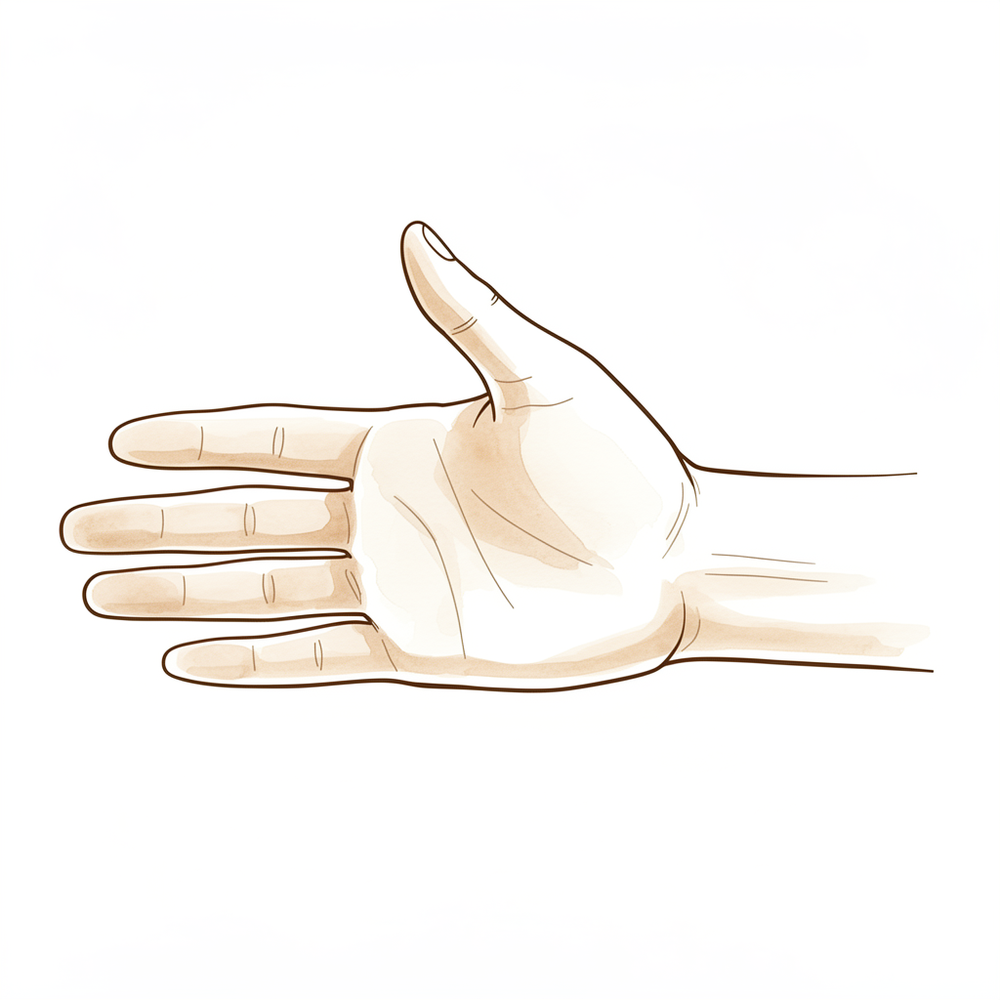
Stretch ng web-space
Buksan ang espasyo sa pagitan ng iyong hinlalaki at hintuturo nang kasinglawak ng komportable, habang nararamdaman ang banayad na stretch sa web space. Maaari mong ipatong ang iyong kamay sa mesa at hayaang dahan-dahang bumukas ang hinlalaki, o itupi ito sa paligid ng isang bilog na bagay. Panatilihin ang bukás na posisyon nang sandali, pagkatapos ay i-relax. Pinapanatili nito na hindi humigpit ang web space habang ikaw ay gumagaling — panatilihin itong banayad, huwag kailanman pilitin.
Hawakan ng ~5 segundo, 5–10 beses, 2–3 beses sa isang araw
Kieran Hirpara 4.0
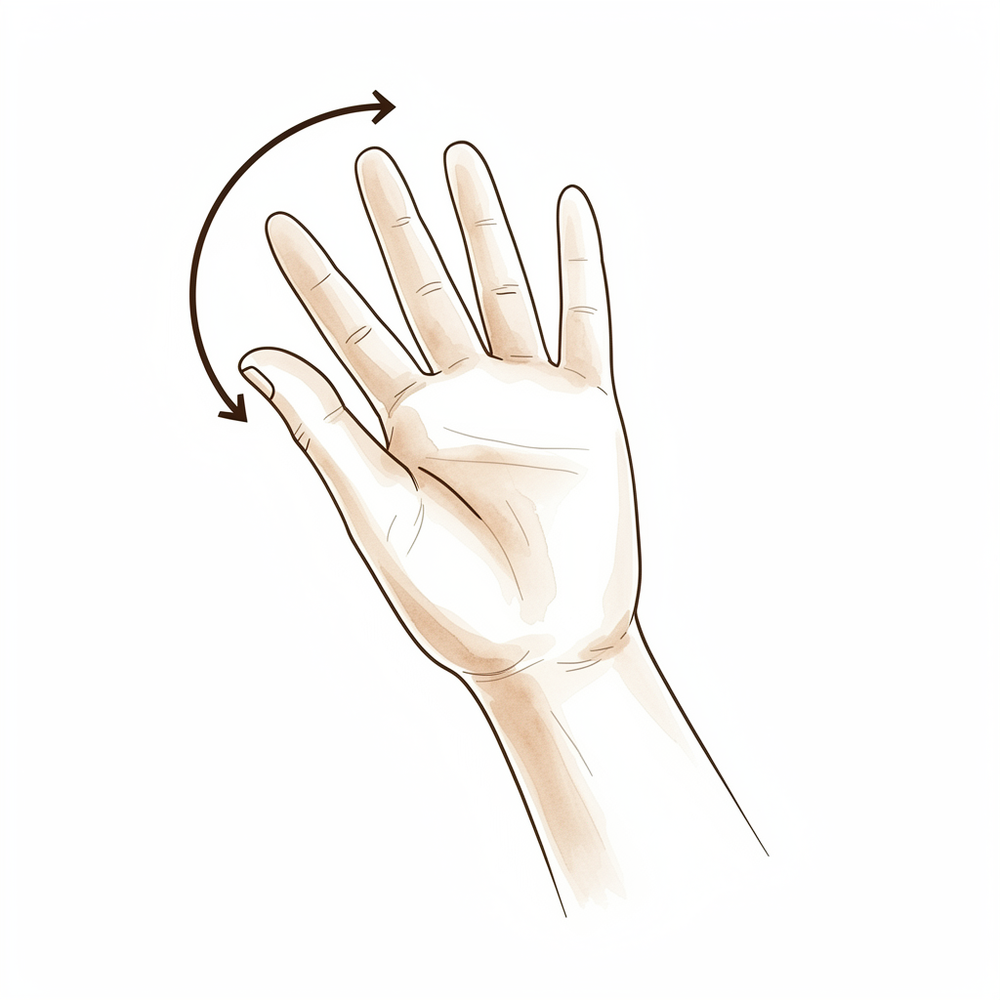
Circumduction ng hinlalaki
Habang nakarelaks ang iyong kamay, gumuhit ng mabagal at swabeng mga bilog gamit ang iyong hinlalaki, dahan-dahang igalaw ito sa buong range nito sa parehong direksyon — na tila naghahalo sa isang maliit na palayok. Panatilihing madali ang mga bilog at nasa loob ng iyong comfort level. Ibinabalik nito ang pinagsamang rolling movement ng bagong joint at sinisimulan nang dahan-dahan kapag wala ka na sa day splint.
5–10 na ikot sa bawat direksyon, 2–3 beses sa isang araw
Kieran Hirpara 4.0
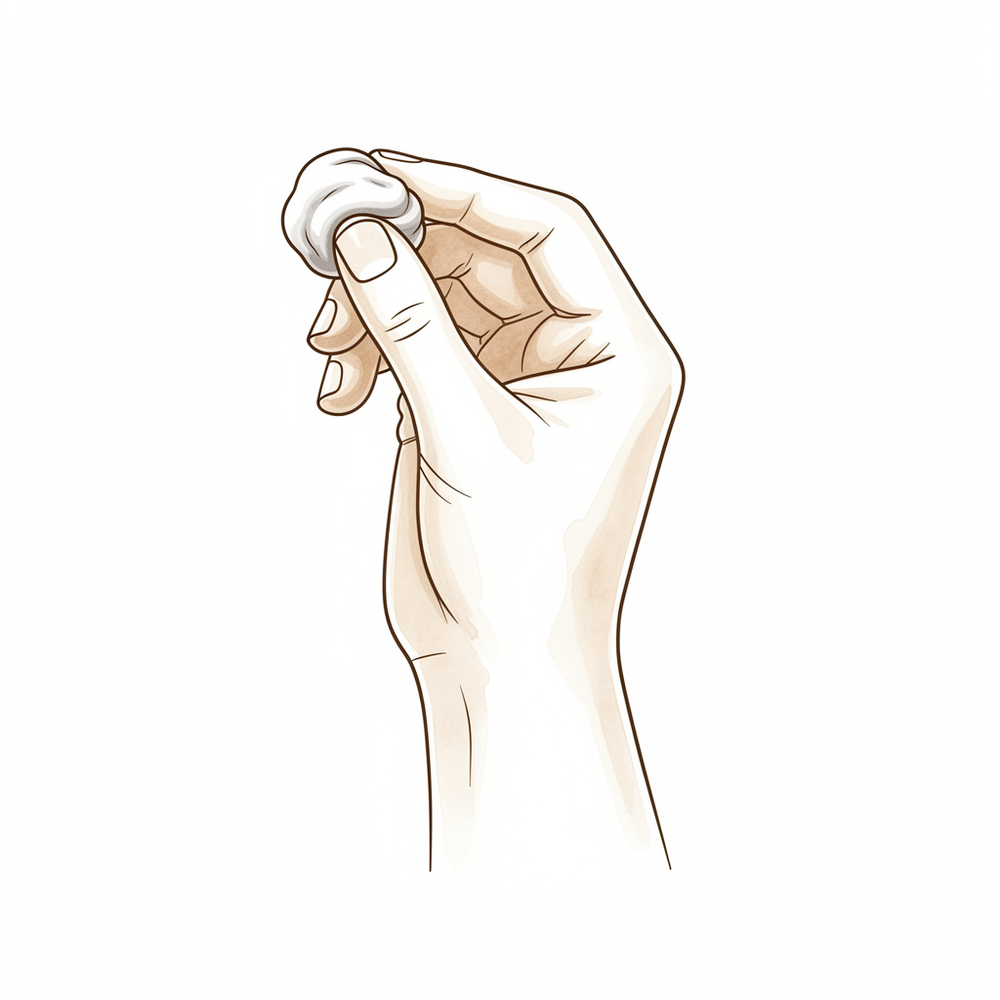
Putty / key pinch (mula linggo 6)
Isang ehersisyo sa PAGHULING bahagi — mula sa ika-anim na linggo lamang, kapag nagsimula na ang iyong hand therapist sa strengthening. Pumitpit ng isang piraso ng therapy putty sa pagitan ng iyong hinlalaki at sa gilid ng iyong hintuturo (isang 'key' pinch), at ipitpit ang dulo ng iyong hinlalaki sa mga dulo ng iyong daliri (isang 'tip' pinch), unti-unting dagdagan ang puwersa sa mga susunod na linggo at buwan. HUWAG gumawa ng malakas na pagpipitpit o paghawak bago ang ika-anim na linggo — kailangan ng bagong joint ang panahong iyon upang kumalma at kumapit sa buto.
Ayon sa gabay ng iyong hand therapist (mula ~6 na linggo), unti-unting pagpapalakas
Ito ang mga ehersisyo mula sa iyong handout. Simulan lamang ang mga ito ayon sa gabay ni Dr Hirpara at ng iyong hand therapist, at manatili sa anumang range at limitasyong ibinigay sa iyo. Ang mga maagang ehersisyo (opposition, pag-angat ng hinlalaki, ang sideways movement, ang web-space stretch at gentle circles) ay nagbabalik ng paggalaw ng hinlalaki nang hindi binibigatan ang bagong joint, at sinisimulan kapag wala ka na sa iyong day splint. Ang putty at key pinch ay isang huling ehersisyo para sa pagpapalakas at hindi dapat simulan hanggang sa humigit-kumulang anim na linggo, kapag sinimulan na ito ng iyong hand therapist. Panatilihing gentle at hindi pilit ang bawat paggalaw sa mga unang linggo, at itigil ang anumang nagdudulot ng matalas na sakit sa base ng hinlalaki.
Ang iyong clinical protocol
Ang natitirang bahagi ng pahinang ito ay ang staged clinical protocol para sa rehabilitasyon pagkatapos ng isang dual-mobility trapeziometacarpal (Touch) total joint replacement. Ang seksyong ito ay ibibigay sa iyong hand therapist, at ang bawat phase ay nagsisimula sa isang paliwanag sa simpleng Ingles tungkol sa kung ano ang nangyayari. Hindi tulad ng trapeziectomy, ang implant ay agad na stable at load-sharing, kaya minimal ang immobilisation at maagang naibabalik ang active opposition; ang early risk na partikular sa implant ay dislocation kung mapipilit sa extreme range, kaya ang mga unang linggo ay proteksyon laban sa mga forced/end-range positions habang ibinabalik ang motion, pagkatapos ay magpapatuloy sa loaded strengthening kapag osseointegrated na.
Bago ang treatment, suriin ang operation report ng pasyente at ang past medical history, at makipag-ugnayan sa treating surgeon tungkol sa implant seating/stability at anumang intra-operative concerns. Ang regimen ni Dr Hirpara ay isang soft bulky dressing sa loob ng 7–10 araw, pagkatapos ay isang thumb spica DAY splint sa loob ng 2–3 linggo, na susundan ng isang NIGHT splint hanggang sa ika-6 na linggo (wrist neutral, thumb in mid palmar abduction, IP free). Ang trapezium ay pinanatili at ang haba ng thumb ay napanatili.
Phase I — proteksyon (linggo 0 hanggang ~2–3)
Ang unang ilang linggo ay para sa paghilom ng mga soft tissue at proteksyon ng bagong joint. Ang thumb ay nakapahinga sa isang soft bulky dressing, pagkatapos ay sa isang thumb spica day splint, habang ang mga daliri, wrist at ang natitirang bahagi ng kamay ay patuloy na iginagalaw. Walang resisted thumb work, at walang pilit o extreme na posisyon ng thumb (ang maagang dislocation ay ang implant-specific risk).
Para sa iyong hand therapist:
Edukasyon at mga pag-iingat - I-immobilise ang base ng thumb: soft bulky dressing 7–10 araw → thumb spica DAY splint sa loob ng ~2–3 linggo (wrist neutral, thumb sa mid palmar abduction, IP joint ay free) - Iwasan ang mga pilit/extreme na posisyon ng thumb at biglaang pagkapit: ang dislocation ay ang maagang implant-specific risk - Walang resisted thumb work (walang pinch, grip, pag-twist o pagbuhat) - Panatilihing unloaded ang implant; light unloaded hand use lamang
Pamamahala - Sugat: surgical dressings ayon sa itinuro; i-monitor para sa impeksyon - Oedema: elevation, gentle hand pump, ice kung kinakailangan - Mga ehersisyo: active ROM ng IP joint ng thumb, ng mga daliri, at ng wrist; panatilihin ang full-hand mobility; wala pang active CMC/opposition work, walang loading
Pamantayan para mag-progress - Paghilom ng sugat; komportable; pag-alis sa day splint sa loob ng humigit-kumulang 2–3 linggo para sa active motion
Phase II — active motion sa isang night splint (linggo ~2–3 hanggang 6)
Mula humigit-kumulang dalawa hanggang tatlong linggo, tatanggalin na ang day splint at magsisimula ang banayad na active thumb movement: opposition (isang Kapandji progression), palmar at radial abduction, banayad na circumduction at web-space mobilisation. Ang night splint ay ipagpapatuloy hanggang anim na linggo. Hinihikayat ang magaan na pang-araw-araw na paggamit; ang mabigat na grip at pinch ay ipinagbabawal pa rin.
Para sa iyong hand therapist:
Assessments - Active thumb opposition (Kapandji score), palmar/radial abduction, lapad ng web-space; sakit at pamamaga; pagsusuri ng sugat/peklat
Education and precautions - Wala na sa day splint; ituloy ang NIGHT splint hanggang 6 na linggo - Active unresisted thumb motion lamang: walang mabigat na grip o pinch bago ang 6 na linggo - Panatilihin ang paggalaw sa loob ng comfort level; iwasan ang pagpilit sa end-range
Management - Mga ehersisyo: active unresisted opposition (Kapandji progression), palmar at radial abduction, banayad na circumduction, web-space mobilisation; magaan na pang-araw-araw na functional use ng kamay; simulan ang scar massage kapag magaling na ang sugat
Criteria to progress - Naibalik ang maayos na active opposition; magaling na ang sugat; pain-free unresisted motion sa humigit-kumulang 6 na linggo
Phase III — paglalagay ng load at pagpapalakas (ika-6 na linggo pataas)
Mula sa humigit-kumulang anim na linggo, ang implant ay osseointegrated na at maaari nang lagyan ng load. Magsisimula ang pagpapalakas ng pinch at grip (putty pinch, key at tip pinch, opposition strengthening) at unti-unting itataas ang antas nito. Ang lakas ay patuloy na mag-ma-mature sa sumunod na 6 hanggang 12 buwan.
Para sa iyong hand therapist:
Mga Assessment - Key/tip pinch at grip strength kumpara sa kabilang panig; opposition; tugon ng sakit/pamamaga sa paglalagay ng load; functional at work-specific testing kung naaangkop
Edukasyon at mga pag-iingat - Simulan ang progressive pinch at grip strengthening mula ika-6 na linggo; unti-unting dagdagan ang load - Inaasahan na ang lakas ay mag-ma-mature sa loob ng 6–12 buwan; payuhan ng pasensya sa mas mabibigat na loading
Pamamahala - Mga ehersisyo: putty pinch, key/tip pinch, opposition strengthening, progressive resistance; grip strengthening; ipagpatuloy ang anumang residual mobility at scar work - Isaalang-alang ang discharge kapag ang lakas ay functional na at nakamit na ang angkop na pagbabalik ng function - Isaalang-alang ang referral pabalik sa treating doctor kung ang recovery ay nag-plateau o mayroong poor outcome
Mga kraytirya para sa discharge - Functional, near-symmetrical na pinch at grip; walang sakit sa pang-araw-araw at work-specific na paggamit
Pagbabalik sa trabaho at aktibidad
Hinihikayat ang magaan na pang-araw-araw na paggamit ng kamay (pagkain, pagsusulat, magaan na pag-aalaga sa sarili) sa loob ng limitasyon ng iyong komportableng pakiramdam mula sa simula, basta't hindi nito kinakasangkutan ng pagpuwersa sa hinlalaki o malakas na pag-pinch at pag-grip. Dahil hindi ka dapat magmaneho hangga't hindi ka pa natatanggal sa iyong splint at hindi pa komportableng nahahawakan ang manibela, magplano ng tulong sa transportasyon sa mga unang linggo. Ang pagmamaneho ay karaniwang nagpapatuloy sa loob ng apat hanggang anim na linggo, kapag kaya mo nang hawakan ang manibela nang walang sakit, gaya ng kumpirmasyon ni Dr Hirpara.
Ang trabaho sa opisina at magaan na gawain ay karaniwang posible sa loob ng dalawa hanggang apat na linggo; ang manual at mas mabigat na trabaho ay naghihintay hanggang mga anim na linggo at pagkatapos ay unti-unting dinadagdagan, dahil ang malakas na pinch at grip loading ay nagsisimula lamang sa ika-anim na linggo. Ang lakas ay patuloy na bumubuti sa loob ng 6 hanggang 12 buwan, kaya ang mas mabigat at mas mapanghamong mga gawain ay binabalikan nang progresibo sa halip na biglaan, batay sa kung paano tumutugon ang iyong hinlalaki, kasama si Dr Hirpara at ang iyong hand therapist sa halip na sa kalendaryo lamang.
Pagkatapos ng iyong protocol
Ang protocol na ito ay kasabay ng pangkalahatang payo sa paggaling ng klinika; tingnan ang pamamahala ng sakit pagkatapos ng operasyon, pag-aalaga ng sugat at pamamahala ng peklat. Ang phased plan sa itaas ay sumasalamin sa nailathalang gabay sa rehabilitasyon pagkatapos ng dual-mobility thumb base joint replacement, at ang iyong patuloy na paggaling ay ginagabayan nang indibidwal ni Dr Hirpara at ng iyong hand therapist ayon sa pag-unlad ng iyong hinlalaki.
Evidence & references
This is the clinical evidence summary written for health professionals. It is technical, and it lists the research this page was built from. You do not need to read it to understand your treatment or to make a decision about it.
Thumb Base Joint Replacement (Touch) — Procedure Outcomes & Post-operative Rehabilitation (Dual-mobility TMC/CMC Total Joint Arthroplasty)
Topic scope: post-operative rehabilitation after a dual-mobility total joint replacement of the trapeziometacarpal (thumb base / CMC) joint for advanced thumb base osteoarthritis — the Touch implant. Unlike trapeziectomy, the trapezium is retained and thumb length preserved, and a correctly seated dual-mobility implant is immediately stable and load-sharing. The rehab is therefore a minimal-immobilisation, early-motion pathway: protect briefly against the implant-specific early dislocation risk, restore opposition within the first month, then load.
Defining principle of the rehab here: a trapeziectomy relies on a scar/haematoma "spacer" forming where the bone was removed, which takes roughly 12 months to mature — so rehab is slow by necessity. A dual-mobility thumb base replacement instead provides an immediately stable, load-sharing artificial joint, so immobilisation can be minimal, opposition is restored within the first month, and recovery is faster than trapeziectomy. The dual-mobility cup specifically reduces the early dislocation risk that drove longer immobilisation with older single-mobility implants. The one deliberate early restraint is therefore avoidance of forced/extreme thumb positions (the implant-specific dislocation risk) for the first few weeks, after which loaded pinch/grip strengthening begins. This is a newer implant: the evidence base is short-to-mid-term and low-to-moderate level, and rehab regimens are under-reported and not standardised.
A. PROCEDURE OUTCOMES (dual-mobility Touch TMC arthroplasty)
Dual-mobility total joint replacement of the thumb base is a comparatively new alternative to trapeziectomy for advanced trapeziometacarpal osteoarthritis. Early- to mid-term series report high implant survival and good restoration of pinch and function, with the principal trade-off being a higher complication/revision profile than the well-established trapeziectomy — though the dual-mobility design improves on the dislocation rate of earlier single-mobility implants.
- High short-to-mid-term implant survival and good function. A Touch-specific series reported 96% implant survival at 2 years with high key-pinch strength; the main adverse events were soft-tissue complications (de Quervain-type tenosynovitis, trigger digit) rather than implant failure [Herren 2023]. A 150-patient dual-mobility cohort similarly reports early normalisation of function. Moderate (case series / retrospective cohort).
- Faster recovery than trapeziectomy because the joint is immediately stable. Because the implant is load-sharing from the outset, the thumb is only briefly immobilised, patients return to near-normal activity early, and formal therapy may not always be required — contrasting with the ~12-month maturation of a trapeziectomy spacer [Duerinckx & Verstreken 2022]. Moderate (narrative review / cohort).
- Opposition and pinch/grip recover well. Using the MOOVIS dual-mobility implant, the Kapandji opposition score improved from 7 to 10 with improved pinch and grip [Dreant 2018]. Moderate (cohort).
- The dual-mobility design reduces dislocation. The extra articulation lowers the early dislocation risk that limited older single-mobility prostheses, supporting earlier mobilisation [Tchurukdichian 2019; Martins 2020]. Moderate (cohort / mechanistic).
- Lower reoperation than ball-and-socket designs; persistent revision risk overall. A network meta-analysis found dual-mobility implants had lower reoperation than ball-and-socket designs, with TOUCH reoperation around 1.0% [Burnett 2026 NMA]. Reported outcomes continue to evolve in ongoing reviews [Tosti & Duerinckx 2026]. Moderate (NMA of mostly observational data).
- Registry-level work-absence benchmark. Swedish registry data give a sense of real-world recovery: sick leave of roughly 94 days for men and 109 days for women — a benchmark to set realistic return-to-work expectations rather than a target. Moderate (registry).
B. REHABILITATION / THERAPY EVIDENCE
The central rehab questions are (1) how long to immobilise, and (2) when to start motion and loading. Because the implant is immediately stable, the modern answer is minimal immobilisation with early active opposition — but the literature is explicit that there is no consensus and wide variation between centres, and that rehab protocols are under-reported.
- Minimal immobilisation is justified by immediate stability. A correctly seated dual-mobility implant is stable and load-sharing, so prolonged casting is unnecessary; the thumb is briefly protected, then mobilised early, with opposition typically back within the first month [Duerinckx & Verstreken 2022]. Moderate (review).
- No standardised regimen — wide variation in immobilisation and motion timing. A dedicated review of immobilisation and rehabilitation after thumb-base arthroplasty found reported immobilisation ranging from 2 to 12 weeks and active range-of-motion commencing anywhere from 1 to 6 weeks, with no consensus across studies [Barrett 2022]. This is the key caveat for any protocol: the timings are a defensible, surgeon-confirmed plan, not a trial-derived standard. Moderate (systematic review of heterogeneous protocols).
- Early opposition recovery is achievable and is the functional priority. Improvement of the Kapandji opposition score (7→10) demonstrates that active opposition is the early rehab target and is realistically attainable in the first weeks-to-months [Dreant 2018]. Moderate (cohort).
- The early restraint is dislocation avoidance, not protected healing. The dual-mobility design reduces but does not abolish early dislocation; the practical implication is to avoid forced/extreme thumb positions in the first weeks rather than to immobilise for prolonged periods [Tchurukdichian 2019; Martins 2020]. Moderate / mechanistic.
Recovery trajectory (expected, evidence-anchored)
| Phase | Window | Restraint | Hand use / therapy focus | Strength / load | Notes |
|---|---|---|---|---|---|
| I — Protect | Week 0 to ~2–3 | Soft bulky dressing 7–10 d → thumb spica DAY splint | Keep IP/MCP/digits/wrist moving; oedema control; avoid forced/extreme thumb positions | No resisted thumb work | Early dislocation is the implant-specific risk; minimal immobilisation because the implant is immediately stable |
| II — Active motion | Week ~2–3 to 6 | NIGHT splint to 6 wk | Out of day splint; active unresisted opposition (Kapandji), palmar + radial abduction, gentle circumduction, web-space work; light everyday use; scar massage once healed | Still no heavy grip/pinch | Opposition typically restored within the first month; faster than trapeziectomy |
| III — Load / strengthen | Week 6+ | Restrictions lifted | Progress pinch/grip-specific loading and task use | Pinch + grip strengthening from 6 wk (putty, key/tip pinch); full weight-bearing ~6 wk | Strength matures over 6–12 months; return to heavy/manual work staged across this window |
(Phase windows reflect KH-confirmed parameters and are consistent with the wide ranges reported in the literature; they are typical guides, not trial-derived deadlines — see Barrett 2022.)
C. KEY CONTROVERSIES / EVIDENCE QUALITY
- Replacement vs trapeziectomy. Dual-mobility replacement restores the joint and gives a faster functional return (immediate stability, opposition back within a month) versus the ~12-month maturation of a trapeziectomy spacer, but at the cost of a higher complication and revision rate and a shorter evidence track record. Trapeziectomy remains the well-established, lower-risk benchmark. Moderate; trade-off, not a clear winner.
- How long to immobilise / when to start motion. No consensus — reported immobilisation spans 2–12 weeks and AROM start 1–6 weeks [Barrett 2022]. This page's day-splint-2–3-weeks → night-splint-to-6-weeks → strengthen-from-6-weeks plan is a defensible, surgeon-confirmed regimen within that reported range, not a proven standard. Weak–moderate.
- Dislocation risk. The dual-mobility cup reduces the early dislocation that limited older single-mobility implants, but the risk is not zero in the first weeks — hence the early forced/extreme-position restraint [Tchurukdichian 2019; Martins 2020]. Moderate / mechanistic.
- Complication profile. Soft-tissue complications (de Quervain-type tenosynovitis, trigger digit) are the commonest early issues rather than implant failure [Herren 2023]; reoperation is low for dual-mobility (TOUCH ~1.0%) and lower than ball-and-socket designs [Burnett 2026 NMA]. Moderate.
- Maturity of the evidence. This is a newer implant: outcomes are short-to-mid-term, evidence is low-to-moderate level (case series, retrospective cohorts, registry and NMA of mostly observational data), and rehabilitation is under-reported and not standardised. Tone should be appropriately cautious. Evidence base still maturing.
D. EVIDENCE STRENGTH FLAGS (summary)
- MODERATE (cohort / registry / NMA of observational data): high short-to-mid-term implant survival (96% at 2 yr, Touch) with good key-pinch; Kapandji opposition 7→10; dual-mobility lower reoperation than ball-and-socket (TOUCH ~1.0%); registry sick-leave benchmark (~94 d men / 109 d women); faster functional return than trapeziectomy.
- MODERATE (systematic review of heterogeneous protocols): no consensus on rehab — immobilisation 2–12 weeks, AROM start 1–6 weeks (Barrett 2022).
- WEAK / CONSENSUS: the specific immobilisation-then-early-opposition-then-strengthen phase timings (surgeon-confirmed, within the reported range; not trial-derived); the dislocation-avoidance rationale (mechanistic).
- CAVEAT: newer implant — short-to-mid-term, low-to-moderate-level evidence; higher complication/revision rates than trapeziectomy persist; rehab under-reported.
CITATIONS
RAG corpus (180,000+ Orthopaedic articles)
- Duerinckx J, Verstreken F. Dual mobility prosthesis for trapeziometacarpal joint arthritis. EFORT Open Rev. 2022. DOI: 10.1530/eor-22-0027
- Herren DB, et al. Trapeziometacarpal joint replacement with the Touch prosthesis: two-year results. J Hand Surg (Eur Vol). 2023. DOI: 10.1177/17531934231179581
- Dreant N, et al. Trapeziometacarpal arthroplasty with the dual-mobility MOOVIS prosthesis. Hand (NY). 2018. DOI: 10.1177/1558944718797341
- Tchurukdichian A, et al. Dual-mobility implant reduces the dislocation risk in trapeziometacarpal arthroplasty. Hand (NY). 2019. DOI: 10.1177/1558944719855690
- Martins A, et al. Dual-mobility trapeziometacarpal prosthesis. J Hand Surg (Eur Vol). 2020. DOI: 10.1177/1753193420901435
- Barrett H, et al. Immobilization and rehabilitation after trapeziometacarpal joint arthroplasty: a review. J Hand Surg Glob Online. 2022. DOI: 10.1016/j.jhsg.2022.05.011
- Tosti R, Duerinckx J. Trapeziometacarpal total joint arthroplasty: current concepts. J Hand Surg Am. 2026. DOI: 10.1016/j.jhsa.2026.01.003
- Burnett K, et al. Implant designs for trapeziometacarpal arthroplasty: a network meta-analysis of reoperation. J Hand Surg Am. 2026. DOI: 10.1016/j.jhsa.2025.12.011
Thumb base arthroplasty literature (URLs)
- Herren DB, et al. TOUCH trapeziometacarpal prosthesis — two-year results. PMC. https://pmc.ncbi.nlm.nih.gov/articles/PMC12098211/
- Dual-mobility trapeziometacarpal arthroplasty — 150-patient cohort. PMC. https://pmc.ncbi.nlm.nih.gov/articles/PMC12662895/
- TOUCH prosthesis case series. PMC. https://pmc.ncbi.nlm.nih.gov/articles/PMC8470025/
- KeriMedical — TOUCH thumb base prosthesis patient information. https://www.kerimedical.com/en/patients/