Patients › Rehabilitation
Instabilidad ng Siko
Rehabilitasyon pagkatapos ng operasyon para sa instability ng siko, na sumasaklaw sa parehong lateral (terrible triad / LCL) na mga pinsala at throwing (medial UCL) na mga pinsala, na nakabase sa protektadong maagang paggalaw sa halip na immobilisation.
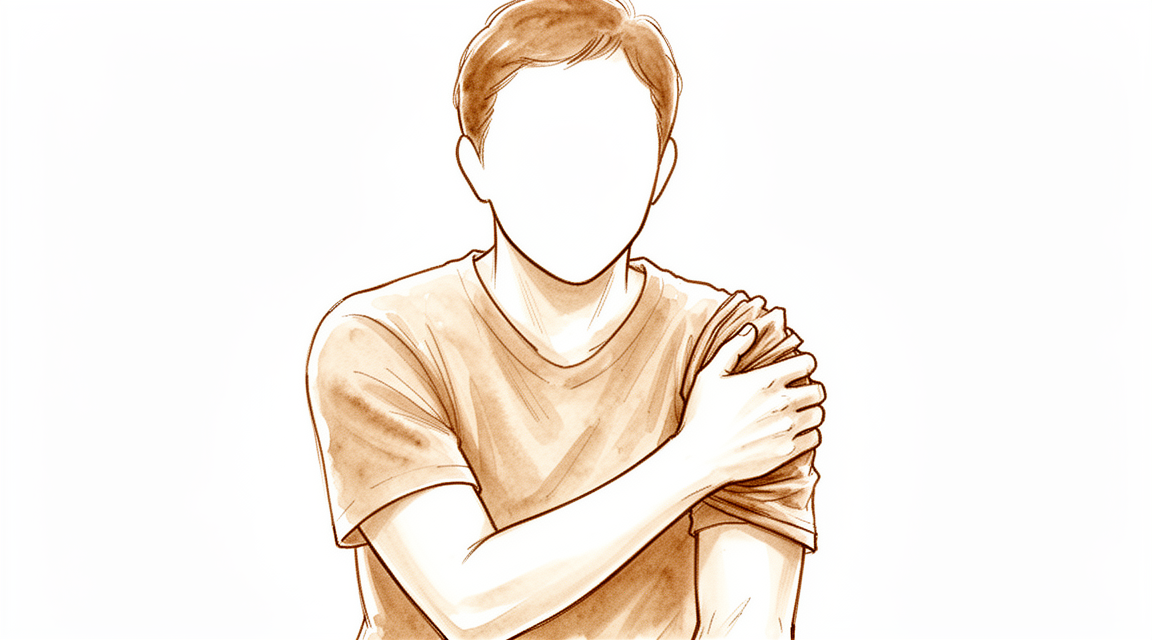
Ang protocol na ito ay nagsisilbing gabay sa iyong paggaling pagkatapos ng operasyon para sa elbow instability kasama si Dr Kieran Hirpara sa Mater Private Hospital Rockhampton. Sinasaklaw nito ang dalawang magkaibang uri ng instability, at sasabihin sa iyo ng iyong surgeon kung alin ang naaangkop sa iyo:
- (A) Lateral (outer-side) injury: gaya ng "terrible triad" injury, fracture-dislocation, o repair ng lateral collateral ligament (LCL). Ang mga pinsalang ito ay pinapatatag upang ang siko ay hindi na dumulas o pumivot palabas ng puwesto.
- (B) Throwing (medial, inner-side) injury: repair o reconstruction ng ulnar collateral ligament (UCL), karaniwan sa mga overhead athletes.
Ang buong plano ay nakabatay sa isang ideya: protected early movement, hindi immobilisation. Ang matagal na pananatili sa cast o splint ang pangunahing sanhi ng permanenteng paninigas ng siko, kaya ang layunin ay magsimulang gumalaw nang ligtas at agad. Dalhin ang pahinang ito o ang PDF nito sa iyong unang therapy visit upang manatiling coordinated ang iyong rehabilitation. Maaaring i-adjust ng iyong therapist ang plano depende sa pag-unlad ng iyong paggaling.
Kung mayroon kang anumang alalahanin tungkol sa iyong sugat pagkatapos ng operasyon, makipag-ugnayan sa mga rooms. Madalas na nakatutulong ang pagkuha ng larawan ng sugat at pag-email nito para masuri.
Ano ang dapat asahan
Ang siko ay pinapanatili sa puwesto ng mga ligament sa loob at labas na bahagi ng joint. Kapag ang mga ito ay napinsala (dahil sa dislocation, fracture-dislocation, o paulit-ulit na paghagis), maaaring maging unstable ang joint. Kinukumpuni o muling binubuo ng operasyon ang mga napinsalang istruktura upang maibalik ang joint sa tamang puwesto.
Ang approach ni Dr Hirpara ay umiiwas sa paggamit ng malaking external hinged brace. Kung ang pagkumpuni ay stable sa buong range nito sa oras ng operasyon, magsusuot ka lamang ng light sling para sa comfort at magsisimulang igalaw ang siko nang maaga, sa loob ng mga ligtas na posisyon. Kung ang stability ay nangangailangan ng higit pang proteksyon, isang internal joint stabiliser ang maaaring ikabit sa oras ng operasyon: isang maliit na internal hinge na humahawak sa siko upang manatiling tama ang pagkaka-reduce mula sa loob habang pinapayagan ka pa ring itiklop at ituwid ito nang maaga. Dahil ang proteksyon ay internal, maiiwasan mo pa rin ang external arc-limiting brace. Kung ginamit, ang internal device na ito ay karaniwang tinatanggal kapag gumaling na ang mga ligament, sa loob ng humigit-kumulang apat hanggang anim na buwan.
Para sa pamamahala ng sugat, pamamaga, at peklat, tingnan ang gabay ng practice sa wound care.
Ang pinakamahalagang gawi sa recovery na ito ay ang pananatiling gumalaw sa loob ng iyong safe range habang sinusunod ang mga posisyong ipinagbabawal ng iyong surgeon. Ang mga ehersisyo sa ibaba ang iyong panimulang punto.
Mga pag-iingat at limitasyon
Ang mga posisyon para sa proteksyon ay nakadepende sa kung anong pinsala ang mayroon ka. Kumpirmasyon ng iyong surgeon at therapist ang iyong mga partikular na posisyon.
Para sa lateral (outer-side) na pinsala (terrible triad / LCL):
- Gawin: Panatilihing nakaharap ang iyong forearm nang nakababa ang palad (pronated) para sa paggalaw; ito ay nagpapatatag sa joint at pinoprotektahan ang repair sa outer side.
- Gawin: Mag-ehersisyo nang ang iyong braso ay nasa harap ng iyong katawan, o nakahiga nang ang braso ay nakaturo sa kisame kung hiningi, upang makatulong ang gravity sa pagpapanatiling magkasama ng joint.
- Huwag: Hayaang mahulog ang braso sa gilid (iwasan ang shoulder abduction) o magbuhat ng bigat gamit ito nang maaga; hihilahin ng gravity ang repair upang maghiwalay.
- Huwag: Pagsamahin ang ganap na pagtuwid ng siko at ang forearm na nakaharap ang palad pataas (supinated) hanggang sa payagan ito ng iyong surgeon (humigit-kumulang 16 na linggo); ito ang posisyon na maaaring magdulot ng muling pag-slip ng joint.
- Huwag: Itulak o i-stretch ang siko hanggang sa makaramdam ng sakit, at iwasan ang weight-bearing at contact loading sa unang ilang buwan.
Para sa throwing (medial, inner-side) na pinsala (UCL):
- Gawin: Panatilihing nakaharap ang iyong forearm nang nakataas ang palad (supinated) o neutral, ayon sa itinuro.
- Huwag: I-load ang shoulder sa outward (external) rotation nang maaga; binibigyang-stress nito ang repair sa inner side. Karaniwang iniwasan ito hanggang sa humigit-kumulang 6 na linggo.
Iyong mga ehersisyo
Kieran Hirpara 4.0
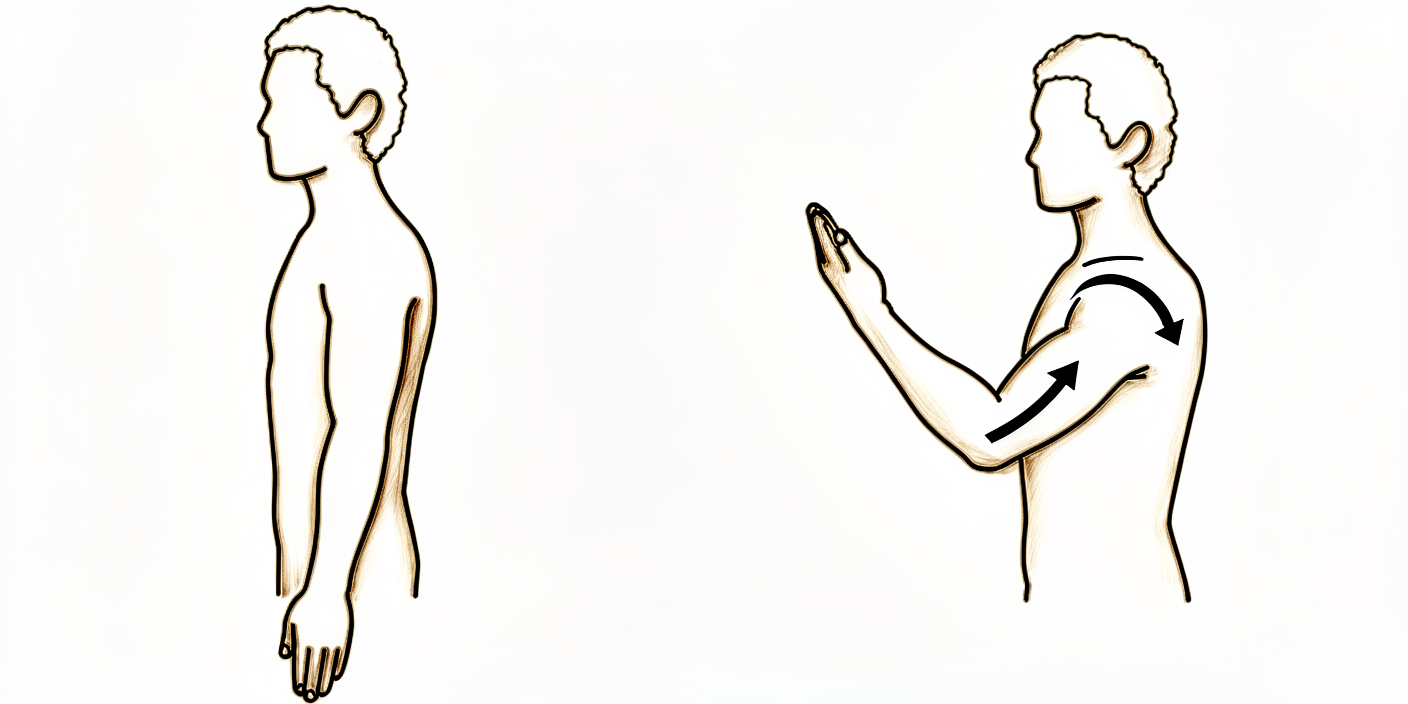
Aktibong pagbaluktot ng siko
Dahan-dahang itiklop ang iyong siko hanggang sa kung saan ito komportable, pagkatapos ay ituwid itong muli hanggang sa puntong pinapayagan ng iyong surgeon at therapist. Panatilihing nakapihit ang iyong forearm ayon sa itinuro sa iyo — para sa lateral (outer-side) na pinsala, karaniwan itong nangangahulugang nakaharap ang palad pababa (pronated). Galawin lamang ang sarili mong mga kalamnan; huwag pilitin ang joint.
10–15 beses, ilang beses sa isang araw
Kieran Hirpara 4.0
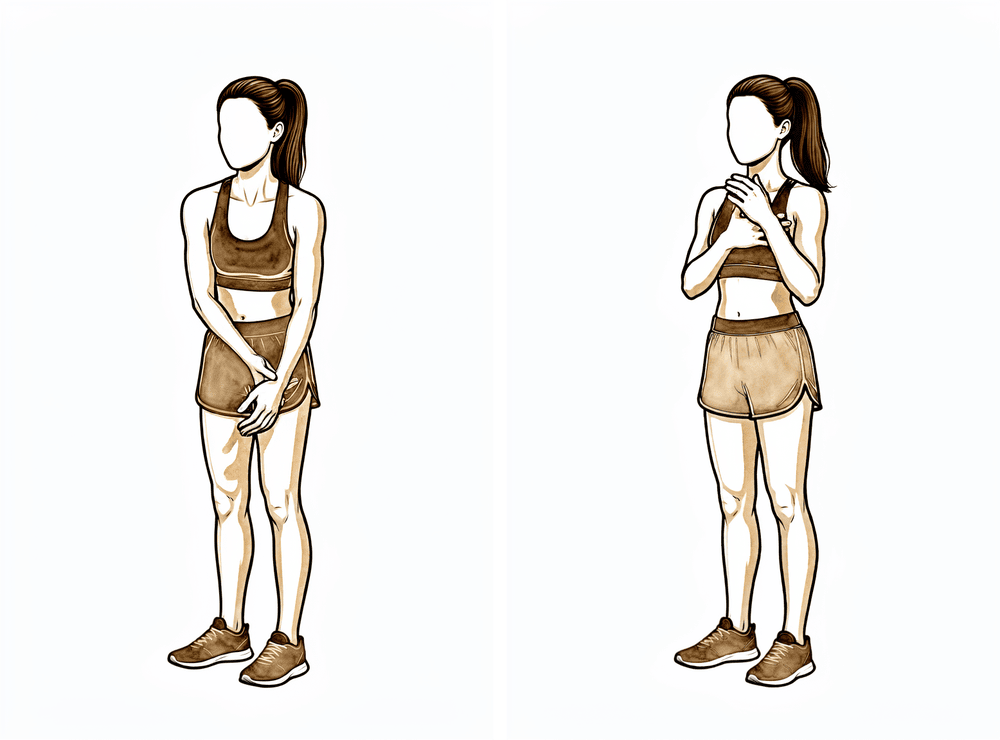
Tinulungang flexion ng siko
Kapag pinayagan ka na ng iyong therapist, gamitin ang iyong kabilang kamay upang dahan-dahang tulungan ang iyong siko na mabaluktot nang kaunti pa kaysa sa kaya nitong igalaw nang mag-isa. Dalhin lamang ito sa isang komportableng stretch — huwag na huwag aabutin sa punto ng pananakit — at dahan-dahang bitawan.
Hawakan nang 10–15 segundo, 5–10 beses, ayon sa itinuro
Kieran Hirpara 4.0
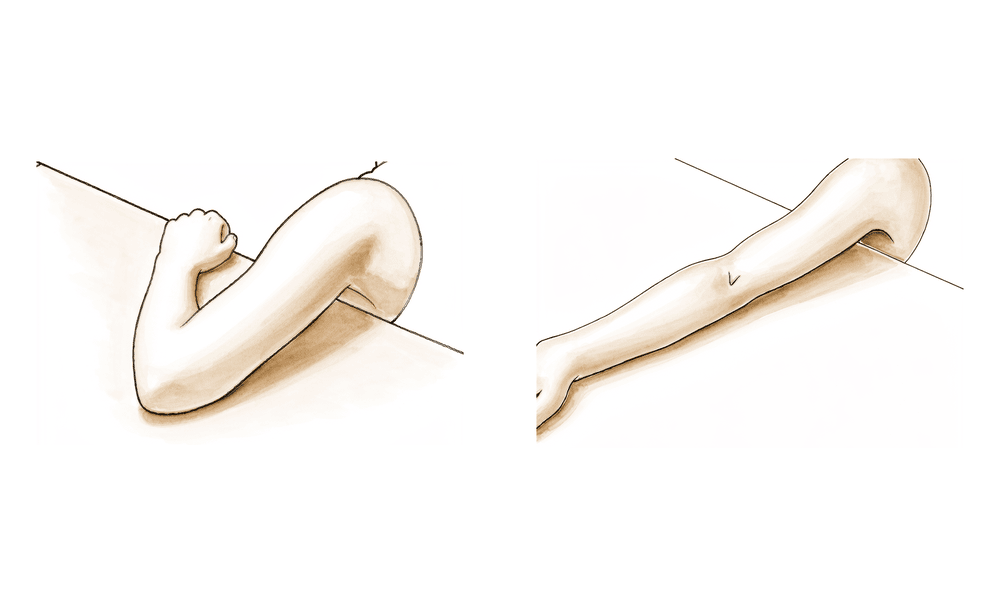
Pagtuwid ng siko (extension hanggang sa maging komportable)
I-unat ang iyong siko hangga't komportable sa loob ng range na itinakda ng iyong surgeon. Para sa lateral injury, panatilihing nakaharap pababa ang iyong palad habang nag-uunat. Huwag piliting i-unat nang husto kasabay ng pag-ikot ng palad paitaas hangga't hindi ito pinapayagan ng iyong surgeon.
10–15 beses, ilang beses sa isang araw
Kieran Hirpara 4.0
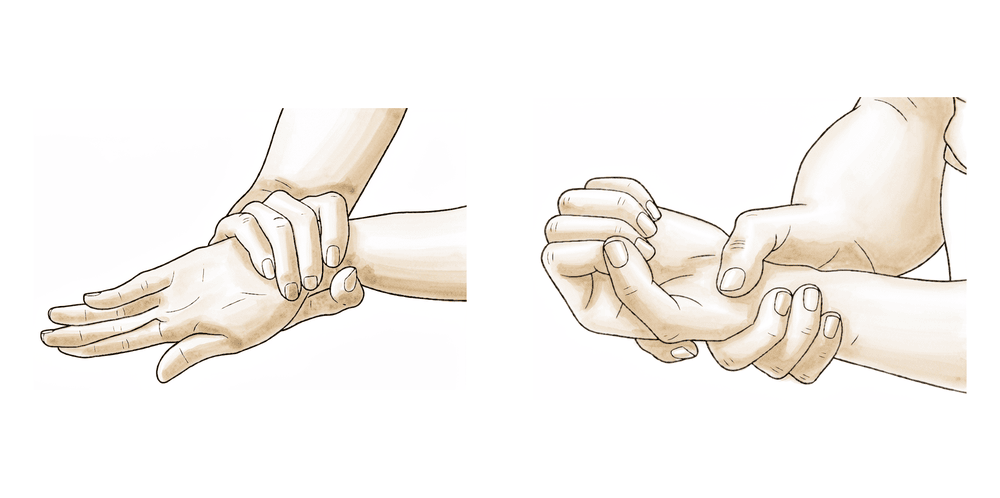
Rotasyon ng forearm (palad paitaas / palad paibaba)
Habang ang iyong siko ay nakadikit sa iyong gilid at nakabaluktot nang mga 90°, dahan-dahang itapat ang iyong palad paitaas, pagkatapos ay palad paibaba, sa loob ng range na ibinigay sa iyo. Ang iyong ligtas na direksyon ay nakadepende sa iyong pinsala — ang lateral injury ay pabor sa palad-paibaba (pronation); ang medial throwing injury ay pabor sa palad-paitaas (supination). Sundin ang direksyong itinakda ng iyong surgeon at therapist.
10 beses sa bawat pinapayagang direksyon, ilang beses sa isang araw
Kieran Hirpara 4.0
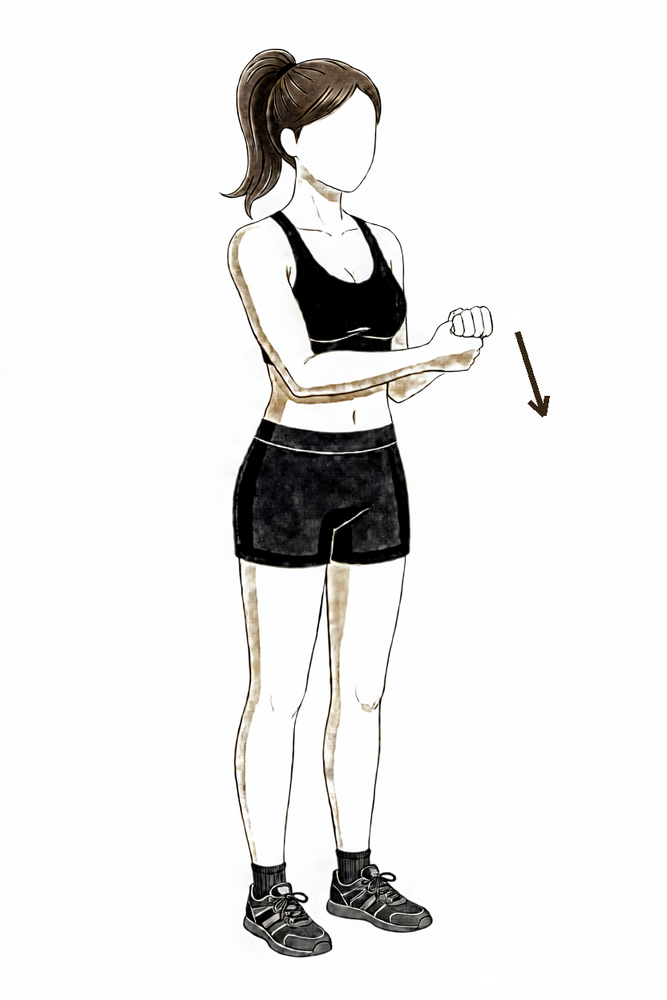
Pag-hold ng kalamnan sa siko — pagtuwid (isometric)
Habang hindi ginagalaw ang iyong siko, dahan-dahang itulak ito na tila ba itutuwid laban sa iyong kabilang kamay o sa isang nakapirming ibabaw. Hindi dapat aktwal na gumalaw ang siko. Ginigising nito ang mga kalamnan nang hindi binibigatan ang mga nagpapagaling na ligament.
Hawakan nang 5 segundo, 10 beses, isang o dalawang beses araw-araw — kapag pinayagan na lamang
Kieran Hirpara 4.0
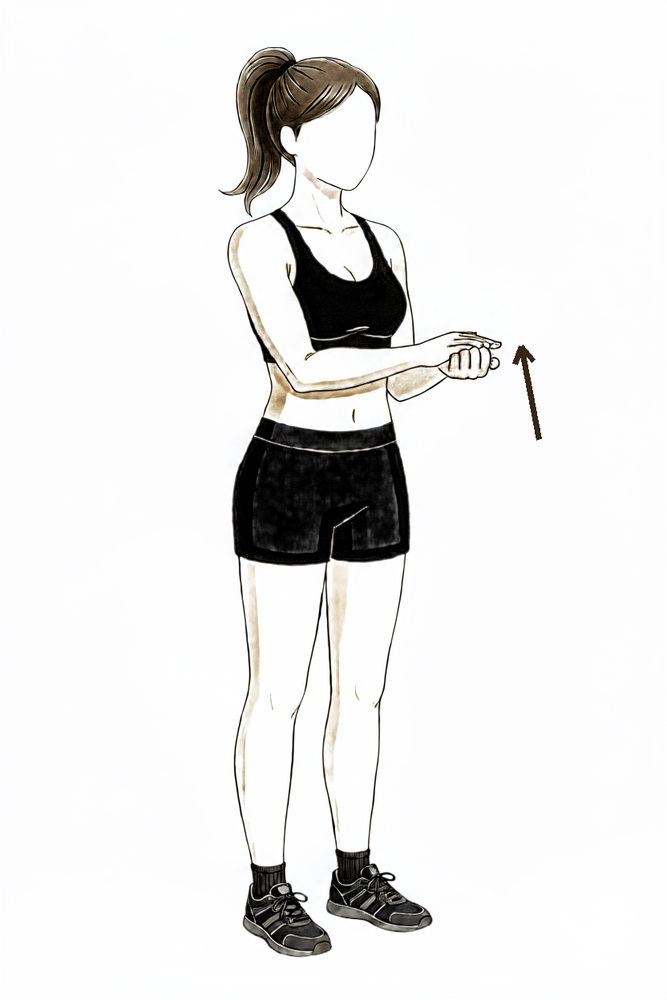
Pag-hold ng kalamnan sa siko — pagbaluktot (isometric)
Habang nakapirmi ang iyong siko, dahan-dahang itulak ito na tila ibinabaluktot laban sa iyong kabilang kamay. Hindi dapat gumalaw ang siko. Panatilihing komportable ang pwersa — ito ay muscle activation, hindi isang workout.
Hawakan nang 5 segundo, 10 beses, isang o dalawang beses araw-araw — kapag pinayagan na lamang
Kieran Hirpara 4.0
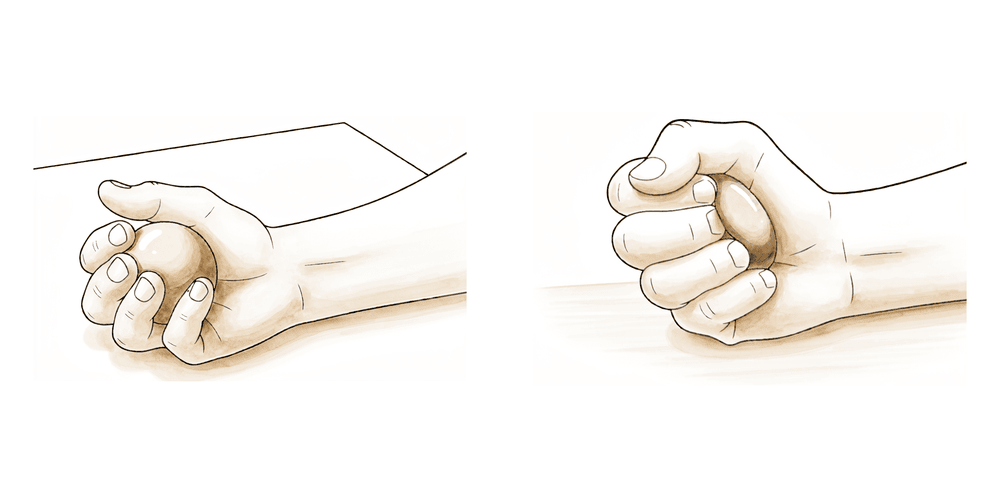
Pagpapalakas ng grip (kapit)
Pigaan ang isang malambot na bola o therapy putty sa iyong kamay at hawakan nang sandali, pagkatapos ay bitawan. Pinapanatili nitong malakas ang iyong kamay at forearm habang protektado ang iyong siko.
10–15 piga, 2–3 beses sa isang araw
Ito ang mga ehersisyo mula sa iyong handout, para muling makuha ang ligtas na paggalaw at mapanatiling gumagana ang iyong kamay, forearm at balikat habang protektado ang siko. Simulan ang mga ito, at ituloy ang pag-unlad, ayon lamang sa gabay ni Dr Hirpara at ng iyong therapist; ang ligtas na posisyon at range ng forearm ay nakadepende sa iyong partikular na pinsala.
Ang iyong clinical protocol
Ang natitirang bahagi ng pahinang ito ay ang clinical protocol para sa iyong physiotherapist o hand therapist. Isinulat ito sa dalawang track dahil ang dalawang pinsala ay pinoprotektahan nang magkaiba. Ang bawat phase ay criteria-gated: magpatuloy kapag naabot na ang mga milestone, hindi base lamang sa kalendaryo.
Bago ang paggamot, suriin ang x-ray ng pasyente, operation report at nakaraang medical history, at makipag-ugnayan sa treating surgeon tungkol sa stability na nakamit sa operasyon, ang safe arc at forearm rotation, at kung may internal joint stabiliser na inilagay. Hindi gumagamit si Dr Hirpara ng external hinged brace: ang isang through-range stable repair ay pinamamahalaan sa isang simpleng sling na may early motion para sa comfort; kung saan kailangang protektahan ang stability, isang internal joint stabiliser ang humahawak sa reduction internally habang pinapayagan ang extension para sa comfort.
Track A — Terrible triad / fracture-dislocation / LCL (LUCL) repair
Layunin: Isang stable at concentrically reduced na siko na gumagalaw nang maaga; iwasan ang posterolateral rotatory re-subluxation.
Mga pangunahing pag-iingat sa buong early phase:
- Panatilihing pronated ang forearm para sa isolated lateral injury (hinihigpitan nito ang mga lateral structure at inilalagay ang radiocapitellar joint sa tamang posisyon). Kung parehong column ang na-repair, panatilihing neutral ang forearm; pinapayagan lamang ang supination kung ang siko ay naka-flex sa ~90°.
- Iwasan ang varus stress at shoulder abduction: ang grabidad ay nagbibigay ng varus load sa lateral repair. Isagawa ang active range of motion habang ang braso ay nasa harap ng katawan, o supine-overhead (gravity-reduced) kung tenuous ang repair.
- Walang full-extension-with-supination hanggang ~16 na linggo (ginagaya nito ang pivot-shift).
- Walang weight-bearing / closed-chain loading sa loob ng 8–16 linggo.
Weeks 0–2: Early motion. Simpleng sling para sa comfort. Simulan agad ang active range of motion ng mga daliri, wrist, at shoulder. Simulan ang active at active-assisted range of motion ng siko ayon sa comfort mula day 2–3, pronated ang forearm, suportado ang braso sa harap ng katawan (o supine-overhead kung tenuous ang repair, upang i-compress ng grabidad ang joint). Kung may nakalagay na internal joint stabiliser, mag-progress nang maaga sa full comfortable extension; pinoprotektahan ng device ang reduction; walang external brace na ginagamit.
Weeks 2–6: Restore the arc. Mag-progress sa full comfortable flexion at extension (extension ayon sa comfort sa lahat ng oras; ang internal stabiliser, kung mayroon, ay pinapayagan ito). Panatilihin ang pronation bias; iwasan ang varus loading. Criteria para mag-progress: nabawi ang full passive arc, walang re-subluxation sa pagsusuri o x-ray, pain ≤3/10.
Weeks 6–12: Strengthening. Kapag clinically at radiographically healed na (~week 6), simulan ang progressive strengthening; magpakilala ng static-progressive splint kung may nabubuong contracture. Patuloy na iwasan ang varus load. Ang internal stabiliser, kung ginamit, ay karaniwang pinananatili hanggang sa gumaling ang ligament.
Weeks 12–20+: Advanced / return. Progressive resistance; pagbabalik sa mabigat na trabaho. Contact at overhead sport sa humigit-kumulang 6–9 buwan (at pagkatapos ng anumang internal-stabiliser removal). Patuloy na iwasan ang varus-loaded strengthening.
Track B — Throwing (medial) UCL repair / reconstruction
Ito ay isang chronic-overload medial problem. Ang preference ni Dr Hirpara ay walang external hinged brace: ang suture-tape internal-brace augmentation (repair) o ang tendon graft (reconstruction) ang nagbibigay ng proteksyon, at ang rehabilitasyon ay throwing-specific. Ang forearm ay nakaposisyon sa supination/neutral; iniwasan ang resisted shoulder external rotation hanggang ~week 6, dahil nagbibigay ito ng valgus-load sa graft.
Internal-brace–augmented repair (accelerated, tumutugma sa no-external-brace approach):
- Maagang protected motion hanggang sa komportable, weeks 0–4 (full arc sa ~week 6).
- Thrower's Ten program mula ~week 3; plyometrics mula ~week 6.
- Interval throwing program mula ~week 11; pagbabalik sa sport sa ~5–7 months.
Reconstruction (graft) track, kung gagamitin (mas mabagal):
- Full arc sa ~week 6; interval throwing sa weeks 14–16; pag-throw mula sa mound ay hindi bago ang 6 months; competitive return to sport ay karaniwang 9–16 months.
Pagbabalik sa trabaho at aktibidad
Ang bilis ng iyong pagbabalik ay nakadepende sa kung anong pinsala ang iyong naranasan at sa mga hinihingi ng iyong trabaho o sport.
- Lateral injury (terrible triad / LCL): ang mga magagaan na gawaing pang-opisina at pag-aalaga sa sarili ay muling sinisimulan nang maaga, sa loob ng iyong mga ligtas na posisyon. Ang pagpapalakas (strengthening) ay karaniwang nagsisimula sa loob ng 6 na linggo kapag ang siko ay gumaling na clinically at sa x-ray. Ang mga contact at overhead sport ay karaniwang ipinagpapaliban hanggang sa humigit-kumulang 6–9 buwan, at pagkatapos alisin ang internal joint stabiliser kung mayroong ikinabit. Iwasang magbuhat ng bigat gamit ang braso o i-load ito palabas sa gilid hanggang sa payagan ito ng iyong surgeon.
- Throwing injury (UCL): sa isang internal-brace-augmented repair, ang isang structured interval throwing program ay karaniwang nagsisimula sa loob ng 11 linggo, na may pagbabalik sa sport sa loob ng humigit-kumulang 5–7 buwan. Pagkatapos ng isang reconstruction, ang pagbabalik sa competitive throwing ay mas mabagal, karaniwang 9–16 buwan.
Ang pagmamaneho ay muling sinisimulan kapag mayroon ka nang komportable at ligtas na kontrol sa braso nang wala sa sling at nakumpirma ng iyong surgeon sa review na ito ay nararapat na. Ang iyong therapist ang magpapaunlad ng iyong strengthening at mga sport- o work-specific drills tungo sa iyong mga indibidwal na layunin.
Pagkatapos ng iyong protocol
Ang protocol na ito ay kasabay ng pangkalahatang payo sa paggaling ng klinika; tingnan ang pamamahala ng sakit pagkatapos ng operasyon at pag-aalaga ng sugat. Ang iyong patuloy na paggaling ay ginagabayan nang indibidwal ng iyong physiotherapist o hand therapist ayon sa pag-unlad ng iyong siko at kung anong pinsala ang iyong naranasan. Ang clinician-facing evidence summary para sa protocol na ito ay nakatabi kasama ng pahinang ito.
Evidence & references
This is the clinical evidence summary written for health professionals. It is technical, and it lists the research this page was built from. You do not need to read it to understand your treatment or to make a decision about it.
Elbow Instability — Rehabilitation Evidence (Lateral / Terrible Triad / LCL and Throwing / UCL)
Topic scope: Post-operative rehabilitation after surgery for elbow instability, in two distinct tracks: (A) complex lateral instability — "terrible triad" / fracture-dislocation and lateral (ulnar) collateral ligament [LCL/LUCL] repair & reconstruction for posterolateral rotatory instability (PLRI); and (B) overhead-throwing ulnar (medial) collateral ligament [UCL] reconstruction & repair ("Tommy John").
Defining principle: the crux of every track is protected motion, not immobilisation. Restore enough stability to permit early range of motion (within ~1 week), because prolonged immobilisation is the dominant cause of disabling flexion contracture and stiffness. Dr Hirpara's stance: he does not use an external hinged brace. A repair that is stable through-range at surgery is managed with a simple sling for comfort plus early motion to comfort within positional precautions. Where stability needs protecting, he implants an internal joint stabiliser (an internal hinge) that holds the elbow reduced from the inside while permitting full flexion and extension to comfort — so the patient still moves early without an external arc-limiting brace. The device is typically removed once the ligaments have healed (~4–6 months). The published external-hinged-brace extension-block arcs below are retained as reference for what they represent biomechanically, not as Dr Hirpara's management.
(A) Terrible triad / complex fracture-dislocation / LCL (LUCL) repair & reconstruction
Forearm-rotation rule (the key precaution)
- Lateral-sided (LCL/LUCL) injury → keep the forearm PRONATED. Pronation tightens the lateral structures and seats the radiocapitellar joint, protecting the lateral repair. Terminal extension is performed pronated; supination near full extension reproduces the pivot-shift and is avoided.
- Medial-sided (MCL/UCL) injury → keep the forearm SUPINATED (Rockwood & Green; Green's Operative Hand Surgery).
- If both columns are repaired (many terrible triads), the forearm is held neutral.
- Early supination, when allowed, is done only with the elbow flexed to ~90° (flexion stabilises the ulnohumeral joint and protects the lateral reconstruction).
Phased timeline
- Week 0–2 — Immediate post-op / early motion. Posterior splint at ~90° flexion in injury-appropriate forearm rotation for 7–14 days in the published protocols; the practical aim is early motion. Begin digit/wrist/shoulder AROM immediately and gentle elbow AROM/AAROM in the surgeon-defined stable arc within days (Brigham fracture-dislocation guideline starts elbow/forearm AROM at day 2–3). A supine/overhead protocol is an option where the lateral repair is tenuous — gravity compresses and stabilises the ulnohumeral joint (Green's; Lee 2013).
- Week 2–6 — Protected motion / restore the arc. Published external-hinged-brace protocols open an extension block ~10°/week, forearm pronated (Denver/Eichinger: 30° at wk2 → 20° wk3 → 10° wk4 → 0° wk5), reaching full extension by ~week 5–6. Dr Hirpara replaces this external brace with a simple sling (through-range stable repair) or an internal joint stabiliser permitting extension to comfort. Precautions: avoid varus stress and shoulder abduction; avoid combined full-extension-with-supination for up to ~16 weeks; no weight-bearing/closed-chain for 8–16 weeks.
- Week 6–12 — Intermediate / strengthening. Full PROM, joint mobilisations. Strengthening starts ~week 6 once clinical and radiographic healing is confirmed (Brigham PRE 6–8 wk; Rockwood & Green). Static-progressive splinting if a contracture is developing (Müller 2013).
- Week 12–20+ — Advanced / return. Progressive resistance; avoid varus-loaded strengthening. Contact/overhead sport often delayed to ~6–9 months for reconstruction (Green's: unrestricted use ≥6 months for graft incorporation; Eichinger: up to 9 months).
Nonoperative (stable terrible triad) caveat: if the joint is concentrically reduced with a stable arc to ≥30° of extension (no radial-head block, small coronoid), nonoperative early-motion management is reasonable (Rockwood & Green / Chan criteria; Najd Mazhar 2017).
(B) UCL reconstruction / repair — throwing athlete ("Tommy John")
Rehabilitation is uniformly described in 4 phases (Brotzman-Wilk lineage; ASMI/Andrews; Mass General). The forearm is biased toward supination/neutral (medial-sided injury); no shoulder external-rotation loading early (it valgus-loads the graft).
- Phase I — Week 0–3. Posterior splint at 90° week 1, then progressive ROM. Wrist AROM, gripping, submax shoulder isometrics (no ER), submax biceps isometrics from week 1–2.
- Phase II — Week 4–6/8. Progress to full ROM by ~week 6. Light wrist/forearm strengthening, rotator-cuff isotonics; resisted shoulder ER avoided until ~week 6 to protect the graft.
- Phase III — Week 6/9–12/13. Progressive elbow/forearm strengthening, eccentrics from ~wk9, Thrower's Ten, plyometrics ~wk9 if appropriate.
- Phase IV — Week 14–26+. Interval throwing program ~week 14–16; long-toss ramp 45→60 ft, +30 ft increments to 180 ft; mound throwing ≥6 months; return to competitive throwing ~6 months for return-to-throw, but full competitive RTS typically 9–16 months (≥12 months a common criterion). ~83–97% RTS in throwers.
Internal-brace–augmented UCL REPAIR (accelerated track) — the recent shift
For acute/avulsion tears with good tissue, UCL repair with internal brace allows a markedly accelerated protocol (Dugas/ASMI; SLU/JOSPT 2019):
- Mobilise early to comfort; full/unrestricted ROM by ~wk4, brace off by wk6.
- Thrower's Ten from ~wk3; plyometrics from ~wk6.
- Interval throwing as early as ~wk11; return to sport ~5–7 months (vs ≥9–12+ for reconstruction). Dugas 2025 (AJSM) head-to-head: repair ~2–3 weeks accelerated for ROM/strengthening and ~5–9 weeks accelerated for starting the interval throwing program, with comparable outcomes in appropriately selected athletes.
Phased-timeline summary
| Phase / window | Track A — lateral (terrible triad / LCL) | Track B — throwing (UCL, internal-brace repair) |
|---|---|---|
| Weeks 0–2 | Sling for comfort; elbow AROM/AAROM to comfort from day 2–3, forearm pronated, arm supported in front / supine-overhead | Early protected motion to comfort; submax shoulder (no ER) + biceps isometrics; grip/wrist work |
| Weeks 2–6 | Restore full comfortable arc; extension to comfort (internal stabiliser permits); maintain pronation, avoid varus | Progress to full arc by ~wk6; Thrower's Ten from ~wk3 |
| Weeks 6–12 | Strengthening once healed (~wk6); static-progressive splint if contracture | Plyometrics from ~wk6; progressive strengthening |
| Weeks 12–20+ | Progressive resistance; contact/overhead sport ~6–9 mo | Interval throwing ~wk11; RTS ~5–7 mo (reconstruction: 9–16 mo) |
Key controversies
- Early vs protected motion (complex instability). Strong consensus favours early motion (≤7 days), BUT the two 2024 systematic reviews (Ahmed Kamel, JSES; Larwa, Shoulder & Elbow) found no RCT and high heterogeneity (immobilisation 1–76 days, weighted mean ~42–47). "Early" is biomechanically favoured, not Level-I proven; over-aggressive motion risks re-subluxation in a marginally stable repair.
- Brace necessity & utility. A hinged orthosis is the published standard, but Manocha/King (JHS 2018) showed it adds little stability with the arm overhead (gravity already compresses the joint), supporting overhead/supine rehab over brace reliance for lateral injuries (Lee 2013). This underpins Dr Hirpara's no-external-brace approach.
- Forearm-rotation dogma. Pronation-for-lateral / supination-for-medial is biomechanically grounded and widely taught, but Selley 2025 found forearm rotation at graft tensioning did not change postoperative medial gapping — questioning how rigidly rotation must be controlled in UCL cases.
- Accelerated vs conservative UCL return-to-throw. Time-to-RTS varies 4–16 months with no consensus threshold; Erickson 2017 found earlier RTS did not raise revision risk in MLB pitchers, undercutting strict "wait ≥12 months" dogma.
- Internal brace enabling faster rehab. The biggest recent shift: suture-tape/internal-brace augmentation gives superior time-zero biomechanics and supports repair (not reconstruction) in selected throwers with a 5–9-week-faster throwing timeline. Durability in elite pitchers and mid-substance tears is still maturing (Level III–IV).
Evidence strength flags
- (A) Complex instability / LCL: LOW–MODERATE. No RCTs; guidance is biomechanical + expert-consensus + Level III/IV case series and two 2024 systematic reviews. Internal-joint-stabiliser data (Orbay/Mighell lineage; Dunning/Morrey biomechanics) are device-specific case series — Consensus / Moderate.
- (B) UCL throwing: MODERATE. Large case series, multiple systematic reviews, and concordant institution-standard protocols (Brigham/Brotzman-Wilk, Mass General, ASMI/Andrews) for the phased arc and interval-throwing timeline. Internal-brace augmentation is newer (Level III–IV, growing).
- Rehabilitation protocols themselves: CONSENSUS / WEAK — phase timings derive from published institutional protocols, not rehab RCTs.
Citations
RAG corpus (180,000+ Orthopaedic articles)
- Szekeres M, Chinchalkar SJ, King GJ. Optimizing Elbow Rehabilitation After Instability. Hand Clin. 2008.
- Wilk KE, Arrigo CA. Rehabilitation of Elbow Injuries. Clin Sports Med. 2020.
- Ahmed Kamel S, Shepherd J, Al-Shahwani A, et al. Postoperative mobilization after terrible triad injury: systematic review and single-arm meta-analysis. J Shoulder Elbow Surg. 2024;33(3):e116–e125.
- Larwa J, Buchanan TR, Janke RL, et al. Characteristics of rehabilitation protocols following operative treatment of terrible triad elbow injuries and the influence of early motion: systematic review and meta-analysis. Shoulder Elbow. 2024.
- Najd Mazhar F, Jafari D, Mirzaei A. Evaluation of functional outcome after nonsurgical management of terrible triad injuries of the elbow. J Shoulder Elbow Surg. 2017;26(8):1342–1347.
- Manocha RH, King GJ, Johnson JA. In Vitro Kinematic Assessment of a Hinged Elbow Orthosis Following Lateral Collateral Ligament Injury. J Hand Surg Am. 2018.
- Lee AT, Schrumpf MA, Choi D, et al. The influence of gravity on the unstable elbow. J Shoulder Elbow Surg. 2013;22(1).
- Dunning CE, et al. (Morrey lineage). Ligamentous Repair and Reconstruction for Posterolateral Rotatory Instability of the Elbow. 2006. (LCL/LUCL stabiliser biomechanics.)
- Müller AM, Sadoghi P, Lucas R, et al. Effectiveness of bracing in the treatment of nonosseous restriction of elbow mobility: systematic review/meta-analysis of 13 studies. J Shoulder Elbow Surg. 2013. (Static-progressive stretch for stiffness.)
- Selley RS, Lawton CD, Owusu-Akyaw K, et al. Forearm Rotation at the Time of Elbow UCL Reconstruction Graft Tensioning Does Not Affect Postoperative Medial Elbow Joint Gapping. Orthop J Sports Med. 2025.
- Erickson BJ, Cvetanovich GL, Frank RM, et al. Do Clinical Results and RTS Rates After UCL Reconstruction Differ Based on Graft Choice and Surgical Technique? Orthop J Sports Med. 2016.
- Erickson BJ, Chalmers PN, Bach BR, et al. Length of time between surgery and RTS after UCL reconstruction in MLB pitchers does not predict need for revision. J Shoulder Elbow Surg. 2017.
- Kemler BR, Rao S, Willier DP, et al. Rehabilitation and Return to Sport Criteria Following UCL Reconstruction: A Systematic Review. Am J Sports Med. 2021.
- Griffith R, Bolia IK, Fretes N, et al. RTS Criteria After Upper Extremity Surgery, Part 2: UCL of the Elbow. Orthop J Sports Med. 2021.
- Dugas JR, Froom RJ, Mussell EA, et al. Clinical Outcomes of UCL Repair With Internal Brace Versus UCL Reconstruction in Competitive Athletes. Am J Sports Med. 2025.
- Dugas JR, Looze CA, Capogna B, et al. UCL Repair With Collagen-Dipped FiberTape Augmentation in Overhead-Throwing Athletes. Am J Sports Med. 2019;47(5).
- Jackson GR, Opara O, Tuthill T, et al. Suture Augmentation in Orthopaedic Surgery Offers Improved Time-Zero Biomechanics and Promising Short-Term Clinical Outcomes. Arthroscopy. 2023.
- Cain EL, Dugas JR, Wolf RS, et al. Elbow Injuries in Throwing Athletes: A Current Concepts Review. Am J Sports Med. 2003.
- Erickson BJ, Bach BR, Verma NN, et al. Treatment of Ulnar Collateral Ligament Tears of the Elbow. Orthop J Sports Med. 2017.
- Rockwood and Green's Fractures in Adults. 2019. — long-arm splint 7–10 d; lateral injury → forearm pronated, medial → supinated; avoid shoulder abduction/varus for lateral injury; strengthening ~6 wk.
- Green's Operative Hand Surgery. 2021. — supination only with elbow maximally flexed; overhead/supine protocol option; isometric strengthening 8–10 wk; unrestricted use ≥6 mo.
Published protocols (literature URLs)
- Brigham & Women's Hospital — Elbow Fracture/Dislocation Post-Op ORIF Hand Therapy Guideline (2021). https://www.brighamandwomens.org/assets/BWH/patients-and-families/rehabilitation-services/pdfs/elbow-fracture-orif-hand-therapy-protocol.pdf
- Brigham & Women's Hospital — UCL of the Elbow Reconstruction Using Autogenous Graft Protocol (Brotzman-Wilk modification). https://www.brighamandwomens.org/assets/BWH/patients-and-families/rehabilitation-services/pdfs/elbow-ulnar-collateral-ligament-reconstruction-protocol-bwh.pdf
- Massachusetts General Hospital Sports Medicine — Rehabilitation Protocol for UCL Reconstruction (rev. Nov 2018). https://www.massgeneral.org/assets/MGH/pdf/orthopaedics/sports-medicine/physical-therapy/rehabilitation-protocol-for-UCL.pdf
- Saint Louis University Sports Medicine / JOSPT 2019 — Rehabilitation s/p UCL Repair with Internal Brace. https://www.slu.edu/medicine/orthopaedic-surgery/sports-medicine/-pdf/ucl-repair-guidelines-final.pdf
- Eichinger MD — Rehabilitation Guidelines for Elbow Lateral Collateral Ligament Repair (2018). https://www.josefeichingermd.com/pdf/rehab-for-lateral-collateral-ligament-repair-3-4-18.pdf
- Denver Shoulder — Rehabilitation Protocol: Lateral Collateral Ligament Repair (extension block 30°→20°→10°→0° wk2–5, forearm pronated; supination only at 90° flexion). https://www.denvershouldersurgeon.com/pdf/lcl-repair-protocol.pdf
- Orthopaedic Medical Group of Tampa Bay — Elbow Dislocation Rehab Protocol. https://www.omgtb.com/wp-content/uploads/pdfs/elbow-dislocation-rehab.pdf