Skip to content

Patients › Shoulder

Thoracic Outlet Syndrome

Compression of the nerves and vessels at the base of the neck — the types, why diagnosis is tricky, and physio-first treatment.
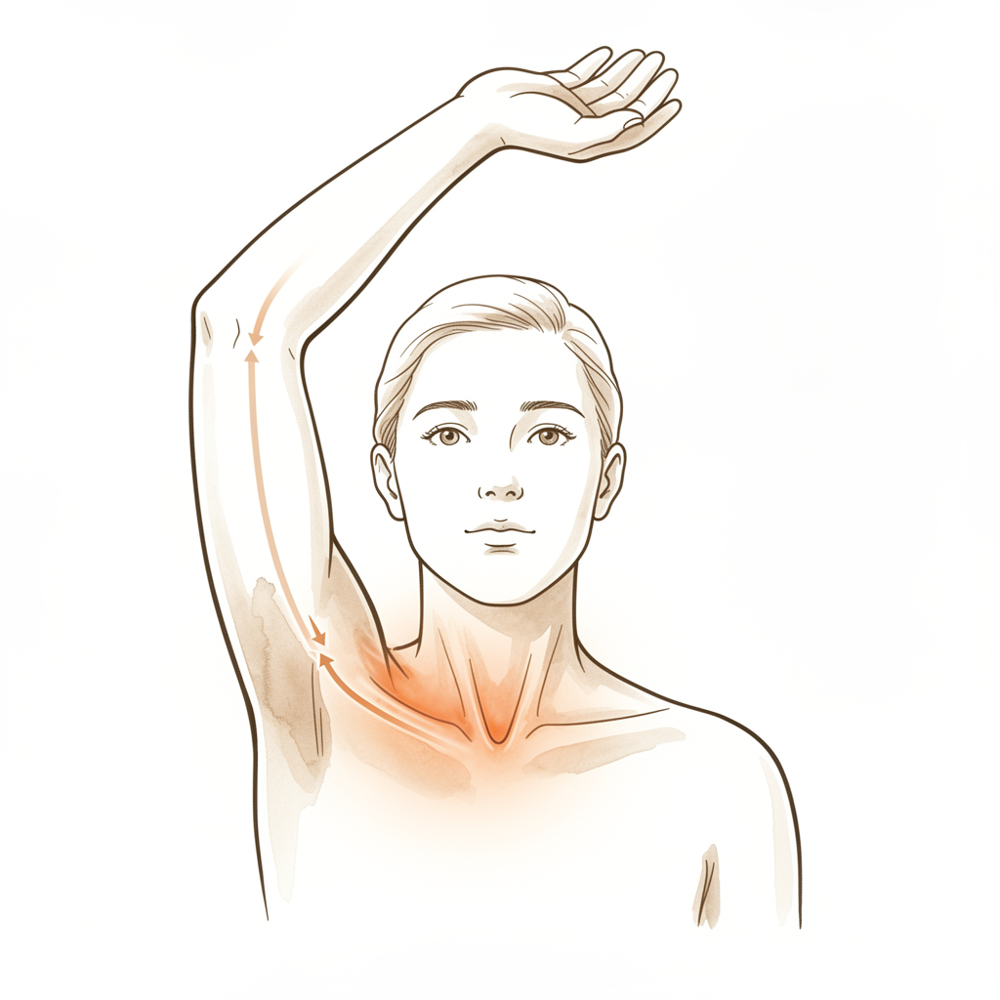
Isang nakataas na braso na may pangingilig na kumakalat mula sa base ng leeg at balikat.
Sa thoracic outlet syndrome, ang mga nerve at vessel ay naiipit sa base ng leeg — madalas na lumalala kapag ang braso ay nakataas. Kieran Hirpara 4.0

Ang pahinang ito ay isinalin ng makina at hindi pa nasusuri ng isang doktor. Ang bersyong Ingles ang siyang opisyal.

Ang iyong nararamdaman

Ang thoracic outlet syndrome ay karaniwang lumalabas bilang isang braso na tila hindi nasa ayos. Maaari kang makaramdam ng kirot sa balikat, sa gilid ng leeg at pababa sa braso, kasama ang pamamanhid, pakiramdam na tila tinutusok ng karayom o pangingilig, madalas sa ring finger at kalingkingan. Ang braso ay maaaring makaramdam ng pagbigat, panghihina o pagkailang, kaya nahuhulog ang mga bagay o mabilis mapagod ang iyong pagkakahawak. Isang napaka-tipikal na palatandaan ay ang mga sintomas ay lumalala kapag ang iyong braso ay nakataas o nasa itaas ng ulo (pagsasampay ng labada, pag-abot sa mataas na istante, pagmamaneho, o pagdadala ng bag sa iyong balikat) at nababawasan muli kapag ipinapahinga ang braso pababa. Ang ilang tao ay nakakaranas din ng sakit ng ulo sa likurang bahagi ng ulo.

Hindi gaanong karaniwan, ang problema ay nasa mga blood vessel sa halip na sa mga nerve. Kung ang isang ugat (vein) ay naiipit, ang buong braso ay maaaring biglang mamaga, bumigat at magkaroon ng pagka-asul na kulay. Kung ang isang artery ay naiipit (na bihirang mangyari), ang kamay ay maaaring pumutla, lumamig at sumakit. Ang mga vascular pattern na ito ay mahalaga, dahil kailangan itong masuri nang mabilis (tingnan ang huling seksyon).

Ano ang aktwal na nangyayari

Upang makarating mula sa iyong leeg patungo sa iyong braso, ang mga nerve at blood vessel ay kailangang dumaan sa isang makitid na puwang sa base ng leeg, sa pagitan ng iyong collarbone, ng iyong unang rib, at ng mga scalene muscle ng leeg. Ang puwang na ito ang "thoracic outlet". Kapag ito ay naging masyadong masikip, ang mga istrukturang iyon ay naiipit, at ang pressure na iyon ang nagdudulot ng mga sintomas.

Mayroong tatlong uri, depende sa kung ano ang naiipit. Ang Neurogenic TOS (pressure sa mga nerve, ang brachial plexus) ang pinakakaraniwan, na bumubuo sa malaking bahagi ng mga kaso; ito ang pattern ng pananakit, pamamanhid, pangingilig, at panghihina. Ang Venous TOS ay kinasasangkutan ng pangunahing ugat (vein) at nagdudulot ng namamagà, mabigat, at bluish na braso, kung minsan ay may kasamang clot. Ang Arterial TOS ay bihira at kinasasangkutan ng artery, na nagdudulot ng maputla at malamig na kamay.

May ilang bagay na nagpapasikip sa puwang. Ang ilang tao ay ipinanganak na may extra rib sa leeg (isang cervical rib) o isang masikip na fibrous band. Mahalaga rin ang posture: ang nakakuba o nakalaylay na mga balikat ay nagsasara sa puwang, gayundin ang malalaki o masisikip na muscle sa leeg at dibdib, kung kaya't ang kondisyong ito ay mas karaniwan sa mga taong gumagawa ng paulit-ulit na overhead work o sport. Ang nakaraang pinsala sa leeg o collarbone ay maaari ring maging trigger.

Ano ang maaari naming gawin tungkol dito

Sa Mater Private Hospital Rockhampton, pinamumunuan ni Dr Kieran Hirpara ang aming approach sa kondisyong ito. Ang mga pasyente ay karaniwang nirerefer sa aming klinika ng kanilang GP; kung iminungkahi ng isang physiotherapist na magpatingin sa amin, kakailanganin mo pa rin ng referral mula sa iyong GP upang maging eligible para sa Medicare rebate, at magsisimula sa isang masusing assessment upang kumpirmahin ang diagnosis. Para sa mga sintomas na matagal na, karaniwan kaming nagsisimula sa non-operative care at isinasaalang-alang lamang ang surgery kung hindi ito nagbibigay ng sapat na ginhawa.

Ang mabuting balita ay para sa karaniwang neurogenic type, ang first-line treatment ay physiotherapy, hindi surgery. Isang targeted programme upang buksan ang thoracic outlet ang gumagawa ng mabigat na trabaho: pagtatama ng posture, pagpapalakas ng mga kalamnan na humahawak sa shoulder blade pabalik at pababa, pag-release ng mga naninigas na kalamnan sa leeg at dibdib, at pag-aaral na iwasan ang mga posisyon ng braso na nag-iipit. Pinapakalma nito ang mga sintomas para sa karamihan ng mga tao, at sulit itong bigyan ng tunay na pagsisikap sa loob ng ilang buwan.

Ang surgery ay nakalaan para sa dalawang sitwasyon. Ang una ay ang mga vascular type (venous o arterial), kung saan karaniwang kailangan ang decompression at ito ang pangunahing treatment. Ang ikalawa ay neurogenic TOS na hindi kumalma sa kabila ng wastong trial ng physiotherapy at tunay na nakakaabala sa buhay. Ang operasyon ay nag-decompress sa outlet, karaniwan sa pamamagitan ng pagtanggal ng unang rib (at anumang extra cervical rib) at pag-release ng mga scalene muscles, upang bigyan ng espasyo ang mga nerves at vessels. Maaari itong gawin sa pamamagitan ng kili-kili, sa itaas ng collarbone, o may tulong ng keyhole. Para sa mga piling pasyente, ito ay epektibo.

Ano ang dapat asahan

Ang TOS ay maaaring maging isang mahirap na diagnosis. Walang iisang test na nakakapagpatunay nito. Ang diagnosis ay pangunahing clinical: ang iyong kuwento kasama ang mga examination test na naglalagay sa braso sa mga provoking position. Ang mga scan at nerve study ay madalas gamitin upang i-rule out ang mga mas karaniwang sanhi (tulad ng carpal tunnel sa wrist, cubital tunnel sa siko, o problema sa leeg/disc) gaya ng pag-confirm sa TOS mismo. Kaya bahagi ng proseso ang matiyagang pag-alam kung saan talaga nanggagaling ang iyong mga sintomas, at ang sagot ay hindi laging malinaw.

Para sa neurogenic na uri, karamihan ng mga tao ay bumubuti sa pamamagitan ng posture at physiotherapy at hindi kailanman nangangailangan ng operasyon, bagaman maaari itong tumagal ng ilang buwan at kailangang panatilihin ang mga gawi. Kapag ang mga vascular na uri o mga matitigas na neurogenic case ay sumailalim sa surgery, ang decompression ay nag-aalis ng mga sintomas para sa karamihan ng maingat na napiling mga pasyente, na may recovery sa loob ng ilang linggo. Dahil ang TOS ay nasa pinaka-proximal na punto ng nerve pathway (mas mataas kaysa sa carpal tunnel sa wrist o cubital tunnel sa siko), kung minsan ay isa lamang itong bahagi ng puzzle, at ang plano ay ini-aangkop para sa iyo.

Kailan dapat magpatingin

  • Biglaang pamamaga, pagbigat, o pag-asul ng braso: maaaring nangangahulugan ito na may nakabarang ugat o may namuong dugo (clot) at nangangailangan ng urgent na pagsusuri, sa mismong araw na iyon.
  • Maputla, malamig, at masakit na kamay, o mga daliri na nagbabago ang kulay: posibleng problema sa arterial at dahilan upang humingi ng urgent na pangangalaga.
  • Pamamanhid, pangingilig, panghihina, o kawalan ng koordinasyon (clumsiness) sa braso o kamay na nananatili, lumalala, o nakakaabala sa trabaho, pagtulog, o mga pang-araw-araw na gawain.
  • Pagliit (pagkawala ng muscle bulk) sa kamay, o mga sintomas na pabalik-balik sa kabila ng maayos na pagsubok sa physiotherapy: nararapat na kumuha ng opinyon ng isang espesyalista.
  • Kung nasabihan kang mayroon kang cervical rib at nakakaranas ng mga sintomas sa braso, nararapat itong ipasuri.

Higit pang kalaliman

Advanced reading: the deeper science (optional)

Ang seksyong ito ay higit pa sa kailangan mo para sa iyong sariling mga desisyon sa paggamot. Ang thoracic outlet syndrome ay karapat-dapat sa karagdagang pagbabasa dahil nahahati ito sa mga anyo na halos magkaiba, ang isa ay objectively demonstrable at paminsan-minsan ay limb-threatening, ang isa naman ay diagnosed nang malaki batay sa clinical judgement, at halos lahat ng kontrobersya ay nakakabit sa ikalawa.

Tatlong kondisyon na may iisang pangalan

Ang thoracic outlet ay ang makitid na espasyo sa pagitan ng collarbone at unang rib kung saan dumadaan ang mga nerve papunta sa braso at ang pangunahing artery at vein. Ang compression doon ay nagdudulot ng tatlong magkakaibang syndrome.

Ang Venous at arterial TOS ay mga vascular problem. Ang mga ito ay hindi karaniwan, objectively demonstrable sa imaging, at maaaring urgent, gaya ng isang clotted subclavian vein na nagdudulot ng namamagang asul na braso, o arterial compression na nagdudulot ng malamig na kamay at, sa pinakamalalang kaso, emboli. Walang kumukwestyon na umiiral ang mga ito o na kailangan ang mga itong gamutin.

Ang Neurogenic TOS ang bumubuo sa malaking mayorya. Dito, ang mga nerve ay compressed, na nagdudulot ng pananakit sa balikat at braso, pamamanhid na karaniwang nasa panig ng kalingkingan, at mga sintomas na lumalala kapag itinataas ang mga braso sa itaas ng ulo. Ang problema ay sa karamihan ng mga kaso ay walang test na nagkukumpirma nito — ang mga nerve conduction study ay madalas na normal, at ang imaging ay hindi nagpapakita ng lesion.

Ang mga kontemporaryong review ay tumutugon dito sa pamamagitan ng pagbubukod ng vascular at objectively verifiable na mga anyo ng neurogenic TOS mula sa iba pa [1], na isang maingat na paraan ng pagkilala na ang mga natitira ay nakadepende sa clinical judgement.

Bakit ang pagkakaibang iyon ang nagdidikta sa lahat

Kung saan ang diagnosis ay maaaring mapatunayan nang obhetibo, ang mga desisyon sa paggamot ay sumusunod sa karaniwang lohika. Kung saan hindi ito posible, dalawang uri ng pagkakamali ang maaaring mangyari: ang mga taong may tunay na compression ay lumilipas ang mga taon nang walang diagnosis dahil normal ang kanilang mga test, at ang mga taong ang pananakit ng braso ay may ibang sanhi ay sumasailalim sa isang malaking operasyon na hindi makakatulong sa kanila.

Ang dalawang pagkakamaling ito ay kilala, kaya naman ang standard of proof bago ang operasyon ay itinakda nang mas mataas dito kaysa sa karamihan ng mga compression, at kung bakit ang isang matagal na trial ng physiotherapy, na tumutugon sa posture, sa mga scalene muscle at shoulder girdle mechanics, ay nauuna bago ang anumang operasyon para sa neurogenic form.

Ano ang tinatanggal, at ang ebidensya kung paano

Ididiskompresa ng operasyon ang outlet sa pamamagitan ng pagtanggal ng unang rib, paghati sa mga scalene muscle, o pareho.

Sa paghahambing ng mga approach sa 2,010 na pasyente, ang Disabilities of the Arm, Shoulder and Hand at Derkash scores ay signipikanteng mas mabuti pagkatapos ng rib-sparing scalenectomy, at mas mataas na complication rates ang naiulat pagkatapos ng first rib resection [2].

Sa kabilang banda, ang mga mas matagal nang series ay nangangatwiran para sa combined operation. Sa 532 na pasyente, ang combined transaxillary first rib resection kasama ang transcervical scalenectomy ay inilarawan bilang pinaka-kumpletong decompression na may mas mabuting rate ng pagbuti ng sintomas at mas mababang recurrence [3], at ang recurrence ay naiulat sa 5% hanggang 10% kapag ang combined procedure ay ginamit bilang primary operation [4].

Ang dalawang posisyon ay hindi lubos na mapagkakasundo mula sa mga nailathalang data. Ang mas bagong comparative analysis ay pumapabor sa paggawa ng mas kaunti; ang malaking karanasan ng isang surgeon ay pumapabor sa paggawa ng mas marami, sa batayan na ang hindi kumpletong decompression ang nagiging sanhi ng recurrence. Ang pinagkakasunduan ng dalawa ay ang recurrent TOS ay isang problemang mas mahirap kaysa sa unang presentasyon, kaya ang paggawa ng tamang paunang desisyon ay mas mahalaga kaysa sa pagpili ng technique.

Ang praktikal na implikasyon

Dahil sa isang diagnosis na madalas ay klinikal, isang operasyon kung saan ang pinakamainam na lawak ay pinagtatalunan, at isang problema sa pag-uulit (recurrence) na mahirap isalba, ito ay isang kondisyon kung saan ang pagkuha ng pangalawang opinyon bago ang operasyon ay makatwiran sa halip na kalaban, partikular na para sa neurogenic na anyo na walang obhetibong kumpirmasyon.

Mga Sanggunian

[1] Panther EJ, Reintgen CD, Cueto RJ, Hao KA, Chim H, King JJ. Thoracic outlet syndrome: a review. J Shoulder Elbow Surg. 2022;31(11):e545-e561. https://doi.org/10.1016/j.jse.2022.06.026

[2] Blondin M, Garner GL, Hones KM, Nichols DS, Cox EA, Chim H. Considerations for surgical treatment of neurogenic thoracic outlet syndrome: a meta-analysis of patient-reported outcomes. J Hand Surg Am. 2023;48(6):585-94. https://doi.org/10.1016/j.jhsa.2023.03.005

[3] Atasoy E. A hand surgeon's further experience with thoracic outlet compression syndrome. J Hand Surg Am. 2010;35(9):1528-38. https://doi.org/10.1016/j.jhsa.2010.06.025

[4] Atasoy E. Recurrent thoracic outlet syndrome. Hand Clin. 2004;20(1):99-105. https://doi.org/10.1016/S0749-0712(03)00085-4


Creative Commons BY-NC 4.0

CC Creative Commons licence
BY Attribution — you must credit the source
NC NonCommercial — not for commercial use

Attribution-NonCommercial 4.0 International


Creative Commons Corporation ("Creative Commons") is not a law firm and does not provide legal services or legal advice. Distribution of Creative Commons public licenses does not create a lawyer-client or other relationship. Creative Commons makes its licenses and related information available on an "as-is" basis. Creative Commons gives no warranties regarding its licenses, any material licensed under their terms and conditions, or any related information. Creative Commons disclaims all liability for damages resulting from their use to the fullest extent possible.

Using Creative Commons Public Licenses

Creative Commons public licenses provide a standard set of terms and conditions that creators and other rights holders may use to share original works of authorship and other material subject to copyright and certain other rights specified in the public license below. The following considerations are for informational purposes only, are not exhaustive, and do not form part of our licenses.

Considerations for licensors: Our public licenses are intended for use by those authorized to give the public permission to use material in ways otherwise restricted by copyright and certain other rights. Our licenses are irrevocable. Licensors should read and understand the terms and conditions of the license they choose before applying it. Licensors should also secure all rights necessary before applying our licenses so that the public can reuse the material as expected. Licensors should clearly mark any material not subject to the license. This includes other CC- licensed material, or material used under an exception or limitation to copyright. More considerations for licensors: wiki.creativecommons.org/Considerations_for_licensors

Considerations for the public: By using one of our public licenses, a licensor grants the public permission to use the licensed material under specified terms and conditions. If the licensor's permission is not necessary for any reason--for example, because of any applicable exception or limitation to copyright--then that use is not regulated by the license. Our licenses grant only permissions under copyright and certain other rights that a licensor has authority to grant. Use of the licensed material may still be restricted for other reasons, including because others have copyright or other rights in the material. A licensor may make special requests, such as asking that all changes be marked or described. Although not required by our licenses, you are encouraged to respect those requests where reasonable. More considerations for the public: wiki.creativecommons.org/Considerations_for_licensees


Creative Commons Attribution-NonCommercial 4.0 International Public License

By exercising the Licensed Rights (defined below), You accept and agree to be bound by the terms and conditions of this Creative Commons Attribution-NonCommercial 4.0 International Public License ("Public License"). To the extent this Public License may be interpreted as a contract, You are granted the Licensed Rights in consideration of Your acceptance of these terms and conditions, and the Licensor grants You such rights in consideration of benefits the Licensor receives from making the Licensed Material available under these terms and conditions.

Section 1 -- Definitions.

a. Adapted Material means material subject to Copyright and Similar Rights that is derived from or based upon the Licensed Material and in which the Licensed Material is translated, altered, arranged, transformed, or otherwise modified in a manner requiring permission under the Copyright and Similar Rights held by the Licensor. For purposes of this Public License, where the Licensed Material is a musical work, performance, or sound recording, Adapted Material is always produced where the Licensed Material is synched in timed relation with a moving image.

b. Adapter's License means the license You apply to Your Copyright and Similar Rights in Your contributions to Adapted Material in accordance with the terms and conditions of this Public License.

c. Copyright and Similar Rights means copyright and/or similar rights closely related to copyright including, without limitation, performance, broadcast, sound recording, and Sui Generis Database Rights, without regard to how the rights are labeled or categorized. For purposes of this Public License, the rights specified in Section 2(b)(1)-(2) are not Copyright and Similar Rights.

d. Effective Technological Measures means those measures that, in the absence of proper authority, may not be circumvented under laws fulfilling obligations under Article 11 of the WIPO Copyright Treaty adopted on December 20, 1996, and/or similar international agreements.

e. Exceptions and Limitations means fair use, fair dealing, and/or any other exception or limitation to Copyright and Similar Rights that applies to Your use of the Licensed Material.

f. Licensed Material means the artistic or literary work, database, or other material to which the Licensor applied this Public License.

g. Licensed Rights means the rights granted to You subject to the terms and conditions of this Public License, which are limited to all Copyright and Similar Rights that apply to Your use of the Licensed Material and that the Licensor has authority to license.

h. Licensor means the individual(s) or entity(ies) granting rights under this Public License.

i. NonCommercial means not primarily intended for or directed towards commercial advantage or monetary compensation. For purposes of this Public License, the exchange of the Licensed Material for other material subject to Copyright and Similar Rights by digital file-sharing or similar means is NonCommercial provided there is no payment of monetary compensation in connection with the exchange.

j. Share means to provide material to the public by any means or process that requires permission under the Licensed Rights, such as reproduction, public display, public performance, distribution, dissemination, communication, or importation, and to make material available to the public including in ways that members of the public may access the material from a place and at a time individually chosen by them.

k. Sui Generis Database Rights means rights other than copyright resulting from Directive 96/9/EC of the European Parliament and of the Council of 11 March 1996 on the legal protection of databases, as amended and/or succeeded, as well as other essentially equivalent rights anywhere in the world.

l. You means the individual or entity exercising the Licensed Rights under this Public License. Your has a corresponding meaning.

Section 2 -- Scope.

a. License grant.

1. Subject to the terms and conditions of this Public License, the Licensor hereby grants You a worldwide, royalty-free, non-sublicensable, non-exclusive, irrevocable license to exercise the Licensed Rights in the Licensed Material to:

a. reproduce and Share the Licensed Material, in whole or in part, for NonCommercial purposes only; and

b. produce, reproduce, and Share Adapted Material for NonCommercial purposes only.

2. Exceptions and Limitations. For the avoidance of doubt, where Exceptions and Limitations apply to Your use, this Public License does not apply, and You do not need to comply with its terms and conditions.

3. Term. The term of this Public License is specified in Section 6(a).

4. Media and formats; technical modifications allowed. The Licensor authorizes You to exercise the Licensed Rights in all media and formats whether now known or hereafter created, and to make technical modifications necessary to do so. The Licensor waives and/or agrees not to assert any right or authority to forbid You from making technical modifications necessary to exercise the Licensed Rights, including technical modifications necessary to circumvent Effective Technological Measures. For purposes of this Public License, simply making modifications authorized by this Section 2(a) (4) never produces Adapted Material.

5. Downstream recipients.

a. Offer from the Licensor -- Licensed Material. Every recipient of the Licensed Material automatically receives an offer from the Licensor to exercise the Licensed Rights under the terms and conditions of this Public License.

b. No downstream restrictions. You may not offer or impose any additional or different terms or conditions on, or apply any Effective Technological Measures to, the Licensed Material if doing so restricts exercise of the Licensed Rights by any recipient of the Licensed Material.

6. No endorsement. Nothing in this Public License constitutes or may be construed as permission to assert or imply that You are, or that Your use of the Licensed Material is, connected with, or sponsored, endorsed, or granted official status by, the Licensor or others designated to receive attribution as provided in Section 3(a)(1)(A)(i).

b. Other rights.

1. Moral rights, such as the right of integrity, are not licensed under this Public License, nor are publicity, privacy, and/or other similar personality rights; however, to the extent possible, the Licensor waives and/or agrees not to assert any such rights held by the Licensor to the limited extent necessary to allow You to exercise the Licensed Rights, but not otherwise.

2. Patent and trademark rights are not licensed under this Public License.

3. To the extent possible, the Licensor waives any right to collect royalties from You for the exercise of the Licensed Rights, whether directly or through a collecting society under any voluntary or waivable statutory or compulsory licensing scheme. In all other cases the Licensor expressly reserves any right to collect such royalties, including when the Licensed Material is used other than for NonCommercial purposes.

Section 3 -- License Conditions.

Your exercise of the Licensed Rights is expressly made subject to the following conditions.

a. Attribution.

1. If You Share the Licensed Material (including in modified form), You must:

a. retain the following if it is supplied by the Licensor with the Licensed Material:

i. identification of the creator(s) of the Licensed Material and any others designated to receive attribution, in any reasonable manner requested by the Licensor (including by pseudonym if designated);

ii. a copyright notice;

iii. a notice that refers to this Public License;

iv. a notice that refers to the disclaimer of warranties;

v. a URI or hyperlink to the Licensed Material to the extent reasonably practicable;

b. indicate if You modified the Licensed Material and retain an indication of any previous modifications; and

c. indicate the Licensed Material is licensed under this Public License, and include the text of, or the URI or hyperlink to, this Public License.

2. You may satisfy the conditions in Section 3(a)(1) in any reasonable manner based on the medium, means, and context in which You Share the Licensed Material. For example, it may be reasonable to satisfy the conditions by providing a URI or hyperlink to a resource that includes the required information.

3. If requested by the Licensor, You must remove any of the information required by Section 3(a)(1)(A) to the extent reasonably practicable.

4. If You Share Adapted Material You produce, the Adapter's License You apply must not prevent recipients of the Adapted Material from complying with this Public License.

Section 4 -- Sui Generis Database Rights.

Where the Licensed Rights include Sui Generis Database Rights that apply to Your use of the Licensed Material:

a. for the avoidance of doubt, Section 2(a)(1) grants You the right to extract, reuse, reproduce, and Share all or a substantial portion of the contents of the database for NonCommercial purposes only;

b. if You include all or a substantial portion of the database contents in a database in which You have Sui Generis Database Rights, then the database in which You have Sui Generis Database Rights (but not its individual contents) is Adapted Material; and

c. You must comply with the conditions in Section 3(a) if You Share all or a substantial portion of the contents of the database.

For the avoidance of doubt, this Section 4 supplements and does not replace Your obligations under this Public License where the Licensed Rights include other Copyright and Similar Rights.

Section 5 -- Disclaimer of Warranties and Limitation of Liability.

a. UNLESS OTHERWISE SEPARATELY UNDERTAKEN BY THE LICENSOR, TO THE EXTENT POSSIBLE, THE LICENSOR OFFERS THE LICENSED MATERIAL AS-IS AND AS-AVAILABLE, AND MAKES NO REPRESENTATIONS OR WARRANTIES OF ANY KIND CONCERNING THE LICENSED MATERIAL, WHETHER EXPRESS, IMPLIED, STATUTORY, OR OTHER. THIS INCLUDES, WITHOUT LIMITATION, WARRANTIES OF TITLE, MERCHANTABILITY, FITNESS FOR A PARTICULAR PURPOSE, NON-INFRINGEMENT, ABSENCE OF LATENT OR OTHER DEFECTS, ACCURACY, OR THE PRESENCE OR ABSENCE OF ERRORS, WHETHER OR NOT KNOWN OR DISCOVERABLE. WHERE DISCLAIMERS OF WARRANTIES ARE NOT ALLOWED IN FULL OR IN PART, THIS DISCLAIMER MAY NOT APPLY TO YOU.

b. TO THE EXTENT POSSIBLE, IN NO EVENT WILL THE LICENSOR BE LIABLE TO YOU ON ANY LEGAL THEORY (INCLUDING, WITHOUT LIMITATION, NEGLIGENCE) OR OTHERWISE FOR ANY DIRECT, SPECIAL, INDIRECT, INCIDENTAL, CONSEQUENTIAL, PUNITIVE, EXEMPLARY, OR OTHER LOSSES, COSTS, EXPENSES, OR DAMAGES ARISING OUT OF THIS PUBLIC LICENSE OR USE OF THE LICENSED MATERIAL, EVEN IF THE LICENSOR HAS BEEN ADVISED OF THE POSSIBILITY OF SUCH LOSSES, COSTS, EXPENSES, OR DAMAGES. WHERE A LIMITATION OF LIABILITY IS NOT ALLOWED IN FULL OR IN PART, THIS LIMITATION MAY NOT APPLY TO YOU.

c. The disclaimer of warranties and limitation of liability provided above shall be interpreted in a manner that, to the extent possible, most closely approximates an absolute disclaimer and waiver of all liability.

Section 6 -- Term and Termination.

a. This Public License applies for the term of the Copyright and Similar Rights licensed here. However, if You fail to comply with this Public License, then Your rights under this Public License terminate automatically.

b. Where Your right to use the Licensed Material has terminated under Section 6(a), it reinstates:

1. automatically as of the date the violation is cured, provided it is cured within 30 days of Your discovery of the violation; or

2. upon express reinstatement by the Licensor.

For the avoidance of doubt, this Section 6(b) does not affect any right the Licensor may have to seek remedies for Your violations of this Public License.

c. For the avoidance of doubt, the Licensor may also offer the Licensed Material under separate terms or conditions or stop distributing the Licensed Material at any time; however, doing so will not terminate this Public License.

d. Sections 1, 5, 6, 7, and 8 survive termination of this Public License.

Section 7 -- Other Terms and Conditions.

a. The Licensor shall not be bound by any additional or different terms or conditions communicated by You unless expressly agreed.

b. Any arrangements, understandings, or agreements regarding the Licensed Material not stated herein are separate from and independent of the terms and conditions of this Public License.

Section 8 -- Interpretation.

a. For the avoidance of doubt, this Public License does not, and shall not be interpreted to, reduce, limit, restrict, or impose conditions on any use of the Licensed Material that could lawfully be made without permission under this Public License.

b. To the extent possible, if any provision of this Public License is deemed unenforceable, it shall be automatically reformed to the minimum extent necessary to make it enforceable. If the provision cannot be reformed, it shall be severed from this Public License without affecting the enforceability of the remaining terms and conditions.

c. No term or condition of this Public License will be waived and no failure to comply consented to unless expressly agreed to by the Licensor.

d. Nothing in this Public License constitutes or may be interpreted as a limitation upon, or waiver of, any privileges and immunities that apply to the Licensor or You, including from the legal processes of any jurisdiction or authority.


Creative Commons is not a party to its public licenses. Notwithstanding, Creative Commons may elect to apply one of its public licenses to material it publishes and in those instances will be considered the “Licensor.” The text of the Creative Commons public licenses is dedicated to the public domain under the CC0 Public Domain Dedication. Except for the limited purpose of indicating that material is shared under a Creative Commons public license or as otherwise permitted by the Creative Commons policies published at creativecommons.org/policies, Creative Commons does not authorize the use of the trademark "Creative Commons" or any other trademark or logo of Creative Commons without its prior written consent including, without limitation, in connection with any unauthorized modifications to any of its public licenses or any other arrangements, understandings, or agreements concerning use of licensed material. For the avoidance of doubt, this paragraph does not form part of the public licenses.

Creative Commons may be contacted at creativecommons.org.