Patients › Elbow
Olecranon Bursitis
Olecranon bursitis — causes, symptoms, and when to seek urgent medical attention for infection.
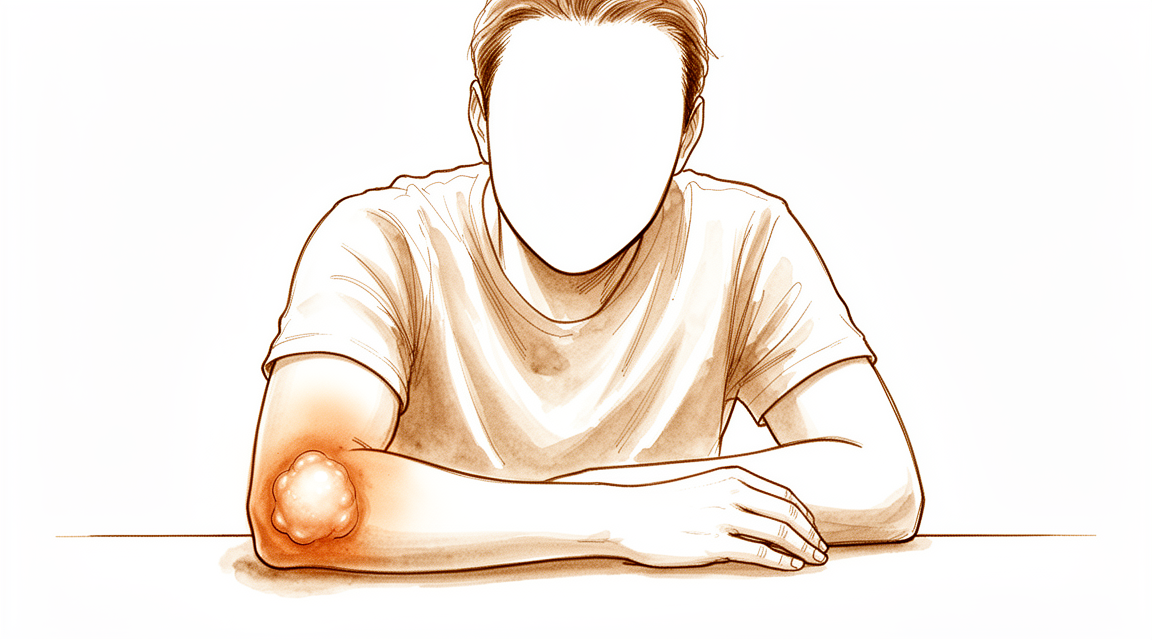
Ang iyong nararamdaman
Ang olecranon bursitis ay nangangahulugang ang maliit na cushioning sac sa dulo ng iyong siko ay namaga. Ang sac na iyon, na tinatawag na bursa, ay karaniwang nagpapahintulot sa balat na dumulas nang maayos sa ibabaw ng buto. Kapag ito ay lumala, mapapansin mo ang isang malambot, at kung minsan ay masakit na bukol mismo sa dulo ng siko.
Ang pamamaga ay karaniwang ang unang bagay na iyong mapapansin. Maaari itong lumitaw nang mabilis sa loob ng isa o dalawang araw, o dahan-dahan sa loob ng ilang linggo. Ang paglean sa sikong iyon ay nagpapalala nito, kaya ang trabaho sa desk, pagpapahinga ng iyong braso sa armrest ng upuan, o pagtulog nang nakabaluktot ang siko sa ilalim mo ay maaaring magpalala rito. Maraming tao ang nakararamdam ng kirot sa gabi, lalo na kung natutulog sila sa panig na iyon. Ang pag-unat ng braso at pag-alis ng pressure sa dulo ng siko ay karaniwang nakakapagpakalma nito.
Ang mga pang-araw-araw na gawain na nagbabaluktot sa siko laban sa resistance o pumipindot sa dulo nito ay nagiging mahirap. Ang pagtulak sa sarili paitaas mula sa isang mababang upuan, pagkakarga ng dishwasher, pagdadala ng mga shopping bag na nakasandal sa iyong forearm, o pagpapahinga ng iyong siko sa mesa habang nagbabasa ay maaaring maging hindi komportable. Ang pag-abot sa itaas ay maaari ring humila sa namamagang bahagi.
Ang pamamaga mismo ay hindi laging dahil lamang sa simpleng wear and tear. Minsan ito ay nagmumula sa isang impeksyon sa sac, na karaniwang nagiging sanhi upang ang balat sa ibabaw ng siko ay maging pula, mainit, at mas masakit. Minsan ito ay nagmumula sa mga crystals sa joint, isang kondisyon na tinatawag na gout, lalo na kung nagkaroon ka na ng mga katulad na attack dati o apektado rin ang kabilang siko. Ang pamamaga rito ay maaari ring may kaugnayan sa mga inflammatory joint condition gaya ng rheumatoid arthritis, na karaniwang nakakaapekto sa ilang joints sa magkabilang panig ng katawan nang sabay-sabay.
Dahil ang mga sanhing ito ay maaaring magmukhang magkakapareho, hindi laging madaling mapagbukod ang mga ito mula sa labas. Kung ang iyong siko ay mainit, pula, o sobrang sakit, o kung ang pamamaga ay nananatili na ng ilang linggo nang hindi humuhupa, mahalagang maipa-examine ito nang maayos upang masimulan ang tamang gamutan.
Ano ang aktwal na nangyayari
Sa dulo ng iyong siko ay mayroong isang maliit na supot ng likido na tinatawag na bursa. Isipin ito bilang isang manipis na cushion, tulad ng isang padded pouch sa pagitan ng balat at ng buto. Ang tungkulin nito ay hayaang dumulas nang maayos ang balat sa ibabaw ng buto sa tuwing ititiklop o itutuwid mo ang iyong braso.
Sa olecranon bursitis, ang cushion na iyon ay namamagâ at napupuno ng sobrang likido. Karaniwan itong nangyayari pagkatapos ng paulit-ulit na maliliit na tama o pressure sa dulo ng siko, ang uri na nagmumula sa paghimlay sa mga matitigas na surface araw-araw. Ang supot ay maaari ring lumaki lamang dahil sa friction sa paglipas ng panahon. Ang bukol na iyong nakikita at nararamdaman ay ang namamagâ na supot mismo, at ang pananakit ay nagmumula sa namamagâ na tissue sa paligid nito.
Minsan, ang pamamaga ay hindi lamang iritasyon. Ang supot ay maaaring ma-infect, kung kaya't ang isang infected na bursa ay may tendensiyang maging mainit, mapula, at mas masakit kaysa sa isa na namamagâ lamang. Ang mga crystals mula sa gout ay maaaring mamuo sa supot, at ang mga inflammatory condition tulad ng rheumatoid arthritis ay maaaring magdulot ng pamamaga at maliliit na matitigas na bukol sa parehong bahagi. Dahil ang mga sanhing ito ay magkakamukha mula sa labas, ang pagtukoy sa pagkakaiba nila ay nangangailangan ng wastong pagsusuri.
Ang buto sa dulo ng siko, na tinatawag na olecranon, ay matatagpuan mismo sa ilalim ng balat na may napakakaunting padding sa paligid nito. Ang nakalantad na posisyong ito ang eksaktong dahilan kung bakit madali itong matamaan, at kung bakit ang bursa sa itaas nito ang sumasalo ng maraming wear. Ang parehong buto ay nagsisilbi ring anchor ng tendon ng muscle sa likod ng iyong braso, ang muscle na nagtutuwid ng iyong siko, kaya ang mga problema sa maliit na bahaging ito ay maaaring makaapekto sa pakiramdam at paggalaw ng buong siko.
Ano ang maaari naming gawin tungkol dito
Si Dr Kieran Hirpara, isang upper-limb surgeon sa Mater Private Hospital Rockhampton, ay nagsisimula sa mga opsyon na hindi gaanong invasive na angkop sa iyong kondisyon. Ang mga pasyente ay karaniwang nirerefer sa aming klinika ng kanilang GP; kung iminungkahi ng isang physiotherapist na magpatingin sa amin, kakailanganin mo pa rin ng referral mula sa iyong GP upang maging eligible para sa Medicare rebate. Sa iyong unang pagbisita, kumukuha kami ng history, sinusuri ang iyong siko at nag-aayos ng imaging tulad ng ultrasound o MRI scan kung ito ay makakatulong. Ang MRI scan ay gumagamit ng mga magnet upang bumuo ng detalyadong mga larawan ng mga soft tissue, at mahusay ito sa pagpapakita kung gaano kapamaga ang sac at kung gaano karaming fluid ang laman nito. Maaari ring makita sa imaging ang iba pang mga problema na nakatago sa likod ng pamamaga, na mahalaga dahil ang iba't ibang sanhi ay nangangailangan ng iba't ibang gamutan.
Para sa karamihan ng mga long-standing cases, nagsisimula kami sa simpleng supportive care. Ibig sabihin nito ay ice, compression gamit ang bandage o sleeve, protective padding sa dulo ng siko, at pagbabago sa mga aktibidad na patuloy na nagpapalala nito. Ang pag-alis ng pressure sa dulo ng siko ay madalas na ang pinaka-kapaki-pakinabang na pagbabagong maaari mong gawin. Layunin ng physiotherapy na pakalmahin ang iritasyon at ibalik ang komportableng paggalaw nang hindi pinupukaw ang pamamaga. Binibigyan namin ang approach na ito ng sapat na pagsubok bago mag-isip ng anumang susunod, dahil ang non-operative care ay epektibo para sa karamihan ng mga tao at naiiiwasan ang mga panganib na kasama ng mga karayom o operasyon.
Kung ang sac ay infected, ginagamot namin ang impeksyong iyon nang direkta. Ang uncomplicated infection sa sac na ito ay karaniwang maaaring maayos sa pamamagitan ng gamot lamang, nang hindi kinakailangang tanggalin ang sac. Binabantayan din namin nang maigi ang mga taong may rheumatoid arthritis, dahil ang elbow joint mismo ay paminsan-minsang nadadamay kasabay ng bursa, at binabago nito ang gamutan.
Ang operasyon ay hindi namin karaniwang unang hakbang para sa kondisyong ito. Karamihan sa mga surgeon ay naghihintay bago mag-opera nang maaga, dahil ang sugat sa ibabaw ng prominenteng butong ito ay maaaring mabagal gumaling at kung minsan ay nag-iiwan ng sinus, isang maliit na channel na patuloy na naglalabas ng fluid. Kapag ang non-operative care ay hindi nagbigay ng sapat na pagbuti at ang pamamaga ay patuloy na bumabalik, isinasaalang-alang namin ang pagtanggal ng inflamed sac, isang operasyon na tinatawag na bursectomy. Kung angkop, maaari namin itong gawin sa pamamagitan ng ilang maliliit na hiwa gamit ang isang maliit na camera, isang approach na tinatawag na endoscopic surgery. Naiiiwasan nito ang isang mahabang sugat nang direkta sa sensitibong dulo ng siko. Kung ang operasyon ay tama para sa iyo ay isang desisyong ginagawa nating magkasama, tinitimbang ang gusto mong mabalikan laban sa kung ano ang kinapapalooban ng bawat opsyon.
Ano ang dapat asahan
Para sa karamihan ng mga tao, ang pamamagang ito ay humuhupa sa pamamagitan ng simpleng pangangalaga. Ang pag-alis ng pressure sa dulo ng iyong siko, pagprotekta rito gamit ang padding, at pagbabawas sa mga aktibidad na nagpapalala rito ay nagbibigay ng pagkakataon sa sac na kumalma. Ang non-operative treatment ay karaniwang mas epektibo at mas ligtas kaysa sa operasyon para sa kondisyong ito, at karamihan ng mga tao ay hindi kailanman nangangailangan ng operasyon. Kung ang sac ay may impeksyon ngunit ang impeksyon ay simple lamang, ang paggamot nito gamit ang gamot lamang ay karaniwang gumagana, at ang pamamaga ay madalas na mapapamahalaan nang hindi na kailangang i-drain o tanggalin ang sac.
Kung walang ganoong pangangalaga, o kung ang parehong pressure ay nagpapatuloy, ang pamamaga ay may tendensiyang manatili o paulit-ulit na bumalik. May ilang tao na nakakaranas na nananatili ito ng ilang linggo nang hindi humuhupa. Kung ang iyong siko ay nananatiling namamaga sa loob ng mahabang panahon, nararapat itong muling masuri, dahil ang pamamagang hindi humuhupa ay maaaring magpahiwatig paminsan-minsan ng isang hindi gaanong karaniwang sanhi na nangangailangan ng sarili nitong paggamot.
Kapag ang non-operative care ay nabigyan na ng sapat na pagkakataon at ang pamamaga ay patuloy pa ring bumabalik, ang operasyon upang tanggalin ang inflamed sac ay nagiging isang opsyon. Ito ay isang desisyong hindi ginagawa nang basta-basta, at karaniwang ipinagpapaliban hanggang sa mabigo ang mga mas simpleng hakbang. Sa mga kaso kung saan isinasagawa ang operasyon para sa matigas na uri ng pamamagang ito, ang mga tao ay may tendensiyang makakita ng tunay na pagbuti sa pakiramdam at function ng kanilang siko. Ang pagtanggal ng sac sa pamamagitan ng ilang maliliit na hiwa gamit ang isang maliit na camera ay naiugnay sa minimal na postoperative pain at mabilis na recovery, na walang mga recurrence o komplikasyon sa paghilom ng sugat na nangangailangan ng pagbalik sa theatre sa mga naiulat na pasyente. Gayunpaman, ang operasyon dito ay hindi foolproof: humigit-kumulang 11.5% ng mga taong tinanggal ang sac ay nangangailangan ng karagdagang operasyon sa kalaunan. Mayroon ding maliit na pagkakataon na bumalik ang pamamaga kahit pagkatapos ng operasyon.
Ang recovery pagkatapos ng operasyon ay karaniwang simple, ngunit ang sugat sa ibabaw ng bony point na ito ay maaaring mabagal gumaling, na isa sa mga dahilan kung bakit mas pinipili ng mga surgeon na iwasan ang maagang operasyon. Karamihan ng mga tao ay nakakabalik sa komportable at pang-araw-araw na paggamit ng siko sa loob ng ilang linggo sa halip na mga buwan. Tatalakayin ng iyong surgeon sa iyo kung ano ang magiging hitsura ng recovery para sa iyo kung sakaling maging bahagi ng plano ang operasyon.
Kailan dapat magpatingin
Karamihan sa mga pamamaga sa dulo ng siko ay nawawala sa pamamagitan ng pahinga at simpleng pangangalaga. Magpatingin sa iyong GP kung ang bukol ay patuloy na lumalaki, o kung hindi ito nawala pagkatapos ng ilang linggo ng pag-iwas sa pressure sa siko.
May ilang mga sanhi na kailangang maayos agad. Pumunta sa emergency department kung ang balat sa ibabaw ng siko ay mainit, pula, at napakasakit, dahil maaaring nangangahulugan ito na ang sac ay may impeksyon at ang impeksyon dito ay nangangailangan ng assessment sa mismong araw na iyon. Humingi ng specialist review kung nagkaroon ka na ng mga gout attack noon, kung namamaga rin ang kabilang siko, o kung ilang mga joint sa magkabilang panig ng iyong katawan ang apektado, dahil ang mga ito ay nagpapahiwatig ng gout o isang inflammatory condition gaya ng rheumatoid arthritis sa halip na simpleng iritasyon. Ang pagtukoy kung ang isang impeksyon ay gout mula sa labas ay maaaring mahirap, kaya huwag subukang alamin ito nang mag-isa.
Higit pang detalye
Advanced reading: the deeper science (optional)
Ang seksyong ito ay higit pa sa kailangan mo para sa iyong sariling mga desisyon sa paggamot. Ang olecranon bursitis ay karapat-dapat sa karagdagang pagbabasa dahil ang dalawa sa mga bagay na pinaka-instinktibong ginagawa para rito, ang pag-drain ng pamamaga gamit ang karayom, at ang pag-inject ng steroid dito, ay may mga ebidensya laban sa mga ito.
Ang pag-drain nito ang maaaring maging sanhi ng problema
Malakas ang intuwisyon: may likido, kaya alisin ang likido. Ngunit ang mga trial data ay nagtuturo sa kabilang direksyon. Sa isang paghahambing ng mga estratehiya sa pamamahala para sa uncomplicated septic olecranon bursitis, ang empirical treatment nang walang aspiration ay naging epektibo, kung saan walang mga pasyenteng nangailangan ng bursectomy, habang sa tradisyonal na aspiration group, 8 sa 11 pasyente ang kalaunang nangailangan ng surgical removal ng bursa [1].
Ito ay isang kapansin-pansing pagkakaiba mula sa isang maliit na serye, at dapat itong basahin nang may pag-iingat. Ngunit ang mekanismo ay hindi misteryoso. Ang bursa ay matatagpuan mismo sa ilalim ng manipis na balat sa ibabaw ng isang bony point na tumatanggap ng bawat tama at bawat pagsandal sa mesa. Ang pagtusok ng karayom sa balat na iyon ay lumilikha ng isang tract, at ang isang tract sa ibabaw ng isang pressure point ay mabagal magsara at maaaring patuloy na maglabas ng discharge.
Ang mga pangkalahatang review ay nagkakaisa sa direksyon. Batay pangunahin sa level IV evidence, ang non-surgical management ay signipikanteng mas epektibo at mas ligtas kaysa sa surgical management [2].
Ang steroid injection ay may dalang panganib nang hindi pinapabuti ang kinalabasan
Ang isang ito ay nakasaad nang hindi pangkaraniwang direkta sa literatura. Para sa aseptic bursitis, ang corticosteroid injection ay nauugnay sa mga makabuluhang panganib nang hindi pinapabuti ang kinalabasan [2].
Ang mga panganib ay partikular sa site: skin atrophy at depigmentation sa ibabaw ng isang subcutaneous bony prominence, at impeksyong naipasok sa isang espasyo na mahirap linisin. Sa ibang bahagi ng upper limb, ang steroid injection ay isang makatwirang hakbang kapag nabigo ang mga mas simpleng pamamaraan. Dito, hindi ito sinusuportahan ng ebidensya, at ang pagkakaibang iyon ay mahalagang malaman kung ito ay inaalok.
Ang operasyon ay isang tunay na huling opsyon, na may nasusukat na failure rate
Kung saan isinasagawa ang bursectomy, hindi nito garantisadong tinatapos ang problema. Ang revision rate pagkatapos ng bursectomy ay 11.5%, at ang revision ay mas madalas sa mga pasyenteng may rheumatoid arthritis, diabetes, kasaysayan ng bursitis sa alinmang siko, at sa mga kababaihan [3].
Inilalarawan ng mga risk factor na ito ang mga sitwasyon kung saan malamang na muling mabuo ang bursa: isang inflammatory o metabolic driver na hindi inaalis ng operasyon, o isang napatunayang tendensya ng tissue ng indibidwal na iyon na lumikha ng problema. Para sa mga recurrent case, ang intrabursal doxycycline sclerotherapy, kung saan sadyang pinapahilom ang espasyo sa pamamagitan ng scarring sa halip na excise ito, ay nailarawan bilang isang alternatibo sa isang serye ng 45 na mga siko [4].
Ano ang tunay na nakapagpapagaling nito
Ang hindi gaanong kapansin-pansing sagot ay proteksyon at oras. Dahil ang bursa ay naiirita nang mekanikal dahil sa presyon sa dulo ng siko, ang gamot na tumutugon sa sanhi ay ang pag-aalis ng presyong iyon: padding, at pagbabago ng gawi ng pagpahinga sa siko, na ipinagpapatuloy nang mas matagal kaysa sa nararamdamang kinakailangan. Karamihan sa mga kaso ay gumagaling [5], at ang mga interbensyong nabanggit sa itaas ay pangunahing mga pagtatangka na paikliin ang prosesong kusang gumagaling, na siyang dahilan kung bakit ang isang interbensyong may sariling panganib ay kailangang pumasa sa isang mataas na pamantayan dito.
Mga Sanggunian
[1] Deal JB, Vaslow AS, Bickley RJ, Verwiebe EG, Ryan PM. Empirical treatment of uncomplicated septic olecranon bursitis without aspiration. J Hand Surg Am. 2020;45(1):20-5. https://doi.org/10.1016/j.jhsa.2019.06.012
[2] Sayegh ET, Strauch RJ. Treatment of olecranon bursitis: a systematic review. Arch Orthop Trauma Surg. 2014;134(11):1517-36. https://doi.org/10.1007/s00402-014-2088-3
[3] Germawi L, Westenberg RF, Wang F, Schep NW, Chen NC, Eberlin KR. Factors associated with revision surgery for olecranon bursitis after bursectomy. J Shoulder Elbow Surg. 2021;30(5):1135-41. https://doi.org/10.1016/j.jse.2020.09.033
[4] McDermott D, Wakefield D, Kowalsky M, Sethi P, Vitale MA, Morrey BF. Intrabursal doxycycline sclerotherapy for recurrent olecranon bursitis of the elbow. J Hand Surg Glob Online. 2024;6(4):504-9. https://doi.org/10.1016/j.jhsg.2024.03.006
[5] Nchinda NN, Wolf JM. Clinical management of olecranon bursitis: a review. J Hand Surg Am. 2021;46(6):501-6. https://doi.org/10.1016/j.jhsa.2021.02.006
Evidence & references
This is the clinical evidence summary written for health professionals. It is technical, and it lists the research this page was built from. You do not need to read it to understand your treatment or to make a decision about it.
Overview
- Surgical resection of a chronic olecranon bursitis should not be considered lightly [1].
- The revision rate after bursectomy for olecranon bursitis was 11.5% [2].
- The operation appears to give satisfactory results for chronic olecranon bursitis [3].
- Based primarily on level IV evidence, nonsurgical management of olecranon bursitis is significantly more effective and safer than surgical management [4].
- Nontuberculous mycobacterial olecranon bursitis should be considered in any patient with a swollen bursa and protracted course, regardless of immune status [5].
- Patients who underwent endoscopic olecranon bursectomy experienced no recurrences or wound-healing complications necessitating return to the operating room [6].
- Empirical management of uncomplicated septic olecranon bursitis was found to be effective with no patients requiring bursectomy [7].
- In the traditional aspiration group for uncomplicated septic olecranon bursitis, 8 of 11 patients required bursectomy [7].
- Intrabursal doxycycline sclerotherapy may be an effective alternative to surgical bursectomy for patients with recurrent olecranon bursitis refractory to conservative management [8].
- Patients with refractory olecranon bursitis, particularly if aseptic, tend to gain significant physical health benefits from open bursectomy [9].
- Endoscopic bursectomies are a useful treatment option for patients with recalcitrant olecranon bursitis [10].
- Bursal suture repair is a viable alternative to bursectomy in selected patients with chronic traumatic olecranon bursitis [11].
- Bursal suture repair combines functional and cosmetic benefits in selected patients with chronic traumatic olecranon bursitis [11].
- Deferring aspiration in uncomplicated septic olecranon bursitis is a reasonable treatment option [16].
Anatomy & Pathophysiology
Bony Anatomy
- The olecranon and the coronoid process form the greater sigmoid notch, which articulates with the trochlea of the distal humerus [19].
- The intrinsic anatomy of the greater sigmoid notch allows flexion/extension movement of the elbow joint and provides stability for the elbow [19].
- The olecranon serves as the insertion for the triceps tendon, which blends with the periosteum of the proximal ulna [19].
- The exposed position of the olecranon renders it vulnerable to direct trauma and violent muscular contractions from the triceps [19].
- In children, the olecranon is predominantly cartilage, particularly in younger children, which reduces the chance of fracture occurring with a direct blow [20].
- The thick periosteum and relatively thin metaphyseal cortex of the olecranon in children predispose it to minimally displaced greenstick fractures [20].
Pathophysiology
- Olecranon bursitis is a condition where the bursal cavity, superficial to the olecranon, becomes inflamed [13].
- Olecranon bursitis can occur with or without infection [13].
- Olecranon bursitis is often predisposed by repeated minor trauma from external pressure [13].
- The olecranon bursa sometimes becomes enlarged as a result of pressure or friction [27].
- When the olecranon bursa is painful, the cause is more likely to be infection, gout, or rheumatoid arthritis [27].
- Gout is suspected in olecranon bursitis if there is a history of previous attacks, if the condition is bilateral, if there are tophi, or if X-ray shows calcification in the bursa [27].
- Rheumatoid arthritis causes both swelling and nodularity over the olecranon [27].
- In almost all cases of rheumatoid arthritis affecting the olecranon, it is associated with a typical symmetrical polyarthritis [27].
- In the late stages of rheumatoid arthritis, erosion of the elbow joint may cause marked instability [27].
Classification
- Olecranon bursitis has been given pseudonyms relating to the repeated minor trauma from external pressure that often predisposes [13].
- Traumatic lesions of the olecranon bursa are common injuries associated with a high risk of complications [14].
Clinical Presentation
- Olecranon bursitis is a common condition where the bursal cavity, superficial to the olecranon, becomes inflamed [13].
- Olecranon bursitis can occur either with or without infection [13].
- Due to multiple aetiologies, olecranon bursitis can present to any medical specialty with reasonable frequency [13].
- When the olecranon bursa is also painful, the cause is more likely to be infection, gout, or rheumatoid arthritis [27].
- Gout is suspected if there is a history of previous attacks, if the condition is bilateral, if there are tophi, or if X-ray shows calcification in the bursa [27].
- In almost all cases of rheumatoid arthritis-associated olecranon bursitis, the condition is associated with a typical symmetrical polyarthritis [27].
- Pyoderma gangrenosum must be considered in the differential diagnosis whenever a patient presents with ulcerative cutaneous lesions that resemble an infectious process such as olecranon bursitis [38].
Investigations
- MR imaging is probably the method of choice for determining both the development of the bursae and their fluid content [44].
Treatment
Non-Operative Management
- The first treatment line for olecranon bursitis is conservative, including ice, rest, anti-inflammatory and analgesic drugs and, occasionally, bursal fluid aspiration [25].
- More recent literature demonstrates adverse effects of intrabursal injections and surgery compared with noninvasive management for initial treatment of nonseptic olecranon bursitis [18].
- Hydrothermal ablation at temperatures between 50C and 52C is a safe treatment option for recurrent or chronic olecranon bursitis [34].
- Hydrothermal ablation for recurrent or chronic olecranon bursitis has fewer complications than open bursectomy and comparable efficacy [34].
Operative Management
- Open bursectomy appears to give satisfactory results for chronic olecranon bursitis [3].
- Endoscopic olecranon bursectomy provides a satisfactory view with less morbidity than the open method while avoiding a wound over the sensitive point of the olecranon [15].
- Bursal suture repair is a viable alternative to bursectomy in selected patients with chronic traumatic olecranon bursitis, combining functional and cosmetic benefits [11].
- Excision has been curative for all lesions of the olecranon bursa, whereas multiple medications have been tried for cutaneous and systemic infections without clear-cut success [17].
Surgical Complications and Outcomes
- More recent literature demonstrates adverse effects of surgery compared with noninvasive management for initial treatment of nonseptic olecranon bursitis [18].
- Surgeons are reluctant to perform surgical excision as first-line treatment for chronic olecranon bursitis due to the fear of causing a chronic draining sinus or infection [45].
Infection and Atypical Etiologies
Recovery
- Nonsurgical management of olecranon bursitis is significantly more effective and safer than surgical management [4].
- 8 of 11 patients in the traditional aspiration group required bursectomy [7].
- Bursal suture repair combines functional and cosmetic benefits [11].
- The extrabursal endoscopic approach provides a satisfactory view with less morbidity than the open method [15].
- The extrabursal endoscopic approach avoids a wound over the sensitive point of the olecranon [15].
- Excision has been curative for all lesions of the olecranon bursa [17].
- Multiple medications have been tried for cutaneous and systemic infections without clear-cut success [17].
Key Evidence
- [L3] The revision rate after bursectomy for olecranon bursitis was 11.5%. [2] (10.1016/j.jse.2020.09.033)
- [L4] The operation appears to give satisfactory results for chronic olecranon bursitis. [3] (10.1016/s0020-1383(77)80050-8)
- [L4] Based primarily on level IV evidence, nonsurgical management of olecranon bursitis is significantly more effective and safer than surgical management. [4] (10.1007/s00402-014-2088-3)
- [L4] Nontuberculous mycobacterial olecranon bursitis should be considered in any patient with a swollen bursa and protracted course, regardless of immune status. [5] (10.1016/j.jse.2008.07.009)
- [L4] In this population, patients who underwent endoscopic olecranon bursectomy experienced no recurrences or wound-healing complications necessitating return to the operating room. [6] (10.1016/j.asmr.2023.100832)
- [L4] Empirical management of uncomplicated septic olecranon bursitis was found to be effective with no patients requiring bursectomy, whereas 8 of 11 patients in the traditional aspiration group required bursectomy. [7] (10.1016/j.jhsa.2019.06.012)
- [L4] This may be an effective alternative to surgical bursectomy for patients with recurrent olecranon bursitis refractory to conservative management. [8] (10.1016/j.jhsg.2024.03.006)
- [L4] Patients with refractory olecranon bursitis, particularly if aseptic, tend to gain significant physical health benefits from open bursectomy. [9] (10.7759/cureus.43696)
- [L5] Endoscopic bursectomies are a useful treatment option for patients with recalcitrant olecranon bursitis. [10] (10.1016/j.eats.2023.09.004)
- [L5] Bursal suture repair is a viable alternative to bursectomy in selected patients with chronic traumatic olecranon bursitis, combining functional and cosmetic benefits. [11] (10.1016/j.xrrt.2025.100597)
- [L4] [13] (10.1177/1758573214532787)
- [Paper] Traumatic lesions of the olecranon bursa or prepatellar bursa are common injuries associated with a high risk of complications. [14] (10.1007/s00402-017-2690-2)
- [L4] This approach provides a satisfactory view with less morbidity than the open method while avoiding a wound over the sensitive point of the olecranon. [15] (10.1097/bth.0b013e31829c0535)
- [L4] Deferring aspiration in uncomplicated septic olecranon bursitis is a reasonable treatment option. [16] (10.1016/j.jhsa.2018.06.059)
- [Case_report] Excision has been curative for all lesions of the olecranon bursa, whereas multiple medications have been tried for cutaneous and systemic infections without clear-cut success. [17] (10.2106/00004623-198062050-00024)
- [L5] Older studies showed resolution with injections and surgery, but more recent literature demonstrates adverse effects of intrabursal injections and surgery compared with noninvasive management for initial treatment of nonseptic olecranon bursitis. [18] (10.1016/j.jhsa.2021.02.006)
- [L4] The first treatment line for olecranon bursitis is conservative, including ice, rest, anti-inflammatory and analgesic drugs and, occasionally, bursal fluid aspiration. [25] (10.1016/j.surge.2012.02.002)
- [L4] Hydrothermal ablation at temperatures between 50C and 52C is a safe treatment option for recurrent or chronic olecranon bursitis with fewer complications than open bursectomy and a comparable efficacy. [34] (10.1016/j.jse.2024.03.021)
- [Case_report] PG must be considered in the differential diagnosis whenever a patient presents with ulcerative cutaneous lesions that resemble an infectious process such as olecranon bursitis. [38] (10.1016/j.jse.2014.06.032)
- [L4] MR imaging is probably the method of choice for determining both the development of the bursae and their fluid content. [44] (10.1007/s002560050117)
- [L3] [45] (10.1016/j.jhsa.2010.12.030)
References
[1] Complications following resection of the olecranon bursa. Acta Orthopaedica Belgica. 2006.
[2] Factors associated with revision surgery for olecranon bursitis after bursectomy. Journal of Shoulder and Elbow Surgery. 2021. DOI: 10.1016/j.jse.2020.09.033
[3] A useful procedure in the treatment of chronic olecranon bursitis. Injury. 1977. DOI: 10.1016/s0020-1383(77)80050-8
[4] Treatment of olecranon bursitis: a systematic review. Archives of Orthopaedic and Trauma Surgery. 2014. DOI: 10.1007/s00402-014-2088-3
[5] Nontuberculous mycobacterial olecranon bursitis: Case reports and literature review. Journal of Shoulder and Elbow Surgery. 2009. DOI: 10.1016/j.jse.2008.07.009
[6] No Wound Healing Complications or Recurrences Were Seen and a High Level of Satisfaction Was Reported in Patients Who Underwent Endoscopic Olecranon Bursectomy for Recalcitrant Olecranon Bursitis. Arthroscopy, Sports Medicine, and Rehabilitation. 2024. DOI: 10.1016/j.asmr.2023.100832
[7] Empirical Treatment of Uncomplicated Septic Olecranon Bursitis Without Aspiration. The Journal of Hand Surgery. 2020. DOI: 10.1016/j.jhsa.2019.06.012
[8] Intrabursal Doxycycline Sclerotherapy for Recurrent Olecranon Bursitis of the Elbow: A Case Control Study. Journal of Hand Surgery Global Online. 2024. DOI: 10.1016/j.jhsg.2024.03.006
[9] Clinical Outcomes Following Open Olecranon Bursa Excision for Septic and Aseptic Olecranon Bursitis: An Observational Study. Cureus. 2023. DOI: 10.7759/cureus.43696
[10] Endoscopic Olecranon Bursectomy in the Treatment of Recalcitrant Olecranon Bursitis: Patient Selection and Operative Technique. Arthroscopy Techniques. 2023. DOI: 10.1016/j.eats.2023.09.004
[11] Olecranon bursal repair for chronic traumatic bursitis: a surgical technique. JSES Reviews, Reports, and Techniques. 2026. DOI: 10.1016/j.xrrt.2025.100597
[13] Olecranon bursitis: a systematic overview. Shoulder & Elbow. 2014. DOI: 10.1177/1758573214532787
[14] Treatment and outcome with traumatic lesions of the olecranon and prepatellar bursa: a literature review apropos a retrospective analysis including 552 cases. Archives of Orthopaedic and Trauma Surgery. 2017. DOI: 10.1007/s00402-017-2690-2
[15] Olecranon Extrabursal Endoscopic Bursectomy. Techniques in Hand & Upper Extremity Surgery. 2013. DOI: 10.1097/bth.0b013e31829c0535
[16] Empiric Treatment of Uncomplicated Septic Olecranon Bursitis Without Aspiration. The Journal of Hand Surgery. 2018. DOI: 10.1016/j.jhsa.2018.06.059
[17] Protothecal olecranon bursitis. A case report and review of the literature.. The Journal of Bone & Joint Surgery. 1980. DOI: 10.2106/00004623-198062050-00024
[18] Clinical Management of Olecranon Bursitis: A Review. The Journal of Hand Surgery. 2021. DOI: 10.1016/j.jhsa.2021.02.006
[19] Aaos Comprehensive Orthopaedic Review 3. Fractures of the Elbow > II. Olecranon Fractures.
[20] Tachdjian S Pediatric Orthopaedics From The Texas Scottish Rite Hospital For Children E Book. Pigmented Villonodular Synovitis and Giant Cell Tumor of the Tendon Sheath > Olecranon Fractures.
[25] Diagnosis and management of olecranon bursitis. The Surgeon. 2012. DOI: 10.1016/j.surge.2012.02.002
[27] Apley And Solomon S Concise System Of Orthopaedics And Trauma. OLECRANON BURSITIS.
[34] Hydrothermal ablation in recurrent or chronic olecranon bursitis: a prospective study. Journal of Shoulder and Elbow Surgery. 2024. DOI: 10.1016/j.jse.2024.03.021
[38] Case report: misdiagnosed olecranon bursitis: pyoderma gangrenosum. Journal of Shoulder and Elbow Surgery. 2014. DOI: 10.1016/j.jse.2014.06.032
[44] The US,CT and MR findings of cubital bursitis: a report of five cases. Skeletal Radiology. 1996. DOI: 10.1007/s002560050117
[45] Chronic Olecranon Bursitis. The Journal of Hand Surgery. 2011. DOI: 10.1016/j.jhsa.2010.12.030