Patients › Rehabilitation
Lateral Epicondylitis (Tennis Elbow)
Isang loading-based rehabilitation program para sa tennis elbow — pagpapakalma ng sakit at pagkatapos ay unti-unting pagpapalakas ng tendon — na sumasaklaw sa parehong non-operative care at recovery pagkatapos ng ECRB tendon debridement.
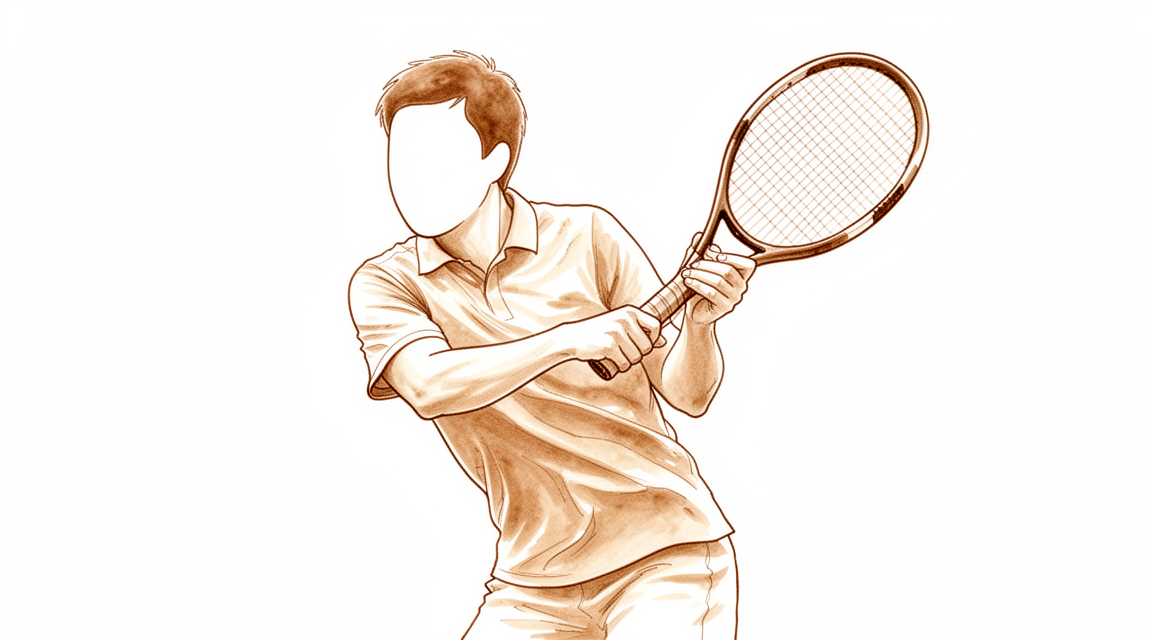
Ipinapaliwanag ng pahinang ito kung paano pinamamahalaan ang tennis elbow at kung paano ito ire-rehabilitate, gamutin man ito nang walang operasyon (na siyang kaso para sa halos lahat) o nagpapagaling pagkatapos ng isang operasyon upang linisin ang tendon. Ito ay pinangangasiwaan ni Dr Kieran Hirpara sa Mater Private Hospital Rockhampton. Nagsisimula ito sa iyong home exercise program, na sinusundan ng structured clinical protocol na isinulat para sa iyong physiotherapist o hand therapist; dalhin ang pahinang ito o ang PDF nito sa iyong mga therapy visit upang manatiling coordinated ang iyong rehabilitasyon. Maaaring i-adjust ng iyong therapist ang plano depende sa pag-unlad ng iyong paggaling.
Ano ang dapat asahan
Ang tennis elbow (lateral epicondylitis) ay isang problema sa tendon sa labas ng siko, partikular na sa common extensor tendon at lalo na sa isang maliit na kalamnan na tinatawag na ECRB. Sa kabila ng "-itis" sa pangalan nito, ito ay hindi isang pamamaga na maaaring mawala sa pamamagitan ng pahinga. Ito ay isang pagbabago sa tendon dahil sa pagkapudpod (isang tendinosis), kung saan ang mga hibla ng tendon ay naging disorganised at hindi gumaling nang maayos.
Mahalaga ito dahil ganap nitong binabago ang paggamot. Hindi ka gagaling sa pamamagitan ng pagpapahinga at pagprotekta sa siko; sa katunayan, ang matagal na pahinga ay may tendensiyang gawing mas mahina ang tendon at mas mabagal ang paggaling. Gagaling ka sa pamamagitan ng unti-unting paglalagay ng load sa tendon upang ito ay mag-remodel at muling mabuo ang tolerance nito para sa pagtatrabaho at paghawak. Ang pattern ay: una, pakalmahin ang sakit, pagkatapos ay progresibong palakasin, simula sa mga banayad na held (isometric) exercises at unti-unting pagpunta sa kontrolado at mabagal na pagpapalakas gaya ng Tyler twist.
Ang mabuting balita ay ang tennis elbow ay karaniwang gumagaling nang kusa sa pamamagitan ng tamang loading program. Humigit-kumulang 80–90% ng mga tao ay gumagaling sa loob ng isang taon, bagaman paminsan-minsan ay maaaring tumagal ng 12–18 buwan bago ito ganap na mawala. Ang operasyon ay isinasaalang-alang lamang pagkatapos ng hindi bababa sa anim na buwan ng may kalidad at konsistent na rehabilitasyon na nabigong magtagumpay, at maliit na minorya lamang (humigit-kumulang 4–11%) ang nakakarating sa puntong iyon.
Mga pag-iingat at limitasyon
Gawin:
- Patuloy na gamitin ang braso: lagyan ng load ang tendon, huwag itong ipahinga.
- Gamiting gabay ang sakit: ang banayad na kirot habang at pagkatapos ng ehersisyo ay ayos lang at inaasahan; ang matalas o tumitinding sakit ay nangangahulugang dapat bawasan ang intensity.
- Magbuhat nang nakaharap pataas ang palad (tulad ng pagdadala ng isang mangkok ng sopas) upang mabawasan ang load sa masakit na tendon.
- Gumamit ng counterforce brace sa muscle ng forearm habang may mga gawaing paghawak (gripping) at pagbuhat.
Huwag gawin:
- Huwag i-immobilise ang siko sa isang cast o sling para sa tennis elbow na ginagamot nang walang operasyon; mali itong gamutan para sa tendinosis. (Iba pagkatapos ng operasyon: gumagamit ng sling para sa ginhawa sa unang linggo, gaya ng nakasaad sa post-operative pathway sa ibaba.)
- Huwag gumawa ng mabigat at provocative na paghawak (gripping) habang diretso ang siko at nakabaluktot ang pulso (halimbawa, pagbuhat ng mabigat na bagay nang nakaharap pababa ang palad).
- Huwag magmadali sa steroid injection. Ang Cortisone ay maaaring magparamdam ng ginhawa sa loob ng ilang linggo, ngunit ipinapakita ng ebidensya na humahantong ito sa mas malalang resulta at mas maraming pag-ulit pagsapit ng 6–12 buwan kaysa sa physiotherapy o simpleng paghihintay. Hindi ito isang first-line treatment.
Iyong mga ehersisyo
Kieran Hirpara 4.0
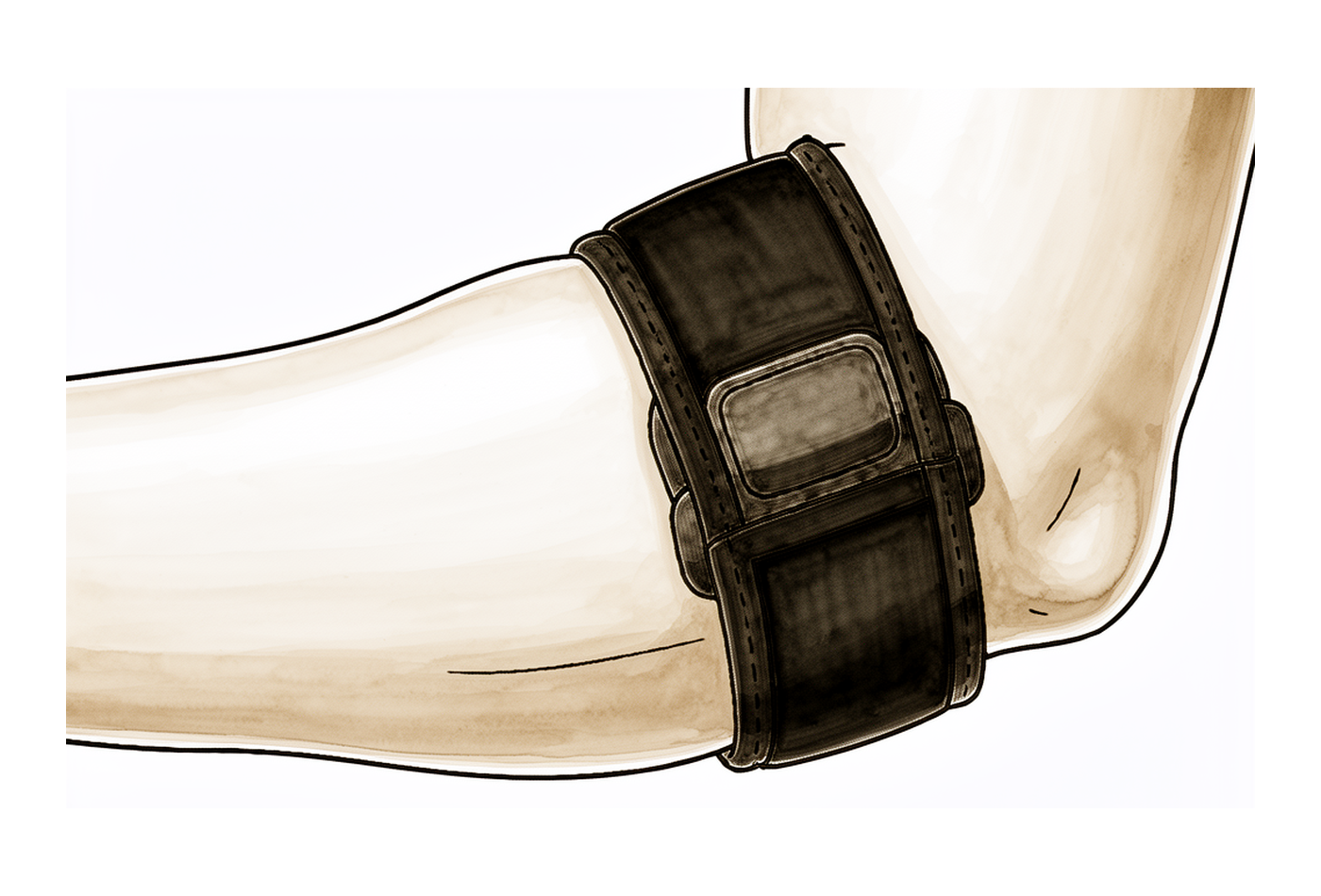
Counterforce brace
Isuot ang counterforce strap sa paligid ng iyong forearm, ilang lapad ng daliri sa ibaba ng siko, sa ibabaw ng pinakamakapal na bahagi ng kalamnan (hindi sa mismong matulis na bahagi ng buto). Dapat itong matatag ngunit hindi sapat ang higpit upang magdulot ng pangingilig sa iyong kamay. Gamitin ito habang may mga gawaing paghawak at pagbuhat upang mabawasan ang load sa masakit na tendon; hindi mo kailangang isuot ito habang nagpapahinga o nasa kama.
Habang may mga aktibidad na nagpapalala nito; luwagan kung nangingilig ang iyong kamay
Kieran Hirpara 4.0
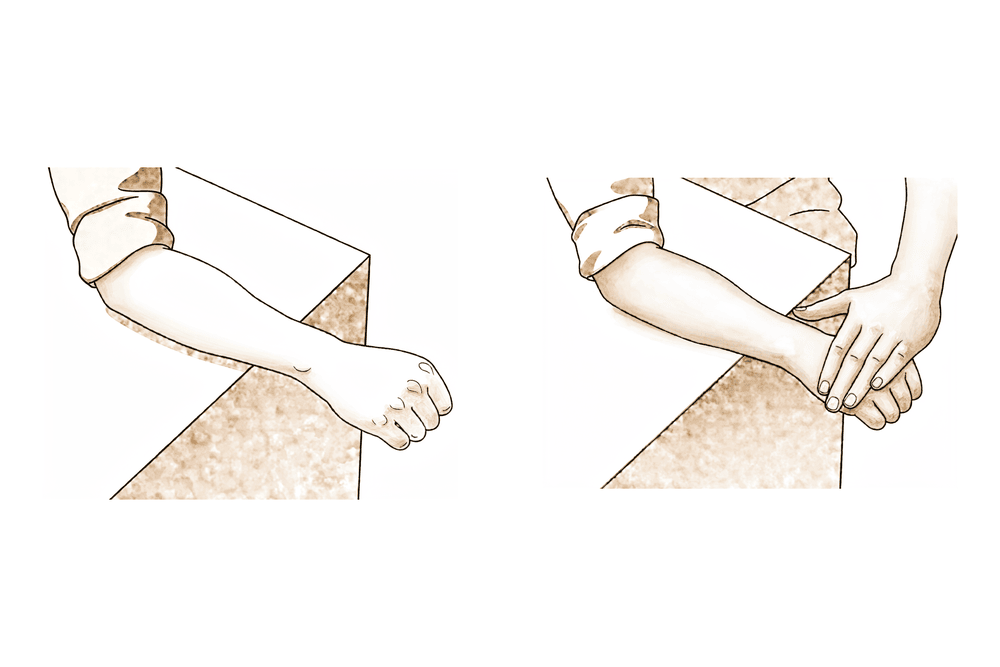
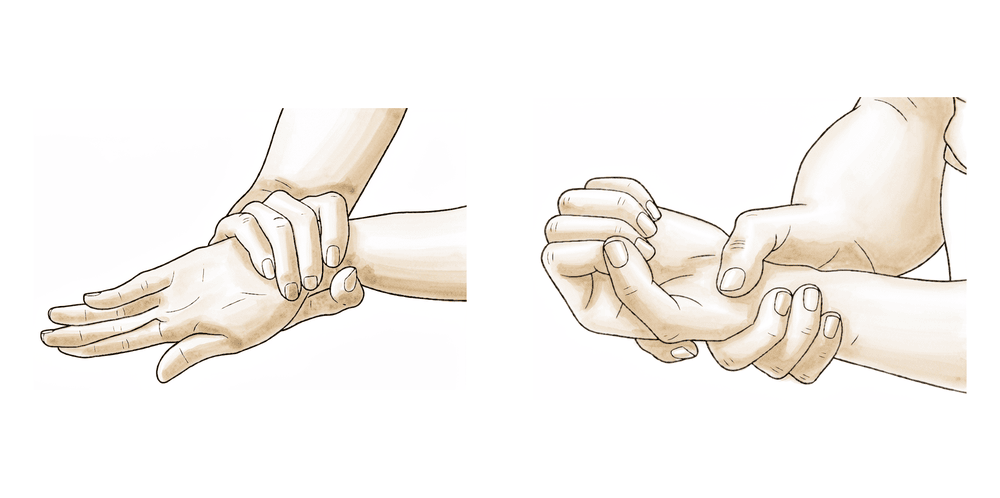
Isometric wrist extension
Ipatong ang iyong forearm sa mesa nang nakaharap pababa ang iyong palad at ang iyong kamay ay nakalampas sa gilid ng mesa. Ilagay ang iyong kabilang kamay sa likod ng kamay na may sakit. Subukang iangat ang likod ng iyong kamay patungo sa kisame habang pinapanatili itong hindi gumagalaw ng iyong kabilang kamay, upang walang aktwal na gumalaw — ito ay isang held, push-against-resistance exercise. Dapat itong maramdaman bilang isang matatag na pagsisikap ngunit hindi dapat magdulot ng matalas na sakit. Panatilihin ang pagtulak, pagkatapos ay mag-relax.
I-hold nang 30–45 segundo, 5 beses, 1–2 beses araw-araw
Kieran Hirpara 4.0
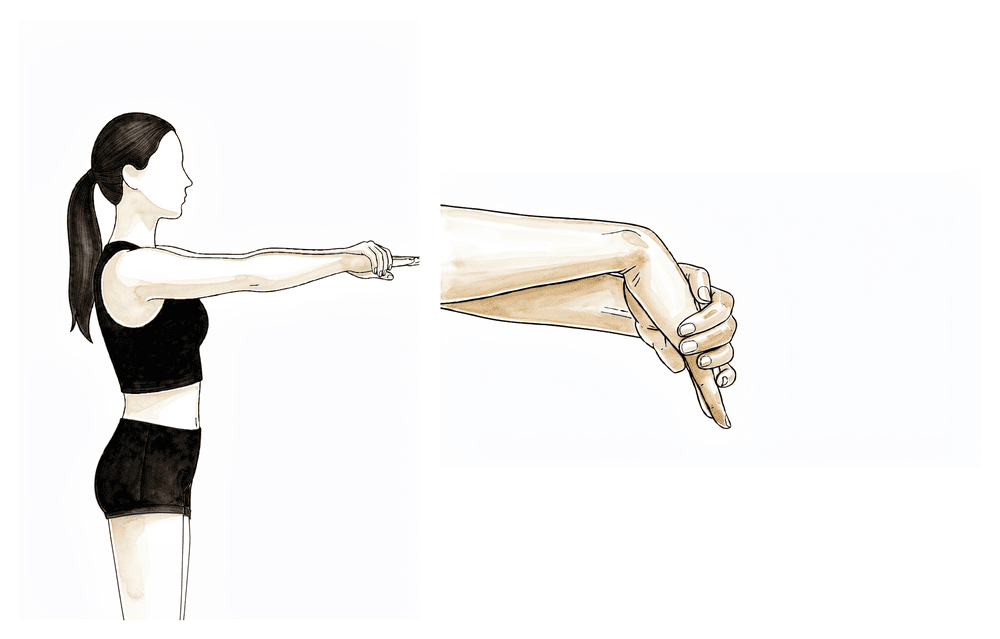
Stretch ng wrist extensor
Iunat ang iyong masakit na braso sa harap mo nang diretso ang siko at nakaharap pababa ang palad. Gamit ang iyong kabilang kamay, dahan-dahang itiklop ang pulso pababa upang ang mga daliri ay nakaturo sa sahig, hanggang sa makaramdam ka ng komportableng hatak sa itaas na bahagi ng iyong forearm. Panatilihing diretso ang siko. Magsimula nang bahagyang nakatiklop ang siko kung masyadong matalas ang pakiramdam kapag idiniretso ito, at unti-unting ituwid nang lubos ang siko habang gumagaan ang pakiramdam.
Hawakan nang 30 segundo, 3 beses, 2–3 beses araw-araw
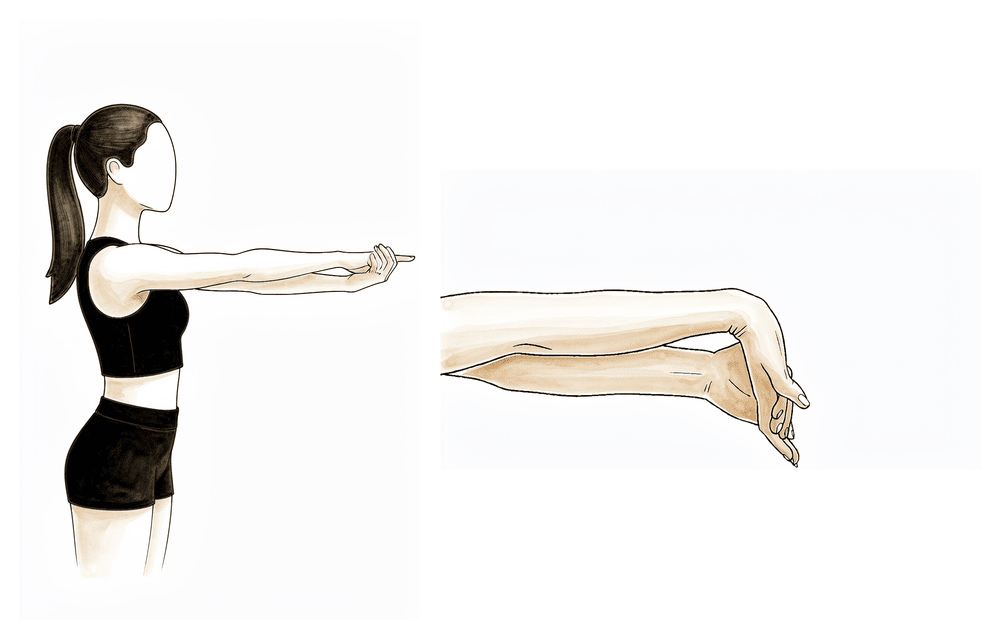
Kieran Hirpara 4.0
Stretch ng wrist flexor
Iunat ang iyong braso sa harap mo na may tuwid na siko at ang palad ay nakaharap sa itaas. Gamit ang iyong kabilang kamay, dahan-dahang hilahin ang mga daliri at pulso pabalik at pababa hanggang sa makaramdam ka ng komportableng hatak sa ilalim ng iyong forearm. Panatilihing tuwid ang siko.
Hawakan nang 30 segundo, 3 beses, 2–3 beses araw-araw
Kieran Hirpara 4.0
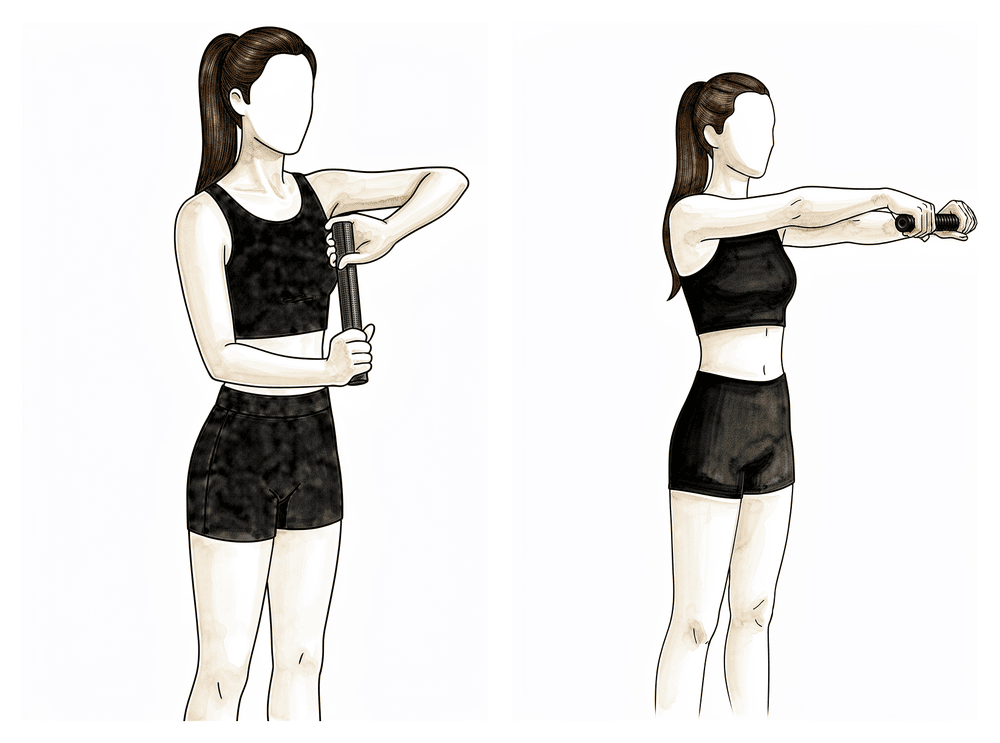
Tyler twist (eccentric wrist extension)
Hawakan ang isang flexible rubber bar (FlexBar) nang patayo sa iyong masakit na kamay na may nakatiklop pabalik na pulso. Hawakan ang itaas ng bar gamit ang iyong kabilang kamay at pilipitin ito. Ngayon, dalhin ang bar sa iyong harapan, habang pinapanatili ang pilipit, at dahan-dahang hayaang bumalik sa dating posisyon ang iyong masakit na pulso nang may kontrol sa loob ng 3–4 segundo — ang mabagal at kontroladong pagbababa na ito ang bahaging bumubuo sa tendon. Ang pag-unwind ay dapat maramdamang may pagsisikap, ngunit hindi matalas na sakit. Ang bahagyang kirot habang ginagawa at kaunti pagkatapos nito ay inaasahan at ayos lamang.
3 sets ng 15, isang beses araw-araw (ang core strengthening exercise)
Kieran Hirpara 4.0
Rotasyon ng forearm
I-tuck ang iyong siko sa iyong tagiliran at itiklop ito sa isang right angle. Dahan-dahang i-rotate ang iyong forearm upang ang palad ay nakaharap sa itaas, pagkatapos ay i-turn ito upang ang palad ay nakaharap sa ibaba, habang nananatiling naka-tuck ang siko. Habang ito ay nagiging mas madali, humawak ng magaan na pabigat gaya ng martilyo o lata upang magdagdag ng load.
10 sa bawat direksyon, 2–3 beses araw-araw; magdagdag ng magaan na pabigat hangga't kaya
Kieran Hirpara 4.0
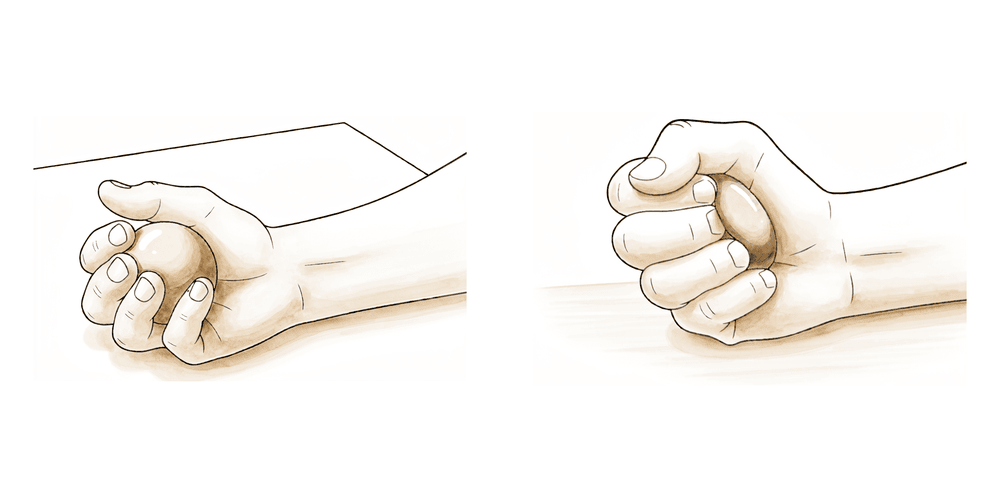
Pagpapalakas ng grip (kapit)
Pigaan ang isang malambot na bola o therapy putty sa iyong kamay, panatilihin ang piga nang sandali, pagkatapos ay i-relax. Unti-unting dagdagan ang higpit ng piga habang mas nakakayanan na ito ng iyong tendon. Kung masyado pang masakit ang paghawak, simulan ito nang mas huli at mas magaan — ang grip work ay kabilang sa strengthening phase, kapag humupa na ang unang iritasyon.
10–15 piga, 2–3 beses araw-araw; dagdagan ang higpit ayon sa kakayahan
Ito ang mga ehersisyo mula sa iyong handout. Sinusunod nito ang pagkakasunod-sunod ng paggaling: ang counterforce brace at isometric holds ay tumutulong na mapababa ang sakit sa simula, ang mga stretch ay pinapanatiling malambot ang forearm, at ang Tyler twist, forearm rotation at grip work ay muling binubuo ang tendon. Simulan ang mga ito ayon sa gabay ni Dr Hirpara at ng iyong therapist, at huwag isiping kailangang gawin ang lahat ng ito mula sa unang araw; sasabihin sa iyo ng iyong therapist kung alin ang uunahin at kung kailan idaragdag ang mga strengthening exercise.
Ang iyong clinical protocol
Ang natitirang bahagi ng pahinang ito ay ang clinical rehabilitation protocol para sa lateral epicondylitis (tennis elbow). Ang seksyong ito ay ibibigay sa iyong physiotherapist o hand therapist, at ang bawat phase ay nagsisimula sa isang paliwanag sa simpleng pananalita tungkol sa kung ano ang nangyayari.
Ang protocol ay may dalawang sangay: isang non-operative pathway (unang lunas para sa halos lahat) at isang post-operative pathway para sa maliit na bilang ng mga sumasailalim sa ECRB debridement matapos mabigo ang anim o higit pang buwan ng de-kalidad na conservative care.
Non-operative pathway
Ang pangunahing prinsipyo ay ang progresibong tendon loading, na ginagabayan ng sakit. Ang layunin ay paikliin ang symptomatic course at ibalik ang load tolerance, hindi upang ipahinga ang tendon.
Phase I — Acute / pain control (0–2 linggo)
Ang pokus dito ay ang pagpapahupa ng sakit at pagbabalik ng unloaded movement. Walang immobilisation; ito ay relative rest, hindi pagka-cast.
Para sa iyong physiotherapist:
- Mga Layunin: papahupain ang sakit; ibalik ang full unloaded active range of motion (AROM).
- Pamamahala: modipikasyon sa aktibidad, proteksyon ng joint at payong ergonomic. Opsyonal ang counterforce brace sa ibabaw ng common extensor mass upang mabawasan ang load sa ECRB origin habang humahawak (grip); maaaring gumamit ng wrist (cock-up) splint kung matindi ang sakit sa mga extension activities. Mga adjunct para papahupain ang sakit: ice, soft-tissue / instrument-assisted soft-tissue mobilisation (IASTM), banayad at pain-free AROM, opsyonal na dry needling, nerve glides.
- Pamantayan para mag-progress: full unloaded AROM nang walang sakit; independent na sa home program.
Phase II — Sub-acute / early loading (2–4 linggo)
Magsisimula nang dahan-dahan ang tendon loading, at tutugunan ang proximal chain (shoulder blade at rotator cuff), dahil ang panghihina sa itaas na bahagi ng braso ay nagdudulot ng overload sa siko.
Para sa iyong physiotherapist:
- Mga Layunin: simulan ang tendon loading; tugunan ang proximal kinetic chain.
- Mga Ehersisyo: isometric wrist extensor at flexor loading (light load; ang mga isometric ay well tolerated at analgesic sa reactive tendinopathy); progresibong stretching ng wrist flexors at extensors habang ang siko ay nasa 90°; proximal work: serratus anterior, middle/lower trapezius, rotator cuff at scapular stabilisers.
- Pamantayan para mag-progress: napanatili ang full ROM; kaya ang stretch sa 90° elbow flexion; humigit-kumulang 70% ng contralateral grip/strength.
Phase III — Pagpapalakas / pagbabalik (4–6+ linggo, madalas na tumatagal hanggang 12 linggo)
Dito muling binubuo ang tendon at ibinabalik ang load tolerance para sa trabaho at sport. Ang eccentric–concentric loading ang pangunahing therapeutic driver.
Para sa iyong physiotherapist:
- Mga Layunin: ibalik ang load tolerance at kapasidad sa sport/trabaho.
- Mga Ehersisyo: eccentric–concentric loading ng wrist extension at forearm pronation/supination; ang Tyler twist (FlexBar) ang prototypical home eccentric tool. I-progress ang stretching sa elbow-extended na posisyon; mobilisation-with-movement (Mulligan). Grip strengthening at task-/sport-specific loading; plyometrics para sa mga atleta. Unti-unting i-wean ang counterforce brace habang ang pasyente ay nagiging asymptomatic. Modipikasyon ng kagamitan para sa mga atleta (grip size, string tension, technique).
- Mga Kraytirya para mag-progress (pagbabalik sa sport): humigit-kumulang 90% ng contralateral strength, pain-free function, at self-management competence.
Post-operative pathway (ECRB debridement ± release)
Ang operasyon ay nakalaan para sa ~4–11% na hindi tumugon sa ≥6 na buwan ng de-kalidad na conservative care. Ang Open Nirschl-type debridement at arthroscopic ECRB debridement ay nagbibigay ng magkatulad na resulta. Ang timeline sa ibaba ay sumusunod sa Brigham & Women's Standard of Care para sa lateral epicondyle debridement.
Phase 1 — Proteksyon (Mga Araw 1–7)
Ang sling ay ginagamit para sa ginhawa lamang sa unang linggo.
Para sa iyong physiotherapist:
- Sling para sa ginhawa; ice sa loob ng 20 minuto, 2–3 beses araw-araw; elbow pad sa ibabaw ng incision.
- Banayad at walang sakit na AROM ng kamay, pulso, at siko; active shoulder ROM; mga ehersisyo sa periscapular.
- Bawasan ang mga ADL na nagbibigay ng stress sa extensor mechanism (pagbuhat, pinagsamang full-elbow-extension at wrist flexion); magbuhat nang nakaharap ang palad pataas upang mabawasan ang load sa mga extensor; opsyon ang wrist splint kung may matinding sakit.
Phase 2 — Maagang paggalaw (Mga Linggo 2–4)
Para sa iyong physiotherapist:
- Itigil ang paggamit ng sling. Simulan ang PROM at active-assisted na paggalaw base sa tolerance sa sakit.
- Banayad na pagpapalakas: active motion at sub-maximal isometrics. Simulan ang scar management.
Phase 3 — Pagpapalakas (Mga Linggo 5–7)
Para sa iyong physiotherapist:
- Advance resistive strengthening (weights / Theraband), na binibigyang-diin ang endurance ng wrist-extensor (light load, higher reps). Ibalik ang full active at passive ROM.
- Ipakilala ang counterforce bracing sa common extensor tendon (kasama ang edukasyon upang maiwasan ang nerve compression); banayad na cross-fibre massage; simulan ang functional preparation.
Phase 4 — Functional / return (Mga Linggo 8–12)
Para sa iyong physiotherapist:
- Task-specific functional training; pagbabalik sa mas mataas na antas ng trabaho at recreational activity.
- Ipagpatuloy ang counterforce brace kung kinakailangan para sa pain-free ADLs at strengthening.
Pagbabalik sa trabaho at aktibidad
Kung ginagamot ang tennis elbow nang walang operasyon, walang itinakdang panahon ng "off work"; maaari mong patuloy na gamitin ang braso, habang binabago ang mga pinakamabibigat na gawaing paghawak at pagbuhat at gumagamit ng counterforce brace upang magawa ang mga ito. Ang makatotohanang inaasahan ay humuhupa ang siko sa loob ng 6–12 buwan, at karamihan sa mga tao (80–90%) ay bumubuti sa loob ng isang taon. Ito ay isang mabagal na problema sa tendon, kaya ang pag-unlad ay sinusukat sa loob ng mga linggo at buwan, hindi mga araw. Ang pagpapatuloy sa loading program ang magdadala sa iyo rito; ang mga flare-up sa proseso ay normal at hindi isang setback basta't ang bahagyang kirot ay humuhupa sa susunod na araw.
Kung ikaw ay naoperahan, ang sling ay para sa ginhawa lamang sa unang linggo at inaalis habang humuhupa ang siko. Ang pagpapalakas (strengthening) ay nabubuo sa loob ng mga linggong 5–7, at karamihan sa mga tao ay nakakabalik sa functional na trabaho at rekreasyon sa paligid ng mga linggong 8–12. Ang mga mas mabibigat at sport-specific na pangangailangan ay unti-unting ibinabalik sa loob ng panahong iyon, base sa kung paano tinatanggap ng tendon ang load.
Ang pagbabalik sa sport (para sa parehong paraan) ay ginagabayan ng pag-abot sa humigit-kumulang 90% ng lakas ng iyong kabilang braso, na may function na walang sakit at kumpiyansa na pamahalaan ang sarili, sa halip na base lamang sa kalendaryo.
Pagkatapos ng iyong protocol
Ang protocol na ito ay kasabay ng pangkalahatang payo sa paggaling ng klinika; tingnan ang pamamahala ng sakit pagkatapos ng operasyon at, kung ikaw ay naoperahan, ang pag-aalaga ng sugat at mga pangunahing kaalaman sa hand therapy. Ang phased plan sa itaas ay sumasalamin sa kasalukuyang pinakamahusay na ebidensya para sa tennis elbow (progresibong tendon loading sa halip na pahinga), at ang iyong patuloy na paggaling ay ginagabayan nang indibidwal ng iyong physiotherapist o hand therapist ayon sa pag-unlad ng iyong siko.
Evidence & references
This is the clinical evidence summary written for health professionals. It is technical, and it lists the research this page was built from. You do not need to read it to understand your treatment or to make a decision about it.
Lateral Epicondylitis (Tennis Elbow) — Non-operative & Post-operative Rehabilitation
Topic scope: (A) the natural history and stepped non-operative management of lateral epicondylitis (relative rest → progressive tendon loading: isometric → eccentric–concentric; counterforce bracing; controversies around corticosteroid and PRP injection), and (B) post-operative rehabilitation after open or arthroscopic ECRB debridement ± release, reserved for the minority who fail ≥6 months of quality conservative care.
Defining principle: despite the "-itis" suffix, lateral epicondylitis is a degenerative tendinopathy (tendinosis) of the extensor carpi radialis brevis (ECRB) origin, not an inflammatory condition. This reframes treatment away from rest and anti-inflammatory measures and toward progressive tendon loading — settle pain with isometrics, then rebuild load tolerance with eccentric–concentric loading (the Tyler twist / FlexBar). KH's stance: load the tendon, do not immobilise it; corticosteroid injection is avoided as first line because it is better short-term but worse at 6–12 months; surgery is a last resort after ≥6 months of genuine conservative care.
A. NATURAL HISTORY & NON-OPERATIVE MANAGEMENT
Natural history (self-limiting in most)
Lateral epicondylitis is self-limiting in the majority: roughly 80–90% resolve within about one year regardless of treatment, with the conservative literature ranging out to 12–18 months [Coonrad & Hooper 1973; Nirschl 1999]. This high spontaneous-resolution rate is the central methodological challenge of the field — any intervention must beat natural history, a high bar most fail to clear. The goal of therapy is therefore to shorten the symptomatic course and restore load tolerance, not to "cure" a condition that largely settles on its own.
Phased non-operative rehabilitation
First-line for essentially all comers. The therapeutic core is progressive tendon loading guided by pain.
Phase I — Acute / pain control (~0–2 weeks). Relative rest, NOT immobilisation — avoid full wrist/elbow casting (Nirschl). Activity modification, joint protection, ergonomics. Optional counterforce brace over the common extensor mass (offloads the ECRB origin during grip) ± a wrist cock-up splint if acutely painful. Adjuncts: ice, soft-tissue/IASTM, pain-free AROM, optional dry needling, nerve glides. Criterion to progress: full unloaded AROM without pain; independent with home program. Consensus / institutional protocol.
Phase II — Sub-acute / early loading (~2–4 weeks). Begin isometric wrist flexor/extensor loading (minimal load; isometrics are well tolerated and analgesic in reactive tendinopathy). Progressive stretching of wrist flexors/extensors with the elbow at 90°. Add proximal kinetic-chain work (serratus anterior, mid/lower trapezius, rotator cuff, scapular stabilisers — proximal deficits drive distal overload). Criteria to progress: full ROM maintained; tolerates stretch at 90° elbow flexion; ~70% contralateral grip/strength. Moderate (strengthening trials) / Consensus (timeline).
Phase III — Late / strengthening & return (~4–6+ weeks, often to 12 weeks). Eccentric–concentric loading of wrist extension and forearm pronation/supination is the core driver; the Tyler twist (FlexBar eccentric wrist-extension) is the prototypical home tool. Progress stretching to the elbow-extended position; add mobilisation-with-movement (Mulligan). Grip strengthening and task-/sport-specific loading; plyometrics for athletes. Gradually wean the counterforce brace as the patient becomes asymptomatic. Return-to-sport criteria: ~90% contralateral strength, pain-free function, self-management competence. Moderate–High (RCT/SR for exercise & loading) / Consensus (phase timings).
B. POST-OPERATIVE REHABILITATION (open or arthroscopic ECRB debridement ± release/repair)
Surgery is reserved for the ~4–11% who fail ≥6 months (commonly 6–12 months) of quality conservative care. Open Nirschl-type debridement and arthroscopic ECRB debridement give comparable complication and reoperation rates (national database, Arthroscopy 2022); arthroscopy additionally allows intra-articular inspection. The phased timeline below is the Brigham & Women's Standard of Care for lateral epicondyle debridement, cross-checked against community ECRB-release protocols.
| Phase | Window | Sling / support | Motion & strengthening | Notes |
|---|---|---|---|---|
| 1 — Protect | Days 1–7 | Sling for comfort; optional wrist splint if painful | Pain-free hand/wrist/elbow AROM; active shoulder ROM; periscapular work | Ice 20 min 2–3×/day; elbow pad over incision; lift palm-up to offload extensors |
| 2 — Early motion | Weeks 2–4 | Discontinue sling | PROM + active-assisted motion within pain tolerance; sub-maximal isometrics | Begin scar management |
| 3 — Strengthening | Weeks 5–7 | Introduce counterforce brace | Advance resistive strengthening (weights/Theraband); wrist-extensor endurance (light load, high rep); restore full A/PROM | Education to avoid nerve compression; cross-fibre massage |
| 4 — Functional / return | Weeks 8–12 | Counterforce brace as needed | Task-specific functional training; return to work/recreation | Functional return wk 8–12 |
Alternative published timelines (community ECRB-release protocols): wrist splint full-time 0–2 wk with no strengthening; full ROM goal by 4–6 wk; strengthening + transition to counterforce brace
6 wk; full activity ~8–10+ wk. Note: one comparative series found post-op bracing/immobilisation delayed symptom resolution versus PRP (mean time to full ROM 96 days surgery vs 42 days PRP) — reinforcing that early controlled motion, not protection, is the goal.
C. KEY CONTROVERSIES / EVIDENCE QUALITY
- Corticosteroid injection: better short-term, WORSE long-term. The Bisset/Smidt body of work (and the BMJ 2006 mobilisation-with-movement RCT) shows steroid gives early relief but higher recurrence and worse 6–12-month outcomes than physiotherapy or wait-and-see. Some authors now call it "always inadvisable" for lateral elbow (Orthop Trauma Surg Res 2019). Prior injection is associated with eventual surgery (a proxy for severity). Strong (Level-1 RCT).
- PRP / autologous blood: contested. Some Level-1 RCTs (Peerbooms 2010; Gosens 2-yr) show PRP superior to corticosteroid with ongoing 2-year benefit; others (Krogh 2013) found PRP ≈ glucocorticoid ≈ saline (no benefit over placebo). Meta-analyses are heterogeneous. Net: a reasonable second-line for refractory cases, but evidence is inconsistent. Conflicting (Level-1).
- Eccentric vs concentric vs isometric. Pure eccentric (Alfredson-style) is effective but not clearly superior; current view favours eccentric–concentric combined loading, with isometrics for early analgesia. Grip/isometric demands of the elbow differ from the Achilles, so blanket extrapolation of eccentric-only protocols is questioned. Moderate.
- Surgical indication/timing & technique. Reserve for failure of ≥6 months conservative care. Open vs arthroscopic debridement: no significant difference in complication or reoperation rates (national database, Arthroscopy 2022); choice is surgeon-/training-dependent. Repair after debridement vs debridement alone remains unsettled. Surgical incidence is declining, attributed to eccentric-exercise protocols and injections. Moderate.
- Self-limiting nature complicates all evidence: ~80–90% resolve within a year regardless of treatment, so any intervention must beat natural history. Strong (natural-history signal).
D. EVIDENCE STRENGTH FLAGS (summary)
- MODERATE–HIGH (RCT / SR): progressive loading (eccentric / eccentric–concentric) and exercise therapy for non-operative lateral epicondylitis; mobilisation-with-movement (BMJ 2006); the natural-history signal (~80–90% resolve within ~1 year).
- MODERATE (cohorts / database): post-operative ECRB debridement outcomes; equivalence of open vs arthroscopic debridement (no difference in complication/reoperation rates).
- CONSENSUS / institutional (Level-5): the phase timelines themselves derive from Standard-of-Care protocols (Brigham & Women's, Mass General Brigham, Campbell's/Nirschl) — broadly concordant across sources but not trial-derived.
- STRONG (against, Level-1): corticosteroid injection as first-line — better short-term, worse at 6–12 months.
CITATIONS
RAG corpus (180,000+ Orthopaedic articles)
- Bisset L et al. Mobilisation with movement and exercise, corticosteroid injection, or wait and see for tennis elbow: randomised trial. BMJ. 2006. DOI: 10.1136/bmj.38961.584653.AE
- Krogh TP et al. Treatment of lateral epicondylitis with platelet-rich plasma, glucocorticoid, or saline: a randomized, double-blind, placebo-controlled trial. Am J Sports Med. 2013. DOI: 10.1177/0363546512472975
- Peerbooms JC et al. Positive effect of an autologous platelet concentrate in lateral epicondylitis in a double-blind randomized controlled trial. Am J Sports Med. 2010. DOI: 10.1177/0363546509355445
- Gosens T et al. Ongoing positive effect of platelet-rich plasma versus corticosteroid injection in lateral epicondylitis: a double-blind randomized controlled trial with 2-year follow-up. Am J Sports Med. 2011. DOI: 10.1177/0363546510397173
- Ortega-Castillo M, Medina-Porqueres I. Effectiveness of the eccentric exercise therapy in physically active adults with symptomatic shoulder impingement or lateral epicondylar tendinopathy: a systematic review. J Sci Med Sport. 2016. DOI: 10.1016/j.jsams.2015.05.010
- Nirschl RP, Ashman ES. Elbow tendinopathy: tennis elbow. Clin Sports Med. 2003. (Current Concepts — Tendinosis of the Elbow, J Bone Joint Surg Am. 1999. DOI: 10.2106/00004623-199902000-00016)
- Coonrad RW, Hooper WR. Tennis elbow: its course, natural history, conservative and surgical management. J Bone Joint Surg Am. 1973. DOI: 10.2106/00004623-197355060-00002
- Lattermann C et al. Arthroscopic debridement of the extensor carpi radialis brevis for recalcitrant lateral epicondylitis. J Shoulder Elbow Surg. 2010. DOI: 10.1016/j.jse.2010.02.008
Lateral epicondylitis literature (URLs)
- Comparative efficacy and safety of nonsurgical treatment options for enthesopathy of the ECRB: a systematic review and meta-analysis of randomized trials. Am J Sports Med. 2018. https://pubmed.ncbi.nlm.nih.gov/29268037/
- Eccentric, eccentric–concentric, and eccentric–concentric + isometric training in lateral elbow tendinopathy. J Hand Ther. 2017. https://pubmed.ncbi.nlm.nih.gov/28732560/
- Role of strengthening during nonoperative treatment of lateral epicondyle tendinopathy. J Hand Ther. 2021. https://pubmed.ncbi.nlm.nih.gov/33041157/
- Chronic lateral elbow tendinopathy managed with a supervised graded exercise protocol. J Hand Ther. 2023. https://pubmed.ncbi.nlm.nih.gov/36127241/
- Management of lateral epicondylitis. Orthop Traumatol Surg Res. 2019. https://pubmed.ncbi.nlm.nih.gov/30414784/
- No difference in complication or reoperation rates between arthroscopic and open debridement for lateral epicondylitis: a national database study. Arthroscopy. 2022. https://pubmed.ncbi.nlm.nih.gov/34838651/
- Wang D et al. Trends in surgical practices for lateral epicondylitis among newly trained orthopaedic surgeons. Orthop J Sports Med. 2017. https://pubmed.ncbi.nlm.nih.gov/28840148/
- Factors associated with failure of nonoperative treatment in lateral epicondylitis. Am J Sports Med. 2015. https://pubmed.ncbi.nlm.nih.gov/26015443/
Published rehab protocols (patient-guidance — basis for the phase structure)
- Brigham & Women's Hospital — Post-Op Protocol for Lateral Epicondyle Debridement. https://www.brighamandwomens.org/assets/bwh/patients-and-families/rehabilitation-services/pdfs/elbow-lateral-epicondyle-debridement-postoperative-bwh.pdf
- Mass General Brigham Sports Medicine — Rehabilitation Protocol for Medial/Lateral Epicondylitis (non-operative), rev. April 2021. https://www.massgeneral.org/assets/MGH/pdf/orthopaedics/sports-medicine/physical-therapy/rehabilitation-protocol-for-medial-lateral-epicondylitis.pdf
- Beacon Orthopaedics — Lateral Epicondylitis ECRB Surgical Release Protocol. https://www.beaconortho.com/wp-content/uploads/Lateral-Epicondylitis-Release.pdf