Patients › Rehabilitation
Anterior Bankart Repair
Rehabilitation protocol after arthroscopic anterior Bankart (labral) repair for anterior shoulder instability — apprehension-position precautions and staged return to sport.
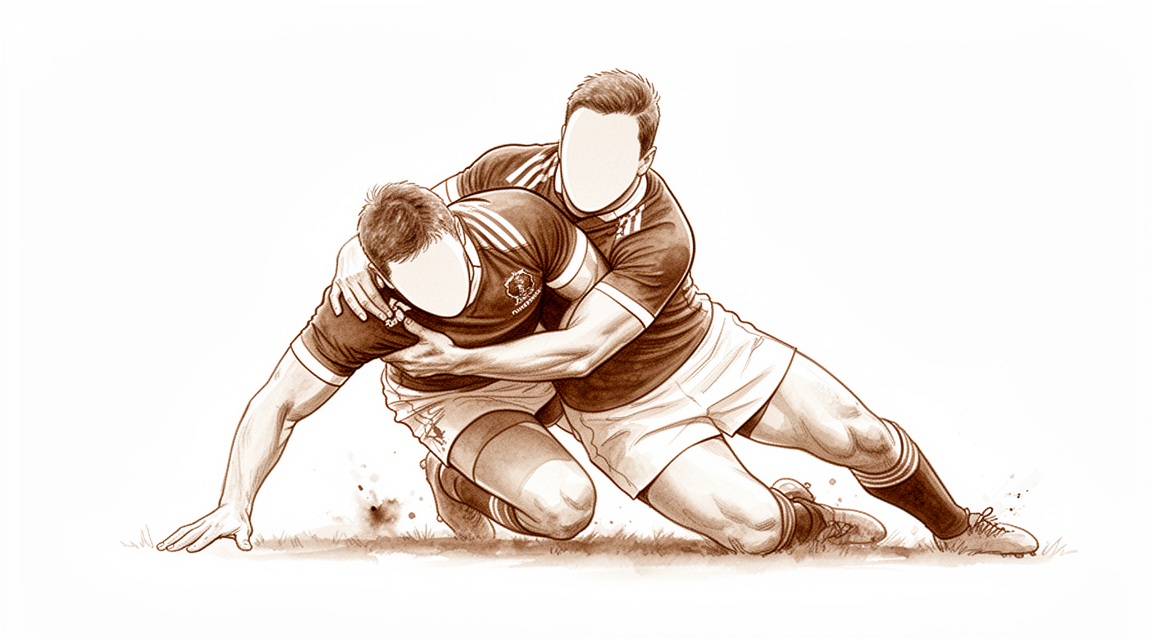
Ang protocol na ito ay nagsisilbing gabay sa iyong paggaling pagkatapos ng isang arthroscopic anterior Bankart repair kasama si Dr Kieran Hirpara sa Mater Private Hospital Rockhampton. Pinagsasama nito ang isang paliwanag sa simpleng Ingles ng bawat yugto at isang structured na programa na maaari mong ibahagi sa iyong physiotherapist; dalhin ang pahinang ito o ang PDF nito sa iyong unang appointment upang manatiling coordinated ang iyong rehabilitasyon. Maaaring i-adjust ng iyong physiotherapist ang plano depende sa pag-unlad ng iyong paggaling.
Kung mayroon kang anumang alalahanin tungkol sa iyong sugat pagkatapos ng operasyon, makipag-ugnayan sa mga rooms. Madalas na nakatutulong ang pagkuha ng larawan ng sugat at pag-email nito para sa pagsusuri.
Ano ang dapat asahan
Ang Bankart repair ay inaayos ang napunit na gilid ng cartilage (ang labrum) at ang nabanat na capsule pabalik sa harap ng socket, matapos ang shoulder dislocation o bahagyang pagkalabas ng joint patungo sa harap. Ang repair na ito ay soft tissue, at tulad ng isang naghihilom na tendon, kailangan nito ng oras upang muling kumapit nang matibay sa buto: humigit-kumulang labindalawang linggo bago ito maging maaasahang matibay. Ang buong programang ito ay binuo upang protektahan ang paghihilom na iyon.
Ang pinakamahalagang panuntunan ay ang protektahan ang harap ng balikat sa simula sa pamamagitan ng paglilimita kung gaano kalayo ang pag-rotate ng braso palabas. Ang pagpihit ng braso palabas (lalo na kung ang braso ay nakataas sa gilid) ay direktang humihila sa repair sa harap. Kaya ang outward rotation ay pinapanatiling maliit sa simula at binubuksan lamang sa maingat na mga hakbang, hanggang sa maabot ang full rotation sa loob ng humigit-kumulang labindalawang linggo.
Ang recovery ay dumaan sa mga yugto sa halip na madaliin. Babalik muna ang paggalaw, pagkatapos ay ang lakas, at pagkatapos ay ang mga pangangailangan ng sport at mas mabigat na trabaho. Ang mga soft-tissue labral repair ay mas mabagal maghilom kaysa sa bony Latarjet operation, kaya ang timeline dito ay sadyang mapagpasensya: karamihan sa mga tao ay bumabalik sa contact o overhead sport sa loob ng apat hanggang anim na buwan, kapag naabot na nila ang mga target, hindi sa isang nakatakdang petsa.
Ang pamamaraan
Ang iyong Bankart repair ay ginagawa nang arthroscopically (keyhole). Sa pamamagitan ng maliliit na hiwa, ang napunit na labrum at capsule sa harap ng balikat ay muling ikinakabit sa gilid ng socket gamit ang maliliit na anchor at tahi, upang maibalik ang bumper at ang tensyon na nagpapanatili sa bola sa gitna ng socket. Ang layunin ng rehabilitasyon ay protektahan ang muling pagkakabit na iyon habang ito ay gumagaling, at pagkatapos ay unti-unting ibalik ang buong paggalaw, lakas, at kumpyansa sa balikat.
Pagsusuot ng iyong sling
Gagamit ka ng simpleng shoulder sling, hindi isang espesyal na brace. Gumagamit si Dr Hirpara ng simpleng sling na nakaposisyon sa neutral rotation (ang forearm ay nakapatong sa tyan); hindi kailangan ng abduction pillow, wedge o "gunslinger" brace. Ang iyong proteksyon ay nagmumula sa sling at sa pagpapanatili ng braso na malayo sa at-risk position, hindi mula sa hugis ng brace.
- Isuot ang sling sa loob ng 6 na linggo para sa suporta sa araw, lalo na kapag ikaw ay nasa labas ng bahay o may kasamang ibang tao.
- Huwag matulog nang nakasuot ng sling. Ito ay para sa suporta sa araw lamang; matulog nang wala ito, habang ang iyong braso ay komportable at suportado ng unan. Habang ikaw ay natutulog, panatilihin ang iyong braso sa harap mo at nakadikit sa iyong katawan: huwag itong hayaang mahulog sa gilid at pumihit palabas (ang posisyong inilarawan sa ibaba).
- Hubarin ito para sa pagligo at para sa iyong mga ehersisyo (kapag naipakita na sa iyo kung paano). Sa tuwing wala ang sling, panatilihing relax ang iyong braso, nasa harap mo, at nasa iyong gilid.
- Gumamit ng ice kung ang balikat ay namamagâ o masakit, lalo na pagkatapos ng ehersisyo.
Bantayan ang iyong postura habang ginagamit ang sling: panatilihing magkahanay ang iyong mga tainga, balikat at balakang at iwasan ang pagkubo.
Mga pangunahing pag-iingat — HUWAG
- HUWAG ilagay ang iyong braso sa "hand-up" o throwing position (brasong nakataas sa gilid at naka-rotate palabas, na tila kumakaway o magbabato). Ito ang posisyon kung saan nadidislokate ang balikat, at direktang hinihila nito ang repair sa harap. Isang simpleng gabay na ginagamit ng ilan ay "laging panatilihin ang iyong mga siko kung saan mo sila nakikita": panatilihin ang mga braso sa iyong harapan.
- HUWAG aktibong i-rotate ang braso palabas lampas sa mga limitasyon sa ibaba sa mga unang linggo. Ang outward rotation ay binubuksan sa mga yugto: maliit na bahagi lamang (mga 20°, malayo sa posisyong diretso sa harap) sa mga unang linggo, hanggang sa maging buo pagdating ng mga 12 linggo.
- HUWAG aktibong igalaw ang balikat gamit ang sarili nitong lakas hanggang mga 6 na linggo: hayaang ang iyong malusog na braso o isang tungkod ang gumawa ng trabaho bago iyon.
- HUWAG abutin ang likod, magkabit ng bra, o ilagay ang kamay sa bulsa sa likuran nang maaga.
- HUWAG magbuhat, tumulak, humila, o magdala ng bigat gamit ang inoperahang braso sa loob ng 6 na linggo.
- HUWAG mag-push-up, bench press, wide-grip o chest-fly weights, military (overhead) press, o pull-downs sa likod ng leeg hanggang sa huling bahagi ng programa; lahat ng ito ay nagbibigay ng load o nag-uunat sa harap ng balikat.
- HUWAG pilitin o i-stretch sa posisyon na pakiramdam mo ay maaaring dumulas ang balikat; ang sakit o pakiramdam ng pangamba ay hudyat upang huminto.
- HUWAG magmaneho habang kinakailangan ang sling (6 na linggo).
Phase I: Proteksyon (mga linggo 0–6)
Kieran Hirpara 4.0
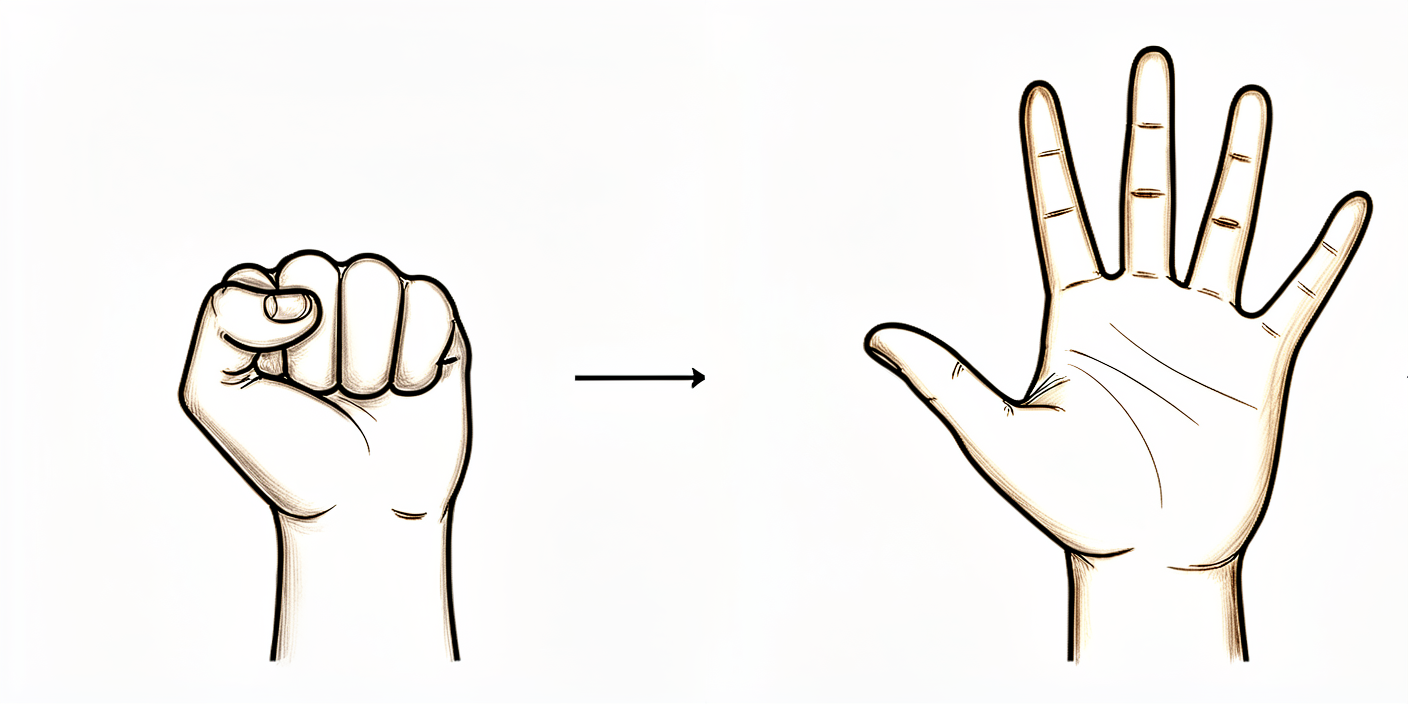
Buksan at isara ang kamay
I-kuyom nang mahigpit ang iyong kamay, pagkatapos ay ibuka ito nang lubos. Pinapanatili nito ang paggalaw ng iyong kamay at tumutulong upang maiwasan ang paninigas at pamamaga.
10 beses bawat oras
Kieran Hirpara 4.0
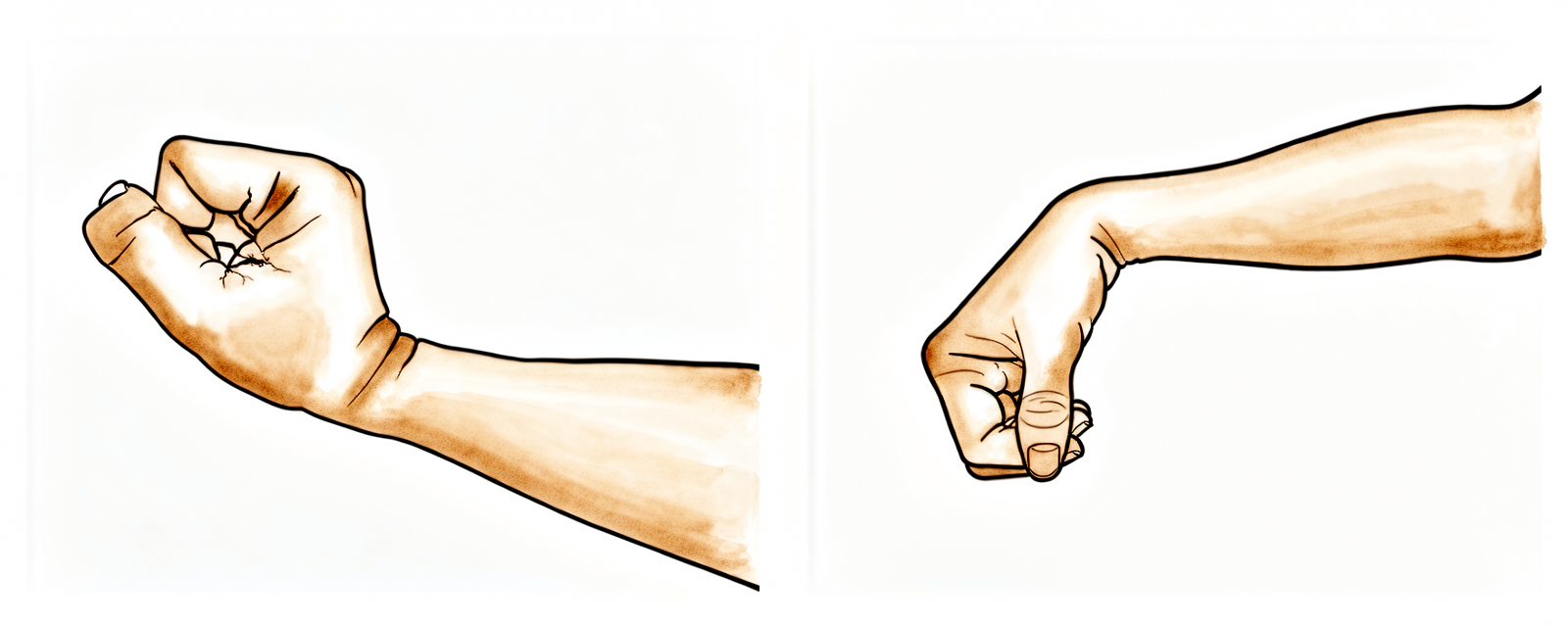
Pagbaluktot ng pulso
Dahan-dahang itiklop ang iyong pulso pasulong, pagkatapos ay pabalik, hanggang sa kung saan ito komportable.
10–15 beses bawat oras
Kieran Hirpara 4.0
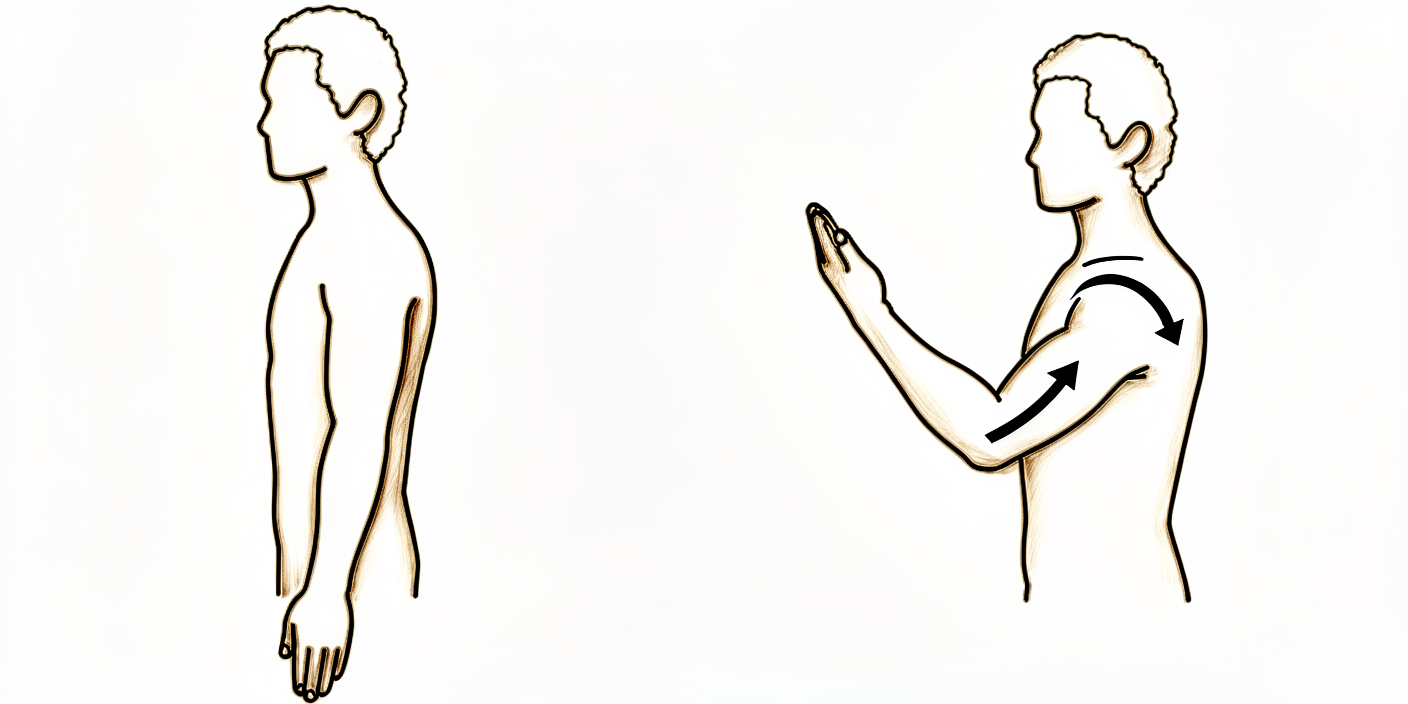
Pagbaluktot ng siko
Habang nakaharap pataas ang iyong palad, dahan-dahang itiklop ang iyong siko hangga't kaya mo, pagkatapos ay ituwid muli ang iyong braso. Panatilihing nakadikit ang iyong upper arm sa iyong tagiliran. HUWAG hayaang pumihit ang braso palabas habang ginagawa ito.
10–15 beses, 2–3 beses sa isang araw
Kieran Hirpara 4.0
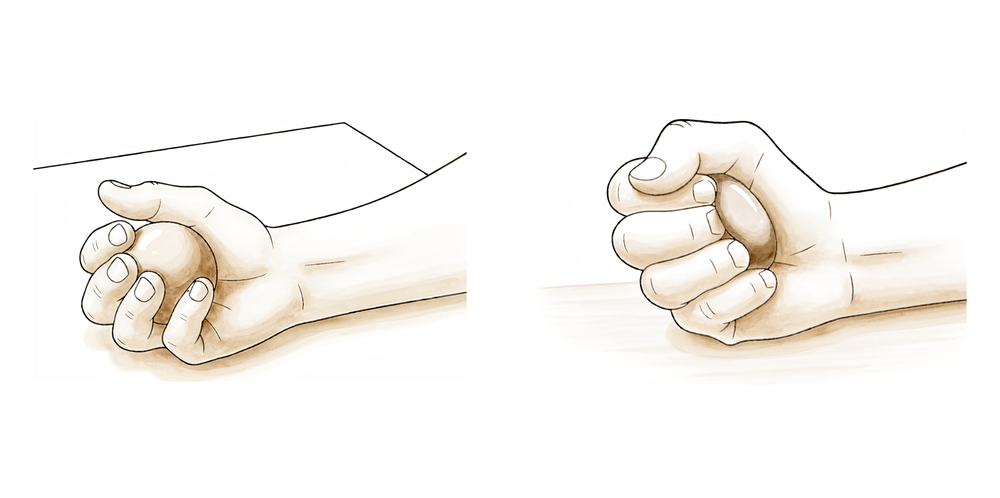
Pagpisil ng bola
Dahan-dahang pisilin ang isang malambot na bola o nakabilot na medyas sa iyong kamay, pagkatapos ay bitawan. Pinapanatili nito na aktibo ang kamay at forearm habang nagpapahinga ang balikat.
10–15 beses, ilang beses sa isang araw
Kieran Hirpara 4.0
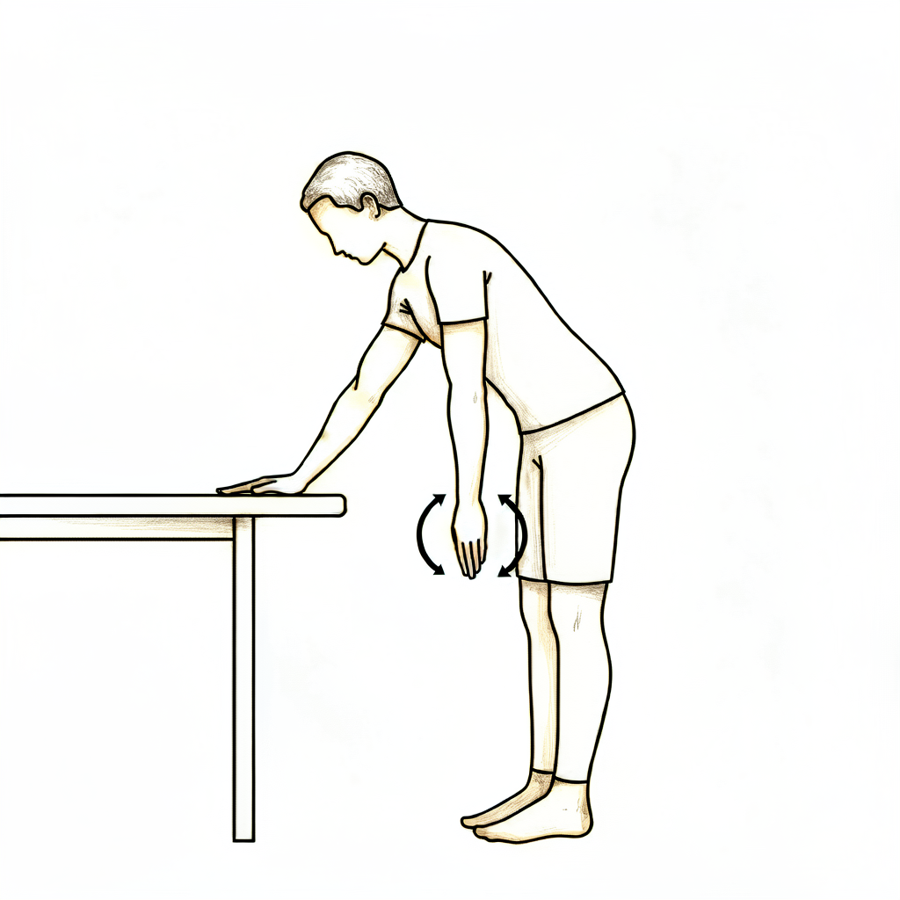
Pendulum swings
Yumuko nang bahagya pasulong at hayaang nakababa ang iyong inoperahang braso, na lubos na relaks. Gumawa ng maliliit na bilog — clockwise, pagkatapos ay sa kabilang direksyon — sa pamamagitan ng pag-ugoy ng iyong katawan, HINDI sa pamamagitan ng paggamit ng mga kalamnan sa iyong balikat. Panatilihing maliit ang bilog (mas mababa sa humigit-kumulang 20 cm) at panatilihing nakababa nang diretso ang braso — huwag itong hayaang umugoy palabas sa gilid at pumihit palabas. Mananatiling relaks ang iyong inoperahang braso sa buong proseso.
10 sa bawat direksyon, 2–3 beses sa isang araw
Kieran Hirpara 4.0
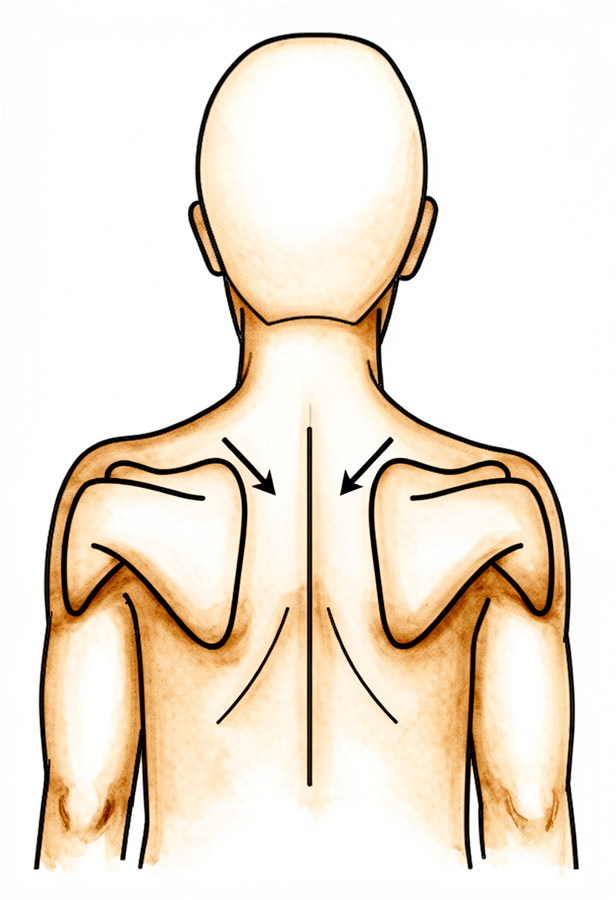
Pag-aayos ng shoulder-blade
Dahan-dahang pisilin ang iyong mga shoulder blade pababa at magkasama, manatili sa posisyong ito, pagkatapos ay i-relax. Ito ay isang light muscle-activation drill — hindi gumagalaw ang iyong braso at nananatiling relaxed ang iyong balikat.
Hawakan nang 5 segundo, 5 beses, 2–3 beses sa isang araw
Kieran Hirpara 4.0
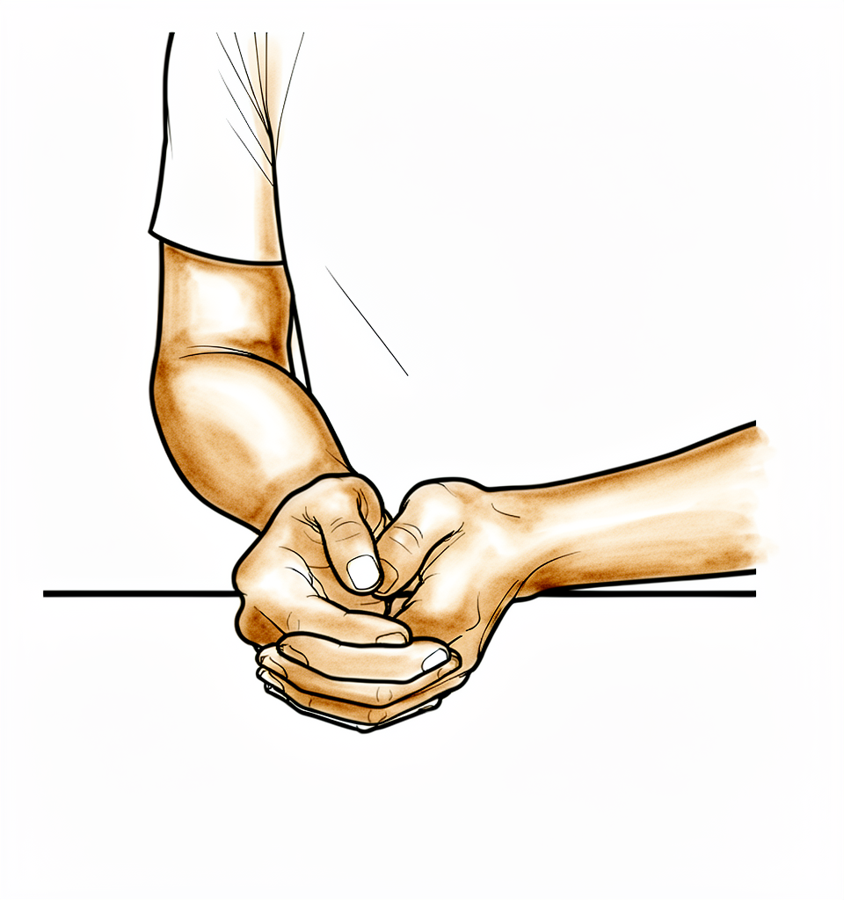
Tinulungang external rotation hanggang neutral
Mula sa humigit-kumulang linggo 2, kung ituturo lamang ng iyong physiotherapist. Habang ang iyong siko ay nakadikit sa iyong gilid at nakabaluktot nang 90° at ang iyong kamay ay nakapatong sa iyong tiyan, gamitin ang iyong maayos na kamay upang dahan-dahang i-gabay ang forearm palabas — ngunit sa MALIIT na halaga lamang (mga isang quarter turn, humigit-kumulang 20°) at huwag na huwag lalampas sa diretsong posisyon (neutral) sa mga unang linggong ito. Manatili nang mahigpit sa limitasyong itinakda ng iyong physiotherapist at huwag itong pilitin. Ito ang galaw na nagbibigay ng stress sa repair, kaya sadyang pinapanatili itong maliit.
Alinsunod sa gabay ng iyong physiotherapist, sa loob ng itinakdang limitasyon
Ang unang anim na linggo ay nakatuon sa isang bagay: ang pagprotekta sa repair sa harap ng balikat habang nagsisimula itong humilom sa buto. Mananatili ka sa simpleng sling para sa suporta sa araw, matutulog nang wala ito (habang ang braso ay nakaposisyon sa harap, hindi kailanman nakalabas-at-rotated), pamamahala ng pamamaga gamit ang ice, at paggawa ng mga banayad na drill upang mapanatiling gumagalaw ang iyong kamay, pulso, at siko nang walang paglalagay ng load o pag-stretch sa repair. Wala pang aktibong paggalaw ng balikat gamit ang sarili mong lakas; ang iyong malusog na braso o isang stick ang gagawa ng trabaho para sa iyo, at dapat kang manatiling lubos na relaxed.
- Sling: simpleng sling sa neutral rotation para sa suporta sa araw; matulog nang WALANG sling ngunit panatilihing nasa harap at nakatiklop ang braso; tanggalin para sa mga ehersisyo at kalinisan.
- Pinapayagang paggalaw: assisted at passive movement lamang (wala nang gamit ang sariling lakas ng iyong balikat). Mula sa ika-2 linggo, banayad na assisted forward lift hanggang sa humigit-kumulang 90° (kalahati pataas), at assisted outward rotation sa maliit na halaga lamang (mga 20°, hindi aabot sa posisyong diretso sa harap). Panatilihing nasa harap ng katawan ang braso sa lahat ng oras; huwag kailanman ilalabas sa gilid at i-rotate palabas.
- Mga Ehersisyo: pendulum swings; banayad na paggalaw ng kamay, pulso, at siko; ball squeezes; shoulder-blade setting; mula sa ika-3 linggo, banayad at pain-free na muscle-setting holds (pagdiin ng braso nang napakagaan sa pader o sa iyong kabilang kamay at pag-hold, nang hindi ini-rotate ang braso, wala pang pag-ikot papasok o palabas) ayon sa direktiba ng iyong physiotherapist; at, mula sa ika-2 linggo kung ididirekta ng iyong physiotherapist, small-range assisted outward rotation na mahigpit na nasa loob ng itinakdang limitasyon.
Handa na para sa susunod na phase kapag: ang iyong sakit ay humuhupa at kontrolado ng simpleng pain relief (mga 3/10 o mas mababa pa); nakumpleto mo na ang anim na linggo ng proteksyon ng sling; ang iyong sugat ay humilom na nang walang mga palatandaan ng problema; kaya mo nang tolerahin ang mga banayad na assisted movement sa loob ng kanilang mga limitasyon nang walang pakiramdam na maaaring dumulas ang balikat; at walang palatandaan na ang repair ay na-over-stress.
Phase II: Pagbabalik ng paggalaw at rotasyon (mga linggo 6–12)
Kieran Hirpara 4.0
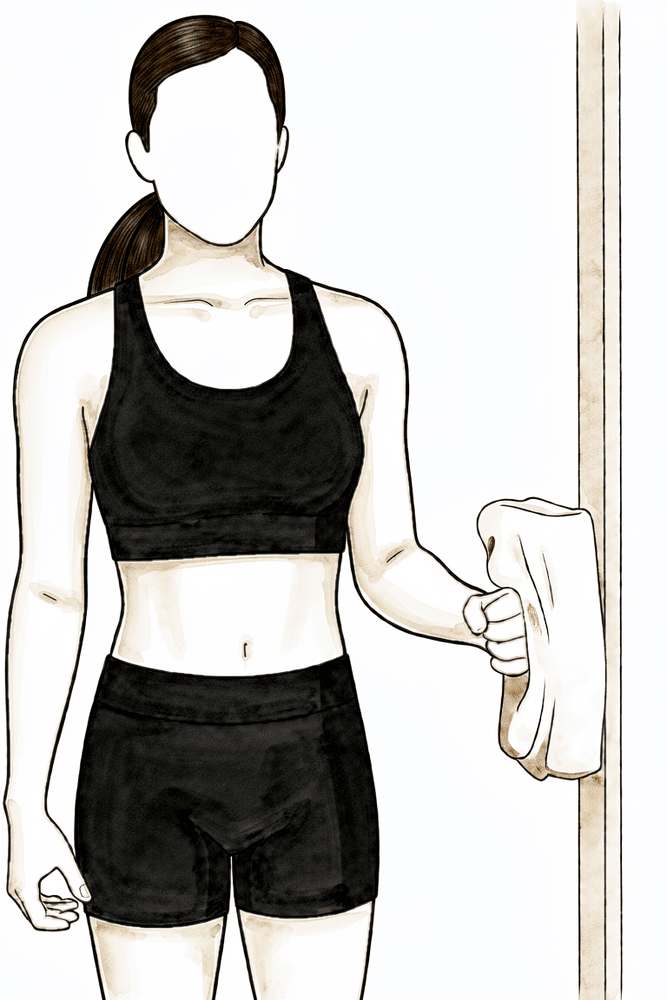
Isometric external rotation
Mula sa humigit-kumulang linggo 6–8, kapag pumayag na ang iyong physiotherapist. Tumayo nang nakadikit ang siko sa iyong gilid at nakabaluktot nang 90°, ang likod ng iyong kamay ay malapit sa pader o hamba ng pinto. Dahan-dahang itulak ang likod ng iyong kamay palabas sa ibabaw NANG HINDI pinapagalaw ang braso — isang banayad na pagsisikap, humigit-kumulang isang kapat ng iyong lakas, nang walang sakit. Hawakan, pagkatapos ay i-relax. Unti-unting dagdagan ito, dahil ang outward rotation ang direksyon kung saan pinakasensitibo ang repair.
Hawakan nang ~5 segundo, dahan-dahan (~25% na pagsisikap), ayon sa gabay ng iyong physiotherapist
Kieran Hirpara 4.0
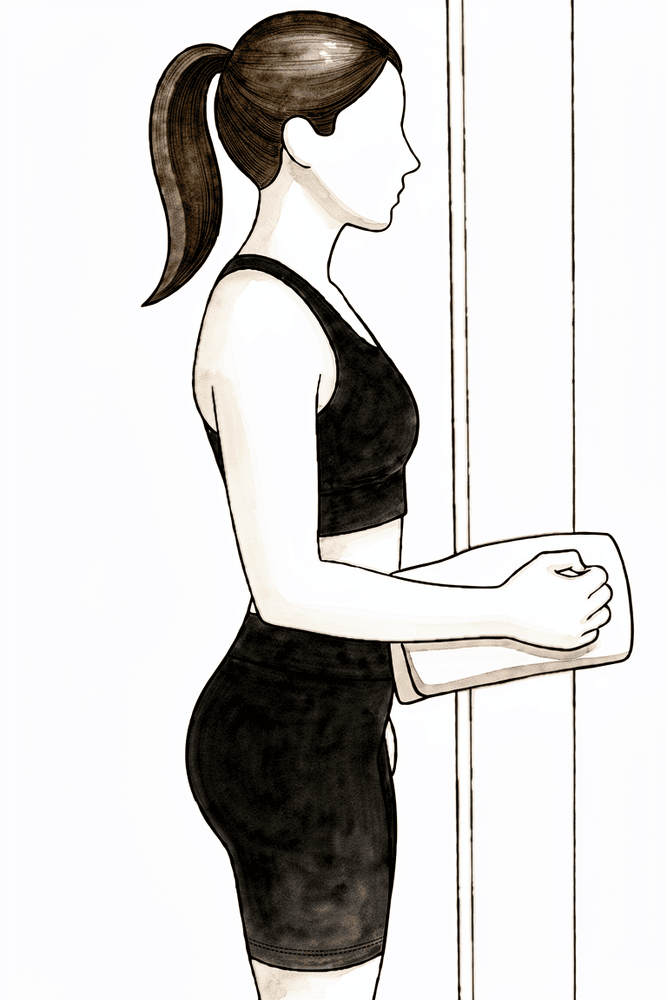
Isometric internal rotation
Mula sa humigit-kumulang linggo 6–8, kapag pumayag na ang iyong physiotherapist. Tumayo nang nakadikit ang siko sa iyong gilid, at ang palad ay nakasandal sa pader. Dahan-dahang itulak ang palad papasok NANG HINDI pinapagalaw ang braso — humigit-kumulang isang kapat na lakas, at walang sakit. Panatilihin ito, pagkatapos ay i-relax.
Hawakan nang ~5 segundo, dahan-dahan (~25% na pagsisikap), ayon sa gabay ng iyong physiotherapist
Kieran Hirpara 4.0
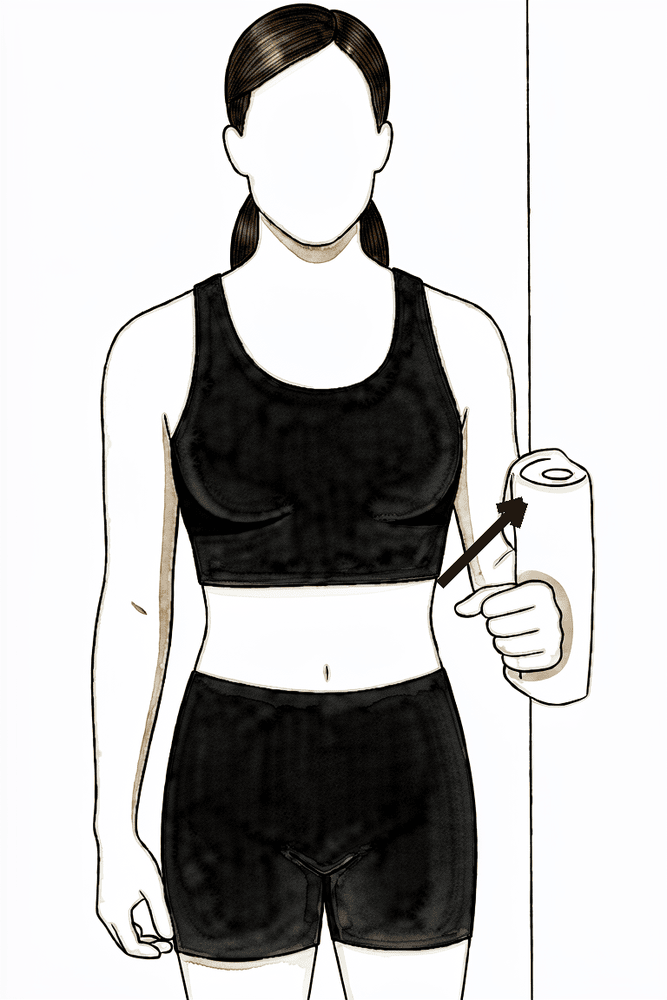
Isometric arm-out-to-the-side
Mula sa humigit-kumulang ika-6–8 linggo, kapag pumayag na ang iyong physiotherapist. Tumayo nang patagilid na ang labas ng iyong upper arm ay malapit sa pader, at ang siko ay nasa iyong tabi. Dahan-dahang itulak ang braso palabas patungo sa pader NANG HINDI hinahayaang gumalaw ito — humigit-kumulang isang kapat na lakas, walang sakit. Manatili sa posisyon, pagkatapos ay i-relax.
Hawakan nang ~5 segundo, dahan-dahan (~25% na pagsisikap), ayon sa gabay ng iyong physiotherapist
Kieran Hirpara 4.0
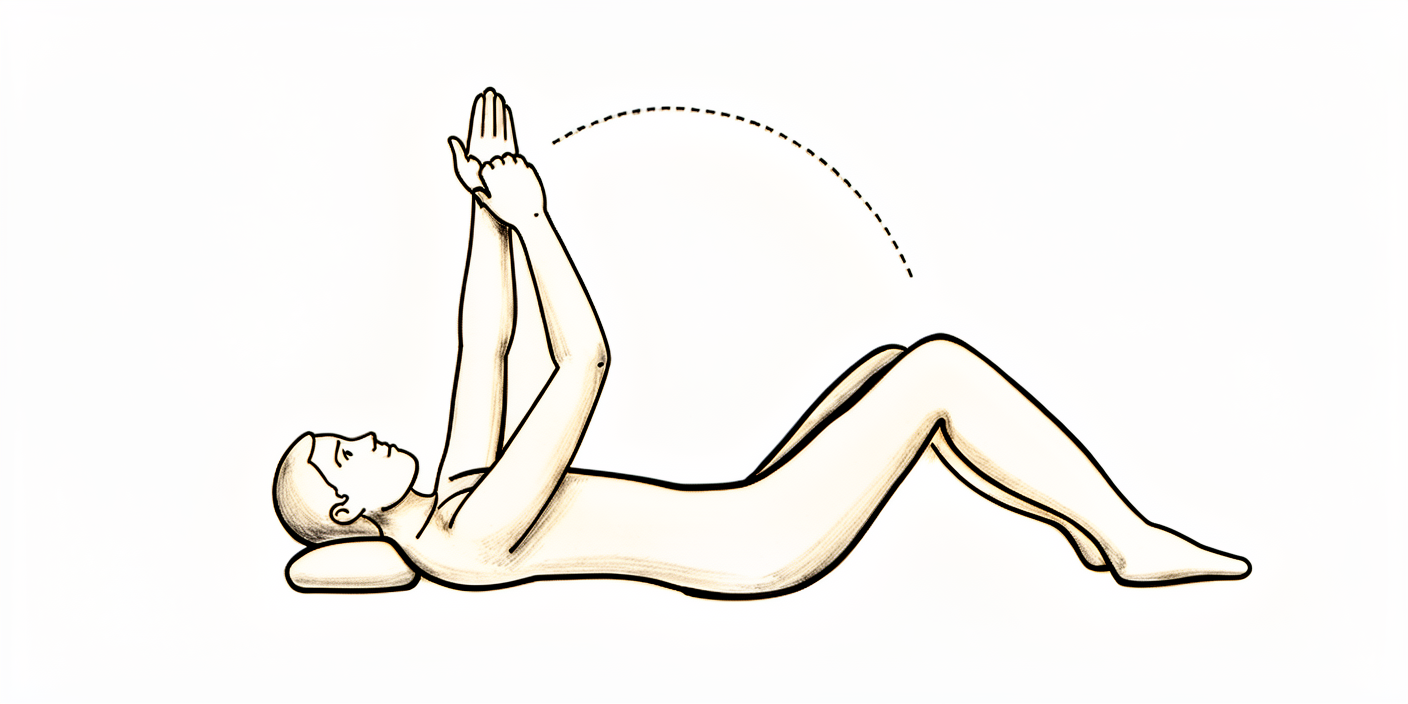
Tinutulungang forward lift habang nakahiga
Habang nakahiga nang patihaya, humawak ng stick sa magkabilang kamay at gamitin ang iyong mabuting braso upang iangat ang inoperahang braso pasulong at pataas — panatilihing relax ang inoperahang balikat. Gumalaw nang swabe, huwag kailanman pilitin, at ibaba ito nang may kontrol. Unti-unting dagdagan ang taas sa loob ng range na itinakda ng iyong physiotherapist.
10 beses, 2–3 beses sa isang araw
Kieran Hirpara 4.0
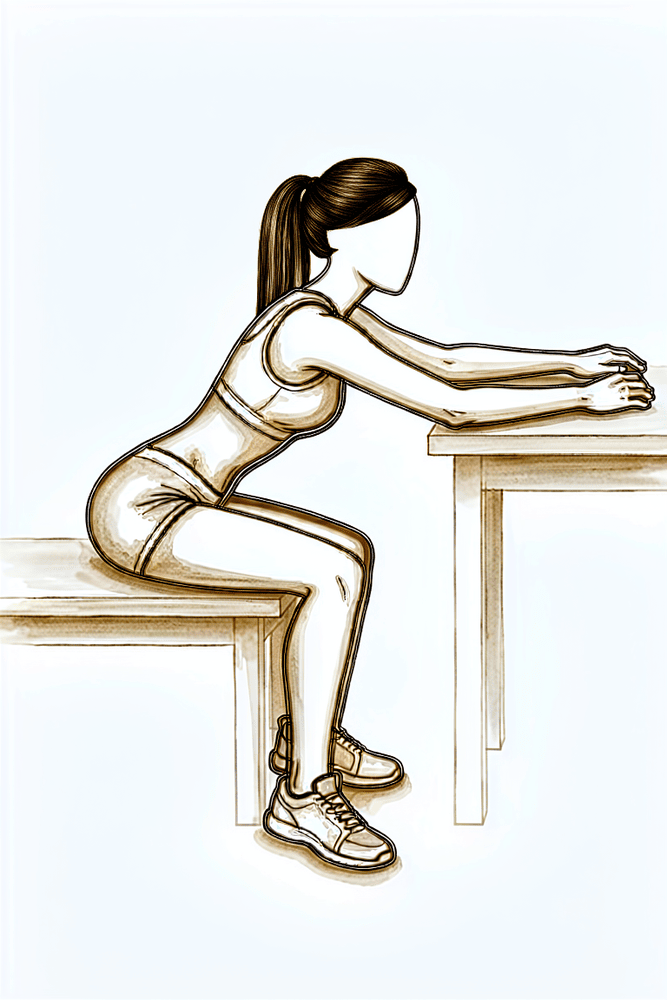
Seated table slide
Umupo sa isang mesa na ang iyong inoperahang kamay ay nasa ibabaw ng isang tuwalya. I-slide ang kamay pasulong sa ibabaw nito upang ang braso ay umabot pasulong at pataas, hayaang ang mesa ang pumasan ng bigat, pagkatapos ay i-slide pabalik. Panatilihin ang braso sa iyong harapan — huwag itong i-slide palabas sa gilid at huwag hayaang pumihit ito palabas.
10 beses, 2–3 beses sa isang araw
Kieran Hirpara 4.0
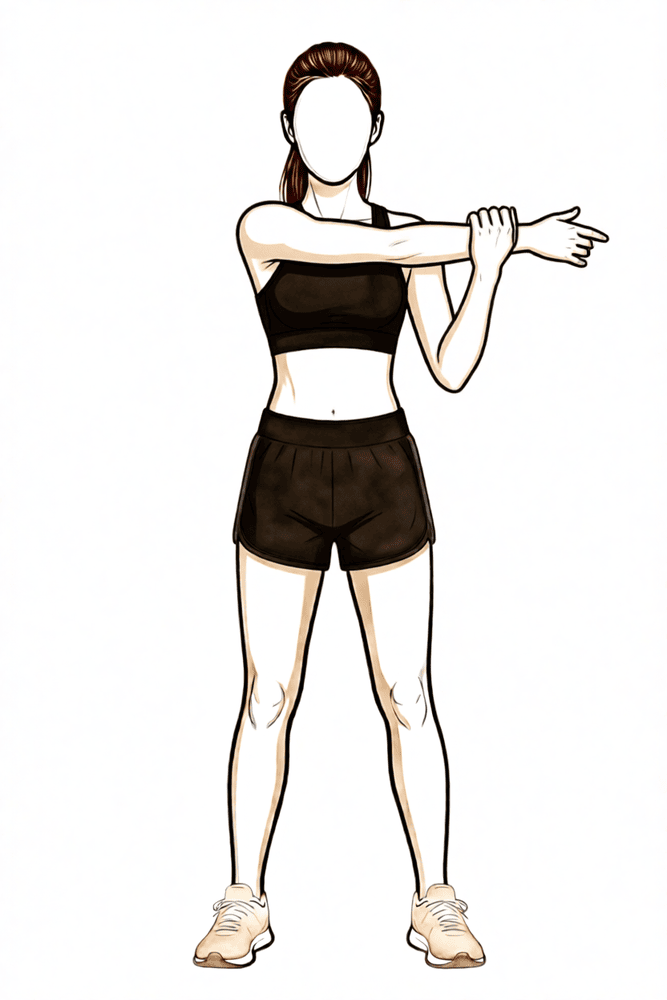
Cross-body stretch
Mula sa humigit-kumulang linggo 6–8 kung ito ay ituturo ng iyong physiotherapist. Gamitin ang iyong malusog na kamay upang dahan-dahang hilahin ang inoperahang braso patawid sa iyong dibdib hanggang sa makaramdam ka ng komportableng stretch sa likod ng balikat. Panatilihin itong dahan-dahan — huwag pilitin. Binabanat nito ang likod ng balikat at hindi binibigyang-diin ang repair sa harap.
I-hold nang 10–20 segundo, nang ilang beses, ayon sa gabay ng iyong physiotherapist
Tinatanggal na ang sling at ang pokus ay ang pagbabalik ng paggalaw, hindi lakas. Mag-uumpisa ka mula sa assisted movement patungo sa paggalaw ng braso gamit ang sarili mong lakas, at, mahalaga, ang outward rotation ay unti-unting bubuksan: mula sa humigit-kumulang 30–45° sa simula ng phase na ito patungo sa full rotation sa loob ng labindalawang linggo. Ginagawa ito sa mga hakbang, hindi kailanman pinipilit, dahil ang repair sa harap ay kasalukuyan pa ring naghihilom. Ang mga light muscle-activation (isometric) drill ay idinaragdag habang bumubuti ang paggalaw.
- Sling: tanggal na.
- Pinapayagang paggalaw: assisted movement na unti-unting magiging paggalaw gamit ang sariling lakas. Ang forward lift ay uunlad patungo sa full overhead. Ang outward rotation ay isinasagawa sa mga yugto: humigit-kumulang 30–45° sa simula ng phase na ito, pagkatapos ay bubuksan patungo sa full rotation sa loob ng ika-12 linggo. Ang pag-abot sa likod ay muling ipinapakilala nang dahan-dahan at sa huling bahagi ng phase na ito.
- Mga Ehersisyo: assisted forward lift habang nakahiga; seated table slide; gentle isometric (press-and-hold) external rotation, internal rotation at arm-out-to-the-side drills; cross-body stretch para sa likod ng balikat.
Handa na para sa susunod na phase kapag: kaya mo nang iangat ang braso pasulong gamit ang sarili mong lakas hanggang sa halos full height na may maayos na kontrol (walang pag-shrug o pag-hitch ng shoulder blade); ang iyong outward rotation ay umunlad na sa full o halos full at komportable na; ang mga gentle isometric ay natatagalan nang walang paglala ng sakit pagkatapos; at wala kang pakiramdam na maaaring dumulas ang balikat habang gumagawa ng mga pang-araw-araw na paggalaw.
Phase III: Pagpapalakas (weeks 12–16)
Kieran Hirpara 4.0
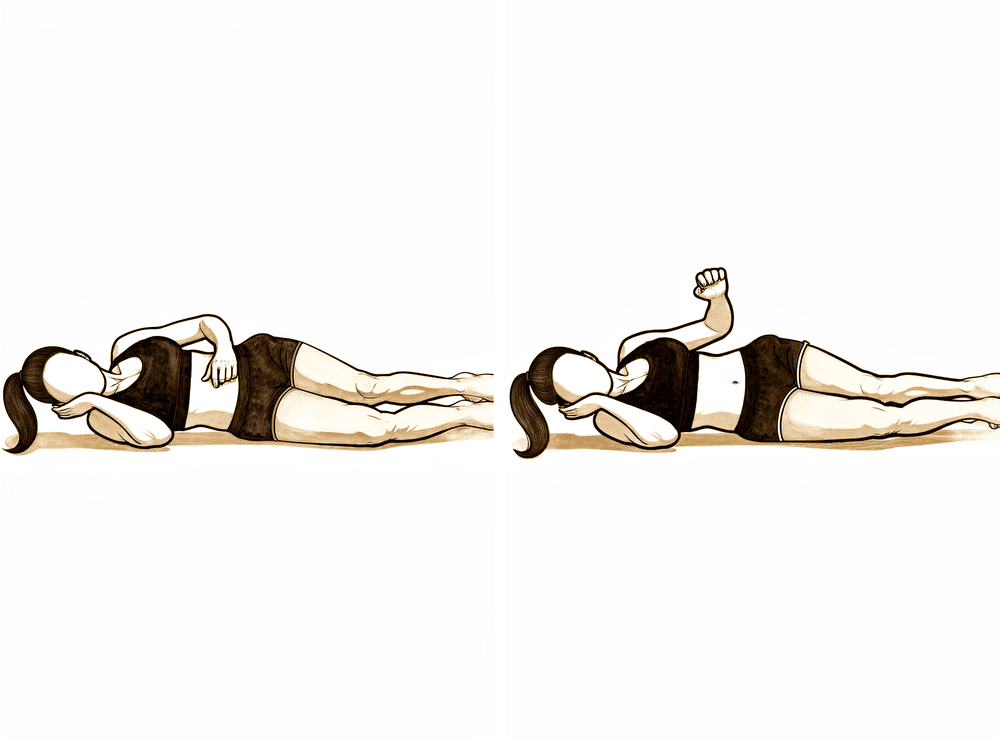
Sidelying outward rotation
Mula sa humigit-kumulang ika-12 linggo. Humiga sa iyong maayos na panig, ang inoperahang siko ay nakasandal sa iyong baywang at nakabaluktot nang 90°. I-rotate ang inoperahang forearm pataas patungo sa kisame, pagkatapos ay ibaba ito nang may kontrol. Magsimula nang walang bigat, manatili sa loob ng range na itinakda ng iyong physiotherapist. Binubuo nito ang lakas ng outward-rotation sa huli, dahil ito ang direksyon kung saan pinaka-protektado ang repair.
Ayon sa gabay ng iyong physiotherapist
Kieran Hirpara 4.0
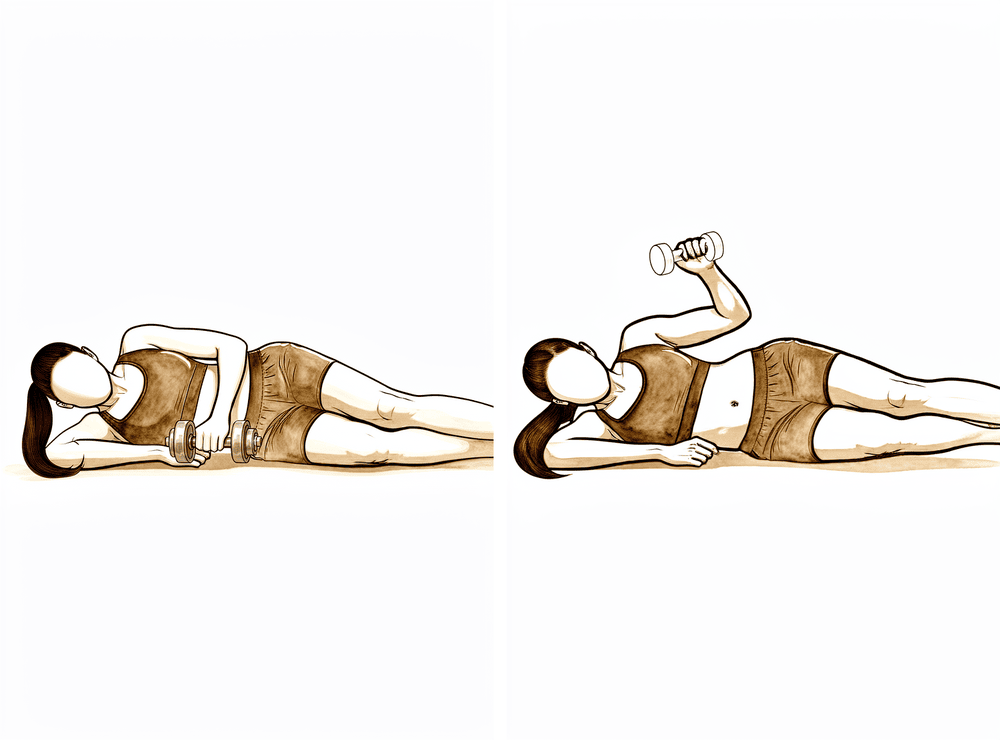
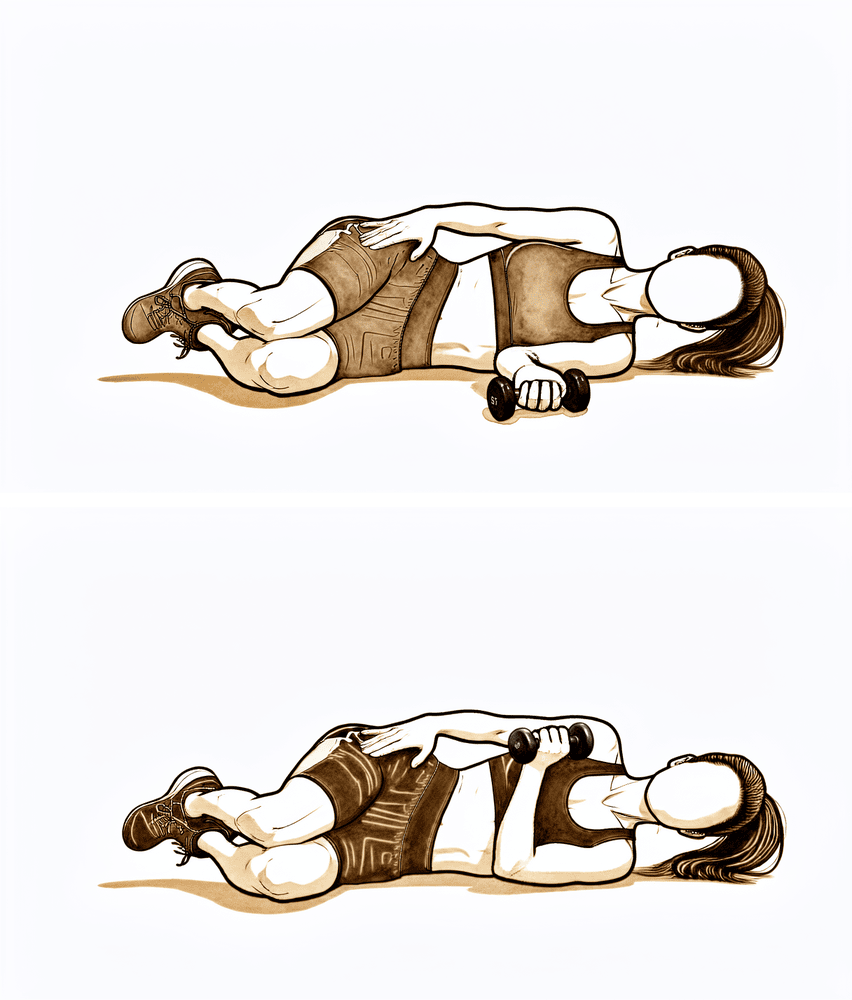
Sidelying outward rotation gamit ang magaan na weight
Ang sidelying outward rotation gaya ng dati, ngayon ay may magaan na pabigat, unti-unting dagdagan ang load. Panatilihing nakadikit ang siko sa iyong baywang. Huminto kung masakit ang balikat.
Ayon sa gabay ng iyong physiotherapist
Kieran Hirpara 4.0
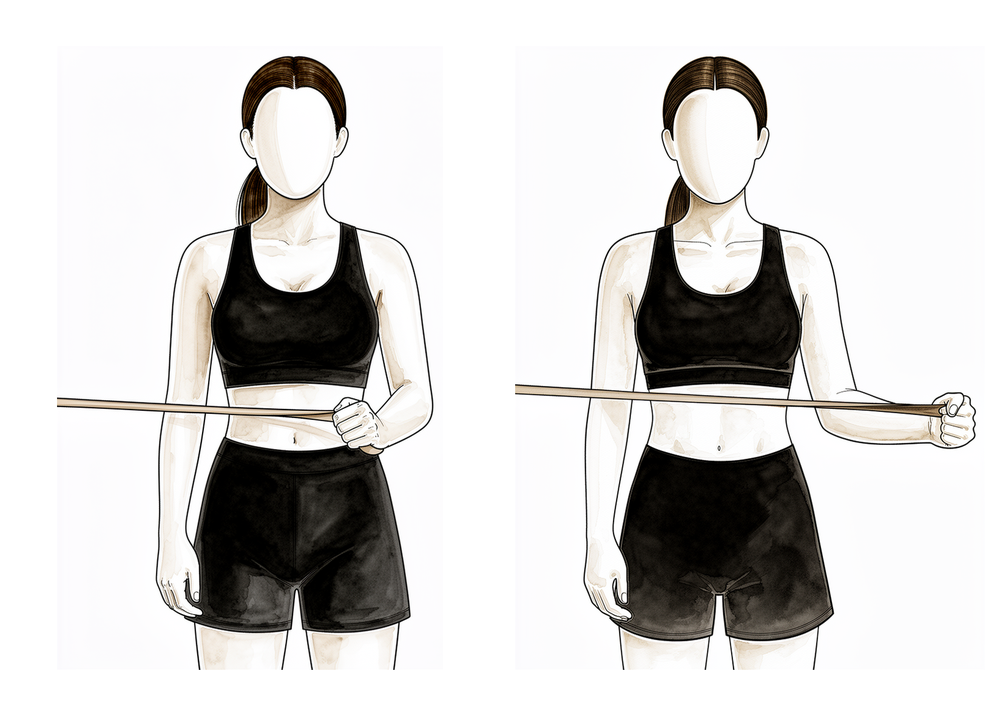
Sidelying inward rotation na may magaan na pabigat
Mula sa humigit-kumulang ika-12 linggo. Humiga sa panig na inoperahan, ang siko ay nakadikit sa iyong baywang at nakabaluktot nang 90°, habang humahawak ng magaan na pabigat. Itaas ang forearm patungo sa iyong tiyan, pagkatapos ay ibaba ito nang may kontrol.
Ayon sa gabay ng iyong physiotherapist
Kieran Hirpara 4.0
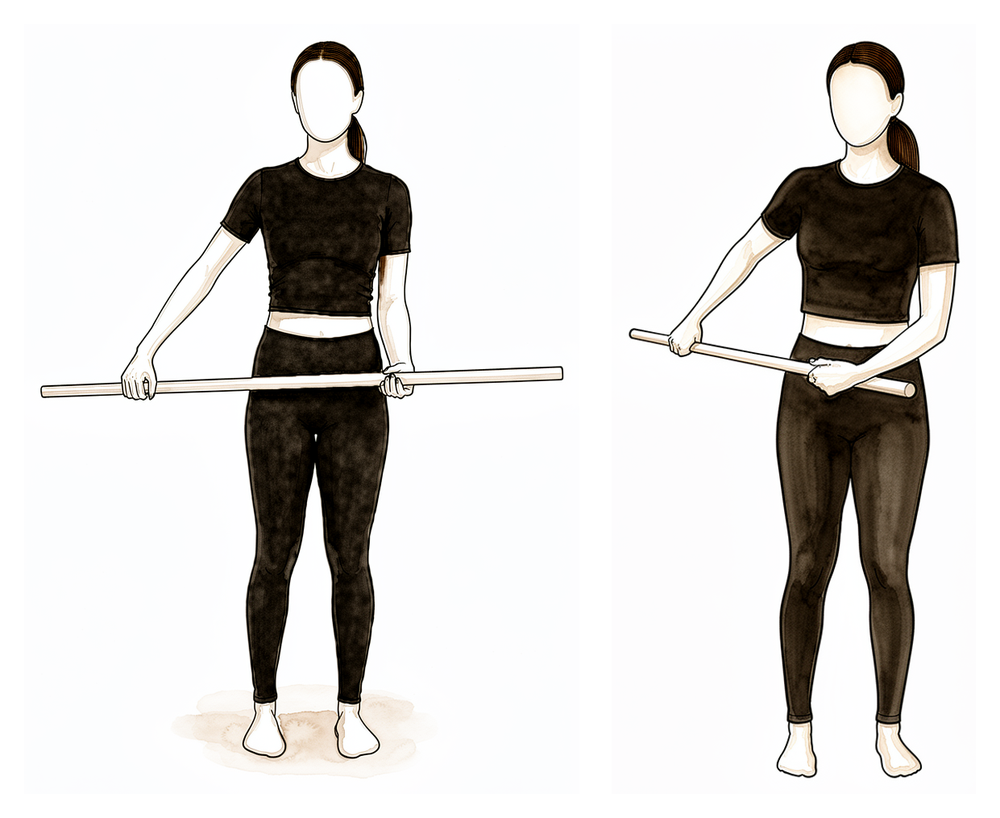
External rotation gamit ang band
Mula sa humigit-kumulang ika-12 linggo, kapag komportable na ang full rotation. Panatilihing nakadikit ang iyong siko sa iyong gilid at nakabaluktot nang 90°. I-rotate ang forearm palabas laban sa isang light band, pagkatapos ay ibalik ito nang may kontrol. Gumamit ng light band at maraming repetitions, hindi mabigat na resistance.
Ayon sa gabay ng iyong physiotherapist
Kieran Hirpara 4.0
Internal rotation gamit ang stick
Mula sa humigit-kumulang ika-12 linggo. Humawak ng isang stick sa likod mo at gamitin ang iyong maayos na kamay upang dahan-dahang itaas ang inoperahang kamay sa iyong likod, pagkatapos ay ibaba ito nang may kontrol. Panatilihin itong komportable at sa loob ng mga limitasyong itinakda ng iyong physiotherapist.
Ayon sa gabay ng iyong physiotherapist
Kieran Hirpara 4.0
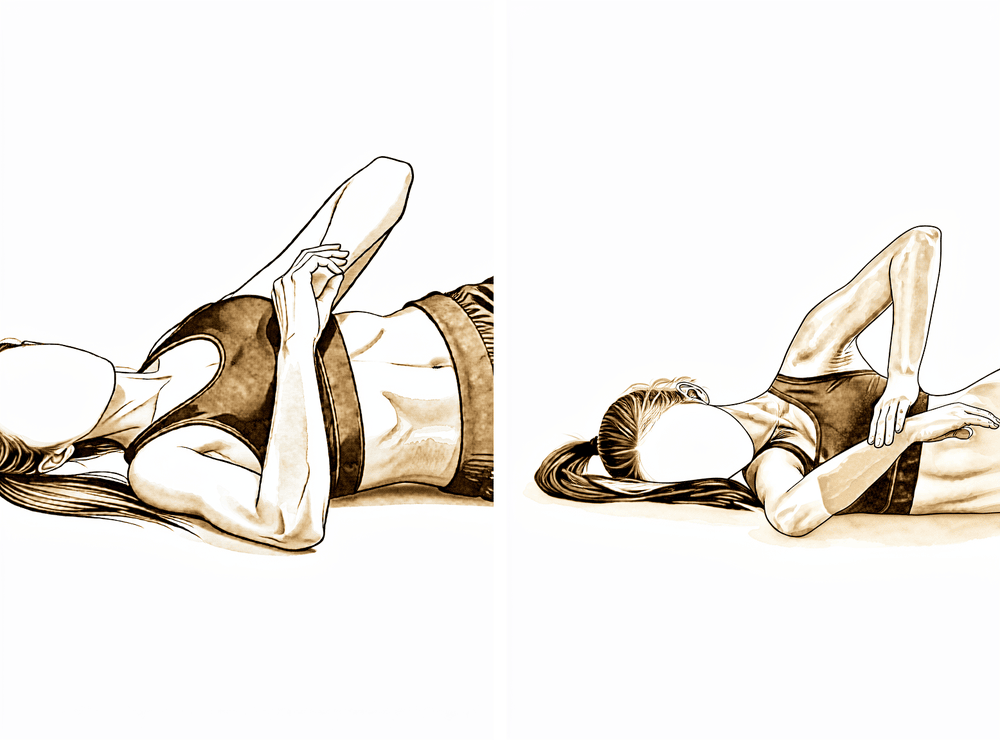
Sleeper stretch
Mula sa humigit-kumulang ika-12 linggo, kung ito ay ituturo ng iyong physiotherapist. Humiga sa panig na inoperahan na ang braso ay nasa harap at ang siko ay nakabaluktot. Gamitin ang iyong kabilang kamay upang dahan-dahang itulak ang forearm pababa sa kama hanggang sa makaramdam ka ng komportableng stretch sa likod ng balikat. Dahan-dahan lamang — huwag pilitin.
I-hold nang 10–20 segundo, nang ilang beses, ayon sa gabay ng iyong physiotherapist
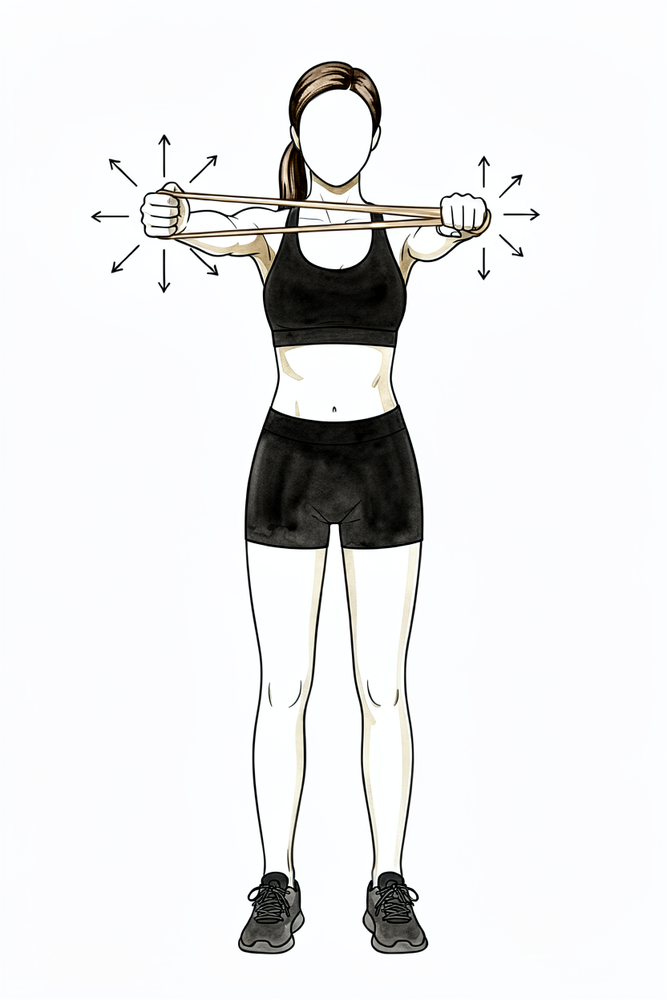
Kieran Hirpara 4.0
Rhythmic stabilisation
Habang ang iyong braso ay suportado sa harap mo sa taas na halos kapantay ng balikat, hayaan ang iyong physiotherapist (o ang iyong maayos na kamay) na magbigay ng maliliit at banayad na tulak mula sa iba't ibang direksyon habang pinapanatili mong hindi gumagalaw at matatag ang braso — huwag itong hayaang gumalaw. Sinasanay nito ang mga stabilising muscle ng balikat na tumugon. Panatilihing banayad ang lahat ng pagsisikap.
Ayon sa gabay ng iyong physiotherapist
Sa ikalabindalawang linggo, ang repair ay sapat na ang lakas upang simulan ang wastong pagpapalakas, at ang pokus ay lilipat mula sa pagbawi ng paggalaw patungo sa muling pagbuo ng lakas, endurance at kontrol. Ang resistance work gamit ang light bands at light weights ay nagsisimula na ngayon: mataas na repetitions, mababang loads. Ang mga rotator-cuff muscles na humahawak sa balikat ay pinalalakas sa lahat ng direksyon, kung saan ang outward rotation ay unti-unting binubuo dahil ito ang direksyong pinakasensitibo ng repair. Panatilihing kontrolado at walang sakit ang mga paggalaw sa lahat ng oras.
- Sling: wala; inaasahan ang full movement.
- Mga Ehersisyo: sidelying outward rotation (nag-proprogress patungo sa light weight); sidelying inward rotation gamit ang light weight; external rotation gamit ang light band, siko ay nasa gilid; internal rotation gamit ang stick; sleeper stretch para sa likod ng balikat. Maaari ring magdagdag ang iyong physiotherapist ng rhythmic stabilisation (mga gentle hold-steady drills kung saan tinutulak nila nang bahagya ang iyong braso at reresist ka) upang muling sanayin ang kontrol ng balikat. Ito ay hands-on work na walang diagram.
Handa na para sa susunod na phase kapag: mayroon ka nang full, pain-free movement gamit ang sarili mong lakas na may pantay na shoulder-blade control; walang sakit o pamamaga pagkatapos ng mga strengthening sessions; ang rotation strength ay patuloy na lumalakas patungo sa antas ng kabilang panig; at wala kang apprehension o instability sa mga pang-araw-araw na loaded tasks.
Phase IV: Pagbabalik sa isport at trabaho (4–6 buwan)
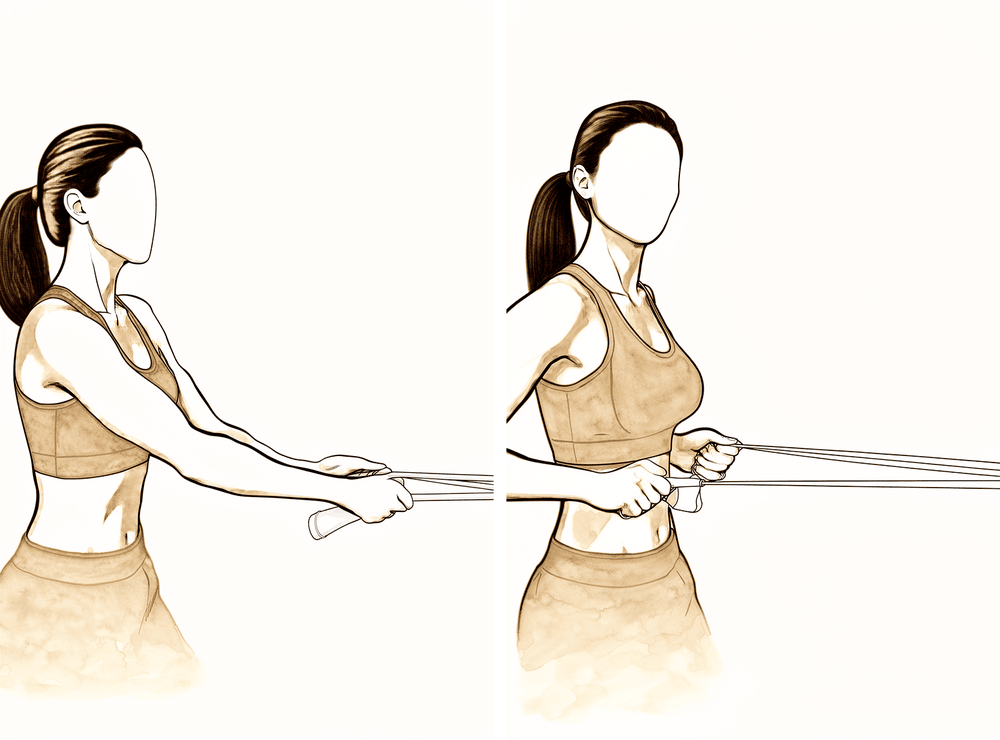
Kieran Hirpara 4.0
Resistance-band row
Gamit ang isang band na naka-angkla sa iyong harapan, hilahin ang mga handle patungo sa iyo, iurong ang iyong mga siko pabalik at pagdikitin ang iyong mga shoulder blade, pagkatapos ay ibalik ito nang may kontrol. Panatilihing malapit ang iyong mga siko sa iyong mga gilid at sa iyong harapan — huwag hayaang mapadpad ang mga ito pabalik sa likod ng linya ng iyong katawan. Magaan na band, mataas na repetitions.
Ayon sa gabay ng iyong physiotherapist
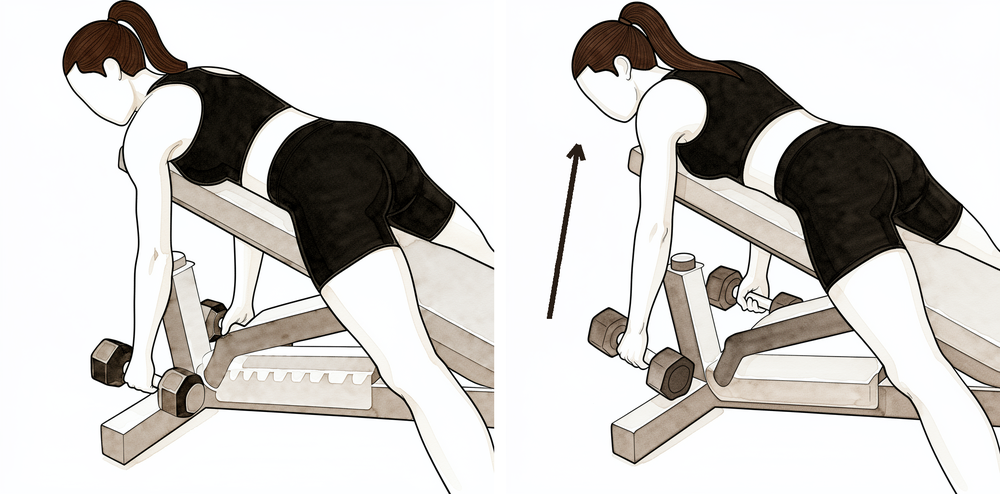
Kieran Hirpara 4.0
Paghila ng shoulder-blade gamit ang pabigat
Hilahin ang iyong mga shoulder blade pabalik at pababa laban sa isang magaan na pabigat o band, hawakan nang sandali, pagkatapos ay dahan-dahang pakawalan. Binubuo nito ang mga kalamnan na nagpapatatag sa shoulder blade at sumusuporta sa na-repair na balikat.
Ayon sa gabay ng iyong physiotherapist
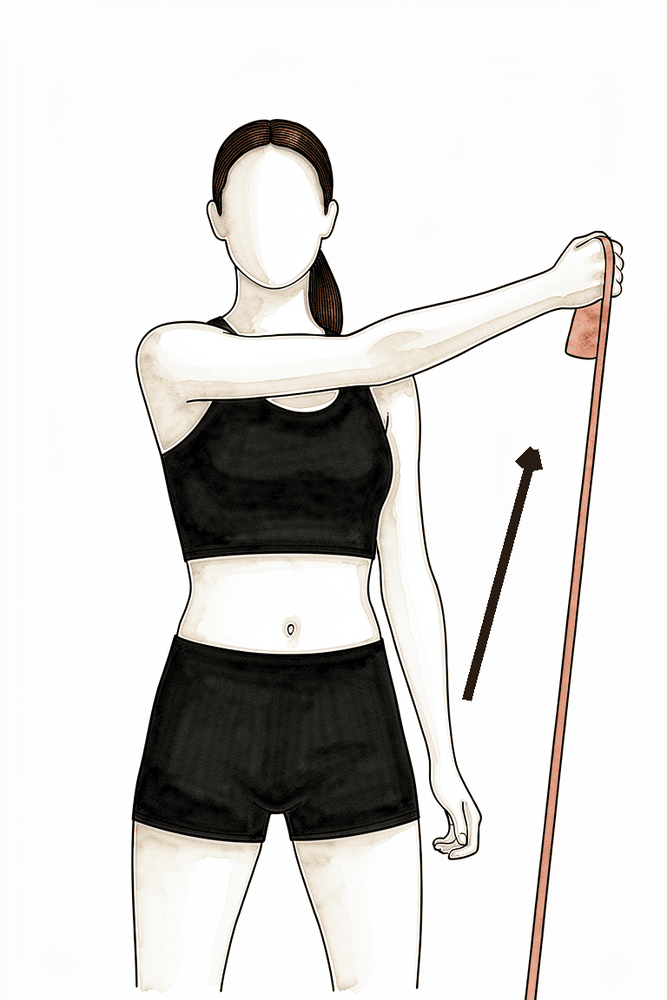
Kieran Hirpara 4.0
Diagonal band pattern (pababa at patawid)
Mula sa humigit-kumulang ika-12 linggo, kapag mayroon ka nang kumpleto at komportableng paggalaw. Gamit ang isang light band, igalaw ang braso sa isang smooth diagonal line — mula sa itaas at palabas, pababa at patawid patungo sa kabilang balakang, pagkatapos ay pabalik. Sinasanay nito ang balikat sa mga natural diagonal pattern na ginagamit sa mga pang-araw-araw na gawain at sports. Panatilihin itong kontrolado at walang sakit.
Ayon sa gabay ng iyong physiotherapist
Kieran Hirpara 4.0
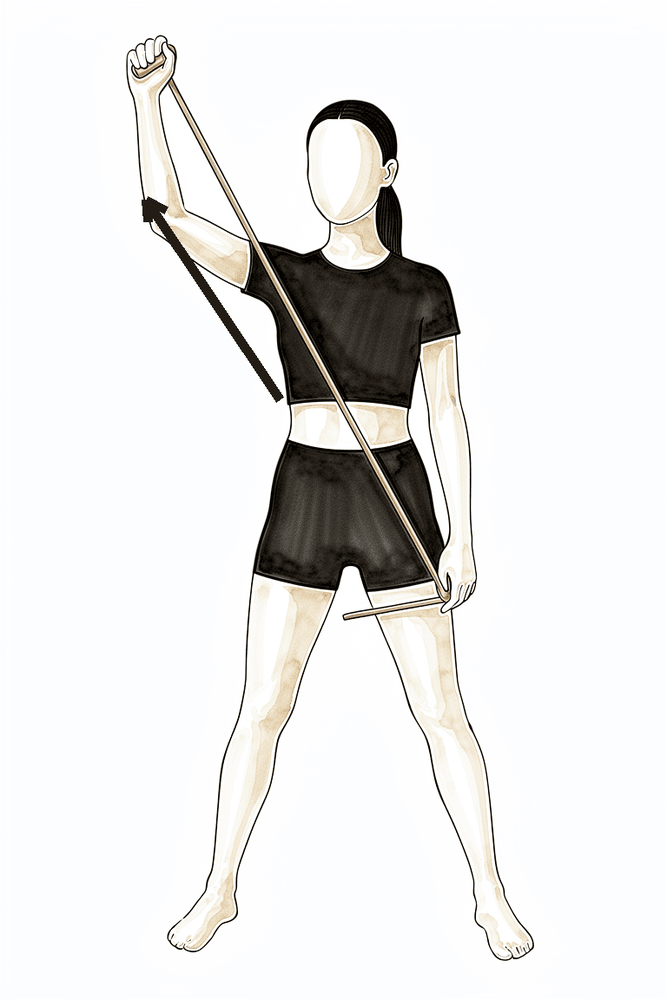
Diagonal band pattern (umaabot paitaas at patawid)
Mula sa huling bahagi ng phase na ito, kapag ang outward rotation ay buo na at komportable. Gamit ang isang light band, igalaw ang braso sa isang smooth diagonal line — mula sa ibaba at patawid sa katawan, pataas at palabas sa itaas ng ulo, pagkatapos ay pabalik. Dahil dinadala ng pattern na ito ang braso sa raised, rotated-out position, ipakilala lamang ito kapag sumang-ayon ang iyong physiotherapist na handa ka na. Panatilihin itong kontrolado at walang sakit.
Ayon sa gabay ng iyong physiotherapist
Ang phase na ito ang nagsisilbing tulay mula sa isang malakas at kontroladong balikat pabalik sa mga pangangailangan ng isport at mas mabigat na trabaho. Pananatilihin mo ang range na iyong nakamit at bubuo ng lakas, power, at endurance upang magamit ito nang may kumpiyansa. Ang pagbabalik ay unti-unti, hindi biglaan; para sa overhead at contact sport, ang isang interval programme na nagpapataas ng volume at intensity step by step ang pinakaligtas na paraan pabalik.
- Sling: wala.
- Mga Ehersisyo: progressive cuff at shoulder-blade strengthening (resistance-band rows, shoulder-blade pulls); diagonal band patterns na nagsasanay sa balikat sa pamamagitan ng mga natural na reaching lines, kung saan ang overhead-and-rotated pattern ay idinaragdag lamang kapag ang outward rotation ay buo na at komportable; pagkatapos ay sport- at work-specific conditioning at mga controlled higher-speed drills ayon sa naaangkop.
Handa nang bumalik kapag: ang iyong lakas ay hindi bababa sa 85% ng kabilang panig at ang balanse sa pagitan ng iyong outward- at inward-rotation strength ay mabuti; mayroon kang buo at walang sakit na paggalaw nang walang pakiramdam ng instability sa ilalim ng load; at naipasa mo ang mga task-specific tests para sa iyong isport o trabaho. Ang pagbabalik sa contact o overhead sport ay karaniwang nasa 4–6 buwan, base sa pagtugon sa mga criteria na ito at sa clearance ni Dr Hirpara at ng iyong physiotherapist, hindi base sa kalendaryo lamang.
Pagbabalik sa isport at trabaho
Ang pagbabalik sa isport at trabaho ay nakabase sa mga criteria: walang sakit, may full range, balanseng lakas, at walang pakiramdam na maaaring madulas ang balikat, at nilagdaan kapwa ni Dr Hirpara at ng iyong physiotherapist, hindi nakabase sa kalendaryo lamang.
- Magaan, sedentary na trabaho: sa loob ng ilang linggo, habang protektado ang braso.
- Pagpapalakas (Strengthening): magaan na resistance mula sa humigit-kumulang 12 linggo.
- Throwing at overhead sport: hindi bago ang 4 na buwan, at pagkatapos lamang ng isang graded build-up.
- Contact at collision sport: karaniwang 4–6 buwan, nakabase sa criteria.
Ang soft-tissue Bankart repair ay mas mabagal gumaling kaysa sa bony Latarjet operation, kaya ang pagbabalik ay karaniwang mas huli nang kaunti; ang pagtitiyaga rito ay nagpoprotekta sa repair at nagpapababa ng pagkakataon na muling matanggal ang balikat.
Pagkatapos ng iyong protocol
Ang protocol na ito ay kasabay ng pangkalahatang payo sa paggaling ng klinika; tingnan ang pamamahala ng sakit pagkatapos ng operasyon at pag-aalaga ng sugat.
Evidence & references
This is the clinical evidence summary written for health professionals. It is technical, and it lists the research this page was built from. You do not need to read it to understand your treatment or to make a decision about it.
Anterior Stabilisation — Arthroscopic Bankart Repair: Rehabilitation Evidence
Topic: Arthroscopic capsulolabral (Bankart) repair for anterior glenohumeral instability. Compiled: 2026-06-16. Sources: local RAG Orthopaedic corpus (154k articles) + published fellowship/PT "standard of care" protocols. Core early precaution: protect the anterior repair -> limit external rotation (ER) (and combined abduction+ER) in the early weeks, because anterior-inferior capsulolabral healing is stressed by ER. This is the mirror image of the posterior protocol.
Consensus phased timeline
The two published academic protocols below are highly concordant. ER limits are given as degrees in the scapular plane / at the side and at 90 deg abduction.
| Phase | Week window | Sling/brace | ROM allowed & restrictions | AROM / strengthening | RTS |
|---|---|---|---|---|---|
| I - Immediate post-surgical / protection | 0-3 wk | Sling at ALL times (neutral rotation, ~30-45 deg abduction per MGH); remove only for shower + elbow/wrist ROM; sleep in sling 6 wk | No shoulder AROM. PROM begins wk 2: flexion <90 deg, ER in scapular plane <20 deg. Avoid abduction+ER (anterior capsule stress); no reaching behind back | Scapular setting, ball squeezes; submaximal isometrics start wk 3 (avoid ER/IR initially) | None |
| II - Protection / PROM | 4-5 wk | Continue sling | PROM progressed: flexion to ~140 deg, ER to 30-45 deg (at side / scapular plane / and at 90 deg abd per MGH), full IR, full abduction in scapular plane | AAROM; submaximal RC isometrics (ER, IR, flexion, abd, ext); periscapular strengthening | None |
| III - Intermediate / AROM | 6-8 wk | Wean / discontinue sling | ER to 50-65 deg scapular plane, ER to ~75 deg at 90 deg abd, flexion to ~160 deg. Begin AROM (gravity-minimised -> resisted). Begin posterior-capsule stretches (cross-arm, sleeper) | Begin isotonic RC + rhythmic stabilisation (closed->open chain). NO push-ups/pec flys (anterior stress) | None |
| IV - Strengthening / transitional | 8-12 (-16) wk | None | Progress ER (BWH: 65 deg at 20 deg abd, 75 deg at 90 deg abd wk 8-10; then all planes to tolerance). Full PROM/AROM by ~12 wk | Progressive RC + periscapular strengthening, PNF diagonals, light resistance until wk 12. Avoid contact sport | None |
| V - Return to activity / strengthening | 12-16 wk | None | Full ROM | Heavier strengthening, Thrower's 10, closed-chain push-up progression. Light golf/tennis (no serve until 4 mo) | Begin sport-specific / interval programs |
| VI - Unrestricted RTS | 4-6 months | None | Full | Throwing/overhead not before 4 months. Plyometrics, interval throwing | Full RTS on criteria + MD clearance |
Active ROM start: ~week 6. Strengthening start: isometrics wk 3; isotonic RC wk 6-8. RTS: sport-specific ~12-16 wk; throwing/overhead >=4 months; full/contact 4-6 months, criterion-based.
RTS criteria (criterion-based, both protocols)
Surgeon clearance; pain-free without instability/apprehension; adequate ROM for task; strength >=85% of uninvolved arm (handheld dynamometry / isokinetic); ER/IR ratio >64%; symmetric scapular mechanics; functional/endurance tests >85% (MGH battery).
Weight-lifting precautions (anterior-specific)
Avoid wide-grip bench press, military press, lat pulls behind the head; "always see your elbows" (avoid the abduction+ER position that re-stresses the anterior repair).
Key controversies & evidence flags
- Immobilisation position - ER vs IR (first-time DISLOCATION, mostly non-operative, but informs surgical positioning debate).
- Basic-science rationale (Itoi): a randomised cadaveric/MRI program showed the anterior labrum is better reduced (less separation/displacement) in external rotation, and that abduction further improves Bankart-lesion reduction (Abd-60ER > Add-ER/Add-IR). Itoi's RCT reported ER immobilisation x3 wk cut recurrence ~46%.
- Meta-analyses split: Hurley et al (JISAKOS 2021) meta-analysis - ER immobilisation reduced recurrence and improved RTP, with higher compliance. Whelan et al (AJSM 2015, meta-analysis of RCTs), Liu et al (Injury 2014) and Vavken et al (JSES 2014) - no significant benefit of ER over IR. Net: genuinely controversial; best-evidence (multiple RCT meta-analyses) does NOT consistently support ER bracing. Most post-Bankart-repair protocols (BWH/MGH above) use a standard neutral-rotation sling, not an ER brace.
-
Evidence strength: STRONG but conflicting (multiple RCTs + >=4 meta-analyses, opposite conclusions).
-
Accelerated vs conservative post-Bankart rehab. An RCT (NCT03347019, "Accelerated Rehabilitation After Arthroscopic Bankart Repair") exists; broader literature (Kim & Saper systematic review, Arthroscopy SM&R 2020; DeFroda et al, Sports Health 2018) finds wide protocol variability and a lack of high-level evidence to define the optimal pace, especially in adolescents/young adults. Evidence: WEAK / consensus-only.
-
Return-to-sport timing & criteria. International consensus (Hurley/Matache, Arthroscopy 2021/2022, Parts I & III) supports criteria-based rather than purely time-based RTS; Ryan (Arthroscopy 2025 editorial) and Kim et al (AJSM 2022 systematic review/meta-analysis) note RTS criteria reduce recurrence but remain hard to validate. Contact/collision athletes: Dickens et al (AJSM 2017, prospective multicentre) - surgical stabilisation gives ~90% successful RTS and far lower recurrence than non-op in contact athletes. Evidence: consensus + good prospective cohort; criteria-based RTS = moderate.
-
Bankart vs Latarjet for the same patient (context). Delgado et al (OJSM 2025, matched-pair long-term) and Beletsky et al (Sports Health 2020, protocol comparison) - Latarjet patients return to sport substantially faster (~19.6 wk vs ~32.4 wk for Bankart, p<0.001 in Beletsky) because bony fixation heals faster than soft-tissue labral repair (which needs ~12 wk). Relevant when choosing procedure in contact athletes / bone loss.
CITATIONS
Published rehabilitation protocols (URLs)
- Brigham & Women's Hospital, Dept. of Rehabilitation Services - Arthroscopic Anterior Stabilization (with or without a Bankart Repair) Protocol (rev. 2016): https://www.brighamandwomens.org/assets/bwh/patients-and-families/rehabilitation-services/pdfs/shoulder-arthroscopic-anterior-stabilization-protocol.pdf
- Massachusetts General Brigham Sports Medicine - Rehabilitation Protocol for Anterior Bankart Repair (rev. 10/2021): https://www.massgeneral.org/assets/MGH/pdf/orthopaedics/sports-medicine/physical-therapy/rehabilitation-protocol-for-anterior-bankart.pdf
- BWH - Open Anterior Stabilization (with or without a Bankart) Protocol: https://www.brighamandwomens.org/assets/bwh/patients-and-families/rehabilitation-services/pdfs/shoulder-open-shoulder-anterior-stabilization-protocol.pdf
Local RAG corpus (article / journal / year)
- Marcaccio SE, Kaarre J, Steuer F, et al. Anterior Glenohumeral Instability. Journal of Bone and Joint Surgery. 2024. (3-phase framework; RTS 4-6 mo; criteria-based testing.) [consensus/review]
- Hurley ET, Matache BA, Wong I, et al. Anterior Shoulder Instability Part I - Diagnosis, Nonoperative Management, and Bankart Repair - An International Consensus Statement. Arthroscopy. 2021;38(2). [consensus]
- Matache BA, Hurley ET, Wong I, et al. Anterior Shoulder Instability Part III - Revision Surgery, Rehabilitation and Return to Play, and Clinical Follow-up - An International Consensus Statement. Arthroscopy. 2021;38(2). [consensus]
- Whelan DB, Kletke SN, Schemitsch G, Chahal J. Immobilization in External Rotation Versus Internal Rotation After Primary Anterior Shoulder Dislocation: A Meta-analysis of Randomized Controlled Trials. The American Journal of Sports Medicine. 2015. [STRONG - meta-analysis of RCTs; no ER benefit]
- Hurley ET, Fried JW, Alaia MJ, et al. Immobilisation in external rotation after first-time traumatic anterior shoulder instability reduces recurrent instability: a meta-analysis. Journal of ISAKOS. 2021;6(1). [STRONG - meta-analysis; favours ER]
- Itoi E, Kitamura T, Hitachi S, et al. Arm Abduction Provides a Better Reduction of the Bankart Lesion During Immobilization in External Rotation After an Initial Shoulder Dislocation. The American Journal of Sports Medicine. 2015. [basic science / imaging]
- Liu A, Xue X, Chen Y, et al. The external rotation immobilisation does not reduce recurrence rates or improve quality of life after primary anterior shoulder dislocation: A systematic review and meta-analysis. Injury. 2014. [STRONG - meta-analysis; no ER benefit]
- Vavken P, Sadoghi P, Quidde J, et al. Immobilization in internal or external rotation does not change recurrence rates after traumatic anterior shoulder dislocation. Journal of Shoulder and Elbow Surgery. 2014;23(1). [STRONG - meta-analysis]
- Kim K, Saper MG. Postoperative Management Following Arthroscopic Bankart Repair in Adolescents and Young Adults: A Systematic Review. Arthroscopy, Sports Medicine, and Rehabilitation. 2020;2(6). [systematic review - notes protocol variability / weak evidence]
- Kim M, Haratian A, Fathi A, et al. Can We Identify Why Athletes Fail to Return to Sports After Arthroscopic Bankart Repair? A Systematic Review and Meta-analysis. The American Journal of Sports Medicine. 2022. [systematic review/meta-analysis]
- Ryan PM. Editorial Commentary: Criteria on the Basis of Return to Sport Evaluation After Arthroscopic Bankart Repair. Arthroscopy. 2025;41(8). [expert editorial]
- Dickens JF, Rue J, Cameron KL, et al. Successful Return to Sport After Arthroscopic Shoulder Stabilization Versus Nonoperative Management in Contact Athletes With Anterior Shoulder Instability: A Prospective Multicenter Study. The American Journal of Sports Medicine. 2017;45(11). [prospective cohort - contact athletes]
- Beletsky A, Cancienne JM, Manderle BJ, et al. A Comparison of Physical Therapy Protocols Between Open Latarjet Coracoid Transfer and Arthroscopic Bankart Repair. Sports Health. 2020. [protocol comparison - Bankart RTS ~32 wk vs Latarjet ~20 wk]
- Bartl C, Schumann K, Paul J, et al. Arthroscopic Capsulolabral Revision Repair for Recurrent Anterior Shoulder Instability. The American Journal of Sports Medicine. 2011;39(3). (ER restricted to 0 deg for 6 wk; flexion/abd limited to 90 deg for 6 wk - example surgical protocol.)
Overall evidence grade for the phased protocol itself: CONSENSUS / institutional standard-of-care (Level V) - no single RCT defines the canonical timeline; the immobilisation-position question is the only part addressed by RCT-level meta-analysis (and is unresolved).