Patients › Rehabilitation
Wrist Arthroscopy
Isang plano ng paggaling pagkatapos ng keyhole (arthroscopic) wrist surgery, kung saan ang bilis ay nakadepende sa kung ano ang ginawa sa loob: ang isang clean-up (debridement, synovectomy, ganglion o central TFCC tidy-up) ay nagpapahintulot ng maagang paggalaw at mabilis na pagbabalik, habang ang TFCC repair ay pinoprotektahan ang rotation ng forearm sa isang splint o cast sa loob ng humigit-kumulang apat hanggang anim na linggo bago muling ibalik ang motion at strength.
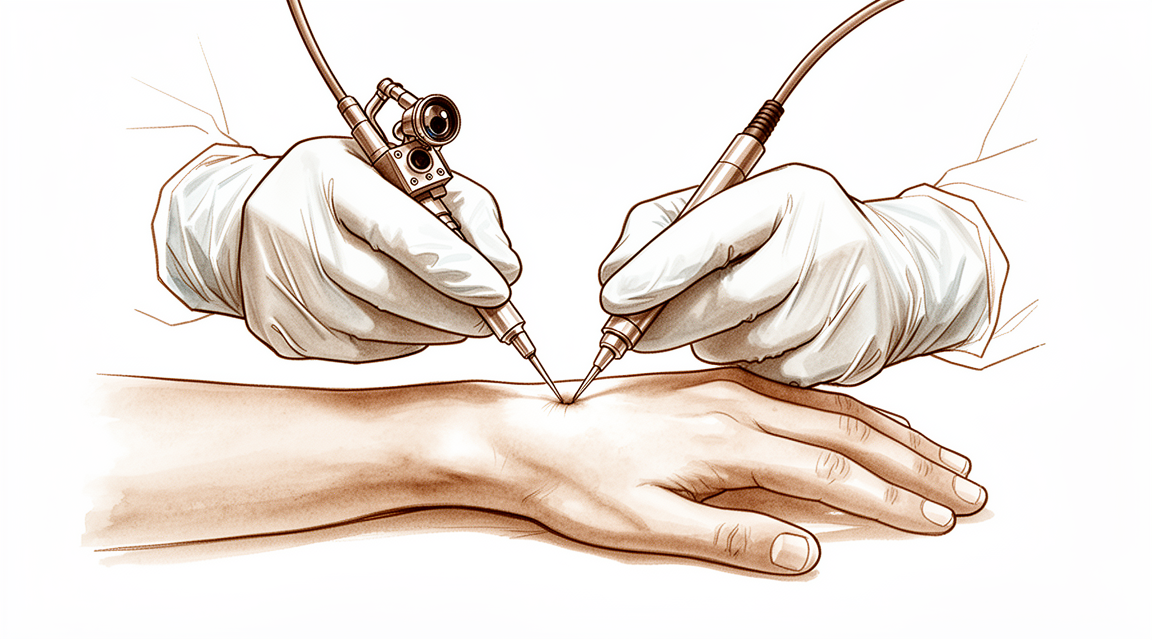
Ang protocol na ito ay nagsisilbing gabay sa iyong paggaling pagkatapos ng keyhole (arthroscopic) surgery sa pulso kasama si Dr Kieran Hirpara sa Mater Private Hospital Rockhampton. Ang wrist arthroscopy ay ginagawa sa pamamagitan ng ilang maliliit na hiwa (portals) sa likod ng pulso, kaya mabilis gumaling ang balat, ngunit ang bilis ng iyong paggaling ay nakadepende sa kung ano ang ginawa sa loob ng joint. Nagsisimula ito sa iyong home exercise program, na susundan ng structured clinical protocol na isinulat para sa iyong hand therapist. Dalhin ang pahinang ito o ang PDF nito sa iyong unang therapy visit upang manatiling coordinated ang iyong rehabilitasyon, at upang masunod ng iyong therapist ang planong tugma sa iyong operasyon. Maaaring i-adjust ng iyong therapist ang plano depende sa pag-unlad ng iyong paggaling.
Kung mayroon kang anumang alalahanin tungkol sa iyong mga sugat pagkatapos ng surgery, makipag-ugnayan sa mga rooms. Madalas na nakatutulong ang pagkuha ng larawan ng sugat at pag-email nito para masuri.
Ano ang dapat asahan
Ang wrist arthroscopy ay nangangahulugang nagtatrabaho ang surgeon sa loob ng iyong pulso sa pamamagitan ng maliliit na keyhole portal gamit ang isang maliit na camera at mga pinong instrumento. Dahil maliliit ang mga hiwa, mabilis gumaling ang balat at mga soft tissue, ngunit ang loob ng pulso ang nagtatakda ng iskedyul, at mayroong dalawang magkaibang landas ng paggaling:
-
Isang clean-up (debridement, synovectomy, pagtanggal ng dorsal ganglion, o isang central TFCC tidy-up). Dito, walang anumang tinahi pabalik na kailangang protektahan; ang mga damaged o inflamed na tissue ay pinuputol o tinatanggal lamang. Kaya ang immobilisation ay maikli (madalas ay soft dressing o maikling splint lamang para sa ginhawa), ang paggalaw ng pulso ay nagsisimula sa loob ng ilang araw, at babalik ka sa karamihan ng mga aktibidad sa loob ng ilang linggo. Ang gitnang bahagi ng TFCC (ang cushion sa panig ng kalingkingan ng pulso) ay walang blood supply at hindi maaaring gumaling kung tatahiin, kaya kapag may punit doon, ito ay pinuputol sa halip na kinukumpuni, at ang pagputol na iyon ay kumikilos tulad ng isang clean-up.
-
Isang TFCC repair (isang peripheral o foveal tear na tinahi pabalik). Ang outer rim ng TFCC ay may blood supply at maaaring gumaling, kaya kapag may punit doon, ito ay kinukumpuni, at ang repair na iyon ay dapat protektahan. Ang pinakamalaking stress sa isang naghihilom na TFCC repair ay ang pagpihit ng forearm (pag-rotate ng palad pataas at pababa). Dahil dito, ang pulso at forearm ay pinapahinga sa isang splint o isang Muenster (above-elbow) cast sa loob ng humigit-kumulang apat hanggang anim na linggo; pinapayagan nito ang pagbaluktot ng siko ngunit hinaharangan ang rotation ng forearm na hihila sa repair. Ang paggalaw, at pagkatapos ay ang lakas, ay muling binubuo sa mga maingat na yugto, at ang full recovery ay tumatagal ng humigit-kumulang tatlong buwan o higit pa.
Sa buong dalawang landas, ang mga daliri ay pinapanatiling gumagalaw mula sa simula (hindi sila inoperahan), kinokontrol ang pamamaga, at inaalagaan ang mga maliliit na peklat ng portal. Susundin ng iyong hand therapist ang plano para sa kung ano ang aktwal na ginawa sa iyong pulso; kung hindi ka sigurado kung aling landas ang iyong tinatahak, magtanong kay Dr Hirpara o tingnan ang iyong operation note.
Mga pag-iingat at limitasyon
- Panatilihing gumagalaw ang iyong mga daliri mula sa simula: itikom ang kamao at iunat nang lubos, ilang beses sa isang araw. Palaging pinapayagan ito at pinipigilan nito ang paninigas at pamamaga.
- Sundin ang plano para sa kung ano ang ginawa. Pagkatapos ng isang clean-up, ang banayad na paggalaw ng pulso ay nagsisimula sa loob ng ilang araw. Pagkatapos ng isang TFCC repair, ang pulso at forearm ay mananatiling protektado sa isang splint o cast at HINDI mo dapat pihitin ang forearm (palad pataas / palad pababa) hanggang sa payagan ito ng iyong hand therapist (mga apat hanggang anim na linggo).
- Pagkatapos ng isang TFCC repair, HUWAG pilitin o lagyan ng bigat ang pag-ikot ng forearm, at HUWAG humawak nang mahigpit o magbuhat ng mabibigat hanggang sa payagan; ang pag-ikot at paglalagay ng bigat ay eksaktong nagbibigay ng stress sa repair.
- Panatilihing malinis at tuyo ang mga keyhole portal hanggang sa gumaling; HUWAG itong ibabad o kuskusin. Alagaan ang maliliit na peklat kapag gumaling na ang mga ito.
- HUWAG magmaneho habang ang iyong pulso ay naka-splint, naka-cast, o hindi kayang kontrolin nang ligtas ang manibela; mag-ayos ng tulong sa transportasyon sa mga unang linggo.
- Gamitin ang kamay para sa mga magagaan na pang-araw-araw na gawain hangga't komportable, basta't hindi ito kinapapalooban ng mga paggalaw o paglalagay ng bigat na sinabihan kang iwasan.
Para sa pamamahala ng sugat, pamamaga, at peklat, tingnan ang gabay ng practice sa wound care.
Iyong mga ehersisyo
Kieran Hirpara 4.0
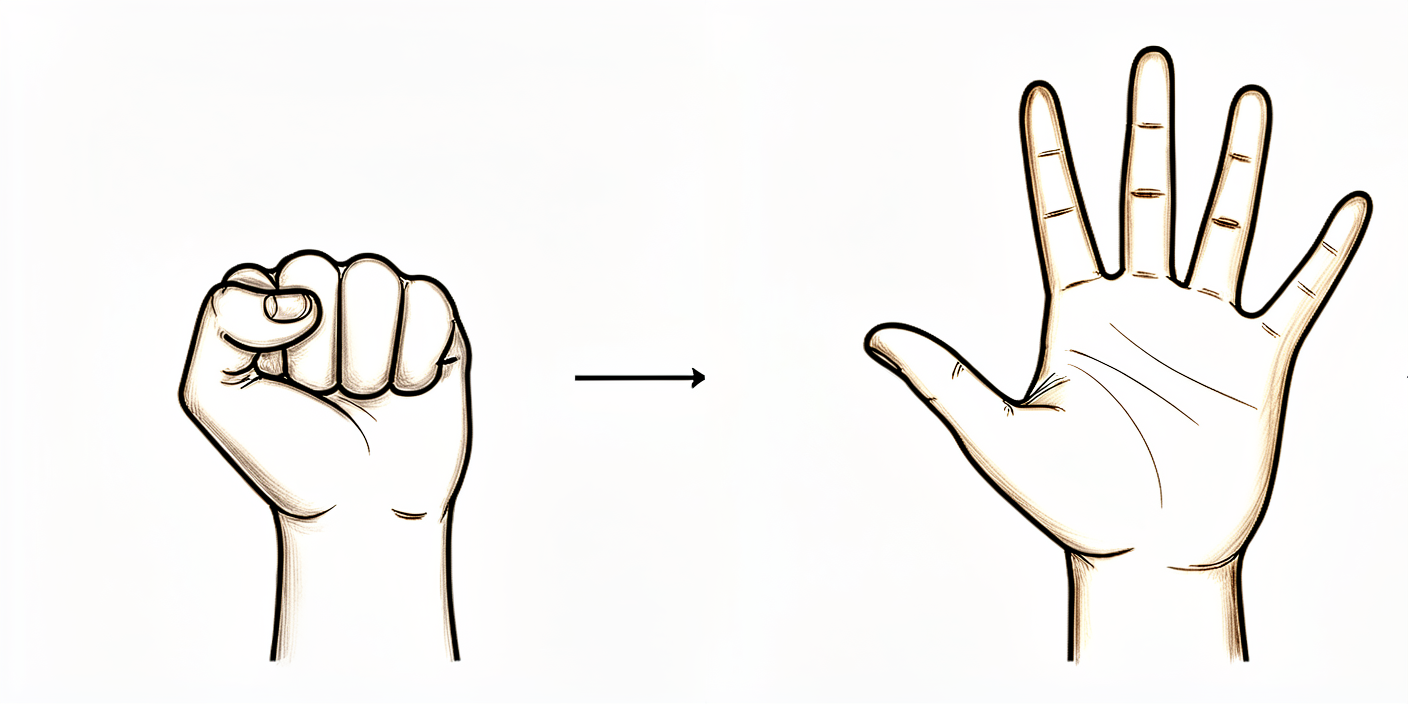
Paggalaw ng daliri (maaga)
Mula sa unang isa o dalawang araw, dahan-dahang itikom ang kamay nang buo, pagkatapos ay iunat nang husto ang iyong mga daliri. Ang mga daliri ay hindi bahagi ng kinumpuni, kaya hinihikayat ang pagpapanatili sa paggalaw ng mga ito mula sa simula — kinokontrol nito ang pamamaga at pinipigilan ang paninigas ng kamay. Gawin ito kahit na ang iyong pulso ay nakapahinga sa isang splint o cast.
10 beses, ilang beses sa isang araw, mula sa simula
Kieran Hirpara 4.0
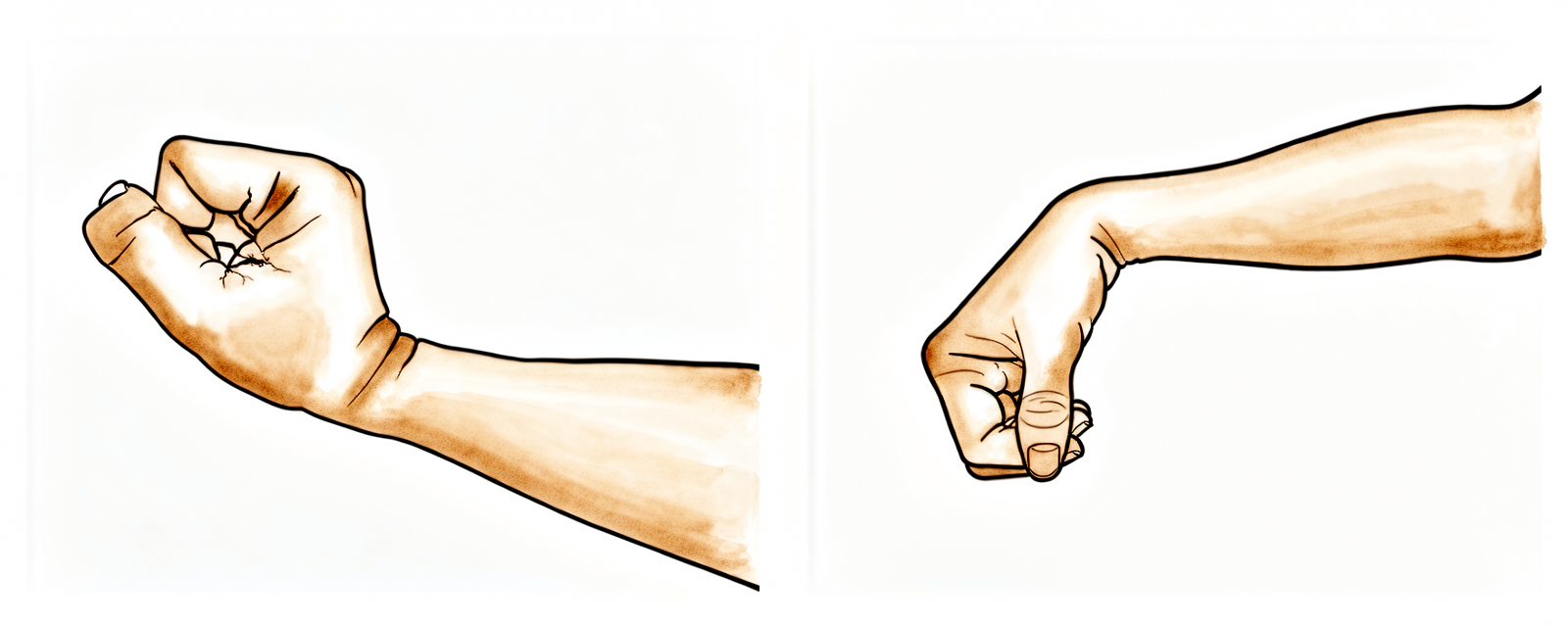
Paggalaw ng pulso (ayon sa iyong plano)
Kung sumailalim ka sa clean-up (debridement, synovectomy o pagtanggal ng ganglion), ang banayad na pagbaluktot ng pulso pataas at pababa — at pabalik-balik sa gilid — ay karaniwang nagsisimula sa loob ng ilang araw, sa oras na kaya na itong gawin nang walang labis na sakit. Kung sumailalim ka sa TFCC repair, ang pulso ay papahingahin muna sa isang splint o cast, at ang paggalaw ng pulso ay magsisimula nang mas huli, lamang kapag sinimulan na ito ng iyong hand therapist. Manatili palagi sa loob ng range na ibinigay sa iyo.
10 beses sa bawat direksyon, 2–3 beses sa isang araw, kapag nasimulan na
Kieran Hirpara 4.0
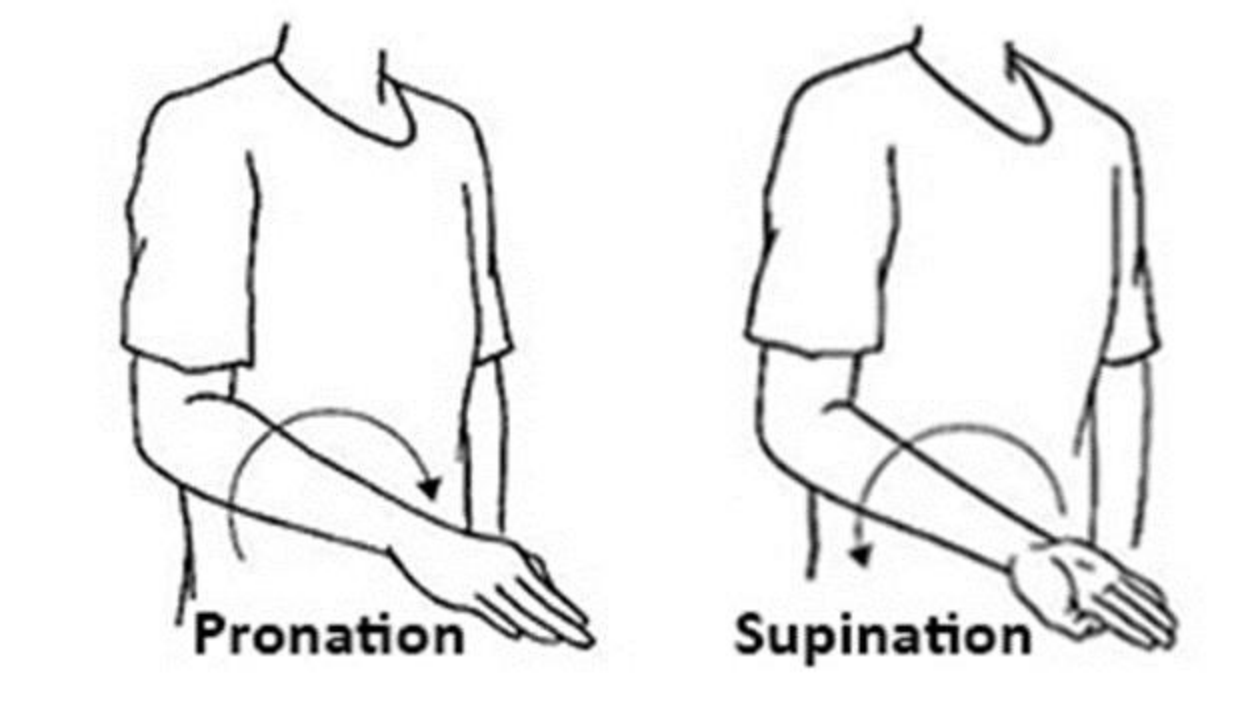
Rotasyon ng forearm — palad paitaas / palad paibaba (ayon sa iyong plano)
Habang nakadikit ang iyong siko sa iyong tagiliran, dahan-dahang iharap ang iyong palad paitaas sa kisame, pagkatapos ay paibaba sa sahig. Pagkatapos ng isang clean-up, karaniwang maaari itong simulan nang maaga. Pagkatapos ng isang TFCC repair, ito ang HULING galaw na pinapayagan — ang pagpihit ng forearm ay nagbibigay ng stress sa repair, kaya ito ay pinananatiling hindi gumagalaw sa isang splint o cast sa loob ng humigit-kumulang apat hanggang anim na linggo at pagkatapos ay unti-unting ibabalik. Gawin lamang ito kapag pinayagan na ito ng iyong hand therapist.
10 beses sa bawat direksyon, 2–3 beses sa isang araw, kapag pinayagan na
Kieran Hirpara 4.0
Pag-aalaga sa peklat at portal
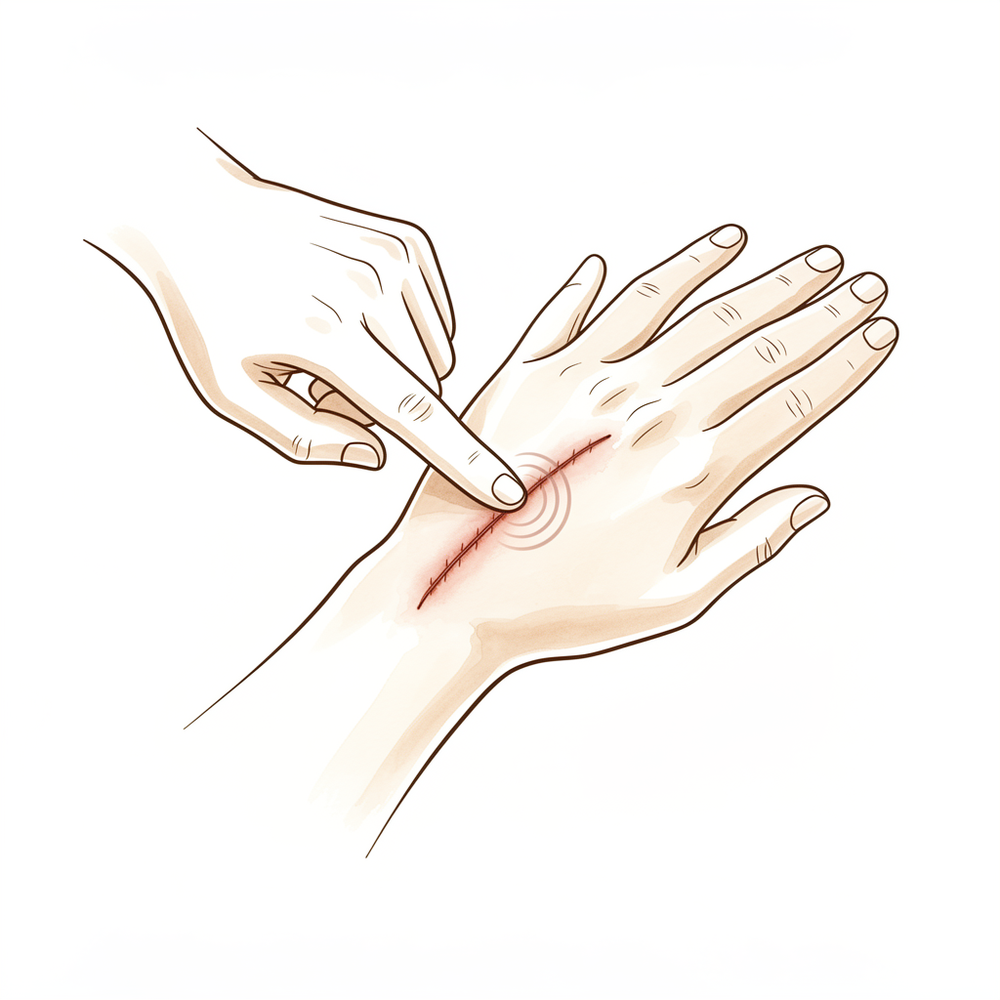
Kapag ang mga maliliit na sugat mula sa portal ay ganap nang naghilom at tuyo na, imasahe ang bawat maliit na peklat gamit ang dulo ng daliri at plain moisturizer, sa pamamagitan ng maliliit na pabilog na galaw. Ang mga keyhole portal ay maliit ngunit maaaring makaramdam ng paninigas o pagiging sensitibo — ang banayad na pagmasahe at pagtapik (desensitisation) ay nagpapanatili sa lambot ng balat at nagpapakalma sa anumang pananakit.
Ilang minuto, 2–3 beses sa isang araw, kapag magaling na ang mga sugat
Kieran Hirpara 4.0
Pagpapalakas ng grip (mamaya)
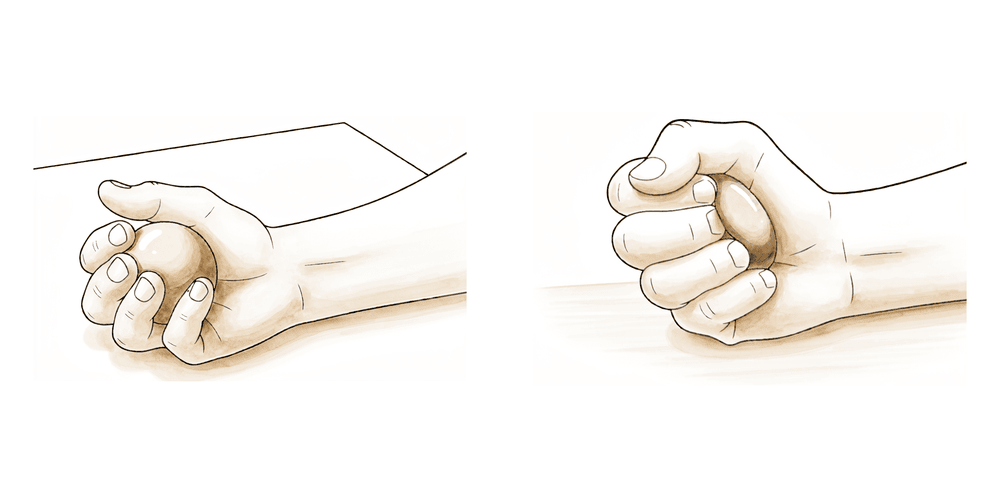
Isang ehersisyo sa HULING bahagi — kapag sinimulan na lamang ito ng iyong hand therapist. Pisilin ang isang malambot na bola o therapy putty, hawakan nang sandali, pagkatapos ay i-relax. Pagkatapos ng clean-up, ang light gripping ay madalas na nagsisimula sa loob ng ilang linggo; pagkatapos ng TFCC repair, ang strengthening ay naghihintay hanggang mga walong linggo, kapag bumalik na ang paggalaw. Unti-unting dagdagan ang puwersa at huminto kung ito ay may matalas na sakit.
10–15 piga, 2–3 beses sa isang araw, kapag pinayagan na
Ito ang mga ehersisyo mula sa iyong handout. Simulan lamang ang mga ito ayon sa gabay ni Dr Hirpara at ng iyong hand therapist, at manatili sa anumang range at limitasyong ibinigay sa iyo. Ang paggalaw ng daliri at pagkontrol sa pamamaga ay nagsisimula agad para sa lahat. Ang paggalaw ng pulso, pag-ikot ng forearm at grip ay nakadepende sa kung ano ang ginawa: maaga pagkatapos ng isang clean-up, ngunit pinipigilan pagkatapos ng TFCC repair (lalo na ang pag-ikot ng forearm, na huling pinapayagan). Ang pag-aalaga sa peklat at portal ay nagsisimula kapag gumaling na ang mga maliliit na sugat. Itigil ang anumang nagdudulot ng matalas na sakit.
Ang iyong clinical protocol
Ang natitirang bahagi ng pahinang ito ay ang staged clinical protocol para sa rehabilitasyon pagkatapos ng wrist arthroscopy. Ang seksyong ito ay ibibigay sa hand therapist, at ang bawat phase ay nagsisimula sa isang paliwanag sa simpleng Ingles tungkol sa kung ano ang nangyayari. Ang protocol ay naghahati base sa kung ano ang ginawa. Ang diagnostic-o-therapeutic clean-up (debridement, synovectomy, dorsal ganglion excision, chondral o scapholunate debridement, central TFCC debridement) ay sumusunod sa early-motion path. Ang peripheral/foveal TFCC repair ay sumusunod sa protected-rotation path, dahil ang rotation ng forearm ay nagbibigay ng load sa repair. Laging kumpirmahin sa operation note at sa treating surgeon kung aling path ang naaangkop.
Bago ang paggamot, suriin ang operation report at past medical history ng pasyente, at makipag-ugnayan sa treating surgeon tungkol sa procedure na isinagawa (pure debridement/synovectomy/ganglion/central-TFCC debridement vs peripheral/foveal TFCC repair), anumang kaugnay na DRUJ instability, at ang iniresetang immobilisation. Ang dalawang pathway sa ibaba ay nagkakaiba pangunahin sa kung gaano katagal pinoprotektahan ang forearm rotation.
Path A — Clean-up (debridement / synovectomy / ganglion / central-TFCC debridement): early-motion
Ang clean-up path ay nag-aalis o nagtatabas ng tissue nang hindi gumagawa ng construct na kailangang protektahan, kaya ang layunin ay maibalik ang paggalaw nang maaga at maiwasan ang paninigas. Ang immobilisation ay maikli at para sa comfort lamang.
Phase I — maagang paggalaw (linggo 0 hanggang 2)
Ang unang ilang linggo ay para sa pagpapababa ng pamamaga at sakit habang ang paggalaw ay nagsisimula halos agad.
Para sa iyong hand therapist:
Edukasyon at mga pag-iingat - Ang immobilisation ay soft dressing o maikling splint para sa comfort lamang, karaniwan hanggang ~2 linggo; walang restriksyon sa rotation para sa pure central debridement/synovectomy/ganglion - Ang mga daliri, thumb at (kung komportable) wrist ay igagalaw mula unang araw - Panatilihing malinis at tuyo ang mga portal hanggang sa gumaling
Pamamahala - Oedema: elevation, gentle finger pumping, ice kung kinakailangan - Mga ehersisyo: full active finger and thumb ROM mula sa simula; active wrist flexion/extension at radial/ulnar deviation ayon sa kakayahang maging komportable sa loob ng mga unang araw; gentle forearm pronation/supination ayon sa kakayahang maging komportable - Sugat: portal dressings ayon sa itinuro; i-monitor para sa impeksyon
Mga kriterya para mag-progress - Mga portal ay gumaling na; humuhupa ang pamamaga; komportableng early ROM
Phase II — pagbabalik ng paggalaw at pagsisimula ng lakas (linggo 2 hanggang 6)
Ibabalik sa normal ang paggalaw at magdaragdag ng light strengthening kapag komportable na ang range.
Para sa iyong hand therapist:
Mga Assessment - Active at passive wrist ROM at forearm rotation; grip; sakit at pamamaga; pagsusuri ng scar/portal
Pamamahala - Mga Ehersisyo: mag-progress patungo sa full wrist and forearm ROM; simulan ang light grip at putty strengthening mula humigit-kumulang 2 linggo; simulan ang scar/portal desensitisation at massage kapag magaling na - I-progress ang functional hand use ayon sa kakayahang maging komportable
Mga kriterya para mag-progress - Malapit sa full painless ROM; humupa na ang pamamaga; bumubuo ng grip
Phase III — pagpapalakas at pagbabalik (linggo 6 at higit pa)
Ibinabalik ang lakas at tolerance sa mga gawain; karamihan sa mga pasyente ay bumabalik sa normal na aktibidad sa loob ng ilang linggo. Tandaan na ang clean-up ay nagbibigay ng maaasahang relief sa mga sintomas ngunit hindi garantisado para sa diffuse o recalcitrant ulnar-sided pain; pamahalaan ang mga ekspektasyon kung ang sakit ay non-focal.
Para sa iyong hand therapist:
Pamamahala - Mga ehersisyo: graded grip at pagpapalakas ng forearm/wrist; task- at work-specific loading - Pagbabalik sa light/most activity ay karaniwang 2–6 linggo; mas mabigat na manual o sporting load ayon sa tolerance at criterion-based - Isaalang-alang ang discharge kapag ang lakas ay malapit nang maging symmetrical at naibalik na ang function
Path B — Peripheral / foveal TFCC repair: protected rotation
Tinatahi ng repair ang outer (vascularised) rim ng TFCC pabalik sa ibaba. Dahil nagbibigay ng stress sa repair ang rotation ng forearm, ang forearm ay pinoprotektahan sa isang splint o Muenster (above-elbow) cast (na nagpapahintulot ng elbow flexion/extension ngunit humaharang sa pronation/supination) sa loob ng humigit-kumulang apat hanggang anim na linggo. Ang motion, at pagkatapos ay strength, ay unti-unting ibabalik nang graded.
Phase I — protektadong immobilisasyon (linggo 0 hanggang 6)
Ang repair ay protektado mula sa rotational load habang nananatiling mobile ang mga daliri. Nag-iiba ang praktis, ngunit ang pinakakaraniwang pattern ay forearm immobilisation sa neutral-to-slight-supination sa loob ng humigit-kumulang anim na linggo; ginagamit ang above-elbow (Muenster) cast o splint kapag kailangang mahigpit na makontrol ang rotation.
Para sa iyong hand therapist:
Edukasyon at mga pag-iingat - I-immobilise upang protektahan ang forearm rotation: splint o Muenster/above-elbow cast (malaya ang siko, blocked ang forearm rotation), forearm sa neutral hanggang slight supination, sa loob ng ~4–6 linggo (karaniwang 6) - Walang active o passive forearm pronation/supination sa phase na ito - Full finger at thumb ROM mula unang araw; gentle shoulder ROM - Panatilihing malinis at tuyo ang mga portal; i-monitor para sa impeksyon
Pamamahala - Oedema: elevation, finger pumping, ice kung kinakailangan - Mga ehersisyo: finger/thumb AROM; isolated elbow flexion/extension kung pinahihintulutan ng Muenster; walang wrist o forearm rotation loading - Sugat/peklat: portal care; simulan ang scar work kapag magaling na
Mga kriterya para mag-progress - ~4–6 linggo na ang nakalipas; protektado ang repair; magaling na ang mga portal; supple ang mga daliri
Phase II — graded motion (linggo 6 hanggang 8)
Tatanggalin na ang cast/splint at muling bubuuin ang paggalaw, ipapasok ang forearm rotation sa huli at unti-unti, dahil ito ang paggalaw na nagbibigay ng stress sa repair.
Para sa iyong hand therapist:
Mga Assessment - ROM ng wrist at forearm; pananakit at pamamaga; pagsusuri ng scar
Pamamahala (Management) - Mga Ehersisyo: simulan ang active wrist flexion/extension at radial/ulnar deviation; unti-unting ibalik ang forearm pronation/supination base sa comfort, palalawakin ang rotation arc sa mga sumunod na linggo sa halip na pilitin ito - Ipagpatuloy ang scar/portal desensitisation
Mga kriterya para mag-progress - Comfortable, bumubuting ROM ng wrist at forearm; humuhupa ang pananakit
Phase III — pagpapalakas at pagbabalik (linggo 8 hanggang 12+ at higit pa)
Nagsisimula ang pagpapalakas kapag humigit-kumulang 70–100% ng galaw ng pulso at forearm ang naibalik, pagkatapos ay unti-unting ibabalik ang load at task tolerance.
Para sa iyong hand therapist:
Mga Assessment - Lakas ng grip at forearm kumpara sa kabilang panig; tugon ng sakit/pamamaga sa loading; functional at work-/sport-specific na pag-test
Pamamahala - Mga Ehersisyo: simulan ang pagpapalakas ng grip at forearm/pulso mula sa humigit-kumulang 8 linggo, kapag nabawi na ang 70–100% ng ROM; magpatuloy sa graded resisted at task-specific na loading - Ang pagbabalik sa sport/mas mabigat na trabaho ay base sa criterion, karaniwan ay humigit-kumulang tatlong buwan (range ~3–4+ buwan depende sa demand) - Isaalang-alang ang discharge kapag ang lakas ay malapit nang maging symmetrical at naibalik na ang function; i-refer muli sa treating doctor kung ang recovery ay nag-plateau o bumalik ang DRUJ instability
Pagbabalik sa trabaho at aktibidad
Hinihikayat ang magaan na pang-araw-araw na paggamit ng kamay (pagkain, pagsusulat, magaan na pag-aalaga sa sarili) mula sa simula hangga't komportable, basta't nananatili ito sa loob ng mga limitasyong ibinigay sa iyo. Maaari nang magmaneho kapag wala ka na sa anumang splint o cast at ligtas nang makokontrol ang manibela, gaya ng kumpirmasyon sa iyong review; magplano ng tulong sa transportasyon sa mga unang linggo.
Ang bilis ng iyong pagbabalik ay depende sa kung ano ang ginawa. Pagkatapos ng isang clean-up (debridement, synovectomy, ganglion o central-TFCC tidy-up), karamihan sa mga tao ay nakakabalik sa normal na magaan na aktibidad sa loob ng dalawa hanggang anim na linggo, at unti-unting ibinabalik ang mas mabigat na load ayon sa kakayanan ng komportable. Pagkatapos ng isang TFCC repair, pinoprotektahan ang rotation ng forearm sa loob ng humigit-kumulang apat hanggang anim na linggo, nagsisimula ang strengthening mula sa humigit-kumulang walong linggo, at ang pagbabalik sa sports o mas mabigat na manual work ay karaniwang nasa tatlong buwan, na hinuhusgahan sa pamamagitan ng pagbawi ng paggalaw at sapat, simetrikong lakas, hindi base sa kalendaryo lamang, at pagdedesisyunan nina Dr Hirpara at ng iyong hand therapist nang magkasama.
Pagkatapos ng iyong protocol
Ang protocol na ito ay kasabay ng pangkalahatang payo sa paggaling ng klinika: tingnan ang pamamahala ng sakit pagkatapos ng operasyon, pag-aalaga ng sugat at pamamahala ng peklat. Kung ang iyong operasyon ay kinasangkutan ng distal radioulnar joint o hindi ka sigurado kung aling pathway ang naaangkop, ang protocol para sa distal radioulnar joint (DRUJ) hemiresection ay isang kaugnay na sibling. Ang phased plan sa itaas ay sumasalamin sa nailathalang gabay sa rehabilitasyon pagkatapos ng wrist arthroscopy at TFCC surgery, at ang iyong patuloy na paggaling ay ginagabayan nang indibidwal ni Dr Hirpara at ng iyong hand therapist ayon sa pag-unlad ng iyong pulso.
Evidence & references
This is the clinical evidence summary written for health professionals. It is technical, and it lists the research this page was built from. You do not need to read it to understand your treatment or to make a decision about it.
Wrist Arthroscopy — Procedure Outcomes & Post-operative Rehabilitation (Diagnostic / Therapeutic Keyhole Wrist Surgery)
Topic scope: post-operative rehabilitation after arthroscopic wrist surgery through small dorsal portals — covering debridement (central TFCC, chondral, scapholunate), synovectomy, dorsal ganglion excision, and peripheral/foveal TFCC repair. The defining feature of this topic is that a single operative approach (keyhole access) covers procedures with opposite rehabilitation needs: a clean-up creates nothing to protect and follows an early-motion pathway, whereas a repair creates a construct loaded by forearm rotation and must be protected. The rehabilitation pathway is therefore gated by what was done, not by the fact that arthroscopy was used.
Defining principle of the rehab here: wrist arthroscopy is a route, not a single operation. Where tissue is only removed (debridement of an avascular central TFCC tear, synovectomy, a dorsal ganglion, a chondral or scapholunate tidy-up), nothing has been reconstructed — immobilisation is brief and for comfort, wrist motion begins within days, and return is measured in weeks. Where the vascularised peripheral or foveal TFCC is repaired, the dominant stress on the construct is forearm rotation (pronation/supination), so the forearm is protected — typically a splint or Muenster (above-elbow) cast that frees the elbow but blocks rotation — for about 4–6 weeks, after which motion and then strength are graded back over roughly three months. The single branch point a therapist must establish from the operation note is debridement-class vs repair-class, and within repair, how long rotation is to be protected. The rehabilitation evidence itself is low-level and heterogeneous — protocols rest on biology, surgeon preference and expert/therapist consensus more than on trials.
A. PROCEDURE OUTCOMES (debridement / synovectomy / ganglion vs TFCC repair)
Wrist arthroscopy is both the diagnostic gold standard and the therapeutic workhorse for intra-articular ulnar-sided wrist pathology. The principal outcome split is between clean-up procedures and repair.
- Wrist arthroscopy is a versatile, low-morbidity platform. Through small dorsal portals it permits direct inspection and treatment of TFCC tears, chondral lesions, synovitis and ganglia, with the keyhole approach giving fast soft-tissue healing and small scars [Gupta, Bozentka, Osterman — JAAOS 2001, DOI 10.5435/00124635-200105000-00006]. Narrative/mechanistic.
- Arthroscopic debridement of central (Palmer 1A) TFCC tears relieves symptoms in well-selected, focal cases. The central disc is avascular and cannot heal if sutured, so trimming is the rational treatment; classic and long-term series report good symptom relief and durable function in suitable patients [Osterman — Arthroscopy 1990, DOI 10.1016/0749-8063(90)90012-3; Soreide et al., 19-year follow-up — HAND 2017, DOI 10.1177/1558944717708029]. Moderate–weak (case series, long follow-up).
- Debridement is unreliable for diffuse, non-focal ulnar-sided wrist pain. Where pain is recalcitrant and not clearly localised to a focal central tear, simple arthroscopic debridement has little useful value on the clinical course — a caution against over-attributing diffuse ulnar wrist pain to a debridable lesion [Nishizuka et al. — Bone Joint J 2013, DOI 10.1302/0301-620x.95b12.31918]. Moderate (prospective cohort).
- Peripheral/foveal TFCC repair restores DRUJ stability and gives good outcomes when the rim is repairable. All-arthroscopic and arthroscopic-assisted repair techniques (e.g. FasT-Fix, all-inside suture) report reliable pain relief, return of grip and high return-to-activity rates in vascularised peripheral tears, especially with DRUJ instability [Yao, Dantuluri, Osterman — Arthroscopy 2007, DOI 10.1016/j.arthro.2007.02.010; Yao — Hand Clin 2011, DOI 10.1016/j.hcl.2011.05.004]. Moderate–weak (technique series).
- Procedure choice is driven by tear location and DRUJ stability. Central tears → debridement; peripheral/foveal tears, particularly with DRUJ instability → repair. In ulnar-positive wrists, peripheral repair may be combined with or weighed against ulnar shortening osteotomy [Papapetropoulos et al. — J Hand Surg Am 2010, DOI 10.1016/j.jhsa.2010.06.015]. Moderate.
- Arthroscopic dorsal ganglion excision gives recurrence rates comparable to (or, in some series, better than) open excision, with the keyhole advantage of faster recovery and smaller scars. Arthroscopic resection reliably removes the cyst and addresses the stalk at its capsular origin [Nishikawa et al. — J Hand Surg Br 2001, DOI 10.1054/jhsb.2001.0620; Luchetti et al. — J Hand Surg Br 2000, DOI 10.1054/jhsb.1999.0290; Konigsberg et al. — HAND 2021, DOI 10.1177/15589447211003184; Suen, Fung, Lung — ISRN Orthop 2013, DOI 10.1155/2013/940615]. Moderate–weak (retrospective comparison + series).
B. REHABILITATION / THERAPY EVIDENCE
The central rehab question is how long, and against what, to protect the wrist — and the answer is set entirely by the procedure. The evidence base for the rehabilitation (as opposed to the surgery) is low-level and markedly heterogeneous, with no level-1 protocol and wide variation in immobilisation and progression timings; recommendations are best regarded as biologically-rationalised, consensus-driven guides rather than trial-proven schedules.
- Clean-up procedures follow an early-motion pathway. After debridement, synovectomy or ganglion excision there is no construct to protect: immobilisation is a soft dressing or short splint for comfort (≈2 weeks at most), wrist motion begins within days, and light grip strengthening is added at around 2 weeks. Return to most activity is measured in weeks (≈2–6) [How-we-treat reviews and technique series; consistent across sources]. Weak–moderate (consensus + series).
- TFCC repair protects forearm rotation, not just the wrist. Because pronation/supination is the dominant load on a peripheral/foveal repair, the forearm is immobilised — commonly a splint or Muenster/above-elbow cast that frees the elbow but blocks rotation — for about 4–6 weeks (six is the most commonly reported figure), in neutral to slight supination [scoping review of arthroscopic peripheral TFCC repair rehabilitation, PMC12274733; Australian hand-therapist survey of foveal-repair rehabilitation, J Hand Ther 2024]. Weak–moderate (scoping review + survey of practice).
- Forearm rotation is re-introduced last and graded. After the protected phase, wrist flexion/extension and deviation are restored first, with pronation/supination re-introduced gradually because it is the motion that stressed the repair. Strengthening typically begins once 70–100% of wrist and forearm ROM is regained (around 8 weeks) [scoping review PMC12274733]. Weak (consensus from heterogeneous protocols).
- Rehabilitation protocols are heterogeneous and lack consensus. Across studies, complete immobilisation ranged 1–8 weeks (forearm most commonly 6), ROM commencement and strengthening start varied widely (strengthening 3–12 weeks), and authors explicitly call for level-1 evidence. The practical implication is to follow the operating surgeon's prescription for the specific repair rather than a fixed universal schedule [scoping review PMC12274733; Australian hand-therapist survey]. Weak (the evidence's own conclusion).
Recovery trajectory (expected, evidence-anchored)
| Phase | Window | Restraint | Hand use / therapy focus | Strength / load | Notes |
|---|---|---|---|---|---|
| Clean-up I — early motion | Week 0–2 | Soft dressing / short splint for comfort | Fingers move day 1; early wrist flexion/extension, deviation and gentle forearm rotation within days; portal care | Light functional use | No construct to protect; rotation not restricted for central debridement/synovectomy/ganglion |
| Clean-up II–III — restore & return | Week 2–6+ | Restrictions lifted | Full wrist/forearm ROM; scar/portal desensitisation once healed | Light grip/putty from ~2 wk, graded loading thereafter | Return to most activity 2–6 wk; debridement unreliable for diffuse (non-focal) ulnar pain |
| Repair I — protected immobilisation | Week 0–6 | Forearm rotation blocked (splint / Muenster cast, neutral–slight supination) | Full finger/thumb ROM day 1; elbow flexion/extension if Muenster permits; no pronation/supination | None to the repair | ~4–6 wk (commonly 6); rotation is the dominant repair load |
| Repair II — graded motion | Week 6–8 | Rotation re-introduced gradually | Active wrist flexion/extension & deviation; forearm rotation re-introduced last and built up | Light, no resisted load yet | Restore motion before strength |
| Repair III — strengthen & return | Week 8–12+ | Load progressed by criteria | Grip/forearm strengthening once 70–100% ROM regained; task-specific loading | Strengthening from ~8 wk; graded resisted load | Return to sport/heavy work ~3 months (range ~3–4+); grip ~85% of opposite side, ~87% return to pre-injury activity |
(Phase windows mirror the precautions and recovery structure in the patient protocol; they are typical, consensus-derived guides — not trial-derived deadlines, and the surgeon's prescription overrides them.)
C. KEY CONTROVERSIES / EVIDENCE QUALITY
- Debridement vs repair is decided by tear location and DRUJ stability, not access. Central (avascular) tears are trimmed; peripheral/foveal (vascularised) tears, especially with DRUJ instability, are repaired. The same keyhole approach therefore launches opposite rehab pathways — the therapist must establish which from the operation note. Strong biological rationale, moderate clinical evidence.
- Debridement is not a panacea for ulnar wrist pain. It relieves focal central-tear symptoms but has little value for diffuse, recalcitrant ulnar-sided pain — a key expectation-setting point [Nishizuka 2013]. Moderate.
- How long to protect forearm rotation after repair is unsettled. Reported immobilisation ranges 1–8 weeks (forearm most commonly 6); there is no level-1 consensus, and practice (including Australian hand-therapist practice) varies. The defensible position is to protect rotation ~4–6 weeks and follow the operating surgeon. Weak (heterogeneous).
- Arthroscopic vs open ganglion excision. Recurrence is broadly comparable, with arthroscopy offering faster recovery and smaller scars; the evidence is retrospective rather than randomised [Konigsberg 2021; Nishikawa 2001; Luchetti 2000]. Moderate–weak.
- The rehabilitation evidence base is the weak link, not the surgery. Outcome studies of the operations outnumber and outrank the rehabilitation studies; rehab timings are biologically and consensus-driven, and the literature itself calls for level-1 trials [scoping review PMC12274733]. Weak.
D. EVIDENCE STRENGTH FLAGS (summary)
- MODERATE: versatility and low morbidity of wrist arthroscopy as a diagnostic/therapeutic platform; symptom relief from debridement of focal central TFCC tears (with long-term series); limited value of debridement for diffuse ulnar wrist pain; comparable recurrence of arthroscopic vs open dorsal ganglion excision; good outcomes of peripheral/foveal TFCC repair when the rim is repairable.
- WEAK / CONSENSUS: the specific rehabilitation schedules — clean-up early-motion (~2-wk comfort splint, motion within days, return 2–6 wk) and repair protected-rotation (splint/Muenster ~4–6 wk, ROM then strength from ~8 wk, return ~3 months). Immobilisation duration and progression timings are heterogeneous across the literature with no level-1 consensus; figures are typical guides, and the operating surgeon's prescription governs.
- EXPECTATION-SETTING (natural history): grip recovers to ≈85% of the opposite side and ≈87% of patients return to pre-injury activity after TFCC repair; debridement of diffuse (non-focal) ulnar wrist pain may not relieve symptoms.
CITATIONS
RAG corpus (180,000+ Orthopaedic articles)
- Wrist arthroscopy: principles and clinical applications. J Am Acad Orthop Surg. 2001. DOI: 10.5435/00124635-200105000-00006
- Arthroscopic debridement of triangular fibrocartilage complex tears. Arthroscopy. 1990. DOI: 10.1016/0749-8063(90)90012-3
- Arthroscopic-assisted resection of triangular fibrocartilage complex lesions: a 19-year follow-up. HAND. 2017. DOI: 10.1177/1558944717708029
- Simple debridement has little useful value on the clinical course of recalcitrant ulnar wrist pain. Bone Joint J. 2013. DOI: 10.1302/0301-620x.95b12.31918
- A novel technique of all-inside arthroscopic triangular fibrocartilage complex repair. Arthroscopy. 2007. DOI: 10.1016/j.arthro.2007.02.010
- All-arthroscopic repair of peripheral triangular fibrocartilage complex tears using FasT-Fix. Hand Clin. 2011. DOI: 10.1016/j.hcl.2011.05.004
- Management of peripheral triangular fibrocartilage complex tears in the ulnar positive patient: arthroscopic repair versus ulnar shortening osteotomy. J Hand Surg Am. 2010. DOI: 10.1016/j.jhsa.2010.06.015
- Arthroscopic diagnosis and treatment of dorsal wrist ganglion. J Hand Surg Br. 2001. DOI: 10.1054/jhsb.2001.0620
- Arthroscopic resection of dorsal wrist ganglia and treatment of recurrences. J Hand Surg Br. 2000. DOI: 10.1054/jhsb.1999.0290
- Recurrence rates of dorsal wrist ganglion cysts after arthroscopic versus open surgical excision: a retrospective comparison. HAND. 2021. DOI: 10.1177/15589447211003184
- Treatment of ganglion cysts. ISRN Orthop. 2013. DOI: 10.1155/2013/940615
Wrist arthroscopy / TFCC rehabilitation literature (URLs)
- Clinical and functional outcomes of rehabilitation strategies following arthroscopic repair of chronic isolated peripheral TFCC tears: a scoping review. J Orthop. 2025. PMC. https://pmc.ncbi.nlm.nih.gov/articles/PMC12274733/
- Current rehabilitation recommendations following primary triangular fibrocartilage complex foveal repair surgery: a survey of Australian hand therapists. J Hand Ther. 2024. https://www.jhandtherapy.org/article/S0894-1130(23)00117-5/fulltext
- TFCC injuries: how we treat? J Clin Orthop Trauma / PMC. 2020. https://pmc.ncbi.nlm.nih.gov/articles/PMC7384326/
- Review and update on the management of triangular fibrocartilage complex injuries in professional athletes. World J Orthop. 2024. https://www.wjgnet.com/2218-5836/full/v15/i2/110.htm
- Arthroscopic-assisted repair of the triangular fibrocartilage complex. J Hand Surg Glob Online. 2024. https://www.jhsgo.org/article/S2589-5141(24)00066-5/fulltext