Patients › Rehabilitation
Total Elbow Replacement (Arthroplasty)
Paggaling pagkatapos ng total elbow replacement: banayad na assisted motion sa isang simpleng sling sa simula, isang functional movement arc bilang layunin, at isang permanenteng lifelong lifting limit upang protektahan ang implant.
Ang protocol na ito ay nagsisilbing gabay sa iyong paggaling pagkatapos ng total elbow replacement (total elbow arthroplasty) kasama si Dr Kieran Hirpara sa Mater Private Hospital Rockhampton. Nagsisimula ito sa iyong home exercise program, na sinusundan ng structured clinical protocol na isinulat para sa iyong physiotherapist o hand therapist: dalhin ang pahinang ito o ang PDF nito sa iyong unang therapy visit upang manatiling coordinated ang iyong rehabilitasyon. Maaaring i-adjust ng iyong therapist ang plano depende sa pag-unlad ng iyong paggaling.
Kung mayroon kang anumang alalahanin tungkol sa iyong sugat pagkatapos ng operasyon, makipag-ugnayan sa mga rooms. Madalas na nakatutulong ang pagkuha ng larawan ng sugat at pag-email nito para masuri.
Ano ang dapat asahan
Ang total elbow replacement ay nag-aalis ng mga gasgas o sirang surface ng joint sa siko at pinapalitan ang mga ito ng isang metal-and-plastic implant. Ang dalawang bahagi (ang isa ay naka-angkla sa buto ng iyong itaas na braso, ang humerus, at ang isa ay sa buto ng iyong forearm, ang ulna) ay karaniwang pinagdurugtong ng isang maliit na hinge, kung kaya't tinatawag itong semi-constrained o "linked" replacement. Madalas itong ginagawa para sa malalang rheumatoid arthritis, para sa end-stage osteoarthritis, o para sa ilang mga bali sa siko sa mga matatandang pasyente kung saan hindi na maaaring kumpunihin ang buto.
Ang layunin ng iyong recovery ay upang mapatag ang siko, protektahan ang mga naghihilom na tissue, at maibalik ang isang komportable at walang sakit na functional arc ng paggalaw (sapat na pagbaluktot at pagtuwid upang magawa ang mga pang-araw-araw na gawain tulad ng pagkain, paghuhugas, at pagbibihis) sa halip na gawing kasinglakas hangga't maaari ang siko. Para sa pamamahala ng sugat, pamamaga, at peklat, tingnan ang gabay ng practice sa wound care.
Ang pinakamahalagang bagay na dapat maunawaan ay ito: ang implant ay idinisenyo para sa komportableng pang-araw-araw na pamumuhay, hindi para sa mabigat na trabaho. Ang mga pangmatagalang kaaway nito ay ang pagkapudpod ng plastic bearing at ang unti-unting pagluwag ng implant sa buto, at parehong dulot ito ng mabigat na karga. Dahil dito, ang isang agresibong strengthening program ay hindi nararapat pagkatapos ng isang total elbow replacement, at ang limitasyon sa pagbubuhat ay mananatili sa iyo habambuhay, hindi lamang habang ikaw ay naghihilom. Ang pagsunod sa limitasyong iyon ang pinakamalaking bagay na maaari mong gawin upang tumagal ang iyong bagong siko.
Ikaw ay gagamit ng simple sling para sa komportable pagkatapos ng operasyon, hindi isang rigid splint o brace. Ang banayad na assisted movement ay magsisimula sa loob ng unang linggo, at ang plano ay dahan-dahan at maingat na bubuuin mula roon.
Mga pag-iingat at limitasyon
Gawin:
- Isuot ang iyong simple sling para sa ginhawa, at gamitin ito ayon sa payo.
- Simulan ang mga banayad na assisted movement sa ibaba sa loob ng unang linggo, gaya ng ginagabay ni Dr Hirpara at ng iyong therapist.
- Panatilihing gumagalaw ang iyong kamay, pulso, at balikat upang maiwasan ang paninigas.
- Sundin ang panghabambuhay na limitasyon sa pagbubuhat (sa ibaba) kapag gumaling ka na.
Huwag gawin:
- Huwag magbuhat ng anumang mas mabigat kaysa sa isang tasa ng tsaa (1 lb / 0.45 kg) gamit ang inoperahang braso sa unang 6 na linggo.
- Huwag piliting itiklop ang iyong siko, at huwag itong biglang i-snap o itulak nang diretso.
- Huwag itulak ang sarili paitaas mula sa upuan gamit ang inoperahang braso, huwag magbuhat, tumulak, o isandal ang iyong bigat dito, o hayaang may humila o pumilipit nito.
- Kung ang iyong triceps muscle ay itinaas habang nag-oopera, huwag aktibong ituwid ang siko laban sa resistance hanggang sa payagan ka ng iyong surgeon (karaniwang 6–12 linggo).
- Permanente at panghabambuhay na mga limitasyon: huwag paulit-ulit na magbuhat ng higit sa humigit-kumulang 2 kg, at huwag magbuhat ng higit sa humigit-kumulang 4.5–5 kg sa isang pagbuhat. Ang mga limitasyong ito ay permanente, habambuhay. Huwag na kailanman mag-tennis, magbato, o maglaro ng mga impact sports.
Iyong mga ehersisyo
Kieran Hirpara 4.0
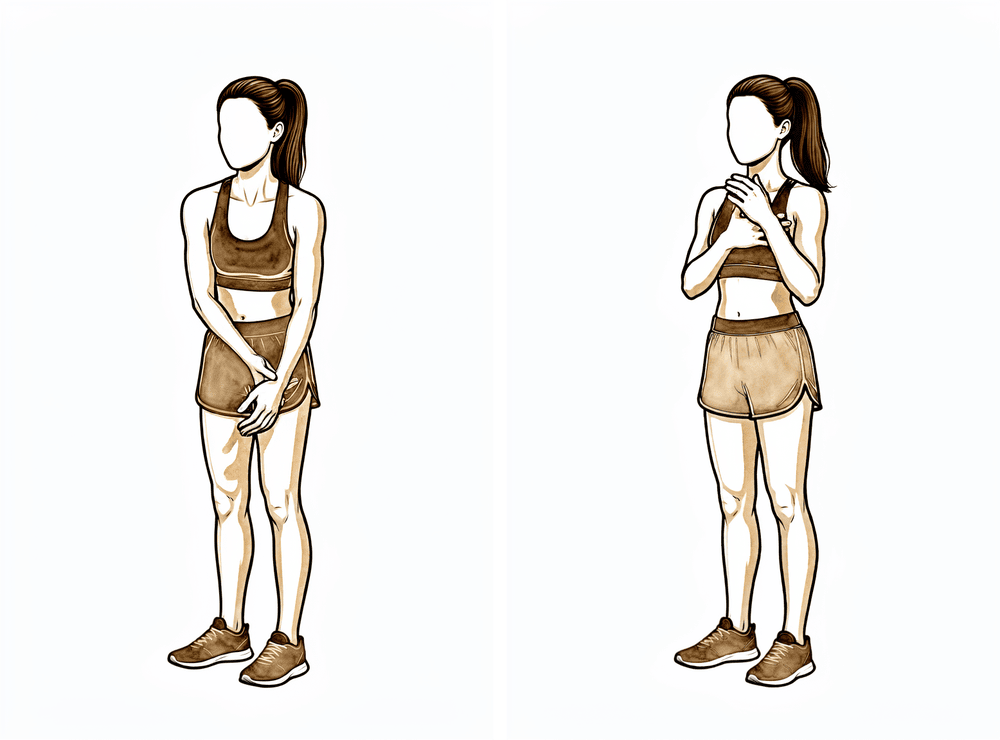
Tinutulungang pagbaluktot ng siko (passive flexion)
Habang nakadikit ang iyong itaas na braso sa iyong gilid, gamitin ang iyong kabilang kamay upang dahan-dahang tulungan ang pagbaluktot ng inoperahang siko pataas patungo sa iyong balikat, hanggang sa kung saan lamang ito komportable. Huwag itong pilitin. Dahan-dahan itong ibaba muli. Sasabihin sa iyo ng iyong therapist kung hanggang saan ang dapat na pagbaluktot.
5–10 beses, ilang beses sa isang araw, hanggang sa komportable
Kieran Hirpara 4.0
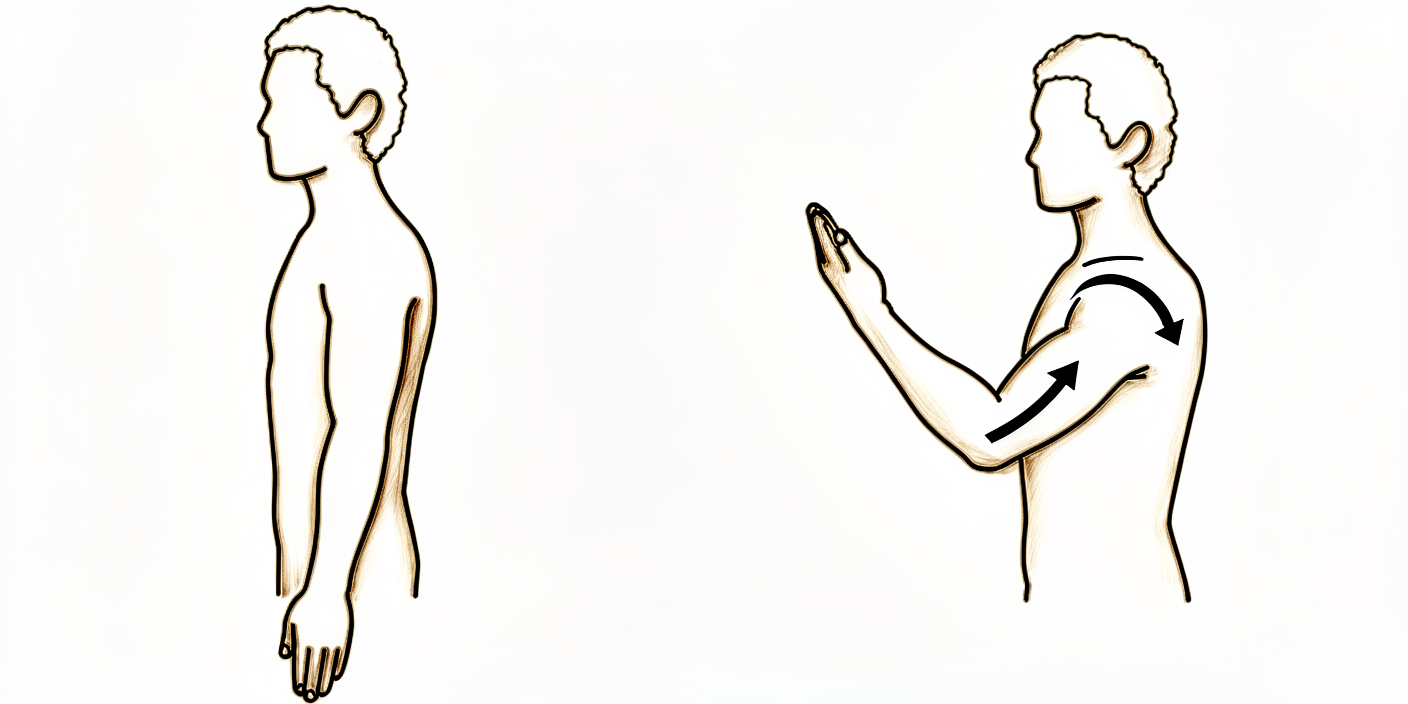
Dahan-dahang pagbaluktot at pagtuwid ng siko
Habang nakaharap pataas ang iyong palad at nakadikit ang iyong itaas na braso sa iyong gilid, dahan-dahang itiklop ang iyong siko hanggang sa kung saan ito komportable, pagkatapos ay hayaan itong bumalik sa pagkatuwid sa tulong ng grabidad. Panatilihing mabagal at hindi pilit ang paggalaw — hayaang ang braso ang gumawa ng trabaho, huwag itulak nang malakas sa dulo ng range.
5–10 beses, ilang beses sa isang araw
Kieran Hirpara 4.0
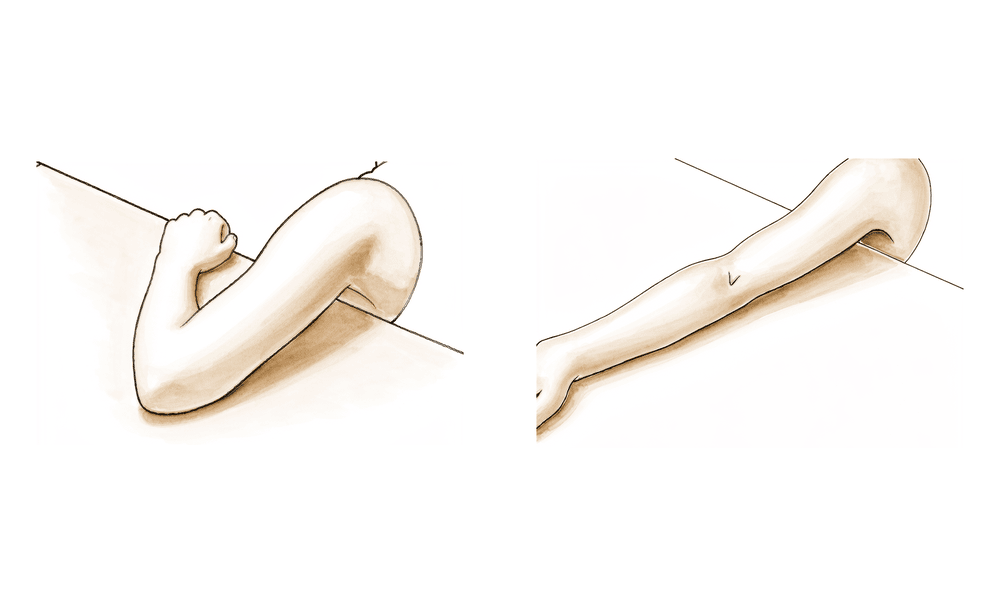
Pagtuwid ng siko na tinutulungan ng grabidad (active extension)
Ipahinga ang iyong upper arm nang may suporta (halimbawa sa isang cushion o sa armrest ng upuan) at hayaang bumaba ang iyong forearm upang dahan-dahang dumiretso ang siko sa tulong ng gravity. Huwag biglaang ituwid o piliting idiretso ang siko. Kung sinabi ng iyong surgeon na ang iyong triceps muscle ay itinaas (lifted) habang nag-oopera, panatilihin itong dahan-dahan at iwasang aktibong itulak ang siko nang diretso hanggang sa payagan ka na.
5–10 beses, ilang beses sa isang araw, hanggang sa komportable
Kieran Hirpara 4.0
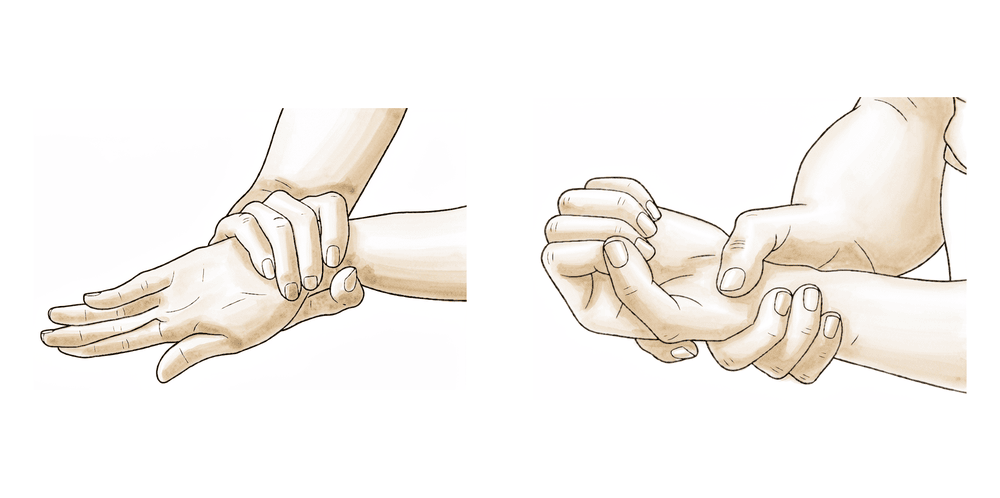
Rotasyon ng forearm (palad paitaas / palad paibaba)
Habang nakabaluktot ang iyong siko at nakadikit sa iyong tagiliran, dahan-dahang itapat ang iyong palad paitaas sa kisame, manatili sa posisyong ito nang sandali, pagkatapos ay itapat ito paibaba sa sahig. Panatilihing hindi gumagalaw ang iyong upper arm upang ang paggalaw ay manggaling sa forearm.
10 beses sa bawat direksyon, ilang beses sa isang araw
Kieran Hirpara 4.0
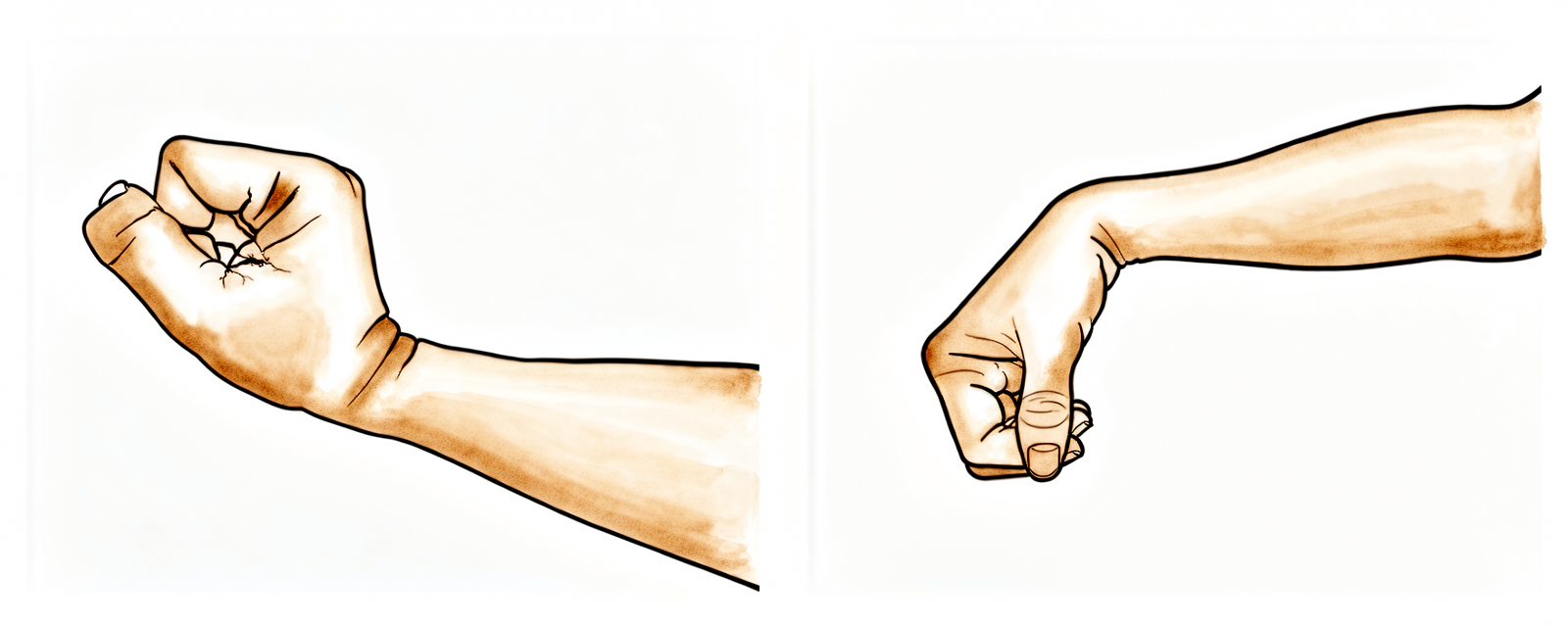
Paggalaw ng pulso
Dahan-dahang itiklop ang iyong pulso pasulong, pagkatapos ay pabalik, hanggang sa kung saan ito komportable. Pinapanatili nito ang paggalaw ng iyong pulso at kamay at tumutulong upang maiwasan ang paninigas at pamamaga habang gumagaling ang iyong siko.
10–15 beses, ilang beses sa isang araw
Kieran Hirpara 4.0
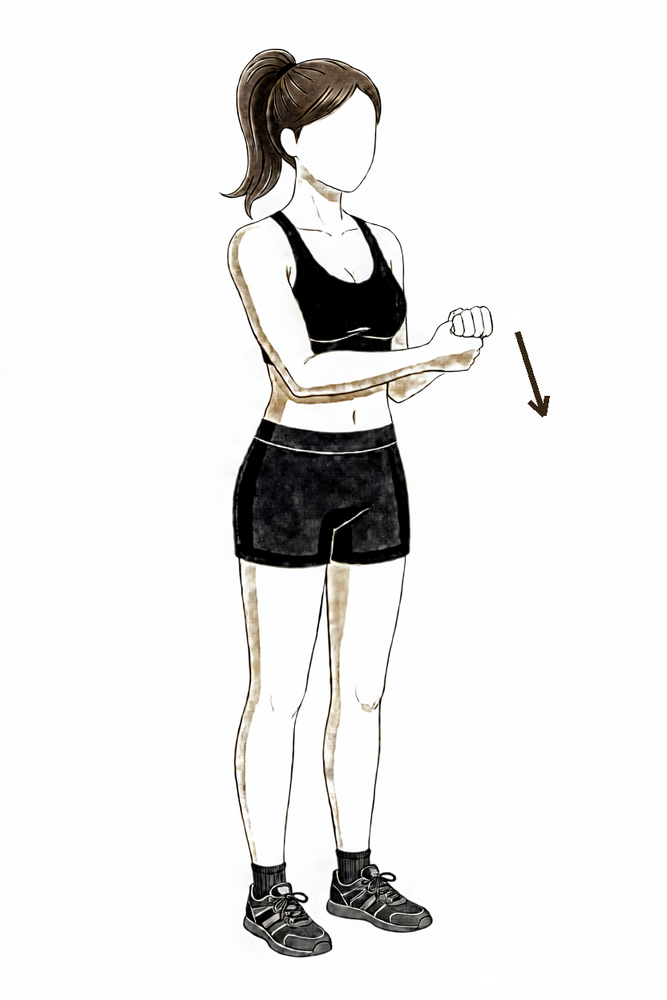
Paghihigpit ng kalamnan ng triceps (isometric)
Ito ay isang ehersisyo para sa huling bahagi — simulan lamang ito kapag sinabi ng iyong surgeon o therapist na handa na ang iyong triceps, karaniwan ay sa ika-6 na linggo o pagkatapos nito. Habang ang iyong siko ay nananatiling hindi gumagalaw sa isang komportableng pagbaluktot, dahan-dahang higpitan ang kalamnan sa likod ng iyong itaas na braso na tila ba itutuwid mo ang siko, ngunit nang hindi ito aktwal na iginagalaw. Hawakan nang dahan-dahan, pagkatapos ay i-relax.
Hawakan ng 5 segundo, 10 beses, kapag cleared na
Ito ang mga ehersisyo mula sa iyong handout, para sa dahan-dahang pagbabalik ng paggalaw ng iyong siko, forearm, pulso at kamay. Simulan ang mga ito ayon sa gabay ni Dr Hirpara at ng iyong therapist. Panatilihing banayad at hindi pilit ang bawat paggalaw; sa simula, ang layunin ay madali at tinutulungang paggalaw, hindi pagsisikap o pag-stretch.
Ang iyong clinical protocol
Ang natitirang bahagi ng pahinang ito ay ang clinical protocol para sa rehabilitasyon pagkatapos ng isang semi-constrained total elbow replacement (posterior approach, ipinagpapalagay na triceps-sparing). Ang seksyong ito ay ibibigay sa iyong physiotherapist o hand therapist, at ang bawat phase sa ibaba ay nagsisimula sa isang paliwanag sa simpleng Ingles tungkol sa kung ano ang nangyayari.
Bago ang paggamot, suriin ang operation report ng pasyente at ang nakaraang medical history, at makipag-ugnayan sa treating surgeon tungkol sa surgical approach, partikular kung ang triceps ay spared, reflected o reattached (Bryan–Morrey), dahil ito ang nagtatakda ng mga maagang extension restriction at resting position.
Phase I — Agad pagkatapos ng operasyon, mga linggong 0–6
Sa unang anim na linggo, ang pokus ay ang pagprotekta sa mga naghihilom na soft tissue at sa triceps, pagpapahupa ng sugat at pamamaga, at pagsisimula ng banayad na assisted motion upang hindi tumigas ang siko. Gumagamit si Dr Hirpara ng simpleng sling para sa ginhawa, hindi posterior splint o brace. Ang banayad na assisted (active-assisted) na pagbaluktot at pagtuwid ng siko ay nagsisimula sa pagitan ng araw 1 at 7, habang ang siko ay nakadikit sa gilid at ang forearm ay neutral-to-pronated, gamit ang gravity upang tumulong sa pagtuwid. Walang pagbubuhat na mas mabigat sa 1 lb (0.45 kg) gamit ang inoperahang braso, at walang weight-bearing o pagtulak gamit ito.
Para sa iyong physiotherapist:
Immobilisation at mga pag-iingat
- Simpleng sling para sa ginhawa (KH practice: walang posterior splint o brace). Kung ang surgeon ay gumamit ng brace o splint dahil sa alalahanian sa soft-tissue, sundin ang direktibong iyon; kung hindi, ang simpleng sling ay isusuot sa loob ng humigit-kumulang anim na linggo, at tatanggalin lamang para sa mga ehersisyo at kalinisan.
- Mga kaso ng triceps-reflected / reattached (hal. Bryan–Morrey): i-immobilise nang mas malapit sa extension, at iwasan ang active at resisted elbow extension sa simula upang protektahan ang repair (cf. distal-triceps-repair logic).
- Walang forced flexion (nagbibigay ng stress sa triceps repair) at walang bigla o forced extension.
- Walang upper-limb weight-bearing, walang pagtulak laban sa resistance, walang varus/valgus stress.
- Walang pagbubuhat ng mga bagay na > 1 lb (0.45 kg) gamit ang inoperahang braso.
Mga Ehersisyo
- Banayad na active-assisted ROM (AAROM) elbow flexion/extension mula araw 1–7, ang siko ay adducted sa gilid, ang forearm ay neutral-to-pronated; gravity-assisted extension stretch.
- Active range of motion para sa kamay, wrist, at balikat upang maiwasan ang paninigas.
Mga kraytirya para magpatuloy sa Phase II: hilom na ang sugat, kontrolado ang sakit, at naitatag na ang banayad na AAROM. Huwag magpatuloy sa strengthening bago ang 6 na linggo.
Phase II — Functional activity, mula 6 na linggo (hindi bago nito)
Ang phase na ito ay nagsisimula sa banayad na muscle activation at, kalaunan, napakagaang na strengthening, ngunit hindi kailanman isang vigorous program. Ang paggalaw ay unti-unting binubuo patungo sa isang functional arc, at ang resistance ay ipinapakilala nang maingat at pinapanatiling magaan. Ang lifting restriction ay nagpapatuloy sa buong panahon.
Para sa iyong physiotherapist:
Timeline sa loob ng Phase II
- 6 na linggo: simulan ang submaximal, pain-free isometrics sa mid-range, sa lahat ng planes. Kung ang triceps ay ni-reflect/ni-reattach, kumpirmahin na ito ay cleared bago magdagdag ng extension isometrics.
- 8 na linggo: mag-progress sa multi-angle submaximal isometrics, iwasan ang end-range.
- 10–12 na linggo: ipakilala ang light isotonic strengthening (walang weights o resistance > 5 lb (2.3 kg)), single-plane muna, pagkatapos ay composite.
Range-of-motion goal
- Functional arc: 30–120/130° flexion, na may 60° pronation at 60° supination.
- Kung ang flexion ay < 120° sa 10–12 na linggo, isaalang-alang ang isang dynamic o static-progressive splint.
Mga Pag-iingat
- Patuloy na iwasan ang heavy loading, pagtulak (pushing) at impact.
- Strengthening philosophy (verbatim): "The need for a vigorous strengthening program is not appropriate following total elbow arthroplasty."
Criteria para mag-progress: ang isang pain-free functional arc ay nakamit at napanatili.
Huling Bahagi ng Phase II at panghabambuhay, mula 12 linggo
Mula humigit-kumulang 12 linggo, ang siko ay lilipat sa isang maintenance home program upang panatilihin ang pain-free functional arc. Walang pormal na mabigat na strengthening, kailanman. Ang mga limitasyon sa aktibidad at pagbubuhat sa ibaba ay permanenteng ipatutupad na ngayon.
Para sa iyong physiotherapist:
- Home program upang mapanatili ang pain-free functional arc.
- Paigtingin ang mga permanenteng restriksyon sa aktibidad kasama ang pasyente.
- Isaalang-alang ang discharge kapag nakamit na ang isang stable at komportableng functional arc at ang angkop na pagbabalik ng pang-araw-araw na function.
Pagbabalik sa trabaho at aktibidad
Ang iyong bagong siko ay ginawa para sa komportableng pang-araw-araw na pamumuhay, at ang mga limitasyon sa ibaba ay permanente; ito ang mga dahilan kung bakit tatagal ang implant.
- Pagbuhat (habambuhay): huwag paulit-ulit na magbuhat ng higit sa humigit-kumulang 2 kg (dalawang punong tasa), at huwag magbuhat ng higit sa humigit-kumulang 4.5–5 kg sa isang pagbuhat (humigit-kumulang isang punong kettle), gamit ang inoperahang braso, kailanman. Sa unang 6 na linggo, ang limitasyon ay mas mahigpit: walang mas mabigat sa humigit-kumulang 1 lb (0.45 kg).
- Isport at impact: walang tennis, paghahagis, o impact loading sa anumang pagkakataon, habambuhay. Hinihikayat ang mga banayad at low-load na aktibidad kapag ikaw ay cleared na, ngunit ang siko ay hindi dapat mabigatan nang husto o mabigla.
- Pagmamaneho: ituloy lamang kapag ikaw ay komportable na, wala na sa sling para sa pagmamaneho, at ligtas nang makokontrol ang manibela. Kumpirmahin ang timing kay Dr Hirpara sa iyong review.
- Trabaho: ang mga light desk-based at self-care tasks ay maaaring ituloy nang maaga base sa iyong komportable. Anumang tungkulin na kinapapalooban ng pagbuhat, pagdadala, pagtulak o paulit-ulit na pagpapasan ng braso ay kailangang talakayin nang indibidwal kay Dr Hirpara, dahil ang mga lifelong limits ay nalalapat din sa trabaho.
Ang tapat na pagsunod sa mga limitasyong ito ang pinakamahalagang bagay na maaari mong gawin upang protektahan ang iyong replacement at maiwasan ang pagluwag o pagkapudpod sa paglipas ng mga taon.
Pagkatapos ng iyong protocol
Ang protocol na ito ay kasabay ng pangkalahatang payo sa paggaling ng klinika; tingnan ang pamamahala ng sakit pagkatapos ng operasyon at pag-aalaga ng sugat. Ang iyong patuloy na paggaling ay ginagabayan nang indibidwal ng iyong physiotherapist o hand therapist ayon sa pag-unlad ng iyong siko, at ang mga limitasyon sa aktibidad habambuhay ay dapat isaalang-alang sa bawat review.
Evidence & references
This is the clinical evidence summary written for health professionals. It is technical, and it lists the research this page was built from. You do not need to read it to understand your treatment or to make a decision about it.
Total Elbow Arthroplasty (TEA) — Rehabilitation Evidence
Topic scope: post-operative rehabilitation after semi-constrained (linked/hinged) total elbow replacement — most commonly for rheumatoid arthritis, end-stage osteoarthritis, or a non-reconstructable distal humerus fracture in an elderly patient. This brief covers the phased rehabilitation timeline, the early triceps-protection rationale, the functional-arc goal, and — critically — the lifelong lifting restriction that exists to protect the implant against polyethylene wear and aseptic loosening.
Defining principle: unlike most joint replacements, the goal of TEA rehabilitation is a pain-free functional arc (~30–130° flexion, 60°/60° rotation), not maximal strength. The implant's long-term enemies are polyethylene wear and aseptic loosening, both driven by load, so heavy loading is restricted permanently, not just during healing — "the need for a vigorous strengthening program is not appropriate following total elbow arthroplasty." Dr Hirpara's practice: a simple sling for comfort (not a posterior splint or brace), gentle active-assisted motion from day 1–7, isometrics from ~6 weeks, light isotonic (≤ 5 lb) from 10–12 weeks, triceps protection where the triceps was reflected or detached, and a lifelong lifting limit (no repetitive lift > ~2.3 kg; no single lift > ~4.5–5 kg; no tennis/throwing/impact ever).
Consensus phased timeline (week windows)
Anchored to the Brigham & Women's Hospital (BWH) Total Elbow Arthroplasty Protocol (Thornhill; semi-constrained, hinged/linked prosthesis; posterior triceps-sparing approach assumed) and cross-checked against the primary literature. Dr Hirpara's practice substitutes a simple sling for comfort in place of BWH's 60° posterior resting splint; the ROM and strengthening cadence and the lifelong limits are retained.
| Phase | Window | Sling / immobilisation | ROM and use | Strengthening | Lifting |
|---|---|---|---|---|---|
| I — Immediate post-surgical | Weeks 0–6 | Simple sling for comfort (KH — no posterior splint/brace); triceps-reflected cases immobilised nearer extension | Gentle AAROM flexion/extension from day 1–7, elbow adducted, forearm neutral-to-pronated, gravity-assisted extension; hand/wrist/shoulder AROM | None | No lifting > 1 lb (0.45 kg); no weight-bearing/pushing |
| II — Functional activity | From 6 weeks (not before) | Sling weaned | 6 wk: submaximal mid-range isometrics, all planes · 8 wk: multi-angle submaximal isometrics (avoid end-range) · target functional arc 30–120/130°, 60°/60° | 10–12 wk: light isotonic, no resistance > 5 lb (2.3 kg), single-plane → composite | Restriction continues |
| Late II / lifelong | 12 weeks onward | — | Maintain pain-free functional arc | No vigorous strengthening — ever | Lifelong limits apply (see below) |
Triceps-protection note. Where the triceps is reflected (Bryan–Morrey) rather than spared, early rehabilitation is stricter — immobilisation nearer extension and delayed/limited active and resisted extension to protect the reattachment (cf. distal-triceps-repair logic). Wiesel keeps the elbow in full extension ~24–36 h then begins active-assisted ROM, and adds no pushing/overhead for 3 months to protect the triceps; Wolfe & Ranawat's osteo-anconeus flap is immobilised ~16 days. Triceps insufficiency is a recognised TEA complication.
CRITICAL — lifelong lifting restriction numbers + sources
| Source | Repetitive limit | Single-event limit | Lifelong? |
|---|---|---|---|
| BWH Standard of Care (Thornhill) | no repetitive lifts > 5 lb | no single lift > 15 lb | yes — "no heavier than 15 lb for life"; "no tennis or throwing for life" |
| Wiesel, Operative Techniques in Orthopaedic Surgery (2011) | > 5 lb (~2.3 kg) | > 10 lb (~4.5 kg) | yes (also no pushing/overhead × 3 months to protect triceps) |
| Toulemonde et al., Int Orthop 2015 (100 semi-constrained TEA) | > 1 kg | 5 kg | yes; all weight-lifting avoided entirely for the first 3 months |
| Kumar & Mahanta, Indian J Orthop 2013 | — | 5 kg | permanent restriction of strenuous activity |
Bottom line / patient-facing range: the canonical teaching is a lifelong restriction of roughly ~5 lb (2.3 kg) repetitive and ~10–15 lb (4.5–5 kg) single event. The exact ceiling varies by source: BWH allows up to 15 lb once; Wiesel caps single lift at 10 lb; the European series (Toulemonde) is most conservative at 1 kg repetitive / 5 kg single. Dr Hirpara quotes the conservative patient-facing range: do not repetitively lift more than ~2 kg, or lift more than ~5 kg in a single event, for life; no tennis/throwing/impact ever.
Key controversies / evidence quality
- Lifting-limit variation. Numbers range from 1 kg / 5 kg (Toulemonde 2015) to 5 lb / 15 lb (BWH). The restriction exists to protect against polyethylene wear and aseptic loosening, the dominant long-term failure mode — hence its permanence.
- Triceps-sparing vs reflected approach. Surgical handling of the triceps dictates early rehab: triceps-sparing (BWH default) permits earlier gentle AAROM; reflected approaches require protecting the reattachment with immobilisation nearer extension and delayed active/resisted extension. Triceps insufficiency/weakness is a recognised complication.
- Longevity and compliance. TEA was historically reserved for elderly low-demand patients owing to implant-longevity concerns (survivorship ~85–96% at 5 y, ~70–92% at 10 y in RA). As indications expand to younger, more active and post-traumatic patients, non-compliance with activity limits drives higher complication and failure rates — which is precisely why the lifelong limit is emphasised to every patient.
Evidence strength flags
- MODERATE–STRONG (published protocol + restriction numbers): the BWH institutional Standard of Care provides an explicit phased timeline with verbatim lifting limits, independently corroborated by multiple peer-reviewed primary sources (JBJS, JHS, JSES, Int Orthop, JAAOS) for the lifelong restriction and the triceps-protection rationale.
- MODERATE (ROM / strengthening cadence): phase timings and the isometric → light-isotonic progression are consensus/expert-driven; no high-level RCT dictates the rehab cadence. The exact lifting ceiling varies by source.
- CONSENSUS: the simple-sling (vs posterior-splint) choice and the precise functional-arc targets reflect surgeon practice and institutional protocols rather than trial data.
CITATIONS
RAG corpus (180,000+ Orthopaedic articles)
- Toulemonde J, Ancelin D, Azoulay V, et al. Complications and revisions after semi-constrained total elbow arthroplasty: a mono-centre analysis of 100 cases. Int Orthop. 2015. (1 kg repetitive / 5 kg single; no weight-lifting first 3 months)
- Kumar S, Mahanta S. Primary total elbow arthroplasty. Indian J Orthop. 2013. (5-kg weight-lifting restriction)
- Schoch B, Wong J, Abboud J, et al. Results of total elbow arthroplasty in patients less than 50 years old. J Hand Surg Am. 2017. (longevity/survivorship driving the restriction)
- Seitz WH, Evans PJ, Bismar H, Peers S. Complications of total elbow arthroplasty in nonrheumatoid patients. J Hand Surg Am. 2014. (active patients, poor compliance → complications)
- Baghdadi YM, Veillette CJ, Malone AA, et al. Total elbow arthroplasty in obese patients. J Bone Joint Surg Am. 2014;96(9). (higher failure with high BMI)
- Barlow JD, Morrey BF, O'Driscoll SW, et al. Activities after total elbow arthroplasty. J Shoulder Elbow Surg. 2013;22(6):787–791.
- You D, King G, Dehghan N, et al. Optimizing outcomes in total elbow arthroplasty. J Am Acad Orthop Surg (JAAOS). 2025. (modern failure-reduction review)
- Burnier M, Nguyen NTV, Morrey ME, et al. Revision elbow arthroplasty using a proximal ulnar allograft with allograft triceps for combined ulnar bone loss and triceps insufficiency. J Bone Joint Surg Am. 2020;102(22). (triceps insufficiency complication)
- Na K, Song S, Lee Y, et al. Modified triceps fascial tongue approach for primary total elbow arthroplasty. J Shoulder Elbow Surg. 2018;27(5):887–893. (triceps weakness after TEA; approach effect)
- Wolfe SW, Ranawat CS. The osteo-anconeus flap: an approach for total elbow arthroplasty. J Bone Joint Surg Am. 1990;72(5). (triceps-continuity-preserving approach; ~16-day immobilisation)
- Ring D. Instability after total elbow arthroplasty. Hand Clin. 2008. (triceps/LCL reattachment and stability)
- Wiesel SW. Operative Techniques in Orthopaedic Surgery. 2011. (5 lb repetitive / 10 lb single; full-extension splint 24–36 h; no pushing/overhead × 3 months to protect triceps)
Published protocol (web)
- Brigham & Women's Hospital, Department of Rehabilitation Services. Total Elbow Arthroplasty Protocol (J. Sayles OTR/L, R.B. Wilcox III PT; reviewer T.S. Thornhill MD; 2010). https://www.brighamandwomens.org/assets/bwh/patients-and-families/rehabilitation-services/pdfs/elbow-total-elbow-arthroplasty-bwh.pdf
- Brigham & Women's Hospital — Physical Therapy Standards of Care index. https://www.brighamandwomens.org/patients-and-families/rehabilitation-services/physical-therapy-protocols