Patients › Rehabilitation
Pag-aayos ng Flexor Tendon
Isang plano para sa early-active-motion recovery pagkatapos ng repair ng flexor tendon sa daliri, gamit ang Manchester short splint upang igalaw ang naghihilom na tendon nang dahan-dahan at ligtas mula sa unang linggo habang pinoprotektahan ang repair sa loob ng anim na linggo.
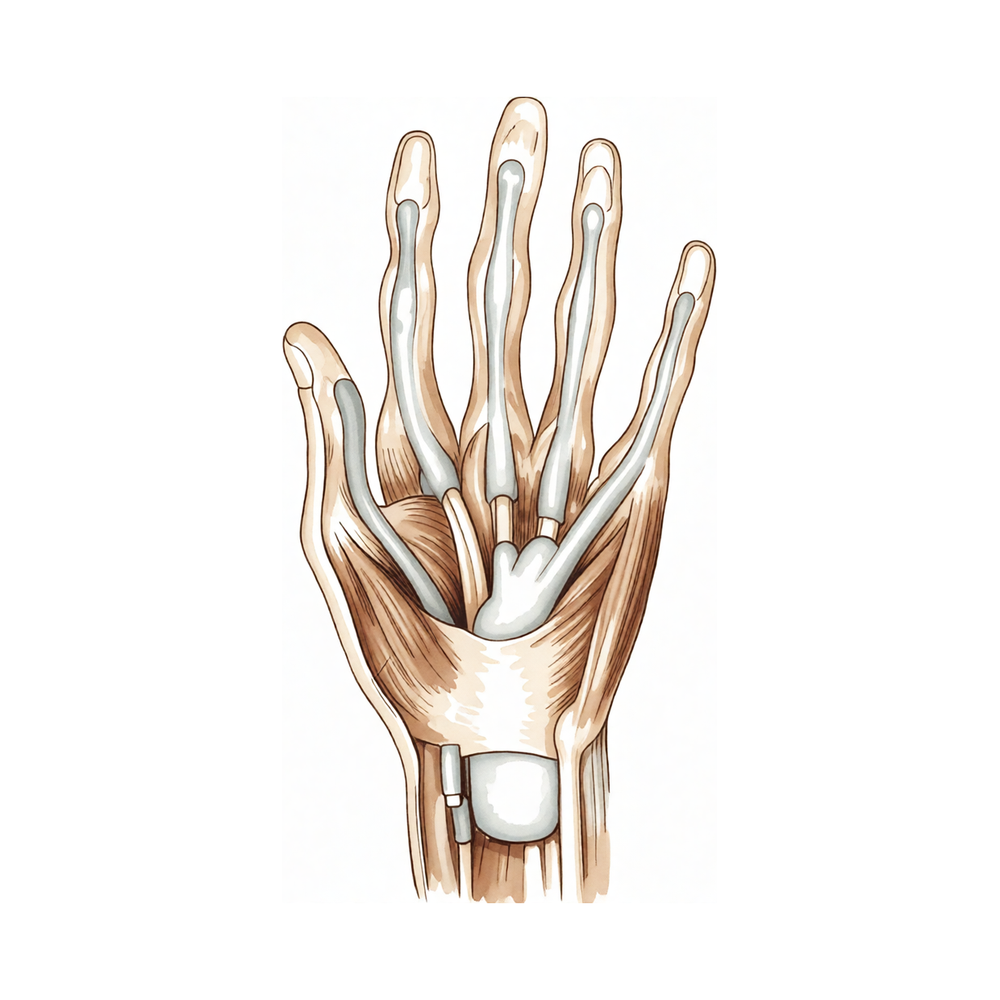
Ang protocol na ito ay nagsisilbing gabay sa iyong paggaling pagkatapos ng surgical repair ng isang flexor tendon sa daliri (ang litid na bumababa sa bahagi ng palad ng daliri at nagbabaluktot nito patungo sa palad) kasama si Dr Kieran Hirpara sa Mater Private Hospital Rockhampton. Nagsisimula ito sa iyong home exercise program, na sinusundan ng structured clinical protocol na isinulat para sa iyong hand therapist: dalhin ang pahinang ito o ang PDF nito sa iyong unang therapy visit upang manatiling coordinated ang iyong rehabilitasyon. Maaaring i-adjust ng iyong hand therapist ang plano depende sa pag-unlad ng iyong paggaling.
Kung mayroon kang anumang alalahanin tungkol sa iyong sugat pagkatapos ng operasyon, makipag-ugnayan sa mga rooms. Madalas na nakakatulong ang pagkuha ng larawan ng sugat at pag-email nito para masuri.
Ano ang dapat asahan
Ang flexor tendon repair ay tinatahi ang mga naputol na dulo ng tendon upang muling maibend ang daliri. Ang repair ay sapat ang lakas upang maigalaw nang dahan-dahan agad, ngunit ito ay nasa pinakamahinang estado sa unang ilang linggo habang naghihilom ang tendon, kaya ang buong plano ay binuo upang igalaw ito nang sapat lamang upang mapanatili itong dumudulas, nang hindi ito nabibigatan nang husto na maaaring pumutol sa mga tahi.
Upang magawa ito, ang iyong kamay ay ititigil sa isang espesyal at magaan na splint na tinatawag na Manchester short splint. Hindi tulad ng mga mas luma at mas malalaking splint, ito ay maikli, na nagtatapos sa tupi ng pulso (wrist crease), kaya malaya ang iyong pulso. Pinapayagan nito ang iyong pulso na gumalaw nang husto pasulong at pabalik hanggang sa mga 45 degrees, habang isang maliit na block ang pumipigil sa iyong malalaking knuckles na magtuwid nang lampas sa mga 30 degrees at hinahayaan ang iyong mga joint ng daliri na malayang gumalaw. Isusuot mo ito nang full-time sa loob ng anim na linggo, at tatanggalin lamang ayon sa instruksyon para sa mga ehersisyo at paghuhugas.
Ang mahalagang bahagi ay kung paano ginagamit ang pulso. Kapag ibinend mo ang iyong pulso pasulong, ang iyong daliri ay kusa ring nagtutuwid (tinatawag itong tenodesis effect), at pinapayagan ka nitong mabuksan nang husto ang daliri nang hindi pinupuwersa ng sarili mong mga kalamnan. Kapag ibinend mo ang iyong pulso pabalik, nagiging mas madali at mas ligtas na dahan-dahang itiklop ang daliri. Ang paggalaw sa paraang ito ay pinapanatiling dumudulas ang tendon at, higit sa lahat, pinipigilan ang daliri na tumiklop sa isang matigas at nakabaluktot na posisyon, na siyang pinakakaraniwang problema pagkatapos ng ganitong uri ng repair.
Ang mga maagang ehersisyo (mula sa humigit-kumulang araw 4–5) ay dahan-dahan at espesipiko: pagbend ng daliri nang passive muna, pagkatapos ay isang magaan na active 'hook' curl na nagsisimula sa dulo ng daliri, at pagkatapos ay pagtutuwid ng daliri habang nakabend ang pulso. Walang matinding paghawak (gripping) at walang pinupuwersang paggalaw sa loob ng anim na linggo. Tatanggalin ang splint sa ika-anim na linggo, magsisimula ang magaan na strengthening, at karamihan sa mga tao ay nakakabalik sa buong unrestricted na paggamit ng kamay sa loob ng sampu hanggang labindalawang linggo.
Mga pag-iingat at limitasyon
- Isuot ang Manchester short splint nang full-time sa loob ng anim na linggo: hubarin lamang ito para sa iyong mga ehersisyo at paghuhugas, ayon sa itinuro.
- HUWAG itikom nang mahigpit at matigas ang kamao at HUWAG humawak, magbuhat, humila o magdala ng anuman gamit ang operadong kamay sa unang anim na linggo: ang mabigat na karga ay maaaring pumutok sa repair.
- HUWAG piliting ituwid o piliting itupi ang daliri; panatilihing banayad ang bawat galaw, sa loob ng range na ipinakita sa iyo.
- Maaari mong gamitin ang kamay para sa napakagaan at ligtas na mga gawain maliban sa napinsalang daliri, hangga't walang humihila o nagbibigay ng strain dito.
- Ang isang lagutok o biglaang 'pagbitaw' na may kasamang kawalan ng kakayahang itupi ang daliri ay maaaring mangahulugan na naputok ang tendon: makipag-ugnayan agad sa klinika kung mangyari ito.
- HUWAG magmaneho habang suot ang splint; maaaring bumalik sa pagmamaneho pagkatapos alisin ang splint (mga anim na linggo), kapag sapat na ang iyong grip at kontrol at nabigyan ka na ng clearance.
Para sa pamamahala ng sugat, pamamaga, at peklat, tingnan ang gabay ng klinika sa wound care.
Iyong mga ehersisyo
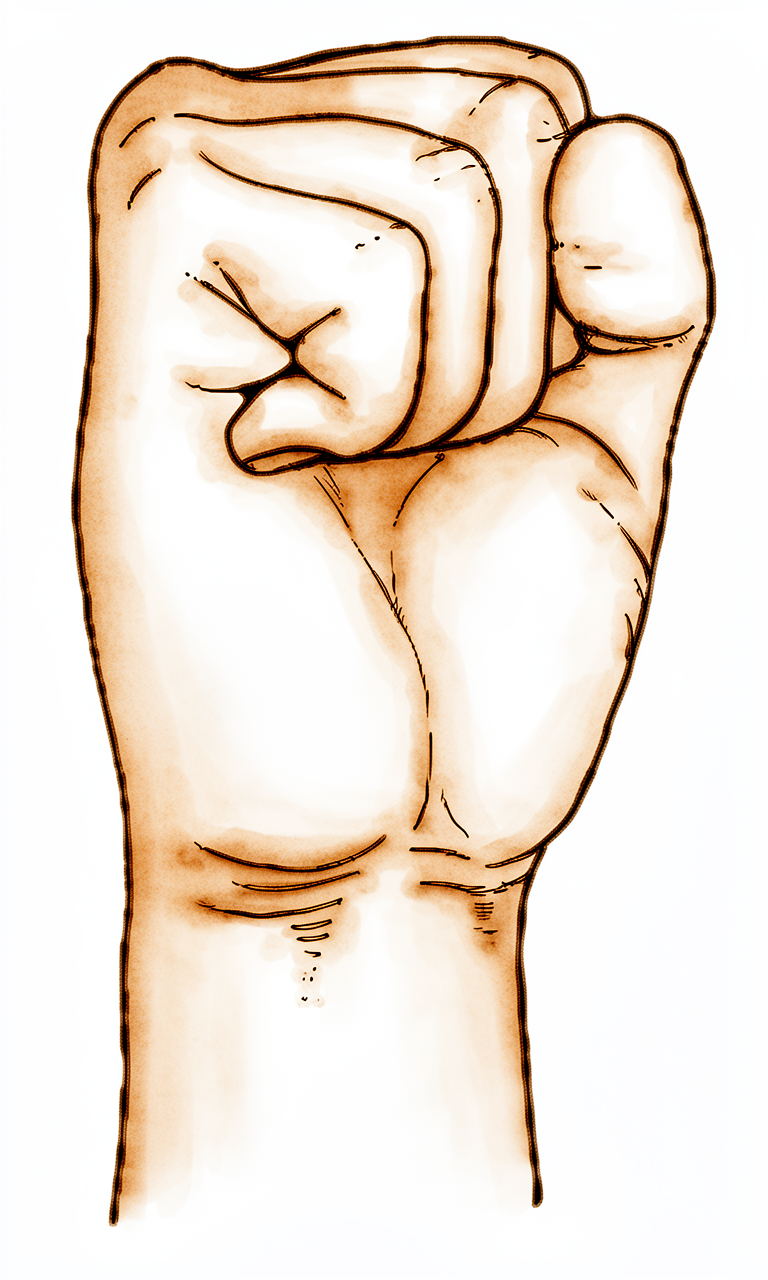
Passive fist stretch (IP flexion)
Gamitin ang iyong kabilang kamay upang dahan-dahang itiklop ang inoperahang daliri hanggang sa maging kamao, ibaluktot nang lubos ang mga kasukasuan ng daliri — panatilihing lubos na relax ang daliri upang ang kabilang kamay ang gumagawa ng lahat ng trabaho. Ginagawa ito UNA sa bawat session upang mapanatiling malambot ang mga kasukasuan ng daliri at handang gumalaw. Hindi nito hinihila ang repair dahil nananatiling naka-off ang iyong sariling kalamnan. Gumalaw nang mabagal at huminto bago makaramdam ng sakit.
10 beses, sa simula ng bawat session, ilang session sa isang araw

Aktibong hook fist mula sa DIP
Habang nakatiklop pabalik (extended) ang iyong pulso, nasa loob man o wala sa splint, itiklop muna ang dulo ng iyong daliri pababa upang gumawa ng 'hook' — itiklop ang dulo at gitnang mga kasukasuan habang pinapanatiling diretso ang malaking knuckle. Hawakan nang dahan-dahan, pagkatapos ay bitawan. Ang pagsisimula ng pagtiklop sa dulo ng daliri ay nagpapadulas sa naghihilom na tendon sa paraang kinakailangan nito. Gumamit lamang ng banayad na puwersa — huwag itong pilitin at huwag kailanman gagawa ng matigas at mahigpit na kamao.
10 beses, ilang sesyon sa isang araw ayon sa gabay
Kieran Hirpara 4.0
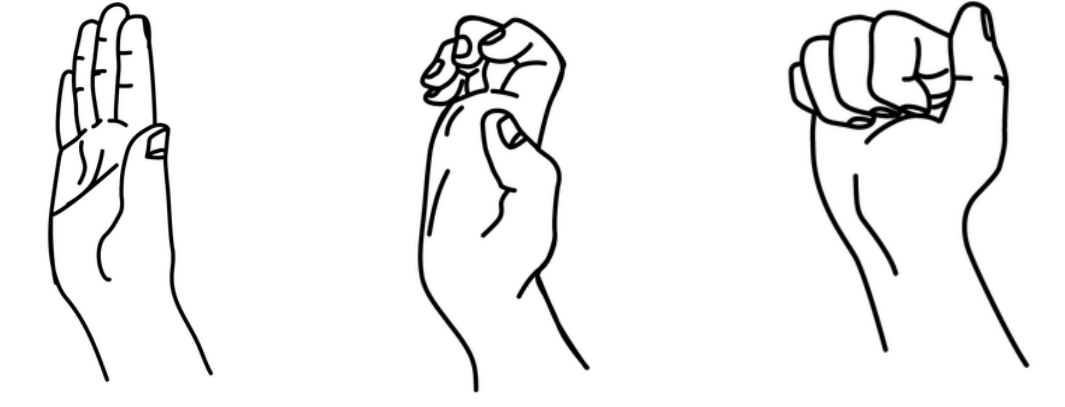
Tendon glides (hook patungong straight patungong full fist)
Dahan-dahang gawin ang tendon-gliding sequence: mga daliri ay diretso, pagkatapos ay hook fist (pag-curl ng mga dulo ng daliri), pagkatapos ay soft full fist, at pagkatapos ay ibalik sa diretso. Pinapanatili nito na ang parehong flexor tendons ay madulas na dumadausdos sa isa't isa at sa nakapalibot na tissue upang hindi sila dumikit. Panatilihing magaan at madali ang bawat posisyon — ang mga ito ay gliding movements, hindi strengthening, kaya hindi dapat magkaroon ng straining.
5 ng bawat posisyon, ilang sesyon sa isang araw ayon sa gabay
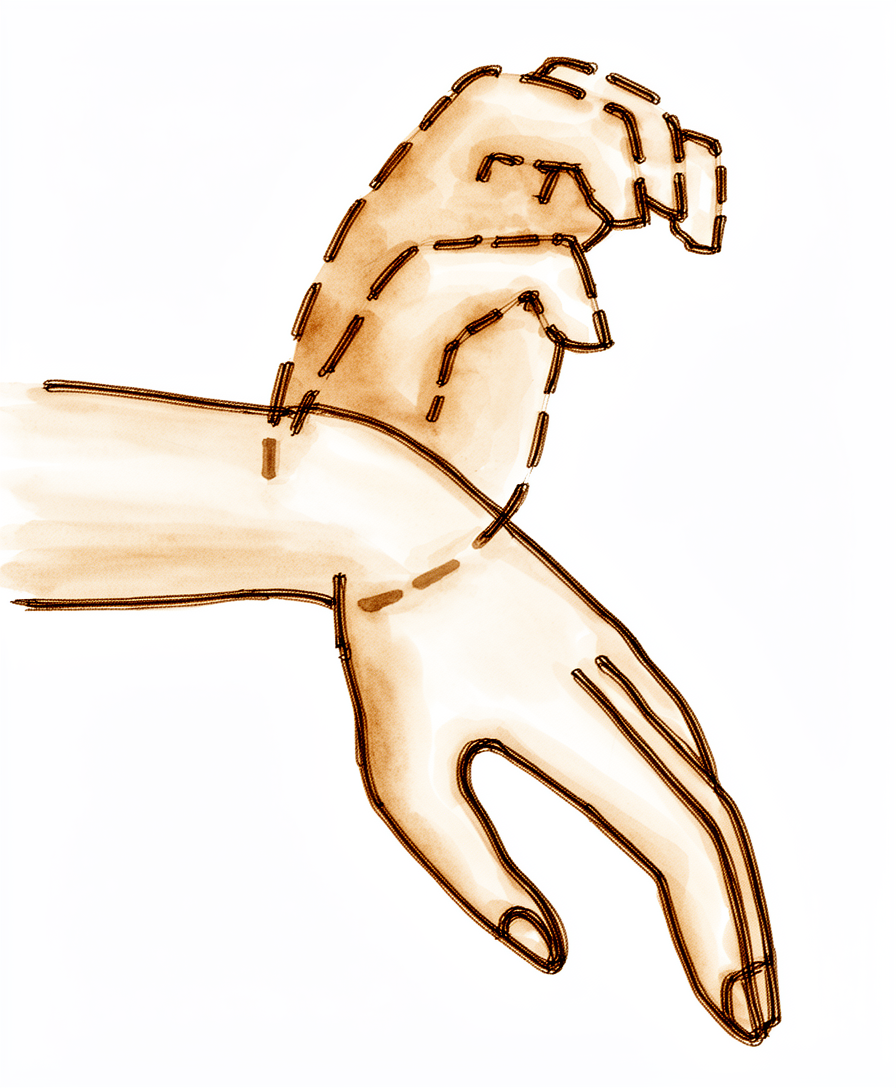
Pagtuwid ng daliri habang nakabaluktot ang pulso (synergy)
Hayaan ang iyong pulso na bumagsak pasulong (flexed) at pagkatapos ay aktibong ituwid ang iyong daliri. Ang pagbaluktot ng pulso sa ganitong paraan ay natural na tumutulong sa pagtuwid ng daliri, kaya madaling nae-extend ang daliri nang hindi pinipilit. Ito ang pangunahing galaw na pumipigil sa daliri na kumulot patungo sa isang permanenteng baluktot — gawin ito nang tapat. Ituwid lamang hanggang kung saan ito komportableng makakarating sa tulong ng pulso; huwag itong puwersahing ituwid.
10 beses, ilang sesyon sa isang araw ayon sa gabay
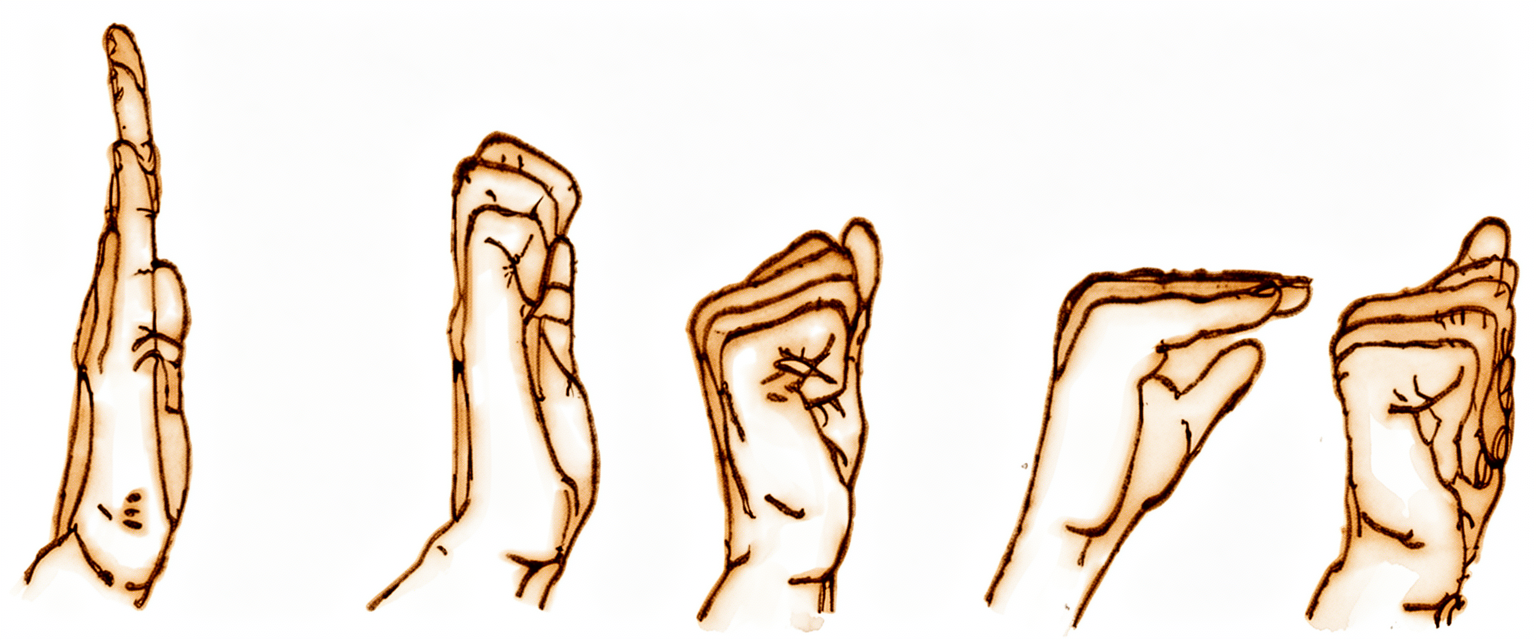
Ilagay-at-hawakan
Gamitin ang iyong kabilang kamay upang dahan-dahang itiklop ang inoperahang daliri sa isang maluwag na kamao, pagkatapos ay bitawan at panatilihin ang posisyong iyon gamit ang napakakaunting puwersa ng iyong sariling kalamnan — sapat lamang upang mapanatili ang daliri doon. Ginigising nito ang na-repair na tendon nang ligtas dahil ang mabigat na trabaho ng pagtiklop ay ginagawa ng iyong kabilang kamay, at ang iyong sariling kalamnan ay kailangan lamang humawak, hindi humila. Panatilihing napakaliit ng pagsisikap; mag-relax nang lubos sa pagitan ng mga pag-uulit.
Hawakan nang ilang segundo, 5–10 beses, ayon lamang sa gabay ng iyong hand therapist
Kieran Hirpara 4.0
Blocking (sa huli, kung may mga adhesion)
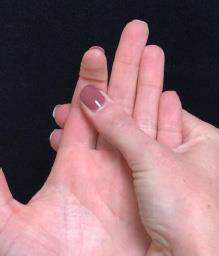
Isang exercise sa HULING bahagi — kung ang iyong tendon ay nakadikit lamang at sinimulan ito ng iyong hand therapist. Patatagin ang iyong daliri sa pamamagitan ng paghawak sa buto sa ibaba lamang ng joint na nais mong igalaw, pagkatapos ay aktibong itiklop ang isang joint na iyon nang mag-isa (halimbawa, panatilihing hindi gumagalaw ang gitna ng daliri at itiklop lamang ang dulo ng daliri). Pinagtutuunan nito ang glide sa isang joint upang palayain ang tendon na naging tethered. Huwag simulan ang blocking nang mag-isa — ito ay mas demanding at idinaragdag lamang kapag hinusgahan ng iyong therapist na ligtas na ito.
Ayon sa gabay ng iyong hand therapist (huling yugto, kung kinakailangan lamang)
Ito ang mga ehersisyo mula sa iyong handout. Simulan lamang ang mga ito ayon sa gabay ni Dr Hirpara at ng iyong hand therapist, at manatili sa anumang range at limitasyong ibinigay sa iyo. Ang bawat session ay sumusunod sa parehong ligtas na pagkakasunod-sunod: dahan-dahang itiklop ang daliri nang passively muna, pagkatapos ay gawin ang iyong active 'hook' curl at tendon glides, pagkatapos ay ituwid ang daliri habang nakatiklop ang wrist upang maiwasan itong tumigas sa isang curl. Panatilihing magaan ang lahat: ito ay gliding, hindi strengthening. Ang place-and-hold at blocking ay kabilang sa mga huling phase at dapat lamang simulan kapag ipinakilala na ito ng iyong hand therapist. Itigil ang anumang nagdudulot ng matalas na sakit sa bahagi ng repair, at huwag na huwag gagawa ng mahigpit na kamao hangga't hindi ka pa pinapayagan.
Ang iyong clinical protocol
Ang natitirang bahagi ng pahinang ito ay ang staged clinical protocol para sa rehabilitasyon pagkatapos ng flexor tendon repair gamit ang Manchester short splint at isang early-active-motion (EAM) regimen. Ang seksyong ito ay ibibigay sa iyong hand therapist, at ang bawat phase ay nagsisimula sa isang paliwanag sa simpleng Ingles tungkol sa kung ano ang nangyayari. Ang repair ay nasa pinakamahinang estado sa mga unang linggo at nabibigatan sa pamamagitan ng active at resisted finger flexion (mahigpit na kamao); samakatuwid, pinoprotektahan ng protocol ang laban sa forceful flexion habang sadyang isinusulong ang tendon excursion at active IP extension upang maiwasan ang flexion contracture na siyang pangunahing nakakaabalang komplikasyon.
Bago ang paggamot, suriin ang operation report ng pasyente at ang nakaraang medical history, at makipag-ugnayan sa treating surgeon tungkol sa zone of injury, ang core-suture configuration at lakas ng repair, anumang pulley venting, at kasabay na digital nerve repair. Ang mga flexor repair ni Dr Hirpara ay pinamamahalaan sa isang Manchester short dorsal splint (nagtatapos sa wrist crease) na nagpapahintulot ng full wrist flexion at extension hanggang 45°, na may MCP joints na naka-block sa 30° ng flexion at ang mga IP joint ay malaya, na isinusuot nang full-time sa loob ng anim na linggo. Ang mga night extension gutter ay idinaragdag lamang kung magkakaroon ng IP flexion deformity.
Phase I — maagang active motion sa Manchester short splint (linggo 0 hanggang 6)
Pinoprotektahan ng unang anim na linggo ang knitting repair habang pinapanatiling gumagalaw (gliding) ang tendon at pinipigilan ang daliri na tumigas patungo sa isang flexion contracture. Ang kamay ay naka-splint full-time sa Manchester short splint (full wrist flexion, extension hanggang 45°, MCP block sa 30°, IPs free). Ang active motion ay nagsisimula sa paligid ng araw 4–5. Ang bawat session ay tumatakbo sa isang itinakdang pagkakasunod-sunod: passive IP flexion muna, pagkatapos ay active hook fist na nagsisimula sa DIP habang ang wrist ay extended, pagkatapos ay active IP extension habang ang wrist ay flexed (synergistic, anti-contracture). Walang forced end-range at walang resisted flexion.
Para sa iyong hand therapist:
Edukasyon at mga pag-iingat - Splint full-time sa Manchester short splint: full wrist flexion, extension hanggang 45°, MCP blocked sa 30°, IPs free; tatanggalin lamang para sa mga ehersisyo at kalinisan (hygiene) - Simulan ang EAM sa araw 4–5 - Walang forced end-range flexion at walang resisted flexion; bawal ang paghawak nang mahigpit (gripping), pagbuhat o paghila - Magaan at "ligtas" na paggamit ng kamay maliban sa napinsalang daliri - Night extension gutter lamang kung nagsisimulang magkaroon ng IP flexion deformity
Pamamahala - Sugat: surgical dressings ayon sa itinuro; bantayan para sa impeksyon - Oedema: elevation, banayad na digital oedema control, pamahalaan ang panganib ng adhesion - Pagkakasunod-sunod ng ehersisyo sa bawat session: (1) full passive IP flexion muna; (2) active hook fist na nagsisimula sa DIP habang ang wrist ay extended hanggang 45°; (3) active finger extension habang ang wrist ay flexed (synergistic / tenodesis, anti-contracture); magdagdag ng place-and-hold sa isang light fist ayon sa gabay - Hand-therapy review linggu-linggo sa buong phase na ito
Mga kraytirya para mag-progress - Hilom na ang sugat; intact ang repair sa ika-anim na linggo; napanatili ang tendon gliding; walang makabuluhang IP flexion contracture
Phase II — pag-alis sa splint, soft-tissue at scar work (ika-6 na linggo)
Sa ika-anim na linggo, aalisin na ang splint. Ang pokus ay lilipat sa pagbawi ng buong passive at active range, pag-alis ng anumang maagang paninigas, at pamamahala sa scar. Hindi pa magsisimula ang strengthening; ang night extension splint ay gagamitin lamang kung may nananatiling residual flexion deformity.
Para sa iyong hand therapist:
Assessments - Active at passive ROM sa MCP/PIP/DIP; presensya ng anumang IP flexion contracture; kalidad ng tendon-gliding (suriin para sa adhesion); pagsusuri sa scar at sugat
Edukasyon at mga pag-iingat - Ititigil ang splint sa ika-anim na linggo (night extension splint lamang para sa residual IP flexion deformity) - Ituloy ang light functional use; wala pa ring resisted gripping o loading
Pamamahala - Soft-tissue stretching upang maibalik ang buong composite flexion at extension; simulan ang scar management kapag magaling na - Ituloy ang tendon glides; ipakilala ang blocking kung ang mga adhesion ay naglilimita sa differential glide - Ituloy ang light functional use ng kamay
Pamantayan para mag-progress - Ang sugat at scar ay settled na; near-full passive ROM; napanatili ang gliding; handa na para sa graded strengthening
Phase III — pagpapalakas at pagbabalik (ika-6 hanggang ika-12 linggo)
Habang mas nagiging mature ang repair, magsisimula ang graded stretching at progressive strengthening at unti-unting palalakasin patungo sa unrestricted use. Ang pagbabalik sa buo at unrestricted na aktibidad ay inaasahan sa humigit-kumulang sampu hanggang labindalawang linggo, base sa criterion.
Para sa iyong hand therapist:
Mga Assessment - Composite ROM at anumang residual contracture; grip at pinch kumpara sa kabilang panig; tugon ng repair sa graded loading
Edukasyon at mga pag-iingat - Simulan ang graded stretching at progressive strengthening mula sa humigit-kumulang anim na linggo; unti-unting dagdagan ang load - Iwasan ang biglaang maximal grip o resisted loading hanggang sa maibalik ang lakas
Pamamahala - Progressive grip at pinch strengthening (putty → graded resistance); ituloy ang stretching para sa anumang residual tightness; ituloy ang scar work kung kinakailangan - Mag-advance patungo sa buo / unrestricted na aktibidad sa 10–12 linggo - Isaalang-alang ang discharge kapag ang ROM at lakas ay functional na at nakamit na ang angkop na pagbabalik sa aktibidad; i-refer muli sa treating surgeon kung nag-plateau ang recovery o kung nananatili ang flexion contracture
Mga Criteria para sa pagbabalik sa buong aktibidad - Functional composite ROM; sapat at halos symmetrical na grip at pinch strength; pain-free unrestricted use, karaniwan sa ika-10–12 linggo
Pagbabalik sa trabaho at aktibidad
Hinihikayat ang magaan at ligtas na paggamit ng kamay (maliban sa napinsalang daliri) mula sa simula habang nasa loob ng splint, basta't walang humihila, humahawak, o nagbibigay ng strain sa repair. Magplano para sa tulong sa mga unang linggo, dahil walang paghawak, pagbuhat, o pagdadala gamit ang inoperahang kamay sa unang anim na linggo. Tatanggalin ang splint sa loob ng humigit-kumulang anim na linggo, at magsisimula ang magaan na strengthening mula noon.
Dahil hindi ka dapat magmaneho habang nasa dorsal splint, mag-ayos ng transportasyon para sa unang anim na linggo. Maaaring magmaneho muli pagkatapos matanggal ang splint (humigit-kumulang anim na linggo), kapag sapat na ang iyong grip at kontrol sa daliri at nabigyan ka na ng clearance sa iyong review. Ang pagbabalik sa buo at walang limitasyong aktibidad, kabilang ang matitinding paghawak at mas mabibigat na gawain, ay inaasahan sa loob ng sampu hanggang labindalawang linggo, na unti-unting itataas at huhusgahan ni Dr Hirpara at ng iyong hand therapist base sa kung paano gumagalaw ang daliri at kung gaano ito kalakas, at hindi base sa kalendaryo lamang.
Pagkatapos ng iyong protocol
Ang protocol na ito ay kasabay ng pangkalahatang payo sa paggaling ng klinika; tingnan din ang pamamahala ng sakit pagkatapos ng operasyon, pag-aalaga ng sugat at pamamahala ng peklat. Ang phased plan sa itaas ay sumasalamin sa nailathalang gabay sa early-active-motion rehabilitation pagkatapos ng flexor tendon repair, at ang iyong patuloy na paggaling ay ginagabayan nang indibidwal ni Dr Hirpara at ng iyong hand therapist ayon sa pag-unlad ng iyong daliri.
Evidence & references
This is the clinical evidence summary written for health professionals. It is technical, and it lists the research this page was built from. You do not need to read it to understand your treatment or to make a decision about it.
Flexor Tendon Repair — Procedure Outcomes & Post-operative Rehabilitation (Manchester Short-Splint Early Active Motion)
Topic scope: post-operative rehabilitation after primary surgical repair of a flexor tendon in the finger (especially zone II) with a robust multi-strand core repair, mobilised on an early-active-motion (EAM) regimen using the Manchester short splint. This is a repair of a divided structure that is at its weakest in the first weeks, so — unlike a decompression — the rehab is a carefully graded protected-but-moving pathway: enough controlled tendon excursion to prevent adhesion and flexion contracture, without the forceful flexion that ruptures the construct.
Defining principle of the rehab here: a repaired flexor tendon must glide to heal well but must not be loaded hard while it is weak. The two competing failures are rupture (from forceful or resisted flexion) and adhesion / PIP flexion contracture (from too little controlled motion). The Manchester short splint resolves this tension by leaving the wrist free: holding the wrist in 45° of extension minimises the work of flexion (Savage) so a gentle active hook fist glides the tendon at low tension, while permitting wrist flexion harnesses the extensor tenodesis effect to drive active IP extension — the single most effective lever against the PIP flexion contracture that is the characteristic nuisance complication of zone II repair. The deliberate sequence each session (passive IP flexion → active hook fist from the DIP, wrist extended → active IP extension, wrist flexed) is what makes the regimen safe and anti-contracture.
A. PROCEDURE / REPAIR OUTCOMES (early active motion vs passive mobilisation)
Flexor tendon repair is technically demanding and historically complication-prone (rupture and adhesion). Modern multi-strand core repairs combined with early active motion have shifted outcomes decisively toward better motion, with the central trade-off being a small rupture risk against markedly better range and function.
- Early active motion gives better finger motion than passive mobilisation, at a small rupture cost. A systematic review of controlled mobilisation after zone II repair found EAM regimens produced better total active motion than passive (Kleinert/Duran) protocols, with a modest increase in rupture (~5% vs ~4%) [Starr 2013]. The contemporary consensus favours active regimens with robust repairs. Moderate–strong (SR).
- The Manchester short splint specifically improves IP extension without increasing rupture. A clinical audit comparing the Manchester short splint (MSS) with a traditional full-length dorsal splint in uncomplicated zone II repairs found less PIP extension deficit (median 15° vs 28° at 6 weeks, p=0.003; 6° vs 18° at 12 weeks), a greater DIP flexion arc (59° vs 30°), and more excellent/good Strickland grades with the MSS. Rupture was not significantly different (2/45, 4.4% MSS vs 3/76, 3.9% traditional) [Peck 2014]. The headline advantage is the reduction in PIP flexion contracture. Moderate (single-centre non-randomised audit, Level III–IV).
- Forearm-based (wrist-blocking) splints constrain the very motion that prevents contracture. A comparison of splint designs found the Manchester short splint allowed greater PIP extension than forearm-based splints [Newington 2021], consistent with the mechanistic rationale that freeing the wrist enables the synergistic IP-extension move. Moderate.
- Mechanistic basis. Positioning the wrist in ~45° extension minimises the work of flexion required for active digital flexion, lowering the tension on the repair during the active hook fist [Savage 1988]; allowing wrist flexion recruits the extensor tenodesis effect to achieve full active IP extension at low cost — the anti-contracture engine of the regimen. Mechanistic.
B. REHABILITATION / THERAPY EVIDENCE
The rehab questions are (1) active vs passive early mobilisation, (2) splint design, and (3) how to structure the session to prevent both rupture and contracture. The evidence supports a robust repair mobilised with early active motion, a short wrist-free splint, and a fixed safe exercise sequence delivered through formal hand therapy.
- Early active motion is the modern default for robust repairs. Active regimens (partial-range combined passive/active, place-and-hold, true active flexion) outperform passive-only protocols on motion and are now standard where the core repair is strong enough to tolerate active glide [Tang 2021; Starr 2013]. Moderate–strong.
- A defined, low-tension active sequence is what makes EAM safe. Therapy guidance emphasises passive flexion first (preconditioning the joints), place-and-hold / active hook fist to glide the tendon at minimal tension, and synergistic wrist-flexion finger-extension to recover IP extension — the explicit structure of the Manchester regimen [Neiduski & Powell 2019; Saint John protocol]. Moderate (consensus + protocol cohorts).
- Splint design materially changes the contracture outcome. Shorter, wrist-free splinting that permits the synergistic extension move yields greater PIP extension than traditional or forearm-based dorsal splints [Peck 2014; Newington 2021]. Moderate.
- All flexor repairs are routed through formal hand therapy. The regimen is exercise-order- and tension-sensitive and is delivered with weekly hand-therapy review through the six-week splinted phase; it is not a self-directed pathway. Consensus / standard of care.
Recovery trajectory (expected, evidence-anchored)
| Phase | Window | Restraint | Hand use / therapy focus | Strength / load | Notes |
|---|---|---|---|---|---|
| I — Early active motion (in MSS) | Week 0–6 | Manchester short splint full-time (full wrist flexion, extension to 45°, MCP block 30°, IPs free) | Start day 4–5; each session: passive IP flexion → active hook fist from the DIP (wrist extended) → active IP extension (wrist flexed); place-and-hold as guided; weekly therapy | No resisted flexion, no gripping/lifting; light safe use excluding the injured finger | EAM drives glide + anti-contracture; rupture risk highest now |
| II — Splint off, soft-tissue / scar | Week 6 | Splint discontinued (night extension gutter only for residual IP flexion deformity) | Restore full passive/active ROM; scar management; tendon glides; blocking if adhesions | Still no resisted loading | PIP flexion contracture is the complication to chase down here |
| III — Strengthen / return | Week 6–12 | Restrictions progressively lifted | Graded stretching; progressive grip/pinch strengthening (putty → resistance) | Build grip/pinch gradually | Return to full / unrestricted activity 10–12 weeks, criterion-based |
(Phase windows mirror the precautions in the patient protocol; they are typical guides, not trial-derived deadlines.)
C. KEY CONTROVERSIES / EVIDENCE QUALITY
- Active vs passive early mobilisation. EAM gives better motion than passive Kleinert/Duran regimens at a small rupture-rate cost (~5% vs ~4%); it is the contemporary default for strong core repairs [Starr 2013; Tang 2021]. Moderate–strong.
- Manchester short splint vs traditional dorsal splint. The MSS audit shows clearly better IP extension and DIP flexion arc with no significant increase in rupture, but it is a single-centre, non-randomised audit (Level III–IV) — the authors themselves call for an RCT. The improvement is consistent with the mechanism (wrist-free synergistic extension), which raises confidence above the study design alone. Moderate; RCT recommended.
- The PIP flexion contracture is the outcome that discriminates protocols. Rupture rates are broadly similar across modern regimens; what separates them is residual PIP extension loss, and that is where the short, wrist-free splint and the synergistic-extension move earn their place [Peck 2014; Newington 2021]. Moderate.
- Repair strength gates the regimen. EAM is only safe with a robust multi-strand core repair; the protocol assumes that and is surgeon-confirmed per case (zone, suture configuration, pulley venting, concurrent nerve repair). Consensus.
D. EVIDENCE STRENGTH FLAGS (summary)
- MODERATE–STRONG (SR): early active motion produces better finger motion than passive mobilisation after zone II repair, at a small rupture-rate increase (~5% vs ~4%) [Starr 2013]; modern partial-range active regimens are the contemporary standard [Tang 2021].
- MODERATE: the Manchester short splint reduces PIP extension deficit (15° vs 28° at 6 wk, p=0.003) and improves DIP flexion arc without significantly increasing rupture (4.4% vs 3.9%) [Peck 2014]; greater PIP extension than forearm-based splints [Newington 2021]; defined low-tension exercise sequence [Neiduski & Powell 2019; Saint John].
- MECHANISTIC / CONSENSUS: wrist 45° extension minimises work of flexion [Savage 1988]; wrist flexion harnesses the extensor tenodesis effect for active IP extension (anti-contracture); exact phase timings are typical guides, not trial-derived; single-centre non-randomised MSS evidence — an RCT is recommended.
CITATIONS
RAG corpus (180,000+ Orthopaedic articles)
- Peck FH, et al. A comparative study of two methods of controlled mobilization of flexor tendon repairs in zone 2 (the Manchester short splint). Hand Ther. 2014. DOI: 10.1177/1758998314533306
- Starr HM, et al. Flexor tendon repair rehabilitation protocols: a systematic review. J Hand Surg Am. 2013. DOI: 10.1016/j.jhsa.2013.06.025
- Neiduski RL, Powell RK. Flexor tendon rehabilitation in the 21st century: a systematic review. J Hand Ther. 2019. DOI: 10.1016/j.jht.2018.06.001
- Tang JB. Rehabilitation after flexor tendon repair and others: a safe and efficient update. J Hand Surg Eur Vol. 2021. DOI: 10.1177/17531934211037112
- Tang JB, et al. (IFSSH flexor tendon committee report). J Hand Surg Eur Vol. 2014. DOI: 10.1177/1753193413500768
- Newington L, et al. Splinting after flexor tendon repair: comparison of the Manchester short splint with forearm-based splinting on PIP joint extension. Hand Ther. 2021. DOI: 10.1177/17589983211017584
Flexor tendon rehabilitation literature (URLs)
- Saint John flexor tendon protocol — early active motion regimen for zone II repair (protocol description and outcomes). PMC. https://www.ncbi.nlm.nih.gov/pmc/articles/PMC5142498/
- Savage R. The influence of wrist position on the minimum force required for active movement of the interphalangeal joints. J Hand Surg Br. 1988 (mechanistic basis: wrist extension minimises the work of flexion). https://doi.org/10.1016/0266-7681(88)90258-2