Patients › Rehabilitation
Operasyon sa Daliri
Post-operative exercises and precautions after finger surgery, including joint blocking and tendon glides.
Ang protocol na ito ay nagsisilbing gabay sa iyong paggaling pagkatapos ng operasyon sa daliri kasama si Dr Kieran Hirpara sa Mater Private Hospital Rockhampton. Ipinapaliwanag nito ang mga dapat asahan sa mga linggo pagkatapos ng iyong operasyon at inilalatag ang programa sa ehersisyo na tumutulong sa iyo upang maibalik ang paggalaw at function ng iyong daliri at kamay. Dalhin ang pahinang ito o ang PDF nito sa iyong unang pagbisita sa physiotherapy o hand therapy upang manatiling coordinated ang iyong rehabilitasyon; maaaring i-adjust ng iyong therapist ang plano depende sa iyong operasyon at kung paano ang pag-unlad ng iyong paggaling.
Kung mayroon kang anumang alalahanin tungkol sa iyong sugat pagkatapos ng operasyon, makipag-ugnayan sa mga rooms. Kadalasang nakatutulong ang pagkuha ng larawan ng sugat at pag-email nito para sa pagsusuri.
Ano ang dapat asahan
Ang pag-aalaga sa iyong sugat ay ipinaliwanag sa wound care handout ng klinika. Ang mga ehersisyo sa ibaba ay sentro sa pagbawi ng paggalaw at pagpapanumbalik ng function sa iyong daliri at kamay.
Kapag magaling na ang iyong sugat, maglagay ng init sa iyong kamay sa loob ng 20 minuto bago gawin ang mga ehersisyong ito. Pagkatapos kumpletuhin ang mga ehersisyo, maglagay ng yelo upang pakalmahin ang anumang pamamaga o inflammation.
Kapag ganap nang magaling ang sugat, simulan ang scar massage: matitigas na pabilog na masahe sa ibabaw ng incision. Mangyaring sumangguni sa wound care handout para sa karagdagang impormasyon tungkol sa scar management.
Mangyaring bantayan ang pamamaga, at tumawag sa klinika o makipag-usap sa isang hand therapist kung mayroon kang mga alalahanin.
Tatlong prinsipyo ang sumusuporta sa paggaling mula sa karamihan ng mga operasyon sa daliri, at ang mga ehersisyo sa ibaba ay nagsasagawa sa bawat isa. Ang una ay ang pagkontrol sa pamamaga: ang patuloy na pamamaga ng kamay ay nagpapatigas sa mga soft tissue at naglilimita kung gaano kahusay makakagalaw ang mga tendon at joint, kaya ang elevation, banayad na paggalaw at (kung kinakailangan) retrograde massage at compression ay mga prayoridad sa mga unang linggo [1]. Ang ikalawa ay maaga at banayad na paggalaw: mabilis tumigas ang mga daliri, kaya ang paggalaw sa mga ito sa loob ng mga limitasyong itinakda para sa iyong partikular na operasyon (simula sa oras na payagan ng iyong sugat at operasyon) ay nagpapanatiling supple sa mga maliliit na joint at tumutulong sa mga tendon na mag-glide sa halip na dumikit sa mga naghihilom na tissue sa paligid nito. Ang ikatlo ay tendon gliding. Ang iba't ibang posisyon ng daliri sa iyong handout (straight, hook, tabletop at full fist) ay hindi arbitraryo: ang bawat posisyon ay nagpapagalaw sa mga deep at superficial finger tendon sa magkakaibang dami kaugnay sa isa't isa at sa tendon sheath, na siyang nagpapanatili sa malayang pag-slide ng mga ito [2]. Ang mga DIP at PIP blocking exercise ay nakatuon sa parehong gliding na ito joint by joint. Ang panuntunan ay kaunti ngunit madalas: ang matatag, madalas, at banayad na pagsasanay sa buong araw ay mas nakakatulong sa iyong paggaling kaysa sa paminsan-minsang matinding pagsisikap.
Mga pag-iingat at limitasyon
Hinihikayat ang magaan na functional na paggamit ng iyong kamay para sa mga gawaing pang-araw-araw tulad ng pag-aalaga sa sarili, pagkain, pagbibihis, pagsusulat at pag-type (maliban kung may ibang payo). Karaniwan kang hihilinging iwasan ang pagbuhat, paghawak nang mahigpit, pagdadala ng bigat at impact hanggang sa loob ng 6 na linggo pagkatapos ng operasyon, depende sa pinsala at sa isinagawang operasyon. Bibigyan ka ng karagdagang gabay tungkol sa iyong mga pag-iingat at limitasyon sa iyong post-operative review.
Para sa iyong physiotherapist:
Pamamahala
- Pag-aalaga sa sugat at peklat ayon sa wound care handout ng klinika; simulan ang scar massage (matitigas na pabilog na masahe sa ibabaw ng insisyon) kapag ganap nang magaling ang sugat
- Kapag magaling na ang sugat, maglagay ng init sa kamay sa loob ng 20 minuto bago ang exercise program; mag-ice pagkatapos ng mga ehersisyo upang mabawasan ang pamamaga at inflammation
- Bantayan ang pamamaga; ipagbigay-alam sa klinika o sa isang hand therapist kung may mga alalahanin
- Ang kontrol sa oedema ay prayoridad kung ang pamamaga ay labis o mabagal mawala: elevation at active movement ang unang hakbang, kasama ang retrograde massage, compression at manual oedema mobilisation bilang mga adjunct kasabay ng standard therapy [1]
- Home exercise program ayon sa mga card sa ibaba: wrist flexion/extension; distal interphalangeal (DIP) at proximal interphalangeal (PIP) joint blocking; tendon glides (Series A at Series B)
- Ang mga tendon glide at joint-blocking sequence ay idinisenyo upang i-maximize ang differential excursion ng mga flexor tendon sa isa't isa at sa sheath: ibahin ang mga posisyon (straight, hook, tabletop, fist) sa halip na ulit-ulitin ang iisang posisyon [2]
Mga Pag-iingat
- Hinihikayat ang magaan na functional na paggamit ng kamay para sa mga gawaing pang-araw-araw (pag-aalaga sa sarili, pagkain, pagbibihis, pagsusulat, pag-type) maliban kung may ibang payo
- Bawal ang pagbuhat, paghawak nang mahigpit, pagdadala ng bigat o impact hanggang sa loob ng 6 na linggo pagkatapos ng operasyon (depende sa pinsala / isinagawang operasyon)
- Ang mga partikular na pag-iingat at limitasyon ay kumpirmado sa post-operative review
- Ito ay isang pangkalahatang post-operative finger program; kung ang partikular na operasyon ay may sariling protected range, motion limits o splinting (halimbawa pagkatapos ng tendon repair), ang mga instruksyong partikular sa operasyon ang masusunod
Ito ang mga ehersisyo mula sa iyong handout, na ipagpapatuloy sa bahay ayon sa gabay ng iyong physiotherapist o hand therapist.
Iyong mga ehersisyo
Kieran Hirpara 4.0
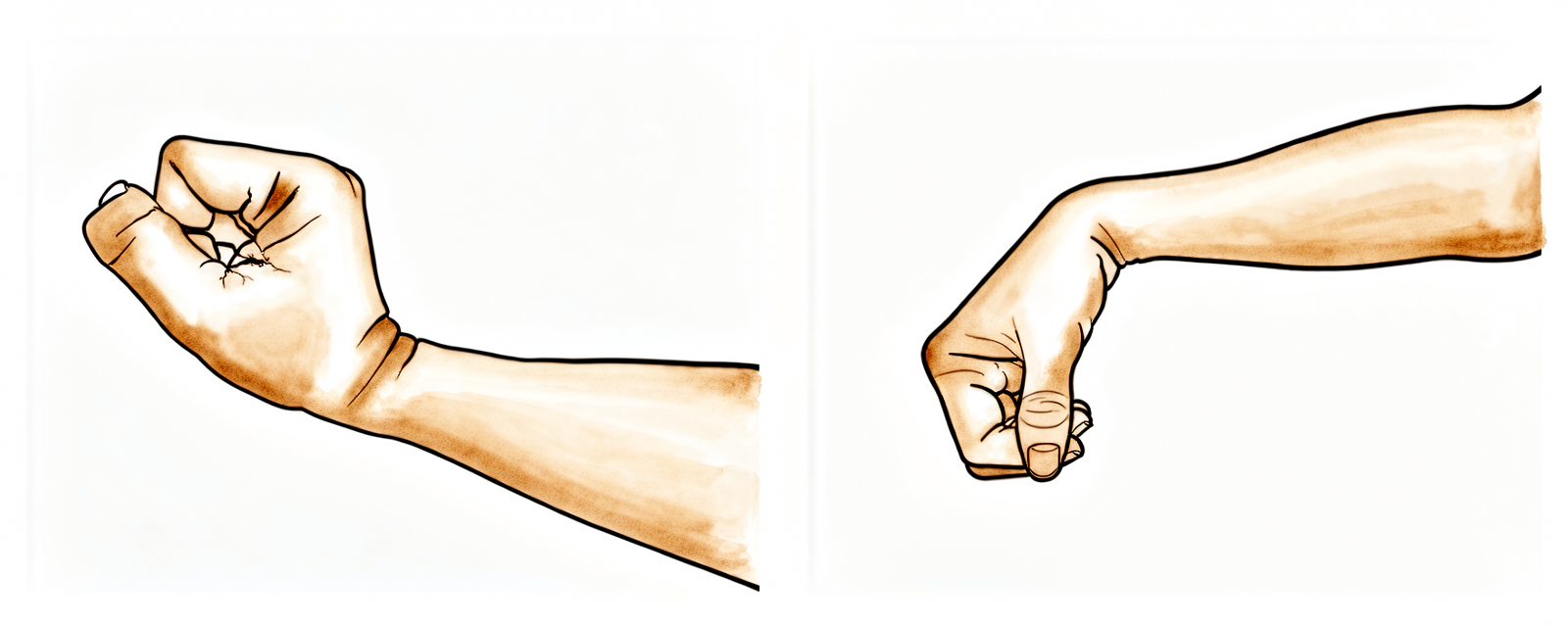
Wrist flexion / extension
Ipatong ang iyong siko sa isang mesa at dahan-dahang i-rock ang iyong pulso nang pabalik-balik (o ipatong ito sa gilid ng isang mesa o armchair, gaya ng nasa larawan). Kapag mas komportable na, hawakan ang palad gamit ang iyong kabilang kamay at itulak ang iyong pulso pabalik upang ang iyong mga daliri ay nakaturo sa kisame, pagkatapos ay sa kabilang direksyon upang nakaturo ang mga ito sa sahig. Panatilihing maluwag ang iyong mga daliri — kusa itong mababaluktot o matutuwid. Hawakan ang bawat stretch sa loob ng 15 segundo; ulitin nang 5 beses sa bawat direksyon.
10 reps, 4–5 beses araw-araw
Kieran Hirpara 4.0
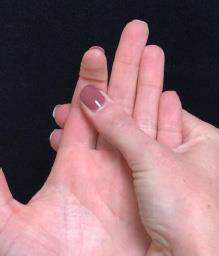
DIP joint blocking
Magsimula nang nakaharap sa itaas ang palad, suportahan ang apektadong kamay gamit ang iyong kabilang kamay sa bahagi na nasa ibaba lamang ng dulo ng joint — ang distal interphalangeal (DIP) joint. Itiklop at ituwid ang dulo ng joint, panatilihin ang bawat posisyon sa loob ng 3–5 segundo. Suportahan ang gitnang joint nang sapat lamang upang hindi ito matiklop. Ayos lang kung gumagalaw ang ibang mga daliri habang ginagawa ang ehersisyong ito.
10 reps, 4 beses sa isang araw, araw-araw
Kieran Hirpara 4.0
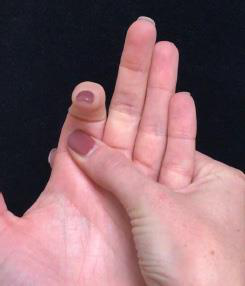
pag-block sa PIP joint
Magsimula nang nakaharap sa itaas ang palad, suportahan ang apektadong kamay gamit ang iyong kabilang kamay sa ibaba lamang ng ikalawang joint — ang proximal interphalangeal (PIP) joint. Itiklop at ituwid ang iyong daliri sa gitnang joint, panatilihin ang bawat posisyon sa loob ng 3–5 segundo. Ayos lang kung gumagalaw din ang ibang mga daliri.
10 reps, 4 beses sa isang araw, araw-araw
Kieran Hirpara 4.0
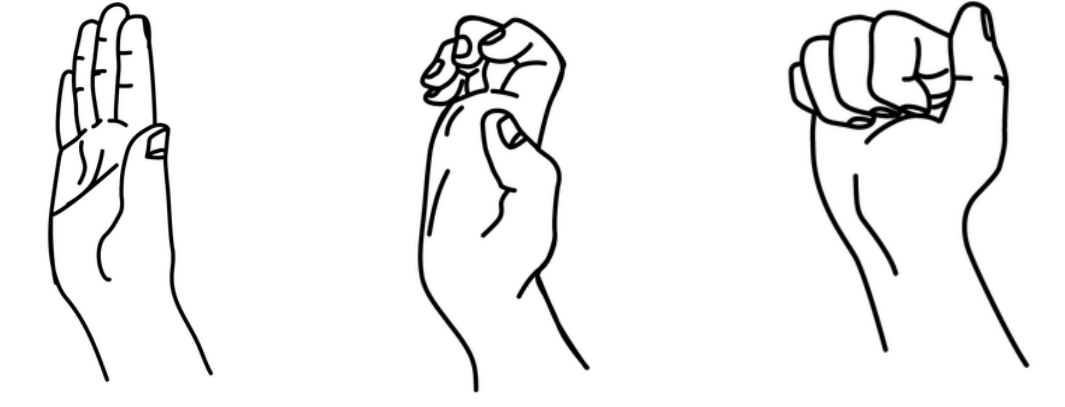
Tendon glides — Series A
Habang ang iyong kamay ay nasa harap mo at ang iyong pulso ay diretso, i-straight nang husto ang lahat ng iyong mga daliri (1). I-bend ang mga dulo ng iyong mga daliri sa posisyong "hook" habang ang iyong mga knuckles ay nakaturo pataas (2). Gumawa ng isang mahigpit na kamao na ang iyong hinlalaki ay nasa ibabaw ng iyong mga daliri (3).
5–10 reps, 2–3 beses sa isang araw, araw-araw
Kieran Hirpara 4.0
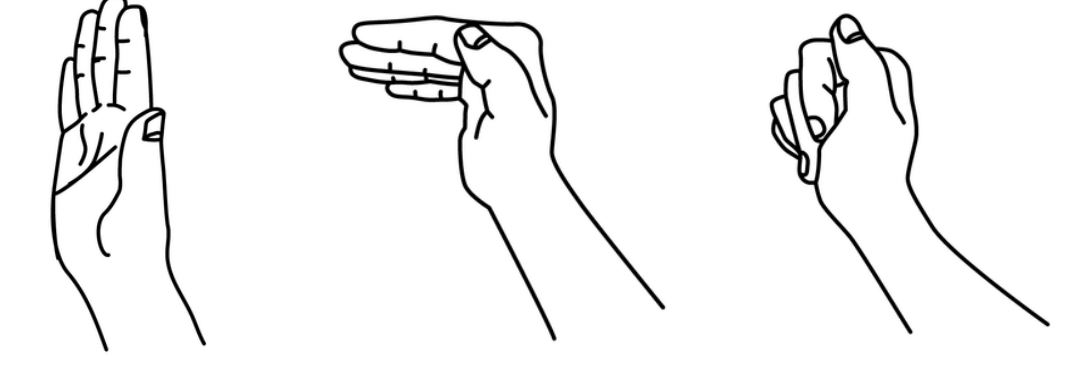
Tendon glides — Series B
Habang ang iyong kamay ay nasa harap mo at ang iyong pulso ay diretso, i-unat nang husto ang lahat ng iyong mga daliri (1). Gumawa ng "tabletop" gamit ang iyong mga daliri sa pamamagitan ng pagbaluktot sa iyong ibabang knuckle at panatilihing diretso ang mga daliri — tiyaking hindi lumulubog ang iyong pulso pasulong (2). Ibaluktot ang iyong mga daliri sa gitnang joint, idikit ang iyong mga daliri sa iyong palad (3).
5–10 reps, 2–3 beses sa isang araw, araw-araw
Simulan lamang ang mga ehersisyo sa ibaba ayon sa gabay ni Dr Hirpara at ng iyong hand therapist, at manatili sa anumang range at limitasyong ibinigay sa iyo. Ang mga blocking exercise ay ang mga partikular na ehersisyo: sa pamamagitan ng pagpapanatiling hindi gumagalaw ng joint sa ibaba, pinipilit mo ang paggalaw na mangyari sa joint na sinusubukan mong paluwagin sa halip na sa joint na madali nang gumagalaw. Ang tendon-glide series ay pinapanatiling maayos ang pagdaloy ng mga flexor tendon sa loob ng sheath, at ang wrist stretch ay pinipigilan ang paninigas ng wrist habang ang daliri ang pokus. Mas epektibo ang madalas ngunit maikling pagsasanay kaysa sa paminsan-minsang mahabang session. Itigil ang anumang nagdudulot ng matalas na sakit.
Pagkatapos ng iyong protocol
Ang protocol na ito ay kasabay ng pangkalahatang payo sa paggaling ng klinika; tingnan ang pamamahala ng sakit pagkatapos ng operasyon, pag-aalaga ng sugat at mga pangunahing kaalaman sa hand therapy. Para sa mga operasyon kung saan karaniwang ginagamit ang programang ito, tingnan ang trigger finger release at Dupuytren's fasciectomy.
Ang programang ito ng ehersisyo ay isinulat sa pakikipagtulungan kay Sarah Farrell, BOccThy, Accredited Hand Therapist.
Mga Sanggunian
[1] Miller LK, Jerosch-Herold C, Shepstone L. Effectiveness of edema management techniques for subacute hand edema: a systematic review. J Hand Ther. 2017;30(4):432–446. https://pubmed.ncbi.nlm.nih.gov/28807598/ [2] Wehbé MA, Hunter JM. Flexor tendon gliding in the hand. Part II. Differential gliding. J Hand Surg Am. 1985;10(4):575–579. https://pubmed.ncbi.nlm.nih.gov/4020073/
Evidence & references
This is the clinical evidence summary written for health professionals. It is technical, and it lists the research this page was built from. You do not need to read it to understand your treatment or to make a decision about it.
Finger Surgery — General Post-operative Hand-Therapy Rehabilitation
Topic scope: This is a general post-operative finger rehabilitation program, not a single-procedure protocol. It applies as the default hand-therapy pathway after common finger operations where the repaired or released structure does not mandate its own protected range — most typically trigger finger (A1 pulley) release and Dupuytren's fasciectomy, and as a baseline mobility/oedema program after finger fracture fixation (proximal/middle phalanx ORIF or K-wire), PIP joint and volar-plate / collateral-ligament procedures, and minor soft-tissue work. The program rests on three levers the patient handout puts into practice — (1) oedema control, (2) early gentle protected movement, and (3) tendon gliding / joint-blocking to preserve differential excursion. It explicitly defers to the operation-specific protocol whenever the surgery carries a defined protected arc, motion limit or splinting regime (most importantly flexor or extensor tendon repair), which this general program does not attempt to reproduce.
Defining principle: fingers stiffen faster than almost any other joint complex in the body. The small interphalangeal joints, the gliding flexor/extensor tendons within their sheaths, and the dense soft-tissue envelope are all exquisitely sensitive to swelling and immobility — adhesions and joint contracture establish within days, not weeks. Rehabilitation is therefore a constant balancing act: protect the repaired structure for exactly the window it needs, and not one day longer, while restoring controlled glide and range early to outrun the stiffness. When in doubt, the default after finger surgery is controlled motion, not rest.
A. WHY EARLY CONTROLLED MOTION (THE CORE RATIONALE)
The unifying problem after any finger operation is the stiff finger: persistent oedema and immobility drive scar between the gliding planes, contract the joint capsule and collateral ligaments, and convert a mechanically sound repair into a functionally poor hand. The hand-surgery literature treats the stiff finger as a largely preventable complication of inadequate early rehabilitation rather than an inevitable consequence of surgery [The Stiff Finger; Stiff Digit, JAAOS].
- Immobilisation has a cost. Reduced range of motion after immobilisation arises from increased swelling, scarring between tendons and surrounding structures, and joint/ligament contracture — the exact mechanisms early motion is designed to defeat (BSSH early-mobilisation guidance).
- Adhesions establish early. The rationale for getting the patient moving — ideally with instructions given pre-operatively — and for a first therapy review at 5–7 days is to begin glide before adhesions become established (BSSH). The synthesis mirrors this: the home program starts as soon as the wound and operation allow, not at an arbitrary late milestone.
- Time to active exercise predicts the end result. In hand-fracture rehabilitation, earlier commencement of active exercise predicts greater total active range of motion at 6 weeks — a direct, measurable dose-response between early motion and outcome [Time to commencement of active exercise predicts TAM, Hand Therapy 2016].
B. EVIDENCE BY PROCEDURE GROUP
Finger fracture fixation (phalangeal ORIF / K-wire)
- The modern standard is stable fixation that permits early protected motion. Wide-awake surgery with early protected movement and pain-guided progression yields better finger ROM than rigid immobilisation (Saint John / pain-guided protocols; "better results with wide-awake surgery and early protected motion"). A systematic review and meta-analysis of mobilisation after ORIF of hand fractures supports earlier mobilisation over prolonged immobilisation for range without compromising union (ScienceDirect 2025 SR).
- Stable construct is the prerequisite. The whole early-motion strategy is contingent on the surgeon's judgement that the fixation will tolerate movement — which is why the synthesis hands the precaution set (load limits, the up-to-6-week no-lift window) back to the post-operative review. Surgeon to confirm per case.
- Minimally invasive fixation techniques are explicitly framed around preserving the soft-tissue envelope to reduce stiffness and allow early motion [Minimally Invasive Finger Fracture Management, Hand Clin].
PIP joint, volar-plate and collateral-ligament injuries
- These are stiffness-prone injuries where the management trade-off (stability vs early motion) is sharpest. The literature on PIP dislocations, fracture-dislocations and volar-plate injuries consistently favours early protected/active motion, often with buddy-strapping or a dorsal blocking approach, over static immobilisation, precisely because the PIP joint contracts so readily [PIP dislocations in athletes, Hand Clin; PIP fracture-dislocations, JBJS Rev; finger joint dislocations, Clin Sports Med].
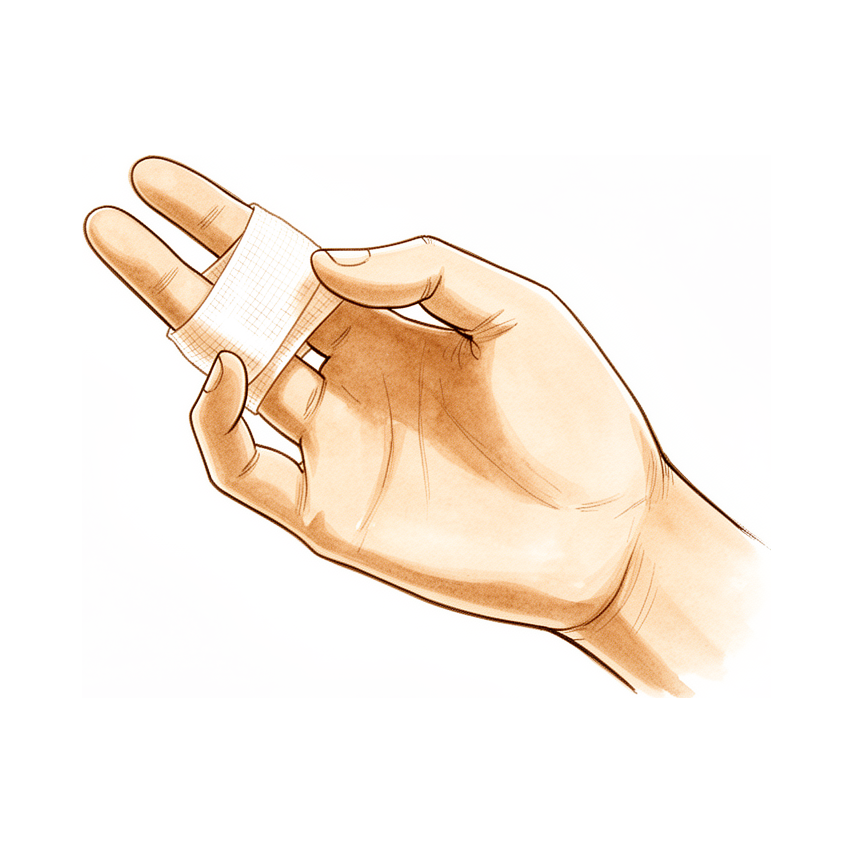
- Buddy taping — depicted in the handout's hero image — is the canonical low-tech "protected early movement" tool here: it shares load with the neighbouring digit while permitting active glide.
Trigger finger (A1 pulley) release
- Release of the A1 pulley is a high-yield day procedure with reliably good patient-perceived recovery [Patient-Perceived Outcomes of Recovery After Trigger Digit Release, JHS 2023].
- Formal supervised therapy is usually NOT required for an uncomplicated release. A prospective randomised controlled trial found no significant difference in DASH, grip strength, ROM or pain between a structured post-operative occupational-therapy arm and a simple home-advice/ROM arm at final follow-up (RCT, PMC10671987). This validates the synthesis framing this as a home program with therapy escalation reserved for those who are slow to settle, stiff or swollen — not mandated for everyone.
Dupuytren's fasciectomy
- Therapy after fasciectomy centres on oedema and wound management, a home exercise program, and night extension splinting — a typical "brief" protocol runs 4 sessions (days 0-3, 2 wk, 4 wk, 8 wk) with a night extension orthosis to ~3 months (post-fasciectomy rehab trials).
- Routine night-splinting for all is contested. The SCoRD-type trials and subsequent work show static night splinting does not clearly improve ROM over hand therapy alone for unselected patients — splinting is best targeted at those losing extension, not applied universally [SCoRD protocol; Dutch Multidisciplinary Guideline on Dupuytren Disease].
- For established post-fasciectomy or post-fracture flexion stiffness, casting motion to mobilise stiffness (CMMS) is an evidence-supported salvage technique to regain digital flexion [Casting motion to mobilise stiffness, Hand Therapy 2010].
C. OEDEMA, SCAR AND STIFFNESS MANAGEMENT
- Oedema control is first-line and non-negotiable. Persistent hand oedema stiffens the soft tissues and degrades both ROM and function. The best systematic review of subacute hand oedema management concluded that active exercise enabling tendon gliding and muscular contraction acts as a pump to drive oedema away from the periphery, and supports elevation and active movement as first-line, with retrograde massage, compression and manual oedema mobilisation as adjuncts — there is no single superior modality, so the program layers them [Miller, Jerosch-Herold & Shepstone, J Hand Ther 2017]. This is reference [1] in the synthesis.
- Tendon gliding works through differential excursion. The straight / hook / tabletop / full-fist positions are not interchangeable repetitions: each moves the FDP relative to the FDS and relative to the sheath by a different amount, and it is this differential glide that keeps the tendons from scarring to one another and to the sheath [Wehbe & Hunter, J Hand Surg Am 1985 — reference [2] in the synthesis]. Joint-by-joint DIP and PIP blocking isolates the same glide at a single joint.
- Scar management. Once the wound is healed, scar massage and desensitisation reduce adherent scar over the incision — relevant to every open finger procedure and the surgical interval through which the tendons must glide.
- Heat before, ice after the exercise session is a standard hand-therapy adjunct to improve tissue extensibility for movement and settle the post-exercise inflammatory flare (consensus practice).
Phased timeline (maps to the synthesis sections)
| Phase | Window | Protect | Motion / glide | Oedema & scar | Notes |
|---|---|---|---|---|---|
| I — Settle & protect | Week 0-~2 | Protect per the specific operation (buddy tape / splint / load limits as set at review); light functional use for self-care, dressing, writing, typing | Begin gentle active motion within the operation's limits; tendon glides and DIP/PIP blocking as the wound and fixation allow | Elevation + active movement first-line for swelling; wound care per handout | First therapy review ideally 5-7 days to start glide before adhesions set (BSSH). No lifting/gripping/impact |
| II — Restore glide & range | Week ~2-6 | Wean protection as the structure consolidates; precautions confirmed at post-op review | Progress active ROM, full tendon-glide series, joint blocking; buddy strapping for PIP/collateral injuries | Once healed: commence scar massage (firm circles); heat before / ice after exercises; retrograde massage + compression if oedema persists | Most ROM is won in this window — frequent gentle practice beats occasional hard effort |
| III — Strengthen & return | Week ~6-12 | Protection generally off (operation-dependent) | Restore full ROM; introduce grip and functional strengthening | Continue scar work until mature; night extension splint to ~3 mo if losing extension (Dupuytren) | Return to lifting/gripping/impact from ~6 weeks per the operation; escalate persistent stiffness to hand therapy / CMMS |
Phase windows are typical and consensus-based; the operation-specific protocol and the surgeon's post-operative review override any timing here.
D. KEY CONTROVERSIES / EVIDENCE QUALITY
- Universal supervised therapy vs home program. For simple procedures (trigger finger release) an RCT shows no benefit of routine formal therapy over good home advice — supporting a targeted therapy model. For complex/stiffness-prone injuries (PIP, fracture-dislocation, fracture ORIF) early supervised hand therapy is far more clearly beneficial. The synthesis correctly pitches a home program with therapist escalation rather than mandating identical input for every operation. Moderate.
- Night-splinting after Dupuytren's fasciectomy. Routine static night splinting is not supported for unselected patients (SCoRD, Dutch guideline); reserve it for those demonstrably losing extension. Moderate (RCT/guideline).
- How early, and how much, to move a fixed fracture. Early protected motion is favoured, but it is strictly contingent on a stable construct — a judgement only the operating surgeon can make. The "early motion is better" evidence assumes adequate fixation. Moderate (SR), construct-dependent.
- The general protocol itself is a consensus scaffold. A single "finger surgery" rehab program necessarily generalises across heterogeneous operations; its three principles (oedema, early motion, glide) are very well supported, but the exact dosing/timing is expert-consensus, individualised by the treating therapist and surgeon.
E. EVIDENCE STRENGTH FLAGS (summary)
- STRONG: oedema control via elevation + active tendon-gliding exercise as first-line (SR, J Hand Ther 2017); tendon differential-excursion rationale for the varied glide positions (mechanistic, Wehbe & Hunter); early motion reduces stiffness/adhesions after finger surgery (consistent across the stiff-finger and BSSH literature).
- MODERATE (RCT / SR / guideline): early mobilisation > immobilisation after hand-fracture ORIF (SR + meta-analysis, 2025); time-to-active-exercise predicts 6-week TAM; no added benefit of routine formal therapy after simple trigger-finger release (RCT); selective (not universal) night splinting after Dupuytren's fasciectomy (SCoRD/Dutch guideline).
- WEAK / CONSENSUS: the precise phase windows and exercise dosing in this general program (expert hand-therapy consensus, individualised); heat-before/ice-after adjunct; the principle that operation-specific protocols override this general scaffold (sound clinical practice, not trial-derived).
CITATIONS
RAG corpus (180,000+ Orthopaedic articles)
- Time to commencement of active exercise predicts total active range of motion 6 weeks after hand-fracture fixation. Hand Therapy. 2016. DOI: 10.1177/1758998316679386
- Hardy MA. The Stiff Finger. Hand Clinics. 2010. DOI: 10.1016/j.hcl.2010.02.001
- Etiology, Evaluation, and Management Options for the Stiff Digit. JAAOS. DOI: 10.5435/jaaos-d-18-00310
- Phalangeal neck fractures of the proximal phalanx of the fingers in adults. Injury. 2010. DOI: 10.1016/j.injury.2010.06.017
- Minimally Invasive Finger Fracture Management. Hand Clinics. 2013. DOI: 10.1016/j.hcl.2013.08.014
- Management of Proximal Interphalangeal Joint Dislocations in Athletes. Hand Clinics. 2009. DOI: 10.1016/j.hcl.2009.05.008
- Treatment of Proximal Interphalangeal Joint Fracture-Dislocations. JBJS Reviews. DOI: 10.2106/jbjs.rvw.o.00019
- Management of Finger Joint Dislocation and Fracture-Dislocations in Athletes. Clinics in Sports Medicine. 2019. DOI: 10.1016/j.csm.2019.10.006
- Patient-Perceived Outcomes of Recovery After Trigger Digit Release. J Hand Surg Am. 2023. DOI: 10.1016/j.jhsa.2023.03.016
- Comparative Study of A1 Pulley Release and Ulnar Superficialis Slip Resection (trigger digit). J Hand Surg Am. 2022. DOI: 10.1016/j.jhsa.2022.04.021
- Use of casting motion to mobilize stiffness (CMMS) to regain digital flexion. Hand Therapy. 2010. DOI: 10.1258/ht.2010.010008
- Dutch Multidisciplinary Guideline on Dupuytren Disease. J Hand Surg Glob Online. 2022. DOI: 10.1016/j.jhsg.2022.11.008
- Factors affecting functional recovery after surgery and hand therapy in Dupuytren's patients. J Hand Ther. 2014. DOI: 10.1016/j.jht.2014.11.006
- Rehabilitation Regimens Following Surgical Repair of Extensor Tendon Injuries of the hand. DOI: 10.1007/s12593-012-0075-x
Hand-therapy / rehabilitation literature (URLs)
- Miller LK, Jerosch-Herold C, Shepstone L. Effectiveness of edema management techniques for subacute hand edema: a systematic review. J Hand Ther. 2017;30(4):432-446. https://pubmed.ncbi.nlm.nih.gov/28807598/
- Wehbe MA, Hunter JM. Flexor tendon gliding in the hand. Part II. Differential gliding. J Hand Surg Am.
- https://pubmed.ncbi.nlm.nih.gov/4020073/
- Systematic review and meta-analysis of mobilisation following ORIF of hand fractures. ScienceDirect.
- https://www.sciencedirect.com/science/article/pii/S1748681525003109
- Better results of finger fractures with wide-awake surgery and early protected motion. PMC. https://www.ncbi.nlm.nih.gov/pmc/articles/PMC4445035/
- The effectiveness of rehabilitation after open surgical release for trigger finger: a prospective, randomized, controlled study. PMC. https://www.ncbi.nlm.nih.gov/pmc/articles/PMC10671987/
- Splinting after contracture release for Dupuytren's contracture (SCoRD): RCT protocol. PMC. https://www.ncbi.nlm.nih.gov/pmc/articles/PMC2386788/
Published rehab protocols (patient-guidance / society — basis for the phase structure)
- The British Society for Surgery of the Hand (BSSH) — Guidelines. https://www.bssh.ac.uk/professionals/guidelines.aspx
- Pain-Guided Hand Therapy for early protected movement of finger fractures (The Saint John Protocol), ASSH. https://handsurgery.org/multimedia/files/preCourse/Pain%20Guided%20Hand%20Therapy%20for%20early%20protected%20movement%20finger%20fractures.pdf
- Rehabilitative Strategies Following Hand Fractures. Hand Clinics. https://www.hand.theclinics.com/article/S0749-0712(13)00066-8/fulltext
- University of Kentucky HealthCare — Hand Rehabilitation Protocols. https://ukhealthcare.uky.edu/sites/default/files/m21-0609_ortho_protocols-final.pdf