Patients › Rehabilitation
Pag-aayos ng Distal Triceps Tendon
Isang protektadong plano ng paggaling pagkatapos ng repair ng distal triceps tendon sa siko, pagpapahinga ng braso sa isang simpleng sling sa 90 degrees at pagpapahintulot ng paggalaw, pagkatapos ay active straightening, at pagkatapos ay lakas sa mga maingat na yugto.
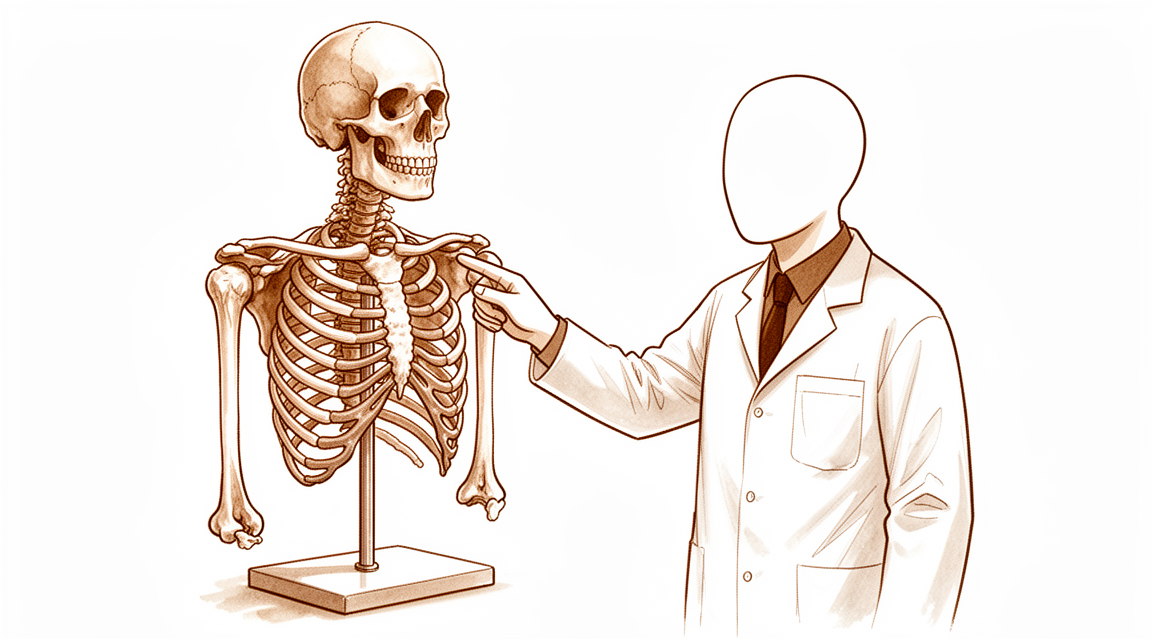
Ang protocol na ito ay nagsisilbing gabay sa iyong paggaling pagkatapos ng surgical repair ng distal triceps tendon (ang tendon na nag-aangkla sa triceps muscle, na nagtutuwid ng iyong siko, sa dulo ng siko), kasama si Dr Kieran Hirpara sa Mater Private Hospital Rockhampton. Nagsisimula ito sa iyong home exercise program, na sinusundan ng structured clinical protocol na isinulat para sa iyong physiotherapist o hand therapist; dalhin ang pahinang ito o ang PDF nito sa iyong unang therapy visit upang manatiling coordinated ang iyong rehabilitasyon. Maaaring i-adjust ng iyong therapist ang plano depende sa pag-unlad ng iyong paggaling.
Kung mayroon kang anumang alalahanin tungkol sa iyong sugat pagkatapos ng operasyon, makipag-ugnayan sa mga rooms. Madalas na nakatutulong ang pagkuha ng larawan ng sugat at pag-email nito para masuri.
Ano ang dapat asahan
Ang distal triceps repair ay muling nagkakabit ng napunit na tendon pabalik sa buto sa bahagi ng siko (ang olecranon). Sa pagtatapos ng operasyon, sinusuri ni Dr Hirpara kung ang repair ay ligtas at buo habang ang siko ay nakatupi sa isang right angle (90°). Dahil dito, ang iyong siko ay nakapahinga sa isang simple sling sa humigit-kumulang 90°, isang komportable at standard na posisyon. Walang hinged brace, at ang siko ay hindi pinapanatiling halos tuwid. Tinatanggal ang sling para sa iyong mga ehersisyo at para sa paghuhugas.
Ang tendon ay nalalagyan ng load (nalalagay sa strain) sa dalawang paraan, at ang maagang plano ay binuo upang maprotektahan laban sa dalawang ito:
- Ang pagtupi ng siko ay nag-uunat sa repair. Kaya para sa unang anim na linggo, ang pagtupi ay limitado sa 90° (isang right angle). Sa kabilang banda, ang pagtuwid ay nagpaparelaks sa tendon, kaya ang ganap na pagtuwid ay malaya at hinihikayat basta't komportable.
- Ang aktibong pagtuwid ng siko ay pinapagana ang triceps, na humihila sa repair. Kaya para sa unang anim na linggo, hindi mo aktibong itutuwid ang siko gamit ang sarili nitong lakas; ang paggalaw sa direksyong iyon ay ginagawa nang dahan-dahan at may tulong, hindi ng triceps mismo.
Ang paggalaw ay unti-unting bubuksan sa mga maingat na yugto: mas malawak na pagtupi mula sa humigit-kumulang anim na linggo, aktibong pagtuwid mula sa humigit-kumulang anim na linggo, at resisted (loaded) strengthening mula sa humigit-kumulang labindalawang linggo. Ang repair ay patuloy na nag-ma-mature sa loob ng ilang buwan, kung kaya't ang mas mabigat na loading at pagbabalik sa sports ay unti-unting ibinabalik sa halip na biglaan.
Mga pag-iingat at limitasyon
- HUWAG itiklop ang iyong siko nang lampas sa right angle (90°) sa loob ng unang anim na linggo, dahil ang pagtiklop ay nag-uunat at nagbibigay ng strain sa repair. Ang ganap na pagtuwid ay ayos lang at hinihikayat.
- HUWAG aktibong ituwid ang siko gamit ang sariling lakas ng kalamnan sa loob ng unang anim na linggo; hayaan itong ituwid nang dahan-dahan nang may tulong, at hindi sa pamamagitan ng pagpapatakbo ng triceps.
- HUWAG gumawa ng anumang resisted straightening o pagtulak/pagdiin gamit ang braso hanggang sa mga labindalawang linggo: walang triceps kickbacks, walang bench o overhead press, at walang pagtulak paitaas mula sa upuan o kama gamit ang operadong braso.
- Isuot ang iyong sling sa 90° ayon sa itinuro (hindi brace, hindi hinahawang tuwid), at HUWAG magmaneho habang suot ito o habang ang iyong braso ay hindi ligtas na makokontrol ang manibela.
- Panatilihing gumagalaw ang iyong kamay, pulso, at balikat mula sa simula, at gamitin ang kamay para sa mga magagaan na pang-araw-araw na gawain sa loob ng iyong comfort, basta't hindi ito kinapapalooban ng pagtulak, pagbuhat, o sapilitang pagtiklop ng siko.
Para sa pamamahala ng sugat, pamamaga, at peklat, tingnan ang gabay ng practice sa wound care.
Iyong mga ehersisyo
Kieran Hirpara 4.0
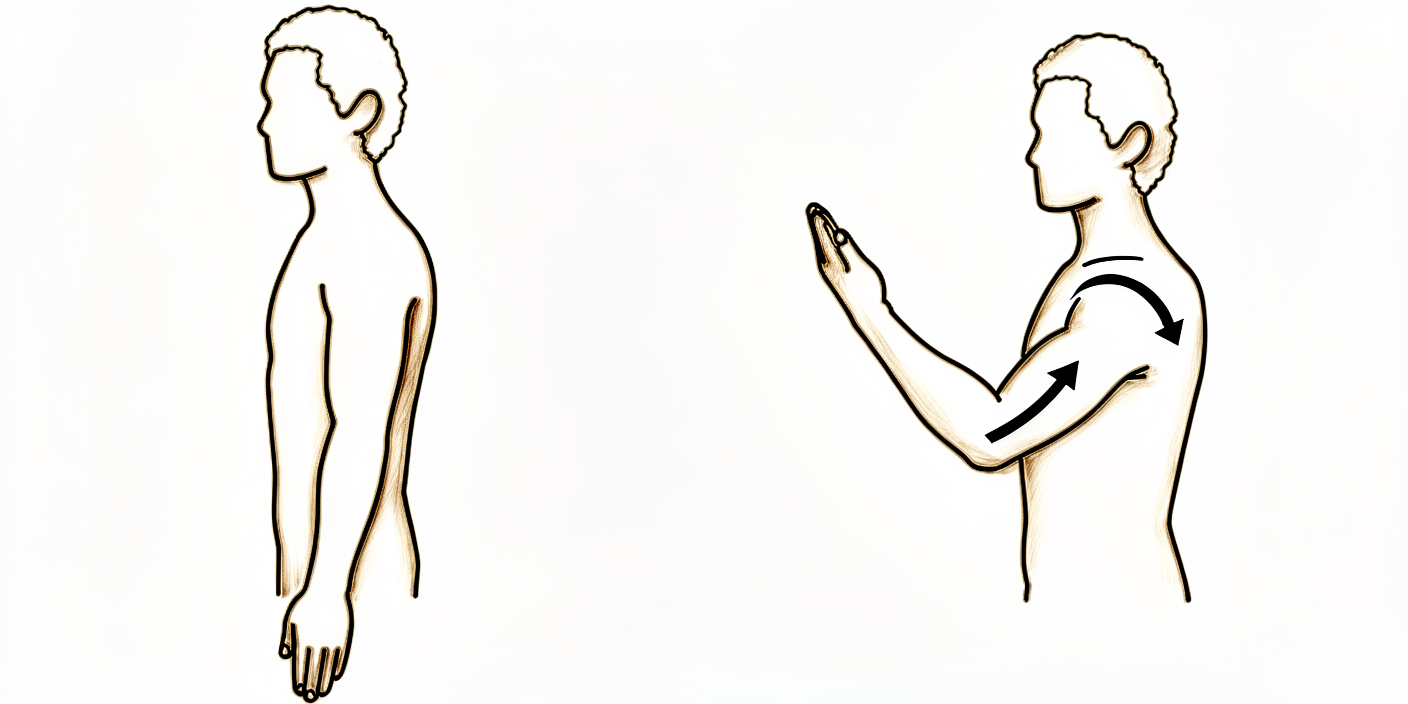
Protektadong paggalaw ng siko (0–90° arc)
Alisin sa sling, dahan-dahang igalaw ang siko sa loob ng ligtas na range nito: maaari itong i-straight nang husto (malaya ang extension, para sa ginhawa), ngunit HUWAG itong itiklop nang lampas sa right angle (90°) — humigit-kumulang hanggang sa posisyon ng paghawak ng telepono sa iyong tainga. Gumalaw nang mabagal at manatili sa loob ng arc na iyon. Ang pagtiklop nang lampas sa 90° ay humihila sa naghihilom na tendon, kaya pinipigilan ito sa loob ng unang anim na linggo.
10 beses, 2–3 beses sa isang araw, sa loob ng 0–90° arc
Kieran Hirpara 4.0
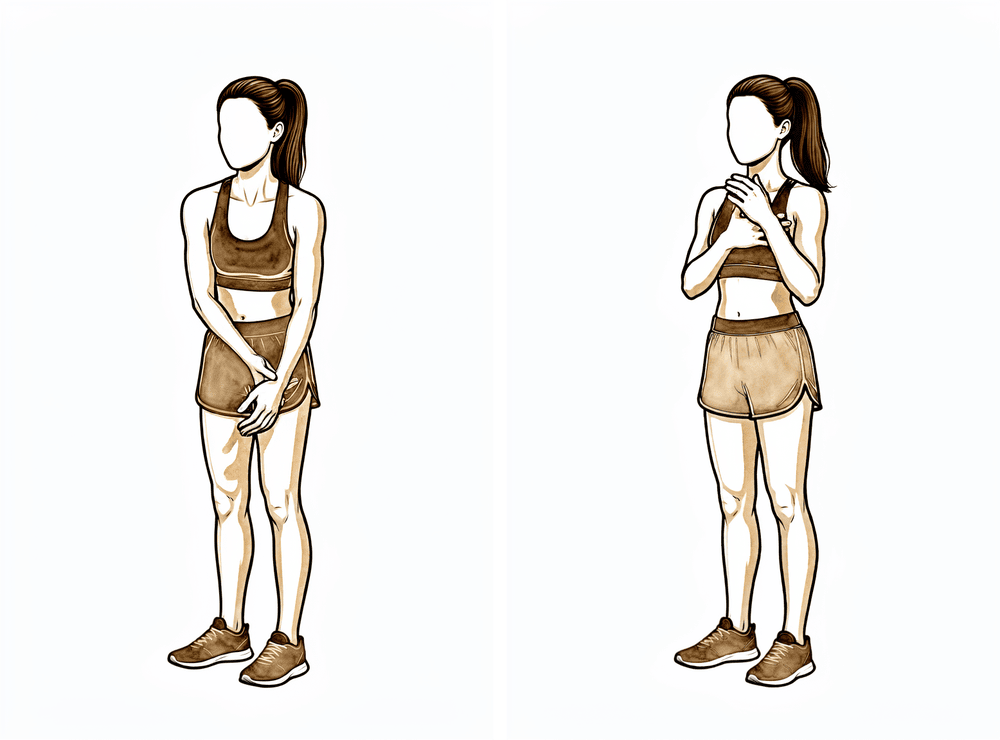
Tinulungang (passive) pagbaluktot ng siko
Gamitin ang iyong kabilang kamay upang dahan-dahang itiklop ang inoperahang siko pataas patungo sa iyong balikat, habang pinapanatiling lubos na relax ang triceps — hindi ka humihila gamit ang inoperahang braso. Huminto sa iyong itinakdang limitasyon (mga 90° sa simula). Pinapanatili nito na malambot ang siko nang hindi pinapagod ang triceps.
10 beses, 2–3 beses sa isang araw, hanggang sa iyong itinakdang limitasyon lamang
Kieran Hirpara 4.0
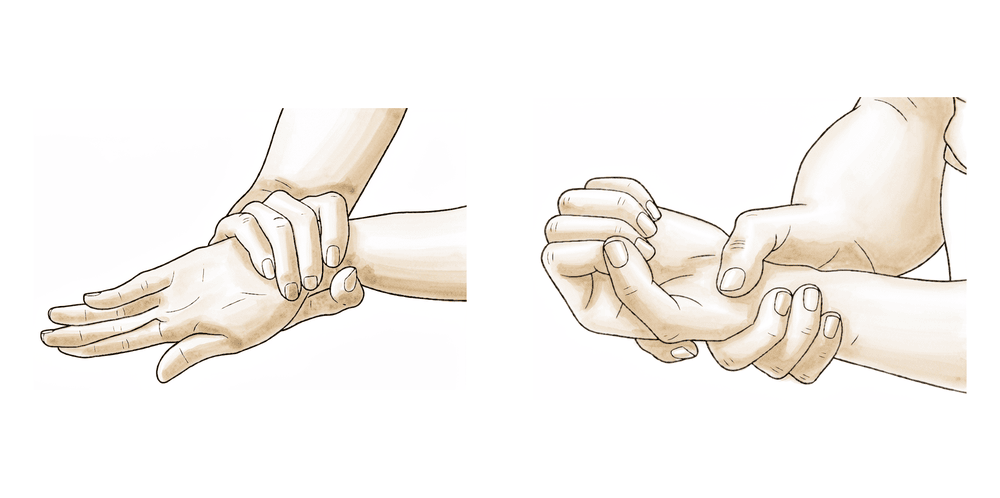
Rotasyon ng forearm (palad paitaas / palad paibaba)
Habang ang iyong siko ay nakadikit sa iyong gilid at nakabaluktot nang komportable, dahan-dahang itagilid ang iyong palad paitaas patungo sa kisame, pagkatapos ay paibaba patungo sa sahig. Panatilihin itong mabagal at madali. Pinapanatili nito ang pagiging supple ng forearm at hindi binibigatan ang triceps repair, kaya maaari itong simulan nang maaga.
10 beses sa bawat direksyon, 2–3 beses sa isang araw
Kieran Hirpara 4.0
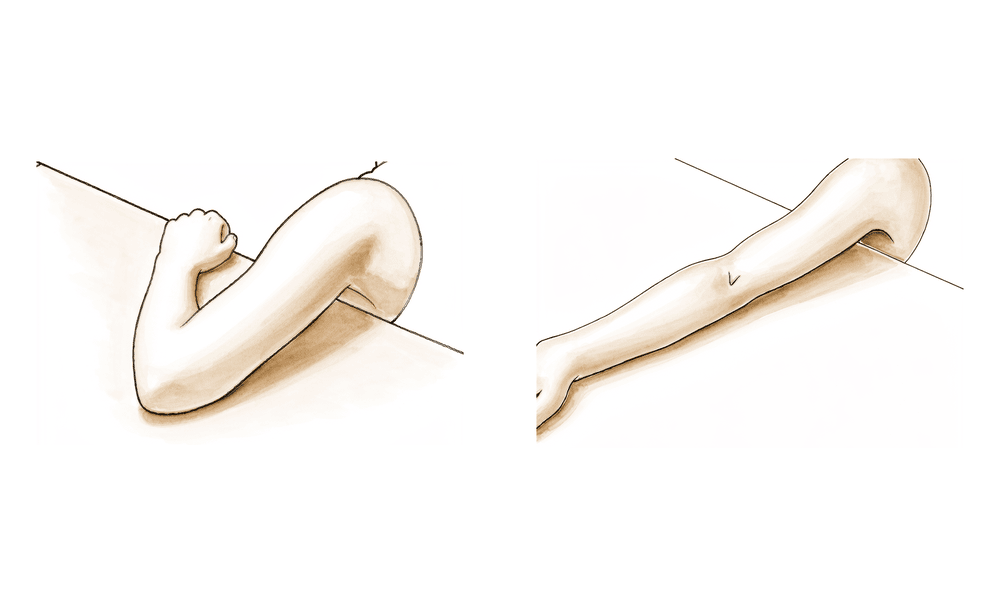
Triceps muscle-set (banayad, walang paggalaw)
Isang ehersisyo sa HULING bahagi — kapag sinimulan na lamang ito ng iyong physiotherapist (karaniwan ay mula sa ika-8 linggo). Habang suportado ang siko, dahan-dahang higpitan ang kalamnan sa LIKOD ng iyong itaas na braso (ang triceps) na tila itutuwid ang siko, ngunit NANG HINDI ito hinahayaang gumalaw — isang magaan na pagdiin, pagpigil, pagkatapos ay pag-relax. Huwag itong gawin sa unang anim na linggo.
Hawakan nang ~5 segundo, 5–10 beses, ayon sa gabay (huling yugto)
Kieran Hirpara 4.0
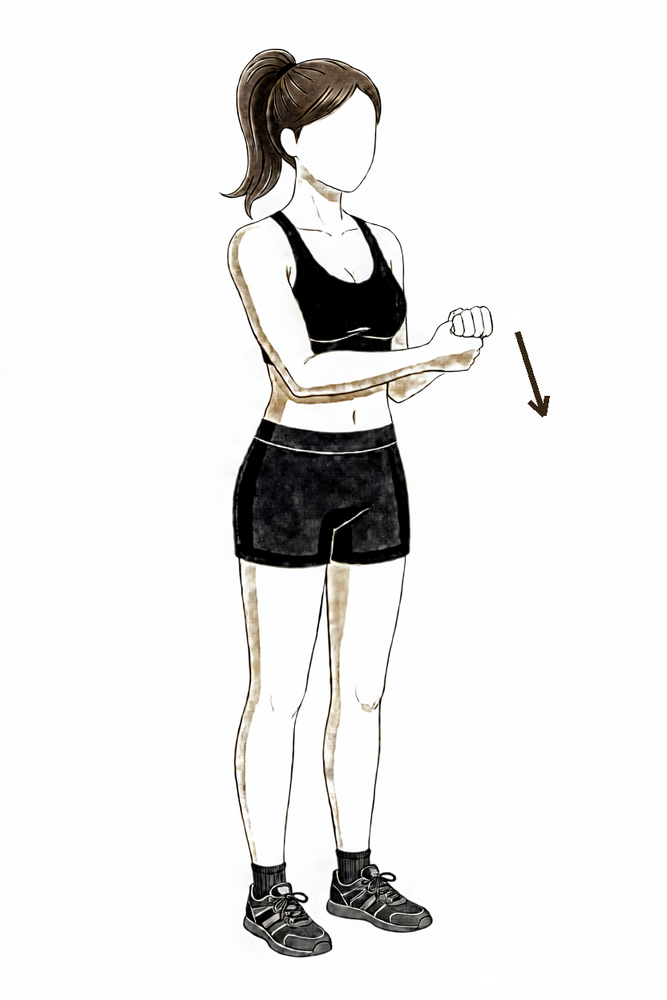
Aktibong pagtuwid ng siko (walang resistensya)
Isang exercise sa HULING bahagi — nagsisimula mula humigit-kumulang 6 na linggo, kapag binigyan na ng clearance. Dahan-dahang ituwid ang siko gamit ang sarili nitong lakas nang WALANG bigat sa kamay, pagkatapos ay gamitin ang iyong kabilang kamay upang tulungan itong ibaba muli (upang hindi pa kailangang kontrolin ng triceps ang downward phase). Manatiling walang sakit. WALANG active straightening sa unang anim na linggo.
10 beses, ayon sa gabay (mula ~6 na linggo, walang resistance)
Kieran Hirpara 4.0
Triceps muscle-set laban sa light hold (isometric extension)
Isang ehersisyo sa HULING bahagi — mula sa humigit-kumulang 8 linggo, ayon sa gabay. Dahan-dahang itulak ang forearm laban sa iyong kabilang kamay o sa isang nakapirming surface na tila itutuwid ang siko, unti-unting itataas ang puwersa hanggang sa magaan at komportableng antas lamang, at panatilihin ito nang hindi gumagalaw ang siko. Ginigising nito ang triceps bago payagan ang resisted work.
Hawakan nang ~5 segundo, 5–10 beses, ayon sa gabay (huling yugto)
Kieran Hirpara 4.0
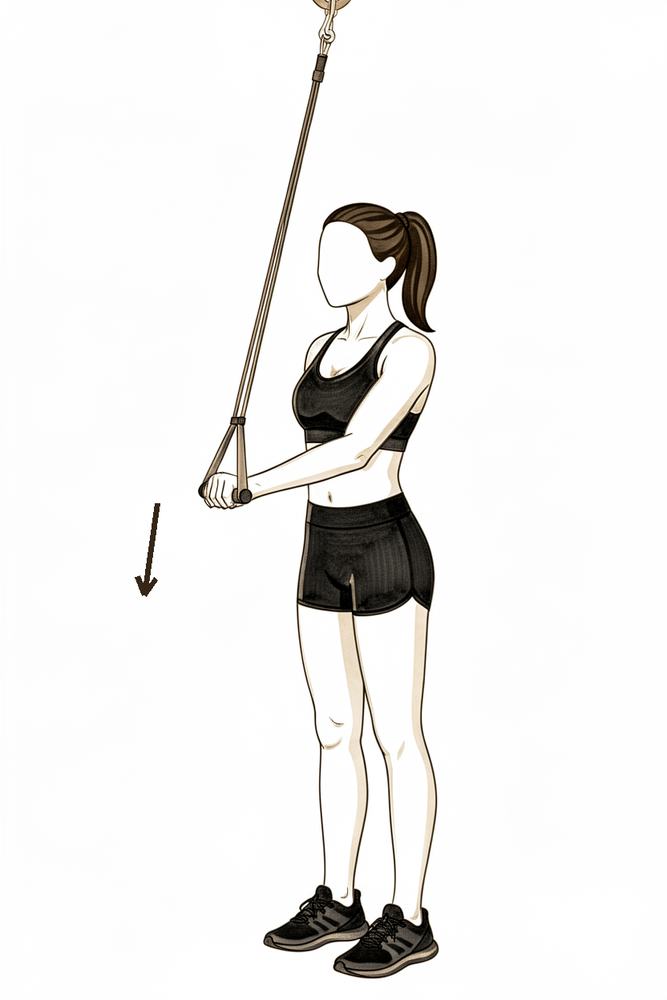
Nilalabanang pagtuwid ng siko gamit ang band (huling yugto ng pagpapalakas)
Isang HULING ehersisyo — kapag pinayagan na lamang ang resisted work, karaniwan ay mula sa ika-12 linggo. Iunat ang siko laban sa isang light resistance band, pagkatapos ay dahan-dahang ibalik ito nang may kontrol. Unti-unting dagdagan ang resistance sa loob ng ilang linggo. Direkta nitong nilalagyan ng load ang na-repair na tendon, kaya ito ang huling sisimulan — huwag itong madaliin, at huminto kung ito ay masakit.
Ayon sa gabay ng iyong physiotherapist (mula ~12 linggo lamang)
Ito ang mga ehersisyo mula sa iyong handout. Simulan lamang ang mga ito ayon sa gabay ni Dr Hirpara at ng iyong physiotherapist, at manatili sa anumang range at limitasyong ibinigay sa iyo. Ang mga maagang ehersisyo ay pinapanatiling gumagalaw ang siko at forearm nang hindi binibigyang-puwersa o ini-stretch ang repair: banayad na paggalaw sa loob ng protektadong 0–90° arc, assisted bending, at forearm rotation. Ang triceps muscle-sets, active straightening at band work ay kabilang sa mga huling phase at hindi dapat simulan hangga't hindi ka partikular na pinapayagan. Itigil ang anumang nagdudulot ng matalas na sakit sa likod ng siko.
Ang iyong clinical protocol
Ang natitirang bahagi ng pahinang ito ay ang staged clinical protocol para sa rehabilitasyon pagkatapos ng distal triceps tendon repair. Ang seksyong ito ay ibibigay sa iyong physiotherapist o hand therapist, at ang bawat phase ay nagsisimula sa isang paliwanag sa simpleng Ingles tungkol sa kung ano ang nangyayari. Ang repair ay nalalagyan ng load sa pamamagitan ng elbow flexion (na nag-uunat dito) at sa pamamagitan ng active o resisted extension (na nagpapakontra ng triceps dito), kaya pinoprotektahan ng protocol ang dalawang ito habang ibinabalik ang motion, pagkatapos ay active extension, at pagkatapos ay resisted strength.
Bago ang paggamot, suriin ang operation report ng pasyente at ang nakaraang medical history, at makipag-ugnayan sa treating surgeon tungkol sa fixation (transosseous tunnels vs suture-anchor footprint), kalidad ng tissue, at ang protected arc. Ang repair ni Dr Hirpara ay sinusuri intra-operatively upang matiyak na ligtas sa 90° ng flexion at pinapahinga sa isang simpleng sling sa 90° (walang hinged brace, hindi pinapanatili sa extension); ang protected arc ay 0–90° kung saan ang extension ay malaya ayon sa comfort at ang flexion ay limitado sa 90°.
Phase I — protektadong paggalaw sa isang 90° sling (linggo 0 hanggang 6)
Ang unang anim na linggo ay nagpoprotekta sa repair habang pinipigilan ang paninigas ng siko. Ang braso ay nakapahinga sa isang simpleng sling sa 90°, tinatanggal para sa mga ehersisyo at kalinisan. Ang siko ay gumagalaw lamang sa loob ng protektadong 0–90° arc, itinutuwid nang lubos hanggang sa komportable ngunit hindi ibabaluktot nang lampas sa right angle, at hinding-hindi gagamitan ng active triceps power.
Para sa iyong physiotherapist:
Edukasyon at mga pag-iingat - I-immobilise sa isang simpleng sling sa 90° (walang hinged brace, HINDI itatabi sa extension); tinatanggal para sa mga ehersisyo at paghuhugas - Protektadong arc 0–90° lamang: extension ay malayang hanggang sa full/comfort; flexion ay hindi lalampas ng 90° - Walang active o resisted elbow extension (ang active triceps contraction ay nagbibigay ng load sa repair) - Walang weight-bearing o pagtulak gamit ang inoperahang braso; magaan at unloaded na paggamit ng kamay sa loob ng comfort level - Panatilihing gentle ang shoulder PROM sa simula (pinoprotektahan ang long head na tumatawid sa balikat)
Pamamahala - Sugat: surgical dressings ayon sa itinuro; i-monitor para sa impeksyon - Oedema: elevation, gentle hand pump, ice kung kinakailangan - Mga Ehersisyo: AAROM/PROM ng siko sa loob ng 0–90° (extension hanggang comfort, flexion ay limitado sa 90°); active wrist, hand at grip ROM; gentle shoulder ROM; gentle forearm rotation; walang active extension
Mga kraytirya para mag-progress - Hilom na ang sugat; komportable at kontroladong 0–90° arc sa loob ng humigit-kumulang anim na linggo
Phase II — pagpapahusay ng flexion at pagsisimula ng active extension (ika-6 hanggang ika-12 linggo)
Mula sa humigit-kumulang anim na linggo, tinatanggal na ang flexion cap at ang pagbaluktot ay pinauunlad nang lampas sa 90° patungo sa full range. Ipinapakilala ang active straightening (extension) nang walang resistance, at ang triceps ay dahan-dahang muling ina-activate gamit ang isometrics. Ang resisted extension at weight-bearing ay hindi pa rin pinapayagan.
Para sa iyong physiotherapist:
Mga Assessment - Active at passive range of motion (ang flexion ay nagpapatuloy na lampas sa 90°, extension); sakit at pamamaga; pagsusuri ng sugat/peklat
Edukasyon at mga pag-iingat - Paunlarin ang flexion lampas sa 90° patungo sa full nang unti-unti mula sa humigit-kumulang anim na linggo - Walang resisted extension at walang weight-bearing sa braso hanggang ika-12 linggo
Pamamahala - Mga ehersisyo: ika-6–8 linggo simulan ang active concentric extension nang WALANG resistance, sa pain-free range (tulungan ang pagbaba/eccentric phase gamit ang kabilang braso); ika-8 linggo light submaximal triceps isometrics; ituloy ang full-arc mobility at forearm rotation; simulan ang scar management kapag magaling na
Mga kraytirya para mag-progress - Full painless ROM; full active extension na may mabuting kontrol; sakit ≤3/10
Phase III — pagpapalakas at pagbabalik (linggo 12 hanggang 16 at higit pa)
Kapag naibalik na ang paggalaw at pinayagan na ang resisted work (bandang labindalawang linggo), magsisimula ang pagpapalakas at unti-unting itataas: resisted triceps work (concentric pagkatapos ay eccentric), pagkatapos ay light closed-chain weight-bearing, at pagkatapos ay limited-range pressing. Ang pagbabalik sa sport ay nakabase sa criterion, sa pinakamaaga ay bandang lima hanggang anim na buwan.
Para sa iyong physiotherapist:
Mga Assessment - Lakas ng triceps kumpara sa kabilang panig; tugon ng sakit/pamamaga sa loading; functional at sport-/work-specific testing kung naaangkop
Edukasyon at mga pag-iingat - Simulan ang resisted triceps strengthening (concentric → eccentric) mula bandang 12 linggo; unti-unting itaas ang load - Closed-chain weight-bearing mula bandang 12 linggo (magsimula nang light, maliit na range); light pressing (push-ups, limited range) mula bandang 14 na linggo
Pamamahala - Mga ehersisyo: progressive resisted elbow extension (band → light weights); graded closed-chain loading; limited-range pressing; ipagpatuloy ang anumang residual mobility work - Isaalang-alang ang discharge kapag ang lakas ay malapit nang maging symmetrical at nakamit na ang angkop na pagbabalik ng function - Isaalang-alang ang referral pabalik sa treating doctor kung ang recovery ay nag-plateau o mayroong poor outcome
Mga Criteria para sa pagbabalik sa sport - 5/5 triceps strength; pain-free high-velocity at sport-specific control
Pagbabalik sa trabaho at aktibidad
Hinihikayat ang magaan na pang-araw-araw na paggamit ng kamay (pagkain, pagsusulat at magaan na pag-aalaga sa sarili) mula sa simula, hangga't komportable, basta't hindi ito kinapapalooban ng pagtulak, pagbuhat o pagbaluktot ng siko lampas sa limitasyon nito. Dahil hindi ka dapat magmaneho habang ang braso ay nasa sling o hindi ligtas na nakokontrol ang manibela, magplano para sa tulong sa transportasyon sa mga unang linggo; ang pagmamaneho ay muling sisimulan kapag wala ka na sa sling at kaya mo nang kontrolin ang kotse, gaya ng kumpirmasyon sa iyong review.
Ang resisted loading at weight-bearing gamit ang braso (pagtulak, pagdiin, pagbuhat at paghila) ay maghihintay hanggang humigit-kumulang labindalawang linggo, at pagkatapos ay unti-unting itataas. Ang pagbabalik sa sports ay sa pinakamaaga ay humigit-kumulang lima hanggang anim na buwan, at nakabase sa pagbawi ng buong paggalaw na walang sakit at sapat, simetrikong lakas ng triceps, na huhusgahan ni Dr Hirpara at ng iyong physiotherapist, hindi base sa kalendaryo lamang. Ang mas mabigat na manwal na trabaho ay susunod sa parehong criterion-based progression.
Pagkatapos ng iyong protocol
Ang protocol na ito ay kasabay ng pangkalahatang payo sa paggaling ng klinika: tingnan ang pamamahala ng sakit pagkatapos ng operasyon, pag-aalaga ng sugat at pagbabalik sa sports. Ang phased plan sa itaas ay sumasalamin sa nailathalang gabay sa rehabilitasyon pagkatapos ng distal triceps tendon repair, at ang iyong patuloy na paggaling ay ginagabayan nang indibidwal ni Dr Hirpara at ng iyong physiotherapist ayon sa pag-unlad ng iyong siko.
Evidence & references
This is the clinical evidence summary written for health professionals. It is technical, and it lists the research this page was built from. You do not need to read it to understand your treatment or to make a decision about it.
Distal Triceps Tendon Repair — Post-operative Rehabilitation (Evidence Brief)
Topic scope: post-operative rehabilitation after surgical reattachment of the avulsed distal triceps tendon to the olecranon (transosseous bone tunnels or suture-anchor footprint repair; best performed within ~3 weeks of injury). The extension mechanism is loaded by elbow flexion (passive stretch of the repair) and by active/resisted extension (triceps contraction), so the rehab cadence is built around protecting both, then restoring motion, then active extension, then resisted strength.
Defining principle: the repair is loaded in flexion and by triceps contraction, so early rehab limits flexion and blocks active/resisted extension while motion is restored, then releases active extension (~6 wk) and resisted extension (~12 wk) in steps, with return to sport at ~5–6 months. Dr Hirpara's stance: the repair is checked intra-operatively to be safe at 90° of flexion, so the elbow is rested in a simple sling at 90° (a standard, comfortable position — no hinged brace, and NOT held near extension) with a protected 0–90° arc (extension free to comfort, flexion capped at 90°) for ~6 weeks. This is deliberately less restrictive on early flexion than the published near-extension / 20°-flexion-lock guidelines, while keeping the key loading rules identical (no active extension to 6 wk, no resisted extension to 12 wk).
Evidence base and corpus note
No RCT and no large prospective cohort defines the rehab cadence for distal triceps repair. The phased timeline rests on a published institutional clinical-care guideline (Ohio State Sports Medicine, 2021), which itself cites the core review literature, corroborated by several surgeon and physiotherapy phased protocols. The local RAG corpus is thin on triceps-specific phased rehab (rotator-cuff and biceps content dominates), but it does contain the key biomechanical repair-strength papers, which inform how early and how aggressively one can mobilise. The week-by-week timeline is therefore carried by the published clinical-care guideline, with the corpus supplying the repair-strength evidence that justifies the cadence.
Key principles and controversies
- Early motion vs prolonged immobilisation. Classic teaching favours protective immobilisation (splint 2–6 wk, flexion-limited brace) because the triceps insertion is loaded in flexion. A counter-trend pushes accelerated early ROM where fixation is strong — a cadaveric study comparing dynamic-tape with standard suture fixation under an intense early-rehab protocol found the novel construct biomechanically superior, i.e. fixation strength is the rate-limiter for how early one can mobilise.
- Suture-anchor vs transosseous (bone-tunnel) repair strength. Carpenter et al. (JSES 2018) found no difference in tendon displacement between transosseous cruciate tunnels and suture-anchor repair when the number of sutures is equalised; the technique by Sarokhan & Leung (Arthrosc Tech 2019) cites Clark et al. (2014) finding anatomic (knotless) footprint repair superior to transosseous cruciate repair. Stronger anatomic footprint fixation is the lever that justifies earlier/more aggressive flexion and earlier resisted extension.
- Flexion-limit progression. No consensus on the exact ramp — the OSU guideline locks at 20° then advances ~15°/5 days; others use ~10°/week or an open 0–60° arc. All converge on full passive flexion by ~6 weeks, with active extension deferred to ~6 weeks and resisted extension to ~12 weeks. KH's variant keeps the elbow at 90° in a simple sling with a free 0–90° arc — less restrictive on early flexion, same loading deferrals.
- Strength athletes / high demand. Retrospective series in strength athletes report satisfactory return to sport but underline that resisted extension and pressing loads are the highest-risk re-rupture activities, supporting the firm 12-week resisted-extension / pressing block.
Phased timeline
| Phase | Window | Sling / ROM ceiling | Exercises | Criteria to progress |
|---|---|---|---|---|
| I — Protected motion | Weeks 0–6 | Simple sling at 90° (no hinged brace, not near extension), off for exercises. Protected arc 0–90°: extension free to comfort, flexion capped at 90°. No active extension. | AAROM/PROM elbow within 0–90°; wrist/hand/grip AROM; gentle shoulder ROM; forearm rotation | Wound healed; comfortable, controlled 0–90° arc at ~6 wk |
| II — Advance flexion + active extension | Weeks 6–12 | Release flexion cap; progress flexion past 90° toward full. No resisted extension / weight-bearing. | Wk 6–8 active concentric extension no resistance (assist eccentric with other arm); wk 8 light submaximal triceps isometrics | Full painless ROM; full active extension with good control; pain ≤3/10 |
| III — Strengthening & return | Weeks 12–16+ | Resisted triceps strengthening (concentric → eccentric) from ~12 wk; CKC weight-bearing from ~12 wk (light, small range); limited-range pressing ~wk 14 | Progressive resisted extension; graded loading; sport-/work-specific progression | 5/5 triceps strength; pain-free high-velocity / sport-specific control |
| Return to sport | ~5–6 months | Criterion-based, at the earliest | — | Full pain-free ROM + symmetrical triceps strength |
Evidence strength flags
- MODERATE (protocol cadence): the phased timeline (no active extension to ~6 wk, resisted extension to ~12 wk, return to sport ~5–6 mo) — anchored to the OSU Sports Medicine clinical-care guideline and corroborating surgeon/PT protocols. No defining rehab RCT.
- MODERATE (repair-strength biomechanics): suture-anchor vs transosseous equivalence with equalised sutures (Carpenter 2018); anatomic footprint superiority (Clark, via Sarokhan & Leung); insertional footprint anatomy (Whitaker 2022) — these justify the mobilisation cadence.
- LOW–MODERATE (KH's 90°-sling / flexion-capped-at-90° variant): biomechanically sound (flexion is the repair-tensioning motion; intra-op tensioning at 90° defines the safe arc) and less restrictive on early flexion than published near-extension guidance, while preserving the key extension-loading deferrals. Consensus / expert rather than trial-derived; corpus gap — no RCT or large cohort defines this exact variant.
CITATIONS
RAG corpus (180,000+ Orthopaedic articles)
- Keener JD, Sethi PM. Distal triceps tendon injuries. Hand Clin. 2015;31(4):641–650. DOI: 10.1016/j.hcl.2015.06.012
- Carpenter SR, Stroh DA, Melvani R, et al. Distal triceps transosseous cruciate versus suture anchor repair using equal constructs: a biomechanical comparison. J Shoulder Elbow Surg. 2018;27(11):2052–2056. DOI: 10.1016/j.jse.2018.07.005
- Sarokhan AK, Leung NL. Acute triceps tendon repair: a technique utilizing 3 curved tunnels and proximal knots. Arthrosc Tech. 2019;8(11):e1325–e1330. DOI: 10.1016/j.eats.2019.07.001
- Ng T, Rush LN, Savoie FH. Arthroscopic distal triceps repair. Arthrosc Tech. 2016;5(6):e1107–e1112. DOI: 10.1016/j.eats.2016.06.011
- Whitaker JJ, Hartke J, Hawayek BJ, et al. Histologic evaluation of the triceps brachii tendon insertion: implications for triceps-sparing surgery. J Hand Surg Am. 2022. DOI: 10.1016/j.jhsa.2022.03.020
Published rehabilitation protocols & literature (URLs)
- Ohio State University Sports Medicine. Distal Triceps Repair — Clinical Care Guideline (G. Hock PT DPT OCS; rev. M. Salsbery PT DPT SCS; Dec 2021). https://medicine.osu.edu/-/media/files/medicine/departments/sports-medicine/medical-professionals/shoulder-and-elbow/distaltricepsrepair.pdf (NB: its near-extension / 20°-flexion-lock immobilisation differs from Dr Hirpara's 90°-sling approach; the loading deferrals are shared.)
- Cadaveric study of dynamic-tape vs standard suture fixation in distal triceps repair under an intense early-rehab protocol. PMC. https://www.ncbi.nlm.nih.gov/pmc/articles/PMC12423150/
- Distal triceps tendon repair in strength athletes — satisfactory return to sport (22 cases). PMC. https://www.ncbi.nlm.nih.gov/pmc/articles/PMC11355401/
Note on corpus gap: the RAG corpus lacks a dedicated distal-triceps phased rehab article; the week-by-week timeline is carried by the OSU clinical-care guideline (and corroborating surgeon protocols), with the corpus papers supplying the repair-strength evidence that justifies the cadence. Flagged accordingly.