Skip to content

Patients › Wrist

Intersection Syndrome

An overuse tendon problem of the back of the forearm, often confused with de Quervain's — its causes, and how rest, splinting or injection settle it.
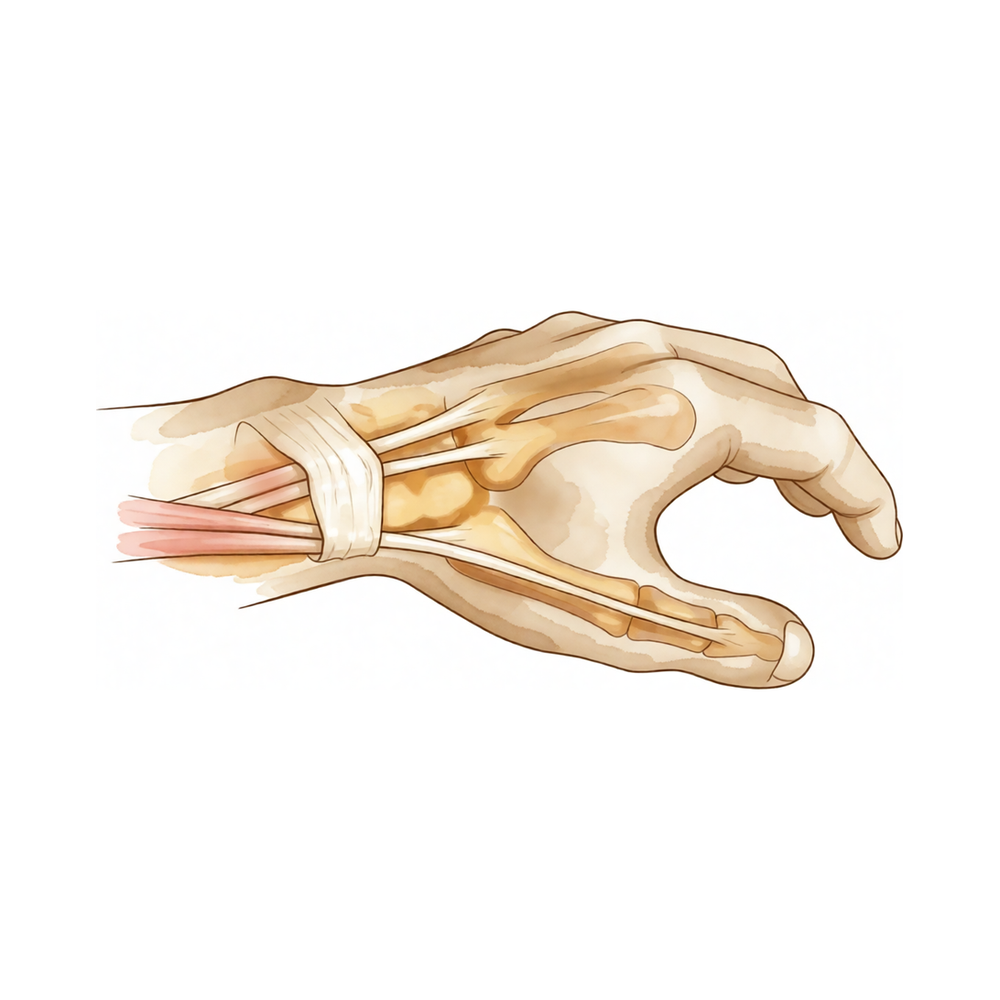
Ilustrasyon ng likod ng forearm kung saan ang mga tendon ng hinlalaki ay tumatawid sa mga wrist-extensor tendon, na may highlight ng sakit sa bahagi ng pagtawid.
Intersection syndrome: ang friction kung saan ang mga tendon ng hinlalaki ay tumatawid sa mga wrist-extensor tendon, ilang sentimetro sa itaas ng pulso, ay nagdudulot ng sakit at pamamaga. Kieran Hirpara 4.0

Ang pahinang ito ay isinalin ng makina at hindi pa nasusuri ng isang doktor. Ang bersyong Ingles ang siyang opisyal.

Ang iyong nararamdaman

Ang intersection syndrome ay nagdudulot ng sakit at pamamaga sa likod at bahagi ng thumb (hinlalaki) ng iyong forearm, ilang distansya sa itaas ng wrist (humigit-kumulang isang lapad ng kamay pataas mula sa bony bump sa likod ng iyong wrist). Hindi ito sakit sa mismong wrist joint, kundi mas mataas, kung saan ang mga kalamnan ng forearm ay nagkakrus-krus.

Ang sakit ay karaniwang lumalala kapag ibinabaluktot mo ang iyong wrist pabalik o iginagalaw ang iyong thumb, at madalas itong lumilitaw pagkatapos ng isang panahon ng paulit-ulit na aktibidad: pagga-row, weightlifting, racquet sports, paghahalaman, o maraming trabaho sa keyboard o mga gawaing mabigat sa wrist. Maraming tao ang nakakapansin ng pamamaga sa sore area, at ang ilan ay nakakaramdam o nakakarinig pa ng malambot na paglangitngit, pag-squeak o pag-grate kapag iginagalaw ang wrist, na tila mayroong nagkikiskisan. Ito ay kung minsan tinatawag na "wet leather" sound.

Ano ang aktwal na nangyayari

Sa likod ng iyong forearm, may dalawang set ng mga kalamnan na nagkukrus na parang isang X. Ang isang set ay papunta sa iyong hinlalaki; ang isa naman ay pababa upang bigyang-lakas ang pulso. Sa punto kung saan sila nagkukrus, ilang sentimetro sa itaas ng pulso, ang mga tendon ay dumudulas pabalik-balik sa isa't isa sa loob ng kanilang mga makinis na sheath.

Kapag gumagawa ka ng maraming paulit-ulit na paggalaw ng pulso, ang crossing point na iyon ay naiirita at namamagâ. Namamaga ang lining ng mga tendon sheath, naiipon ang friction, at ang mga tissue ay nagiging sensitibo at puffy, na nagiging sanhi ng sakit, pamamaga, at paglangitngit. Ito ay isang overuse problem, hindi isang pinsala mula sa isang solong aksidente, at hindi ito katulad ng de Quervain's, isang kaugnay na problema sa tendon sa bahagi ng hinlalaki na matatagpuan nang mas mababa, mismong sa pulso. Ang intersection syndrome ay matatagpuan nang mas mataas.

Ang mabuting balita ay ang naiiritang tissue ay humuhupa nang maayos kapag tumigil na ang pagkikiskisan, at ang kondisyong ito ay hindi nagdudulot ng permanenteng pinsala sa karamihan ng mga tao.

Ano ang maaari naming gawin tungkol dito

Ginagabayan ni Dr Kieran Hirpara ang aming pamamaraan sa pamamahala ng kondisyong ito sa aming klinika. Nagsisimula kami sa non-operative care at isinasaalang-alang lamang ang operasyon kung nananatili ang mga sintomas sa kabila ng mga hakbang na ito.

Halos lahat ay gumagaling nang walang operasyon. Ang mga pangunahing paraan ay:

  • Pagpapahinga mula sa aktibidad na nagpapalala nito: ang pinakamahalagang hakbang. Ang pagbabawas ng rowing, pagbubuhat, o paulit-ulit na gawain sa loob ng ilang linggo ay nagbibigay-daan upang humupa ang pamamaga.
  • Isang wrist splint na humahawak sa pulso na bahagyang nakatiklop pabalik. Pinapahinga nito ang mga nagkakrus na tendon at madalas na isinusuot sa loob ng ilang linggo.
  • Anti-inflammatory tablets o gels (NSAIDs) upang pakalmahin ang sakit at pamamaga.
  • Yelo sa masakit na bahagi pagkatapos ng aktibidad.

Kung hindi humupa ang mga bagay-bagay gamit ang mga hakbang na iyon, ang isang corticosteroid injection sa tendon compartment (madalas na ginagabayan ng ultrasound para sa katumpakan) ay karaniwang nagpapababa ng pamamaga. Para sa maliit na bilang ng mga tao na patuloy na bumabalik ang mga sintomas sa kabila ng lahat ng ito, ang isang minor operation upang i-release at linisin ang naiiritang tendon sheath ay napaka-epektibo. Bihira itong kailanganin.

Ano ang dapat asahan

Karamihan sa mga tao ay gumiginhawa sa loob ng ilang linggo hanggang dalawang buwan kapag pinahinga ang aktibidad at gumamit ng splint. Ang outlook ay mahusay: ito ay isang kondisyon na tunay na bumubuti, at hindi ito madalas mag-iwan ng anumang permanenteng panghihina o paninigas kapag ito ay kumalma na.

Ang pangunahing bagay na nagpapabalik nito ay ang mabilis na pagbabalik sa parehong mabigat o paulit-ulit na aktibidad. Ang unti-unting pagbabalik, at kung naaangkop, ang pagsusuri sa tekniko o kagamitan (halimbawa, oar grip sa mga rowers, o bar grip sa gym), ay nakatutulong upang hindi na ito bumalik nang tuluyan.

Kailan dapat magpatingin

  • Pananakit at pamamaga sa likod ng forearm na hindi nawawala pagkatapos ng ilang linggong pahinga at paggamit ng splint.
  • Paglangitngit o pag-tunog sa apektadong bahagi, o pananakit na bumabalik tuwing bumabalik ka sa iyong isport o gawain sa trabaho.
  • Mga sintomas na pabalik-balik sa kabila ng pagpapahinga, na nararapat suriin, dahil ang ultrasound-guided injection ay maaaring makatulong.
  • Anumang lagnat, mainit at pulang balat, o mabilis na lumalalang pamamaga: magpatingin agad sa doktor, dahil ito ay nagpapahiwatig ng ibang kondisyon maliban sa simpleng overuse.

Higit pang detalye

Advanced reading: the deeper science (optional)

Ang seksyong ito ay lumalampas sa kailangan mo para sa iyong sariling mga desisyon sa paggamot. Ang intersection syndrome ay karapat-dapat sa karagdagang pagbabasa pangunahin dahil sa kung ano ang napagkakamalan dito, matatagpuan ito ilang sentimetro mula sa de Quervain's tenosynovitis, magkaiba ang paraan ng paggamot, at ang ebidensyang nagbubukod sa kanila ay tunay na kakaunti.

Kung nasaan ito, at kung bakit iyon na ang buong diagnosis

Dalawang kalamnan na papunta sa hinlalaki ang tumatawid sa dalawang wrist extensor tendon mga apat hanggang walong sentimetro sa itaas ng pulso, sa likod ng forearm. Ang friction sa crossing point na iyon ay nagdudulot ng sakit, pamamaga, at kung minsan ay isang naririnig o nararamdamang paglangitngit habang gumagalaw ang pulso.

Ang lokasyon ang diagnosis. Ang De Quervain's ay masakit sa mismong pulso, sa ibabaw ng bony prominence sa panig ng hinlalaki. Ang Intersection syndrome ay masakit nang kapansin-pansing mas mataas sa forearm. Parehong napupukaw ng paggalaw ng hinlalaki at pulso, at parehong maaaring magdulot ng pamamaga, ngunit ang point of maximal tenderness ang naghihiwalay sa kanila, at ginagawa ito nang sapat na maaasahan kaya madalas ay hindi na kailangan ang imaging.

Ano ang nagpapaiba sa dalawang populasyon

Ang direktang paghahambing ay maliit, 80 pasyente, ngunit nagbibigay ng impormasyon. Ang intersection syndrome ay nangyari nang mas madalas sa mga kalalakihan at sa dominanteng kamay kaysa sa de Quervain's disease, kapwa sa lahat ng pasyente at kapag hindi kasama ang mga kababaihang peripartum, at ang mga pasyenteng may intersection syndrome ay nagpakita ng mas maikling tagal ng mga sintomas [1].

Ang bawat isa sa mga ito ay tumutugma sa mekanismo. Ang intersection syndrome ay isang friction injury mula sa paulit-ulit na resisted wrist extension, rowing, weight training, racquet sports, mabigat na manwal na trabaho, kaya pabor ito sa dominanteng panig at sa grupong exposed sa trabaho. Ang mas maikling tagal ng sintomas ay sumasalamin na ito ay may tendensiyang lumitaw pagkatapos ng isang natutukoy na pagbabago sa aktibidad sa halip na unti-unting naipon.

Ang contrast ng de Quervain's ay nagbibigay-turo sa kabilang direksyon: ang pag-exclude sa mga kababaihang peripartum ay nagpabago sa paghahambing, na nagbibigay-diin kung gaano kalakas ang kaugnayan ng kondisyong iyon sa postnatal period — isang kaugnayan na hindi ibinabahagi ng intersection syndrome.

Gamutan, at isang tapat na pahayag ng ebidensya

Konserbatibo ang pamamahala sa malaking karamihan: relatibong pahinga mula sa nakaka-trigger na paggalaw, isang thumb-spica-style splint, mga anti-inflammatory measure, at pagtatama ng teknik o workload na nagdulot nito. Ang corticosteroid injection sa apektadong espasyo ay ginagamit kung mabigo ang mga ito, at ang surgical release ng ikalawang compartment ay nakalaan para sa maliit na bilang ng mga pasyenteng hindi gumagaling.

Manipis ang basehan ng ebidensya para sa pagkakasunod-sunod na iyon. Ang literatura ay binubuo nang malaki ng mga case series at descriptive reports; walang mga trial na naghahambing sa mga opsyon, at ang pinakamalaking comparative study na available ay ang 80-patient series sa itaas [1]. Ang treatment ladder ay nakabatay sa mekanismo at klinikal na karanasan sa halip na sa napatunayang superiority, na nararapat na isaad nang malinaw sa halip na magpahiwatig ng mas matibay na pundasyon kaysa sa umiiral.

Ang ibig sabihin nito sa praktikal na paraan ay ang pinakamahalagang bagay na maiaalay ng sinuman dito ay ang diagnosis mismo. Dahil ang kondisyon ay self-limiting kapag naalis na ang nakaka-trigger na load, ang tamang pagtukoy sa site, at samakatuwid ay ang paggalaw na dapat baguhin, ang gumagawa ng malaking bahagi ng trabaho.

Mga Sanggunian

[1] Sato J, Ishii Y, Noguchi H. Clinical and ultrasound features in patients with intersection syndrome or de Quervain's disease. J Hand Surg Eur Vol. 2015;41(2):220-5. https://doi.org/10.1177/1753193415614267


Creative Commons BY-NC 4.0

CC Creative Commons licence
BY Attribution — you must credit the source
NC NonCommercial — not for commercial use

Attribution-NonCommercial 4.0 International


Creative Commons Corporation ("Creative Commons") is not a law firm and does not provide legal services or legal advice. Distribution of Creative Commons public licenses does not create a lawyer-client or other relationship. Creative Commons makes its licenses and related information available on an "as-is" basis. Creative Commons gives no warranties regarding its licenses, any material licensed under their terms and conditions, or any related information. Creative Commons disclaims all liability for damages resulting from their use to the fullest extent possible.

Using Creative Commons Public Licenses

Creative Commons public licenses provide a standard set of terms and conditions that creators and other rights holders may use to share original works of authorship and other material subject to copyright and certain other rights specified in the public license below. The following considerations are for informational purposes only, are not exhaustive, and do not form part of our licenses.

Considerations for licensors: Our public licenses are intended for use by those authorized to give the public permission to use material in ways otherwise restricted by copyright and certain other rights. Our licenses are irrevocable. Licensors should read and understand the terms and conditions of the license they choose before applying it. Licensors should also secure all rights necessary before applying our licenses so that the public can reuse the material as expected. Licensors should clearly mark any material not subject to the license. This includes other CC- licensed material, or material used under an exception or limitation to copyright. More considerations for licensors: wiki.creativecommons.org/Considerations_for_licensors

Considerations for the public: By using one of our public licenses, a licensor grants the public permission to use the licensed material under specified terms and conditions. If the licensor's permission is not necessary for any reason--for example, because of any applicable exception or limitation to copyright--then that use is not regulated by the license. Our licenses grant only permissions under copyright and certain other rights that a licensor has authority to grant. Use of the licensed material may still be restricted for other reasons, including because others have copyright or other rights in the material. A licensor may make special requests, such as asking that all changes be marked or described. Although not required by our licenses, you are encouraged to respect those requests where reasonable. More considerations for the public: wiki.creativecommons.org/Considerations_for_licensees


Creative Commons Attribution-NonCommercial 4.0 International Public License

By exercising the Licensed Rights (defined below), You accept and agree to be bound by the terms and conditions of this Creative Commons Attribution-NonCommercial 4.0 International Public License ("Public License"). To the extent this Public License may be interpreted as a contract, You are granted the Licensed Rights in consideration of Your acceptance of these terms and conditions, and the Licensor grants You such rights in consideration of benefits the Licensor receives from making the Licensed Material available under these terms and conditions.

Section 1 -- Definitions.

a. Adapted Material means material subject to Copyright and Similar Rights that is derived from or based upon the Licensed Material and in which the Licensed Material is translated, altered, arranged, transformed, or otherwise modified in a manner requiring permission under the Copyright and Similar Rights held by the Licensor. For purposes of this Public License, where the Licensed Material is a musical work, performance, or sound recording, Adapted Material is always produced where the Licensed Material is synched in timed relation with a moving image.

b. Adapter's License means the license You apply to Your Copyright and Similar Rights in Your contributions to Adapted Material in accordance with the terms and conditions of this Public License.

c. Copyright and Similar Rights means copyright and/or similar rights closely related to copyright including, without limitation, performance, broadcast, sound recording, and Sui Generis Database Rights, without regard to how the rights are labeled or categorized. For purposes of this Public License, the rights specified in Section 2(b)(1)-(2) are not Copyright and Similar Rights.

d. Effective Technological Measures means those measures that, in the absence of proper authority, may not be circumvented under laws fulfilling obligations under Article 11 of the WIPO Copyright Treaty adopted on December 20, 1996, and/or similar international agreements.

e. Exceptions and Limitations means fair use, fair dealing, and/or any other exception or limitation to Copyright and Similar Rights that applies to Your use of the Licensed Material.

f. Licensed Material means the artistic or literary work, database, or other material to which the Licensor applied this Public License.

g. Licensed Rights means the rights granted to You subject to the terms and conditions of this Public License, which are limited to all Copyright and Similar Rights that apply to Your use of the Licensed Material and that the Licensor has authority to license.

h. Licensor means the individual(s) or entity(ies) granting rights under this Public License.

i. NonCommercial means not primarily intended for or directed towards commercial advantage or monetary compensation. For purposes of this Public License, the exchange of the Licensed Material for other material subject to Copyright and Similar Rights by digital file-sharing or similar means is NonCommercial provided there is no payment of monetary compensation in connection with the exchange.

j. Share means to provide material to the public by any means or process that requires permission under the Licensed Rights, such as reproduction, public display, public performance, distribution, dissemination, communication, or importation, and to make material available to the public including in ways that members of the public may access the material from a place and at a time individually chosen by them.

k. Sui Generis Database Rights means rights other than copyright resulting from Directive 96/9/EC of the European Parliament and of the Council of 11 March 1996 on the legal protection of databases, as amended and/or succeeded, as well as other essentially equivalent rights anywhere in the world.

l. You means the individual or entity exercising the Licensed Rights under this Public License. Your has a corresponding meaning.

Section 2 -- Scope.

a. License grant.

1. Subject to the terms and conditions of this Public License, the Licensor hereby grants You a worldwide, royalty-free, non-sublicensable, non-exclusive, irrevocable license to exercise the Licensed Rights in the Licensed Material to:

a. reproduce and Share the Licensed Material, in whole or in part, for NonCommercial purposes only; and

b. produce, reproduce, and Share Adapted Material for NonCommercial purposes only.

2. Exceptions and Limitations. For the avoidance of doubt, where Exceptions and Limitations apply to Your use, this Public License does not apply, and You do not need to comply with its terms and conditions.

3. Term. The term of this Public License is specified in Section 6(a).

4. Media and formats; technical modifications allowed. The Licensor authorizes You to exercise the Licensed Rights in all media and formats whether now known or hereafter created, and to make technical modifications necessary to do so. The Licensor waives and/or agrees not to assert any right or authority to forbid You from making technical modifications necessary to exercise the Licensed Rights, including technical modifications necessary to circumvent Effective Technological Measures. For purposes of this Public License, simply making modifications authorized by this Section 2(a) (4) never produces Adapted Material.

5. Downstream recipients.

a. Offer from the Licensor -- Licensed Material. Every recipient of the Licensed Material automatically receives an offer from the Licensor to exercise the Licensed Rights under the terms and conditions of this Public License.

b. No downstream restrictions. You may not offer or impose any additional or different terms or conditions on, or apply any Effective Technological Measures to, the Licensed Material if doing so restricts exercise of the Licensed Rights by any recipient of the Licensed Material.

6. No endorsement. Nothing in this Public License constitutes or may be construed as permission to assert or imply that You are, or that Your use of the Licensed Material is, connected with, or sponsored, endorsed, or granted official status by, the Licensor or others designated to receive attribution as provided in Section 3(a)(1)(A)(i).

b. Other rights.

1. Moral rights, such as the right of integrity, are not licensed under this Public License, nor are publicity, privacy, and/or other similar personality rights; however, to the extent possible, the Licensor waives and/or agrees not to assert any such rights held by the Licensor to the limited extent necessary to allow You to exercise the Licensed Rights, but not otherwise.

2. Patent and trademark rights are not licensed under this Public License.

3. To the extent possible, the Licensor waives any right to collect royalties from You for the exercise of the Licensed Rights, whether directly or through a collecting society under any voluntary or waivable statutory or compulsory licensing scheme. In all other cases the Licensor expressly reserves any right to collect such royalties, including when the Licensed Material is used other than for NonCommercial purposes.

Section 3 -- License Conditions.

Your exercise of the Licensed Rights is expressly made subject to the following conditions.

a. Attribution.

1. If You Share the Licensed Material (including in modified form), You must:

a. retain the following if it is supplied by the Licensor with the Licensed Material:

i. identification of the creator(s) of the Licensed Material and any others designated to receive attribution, in any reasonable manner requested by the Licensor (including by pseudonym if designated);

ii. a copyright notice;

iii. a notice that refers to this Public License;

iv. a notice that refers to the disclaimer of warranties;

v. a URI or hyperlink to the Licensed Material to the extent reasonably practicable;

b. indicate if You modified the Licensed Material and retain an indication of any previous modifications; and

c. indicate the Licensed Material is licensed under this Public License, and include the text of, or the URI or hyperlink to, this Public License.

2. You may satisfy the conditions in Section 3(a)(1) in any reasonable manner based on the medium, means, and context in which You Share the Licensed Material. For example, it may be reasonable to satisfy the conditions by providing a URI or hyperlink to a resource that includes the required information.

3. If requested by the Licensor, You must remove any of the information required by Section 3(a)(1)(A) to the extent reasonably practicable.

4. If You Share Adapted Material You produce, the Adapter's License You apply must not prevent recipients of the Adapted Material from complying with this Public License.

Section 4 -- Sui Generis Database Rights.

Where the Licensed Rights include Sui Generis Database Rights that apply to Your use of the Licensed Material:

a. for the avoidance of doubt, Section 2(a)(1) grants You the right to extract, reuse, reproduce, and Share all or a substantial portion of the contents of the database for NonCommercial purposes only;

b. if You include all or a substantial portion of the database contents in a database in which You have Sui Generis Database Rights, then the database in which You have Sui Generis Database Rights (but not its individual contents) is Adapted Material; and

c. You must comply with the conditions in Section 3(a) if You Share all or a substantial portion of the contents of the database.

For the avoidance of doubt, this Section 4 supplements and does not replace Your obligations under this Public License where the Licensed Rights include other Copyright and Similar Rights.

Section 5 -- Disclaimer of Warranties and Limitation of Liability.

a. UNLESS OTHERWISE SEPARATELY UNDERTAKEN BY THE LICENSOR, TO THE EXTENT POSSIBLE, THE LICENSOR OFFERS THE LICENSED MATERIAL AS-IS AND AS-AVAILABLE, AND MAKES NO REPRESENTATIONS OR WARRANTIES OF ANY KIND CONCERNING THE LICENSED MATERIAL, WHETHER EXPRESS, IMPLIED, STATUTORY, OR OTHER. THIS INCLUDES, WITHOUT LIMITATION, WARRANTIES OF TITLE, MERCHANTABILITY, FITNESS FOR A PARTICULAR PURPOSE, NON-INFRINGEMENT, ABSENCE OF LATENT OR OTHER DEFECTS, ACCURACY, OR THE PRESENCE OR ABSENCE OF ERRORS, WHETHER OR NOT KNOWN OR DISCOVERABLE. WHERE DISCLAIMERS OF WARRANTIES ARE NOT ALLOWED IN FULL OR IN PART, THIS DISCLAIMER MAY NOT APPLY TO YOU.

b. TO THE EXTENT POSSIBLE, IN NO EVENT WILL THE LICENSOR BE LIABLE TO YOU ON ANY LEGAL THEORY (INCLUDING, WITHOUT LIMITATION, NEGLIGENCE) OR OTHERWISE FOR ANY DIRECT, SPECIAL, INDIRECT, INCIDENTAL, CONSEQUENTIAL, PUNITIVE, EXEMPLARY, OR OTHER LOSSES, COSTS, EXPENSES, OR DAMAGES ARISING OUT OF THIS PUBLIC LICENSE OR USE OF THE LICENSED MATERIAL, EVEN IF THE LICENSOR HAS BEEN ADVISED OF THE POSSIBILITY OF SUCH LOSSES, COSTS, EXPENSES, OR DAMAGES. WHERE A LIMITATION OF LIABILITY IS NOT ALLOWED IN FULL OR IN PART, THIS LIMITATION MAY NOT APPLY TO YOU.

c. The disclaimer of warranties and limitation of liability provided above shall be interpreted in a manner that, to the extent possible, most closely approximates an absolute disclaimer and waiver of all liability.

Section 6 -- Term and Termination.

a. This Public License applies for the term of the Copyright and Similar Rights licensed here. However, if You fail to comply with this Public License, then Your rights under this Public License terminate automatically.

b. Where Your right to use the Licensed Material has terminated under Section 6(a), it reinstates:

1. automatically as of the date the violation is cured, provided it is cured within 30 days of Your discovery of the violation; or

2. upon express reinstatement by the Licensor.

For the avoidance of doubt, this Section 6(b) does not affect any right the Licensor may have to seek remedies for Your violations of this Public License.

c. For the avoidance of doubt, the Licensor may also offer the Licensed Material under separate terms or conditions or stop distributing the Licensed Material at any time; however, doing so will not terminate this Public License.

d. Sections 1, 5, 6, 7, and 8 survive termination of this Public License.

Section 7 -- Other Terms and Conditions.

a. The Licensor shall not be bound by any additional or different terms or conditions communicated by You unless expressly agreed.

b. Any arrangements, understandings, or agreements regarding the Licensed Material not stated herein are separate from and independent of the terms and conditions of this Public License.

Section 8 -- Interpretation.

a. For the avoidance of doubt, this Public License does not, and shall not be interpreted to, reduce, limit, restrict, or impose conditions on any use of the Licensed Material that could lawfully be made without permission under this Public License.

b. To the extent possible, if any provision of this Public License is deemed unenforceable, it shall be automatically reformed to the minimum extent necessary to make it enforceable. If the provision cannot be reformed, it shall be severed from this Public License without affecting the enforceability of the remaining terms and conditions.

c. No term or condition of this Public License will be waived and no failure to comply consented to unless expressly agreed to by the Licensor.

d. Nothing in this Public License constitutes or may be interpreted as a limitation upon, or waiver of, any privileges and immunities that apply to the Licensor or You, including from the legal processes of any jurisdiction or authority.


Creative Commons is not a party to its public licenses. Notwithstanding, Creative Commons may elect to apply one of its public licenses to material it publishes and in those instances will be considered the “Licensor.” The text of the Creative Commons public licenses is dedicated to the public domain under the CC0 Public Domain Dedication. Except for the limited purpose of indicating that material is shared under a Creative Commons public license or as otherwise permitted by the Creative Commons policies published at creativecommons.org/policies, Creative Commons does not authorize the use of the trademark "Creative Commons" or any other trademark or logo of Creative Commons without its prior written consent including, without limitation, in connection with any unauthorized modifications to any of its public licenses or any other arrangements, understandings, or agreements concerning use of licensed material. For the avoidance of doubt, this paragraph does not form part of the public licenses.

Creative Commons may be contacted at creativecommons.org.