Patients › Rehabilitation
Pag-aayos ng Pectoralis Major
Rehabilitation protocol after pectoralis major repair, with the protected safe zone and staged return to chest loading.

Ang protocol na ito ay nagsisilbing gabay sa iyong paggaling pagkatapos ng pectoralis major repair kasama si Dr Kieran Hirpara sa Mater Private Hospital Rockhampton. Ang bawat phase sa ibaba ay nagsisimula sa isang paliwanag sa simpleng Ingles tungkol sa kung ano ang nangyayari at kung ano ang pinakamahalaga, na sinusundan ng structured detail na kailangan ng iyong physiotherapist; dalhin ang pahinang ito o ang PDF nito sa iyong unang physiotherapy visit upang manatiling coordinated ang iyong rehabilitasyon. Maaaring i-adjust ng iyong physiotherapist ang plano depende sa pag-unlad ng iyong paggaling.
Kung mayroon kang anumang alalahanin tungkol sa iyong sugat pagkatapos ng operasyon, makipag-ugnayan sa mga rooms. Madalas na nakatutulong ang pagkuha ng larawan ng sugat at pag-email nito para masuri. Ang incision ay matatagpuan malapit sa tupi ng kili-kili, kung saan naiipon ang pawis at moisture; panatilihin itong malinis at tuyo, at agad na iulat ang anumang pamumula, discharge, o lagnat.
Ano ang dapat asahan
Ang pectoralis major ay ang malakas na kalamnan sa dibdib na nagpapatakbo sa mga paggalaw ng pagtulak at pagyakap: ang bench press, push-ups, at paghila ng braso patawid sa katawan. Ang pagkapunit ay karaniwang nangyayari sa isang malakas at batang lalaki habang ibinababa ang mabigat na bench press, kung kailan ang kalamnan ay nababanat at nabibigatan nang sabay. Ang pag-repair nito ay muling nagkakabit sa punit na tendon, at ang buong programa ay binuo sa isang simpleng ideya: panatilihing walang banat (off-stretch) at walang bigat (off-load) ang na-repair na tendon habang ito ay gumagaling.
Hinihila ng pectoralis major ang braso patawid sa katawan at papasok, at pini-rotate ito papasok. Ang dalawang paggalaw na pinaka-nagbabanaat at nagbibigay ng tensyon sa repair ay ang paglalabas ng braso patagilid (abduction) at pag-rotate nito palabas (external rotation), lalo na kapag magkasabay, na siyang posisyon na nagiging sanhi ng pagkapunit nito noong una. Kaya sa simula, ang braso ay pinapanatili sa harap ng katawan, dahan-dahang pini-rotate papasok, at ang dalawang paggalaw na iyon ay mahigpit na nililimitahan at unti-unting ibinabalik nang ilang digri sa bawat pagkakataon.
Dahil ang repair ay maaaring humiwalay sa buto kung ito ay mabibigatan nang sobra, ang mabibigat na ehersisyo sa dibdib (bench press, flyes, dips, push-ups at contact sport) ay sadyang ipinagpapaliban ng apat hanggang anim na buwan. Mas matagal ito kaysa sa inaakala, ngunit ito ang pinakaimportanteng bagay na nagpoprotekta sa iyong repair.
Ang iyong timeline ay nakadepende rin sa kung paano na-repair ang tendon. Ang bone-tendon repair (ang tendon ay muling ikinakabit sa buto ng upper arm gamit ang mga anchor o button) ay mas mabagal gumaling kaysa sa tendon-to-tendon repair, at mas huling tinatanggal ang sling. Sasabihin sa iyo ni Dr Hirpara kung alin ang naaangkop sa iyo. Sa buong programang ito, uusad ka kapag handa na ang iyong balikat, hindi lamang base sa nakasaad sa kalendaryo: ang bawat phase sa ibaba ay naglilista kung ano ang hitsura ng pagiging "handa."
Ang pamamaraan
Ang pectoralis major repair ay muling nagkakabit sa napunit na tendon ng kalamnan sa dibdib. Kadalasan, ang tendon ay nahugot mula sa kung saan ito nakakabit sa buto ng itaas na braso (ang humerus), at muli itong ikinakabit doon gamit ang matitibay na sutures sa pamamagitan ng mga anchor o button; kung minsan ang punit ay nasa loob mismo ng tendon at tinatahi itong muli. Ang layunin ng rehabilitasyon ay protektahan ang muling pagkakabit na iyon habang ito ay gumagaling, at pagkatapos ay unti-unting ibalik ang buong paggalaw, lakas, at kumpiyansa sa pagtulak (pressing power).
Pagsusuot ng iyong sling
Gagamit ka ng simpleng sling: gumagamit si Dr Hirpara ng simpleng sling, hindi ng malaking abduction-pillow o gunslinger brace. Pinapanatili ng sling ang iyong braso sa protektadong posisyon: sa harap ng iyong katawan at dahan-dahang nakapihit papasok, kung saan nakarelaks ang naoperahang kalamnan ng dibdib.
- Isuot ang sling sa loob ng 4 hanggang 6 na linggo (ang bone-tendon repair ay nananatili rito nang mas matagal kaysa sa tendon-to-tendon repair; sasabihin sa iyo ni Dr Hirpara kung alin dito). Hindi mo kailangang matulog nang nakasuot nito.
- Hubarin lamang ito para sa pagligo at para sa iyong mga ehersisyo, kapag naipakita na sa iyo kung paano; sa tuwing wala ang sling, panatilihin ang iyong braso sa harap ng iyong katawan at sa iyong tabi, hindi nakalabas sa gilid at hindi nakapihit palabas.
- Habang nagpapahinga sa bahay, maaari itong hubarin kung magiging maingat ka: ang braso ay nakapatong sa unan, at nakapanatili sa iyong harapan.
- Gumamit ng ice kung ang balikat ay namamagâ o masakit, lalo na pagkatapos ng ehersisyo.
Habang nakasuot ng sling, bantayan ang iyong postura. Panatilihing nakalinya ang iyong mga tainga, balikat, at balakang at iwasang hayaang lumaylay ang iyong mga balikat; ang mabuting postura ay nagpoprotekta sa iyong likod at tumutulong upang maiwasan ang paninigas ng iyong balikat.
Mga pangunahing pag-iingat — HUWAG
- HUWAG i-rotate ang braso palabas lampas sa lingguhang limitasyong itinakda ng iyong physiotherapist. Ang outward rotation ay nagsisimula sa posisyong diretso sa harap (neutral, 0°) at ibinabalik nang paunti-unti, mga 5° lamang bawat linggo, dahil ang pag-rotate palabas ay nag-uunat sa repair.
- HUWAG ilabas ang braso sa gilid lampas sa maliit na halagang pinapayagan bawat linggo, at huwag na huwag pagsasamahin ang paglalabas ng braso sa gilid at ang pag-rotate nito palabas: iyon ang posisyong pumupunit sa kalamnan.
- HUWAG hayaang gumalaw ang siko pabalik sa likod ng linya ng iyong dibdib (ini-uunat nito ang repair); iwasan ito sa loob ng mahabang panahon pagkatapos nito sa gym.
- HUWAG gumawa ng pendulum (arm-dangling) o stick-levered exercises sa mga unang linggo; hindi tulad ng karaniwang shoulder surgery, ang pagpapabitin ng braso o pag-lever nito gamit ang stick ay humihila sa na-repair na kalamnan ng dibdib. (Ang mga stick-assisted drills ay gagawin sa huling bahagi, mula sa ika-4 na linggo.)
- HUWAG itulak, idiin o lagyan ng load ang dibdib (walang bench press, flyes, dips, pec-deck, push-ups o contact sport) hanggang sa payagan, hindi bago ang 4 hanggang 6 na buwan.
- HUWAG pilitin o i-stretch ang anumang paggalaw, at huwag direktang i-exercise ang na-repair na kalamnan ng dibdib (resisted inward rotation o pressing) hanggang sa simulan ito ng iyong team, mula sa ika-9 na linggo.
Phase I — Proteksyon (mga linggo 0–3)
Ang mga unang linggo ay nakatuon nang lubos sa pagprotekta sa kinalas na tendon habang ito ay kumakapit sa buto. Mananatili ka sa simpleng sling sa oras ng araw, na ang braso ay nasa harap mo at dahan-dahang naka-rotate papasok; hindi mo kailangang matulog nang nakasuot nito, ngunit panatilihin ang braso sa ligtas na posisyong iyon sa buong gabi. Ang iyong kamay, pulso, mga daliri at siko ay patuloy na gumagalaw nang normal. Mula sa ika-2 linggo, maaaring simulan ng iyong physiotherapist ang dahan-dahang paggalaw ng balikat para sa iyo (passive movement) sa loob ng mahigpit na limitasyon, ngunit walang anuman sa sarili mong lakas, walang pilit, at walang pendulum o stick exercises.
- Sling: simpleng sling, braso ay nasa harap at dahan-dahang naka-rotate papasok, isinusuot sa oras ng araw; matulog nang wala ito ngunit panatilihin ang braso sa parehong ligtas na posisyon.
- Pinapayagang paggalaw: passive (assisted) movement lamang, sisimulan mula sa ika-2 linggo at pananatilihin sa loob ng mahigpit na limitasyon: outward rotation hanggang neutral (0°) lamang, forward lift hanggang mga 45° lamang, at arm-out-to-the-side hanggang mga 30° lamang. Ang iyong siko, pulso at kamay ay malayang gumagalaw.
- Mga Ehersisyo: paggalaw ng kamay, pulso at siko; dahan-dahang pag-squeeze ng kamay; shoulder-blade setting at low rows para sa mga kalamnan sa paligid ng shoulder blade (panatilihing mababa, malayong mababa sa taas ng balikat). Walang anumang chest-muscle loading.
Handa na para sa susunod na phase kapag: kontrolado na ang iyong sakit; ang iyong sugat ay naghilom na nang walang mga palatandaan ng problema; ang iyong passive movement ay komportable sa loob ng mga limitasyong nabanggit sa itaas; at walang palatandaan na ang repair ay na-over-stress.
Phase II — Pagbabalik ng paggalaw at pag-alis ng sling (weeks 4–6)
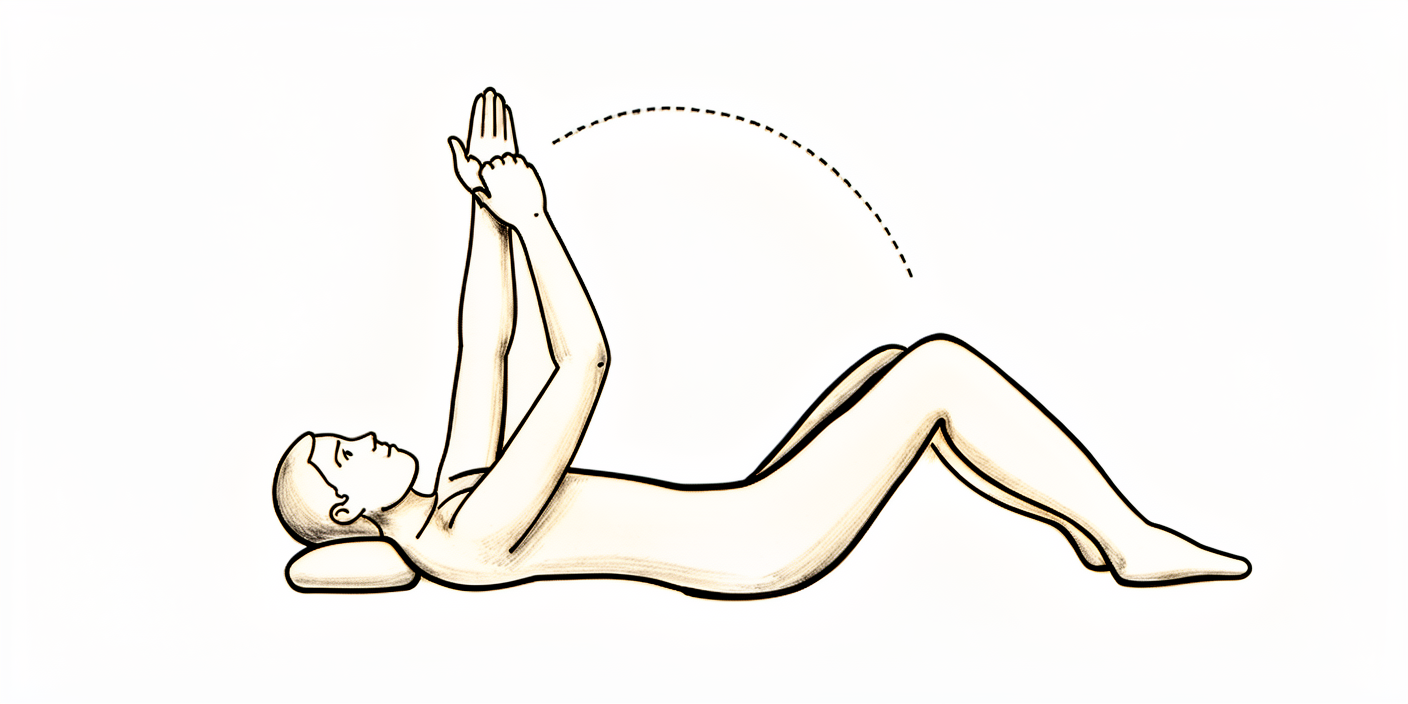
Kieran Hirpara 4.0
Tinutulungang forward lift habang nakahiga
Humiga nang patihaya. Gamitin ang iyong malusog na kamay sa ilalim ng siko ng inoperahang braso upang tulungan itong iangat pasulong, hanggang sa taas lamang na itinakda ng iyong physiotherapist, pagkatapos ay dahan-dahang ibaba. Manatiling relax ang inoperahang balikat at ang iyong malusog na braso ang gagawa ng trabaho. Ipinapakilala mula sa ika-4 na linggo — hindi sa mga unang linggo.
Ayon sa gabay ng iyong physiotherapist
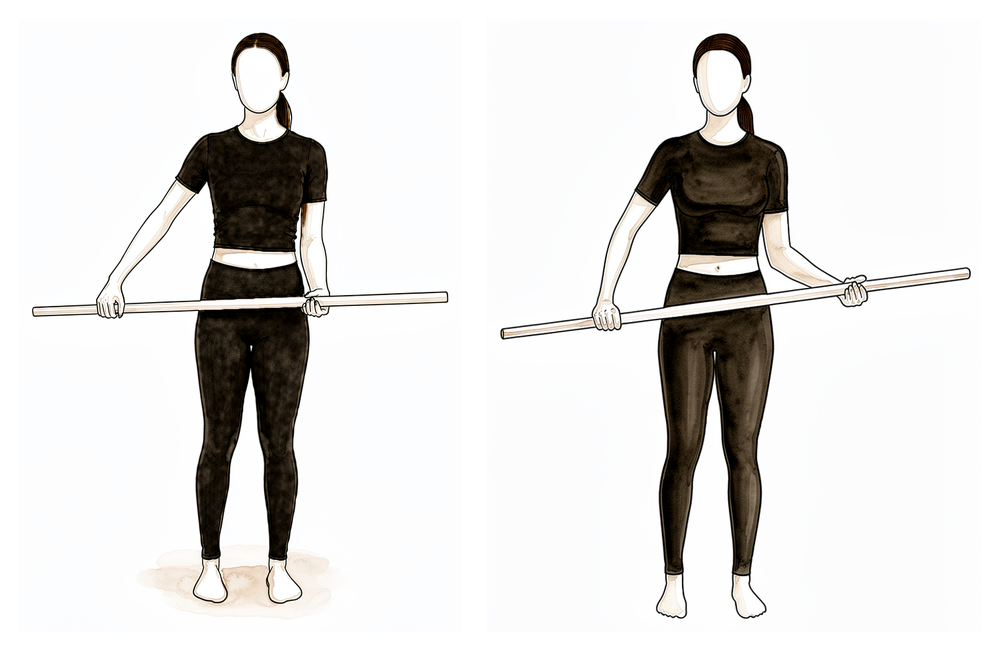
Kieran Hirpara 4.0
Tinulungang outward rotation gamit ang stick
Humawak ng stick (o walking stick) sa magkabilang kamay habang ang siko ng operadong braso ay nakadikit sa iyong tagiliran. Gamitin ang iyong maayos na braso upang dahan-dahang itulak ang operadong forearm palabas, hanggang lamang sa weekly limit na itinakda ng iyong physiotherapist, pagkatapos ay ibalik ito. Ipinapakilala mula sa ika-4 na linggo — hindi sa mga unang linggo.
Ayon sa gabay ng iyong physiotherapist
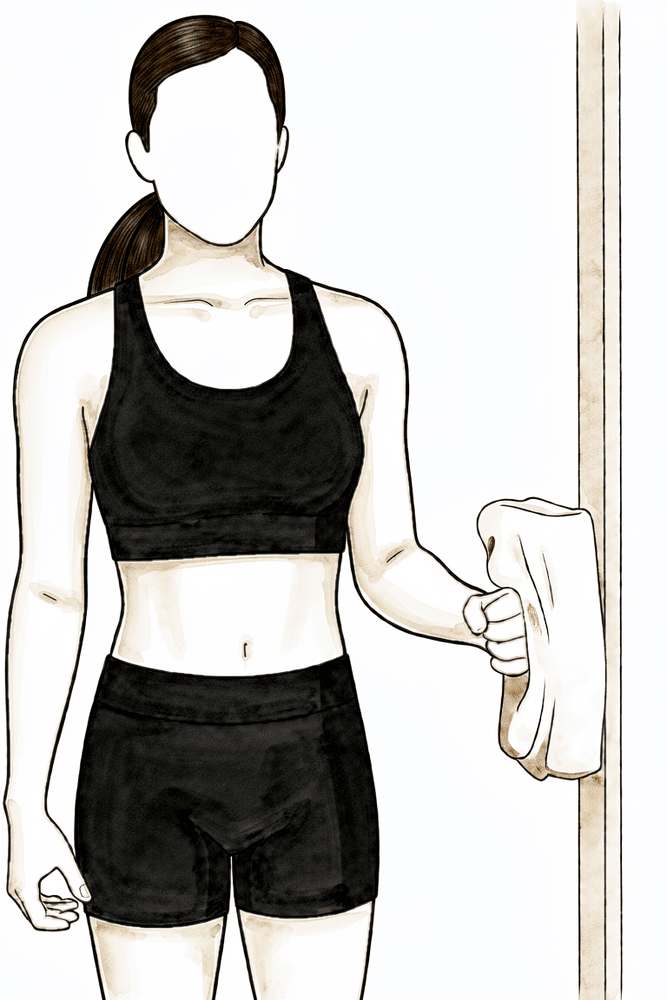
Kieran Hirpara 4.0
Press-and-hold outward rotation
Tumayo nang nakadikit ang iyong siko sa iyong gilid at nakabaluktot nang 90 degrees, ang likod ng iyong kamay ay nakasandal sa pader o hamba ng pinto. Dahan-dahang itulak ang likod ng iyong kamay palabas sa pader — mga isang kapat lamang ng iyong lakas — nang hindi talaga gumagalaw ang braso. Panatilihin ito nang mga 5 segundo, pagkatapos ay i-relax.
10 beses, isang beses o dalawang beses sa isang araw
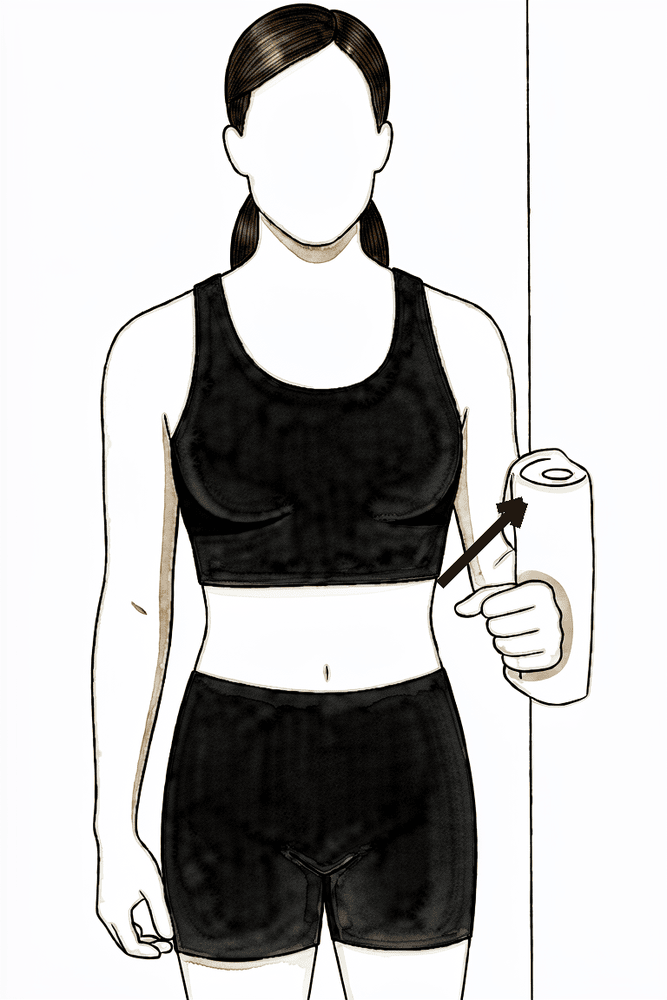
Kieran Hirpara 4.0
Diinan-at-panatilihing-nakadipa-ang-braso-sa-gilid
Tumayo nang patagilid na ang labas ng iyong upper arm ay nakasandal sa pader, at ang siko ay nasa iyong gilid. Dahan-dahang itulak palabas ang pader — mga isang kapat ng iyong lakas — nang hindi gumagalaw ang braso. Panatilihin ito nang mga 5 segundo, pagkatapos ay i-relax.
10 beses, isang beses o dalawang beses sa isang araw
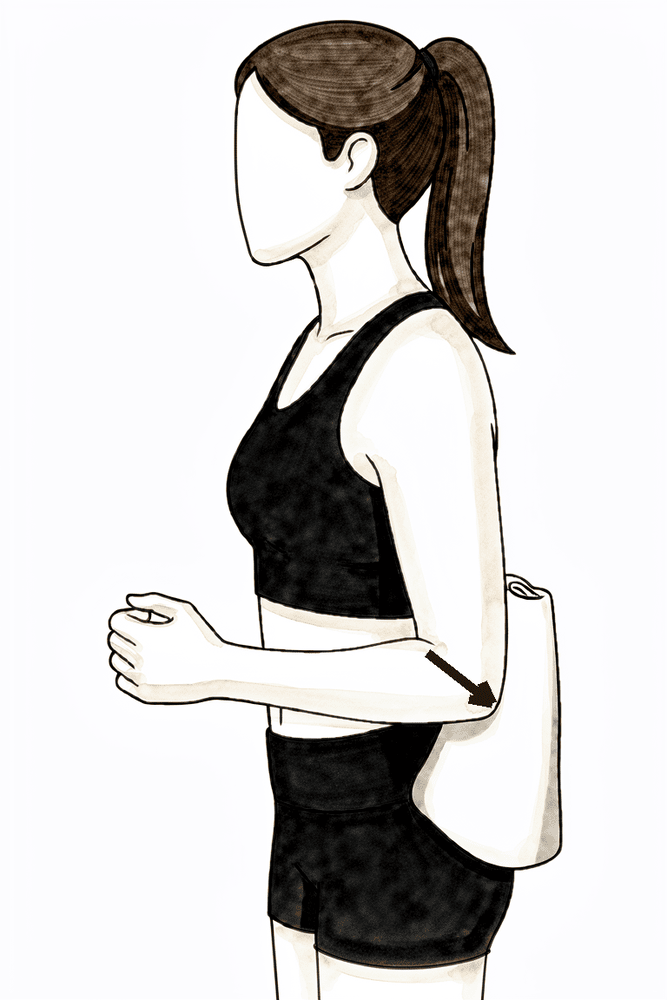
Kieran Hirpara 4.0
Diinan-at-panatilihing-paatras-ang-braso
Tumayo nang ang iyong likod ay malapit sa pader, ang braso ay nasa iyong gilid at ang siko ay tuwid. Dahan-dahang itulak ang likod ng iyong braso pabalik sa pader — humigit-kumulang isang kapat ng iyong lakas — nang hindi gumagalaw ang braso. Panatilihin ito sa loob ng mga 5 segundo, pagkatapos ay i-relax. Pinapagana nito ang mga kalamnan sa likod ng balikat. Ginagamit namin ito sa halip na ang inward-pressing hold sa simula, dahil ang inward pressing ay nagbibigay ng load sa na-repair na kalamnan ng dibdib.
10 beses, isang beses o dalawang beses sa isang araw
Naghihilom na ang repair at unti-unting inaalis ang sling sa pagitan ng weeks 4 at 6. Ang iyong protected movement ay uunlad lamang ng ilang digri bawat linggo, at maaari nang simulan ang mga gentle assisted (stick-assisted) drill. Magsisimula ang light muscle-tensing (isometric) drills para sa mga kalamnan sa paligid ng balikat, ngunit hindi para sa kalamnan ng dibdib mismo, at hindi para sa inward rotation, dahil pareho nitong binibigatan ang repair.
- Sling: unti-unting inaalis (bandang week 4 para sa bone-tendon repair, weeks 5–6 para sa tendon-to-tendon repair).
- Pinapayagang paggalaw: passive at assisted movement, uunlad ng humigit-kumulang 5° bawat linggo: outward rotation na nagsisimula mula sa neutral, forward lift patungo sa humigit-kumulang 65–85°, at arm-out-to-the-side patungo sa humigit-kumulang 50°. Wala pa ring paggalaw gamit ang sariling lakas, at bawal ang pagtulak lampas sa mga weekly limit.
- Mga Ehersisyo: assisted forward lift habang nakahiga; assisted outward rotation gamit ang stick (hanggang sa weekly limit lamang); press-and-hold (isometric) drills para sa outward rotation, arm-out-to-the-side at arm-backward, hindi inward rotation; shoulder-blade setting.
Handa na para sa susunod na phase kapag: wala ka na sa sling; ang iyong protected movement ay umuunlad ayon sa iskedyul; wala kang nararamdamang sakit sa harap ng balikat kapag nag-ro-rotate outward hanggang sa limit; at komportable ang iyong mga isometric drill.
Phase III — Aktibong paggalaw (weeks 6–8)
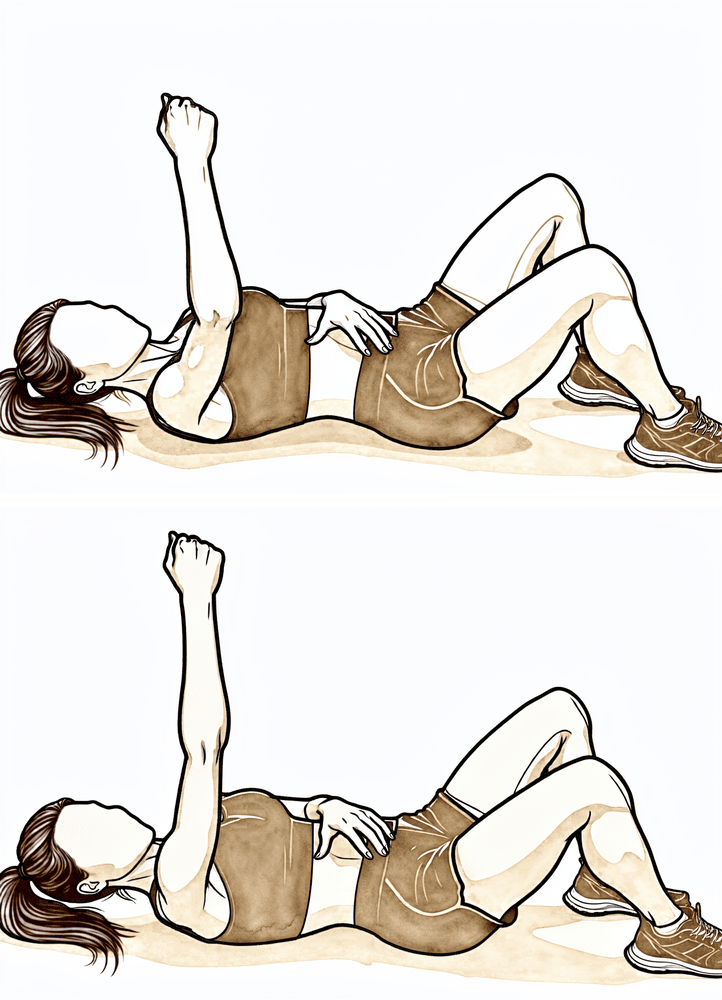
Kieran Hirpara 4.0
Supine punch (salute)
Humiga nang patihaya na ang inoperahang braso ay nakaturo sa kisame. Iunat ang kamay paitaas patungo sa kisame upang ang shoulder blade ay umangat mula sa sahig, pagkatapos ay dahan-dahang ibaba. Panatilihing swabe ang paggalaw at sa loob ng komportableng range.
10 beses, isang beses sa isang araw
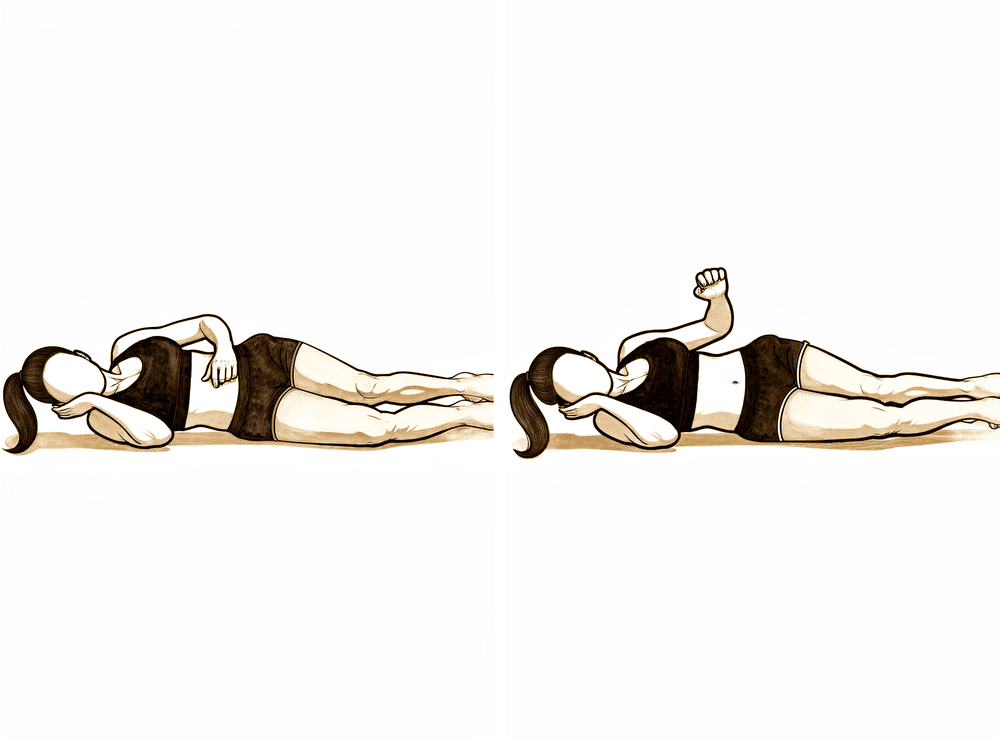
Kieran Hirpara 4.0
Panlabas na pag-ikot habang nakahiga nang patagilid
Humiga sa iyong maayos na panig na ang inoperahang siko ay nakadikit sa iyong baywang at nakabaluktot nang 90 degrees. Habang nakadikit ang siko, i-rotate ang forearm pataas hanggang sa komportable, pagkatapos ay dahan-dahang ibaba. Magsimula nang walang bigat.
10–15 beses, isang beses sa isang araw
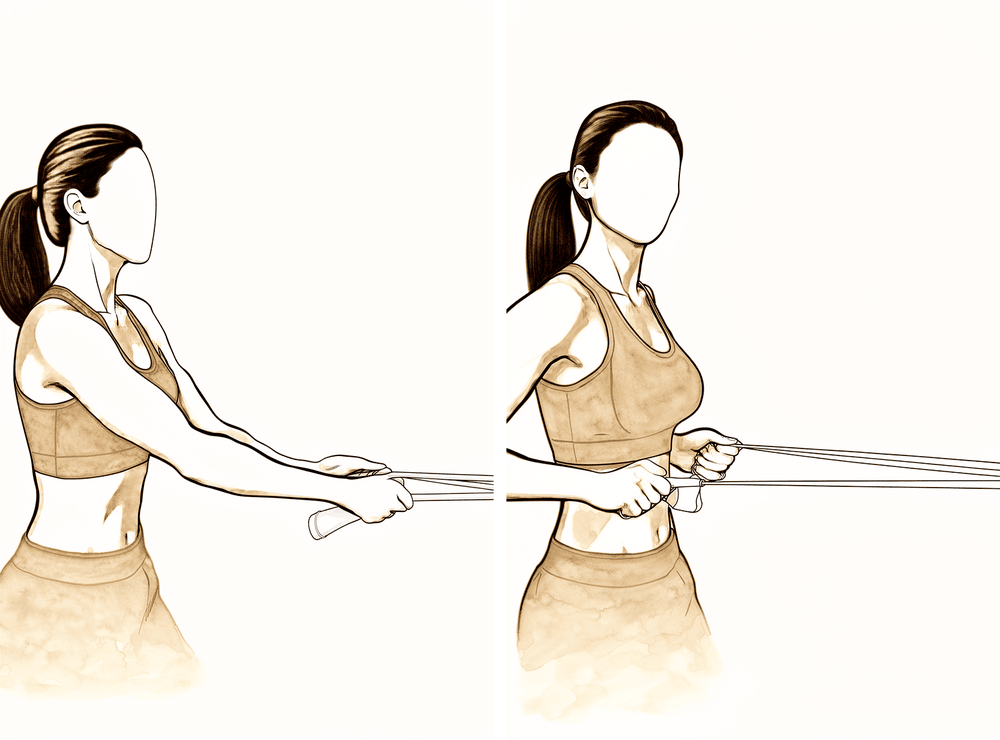
Kieran Hirpara 4.0
Resistance-band rows
I-angkla ang isang band sa harap mo sa taas ng iyong baywang. Tumayo nang tuwid at hilahin ang iyong mga siko pabalik patungo sa iyong katawan, pigain ang mga shoulder blade, pagkatapos ay dahan-dahang ibalik. Panatilihing malapit ang iyong mga siko sa iyong mga gilid at huwag hayaang lumampas ang mga ito sa likod ng linya ng iyong katawan.
10–15 beses, isang beses sa isang araw
Kieran Hirpara 4.0
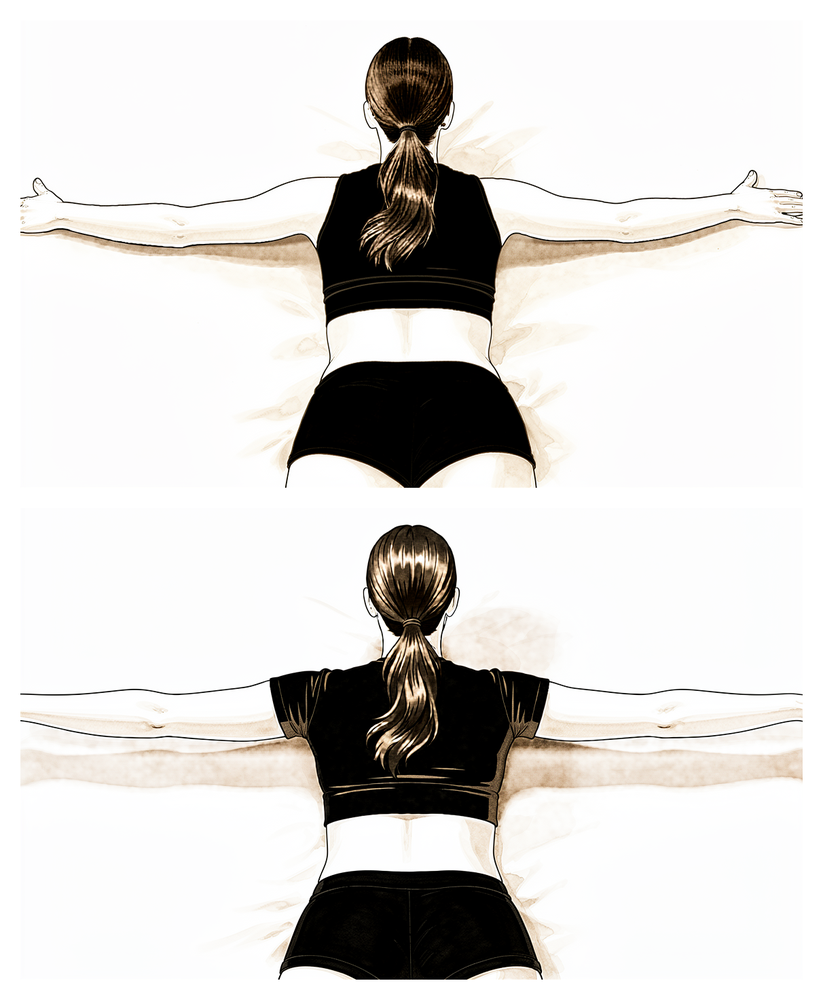
Shoulder-blade pull-down (prone Y)
Dapa nang nakaharap sa ibaba habang nakalaylay ang iyong mga braso. Itaas ang mga ito palabas sa mga gilid hanggang sa antas ng balikat, pigain ang mga shoulder blade nang magkasama, pagkatapos ay dahan-dahang ibaba. Panatilihing maliit at kontrolado ang paggalaw.
10 beses, isang beses sa isang araw
Kieran Hirpara 4.0
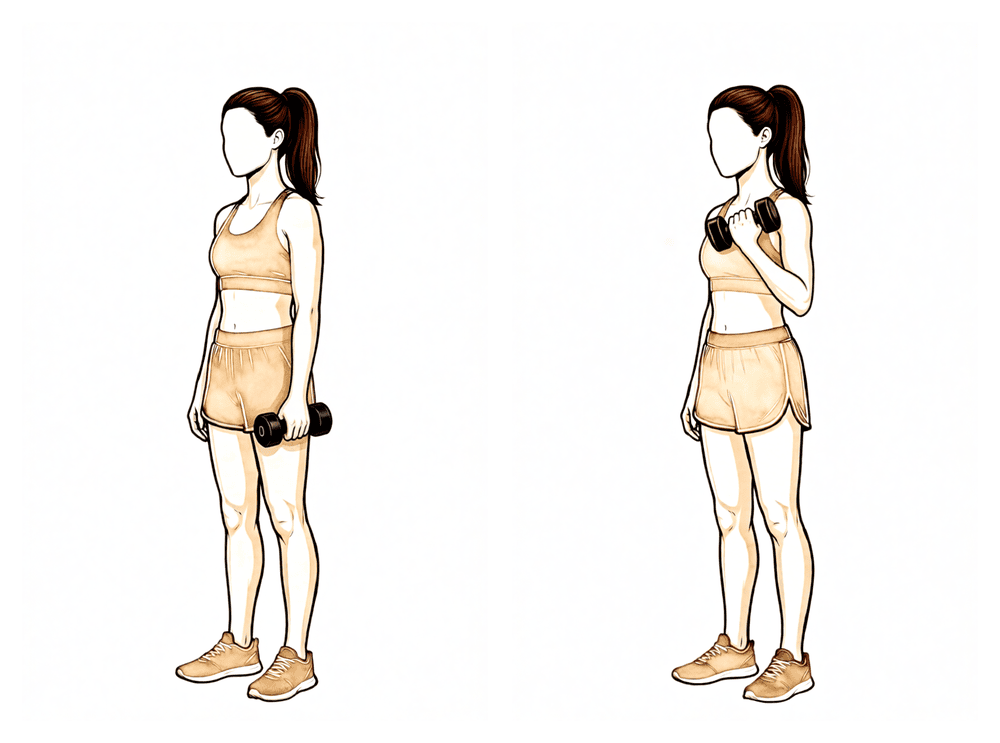
Biceps curl
Gamit ang isang magaan na pabigat at ang iyong siko ay nakadikit sa iyong gilid, itiklop ang siko upang iangat ang pabigat, pagkatapos ay ibaba ito nang dahan-dahan. Panatilihing hindi gumagalaw ang itaas na bahagi ng braso at nasa harap ng iyong katawan.
10–15 beses, isang beses sa isang araw
Kieran Hirpara 4.0
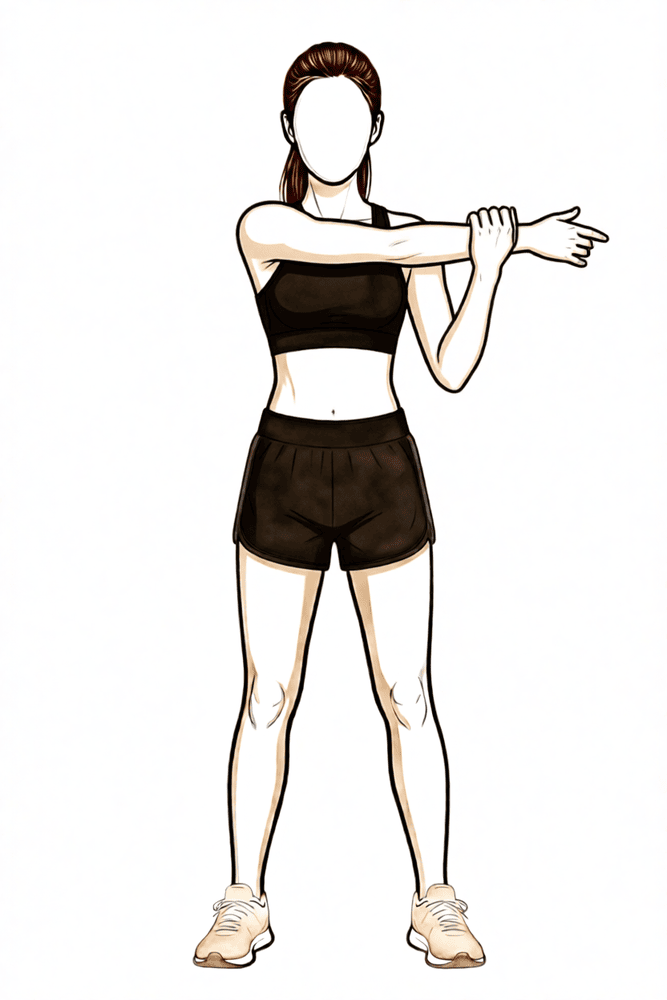
Cross-body stretch
Gamitin ang iyong maayos na kamay upang dahan-dahang hilahin ang inoperahang braso patawid sa iyong dibdib, sa ibaba ng taas ng balikat, hanggang sa makaramdam ng banayad na pag-unat sa likod ng balikat, pagkatapos ay bitawan. Huwag pilitin o i-stretch hanggang sa magdulot ng sakit.
Hawakan nang 20–30 segundo, 2–3 beses
Kieran Hirpara 4.0
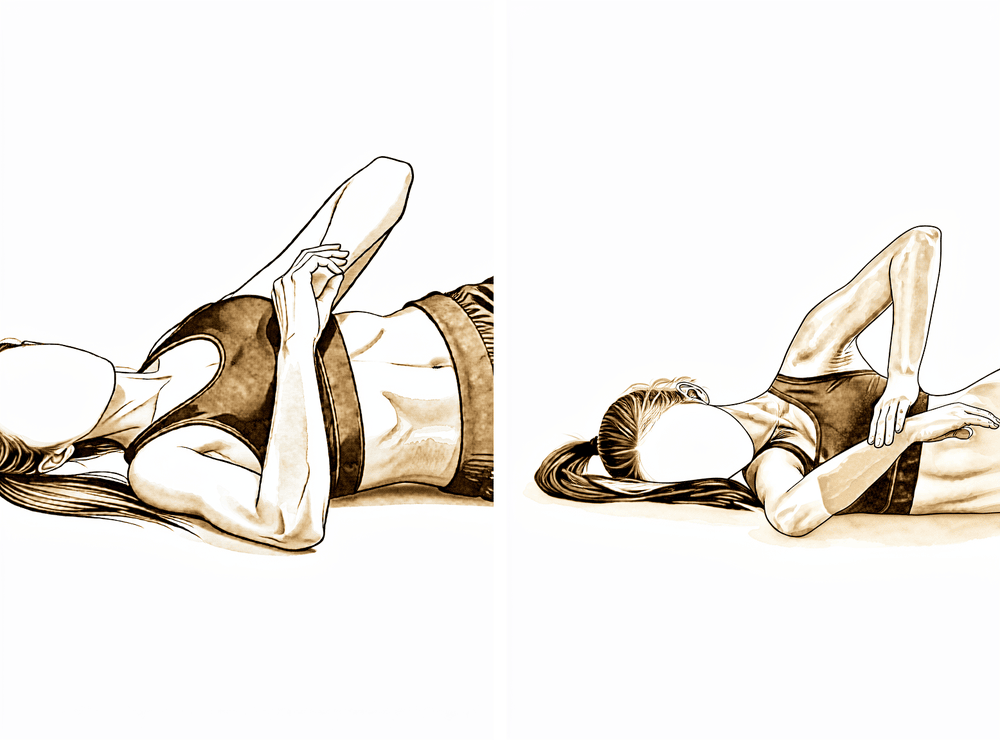
Sleeper stretch
Humiga sa panig ng iyong inoperahang bahagi na ang balikat at siko ay nakabaluktot nang 90 degrees. Gamitin ang iyong maayos na kamay upang dahan-dahang itulak ang forearm pababa sa kama hanggang sa makaramdam ng banayad na stretch sa likod ng balikat. Huwag itong pilitin.
Hawakan nang 20–30 segundo, 2–3 beses
Mula sa ika-anim na linggo, tinatanggal na ang sling at magsisimula ka nang igalaw ang braso gamit ang sarili mong lakas, simula sa mga madaling posisyon kung saan pinakakaunti ang tulong ng grabidad: nakahiga, o pag-abot patungo sa kisame. Ang iyong mga protected range ay patuloy na bubukas nang ilang digri kada linggo patungo sa pagiging buo. Pinapalakas ang mga kalamnan sa paligid ng balikat, at nagsisimula ang mga banayad na stretch para sa likod ng balikat, ngunit ang inoperahang kalamnan sa dibdib ay hindi pa rin ginagalaw.
- Sling: ititigil na.
- Pinapayagang paggalaw: pagpapatuloy ng passive movement patungo sa pagiging buo (humigit-kumulang 5° na dagdag bawat linggo sa bawat direksyon), at pagsisimula ng aktibong paggalaw gamit ang sarili mong lakas. Pinapayagan ang light weight-bearing sa braso.
- Mga ehersisyo: supine punch (salute); outward rotation habang nakahiga sa iyong tagiliran (walang bigat); resistance-band rows at shoulder-blade work; light biceps; cross-body at sleeper stretches para sa likod ng balikat.
Handa na para sa susunod na phase kapag: ang iyong paggalaw ay buo o halos buo na sa lahat ng direksyon; kaya mo nang igalaw ang braso gamit ang sarili mong lakas nang may maayos na kontrol (walang pag-shrug o pag-hitch); at wala nang sakit sa harap ng balikat.
Phase IV — Nagsisimula ang pag-load sa kalamnan ng dibdib (weeks 9–14)
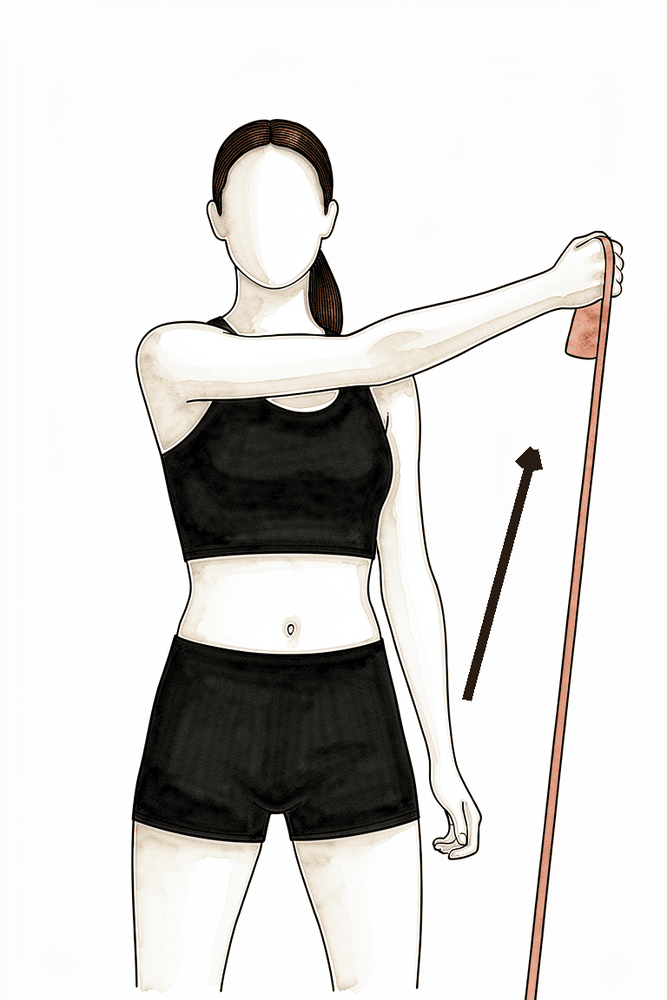
Kieran Hirpara 4.0
PNF diagonal D1 gamit ang band
Habang hawak ang isang band, igalaw ang braso sa isang kontroladong diagonal — mula sa tapat ng iyong tiyan palabas at pataas patungo sa kabilang panig — pagkatapos ay ibalik ito nang swabe. Itatakda ng iyong physiotherapist ang mga panimula at huling posisyon. Magsimula lamang kapag mayroon ka nang buo at walang sakit na paggalaw.
Ayon sa gabay ng iyong physiotherapist
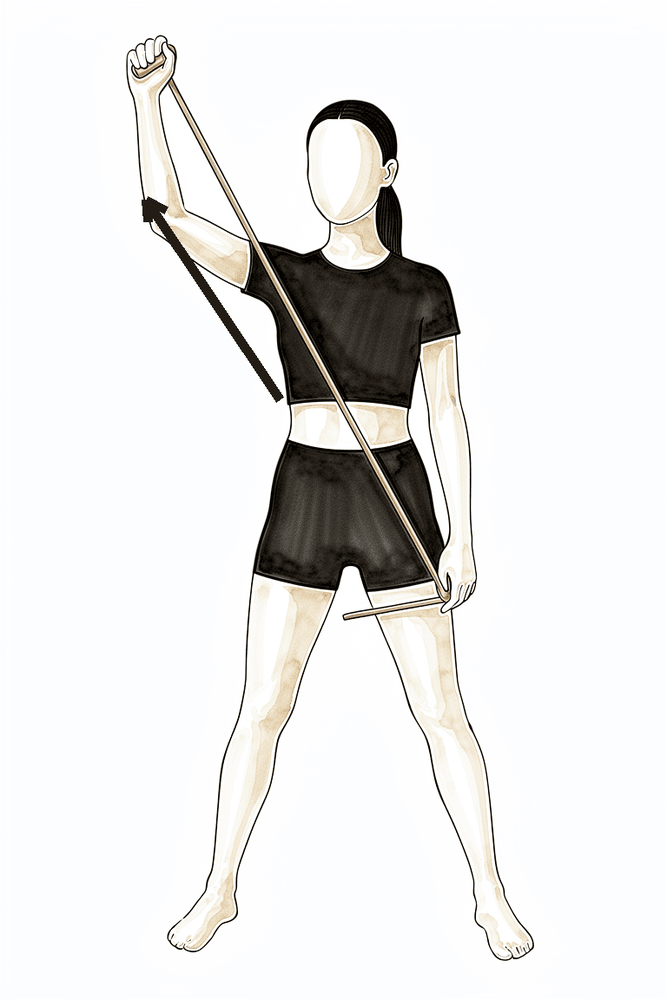
Kieran Hirpara 4.0
PNF diagonal D2 gamit ang band
Habang hawak ang isang band, igalaw ang braso sa isang kontroladong diagonal — mula sa iyong kabilang balakang palabas at pataas sa itaas ng ulo — pagkatapos ay dahan-dahang ibalik sa dating posisyon. Ang iyong physiotherapist ang magtatakda ng range. Magsimula lamang kapag mayroon ka nang buo at walang sakit na paggalaw.
Ayon sa gabay ng iyong physiotherapist
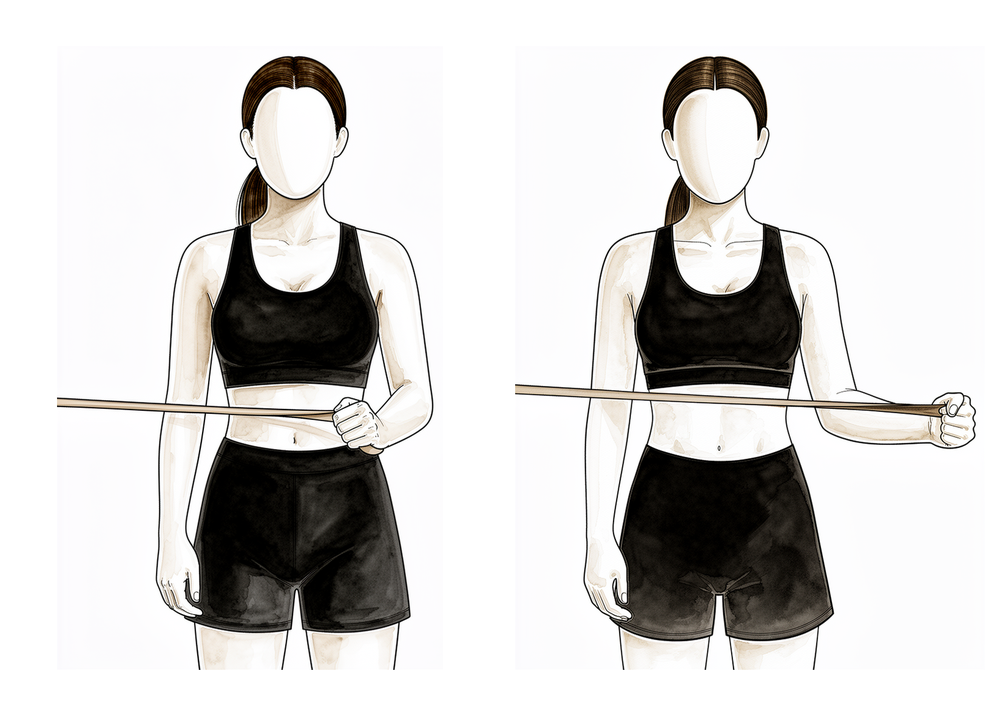
Kieran Hirpara 4.0
Band outward rotation
Habang ang iyong siko ay nakadikit sa iyong gilid at nakabaluktot nang 90 degrees, humawak ng band at i-rotate ang forearm palabas laban sa resistance, pagkatapos ay dahan-dahang ibalik. Panatilihing nakadikit ang siko sa iyong gilid.
10–15 beses, isang beses sa isang araw
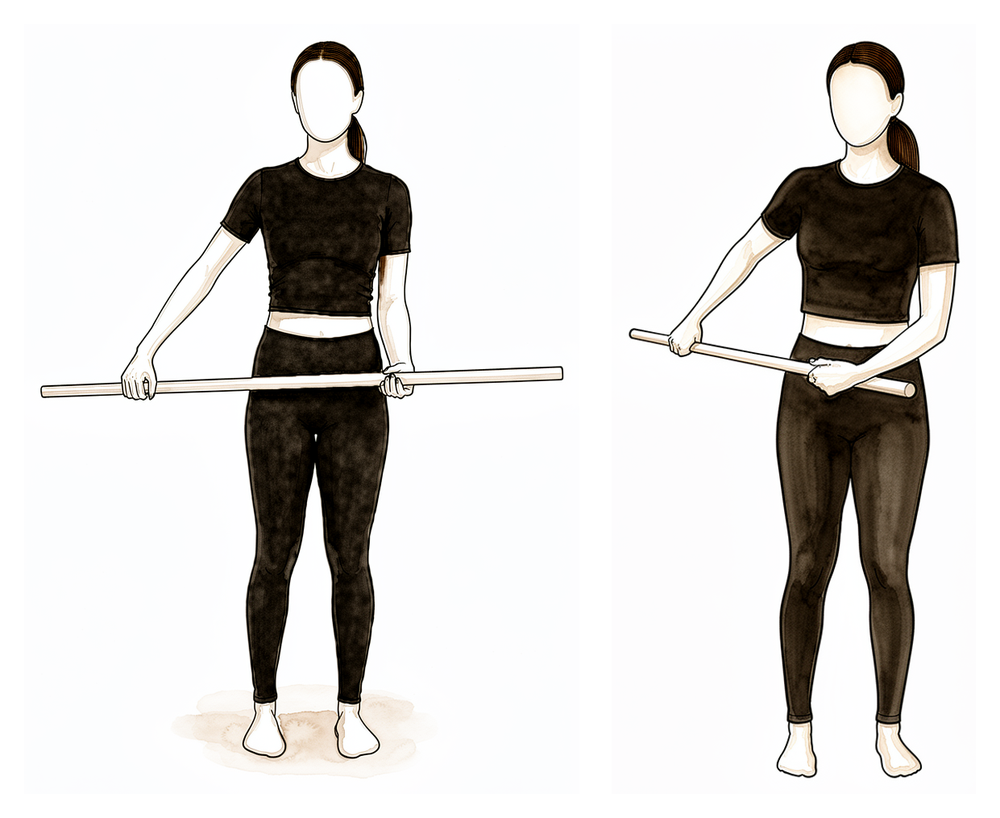
Kieran Hirpara 4.0
Inward rotation gamit ang stick
Humawak ng stick o tuwalya at dahan-dahang i-guide ang inoperahang kamay papasok patawid ng iyong tiyan o sa likod mo, hanggang sa isang komportableng range. Ang inward rotation ay nagbibigay ng load sa na-repair na kalamnan ng dibdib, kaya ito ay ipinapakilala lamang mula sa ika-9 na linggo at dahan-dahang pinatataas.
Ayon sa gabay ng iyong physiotherapist
Ito ang turning point: mula humigit-kumulang week 9, ang kumpuning kalamnan ng dibdib mismo ay nagsisimulang gumana, nang dahan-dahan. Nagsisimula ito sa isang shortened (relaxed) position at nagpapatuloy patungo sa isang lengthened position habang kinakaya nito ang load. Ang inward rotation, ang sariling aksyon ng kalamnan ng dibdib na sadyang pinigilan hanggang ngayon, ay ipinapakilala rin dito at unti-unting binubuo. Dapat ay full ang paggalaw, at ang pokus ay lilipat sa kontrolado at magaan na loading. Ang mas mabigat na pressing ay maghihintay pa.
- Paggalaw: full o halos full na passive at active movement sa lahat ng direksyon.
- Mga Ehersisyo: banayad na inward-rotation at chest-muscle tensing drills, shortened position muna; inward rotation gamit ang stick; band outward rotation; PNF diagonal patterns gamit ang band (kontroladong diagonal movements na itatakda ng iyong physiotherapist).
Handa na para sa susunod na phase kapag: mayroon ka nang full at pain-free na paggalaw; at kaya mo nang gawin ang mga banayad na chest-muscle drills nang walang anumang sakit pagkatapos.
Phase V — Pagpapalakas (weeks 14–20)
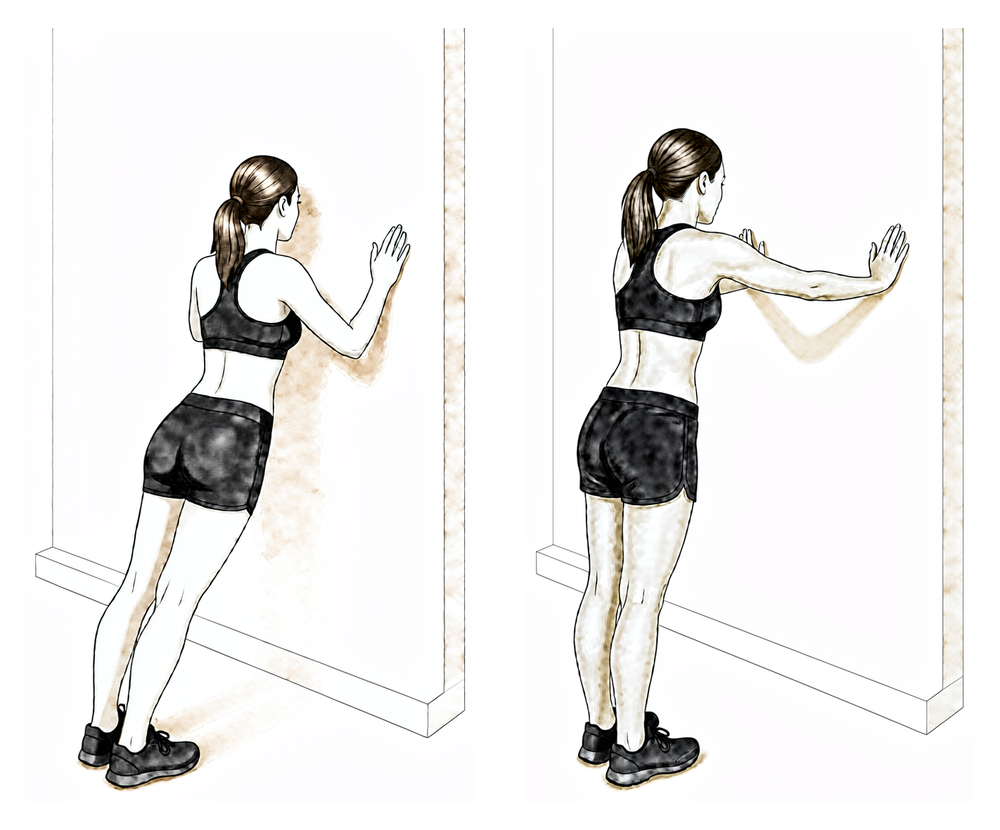
Kieran Hirpara 4.0
Wall push-up patungong floor push-up
Magsimula sa mga push-up sa dingding: yumuko, pagkatapos ay itulak palayo, hayaang maghiwalay ang mga shoulder blade sa itaas. Habang lumalakas, mag-progress sa kitchen bench, pagkatapos ay sa iyong mga tuhod, at pagkatapos ay sa sahig. Huwag hayaang lumampas ang iyong mga siko sa likod ng linya ng iyong katawan — huwag kailanman hayaang bumaba ang dibdib nang lampas sa lebel ng iyong mga siko.
Ayon sa gabay ng iyong physiotherapist
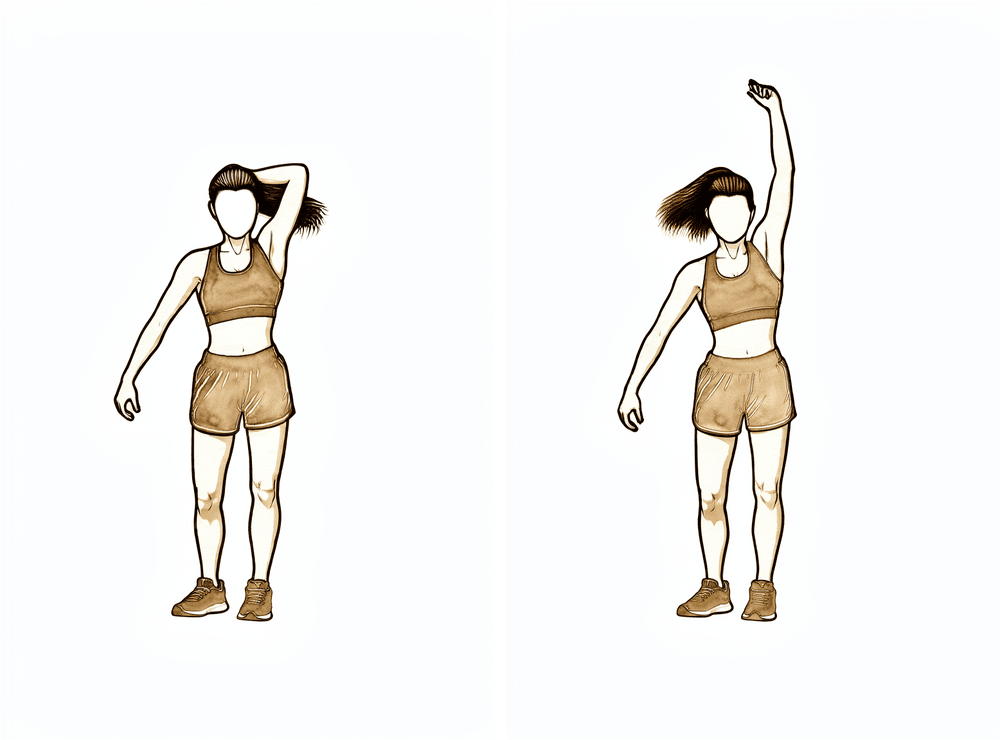
Kieran Hirpara 4.0
Overhead triceps
Habang may hawak na magaan na pabigat sa itaas ng ulo at nakabaluktot ang siko, ituwid ang siko upang iangat ang pabigat, pagkatapos ay dahan-dahang ibaba. Magsimula kapag ang paggalaw sa itaas ng ulo ay buo na at komportable.
10–15 beses, isang beses sa isang araw
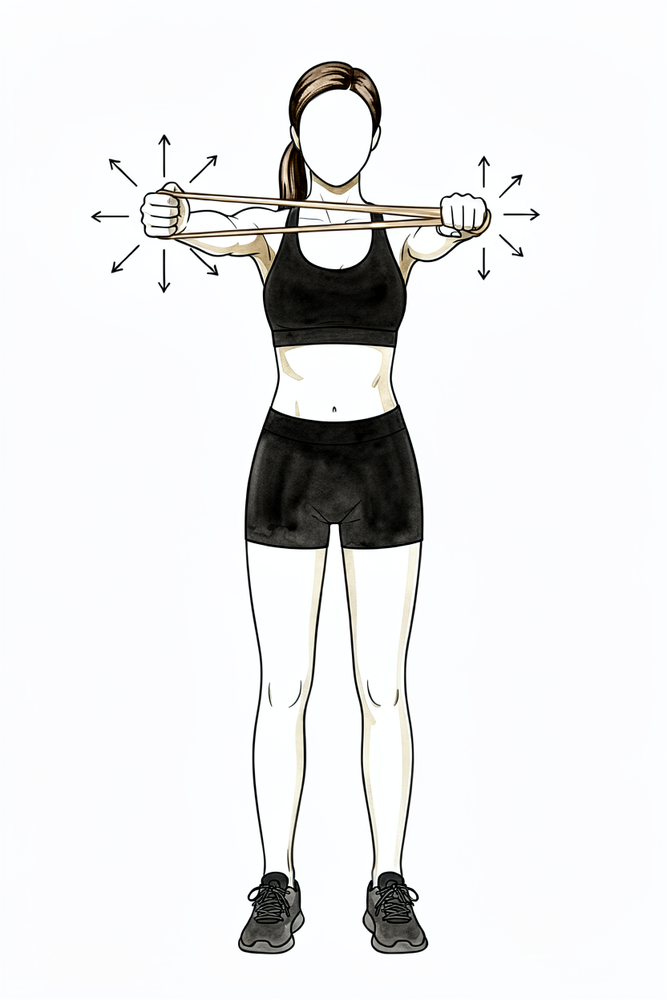
Kieran Hirpara 4.0
Rhythmic stabilisation
Habang ang iyong braso ay suportado sa harap mo sa taas na halos kapantay ng balikat, hayaan ang iyong physiotherapist (o ang iyong maayos na kamay) na magbigay ng maliliit at banayad na tulak mula sa iba't ibang direksyon habang pinapanatili mong hindi gumagalaw at matatag ang braso — huwag itong hayaang gumalaw. Sinasanay nito ang mga stabilising muscle ng balikat na tumugon. Panatilihing banayad ang lahat ng pagsisikap.
Ayon sa gabay ng iyong physiotherapist
Mula sa humigit-kumulang ika-14 na linggo, magsisimula ang wastong pagpapalakas ng dibdib (magaan na weights at resistance, o "isotonics"), na unti-unting binubuo nang simetriko kasabay ng kabilang panig. Ang push-up work ay magsisimula laban sa pader at magpapatuloy patungo sa sahig lamang kung pahihintulutan ng lakas. Dalawang panuntunan sa gym ang mahalaga ngayon sa loob ng mahabang panahon, dahil niloload nito ang kinalutang na tendon sa paraang maaari itong mapunit: huwag hayaang lumampas ang iyong mga siko sa linya ng iyong katawan sa ibaba ng isang press, flye o pec-deck; at iwasan ang mabibigat na weights na may mababang repetitions: mas piliin ang mas magaan na load at mas maraming repetitions, at mag-warm up nang dahan-dahan.
- Paggalaw: buo.
- Mga Ehersisyo: wall push-ups na nagpapatuloy patungo sa sahig; inward rotation laban sa isang band; overhead triceps; magaan at progresibong chest at pressing work; isang banayad na doorway chest stretch.
Handa na para sa susunod na phase kapag: ang iyong lakas ay nabubuo nang pantay kumpara sa kabilang panig; at wala kang nararamdamang sakit sa resisted chest work.
Phase VI — Maagang pagbabalik sa sport (5–6 buwan)
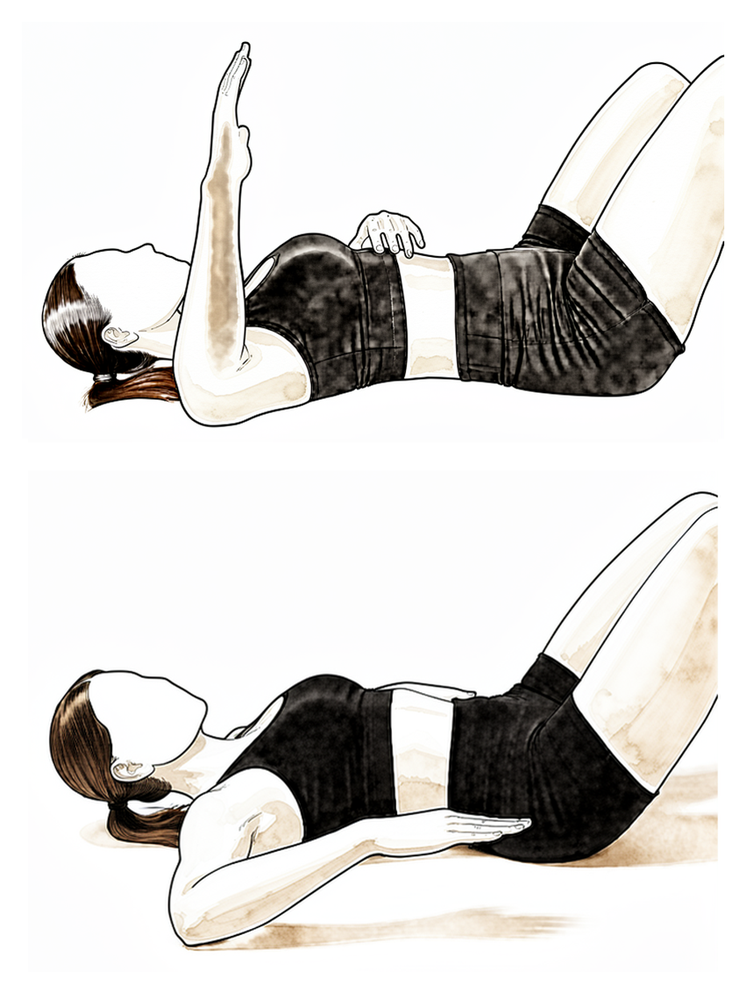
Kieran Hirpara 4.0
90/90 outward at inward rotation
Habang ang braso ay nakalabas sa gilid sa taas ng balikat at ang siko ay nakabaluktot nang 90 degrees, i-rotate ang forearm pataas at pababa sa isang kontroladong range. Ito ay isang late-stage, sport-preparation drill — magsimula lamang kapag pinayagan na, dahil ang posisyong ito ay nag-i-stretch sa na-repair na kalamnan ng dibdib.
Ayon sa gabay ng iyong physiotherapist
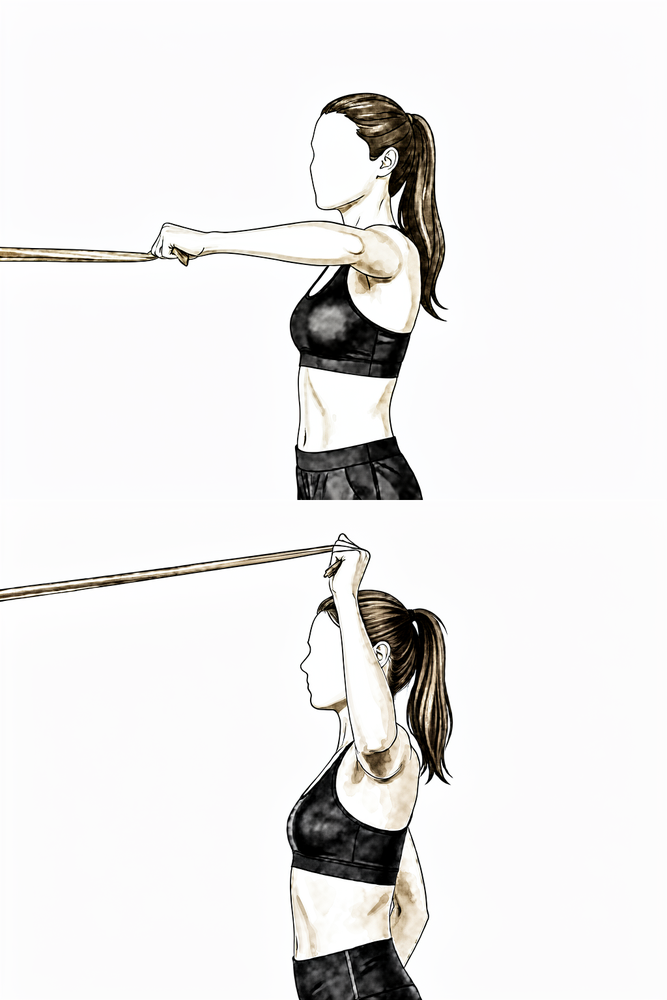
Kieran Hirpara 4.0
External rotation sa 90/90 (band)
Habang ang braso ay nakalabas sa gilid sa taas ng balikat at ang siko ay nakabaluktot sa isang right angle, i-rotate ang forearm pabalik at pataas laban sa isang light band o weight, pagkatapos ay ibaba ito nang dahan-dahan. Nagpapalakas ng rotator-cuff strength sa raised (throwing) position.
2 hanggang 3 sets ng 10 hanggang 15, mababang resistance
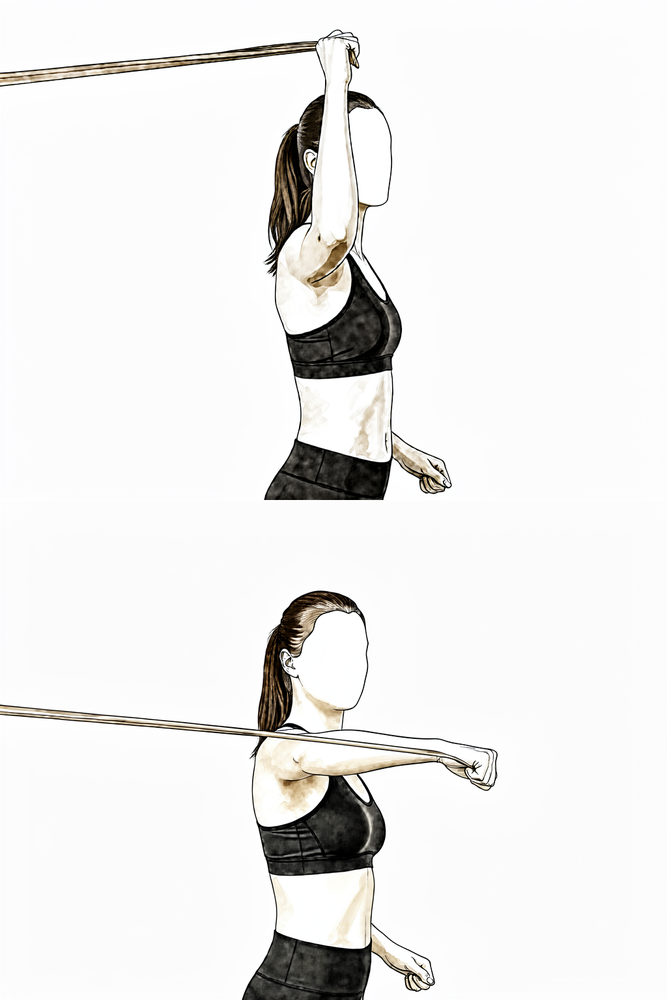
Kieran Hirpara 4.0
Internal rotation sa 90/90 (band)
Mula sa parehong posisyon kung saan ang braso ay nakalabas sa gilid sa taas ng balikat, i-rotate ang forearm pasulong at pababa patungo sa iyong mga paa laban sa isang light band o weight, pagkatapos ay ibalik ito nang may kontrol.
2 hanggang 3 sets ng 10 hanggang 15, mababang resistance
Ang braso ay malakas na ngayon at may full-range, at ang pagsasanay ay nagiging espesipiko na sa iyong sport, kabilang ang mas mabilis at mas explosive (plyometric) na mga drill tulad ng chest passes at throwing positions. Ito ay paghahanda para sa pagbabalik sa sport, at hindi pa isang green light para sa unrestricted heavy loading.
- Paggalaw: full.
- Mga Ehersisyo: outward at inward rotation sa 90/90 (sport) position; plyometric chest at throwing drills ayon sa direktiba ng iyong physiotherapist.
Handa na para sa susunod na phase kapag: nakapasa ka sa strength at task-specific tests para sa iyong sport; at kapwa ka binigyan ng clearance ni Dr Hirpara at ng iyong physiotherapist.
Phase VII — Walang limitasyong pagbabalik (6 na buwan pataas)
Mula sa humigit-kumulang anim na buwan, nang may clearance, babalik ka na sa full strenuous work at recreation. Ang bench press ay muling sisimulan sa humigit-kumulang kalahati ng iyong dating maximum at dahan-dahang itataas, at ang contact sport ay hindi bago ang anim na buwan. Ang pagbabalik ay nakabase sa iyong lakas na dapat ay hindi bababa sa 85–90% ng kabilang panig at sa clearance ni Dr Hirpara, hindi sa kalendaryo lamang.
- Paggalaw: full.
- Mga Ehersisyo: full return sa heavy pressing at lifting, dahan-dahang itataas mula sa light loads, at full sport-specific training.
Handa kapag: ang iyong lakas ay hindi bababa sa 85–90% ng kabilang panig; mayroon kang full, pain-free movement at endurance na walang reactive pain pagkatapos ng heavy load; at kapwa si Dr Hirpara at ang iyong physiotherapist ay nag-sign off na.
Pagbabalik sa isport at trabaho
Ang pagbabalik sa chest loading at isport ay batay sa mga criteria: sapat na range, lakas, at endurance, nang walang sakit, at may pahintulot mula kay Dr Hirpara at sa iyong physiotherapist, at hindi nakadepende sa kalendaryo lamang.
- Trabaho: sedentary work ayon sa kakayahan; manual o mabigat na trabaho mula sa hindi bababa sa 3 buwan.
- Pagmamaneho: humigit-kumulang 6 hanggang 8 linggo.
- Light chest strengthening: mula sa humigit-kumulang ika-14 na linggo.
- Bench press, mabigat na pagbubuhat, push-ups at contact sport: hindi bago ang 4 hanggang 6 na buwan, at kapag bumalik na lamang ang iyong lakas; ang bench press ay muling sisimulan sa humigit-kumulang kalahati ng iyong dating maximum at dahan-dahang itataas.
Para sa paghahagis at mga contact sport, kumpletuhin ang isang graded build-up programme bago ang unrestricted play.
Ang iyong mga maagang ehersisyo
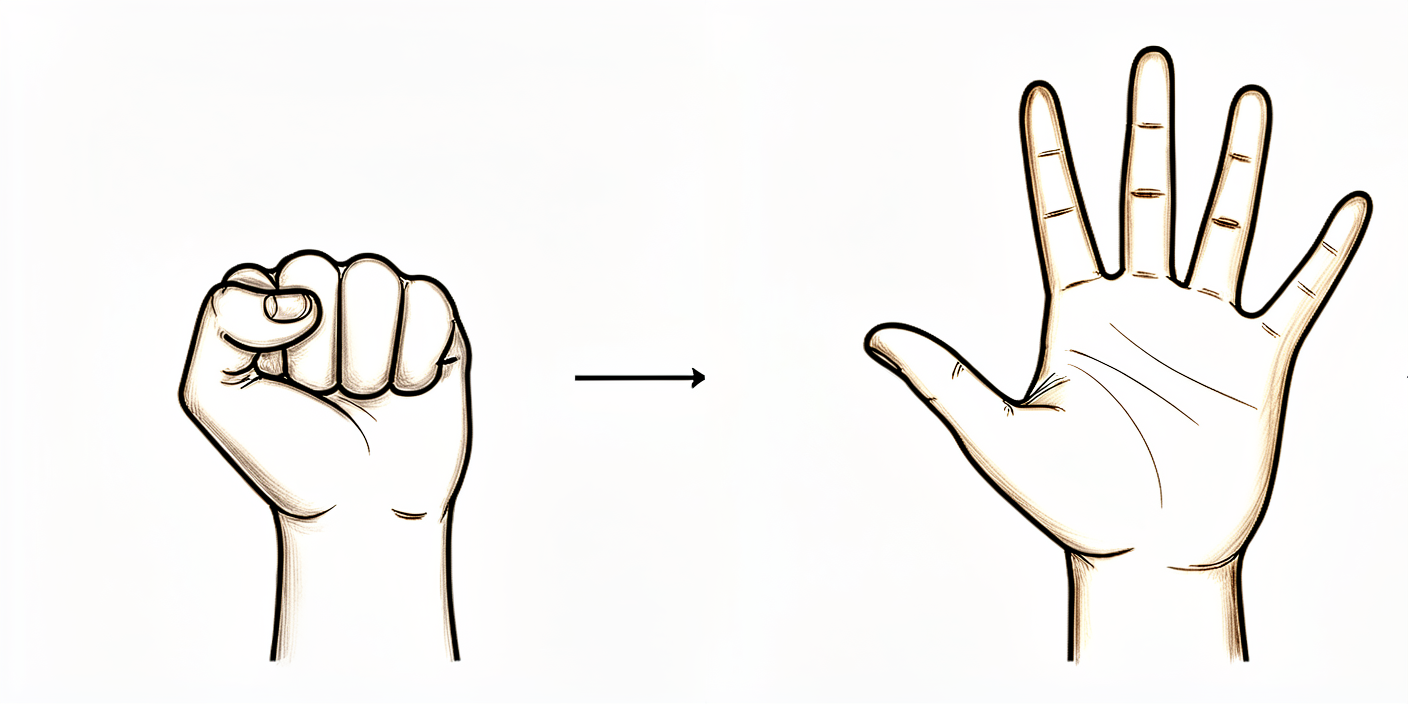
Kieran Hirpara 4.0
Buksan at isara ang kamay
Gumawa ng isang mahigpit na kamao, pagkatapos ay buksan ang kamay at iunat nang husto ang mga daliri. Panatilihing normal ang paggalaw ng iyong kamay, mga daliri, at pulso sa buong araw.
10 beses bawat oras
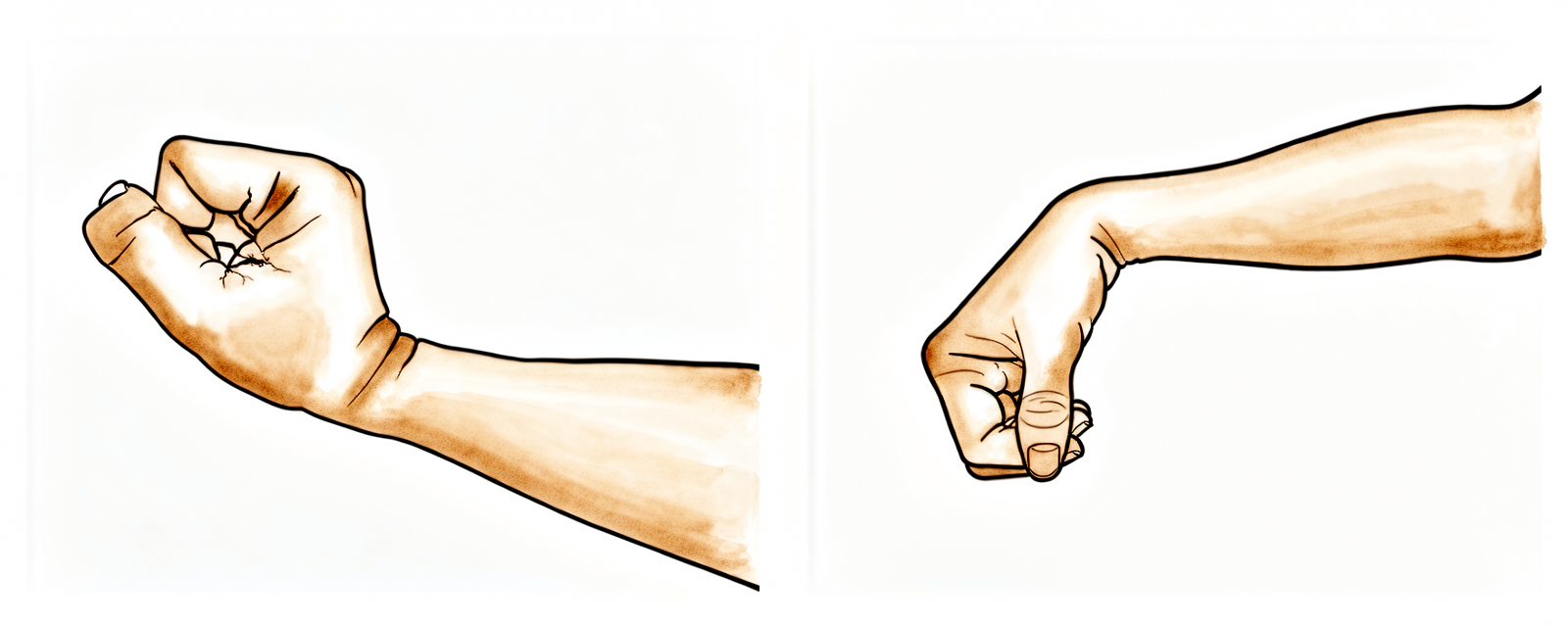
Kieran Hirpara 4.0
Paggalaw ng pulso
Habang nakasuporta ang forearm, itiklop ang pulso pasulong hanggang sa komportable, pagkatapos ay pabalik. Panatilihing banayad at regular ang paggalaw sa buong araw.
10–15 beses bawat oras
Kieran Hirpara 4.0
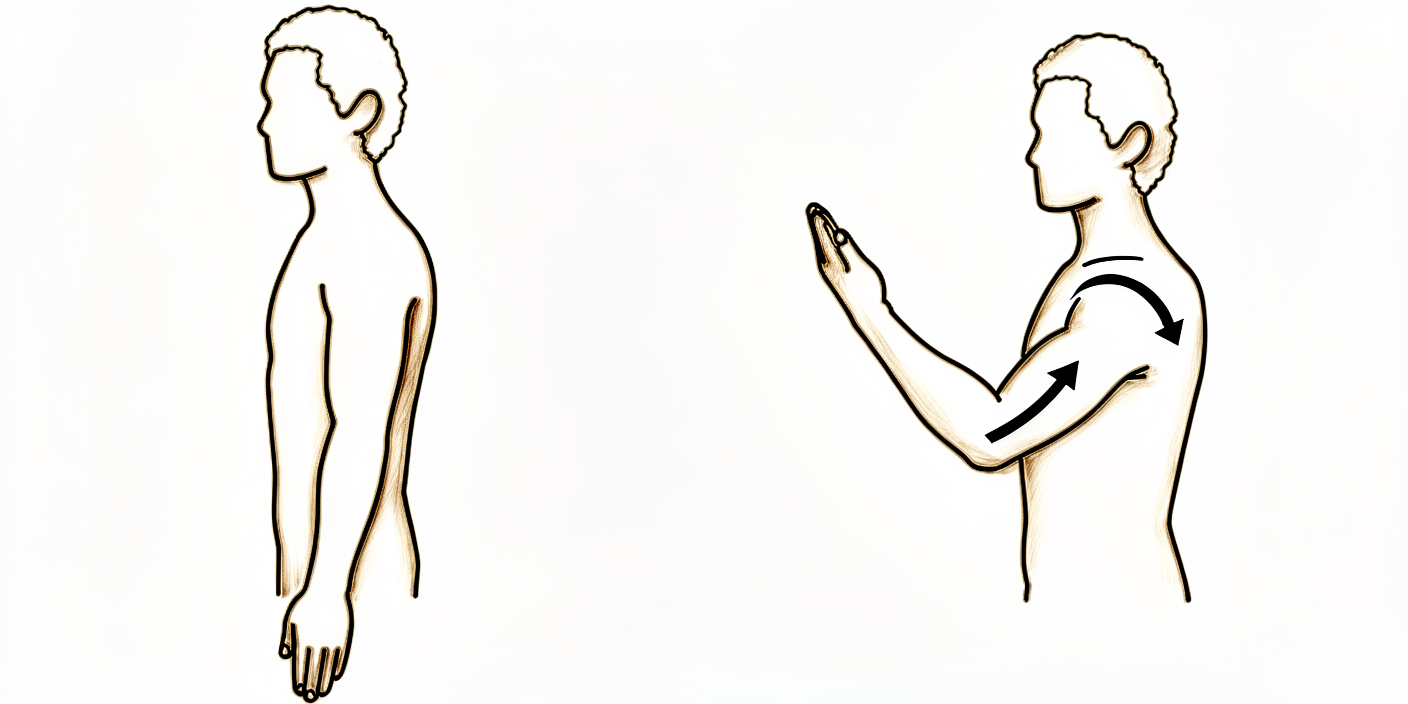
Aktibong pagbaluktot ng siko
Habang nakapahinga ang itaas na bahagi ng braso sa iyong tabi at sa harap ng iyong katawan, itiklop ang siko hangga't kaya nito nang komportable, pagkatapos ay ituwid ito nang lubos. Siko lamang ang gumagalaw — ang itaas na bahagi ng braso ay nananatiling hindi gumagalaw.
10–15 beses, 2–3 beses sa isang araw
Kieran Hirpara 4.0
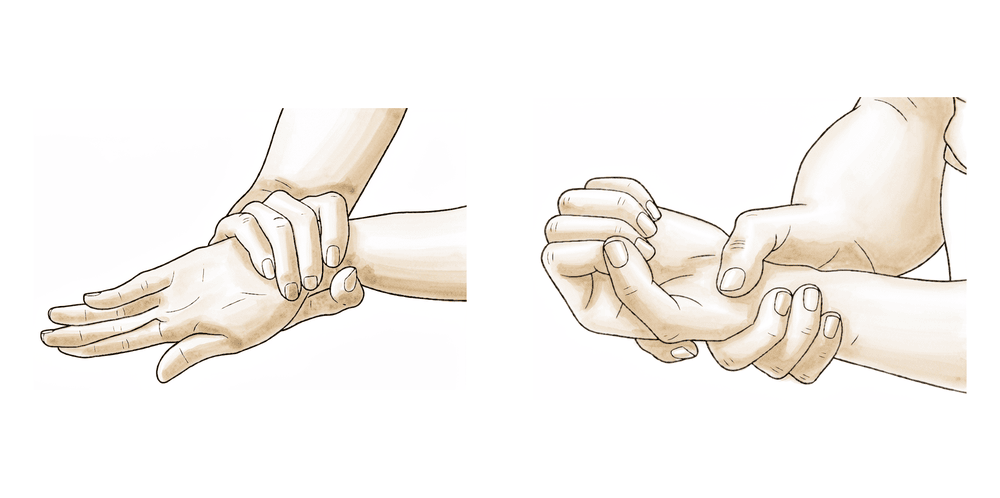
Rotasyon ng forearm
Habang nakabaluktot ang siko sa 90 degrees at nakadikit sa iyong tagiliran, iikot ang forearm upang ang palad ay nakaharap sa ibaba, pagkatapos ay sa itaas. Panatilihing nakadikit ang siko sa iyong katawan upang ang forearm lamang ang umiikot.
10 beses, 2–3 beses sa isang araw
Kieran Hirpara 4.0
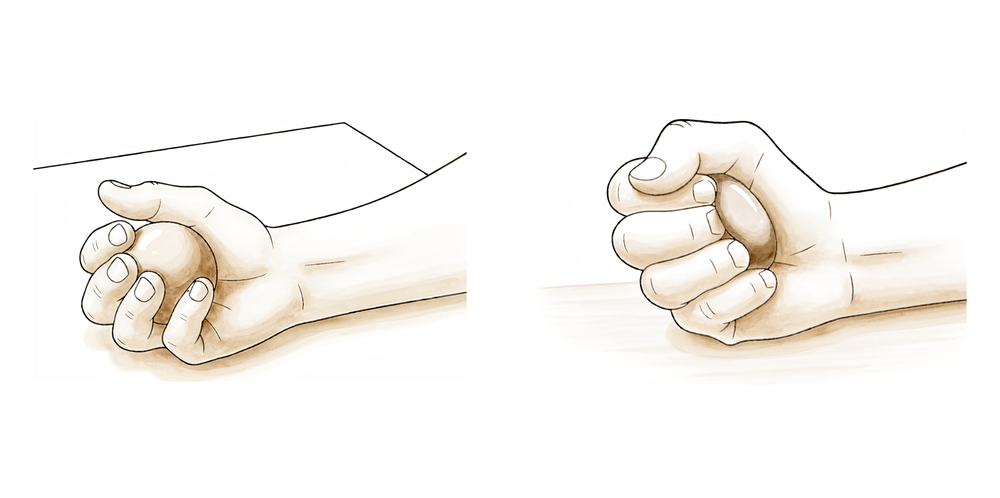
Pagpisil ng kamay
Habang suportado ang braso at nasa harap ng iyong katawan, dahan-dahang pisilin ang isang malambot na bola o nakabilot na medyas, hawakan nang ilang segundo, pagkatapos ay i-relax. Pinapanatili nito na aktibo ang braso nang hindi hinihila ang repair.
10 beses, 2–3 beses sa isang araw
Kieran Hirpara 4.0
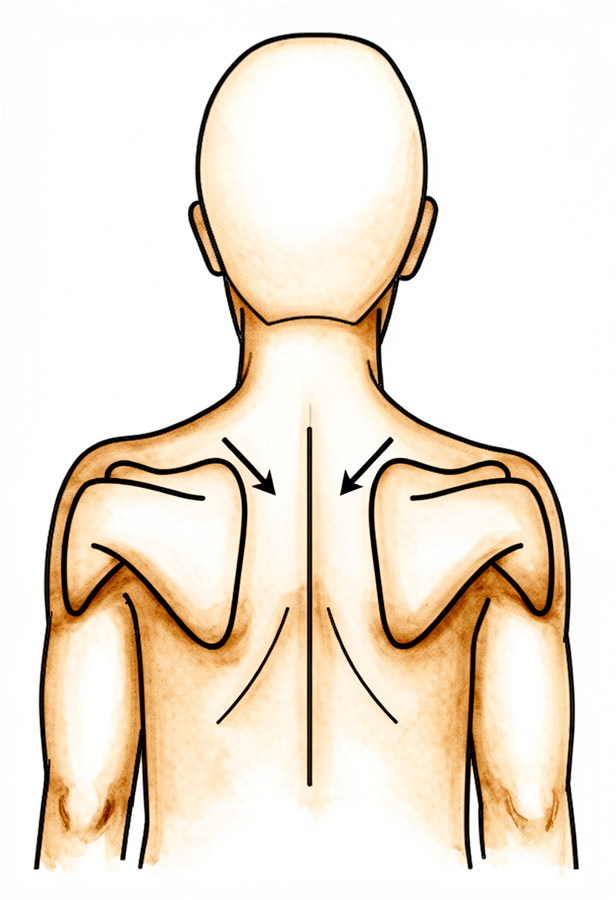
Pag-aayos ng scapula
Habang nakaupo o nakatayo nang tuwid, dahan-dahang hilahin ang iyong mga shoulder blade pababa at pabalik nang magkasama nang hindi ginagalaw ang mga braso, panatilihin ito nang ilang segundo, pagkatapos ay i-relax. Panatilihing magkahanay ang iyong mga tainga, balikat, at balakang.
10 beses, 2–3 beses sa isang araw
Kieran Hirpara 4.0
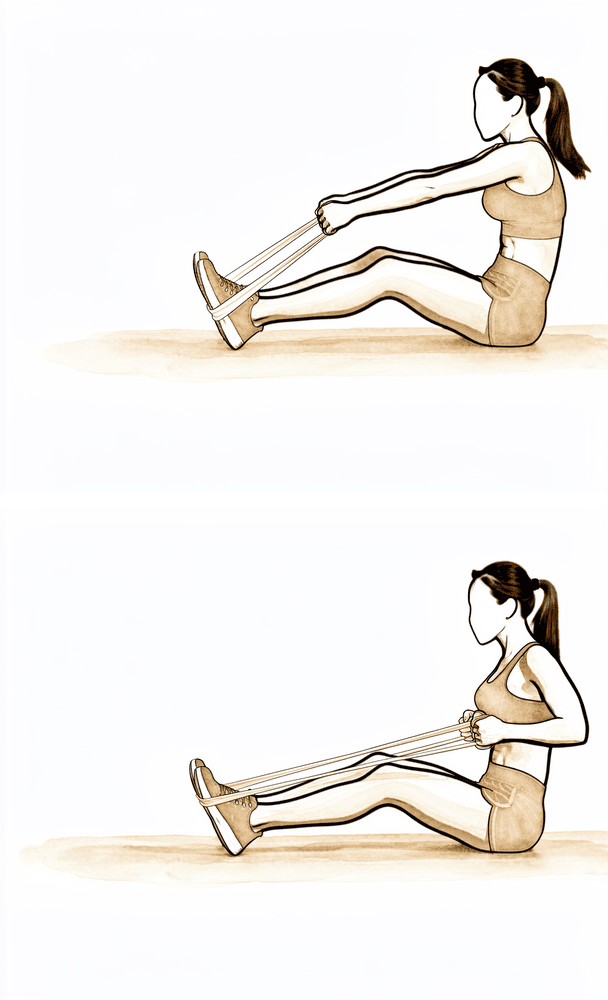
Low row (pag-aayos ng shoulder-blade)
Umupo nang tuwid na ang braso ay mababa at nasa harap mo, dahan-dahang hilahin ang siko pababa at pabalik upang i-set ang shoulder blade, hawakan nang sandali, pagkatapos ay i-relax. Panatilihing mababa ang braso kaysa sa taas ng balikat — pinapagana nito ang mga kalamnan sa paligid ng shoulder blade nang hindi binibigatan ang dibdib.
10 beses, 2–3 beses sa isang araw
Kieran Hirpara 4.0
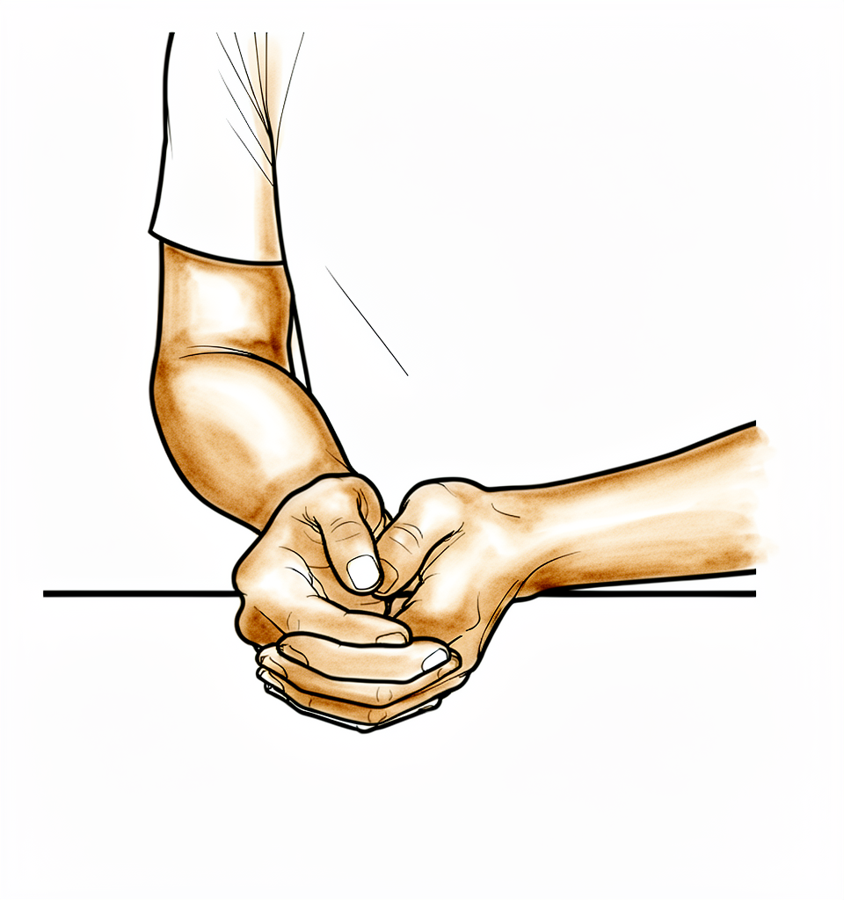
External rotation hanggang neutral
Habang nakabaluktot ang siko sa 90 degrees at nakadikit sa iyong tagiliran, dahan-dahang i-rotate ang forearm mula sa nakapatong sa iyong tiyan hanggang sa nakaturo ito nang diretso sa harap (ang neutral position — 0 degrees), pagkatapos ay ibalik ito. Sa mga unang linggo, huminto sa neutral; lumampas lamang palabas ayon sa maliit na halagang itatakda ng iyong physiotherapist bawat linggo. Huwag ilabas ang braso sa gilid.
Ayon sa gabay ng iyong physiotherapist
Kieran Hirpara 4.0
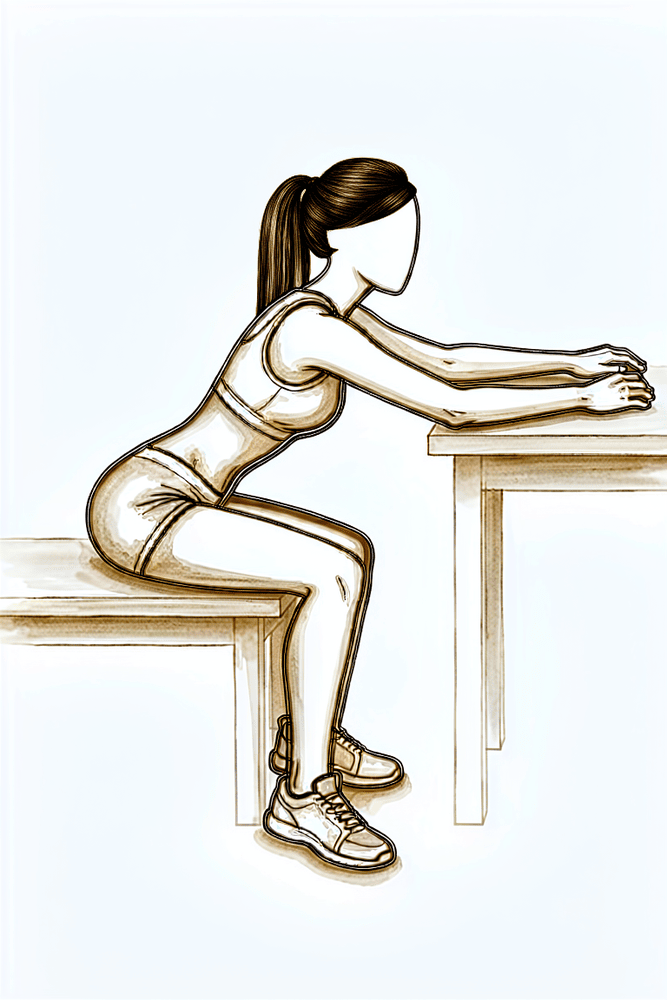
Flexion sa mesa (table slide)
Umupo sa isang mesa na nakapatong dito ang iyong forearm. Dahan-dahang humilig pasulong upang dumulas ang iyong kamay sa mesa, hayaang ang mesa ang pumasan sa bigat ng braso, pagkatapos ay bumalik sa pag-upo nang tuwid. Manatili sa limitasyong itinakda ng iyong physiotherapist — ang braso ay nasa harap ng iyong katawan, mas mababa sa taas ng balikat — at huwag pilitin o i-stretch.
Ayon sa gabay ng iyong physiotherapist
Ito ay mga banayad na ehersisyo para sa maagang yugto (proteksyon), na magsisimula sa ward at ipagpapatuloy sa bahay, na ginagawa habang ang iyong inoperahang braso ay nananatili sa harap ng iyong katawan at ang mga kalamnan ng iyong balikat ay relaks. Simulan ang mga ito ayon sa gabay ng iyong physiotherapist, at itigil ang anumang nagdudulot ng matalas na sakit sa balikat. Tandaan ang mga maagang panuntunan: wala pang pendulum o stick exercises, at huwag kailanman ilalabas ang braso sa gilid at iikot ito palabas nang sabay.
Pagkatapos ng iyong protocol
Ang protocol na ito ay kasabay ng pangkalahatang payo sa paggaling ng klinika: tingnan ang pamamahala ng sakit pagkatapos ng operasyon at pag-aalaga ng sugat.
Evidence & references
This is the clinical evidence summary written for health professionals. It is technical, and it lists the research this page was built from. You do not need to read it to understand your treatment or to make a decision about it.
Pectoralis Major Tendon Repair -- Post-operative Rehabilitation
Topic scope: Rehabilitation after surgical repair of a pectoralis major (PM) tendon rupture/tear (typically a humeral-insertion avulsion in a 20-40 yr-old male, classically during the eccentric phase of a bench press). Covers protected positioning, the early restrictions on abduction (ABD) and external rotation (ER), ROM progression, when active ROM and strengthening start, and return to heavy lifting / bench press / sport.
Defining principle (contrast with frozen-shoulder release): PM repair rehab is a classic protect-the-repair protocol -- the OPPOSITE of frozen-shoulder release. The repaired tendon runs anteriorly to its humeral insertion; abduction and external rotation stretch/tension the repair, so both are strictly limited early and the arm is held in adduction + internal rotation in a sling/immobiliser. Progression is deliberately slow, and heavy resisted pec loading (bench press, flyes, dips, contact sport) is delayed to ~4-6 months to avoid re-rupture.
A key modifier throughout: repair type dictates the timeline. Bone-tendon repairs (suture anchors/cortical buttons into humerus) heal slower than tendon-tendon or muscle-tendon repairs and wean from the sling later (MGH protocol).
CONSENSUS PHASED TIMELINE
Synthesised from the Mass General Brigham (MGH) Sports Medicine protocol (rev. 7/2023, the most granular degree-by-degree protocol) and the University Orthopedics protocol, cross-checked against the published literature (Cordasco/HSS 2017; Manske & Prohaska 2007; Schepsis 2000; Haley/Zacchilli 2014). Both published protocols agree on the core structure; the ROM numbers below are the MGH degree targets.
| Phase | Window | Sling / position | ROM allowed + RESTRICTIONS | Active ROM | Strengthening | RTS / lifting |
|---|---|---|---|---|---|---|
| I -- Immediate | 0-3 wk (UnivOrtho: 0-2 wk) | Sling/immobiliser, arm in NEUTRAL or INTERNAL ROTATION, worn day & night | PROM only, started ~week 2. ER limited: start at 0 deg in adduction, progress ~5 deg/week. Flexion start 45 deg, +5-10 deg/wk. ABD start 30 deg, +5 deg/wk. Elbow/wrist/hand AROM free. No active shoulder motion; no ER beyond limit; no abduction/extension stretch | None at shoulder (distal joints only) | Wk 3: periscapular only (inferior glide <35 deg ABD, low row), ball squeeze. No pec loading | None |
| II -- Intermediate | 4-6 wk | Begin weaning sling: bone-tendon at 4 wk; tendon-tendon / muscle-tendon at 5-6 wk (UnivOrtho: immobiliser to 6 wk for all) | PROM continues (ER +5 deg/wk; flex +5-10 deg/wk to ~65-85 deg; ABD +5 deg/wk to ~50 deg). Begin AAROM (cane flexion, cane ER stretch, washcloth press). Still no aggressive ER/ABD past targets | AAROM introduced | Submaximal isometrics: ABD, extension, ER -- explicitly NO IR isometrics (IR/adduction tension the pec); periscapular setting | None |
| III -- Late | 6-8 wk | Sling discontinued | PROM continue to full (ER, flex, ABD each +5 deg/wk to full). Initiate AROM (supine flexion, salutes, supine punch). Can begin weight-bearing through arm | Active ROM starts ~6 wk | Sidelying ER, periscapular rows/extension, biceps/triceps; rhythmic stabilisation; sleeper/cross-body stretch | None |
| IV -- Transitional | 9-14 wk | None | Restore full PROM/AROM (full by wk 12-14 for bone-tendon) | Full | Initiate shoulder IR isometrics + pec major isometrics (~week 9) -- shortened position first, then lengthened; ER w/ band, ABD; PNF D1/D2 | None |
| V -- Advanced strengthening | 14-20 wk (~3.5-5 mo) | None | Full | Full | Pectoralis isotonics begin; IR w/ band, counter push-ups -> push-ups, lat pulldowns; doorway pec stretch gentle | Begin sport-specific prep |
| VI -- Early return to sport | 5-6 months | None | Full | Full | ER/IR at 90 deg, plyometrics (med-ball chest pass, ball drops, 90/90 throws) | Begin return-to-sport program when criteria met |
| VII -- Unrestricted RTS | 6+ months | None | Full | Full | Bench press resumed at 50% 1-RM, progress slowly with physician; full return to strenuous work, recreation, contact sport NOT before 6 months | Heavy lifting / bench press / contact sport: 6+ months, criterion-based |
Key numeric consensus points
- Sling: ~4-6 weeks (4 wk bone-tendon may wean earlier; 6 wk common; UnivOrtho keeps immobiliser a full 6 wk), arm in adduction/internal rotation.
- ER early limit: 0 deg at the side, advance ~5 deg/week -- because ER tensions the anterior repair.
- ABD/flexion early limit: ABD ~30 deg and flexion ~45 deg initially, advancing ~5-10 deg/week.
- Active ROM: ~6 weeks.
- Isometrics: scapular wk 3; submaximal shoulder (ABD/ext/ER, no IR) wk 4-6; pec/IR isometrics ~wk 9 (Phase IV).
- Pec isotonics / push-ups: ~14 weeks (Phase V).
- Bench press / heavy lifting / contact sport: deferred to ~4-6 months (MGH: 50% 1-RM bench at 6+ mo; UnivOrtho: light bench from ~4 mo with very light resistance, no contact until 6 mo).
The rationale for restricting ER and ABD is biomechanical: the PM is a strong adductor, internal rotator and flexor; abduction + external rotation is the position of maximal stretch on the anterior insertion (this is the injuring mechanism -- eccentric load in abduction/ER, e.g. bench press), so it maximally tensions the repair (Maier 2021; Schepsis 2000; Provencher 2010). Biomechanical work shows transosseous sutures, suture anchors and cortical buttons confer similar repair strength, and early activity should stay below identified failure loads until soft-tissue- to-bone healing is reliable (Sherman 2012; Edgar 2017) -- the biomechanical basis for the slow progression.
OUTCOMES / RETURN TO SPORT EVIDENCE
- Surgical > non-operative for restoring strength/function: objective strength testing shows repair recovers significantly more peak torque and work than conservative care (Hanna 2001 -- comparative cohort); literature "strongly supports early operative treatment" of complete tears in active patients/athletes (Kircher 2010 review; Schepsis 2000). Acute repair > chronic/delayed repair (Schepsis 2000).
- Return to sport in repaired athletes is generally good, with most returning by ~6 months to a year; Cordasco (HSS, 2017, n=40 acutely repaired athletes) reported high RTS and functional scores with low re-operation. Faster individual returns (5-7 mo) are reported in single cases but 6 months is the consensus floor for heavy/contact loading.
KEY CONTROVERSIES / VARIABLES
- Sling duration & wean point. 4 wk vs 6 wk; MGH ties it to repair type (bone-tendon later); UnivOrtho fixes 6 wk for all. No RCT defines the optimum. Weak/consensus.
- How fast to advance ER/ABD. ~5 deg/week is widely used but arbitrary; tissue quality, tear size and fixation method modify it -- larger tears / poor tissue / chronic repairs progress slower. Expert opinion.
- Repair construct. Cortical button vs suture anchor vs transosseous -- biomechanically similar (Sherman 2012; Edgar 2017), so construct should not, in principle, change the rehab timeline, but surgeons individualise. Strong biomechanical, weak clinical.
- RTS timing for bench press / contact sport. Range 4-6 months across protocols; no high-level evidence sets the safe threshold -- driven by re-rupture fear and biomechanical failure-load data, not RCTs. Weak/consensus.
- Acute vs chronic / augmentation. Chronic or retracted tears may need allograft or autograft (semitendinosus) augmentation and a more conservative timeline (Neumann 2018 dermal allograft: 6 wk full immobilisation then 4-phase PT from wk 6; Garofo 2025 semitendinosus technique). Weak (technique notes/small series).
- Overall evidence base. Almost entirely retrospective cohorts, technique notes and biomechanical studies -- no RCTs of one rehab protocol vs another for PM repair. The whole timeline is consensus/expert, anchored by biomechanical failure-load data. Flag: WEAK.
EVIDENCE STRENGTH FLAGS (summary)
- STRONG: biomechanical failure-load / repair-construct comparisons (Sherman 2012; Edgar 2017 -- cadaveric, controlled) -- these justify the load restrictions.
- MODERATE: surgical vs conservative superiority (Hanna 2001 comparative; Schepsis 2000; Cordasco 2017 n=40 outcome series; Campbell's / Pochini 2014 prospective 60-case series).
- WEAK / CONSENSUS ONLY: every specific rehab parameter -- sling duration, ER/ABD degree-per- week limits, AROM/strengthening start weeks, 4-6 month RTS/bench-press timing. Derived from institutional PT protocols (MGH, University Orthopedics) and narrative reviews (Manske/Prohaska 2007; Haley/Zacchilli 2014; Maier 2021), not RCTs.
CITATIONS
RAG corpus (180,000+ Orthopaedic articles)
- Cordasco FA, Mahony GT, Tsouris N, et al. Pectoralis major tendon tears: functional outcomes and return to sport in a consecutive series of 40 athletes. J Shoulder Elbow Surg. 2017;26(3):458-463.
- Kang RW, Mahony GT, Cordasco FA. Pectoralis major repair with cortical button technique. Arthroscopy Techniques. 2014.
- Haley CA, Zacchilli MA. Pectoralis major injuries. Clin Sports Med. 2014.
- Schepsis AA, Grafe MW, Jones HP, et al. Rupture of the pectoralis major muscle. Am J Sports Med. 2000;28(1):9-15.
- Sherman SL, Lin EC, Verma NN, et al. Biomechanical analysis of the pectoralis major tendon and comparison of techniques for tendo-osseous repair. Am J Sports Med. 2012.
- Hanna CM, Glenny AB, Stanley SN, et al. Pectoralis major tears: comparison of surgical and conservative treatment. Br J Sports Med. 2001.
- Kircher J. Surgical and nonsurgical treatment of total rupture of the pectoralis major muscle in athletes: update and critical appraisal. Open Access J Sports Med. 2010.
- Maier J, Oak SR, Soloff L, et al. Management of common upper extremity injuries in throwing athletes: a critical review of current outcomes. JSES Rev Rep Tech. 2021;1(4).
- Neumann JA, Klein CM, van Eck CF, et al. Outcomes after dermal allograft reconstruction of chronic or subacute pectoralis major tendon ruptures. Orthop J Sports Med. 2018. (6 wk full immobilisation; PT from wk 6, 4 phases)
- Garofo AGP, Medina G, Schor B. Acute pectoralis major tendon tear reconstruction with semitendinosus augmentation: a technique note. JSES Rev Rep Tech. 2025;5(4).
- Azar FM, Canale ST, Beaty JH. Campbell's Operative Orthopaedics (cites Pochini 2014 prospective 60-case series; Edgar 2017 repair-configuration biomechanics; ElMaraghy classification). 2020.
- (Provencher MT, Handfield K, Boniquit NT, et al. Injuries to the pectoralis major muscle: diagnosis and management. Am J Sports Med. 2010;38(8):1693-1705 -- cited within MGH protocol.)
- (Manske RC, Prohaska D. Pectoralis major tendon repair post-surgical rehabilitation. N Am J Sports Phys Ther. 2007;2(1):22-33 -- cited within MGH protocol.)
Published rehab protocols (URLs)
- Mass General Brigham (MGH) Sports Medicine -- Rehabilitation Protocol for Pectoralis Major Repair (rev. 7/2023): https://www.massgeneral.org/assets/MGH/pdf/orthopaedics/sports-medicine/physical-therapy/rehabilitation-protocol-for-pectoralis-major-repair.pdf (source for the degree-by-degree ER 0 deg +5/wk, flex 45 deg, ABD 30 deg limits; sling neutral/IR; bone-tendon vs tendon-tendon wean; pec isometrics wk 9, pec isotonics wk 14; bench 50% 1-RM at 6+ mo).
- University Orthopedics, Inc. -- Pectoralis Major Repair Rehabilitation Protocol: https://universityorthopedics.com/assets/shoulder/PECTORALIS-MAJOR-REPAIR.pdf (immobiliser x6 wk; AROM ~6 wk; phased push-up progression; light bench from ~4 mo; no contact sport until 6 mo).
- Additional concordant institutional protocols: Melbourne Orthopaedic Group https://mgorthopaedics.com.au/wp-content/uploads/2021/04/PECTORALIS-MAJOR-REPAIR-PROTOCOL.pdf ; Summit Orthopedics https://www.summitortho.com/wp-content/uploads/2022/08/6575_SURGICAL-Pect-Major-Repair-Protocol_6.22_MB.pdf