Patients › Rehabilitation
Dupuytren's Release
Rehabilitation after Dupuytren's fasciectomy — the extension splint regime and exercise program, with hand-therapist follow-up.
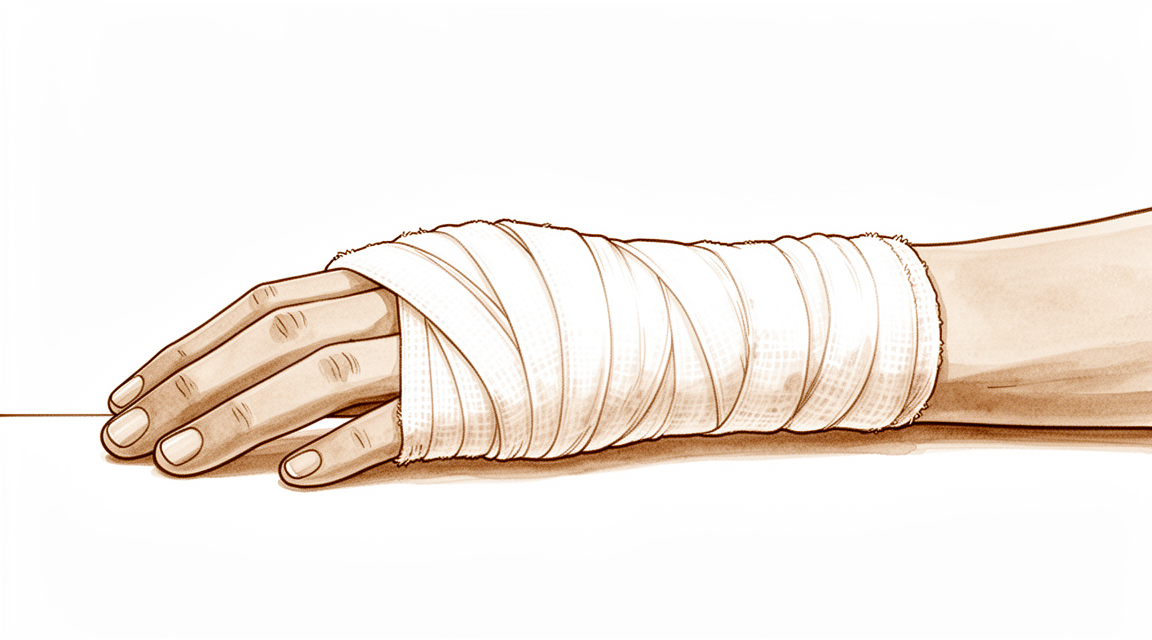
Ang protocol na ito ay nagsisilbing gabay sa iyong paggaling pagkatapos ng surgical release ng Dupuytren's contracture (fasciectomy) kasama si Dr Kieran Hirpara sa Mater Private Hospital Rockhampton. Ang dalawang haligi ng isang magandang resulta ay ang splint, na nagpapanatiling diretso sa mga pinalayang daliri habang naghihilom ang lahat, at ang exercise program, na nagpapanatili sa paggalaw ng mga ito. Dalhin ang pahinang ito o ang PDF nito sa iyong hand therapist upang manatiling coordinated ang iyong rehabilitasyon.
Kung mayroon kang anumang alalahanin tungkol sa iyong sugat pagkatapos ng operasyon, makipag-ugnayan sa mga rooms. Madalas na nakatutulong ang pagkuha ng larawan ng sugat at pag-email nito para masuri.
Ano ang dapat asahan¶
Ang operasyon para sa sakit na Dupuytren ay nag-aalis ng mga may sakit na cords ng tissue na humihila sa iyong mga daliri papunta sa palad, upang maibalik ang kakayahang ituwid ang mga ito. Ang kondisyon mismo ay ipinaliwanag sa pahina ng Dupuytren's disease; walang permanenteng lunas, at ang layunin ng operasyon ay excise ang may sakit na tissue at ibalik ang extension ng daliri.
Karaniwan kang irerefer sa isang hand therapist 2–3 araw pagkatapos ng operasyon. Gagawa ang therapist ng isang custom plastic splint na humahawak sa mga inoperahang daliri sa isang extended (tuwid) na posisyon, at pasisimulan ka sa banayad na programa ng ehersisyo sa ibaba. Ang splint at ang mga ehersisyo ay nagtutulungan: pinoprotektahan ng splint ang pagiging tuwid na nakamit ng operasyon, at pinapanatili ng mga ehersisyo ang pagbaluktot ng mga daliri upang hindi sila tumigas.
Panatilihing malinis at tuyo ang sugat hanggang sa matanggal ang iyong mga sutures. Kapag wala na ang mga sutures, maaari mo nang basain ang balat, ngunit iwasan ang pagbababad o paglubog ng kamay sa tubig sa loob ng isa pang linggo. Ang pahina ng wound care ng klinika ay sumasaklaw sa mga dressing, mga palatandaan ng impeksyon, at pag-aalaga sa peklat nang detalyado. Mahalaga ang scar massage pagkatapos ng operasyon sa Dupuytren, at gagabayan ito ng iyong therapist kapag gumaling na ang sugat.
Pag-aalaga sa iyong peklat¶
Ang peklat sa palad ay madalas na matigas, nakaumbok, at maselan sa unang mga linggo pagkatapos ng operasyon sa Dupuytren bago ito unti-unting lumambot at maglaho sa mga sumunod na buwan. Ang masahe sa peklat ay isang rutin na bahagi ng pangangalaga sa hand-therapy sa Australia: sa isang pambansang survey ng mga akreditadong hand therapist, halos lahat ay gumagamit nito pagkatapos ng operasyon sa kamay (karaniwang nagsisimula sa paligid ng pagtanggal ng tahi, kapag ang sugat ay ganap nang gumaling) upang palambutin ang peklat, pagbutihin ang pagdausdos ng balat sa mga tisyu sa ilalim nito, at pakalmahin ang pagiging sensitibo ng peklat, na karaniwang isinasama sa silicone gel o sheeting sa halip na gamitin nang mag-isa [6]. Ang mga ebidensya mula sa pananaliksik sa likod ng masahe sa peklat ay kasalukuyan pa ring nabubuo, ngunit sinusuportahan nito ang paggamit nito para mabawasan ang discomfort na may kaugnayan sa peklat at mapabuti ang paggalaw [6]. Ipapakita sa iyo ng iyong therapist ang teknika at maaaring magdagdag ng produktong silicone, na madalas na isinusuot sa gabi kasabay ng splint.
Paggaling, trabaho at ang pangmatagalan¶
Ang pamamaga at paninigas ay normal sa mga unang linggo at humuhupa habang ginagamit ang kamay; ang ginhawa, paggalaw at pagkakahawak ay karaniwang patuloy na bumubuti sa loob ng ilang buwan. Ang pagpapanatiling nakataas ng kamay at dahan-dahang paggalaw sa mga unang linggong iyon ay nakatutulong upang humupa ang pamamaga at nagpoprotekta laban sa paninigas ng maliliit na kasukasuan. Ang pagkatuwid na nakamit sa operasyon ay karaniwang napapanatili nang maayos sa panahong ito. Sa isang randomised trial ng rehabilitasyon pagkatapos ng Dupuytren's release, karamihan sa mga dinaluhong daliri ay napanatili o bumuti ang kanilang extension sa unang tatlong buwan ng hand therapy [2].
Ang oras ng pagliban sa trabaho ay depende sa kung ano ang ginagawa mo gamit ang iyong mga kamay. Sa isang pag-aaral sa higit 2,500 katao na ginamot para sa Dupuytren's disease, ang median na pagbabalik sa trabaho pagkatapos ng open fasciectomy ay humigit-kumulang dalawang linggo, at mga siyam sa sampung tao ang nakabalik sa trabaho sa loob ng isang taon; ang mga trabahong pisikal na mabigat ay mas matagal [4]. Tatalakayin ni Dr Hirpara ang timing para sa iyong partikular na trabaho sa review; ang mas mabigat na manual work ay karaniwang hinihintay hanggang sa ang sugat ay maayos nang gumaling at ang pagkakahawak ay komportable na.
Dahil ang Dupuytren's ay isang lifelong condition, maaaring bumalik ang ilang paninigas sa paglipas ng mga taon, at ang mga naiulat na recurrence rates ay malawak na nag-iiba sa pagitan ng mga pag-aaral depende sa kung paano binibigyang-kahulugan ang recurrence. Ang pangmatagalang sitwasyon ay karaniwang nakakaasa: sa isang follow-up ng 142 fasciectomies sa loob ng humigit-kumulang apat na taon gamit ang modern consensus definition, ang tunay na recurrence ng contracture ay nangyari sa humigit-kumulang 3–4% ng mga kamay, bagaman ang halos isang katlo ay nagpanatili ng ilang residual curvature, na karaniwang mild at malayo sa contracture na itinama sa operasyon [5]. Ang splint, pag-aalaga sa peklat at exercise program ay pawang naglalayong protektahan ang iyong resulta; kung ang isang daliri ay magsimulang sumikip muli sa anumang punto, ipaalam sa mga rooms.
Ang iyong splint¶
- Unang linggo o higit pa: isuot ang splint araw at gabi, tatanggalin lamang ito para sa iyong mga ehersisyo (at paghuhugas, kapag pinayagan na).
- Pagkatapos ng unang linggo: karamihan ng mga tao ay lilipat sa pagsuot ng splint sa gabi lamang, at maaaring magsimulang gamitin ang kamay para sa magaan na aktibidad sa araw.
- Ang pag-splint sa gabi ay magpapatuloy sa loob ng humigit-kumulang 3 buwan (at sa ilang mga kaso hanggang 6 na buwan) upang maprotektahan laban sa pag-drift ng mga daliri pabalik sa palad habang nag-ma-mature ang mga tissue.
- Ang iyong hand therapist at si Dr Hirpara ang magpapayo sa iyo nang partikular tungkol sa iyong iskedyul ng pagsuot ng splint at aktibidad. Ang mga oras sa itaas ay ang karaniwang pattern, hindi isang permanenteng panuntunan.
Hindi ka dapat magmaneho habang ang iyong kamay ay nasa splint. Kapag lumipat ka na sa pagsuot sa gabi lamang, maaaring ituloy ang pagmamaneho sa araw depende sa iyong komportable at ligtas na pagkakahawak sa manibela.
Para sa iyong physiotherapist / hand therapist:
Pamamahala (Management)
- Referral 2–3 araw post-operatively para sa paggawa ng isang thermoplastic extension splint
- Splint regime: araw at gabi sa loob ng humigit-kumulang unang linggo (tanggal para sa mga ehersisyo), pagkatapos ay gabi lamang na may magaan na functional day use; ang pag-splint sa gabi ay ipagpapatuloy sa loob ng humigit-kumulang 3 buwan (hanggang 6 na buwan kung kinakailangan), ayon sa review ng surgeon/therapist
- Home exercise program ayon sa mga card sa ibaba: active extension, blocked DIP flexion, DIP/PIP flexion sa ibabaw ng panulat, composite flexion, wrist tenodesis
- Pag-aalaga ng sugat ayon sa wound care guidance ng practice; pamamahala ng peklat kapag magaling na
- Ang mga repetisyon at araw-araw na dalas ay itatakda ng treating therapist
Mga Pag-iingat (Precautions)
- Panatilihing malinis at tuyo ang sugat hanggang sa pagtanggal ng tahi; bawal ang pagbababad/paglubog sa tubig sa loob ng isa pang linggo pagkatapos nito
- Ang pagsunod sa paggamit ng splint ay sentro sa pagpapanatili ng extension na nakuha sa operasyon
- Bawal magmaneho habang ang kamay ay nasa splint
Ito ang mga ehersisyo mula sa iyong handout, na sinimulan kasama ang iyong hand therapist at ipinagpapatuloy sa bahay.
Iyong mga ehersisyo¶
Kieran Hirpara 4.0
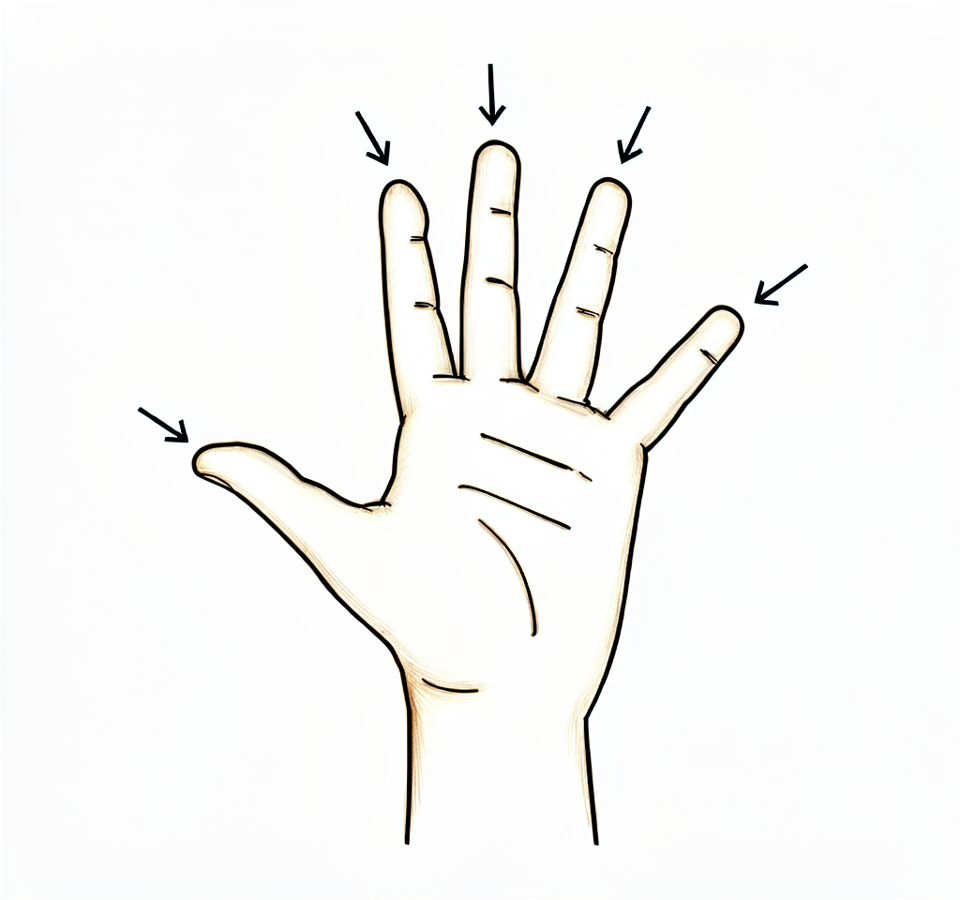
Aktibong ekstensyon
Habang diretso ang iyong pulso, ituwid at ibuka ang iyong mga daliri hangga't kaya mo. Maaari mong tulungan nang dahan-dahan gamit ang iyong kabilang kamay. Mag-relax at ulitin.
Ayon sa inireseta ng iyong hand therapist
Kieran Hirpara 4.0
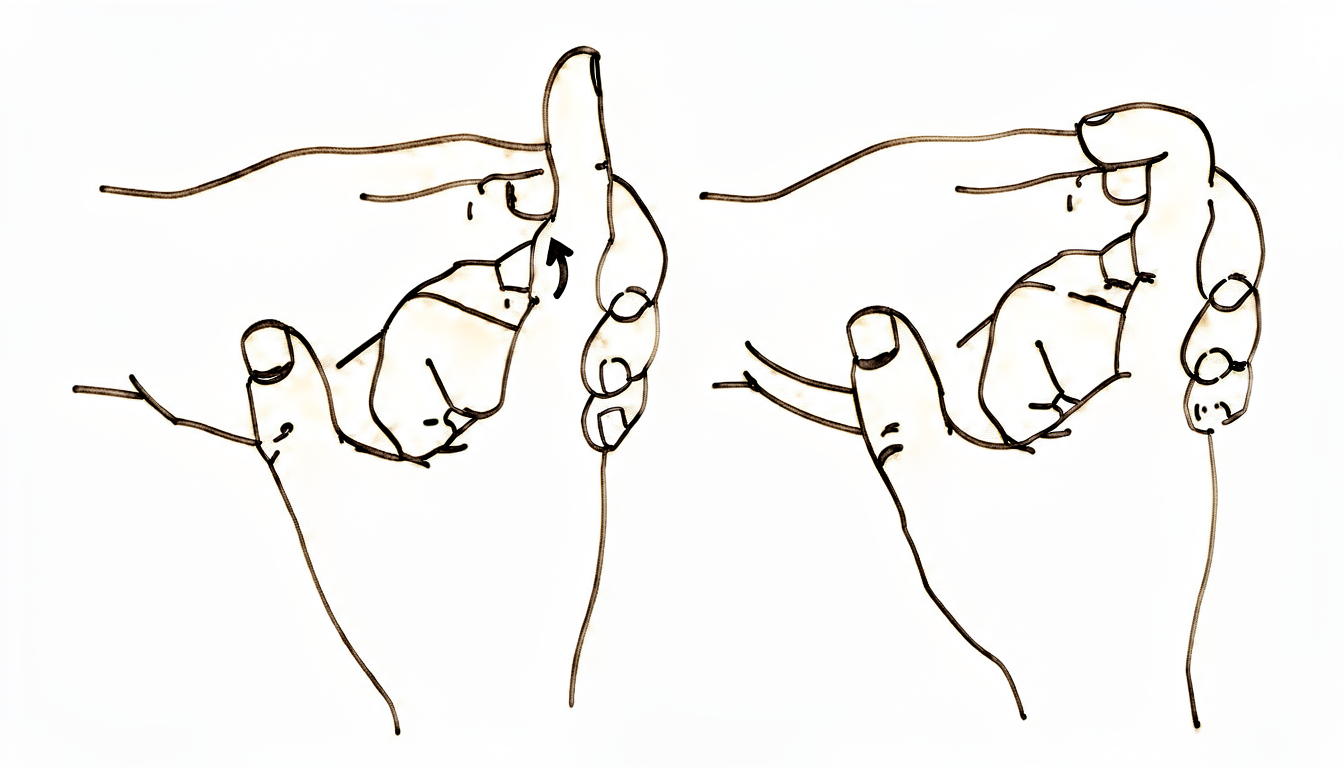
Aktibong flexion ng DIP
Suportahan ang daliri sa mismong ibaba ng tupi ng dulo (DIP) joint gamit ang iyong kabilang kamay. Itiklop nang matatag ang dulo ng joint, pagkatapos ay i-relax.
Ayon sa inireseta ng iyong hand therapist
Kieran Hirpara 4.0
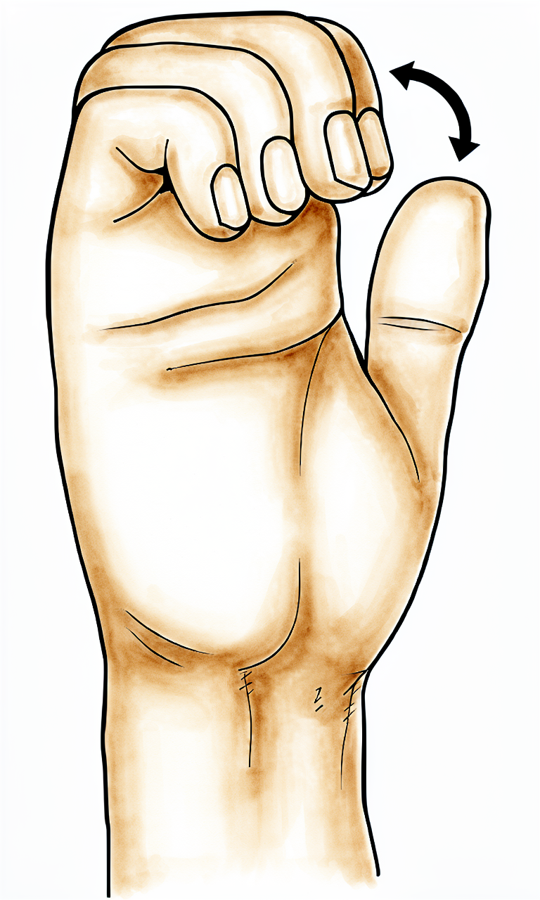
Aktibong flexion ng DIP/PIP
Maglagay ng panulat sa base ng iyong mga daliri. I-curl ang iyong mga daliri sa paligid ng panulat upang ang dalawang joint ng daliri (ang gitna at dulo na mga joint) ay mabaluktot, pagkatapos ay i-relax.
Ayon sa inireseta ng iyong hand therapist
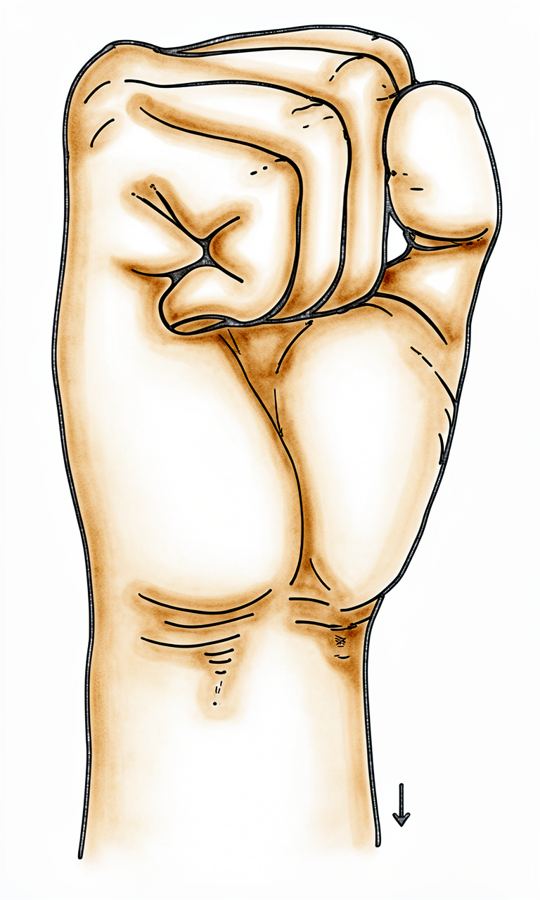
Kieran Hirpara 4.0
Composite flexion
Dahan-dahang itikom ang kamay nang maluwag, pagkatapos ay i-relax at hayaang maituwid ang mga daliri.
Ayon sa inireseta ng iyong hand therapist
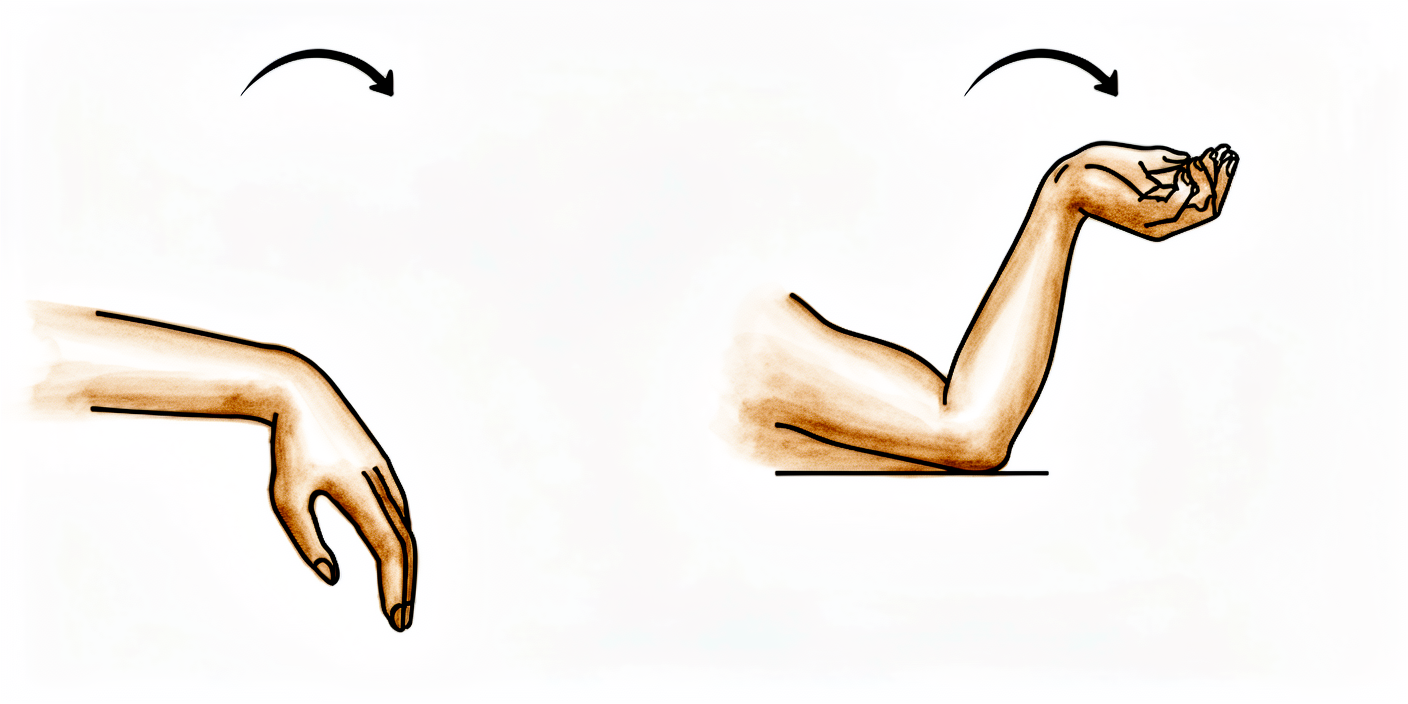
Kieran Hirpara 4.0
Tenodesis ng pulso
Habang nakasandal ang iyong siko at nakarelaks ang iyong mga daliri, itiklop ang iyong pulso pasulong at pagkatapos ay pabalik, hayaang sumunod ang mga daliri nang natural.
Ayon sa inireseta ng iyong hand therapist
Simulan lamang ang mga ehersisyo sa ibaba ayon sa gabay ni Dr Hirpara at ng iyong hand therapist, at manatili sa anumang range at limitasyong ibinigay sa iyo. Ang pagtutuwid ang pangunahing layunin ng operasyong ito, kaya ang active extension ang prayoridad na ehersisyo — hihila ang mga daliri pabalik sa nakabaluktot na posisyon kung hahayaan mo, at ang range na mapapanatili mo ay ang range na iyong magagamit. Mahalaga rin ang mga ehersisyo sa pagbaluktot (DIP, DIP/PIP at composite flexion), dahil ang daliring tumutuwid lamang ay hindi mas kapaki-pakinabang kaysa sa isang daliring bumabaluktot lamang. Ang wrist tenodesis ang nag-uugnay sa dalawa. Isuot ang iyong night splint ayon sa itinuro. Itigil ang anumang nagdudulot ng matalas na sakit, at sabihan ang iyong therapist kung ang isang daliri ay nagsisimulang mawalan ng extension.
Pagkatapos ng iyong protocol¶
Ang protocol na ito ay isinulat sa pakikipagtulungan kay Ruby Doolan, Accredited Hand Therapist, Extend Rehabilitation. Gumagana ito kasabay ng pangkalahatang payo sa paggaling ng klinika: tingnan ang pamamahala ng post-operative pain, pag-aalaga ng sugat at mga pangunahing kaalaman sa hand therapy. Para sa operasyon mismo, tingnan ang Dupuytren's fasciectomy.
Ang mga inaasahan sa paggaling, mga pigura sa pagbabalik-trabaho at gabay sa pag-aalaga ng peklat sa itaas ay hango sa mga nailathalang trial, review at survey ng rehabilitasyon pagkatapos ng Dupuytren's surgery, kabilang ang mga randomised trial at isang systematic review ng splinting at hand therapy pagkatapos ng fasciectomy [1–3]. Ang splint regime at programa sa ehersisyo ay pagmamay-ari ng klinika, na pinagkasunduan nina Dr Hirpara at ng iyong hand therapist, at ang iyong iskedyul sa pagsuot ng splint ay ginagawang indibidwal sa iyong mga review.
Mga Sanggunian¶
[1] Jerosch-Herold C, Shepstone L, Chojnowski AJ, Larson D, Barrett E, Vaughan SP. Night-time splinting after fasciectomy or dermo-fasciectomy for Dupuytren's contracture: a pragmatic, multi-centre, randomised controlled trial. BMC Musculoskeletal Disorders. 2011;12:136. https://pmc.ncbi.nlm.nih.gov/articles/PMC3146906/ [2] Collis J, Collocott S, Hing W, Kelly E. The effect of night extension orthoses following surgical release of Dupuytren contracture: a single-center, randomized, controlled trial. Journal of Hand Surgery (American). 2013;38(7):1285–1294.e2. https://doi.org/10.1016/j.jhsa.2013.04.012 [3] Karam M, Kahlar N, Abul A, Rahman S, Pinder R. Comparison of hand therapy with or without splinting postfasciectomy for Dupuytren's contracture: systematic review and meta-analysis. Journal of Hand and Microsurgery. 2022;14(4):308–314. https://pmc.ncbi.nlm.nih.gov/articles/PMC10042625/ [4] Blake SN, Poelstra R, Andrinopoulou ER, et al. Return to work and associated costs after treatment for Dupuytren's disease. Plastic and Reconstructive Surgery. 2021;148(3):580–590. https://pubmed.ncbi.nlm.nih.gov/34292887/ [5] Radhamony NG, Nair RR, Sreenivasan S, et al. Residual deformity versus recurrence following Dupuytren's palmar fasciectomy — a long-term follow-up of 142 cases. Annals of Medicine and Surgery. 2022;73:103224. https://pmc.ncbi.nlm.nih.gov/articles/PMC8767281/ [6] Scott HC, Robinson LS, Brown T. Scar massage as an intervention for post-surgical scars: a practice survey of Australian hand therapists. Hand Therapy. 2024;29(1):21–29. https://pmc.ncbi.nlm.nih.gov/articles/PMC10901164/
Evidence & references
This is the clinical evidence summary written for health professionals. It is technical, and it lists the research this page was built from. You do not need to read it to understand your treatment or to make a decision about it.
Dupuytren Contracture — Surgical Release & Post-operative Hand-Therapy Rehabilitation (Open Fasciectomy)¶
Topic scope: post-operative rehabilitation after open excision of diseased palmar/digital fascia for Dupuytren contracture — limited/regional fasciectomy, extending to dermofasciectomy (fascia plus overlying involved skin, replaced with a graft) for aggressive or recurrent disease. The procedure-selection literature (fasciectomy vs needle aponeurotomy vs collagenase) is summarised only as far as it frames recurrence expectations and rehabilitation; the rehab focus is the post-fasciectomy pathway — early active and passive finger extension and flexion, oedema control, scar management, and night extension splinting.
Defining principle of this rehab: fasciectomy removes diseased tissue and restores extension that the disease had taken away — it does not cure the diathesis, and the corrected finger sits in a tissue bed that wants to contract back. So the rehab is a "regain-and-hold" pathway: early motion to keep the freed joints supple and prevent the new flexor-tendon and skin-glide planes from binding down, oedema and scar control so the soft tissues mature without tethering, and a night extension orthosis to defend the surgical correction during healing. The defining clinical question is not whether a construct needs protection (there is no construct), but how aggressively to splint — and here the evidence has shifted decisively toward selective, not routine, splinting.
A. PROCEDURE OUTCOMES & RECURRENCE (context for the rehab)¶
Open partial (limited) fasciectomy is the long-standing reference operation for Dupuytren contracture and gives the most durable correction of the three mainstream options:
- Correction is reliable and recurrence is the dominant long-term limitation. Across modern series the operation restores extension well, but Dupuytren is a lifelong diathesis and some tightening returns over years. Reported recurrence rates vary enormously because studies define recurrence differently (any palpable disease vs a threshold extension loss vs need for re-intervention). Using the modern consensus definition, true recurrence of contracture is low at medium-term follow-up, though a substantial minority retain mild residual curvature well short of the pre-operative deformity [corpus: jhsa.2012.06.032; literature: Radhamony 2022].
- Fasciectomy vs minimally invasive options. Compared with needle aponeurotomy/fasciotomy and collagenase Clostridium histolyticum, open fasciectomy has a longer recovery and higher minor complication rate but lower recurrence — the recurring trade-off in this disease. Needle and collagenase are quicker with faster return to function but recur sooner [corpus: jhsa.2021.05.022; jhsa.2011.08.004; 1753193418786947]. This trade-off is why fasciectomy is typically chosen for denser, multi-ray or PIP-predominant contractures — the same cases whose rehab is hardest and whose splinting is most likely to be justified.
- Repeat limited fasciectomy for recurrence is safe and effective, supporting fasciectomy as a durable, repeatable mainstay rather than a one-shot procedure [corpus: bjj-2020-1393.r2].
Why this matters for rehab: recovery counselling and splint expectations must be framed against a disease that cannot be cured, only corrected — the rehab protects a correction, it does not prevent the diathesis.
B. THE SPLINTING CONTROVERSY (the central rehab question)¶
Historically, every patient was issued a static night extension orthosis after fasciectomy on the assumption it preserved the correction. The best available evidence does not support routine splinting — it supports selective splinting for patients who lose extension.
- Jerosch-Herold 2011 (pragmatic multi-centre RCT, n = 154). Hand therapy alone vs hand therapy + night splinting after fasciectomy/dermofasciectomy. No between-group difference in self-reported function (DASH), finger range of motion, or satisfaction. Authors concluded routine night splinting for all patients is not recommended, reserving it for cases where extension deficits recur [literature: Jerosch-Herold 2011, BMC Musculoskelet Disord].
- Collis 2013 (single-centre RCT, n = 56). Night extension orthosis + hand therapy vs hand therapy alone after surgical release. No significant difference in total active extension or any secondary outcome at 3 months. Same conclusion: provide an orthosis selectively, when extension loss occurs, not universally [corpus: jhsa.2013.04.012; literature: Collis 2013].
- Karam 2022 (systematic review + meta-analysis, 4 RCTs, n = 295). Pooling the splint-vs-no-splint trials found no significant difference in total active flexion/extension, DASH, pain, grip or satisfaction. The collective signal is consistent and now moderately strong: adding a splint to good hand therapy does not improve the average outcome [corpus: 1055/s-0041-1725221; literature: Karam 2022].
- Earlier/smaller work (e.g., post-fasciectomy splinting pilot studies) pointed the same way — splinting is low-yield as a blanket policy [corpus: 1753193412437631].
Practical reading for this protocol. The practice's pattern — splint day-and-night for ~1 week, then night-only with a low threshold to continue (or reinstate) splinting if a finger starts to drift back into flexion — is a reasonable, evidence-aligned middle path: it defends the correction during the highest-risk early healing window and during sleep, while honouring the trial finding that indefinite routine splinting adds little. The trials measured average outcomes; they do not say splinting is useless for the individual who is losing extension, which is exactly the subgroup the authors carved out. This is a defensible selective-splinting stance, not a contradiction of the protocol.
C. HAND-THERAPY & EXERCISE EVIDENCE¶
- Early supervised hand therapy is the backbone of recovery and is where the demonstrable benefit lies (the splint trials all compared against a hand-therapy baseline, not against nothing). Active and passive extension and flexion, oedema control and scar management are standard from the first post-operative therapy visit, typically 2–3 days after surgery.
- Most operated fingers hold or improve their extension over the first three months of hand therapy — the window in which the protocol concentrates splinting and exercise [corpus: jhsa.2013.04.012, control arm; literature: Collis 2013].
- Scar management. Scar massage is near-universal in hand-therapy practice after Dupuytren surgery to soften the palmar scar, improve skin glide and settle sensitivity, generally combined with silicone gel/sheeting and begun around suture removal once the wound is healed. The supporting evidence is developing rather than definitive but favours reduced scar-related discomfort and improved movement [literature: Scott 2024, Australian hand-therapist survey].
- Return to work. In a large cohort, median return after open fasciectomy was ~2 weeks with ~90% back at work within the year; physically demanding jobs took longer [literature: Blake 2021].
- Pre-operative hand therapy has a thinner evidence base and is not a substitute for the post-operative programme [corpus: 17589983241227162].
Phased rehabilitation timeline (matching the synthesis phases)¶
| Phase | Window | Splint | Movement / use | Scar & oedema | Notes |
|---|---|---|---|---|---|
| I — Protect & mobilise | ~Days 2–7 | Custom thermoplastic extension orthosis day & night, off for exercises | Gentle active extension + active DIP/PIP and composite flexion from the first therapy visit; wrist tenodesis | Oedema control (elevation, gentle movement); wound kept clean & dry | Therapy referral 2–3 days post-op; splint defends the surgical correction during the highest-risk window |
| II — Restore motion | ~Week 1 → 6–8 | Transition to night-only; light functional day use of the hand | Progress active + passive extension and flexion; restore full composite fist and full extension | Scar massage + silicone once wound healed (around suture removal) | Most extension is held or regained through this window; daytime driving resumes once out of the splint and grip is safe |
| III — Strengthen & return | ~Week 6–8 → 3 months | Night-only continues ~3 months (up to ~6 months selectively if extension is being lost) | Grip and functional strengthening; return to heavier manual work as wound is soundly healed and grip comfortable | Ongoing scar maturation over months | Splinting beyond this window is selective, driven by extension loss — not routine (see §B) |
The phase structure and timings are protocol/consensus, agreed between the surgeon and hand therapist; the trials inform the splinting policy within them, not the exact week boundaries.
D. COMPLICATIONS (rehab-relevant)¶
- Flare reaction / early CRPS-spectrum. A proportion of patients develop a post-operative inflammatory "flare" — disproportionate swelling, stiffness, redness and pain — which can progress to complex regional pain syndrome (CRPS type 1). Early recognition, oedema control, gentle continued motion and analgesia matter; CRPS is one of the more feared rehab-derailing complications after hand surgery [corpus: jht.2024.09.002 (Dupuytren CRPS-1 case); hcl.2009.11.001 (CRPS after hand surgery)].
- Digital nerve / vessel injury. The neurovascular bundles are displaced by Dupuytren cords, especially in recurrent disease and at the PIP; injury is a recognised operative risk. New sensory change post-operatively warrants surgeon review [corpus: hansur.2017.07.002 — complications systematic review; 17531934231206317 — surgical complications/adverse events].
- Wound healing, haematoma, infection, stiffness. Open fasciectomy has a higher minor-complication rate than the minimally invasive options; meticulous wound care and early motion mitigate stiffness and tethering [corpus: hansur.2017.07.002].
- Incomplete correction / residual PIP deficit. PIP contractures correct less completely than MCP; residual deficit may persist and is the usual trigger for selective ongoing splinting.
E. KEY CONTROVERSIES / EVIDENCE QUALITY¶
- Routine vs selective splinting — the headline controversy, now reasonably settled toward selective: three RCTs and a meta-analysis show no average benefit from adding a static night orthosis to good hand therapy, with all authors carving out the extension-loss subgroup. The practice's "night-only, low threshold to continue if drifting" approach is consistent with this. Moderate (multiple RCTs + SR/MA).
- Recurrence is definition-dependent — headline recurrence figures are not comparable across studies; the consensus definition gives lower, more credible rates. Counsel against the cure expectation. Moderate.
- Procedure choice frames rehab — fasciectomy trades a longer recovery and more minor complications for lower recurrence than needle/collagenase. The fasciectomy cohort is, by selection, the harder-rehab cohort. Moderate.
- The phase timings are consensus — drawn from surgeon/therapist protocols, not a rehab RCT. The splinting policy within them is trial-informed; the week boundaries are typical, not trial-derived. Weak/consensus.
F. EVIDENCE STRENGTH FLAGS (summary)¶
- MODERATE (multiple RCTs + SR/MA): routine night splinting adds no average benefit over hand therapy alone after fasciectomy — splint selectively for extension loss (Jerosch-Herold 2011; Collis 2013; Karam 2022 meta-analysis of 4 RCTs / 295 patients).
- MODERATE (cohorts / comparative): fasciectomy gives durable correction with lower recurrence but longer recovery and more minor complications than needle aponeurotomy/collagenase; repeat fasciectomy is safe and effective; CRPS and digital-nerve injury are recognised rehab-relevant complications.
- WEAK / CONSENSUS: the post-operative phase structure and timings themselves (surgeon + hand-therapist protocol; no defining rehab RCT). Scar-massage benefit is supportive but the evidence base is still developing.
CITATIONS¶
RAG corpus (180,000+ Orthopaedic articles)¶
- Correction of contracture and recurrence rates of Dupuytren contracture following fasciectomy. J Hand Surg Am. 2012. DOI: 10.1016/j.jhsa.2012.06.032
- Repeat limited fasciectomy is a safe and effective treatment for recurrence of Dupuytren's contracture. Bone Joint J. 2021. DOI: 10.1302/0301-620X.103B5.BJJ-2020-1393.R2
- Limited fasciectomy versus collagenase Clostridium histolyticum for Dupuytren contracture. J Hand Surg Am. 2021. DOI: 10.1016/j.jhsa.2021.05.022
- The efficacy and safety of fasciectomy and fasciotomy for Dupuytren's contracture. J Hand Surg Eur. 2011. DOI: 10.1177/1753193410397971
- Cost-effectiveness of open partial fasciectomy, needle aponeurotomy, and collagenase injection for Dupuytren contracture. J Hand Surg Am. 2011. DOI: 10.1016/j.jhsa.2011.08.004
- Three-year recurrence of Dupuytren's contracture after needle fasciotomy and collagenase injection. J Hand Surg Eur. 2018. DOI: 10.1177/1753193418786947
- The effect of night extension orthoses following surgical release of Dupuytren contracture: a single-centre RCT. J Hand Surg Am. 2013. DOI: 10.1016/j.jhsa.2013.04.012
- Comparison of hand therapy with or without splinting postfasciectomy for Dupuytren's contracture: systematic review and meta-analysis. J Hand Microsurg. 2022. DOI: 10.1055/s-0041-1725221
- Does use of a night extension orthosis improve outcomes in patients with Dupuytren contracture? J Hand Surg Glob Online. 2021. DOI: 10.1016/j.jhsg.2021.05.001
- A pilot study assessing the effectiveness of postoperative splinting after limited fasciectomy. J Hand Surg Eur. 2012. DOI: 10.1177/1753193412437631
- Pre-operative hand therapy management of Dupuytren's disease: a systematic review. Hand Ther. 2024. DOI: 10.1177/17589983241227162
- Current concepts in the management of Dupuytren disease of the hand. J Am Acad Orthop Surg. 2020. DOI: 10.5435/JAAOS-D-20-00190
- Complications after treating Dupuytren's disease: a systematic literature review. Hand Surg Rehabil. 2017. DOI: 10.1016/j.hansur.2017.07.002
- Surgical complications: errors and adverse events (hand surgery). J Hand Surg Eur. 2023. DOI: 10.1177/17531934231206317
- The case of a woman with bilateral Dupuytren's contractures who developed CRPS-1. J Hand Ther. 2024. DOI: 10.1016/j.jht.2024.09.002
- Complex regional pain syndrome after hand surgery. Hand Clin. 2009. DOI: 10.1016/j.hcl.2009.11.001
Splinting & hand-therapy literature (URLs)¶
- Jerosch-Herold C, Shepstone L, Chojnowski AJ, et al. Night-time splinting after fasciectomy or dermo-fasciectomy for Dupuytren's contracture: a pragmatic, multi-centre, randomised controlled trial. BMC Musculoskelet Disord. 2011;12:136. https://pmc.ncbi.nlm.nih.gov/articles/PMC3146906/
- Collis J, Collocott S, Hing W, Kelly E. The effect of night extension orthoses following surgical release of Dupuytren contracture: a single-centre, randomised, controlled trial. J Hand Surg Am. 2013. https://pubmed.ncbi.nlm.nih.gov/23790420/
- Karam M, Kahlar N, Abul A, et al. Comparison of hand therapy with or without splinting postfasciectomy for Dupuytren's contracture: systematic review and meta-analysis. J Hand Microsurg. 2022. https://pmc.ncbi.nlm.nih.gov/articles/PMC10042625/
- Blake SN, Poelstra R, Andrinopoulou ER, et al. Return to work and associated costs after treatment for Dupuytren's disease. Plast Reconstr Surg. 2021. https://pubmed.ncbi.nlm.nih.gov/34292887/
- Radhamony NG, Nair RR, Sreenivasan S, et al. Residual deformity versus recurrence following Dupuytren's palmar fasciectomy — long-term follow-up of 142 cases. Ann Med Surg. 2022. https://pmc.ncbi.nlm.nih.gov/articles/PMC8767281/
- Scott HC, Robinson LS, Brown T. Scar massage as an intervention for post-surgical scars: a practice survey of Australian hand therapists. Hand Ther. 2024. https://pmc.ncbi.nlm.nih.gov/articles/PMC10901164/
Society guidance & published rehab protocols¶
- The British Society for Surgery of the Hand (BSSH) — Dupuytren's disease patient and professional guidance. https://www.bssh.ac.uk/patients/conditions/25/dupuytrens_disease
- BSSH — Assessing the outcome of surgery for Dupuytren's disease of the hand. https://www.bssh.ac.uk/assessing_the_outcome_of_surgery_for_dupuytrens_disease_of_the_hand.aspx